
DEGRADATION OF Al4C3 IN Al Mg Si/SiCP COMPOSITES EXPOSED TO MOIST ENVIRONMENTS
9
0
0
Texto completo
(2) XIX INTERNATIONAL CONFERENCE ON EXTRACTIVE METALLURY Recent Developments in Metallurgy, Materials and Environment. DEGRADATION OF Al4C3 IN Al-Mg-Si/SiCP COMPOSITES EXPOSED TO MOIST ENVIRONMENTS M. RODRÍGUEZ-REYES1*, D. VÁZQUEZ-OBREGÓN1, J.E.PÉREZTERRAZAS1, M.I. PECH-CANUL2, J.A. AGUILAR-MARTÍNEZ3, H.F. LÓPEZ4 1. Instituto Tecnológico de Saltillo, Venustiano Carranza 2400, Col. Tecnológico C.P. 25280, Saltillo, Coahuila México. 2 Centro de Investigación y de Estudios Avanzados del IPN, Unidad Saltillo, Carr. Saltillo-Mty Km 13.5, Ramos Arizpe Coahuila, C.P. 25900, México. 3 Centro de Investigación en Materiales Avanzados, S.C, Alianza Norte 202, Parque de Investigación e Innovación Tecnológica, Nueva Carretera Aeropuerto, Km. 10, Apodaca, Nuevo León, C.P. 66600, México 4 University of Wisconsin-Milwaukee, 3200N, Cramer, Milwaukee, WI 53201, USA *Corresponding author. Tel.: +52 (844) 438-9500 Ext. 1150, 1137 E-mail address: [email protected], [email protected] ABSTRACT In this work the degradation of metal/composite (M/C) interfaces in Al-MgSi/SiCp composites exposed to moist environments was investigated. The formation of Al(OH)3 at the M/C interface indicated the development of Al4C3 during processing. It was found that at room temperature Al4C3 slowly reacts with moisture in the atmosphere. As a result, the composite undergoes degradation with the degradation rate increasing logarithmically with time. In particular, it was found that the kinetics of degradation is influenced by the atmospheric conditions and the air quality. Keywords: Al/SiCP composites; pressureless infiltration; degradation of Al4C3. RESUMEN En este trabajo se investigó la degradación de la interfase metal/compósito (M/C) en compósitos Al-Mg-Si/SiCp expuestos a condiciones ambientales. La formación de la fase Al(OH)3 en la interfase M/C indicó la presencia de Al4C3 formada durante el procesamiento. Se encontró que la fase Al4C3 reacciona lentamente con la humedad atmosférica a temperatura ambiente. La velocidad de degradación incrementa logarítmicamente con el tiempo. En particular, la cinética de degradación está influenciada por las condiciones atmosféricas y la calidad del aire.. 244.
(3) INTRODUCTION During the processing of the Al/SiCP composites via alloy melting there are undesirable reactions which can lead to the formation of aluminium carbides, Al4C3 [1-6]. In general, the development of Al4C3 phases is strongly influenced by the temperature, holding times and silicon content in the matrix [1-7]. Hence, a number of technological approaches have been considered to address this problem, including: (a) control of time and temperature parameters, (b) modification of the metal matrix chemistry (Si, Li, etc.) and (c) use of metallic and oxide coatings on the ceramic reinforcements. In addition, due to its inherent advantages, the oxidation of SiC has been seriously considered by various workers [2,5-7]. As a result, the method of adding SiO2 particles into SiCP performs is actually considered as a new route in order to avoid the formation of the Al4C3 phase [8]. Several studies have shown that Al4C3 has several detrimental effects such as (a) degradation of the reinforcement strength and the interfacial strength, (b) instability of the reaction product Al4C3 in environments such as water, methanol, HCl, etc. [14], due to the hydrophilic nature of this phase. Park et al [9] investigated the formation of Al4C3 and the propensity to its dissolution when exposed to de-ionized water environments. In their work, they found that when water is in direct contact with Al4C3 dissolution is relatively fast resulting in pitting of the SiC/6061 Al interface. The degradation of Al4C3 under moist atmospheres has not yet been investigated in detail. Hence, in the present work the degradation of Al4C3 in the presence of atmospheric moisture at room temperature was investigated. In particular, the changes occurring in the M/C interfaces were characterized by optical microscopy (OM), scanning electron microscopy (SEM), energy dispersive x-ray (EDX) and xray diffraction (XRD). EXPERIMENTAL In this work Al/SiCp composites were fabricated by pressureless infiltration in the temperature range of 950-1100°C and times of 0 to 60 min using an Al10Mg-12Si alloy and cylindrical SiCp performs with 50% porosity. After furnace cooling, first in a nitrogen atmosphere down to 550°C and then in air to room temperature, MMC samples were prepared for chemical and microstructural analyses. Formation of Al4C3 was intentionally promoted by infiltration at relatively high temperatures (1100°C) and long processing times (60 min). Since the outer surface of the cylindrical preform is the area exposed to liquid aluminum samples infiltrated for the longest time periods are thus expected to be the most susceptible to the formation of aluminum carbide (Al4C3). Accordingly, MMC’s were sectioned longitudinally to produce slabs for microstructural characterization. Specimens were mounted and polished 245.
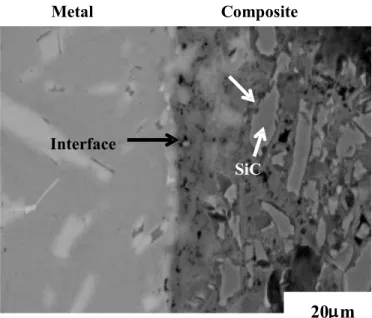
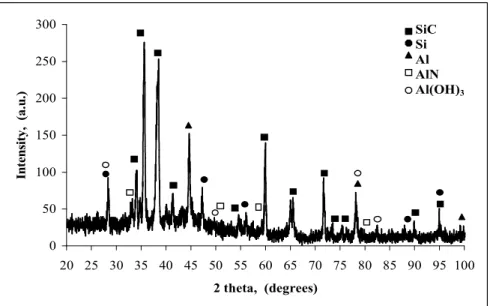
(4) using standard metallurgical procedures and the analysis was carried out using optical microscopy (OM), scanning electron microscopy (SEM), energy dispersive x-rays (EDX) and x-rays diffraction (XRD, CuKα radiation). In order to identify and reveal the morphology of the reaction products at the metal/composite interface, specimens were electrochemically etched (DC-5V3A) with an aqueous solution of HNO3 (33 vol%). RESULTS AND DISCUSSION The microstructure of the resultant MMC´s interfaces was analyzed 20 days, 4 months and 17 months after infiltration. SEM results of the resultant M/C interfaces indicate that a notable dissolution of the SiC particles took place in the composite. Figure 1, shows the resultant M/C interface of a specimen exposed to 1100°C and 60 min, the attack of SiC particles is indicated by the arrow in this figure. XRD analyses of the MMC composite show that the presence of two new phases, Mg2Si and AlN. Yet, there are no diffraction peaks corresponding to the harmful aluminum carbide phases (see Figure 2). Metal. Composite. Interface SiC. 20µm Figure 1. Scanning electron photomicrograph of the M/C interface taken 20 days after the infiltration trials of a specimen processed at 1100ºC for 60 min.. Four months after infiltration, the MMC a reaction zone characterized by a porous phase was observed in the M/C interface. X-ray diffraction of the porous phase indicated the presence of aluminum hydroxide Al(OH)3 at the M/C interface (see Figure 3). The development of Al(OH)3 at the M/C interface can be explained by the reaction of Al4C3 with moisture from the atmosphere according to [4, 9-10]: 4Al + 3SiC ↔ Al4C3 + 3Si Al4C3 + 12H2O → 4Al(OH) 3 + 3CH4 Al4C3 + 18H2O → 4Al(OH) 3 + 3CO2 + 12H2. (1) (2) (3) 246.
(5) Since the composite specimens were not immersed in water, but exposed to the ambient atmosphere, it is expected that the formation of Al(OH)3 is closely related to the interaction of Al4C3 with moisture. According to Kosolapova, reaction (2) takes place slowly at room temperature with the liberation of methane gas [10]. 550. SiC Si Al AlN Mg2Si. 500 450 Intensity, (a.u.). 400 350 300 250 200 150 100 50 0. 20 25 30 35 40 45 50 55 60 65 70 75 80 85 90 95 100 2 theta, (degrees). Figure 2. X-ray diffraction pattern in the composite specimen processed at 1100ºC for 60 min (20 days after the infiltration trials).. Alternatively, Park et al. suggest that CO2 gas is evolved during the interaction of aluminum carbide with water according to reaction (3). They attribute this to observations of bubbles emerging from the polished surface of a SiC/6061 composite material [9]. 300. SiC Si Al AlN Al(OH)3. Intensity, (a.u.). 250 200 150 100 50 0. 20 25 30 35 40 45 50 55 60 65 70 75 80 85 90 95 100 2 theta, (degrees). Figure 3. X-ray diffraction pattern of the powder formed in the reaction zone at the metal/composite interface (4 months after the infiltration trials).. 247.
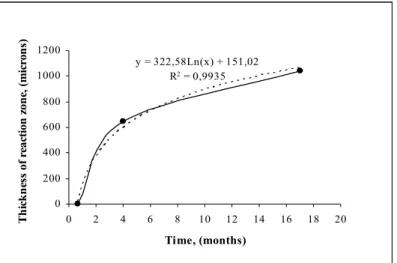
(6) Figure 4 SEM is an SEM micrograph of the M/C interface 17 months after infiltration trials of a specimen processed at 1100°C for 60 min. Notice that in this case the reaction zone is characterized by a volume expansion due the reaction between the Al4C3 and moisture from the atmosphere. Since the density of Al4C3 is lower than that of SiC and Al, upon carbide formation there is a net volume expansion. This volume expansion induces mechanical stressing of the M/C interface due to dilatational strains associated with Al4C3 formation. In turn, this leads to degradation of the interfacial strength [11]. Metal. Composite. Reaction zone. Figure 4. Scanning electron photomicrograph taken 17 months after the infiltration trials in the specimen processed at 1100ºC for 60 min.. Thickness of reaction zone, (microns). Figure 5 shows graphically the thickness of the reaction zone as a function of the exposure time under atmospheric moisture. The extension for the reaction zone increased from 0.65 mm (after 4 months) to 1.04 mm (after 17 months). According to this figure, the thickness of the reaction zone increases with the exposure time to the environment in a logarithmic way.. 1200 y = 322,58Ln(x) + 151,02 R2 = 0,9935. 1000 800 600 400 200 0 0. 2. 4. 6. 8. 10. 12. 14. 16. 18. 20. Time, (months). Figure 5. Plot of thickness of reaction zone vs. exposure time in atmospheric moisture.. 248.
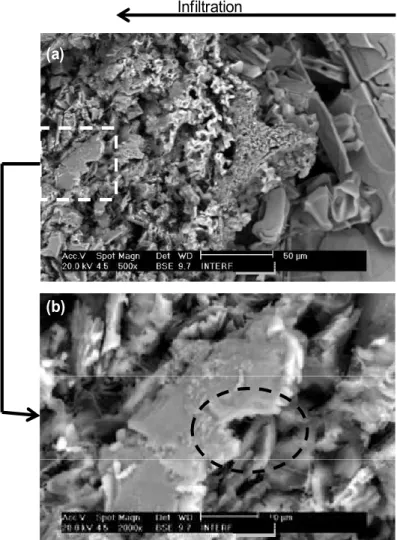
(7) Figures 6a-b are SEM micrographs of the metal/composite interface of a specimen processed at 1100ºC for 60 min and electrochemically etched. It is evident that there is partial dissolution of the SiC particles (indicated by arrows) by liquid aluminum at preferential SiC planes. According to the literature, pits on the SiC particles have been observed but (0001) SiC planes exhibit increasing resistance to the attack by liquid aluminum [12]. In the specimens fabricated at 1050ºC and 1100ºC it was found that there is degradation of the M/C interface at room temperature. However, the degradation of Al4C3 with atmospheric moisture is in general slow and it depends on the chemistry of the air and moisture. Infiltration (a). (b). Figure 6. Scanning electron photomicrograph showing the metal/composite interface of composite electrochemically etched.. 249.
(8) SUMMARY AND CONCLUSIONS Results from this investigation show that the unwanted Al4C3 phase was not identified shortly after the processing of the composites. Nevertheless, the presence of Al(OH)3 4 and 17 months after the infiltration tests reveals that the unwanted Al4C3 phase actually forms under the processing conditions employed. It is worth noting however, that structurally the Al(OH)3 phase can be present in various forms. It was found that thickening of the reaction zone versus time follows a logarithmic tendency. Apparently, the kinetics of the Al4C3 degradation at the M/C interfaces are affected by the atmospheric conditions, such as temperature and air quality. In addition, partial dissolution of the SiC particles can be explained by some facets of SiC particles being more resistant than others to the attack by liquid aluminum.. ACKNOWLEDGEMENTS Authors gratefully acknowledge Microabrasivos de México S.A. de C.V. for supplying the SiC powders. Authors are grateful to Mrs. M. Rivas-Aguilar and Mr. F. Márquez-Torres for technical assistance during the characterization by SEM and EBSD, and to Mr. S. Rodríguez-Arias for assistance during the analysis by X-ray diffraction.. REFERENCES. [1] T. Iseki, T. Kameda and T. Maruyama, “Interfacial reactions between SiC and aluminium during joining”, Journal of Materials Science, 19, 16921698, (1984). [2] J.C. Lee, J.P. Ahn, Z. Shi, Y. KIim and H.I. Lee, “Modification of the interface in SiC/Al composites”, Metallurgical and Materials Transactions A, 31A, 2361-2368, (2000). [3] D.J. Lloyd, H. Lagace, A. McLeod, P. L. Morris, “Microstructural aspects of aluminium-silicon carbide particulate composites produced by a casting method”, Materials Science and Engineering, A107, 73-80 (1989). [4] M.I. Pech-Canul, R.N. KatzATZ, M.M. Makhlouf, “Optimum parameters for wetting silicon carbide by aluminum alloys”. Metallurgical and Materials Transactions A, 31A, 565–573, (2000). [5] J.C. Lee, S.B. Park, H.K. Seok, C.S. Oh and H.I. Lee, “Prediction of Si contents to suppress the interfacial reaction in the SiCP/2014 Al composite”, Acta Materialia, 46, 8, 2635-2643 (1998). [6] J.C. Viala, P. Fortier and J. Bouix, “Stable and metastable phase equilibria in the chemical interaction between aluminium and silicon carbide”, Journal of Materials Science, 25, 1842-1850 (1990). 250.
(9) [7] A. Ureña, E.E. Martínez, P. Rodrigo and L. Gil, “Oxidation treatments for SiC particles used as reinforcement in aluminium matrix composites”, Composites Science and Technology 64 (2004) 1843-1854. [8] M. Rodríguez-Reyes, M.I. Pech-Canul, J.C. Rendón-Angeles and J. López-Cuevas, “Limiting the development of Al4C3 to prevent degradation of Al/SiCP composites processed by pressureless infiltration”, Composites Science and Technology, 66,1056-1062 (2006). [9] J.K. Park and J.P. Lucas, “Moisture effect on SiCP/6061 Al MMC: dissolution of interfacial Al4C3” , Scripta Materialia, 37, 4, 511-516 (1997). [10] T.Y. Kosolapova. 1st ed. New York: Plenum Press, 1971. [11] R. Mitra, V.S. Chalapathi, R. Maiti, M. Chakraborty, “Stability and response to rolling of the interfaces in cast Al–SiCp and Al–Mg alloySiCp composites”, Materials Science and Engineering, A 379, 391-400 (2004). [12] T. Sritharan, L.S. Chan, L.K, Tan, N.P. Hung, “A feature of the reaction between Al and SiC particles in an MMC”, Materials Characterization, 47, 75-77 (2001).. 251.
(10)
Figure
Documento similar
HIF-1, hypoxia inducible factor-1; IKKB, inhibitor of nuclear factor kappa-B kinase subunit beta; JNK1, c-Jun N-terminal kinase; LC3, microtubule-associated protein light chain 3;
Vaccines may help to prevent the development of addiction, initiate drug abstinence in those already addicted to drugs, or prevent drug use relapse by reducing the
using plates of the produced alumina and alumina/zirconia composites, and plates of.. It should be noted that zirconia was considered in this study because of its
In Figure 2 we show the results of the functionalized graphene as reinforcements for UHMWPE-based composites. After running-in period, friction coefficient for the
Chapter 4: Synthesis of functional molecules@MOF composites ... Incorporation of functional molecules into the MOFs ... Post synthetic modification of the MOFs by
No obstante, como esta enfermedad afecta a cada persona de manera diferente, no todas las opciones de cuidado y tratamiento pueden ser apropiadas para cada individuo.. La forma
In recycled PLA obtained from slightly degraded PLA, the addition of fibroin obtained by acid hydrolysis and high molecular weight chitosan led to some degradation of the polymer,
For composites modified with one interlayered veil, an increase in flexural strength of 19.7% and 24.6% was observed for the composite with PA6 and 25 wt.% TiO 2 modified
