30-Gb/s Optical Link Combining Heterogeneously
Integrated III–V/Si Photonics With 32-nm
CMOS Circuits
Nicolas Dupuis, Benjamin G. Lee, Senior Member, IEEE, Jonathan E. Proesel, Member, IEEE,
Alexander Rylyakov, Renato Rimolo-Donadio, Member, IEEE, Christian W. Baks, Abhijeet Ardey,
Clint L. Schow, Senior Member, IEEE, Senior Member, OSA, Anand Ramaswamy, Jonathan E. Roth,
Robert S. Guzzon, Brian Koch, Daniel K. Sparacin, Member, IEEE, and Greg A. Fish, Senior Member, IEEE
Abstract—We present a silicon photonics optical link utilizing
heterogeneously integrated photonic devices driven by low-power
advanced 32-nm CMOS integrated circuits. The photonic
com-ponents include a quantum-confined Stark effect
electroabsorp-tion modulator and an edge-coupled waveguide photodetector,
both made of III–V material wafer bonded on silicon-on-insulator
wafers. The photonic devices are wire bonded to the CMOS chips
and mounted on a custom PCB card for testing. We demonstrate an
error-free operation at data rates up to 30 Gb/s and transmission
over 10 km at 25 Gb/s with no measured sensitivity penalty and a
timing margin penalty of 0.2 UI.
Index Terms—CMOS integrated circuits, optical receivers,
optical transmitters.
I. I
NTRODUCTIONW
HILE multimode VCSEL-based interconnects currently
dominate short-reach optical links (
<
100 m), silicon
photonics is a strong candidate for longer distance applications
typically found in data centers (up to 2 km). Silicon photonics
incorporating WDM promises very high-bandwidth transceivers
that may also satisfy the low-power and low-cost requirements
of the datacom industry. Different implementations of silicon
photonics are currently under investigation. In the monolithic
integration paradigm, the electronics and the photonics share
the same silicon wafer, enabling very low parasitics, and
po-tentially a denser footprint than discrete solutions. However,
Manuscript received June 15, 2014; accepted October 6, 2014. Date of publi-cation October 23, 2014; date of current version February 17, 2015. The work was partially supported by DARPA/ARL under Contract W911NF-12-2-0051 and DARPA/EPHI under Contract HR0011-12-C-0006.
N. Dupuis, B. G. Lee, J. E. Proesel, A. Rylyakov, C. W. Baks, and C. L. Schow are with the IBM T. J. Watson Research Center, Yorktown Heights, NY 10598, USA (e-mail: [email protected]; [email protected]; jonproesel@ us.ibm.com; [email protected]; [email protected]; [email protected]).
R. Rimolo-Donadio was with the IBM T. J. Watson Research Center, York-town Heights, NY 10598, USA. He is now with the Costa Rica Institute of Technology (ITCR), Cartago 30101, Costa Rica (e-mail: [email protected]).
A. Ardey was with the IBM T. J. Watson Research Center, Yorktown Heights, NY 10598, USA. He is now with the College of Optics & Photonics (CREOL), University of Central Florida, Orlando, FL 32816-2700, USA (e-mail: [email protected]).
A. Ramaswamy, J. E. Roth, R. S. Guzzon, B. Koch, D. K. Sparacin, and G. A. Fish are with the Aurrion Inc., Goleta, CA 93117, USA (e-mail: anand. [email protected]; [email protected]; [email protected]; [email protected]; [email protected]; greg.fish@aurrion. com).
Color versions of one or more of the figures in this paper are available online at http://ieeexplore.ieee.org.
Digital Object Identifier 10.1109/JLT.2014.2364551
there are some tradeoffs in tuning the fabrication process for
best electronic or photonic device performance. For example,
photonics wants thicker silicon to get a lower waveguide aspect
ratio and tighter bend radius, while FETs want thinner silicon to
get better gate control over channel and a smaller partially
de-pleted region. Also, current monolithic processes have achieved
integration with
>
100
nm [1] and sub-100 nm CMOS [2], but
migrating or scaling the technology to new CMOS node is not
necessarily straightforward and typically requires significant
in-vestment. In the hybrid integration paradigm, the electronics and
the photonics are designed and fabricated on different platforms.
This two-chip approach enables higher flexibility in choosing
the best performance devices, with a potential disadvantage of
higher interconnect parasitics between the chips. These effects
can however be mitigated by using short wire-bonds or by
flip-chip bonding the TX and RX drivers on the photonics.
Us-ing the hybrid approach, advanced CMOS technology can be
used to drive silicon photonics components enabling low-power
and high-speed transceiver modules. For instance, in [3], the
authors demonstrated a fully integrated link at 10 Gb/s using
40 nm CMOS chips driving a ring modulator and a waveguide
photodetector (PD) with a power efficiency of 2.1 pJ/bit,
ex-cluding laser wall-plug efficiency.
The flexibility offered by hybrid integration also enables more
options for the design and fabrication of the photonics elements.
Among these is the possibility to utilize III–V material as a gain
medium on the silicon photonic platform. This approach,
re-ferred to as heterogeneous integration, was originally developed
by groups at Ghent University [4], the University of California
Santa Barbara [5], and Intel [6]. The heterogeneous platform
enables low-loss and dense footprint silicon waveguides for
all passive functions including waveguide routing, polarization
handling and WDM filters. The integrated III–V material can
be used to implement efficient modulators [7] and detectors [8]
and to provide on-chip gain for lasers and semiconductor optical
amplifiers (OAs). Having the laser source integrated on-chip is a
main advantage of this architecture and there have been various
demonstrations of heterogeneous lasers having performances
comparable with InP-based devices [9], [10].
We present an optical link at 1.31
μ
m comprised of
electroab-sorption modulator (EAM) and PD devices hybrid integrated
with low-power 32 nm CMOS electronics. The photonic devices
were fabricated in a heterogeneous process using wafer-bonding
techniques to integrate III–V materials on silicon-on-insulator
(SOI) wafers. We previously demonstrated in [11] data-rates
up to 30 Gb/s, and have also shown transmission at 25 Gb/s
over 10 km of single-mode fiber without penalty, highlighting
the ability of silicon photonics to enable the reach needed for
datacenters. In this paper, we present more details on the
de-sign and performance of the TX and RX assemblies and also
show additional results of transmission experiments. The paper
is organized as follows. In Section II we describe the
heteroge-neously integrated photonic devices. In Section III we present
the TX and RX assemblies. In Section IV we present the results
on the optical link. Finally, we conclude the paper in Section V
II. H
ETEROGENEOUSLYI
NTEGRATEDP
HOTONICD
EVICESThe photonic devices used in the link were fabricated using
III–V material heterogeneously integrated with silicon
waveg-uides. They include an EAM and a waveguide PD. Both devices
were fabricated using an established foundry infrastructure with
Aurrion’s heterogeneous integration process. The basic
underly-ing photonic circuit is comprised of low-loss silicon and
dielec-tric waveguides and is generated on an 8” SOI substrate.
Het-erogeneous integration of InP is realized by bonding “chiplets”
of custom unprocessed InP epitaxial material to the silicon
sub-strate. Subsequent lithography and etch steps are used to form
a number of devices including lasers, OAs, modulators, and
PD devices. Evanescent mode converters provide a conduit
be-tween the silicon and InP layers to optimally place the optical
mode within the device structures. Further deposition and etch
processing steps encapsulate the InP device structures with
di-electric materials and form metal interconnects and contacts for
interfacing with driver and control circuitry.
A. Electroabsorption Modulator
Fig. 1(a) shows the transmission spectra of the EAM for
dif-ferent bias voltages using TE-polarized light from a tunable
external-cavity laser. The spectra were normalized to the
trans-mission losses of a passive silicon waveguide. Far from the
band edges, the intrinsic insertion loss of the EAM without bias
is
∼
1
dB. With increasing voltage, the absorption edge shifts to
longer wavelengths due to the quantum-confined Stark effect.
The EAM can operate over a large wavelength range of
∼
30 nm
(see gray area in Fig. 1) while providing an extinction ratio (ER)
larger than 20 dB with residual absorption below 3 dB. Fig. 1(b)
presents the electro-optical (EO) small-signal response of the
EAM (
S
21, left axis) and the real part of
S
11(right axis). For
this measurement, the EAM was driven directly by a network
analyzer (Agilent N5230A 40 GHz PNA) with no additional
driver. A bias tee was added and the EAM was probed with
GSG probes. The output light was coupled into fiber and a 40
GHz bandwidth u2t PD was used for optical to electrical
conver-sion. The cables, the bias tee, and the probe were calibrated out.
The EO
S
21shows a 3-dB
RC
roll-off of 16 GHz that matches
the purely electrical measurement,
{|
S
11|}
, and gives a
capac-itance of 200 fF at a reverse bias of
5
.
4
V. It should be noted
that the EO bandwidth measurement is not a true measurement
of the device speed but rather a way to measure its capacitance.
Fig. 1. (a) EAM transmission spectra for different reverse bias from 0 to 10 V (1 V steps); (b) EO and EE small-signal response of the EAM at a reverse bias of5.4V:S2 1at 1310 nm (left axis), and{|S1 1|}(right axis).
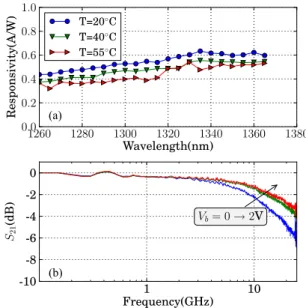
Fig. 2. (a) Responsivity spectra of the PD for different temperatures. (b) OE small-signal response of the PD for 0, 1 and 2 V reverse bias.
The EAM is essentially a capacitor which is here driven with a
50
Ω
source. In the link presented below, the EAM is driven with
a custom driver chip designed to deliver maximum amplitude to
the capacitive load thus avoiding fixed impedance transmission
lines.
B. Waveguide Integrated Photodiode
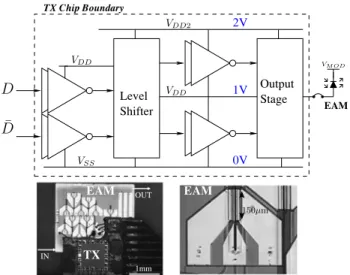
Fig. 3. TX block diagram (top) and pictures of the TX assembly (bottom) showing the wired-bonded package and a close-up of the EAM.
Fig. 4. RX block diagram (top) and pictures of the RX assembly (bottom) showing the wired-bonded package and a close-up of the PD.
was
∼
6
nA at a reverse bias of
1
.
5
V. In Fig. 2(b), we present
the OE small-signal response of the PD. For that measurement,
we used a lightwave component analyzer (Agilent N4373A 67
GHz LCA), and we calibrated down to the probe tips using an
impedance standard substrate. As seen in the spectrum, the PD
device exhibits a 3-dB bandwidth of 22 GHz at
2
V reverse bias.
III. T
RANSMITTER ANDR
ECEIVER ASSEMBLIESIn Figs. 3 and 4 we present high-level block diagrams
il-lustrating the TX and RX assemblies used for the optical link.
The TX consists of a driver chip wire-bonded to an EAM. The
differential electrical inputs have 50
Ω
on-chip terminations to
V
D D/
2
, followed by CMOS inverters to amplify the signal to
full-swing CMOS levels. Cross-coupled CMOS inverters
min-imize timing error between the differential signals. The level
shifter [13] provides low (
V
SSto
V
D D) and high (
V
D Dto
V
D D 2)
CMOS outputs, which are buffered by inverter chains to drive
the output stage [14]. The output stage uses cascoding to limit
the static voltage across any device to
V
D Dwhile providing
V
SSto
V
D D 2output swing [14], [15]. Using this stacked approach,
we were able to provide an output swing of 2 V
ppto the EAM.
The RX chip was reported previously in [16]. The RX consists
of a PD wirebonded to the RX chip containing a transimpedance
amplifier (TIA), a limiting amplifier (LA), an offset
cancella-tion loop, and a 50
Ω
output buffer (OUT). The combination
of TIA, LA, and LPF has 39.1k
Ω
gain, 23.7 GHz bandwidth,
2.6 MHz low frequency cutoff, and 3.7
μ
Arms input-referred
current noise in simulation after layout parasitic extraction.
Both TX and RX were fabricated in IBM’s standard 32 nm
SOI CMOS technology, using thin oxide 1V breakdown
de-vices only. The TX and RX circuits occupy 18
μ
m
×
69
μ
m and
114
μ
m
×
88
μ
m respectively. Both TX and RX sites were
wire-bonded to a high-speed custom PCB for testing. The PCB has
short uncoupled 50
Ω
traces for applying/extracting the
high-speed differential signals to/from the TX/RX. Power and control
biases are routed to wirebond pads near the chip and
surface-mount decoupling capacitors are used on all the supplies. The
PCB is cut into a diving board configuration for edge-coupled
optical access.
IV. O
PTICALL
INKT
ESTING ANDR
ESULTSA. Experimental Setup
Fig. 5(a) describes the link setup which includes: a 1.31
μ
m
commercially available DFB laser with an output power of
12 dBm, a polarization controller (PC), the TX assembly, an
O-band OA with 20-dB gain, a fiber spool, a variable optical
attenuator, another PC and the RX assembly. The output of the
RX was connected either to a bit error rate (BER) tester or to a
50-GHz sampling scope. For all link measurements, the reverse
bias on the EAM was fixed at
5
.
4
V and we measured a dynamic
ER of
∼
8 dB with the 2 V
ppoutput swing of the CMOS driver.
The reverse bias on the PD was
1
.
5
V. The photonics chips
were accessed via lensed fibers using piezo-controlled stages.
The optical power breakdown of the link was as follows:
∼
21
dB EAM loss including
2
× ∼
7
dB coupling loss and
∼
7
dB
insertion losses (at
5
.
4
V reverse bias), and
∼
7
dB coupling loss
at the PD. The high coupling losses of the photonic devices are
due to the absence of fiber couplers in the current designs and
explain the need for an OA to close the link.
B. Results and Discussions
Fig. 5. (a) Experimental setup for high-speed link characterization; (b) Optical eyes captured after the transmitter at 10, 20, 25, and 30 Gb/s; (c) RX electrical eyes at 10, 20, 25, and 30 Gb/s; (d) RX sensitivity of the link at 10, 20, 25, and 30 Gb/s for PRBS7; (e) RX sensitivity of the link at 25 and 30 Gb/s for PRBS7 and PRS31. For the sensitivity measurements the received power was referenced to the light coupled in the silicon waveguide and corrected for infinite extinction ratio.
to the light coupled in the silicon waveguide through received
photo-current and corrected for infinite ER. At BER
=10
−12,
the RX sensitivity was
−
10
.
5
,
−
9
.
4
,
−
7
.
6
, and
−
3
.
2
dBm at
data-rates of 10, 20, 25, and 30 Gb/s, respectively. Negligible
sensitivity degradation was observed when moving from
2
7−
1
PRBS to
2
31−
1
PRBS at 25 and 30 Gb/s as seen in Fig. 5(e). In
Fig. 6(a) we present the sensitivity curves at 25 Gb/s after 11 km
of fiber transmission and show no measured penalty compared
with the back-to-back curve. The bathtub curves in Fig. 6(b)
indicate small closure of the eye (
∼
0.2UI) when moving from
back-to-back to 11 km fiber transmission, likely due to the
dis-persion of the fiber. We used two different transmitters for the
measurements described above. The two assemblies were
pack-aged in exactly the same manner using nominally identical chips
and we did not observe any differences in the link sensitivity
under identical conditions. A first version was used for the
sen-sitivity measurements at 10, 20, and 25 Gb/s PRBS7, and a later
version was used for 30 Gb/s PRBS7, PRBS31 measurements
and all transmission characterizations. The eyes were also
cap-tured with the later version.
We used similar power settings for all measurements and
measured a power efficiency (excluding laser and amplifier) of
3 pJ/bit at 30 Gb/s. This includes 1.25 pJ/bit for the TX assembly
and 1.75 pJ/bit for the RX assembly. The power efficiency can
likely be improved at lower data-rates at the expense of the
bandwidth of the RX as shown in [16]. The external OA was
necessary to offset the high coupling losses of both EAM and PD
chips which did not have fiber couplers to efficiently transition
Fig. 6. Transmission experiment at 25 Gb/s and PRBS7; (a) link sensitivity and (b) bathtub curves in back-to-back and after 11 km of fiber transmission.
the optical mode between the waveguide and the fiber. If fiber
mode converters were included and the coupling losses were
(conservatively) reduced to 3 dB per facet, the link without
amplifier would have
∼
3 dB margin at 25 Gb/s assuming the
same laser input power of 12 dBm and a RX sensitivity of
−
7
.
6
integrating the laser on-chip which is a significant advantage of
the heterogeneously integrated approach [9].
V. C
ONCLUSIONWe presented an optical link combining fast and efficient
het-erogeneously integrated silicon photonics with 32 nm CMOS
electronics. We demonstrated data-rates up to 30 Gb/s and
trans-mission at 25 Gb/s over more than 10 km of fiber with no penalty.
We measured a power efficiency of 3 pJ/bit excluding the laser
and the OA. By including fiber couplers into the photonic
com-ponents, we expect to be able to close the link with
∼
3 dB
margin at 25 Gb/s with further potential improvement enabled
by monolithic integration of the laser with the EAM. Our
re-sults illustrate the potential speed and efficiency offered by
com-bining high performance heterogeneously-integrated photonics
with advanced CMOS to meet the challenging requirements of
next-generation data centers.
A
CKNOWLEDGMENTThe authors thank Prof. J. Bowers at UCSB for the use of
the Agilent N4373A 67 GHz LCA. The authors also thank Dr.
J. Shah of the Defense Advanced Research Projects Agency,
Microsystems Technology Office, for inspiration and support.
The views, opinions, and/or findings contained in this paper are
those of the authors and should not be interpreted as representing
the official views or policies, either expressed or implied, of
Defense Advanced Research Projects Agency or the Department
of Defense. Approved for public release, distribution unlimited.
R
EFERENCES[1] T. Pinguet, P. M. De Dobbelaere, D. Foltz, S. Gloeckner, S. Hovey, Y. Liang, M. Mack, G. Masini, A. Mekis, M. Peterson, T. Pinguet, S. Sahni, J. Schramm, M. Sharp, L. Verslegers, B. P. Welch, K. Yokoyama, and S. Yu, “25 Gb/s silicon photonic transceivers,” in Proc. Group IV
Pho-ton., Aug. 2012, pp. 189–191.
[2] S. Assefa, S. Shank, W. Green, M. Khater, E. Kiewra, C. Reinholm, S. Kamlapurkar, A. Rylyakov, C. Schow, F. Horst, H. Pan, T. Topuria, P. Rice, D. M. Gill, J. Rosenberg, T. Barwicz, M. Yang, J. Proesel, J. Hofrichter, B. Offrein, X. Gu, W. Haensch, J. Ellis-Monaghan, and Y. Vlasov, “A 90 nm CMOS integrated nano-photonics technology for 25Gbps WDM optical communications applications,” in Proc. IEEE Int.
Electron Devices Meet., Dec. 2012, pp. 33.8.1–33.8.3.
[3] X. Zheng, Y. Luo, J. Lexau, F. Liu, G. Li, H. D. Thacker, I. Shubin, J. Yao, R. Ho, J. E. Cunningham, and A. V. Krishnamoorthy, “2-pJ/bit (on-chip) 10-Gb/s digital CMOS silicon photonic link,” IEEE Photon. Technol. Lett., vol. 24, no. 14, pp. 1260–1262, Jul. 2012.
[4] J. Van Campenhout, P. Rojo Romeo, P. Regreny, C. Seassal, D. Van Thourhout, S. Verstuyft, L. Di Cioccio, J.-M. Fedeli, C. Lagahe, and R. Baets, “Electrically pumped InP-based microdisk lasers integrated with a nanophotonic silicon-on-insulator waveguide circuit,” Opt. Exp., vol. 15, no. 11, p. 6744, 2007.
[5] A. W. Fang, E. Lively, Y.-H. Kuo, D. Liang, and J. E. Bowers, “ A distributed feedback silicon evanescent laser,” Opt. Exp., vol. 16, no. 7, p. 4413, Mar. 2008.
[6] H.-F. Liu, “Demonstration of a 4-wavelength×12.5 Gb/s fully integrated silicon photonic link,” in Proc. Microoptics Conf., 2011, pp. 1–3. [7] Y. Tang, J. D. Peters, and J. E. Bowers, “Energy-efficient hybrid silicon
electroabsorption modulator for 40-Gb/s 1-V uncooled operation,” IEEE
Photon. Technol. Lett., vol. 24, no. 19, pp. 1689–1692, Oct. 2012.
[8] B. G. Lee, A. V. Rylyakov, J. E. Proesel, C. W. Baks, R. Rimolo-Donadio, C. L. Schow, A. Ramaswamy, J. E. Roth, M. Jacob-Mitos, and G. Fish, “60-Gb/s receiver employing heterogeneously integrated silicon wave-guide coupled photodetector, ”presented at the Conf. Lasers Electr-Opt., San Jose, CA, USA, 2013, Paper CTh5D.4.
[9] B. R. Koch, E. J. Norberg, B. Kim, J. Hutchinson, J.-H. Shin, G. Fish, and A. Fang, “Integrated silicon photonic laser sources for telecom and datacom,” presented at the Opt. Fiber Commun. Conf., Anaheim, CA, USA, 2013, Paper PDP5C.8.
[10] E. Marchena, T. Creazzo, S. B. Krasulick, P. Yu, D. Van Orden, J. Y. Spann, C. C. Blivin, J. M. Dallesasse, P. Varangis, R. J. Stone, and A. Mizrahi, “Integrated tunable CMOS laser for Si photonics,” presented at the Opt. Fiber Commun. Conf., Anaheim, CA, USA, 2013, p. PDP5C.7. [11] N. Dupuis, B. Lee, J. Proesel, A. V. Rylyakov, R. Rimolo-Donadio, C. Baks, C. L. Schow, A. Ramaswamy, J. E. Roth, R. Guzzon, B. Koch, D. K. Sparacin, and G. Fish, “30Gbps optical link utilizing heterogeneously integrated III-V/Si photonics and CMOS circuits,”presented at the Opt. Fiber Commun. Conf., San Francisco, CA, USA, 2014, Paper Th5A.6. [12] H.-H. Chang, Y.-H. Kuo, R. Jones, A. Barkai, and J. E. Bowers, “ Integrated
hybrid silicon triplexer,” Opt. Exp., vol. 18, no. 23, p. 23891, Nov. 2010. [13] C. Menolfi, T. Toifl, M. Rueegg, M. Braendli, P. Buchmann, M. Kossel, and T. Morf, “A 14Gb/s high-swing thin-oxide device SST TX in 45nm CMOS SOI,” in Proc. Solid-State Circuits Conf. Tech. Papers, Feb. 2011, pp. 156–158.
[14] S. Palermo and M. Horowitz, “High-speed transmitters in 90nm CMOS for high-density optical interconnects,” in Proc. Solid-State Circuits Conf.
Tech. Papers, Sep. 2006, pp. 508–511.
[15] T. Woodward, A. Krishnamoorthy, K. Goossen, J. Walker, B. Tseng, J. Lothian, S. Hui, and R. Leibenguth, “Modulator-driver circuits for optoelectronic VLSI,” IEEE Photon. Technol. Lett., vol. 9, no. 6, pp. 839– 841, Jun. 1997.
[16] J. Proesel, B. G. Lee, C. W. Baks, and C. Schow, “35-Gb/s VCSEL-based optical link using 32-nm SOI CMOS circuits,” presented at the Opt. Fiber Commun. Conf., Anaheim, CA, USA, 2013, Paper OM2H.2.
Nicolas Dupuis received the B.S. and M.S. degrees from Universit´e Blaise
Pascal, Clermont-Ferrand, France, and the Ph.D. degree from Universit´e de Lorraine, Metz, France, in 2009, all in physics. He is currently a Postdoctoral Researcher at the IBM T.J. Watson Research Center, Yorktown Heights, NY, USA. His research interests include silicon photonics, optical switching and optical link modeling. Before joining IBM, he was with Bell Laboratories, Crawford Hill, NJ, USA, working on high-speed InP-based photonic circuits.
Benjamin G. Lee (M’04–SM’14) received the B.S. degree from Oklahoma
State University, Stillwater, OK, USA, in 2004, and the M.S. and Ph.D. degrees from Columbia University, New York, NY, USA, in 2006 and 2009, respectively, all in electrical engineering. In 2009, he became a Postdoctoral Researcher at IBM Thomas J. Watson Research Center, Yorktown Heights, NY, where he is currently a Research Staff Member. He is also an Assistant Adjunct Pro-fessor of electrical engineering at Columbia University. His research interests include silicon photonic devices, integrated optical switches and networks for high-performance computing systems and datacenters, and highly parallel mul-timode transceivers. Dr. Lee is a member of the Optical Society and the IEEE Photonics Society, where he serves as an Associate Vice President of Mem-bership. He serves on the technical program committees for the Optical Fiber Communications Conference and the Optical Interconnects Conference.
Jonathan E. Proesel (M’10) received the B.S. degree in computer engineering
Alexander Rylyakov received the M.S. degree from the Moscow Institute of
Physics and Technology, Moscow, Russia, and the Ph.D. degree from State Uni-versity of New York at Stony Brook, Stony Brook, NY, USA, both in physics. He is a Research Staff Member at the IBM T.J. Watson Research Center, York-town Heights, NY. His current research interests include high-speed integrated circuits for optical communications and high-performance digital phase-locked loops.
Renato Rimolo-Donadio (S’08–M’11) received the B.S. and Lic. degrees in
electrical engineering from the Technical University of Costa Rica (ITCR), Cartago, Costa Rica, in 1999 and 2004, respectively, the M.S. degree in micro-electronics and microsystems, and the Ph.D. degree in electrical engineering, both from the Technical University of Hamburg-Harburg (TUHH), Hamburg, Germany, in 2006 and 2010, respectively. In 2014, he joined as a Professor at the Electronics Engineering Department, Instituto Tecnolgico de Costa Rica (ITCR). From 2012 to 2014, he was with the IBM T.J. Watson Research Center, and from 2006 to 2012, with the Institute of Electromagnetic Theory, Technical University of Hamburg-Harburg. His current research interests include system-level modeling and optimization of interconnects, analysis of signal and power integrity problems, and high-speed circuit design.
Christian W. Baks received the B.S. degree in applied physics from Fontys
College of Technology, Eindhoven, The Netherlands, in 2000 and the M.S. degree in physics from the State University of New York, Albany, NY, USA, in 2001. He joined the IBM T.J. Watson Research Center, Yorktown Heights, NY, as an Engineer in 2001, where he is involved in high-speed optoelectronic package and backplane interconnect design specializing in signal integrity issues.
Abhijeet Ardey received the M.S. degree in physics from the University of
Delhi, Delhi, India, in 2003 and the M.S. and Ph.D. degrees in physics from the University of Central Florida (UCF), Orlando, FL, USA, in 2007 and 2014, respectively. He is currently a Research Scientist at CREOL, The College of Optics and Photonics, at UCF. His research interests include the development of novel low-noise modelocked semiconductor lasers and integrated devices for applications in future high-capacity optical communication networks.
Clint L. Schow (SM’10) received the Ph.D. degree in electrical engineering
from the University of Texas at Austin, Austin, TX, USA, in 1999. He joined IBM, Rochester, MN, USA, assuming responsibility for the optical receivers used in IBMs optical transceiver business. From 2001 to 2004, he was with Agility Communications, Santa Barbara, CA, USA, developing high-speed op-toelectronic modulators and tunable laser sources. In 2004, he joined the IBM T.J. Watson Research Center, Yorktown Heights, NY, USA, as a Research Staff Member and currently manages the Optical Link and System Design Group responsible for optics in future generations of servers and supercomputers. He has directed multiple DARPA-sponsored programs investigating chip-to-chip optical links, nanophotonic switches, and future systems utilizing photonic switching fabrics. He has published more than 150 journals and conference articles and has 16 issued patents. Dr. Schow is a senior member of the OSA.
Anand Ramaswamy received the B.S. degree in electrical engineering with
a minor in physics and the M.S. and Ph.D. degrees in electrical engineering from the University of Southern California, Los Angeles, CA, USA, and the University of California, Santa Barbara, Santa Barbara, CA, in 2005, 2007, and 2010, respectively. He is currently the Photonics Systems Manager at Aurrion Inc., Santa Barbara. His current research interests include photonic integrated circuits for optical communications.
Jonathan E. Roth was born in Lansdale, PA, USA, in 1977. He received the
B.S. degree in biomedical engineering from Case Western Reserve University in Cleveland, OH, USA, in 2000, and the Ph.D. degree in electrical engineer-ing from Stanford University in Stanford, CA, USA, in 2007. His dissertation work was on electroabsorption modulators in indium phosphide and silicon germanium. He is employed by Aurrion Inc. as a Senior Optoelectronic Device Engineer, where he designs heterogeneous III–V on silicon devices and pho-tonic integrated circuits.
Robert S. Guzzon received the B.S. degrees in electrical engineering and
physics from Lehigh University in Bethlehem, PA, USA, in 2007 and the M.S. and Ph.D. degrees in electrical engineering from the University of California, Santa Barbara, CA, USA, in 2011 where his dissertation focused on the the-ory, design, and fabrication of high-SFDR photonic integrated microwave filter circuits. His current interests include the development of photonic integrated circuit systems and their electronic and optical interfaces.
Brian Koch received the B.S. degree in physics (Hons.) from the College of
William and Mary, Williamsburg, VA, USA, in 2003 and the M.S. and Ph.D. degrees in electrical and computer engineering from the University of Califor-nia, Santa Barbara, CA, USA, in 2004 and 2008, respectively. His dissertation was focused on optoelectronic resonators and mode-locked lasers in photonic integrated circuits, with applications in optical clock recovery and optical signal regeneration. He is a Design Engineering Manager at Aurrion. He has been heavily involved in the development of heterogeneous silicon laser technology for more than seven years. He was an Optical Researcher at Intels Photonics Technology Lab in Santa Clara, CA, from 2008 to 2012, where he was involved in the design and testing of heterogeneously integrated silicon lasers and other silicon-based photonic components and circuits. Since joining Aurrion in 2012, he has has been with a design team developing novel devices and architec-tures on a silicon-based heterogeneous integration platform. Dr. Koch holds two patents and has authored more than 40 papers and two book chapters.
Daniel K. Sparacin (M’12) received the B.S. degree in material science and
engineering from Brown University, Providence, RI, USA, in 2000 and the Ph.D. degree from MIT, Cambridge, MA, USA, in 2006 focused on silicon photonics device design and fabrication. After graduation, he consulted for Defense Advanced Research Projects Agency Microsystems Technology Office in the areas of digital and RF photonic materials, devices, and systems. In 2012, he joined Aurrion, Goleta, CA, USA, where he is the Director of Technology.
Greg A. Fish (SM’11) received the B.S. degree in electrical engineering from