
A supply and demand analysis between the implementation of the 1995 EFL program at I T E S M Campus Cd Juarez as seen by EFL instructors and the occupational needs in the northern US Mexico border as seen by college graduate employees
197
0
0
Texto completo
(2) INSTITUTO TECNOLOGICO Y DE ESTUDIOS SUPERIORES DE IVIONTERREY U1'11\'ERSIDAD VIRTUAL. A SUPPLY AND DEMAND ANALYSIS BET\VEEN THE IMPLEMENTATION OF THE 1995 EFL PROGRAM AT I.T.E.S.M. CAMPUS CD. JUAREZ AS SEEN BY EFL INSTRUCTORS AND THE OCCUPATIONAL NEEDS IN THE NOTHERN US-MEXICO BORDER AS SEEN BY COLLEGE GRADUATE EMPLOYEES.. TESIS Presentada como requisito parcial para optar al título de Maestro en Educación con especialidad en Lingüística Aplicada. Autor: Lic. Ercilia Loera Anchando Asesor: Dr. Irene Gartz. Monterrey, N.L. a 7 de Febrero de 1997.
(3) With love to my parents. ¡¡.
(4) Acknowledgements I want to express my enormous gratitude to all of the following. First of all, I am deeply indebted to I.T.E.S.M. Campus Cd. Juárez for trusting me and providing me the academic environment, and communication resources through the MEE program for the elaboration of the present research project. To Dr. Irene Gartz, who devoted valuable time to guiding, discussing and preparing this thesis since 1995; as well as for her help preparing the questionnaires, which were enriched with many of her excellent suggestions; for her endless patience and wise answer to doubts during numerous long-distance calls. I am indebted to Lic. Luz María Barrón, coordinator of the English Department at I.T.E.S.M. Campus Cd. Juárez who gave me unconditional support facilitating me English programs, as well as time and help through her participation as a proofreader in this research project. To all the instructors who answered the questionnaire with enthusiasm. To Ing. Sergio Madrid and Lic. Héctor Servín for their valuable time devoted to provide information about the EFL history on this campus. To Ing. Félix Aragón for his help in the elaboration of the graphs. I am equally grateful to Dr. Dennis J. Bixler who is a sociolinguist from the University of Texas at El Paso. I could not omit mentioning the twin-plant managers' help, Jesus del Hierro and Karl Popierlarczky whose valuable information about the use of English in twin plants was taken into consideration to prepare the questionnaires. I wish to acknowledge my gratitude to the forty anonymous twin-plant employees whose foreign language use reports are presented in this study. I also have a debt of gratitude to my husband, my son and my sisters for their endless patience and help in many occasions during the elaboration of this study. Finally, I am deeply indebted to my parents for their un. 111.
(5) conditional support by baby-sitting Mario Alberto countless hours; for their warmth, love as well as for encouraging me to pursue my educational endeavors.. iv.
(6) Summary This thesis is a bilingual study in which forty. em-. ployees holding undergraduate degrees in diverse academic disciplines who work in the twin plant sector of Cd. Juárez were interviewed by means of a questionnaire.. The. study is merely based on the twin-plant college graduates' opinions that define the demands concerning the skills of English as a foreign language which are needed to fulfill the employees' job responsibilities.. It describes the EFL. instructors' point of view regarding the foreign language instruction as implemented according to the 1995 English Foreign Language Program at I.T.E.S.M. Campus Cd. Juárez.. An interview with I.T.E.S.M. instructors was carried out in order to compare the college graduate employees' perception regarding their needs with the instructors' point of view about the foreign language instruction at I.T.E.S.M. Based on the employees' perception, it was found that the skills most demanded by college graduates working at twin plants are the oral ones.. Certain needs regarding. cultural-conventional aspect in the foreign language were also reported.. The study also reveals the relationship. between the skills employees state they require and the. V.
(7) style of language college graduates affirm they demand. An example of this is the employees' perception about the low demand of informal language in reading and writing as well as the high demand of formal language in the same abilities.. Another aspect employees considered was the. need for technical language which is demanded with a higher frequency in the non-oral skills than in the oral abilities. Regarding the implementation of the 1995 English Foreign Language Program instructors think that it fulfills the majority of the demands detected in the sample under study.. However, teachers perceive that the aspect not. considered sufficiently is the need for technical language.. The cultural-conventional issue is proposed to be. studied in more detail in future projects dueto the discrepancy between what instructors claimed to be doing in class and the suggestions they made about the emphasis the cultural-conventional issue should receive.. vi.
(8) Resumen Esta tesis es un estudio bilingüe en el cual cuarenta empleados profesionales con grado escolar de licenciatura en diversas disciplinas académicas que trabajan en el sector de la industria maquiladora de Cd. Juárez fueron entrevistados por medio de un cuestionario.. El estudio. está basado meramente en la opiniones de los empleados que definen las demandas concerniente a las habilidades del inglés como idioma extranjero para satisfacer las responsabilidades de trabajo de los empleados.. Describe el pun-. to de vista de los instructores de Inglés como Lengua Extranjera concerniente a la instrucción del Programa de Inglés como Lengua Extranjera 1995 en el Instituto Tecnológico y de Estudios Superiores de Monterrey Campus Cd. Juárez mediante una entrevista con los maestros y compara la percepción de los empleados profesionales concerniente a sus necesidades con el punto de vista de los maestros acerca de la implementación del Programa de Inglés como Lengua Extranjera 1995. En base a la percepción de los empleados, se encontró que las habilidades más demandadas por los profesionales que trabajan en la industria maquiladora son las orales. Las necesidades que se refieren al aspecto cultural-. vii.
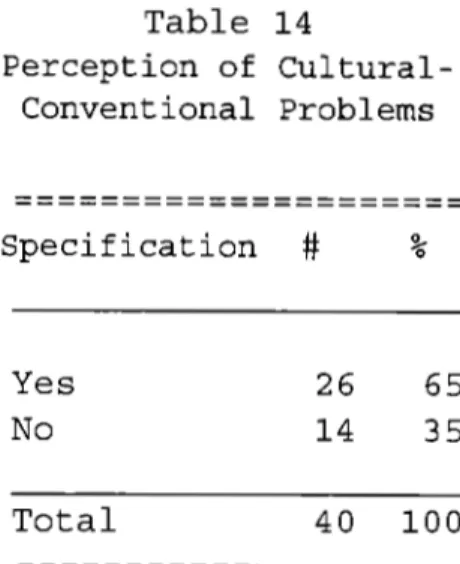
(9) convencional en la lengua extranjera también fueron reportadas.. Asímismo el estudio revela la relación entre el. tipo de habilidades que los empleados dicen requerir y el esti- lo de lenguaje que los profesionales afirman demandar.. Un ejemplo de esto es la percepción de los empleados. referente a la baja demanda de lenguaje informal en escritura y lectura así como la alta demanda de lenguaje formal en las mismas habilidades.. Otro hallazgo es el que se re-. fiere al lenguaje técnico donde los empleados consideraron que éste es demandado con mayor frecuencia en habilidades no orales que en habilidades orales. Concerniente a la implementación del Programa de Inglés como Lengua Extranjera 1995 del I.T.E.S.M., los maestros piensan que éste satisface la mayoría de las demandas detectadas en la muestra bajo estudio.. Sin embargo, ellos. opinan que el aspecto que no es considerado suficientemente en la instrucción del programa es la necesidad del lenguaje técnico.. La cuestión cultural-convencional se pro-. pone a ser estudiada más a fondo en futuros proyectos debido a la discrepancia que existe entre lo que los maestros afirmaron llevar a cabo en clase y las sugerencias que ellos mismos hicieron acerca de que el aspecto cultural-convencional debería ser más enfatizado.. viii.
(10) Table of Contents. Title page.............................. . . . . . . . . . . . .. 1. Dedication. . . . . . . . . . . . . . . . . . . . . . . . . . . . . . . . . . . . . . . . . .. ii. Acknowledgements........................ .. . . .. . .. . . .. 111. Summary.............................................. v. Resumen. . . . . . . . . . . . . . . . . . . . . . . . . . . . . . . . . . . . . . . . . . . . .. vii. Table of Contents. . . . . . . . . . . . . . . . . . . . . . . . . . . . . . . . . . .. ix. List of tables. . . . . . . . . . . . . . . . . . . . . . . . . . . . . . . . . . . . . .. xi. List of figures. . . . . . . . . . . . . . . . . . . . . . . . . . . . . . . . . . . . .. xiii. Introduction. . . . . . . . . . . . . . . . . . . . . . . . . . . . . . . . . . . . . . . .. 1. l.. 3. Problem, purpose and limitation of the study.... 1.1.. Definition of the problem... ............. .. .. 1. 1. 1.. 4. 1.1.1.1.. Cd. Juarez twin plants... .. . . . . . . . .. 5. 1.1.1.2.. English at I.T.E.S.M................ 9. Linguistic and cultural aspects......... 16. 1.1.2.. 2.. Antecedents. . . . . . . . . . . . . . . . . . . . . . . . . . . .. 3. 1.1.2.1.. Bilingualism in the border region... 19. 1.1.2.2.. Disruption in communication......... 20. 1. 2.. Purpose of the study................... . . .. . .. 21. 1.3.. Limitation of the study...................... 22. Theoretical framework............. .. . . . . . . . . . . . .. 25. 2.1.. The economic value of language.... .. . . . . . . . .. IX. 25.
(11) 2. 2.. Bilingualism. . . . . . . . . . . . . . . . . . . . . . . . . . . . . . .. 28. 2.3.. Culture ...................................... 32. 2.4.. Language skills.............................. 39. 2.4.1.. Listening ............................... 39. 2. 4. 2.. Speaking. . . . . . . . . . . . . . . . . . . . . . . . . . . . . . .. 43. 2. 4. 3.. Reading. . . . . . . . . . . . . . . . . . . . . . . . . . . . . . . .. 54. 2.4.4.. Writing ................................. 57. Earlier Studies. . . . . . . . . . . . . . . . . . . . . . . . . . . . .. 58. Methodology. . . . . . . . . . . . . . . . . . . . . . . . . . . . . . . . . . . . .. 64. 2. 5. 3.. 3.1.. The variables and the hypotheses............. 67. 3.2.. The preparation and administration of the questionnaire for employees.............. 70. The preparation and administration of the questionnaire for teachers............ 77. Presentation and discussion of the results....... 80. 3.3.. 4.. 4.1.. Presentation and discussion of the data obtained from employees' questionnaire....... 80. Presentation and discussion of the data obtained from instructors' questionnaire..... 114. 5.. Comparison of supply and demand.................. 128. 6.. Conclusions. . . . . . . . . . . . . . . . . . . . . . . . . . . . . . . . . . . . .. 13 8. 4.2.. 6.1.. Summary . . . . . . . . . . . . . . . . . . . . . . . . . . . . . . . . .. 13 8. 6. 2.. Suggestions. . . . . . . . . . . . . . . . . . . . . . . . . . . . .. 142. Appendices. . . . . . . . . . . . . . . . . . . . . . . . . . . . . . . . . . . . . . . . . .. 148. Appendix A. First Questionnaire: Form............ 149. X.
(12) Appendix B. Questionnaire for Employees: Form.... 152. Appendix C. Teachers' Questionnaire: Form........ 156. Appendix D. Employees' questionnaire: tally sheets............. . . . . . . . . . . .. 157. Appendix E. Teachers' questionnaire: tally sheets. . . . . . . . . . . . . . . . . . . . . . . .. 165. Appendix F. Calculations for hypotheses in section 4 .1. . . . . . . . . . . . . . . . . . . . . .. 167. Appendix G. Calculations for teachers' questionnaire answers................ 170. Bibliography. . . . . . . . . . . . . . . . . . . . . . . . . . . . . . . . . . . . . . . .. 1 72. Vitae................................................ 178. List of tables Title. # 1. Page. Distribution of the Informants According to Sex.......................................... 80. 2. Data from Personal Information ................ .. 81. 3. College Graduates' Educational Background ..... .. 83. 4. Occupational Activities of College Graduates. . . . . . . . . . . . . . . . . . . . . . . . . . . . . . . . . . . . . .. 84. 5. EFL Learning Background . . . . . . . . . . . . . . . . . . . . . . . .. 86. 6. Amount of Time Devoted to English Classes by 32 Twin-Plant Employees . . . . . . . . . . . . . . . . . . . . .. 88. Intensity of EFL Studies in College Graduates........................... . . . . . . . . . . .. 89. Frequency of Skills Demands by College Graduate Employees in Twin Plants ............. .. 91. 7. 8. xi.
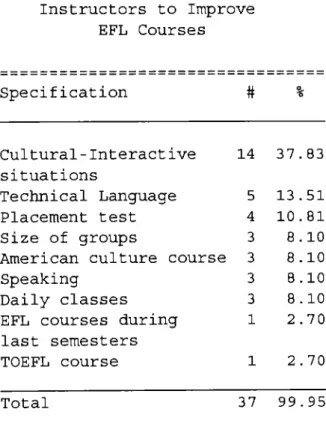
(13) Purpose of Reading English among College Graduates . . . . . . . . . . . . . . . . . . . . . . . . . . . . . .. 94. Frequency of Demand for Formal Language in the Different Skills . . . . . . . . . . . . . . . . . . . . . . . . . . .. 96. Frequency of Demand for Informal Language in Reading and Writing . . . . . . . . . . . . . . . . . . . . . . . . .. 98. Demand of Technical Language in the Dif ferent Skills . . . . . . . . . . . . . . . . . . . . . . . . . . . . . . .. 100. 13. Areas in which Technical Language is Used ..... .. 103. 14. Perception of Cultural-Conventional Problems . . . . . . . . . . . . . . . . . . . . . . . . . . . . . . . . . . . . . . .. 105. The Manner Pre-Job English Studies Employees' Prepare for Job Requirements . . . . . . . . . . . . . . . . . . .. 108. Type of Suggestions for EFL Teaching Programs Made by Employees . . . . . . . . . . . . . . . . . . . . . . . . . . . . . .. 109. The Frequency of EFL Skills Encouraged by Teachers. . . . . . . . . . . . . . . . . . . . . . . . . . . . . . . . . . . . . . .. 115. The Frequency of Formal Language Encouraged by Instructors. . . . . . . . . . . . . . . . . . . . . . . . . . . . . . . . .. 11 7. The Frequency of Teachers' Encouragement Toward Informal Language . . . . . . . . . . . . . . . . . . . . . . .. 120. The Frequency of Technical Language Encouraged or Practiced in Class........................... 121. The Frequency of Teachers' Encouragement Toward Cultural-Interactive Situations ............... .. 123. Aspects to be Considered by Instructors to Improve EFL Courses . . . . . . . . . . . . . . . . . . . . . . . . . . . .. 125. Comparative Distribution of Suggestions to EFL Courses Made by Twin-Plant Workers and Instructors........................... . . . . . . . . .. 135. 9. 10. 11. 12. 15. 16. 17. 18. 19. 20. 21. 22. 23. XII.
(14) List of figures. #. Title. 1. Frequency Distribution of Male/Female Population in Percentages....................... 81. Frequency Distribution of Employees According to Age ........................................ .. 82. Frequency Distribution of Respondents Based on their Education ............................ .. 83. Frequency Distribution of College Graduates' Occupational Activities ............ .. 85. Frequency Distribution of College Graduates' EFL Learning History ............... .. 87. Amount of Time Devoted to English Classes by Employees in Twin Plants ................... .. 89. Frequency Distribution of EFL Studies' Intensity ..................................... .. 90. Frequency Distribution of Need for Oral and Non-oral skills ........................... .. 92. Distribution of the Frequency with which Skills are Required ........................... .. 93. Frequency Distribution of College Graduates' Reading Purpose .................... .. 95. Frequency Distribution of Need of Formal Language in Different Skills .................. .. 96. Frequency Distribution of Demand for Formal Language in Different Skills .................. .. 97. Frequency Distribution of Need of Informal Language in Reading and Writing ............... .. 99. Frequency Distribution of Need for Technical Language in Listening/Speaking and Reading/ Writing ....................................... .. 101. 2. 3. 4. 5. 6. 7. 8. 9. 10. 11. 12. 13. 14. Page. xiii.
(15) 15. 16. 17. 18. 19. 20. 21. 22. 23. 24. Frequency Distribution of Demand for Technical Language in Oral and Non-oral Skills .......... .. 102. Frequency Distribution of Areas of Technical Language where College Graduates Work ......... .. 104. Frequency Distribution of How EFL-Studies Prepare Employees ............................. .. 108. Frequency Distribution of Recommendations About EFL Programs ............................ .. 110. Frequency Distribution of EFL Skills Encouraged by Instructors ..................... .. 116. Frequency Distribution of Formal Language Encouraged in EFL Classes ..................... .. 118. Frequency Distribution of Informal Language Encouraged in EFL Courses ..................... .. 120. Frequency Distribution of Technical Language Encouraged in EFL Classes ..................... .. 122. Frequency Distribution of Cultural-Interactive Situations Encouraged by Instructors............ 124. Frequency Distribution of Suggestions for EFL Courses. . . . . . . . . . . . . . . . . . . . . . . . . . . . . . . . . . . . . . . .. 126. XIV.
(16) Introduction Cd. Juárez, Chihuahua is located in the border region between the United States and Mexico.. Its permanent con-. tact with El Paso, Texas creates a cosmopolitan area where economy dependency, cultural diversity anda mixture of two languages are observed. The economy of this border town and surrounding area is heavily based on the twin-plant activity where the English and Spanish languages are simultaneously handled due to the contact between American personnel and Mexican professional employees and workers.. This work relationship. has led many Mexican employees who work in twin plants to learn the language through which the commercial and technical transactions as well as communication by different means are carried out: English. Education plays a crucial role in this phenomenon where bilingual and bicultural people are more demanded day by day.. Universities in this region should be more. aware of the changes taking place in the Commerce and Industry areas.. English in Foreign Language Programs in. higher level institutions as well as the professional training of teachers for these programs is an essential aspect to be considered permanently by educative institu-.
(17) tions. Based on these reflections and taking into consideration I.T.E.S.M. campus Cd. Juárez' concern for this issue, the present study intends to find out the college graduate employees' perception on the English Foreign Language necessities in twin plants and to analyze the instructors' point of view about the offerings regarding the instruction of the 1995 EFL Program to see whether this implementation fulfills those demands and later to make suggestions according to the findings.. 2.
(18) l.. Problem, purpose and limitation of the study. The first chapter of this thesis will consideraspects such as a general overview of the City of Juarez and the relevance of twin plants for its life.. Also, the lin-. guistic and cultural dimensions in this locality and in the twin plant sector will be discussed.. Finally, the ob-. jectives and limitation of the present project will be established.. 1.1.. Definition of the problem. Cd. Juárez has become a relevant international commercial area due in part to its nearness to El Paso, Texas and the implementation and growth of twin plant companies that assemble premanufactured parts using inexpensive labor available in Mexico.. Part of the labor force include. white-collar personnel such as engineers, accountants and managers.. Dueto their position in these companies, they. have interaction with American executive personnel and therefore need to communicate in English to perform their tasks.. Communication is not only verbal but also in a. written form.. Learning a foreign language among college. graduates has become an increasing demand with the expan-. 3.
(19) sion of the international trade in the border region. Nevertheless, from the linguistic and cultural point of view, English learning among white-collar people has not been sufficient to accomplish their communication tasks. Education plays an important role in this process. I.T.E.S.M. Campus Cd. Juárez has always been conscious about the importance of English in the border region; however, based on my personal perception, it can be said that the implementation of the English programs is not sufficient to meet the demands of English language skills college graduate employees affirm they require working in twin plants.. Recognizing such discrepancy, the present. project will focus on the this problem making a conscious study of its background.. 1.1.1.. Antecedents. Cd. Juárez lies approximately 300 miles north Chihuahua City, the capital of its state, Chihuahua, and borders on El Paso, Texas.. The census data for 1990 show that Cd.. Juárez has a population of 749,499. 64.3% of this population is. It is estimated that. employed.. The residents of. Juarez are engaged in different activities such as industry and constructions (49.3%) commerce and services (45%). 4.
(20) and agriculture (1.4%). (Cuaderno Estadístico Municipal,. 58) .. Almost the entire population of this city is, for economic purposes, very much related to the U.S. It is estimated that one third of its habitants draw their livelihood from the two hundred and sixty-seven American-owned assembly plants set up on a permanent basis in this locality (Anuario Estadístico del Estado de Chihuahua, 98). Cd. Juárez has become the dominant trade zone along Mexico's border with the United States.. Its rail, highway. and air services to the interior of Mexico and its access to services located in El Paso combine to make Cd. Juárez a major center for international trade.. Twin plants have. played an important role in such trade growth.. 1.1.1.1.. Cd. Juárez twin plants. Twin plants originated from BIP (Border Industrialization Program) in 1963 from a Mexican government's desire to alleviate the serious unemployment that had developed along the border.. The contract labor agreement which al-. lowed Mexican workers to work in the United States had ended in 1960.. As a result, the unemployed found it in-. creasingly difficult to enter the United States dueto the. 5.
(21) restrictions resulting from the United States labor-union pressures.. In response, the Mexican government invested. millions of pesos in commercial and cultural facilities designed to improve the appearance of Juarez and to promote the sale of national products; in this way the Pro-. grama Nacional Fronterizo (PRONAF) complex was established.. In addition, in 1964, Mexico began to advertise. cheap labor and geographic advantages existent at the border in order to persuade U.S. firms to found assembly plants in the region.. Once twin plants were established,. employment opportunities increased considerably in arelatively short time.. Two years into the program, there were. fifty-seven twin plants with 4,257 people employed along the border.. By 1970 BIP plants had increased to 120 and. employees to 20,327.. Between 1970 and 1974, the number of. plants in Juarez raised from twenty-two to eighty-nine and employees from 3,165 to 17,489 (Castellanos, 132 f.). Since twin plants were established, this concept has been present in Cd. Juárez.. These companies are generally. subsidiaries of foreign firms where labor-intensive assembly is carried out.. They were called "twin plant" because. the program envisioned these companies were established in close proximity along both sides of the border.. 6. This type.
(22) of industries have their own particular way to operate: U.S border operations consist of receiving components from suppliers elsewhere, ship them to the twin plant located in Cd. Juárez where the product is assembled, and then the company located in the U.S. border rece1ve, inspect, warehouse and finally ship the complete product to costumers (IN-Bond Industry, 30).. As mentioned before twin-plant industry has been a major source of employment.. Since the principal attrac-. tion of this type of companies is the low Mexican wage rates, most of the job creation is at minimum wage level; it is obvious the majority of the Mexican employees who work in twin plants are blue-collar workers.. Tradition-. ally, the top positions in the company has been filled by Americans.. U.S employees are managers transferred from. the domestic organization to the twin plant operation. However, Mexican executives have taken over many middle management positions such as controller, purchasing manager and personnel manager.. Mexican employees also fill. other qualified positions such as engineers, accountants, supervisors and analysts (IN-Bond Industry, 53 f.).. This. type of personnel are generally in close communication. 7.
(23) with the American managers in meetings and through electronic media.. Besides this type of relationship, it is. known that sorne American employees such as engineers and supervisors come from El Paso to work with Mexican colleagues.. Dueto these interactions, the demand for quali-. fied bilingual personnel is high. Since 1965 the growth of twin-plant activity has increased.. Through these years the Mexican labor has been. attractive to foreign markets dueto the peso devaluation. Another factor is that Mexico offers not only a safe investment climate but its proximity to the United States also gives the foreign companies a chance to retreat quickly if conditions change.. Furthermore, dueto the. nearness, the transportation costs are reasonable. Although Mexico has suffered dramatic changes in its economy, the future for twin plants seems to be good for the following years.. Alonso Corrales, president of the. Asociación de Maquiladoras Asociación Civil. (AMAC). in this. community, predicts an expansion of the already established twin plants in this locality and the growth of those companies will be of 7% or more.. Periodic devalua-. tions of the peso makes Mexico more attractive for investment (Interview. March, 1995).. 8. Also, the president of the.
(24) Cámara Nacional de Industria Maquiladora de Exportación, Raúl Avila, affirms that twin plants investment plans in 1995 will not be detained although a violent fluctuation of the dollar-peso relation is taking place.. In situa-. tions like this, twin plants function as a shelter for unemployment (Diario de Juárez, 12-A. Feb 20, 1995).. 1.1.1.2.. English at I.T.E.S.M.. As can be seen, the role of twin plants in this community has been relevant for its economy, giving raise to employment.. An important aspect to consider in the pres-. ent project is education.. The preparation of college. graduates with respect to the knowledge of a foreign language has been crucial in their development when working in twin plants.. Educational institutions such as. I.T.E.S.M. have been aware of the importance of this training in their students.. For a better understanding of. the problem, it will be helpful to have sorne knowledge about English as a Foreign Language (EFL) history in this institution. The I.T.E.S.M. Campus Cd. Juárez was founded on August 8, 1983 with 108 students.. It offered four majors:. Industrial Engineering, Business Administration, Account-. 9.
(25) 1ng and Computer Engineering.. Since. the I.T.E.S.M. Sys-. tem was created, the ambitious educational goal has always been "to train professionals in their fields of study at the undergraduate and graduate level placing special emphasis on the quality and excellence of the study programs (I.T.E.S.M.. Planes. y Programas de Estudio de las Carre-. ras Profesionales del Sistema ITESM, 11).. Campus Cd.. Juárez has taken this objective as part of its philosophy. The I.T.E.S.M. Campus Cd. Juárez history is relatively short, but there have been significant changes in its English programs through these years. study program dates back to 1987.. The oldest. According to this docu-. ment, students should take English for six semesters in high school. times a week.. Each course was taught for one hour three The main objective at all levels was "to. acquire a relatively high English proficiency of the four abilities placing particular emphasis on reading comprehension and oral expression". gramas de Estudio 1987, 32).. (I.T.E.S.M.. Planes y Pro-. On the other hand, Lic.. Héctor Servín who was the high school principal from 19871992 states that the main focus was grammar instruction.. The English Department did not exist officially at that time but there was a coordinator, Ana Lilia Vargas. 10.
(26) (Interview.. March, 1995).. Applicants used to take an ad-. mission test to be accepted to high school anda placement test for English as well.. According to the latter, they. were placed ata given level within the six compulsory courses according to the results of their exam.. As of. 1992, if a student was placed in level III, the courses to be taken would be English IV, V and VI; those students placed at the beginning in English IV or higher could take a French class in order to complete the six foreign language courses required to graduate (Luz María Barrón, Interview.. March, 1995).. During those years, teachers changed from one textbook to another very frequently. decision.. Many factors influenced their. One of them was the publishing companies' pres-. sure to buy a certain quantity of textbooks ata given time.. Another point to consider is that there was not any. evaluating mechanism to measure the students' language achievement at the end of the program (Héctor Servín, Interview.. March, 1995).. Before 1990, at the undergraduate college level, the study programs included only one English course.. All aca-. demic majors offered by I.T.E.S.M. required a placement test of English.. The students coming from I.T.E.S.M. high. 11.
(27) school were exempted from it while students from other high schools had to take it.. If they did not pass the. test, they would have to take one English course (Sergio Madrid, Interview.. February, 1995).. By 1990, the English programs underwent an important modification in both high school and college. ment test was replaced by a new version: far the English Spectrum Courses.". The place-. ~Placement Test. A Department of Eng-. lish was officially established; the coordinator has been Lic. Luz María Barrón.. The textbooks used for those. courses were from the Spectrum series.. Nevertheless, be-. fare 1995, which was the official date to implement new foreign language programs in the I.T.E.S.M. System, the Spectrum series had been gradually replaced by other books such as On Target and In Contact.. In 1992, in addition to. the French classes already existing in high school advanced English courses were added to the Foreign Language Program.. The Advanced English I course deals with reading. and analysis of newspapers and other news media.. The Ad-. vanced English II course focuses on film analysis.. To. date the content of the Advanced English III has not been defined as firmly as the two previous courses.. At times,. the content has been public speaking and at others the. 12.
(28) teaching of advanced writing v1ew.. (Luz María Barrón, Inter-. March, 1995). In January 1993 a language laboratory was created.. In August of the same year, the bilingual high school was established.. Under this program, English courses are. taught daily.. In January 1994 the last Placement Test for. the English Spectrum Courses was replaced by The Maculatis Assessment Battery Test which is considered to be more accurate and evaluates the four language skills.. From May. 1995 on, the Test of English as a Foreign Language (TOEFL). will be administered to the 1990 high school generation to evaluate students' command of English (Luz María Barrón, Interview.. March, 1995).. At the undergraduate college level, special language courses were included as a curricular requirement for I.T.E.S.M. students.. This significant change took place. dueto the fact that the Southern Association of Schools and Colleges (SACS), one of the organizations that accredits the I.T.E.S.M. System in the U.S., made sorne recommendations.. They emphasized the need to broaden the stu-. dents' general knowledge in the 1990 study programs. System decided to include what is called Cursos Sello ("Sello" means 'seal' and is equivalent to the core. 13. The.
(29) courses in American universities).. English courses were. included in this program.. The 1990 English courses at the undergraduate level included the remedial elementary level with two courses, Remedial I and Remedial II where Spectrum I and Spectrum. II textbooks were used respectively.. The intermediate and. early advanced level consisted of three courses named English I, English II and English III; these were taught using Spectrum III, IV and V.. The advanced level was of-. fered to students who possess a high English proficiency: Composition, Listening Comprehension and Public Speaking (I.T.E.S.M.. Planes y Programs de Estudio de las Carreras. Profesionales del Sistema ITESM, 35).. According to the. students' proficiency, they could be placed in either Remedial I or II or in one of the three courses from the basic level.. If the students were placed in Remedial I,. they had to take five English courses; if they were placed in Remedial II, they took four courses;. if placed in Eng-. lish I, they needed three courses and so on.. If students. were placed in English IV (the first of the advanced courses) they took the last three courses. given for these advanced courses.. No credit was. Those courses were. based on the communicative approach in which the four 14.
(30) abilities of the language are stressed in foreign language teaching and learning (I.T.E.S.M.. Planes y Programas de. Estudio de las Carreras Profesionales del Sistema ITESM, 3 8) .. It is difficult to evaluate the English programs because from 1990 to 1995 there is no evaluating instrument after students started and finished the entire program. Despite this fact,. it can be said that from 1983 to 1990,. the students learned mainly grammar and vocabulary.. The. four abilities were not emphasized even though the printed English programs stated the opposite.. This is due in part. to the fact that the I.T.E.S.M. curriculum at the undergraduate level did not stress the learning of a foreign language; the requirement for all majors was to take only one English course.. Furthermore, students were not ex-. pected toread as many books in English as they are today (Héctor Servín, Interview.. March, 1995).. In addition and. from personal observation, it can be said that the four abilities were not emphasized dueto the insufficient preparation in EFL teaching of instructors. From 1990 to the present, English has played an important role in the I.T.E.S.M. curricular programs.. 15. This.
(31) is reflected in the establishment of the bilingual high school, the creation of a language laboratory and the inclusion of additional courses at the undergraduate level. It is difficult to judge to what extent I.T.E.S.M. has succeeded in its foreign language teaching because 1) there has not been any evaluating mechanism when students completed the English programs, and 2) because only two generations, one from high school and one from college have graduated under the 1990 EFL program. early to know about its success.. It is too. In spite of this, mere. observations lead to the conclusion that also the instruction of the 1995 English programs do not suffice to provide students with the English skills demanded in college graduates working jobs in twin plants.. 1.1.2.. Linguistic and cultural aspects. I.T.E.S.M. Campus Cd. Juárez has enhanced in one way or the other the learning of English among its students. Both linguistic and cultural dimensions are important aspects in such process.. For this reason, phenomena such as. bilingualism and disruption in communication in this city and the twin plant sector will be analyzed. Juarez is characterized by the absence of a community. 16.
(32) of native speakers of English; that is, there is no an American colony.. This language is restricted to certain. areas such as tourism, business and industry.. English in. Juarez is used for advertisement in the spoken and written media where it is frequently mispronounced and misspelled. In certain areas of the city, it is also used on street signs (Castellanos 1981 in Hidalgo, 195). The use of English in twin plants, on the other hand, has become an important demand for those people that need to communicate with Americans.. Authors like Cisneros. state that one of the dimensions of global economy with immediate repercussion in a curriculum is the rapid electronic communication carried out in English, the international language for commerce (Bixler, 3).. It is known. that the executive personnel working in twin plants is American, but in recent years other American college graduates such as engineers and supervisors come from El Paso to work in the companies established in Juarez; they need to have a closer communication with Mexican managers and colleagues.. In addition to the necessity of closer. communication, it is understood that it is less expensive to give maintenance (to pay utilities, taxes, etc.) to offices established in Cd. Juárez than giving such mainte-. 17.
(33) nance to offices in El Paso.. Because of these facts, much. interaction between American and Mexican people takes place.. Mexican college graduates and technicians get in. touch with American personnel in meetings to give presentations.. Managers in twin plants like Jesús del Hierro. and Karl Popierlarczky, state that in those meetings Mexican personnel talk about their projects, they give suggestions, and discuss their work; sometimes it is necessary to talk about other topics, evento make jokes, in order to create a relaxed atmosphere in which both Americans and Mexicans feel more confident (Interview.. February, 1995). Communication in the written media is an increasing demand.. Personnel in twin plants need to write memos, and. the sophisticated media in which electronic mail and faxes are included force people to interact in English inside as well as outside the company.. Translations of information. in English is necessary too.. In addition, sometimes it is. required to travel to the United States and people must be proficient in English to perform those and other tasks. Speaking is the most demanded skill.. Mexican workers need. to talk fluently; it is not enough to utter sentences which are grammatically right, they need to have knowledge about American cultural patterns (Del Hierro and Popier-. 18.
(34) larczky, Interview.. February, 1995).. With respect to this, it can be observed in daily life that a certain biculturalism prevails among the population.. There is a mixture of cultures on both sides of. the border since Cd. Juárez and El Paso have a close interaction dueto the diverse existing relationships. sequently,. Con-. Mexicans have modified their habits in dress,. diet and language and have adopted sorne American holidays to celebrate (Hidalgo, 195).. These changes in cultural. patterns have also extended to work places such as twin plants.. Nevertheless, they have not been enough for Mexi-. cans to interact successfully with Americans anda more profound knowledge of American culture is required to have meaningful interaction with them, since it can not be expected that the American bosses adapt to the Mexican patterns.. 1.1.2.1.. Bilingualism in the border region. Juarez residents are both dependent from and interdependent with El Paso.. Daily contact occurs in all social. economic levels and involves a wide spectrum of activities such as work, shopping, entertainment, visits to relatives and friends and commercial transactions.. 19. The type of con-.
(35) tact depends on factors such as sex, age, 1ncome and occupational activity (Martínez 1977 and 1978 in Hidalgo, Thus, bilingualism is omni-present.. 195).. The access to. English by Juarez residents is given by informal exposure such as watching movies or television, listening to the radio or reading material in the other language as well as the daily casual contact with people from the United States.. The formal exposure is given when English in-. struction takes place in the classroom.. The two languages. are taught as school subjects and they are offered by a large number of language schools and academies (197). Bilingualism has also extended to American-owned assembly plants, mainly for interaction between Mexican and American personnel.. Proof of this are the numerous em-. ployment's advertisements in both El Paso, Tx. and Juarez, Chih. that reveal the increasing necessity of bilingual college graduates.. 1.1.2.2.. Disruption in communication. Bilingualism is an advantageous phenomenon which allows. for a better communication between the residents of. both sides of the border; however many cases of disruption in communication may occur.. 20. This is due in part to the.
(36) coexistence of two cultures.. Such disturbance in interac-. tion also takes place in work places where two languages are handled, specifically in twin plants.. Bixler empha-. sizes that the educational programs should not only produce a larger number of bilingual and polyglot college graduates, but also personnel with transcultural communicative skills (5).. One of the most important problems in. industries located in Mexico and Latin America concerns the misunderstandings between foreign personnel with Mexican college graduates because of cultural differences. Such misunderstandings cause a high social and economic cost.. Transcultural communication training is necessary. for Mexican and American college graduates who are unaware of social, cultural and demographic characteristics of the border.. Their adaptation is fundamental for twin plants. (Bixler, 5).. 1.2.. Purpose of the study. English as a foreign language has been studied in this border community for different purposes which reflect among other things the economic and cultural dimensions of the city.. Twin plants have become an important part of. the economic aspect in which English is necessary to be. 21. 000865.
(37) learned by white-collar workers.. Taking into considera-. tion the aspects mentioned above, the main objective which the present study tries to accomplish is to find out college graduates' perception regarding the type of language skills they demandas well as the type of English needed in their jobs.. Since the teaching of English is an inher-. ent aspect in this issue and considering that I.T.E.S.M. has been conscious of its importance in this community, a question to be answered by the present research is the following: Do the instructors consider the implementation of the 1995 English Foreign Language Program at I.T.E.S.M. Campus Cd. Juárez adequately meet the English language needs college graduate employees perceived in the twinplant sector? Once the information has been obtained, it will be used to give suggestions (if it is necessary) to improve the implementation of the programs under study.. 1.3.. Limitation of the study. The present investigation will include a brief theoretical frame and the sample under study will consist of information from forty college graduate employees of different occupations such as accountants and engineers. 22.
(38) who work where English and Spanish are handled.. The sur-. vey will be limited to companies located in Cd. Juárez. It will provide information about the college graduates employees' perception regarding the type of English demanded and the type of language skills required as well as information about the cultural aspect.. The institution. from which the instructors' point of view will be taken into consideration in order to evaluate supplies and demands based on the implementation of the 1995 EFL program is I.T.E.S.M. Campus Cd. Juárez. As mentioned before, this study intends to obtain information (through the administration of two questionnaires) about the instructors' and employees' perceptions regarding the EFL necessities and other research techniques such as the direct observation are not used. At this point it is important to notice that college graduate employees will answer the questionnaire after taking English courses from earlier programs, whereas the instructors' answers will be based on the instruction of the 1995 EFL Program. For the realization of the present project, it is important to note that the long-distance tutoring caused sorne delays and misunderstandings.. 23.
(39) Taking into consideration the background of the issue provided in the present chapter, the theoretical and empirical dimensions of the thesis will be elucidated in the following section.. 24.
(40) 2.. Theoretical framework. From the forgoing it becomes clear that I.T.E.S.M. has stressed the teaching of English as a foreign language in recent years taking in consideration the importance of such language in the productive life of this community. This fact leads to think about a connection between the language and the economy of a society.. For this reason,. the value of language from inside the economic structures will be studied.. In addition, because of the nature of. this research, aspects such as bilingualism and culture differences will be discussed.. The English language. skills are significant variables in this study, hence a portion of the present chapter will be devoted to them.. 2.1.. The economic value of language. In the present context the main question to be asked is how to represent the economic value of a language and how to compare languages 1n terms of this value.. From the. point of view of Coulmas, language is not but has a value. The dominion of a language involves a potential for individuals to expand their action and therefore their enrichment (54). 25.
(41) Different people mean different things when talking about the value of a language.. The author's hypothesis. states that its value correlates with the number of speakers; the more numerous the language group with which a person can interact, the greater is its utility to him/her in a practical sense; German which is spoken by almost 100 million speakers is more valuable than Dutch with a speech community of 20 million.. In this sense, English is more. valuable than Spanish, French and Italian (59). In addition to the absolute size of its speech community, the functional aspect of a language also depends on its culture's socioeconomic profile, geographic position, sociopolitical status, as well as its association with religion, literary and cultural tradition.. These factors. also determine about how attractive a language is as a foreign language (63). Only a small fraction of the languages of the world possess the above attributes for the exchange of scientific ideas, administration and technology.. When a lan-. guage is useful in those domains and provides access to knowledge which is helpful to individuals, it is recognized as a mean of production.. This explains why opportu-. nities in the labor market are affected by language skills 26.
(42) (Coulmas, 65).. Two aspects need to be considered when. languages are studied under this angle.. The first one has. to do with the grade to which a language can adapt to the requirements of modern communication.. The second aspect. concerns the potential a language has on a certain market (66).. Today English and Spanish are fully adapted for all. demands of modern communication.. However, a Mexican busi-. nessman does not try to operate on the American market without a sufficient command of English while on the contrary, American business people expect to be able to do business in Mexico without being proficient in Spanish. This is a reflection of the "arrogance of power," but on the other hand, it affirms that the potential value of English on the Mexican market is stronger than that of Spanish on the American market (67). Another point of view of the value of language in the opinion of Coulmas is determined in relation to that of others.. In other words, languages have a market value.. The most important factors for determining it are the economic, followed by political and cultural aspects.. For. instance, Chinese is the language of a huge speech community with cultural tradition and political importance in the world today.. In spite of this, there is no great de27.
(43) mand for Chinese as a foreign language because in addition to its difficulty, there is a limitation of its potential for economic utilization (79). Taking into consideration the ideas mentioned above, it is clear that English has a high value as a foreign language.. Seventy percent of the world's mail is esti-. mated to be written in English and eighty percent of all information stored in data banks is in English (80).. 2.2.. Bilingualism. A community may perceive a foreign language as a value for any of the reasons mentioned befare.. When this. occurs, the probability of both native and foreign languages to be used is high. develops.. In this situation bilingualism. This phenomenon has been observed in Cd. Juárez. in view of the different kinds of relations with El Paso, Tx.. Since maquilas--(American twin plants, i.e., facto-. ries) whose main function is to assemble premanufactured parts using inexpensive labor--began to operate in this city, bilingualism has played an important role in communication on the job market between American and Mexican personnel.. For this reason, the phenomenon will be dis-. cussed in this chapter.. Researchers have proposed a vari28.
(44) ety of definitions of Bilingualism.. Fluency has been the. main factor in order to determine the use of this term. Bloomfield claims that true bilinguals are characterized by being proficient in a second language and indistinguishable from the native speakers around them without losing the command of their native language (Grosjean, 231).. Thiery states that the true bilinguals he studied. had learned their two languages before the age of fourteen.. They do not have any accent in either languages and. are equally fluent in all skills in the two languages (232) .. As can be seen, those definitions are very strict about the term under study.. Macnamara, on the other hand,. considers a person bilingual if he/she possesses at least one language skill--even to a minimal degree-- in a second language (232).. This definition is more realistic and ap-. plicable to the sample to be studied in the present research; it can be observed, for instance, that sorne of the college graduate people know how toread in English but their proficiency in speaking is poor.. Mackey refers to. this phenomenon as "receptive bilingualism" (Grosjean, 236).. This definition has led psycholinguists to differ-. entiate between "balanced" bilinguals, comprising those 29.
(45) persons equally fluent in two languages, and "nonbalanced" bilinguals who are really fluent in only one language; balanced bilinguals are the exception since the most bilinguals use their language for different purposes and in different situations.. Malherbe supports this point. when he affirms "that the only practical approach is to assess bilingualism in terms of certain social and occupational demands of a practical nature in a particular society" (Grosjean, 235).. For him, purpose and function are. the main determinants.. The concept above is valid for the. consideration of this study.. Mackey coincides with this. definition when he remarks that "the degree of proficiency in each language depends on its function, that is, on the uses to which the bilingual puts the language and the conditions under which he has used it; these may be external or internal" (236).. The external functions comprise the. areas in which the bilingual is in contact with the language as well as the duration and frequency of contact. Internal function includes factors such as sex, age, intelligence, memory, motivation and use of internal speech on which the utterance is directed toward himself/herself; for example, counting and praying.. In addition, Mackey. writes that immigration, marriage, education and commerce 30.
(46) ensure the development of certain language skills but rarely all of them equally (237). From the psycholinguistic point of v1ew, there are three types of bilingualism.. Weinreich was the first to. propose this classification.. He states that in the coor-. dinate type, the individual keeps the vocabularies of the two languages totally separated; each word has its own very specific meaning.. In the compound type, on the other. hand, the two equivalent words have one common meaning for both so that each word brings to mind the same reality. Finally, the subordinate type of bilingualism interprets words of the weaker language through the words of the stronger language (Grosjean, 240 f.). Bilingualism is an inherent concept in the study of demands required by college graduates working in places where two languages are spoken.. Besides bilingualism, an-. other aspect of language namely the different types of English will need to be discussed. For this research, two dichotomous dimensions will be considered: the use of formal vs informal and technical vs general language.. Formal English is typically acquired. through instruction at school, and it is syntactically correct; it is more elaborated. 31. In contrast, informal.
(47) English is characterized by being used in every day situations; it is not very careful about the syntax and the use of contractions is common (notes from Análisis del Discurso, 1994).. The technical language focuses more pre-. cisely on the type of tasks performed by people working in a specific area; a normal practice is the utilization of glossaries in arder to look upa specific word used in a certain area of study.. On the other hand, in general lan-. guage no specific terminology is employed; the structure and vocabulary can be understood by any individual (notes from Análisis del Discurso, 1994).. 2.3.. Culture. An important aspect of foreign language acquisition is related to the cultures involved because language is one of the most observable expressions of the culture of a group.. This is also the case in the context in which the. present study is taking place, since two cultures coexist. For the purpose of this thesis, culture is defined as a system of attitudes and values learned by individuals in arder to achieve social and psychological adaptation (Krashen 1995, 43). job environment.. This concept is here applied to the. It might also be necessary to distin32.
(48) guish between the concepts of second language (SL) and foreign language (FL).. Second language refers to the ac-. quisition of a new language, normally the official language in the country the person lives, once his/her first language has been acquired at home.. Foreign language is a. language not used as native by residents of the community in which that language is being learned, e.g., English learned in Mexico (notes from Análisis del Discurso, 1994).. In the case described, we are dealing with English. as a foreign language.. Furthermore, the distinction be-. tween language acquisition and language learning has to be explained.. The former refers to the process by which a. child gains dominion of his mother tangue from natural input without formal instruction.. Language learning, on the. other hand, is the process of assimilating a language through an organized program (notes from Análisis del Discurso, 1994).. Where second language is concerned, both. processes are possible.. Relevant information has been. found in Krashen (1982), Schumann (1978), and others. Schumann considers that these processes are just one aspect of acculturation, and that the success of learning the second language will depend on the degree a learner acculturates to the target language (78). 33.
(49) Acculturation and consequently second language acquisition is determined by the degree of social and psychological distance.. Social distance includes a number of. factors which affect the learner within a social group in contact with the target language group.. Although Schumann. only discusses the situations of members of. ethnic mi-. norities in the United States, the concept can be easily transferred to the Mexican border region.. A Mexican who. takes on a job in a U.S. administrated twin plant immerses himself/herself into the U.S. cultural background.. In. Mexico as in the U.S., the following issues are involved in social distance: the subordination of either the target-language or second-language-learning group.. One group. is said to be dominant in relation to the other when its standard of living, level of education or degree of technical development is higher than the other's. Another factor is the kind of integration pattern. According to the acculturation theory, Schumann states there are three integration strategies which the second language learning group might adopt: assimilation, acculturation or preservation.. When assimilation occurs, the. group learning the second language gives up its own life styles and values and adopts those of the target language 34.
(50) group.. Acculturation consists of the adoption of the life. styles and values of the target group, but at the same time maintaining one's cultural patterns.. Preservation is. a strategy in which the second language learning group rejects completely the life style and values of the target language group and maintains its own cultural values as muchas possible (75 f.). An additional social variable proposed by Schumann is the degree of enclosure which refers to the structural aspect of integration.. It is defined by whether the two. groups share the same social institutions, for instance, if they are free to intermarry, if they are engaged in the same professions or trades, etc. Other factors such as cohesiveness and size are also contemplated.. The first one refers to the condition in. which the speakers maintain their unity and their language.. A less cohesive group favors the learning of a. second language, whereas a cohesive group is more reluctant.. Regarding size, it is observed that a smaller group. benefits more from learning situations. Schumann also discusses the similarity and difference between the cultures of the target group and that of the second language learners. (congruence) as well as their at35.
(51) titudes.. This concerns the cultural expectations main-. tained by the second language learners toward the target language group and vice versa. Another aspect that affects second language learning is the length of residence of the individual which is defined in terms of time the second language learner intends to live in the target language area (77 f.). Based on the factors mentioned above, sorne of the researcher's general impressions and observations can be linked to Schumann's postulations: It appears that Mexican college graduates normally subordinate to the American executive personnel.. In other words, they do not see them-. selves as socially equal.. With respect to the type of in-. tegration pattern, college graduates adopt the pattern of acculturation.. Concerning the degree of enclosure, no. statements can be made as to whether both groups expect the second language learners to share social facilities with the target language group.. In addition, from mere. observation it can be said that the second language learners' group is not normally very cohesive and the size of that group is larger than the target language speakers', there are more Mexicans than Americans.. In the sample un-. der study the following three aspects positively affect 36.
(52) second language learning.. The degree of similarity be-. tween Mexicans and Americans is notas low as it could be between Mexicans and Chinese people. ern cultures.. Both belong to west-. Regarding attitude, there is a degree of. similarity between the second language group's culture with that of the target language.. As mentioned earlier,. people in the border have adopted sorne of the American customs in dress, food and celebrations.. Finally, al-. though most college graduates do not live in El Paso, they intend to reside in the border region permanently. Schumann also discusses the psychological aspect of acculturation.. It comprises affective characteristics. which imply language shock, culture shock, motivation and ego boundaries (86-91). factors,. Taking into consideration these. the psychological aspect can be linked to the. sample under study.. For instance, concerning language. shock that refers to the doubt or confusion the learner experience when he/she uses the second language (Schumann, 87), a no definitive statement can be made as to whether college graduates undergo these situations.. Nevertheless,. from mere observation it can be said there is a degree of language shock, not only in college graduate employees, but also in any second language learner. 37. This is also.
(53) true for culture shock where the learner experiences disorientation, stress or fear as a result of the differences between his/her culture and that of the second language (Schumann, 87).. It is observed these are common feelings. among learners as a second language including college graduate employees, but as mentioned before, a no definitive statement can be made about culture shock in twinplant employees. With respect to these aspects, Krashen affirms that, together with the comprehensible input, the affective aspect of the learner has to be considered.. The Affective. Filter Hypothesis claims that when the student is not motivated, he does not identify with the speakers of the second language and feels anxious.. A mental block, called. affective filter will obstruct his/her language acquisi-. tion (22). Although the present study does not focus on the psychological aspect of language, this topic is mentioned asan additional factor that affects foreign language learning in twin-plant employees based on the acculturation theory.. 38.
(54) 2.4.. Language skills. Nowadays the development of language skills in college graduates is imperative for their employment.. This. chapter is devoted to the basic types of language skills which determine the proficiency in a foreign language: listening, speaking, reading and writing.. The sequence in. which they appear is based on that corresponding to the normal language acquisition process.. 2.4.1.. Listening. Listening comprehension has been one of the maJor goals to achieve by students in order to understand speakers of English.. According to Peterson, the following. ideas about the listening process have been accepted widely in the last thirty years.. They are based on obser-. vations made by Nida, 1957, with Africans (Peterson, 107). One of them is related to a very active subprocess in language learning called global listening during which the learner's mind operates on the incoming language input, without the individual's. effort to learn; his/her mind. assimilates and classifies many features of the input in order to get a total impression of the message's form and meaning.. Nida also refers to a different process, selec39.
(55) tive listening, when the attention is directed toward specific language features.. The learner listens to one fea-. ture ata time in the following order: 1) tone of voice, 2). new second language sounds, 3) sounds similar to the. native language, 4) words and phrases and 5) grammatical forms.. Exercises in Selective listening are recommended. when first language production habits might interfere with the perception of the second language.. It allows the. learner to be aware of important linguistic distinctions (Nida 1957 in Peterson, 108). For this study it is important to establish the language functions in listening.. Brown and Yule, 1983, di-. vide language functions into two major types.. The inter-. actional language function comprises social relationships and expresses personal attitudes.. Its objective is to es-. tablish and maintain cordial social relationships.. It is. oriented to listeners and focuses more on persons than on information.. One feature of the interactional function of. language is talking about 'safe' a topic, such as the weather.. In contrast, the transactional function of lan-. guage is message-oriented and focuses on content.. Sorne. characteristics of transactional language are instructing, giving directions, explaining, describing, requesting, re40.
(56) lating, ordering, etc.. For the listener it is important. to distinguish those functions in order to know how to respond appropriately (Morley, 86). In addition to language functions,. it is meaningful. to consider the processes involved in listening comprehension.. Bottom-up and top-down cognitive processes are both. involved in this type of skill.. Bottom-up comprehension. of speech refers to what Nida calls selective listening; the learner's understanding is proceeded from integrating sounds into words, words into grammatical relations, and so on.. The top-down processing goes from the whole down. to details and internal sources such as prior knowledge and global expectations are used.. On the basis of con-. text, listeners can predict what the incoming message will be about (Morley, 87). Taking into account the functions and processes involved in listening Richards proposes a model for second language comprehension that combines language functions (interactional and transactional) and language processes (top-down and bottom-up).. For instance, the purpose. (transactional or interactional) for listening, the kind of background knowledge which can be applied to the task and the degree of familiarity listeners have with the 41.
(57) topic determines the extent to which one of the processes (top-down and bottom-up) dominates.. Richards uses the. following diagram which allows listening to be classified as depending on the demand of the function (Richards 1990 in Morley, 87 f.).. Interactional. Bottom up. 1. 3. 2. 4. Top down. Transactional. In the bottom-up mode, cell 1 refers to something like listening closely to a joke (interactive) in order to know when to laugh.. Cell 2 exemplifies listening closely to. instructions (transactive).. In the top-down mode, cell 3. has to do with listening casually to small talk during a cocktail party (interactive).. With respect to cell 4, the. author gives an example in which an experienced air traveler listens casually to the verbal air safety instructions (transactive) that have been heard many times (Richards 1990 in Morley, 88). 42.
(58) 2.4.2.. Speaking. Oral communication is an important need for a foreign language learner, specially when the contact is given with native speakers of the target language.. One of the most. popular theories about how a person acquires speech is the hypothesis formulated by Krashen.. He affirms that the. ability to speak results from language acquisition as a result of obtaining comprehensible input.. One way to ob-. tain the input might be through listening (Krashen 1993, 9). In acquiring the skill for oral communication, the learner needs to know, in addition to the structural aspect, a set of sociocultural rules in order to choose the appropriate forms for a given situation.. It is observed. that speakers of a community with the same language follow norms to interact with each other.. Examples of them are. the knowledge about what the acceptable topics are and what is said next in a conversation.. Those examples il-. lustrate to Hymes' concept of ethnography of speaking. Contrary to Chomsky's point of view in which the linguist emphasizes the grammatical aspect of language (Coulthard, 33), anthropologist Hymes states that besides language structure, language use should be considered. 43. For in-.
(59) stance,. "the rules of speaking ... the ways in which speak-. ers associate particular modes of speaking tapies, or messages forms with particular settings and activities" is an important point to pender (Coulthard, 34).. British phi-. losopher Austin agrees with Hymes when remarking the importance of using appropriate words in appropriate circumstances (Coulthard, 15).. This is reflected in the speech. act theory, claiming that an individual performs actions through language.. The verbs used in certain situations. are called performatives since a person does things through them. While Austin suggests the term performative to the situation mentioned above, Wilkins refers to itas the. communicative function of a language in which, he remarks, it is not enough to use language to describe or report things or events; it is even more important to know how to do things through language (41).. The premise on which the. functional approach to second language teaching and learning is based are the needs of the learners and their purpose for learning English.. The practical sense of what. they study derives from the use of linked language forms in everyday life.. These assertions lead to think about. the English courses which should not necessarily be highly 44.
(60) structured or intensive, but should give guidelines for responding to the specific needs of the individuals or small groups instead (Howatt, 282 f.) One of the first studies about the functions of language is given by Roman Jakobson.. He states that there. are different factors that determine a different function of language.. He mentions the addresser who sends the mes-. sage, the addressee who receives it. self anda context are included.. Also the message it-. A contact is another. factor which allows to stay in communication between the addresser and the addressee through a physical channel and psychological connection.. An additional component is a. common code--or language--by which they understand each other.. Those factors serve as bases to define the differ-. ent types of functions.. One of these is the emotive that. concentrates on the addresser's feelings; it intends to produce an expression of an emotion; the speaker's attitude is reflected in what he is speaking about; the conative function, on the other hand, is directed toward the. addressee and tries to influence him/her; it is often found in imperative sentences.. The referential function. points to someone or something spoken of (third person). It is also called by sorne authors the ideational, intel45.
(61) lective, or informative function.. An additional function. is used to begin, prolong and/or shut down communication; it is named the contact or phatic function,; it is disposed to communicate before informative communication is sent orto conclude a dialogue.. The metalingual function. refers to the capacity of language to speak about itself. Actually, all linguistic terminology belongs into this group.. Metalanguage is practiced without realizing that. it is carried out.. Jakobson is mostly concerned with the. poetic functions which focuses on the form of the message; it deepens the division of signs and objects by promoting the readily perception of the first ones and guides all stylistic choices.. The examination of language requires. an exhaustive consideration of its poetic function (Jackobson, 53-7). These functions are put into practice through the already mentioned speech acts which reflect the communicative function of a language as well as the sociocultural aspect of it.. The correct use of speech acts is important. to be mastered by any person who learns oral communication in a foreign language.. For this reason, they will be. studied in this section. It is necessary for any foreign language learner to 46.
(62) be placed in a social and cultural context when speaking according to different situations.. Speech acts are then. defined as the underlying intentions expressed through habitual verbalizations speakers use to perform a variety of functions, such as apologies, requests and so on (Olshtain and Cohen, 155).. The student must have linguistic, social. and pragmatic knowledge for the success of speech act realizations language.. whose manifestations vary from language to As a result, second language learners might. fail accomplishing speech acts in the target language in an effective and appropriate manner (Blum-Kulka, 37). Once they acquire the linguistic means necessary for uttering their speech acts, they also have to learn the social appropriateness rules that specify how to choose among available forms in a given context (38). speech act is compliments.. One common. These are particular interest-. ing since they reflect, express, and maintain cultural values.. They include expressions of approval or admira-. tion of another's work, appearance or taste.. A majar. function of compliments is to establish and reinforce solidarity between the speaker and the other person.. The. individual compliment must express approval of something which both speaker and addressee feel to be positive 47.
(63) (Manes, 97).. One of the most striking aspects of American. English compliments from the point of view of social values relates to personal appearance, or the quality of something produced through the person's skills or efforts such as a well-done job or the preparation of a good meal (Manes, 101). Apologies are another form of expression in any language.. The apology speech act set consists of five pat-. terns.. The two general ones are characterized by being. conventional and habitual; those expressions are formulaic and routinized containing explicit performative verb (e.g. "I'm sorry," "excuse me," "I regret").. The other three. strategies are specific for a giving situation whose content is reflected semantically.. An explanation, an offer. of repair, anda promise of not repeating the offense again are examples of it (Olshtain and Cohen, 156).. There. are ways by which the speaker can modify the apology. of them is to strengthen it.. One. In this situation, itere-. ates more support for the hearer and the speaker expresses shame.. When the speaker attenuates the apology, the com-. ment minimizes the offense it may have caused (156). In addition to knowing how to handle apologies, a foreign language learner must know how to make requests in 48.
(64) an appropriate manner.. The speech act of requesting takes. place when the speaker verbalizes a wish which can be carried out by the hearer.. The speech act of request con-. sists of three major categories of strategies: the explicit impositives, the conventionalized routines and the indirect hints.. The explicit type includes imperatives,. which are the most direct strategies.. The conventional-. ized are polite utterances through forms such as "Could you help me?" or "Would you open the door?".. The indirect. request comprises a group of hints mentioned by the speaker which could be interpreted as a request under given circumstances; they are nonconventional and habitual forms. (Olshtain and Cohen, 157). Another function persons perform through language is. complaining.. This type of speech act is characterized by. being denunciatory toward the hearer.. Complaining is a. situation in which the speaker expresses displeasure or annoyance about a pastor ongoing action.. This speech act. can use three strategies: making a mild complaint, an explicit complaint anda more severe complaint.. In the mild. complaint the speaker expresses the consequences of the violation in an indirect way.. The explicit complaint men-. tions the responsibility of the person who committed the 49.
Figure

Documento similar
Source: From 1794, 1803 to 1807, data is from the Factory with respect to processed tobacco since each type of tobacco is detailed: snuff, pipe and powdered tobacco and cigarettes
The aim of this paper is to demonstrate that reading authentic literary material in the English as a Foreign Language (EFL) classroom can improve students’ language learning skills as
The expansionary monetary policy measures have had a negative impact on net interest margins both via the reduction in interest rates and –less powerfully- the flattening of the
Jointly estimate this entry game with several outcome equations (fees/rates, credit limits) for bank accounts, credit cards and lines of credit. Use simulation methods to
In our sample, 2890 deals were issued by less reputable underwriters (i.e. a weighted syndication underwriting reputation share below the share of the 7 th largest underwriter
Reading “The Thing around your Neck” and “The Arrangers of Marriage” by Chimamanda Ngozi Adichie let my students debunk English as a Global Language while paradoxically using it as
As can be seen, confirmation of the observed species as the linear LiCCCN isomer resides in the excellent agreement between the experimental and the- oretical values of the
language gains in English according to the type of program they
