
Analysis of the relationship between social media management and eWOM: an exploratory study of the hotel sector
25
0
0
Texto completo
(2) Analysis of the relationship between social media management and eWOM: an exploratory study of the hotel sector. Analysis of the relationship between social media management and eWOM: an exploratory study of the hotel sector. ABSTRACT. Nowadays, most of the travelers look for the experiences and recommendations that other tourists have shared on social media platforms before booking their trips. As a consequence, positive and negative travelers’ online reviews have a direct impact on tourism companies’ incomes. The main objective of this study is to analyze how hotels manage all these comments and reviews posted on social media platforms in order to influence their potential customers positively and increase their room’s bookings. So that reaching this goal, the Facebook sites of thirty 4-star and 3-star hotels from a touristic Spanish destination (Mallorca) have been analyzed. The results of the study reveal that, even though most of the hotels understand the importance of having updated and complete Facebook sites in the room’s selling process, just a few of them invest time in interacting with travelers and they don’t make many efforts to manage the opinions tourists have shared. Consequently, hotels are missing one of the main opportunities that social media platforms and electronic word-of-mouth offer to increase revenues. Therefore, in this paper implications for the industry will be discussed.. Keywords: Electronic word-of-mouth; Social Media; Facebook; reviews;. 2.
(3) Analysis of the relationship between social media management and eWOM: an exploratory study of the hotel sector. 1. INTRODUCTION Hospitality and tourism products are intangible goods, so they cannot be evaluated before their consumption and are seen as high-risk purchases (Lewis & Chambers, 1999). Therefore, a high number of travelers use internet to find information about their destination before making purchases (Litvin, Goldsmith, & Pan, 2008). For instance, nearly 70% of tourists consult experiences of other customers in order to take a decision (Minazzi & Lagrosen, 2013), and 52% of Facebook users commented that seeing their friends’ photos on this social media platform influenced them so that choosing and booking a trip (Bulencea & Egger, 2013). This communication process between customers about a product, service or a company in which the sources are independent of commercial influence is known as Word-ofMouth (WOM). Favorable WOM can help companies to sell their products, while negative WOM will probably imply a decrease in sales (Litvin et al., 2008). Nowadays, because of internet and the new technologies evolution, most of these customers’ thoughts, opinions and personal feelings are uploaded and, therefore, are easily available, in the electronic environment (Dellarocas, 2003). Word-of-mouth has evolved in electronic word-of-mouth. The ultimate goal of our study is to find out the best practices that hotels can carry out on Facebook in order to influence that electronic word-of-mouth and increase their incomes. There are some authors who have previously worked on similar topics but without linking both ideas. There are several investigations which analyze electronic word-of-mouth management by hotels, but they only focus on rating websites like TripAdvisor. On the other hand, Facebook studies are more oriented to observe the use of that social media platform from a promotional point o view (online brand exposure). This paper is structured as follows: first, a literature review explaining the importance of eWOM in tourism and how hotels can manage Facebook so that influencing it; second, we will define a set of indicators based on the academic journals and internet sources specialized in the topic; third, a description of the method and the premises kept in mind when choosing the sample; then, the analysis and the results; and lastly, a discussion of the key findings, as well as the limitations of our study and future investigation lines. 3.
(4) Analysis of the relationship between social media management and eWOM: an exploratory study of the hotel sector. 1.1 What is electronic word-of-mouth (eWOM) and its effects on tourism Electronic word-of-mouth (eWOM) can be defined as all informal communications directed at consumers through Internet-based technology related to the usage or characteristics of particular goods and services, or their sellers (Westbrook, 1987). This includes communication between producers and consumers as well as those between consumers themselves (Goldsmith & Horowitz, 2006). The most important features of eWOM are that customers posts on internet can be seen by millions of people (Libai et al., 2010), information is available at any time and there is no face-to-face human pressure (Sun, Youn, Wu, & Kuntaraporn, 2006). Because of that, and keeping also in mind some hospitality and tourism characteristics like the inseparability between the production and consumption process, we can easily realize that eWOM has an strong impact on the tourism industry (Serra & Salvi, 2014). Nowadays, travelers rely more and more on online reviews and the percentage of customers who check them before purchasing has increased a lot (Anderson, 2012), turning eWOM into one of the main sources of information for people interested in traveling (Yoon & Uysal, 2005). Within the tourism industry, hotels are probably the most affected companies by eWOM (Serra & Salvi, 2014), since positive online reviews can mean an important increase of hotel bookings and negative ones have the opposite effect (Ye, Law, & Gu, 2009). 1.2 EWOM as a marketing opportunity We can state that eWOM has changed the structure and accessibility to travel information, and the tourists’ knowledge and perception of several travel products. This fact must be seen as a marketing opportunity rather than as a threat by tourism companies managers (Litvin et al., 2008). Understanding the importance of eWOM, posting product and services information on internet as well as chatting online with current and potential customers can become a key marketing tool for tourism companies (Dellarocas, 2003). Managing eWOM effectively (focusing all your marketing initiatives on your target, maintaining a fluent relationship with current clients and trying to influence customers who can potentially become loyal to the brand) helps companies to achieve a competitive advantage within the tourism sector (Loureiro & Kastenholz, 2011). 4.
(5) Analysis of the relationship between social media management and eWOM: an exploratory study of the hotel sector. EWOM allows companies to get customers feedback, solve tourists problems enhancing their satisfaction, reply possible negative comments showing that the company cares about their clients, analyze competitive strategies and monitor brand image and reputation (Litvin et al., 2008). 1.3 Managing eWOM: Social media platforms Social media sites are essential so that diffusing information (Goldenberg, Libai, & Muller, 2001) and they have become the greatest and most effective tool in order to inform customers about products and services (Herr, Kardes, & Kim, 1991). Travel websites such as TripAdvisor, Expedia, Hotels.com and Orbitz, as well as social networking platforms (Facebook and Twitter) currently play a key role on the online communications among travelers (Kim, Lim, & Brymer, 2015). We are in front of userfriendly platforms, where travelers can easily find or share comments, opinions, photos and videos about their travel experiences (Papathanassis & Knolle, 2011). Just to have an idea of how social media networks have changed the manner of communication, there were 98.000 tweets, 695.000 Facebook status updates, 79.364 wall posts on Facebook and 600 new video clips uploaded to Youtube every minute on 2013. Obviously these numbers are even higher today, since social media is classified as the most important thing in life of young people. The 80% of them have admitted that they access social media networks on a daily basis, and the third of them log in several times per an hour (Živkovic, Gajic, & Muharemovic, 2013) All the content uploaded on the above mentioned social media sites has an strong impact and influence on the tourists’ decision-making process, so it is essential for the companies to implement different marketing strategies so that addressing their social media platforms (Kim et al., 2015). For example, an effective management of Facebook by hoteliers will allow them to gain more knowledge about their customers, interact with them fluidly and inform them persuasively (Hsu, 2012). In order to manage social media platforms successfully and improve their brand image, tourism companies should follow five interrelated steps. First of all, it is necessary to actively monitor Social Media channels and track what is said about the brand. Secondly, the tourism company should create an account on that Social Media channels (presence), so that being found by travelers whenever they look for information. On the 5.
(6) Analysis of the relationship between social media management and eWOM: an exploratory study of the hotel sector. next steps, the tourism firm should start to interact with customers, in a reactive (answering comments) or proactive (starting conversations) ways. Finally, it has to engage with the community members. If tourism companies follow and carry out all these steps correctly, community members will see them as a partner, and will promote them amongst their network (O Connor, 2011). Hotels can get several benefits from an effective social media platforms management. On the one hand, thanks to their interaction with customers, hotels have a better knowledge about them, so segmentation and product differentiation strategies can be carried out more accurately. On the other hand, hotels can promote room sales through their social media sites and their websites (Minazzi & Lagrosen, 2013). As hotels have a better and higher control of their room sales, there is a decrease of the amount of commissions to be paid to online travel agencies and other distribution costs (Noone, McGuire, & Rohlfs, 2011). Furthermore, there is a chance to increase hotel rates in quality rakings like the TripAdvisor one, and to also increase word-of-mouth (Godes & Mayzlin, 2009). 1.4 The importance of Facebook as social network There are six types of social media: social networking websites (Facebook, LinkedIn…), content communities (Youtube, Flickr…), blogs, collaborative projects (Wikitravel…), virtual social worlds and virtual game worlds. Furthermore, we can also find microblogs (Twitter), consumer review and rating websites (TripAdvisor) and internet forums (Živkovic et al., 2013). This document will be focused on Facebook management analysis, as it is the most used social network for number of visitors and total minutes spent (Minazzi & Lagrosen, 2013). By the end of 2013, Facebook had 1.15 billion users (Bulencea & Egger, 2013). More than a half of them logging in every day and spending an average of 19 minutes a day on the site. Furthermore, it dominates and has an outstanding influence in most Western countries (O Connor, 2011). Facebook has an outstanding influence over consumer choices within the travel sector. A research from 2012 stated that 76% of travelers post trip photos and 40% of them post activities and attractions reviews on Facebook. Furthermore, since most of the information comes from friends rather than from commercial sources, the 90% of 6.
(7) Analysis of the relationship between social media management and eWOM: an exploratory study of the hotel sector. travelers shown their trust in the content generated on Facebook. On the other hand, and from a business point of view, 77% of the tourism companies’ managers who participated in the survey claimed that had acquired ―business to consumers‖ customers while 43% of them acquired ―business to business‖ clients thanks to Facebook (Živkovic et al., 2013). Understanding the essence of Facebook is crucial in order to leverage the potential that this customer interaction channel can offer. Facebook is not an advertising channel but a communication and conversation space, where hoteliers’ objective should be to allow fans to connect with the people behind a brand and let them feel appreciated (Murphy & Nolly, 2012). Having activity and posting information constantly is useful as far as hotels reach travelers engagement, which can be shown as a click on the ―like‖ button or posting a comment (O Connor, 2011). Hotels should not treat Facebook as a site where you can only post promotions but also to stimulate customers’ relationships and brand loyalty. Providing personal service support, sharing events, videos, polls or photos with customers are just a few examples of some good practices that will help hotels to enhance customers engagement and enrich brand-related activities (Phelan, Chen, & Haney, 2013). The use of Facebook during the hotel selection process by customers has three differentiated phases: pre-stay, during-stay and post-stay. During the pre-stay or planning stage travelers look for information related to destination, activities available, attractions, transportation and accommodation (Cox, Burgess, Sellitto, & Buultjens, 2009). Along their trip travelers usually share pictures, tag friends and post comments on the hotel or personal Facebook pages (Xiang & Gretzel, 2010). Moreover, they can use the check-in function to share where they are as well as search information about restaurants and hotels based on previous travel experiences posted by friends. Finally, after their trip, travelers share opinions about their experiences, showing satisfaction or dissatisfaction. If they are satisfied they might also post a comment on hotels’ Facebook pages, showing their gratitude and asking for future reservations (Phelan et al., 2013). Hotels have to take all these selection process stages into account so that making the best use of their marketing online efforts (Cox et al., 2009).. 7.
(8) Analysis of the relationship between social media management and eWOM: an exploratory study of the hotel sector. Therefore, and taking into account the great impact of a proper Facebook Management into the hotels’ room bookings, the aim of this paper will be to address the following research objectives: -. To analyze whether hotels have updated Facebook sites, where customers can find all the information they usually want to know about a hotel before booking a room.. -. To measure interaction between hotels and customers through Facebook along the during-stay stage.. -. To study how hotels manage all the reviews posted by customers on the hotels’ Facebook sites.. -. To observe differences and similarities between 4-star hotels and 3-star hotels’ Facebook management.. 2. LITERATURE REVIEW Social media are commonly used by travelers in order to find information about their destination and take some decisions related to accommodation, transportation or activities (Cox et al., 2009; Xiang & Gretzel, 2010). Consequently, there are several authors that have analyzed the importance of eWOM (positive and negative online reviews) and its impact on consumer purchase intentions within the tourism industry (Anderson, 2012; Buhalis & Law, 2008; Goldsmith & Horowitz, 2006; Kim et al., 2015; Ladhari & Michaud, 2015; Mauri & Minazzi, 2013; Papathanassis & Knolle, 2011; Vermeulen & Seegers, 2009). Most of them highlighted the effect of social media on brand loyalty, as well as its impact on hotels’ sales (Dellarocas, 2003; Litvin et al., 2008; Ye et al., 2009). Because of that, implementing effective online strategies is a must for hotels to increase their revenues. Some authors have focused their studies on hotels websites’ evaluation (Escobar-Rodríguez & Carvajal-Trujillo, 2013; Wan, 2002; Wong & Law, 2005). On the other hand, we can also find several studies related to Facebook management by hoteliers. Although many hotels are present in Facebook, most of them are quite invisible and doesn’t reach high levels of activity and engagement (O Connor, 2011). 8.
(9) Analysis of the relationship between social media management and eWOM: an exploratory study of the hotel sector. There are many reasons for this, like a low implication of the hotels’ top management (Murphy & Nolly, 2012) or even language barriers (Hsu, 2012). Hotels’ Facebook sites management has been analyzed using both quantitative and qualitative research methods, and we can find studies focused on hotels from different countries (United States, China, Italy…) and sizes (Bulencea & Egger, 2013; Mich & Baggio, 2015; Minazzi & Lagrosen, 2013; Phelan et al., 2013). Most of these social media researches study the performance of hotel chains, giving little attention to small to medium sized hotels (Murphy & Nolly, 2012). Along this document, we will explore what happens in Balearic Islands (Mallorca), a Spanish region where year after year the number of tourists increases sharply.. 3. METHODOLOGY 3.1 Indicators Based upon previous literature (Mich & Baggio, 2015; Minazzi & Lagrosen, 2013; Virginia Phelan et al., 2013), and Table 1 shows twenty-two indicators will be used so that measuring the extent of how hotels use Facebook. Those indicators are grouped into 5 main categories, strongly related to the hotel selection process stages: -. Facebook site’s accessibility: Are the hotels’ Facebook sites easy to find by customers?. -. Hotel’s main information: Do hotels provide key information (contact details, pictures of its facilities, etc) so that attracting tourists attention and convincing them to book a room?. -. Social Media Links: Is it possible to connect easily with other social media platforms or consumer rating websites (TripAdvisor) from the Facebook site?. -. Interactivity between hotel and customers (during-stay stage): Some key metrics such as the number of ―likes‖ or ―were here‖ will be measured. Furthermore, we will analyze the level of engagement that hotels reach through their posts, and whether they make an effort to answer possible customers’ comments.. 9.
(10) Analysis of the relationship between social media management and eWOM: an exploratory study of the hotel sector. -. Interactivity between hotel and customers (post-stay stage): Do hotels manage customers’ reviews properly? Do they try to get information about travelers’ preferences and opinions so that being able to offer a better service in the future?. Table 1. Indicators of Facebook use Indicators Facebook site's accessibility Is it easy to find the Facebook site by searching via Facebook’s search engine? Link to the Facebook site on the hotel's website Hotel's main information Hotel's address and telephone number Hotel's website link Hotel's email address Hotel description: facilities, amenities, etc Pictures of the hotel facilities Videos of the hotel facilities Videos about hotel activities Calendar of upcoming events Room's availability and rates Social Media Links Links to other social media platforms like Twitter or Flickr Link to the TripAdvisor reviews page Interactivity between hotels and customers (during-stay stage) Number of "likes" Number of people that "were here" Number of posts (15th of June - 15th of August) Number of likes of the last 5 official posts Number of customers comments of the last 5 official posts Does the hotel reply to the customers comments? Interactivity between hotels and customers (post-stay stage) Number of Facebook reviews Does the hotel reply to the customers reviews? Does the hotel request customer feedback through online surveys?. 3.2 Sample Hotel chains normally have the financial resources, expertise and skills to manage Facebook in a professional manner (O Connor, 2011). The larger hotels invest heavily into their social media presence (Dev, Buschman, & Bowen, 2010), because they consider it a useful way to strength hotels’ brand image (Minazzi & Lagrosen, 2013). Therefore, an analysis of Facebook management by hotel chains would give us an idea of industry best practices.. 10.
(11) Analysis of the relationship between social media management and eWOM: an exploratory study of the hotel sector. Nevertheless, we also should keep in mind that 70-75% of the European hotels are small to medium sized (Murphy & Nolly, 2012). Then, as our objective is to show an accurate and complete overview of how Mallorca’s hotels manage Social Media, and more concretely Facebook, our sample will involve not only larger hotels but also SME ones. We have chosen a sample of fifteen 4-star hotels and fifteen 3-star hotels from Mallorca. The study was conducted in the period 15th of June – 15th of August. The sample is a convenience sample, our study has been based on qualitative approach, and will be explanatory and descriptive, keeping in mind the following premises: -. Our objective is to study the relationship between social media management and eWOM. Therefore, we will analyze hotels which have a positive eWOM and receive very positive reviews in TripAdvisor. All the hotels of our sample are ranked amongst the Top 40 hotels within the classification of that consumer rating website in August 2016.. -. The minimum number of reviews that a hotel should receive in TripAdvisor so that being included in our sample is 500 reviews for 4-star hotels and 400 reviews for 3-star hotels. There are some hotels which have very positive reviews and consequently they are ranked amongst the Top 40 hotels, but as the number of reviews is low we don’t consider this ranking position representative enough, and we won’t include them in our sample.. -. In each category (4-star hotels and 3-star hotels) there can be a maximum of one hotel from the same hotel chain. For instance, Inturotel, Protur Hotels or Viva Hotels have several hotels ranked amongst the Top 40, but we have only chosen the best one. Most of the Facebook sites of hotels pertaining to the same hotel chain are managed similarly, so we will only include one example, obtaining therefore a more heterogeneous sample.. -. Furthermore, a hotel pertaining to a hotel chain should have its own Facebook site so that being included in our sample. For example, there are no hotels from Grupotel with their own site (there is only a general site for the hotel chain), so we won’t choose them.. -. There are no restrictions in terms of location. There is no minimum nor maximum number of hotels from any area of Mallorca. 11.
(12) Analysis of the relationship between social media management and eWOM: an exploratory study of the hotel sector. -. There are no restrictions in terms of kind of hotel. There can be urban hotels, beach&sun hotels, rural hotels, etc.. -. All the chosen hotels have a fan-page. If there is a hotel ranked amongst the Top 40 with no Facebook site, or with a group-page or a friend-page site, it won’t be included in our sample. The aim of this premise is to compare hotels with a similar Facebook structure.. Taking all these premises into account, table 2 shows the list of hotels that will be analyzed and their Facebook sites. Table 2. Sample characteristics Name of the hotel Stars. Facebook site address. Hotel Astoria Playa. ****. https://www.facebook.com/HOTELASTORIAPLAYA?rf=172234812833628. Protur Playa Cala Millor Hotel. ****. https://www.facebook.com/ProturPlayaCalaMillor/?fref=ts. Aimia Hotel. ****. https://www.facebook.com/aimia.hotel. Hotel Bon Sol Resort & Spa. ****. https://www.facebook.com/HotelBonsol?ref=ts&fref=ts. Hotel Son Matías Beach. ****. https://www.facebook.com/Hotel-Son-Matias-Beach-104845419011/. Hotel Miramar. ****. https://www.facebook.com/hotelmiramar. Inturotel Sa Marina. ****. https://www.facebook.com/InturotelSaMarina/?fref=ts. Viva Blue. ****. https://www.facebook.com/VivaBlue/?fref=ts. Las Gaviotas Suites Hotel. ****. https://www.facebook.com/hotellasgaviotas.es/. Vanity Hotel Suite & Spa. ****. https://www.facebook.com/VanitySuite/?fref=ts. Hotel Illa d'Or. ****. https://www.facebook.com/hotelillador. Olimarotel Gran Camp de Mar. ****. https://www.facebook.com/grancampdemar/?fref=ts. Hoposa Daina. ****. https://www.facebook.com/HotelDaina/?fref=ts. Hotel Riu Bonanza Palace. ****. https://www.facebook.com/Riupalacebonanzaplaya/?fref=ts. Sol Beach House Cala Blanca. ****. Espléndido Hotel. ***. Jutlandia Family Resort. ***. https://www.facebook.com/Jutlandia-Hotel-Santa-Ponsa178951745493868/?fref=ts. Sotavento Apartamentos. ***. https://www.facebook.com/sotaventoapartments/. Viva Sunrise. ***. https://www.facebook.com/VivaSunrise/?fref=ts. Hotel Sis Pins. ***. https://www.facebook.com/hotelsispins/?fref=ts. Hotel Ivory Playa. ***. https://www.facebook.com/Ivoryplaya. Inturotel Cala Azul Park. ***. https://www.facebook.com/InturotelCalaAzulPark/?fref=ts. Hotel Playa. ***. https://www.facebook.com/hotelplaya. Apartamentos Cala d'Or Playa. ***. https://www.facebook.com/CalaDOrPlayaApartamentos?ref=hl. Playa Ca's Saboners Aparthotel. ***. https://www.facebook.com/cassaboners. HSM Lago Park. ***. https://www.facebook.com/HSMLagoPark. Hotel Morè. ***. https://www.facebook.com/hotelmorealcudia. Hotel Atolon. ***. https://www.facebook.com/Hotel-Atolon-576569935713981/. BQ Belvedere Hotel. ***. https://www.facebook.com/BQBelvedere/?fref=ts. Hotel Son Bauló. ***. https://www.facebook.com/hotelsonbaulo/home. https://www.facebook.com/Sol-Beach-House-Mallorca1086201048075071/?fref=ts https://www.facebook.com/EsplendidoHoteldeSoller. 12.
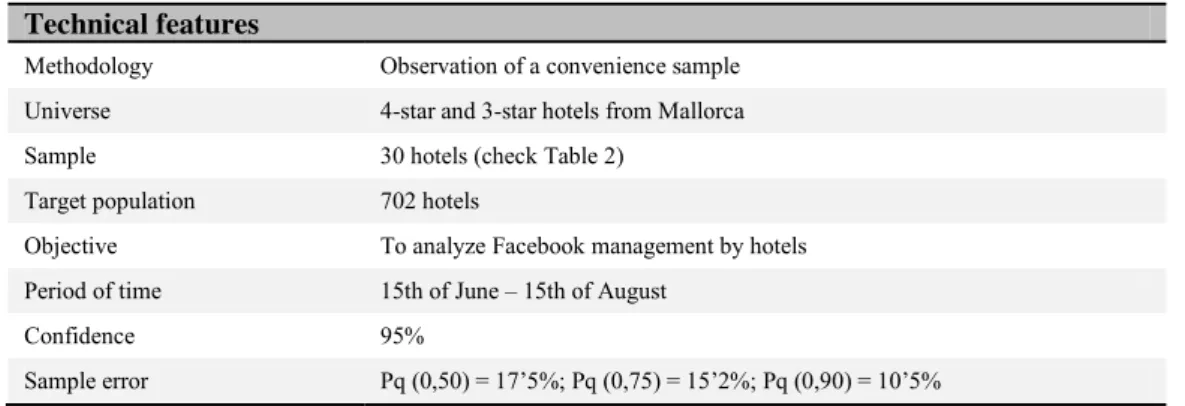
(13) Analysis of the relationship between social media management and eWOM: an exploratory study of the hotel sector. Furthermore, table 3 summarizes the key technical features of the analysis. Table 3. Technichal features Technical features Methodology. Observation of a convenience sample. Universe. 4-star and 3-star hotels from Mallorca. Sample. 30 hotels (check Table 2). Target population. 702 hotels. Objective. To analyze Facebook management by hotels. Period of time. 15th of June – 15th of August. Confidence. 95%. Sample error. Pq (0,50) = 17’5%; Pq (0,75) = 15’2%; Pq (0,90) = 10’5%. 4. RESULTS 4.1 Facebook site’s accessibility All the hotel’s Facebook sites are easily found through the Facebook’s search box. On the other hand, even though most of the hotels have a direct link to their Facebook pages on their websites, we can observe some accessibility difficulties on hotels pertaining to a hotel chain. This is because hotel chains don’t have direct links to the Facebook pages of every single hotel, but to a general hotel chain’s Facebook site. 4.2 Hotel’s main information Hotels’ address, telephone number and the website link appear on every Facebook site we have analyzed. Furthermore, most of the hotels provide an email address to contact them (there are just four 3-star hotels which don’t include this information). Concerning hotels description, 70% of hotels include a few lines talking about their location and facilities. There is an important difference between 4-star and 3-star hotels strategy, since 87% of 4-star hotels include this information, while only 53% of 3-star hotels do. There is only one hotel without pictures of its facilities on the Facebook site. Nevertheless, just a few hotels such as Hoposa Daina and Las Gaviotas Suites hotel have an album with those pictures. In almost all the cases, you have to look for these pictures amongst all their timeline photos. Furthermore, only 27% of the hotels have uploaded a corporative video showing their facilities. On that sense, both 4-star and 3-star hotels follow a similar strategy (four videos are from 4-star hotels and four videos are from 3-star hotels). It is important to 13.
(14) Analysis of the relationship between social media management and eWOM: an exploratory study of the hotel sector. highlight that two of the analyzed hotels (Inturotel Sa Marina and Inturotel Cala Azul Park) use an application that give the travelers the chance to make a virtual tour around the hotel facilities. Additionally, there is an example of a hotel (Aimia Hotel) which has uploaded a corporative video, but instead of showing and promoting their facilities most of the images are focused on the hotel staff, turning them into the most valuable asset of the company and the main reason to convince tourists to book a room there. Apart from corporative videos, many hotels have also uploaded videos about some activities and amenities that travelers can find if they book a room there (pool party, yoga session, fireworks, etc). On that sense, nearly 93% of 4-star hotels have uploaded at least 1 video. From them, around 13% have uploaded between 6 and 10 videos, and 20% of the hotels up posted more than 10 videos. On the other hand, in regards of 3-star hotels strategy, percentages are quite different. There are 40% of the hotels which have no videos available on their Facebook sites, and there is no hotel that has uploaded more than 10 videos. The calendar of upcoming events tool is not really taken into account by the majority of the hotels. There are just 17% of them which use it to promote special parties or activities (mainly Magaluf places). Furthermore, there are some hotels which have used that tool in the past and they are not doing it currently, so it is common to check that part of the site and find very old and outdated information (events from 2012 or 2013). Another wasted tool is the call to action application. There are only three 4-star hotels (20%) and one 3-star hotel (7%) with their room rates and booking platform available within the Facebook site. Hoposa Daina and Riu Palace Bonanza (4-star hotels) and Ivory Playa (3-star hotel) are the ones which better use this platform. Some hotels redirect travelers to their websites when clicking the call to action button (users have to leave Facebook to get information about booking) and more than a half don’t even use this option. 4.3 Social Media links In regards of connection with other social media platforms like Twitter, Flickr or Instragram, there are only 13% of the hotels with links to these social networks pages on their Facebook sites. Moreover, all of them are 4-star hotels (there is no 3-star hotel with this kind of social network connection). 14.
(15) Analysis of the relationship between social media management and eWOM: an exploratory study of the hotel sector. Nevertheless, a different trend can be appreciated concerning to TripAdvisor platform. Nearly 60% of the hotels have a direct link to TripAdvisor on Facebook. On that sense, we can also see that there is a difference between 4-star and 3-star hotels strategies. Meanwhile 80% of 4-star hotels promote TripAdvisor platform on their Facebook sites, less than a half of 3-star hotels do. However, we should also mention that some 3-star hotels such as Hotel Sis Pins, Playa Ca’s Saboners Aparthotel and Hotel Atolon have published posts in order to thank travelers for their positive TripAdvisor reviews or even asking them to do that. 4.4 Interactivity between hotel and customers (during-stay stage) General engagement indicators (number of ―likes‖ and ―were here‖) show us small differences between 4-star and 3-star hotels. In both cases, the majority of hotels have between 1000 and 3000 ―likes‖. Even though the percentage of 3-star hotels with less than 1000 ―likes‖ is a little bit higher than in 4-star hotels (20% vs. 13%), it is also true that three of the four hotels with a higher number of ―likes‖ (Sotavento Apartamentos, Viva Sunrise and Hotel Sis Pins) are 3-star hotels. In regards of the ―were here‖ indicator, which could provide us more accurate information about the interaction between travelers and the Facebook site, we got similar figures. Nearly 66% of the hotels get more than 1000 ―were here‖, being three of the four hotels with higher numbers (Viva Sunrise, Playa Ca’s Saboners Aparthotel and BQ Belvedere hotel) a 3-star hotel. We can’t find any correlation between both indicators, since there are hotels with a high number of ―likes‖ and a low number of ―were here‖, other hotels with a low number of ―likes‖ and a high number of ―were here‖, and hotels with high or low numbers in both indicators. Moreover, we can’t either observe any common trend depending on whether a hotel pertains to a hotel chain. More relevant results can be obtained from the analysis of the posts published from June 15th to August 15th and their impact on travelers’ engagement. Firstly, we realized that 4-star hotels published almost the triple of posts than 3-star hotels. Around 60% of 3-star hotels published less than 10 posts during that period, while just 27% of 4-star hotels had such a low frequency trend. The higher number of posts published by a 3-star. 15.
(16) Analysis of the relationship between social media management and eWOM: an exploratory study of the hotel sector. hotel is 37 and this number increase up to 80 posts when we analyze 4-star hotels situation. In fact, 27% of 4-star hotels published more than 37 posts. Nevertheless, if we check the number of ―likes‖ and comments received on the last 5 official posts, the trend is completely different. 3-star hotels’ posts have received almost 1000 ―likes‖ and 150 ―comments‖ more than 4-star hotels’ posts. Therefore, the level of engagement and interaction with travelers is higher on 3-star hotels’ Facebook sites, since their posts get higher attention from travelers. One of the possible reasons is the kind of posts published. On that sense, we have found some 3-star hotels which have organized photography quizzes on their Facebook sites. Furthermore, another possible reason is the active participation of 3-star hotels on their own posts conversations. Nearly 67% of them answer to the comments done by travelers on each post. This percentage is a little bit lower on 4-star hotels situation (around 60%). 4.5 Interactivity between hotel and customers (post-stay stage) The first interesting figure is that 23% of the hotels don’t have the option to post a review on their Facebook sites (33% if we only take into account 4-star hotels). On the other hand, there are 30% of the hotels which have received up to 100 reviews, 17% which have received between 101 and 200 reviews, and 30% which have received more than 200 reviews. We can appreciate that 3-star hotels usually receive more reviews than 4-star hotels, reaching in some cases more than 400 or even 500 reviews. Less than a half on analyzed hotels invest time in answering travelers’ reviews. Concretely, 47% of 4-star hotels and 40% of 3-star hotels make an effort to thank tourists who have posted a positive review and try to give a solution to travelers who posted a negative one. It is important to clarify that we have only taken into account hotels that write an answer to their customers (just clicking on the ―like‖ button on the positive comments when customers have spent time writing two or three paragraphs sharing their opinions is not considered enough). We can also realize that sometimes language could be a barrier to answer reviews (there are sites where only reviews written in English or Spanish are answered). Nevertheless, this shouldn’t be an excuse for hotels that mainly host German tourists and don’t answer reviews written in German. 16.
(17) Analysis of the relationship between social media management and eWOM: an exploratory study of the hotel sector. Most of the hotels pay more attention to answer negative reviews than positive ones. On that sense, some hotels just try to apologize for a bad service and show their commitment to improve in the future, while other hotels start long discussions with customers trying to convince them that the service provided was perfect. Regarding positive reviews, there are some hotels like Playa Ca’s Saboners Aparthotel that usually publish them on their timeline, so that people can find and read them easily. Furthermore, some hotels like Hotel Sis Pins directly ask to their customers for posting those positive reviews written in Facebook also in TripAdvisor. Another interesting result is that we haven’t found any correlation between answering reviews and other indicators such as number of ―likes‖, number of ―were here‖ or even ―number of reviews‖. There are hotels which don’t answer reviews with a high number of likes or reviews, and we can also find hotels which make the effort to show their gratitude to the tourists and it has no impact on the rest of Facebook indicators. Last but not least, we would need to highlight that there is no hotel which used Facebook to ask for travelers’ preferences and opinions during the analyzed period. Some of them have shown interest and asked for positive TripAdvisor reviews, but none tried to organize an online survey or posted a comment asking for feedback so that improving their services in the future.. 5. DISCUSSION AND CONCLUSIONS The main objective of our paper was to check whether 4-star and 3-star hotels of Mallorca manage properly their social networks specifically their Facebook sites, keeping in mind that the use of Facebook during the hotel selection process by customers has three differentiated phases: pre-stay, during-stay and post-stay (Cox et al., 2009). The first and crucial step hotels must work on during the pre-stay stage is getting an easy-to-find Facebook site (Minazzi & Lagrosen, 2013). Otherwise, all the future efforts made on that site could be useless, as people won’t realize about them. Furthermore, appealing and updated information about the hotel must be available (Cox et al., 2009). We have seen that almost all the hotels’ Facebook sites give this information to the travelers. However, some improvements related to the way of organizing this 17.
(18) Analysis of the relationship between social media management and eWOM: an exploratory study of the hotel sector. information should be implemented: pictures distributed in albums, events promoted through the events calendar, etc. Moreover, taking into account that Facebook pages can become a great channel to increase the number of bookings and decrease costs paying less commissions to online travel agencies (Minazzi & Lagrosen, 2013) hotels must take more advantage of the ―call to action‖ function. Keeping in mind the high amount of people who check online reviews before booking a room (Anderson, 2012) the direct link to the TripAdvisor platform that hotels have on their webpage is highly appreciated by travelers, and can help them to sell their rooms. On that sense, 3-star hotels’s Facebook sites could be improved. Along the second stage (during-stay phase) hotels must take into account that travelers check Facebook pages to share pictures, check information about amenities and post comments (Xiang & Gretzel, 2010). After analyzing the interaction between hotels and tourists we have realized that the number of posts don’t influence on the level of engagement, as it happened on the Investigating Social Media Marketing in the Hospitality Industry (Minazzi & Lagrosen, 2013). The frequency of posts is not as important as the content itself so that reaching travelers engagement. Furthermore, a lot of work still has to be done by hotels during the third stage (post-stay phase). Answering positive and negatives comments, as well as getting customer feedback so that improving services in the future are marketing opportunities hotels should take advantage of (Litvin et al., 2008). Nevertheless, in our analysis we have observed that the percentage of hotels which invest time on replying travelers reviews is very low, missing the chance to use eWOM in order to achieve a competitive advantage (Loureiro & Kastenholz, 2011). Comparing our study with other previous investigations that also analyzed the use of Facebook by hotels, we can realize that the main findings are quite similar. Although the obtained results demonstrates that hotels in Mallorca are present to a certain extent in Facebook, overall they don’t take as much profit as possible of that social media platform, so there does still remain ample room for improvement (O Connor, 2011; Phelan et al., 2013).. 18.
(19) Analysis of the relationship between social media management and eWOM: an exploratory study of the hotel sector. Finally, we would like to highlight the importance of this study for the hoteliers in Mallorca. According to the Instituto Nacional de Estadística, there were more than 2 million tourists who visited Balearic Islands in July. These great numbers for the tourism sector also imply some challenges to deal with, like some travelers complaints because of overcrowding (hotels, restaurants and other tourism-related companies haven’t been able to fulfill service quality expectations). Hotel managers should understand that maintaining the same occupation rates in 2017 will partly depend on how effective they are managing those travelers’ negative opinions. Therefore, most of the Facebook management guidelines analyzed and explained along this document can be very helpful.. 6. LIMITATIONS First of all, even thought we have tried to analyze a heterogeneous and representative sample, including hotels from different sizes and areas of the island, a study of only 30 hotels in such a touristic place as Mallorca is not enough to get a very accurate overview of the real situation. Future studies should consider a larger sample, which involves many hotels from different quality levels. Secondly, the fact of comparing hotels which target people from different countries and purchasing power might imply some gaps or even mistakes in our final conclusions. A 4-star hotel located in Port de Pollença whose target is 70-year old German couples and a 3-star hotel of Magaluf plenty of British students should implement different online marketing strategies. A deeper analysis on that sense, thinking about more specific indicators for each kind of hotel, would help us to get better conclusions. In addition, most of the information is related to the summer months. Extending the period of observation would be interesting so that observing whether those hotels work actively on their Facebook sites during the tourism low season. Moreover, this study mainly considers some Facebook indicators to analyze how hotels manage eWOM. There are many other social media platforms and consumer review websites (TripAdvisor) that have an important effect on hotels’ booking results. A further analysis that takes into account a higher number of metrics and different social. 19.
(20) Analysis of the relationship between social media management and eWOM: an exploratory study of the hotel sector. media sites will provide us a better overview of how hotels in Mallorca manage eWOM so that increasing their revenues. Finally, future lines of investigation should focus not only on how social media management affects eWOM but also on measuring the direct impact of eWOM on hotels revenues. For instance, it should be analyzed whether hotels from Mallorca really need to manage eWOM to increase their sales, as well as the percentage of the hotels’ current occupancy rates which is a direct consequence of eWOM management. Additionally, future investigations should study whether the economic impact of eWOM management is important enough so that compensating all the money invested in that area (community managers’ wages, bonus offered to hotel directors related to TripAdvisor reviews, etc).. ACKOWLEDGEMENTS The author would like to thank Francisco Rejón for his advices and recommendations along all this study. His knowledge and experience have been crucial so that establishing the key guidelines of this analysis and reaching the desired goals. Furthermore, Francina Orfila and Maria Sard also contributed to this document elaboration, giving some ideas and providing some interesting journal articles which have been very useful.. 7. REFERENCES Anderson, Chris. (2012). The Impact of Social Media on Lodging Performance, 4–12. Buhalis, D., & Law, R. (2008). Progress in information technology and tourism management: 20 years on and 10 years after the Internet—The state of eTourism research. Tourism Management, 29(4), 609–623. http://doi.org/10.1016/j.tourman.2008.01.005 Bulencea, P., & Egger, R. (2013). Facebook it: Evaluation of Facebook’s Search Engine for Travel Related Information Retrieval. In Z. Xiang & I. Tussyadiah (Eds.), Information and Communication Technologies in Tourism 2014 (pp. 467–480). 20.
(21) Analysis of the relationship between social media management and eWOM: an exploratory study of the hotel sector. Cham: Springer International Publishing. Retrieved from http://link.springer.com/10.1007/978-3-319-03973-2_34 Cox, C., Burgess, S., Sellitto, C., & Buultjens, J. (2009). The Role of User-Generated Content in Tourists’ Travel Planning Behavior. Journal of Hospitality Marketing & Management, 18(8), 743–764. http://doi.org/10.1080/19368620903235753 Dellarocas, C. (2003). The digitization of word of mouth: Promise and challenges of online feedback mechanisms. Management Science, 49(10), 1407–1424. Dev, C. S., Buschman, J. D., & Bowen, J. T. (2010). Hospitality Marketing: A Retrospective Analysis (1960-2010) and Predictions (2010-2020). Cornell Hospitality Quarterly, 51(4), 459–469. http://doi.org/10.1177/1938965510376353 Escobar-Rodríguez, T., & Carvajal-Trujillo, E. (2013). An evaluation of Spanish hotel websites: Informational vs. relational strategies. International Journal of Hospitality Management, 33, 228–239. http://doi.org/10.1016/j.ijhm.2012.08.008 Godes, D., & Mayzlin, D. (2009). Firm-Created Word-of-Mouth Communication: Evidence from a Field Test. Marketing Science, 28(4), 721–739. http://doi.org/10.1287/mksc.1080.0444 Goldenberg, J., Libai, B., & Muller, E. (2001). Talk of the network: A complex systems look at the underlying process of word-of-mouth. Marketing Letters, 12(3), 211– 223. Goldsmith, R.E., Horowitz, D. (2006). Electronic word-of-mouth. In Encyclopedia of ecommerce, e-government and mobile commerce (pp. 408–412). Hershey PA: Idea Group Publishing.. 21.
(22) Analysis of the relationship between social media management and eWOM: an exploratory study of the hotel sector. Herr, P. M., Kardes, F. R., & Kim, J. (1991). Effects of Word-of-Mouth and ProductAttribute Information on Persuasion: An Accessibility-Diagnosticity Perspective. Journal of Consumer Research, 17(4), 454. http://doi.org/10.1086/208570 Hsu, Y.-L. (2012). Facebook as international eMarketing strategy of Taiwan hotels. International Journal of Hospitality Management, 31(3), 972–980. http://doi.org/10.1016/j.ijhm.2011.11.005 Kim, W. G., Lim, H., & Brymer, R. A. (2015). The effectiveness of managing social media on hotel performance. International Journal of Hospitality Management, 44, 165–171. http://doi.org/10.1016/j.ijhm.2014.10.014 Ladhari, R., & Michaud, M. (2015). eWOM effects on hotel booking intentions, attitudes, trust, and website perceptions. International Journal of Hospitality Management, 46, 36–45. http://doi.org/10.1016/j.ijhm.2015.01.010 Lewis, R. C., & Chambers, R. E. (1999). Marketing leadership in hospitality, foundations and practices (3rd ed). John Wiley and Sons. Libai, B., Bolton, R., Bugel, M. S., de Ruyter, K., Gotz, O., Risselada, H., & Stephen, A. T. (2010). Customer-to-Customer Interactions: Broadening the Scope of Word of Mouth Research. Journal of Service Research, 13(3), 267–282. http://doi.org/10.1177/1094670510375600 Litvin, S. W., Goldsmith, R. E., & Pan, B. (2008). Electronic word-of-mouth in hospitality and tourism management. Tourism Management, 29(3), 458–468. http://doi.org/10.1016/j.tourman.2007.05.011 Loureiro, S. M. C., & Kastenholz, E. (2011). Corporate reputation, satisfaction, delight, and loyalty towards rural lodging units in Portugal. International Journal of. 22.
(23) Analysis of the relationship between social media management and eWOM: an exploratory study of the hotel sector. Hospitality Management, 30(3), 575–583. http://doi.org/10.1016/j.ijhm.2010.10.007 Mauri, A. G., & Minazzi, R. (2013). Web reviews influence on expectations and purchasing intentions of hotel potential customers. International Journal of Hospitality Management, 34, 99–107. http://doi.org/10.1016/j.ijhm.2013.02.012 Mich, L., & Baggio, R. (2015). Evaluating Facebook pages for small hotels: a systematic approach. Information Technology & Tourism, 15(3), 209–231. http://doi.org/10.1007/s40558-015-0031-2 Minazzi, R., & Lagrosen, S. (2013). Investigating Social Media Marketing in the Hospitality Industry: Facebook and European Hotels. In Z. Xiang & I. Tussyadiah (Eds.), Information and Communication Technologies in Tourism 2014 (pp. 145–157). Cham: Springer International Publishing. Retrieved from http://link.springer.com/10.1007/978-3-319-03973-2_11 Murphy, H. C., & Nolly, M. (2012). An exploration of the adoption and drivers of Facebook as a marketing tool in small medium sized enterprise (SME) hotels. 2nd Advances in Hospitality and Tourism Marketing & Management, Corfu Island, Greece. Retrieved from http://www.ahtmm.com/proceedings/2012/2ndahtmmc_submission_120.pdf Noone, B. M., McGuire, K. A., & Rohlfs, K. V. (2011). Social media meets hotel revenue management: Opportunities, issues and unanswered questions. Journal of Revenue & Pricing Management, 10(4), 293–305. O Connor, P. (2011). An analysis of the use of Facebook by international hotel chains. Retrieved from http://scholarworks.umass.edu/refereed/ICHRIE_2011/Wednesday/9/. 23.
(24) Analysis of the relationship between social media management and eWOM: an exploratory study of the hotel sector. Papathanassis, A., & Knolle, F. (2011). Exploring the adoption and processing of online holiday reviews: A grounded theory approach. Tourism Management, 32(2), 215–224. http://doi.org/10.1016/j.tourman.2009.12.005 Serra Cantallops, A., & Salvi, F. (2014). New consumer behavior: A review of research on eWOM and hotels. International Journal of Hospitality Management, 36, 41– 51. http://doi.org/10.1016/j.ijhm.2013.08.007 Sun, T., Youn, S., Wu, G., & Kuntaraporn, M. (2006). Online Word-of-Mouth (or Mouse): An Exploration of Its Antecedents and Consequences. Journal of Computer-Mediated Communication, 11(4), 1104–1127. http://doi.org/10.1111/j.1083-6101.2006.00310.x Vermeulen, I. E., & Seegers, D. (2009). Tried and tested: The impact of online hotel reviews on consumer consideration. Tourism Management, 30(1), 123–127. http://doi.org/10.1016/j.tourman.2008.04.008 Virginia Phelan, K., Chen, H.-T., & Haney, M. (2013). ―Like‖ and ―Check-in‖: how hotels utilize Facebook as an effective marketing tool. Journal of Hospitality and Tourism Technology, 4(2), 134–154. http://doi.org/10.1108/JHTT-Jul-20120020 Wan, C.-S. (2002). The web sites of international tourist hotels and tour wholesalers in Taiwan. Tourism Management, 23(2), 155–160. Westbrook, R. A. (1987). Product/Consumption-Based Affective Responses and Postpurchase Processes. Journal of Marketing Research, 24(3), 258. http://doi.org/10.2307/3151636 Wong, J., & Law, R. (2005). Analysing the intention to purchase on hotel websites: a study of travellers to Hong Kong. International Journal of Hospitality Management, 24(3), 311–329. http://doi.org/10.1016/j.ijhm.2004.08.002. 24.
(25) Analysis of the relationship between social media management and eWOM: an exploratory study of the hotel sector. Xiang, Z., & Gretzel, U. (2010). Role of social media in online travel information search. Tourism Management, 31(2), 179–188. http://doi.org/10.1016/j.tourman.2009.02.016 Ye, Q., Law, R., & Gu, B. (2009). The impact of online user reviews on hotel room sales. International Journal of Hospitality Management, 28(1), 180–182. http://doi.org/10.1016/j.ijhm.2008.06.011 Yoon, Y., & Uysal, M. (2005). An examination of the effects of motivation and satisfaction on destination loyalty: a structural model. Tourism Management, 26(1), 45–56. http://doi.org/10.1016/j.tourman.2003.08.016 Živkovic, R., Gajic, J., & Muharemovic, J. (2013). The impact of digital media on tourism and hospitality. Fakultet Za Menadzment Sremski Karlovici, 35.. 25.
(26)
Figure


Documento similar
1 N en Vienna en Hotel Grand Ferdinand 5* / Hotel Kaiserhof 4* / Hotel Austria Trend Savoyen 4* o similar 2 N en Prague en Hotel Grandium 5* / Hotel Grandior 5* / Hotel La Ballerina
Alojamiento en un encantador hotel pequeño, donde nuestros anfitriones prepararán comidas tradicionales para la cena.. Alojamiento en hotel en régimen de habitación doble
Por la noche cena libre Opcional en el Hotel (restaurante o cafetería) A las 23:30h saldremos con el autobús desde el hotel para ir a la Fiesta en la Discoteca Circulo
In relation to the Corporate Social Responsibility of the Barceló Group, in its reports it does not refer to aspects related to environmental issues, efforts to reduce
In relation to the returns that tourism sector organizations could achieve through ICTs, we observe in the literature that: (1) if ICTs are properly directed, they would help
The third article “Customer orientation and e-WOM in the hotel sector” was a qualitative study, on family businesses from the hotel sector, that tested the extent to
Con la última intervencion sobre el eje de la Avenida Jimenez se incorporo espacio público en esta zona cadente de espacios propios para el ciudadano.. Deficit de espacio
Cena en el Restaurante del Hotel Shana Resort o Wyndham Tamarindo Alojamiento en el hotel de Manuel Antonio, el Hotel Shana Resort en habitación estándar o Alojamiento
