Accepted Manuscript
Business model analysis of public services operating in the smart city ecosystem: The case of SmartSantander
Raimundo Díaz-Díaz, Luis Muñoz, Daniel Pérez-González
PII: S0167-739X(17)30155-3
DOI: http://dx.doi.org/10.1016/j.future.2017.01.032 Reference: FUTURE 3314
To appear in: Future Generation Computer Systems Received date : 1 December 2015
Revised date : 16 December 2016 Accepted date : 26 January 2017
Please cite this article as: R. Díaz-Díaz, et al., Business model analysis of public services operating in the smart city ecosystem: The case of SmartSantander, Future Generation Computer Systems (2017), http://dx.doi.org/10.1016/j.future.2017.01.032
This is a PDF file of an unedited manuscript that has been accepted for publication. As a service to our customers we are providing this early version of the manuscript. The manuscript will undergo copyediting, typesetting, and review of the resulting proof before it is published in its final form. Please note that during the production process errors may be discovered which could affect the content, and all legal disclaimers that apply to the journal pertain.
Business model analysis of public services operating in the smart city ecosystem: The case of SmartSantander
Raimundo Díaz-Díaza *, Luis Muñozb, Daniel Pérez-Gonzáleza
a
Department of Business Administration, University of Cantabria, Spain
b
Department of Communication Engineering, University of Cantabria, Spain
*Corresponding author. Tel.: +34 942201605. E-mail address: [email protected]
Faculty of Economics and Business Studies, University of Cantabria, Avenida de los Castros SN, 39005, Santander, Cantabria, Spain
Abstract
As the deployment of Internet of Things and other enabling technologies is still in an initial phase worldwide, few research studies have addressed the associated business models. This paper aims to fill this gap. The main objective of this research is to gain a deeper knowledge about practical business models matching into a real-life smart city ecosystem. Hence, a benchmarking of eight urban services provided in the city of Santander has been carried out: waste management; water supply; traffic management; street lighting; augmented reality and tourism; incidences management, parks and gardens and citizen participation. Among the main results of our study, we highlight that those public services properly managed embedding IoT technology convey cost reductions in the long term. There is also a reduction in energy consumption and environmental impact with the consequent social impact. It should also be highlighted that most data are managed with the same platform. Last but not least, an emerging ecosystem of incentivized citizens has been proved to be arising.
Keywords: smart cities; business model; Canvas; sustainability; Santander; IoT;
1. Introduction
Progress in ICT (Information and Communication Technologies) solutions have enabled not only the private sector, but also public institutions to radically improve the way they perform their operational activities [1]. This has inspired particularly local government administrations to transform the way services are offered to citizens [2]. The cities themselves firmly believe that innovative uses of ICT will foster sustainable city innovation that is able to improve the quality of life of its citizens [3].
Smart cities with instrumentation and interconnection of mobile devices and sensors can collect and analyze data gathered and improve the ability to forecast and manage urban flows, thus push city intelligence forward [4].
We identify a smart city as one with a comprehensive commitment to innovation in technology, management and policy [5].
Modern cities are facing a variety of challenges ranging from ecological sustainability or climate-neutral architecture to new socio-economic opportunities, budget cuts or global accessibility. Clearly, improvements in smart governance systems are of paramount relevance for the success of smart city strategies [6]. In addition, the latest technological developments open up different ways of creating value in cities and, thus, new business models.
As the first projects for smart cities are still ongoing [7], different aspects remain vague. Financial sustainability and business models are among the issues pending to be fixed [8–10]. Even though the message that smart cities require new business models [8] is well repeated, few research studies have been published describing such practical business models.
This research is an initial effort towards bridging the existing knowledge gap in the literature. More specifically, the main objective of this research is to acquire a deeper knowledge about practical business models aiming at fulfilling present and future city requirements in the city scenario. In particular, we will be coping with the following four research questions:
RQ1: Do public services implemented with smart technologies in smart cities differ in their
business models from those managed as conventionally?
RQ2: Are the economic impact of public services developed with smart technologies higher or
lower for citizens related to those managed as traditionally?
RQ3: Are the environmental costs of public services developed with smart technologies different
from those managed as conventionally?
RQ4: Does the use of public services developed with smart technologies stimulate different
stakeholders’ participation in order to achieve sustainable solutions for environmental, social or economic issues?
In order to address these questions, we have examined eight use cases related to urban services and to citizen participation performed in the city of Santander, Spain. We have focused our research on this city due to its innovative projects within the context of smart cities [11–14] and its recognition as a pathfinder in smart cities’ technology and management [15,16]. Following the eight case studies, we conducted a double benchmarking: the first one, between the conventional way of managing those municipal services
and the management developed with innovative ICT solutions. The second one highlights the differences among the eight types of public services.
The remaining of the paper is structured as follows: section 2 describes the smart cities and business models concepts. In section 3 we explain the methodology used for the research. Section 4 is dedicated to the results of the case studies analyzed and the benchmarking developed. In section 5 we discuss the results and in the number 6 we report the conclusions, the limitation of our research and propose lines for future work.
2. State of the art
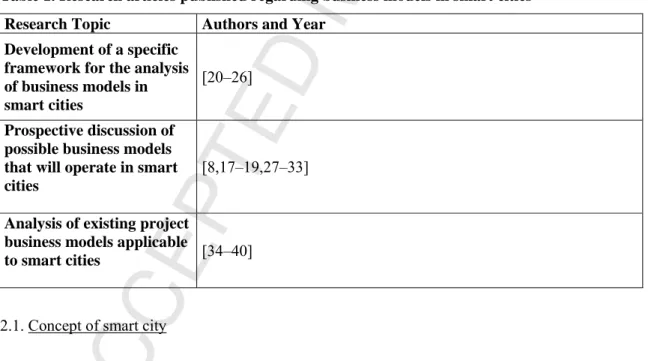
Smart cities are a subject of research that has generated a growing interest in the scientific community during the last decade [17]. The business model is one of the areas considered most important by the changes that the smart city produces in public services [18]. However, the scientific literature that analyzes their business models is reduced because there are currently few smart city projects underway and those that exist are small scale [19]. Precisely, this is one of the reasons that put the value of this article. The following table presents a description of the main published works (Table 1).
Table 1. Research articles published regarding business models in smart cities Research Topic Authors and Year
Development of a specific framework for the analysis of business models in smart cities
[20–26]
Prospective discussion of possible business models that will operate in smart cities
[8,17–19,27–33]
Analysis of existing project business models applicable
to smart cities [34–40]
2.1. Concept of smart city
The smart city concept varies dramatically depending on the approach [20]. Making simple the controversy, it can be said that there are two different approaches. On the one hand, the vision of those who understand the concept “smarter” in the urban context as more efficient, sustainable, equitable, and livable [41]. On the other hand, a vision closer to industry that prefers to emphasize that the smart city denotes an instrumented, interconnected, and intelligent city [42]. However, the most significant features
around smart cities can be summarized as follows: 1) The technological innovation; 2) The policy innovation; 3) And the management innovation [43].
Caragliu states that a smart city is characterized by a clever combination of investments in – and a clever use of – resources (in particular, human, social, creative, infrastructural, technological and business capital) that fuel sustainable economic growth and produce a high quality of life, under conditions of a wise management of natural resources and a broadly supported governance system [44].
Six main areas can be identified in which these digital innovations should make a difference: smart living, smart governance, smart economy, smart environment, smart people and smart mobility [45].
The Internet of Things (IoT) is one of the main technologies deployed in smart cities. It consists on interconnecting new services to the physical and virtual worlds through electronic devices distributed in houses, vehicles, streets, buildings and many other public environments. Hence, a massive amount of data will be flowing over the Internet.
Although IoT deployment in smart cities is still in an initial phase [7], various projects using IoT and other emerging technologies have being set up in the European Union [3]. Santander is one of the cities that has gained more attention since in 2009 the SmartSantander project was funded by the European Commission’s FP7 [7,46–49].
2.2. Public services in smart cities
e-Government applications enhance cost efficiency and effectiveness in the public sector, and bring about transformational change in public service provision, administration and engagement with the general public [50]. Technology is key for being a smart city because of the use of ICT to transform life and work within a city in significant and fundamental ways [51]. ICT applications can offer some solutions when addressing those political, managerial, democratic or material challenges.
There are many examples of smart solutions in public services to improve the quality of life in cities across the world [28]. A wide range of smart services can be deployed as part of smart city initiatives, including transportation, environment, building, education, tourism, healthcare, public safety – to use real-time information to anticipate and respond rapidly to emergencies [7].
The term “Business Model” has been documented broadly in business and academic environments during the last few years [52] and various researchers have developed frameworks to analyze business models. In particular, Osterwalder’s Business Model Canvas has gained significant attention within the entrepreneurship mood [53].
A business model describes the rationale of how an organization creates, marketing, delivers and captures value [54]. Nowadays, business model innovation is often more important than a better idea or technology [55].
Smart cities require new business models [8] but there is not only one municipal business model and none is better [34], they depend of different factors, being the character of the stakeholders taking part in the network one of the main ones [35]. Cities are made of subsystems which interact, i.e. an ecosystem [25]. 2.4. Smart city ecosystems
Biological ecosystems are systems composed of organic and inorganic matter and natural forces that interact and change [56]. Cities are ecosystems where sustainability is maintained through the interactions of urban components [36].
In the smart city ecosystem, the different stakeholders perform a more active role [57]: private sector participation is key in project sustainability [58,59]; citizens can interact directly to city officials and generate useful data coming from digital footprints, social media and crowd sourcing [48,60]; Governments foster the collaboration of different actors [61]. As the stakeholders of novel ecosystems adopt a different role in the value chain, they are forced to reshape their business models; therefore, smart cities also raise new business models [17]. A large number of real life smart city ecosystems are now being analyzed around the globe; it is the case of the European Network of Living Labs (ENOLL) [62].
3. Methodology
We have chosen the case study method in order to address the four RQs highlighted previously. The case study is a good research strategy for examining a contemporary phenomenon in its real-life context, especially when the boundaries between phenomenon and context are not clearly evident [63]. A lack of prior theorizing about a topic makes the inductive case study approach an appropriate choice of methodology for developing theory [64]. Using cases to recognize patterns of relationships is appropriate to develop theory inductively [65]. We use the case studies’ results in order to address the RQs and to draw several conclusions.
The case of the cit to analyz before th previous significa those off Asking o literature During t tools am and desig being su alternativ model [6 customer 2. Table 2. The Can its main for the fa e studies cho ty of Santand ze their busi he integration s comparison ant difference fered using sm ourselves abo e several suit the last few mong entrepre gning busine uccessfully u ves. Moreove 67]. The Ca rs, offer, infr . Nine Busin
nvas was des function is to amous Busin
sen for the c der. Eight pu iness models n of such nov ns. This doub es existing b mart technol out the most table framew years, Oster eneurs. The B ess models. I used to easi er, this frame anvas compr rastructure an ness Model B igned to allo o help to gen ness Model Y current resear ublic services s and compar vel technical ble benchmar between busin logy. appropriate w works for this
rwalder’s Bu Business Mo t was applied ily describe ework presen rises nine el nd financial v Building Bloc ow entrepren nerate profit. You [68]. Thi rch were sele s, operating red these wi solutions. A rk methodolo ness models way to analy kind of busin usiness Mode del Canvas i d and tested and manipu nts a clear de lements, wh viability. The cks [54] eurs to analy It has also b s framework ected from th in Santander ith the mode fterwards, w ogy allows u , the ones fo yze each of th ness model a el Canvas ha is a framewo in many org ulate busines escription of ich cover th ese elements
yze their proj een used for k is not that su he smart city r using ICTs, els developed we analyzed th us to draw co or convention he business m analysis [66]. as become on rk created fo anizations (e ss models to the elements he four main are depicted ject business many other p uitable for pu y’s paradigma , were select d for the sam
he results of onclusions o nal public se models, we fo . ne of the mo or describing e.g. IBM and o create new s comprising n areas of a d and describe s models, tha purposes her ublic adminis atic project ed in order me services those eight on the most ervices and ound in the ost popular , analyzing d Ericsson), w strategic g a business a business: ed in Table at is to say, reafter, like strations as
the prov economi ageing p activities city cont The auth They re administ literature two addi Figure 1) Figure 1 In additi [66,71]. There is the intan value [72 vision of an ic benefits. It population, h s [7]. Howev text [69]. hors of the C commend to trations [70], e. The main itional param ). 1: Business M
on, some res
also a specif ngible factor 2]. improved q t is for instan health, etc.) ver, some res
Canvas also o use the fr , although w difference be meters, “Socia Model Canv searchers hav fic framewor rs of the citie quality of lif nce the case o
or environm searchers [37 created the ramework fo we have been etween this f al and Enviro
vas for Non-P
ve modified t rk to examine es which the fe to citizen of smart citie mental goals 7] and practi Non-Profit or non-profit n unable to f framework an onmental Ben Profits [70] the Canvas in e business m e authors co ns is usually es, which pur
like reducin itioners have
Canvas for a ts when ana find any auth
nd the origin nefit” and “S n order to ada models in sma mpress with a priority o rsue social ac ng environme e also used th analyzing no alyzing busin hor using it nal one is tha Social and En
apt it to their
art cities [20, hin the conce
over the gen chievements ental footpri he Canvas in
on-profit org ness models for this purp at the first on nvironmental r specific inv ,21]. It takes epts control neration of (regarding int of their n the smart ganizations. s in public pose in the ne includes Cost” (see vestigations in account and public
In order to select the most suitable framework, we relied on the insights collected through in-depth interviews with eleven experts on business plan development and business model design. The in-depth interview method is a widely used qualitative method in exploratory and social research (Bogner et al., 2009; Hill & White, 2000; White & Raman, 1999) that helped us to determine the most appropriate framework to conduct the current analysis. Seven out of the eleven experts recommended the use of the Business Model Canvas or the version for non-profits. The remaining four suggested that there is more than one suitable framework to analyze the business models. However, only one of these four experts stated that the Canvas is not the most appropriate approach. The experts underlined two advantages of the Canvas in comparison to other frameworks: 1) It is the most widely used and recognized method within both the scientific and the professional level, which gives it prestige and, additionally, makes our research more readily understandable to those interested in it; 2) It is a flexible method that allows to fit into it the different specificities of each business model. Hence, we decided to use the Canvas for non-profit organizations.
When analyzing the public services through the Canvas, we should place ourselves in the position of the service provider. However, given that usually several stakeholders participate in the provision of public services (city councils, companies, citizens, etc.) [58,76], we carry out the analysis from the perspective of the aggregation. We use such an approach as we consider the point of view of each stakeholder participating in the provision of the service, as we believe the whole city benefits from this aggregated system of actors with convergent interests. The different agents of the aggregation model share most of the Canvas’ parameters and, thus, we take both points of view. However, there are some of such parameters that only influence on one single agent. For instance, in the waste management case there are three main actors taking part in the aggregation (the city council, the company hired to provide the service and the own University of Cantabria). The citizens (users of the service) are the customers of the aggregation but, at the same time, the company will consider the city council as its customer, thus the city council is part of the aggregation as well as any customer. In order to address this question, we have been explicit in the texts of the canvases regarding the factors which only affect to one of the actors.
Afterwards, we have analyzed the business models using the Canvas approach as well as public information available in the CKAN Open Data repository and additional information owned by the Municipality. We have also collected information monitoring how the services are performing. In the case of Santander City Brain, we also interviewed the city official responsible for the service.
We carried out a double benchmarking hereafter. First, we compared the business models of the selected eight public services as they were traditionally operated, with the business models of the same services supported with ICT. The differences between each pair of business models are highlighted in bold letters.
We decided to choose eight services from different sectors to assess the validity of our research and develop action for a wide range of sectors. We strengthened replication logic since pair-wise comparison could be done within a sector resulting in the sector-specific measures [77], and then continued with a cross-sector comparison, producing the generalized measures. This has helped us to connect sector-specific insights to the generic constructs and formulate strong measures that can be generalized across sectors.
Finally, we compared the differences in the eight cases in order to identify the common parameters, discuss the results and address the RQs raised.
The full research process can be summarized in the following chart (Table 3).
Table 3. Process of research work
4. Results
The business models of some of the key public services (waste management, water supply, tourism promotion, traffic management, street lighting, city incidence management, public gardens and parks irrigation system and citizen participation management) relying on conventional operation models are compared with the ones resulting from the integration of ICT technologies. The results have been described in section 4.1. These results were analyzed in a new comparison where the more repeated differences were highlighted, as can be seen in section 4.2.
The methodology used for comparing business models allowed us to underline the differences between the conventional and the new approach. All the main characteristics of the business models were detected with the Business Model Canvas for Non-Profit and the differences among them were clearly highlighted. 4.1. Business Model Analysis of public services
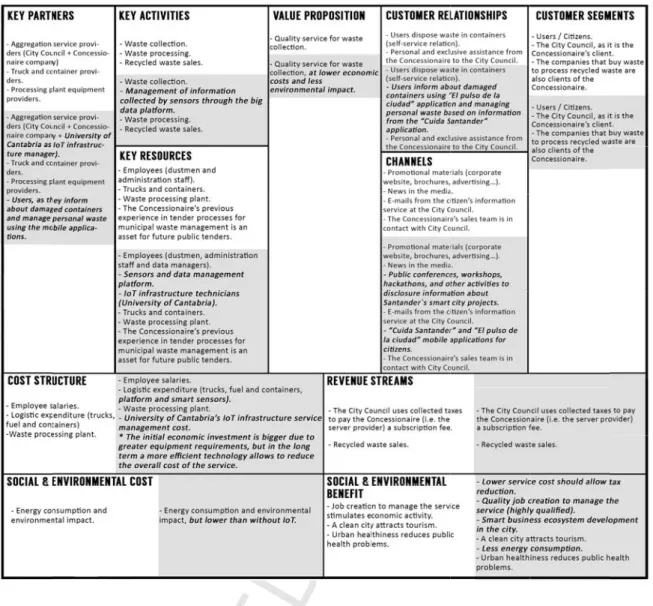
In this subsection, the business models of public services managed with innovative technologies have been compared with those managed conventionally. In the Canvases, the conventional business models
Action Literature review Interviews to experts Benchamark 1 Benchamark 2 Writing of research paper
Outcome
Selection of the Non-Profit Business Model Canvas and development of a first draft of a method to evaluate business models in smart cities
In-depth interviews to select the proper framework for analyzing performance of business models in smart cities
Case study analysis of 8 public services and comparison between the business models of those traditionally managed and the ones that use ICT technologies
Analysis of the main differences between conventional and smart business models of public services
Final paper with the description of the research work and the conclusions
have white background, while business models using innovative technologies are described on a gray background.
4.1.1. Waste management
The Santander City Council is developing a service linked to non-organic waste collection that incorporates the use of the Internet of Things technologies. The city has more than 5,000 sensors to monitor the status of the discharge points (waste containers and bins), which provide information in real time on their location, characteristics and fill levels. The management of this information allows the planning of collecting routes according to the location of full containers, instead of the predefined routes existing in the conventional service. Additionally, both the garbage trucks and other cleaning devices have appliances that gather information about the route followed, the activity carried out and the time involved. This system of smart waste management includes a mobile application called “Cuida Santander”, which allows citizens to know the fill level of bins and containers, the collection routes and timetables, as well as to communicate the service any incident informing about its location. This way users contribute to enhance the service’s efficiency, since the information gathered through the application allows them to plan the appropriate moment to dispose their waste.
Table 4 managem the analy service, Universi infrastru affect on when co social an The mos environm The serv is a 10% shows the r ment services
ysis from the which are th ity of Cantab cture. Most ne of them. W nceiving a n nd environme st significant mental cost se vice managem % lower than results for th s’ business m e perspective he City Cou bria whose re of the factor We aim at ex new way to p ental perspec t differences ections, as th ment’s tender that publish he analysis u models opera e of the agg uncil, the con esearchers co rs described xtending the provide urban ctive. s between bo he IoT model r price prove ed in the pre using the Bu ated conventi gregation of m ncessionaire ordinated the in the Canv legacy Canv n services as oth models a l is cheaper a es that the ser evious tender siness Mode onally and w main actors company w e integration vas affect all vas Model w
well as to m
are found in and less pollu
rvice provide r process. M
el Canvas fo with IoT tech taking part which provide
of the IoT d the actors w ith the differ measure the c the econom uting. ed with IoT e oreover, ther r Non-Profit hnology. We in the provis es the servic devices in the while a few o rent stakehol cost and bene
mic cost and
entails lower re is an addit
ts of waste carried out sion of the ce, and the e smart city others only lders active efits from a social and costs, as it tional 10%
discount in the tender price offered by the winner company of the tender process in 2013, which represents an amount of 15.9 million euros per year for a period of ten years. Therefore, the City Council will spend in the waste management service a 20% less annually compared with the previous tender. The total amount of the contract includes the cost of the researcher’s tasks at the University of Cantabria, as this institution receive a small percentage of the contract’s value.
Hence, the use of smart devices allows a greater efficiency in the service development, resulting in an optimization of the collection frequency and subsequently improving fuel economy. Dealing effectively with urban waste is key for sustainable city design [78]. Telematic tools allow gathering information from every waste collection point, which can be used to characterize waste production, collection and disposal [79], thus contributing to service and resource optimization.
In addition, the smart model promotes and facilitates direct citizen/user participation in the service management, giving them and active role in the city’s sustainable development, in opposition to the conventional model where they are merely service receivers. Furthermore, the smart model allows quality job creation suitable for the analysis and the management of the whole volume of information generated by the smart devices.
4.1.2. Water supply
Water leakages within the Spanish water networks represent an average 21.7% of the total displaced volume. These losses are mainly caused by leaks in pipelines in poor condition or accidents along the distribution system connecting the water collection points and the households. Most of those leakages are not repaired due to poor detection systems.
Santander has implemented the Smart Water project for a smart water management. The project involves the Santander City Council as project coordinator, the University of Cantabria as responsible of IoT’s infrastructure management and the FCC Aqualia Company as service provider. The project, being gradually implemented in the city, consists in the integration of sensing and monitoring capabilities of the water distribution network using devices placed on the city distribution pipelines. Those sensors measure water pressure in each section and inform about the network’s flow rate at each point, the water level and different water quality parameters. When a significant pressure variation between two points is detected, it is understood that there is a potential leak at that specific network section, therefore the company managing the service repairs it immediately. All this amount of information ensures a balanced management of the supply demand, adapting itself to current and future constraints.
Addition water ne informat consump process. Table 5: The Bus model op most com compose research engagem offered u nally, Smart W etwork manag tion on suppl ption curves. : Canvas for iness Model perating sinc mmon one a ed of the thre institution m ment in the co using ICT r Water includ gement comp ly disruption This tool fa r convention Canvas (Tab ce the applic among Span ee agents me managing the onventional m requires new des a mobile a pany in order ns, etc., whic facilitates an
nal water sup
ble 5) allowe cation of IoT nish cities. R entioned abov e smart techn model. Amon w key resour application th r to address a ch may affec overall serv pply vs. Can ed us to com T technologie Regarding the ve (the City nologies). On ng other diffe rces (sensors hat allows us any supply in ct them, as w vice managem
nvas for wate
mpare the mun es with the p e smart serv council, the n the other h erences, it sh s, data mana sers to reques ncidence, rec well as inform ment, involv er supply wi nicipal waste previous mod vice, the key service prov hand, there is hould be high agement tech st a phone ca ceive fault no mation about ving the citiz
ith IoT e managemen del, which r actors’ agg vider compan s no research hlighted that hnicians and
all from the otifications, t their own zen in such nt business emains the gregation is ny, and the h institution the service d a mobile
application available for customers) that increase costs. However, cost savings due to fewer water losses are also expected. The City Council has concluded that, although the new model involves greater initial investments, the overall cost will be lower through a reduction in water consumption. However, there are not current data to support that statement.
Furthermore, there is a significant reduction in water leakage and energy consumption by means of the sensor system, resulting in the mitigation of environmental impacts. In addition, the smart system entails other social benefits to take into consideration, as quality job creation to manage the technology and the boost of an ecosystem in Santander for companies within the sphere of activity of the smart cities that support these initiatives and that use the acquired know how in order to offer their products and services to other cities.
4.1.3. Tourism promotion
Tourism is a key sector for Santander’s economy, thus the city assigns a significant part of its budget to tourism promotion. There are stands across the city to inform about tourist attractions and to hand out brochures detailing the tourist offer. Moreover, two years ago it was launched the SmartSantanderRA mobile application for Android and iOS, which has been downloaded by more than 24,000 citizens. This free application provides information about different buildings and other cultural features of the city. The application works pointing a mobile device towards, for instance, a landmark building. The application will display an augmented reality image of the building, as well as information about its history, characteristics and further visual media. The application offers information of around 200 touristic landmarks in Santander, in addition to other sections as a cultural agenda with geolocated incidences; urban transport information highlighting the closest bus stops, the lines and the distance of the next buses; nearest taxi queues, underground parking lots and bike loan points. Additionally, aiming to enrich the application, 2,600 dual tags (NFC and QR) have been deployed in bus stops and business. Moreover, local business can add their information to the application data as well.
Table 6: Canvas for conventional tourism promotion vs. Canvas for tourism promotion with augmented reality
Table 6 portable Universi value pr financed propositi and smal customer Regardin Cantabri applicati there is shows the d brochures, a ity of Cantab oposition of d by advertisi ion adds geo ll businesses r (small busin ng the cost, ia’s researche ion availabili not data su differences b and the one b
bria form the f the informa ing spaces pu olocated info s. Hence, the nesses) and b the applicat ers, who are ity should im upporting th between the built around th e aggregation ation system urchased by m ormation, as w mobile appl by promoting tion needs to e responsible mply a lesser his assumptio conventiona he SmartSan n of actors t using printe major compa well as geolo ication incre g tourist visit o cover the e for the app r use of broc on. This bro
al tourism p ntanderRA ap taking part in ed brochures anies. On the ocated adver ase its reven ts to public b cost of a ne lication desi hures and, th ochure cost promotion m pplication. Th n the provisi offers porta e other hand, rtising oppor nue sources b buildings that ew key resou gn and main herefore, a c reduction, c model, based he City Coun ion of the se able tourist in the SmartSa rtunities for b by adding a n t charge entra urce, the Un ntenance. Ho ost reduction combined w mainly on ncil and the ervice. The nformation antanderRA both major new type of ance fees. niversity of owever, the n, although with greater
advertising revenues, would make the launch of the application profitable. The SmartSantanderRA application was designed by the University of Cantabria in collaboration with the Santander City Council as part of the SmartSantander European research project, whose setting up was funded by the EU.
The fall in the production of printed brochures entails energy savings and, therefore, a reduction in CO2 emissions to the atmosphere, thus the transition to a tourism promotion model that uses the application reduces the environmental impact. Among social benefits, it should be highlighted that being SmartSantanderRA an innovative application, it helps to set the city as a smart city, creating a positive perception for both citizens and tourists and fostering the development of an ecosystem for technological business in the city. Additionally, the savings related with the use of the application should allow future tax reductions or greater investment in other budget headings.
4.1.4. Traffic management
The transport sector in the EU is responsible for approximately 30% of total energy consumptions and the 27% of total greenhouse gas emissions [80]. Additionally, traffic accidents and congestion impose an important economic burden to the society [81], which makes urgent a rationalization of urban processes to improve the quality of life, energy saving and the sustainability of the planet [82].
A network of fixed and mobile smart sensors has been added to the conventional Santander’s traffic management. Those sensors enable monitoring traffic parameters such as its intensity, traffic density, speed of the vehicles or queue sizes, allowing, after being integrated in a control center, carry out a more efficient urban traffic management and enabling real-time responses to changing circumstances. The control center also integrates the city’s traffic light system management, as well as the control panel management of 400 parking spaces and all the information related to public transport. There are also mobile IoT devices deployed on public transport vehicles equipped with GPS, so that all their observations are geolocalized and they also report speed and course of the vehicle providing information that is used to feed the traffic assessment service [14]. Additionally, there have been developed web and mobile applications that allow an easy and effective access to traffic conditions in real-time for all users, so they can choose the best route to get to their destination, thus participating actively in the city’s traffic management.
We used traffic m 7). The compreh about tra as smart channels this syst Cantabri data coll sensors t consider d the Busines management a current mod hensive value affic conditio sensors, the s as the appl tem involve ia, responsib lected from that provide red the stakeh
ss Model Ca after the inte del, involvin e proposition ons to make t e data manag ication itself the particip le for the ma
the taxis fle traffic infor holder’s aggr anvas framew egration of Io ng and inten since both th their decisio gement platfo f and traffic pation of new anaging the eet and the rmation in re regation resp work in orde oT technolog nsive use of he traffic ma ns. For that p orm and the m
information w agents su IoT infrastru local buses, eal-time. The onsible for m er to compar gies with the
ICT, introd anagers and s purpose, this mobile appli panels locat uch as the r ucture includ since both e City Coun managing the e the busine e legacy conv duces a high service users s model rely ication for us ted in the str esearchers f ding the tech ambos vehic ncil and the r e smart system ss model op ventional mo er quality an have more in on new reso sers, as well reets. The se from the Un hnological pla cle types ca research inst m. perating the odel (Table nd a more nformation ources such as on new etting up of niversity of atform and arry mobile titution are
The cost structure of the smart system for traffic management requires an initial investment that in the case of Santander is covered by the SmartSantander research project.
The higher quality service results in a greater citizen satisfaction associated to more traffic fluidity and the availability of information. Both are social benefits, as well as the creation of quality and highly qualified jobs for technology management and the development in Santander of an ecosystem for companies that offer products and services for smart cities. Moreover, a well-managed traffic requires less energy consumption and reduces the environmental impact.
4.1.5. Street lighting
As street lighting represents a 2.3% in global electricity consumption in the world and since possibilities for energy savings in the streets are numerous, being some of them able to reduce electricity consumption in even more than a 50% [83], efficient energy programs in this field are welcomed.
Santander used to have a conventional street lighting system and it is currently deploying a more efficient system that relies on the use of LED technology. The infrastructure incorporates a point-to-point monitoring and command system (node status, whether it is connected to the network or not; battery power; luminosity level), or to regulate the light intensity, to reprogram new actions. Light intensity in not uniform across the city, it is adjusted according to whether the luminary is placed in a commercial or touristic area (30-35 lux), a main street (25-30 lux), a secondary street (20-25 lux) or a park or any other area (minimum 15 lux). The company awarded in the public tender (Elecnor) will perceive an amount of 34.3 million euros during a period of 15 year. The concessionaire will cover an initial investment of 11 million euros to replace the existing 22,700 luminaires in the city. In Santander, the annual street lighting expenditure used to be around 2.5 or 3 million euros, including the electricity consumption. The proposed management model implies the distribution of profits; therefore the 65% projected savings will be shared allocating a 60% for the company and a 40% for the City Council. The new system aims to reduce CO2 emissions by 2.4 million kilograms per year
Table 8 being cu higher ec long-term represen The adop which c highlight qualified it is bein for smar allow tax shows busin urrently impl conomic inve m by its grea t consumptio ption of thes onstitutes an ted that the d professiona ng generated rt cities. Add x reductions ness model d lemented. It estment in se ater energy ef on savings of e new techno n environme installation als in the city in Santander ditionally, on or to devote differences b indicates th ensor and LE fficiency, life f up to 80%. ologies impli ental benefit and mainte y that subsequ r an ecosyste nce the new more resourc
etween the c hat, even tho
ED technolog fe span and lo
ies energy sa for the city enance of th uently can ex em of special technology ces to other a conventional ugh the sma gy in the sho ow maintena
avings and si y. Among m
ese new tec xport their ex lized compan
has been am activities.
street lighti art street ligh ort-term, it is ance requirem ignificant CO many social chnologies re xperience to nies that offe mortized in th ing system a hting model counterbalan ments, all of w O2 emission benefits, it equire the p other cities. er products an he long-term
and the one requires a nced in the which may reductions, should be presence of Therefore, nd services m, it should
On the other hand, the legacy solutions offer permanent lighting level even when there is not pedestrian transit. As stated previously, this represents an economic and energy cost, but also enables greater visibility, which is a benefit, although of lesser importance for being favorable just in very exceptional circumstances.
In order to launch this new street lighting system, the Santander City Council established partnership with the University of Cantabria, which initially developed a pilot trial with a lighting system using sensors in parks as part of the SmartSantander scientific project. A consulting firm carried out a strategic analysis of the city’s lighting infrastructure, and Viesgo is the energy provider in the municipality.
4.1.6. City incidence management
The conventional incidence management system in Spanish cities comprise civil servants (police agents, fire-fighters, maintenance workers, town planning technicians, etc.) monitoring incidences and reporting them to the appropriate service for their correction. In addition, Santander has enabled since 2012 a participatory sensing system called “El pulso de la ciudad” through which citizens are able to inform about incidents occurring across the city using a mobile application [11]. Any citizen can report, share and be notified events happening in the city taking a picture of the incidence and geolocating it to report civil servants and other platform users. Hence, the Santander City Council’s civil servants can receive an early warning of the incidence, as this system complements the conventional one. On the other hand, the open access publication of the incidence provides and incentive to local civil servants, who reported that the troubleshooting period has been decreasing gradually since the launch of the application. Likewise, anyone can report traffic accidents, etc., alerting both authorities and other drivers.
The “El pulso de la ciudad” platform was developed by the University of Cantabria researchers as part of the SmartSantander scientific project. In addition to the university, which is the platform administrator, and the Santander City Council, which manages the incidences, the regional newspaper, El Diario Montañés, also participates in this project. It manages the web version of the platform and has been actively involved in the promotion of the mobile application. To date, the “El pulso de la ciudad” mobile application has been downloaded 8,400 times in Android and iOS devices.
Table 9: Canvas for conventional city incident management vs. Canvas for city incidence management including “El pulso de la ciudad”
Using th incidenc The new engagem municipa did not i the platf advertisi Among efficienc environm incidenc he Canvas fr e manageme w system of ment to those al budget. As involve any c form and ben ing. social benef cy because th mental cost es due to cit ramework, w ent with the s
ffers a valu tools used p s the applicat cost for the C nefiting from
fits, it shoul hey know the as there is izen engagem we have com ystem that in ue propositio previously in tion was orig City Council m the visits t ld be highli e incidence s a lesser nee ment in the p mpared the b ncorporates d on that imp the conventi ginally a rese l. On the oth that it genera ighted that t situation in r ed for civil process, freei business mod de use of the plies a more ional system earch project her side, El D ates, which r the citizens real-time, the servants to ing up the civ
del of the co SmartSantan e efficient s m. The main s t funded by th Diario Monta represent mo should perc ere is less en move acros vil servants t onventional nder platform system, addi source of rev he EU, its de añés contribu ore revenues ceive a grea nergy consum ss the city m to focus on o system for m (Table 9). ing citizen venue is the evelopment utes hosting via online ater service mption and monitoring other tasks.
The launch of this innovative technology contributes to generate an ecosystem in the city for specialized business on smart cities that employs highly qualified professionals.
In the cost structure of the new system it must be added the application development as well as its maintenance.
In the key partners section are included the Santander City Council, responsible for the incident management service; the University of Cantabria, which has developed and manages the mobile platform; the company owning El Diario Montañés, which hosts the web version of the platform and promotes the application among its readers; and the citizens, who are the ones reporting incidences.
4.1.7. Public garden and parks irrigation system
Water used in urban landscape irrigation has been documented to reach 56% of the total water use in cities [84], hence the need for smart technologies that lead to a sustainable water consumption in urban public gardens. Advanced irrigation controllers exhibit significant reductions in water use when compared with manual irrigation or irrigation with standard time controllers [85]. Wireless smart sensor arrays for measuring soil moisture and temperature permits fine scheduling irrigation for further water savings [86]. Santander has developed and integrated a precision irrigation service that estimates plants’ requirements in water for different areas using IoT nodes equipped with sensors measuring parameters like air temperature and humidity, soil temperature and moisture, atmospheric pressure, solar radiation, wind speed/direction and rainfall [13]. The information collected in real time allows park technicians to adjust irrigation strategies at any given time. Instead of taking decisions based on average conditions or having to be constantly physically present on-site, a precision park irrigation approach recognizes differences and accordingly automates management actions. Additionally, this service makes use of, both, web and mobile applications, which provide easy access to the measured parameters inside the park and garden areas. The system was tested within the SmartSantander scientific project for the first time, enabling the University of Cantabria researchers to obtain the know-how.
When the conventional system was in place, gardeners moved across the city in order to monitor moisture in gardens and parks and, therefore, make the decision of whether or not operate the irrigation system.
Table 10: Canvas for conventional gardens and parks irrigation vs. Canvas for gardens and parks irrigation with IoT
We used technolo of the ag gardener are in ch but in th Canvas a The new and park must be data man consump daily on d the Busines ogies against ggregation o rs work in the harge of mana he future the
affect the full w model valu
ks irrigation s considered, nagement sta ption and red n-site moistu
ss Model Can the conventi of the main a
e gardens (U aging the IoT
concessiona l aggregation ue proposition system mana such as sma aff or mainten duced logisti ure measurem nvas in order ional system actors, inclu UTE Piñera -T infrastructu aire company n while there n comprises agement than art sensors, t nance expend c expenditur ments. The s r to compare (Table 10). W ding the Cit Urbaser), an ure. At the m y will assume is a few that a more cost-n the cocost-nvecost-nt
the data man diture, there re, since tech service is be e the irrigatio We carried o ty Council, t nd the Univer moment, the U e this task. M t only affect o -effective an tional one. H nagement pla
are also sign hnicians do n eing currentl
on system bu out the analys
the concessio rsity of Canta University is Most of the f one of the ac nd environme ence, althoug atform, the U nificant savin not need to u ly implemen usiness model sis from the p onaire comp abria whose r also managi factors descr ctors. entally friend gh new inves University of ngs such as lo use vehicles nted and the
l using IoT perspective any whose researchers ng the data ribed in the dly gardens stment cost f Cantabria ower water to perform ere are not
official data available about costs or amortization periods. However, the City Council forecast a return on investment for the IoT model in the medium-term.
The creation of highly qualified jobs for data management is a social benefit that must be noted. This enables an ecosystem generation for companies and professionals specialized on IoT technologies and smart City management.
Regarding to environmental benefits, it should be highlighted the water savings this technology allows, since irrigation is enabled only when it is really needed. Moreover, a lesser need for on-site monitoring also allows a lower energy consumption that reduces CO2 emissions to the atmosphere.
4.1.8. Citizen engagement management
Santander has a population of 178,456 [87] and is located in the north coast of Spain. Communication between the municipality government and the citizens has been carried out mainly through community associations and civil society organizations such as unions or employer federations. Additionally, the city enjoys the Santander City Brain tool since 2013, which is designed to enable citizen engagement and idea generation focused on city improvement.
Santander City Brain is a user-driven tool and idea generations are proposed by the City Council. Most times, participation is fostered through idea competitions that are launched on the platform. The rules of the competition stipulate that the 10 most voted ideas by the community of users go over to the final phase and, afterwards, a panel made up of members of the City Council selects the winner. In addition, the Mayor of Santander has published two queries from his own user profile. Both questions aim to gain knowledge on the public’s opinion about issues of municipal management.
Table 11: Canvas for Citizen Engagement management vs. Canvas for Citizen Engagement management with Santander City Brain
Table 11 managem civil soc Brain too governm opinions organiza Among s which is in policie in Santan IBM and project 7 action an of the so 1 shows the a ment system, iety organiza ol. The value ment and citiz s and ideas di ations. Hence social benefit
characterize es, since mor nder an ecosy d ISBAN (a s 70,000 and 30 nd collaborat ocial network analysis that c which opera ations, and th e proposition zens by mean irectly to the e, the new ch ts of the new ed as a positiv re ideas are t ystem of bus subsidiary co 0,000 euros, te in the Sant k as well as th compares the ates through he one that co of the new m ns of an effici authorities w annel, i.e. the w system, it sh ve aspect by
aken into acc siness special ompany of Sa respectively, tander’s smar he salary of i e business mo communicati ombines the c model stands
ient and orga without havin e Santander C hould be note several autho count [89]. A lized in produ antander Ban , as they purs rt city enviro ts communit odel of the co ion between conventional s out for foste anized system ng to go throu City Brain so ed the boost ors [88], as w Additionally,
ucts and serv nk focused on sue both deve onment. This ty manager. onventional c local govern l model with ering a closer m, since the c ugh the filter ocial network to citizen po well as the ex
this project c vices for sma n software en eloping a com amount inclu citizen engag nment officia the Santande r relationship citizens can s r of civil soci k. olitical engag xpected impr contributes to art cities. ngineering) g mmunity par udes the dev
gement als with er City p between share their iety ement, rovement o produce granted the rtnership elopment
Santander City Brain is an official social media tool and belongs to the Santander City Council. It is a public-private partnership project (PPP), as the firms IBM, ISBAN and Ideas4All also take part in the project. IBM and ISBAN defray the project whereas Ideas4All developed the technological platform and manages the community of users, i.e. is the community manager. The Santander City Council, as main decision maker of the project, is responsible of proposing the topic of the ideas to be asked to the community.
4.2. Differences between conventional and smart business models of public services
The business models of public services managed with innovative technologies differ many times from those managed conventionally. Many of those differences are repeated in several of the eight cases studied. The most significant and common features that the new management systems incorporate to the business models have been described in Table 12.
Table 12: Most repeated differences between business models of public services
Most repeated features Services provided with innovative technologies which include these features
Number of times repeated
Service of the same quality or above
Waste management, Water supply, Tourism promotion, Traffic management, City incident management, Gardens and parks irrigation, Citizen Engagement Management
7
More actors involved in the management of the service
Waste management, Water supply, Tourism promotion, Traffic management, Pubic lighting, City incident management, Gardens and parks irrigation, Citizen Engagement management
8
Lower costs in the long term
Waste management, Water supply, Tourism promotion, Pubic lighting, City incident management, Gardens and parks irrigation
6
Some initial investment required
Waste management, Water supply, Tourism promotion, Traffic management, Pubic lighting, City incident management, Gardens and parks irrigation, Citizen Engagement management
8
Use of Big Data for decision-making
Waste management, Water supply, Tourism promotion, Traffic management, Pubic lighting, Gardens and parks
irrigation 6
Users are provided with more information of the service
Waste management, Water supply, Tourism promotion, Traffic management, City incident management,
Citizen Engagement management 6
Reductions in energy and/or water consumption
Waste management, Water supply, Tourism promotion, Traffic management, Pubic lighting, City incident management, Gardens and parks irrigation
7
Contributes to foster an ecosystem of IT businesses and professionals in
Santander
Waste management, Water supply, Tourism promotion, Traffic management, Pubic lighting, City incident management, Gardens and parks irrigation, Citizen Engagement management
5. Discussion
The research methodology developed allowed us to analyze and compare business models. The Business Model Canvas for Non Profit framework was useful to describe business models in smart cities. It helped to highlight important aspects that the original Business Model Canvas does not take into account, like the social and environmental issues.
The results of the current research highlight that the municipal services that makes an intensive use of smart technologies generally display a value proposition focused on service efficiency, which results in lower economic costs and reduces environmental impacts when compared with those of the conventional provision systems for the same service. The new services are always of the same quality or above, because they increase the efficiency while not dropping the conventional methods completely, which helps to supplement the innovative approach. On the other hand, the value propositions include in a number of cases an improvement in the information provided to the users and, sometimes, they even make use of citizen engagement in order to increase the service efficiency and coverage. For these reasons, and the engagement of new agents along the service provision chain, we state that the business models of public services implemented in smart cities using smart technologies present significant differences with those conventionally managed (RQ1).
A greater amount of information and the use of big data techniques in order to analyze it enable an increased ability for decision-making and to adjust efficiency in the use of resources. With the exception of the Santander City Brain tool, data are mixed and analyzed with the same platform which allows improving results in the entire value chain. This platform was developed by the University of Cantabria and the Japanese corporation NEC is also developing a more powerful one that will be implemented in the near future. These new approaches require initial investment in technology (sensors, data processing tools, specialized technicians training, etc.). However, those investments are amortized in the long-term, thus saving economic resources for the city council. Although there are expected savings for several services, only the waste management service (a 20% saved with respect to the former contract) and the street lighting service (an expected minimum 65% of the cost) display official figures to support the projections.
The case of Santander is unique within the smart city context regarding the range of research projects being carried in the city around this subject. Some of them have been funded by national and international institutions and have helped to test technologies for the management of urban services before their common adoption. These investments have enabled the development of know-how and the implementation of sensor networks across the city that would not have been possible otherwise within the context of the current economic crisis.
Finally, regarding to cost aspects, we should highlight that citizen engagement through applications allows allocating human resources to other activities.
The main part of the new service’s business models rely on the same revenue source than the conventionally managed services, i.e., the municipal budget. However, among the services analyzed in this paper there are some that create new revenue streams. Hence, SantanderRA generates revenue from companies that buy advertising spaces within the application; Santander City Brain have been sponsored by two companies (IBM e ISBAN); and “El pulso de la ciudad” generates revenue enabling online advertising for El Diario Montañés newspaper, the web platform manager. Incomes from funded projects, such as those of European Union Framework Programs add to the revenue models stated above.
The cost reduction arguments described above and the revenue increase lead us to the RQ2: The economic cost of the public services developed by means of ICT is smaller for the citizens than those managed conventionally. Furthermore, we believe that lower service costs should enable future tax reductions or increased spending in other budget expenditures, although, as stated previously, there are not actual data available to support these assumptions as they are currently in the investment in infrastructure stage.
There are further elements within the social benefit parameter that could strengthen the RQ2 answer. Foremost, the deployment of new services with an intensive use of ICT generates around the city a business ecosystem focused in solutions and services for smart cities. Secondly, the creation of new and highly qualified jobs to work for those or other actors of the ecosystem, such as the University of Cantabria or the Santander City Council. These highly qualified workers settle in the city and allow increasing the municipal budget by paying their taxes there. However, as the projects move forward and consolidate, we will need to carry out further analysis in order to state if there is net job creation. Within the literature there is a divergence of views to that respect, some authors consider that the technology development benefits job creation while others think the opposite [90]. And thirdly, it is reasonable to presume that more efficient and of higher quality services will attract more tourists, further increasing revenue this way.
Additionally, the results of our research show that an increased flow of information and a more efficient management of public services enable reductions in energy and water consumption, resulting in an environmental impact reduction (e.g. CO2 emissions or unnecessary waste of water). Moreover, citizen engagement in projects like Smart Water allows users to contribute to protect the environment enabling them to plan their resource’s consumption. Therefore, RQ3 can be addressed stating that municipal services relying on IoT and other smart city’s technologies have a reduced ecological footprint.
For various reasons, the ICT based urban service management involves more stakeholders than those public services managed with legacy models. First, the economic crisis avoids public administrations to carry out major investments on their own and many times they rely on public-private partnerships (PPPs). Secondly, the need of expertise in order to carry out some of the most evolved tasks within the system
requires the aggregation of different actors: the University of Cantabria’s researchers carry out the IoT infrastructure management and the sensor’s data management tasks and additionally they contribute to finding resources as long as they apply for funds to the institutions in order to produce further useful knowledge for the municipal services of Santander; companies as NEC or Ideas4All provide their expertise on some areas of the value chain; El Diario Montañés offers its online content platform, having some of the higher page visits in the region; small businesses help to fund a tourist information
application buying geolocated advertising spaces; finally, the City Council takes the role of service administrator, quality controller and a catalyst for all actors. Third, citizens engage actively in the system since they have information to efficiently manage their consumption, and can also, in some cases, produce useful information for the other actors. Addressing RQ4, we state that the use of public services
implemented with smart technologies fosters the engagement of different actors in order to achieve sustainable and innovative solutions to socioeconomic and environmental problems.
The stakeholder’s ecosystem remains essentially the same; however, the integration of technology opens a new dimension to such stakeholders enabling them to become much more proactive. They do not behave only as consumers but as prosumers which means that, for example, new business models potentially arise. Smart cities are reshaping legacy ecosystems and, as a consequence, bringing new business models. In addition, the greater participation of companies, entrepreneurs and other stakeholders also boosts the development of the business ecosystem specialized in products and services for smart cities, mentioned above in this section. Participation is encouraged through public speeches for citizens, workshops for entrepreneurs or executives, hackathons, and other activities.
6. Conclusions and limitations
The current research analyses the case study of the business models of Santander’s public services in order to identify the most common features of business models in smart cities. The paper is structured around four questions that are answered throughout the research work. A comparison among eight services managed using IoT and other technologies and those implemented before the use of the mentioned technologies shows that their business models have significant differences, even in those cases where the new technologies just complement the conventional management systems.
In order to carry out the analysis mentioned above, we selected the Business Model Canvas for Non-Profits framework, based on the insights collected through in-depth interviews with eleven experts on business model analysis. This management tool has shown to be useful to describe business models in smart cities as it enables to identify important aspects, like social and environmental issues, which other frameworks do not take into account.
Many of the differences among the business models of public services managed conventionally and those managed with innovative technologies are repeated in various cases. The most recurrent differences that the smart public services present are the following: the service maintains the same or superior quality;
there are more actors involved in the management of the service; the total costs are lower in the long term; some initial investment is required; the use of Big Data for decision-making; the users are provided with more information of the service; reductions in energy and/or water consumption are produced; they contribute to foster an ecosystem of IT businesses and professionals in Santander.
The current research allows us to conclude that public services managed with ICT require initial technology investments and know-how; however, they allow the municipality to save costs and to increase management efficiency in the long term. The contract signed with the corresponding company enables the City Council to reduce the cost of the previous contract by 20%. Likewise, the new lighting system is expected to entail a minimum saving of 65% of the previous cost.
The large amount of information is usually managed and analyzed with the same platform, which allows mixing data and obtaining improved results in the entire value chain.
As the current research suggests, smart cities also enable energy and other natural resources consumption savings. Municipal services provided with IoT and other smart city technologies have a reduced ecological footprint when compared with those conventionally managed.
Santander smart city engages different actors in the public services management, more than when the services were conventionally managed. The smart city management benefits from the engagement of citizens that are better informed about the public services and are more committed with their management. Furthermore, the economic crises force local administrations to rely on PPPs projects in order to finance the services. Additionally, the higher complexity of the smart systems requires actors capable of providing expertise. Those factors fully enable the creation of an ecosystem of business specialized in products and services for smart cities and, therefore, new and highly qualified jobs. We have already assessed that the migration towards the smart city paradigm has reshaped the ecosystem built around the city giving much more relevance to the knowledge and technology with the consequent impact in company attraction, start-up creation, etc.
With regard to the limitations of the current research, we should highlight the limited open data available on economic and environmental issues for several of the services analyzed due to their new implementation. Although there is available data for three of the services that support our statements, in the near future we will monitor and analyze new data in order to broaden our research.
Also among the limitations, it has to be said that although the infrastructure has been designed with the aim to cope with some equipment failure, network resilience is one of the key topics to be addressed in the forthcoming phases. Last but not least, data privacy and integrity are also relevant issues which have been taken into consideration when deploying the network [13,91,92].
In our future work we would like to carry out further research on the development of business ecosystems in the smart city and its consequences on net job creation. We will also open a line of research focused on examining citizen perception of the services provided with smart technologies.
We also plan to delve into the development of methods to analyze and benchmark business models in smart cities as we believe that the growth of smart city initiatives will make business model analysis more necessary.
7. Bibliography
[1] M. Kamal, V. Weerakkody, Z. Irani, Attitudinal and behavioural determinants influencing
decision makers when adopting integration technologies in local government, in: Proc. Annu. Hawaii Int. Conf. Syst. Sci., IEEE, Honolulu, 2010: pp. 1–12. doi:10.1109/HICSS.2010.74.
[2] B. Gupta, S. Dasgupta, A. Gupta, Adoption of ICT in a government organization in a developing
country: An empirical study, J. Strateg. Inf. Syst. 17 (2008) 140–154. doi:10.1016/j.jsis.2007.12.004.
[3] D. Schuurman, B. Baccarne, L. De Marez, P. Mechant, Smart ideas for smart cities: investigating
crowdsourcing for generating and selecting ideas for ICT innovation in a city context, J. Theor. Appl. Electron. Commer. Res. 7 (2012) 49–62. doi:10.4067/S0718-18762012000300006.
[4] N. Komninos, H. Schaffers, M. Pallot, Developing a Policy road map for Smart Cities and the
future internet, in: eChallenges E-2011 Conf., 2011: pp. 1–8.
[5] T. Nam, T.A. Pardo, Smart city as urban innovation: Focusing on management, policy, and
context, in: Proc. 5th Int. Conf. Theory Pract. Electron. Gov., New York, New York, USA, 2011: pp. 185–194. doi:10.1145/2072069.2072100.
[6] A. Caragliu, C. Del Bo, K. Kourtit, P. Nijkamp, Comparative performance assessment of Smart
Cities around the North Sea basin, Netw. Ind. Q. 13 (2011) 15–17.
[7] F. Le Gall, S.V. Chevillard, A. Gluhak, N. Walravens, Z. Xueli, H. Ben Hadji, Benchmarking
Internet of Things Deployment: Frameworks, Best Practices and Experiences, Model. Process. Next-Generation Big-Data Technol. 4 (2011) 473–496. doi:10.1007/978-3-319-09177-8_19.
[8] J. Bélissent, C. Mines, E. Radcliffe, Y. Darashkevich, Getting Clever About Smart Cities: New
Opportunities Require New Business Models, Cambridge, Massachusetts, USA, 2010.
[9] A. Abdoullaev, A Smart World: A Development Model for Intelligent Cities, in: Proc. 11th IEEE
Int. Conf. Comput. Inf. Technol., 2011: pp. 1–28. [10] Alcatel-Lucent, Getting Smart About Cities, 2012.
[11] V. Gutiérrez, J.A. Galache, L. Sánchez, SmartSantander: Internet of Things Research and
Innovation through Citizen Participation, in: Futur. Internet, Springer Berlin Heidelberg, 2013: pp. 173–186.
[12] J.A. Galache, V. Gutiérrez, J.R. Santana, L. Sánchez, J. Casanueva, P. Sostres, SmartSantander: A joint service provision facility and experimentation-oriented testbed, within a smart city
environment, in: Futur. Netw. Mob. Summit 2013, Santander, 2013: pp. 0–4.
[13] L. Sanchez, J.A. Galache, SmartSantander: IoT experimentation over a smart city testbed, Comput. Networks. 61 (2014) 217–238. doi:10.1016/j.bjp.2013.12.020.
[14] J. Lanza, L. Sánchez, L. Muñoz, J.A. Galache, P. Sotres, J.R. Santana, V. Gutiérrez, Large-Scale Mobile Sensing Enabled Internet-of-Things Testbed for Smart City Services, Int. J. Distrib. Sens.