Open Access
Research article
Genetic polymorphisms are associated with serum levels of sex
hormone binding globulin in postmenopausal women
José A Riancho*
1, Carmen Valero
1, María T Zarrabeitia
2, María T
García-Unzueta
3, José A Amado
3and Jesús González-Macías
1Address: 1Department of Internal Medicine, Hospital UM Valdecilla-IFIMAV, University of Cantabria, Santander, Spain, 2Unit of Legal Medicine,
University of Cantabria, Santander, Spain and 3Laboratory of Endocrinology, Hospital UM Valdecilla, University of Cantabria, Santander, Spain
Email: José A Riancho* - [email protected]; Carmen Valero - [email protected]; María T Zarrabeitia - [email protected]; María T García-Unzueta - [email protected]; José A Amado - [email protected]; Jesús González-Macías - [email protected]
* Corresponding author
Abstract
Background: Estrogen activity plays a critical role in bone homeostasis. The serum levels of sex hormone binding globulin (SHBG) influence free estrogen levels and activity on target tissues. The objective of this study was to analyze the influence of common polymorphisms of the SHBG gene on serum SHBG, bone mineral density (BMD), and osteoporotic fractures.
Methods: Four biallelic polymorphisms of the SHBG gene were studied by means of Taqman assays in 753 postmenopausal women. BMD was measured by DXA and serum SHBG was measured by ELISA.
Results: Age, body weight, and two polymorphisms of the SHBG gene (rs6257 and rs1799941 [A/ G]) were significantly associated with serum SHBG in unadjusted and age- and weight-adjusted models. Alleles at the rs1799941 locus showed the strongest association with serum SHBG (p = 0.0004). The difference in SHBG levels between women with AA and GG genotypes at the rs1799941 locus was 39%. There were no significant differences in BMD across SHBG genotypes. The genotypes showed similar frequency distributions in control women and women with vertebral or hip fractures.
Conclusion: Some common genetic variants of the SHBG gene, and particularly an A/G polymorphism situated in the 5' region, influence serum SHBG levels. However, a significant association with BMD or osteoporotic fractures has not been demonstrated.
Background
Osteoporosis is a complex disease characterized by reduced bone mineral density (BMD) and a propensity for fractures that results from the interaction of genetic and environmental factors. It has been estimated that the her-itability of BMD is about 50–80% [1,2]. Estrogens play a critical role in bone homeostasis, and are essential for the
acquisition and maintenance of bone mass. Estrogen defi-ciency accounts for the marked decrease in BMD when gonadal function ceases at the menopause, leading to the high incidence of osteoporotic fractures in postmenopau-sal women. However, it must be stressed that estrogens may still play a role after the menopause. In fact, the aro-matization of androgenic precursors in the adipose tissue
Published: 17 December 2008
BMC Medical Genetics 2008, 9:112 doi:10.1186/1471-2350-9-112
Received: 1 August 2008 Accepted: 17 December 2008 This article is available from: http://www.biomedcentral.com/1471-2350/9/112
© 2008 Riancho et al; licensee BioMed Central Ltd.
This is an Open Access article distributed under the terms of the Creative Commons Attribution License (http://creativecommons.org/licenses/by/2.0), which permits unrestricted use, distribution, and reproduction in any medium, provided the original work is properly cited.
and other extragonadal tissues continues during life and an association between serum estradiol and certain poly-morphisms of the aromatase gene has been reported [3]. Similar to other lipophilic hormones, estradiol circulates in the blood bound to proteins, specifically to sex hor-mone binding globulin (SHBG). The free fraction of the hormone is the fraction usually considered to be the bio-logically important form. As a consequence, the levels of SHBG may influence estradiol bioavailability and cellular effects. Thus, it is important to understand the factors that modulate SHBG levels. Some of the factors are well-known, including pregnancy, exogenous sex steroids, and body weight [4]. In recent years, some studies have sug-gested that certain genetic variants of the SHBG gene could also influence SHBG levels and estrogen activity on both normal and neoplastic target tissues. However, the available data are limited and the reported results are con-troversial [5-13]. Therefore, the objective of this study was to analyze the influence of several polymorphisms of the
SHBG gene on SHBG serum levels, BMD, and
oste-oporotic fractures
Methods
Individuals
We studied a group of 753 postmenopausal women over 60 years of age. They were volunteers recruited by voice and written announcements or sent to our outpatient clinic to be studied for possible osteoporosis (n = 463; age, 70 ± 6 yr), and women admitted to the hospital with hip fractures due to low-energy trauma (n = 290; age, 78 ± 6 yr). All participants were living in Cantabria, a region in Northern Spain with a population of about 530,000. They were interviewed by one of the investigators in order to check the absence of exclusion criteria. Subjects taking bisphosphonates, corticosteroids, antiepileptics, estro-gens, or other drugs known to modify bone mass, or with non-Spanish ancestry, were excluded. The study was approved by the Institutional Committee on Ethics in Clinical Research.
Techniques
BMD was determined in control women and women with spine osteoporosis by anterior-posterior DXA scans at the lumbar spine (L2–L4) and the total hip region using an Hologic QDR 4500 densitometer (Hologic, Waltham, MA, USA). Serum SHBG was measured by ELISA (IBL, Hamburg, Germany) with a sensitivity of 0.2 nmol/l and a coefficient of variation of 9%.
Genetic analysis
We used PupaSuite (available at http://pupasuite.bio info.cipf.es) and FastSNP/VisualSNP (available at http:// genepipe.ngc.sinica.edu.tw/visualsnp/input.do) to iden-tify potentially functional single nucleotide polymor-phisms in the SHBG gene. Those web-based tools utilize
several algorithms to identify sequences likely to influ-ence gene transcription or the function of the gene prod-uct based on a number of features, such as the homology to transcription factor binding sites, the coincidence with splicing sites, or amino acid changes [14-16]. We chose variations with a minor allelic frequency > 5% in Cauca-sian populations and thus selected rs6260, rs6257, and rs6259. We also included rs1799941 based on some liter-ature reports suggesting an association with SHBG levels [8]. Genomic DNA was obtained from the peripheral blood using a commercial kit, according to the manufac-turer's instructions (Qiagen, Hilden, Germany). SHBG genotyping was performed by means of a procedure based on the exonuclease activity of Taq DNA-polymerase, using allele-specific Taqman probes labelled with VIC and FAM. Primers and probes were designed by the manufacturer with Primer Express software (Applied Biosystems, Foster City, CA, USA). After amplification in an ABI9700 ther-mal cycler (Applied Biosystems), the fluorescence was read in an ABI7300 sequence detector. Random samples were analysed twice to check for consistency of results.
Statistics
Hardy-Weinberg equilibrium (HWE) was checked with HWSIM software (available at http://krunch.med.yale.ed u/hwsim/). Linkage disequilibrium measures were esti-mated with Haploview software [17]. SHBG values did not follow a normal distribution, thus their natural loga-rithms were computed prior to statistical analysis. Between-genotype comparisons were done by means of general linear models, with and without adjustment for possible confounders, and by linear regression, assuming an additive genetic model by coding genotypes numeri-cally as 1,2 (heterozygotes) and 3, and using SPSS soft-ware (SPSS Inc., Chicago, IL, USA). Power calculations were done with Quanto software (Gauderman WJ, Morri-son JM. QUANTO 1.2: A computer program for power and sample size calculations for genetic-epidemiology studies, http://hydra.usc.edu/gxe, 2006).
Results
The rs6260 locus had very little variation in our popula-tion, with a minor allele frequency of 0.5% and was thus not considered further in the analysis. The minor allelic frequencies for rs6257 (C), rs6259 (A), and rs1799941 (A) were 16%, 15%, and 27%, respectively. There was no evidence for deviation from the HWE. The three polymor-phisms exhibited significant linkage disequilibrium (rs1799941-rs6259: D' = 1.0, r2 = 0.05, p < 0.001;
rs1799941-rs6257: D' = 0.81, r2 = 0.03, p = 0.03; and
rs6257-rs6259: D' = 1.0, r2 = 0.01, p = 0.01).
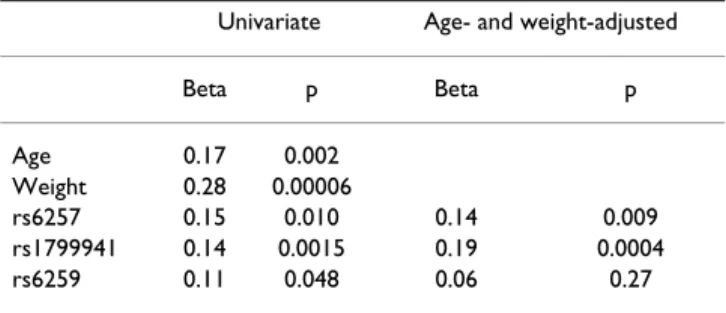
Based on univariate regression analysis, age, body weight, and the polymorphisms were significantly associated with serum SHBG levels measured in 307 randomly selected
women of the control and osteoporotic subgroups. Among the polymorphisms, rs1799941 and rs6257 showed a stronger association with serum SHBG than rs6259 (Table 1). When the results were adjusted by age and weight, the associations of rs1799941 and rs6257 genotypes with serum SHBG remained statistically signif-icant (p = 0.0004 and 0.009, respectively). In Figure 1, the age and weight-adjusted SHBG levels across rs1799941 genotypes are shown. The SHBG levels in AA homozy-gotes were 39% higher than in GG homozyhomozy-gotes. Based on multiple linear regression models, age and weight together accounted for 10.5% of the variance of serum SHBG; the inclusion of the rs1799941 genotype explained a further 3.7% of the SHBG variance. The inclusion of other polymorphisms did not further increase the propor-tion of variance explained.
Serum SHBG showed a negative association with BMD (p = 0.040 at the spine and 0.014 at the hip). Thus, we next determined the association between the rs1799941 allele and BMD and osteoporotic fractures; however, there were no genotype-related significant differences in the spine or hip BMD (Table 2), nor in the distribution of genotypes in women with and without fractures (Table 3). The study had 87% power to detect an association between rs1799941 polymorphisms and BMD if at least 2% of the BMD variance was explained. Likewise, the power to detect an association with vertebral and hip fractures was 87% and 96%, respectively, assuming a risk ratio of 1.6.
Discussion
The SHBG gene is located on chromosome 17 and the major transcript is encoded by 8 exons, spanning approx-imately 3.2 Kb. In the present study, we report that several polymorphisms of the SHBG gene are strongly associated with serum SHBG levels in postmenopausal women. In particular, women with the AA genotype at the rs1799941 locus had 39% higher SHBG levels than those with the GG genotype. This polymorphism is located in the 5' region of the gene, 8 nucleotides upstream of the tran-scription start site. Thus, it is well situated to influence gene transcription. In fact, higher SHBG serum levels have
also been recently reported in men and women bearing A alleles, in comparison with those with G alleles. Dunning et al. [18] found that SHBG serum levels were 28% higher in women with the AA genotype than in those with the GG genotype. Similarly, Eriksson et al. [8] found 22% and 26% higher SHBG levels in individuals with the AA geno-type in two cohorts of Swedish men. The C/T rs6257 pol-ymorphism was also associated with SHBG levels in the present study. The mechanism is unclear, as it is located in an intronic region (intron 1). A search of potentially func-tional polymorphisms with the PupaSuite web-based tool revealed that it is located in a potential binding site for the transcription factor hepatocyte nuclear factor 3/Fox. The A/G rs6259 polymorphism is located in exon 8 and causes a change in the amino acid sequence of SHBG (Asn>Asp). It was also associated with SHBG levels, but to a lesser extent than the other polymorphisms. It has been sug-gested that the Asn>Asp modification affects a potential glycosylation site and increases the half-life of the protein coded for the less common allele [6]. Previous studies of the relationship of this SNP with serum SHBG in women have given conflicting results [6,9,18].
Our results show a clear association between several
SHBG gene polymorphisms and serum SHBG levels, but
since they are in linkage disequilibrium, we cannot estab-lish with certainty which polymorphism is truly responsi-ble for the association. On the other hand, we cannot exclude the possibility that other polymorphisms in link-age disequilibrium with those studied herein are actually responsible for the association with SHBG levels [6,8]. Serum SHBG showed a stronger association with rs1799941 than with other loci. However, allelic frequen-cies of rs1799941 were more balanced than those of other polymorphisms, which may favour the detection of asso-ciations between genotypes and SHBG levels.
Several authors have reported an association between serum SHBG and BMD or osteoporotic fractures [19-24]. In the present study, we did not find an association between SHBG alleles and BMD, despite the fact that they were strongly associated with serum SHBG levels, which in turn was associated with BMD. This lack of association between SHBG genotype and BMD may be due merely to the multiple factors influencing these traits and introduc-ing noise in the relationship between genotype, serum SHBG levels, and BMD. Although the association between genotypes and serum SHBG was statistically significant and quantitatively important (39% difference between AA and GG genotypes), there was wide inter-individual vari-ation, and thus rs1799941 alleles explained < 4% of serum SHBG variance. Similarly, the contribution of serum SHBG to BMD variance was rather small (SHBG explained 2% of the BMD variance at the spine and 3% at the hip). Thus, given the moderate sample size of this
Table 1: Factors associated with serum SHBG levels (Beta standarized regression coefficients and p values from univariate and multivariate regression analyses)
Univariate Age- and weight-adjusted
Beta p Beta p Age 0.17 0.002 Weight 0.28 0.00006 rs6257 0.15 0.010 0.14 0.009 rs1799941 0.14 0.0015 0.19 0.0004 rs6259 0.11 0.048 0.06 0.27
study, we cannot completely exclude a small effect of
SHBG polymorphisms on BMD or fractures, but our data
suggest that such effect, if any, is unlikely to be clinically important in postmenopausal women.
It is also worth noting that SHBG may have a complex influence on estrogen activity and, consequently in the homeostasis of estrogen-responsive tissues, such as bone. It is generally accepted that the unbound fraction of sex steroids is the biologically important fraction because it can diffuse from the capillaries into the peripheral tissues. However, SHBG may be synthesized in certain target tis-sues and some cells appear to have specific binding sites for SHBG and actively internalize it, through the megalin and other pathways [25-27]. Although the true biological significance of this phenomenon is unclear, it might rep-resent a mechanism increasing estrogen activity on the tar-get tissues. The results of some studies appear to be in line
with this hypothesis. In fact, although a negative associa-tion between SHBG and BMD or fractures was reported in several studies [19-21] others found a direct positive cor-relation between serum SHBG levels and hip BMD [8]. Thus, it has been suggested that increasing SHBG may either facilitate or impair estradiol action on target tissues, depending on several factors, including the overall estro-gen status [25].
The results of genetic association studies may be biased by a number of factors, including genotyping and phenotyp-ing errors, and population stratification. Good clinical and laboratory practices can diminish the impact of such errors, but the confounding effect of population substruc-ture may be particularly difficult to exclude [28]. Never-theless, we tried to avoid it by studying women in a relatively small region and excluding those with non-Spanish ancestors. Given the moderate size of our study,
SHBG levels according to rs1799941 (mean and SEM of age- and weight-adjusted values)
Figure 1
SHBG levels according to rs1799941 (mean and SEM of age- and weight-adjusted values).
0
20
40
60
80
100
Genotype
AA
AG
GG
p<0.001
SHBG, nmol/l
Table 2: Spine and hip BMD according to rs1799941 genotypes (mean (SE) and 95% confidence intervals after age- and weight-adjustment)
Spine Hip
Genotype Mean (SE) 95% CI p Mean (SE) 95% CI p
AA 0.815 (0.027) 0.763–0.868 0.9 0.807 (0.021) 0.766–0.848 0.9
AG 0.820 (0.013) 0.794–0.845 0.799 (0.010) 0.779–0.819
a relatively small, but still clinically significant effect (i.e., a 1.2 odds ratio for fracture) cannot be excluded. On the other hand, we cannot exclude the possibility that other polymorphisms in the SHBG gene region might have an influence on BMD or fracture risk. The SHBG gene is small and only a few SNPs are included in the Hapmap data-base. Therefore, we focused on potentially functional SNPs, rather than in haplotype-tagging SNPs.
Conclusion
Our results show that apart from other factors, such as age and body weight, some common genetic variants of the
SHBG gene, and particularly an A/G polymorphism
situ-ated in the 5' region, influence serum SHBG, but we have not been able to demonstrate its association with either BMD or osteoporotic fractures.
Competing interests
The authors declare that they have no competing interests.
Authors' contributions
JAR conceived and coordinated the study, carried out the statistical analysis and wrote the manuscript draft. CV was responsible for the bone densitometry studies. MTZ was responsible for the genetic studies. MTGU carried out the biochemical analyses. JAA participated in the design of study and supervised the biochemical analyses. JGM helped in the design of the study and made substantial contributions to the interpretation of results. All authors reviewed the first draft and read and approved the final manuscript.
Acknowledgements
We acknowledge the technical assistance of Blanca Paule, Carolina Sañudo, Jana Arozamena, and Verónica Mijares, and the review of the manuscript style by David Cushley (International Science Editing).
Supported by FIS grant 06/34 and IFIMAV.
References
1. Peacock M, Turner CH, Econs MJ, Foroud T: Genetics of oste-oporosis. Endocr Rev 2002, 23:303-326.
2. Ralston SH, de Crombrugghe B: Genetic regulation of bone mass and susceptibility to osteoporosis. Genes Dev 2006, 20:2492-2506.
3. Riancho JA: Polymorphisms in the CYP19 gene that influence bone mineral density. Pharmacogenomics 2007, 8:339-352. 4. Strauss R, Barbieri J: Yen and Jaffe's reproductive endocrinology:
physiol-ogy, pathophysiology and clinical management Philadelphia: Saunders;
2004.
5. Abrahamson PE, Tworoger SS, Aiello EJ, Bernstein L, Ulrich CM, Gil-liland FD, Stanczyk FZ, Baumgartner R, Baumgartner K, Sorensen B,
et al.: Associations between the CYP17, CYPIB1, COMT and
SHBG polymorphisms and serum sex hormones in post-menopausal breast cancer survivors. Breast Cancer Res Treat 2007, 105:45-54.
6. Cousin P, Calemard-Michel L, Lejeune H, Raverot G, Yessaad N, Emp-toz-Bonneton A, Morel Y, Pugeat M: Influence of SHBG gene pentanucleotide TAAAA repeat and D327N polymorphism on serum sex hormone-binding globulin concentration in hirsute women. J Clin Endocrinol Metab 2004, 89:917-924. 7. Cui Y, Shu XO, Cai Q, Jin F, Cheng JR, Cai H, Gao YT, Zheng W:
Association of breast cancer risk with a common functional polymorphism (Asp327Asn) in the sex hormone-binding globulin gene. Cancer Epidemiology, Biomarkers & Prevention 2005, 14:1096-1101.
8. Eriksson AL, Lorentzon M, Mellstrom D, Vandenput L, Swanson C, Andersson N, Hammond GL, Jakobsson J, Rane A, Orwoll ES, et al.: SHBG gene promoter polymorphisms in men are associated with serum sex hormone-binding globulin, androgen and androgen metabolite levels, and hip bone mineral density. J
Clin Endocrinol Metab 2006, 91:5029-5037.
9. Ferk P, Teran N, Gersak K: The (TAAAA)n microsatellite poly-morphism in the SHBG gene influences serum SHBG levels in women with polycystic ovary syndrome. Hum Reprod 2007, 22:1031-1036.
10. Haiman CA, Riley SE, Freedman ML, Setiawan VW, Conti DV, Le Marchand L: Common genetic variation in the sex steroid hor-mone-binding globulin (SHBG) gene and circulating shbg levels among postmenopausal women: the Multiethnic Cohort. J Clin Endocrinol Metab 2005, 90:2198-2204.
11. Hogeveen KN, Talikka M, Hammond GL: Human sex hormone-binding globulin promoter activity is influenced by a (TAAAA)n repeat element within an Alu sequence. J Biol
Chem 2001, 276:36383-36390.
12. Kataoka N, Cai Q, Xu WH, Xiang YB, Cai H, Zheng W, Shu XO: Association of endometrial cancer risk with a functional pol-ymorphism (Asp(327)Asn) in the sex hormone-binding glob-ulin gene. Cancer 2007, 109:1296-1302.
13. Xita N, Tsatsoulis A, Chatzikyriakidou A, Georgiou I: Association of the (TAAAA)n repeat polymorphism in the sex hormone-binding globulin (SHBG) gene with polycystic ovary syn-drome and relation to SHBG serum levels. J Clin Endocrinol
Metab 2003, 88:5976-5980.
14. Conde L, Vaquerizas JM, Dopazo H, Arbiza L, Reumers J, Rousseau F, Schymkowitz J, Dopazo J: PupaSuite: finding functional single nucleotide polymorphisms for large-scale genotyping pur-poses. Nucleic Acids Res 2006, 34:W621-W625.
15. Reumers J, Conde L, Medina I, Maurer-Stroh S, Van Durme J, Dopazo J, Rousseau F, Schymkowitz J: Joint annotation of coding and Table 3: Distributions of rs1799941 genotypes in control women and women with osteoporotic fractures (numbers (%) and odds ratios considering the most frequent genotype as the reference)
Controls Vertebral fractures Hip fractures
Genotype n (%) n (%) OR (95% CI) n (%) OR (95% CI)
AA 24 (7) 9 (6) 1.0 (0.5–2.3) 19 (6) 0.8 (0.4–1.5)
AG 125 (40) 54 (37) 1.2 (0.8–1.8) 107 (37) 0.9 (0.6–1.2)
GG 169 (53) 62 (57) reference 164 (57) reference
Publish with BioMed Central and every scientist can read your work free of charge "BioMed Central will be the most significant development for disseminating the results of biomedical researc h in our lifetime."
Sir Paul Nurse, Cancer Research UK Your research papers will be:
available free of charge to the entire biomedical community peer reviewed and published immediately upon acceptance cited in PubMed and archived on PubMed Central yours — you keep the copyright
Submit your manuscript here:
http://www.biomedcentral.com/info/publishing_adv.asp
BioMedcentral
non-coding single nucleotide polymorphisms and mutations in the SNPeffect and PupaSuite databases. Nucleic Acids Res 2008, 36:D825-D829.
16. Yuan HY, Chiou JJ, Tseng WH, Liu CH, Liu CK, Lin YJ, Wang HH, Yao A, Chen YT, Hsu CN: FASTSNP: an always up-to-date and extendable service for SNP function analysis and prioritiza-tion. Nucleic Acids Res 2006, 34:W635-W641.
17. Barrett JC, Fry B, Maller J, Daly MJ: Haploview: analysis and visu-alization of LD and haplotype maps. Bioinformatics 2005, 21:263-265.
18. Dunning AM, Dowsett M, Healey CS, Tee L, Luben RN, Folkerd E, Novik KL, Kelemen L, Ogata S, Pharoah PD, et al.: Polymorphisms associated with circulating sex hormone levels in postmeno-pausal women. J Natl Cancer Inst 2004, 96:936-945.
19. Goderie-Plomp HW, van der KM, de Ronde W, Hofman A, de Jong FH, Pols HA: Endogenous sex hormones, sex hormone-bind-ing globulin, and the risk of incident vertebral fractures in elderly men and women: the Rotterdam Study. J Clin
Endocri-nol Metab 2004, 89:3261-3269.
20. Rapuri PB, Gallagher JC, Haynatzki G: Endogenous levels of serum estradiol and sex hormone binding globulin determine bone mineral density, bone remodeling, the rate of bone loss, and response to treatment with estrogen in elderly women. J Clin
Endocrinol Metab 2004, 89:4954-4962.
21. Lormeau C, Soudan B, d'Herbomez M, Pigny P, Duquesnoy B, Cortet B: Sex hormone-binding globulin, estradiol, and bone turno-ver markers in male osteoporosis. Bone 2004, 34:933-939. 22. Bjornerem A, Ahmed LA, Joakimsen RM, Berntsen GK, Fonnebo V,
Jorgensen L, Oian P, Seeman E, Straume B: A prospective study of sex steroids, sex hormone-binding globulin, and non-verte-bral fractures in women and men: the Tromso Study. Eur J
Endocrinol 2007, 157:119-125.
23. Bjornerem A, Emaus N, Berntsen GK, Joakimsen RM, Fonnebo V, Wilsgaard T, Oian P, Seeman E, Straume B: Circulating sex ster-oids, sex hormone-binding globulin, and longitudinal changes in forearm bone mineral density in postmenopausal women and men: the tromso study. Calcif Tissue Int 2007, 81:65-72. 24. Araujo AB, Travison TG, Leder BZ, McKinlay JB: Correlations
between serum testosterone, estradiol, and sex hormone-binding globulin and bone mineral density in a diverse sam-ple of men. J Clin Endocrinol Metab 2008, 93:2135-2141.
25. Khosla S: Sex hormone binding globulin: inhibitor, facilitator (or both) of sex steroid action? J Clin Endocrinol Metab 2006, 91:4764-4766.
26. Kahn SM, Hryb DJ, Nakhla AM, Romas NA, Rosner W: Sex hor-mone-binding globulin is synthesized in target cells. J
Endocri-nol 2002, 175:113-120.
27. Caldwell JD, Suleman F, Jirikowski GF: Internalization of sex hor-mone binding globulin into fibroblast 3T3 cells. Horm Metab
Res 2007, 39:620-622.
28. Cardon LR, Palmer LJ: Population stratification and spurious allelic association. Lancet 2003, 361:598-604.
Pre-publication history
The pre-publication history for this paper can be accessed here:
http://www.biomedcentral.com/1471-2350/9/112/pre pub