Governance in the energy
Coordination
Meritxell Martell (Merience)
Authors
Gil Lladó and Ana Romero (Àrea Metropolitana de Barcelona) Pauline Gabillet and Luce Ponsar (Lyon Métropole)
Nelson Fernández and Andrea de Nigris (Intendencia de Montevideo) Meritxell Martell (Merience)
Edition
Barcelona Metropolitan Area
Design and layout
Daniel Macià · Imatge & Comunicació
Barcelona, June 2019
Metropolis
, World Association of Major Metropolises, is
the leading international organisation created in 1985
that gathers cities and metropolitan regions with more
than a million inhabitants.
Metropolis brings together the governments of 138
urban agglomerations worldwide. The association is the
focal point of expertise on metropolitan governance.
Raising the voices of metropolises to the global agenda
and building capacity to deliver public policies and
services, Metropolis contributes to finding common
answers to the challenges of metropolisation.
Table of contents
The MEGA initiative 4
The energy transition 5
Fundamental role of cities in the energy transition 6
Partners in MEGA 7
Barcelona Metropolitan Area (AMB), SPAIN 8
Lyon Métropole, FRANCE 12
Montevideo, URUGUAY 16
Different governance approaches in MEGA partners 20
4
4
EGA is an initiative of Barcelona Metropolitan Area in cooperation with Lyon Métropole and Intendencia de Montevideo and partly funded by Metropolis through its pilot projects program. The aim of MEGA is to exchange knowledge on how metro-politan areas address governance in the energy transition process towards a low-carbon society. The project was launched in June 2017 and finished in July 2019.
Three workshops were conducted in each of the part-ner cities to present the plans and strategies, challeng-es and actions faced by metropolitan areas to addrchalleng-ess the energy transition.
Lyon workshop:
23-24 Nov. 2017
Montevideo workshop:
15-16 May 2018
Barcelona workshop:
28 Feb. - 1 March 2019
Each workshop was organised around presentations from experts in relevant organisations and institutions addressing different aspects of the energy transition – energy efficiency, increase of renewable sources, governance aspects – as well as field trips to learn how each city faces the energy transition across its urban area. This publication summarises the results of the exchanges and visits from late 2017 to mid 2019 among the project partners. The exchanges and discussions throughout the course of this project have resulted in the following main findings regarding governance of the energy transition process:
• All metropolitan areas have already taken the decision to adopt ambitious renewable energy targets by 2030 and to promote energy efficiency as part of their pol-icies towards a low carbon economy. However, it is not an easy path. A reflection needs to be made on to what extent ambitions can also be realistic and prac-ticable, as some objectives might not be applicable for different regions which show different character-istics at local level (e.g. density of urban areas, wind potential, etc).
• Although the different metropolitan areas vary in size, population density, level of development, climate, de-ployment of renewables, level of resources, etc, each metropolitan area focused on a specific aspect to pave the way to a sustainable energy system. Grand Lyon works in partnerships with industry and busi-nesses to engage them in energy matters and AMB focuses its work on the municipalities of the metropol-itan area to advance the deployment of renewables and foster energy efficiency. Instead, Montevideo has the advantage of being in a country where renewa-bles provide more than 95% of the country’s elec-tricity. Therefore, the Intendencia of Montevideo has focused on the transport sector, encouraging the use of electric vehicles and bike system in the city. • The cross-cutting and transversal nature of energy
and its importance on a regional scale requires an integrated approach and working closely with other departments at metropolitan level, such as economy, urban planning, housing, industrial development, transport and mobility and resource management, among others.
• The engagement of civil society in designing and implementing a new energy model is a crucial aspect in the process of transition towards a low carbon economy.
The MEGA
initiative
M
5
5
he transition to a sustainable and secure energy supply is one of the grand global challenges for society this century. The low carbon transition is long-term and encompass-es many different aspects, becoming a multi-faceted process which will de-pend on each country’s circumstances, including energy potential, policy and technology priorities. The transition is intertwined with the need to address broader challenges, such as those in-spired by the Sustainable Development Goals (SDGs), adopted in 2015 by the United Nations General Assembly, which set a broad global perspective for a sustainable, fair and inclusive future. Examples of SDGs that relate to the energy transition include:
Goal 7
Affordable and clean energy:
“ensure access to affordable,
reliable, sustainable and
modern energy for all”
Goal 9
Industry, innovation and
infrastructure: “Build resilient
infrastructure, promote
inclusive and sustainable
industrialisation, and foster
innovation”
Goal 11
Sustainable cities and
communities: “Make cities
and human settlements
inclusive, safe, resilient,
and sustainable”
Goal 12
Responsible consumption
and production: “Ensure
sustainable consumption
and production patterns”
Goal 13
Climate Action: “Take urgent
action to combat climate
change and its impacts by
regulating emissions and
promoting developments in
renewable energy”
A sustainable energy transition con-sistent with the collective global goal of the 2015 Paris Agreement to limit the temperature rise to well below 2ºC above pre-industrial levels requires a major reduction in global greenhouse gas emissions. It also implies profound changes throughout the energy system – from production, distribution and consumption – directly impacting on infrastructure, the market and society at large. Changes are required at the level of technology, urban planning, transportation, consumption patterns, built environment, investments, etc. Close cooperation across all levels of government and civil society is crucial to implement a sustainable energy tran-sition and deliver the goals of the Paris Agreement. The New Urban Agenda adopted at the United National Con-ference on Housing and Sustainable Urban Development (Habitat III) in Quito on 20 October 2016 also emphasises the need to empower cities in climate change policies, including energy policies that aim at energy transitions towards more energy efficiency and the use of renewable energies, two central components of a successful low carbon transition. Therefore, local and regional governments, as the closest level to citizens, play a key role to engage communities and implement ambitious actions to meet the challeng-es ahead.
The
energy
transition
T
6
6
ities are responsible for 67% of global energy use and 70% of greenhouse gas emissions1, a level which is expected to reach 75% by 2030 when two thirds of the world’s population will live in cities. Therefore, cities need to be proactive and take actions to maintain a healthy living en-vironment for their citizens. As they are faced with fast urban-isations, they are playing an increasing role in the global en-ergy transition, having to adopt innovative solutions to meet climate objectives. In this context, cities have an opportunity to lead by example, make decisions that benefit and inspire their communities and demonstrate good practice. They are best placed to come up with practical solutions adapted to the local context, meeting the needs of their citizens.
Metropolitan areas have a fundamental role in facilitating and promoting the energy transition by exchanging knowledge among cities, raising awareness, developing broader strate-gies for the entire metropolis, providing technical assistance and support to enable and manage the transition effectively. Metropolitan areas can commit to an ambitious energy transi-tion based on reduced energy use, carbon emissions and the development of renewable energy. Improving energy efficien-cy in buildings, industry and transport can reduce emissions as well as costs and provide significant benefits for local communities. Additionally, renewable solutions can transform communities and economies, create green jobs and new economic activities, democratize energy sources and ensure energy independence.
The energy transition, and ultimately, the decarbonisation of the energy system, is a huge challenge that will require fundamental changes to how we produce, store, distribute, manage and consume our energy, both heat and power. The solutions will be innovative and complex, and delivered by a multitude of stakeholders over the long-term. Thus, the ‘en-ergy transition’ encompasses technological, societal, cultural, economic and environmental aspects and is based on the active participation of citizens and communities who are no longer a simple consumer but at the centre of decision-mak-ing processes.
The shift to a low carbon energy model is a chance to move from centralized power generation and distribution to shared systems, giving local stakeholders wider opportunities to participate, co-create and develop new economic models. Thus, public engagement and participation will be a fun-damental driver for the sustainability of the low carbon energy transformation. Local or central governments alone cannot achieve the far-reaching changes required by the energy transition.
Fundamental
role of
cities
in the energy
transition
C
1 http://unhabitat.org/wp-content/uploads/2012/06/P1HotCities.pdf
7
7
Partners
in MEGA
The three core partners that have been actively engaged in MEGA are from three different countries:
Barcelona Metropolitan Area (AMB) in Spain, Lyon Métropole in France and Intendencia de
Montevideo in Uruguay. The three partner cities have different national and institutional contexts which is crucial to explain differences in their approaches towards energy policy-making and the way they face the energy transition. For each metropolitan area, the following elements are considered:
Brief summary: population, area, density, creation of territorial authority, main
jurisdictions, type of election and principal type of financing;
Competences on energy issues at the metropolitan level;
National policies on energy which may affect metropolitan governance;
Relevant metropolitan policy documents on energy;
Relevant projects within the framework of a progressive energy transition
8
8
Barcelona
Metropolitan
Area (AMB),
SPAIN
Catalonia,
one region
in Spain
Barcelona
Metropolitan
Area within
Catalonia
9
9
Competences on
energy issues at
metropolitan level
Classical competences related to ener-gy are centralized by the Spanish Gov-ernment (e.g. planning and execution of transport and distribution networks, entire regulation of the energy sector, etc.). Considering that the energy transition will be based on distributed production, municipalities have a main role. Thus, the AMB has competences on planning, energy efficiency and pro-motion and management of renewable energy facilities from the point of view of the public common interest.
National policies on
energy which may
affect metropolitan
governance
In Spain, the previous Royal Decree 900/2015 on self-consumption estab-lished that consumers covered by any self-consumption modality would be subjected to distribution and transport grid access fees charged in order to ensure technical and economic sustainability of the grid. This regulation presented important problems in incen-tives to encourage the prosumer ac-tivity. However, the latest Royal Decree Law 15/2018, 5 October, on urgent measures for the energy transition and the protection of consumers, eliminated the so-called ‘sun tax’ to provide
cer-tainty for energy ‘prosumers’. Hence, it recognizes the right to self-consume electric energy without charge. The new provisions also reduce adminis-trative procedures for all prosumers, defines collective self-consumption and simplifies the mechanism of payment for any surplus energy injected back into the grid.
In the European context, it is also important to consider the transposition of the main European Directives, such as the revised Energy Performance of Buildings Directive to be transposed by March, 2020. In this context, the main focus of AMB is on retrofitting rather than new developments, where there is a clear lack of policies and obligations.
Population:
3.2 million people
(includes the city of Barcelona with
1.5 million people and 35 surrounding
municipalities)
Area:
636 km
2Density:
5,093 inhabitants/km
2Creation of territorial authority:
27 July
2010 (as a single administration)
Main jurisdictions:
spatial planning,
transport and mobility, environment
(water, waste, sustainability), economic
development, housing, social cohesion.
Type of election:
Indirect: council
of 89 members (delegates from
municipalities)
Principal type of financing:
Transfers
(above all from municipalities and
consortia) and taxes
COM SERÀ LA METRÒPOLI DEL 2030?
Més autosuficient, amb menys emissions i més resilient als impactes del canvi climàtic
THE PATH TOWARDS A MORE SELF-SUFFICIENT, RESILIENT AND EMISSION-NEUTRAL METROPOLIS
10
10
Relevant metropolitan policy
documents on energy
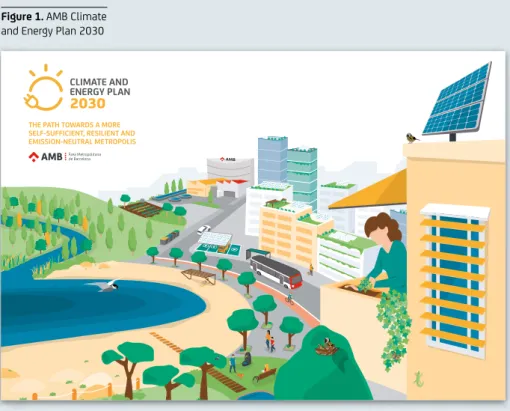
In 2015 AMB started to work on the energy transition. In September 2018, AMB approved the “2030 AMB Climate and Energy Plan” with the goal to decrease 40% CO2 emis-sions, increase 30% energy efficiency and 30% renewables by 2030, in line with the 2030 climate and energy framework of the European Commission. It is a “plan of plans” and includes three strategies to fight against climate change: car-bon management strategy, roadmap for energy transition and climate change adaptation plan. The plan was developed for the period 2018-2030 with triennial revisions. The main outcomes planned as part of the Plan are: the creation of the Metropolitan Energy Agency, a Public Electricity Utility, a pub-lic platform to promote photovoltaic projects from citizenship investment and a public revolving fund.
The Plan, so far, is a tool to raise awareness inside the or-ganization. Stakeholder involvement has not yet taken place. However, the intention for the next revision in 2021 is to involve stakeholders from all sectors and the whole territory. So far, the 36 municipalities of AMB are involved through a “municipal energy forum” which meets once a year to dis-cuss good practices, obstacles, ask for assistance, etc.
The plan is organized in 4 areas of action, with 13 lines of action and 92 actions to be implemented from 2018-2030 and to better explain the Plan to the public.
1 Renaturalisation to become more resilient and
live better – rehabilitation of old buildings, more
permeable and cooler spaces;
2 Promoting local generation of renewables and
more efficient use of energy, water and other
resources: energy efficiency, reduce demand,
water, etc
3 Working with citizens: environmental
awareness programme, reaching 50,000 persons/
year
4 Metropolitan governance coordinated with
councils – AMB as coordinator of Covenant of
Mayors
Figure 1. AMB Climate
and Energy Plan 2030
11
11
Relevant projects
within the framework
of the energy
transition
Metropolitan solar charging
stations
A concrete action towards the im-plementation of AMB’s Climate and Energy Plan 2030 is the solar charging station of Molins de Rei, a pioneer-ing public source of solar energy for Barcelona metropolitan area. It is the first public bidirectional solar charging station in Spain and it is located at the parking lot of the municipal sports cen-tre in Molins de Rei, a city in the met-ropolitan area of Barcelona. It was
in-augurated in February 2019 and it has been designed and financed by AMB. This facility converts the sunlight into electricity to charge electric vehicles and also to supply the municipal sports centre with energy. The station enables the energy stored in electric vehicles to be fed back into the electricity network to help supply energy at times of peak demand. This technology is known as V2G, meaning that it integrates the “vehicle to grid” system.
Near Zero Emissions Building,
the public school El Garrofer in
Viladecans
Another concrete action towards the implementation of AMB’s Climate and
Energy Plan 2030 is the project of deep renovation of “El Garrofer” school. The project was contracted by Viladecans city council based on the study of the capacity of deep renovation of three schools undertaken by the AMB. The school was built in 1974 and its users lacked comfort in winter and summer. The renovation included replacement of window frames and glasses, thermal isolation on the outdoor side of the façades and roof, controlled ventilation system, improvement of lighting, incor-poration of solar control louvers and introduction of airtightness layer in the façade. The objective was to transform the school into a building nZEB (near Zero Emissions Building) and get the standard Passivhaus.
Metropolitan solar charging stations Public school
12
12
Lyon
Métropole,
FRANCE
13
13
Competences on energy of the
metropolitan area
Lyon Métropole has the following competences:
• Support for energy management actions including renewa-ble energy development: possibility to create power plants for its own use or to seal it, support to renewables; • Creation, organisation, maintenance and management of
district heating and cold in 6 districts;
• Concession for public distribution of electricity and gas.
National policies on energy
which may affect metropolitan
governance
Modernisation of Public Territorial Action and Affirmation of Metropolises Act (2014): creation of metropolises with new energy competences.
Energy Transition for Green Growth Act (2015): provides a framework in which individuals, businesses, regions and the
State can take actions together, setting medium- and long-term goals.
The objectives are the following:
• Reduce greenhouse gas emissions by 40% in 2030 compared with 1990;
• Reduce the use of fossil fuels by 30% in 2030 com-pared with 2012;
• Increase the share of renewable energy sources to 32% of total energy consumption by 2030 and to 40% of electricity generation;
• Reduce total energy consumption by 50% in 2050 compared with 2012;
• Diversify electricity generation and reduce the share of nuclear to 50% by 2025.
These are very ambitious goals for the metropolitan scale. This law has reinforced the role of the local authority in the fight against climate change. There is also an obligation for the intercommunal authority (with more than 20,000 inhabit-ants) to develop a climate plan, including air quality.
Population:
1,3
million people in 2014
(Lyon with 500,000
inhabitants) and 59
communes including
Lyon
Area:
538 km
2Density:
2,383
inhabitants/km
2Creation of territorial
authority:
1 January
2015
Main jurisdictions:
employment and
economic development;
major projects and
urban planning;
knowledge and
culture; energy and the
environment; transport;
living environment
and housing;
children and family;
solidarity; water and
sewage; cleanliness;
attractiveness and
reputation.
Type of election:
indirect: council of 153
members (delegates
from municipalities)
Principal type of
financing:
fees and
own taxes and central
government transfers
14
14
Relevant plans and
programmes
Territorial Climate and Energy
Plan of Lyon Métropole (Plan
Climat)
Was adopted in 2012. It is a local strat-egy to reduce greenhouse emissions by 20% between 2000 and 2020, thanks to 26 actions. 83 organisations signed the plan in 2015 and more than 100 at the end of 2017. These partners recognize the Vision 2020 which will allow a fall in CO2 emissions by 2020 and undertake to roll out the 26 actions in their field of expertise. A new Terri-torial Climate, Air and Energy Plan is being developed and is planned to be approved by the end of 2019.
Oxygen plan (2016)
Has the objective to reduce pollutant emissions to maintain health and qual-ity of life.
Energy Master Plan
This project, launched in 2015, is the core of the Climate, Air and Energy Ter-ritorial Plan with a scenario at horizon 2030 to be approved in autumn 2019 at the 6th Energy Climate conference. It has the following goals:
• Provide guidelines to develop a metropolitan energy transition policy (control energy consumption, rational-ly develop energy networks, develop renewable energy, secure universal access to energy, etc.)
• Include energy as a structured part of public policies and projects deriving from it (water resource and sanitation management, waste management, transportation, urban planning, hous-ing, etc.)
This scheme is a four-year’s multidi-mensional and experimental process including a diagnosis and the devel-opment of an energy model at the metropolitan scale, energy scenarios building and the definition of an energy strategy. There is a challenge of territo-rialisation, this is, develop a diagnosis and a strategy at an infracommunal
scale, multi-energy (electricity, gas, district heating and cold). This scheme was approved in May 2019 with the following objectives:
Energy Climate Conference, 23 November 2017
-20
%-43
%Reduce greenhouse
gas emissions from
2000 levels in 2030
Reduction of energy consumption by
2030 (compared to 2013)
17
%Double the renewable energy and
recovery as part of metropolitan
consumption by 2030, with a growth
15
15
Relevant projects
within the framework
of the energy
transition
ECORENO’V
Since 2012, Grand Lyon and its partners have endeavored to develop highly effective thermal renovations, i.e. to achieve the “renovation BBC” stand-ard of 96 kWhep / year / m². In 2015, this support became more generally available with the launch of the “local eco-renovation platform” supported by the ADEME and the Rhône-Alpes region. Financial assistance for the works is boosted by a subsidy of € 3,500 excl. tax / home for reaching the BBC standard and € 2,000 / home for a “voluntary” renovation, with a 35% energy saving. To support renovations in the social and private housing sector, Lyon Métropole voted in an envelope of € 30 million by 2020.
Confluence urban project
The Lyon Confluence Urban renewal scheme was awarded the eco-dis-trict label by the Ministry for Ecology, Sustainable Development and the Sea. Since 2000 and until 2030, the development of the Lyon Confluence urban project takes place in an area of 150 hectares. Half of the area was an existing neighbourhood whilst the other half is new construction and public spaces.
The Confluence area, which represents doubling the size of the Lyon city, will not involve an increase of greenhouse gas emissions due to:
• The increase of local renewable energy production (photovoltaic and district heating);
• The construction of new buildings with high energy performance, includ-ing positive energy blocks;
• The energy renovation of the existing neighbourhood;
• Sustainable mobility;
• The development of a smart grid, via an energy data management platform.
A good governance practice in Grand Lyon is the Energy Master Plan. From the beginning of the project, the ambition is to:
Integrate the territorial
expertise of energy actors
Develop an action plan that
will result from the diagnosis
and will recalibrate on the
basis of their impact and to
be territorialized
Devise a scenario for 2030
of CO
2emissions and
consumption in the territory
jointly with the partners
The Confluence Urban Project
16
16
Montevideo
,
URUGUAY
17
17
Competences
on energy of the
metropolitan area
The high concentration of energy consumption in urban areas demands an energy policy at departmental (local) level, which must consider aspects of energy efficiency and promote a diver-sified matrix generation in the depart-mental territory, within the framework of national and territorial policies. Mon-tevideo has the opportunity to provide energy efficiency solutions related to transport, urban waste management, the industrial sector and buildings. Especially in the transport sector taking into consideration the scale in energy consumption.
National policies on
energy which may
affect metropolitan
governance
Uruguay gets more than 95% of its electricity from renewables. In addi-tion to old hydropower plants, a hefty investment in wind, biomass and solar in recent years has raised the share of these sources in the total energy mix to 55%, compared with a global average of 12%, and about 20% in Europe.
In 2008, the government approved a national energy policy “Energy Policy Uruguay 2005-2030”. It was approved by the Executive Power and ratified by the Parliament’s Energy Multiparty
Committee in 2010 (as an agreement between all the political parties that have parliamentary representation), for which it is configured as a Policy of State. This policy included a long-term perspective and also incorporated the social, ethical and cultural implications in addition to the classic technical-eco-nomic analysis of the energy issue. The Energy Policy Uruguay 2030 represents a strong commitment to renewable energy sources and energy efficiency and considers access to energy as a human right. It established strategic guidelines which included goals for the short, medium and long-term, as well as courses of action to reach such goals.
Population:
1,319,108 inhabitants (in
Montevideo capital city)
Area:
530 km
2Density:
2,602 inhabitants/ km
2Creation of territorial authority:
Montevideo City Hall was created on
December 1908. Since 2010 the city is
divided into 8 municipalities. Also it has
62 neighborhoods.
Main jurisdictions:
planning (urban
planning services, infrastructure,
public space and housing); mobility
(transport and planning); environment
(water, waste and sustainability); social
projects, social economy and inclusion
politics; and international relations and
cooperation.
Type of election:
direct elections. The
election of mayors, members of the
Departmental Boards and other elective
local authorities, always take place
in May of the year after the national
elections (every five years).
Principal type of financing:
transfer
from national government and fees.
18
18
Relevant metropolitan policy
documents on energy
Strategic Energy Plan of Montevideo (PEDEM) 2030 is the current framework for all the actions in this matter. It was pre-pared based on a broad participatory process, both internally and externally. It has the following five objectives:
Objective 1: Contribute to
the savings and efficient use
of energy
• Systematically update Montevideo regulations to improve energy effi-ciency;
• Create incentive mechanisms for the incorporation of energy efficien-cy criteria in buildings, industry and transport.
• Systematically incorporate energy efficiency criteria in the services of the institution, as a model of good practices.
• Encourage the use of public trans-port.
• Stimulate active transport in Monte-video.
Objective 2: Promote
renewable energy in order to
promote the diversification
of the energy mix.
• Define a model regarding the use and / or generation of energy at depart-mental level within the framework of the national energy mix.
• Diversify the energy mix of the trans-port sector.
Objective 3: Build awareness
and citizen education in
energy
• Generate information, communica-tion and participacommunica-tion of all the actors involved in the process of implement-ing the Strategic Plan of Energy of Montevideo.
• Create innovative public-private partnerships to strengthen the “know-how”.
Objective 4: Promote
equitable access to energy
for the population of
Montevideo.
• Coordinate inter-institutional efforts in the development of the regulatory framework that regulates aspects linked to the energy sector.
Objective 5: Institutional
strengthening in energy.
• Adapt the organizational structure to plan and manage energy issues in the institution and according to its scope and dimensions.
• Incorporate energy in current pro-grams and plans, objectives and goals.
• Encouraging the acquisition of extra-budgetary resources such as external financing for specific projects. • Promote the training of those involved
in energy issues, and integrate and promote areas of knowledge, access and dissemination of technologies. • Integrate the information available in
the different sectors of the institution and other institutions related with energy and systematic dissemination of information.
19
19
Relevant projects within the
framework of a progressive energy
transition
• Bicycle paths: 40 Km of infrastructure for bicycle use. The programme “movete” involves 80 bicycles and 8 stations and will be extended to cover 16 stations and between 100 and 200 bicycles.
• Mobility Management Centre: implementation of intelligent transport systems applied to the administration, manage-ment and control of traffic and transport of the city in real time. The Centre collects traffic data during all day every day of the year. They model traffic through the use of specific computer tools and prepare new traffic lights plans that allow synchronizing the network adapting it to the traffic demand.
• Incorporation of 50 electric taxis to encourage the entry of electric cars. This is encouraged by: Montevideo city hall establishes the taxi licence price at 50% of the market value; the Ministry of Industry, Energy and Mining with the Ministry of Economy provides exoneration of the external tariff for two years; the National administration of electric transmis-sions supports the initiative by signing an advertising
con-tract with the taxi driver which imposes certain obligations and provides $10,000 and the financial institutions have established specific conditions for the electric vehicle. The objective in the long run is to have 300 electric taxis (10% of the total).
• Replacement of 70,000 public lighting lamps by LED tech-nology, which will involve a reduction of 6.4 MW of installed power, $6 millions of savings and a reduction of 12,254 tonnes of CO2. Furthermore, there will be benefits concern-ing the maintenance.
• Incorporation of photovoltaic energy in the departmental governments, which will become promoters and generators and at the same time will acquire experience in the imple-mentation of this technology. The municipality of Montevideo promotes the integral use of renewable energy resources for self-supply as an element for dissemination and awareness among the community.
Mobility Management
20
20
ifferent approaches to govern-ance in the energy transition towards a low carbon econ-omy are clearly observed in the three core partners that have been actively engaged in MEGA. Barcelona, Grand Lyon and Montevideo show different characteristics in terms of size, pop-ulation, competences and the type of national policies affecting the metro-politan area in the field of energy. All three metropolitan areas have decided to take measures to cope with climate change and implement the energy transition by approving specific plans to address these challenges by 2030. MEGA has explored the governance ar-rangements of metropolitan authorities with various stakeholders in the energy transition, taking into account the differ-ent contextual factors which influence the nature of decision-making in energy matters. AMB, Grand Lyon and Mon-tevideo have taken initiatives to bring together different types of stakeholders to support the transition to a low car-bon economy. Given that AMB has lim-ited competences over energy matters as it does not have direct competences on energy efficiency or renewables planning, it leaves the power on energy planning in the hands of the State and municipalities. However, the
metropoli-tan administration focuses its efforts on the collaboration with municipal repre-sentatives to support their initiatives in the field of promoting energy efficiency and adopting renewables. This is the case for instance, of the support to the projects explained above, such as the NZEB School and the solar charging stations in different municipalities of the metropolitan area. In contrast, Grand Lyon is highly industrial and the efforts made by the main emitters of CO2 emissions to reduce their energy expenditure have a big impact in the overall metropolitan area. Thus, Grand Lyon focuses on establishing partner-ships with industry and businesses in the territory to achieve the objectives of the vision climate-air-energy by 2030. The charter of engagement in the Climate Plan (2019) aims to mobilise not only businesses but also institu-tions, local authorities and associations in signing up partnerships with Grand Lyon to address the climate, energy and air quality challenges.
In Montevideo, the fact that Uruguay has more than 95% of electricity com-ing from renewable sources and the electricity industry continues to be na-tionalized sets a specific framework for action at metropolitan level. Therefore, the main focus of the Intendencia is on
transport and mobility by promoting electric vehicles in collective transport and working to improve traffic and safety through the mobility manage-ment centre. In addition, a specific action to replace street lighting fixtures with LED has also been undertaken, among other actions. All of these actions have been undertaken with dif-ferent actors involved in energy issues and in the national working group (cre-ated in the framework of the national energy policy “Energy Policy Uruguay 2005-2030” as a Policy of State), which involves different national and local authorities in constant interaction with civil society and the private sector.
Different governance
approaches in MEGA partners
D
21
21
Size (Km
2)
636
533,7
530
Population (nº
inhabitants)
3,2 million
1,3 million
1,3 million
Municipalities
36
59
8
Main
competences
on energy
Centralised on the Spanish
government. Considering
that the energy transition
will be based on distributed
production, municipalities
have a key role. AMB has
competences on planning,
energy efficiency and
renew-ables with public common
interest criteria.
Support for energy
manage-ment actions; concession
for public distribution of
gas and electricity; creation,
organisation, maintenance
and management of district
heating and cooling.
Competences on planning,
energy efficiency and
re-newables. Energy issues are
incorporated in the different
areas as a transversal issue,
led by the planning
depart-ment.
National
policies
affecting the
metropolitan
area
- Royal Decree law 15/2018
on urgent measures for the
energy transition and the
protection of consumers
- Energy Performance of
Buildings Directive
(retrofit-ting)
- Modernisation of public
territorial action and
affir-mation of metropolises Act
(2014)
- Energy Transition for Green
Growth Act (2015)
- Energy Policy Uruguay
(2005 - 2030)
- Energy Efficiency National
PLan (2015 - 2024)
Main
Metropolitan
Plans on
energy
2030 AMB Climate & Energy
Plan (2018 - 2030)
Triennial revisions
Climate Plan (2012 - 2020)
Energy master scheme
(2015 - 2030)
22
22
There is no one-size fit all. No two cities
or metropolitan areas are alike. The policies
applicable in metropolitan areas will depend and
be shaped very much on what is possible based
on national and regional policy objectives (such
as economic development goals, health
consid-erations, energy security issues) and constraints
(such as limited resources, increasing energy
prices, etc).
All metropolitan areas have already taken
the decision to adopt ambitious renewable
energy targets by 2030 and to promote energy
efficiency as part of their policies towards a low
carbon economy. However, it is not an easy path.
A reflection needs to be made on to what extent
ambitions can also be realistic and practicable,
as some objectives might not be applicable for
different regions which show different
characteris-tics at local level (e.g. density of urban areas, wind
potential, etc) and need to be “territorialised”.
Although the different metropolitan areas
vary in size, population density, level of
development, climate, deployment of renewables,
level of resources, etc, each metropolitan area
focuses on a specific aspect to pave the way to
a sustainable energy system. Grand Lyon works
in partnerships with industry and businesses to
engage them in energy matters and AMB focuses
its work on the municipalities of the metropolitan
area to advance the deployment of renewables
and foster energy efficiency. Instead, Montevideo
has the advantage of being in a country where
re-newables provide more than 95% of the country’s
electricity. Therefore, the Intendencia of
Montevi-deo focuses on the transport sector, encouraging
the use of electric vehicles and bike system in
the city, working with different actors involved in
energy.
The cross-cutting and transversal nature
of energy and its importance on a regional
scale requires an integrated approach and
work-ing closely with other departments at metropolitan
level, such as economy, urban planning, housing,
industrial development, transport and mobility and
resource management, among others. Effective
collaborative interdisciplinary working with
dif-ferent departments (e.g. urban planning, ecology,
economy, etc) results in a better understanding
of the multi-faceted energy challenges and better
outcomes.
The engagement of civil society in
design-ing and implementdesign-ing a new energy model
is a crucial aspect in the process of transition
towards a low carbon economy.
While the potential for renewables is high,
it varies greatly depending on each city’s
characteristics. Population density, growth
prospects, availability of natural resources in the
territory and neighbouring areas and demand
profiles in cold versus hot climates all shape the
opportunities to introduce renewables,
includ-ing the vast growth potential for uses in urban
buildings and transport. Accordingly, deployment
strategies must be tailored to technology options
and enabling policy frameworks for each city.
Lessons
learned
23
23
Gil Lladó
Metropolitan Area of Barcelona
“The MEGA Project has contributed to enhance our understanding in a number of areas:
• Access to detailed, continuous in time and quality data is crucial in order to take decisions.
• There is a need to strengthen the links between the different sub-national levels - local, metropolitan and regional governance. In all the three countries involved, the national level has similar types competences in energy matters and this allows a high level of cooperation among States. However, at the lower level, there are a lot of dif-ferences between cities which make collaboration more challenging. For this reason, the identification of barriers to implement the energy transition and the exchange of experiences and good practices in energy governance is more demanding than at national level. It is precisely for this reason that it is extremely necessary to reinforce the cooperation between metropolitan areas.
• It is possible to have an energy revolution in 10 years, as shown in Uruguay. How-ever, this revolution should be undertaken placing citizens at the centre of deci-sion-making as they will enable a change in the energy culture if they actively take decisions in a democratic way. Without this social change, to replace fossil fuels by renewables is only a way to delay the problem of limited resources and to avoid the urgent need for de-growth.
• The importance of regular energy strategic planning over time should be empha-sized as well as the need to involve the private sector, industry, businesses in the energy transition without interfering in efficient, transparent and fair public decisions”.
Pauline Gabillet
Lyon Métropole
“On the one hand, we are particularly interested in the way AMB works with mu-nicipalities. This is an important outcome of implementation for the Energy master plan in Grand Lyon. The implementation of a strategic plan at the municipal and district scales is necessary to successfully develop the energy transition. Munici-palities can have an important intermediate role. On the other hand, the exchange with Montevideo has also been interesting to realize that the energy mix can be very different according to national and territorial contexts. The importance of the renewable electric production in Uruguay and the absence of gas production has been very stimulating”.
Andrea de Nigris
Intendencia de Montevideo
“Even if the realities in the different metropolitan areas participating in MEGA seem very different, the exchange of experiences confirms that the challenges involved in the energy transition are very similar. MEGA has shown that collaboration and the exchange of experiences is one of the most powerful tools to find solutions to the decarbonization challenge that local authorities have to face.
The paradigm of a unique and universal solution applicable to all realities does not seem to be possible. Creativity is the key to success. In this regard, the participa-tion of Intendencia de Montevideo in MEGA allowed us to better understand and discuss with the partners how a variety of strategies on energy sustainability can be developed from the local level to meet the United Nations Sustainable Develop-ment Goals”.
Lessons learned from MEGA partners
Pauline Gabillet
Andrea de Nigris Gil Lladó
Luce Ponsar