UNIVERSIDAD TÉCNICA DE AMBATO
FACULTAD DE CIENCIAS HUMANAS Y DE LA
EDUCACIÒN
PortadaCARRERA DE IDIOMAS
Proyecto de Investigación previo la Obtención del Título de Licenciado en Ciencias de la Educación, Mención Inglés
TEMA:
QUALITY OF EVALUATION OF PTS (PRONUNCIATION TRAINING SOFTWARE) AND THE INTENTION TO USE TECHNOLOGY AMONG ENGLISH TEACHERS FROM AMBATO TECHNICAL UNIVERSITY
AUTHOR:
Diego Alejandro Ramos Villegas
TUTOR:
Lic. Mg. Edgar Encalada Trujillo
Ambato- Ecuador
2018
II
SUPERVISOR APPROVAL CERTIFY:
I, Lcdo. Mg. Edgar Guadia Encalada Trujillo, holder of the I.D No. 050182417-1, in my capacity as supervisor of the Research dissertation on the topic:
“Quality of evaluation of PTS (Pronunciation Training Software) and the intention to use technology among English teachers from Ambato Technical University” investigated by Mr. Diego Alejandro Ramos Villegas with I.D No.1803574381, confirm that this research report meets the technical, scientific and regulatory requirements, so the presentation of it is authorized to the corresponding organism in order to be submitted for evaluation by the Qualifying Commission appointed by the Board of Directors.
……… Lcdo. Mg. Edgar Guadia Encalada Trujillo
C.I. 0501824171 SUPERVISOR
III
DECLARATION PAGE
I declare this undergraduate dissertation entitled “Quality of evaluation of PTS (Pronunciation Training Software) and the intention to use technology among English teachers from Ambato Technical University” is the result of the author’s investigation and has reached the conclusions and recommendations described in the present study.
Comments expressed in this report are the author’s responsibility.
………. Diego Alejandro Ramos Villegas
I.D # 1803574381 AUTHOR
IV
TO THE DIRECTIVE COUNCIL OF THE FACULTY OF HUMAN SCIENCES AND EDUCATION
The Board of Directors which has received the defence of the research dissertation with the purpose of obtaining the academic degree with the topic " Quality of evaluation of PTS (Pronunciation Training Software) and the intention to use technology among English teachers from Ambato Technical University " which is held by Diego Alejandro Ramos Villegas undergraduated student from Carrera de Idiomas, promotion: 2017-2018, and once the research has been reviewed, it is approved because it complies with the basic, technical, scientific and regulatory principles.
Therefore, the presentation before the pertinent organisms is authorized.
Ambato, December 2017
REVISION COMMISSION
Lcda. Mg. Ana Jazmina Vera de la Torre Lcda. Mg. Sarah Jaqueline Iza Pazmiño C.I. 1801249341 C.I. 0501741060
V
Copyright Reuse
I, Diego Alejandro Ramos Villegas with I.D. No. 1803574381, confer the rights of this undergraduate dissertation " Quality of evaluation of PTS (Pronunciation Training Software) and the intention to use technology among English teachers from Ambato Technical University ", and authorize its total reproduction or part of it, as long as it is in accordance with the regulations of the Universidad Técnica de Ambato, without profit.
………. Diego Alejandro Ramos Villegas
I.D card # 1803574381 AUTHOR
VI
Dedication
I would like to dedicate this big effort to God and the Virgin Mary. They are the power that have made me continue working hard and looking after my family.
Next, I dedicate this to my sister Andrea and my parents Carmita and Edgar. They are the ones who deserve my complete happiness and I am entirely sure they will enjoy my personal and professional development. Thank you very much my dear family for bringing me up in an excellent family environment. You do not know how thankful I am with you MY BELOVED FAMILY.
VII
Thankfulness
As everybody know all of us without any exemption have to make an effort, no matter how big or small is our responsibility. Even though you do not feel comfortable when you are doing something, you will see the results at the end when every single duty that you have got in your mind has finished.
That is why I want to thank God and the Virgin Mary for giving me the opportunity to live and to experiment everything I have done until now. Furthermore, everything has got a purpose, for that reason I have not got any kind of regret in my life. I have learnt with every good and bad experience along with I have tried to take just the good things and good memories.
As a second point, I would like to thank my dear parents and my sister. They have been the ones who really support me, believe in me and in any decision, that I have made. They are there as a guide in order to do the right things. Without thinking in their needs, they have supported me in my studies and in my whole development. Thanks a lot for looking after me and for being the best teachers I have ever had.
I just want to say thank you very much teachers and Ambato Technical University. I would like to thank my thesis tutor Lic. Mg. Edgar Encalada for helping me and encouraging me to do the right things. Now I have got a new and a higher position in my professional life. I have been taking every single good thing from my teachers, the ones who have taught me since I started this wonderful career. I have made loads of mistakes but thanks to god I have learned from them.
To finish up, I would like to thank Charlotte English School. Thank you very much for allowing me to start working without any experience at all and to gain it step by step. Thanks a lot, to my friends and co-workers Nestor Muñoz as well as Luis Vega, you have taught me everything that I could not learn at the university. Thank you so much to my friends all and future colleagues. I am very grateful with my revisers Lcda. Mg. Sarah Iza Pazmiño and Lcda. Mg. Ana Vera de la Torre, thanks a lot for your patience.
VIII
Table of Contents
Cover Page ... I SUPERVISOR APPROVAL ... II DECLARATION PAGE ... III TO THE DIRECTIVE COUNCIL OF THE FACULTY OF HUMAN SCIENCES AND
EDUCATION ... IV Copyright Reuse ... V Dedication ... VI Thankfulness ... VII Table of Contents ... VIII Index of charts and graphs ... X Abstract ... XI INTRODUCTION ... XIII CHAPTER 1. ... 1 THE PROBLEM ... 1 1.1 Theme ... 1 1.2 Problem Statement ... 1 1.2.1 Contextualization ... 1 1.2.2 Critical analysis ... 5 1.2.3 Prognosis ... 6
1.2.4 Formulation of the problem ... 7
1.2.5 Research questions ... 7
1.2.6 Delimitation of the Research Object ... 7
1.3 Justification ... 7 1.4 Objectives ... 9 1.4.1 General ... 9 1.4.2 Specific ... 9 CHAPTER 2 ... 10 THEORETICAL FRAMEWORK ... 10
2.1 Investigative Background (Preliminary Investigations, State of the Art) ... 10
2.2 Philosophical foundations ... 12
2.3 Legal basis (if necessary) ... 13
2.4 Key Categories ... 15
2.5 Hypothesis (Depending on the modality) ... 28
2.6 Description variables ... 29
IX
2.6.2 Dependent Variable ... 29
CHAPTER 3 ... 30
METHODOLOGY ... 30
3.1 Basic method of investigation ... 30
3.1.1 Bibliographic-documentary research ... 30
3.1.2 Field Research ... 30
3.2 Level or type of research ... 30
3.3 Population and sample ... 31
3.4 Operationalization of variables ... 32
3.5 Information collection plan ... 35
3.6 Information Processing Plan ... 35
CHAPTER 4. ... 36
ANALYSIS AND INTERPRETATION OF RESULTS ... 36
4.1 Analysis of the results ... 36
4.2 Interpretation of data ... 36
4.3 Verification of hypotheses ... 47
4.3.1 Logical approach to the hypothesis ... 47
4.3.2 Selection of significance level ... 47
4.3.3 Statistician specification ... 47
4.3.4 Determination of the acceptance and rejection zone ... 48
4.3.5 Data collection and statistical calculations ... 49
CHAPTER 5 ... 53
5. CONCLUSIONS AND RECOMMENDATIONS ... 53
5.1 CONCLUSIONS ... 53 5.2 RECOMMENDATIONS ... 55 C. REFERENCE MATERIALS ... 56 1. Reference Materials ... 56 References ... 56 2. Annexes ... 1
Annex 1: ACADEMIC ARTICLE ... 1
References ... 9
Annex 2 ANALSYS URKUND ... 12
X
Index of charts and graphs
Graphic 1 Problem Diagram... 4
Graphic 2 Main categories ... 15
Graphic 3 Downloading ... 20
Graphic 4 Cover page ... 20
Graphic 5 Starting page ... 21
Graphic 6 Main Instructions ... 21
Graphic 7 Listening ... 22
Graphic 8 Recording ... 22
Graphic 9 Feedback ... 23
Graphic 10 Pronunciation practice. ... 37
Graphic 11 Language learning. ... 38
Graphic 12 Native Accent ... 39
Graphic 13 Teaching learning process ... 40
Graphic 14 Technology for language learning ... 41
Graphic 15 Teacher’s intentions ... 42
Graphic 16 Language learning ... 43
Graphic 17 Language production ... 44
Graphic 18 Attitudes ... 45
Graphic 19 Oral language development ... 46
Graphic 20 Xc² Distribution ... 52
Charts Chart 1 Population Data ... 31
Chart 2 Operationalization of the independent Variable ... 32
Chart 3 Operationalization of the dependent variable ... 33
Chart 4 Pronunciation practice. ... 37
Chart 5 Language learning. ... 38
Chart 6 Native Accent ... 39
Chart 7 Teaching learning process ... 40
Chart 8 Technology for language learning ... 41
Chart 9 Teacher’s intentions ... 42
Chart 10 Language learning ... 43
Chart 11 Language production ... 44
Chart 12 Attitudes ... 45
Chart 13 Oral language development ... 46
Chart 14 Observed frequencies ... 49
Chart 15 Expected frequencies ... 50
XI
Abstract
AMBATO TECHNICAL UNIVERSITY
FACULTY OF HUMAN SCIENCES AND EDUCATION LANGUAGES CAREER
THEME: QUALITY OF EVALUATION OF PTS (PRONUNCIATION TRAINING
SOFTWARE) AND THE INTENTION TO USE TECHNOLOGY AMONG ENGLISH TEACHERS FROM AMBATO TECHNICAL UNIVERSITY
AUTHOR: Diego Alejandro Ramos Villegas TUTOR: Lic. Mg. Edgar Encalada Trujillo
This research paper is mainly focused on analysing and evaluating PTS (Pronunciation Training Software) as a learning tool for the development and improvement the English oral skills in students. The most important thing is to look for the intentions to use it in teachers from Languages School (Carrera de Idiomas) and Languages Centre (Centro de Idiomas) at Ambato Technical University. The present investigation has got a qualitative approach because the data was collected by a check list and to be specific it was targeted at 74 teachers. The data collected was tabulated with the respective tables and statistical charts to determine the percentage of each question. Finally, the data was analysed by Chi square and considered as a final result, teachers have got the intention to make their students improve their oral skill of the researched population using PTS.
XII
RESUMEN EJECUTIVO
UNIVERSIDAD TÉCNICA DE AMBATO
FACULTAD DE CIENCIAS HUMANAS Y DE LA EDUCACIÓN CARRERA DE IDIOMAS
TEMA: EVALUACION DE CALIDAD DE PTS (Software de Entrenamiento de Pronunciación), Y LA INTENCION DE USAR LA TECNOLOGIA ENTRE LOD PROFESORES DE INGLES DE LA UNIVERSIDAD TECNICA DE AMBATO
AUTOR: Diego Alejandro Ramos Villegas TUTOR: Lic. Mg. Edgar Encalada Trujillo
Este trabajo de investigación se centra principalmente en analizar y evaluar PTS (PRONUNCIATION TRAINING SOFTWARE)-(Software de Entrenamiento de Pronunciación) como una herramienta de aprendizaje para el desarrollo y la mejora de las habilidades orales en Inglés en los estudiantes. Lo más importante es buscar las intenciones de utilizarlo en los docentes de la Carrera de Idiomas y del Centro de Idiomas de la Universidad Técnica de Ambato. La presente investigación tiene un enfoque cualitativo porque los datos fueron recopilados mediante una lista de verificación y, para ser específicos, se destinó a 74 docentes. Los datos recopilados se tabularon con las tablas y gráficos estadísticos respectivos para determinar el porcentaje de cada pregunta. Finalmente, los datos fueron analizados por Chi cuadrado y considerados como un resultado final, los maestros tienen la intención de hacer que sus estudiantes mejoren sus habilidades orales de la población investigada usando PTS.
Palabras clave: PTS (Software de entrenamiento de pronunciación), Intenciones, herramienta de aprendizaje, habilidad oral.
XIII
INTRODUCTION
This investigation aims to estimate the value of the “Quality of Evaluation of PTS (Pronunciation Training Software) and the Intention to use technology among English Teachers from Ambato Technical University”. Given that, PTS (Pronunciation Training Software) encourages the improvement of the students’ English speaking as a foreign language. This software allows students to rehearse their pronunciation by reading a sentence, listening, repeating and checking the feedback at that time. It is sharply connected with the ASR (Automatic Speech Recognition), which means that the students can have a self-evaluation.
Moreover, the feedback can be seen in a spectrogram where is interpreted the pronunciation and tone of voice in falling and raising intonation. This class or home-practice can be used in accordance with the teachers’ intention to use it. Teachers’ intention is essential in this research because it is the one to encourage their students to rehearse in speaking along with obtain a good language development as a foreign language learner.
Considering that, the most important cause of this research work is to develop a correct use of the oral skill in which English pupils do not exploit at all, due to they feel frightened to be criticized when expressing ideas and make mistakes producing the foreign language. Additionally, it directly affects the correct development of the English language since university students need to express orally in a correct way.
Thus, the use of PTS is proposed as an educational as well as technological tool to enhance the English speaking as a foreign language depending on the teachers’ intentions to use it in the Languages Career and Languages Centre at Ambato Technical University.
The present research work shows a structure divided into five chapters outlined below.
CHAPTER I: This chapter raises the main problem, which refers to the adequate use of PTS in the development of the English language and the intention to use it, contextualizing the problem, delimiting the research objective, justifying the study of it and focuses on the objectives subject to the study of the quality of evaluation of PTS and the intention to use technology among English teachers.
CHAPTER II: This chapter focuses in a detailed way on the theoretical framework, the research antecedents, the fundamental categories of the variables, the hypothesis for the verification of the investigation, and the pointing of the variables.
XIV
CHAPTER III: This chapter details the methodology to be used, the basic modality of the investigation, the level or type of study, the description of the population along with the collection and processing of information.
CHAPTER IV: This chapter presents the analysis and interpretation of the results obtained through the application of surveys conducted by means of tabulations to arrive at the verification of the hypothesis applying the Chi² as a coefficient statistical calculation tool.
CHAPTER V: This chapter determines the conclusions and recommendations based on the results obtained as well as the objectives.
1
CHAPTER 1. THE PROBLEM 1.1 Theme
Quality of Evaluation of PTS (Pronunciation Training Software) and the Intention to Use Technology among English Teachers from Ambato Technical University
1.2 Problem Statement 1.2.1 Contextualization
At an international level, a controversial idea has been generated about improving oral skills. In many countries, worldwide who do not speak in English are trying to make students to focus on in their speaking, pronunciation, intonation and oral language development. While humans usually write, gesticulate, they also use other modes of communication, such as oral communication, as this is still predominant. A human voice interface for a computer represents what should probably be an evolutionarily defined modality for a communication interface between man and computer. As the speech has evolved in humans probably for many millions of years. It is believed that this is the case because even relatively primitive life forms have highly developed "speech" characteristics. To illustrate, many investigations have been made in the study of the use of sounds to communicate various information elements by whales. Likewise, scientists have identified and itemised patterns of global communication in chimpanzees, (Li, Siniscalchi, Chen, & Lee, 2016)
According to the study about “Mispronunciation Detection without Non-native Training Data” made by Ann Lee and James Glass in Cambridge, Massachusetts in 2015, there has been a rapid growth in the number of people with diverse backgrounds of mother tongue (L1) learning a second language (L2) or a foreign language, due to the great increase of globalization in the world. Pronunciation training systems such as CAPT (Computer Assisted Pronunciation Training) and CALL (Computer Assisted Language Learning) have gained popularity due to the flexibility provided by a facility for students to practice speaking skills at their own pace. (Lee & Glass, Mispronunciation Detection without Nonnative Training Data, 2015). The aforementioned systems have a speech recognition technology (ASR). These systems can provide an automatic pronunciation evaluation with an immediate correction for students who wish to improve their pronunciation. It is
2
important to have the technology as a learning tool where students can practice what they are learning without thinking in their background. Whereas students can make as many mistakes as they can in order to reinforce along with improve their speaking skill including its subskills like pronunciation, rhythm, stress, intonation, and so forth. In Ecuador, there is a low regard for the pronunciation of a foreign language in this case English as a foreign language learned in schools, high schools and universities. Many of the students study the language, nevertheless in a very general way only to approve their studies because they are not very interested in learning the language. In a survey made by the British Council in 2015 says that there is much lower confidence in speaking than in other skill such as writing, listening and reading. Approximately, the 50% have answered that they do not speak English fluently, practically the second half is divided into some answers in accordance with their own percentages like people have not been studying English recently, none of their relatives and friends speak in English, their teachers were not good enough in previous courses or just speaking is the most difficult skill to develop. On the contrary, there are some people who have learnt English very well, their answers were because they have practiced the language with their friends, English has been focused on in the curriculum, they have learnt and practiced English by watching and listening to music and so on, (Brtish Council, 2015).
There are some barriers that sharply decrease the language knowledge and speaking development. These barriers are similarly English was not taught neither at school nor at high school, any of the students’ relatives along with friends did not know English and they could not practice English, it is too expensive to pay an extra private course, the lack of time or just they do not like English at all. Students should be encouraged by teachers and parents, however, unfortunately the majority of teens study in government high schools and they have not got the enough bases to reinforce at the university. Students scarcely pass the scholar year and they stop then. The ones that are studying at the university must study English otherwise they will not be able to get their university degree. They do not exploit the language on their own and for that reason teachers should help them to encourage to learn a foreign language by doing something extra. As everybody knows, bachelor students need to graduate with B1, a level taken from CEFR (Common European Framework). Students cannot achieve this level because they receive insufficient time-hour class at high schools. As it must be developed, students do not
3
finish high schools with B1 level in English. That is why students do not have the enough knowledge, therefore they cannot produce the language adequately.
In Ambato Technical University, Human Sciences and Education Faculty, at English Career; It has been perceived that students have shortcomings in oral skills in the English language upon reaching higher courses. It should be considered that this career train teachers who need to be specialized in English pedagogy. The candidates must master the language in order to have got and direct a class widely in English. Furthermore, they will be able to teach and explain to their students not only the part of grammar, they should go a bit further than traditional. For this reason, it is thought about some tools specifically taken from PTS (Pronunciation Training Software) which there will be evaluated by the teachers. This software will be analysed and the teachers will define whether it is useful for students to improve their oral skills with good management of the language in terms of pronunciation and intonation of words or not. At Ambato Technical University, teachers usually evaluate students’ oral skill by using a rubric adapted from CEFR or using their own parameters.
Speaking is assessed throughout oral drills, role plays, oral lessons, open and close questions, conversations and so on. All of the activities already mentioned are used and carry out in the classroom. It is important to keep in mind some teachers assign activities to some virtual platforms in which students have to practice and record their voices and the teacher gives feedback and a grade. Another sort of assignments is when teachers ask students to make a video participating all of the students working in groups. There are some agreeing or disagreeing debates in which students have to participate. Even though students do not have a very good level, they have to practice and interact each other supporting any topic. These activities are important in students’ development, it would be better to practice in something extra to enhance their speaking skill. Technology is the key to enhance the English language and the speaking skill in particular. Students are going to keep in contact with educational material such as radio and tv programs, videos, movies, music, software and applications. This educational material will help students to develop all their English strategies, specifically oral skill in its totality. (British Council, 2015). In some cases, teachers still keep on applying traditional classes where students have to memorize and repeat grammar. In other cases, the number of students is too high which means that the teacher cannot concentrate in some specific tasks in order to make students practice, reinforce and produce.
4
5
1.2.2 Critical analysis
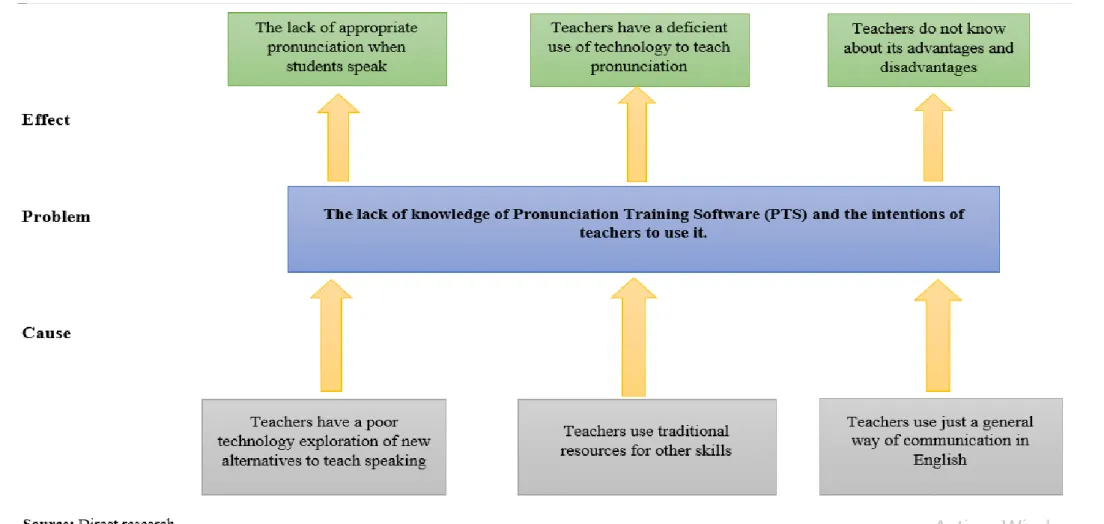
In this research work there are some effects that are caused for the main problem that is the lack of knowledge of Pronunciation Training Software (PTS) and the intentions of teachers to use it. it is important to know the causes and effects in order to understand better why the problem is stated.
The main cause of the problem is “teachers have a poor technology exploration of new alternatives to teach speaking”. There are loads of software, programmes and application that teachers can use to rehearse any skill in language. Teachers can find them for reading, writing as well as listening too. There are many others for speaking along with its subskills, they do not look for them, nonetheless. Most of the university, high school and school teachers do not know its existence. For that reason, their students are not able to apply an appropriate pronunciation at the moment to speak in a foreign language. Technology makes easier the English learning pronunciation and intonation when speaking in students and in teachers, as well. Whether teachers have not used and evaluated this kind of speaking software yet, it is too difficult to assign it as a home-practice because students are not going to understand its function neither use nor purpose. As there is not any kind of familiarity by the teachers, there is not an appropriate and accurate students’ practice at home or in the classroom. Students are not aware about the facilities at the moment to practice in this kind of programmes, software or applications. That is why the importance of the evaluation of this PTS (Pronunciation Training Software). It is crucial to recline upon an expert knowledge about this topic in the case of using this kind of tool to describe the shift language from the non-native to the native language practice.
Another cause is teachers use traditional resources for other skills. As a matter of fact, at Ambato Technical University teachers use loads of material for writing, reading and listening. They use the exercises from the book and they look for more extra material like worksheets, webpages, blogs and so forth. And for speaking they use conversations, role plays, debates, oral lessons, some drills and so on. The material along with the activities are important to learn, however, they are a traditional material. It causes the deficient use of technology to teach pronunciation. At least, to let students know that they can practice and develop their speaking, repeating from a native speaker voice realizing the stress of the whole phrase or sentence and for each word. It cannot be approached for the lack of
6
use of PTS when teaching, practicing and developing the language for students as a foreign language. It is unnoticed by teachers and students the knowledge of the software and the lack of parameters in order to evaluate it. (Willians, Duarte, & Francine, 2016) says that m-learning implies a self-explanatory set of criteria and requirements that is stablished by this quality model. It encompasses the systematic review of mobile learning application and its characteristics. Even though PTS is known in mobile learning (m-learning), it is not used by teachers and language experts to make students practice pronunciation, intonation, vocalization, raise-fall intonation, phonology, and so forth. The teachers use just a general way of communication in English is another cause in which it is noticed. As its effect, there is no idea about the strengths and weaknesses of this software due to the lack of intentions to use it by teachers. There is another way to practise it with CAPT (Computer-assisted pronunciation training). According to (Lee, Department of Electrical Engineering and Computer Science, 2016), this is a system in which students can speak and practice a foreign language getting a feedback. Furthermore, it assesses students’ pronunciation automatically in which students can realize their own errors and overcome them not just in the English language. If teachers do not know about this useful pronunciation training tool to rehearse speaking including subskills in their students, it is almost impossible to determine its strengths and weaknesses, its purpose, its usage and procedure.
1.2.3 Prognosis
The demotivation of students when speaking and interacting each other in English. Continuing with the lack of confidence in students and the same fluency problems with the ones that have not studied English before at schools, high school or private English courses. The ones who have not travelled to an English-speaking country before. The same fear of speaking will remain in students’ due to the lack of practice and being exposed to the language at once, without thinking whether they are getting everything or not. That is why students do not want to participate in classes increasing stress, insisting on them speaking, asking for their ideas or developing their critical thinking. All of these are caused for not applying a technological tool as a guide that help students to improve the word-sound, pronunciation, intonation and vocalization. Thus, in the case of not being applied the PTS (Pronunciation Training Software) layout and evaluation in English
7
teachers from “Carrera de Idiomas” at Ambato Technical University, everything already mentioned might happen.
1.2.4 Formulation of the problem
How does the quality of evaluation of the PTS (Pronunciation Training Software) influence on the intention to use it among English teachers from Ambato technical university?
1.2.5 Research questions
• Which is the correct operation of PTS (Pronunciation Training Software)? • What is the reason why there must be the teachers’ intentions in the use of PTS
(Pronunciation Training Software?
• What would be the possible solution to the problem under study? 1.2.6 Delimitation of the Research Object
This investigation has the following characteristics: ➢ Field: Educational
➢ Area: English
➢ Aspect: Intentions to use PTS (Pronunciation Training Software) ➢ Spatial delimitation: September 2017-February 2018
➢ Temporal delimitation: Languages Career (Carrera de Idiomas), Languages Centre (Centro de Idiomas)
1.3 Justification
This research project is extremely important because it will help to improve the use of the English language orally in students of the Languages Centre along with Languages School from Ambato Technical University using Pronunciation Training Software. Students will develop their pronunciation and fluency in language, strengthening their learning of English as foreign language students. This academic research is focused on the quality of evaluation of PTS (Pronunciation Training Software) by the teachers according to their intentions. As a matter of fact, they are going to evaluate this software using any checking tool for instance a check list in order to determine if it is suitable to apply to the students who are studying English in general or not. The evaluation material
8
will be created as a source of the evaluators in this case all the teacher from Ambato Technical University specifically from Languages School (Carrera de Idiomas) and Languages Centre (Centro de Idiomas) already mentioned.
This evaluation will be made not just for English Career teachers, it also will be made for teachers from Languages Centre (Centro de Idiomas) from Ambato Technical University. This is an original academy research due to the evaluation of a software specifically to improve the speaking skill in university students who are learning and producing a foreign language. Its originality is based on learning the usage of any application or software to use with students. Apart from this, it is not a well-known technological tool that can provide an instant feedback with some specific features and with an automatic speech recognition.
The most crucial thing is to know if the teachers use some of these resources with their students and after that they must evaluate the software. It is considered an important part in learning or teaching English due to teachers can reinforce the speaking skill and its subskills in their students. Of course, in some students is too difficult to acquire the tone, the stress, the intonation and pronunciation the words and phrases. In fact, it is essential to support students with pronunciation problems particularly if students are starting the course or if they are in the middle to master it.
The aforementioned project is highly feasible since it has the human, economic and bibliographic resources that will be a significant contribution to carry out the following research and comply with the accomplishment of the project itself. This research project is feasible as it tries to facilitate the teaching-learning process of the English language and its development in speaking skill. Apart from this, teachers can have this kind of pronunciation training software in a free way as an application into any mobile phone, laptop or even an i-pad. It is found in the application store along with the play store, as well.
The main beneficiaries of this research project are the lecturers of the Ambato Technical University, in the Tungurahua province, who will be motivated with an innovative and non-traditional way, and the teachers will acquire a better development with their pupils in oral dexterity; Whose goal is to improve and facilitate the application of oral proficiency in the English language learned as a second language. Thus, to benefiting the teachers, students the community and the Language Race itself.
9
1.4 Objectives 1.4.1 General
To identify the validity of Pronunciation Training Software in the development of the English language oral proficiency in English teachers’ intentions of the Languages Career and Languages Centre at Ambato Technical University in the Tungurahua province. 1.4.2 Specific
• To stablish theoretically the methodological bases of PTS (Pronunciation Training Software).
• To determine the importance of PTS in the proficiency of the English language. • To identify the teachers’ intentions in order to use the PTS (Pronunciation
10
CHAPTER 2
THEORETICAL FRAMEWORK
2.1 Investigative Background (Preliminary Investigations, State of the Art)
Considering a work research taken from the repository of Ambato Technical University made by Benalcazar, Carolina in 2017 at the technical university says that the main objective was to apply the System of Teaching Computer Assisted Pronunciation (CAPT) in order to study the use of My English Tutor (MyET) educational software and the development of oral dexterity in third and fourth semester students of the Languages School from Ambato Technical University.
This research was qualitative-quantitative, for its approach contextualized, participatory, humanistic and interpretative. It was done through the use of a pre-test and post-test which were measured using My English Tutor. Surveys were also applied to identify the degree of acceptance and MyET utility from the point of view of the students who used it. A t test was used to check the silver hypothesis to identify the relationship between the use of educational software "My English Tutor" and the development of oral skills in the English language, (Benalcazar, 2017)
The results obtained from the pre-test and post-test of the two groups both experimental and control by the use of a test T proved that there was no greater effect of the experiment, since it is considered that the results of the experimental group are similar to those of the controlled group. Therefore, it is concluded that the use of My English Tutor throws similar results to the use of the traditional methodology for the development of the oral dexterity.
Referring to software evaluation, this investigation was made by Jerez, Daniel in 2017 in the Directorate of Information Technology and Communication of the Technical University of Ambato, The quality of software is an essential factor for the development of products and services that face the needs and expectations of customers. It was made to get off a desired quality, a development process is required of adequate software, in addition to the use of the verification and validation of software, which relied on methods, techniques and tools that help finding this objective.
11
According to (Jerez, 2017), this project proposed the application of methods, tools and techniques of verification and validation appropriate to meet the needs in the development of software in the DITIC of the Technical University of Ambato, for which the methods, techniques were identified and tools used in the direction, as well as the type of tests that apply to the software, the process, models, control and tools used currently for software development. An analysis was carried out based on the international standard for the evaluation of Software ISO / IEC 9126, in which the quality characteristics are established for software products. The V & V methods, techniques and tools were evaluated of software, together with those applied in the DITIC.
The methods and techniques were evaluated according to the characteristics and sub-characteristics of the Quality Model of the aforementioned standard, and the tools were evaluated according to the M'etrics of Quality in Use defined by the Standard in its part 4 that define the acceptance of software by the end user. This analysis supports the selection of methods, techniques and tools for Verification and validation that meet the needs of the Technical University of Ambato, so that they help the software to reach compliance with quality.
Quality of evaluation of PTS (Pronunciation Training Software) is not specifically to modify entirely the software already created and in use, as well. The quality of evaluation is just to analyse the teachers’ intentions to use it or not with their students. It is a matter to adapt in the teachers’ intentions the qualifications of the software itself. Making it as a new official tool when students learn a new language as a foreign one.
Morales, Nelson in his research work "Use of Computer Assisted Language Learning", in 2014 determines that the objective of his study is to demonstrate the positive impact 14 that has the technology in the teaching and learning of an L2. The data for this research work was obtained from eight foreign language teachers who teach classes in different schools, which were provided with a survey of fifteen questions with the purpose of understanding the benefits of language instruction foreign students through the use of CALL and create a list of reliable programs that can be used by teachers to improve the learning process and teaching other languages. The results of the study show that the lack of use of Computer Aided Language Teaching by teachers and students reduces the possibility for students to become more independent learners due to the ease of access to technology inside and outside the classroom and therefore the absence of limitations of time to learn and practice the language. In other words, CALL transforms traditional
12
learning into a more dynamic student-centered process, which allows them to develop more independent and flexible learning by removing time constraints to L2 exposure. Besides, teachers assume the role of supervisor, leaving behind the traditional representation of the speaker, (Morales, 2014)
Hsieh, Shu-min who developed an investigation in 2013 known as "Preliminary Investigation of a Computer's Pronunciation Software for Phonetics Symbols Learning" in order to evaluate the pedagogical effectiveness of the software focused on phonics called "Phonics Master" and determine if the benefits obtained with its use were equally good compared to teaching traditional. This technological tool was applied in a population of 45 people from China who were learning English as a foreign language. These participants were divided into a control group that received a traditional teaching, and an experimental group that used the "Phonics Master" software. This process was carried out through the use of a pre-test and a post-test in the form of a questionnaire. According to the results, it was concluded that the improvement of the pronunciation of the experimental group was similar to the control group and it was proved that CALL could reduce the burden that the teacher has when working with a large group of students. In addition, the author states that the use of this type of software focused on phonetics solves the learning problems of students individually, such as pronunciation and grammar, (Hsieh, 2013).
2.2 Philosophical foundations
The following research will be oriented or philosophically focused on the Critical - Propositional paradigm. We proceed to focus this research under this paradigm, because it requires knowing the whole problem, to find coherent and feasible solutions, also deepens on the study of variables of the problem until we unravel and find the root causes of it, having this a broader view of the problem in order to find real solutions to this problem.
In the Critical - Propositional paradigm, the commitment of research is the growth and development of human beings throughout technology, without any discrimination and with equal opportunities for all. To be able to achieve this, it places first the human beings and their attitudes, being these the main protagonists throughout the investigative process.
13
2.3 Legal basis (if necessary)
The present investigation is endorsed in legal part by the laws established in the Constitution of the Republic of Ecuador (2008), the Organic Law of Intercultural Education (2012), and the National Plan for Good Living (2013- 2017).
La Constitución de la República del Ecuador establece:
Art. 26. - Educación
La educación es un derecho de las personas a lo largo de su vida y un deber ineludible e inexcusable del Estado. Constituye un área prioritaria de la política pública y de la inversión estatal, garantía de la igualdad e inclusión social y condición indispensable para el buen vivir. Las personas, las familias y la sociedad tienen el derecho y la responsabilidad de participar en el proceso educativo.
Art. 80.- De la ciencia y tecnología
El Estado fomentará la ciencia y la tecnología, especialmente en todos los niveles educativos, dirigidas a mejorar la productividad, la competitividad, el manejo sustentable de los recursos naturales, y a satisfacer las necesidades básica de la población. Garantizará la libertad de las actividades científicas y tecnológicas y la protección legal de sus resultados, así como el conocimiento ancestral colectivo.
El Plan Nacional para el Buen Vivir indica:
Lineamiento i: Promover el aprendizaje de una lengua extranjera bajo parámetros de acreditación
internacional, desde la educación temprana hasta el nivel superior.
La Ley Orgánica de Educación Intercultural (LOEI) constituye:
Art. 2.- Principios Generales
h) Inter aprendizaje y multiaprendizaje.- Se considera al interaprendizaje y multiaprendizaje como instrumentos para potenciar las capacidades humanas por medio de la cultura, el deporte, el acceso a la información y sus tecnologías, la comunicación y el conocimiento, para alcanzar niveles de desarrollo personal y colectivo.
q) “Motivación. - Se promueve el esfuerzo individual y la motivación a las personas para el aprendizaje, así como el reconocimiento y valoración del profesorado, la garantía del cumplimiento de sus derechos y el apoyo a su tarea, como factor esencial de calidad de la educación.”
Art. 10. – Derechos
14
a) Acceder gratuitamente a procesos de desarrollo profesional, capacitación, actualización, formación continua, mejoramiento pedagógico y académico en todos los niveles y modalidades, según sus necesidades y las del Sistema Nacional de Educación".
Art. 26.- “La educación es un derecho de las personas a lo largo de su vida y un deber ineludible e inexcusable del Estado. Constituye un área prioritaria de la política pública y de la inversión estatal, garantía de la igualdad e inclusión social y condición indispensable para el buen vivir. Las personas, las familias y la 18 sociedad tienen el derecho y la responsabilidad de participar en el proceso educativo”
Art. 343.- (Ecuador, 2008)“El sistema nacional de educación tendrá como finalidad el desarrollo de capacidades y potencialidades individuales y colectivas de la población, que posibiliten el aprendizaje, y la generación y utilización de conocimientos, técnicas, saberes, artes y cultura. El sistema tendrá como centro al sujeto que aprende, y funcionará de manera flexible y dinámica, incluyente, eficaz y eficiente.
Art.37.- “Derecho a la educación.- Garantice que los niños, niñas y adolescentes cuenten con docentes y materiales didácticos, laboratorios, locales, instalaciones y recursos adecuados y gocen de un ambiente favorable para el aprendizaje”.
Art.38.- “Objetivos de los programas de educación.-La educación básica y media asegurarán los conocimientos, valores y actitudes indispensables para: Desarrollar la personalidad, las aptitudes y capacidad mental y física de los niños, niñas y adolescentes hasta su máximo potencial, en un entorno afectivo. Desarrollar un pensamiento autónomo, crítico y creativo.”
Art. 204 (Ecuador, 2008). “Proceso de evaluación, retroalimentación y refuerzo académico A fin de promover el mejoramiento académico y evitar que los estudiantes finalicen el año escolar sin haber cumplido con los aprendizajes esperados para el grado o curso, los establecimientos educativos deben cumplir, como mínimo, con los procesos de evaluación, retroalimentación y refuerzo académico”
15
2.4 Key Categories
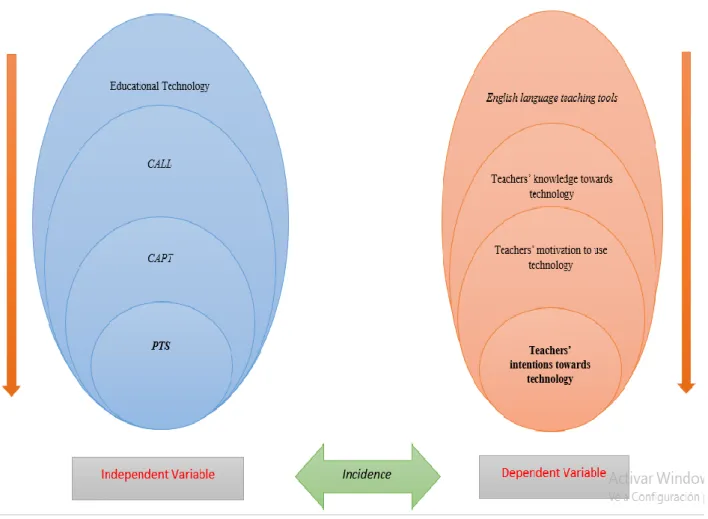
Graphic 2 Main categories
Source: Direct research
Elaborated by: Ramos, D (2017)
Fundamental Categories from Independent Variable: PTS (Pronunciation Training Software)
EDUCATIONAL TECHNOLOGY
References to educational technology, learning technologies, and instructional technology pervade professional journals and magazines throughout education. Yet no single, acceptable definition for these terms serves the field, and there is uncertainty even about the origins of the terms (Reiser & Dempsey, 2006). Educational technology historian Paul Saettler (1990) says that the earliest reference to educational technology seems to have been made by radio instruction pioneer Charters in 1948, and instructional technology was first used by audio-visual expert James Finn in 1963. Even in those early days, definitions of these terms focused on more than just devices and materials. Saettler
16
notes that a 1970 Commission on Instructional Technology defined it as both "the media born of the communication revolution which can be used for instructional purposes ... " (p. 6) and "a systematic way of designing, carrying out, and evaluating the total process of learning and teaching. . ." (p. 6).
According to (Coll C. , 2004), the significant difference between the multiple and diverse uses of ICT in school education lies not so much in the characteristics of the technological resources used in each case, but in its location in the conceptual space delimited by the framework of relationships between the three elements of the interactive triangle. Without leaving aside the characteristics of the different ICT tools considered, it is in the incidence that the uses of these tools have on the joint activity of teachers and students where the key resides to analyse its impact on educational practice and, therefore, on student learning (Coll, 2004). In the same way, it is in the incidence of some uses on the joint activity where it will be concrete or not, the capacity of the ICT to transform and improve the educational practices.
The incorporation of technology to education is often justified on the grounds of its ability to improve learning. This argument, however, has not yet found sufficient empirical support, clear and unambiguous. The consideration of the human mind as mediated by instruments is, as is well known, one of the fundamental theses of the sociocultural perspective. According to the ideas of Vygotsky and his followers, the higher psychological processes are characterized, precisely, using instruments of cultural origin acquired socially, particularly symbolic instruments such as language or other systems of representation. This use allows active adaptation to the environment, and the realization and conscious control that characterize these higher psychological processes. From this perspective, ICT’s are means of representation and novel communication, in which their use can introduce important changes in certain aspects of the psychological functioning of people; it means that, although it does not constitute in the strict sense a new semiotic system - since it mainly uses previously existing semiotic systems, such as oral and written language, audio-visual image, graphic representations, and so on. It creates, from the integration of such systems, totally new conditions of treatment, transmission, access and use of information. (Coll, Majós, & Onrubia, 2018)
ICT’s in the world are part of the new technologies which have been inserted in the society favouring the communication, the education, the health, etc. It is essential to always keep them in mind and apply them carefully. They can work as tools being an important and
17
efficient part of the human development. The tools can be of very diverse types, and with different cognitive processes and purposes when using them in any kind of activity. Thus, ICT can act, to cite only a few examples, as tools to support the semantic organization of information. For instance, databases, conceptual networks; to the interpretation of information visualization tools; or to communication between people email, videoconference, instant messaging, chat, and so forth.
CALL
Jeong-Bae in his book "Computer-Assisted Language Learning: Learners, Teachers and Tools (1)" in 2014 exposes the importance of the use of CALL and presents findings of recent work based on its use in the educational field, showing that its application is a valuable academic contribution. At the same time, this book offers information for readers to participate in discussions about CALL research and practice, (Jeong-Bae, 2014) Computer Assisted Language Learning (CALL) is often perceived, somewhat narrowly, as an approach to language teaching and learning in which the computer is used as an aid to the presentation, reinforcement and assessment of material to be learned, usually including a substantial interactive element. Levy (1997:1) defines CALL more succinctly and more broadly as "the search for and study of applications of the computer in language teaching and learning". Levy's definition is in line with the view held by the majority of modern CALL practitioners.
Computer Assisted Language Learning CALL can provide an interaction in pupils according to their level of knowledge and being more focused in their input at the moment to evaluate pupils’ responses. They can practice in some controlled activities providing them more opportunities to overcome their mistakes when managing the language. This kind of activities could be reading texts, watching or listening to videos or any other audio-visual in order to realise by themselves what they are doing wrong.
It has to be with technology, it means, with the use of computers which contain this kind of activities that are downloaded or on-line. It creates an immediate correctness in pupils’ language development and language input. It has been found too beneficial when learning, practicing and improving. In most of this practice, there is some feedback that make students notice in their mistakes.
18
Pupils can be addressed to develop their knowledge by autonomous learning with individual activities providing them a correct guidance with the use of CALL. Benson pointed out, “there is an assumption that technology can provide learners with the kinds of support they need to develop the skills associated with autonomy.” It really depends on the activities and their characteristics of the technology support. (Spolsky & Hult, 2008)
CAPT
Computer-assisted pronunciation training (CAPT) systems help students practice speaking foreign languages by providing automatic pronunciation assessment and corrective feedback. Automatic speech recognition (ASR) technology is a natural component in CAPT systems. Since a non-native speaker’s native language (L1) background affects their pronunciation patterns in a target language (L2), typically not only native but also non-native training data of specific L1s is needed to train a recognizer for CAPT systems. Given that there are around 7,000 languages in the world, the data collection process is costly and has scalability issues. In addition, expert knowledge on the target L2 is also often needed to design a large feature set describing the deviation of non-native speech from native speech.
Currently, still exist teachers who do not believe in how CAPT can work in students and how can be used it by the students. Maybe the lack of use from teachers make it difficult in its usage. That is why teachers or at least the majority of them feel uncomfortable sending practice to their students at home or even making a speaking practice in the class room. Referring to this, it is important to mention ASR is a very important part of CAPT and it can make students follow an accurate well-accented pronunciation and good-developed intonation.
The most important thing here is that it recognises any mispronunciation error taking into account the speech recognition. It consists on a phonological and syntactical part and it is contained the computer-based activities to improve the communicative skills and the ASR-based CAPT. They make students interact with the computer and start practicing with repeating, matching, answering and completing activities. All of these practices are scored in order to evaluate the global pronunciation quality. When the software or the on-line programme rate or evaluate the student oral development. There is going to be an error detection in the utterance and specifically in some certain sounds of a word. This
19
ASR help students to continue practicing in their pronunciation errors. It could determine the error and find a specific error making the opportunity to give the student some feedback. It is going to be stablished to make students practice and improve their communicative skill. This ASR-based CAPT is recommended for people specifically non-native students who are learning another language as a second language, in this case who are learning English. (Automatic Speech Recognition for second language learning: How and why it actually works, 2003)
CAPT can even offer a number of advantages compared to traditional instruction in the classroom. First, by allowing the student to detect individual problems. In addition, CAPT is able to present certain tasks aimed at developing specific skills. Second, CAPT systems allow students to practice the language as much as they want at their own pace. Third, the privacy and the type of self-directed learning offered by these environments can lead to a reduction of anxiety when practicing the foreign language, favouring learning. Finally, the student can receive feedback on their oral performance in real time, (Neri A. , Cucchiarini, Strik, & Boves, 2002)
PTS
Pronunciation Training Software is a learning tool that can be used in any electronical device. It could be represented as a software or an application. It depends the usage people want to apply. It could be in a medical field or in an educational field. There is some software that can be paid for using and they work in a professional development such as “pronunciation coach”, “saundz”, “speechace”, e-ENGLISH and so on. It is used for people whom do not their speech well-developed. It could be for any speaking or communicative disorders. It is assigned or applied as a treatment to help them in the vocalization, intonation, pronunciation, articulation, stress, etc.
As it is mentioned before there are some applications that are free on the web to download. The one that is well-known and easy to get is the “Learn English”.
20
Graphic 3 Downloading
Source: Learn English application Elaborated by: Otterall INC
It can be found and downloaded from “Play Store” or App. Store. Without any credit card, neither paying in cash and any money. After looking for the application it must be downloaded and installed in your own electronical device.
Graphic 4 Cover page
Source: Learn English application Elaborated by: Otterall INC
This image shows that the program or the application is getting ready to use. It is easy to manage in any age specially for students who are studying and learning English as a foreign language. It has got several topics to choose in order to reinforce the pronunciation of some specific vocabulary. Students are going to have an extra tool where practicing the pronunciation.
21
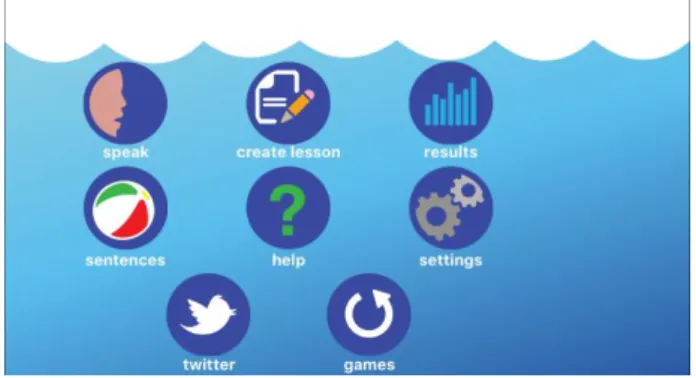
Graphic 5 Starting page
Source: Learn English application Elaborated by: Otterall INC
Graphic 6 Main Instructions
Source: Learn English application Elaborated by: Otterall INC
The instructions how to use are well-stated at the moment to start using the application. As it is indicated in the graphic, it says what to do and how to do. First, you listen the original audio with a native accent and after that the student has to record him or herself with the same pronunciation as well as intonation like the first one.
22
Graphic 7 Listening
Source: Learn English application Elaborated by: Otterall INC
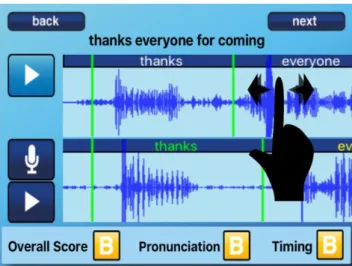
The use of spectrograms is the feedback that students have. These two spectrograms are divided into two, the first is the original one and the second is from the students’ recording. This application assesses pronunciation along with timing, as well. It is an important practice for the ones who have got problems to assimilate the pronunciation.
Graphic 8 Recording
Source: Learn English application
Elaborated by: Otterall INC
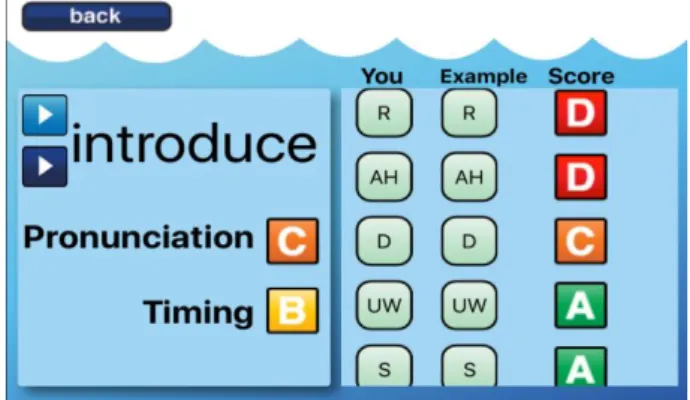
As a final point, there is the individual feedback that students can have in the practice. They can even listen to their own errors letter by letter and sound by sound. In the spectrogram, there are some lines that divides the clause or sentence in chunked parts.
23
Chunking, best known like the ability to divide a sentence into correct sounds in order to express the idea clearly and accurately.
Graphic 9 Feedback
Source: Learn English application
Elaborated by: Otterall INC
English learning, just teaching English language is not enough, nor is just language learning, and successful English should cultivate students’ intercultural communication ability and integrate the social culture factors of a language into the language teaching for students. people pay more attention to the importance of culture teaching in English language teaching. English language teaching and culture teaching are organic and interconnected components of English teaching, while an important aim of English teaching is to cultivate students’ intercultural communication ability from a global perspective. Successful English teaching is an important guarantee of successful intercultural communication, but in real life, there are many cases of communication misunderstanding and failure which are caused by the disconnection between language teaching and culture teaching. Therefore, it is necessary to enhance cultural infiltration in English teaching. (Sun & Jiang, 2017)
24
Fundamental Categories from Dependent Variable: Teachers’ intentions towards technology
English language teaching tools
Face-to-face education in accordance with a complex context that colloquially reinforces the students’ interest in the learning activity that any of them displays such as peers, exchange of notes and points of view, the team review, the extra-educational activities, the contact with the teachers. In short, interpersonal communication is the best trigger for motivation. Nevertheless, education systems must address social, economic, and technological changes. Each has had its own educational institutions, adapting the educational processes to the circumstances. Currently, the changes that affect educational institutions make up a new context, where the universality of telecommunications in society, the need to train professionals for times of change, the continuous updating of these professionals, demand new teaching-learning situations and demand new models suitable for them. (Salinas, 1999)
Talking about technological tools, students have the opportunity to expand their learning experience when using new technologies as educational tools for constructivist learning. These tools offer you options to get the classroom traditionally become a new space, where they have at your disposal innovative collaborative activities and with creative aspects that allow them to secure what they learn while having fun. Therefore, these characteristics in the student himself being able to build his knowledge with the teacher as a guide, granting students the necessary freedom to explore the technological environment, but being present the teacher when they have got doubts or problems. (Hernandez, 2008)
It may be convenient to have courses and tools from learning for a double use, in such a way that both students who attend the institution can access them in the classroom, in the centre, as those who cannot attend the centre, can access to those same materials through networks. Among these new approaches, those related to the open learning can involve a new conception, regardless of whether the teaching is face-to-face or distance learning, provides the student with a variety of means and the possibility of taking decisions about learning. Most of the concepts associated with learning in the traditional classroom, but absent when use conventional systems of distance education, can be rearranged in the use of networks for teaching, leading to a new configuration of teaching that can overcome
25
the deficiencies of conventional classroom and remote systems. Here, the student, whether he is in the institution, as if he is at home, at work, etc. He accesses a series of services through telecommunications: standard materials such as database, etc. specific materials of software training, communication with the tutor, possibility of interaction with others or themselves. (Salinas, 1999)
Teachers knowledge towards technology
Technology is the application of a set of knowledge and skills with a clear objective: to achieve a solution that allows the human being from solving a specific problem to meeting a need in a specific field.
It can be understood as the practical application of knowledge generated by science. In colloquial language, however, technology is linked to information technology, which is one that enables the processing of information through artificial means such as computers, mobile phones, i-pads and so forth.
Within the framework of Information and Communication Technologies are emerging new ways of planning and developing the teaching-learning processes. Thus, the synchronous and asynchronous participation is promoted among subjects which are physically in the same place. According to the author (Bitner & Bitner, 2002) says that
The skill and attitude from the teacher is essential to choose, use and apply the appropriate software and hardware in his or her students. Therefore, it can determine the effectiveness in his or her curriculum using technology in classroom.
Teachers are the ones who must be in charge to change their own way of thinking along with their students’ way of thinking, as well. When the class has to be referred with technology, some of them, sometimes or most of the time prefer to overlook it because they are not prepared enough to carry out a class within this technological context. They get disappointed and the students do not have the class that they expect. On the contrary, some teachers are very well-prepared to use their classes using technology. They enjoy making their students practicing with technology. The most crucial thing is that teachers are aware that their students will improve their foreign language management rehearsing with technology in some of their language skills. Thus, teachers have to use technology in their teaching strategies in order to change or enhance the traditional teaching paradigm, (Bitner & Bitner, 2002)
26
Teachers motivation to use technology
According to (Anton, 2005), motivation is very important at the moment to teach or to work with technology with students as well as produce motivation on the part of the teacher with the use of technology within the classroom, it must comply with several parameters or objectives which are to master the subject in a professional way that will be taught using some technological tools. This shows that the teacher knows the subject and he or she is completely sure about what he or she says and does, making the class more interesting and catching. The knowledge that the teacher imparts must be transmitted in a way that fully put forward of the entire class. Whilst it is true, that just working with technological tools already produces a sense of curiosity to learn new along with new-fangled topics that not only includes the theory but the practice, as well. Additionally, teachers must generate a lot of motivation in their students to learn or work with technology using their thinking in an effective way and generating an adequate reflection in which it causes easy understanding in their students. Community participation or group-work is very helpful as the class avoids being monotonous and ambiguous. This will make the student participate in a voluntary way creating an environment of trust. This type of work in the classroom causes an exchange of educational experiences, encouraging more adequate attention regarding the use of technology. Apart from this, if there is an exchange of experiences and knowledge among the students, teamwork will be encouraged more and more.
Students feel more motivated when they see their other classmates talking, using technology tools or materials and participating in class each other. When teachers work with technology, they are empowering innovative actions in their students. Taking into account that technology is changing and updating its information and way of working, leaving behind the traditionalism in which the classes were made in some time ago. Talking about higher education, the teacher must motivate his students using technology and participate in national and international events in representation of their universities, cities or even countries. For this reason, the authorities in charge together with the technology teachers should reinforce the curriculum, adapting new methodological proposals where the motivation for the use of technology in classes is directly found. Whether we talk about motivating students, it is to provoke in them the personal search for knowledge and learning from the establishment of stimulating contexts. Stimulating