
Callovian nautiloids from the Neuquén Basin, Argentina
6
0
0
Texto completo
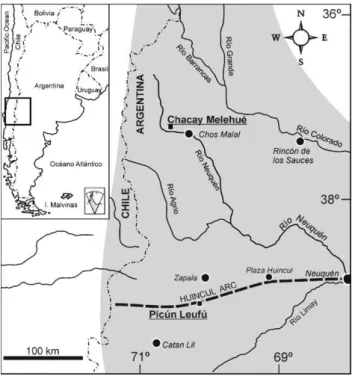
(2) Parent & Garrido - Callovian nautiloids from the Neuquén Basin, Argentina.. 14. INTRODUCTION Jurassic Nautilida have much importance from an evolutionary point of view considering the great extinction in this group of cephalopods at the end of the Triassic (Kummel 1956). During Jurassic times, they slowly increased in diversity and, apparently, abundance, giving rise to the supposedly monophyletic Nautilina (the so-called post-Triassic nautiloids). In particular, Cenoceras Hyatt is a key genus in this scenario. However, most taxonomists agree that its systematics is complex (e.g. Dzik 1984, Tintant 1984, Rulleau 2008, King 2011), mainly due to the few morphologic variations through the lineages. Jurassic nautiloids are known in South America almost exclusively by the Tithonian Cymatoceras perstriatum (Steuer, 1897), e.g. Gerth (1925), Weaver (1931), recently reviewed by Cichowolski (2003). This situation of great scarcity, especially respect to ammonites so abundant in the Neuquén Basin, seems to be a world-wide phenomenon. It was already pointed out by Kummel (1954: 320) who noted that “Nautiloids from the Jurassic formations are very uncommon fossils”. This author related it with the Triassic extinction event. In the last years, the authors have gathered an interesting collection of Callovian, Tithonian and Berriasian nautiloids from different localities of the Neuquén Basin. However, it is worth to note that among more than 5.000 ammonites collected in several localities of the basin, there were found only some fifteen nautiloids. In the present study, we describe three specimens from the Andean Upper Callovian Patagoniensis Zone of Picún Leufú and two other ones from the upper Lowerlower Middle Callovian Proximum-"Jason" zones of Chacay Melehué. Their relatively poor preservation prevents specific identifications, but their occurrence is important considering the lack of previous records of Callovian representatives in the Neuquén Basin. The Callovian-Oxfordian chronostratigraphic zone scale of Parent & Garrido (2015) is adopted herein. GEOLOGICAL SETTING The specimens come from two localities (see Fig. 1): (1) Picún Leufú, southern end of the Neuquén Basin, south of the Huincul Arc, from the upper part of the Lotena Fm (Fig. 2A), assigned to the lower Upper Callovian Patagoniensis Zone (Garrido & Parent 2013), and (2) Chacay Melehué, central part (depocentre) of the Neuquén Basin, from the uppermost part of the Los Molles Fm (upper Lower-lower Middle Callovian, Proximum-"Jason" zones). The geology of this area has been dealt in variable detail by several authors (e.g. HerreroDucloux & Leanza 1943, Groeber 1952, Leanza 1973 and references therein). The log-section of the upper Los Molles Fm in Chacay Melehué is shown in Fig. 2B. The outcrops of the Lotena Fm in Picún Leufú consist of a 30 to 50 m thick succession composed of mudstones and silty mudstones, with thin intercalations of limestone and finegrained sandstone. In these thin banks occur the nautiloids described below; ammonites are moderately abundant (Fig. 2A). The age of the Lotena Fm in this area is Late Callovian, Patagoniensis Zone (Parent 2006). All along the section we have collected an interesting ammonite fauna typical of this zone (see Garrido & Parent 2013), composed of Hecticoceras cf. lairense (Waagen, 1875), Rehmannia patagoniensis (Weaver, 1931), Choffatia cf. isabellae Bonnot et al., 2008, Alligaticeras? aff. raguini (Gerard & Contaut, 1936), and Binatisphinctes sp. A. The lower occurrence of nautiloids in the silty mudstone beds consists of Cenoceras sp. A (Figs. 2A, 3B),. Figure 1. Location of the sampled localities in the Neuquén Basin (gray area) superimposed on a Recent geography.. whereas the upper occurrence in the mudstone levels consists of the single specimen described below as Cenoceras sp. B (Figs. 2A, 4). In the studied section of Chacay Melehué, the uppermost 30 m of the Los Molles Fm, where our specimen comes from, consists of black shales with levels of calcareous concretions containing abundant and well-preserved ammonites (Fig. 2B). The fauna collected from these levels is in its most part new and currently under study. Two fossiliferous levels are indicated in Fig. 2B: (1) the uppermost level, at 9.7 m below the contact of the Los Molles and Tabanos formations, yielded Cenoceras sp. A (Fig. 3A) and the ammonites Araucanites? n. sp., Hecticoceras proximum Elmi, Hecticoceras n. sp., and Rehmannia paucicostata (Tornquist): (2) the lower level, 14 m below the contact, yielded Choffatia sp. or spp. The cited ammonites indicate a stratigraphic position within the interval Proximum-lower "Jason" zones (see Riccardi & Westermann 1991, Parent & Garrido 2015: fig. 38). SYSTEMATIC PALAEONTOLOGY The specimens are stored in the Museo Provincial de Ciencias Naturales "Prof. Dr. Juan A. Olsacher", Zapala (MOZ-PI). The dimensions of the specimens are indicated as follows: D: shell diameter, U: umbilical diameter, W: maximum septal width, H1: maximum septal height, H2: apertural septal height. The determinations are left in open nomenclature mainly due to the poor or incomplete preservation of the specimens. Class Cephalopoda Cuvier, 1797 Order Nautilida Agassiz, 1847 Family Nautilidae De Blainville, 1825 Genus Cenoceras Hyatt, 1883 Type species: Nautilus intermedius Sowerby, 1816; by original designation.
(3) Boletín del Instituto de Fisiografía y Geología 85, 2015. 15. flattened flanks, and widely rounded venter. Phragmocone, at D = 40-70 mm, slightly more inflate (W/H1 = 1.06), moderately evolute (H2/H1 = 0.60), umbilicus relatively wide (U/D = 0.13) with indistinctly rounded margin; whorl section suboval to subtrapezoidal with high, flattened flanks. Septal suture line slightly sinuous. Sculpture is not preserved. Remarks.- The phragmocone in Fig. 3B could be compared with that from the upper? Callovian of Chari (India) figured by Spath (1927-1933: pl. 2: 1) as Paracenoceras cf. calloviense (Oppel). Also similar is the specimen from the lower? Callovian of Jumara figured by Waagen (1875: pl. 3: 2, later refigured by Spath 1927-1933: pl. 3: 5) as Nautilus calloviense. Complete adult specimens with preserved bodychamber are quite rare in the literature, furthermore most Jurassic species and genera are based on phragmocones only. Cenoceras sp. B Fig. 4 Material.- A well-preserved phragmocone and a portion of whorl of a large specimen (MOZ-PI 7265/1-2) from Picún Leufú, Lotena Fm, Patagoniensis Zone, lower Upper Callovian. Description.- Innermost (embryonic) whorl (D = 20-25 mm) inflate, rounded subtriangular in whorl section with narrow venter. Outer whorls globose and involute; whorl section suboval with rounded umbilical margin and widely rounded venter. The sculpture is well preserved only on the innermost whorl, and consists of two elements which form a conspicuous reticulate pattern: (1) sharp, narrow rursiradiate ribs, and (2) well defined, fine, parallel spiral lirae radiating away from the apex. The sipho at D > 35 mm is subdorsal, placed at about two thirds the apertural height from the venter. Septal suture line slightly sinuous. Remarks.- This specimen shows some resemblance with "Eutrephoceras" montanense Kummel, 1954, which seems to be Callovian in age. DISCUSSION Figure 2. A. Log-section of the Mutrucó and Lotena formations in Picún Leufú summarized from Garrido & Parent (2013), with indication of the occurrences of ammonites and nautiloids (lower occurrence: Cenoceras sp. A.; upper occurrence: Cenoceras sp. B). B: Log section of the topmost part of the Los Molles Fm, Tábanos Fm (total thickness 39 m), and basal part of the Lotena Fm (which is 85 m in total thickness), with indication of the occurrences of ammonites and nautiloids (Cenoceras sp. A). – Note the very different scales.. Cenoceras sp. A Fig. 3 Material.- Two large adults with phragmocone and part of bodychamber (MOZ-PI 3556/1-2) from Chacay Melehué, Los Molles Fm, Proximum Z., upper Lower-lower Middle Callovian. A phragmocone, internal mould (MOZ-PI 7836) from Picún Leufú, Lotena Fm, Patagoniensis Zone, Upper Callovian. Description.- Large; maximum preserved diameter (estimated) D = 200 mm, last septum at about D = 150 mm. Bodychamber narrowly umbilicated, whorl section subrectangular (W/H1 = 0.90) with indistinct umbilical margin,. The nautiloids from Picún Leufú were collected from two different horizons. One of the specimens, Cenoceras sp. B (Fig. 4), was collected in isolation in the upper part of the Lotena Fm. Two of the specimens of Cenoceras sp. A (Fig. 3B) come from a level where ammonites co-occur. In Chacay Melehué the studied specimens (Fig. 3A) were collected from a single horizon, associated with numerous ammonites, even relatively large fragmentary hecticoceratids were found within the bodychamber of the largest specimen (not figured). Considering the absence of published records of Callovian nautiloids in western South American, it is not possible to advance a detailed discussion of the implications of the present records. Chirat & Rioult (1998) have concluded that Jurassic nautiloids have preferred habitats in stable cratonic areas with hard substrate and low sedimentation rates in warm and welloxygenated seawaters. The rocks of the Lotena Fm, from where the nautiloids were collected in Picún Leufú, indicate a position on the inner platform, under oxygenate conditions and low influx of terrigenous sediments (Garrido & Parent 2013). In Europe and India the nautiloids seem to have expanded.
(4) 16. Parent & Garrido - Callovian nautiloids from the Neuquén Basin, Argentina.. Figure 3. Cenoceras sp. A., Callovian, Neuquén Basin, Argentina. A: Almost complete adult specimen (MOZ-PI 3556/1) from Chacay Melehué, uppermost Los Molles Fm., Proximum-"Jason" zones, upper Lower-lower Middle Callovian; A1: whorl section drawn at the beginning of the bodychamber (asterisk in A2); A2: lateral view of the specimen; A3: inner whorls removed for showing the flanks and suture. B: Phragmocone (MOZ-PI 7836) from Picún Leufú, Lotena Fm., Patagoniensis Z., lower Upper Callovian. Standard lateral (B1), ventral (B2) and apertural (B3) views; B4: whorl section at the apertural view. All in natural size (x1).. more widely than in other regions, being relatively abundant and diverse since the Early Jurassic (e.g. Spath 1927, Kummel 1964, Calzada 1988, Branger 2004, Rulleau 2008, King 2011). In south-western Gondwana the occurrences of these cephalopods appear to have been scarce and scattered. To our knowledge, there are no records of nautiloids from the extensive marine Lower Jurassic outcrops of the Neuquén Basin. This basin is widely known as having one of the worldwide most important outcrops, mainly Mesozoic, being a reservoir of hydrocarbons and therefore deeply studied from a geological and stratigraphical point of view (e.g. Digregorio & Uliana 1980, Uliana & Biddle 1988, Legarreta & Gulisano. 1989, Uliana et al. 1989, Uliana & Legarreta 1993, Urien & Zambrano 1994, Vergani et al. 1995, Howell et al. 2005, among others). Therefore, it is worth to note the almost absence of Jurassic Nautilida in this region. Moreover, the ammonoid fauna of the Jurassic of this basin is abundant and diverse, in many aspects directly comparable to that of the Tethys, being more noticeable the almost absence of nautiloids. In the Lower Cretaceous, on the other hand, the ammonoid fauna is less diverse than that of the Tethyan region, but nautiloids, although monospecific, may locally occur in abundance (Cichowolski 2003, Cichowolski et al. 2013). The asymmetric pattern of abundance of nautiloids versus.
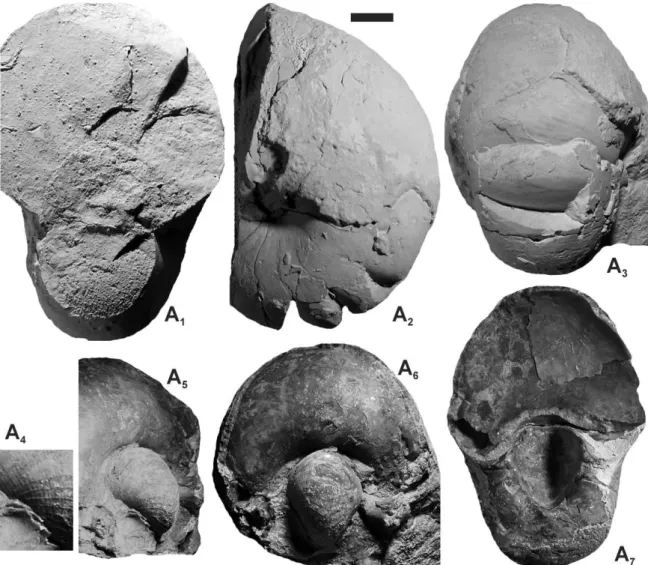
(5) Boletín del Instituto de Fisiografía y Geología 85, 2015. 17. Figure 4. Cenoceras sp. B. (MOZ-PI 7265) from Picún Leufú, Lotena Fm., Patagoniensis Zone, lower Upper Callovian. Standard apertural (A1), lateral (A2) and ventral (A3) views; A4: enlarged view (x2) of the sculpture of the innermost (embryonic) whorl shown in A5-A6 with the outer whorl (A7) removed. All in natural size (x1) except A4 (x2). The scale bar indicates 10 mm for all except for A4 (5 mm).. ammonoids can be attributed, among other factors, to their very different reproductive strategies (see Landman 1987, Landman et al. 1996, Stephen & Stanton 2002, Laptikhovsky et al. 2013, Lukeneder 2015). Ammonoid reproductive strategy must have been based on thousands of small eggs per batch as undoubtely indicated by their protoconch size range, producing large masses of mainly planktic to nektonic or demersal juvenile individuals (e.g. Westermann 1996 and references therein) which, depending the species, passed to different positions in the water column. In contrast, and as in living Nautilus, Jurassic nautiloids must have based their reproductive strategy in much larger eggs laid in batches of few individuals, beginning their development in benthic habitats and probably migrating through ontogeny to demersal or nektonic habitats. Interestingly these differences seem to explain not only the asymmetry of the patterns of abundance, but also the much more diversified biomes and biotas of ammonoids, which show morphologic evolutionary changes faster than nautiloids. Acknowledgements: Marcela Cichowolki (Buenos Aires, Argentina) for discussion and information. Facultad de Ingeniería (Universidad Nacional de Rosario) and Dirección General de Minería (Gobierno de la Provincia del Neuquén) funded the field works. Günter Schweigert (Stuttgart, Germany) for the edition of this paper. Patrick Branger (Cherveux, France) and Jerzy Dzik (Warszawa, Poland) greatly contributed for enhancing the early version of the manuscript as referees of the journal.. REFERENCES Bonnot A., Boursicot P.-Y., Ferchaud P. & Marchand D., 2008. Les Pseudoperisphinctinae (Ammonitina, Perisphinctidae) de l'horizon à Leckenbyi (Callovien supérieur, zone à Athleta) de Montreuil-Bellay (Maine-et-Loire, France) et description d'une nouvelle espèce, Choffatia isabellae. – Carnets de Géologie 2008/5: 1-27. Branger P., 2004. Middle Jurassic Nautiloidea from Western France. – Rivista Italiana di Paleontologia e Stratigrafia 110: 141-149. Calzada S., 1988. Nautílidos liásicos de los alrededores de Alfara (Tarragona, NE España). – Acta Geológica Hispánica 23: 303-309. Cichowolski, M. 2003. The nautiloid genus Cymatoceras from the Cretaceous of the Neuquén and Austral basins, Argentina. – Cretaceous Research 23: 375-390. Cichowolski M., Pazos P.J., Tunik M.A. & Aguirre-Urreta M.B., 2012. An exceptional storm accumulation of nautilids in the Lower Cretaceous of the Neuquén Basin, Argentina. – Lethaia 45: 121-138. Chirat R. & Rioult M., 1998. Les reliefs des bordures de massifs anciens: des sites privilégiés de reproduction pour les Nautilida jurassiques. – Compte Rendu Academie des sciences de Paris (Sciences de la terre et des planétes) 327: 197-202..
(6) 18. Digregorio J.H. & Uliana M.A., 1980. Cuenca Neuquina. Actas del Segundo Simposio de Geología Regional Argentina. – Academia Nacional de Ciencias de Córdoba 2: 985-1032. Dzik J., 1984. Phylogeny of the Nautiloidea. – Palaeontologica Polonica 45: 1-219. Garrido A.C. & Parent H., 2013. Estratigrafía y fauna de amonites de los depósitos “Lotenianos” (Caloviano Medio-Oxfordiano Inferior?) del anticlinal de Picún Leufú, Cuenca Nequina – Subcuenca de Picún Leufú, Argentina. – Boletín del Instituto de Fisiografía y Geología 83: 35-68. Gerard, Ch. & Contaut, H. (1936): Les ammonites de la Zone à Peltoceras athleta du Centre-Ouest de la France. – Mémoires de la Societé Géologique de France 29: 1-79. Gerth E. [Gerth H.], 1925. La fauna necocomiana de la Cordillera Argentina en la parte meridional de la Provincia de Mendoza. – Actas de la Academia Nacional de Ciencias de la República Argentina 9: 57-132. Groeber P., 1952. Andico. Mesozoico. – In: Geografía de la República Argentina 2: 49-541; Buenos Aires (Sociedad Argentina de Estudios Geográficos). Herrero-Ducloux A. & Leanza A.F., 1943. Sobre los ammonites de la Lotena Formation y su significación geológica. – Notas del Museo de La Plata 8(54): 281-304. Howell J.A., Schwarz E., Spalletti L.A. & Veiga G.D., 2005. The Neuquén Basin: an overview. In: G.D. Veiga, L.A. Spalletti, J.A. Howell & E. Schwarz (eds.): The Neuquén Basin, Argentina: A Case Study in Sequence Stratigraphy and Basin Dynamics. – Geological Society London Special Publications 252: 1-14. Hyatt A., 1883-1884. Genera of fossil cephalopods. – Proceedings of the Boston Society of Natural History 22: 253-338. King A., 2011. Fossil nautiloids from the Upper Lias (Toarcian) 'Junction Bed' of the Ilminster Area, Somerset. – Proceedings of the Somerset Archaeological and Natural History Society 154: 249-258. Kummel B., 1954. Jurassic nautiloids from Western North America. – Journal of Paleontology 28: 320-324. Kummel B., 1956. Post-Triassic nautiloid genera. – Bulletin of the Museum of Comparative Zoololgy 114: 224-494. Kummel B., 1964. Nautiloidea-Nautilida. In: Moore, R.C. (ed.): Treatise on Invertebrate Paleontology, Part K, Mollusca 3. Geological Society of America, Boulder & University of Kansas Press, Lawrence, pp. 383-456. Landman N.H., 1987. Ontogeny of Upper Cretaceous (TuronianSantonian) scaphitid ammonites from the Western interior of North America: systematics, developmental patterns, and life history. – Bulletin of the American Museum of Natural History 185: 117-241. Landman N.H., Tanabe K. & Shigeta Y., 1996. Ammonoid embryonic development. In: N. Landman, K. Tanabe & R.A. Davis (eds.): Ammonoid paleobiology. – Topics in Geobiology 13: 607-707. Laptikhovsky V.L., Rogov M.A., Nikolaeva S.E. & Arkhipkin A.I. 2013. Environmental impact on ectocochleate cephalopod reproductive strategies and the evolutionary significance of cephalopod egg size. – Bulletin of Geosciences 88: 83-93. Leanza H.A., 1973. Estudio sobre los cambios faciales de los estratos limítrofes Jurásico-Cretácicos entre Loncopué y Picún Leufú, Provincia de Neuquén, República Argentina. – Revista de la Asociación Geológica Argentina 28: 97-132. Legarreta L. & Gulisano C.A., 1989. Análisis estratigráfico secuencial de la Cuenca Neuquina (Triásico superiorTerciario inferior). In: G. Chebli & L. Spalletti (Eds.): Cuencas Sedimentarias Argentinas. Actas del Décimo Congreso Geológico Argentino. – Serie Correlación Geológica 6: 221-243. Lukeneder A., 2015. Ammonoid Habitats and Life History. In: C. Klug, D. Korn, K. De Baets, I. Kruta & R.H. Mapes (eds.): Ammonoid Paleobiology: From Anatomy to Ecology. – Topics in Geobiology 43: 689-791.. Parent & Garrido - Callovian nautiloids from the Neuquén Basin, Argentina.. Parent H., 2006. Oxfordian and late Callovian ammonite faunas and biostratigraphy of the Neuquén-Mendoza and Tarapacá basins (Jurassic, Ammonoidea, western South-America). – Boletín del Instituto de Fisiografía y Geología 76: 1-70. Parent H. & Garrido A.C., 2015. The ammonite fauna of the La Manga Formation (Late Callovian-Early Oxfordian) of Vega de la Veranada, Neuquén Basin, Argentina. – Neues Jahrbuch für Geologie und Paläontologie Abhandlungen 275: 163217. Riccardi A.C. & Westermann G.E.G., 1991. Middle Jurassic ammonoid fauna and biochronology of the ArgentineChilean Andes. Part III: Bajocian-Callovian Eurycephalitinae, Stephanocerataceae. Part IV: BathonianCallovian Reineckeiidae. – Palaeontographica A216: 1-145. Rulleau L., 2008. Les Nautiles du Lias et du Dogger de la région Lyonnaise. – Section Géo-Paléo du Comité dʼÉtablissement des carrières Lafârge à Lettonne, 149 p. Spath L.F., 1927-1933. Revision of the Jurassic cephalopod fauna of Kachh (Cutch). – Palaeontologica Indica, N.S. 9, 2(1-6): 1-945. Stephen D.A. & Stanton R.J., 2002. Impact of Reproductive Strategy on Cephalopod Evolution. – Abhandlungen der Geologischen Bundesanstalt 57: 151-155. Steuer A., 1897. Argentinische Jura-Ablagerungen. Ein Beitrag zur Kenntnis der Geologie und Paläontologie der argentinischen Anden. – Palaeontologische Abhandlungen (N.F. 3) 7: 129-222. Tintant H., 1984. Contribution à la connaissance des nautilacés jurassique. 1- Le sous-genre Cenoceras Hyatt dans le Lias du Sud-Est de la France – Géologie de France 1-2: 29-66. Uliana M.A. & Biddle K.T., 1988. Mesozoic-Cenozoic paleogeographic and geodynamic evolution of southern South America. – Revista Brasileira de Geociencias 18: 172190. Uliana M.A. & Legarreta L., 1993. Hidrocarbons habitat in a Triassic-to-Cretaceous sub-andean setting: Neuquén Basin, Argentina. – Journal of Petroleum Geology 16: 397-420. Uliana M.A., Biddle K.T. & Cerdan J., 1989. Mesozoic extension and the formation of Argentine Sedimentary Basins. In: Tankard A.J. & Balkwill H.R. (Eds.): Extensional Tectonics and Stratigraphy of the North Atlantic Margins. – American Association of Petroleum Geologists Memoir 62: 383-402. Urien C.M. & Zambrano J.J., 1994. Petroleum Systems in the Neuquén Basin, Argentina. In: L.B. Magoon & W.G. Dow (Eds.): The petroleum system – from source to trap. – American Association of Petroleum Geologists Memoir 60: 513-534. Vergani G., Tankard A.J., Belotti H.J. & Welsink H.J., 1995. Tectonic evolution and palaeogeography of the Neuquén Basin. In: A.J. Tankard, R. Suárez Sorucco & H.J. Welsink (Eds.): Petroleum Basins of South America. – American Association of Petroleum Geologists Memoir 62: 383-402. Waagen W., 1875. Jurassic fauna of Kutch. The Cephalopoda. – Palaeontographica Indica 9(1): 1-247. Weaver A., 1931. Paleontology of the Jurassic and Cretaceous of West Central Argentina. – Memoirs of the University of Washington 1: 1-496. Westermann G.E.G., 1996. Ammonoid life and habitat. In: N. Landmann et al. (eds.): Ammonoid palaeobiology. – Topics in Geobiology 13: 607-707..
(7)
Figure

Documento similar
In the preparation of this report, the Venice Commission has relied on the comments of its rapporteurs; its recently adopted Report on Respect for Democracy, Human Rights and the Rule
MD simulations in this and previous work has allowed us to propose a relation between the nature of the interactions at the interface and the observed properties of nanofluids:
Government policy varies between nations and this guidance sets out the need for balanced decision-making about ways of working, and the ongoing safety considerations
No obstante, como esta enfermedad afecta a cada persona de manera diferente, no todas las opciones de cuidado y tratamiento pueden ser apropiadas para cada individuo.. La forma
Astrometric and photometric star cata- logues derived from the ESA HIPPARCOS Space Astrometry Mission.
In addition to two learning modes that are articulated in the literature (learning through incident handling practices, and post-incident reflection), the chapter
In the previous sections we have shown how astronomical alignments and solar hierophanies – with a common interest in the solstices − were substantiated in the
To do that, we have introduced, for both the case of trivial and non-trivial ’t Hooft non-abelian flux, the back- ground symmetric gauge: the gauge in which the stable SU (N )
