
TítuloEl poder de la esperanza: la evangelización en el sur de Hungría
8
0
0
Texto completo
(2) THE POWER OF HOPE: EVANGELISATION IN SOUTHERN HUNGARY. Fig. 01. Aerial view of Drávapiski (Hungary), 2012.. INTRODUCTION Chronicles tell us about a wealthy region in Hungary rich in yields, abundant in fish and fruits, and famous for its flourishing economy. Ormánság was among the first rural provinces of the Carpathian Basin with considerable civic advancements due to an intense growth of land investments until the enduring geopolitical consequences of the First World War1. Today, this southernmost part of the rest of Hungary houses the most impoverished society of the country. Being peripheral from the investors’ point of view, Ormánság was neglected by central politics for decades, but the year 2013 brought at least some hope, when a complex economical and cultural revitalisation plan was initiated parallel to an emergency re-evangelisation program in the Diocese of Pécs. The plan was introduced publicly in April 26, 2013 by Attila Illés, the vice mayor of Drávapiski (Fig. 01), one of the most miserable villages. Drávapiski hopes for an advance. In this region of Hungary few things work well beyond basic infrastructure. There is emigration, crime, insenescence of the society, along with lacking religious communities and finances to erect such buildings (Fig. 02). Villagers are not used to speak about their problems, though communication is vital for any future change, as most examples would confirm. Among these examples is the. symbolic St Jude Thaddeus Church by Ottokar Uhl in Karlsruhe-Neureut, Germany (1979/89). Uhl is mostly respected for his enduring work to re-establish religious communities after the fall of the Iron Curtain. His effort was unflinching to find an ideal space for a communitybased Christian liturgy. He spent ten years with his attempt to balance three basic aspects of contemporary religious architecture: the liturgical program, the evangelization of the community, and the architectural quality of the building2. The situation today in Drávapiski is somewhat similar, for we need to set the cornerstones of a church as a message of the resurrection of Christ’s mystical body, that is, of the emerging new congregation (1Cor 12:27). LITURGICAL PROGRAM The liturgical teaching of the Church is considered complete, but the ongoing arguments about the extraordinary form of the Roman rite still raise questions. Some are about the flexibility of liturgical space. The Summorum Pontificum apostolic letter given motu proprio of Pope Benedict XVI states «in parishes where a group of the faithful attached to the previous liturgical tradition stable exists, the parish priest should willingly accede to their requests to celebrate Holy Mass according to the rite of the 1962 Roman Missal»3, This implies that wherever the need for the extraordinary. Actas del Congreso Internacional de Arquitectura Religiosa Contemporánea 3 (2013). 57.
(3) VILMOS KATONA. Fig. 02. Villagers on a chariot, 2011.. 58. Actas del Congreso Internacional de Arquitectura Religiosa Contemporánea 3 (2013).
(4) THE POWER OF HOPE: EVANGELISATION IN SOUTHERN HUNGARY. form shows up, «avoiding discord and favouring the unity of the whole Church»4, the sacred space will adjust to it. If taken literally, it means that every place of worship should be prepared for welcoming the Missal of Pope John XXIII either with flexible furniture or a fixed but open spatial structure. The latter seems more adequate in the light of Ordo Dedicationis Ecclesiae et Altaris suggesting that each church should be provided with an immovable altar, unless it is in «other places set apart for sacred celebrations»5. New interiors are recommended to have only one fixed and solid altar6. As a clear result, contemporary religious architecture can appear ephemeral outside the sacred space, but inside it does not apply to the altar. Since that is the liturgical (but rarely geometrical) centre of the space which all the worshippers are focused and devoted to7, it can be understood as a foot-stone, around which the space can change according to the local interpretations of the liturgical tradition, and the intentions of the Second Vatican Ecumenical Council. Architects can feel free to encourage the congregation to actively participate8 by the means of a flexibly furnished nave, choir, or sanctuary, but in order to re-enact the traditional space of religious devotion (Vetus Ordo), we need to examine the position of the altar. Because it is the only immobile part of the church’s interior, the sanctuary is best composed with an altar capable of being used both ways: oriented towards God (versus Deum) as well as the congregation (versus populum). EVANGELISATION OF THE COMMUNITY We have more reasons why this is an important issue in Drávapiski. One reason is the sore need for historical continuity. As two generations has risen undevout, we can only build on the faith of elderly people, who still recall pre-Vatican liturgy. Summorum Pontificum is concessive towards those regions, where «the faithful continued to be attached with such love and affection to the earlier liturgical forms which had deeply shaped their culture and spirit»9. Hence, a mass which «reappears in new splendour in its dignity and harmony»10 can be highly effective at bridging decades of religious amnesia. Another reason is that the villagers’ simple way of life. People are not accustomed to argue about theology. Ottokar Uhl’s urban congregation could properly con-. ceptualise its needs regarding the place of worship, but in our case, it is hardly an option. In Karlsruhe, the final U shape of the liturgy symbolised disciples’ gathering and talking around the Lord’s Table11, but how could the church of Drávapiski do the same? Locals need to be called to study the Bible first, and then learn to pray. Only in the company of the Divine could they accumulate some faith, alike the ‘sceptics’ of Emmaus slowly recognising the Eternal Son (Lk 24:30-31). Believers can respect each other as equals through His presence, therefore the interior should strongly focus its attention to the Holy Eucharist. It can be done in various ways, but that is not merely the geometry of the architectural space which would enable this orientation. The church inspires a certain way of celebration, which is even more important. Opposing Häussling, Joseph Ratzinger points out that in order to catch the countenance of Christ through the faces of the others in the assembly, we need to acquire a new type of vision, a gift of the Eucharist, first12, It is also well known that the extraordinary form of Roman Rite is abundant in religious expressions of self-devotion to the highest Sacrament. Nicola Bux confirms that the worshippers’ orientation towards the Lord makes the axis of a full-hearted traditional celebration of the Roman Rite13, while Uwe Michael Lang goes even further proving that it has been a part of the phenomenon of Christian prayer ever since the earliest communities14. The rising sun was identified as the light of the Saviour, who, from the eternity, steps into human history by the mystery of his Easter15. Such re-evaluation of symbolism is topical regarding the sacred space of Catholic liturgy, which may enrich both the Tridentine and the Vatican concept of the place of worship, and hopefully lead to a final reconciliation16. This is at the same time the third reason for our taking the liturgical guidelines of Pope Benedict XVI into account. A church reflecting a contemporary issue helps the community break out and rejoin the rest of the Christian world. ARCHITECTURAL QUALITY Poverty means compromises, but shortage is often compensated with human effort. As a result, people prefer to work in communities, use local resources, and offer the project much of what they have: their skills and labour, tools, local materials, food, dress, and pra-. Actas del Congreso Internacional de Arquitectura Religiosa Contemporánea 3 (2013). 59.
(5) VILMOS KATONA. Fig. 03. László Csaba, Church of St. Joseph, Cserépváralja (Hungary), 1959/61. Fig. 04. László Csaba, Church of St. László, Hollóháza (Hungary), 1964/67. Fig. 05. Interior. Fig. 06. Zoltán Vass, Church of St. Joseph the Worker, Szúcs (Hungary), 1967/68.. 60. Actas del Congreso Internacional de Arquitectura Religiosa Contemporánea 3 (2013).
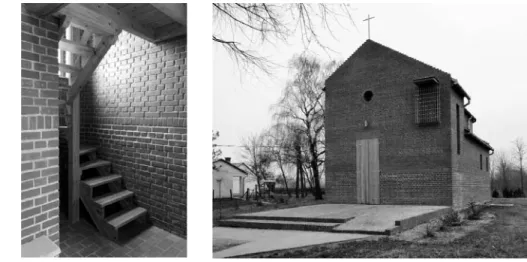
(6) THE POWER OF HOPE: EVANGELISATION IN SOUTHERN HUNGARY. Fig. 07-08. István Lukáts, «Church of the Gypsies», Pálmajor (Hungary), 2005/09.. yers. Modern liturgical architecture in Hungary has excellent evidences to verify this short thesis. Some of them are the works of László Csaba, a protester against the submissive politics of architecture typical for the fifties in Hungary. By the time Csaba was nominated for Secretary General at MÉSZ (Association of Hungarian Architects), a church designed by him had already been erected in Cserépváralja (1959/61), constructed by the local believers, and deservedly dedicated to St. Joseph (Fig. 03)17. This community church was built from rustic stone with symbolically white mortar joints. The architect’s later work, the church of St. László (1964/67) in Hollóháza (Fig. 04)18, famous for its historical porcelain manufacture, followed the language of international modernism, more specifically, of Oscar Niemeyer or Aarno Ruusuvuori19. Despite the lack of finances, neither one was built up unloaded with religious art. Csaba invited popular artists like Endre Szász for the porcelain works, Margit Kovács for the Stations of the Cross, and József Somogyi, the sculptor of the remarkable Corpse of Christ (1976) hung from above the altar (Fig. 05). Every one of them were figurative masterpieces with a discernible iconographical subject, alike the murals of the church at Szúcs (1967/68), where Christian symbols were combined with scenes depicting the everyday life of labourers. The building of Zoltán Vass, designed for colliers and their families, was erected on the slope of an undermined hill (Fig. 06). Vass used the natural conditions of the slope to shape an inclined and strongly. focused space, similar to a theatre20. The outcome was something that the community felt very familiar, for it has not lost its orientation towards the One, who ‘is present here’, yet transcendently ‘lies out there’21. The closest example, which indicates the scale of our proposed building, is the church of István Lukáts at Pálmajor (2005/09). According to the year of 2010 statistics, the village was the most handicapped place all over in Hungary, yet five years of tenacious work resulted in a foothold of peace (Fig. 07). People raised funds and built up the walls brick by brick. It became a symbolic material afterwards, and remained pure without plaster or paint22. The building is not bigger than an average apartment, but still spacious for the believers of the village, counting 382 residents, thanks to its vertical dimension, and its compact longitudinal frame (Fig. 08). PROSPECTS The above mentioned examples prepare us for an intense architectural collaboration with the local population. Drávapiski has no more than 109 inhabitants, but in April 26, 2013 the scientific committee of the Liveable Village Program (Élhetõ Falu Program) – along with Bertalan Andrásfalvy, first Minister of Education and Culture of the independent government of Hungary in 1990, and founder of the Department of Ethnography and Cultural Anthropology in the University of Pécs – announced the plans of an expansion program inviting twenty families to improve the. Actas del Congreso Internacional de Arquitectura Religiosa Contemporánea 3 (2013). 61.
(7) VILMOS KATONA. University of Pécs, Faculty of Music and Visual Arts were commissioned to design a cross with the Corpse of Christ (Fig. 10), and set up in the middle of the village. Construction starts with a modest niche to shelter the sculpture, but will continue on, one step at a time. CREDITS OF ILUSTRATIONS Photos by the author, except: Fig. 01. Attila Illés. Fig. 03. http://indafoto.hu/rlevente, accessed October 14, 2013. Fig. 06. Zorán Vukoszávlyev. Fig. 09-10. Ferenc Varga.. NOTES (1) Miklós Lantos, Ormánság (Pécs: Pro Pannónia Kiadói Alapítvány, 2005). (2) Walter Zahner, «La construcción de iglesias en Alemania durante los siglos XX y XXI: en busca de una casa para Dios y. Fig. 09. Student painting traditional icon, studio of Ferenc Varga, Kisújbánya (Hungary), 2013. Fig. 10. Balázs Hadházi, model sculpture of the Corpse of Christ for the church of Drávapiski (Hungary), 2013.. local community23. They will settle around the church, forming a nucleus next to the main crossroad. In the centre of the village, there is a Calvinist church (1781), which has lost its congregation long ago, but for historical preservation reasons, we disapproved of remaking the building for the daily use of another denomination. The sacred space can be a part of a monastery in case of an interest of an order, which would be the most beneficial for the permanent evangelization. Monastic orders, mostly the ones traditionally concerned with physical labour and agriculture, could help organising the work and arranging everyday life in Drávapiski as well, mainly of a self-supplying and sustainable economy: ora et labora (pray and work). Thinking more realistically, we need to build on what is already there. As a first step, Ferenc Varga and his students specialised in Christian art (Fig. 09) at the. 62. Actas del Congreso Internacional de Arquitectura Religiosa Contemporánea 3 (2013).
(8) THE POWER OF HOPE: EVANGELISATION IN SOUTHERN HUNGARY. para el hombre / Church-building in Germany during the 20th and 21st ceturies: In search of a house for God and men», in Arquitectura de lo sagrado: Memoria y proyecto, ed. Estebán Fernández-Cobián (Ourense: Netbiblo, 2009), 56-57. (3) Pope Benedict XVI, Apostolic Letter Given Motu Proprio Summorum Pontificum: On the Use of the Roman Liturgy Prior to the Reform of 1970 (July 7, 2007), Art. 5, § 1 / AAS 99 (2007): 780. (4) Ibid. (5) Congregation for Divine Worship and the Discipline of the Sacraments, «Ordo Dedicationis Ecclesiae et Altaris», ed. typica (May 29, 1977), in Pontificale Romanum ex decreto Sacrosancti Oecumenici Concilii Vaticani II instauratum auctoritate Pauli pp. VI promulgatum (Typis Polyglottis Vaticanis, 1977), IV, 6, and 9. (6) General Instructions of the Roman Missal, 303. (7) Ibid., 299. (8)‘Participatio actuosa’, cf. Second Vatican Ecumenical Council, Sacrosanctum Concilium, Constitution on the Sacred Liturgy, 48. (8) Pope Benedict XVI, Summorum Pontificum, paragraph 8. (10) Pope John Paul II, Apostolic Letter Vicesimus Quintus Annus (December 4, 1988), 3 / AAS 81 (1989): 899. (11) Cf. Walter Zahner, Katholisches Gemeindezentrum St. Judas Thaddäus, Karlsruhe-Neureut (Lindenberg: Kunstverlag Fink, 1998). (12) Joseph Ratzinger, The Spirit of the Liturgy (San Francisco: Ignatius Press, 2000), 82-83. (13) Nicola Bux, Benedict XVI’s Reform: The Liturgy Between Innovation and Tradition (San Francisco: Ignatius Press, 2012).. (14) Uwe Michael Lang, Turning towards the Lord: Orientation in Liturgical Prayer (San Francisco: Ignatius Press, 2004), 35 ff., and 95 ff. (15) Joseph Ratzinger, The Feast of Faith: Approaches to a Theology of the Liturgy (San Francisco: Ignatus Press, 1986), 140141. (16) Albert Gerhards, «‘Tridentinischer’ und ‘Vatikanischer’ Feierraum: Reflexionen zum Erscheinungsbild der liturgischen Versammlung anlässlich eines Kongresses im Kloster Bose/Italien», Gottesdienst 42 (2008): 145–147. (17) László Csaba, «Templom Cserépváralján, 1960-tól napjainkig», Magyar Építõmûvészet 3 (1988): 30-31. (18) Wolfgang Jean Stock, ed., Architekturführer: Christliche Sakralbauten in Europa seit 1950 / Architectural Guide: Christian Sacred buildings in Europe since 1950, (München/Berlin/London/ New York: Prestel, 2004), 313. (19) Vilmos Katona and Zorán Vukoszávlyev, «Modern Tradition and Liturgy: The Ways of Modernism in Hungarian Church Architecture in 20th Century», Architektúra & Urbanizmus / Architecture and Town Planning 1-2 (2012): 15-16. (20) Zorán Vukoszávlyev, «Mai szemmel: Munkás Szent József római katolikus templom, Szúcs (1967-1968): Építész: Vass Zoltán», Metszet 4 (2011): 11. (21) Cf. Rudolf Schwarz, The Church Incarnate: The Sacred Function of Christian Architecture (Chicago: Henry Regnery Company, 1958), 70-73. (22) Vilmos Katona, «Hitbõl épült: Lukáts István pálmajori temploma», Metszet 2 (2011): 50-53. (2011) (23) Tamás Velkei, «Téglát gyûjt templomához Drávapiski», Magyar Nemzet, May 6, 2013, 4.. Actas del Congreso Internacional de Arquitectura Religiosa Contemporánea 3 (2013). 63.
(9)
Figure


+2

Documento similar
que hasta que llegue el tiempo en que su regia planta ; | pise el hispano suelo... que hasta que el
En junio de 1980, el Departamento de Literatura Española de la Universi- dad de Sevilla, tras consultar con diversos estudiosos del poeta, decidió propo- ner al Claustro de la
E Clamades andaua sienpre sobre el caua- 11o de madera, y en poco tienpo fue tan lexos, que el no sabia en donde estaña; pero el tomo muy gran esfuergo en si, y pensó yendo assi
Sanz (Universidad Carlos III-IUNE): "El papel de las fuentes de datos en los ranking nacionales de universidades".. Reuniones científicas 75 Los días 12 y 13 de noviembre
(Banco de España) Mancebo, Pascual (U. de Alicante) Marco, Mariluz (U. de València) Marhuenda, Francisco (U. de Alicante) Marhuenda, Joaquín (U. de Alicante) Marquerie,
d) que haya «identidad de órgano» (con identidad de Sala y Sección); e) que haya alteridad, es decir, que las sentencias aportadas sean de persona distinta a la recurrente, e) que
Las manifestaciones musicales y su organización institucional a lo largo de los siglos XVI al XVIII son aspectos poco conocidos de la cultura alicantina. Analizar el alcance y
Para denegación hegeliana del mal: «Así como no existe lo fal- so, no existe el mal, es objetada primero por Sade y luego por la subjetividad romántica: en la mé- dula de la
