
Intercultural education and incoming outcoming of Erasmus student study exchange: Marmara University students
13
0
0
Texto completo
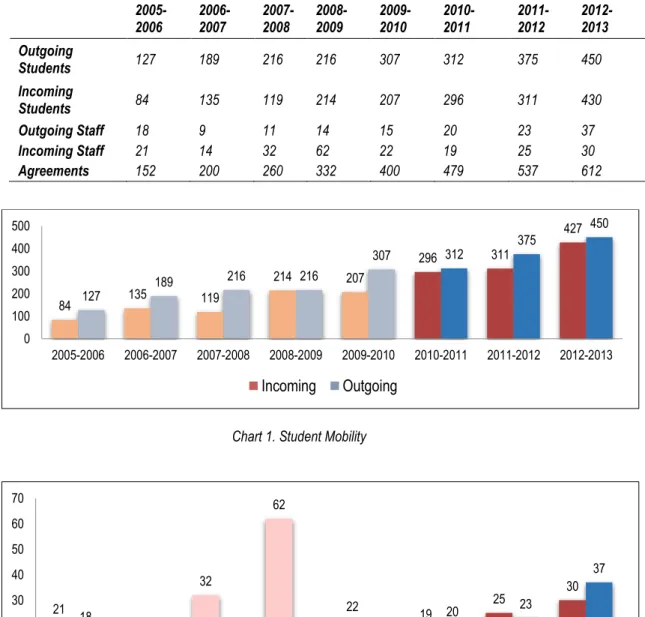
(2) F. Esra Molu; Münevver Başman; Derya Eryiğit; Burcu Tunç; Gamze Yaman. 1. Internationalization, Intercultural Education, Multiculturalism Internationalization can be defined as “the process of integrating an international, intercultural or global dimension into the purpose, functions or delivery of tertiary education.” (Knight, 2003). The main purposes of internationalization can be defined as follows (Valiulis and Valiulis, 2006): . To promote multicultural and intercultural education. . To contribute to the improvement of the learning experiences of exchange students at host institutions;. . To contribute to improving the teaching experiences of teachers who instruct exchange students in mixed groups with home students;. . To improve the level of intercultural competences of all those involved in university education;. . To raise awareness within universities regarding multiculturalism;. . To describe exchange students’ specific needs in the classroom;. . To promote continuous staff training for multiculturalism and interculturalism. Intercultural Education can be defined as the process whereby students learn about and interact with the different cultures in the educational setting. Multiculturalism, on the other hand, refers to the living side by side of different cultures in a society. Multicultural education is an inclusive concept used to describe a wide variety of school practices, programs and materials designed to help children from diverse groups to experience educational equality (Banks, 2007; as cited in Race, 2010). Multiculturalism; according to Race (2010), can be used in conjunction with the term to analyse contemporary issues in education. The significance of these concepts are embedded within the nature of the ERASMUS Exchange Programmes, aiming to create a European identity as well as increasing awareness on diversity and respect to different cultures. The students who have participated in the program have shown significant improvement in basic characteristics such as open-mindedness, flexibility, cross-cultural adaptability and appreciation of diversity (EIS, 2014). The intercultural competence acquired during this experience also contributes to the students’ future employability since it promotes the ability to communicate effectively on intercultural situations.. 1.1.. ERASMUS Exchange Program. Following its start in 1987, ERASMUS Exchange programs are expected to contribute to European Union's strategy to maintain economic growth and achieve prosperity and are seen as a way to achieve the internationalization of European higher education, as well as to equip European citizens with the skills needed to increase their employability and thus contribute to Europe’s economic growth (EIS, 2014). According to the latest report by EU Commission, until the end of Academic year 2012-13, more than 3 million students as well as 30.000 staff have benefited from the program from more than participating 4000 higher education institutions in 34 countries. The main focus is on the acquisition of social and intercultural competences as well as the students’ employability in the labor market. The intercultural competence acquired during this experience also contributes to the students’ future employability since it promotes the ability to communicate effectively on intercultural situations. Turkey has been actively participating in the program since 2002, as an EU candidate country (Turkish National Agency, 2013, as cited in Yucelsin-Tas, 2013). Marmara University has joined this program as a pilot institution in 2002 and has actively been participating since 2004. (Yucelsin-Tas, 2013). The University promotes the ERASMUS exchange for both incoming and outgoing students and has a successful record in terms of the number of bilateral agreements; over 650 bilateral agreements have been 22. International Journal for 21st Century Education, 1 (2014), 21-33. ISSN:XXXX-XXXX.
(3) Intercultural Education and Input-Output of ERASMUS Student Study Exchange: Marmara University Students. signed and renewed under the ERASMUS program (Marmara University International Office, 2014.) Marmara University boosts approximately 500 outgoing students each year, to almost all over the countries in Europe.. 1.2.. Marmara University ERASMUS Exchange Figures. In order to better explain the circulation among Marmara University students, University’s ERASMUS Figures are given in the tables below (Marmara University International Office, 2014):. Table 1. Number of Exchanges – ERASMUS. Outgoing Students Incoming Students Outgoing Staff Incoming Staff Agreements. 20052006. 20062007. 20072008. 20082009. 20092010. 20102011. 20112012. 20122013. 127. 189. 216. 216. 307. 312. 375. 450. 84. 135. 119. 214. 207. 296. 311. 430. 18 21 152. 9 14 200. 11 32 260. 14 62 332. 15 22 400. 20 19 479. 23 25 537. 37 30 612. 500 400. 307. 300 200 100. 84. 127. 135. 216. 189. 214 216. 207. 2008-2009. 2009-2010. 375. 296 312. 311. 2010-2011. 2011-2012. 427 450. 119. 0 2005-2006. 2006-2007. 2007-2008. Incoming. 2012-2013. Outgoing. Chart 1. Student Mobility. 70. 62. 60 50 40 30 20. 37. 32 21. 18. 10. 22 14. 9. 15. 14. 11. 19. 20. 25. 30 23. 0 2005-2006. 2006-2007. 2007-2008. 2008-2009. Incoming. 2009-2010. 2010-2011. 2011-2012. 2012-2013. Outgoing. Chart 2. Staff Mobility. International Journal for 21st Century Education, 1 (2014), 21-33. ISSN:XXXX-XXXX. 23.
(4) F. Esra Molu; Münevver Başman; Derya Eryiğit; Burcu Tunç; Gamze Yaman. 1000. 608. 537. 479. 500 0 2010-2011. 2011-2012. 2012-2013. Chart 3. Bilateral Agreements. Poland; 21. Hungary; 9. Romania; 3 Slovakia; 3 Portugal; 18. Slovenia; 6 Greece; 6. Lithuania; 5 Latvia; 2 Italy; 68. Germany; 182. Sweden; 19 Spain; 24. France; 55. UK; 9. Austria; 16. Netherlands; 21 Finland; 6. Estonia; 8. Belgium; 22 Bulgaria; 8 Czech Rep.; 18 Denmark; 15. Chart 4. Bilateral Agreements. Latvia; 1. Hungary; 11 Portugal; 10 Romania; 1 Slovenia; 1 Poland; 16 Lithuania; 6 Italy; 54. Ireland; 3. Germany; 166. Sweden; 16 Spain; 30. France; 75. UK; 22. Austria; 5. Netherlands; 9. Belgium; 13 Finland ;1. Czech Rep.; 22 Estonia; 1. Denmark; 9. Chart 5. Outgoing (Staff, Students). 24. International Journal for 21st Century Education, 1 (2014), 21-33. ISSN:XXXX-XXXX.
(5) Intercultural Education and Input-Output of ERASMUS Student Study Exchange: Marmara University Students. Chart 6. Outgoing-Incoming Students (Marmara University and others). 2. Impact of ERASMUS Studies Exchange on Marmara University Students Having examined the facts and figures, this study focuses on the impact of this program on the development of skills and competences of the participating students from Marmara University. In accordance with the EIS findings, the research has shown that participation in the program has improved individual competences such as self-esteem, self-efficacy, decision making, problem solving, social interaction, appreciation of diversities and assuming responsibility. It has also enabled the students to take courses which are not offered at their home institution, improved their language skills and career prospects and employability.. 2.1.. Methodology. This study is based on descriptive analysis, of a study group of 40 Marmara University students who have participated in the ERASMUS Student Studies Exchange program between years 2012-2014, of which 29 (72.5%) are female and 11(27.5%) are male. The frequency table of the students’ field of study is given in Table 2.. Table 2. Frequency with respect to field of study Frequency Percentiles (f) (%) Computer Eng. 5 12,5 Econometrics 1 2,5 French Language Education. 9 22,5 Mathematics Education. 1 2,5 Early Years Education 1 2,5 Guidance and Psychological Counselling 19 47,5 Primary Years Education. 1 2,5 International Relations and Political Science 1 2,5 Sociology 2 5. International Journal for 21st Century Education, 1 (2014), 21-33. ISSN:XXXX-XXXX. 25.
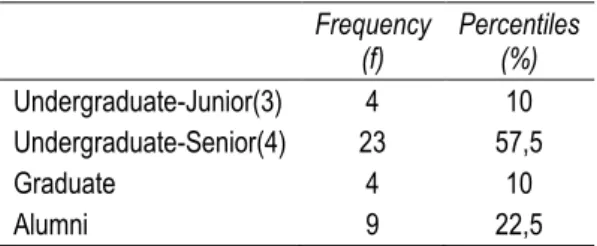
(6) F. Esra Molu; Münevver Başman; Derya Eryiğit; Burcu Tunç; Gamze Yaman. Table 2 indicates that out of the 40 students who have participated in the program, the field of study of: 2 students (5%) is Sociology, 5 students (12.5%) is Computer Engineering, 9 students (22.5%) is French Language Education, 19 students (47.5%) is Guidance and Psychological Counselling. One student (2.5%) from each of the departments of Econometrics, Mathematics Education, International Relations and Political Science, Early Years Education and Primary Years Education have also participated in the study group. The frequency with respect to the level of studies is given in Table 3.. Table 3. Frequency with respect to level of studies Frequency Percentiles (f) (%) Undergraduate-Junior(3) 4 10 Undergraduate-Senior(4) 23 57,5 Graduate 4 10 Alumni 9 22,5. Table 3 indicates that out of the 40 participating students, 27 are undergraduate students of which 4 are juniors(10%), 23 are seniors(57.5%), 4 are graduate students(10%) ,and 9 are alumni (22.5%).. 2.2.. Data Collection and Analysis. A questionnaire has been designed in order to determine the variables which might influence students’ participation in the program. There are 16 items in the questionnaire and the frequencies and percentiles of the variables are given as tables for data analysis.. 2.3.. Findings. Table 4 gives the frequency with respect to household income.. Table 4. Frequency with respect to household income Frequency Percentiles (f) (%) 750 and under 1 2,5 750-1500 3 7,5 1500-3000 13 32,5 3000-4500 14 35 4500 and above 9 22,5 TL(Turkish Lira). Out of the 40 participating students; the household income of: 1 is 750 and under (2.5%), 3 is between 750-1500 (7.5%), 13 is between 1500-3000 (32.5%), 14 is between 3000-4500 (35%) and 9 is 4500 and above (22.5%) TL. It can be concluded that the majority of the students come from middle income families with an average household income of 1500-4500TL.. 26. International Journal for 21st Century Education, 1 (2014), 21-33. ISSN:XXXX-XXXX.
(7) Intercultural Education and Input-Output of ERASMUS Student Study Exchange: Marmara University Students. Table 5 gives the frequency with respect to the level of education of parents.. Table 5. Frequency with respect to the level of education of parents Level of Education of the Mother Frequency (f) 8 7 14 4 7. Primary School Secondary School High School Associate Degree Bachelor’s Degree. Percentiles (%) 20 17,5 35 10 17,5. Level of Education of the Father Frequency (f) 5 7 11 1 16. Percentiles (%) 12,5 17,5 27,5 2,5 40. The levels of education of the parents of 40 participating students given in Table 5 are as follows: 8 mothers (20%) and 5 fathers (12.5%) primary school; 7 mothers (17.5%) and 7 fathers (17.5%) secondary school; 14 mothers (35%) and 11 fathers (27.5%) high school; 4 mothers (10%) and 1 father (2.5%) have associate degree whereas 7 mothers (17.5%) and 16 fathers (40%) have bachelor’s degree. Table 6 gives the frequency with respect to foreign language skills of the students prior to participation in the program.. Table 6. Frequency with respect to foreign language skills prior to participation in the program Frequency Percentiles (f) (%) Beginner/Elementary 1 2,5 Pre-intermediate 11 27,5 Intermediate 15 37,5 Upper-Intermediate 8 20 Advanced 5 12,5. Table 6 gives foreign language skills of the 40 students prior to participation in the program as follows: 1 beginner/elementary (2.5%), 11 pre-intermediate (27.5%), 15 intermediate (37.5%), 8 upper-intermediate (20%) and 5 advanced (12.5%). It can be concluded that the foreign language skills of the majority of the students are at intermediate level prior to participating in the program. Table 7 gives the frequency with respect to international experience and personal relationship status.. Table 7. Frequency with respect to international experience and personal relationship status International Experience Prior to Program Participation. Yes No. International Studies Exprerience Prior to Program Participation. Personal Relationship Status. Family Support. (f). (%). (f). (%). (f). (%). (f). (%). 25 15. 62,5 37,5. 6 34. 15 85. 39 1. 97,5 2,5. 11 29. 27,5 72,5. International Journal for 21st Century Education, 1 (2014), 21-33. ISSN:XXXX-XXXX. 27.
(8) F. Esra Molu; Münevver Başman; Derya Eryiğit; Burcu Tunç; Gamze Yaman. Table 7 indicates that out of the 40 participating students: 25 (62.5%), had international experience prior to participating in the program whereas 15 (37.5%) had none. 34 (85%) had not participated in any other international student exchange program; 6 (15%) had participated in other international exchange programs and out of these 6 students; 5 have reported that their prevoius experience had an impact on their participation to the ERASMUS program whereas 1 student reported no impact. 39 students (97.5%) reported that their families supported them for participating in the program whereas only 1 student(2.5%) reported no family support. 29 students (72.5%) reported no effect of their personal relationship status in program participation whereas 11 students (27.5%) reported an effect; eight of them being positive and three negative. It has been ascertained that more than half of the students have had prior international experience whereas only a small percentile had previously participated in other international study programs. Almost all of the students have received family support and no negative effect of personal relationship status on program participation has been found. Table 8 gives the frequency of students’ expectancy on the impact of program participation to present/future employability.. Table 8. Students’ expectations on program participation and present/future employability Frequency (f) 9 1 23 7. Positive impact experience No impact experience Positive impact expectancy No impact expectancy. Percentile (%) 22,5 2,5 57,5 17,5. Table 8 indicates that out of the 40 students: 23 students (57.5%) have a positive expectancy towards the impact of program participation on their future employability whereas 7 students (17.5%) do not have any expectancy. 9 alumni (22.5%) reported positive impact of program participation on their present employability whereas one student reported no impact. It can be concluded that the majority of students (80%) have positive expectancy and/or experience about program participation and employability. Table 9 gives the frequency of the sources of information about the ERASMUS Program. Table 9. Sources of Information about the ERASMUS Program Poster. Yes No. Web Site. Institutional Presentations. Friends. (f). (%). (f). (%). (f). (%). (f). (%). 5 35. 12,5 87,5. 8 32. 20 80. 18 22. 45 55. 25 15. 62,5 37,5. Table 9 indicates that out of the 40 participating students: 25 students (62.5%) reported to have been informed about the program by their friends, 18 students (45%) reported to have been informed via the presentations held at their institutions and 2 students reported having been informed through their siblings’ prior participation in the program. It can be concluded that posters and web site had not been efficient as sources of information whereas the most efficient means of information have been friends and institutional presentations. Table 10 gives the frequency of program achievements with respect to personality traits and academic competences.. 28. International Journal for 21st Century Education, 1 (2014), 21-33. ISSN:XXXX-XXXX.
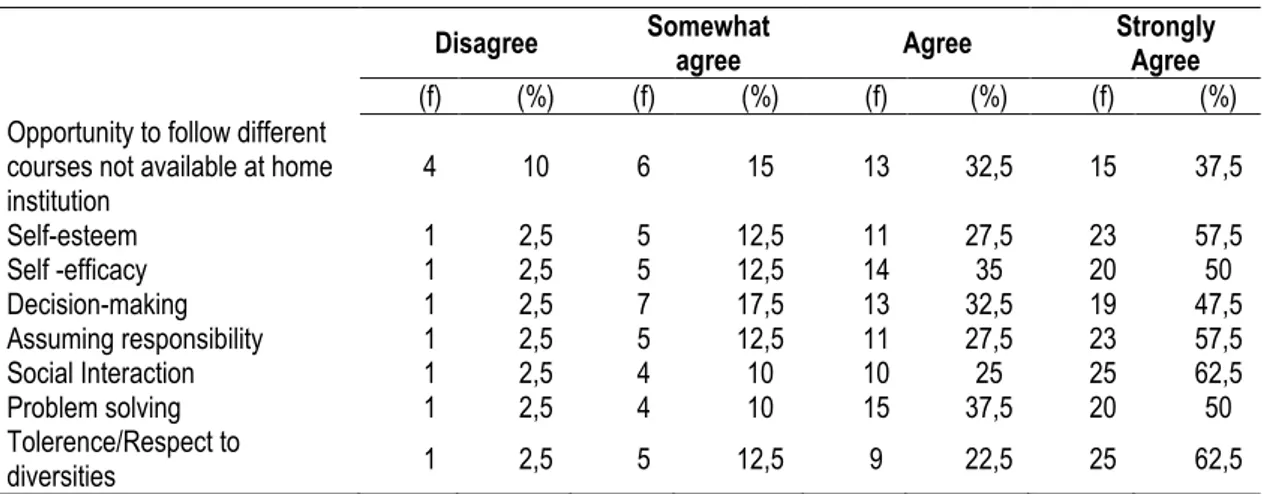
(9) Intercultural Education and Input-Output of ERASMUS Student Study Exchange: Marmara University Students. Table 10. Program Achievements. (f). (%). Somewhat agree (f) (%). 4. 10. 6. 15. 13. 32,5. 15. 37,5. 1 1 1 1 1 1. 2,5 2,5 2,5 2,5 2,5 2,5. 5 5 7 5 4 4. 12,5 12,5 17,5 12,5 10 10. 11 14 13 11 10 15. 27,5 35 32,5 27,5 25 37,5. 23 20 19 23 25 20. 57,5 50 47,5 57,5 62,5 50. 1. 2,5. 5. 12,5. 9. 22,5. 25. 62,5. Disagree Opportunity to follow different courses not available at home institution Self-esteem Self -efficacy Decision-making Assuming responsibility Social Interaction Problem solving Tolerence/Respect to diversities. (f). (%). Strongly Agree (f) (%). Agree. Table 10 indicates that the majority of participating students ‘strongly agree’ with the variables and none of the students ‘disagree’ with the personality trait variables. Regarding academic competences variables; only two students have reported that they ‘strongly disagree’. It can be concluded that (85%) of the participating students have reported the positive impact of the program on their personality traits in terms of enhancement of self esteem, self efficacy, decision making and problem solving skills, assuming responsibility, social interaction and tolerence/ respect to diversities and on their academic competences in terms of the opportunity to follow different courses not available at their home institution. Out of the 40 participating students; 27 reported to have participated in the program in order to increase their cultural awareness and knowledge of different cultures, 22 to improve their language skills,15 for selfdevelopment,8 for career prospects and employability and 8 to experience different systems of education. Some examples of students’ expressions can be found below: . ERASMUS was my dream. It was far beyond gaining academic benefits. It helped me to learn about a different culture and meet with new people. My main goal in participating ERASMUS was to improve my foreign language speaking skills and it really helped. Living in a different country and taking all responsibility was a great chance for me to improve my self esteem and self efficacy. Since ERASMUS gives you the ability to consider things in a different perspective, it will be a useful tool when you are seeking a job. I believe globalization increases the need for people with this perspective and ERASMUS experience increases our opportunity for employment. Experiencing a different education system was my primary goal.. Conclusion The findings indicate that the 40 students in the study group have supporting preferences and expectations in participating the ERASMUS Student Studies Exchange Program when compared with previous studies. The findings are also congruent with the literature in terms of the program outcomes. Eighty per cent of the students in the study group think that participation in the program is going to /have promote(d) their career prospects and employability. On average, ERASMUS students have better employability skills after a stay abroad than 70% of all students. Based on their personality traits, they have better predisposition for employability even before going abroad. By the time they return they have increased their advantage by 42% on average. Asked to compare their competences upon graduation to the competences of non-mobile graduates, they rate themselves substantially better as far as international. International Journal for 21st Century Education, 1 (2014), 21-33. ISSN:XXXX-XXXX. 29.
(10) F. Esra Molu; Münevver Başman; Derya Eryiğit; Burcu Tunç; Gamze Yaman. competences like knowledge of other countries, foreign language proficiency or intercultural understanding are concerned. More than 90 per cent report to have better abilities in these regards. But they also feel to be better prepared for future employment and work (63%) and to be somewhat better (53%) with regards to field specific knowledge and skills. One could argue that the graduates’ self-assessment is not the most reliable source for developing a realistic picture of their competences. Yet the employers surveyed in the VALERA study report a similar view. Again, not surprisingly, the employers see mobile graduates as substantially superior compared to non-mobile graduates in their international competences, but they also note considerable differences in the soft-skills of graduates as well as regards their field-related competences (Engel, 2012). Varghese (2008) concludes that study abroad programs are prestigious as they can be used to enhance one's academic credentials, to obtain high-paid jobs and to enter into influential professional networks. The majority of the students in the study group have also reported that one of the reasons for their program participation was to improve their foreign language skills. Their average language level was initially intermediate and most of the students have reported that the studies abroad promoted their language competences. More than 90% of the mobile students go abroad to live abroad, to improve their language skills, to form new relationships and to develop skills such as adaptability (EIS, EU Commission, 2014). Fombona and Rodriguez (2013), in their studies regarding the motivational factors of ERASMUS students found out that there is a significant increase in the mastery of the new language after the student exchange. Of the surveyed, 22% stated that their mastery of the language before the stay was poor, but this percentage sank to 1% after the stay. Likewise, before the stay, 25% considered their language level to be good, and this increased to 50% after the stay. The exchange had a positive impact on language, as 7% stated that their mastery was excellent before the stay, and this percentage reached 36% after the stay. The findings indicate that the majority of the students in the study group come from middle income families and the average level of education of parents has been found as middle and high school for mothers and bachelor’s degree for fathers. The findings support the literature that the socioeconomic status of a student’s family is positively related to program participation and to study abroad. Lower income students— i.e., students from families eligible for federal financial aid—are less likely to plan to study abroad than higher income students. Students who receive federal financial aid are 11 percentage points less likely to intend to study abroad than are those not getting federal aid. This suggests that finances not only serve as a barrier, but lack of resources shapes student expectations about studying abroad. Likewise, level of parents’ education is positively related to the probability of planning to study abroad. With every standard deviation increase in average parental education, the likelihood of planning to study abroad increases approximately 5 percentage points. In combination, both of these elements of socioeconomic status—as formative, classbased indicators of early home habitus—can discourage even the development of aspirations or intentions to participate in study abroad programs (Salisbury, Umbach, Paulsen and Pascarella, 2008). Supporting this, our findings show that although all students in the study group, except for one, reported that their families have encourged them for program participation, it is obvious that students from low income families are less likely to volunteer for participation since they are less likely to receive any financial support from their families during their stay abroad. At this point, additional financial aid apart from ERASMUS grants such as institutional scholarships might be helpful to promote these students’ program participation. Previous international experience also increases the likelihood in program participation. Students whose families travel abroad are more comfortable with foreign cultures and are more likely to see study abroad programs as appropriate for themselves and/or relevant to their educational goals. (Simon and Ainsworth, 2012). The findings show that more than half of the students in the study group had previous international experience and have expressed that one of the main reasons for their program particiption was to enhance their knowledge of different cultures and intercultural competences. Exposing to different cultures promotes their tolerence to and understanding of diversities and hence contributes to the promotion of an intercultural identity. This has also been observed as an expectancy for the rest of the students in the group who did not have prior international experience.. 30. International Journal for 21st Century Education, 1 (2014), 21-33. ISSN:XXXX-XXXX.
(11) Intercultural Education and Input-Output of ERASMUS Student Study Exchange: Marmara University Students. EURODATA Student Mobility in European Higher Education (Kelo, Teichler and Wächter 2006), the ERASMUS statistics (European Commission 2012a), the Flash Eurobarometers (Gallup Organization 2010; Gallup Organization 2011) and the EU-funded study Mapping Mobility in European Higher Education (Teichler, Ferencz and Wächter 2011a; Teichler, Ferencz and Wächter 2011b) studies showed that experience abroad not only enriched students’ professional and academic lives, but could also promote openness, adaptability and flexibility, or enhance language learning, intercultural skills, self-reliance and self-awareness (EIS,EU Commission, 2014). According to (Hofstede 2009), the acquisition of intercultural competences, in particular, generally defined as “the ability to communicate effectively and appropriately in intercultural situations based on one’s intercultural knowledge, skills and attitudes” (Deardorff 2006) could be regarded today as an important strategy for preparing students to live and work within a globalised and complex World (EIS, EU Commission, 2014). A large-scale, multi-year study of US students learning abroad with the aim of documenting students’ target-language, intercultural and disciplinary learning revealed that: 1) students enrolled in study-abroad programmes achieved more progress in intercultural learning and oral proficiency in their target languages than control students studying these same languages in US classrooms; 2) there were significant statistical relationships between independent variables representing learner characteristics (e.g. gender, prior experience of studying abroad, the amount of target-language learning completed prior to departure) and programme features (e.g. duration of programme, type of housing) and the intercultural and target-language learning of students abroad; and 3) there were significant—though somewhat indirect—statistical relationships between gains in target-language oral proficiency and intercultural development (Van de Berg, Connor-Linton and Paige 2009).(EIS, EU Commission, 2014). In terms of self-development, the majority of students (85%) in the study group have reported that program participation promoted their skills in decision –making and problem solving, assuming responsibility as well as their self-esteem and self-efficacy. They expressed to have improved their social interaction skills and to become more tolerant to diversities. Moreover, students gained respect for their own culture and mentality, experience what increased their competences in the area of intercultural learning, learning in general and understanding of intercultural differences. They become more extroverted and flexible and developed empathy. The findings revealed that most of the students in the study group had been informed of the ERASMUS program through their friends; this also indicates the level of satisfaction congruent with previous findings; those who had experienced the benefits of the program encouraged their friends for participation. Asked to compare their competences with those of non-mobile students, more than 90 percent feel superior with respect to knowledge of other countries, foreign language and intercultural understanding. It might be more impressive to note that former ERASMUS students consider themselves superior regarding other competences as well: – 65 percent as regards preparation for future employment and work, and – 53 percent as regards academic knowledge and skills in general. (Valera, 2009). The students in the study group have also reported that acquiring knowledge about the European Education System was another reason for them to participate in the program. In the more and more internationalized higher education system of the 21st century, this is regarded as an important distinguishing aspect in terms of future career prospects and employability. Familiarity to international programs facilitates the transfer of the acquired skills and competences to the work place. An increasing number of studies pointed to transformative experiences gained from study, work and volunteering abroad, which can be linked to transferable and employability skills. Brooks and Waters (2011, 11) claimed that “there is substantial evidence that, in certain countries at least, an overseas qualification does often lead to substantial labour market rewards.” Indeed, “for many overseas students, international experience is seen as an essential part of their CV in an increasingly competitive global employment market” (Fielden, Middlehurst and Woodfield 2007, 16). Rizvi (Rizvi 2000, 214) argued that employers attributed. International Journal for 21st Century Education, 1 (2014), 21-33. ISSN:XXXX-XXXX. 31.
(12) F. Esra Molu; Münevver Başman; Derya Eryiğit; Burcu Tunç; Gamze Yaman. greater value to an overseas education that could offer “exposure to different people and cultures, to different ideas and attitudes, and to different ways of learning and working”. (EIS, EU Commission, 2014). Student Mobility contributes positively to local economies in terms of the students’ consumption of local products besides their regular consumption. This is especially valid for small towns where university student population has high percentages within the overall population. This enables a multifaceted benefit to the economy and labor market, on the one hand students support local economies while on the other, they benefit from them as international work force in the long run. The positive impact of program participation has been observed from many different angles and students need to be informed more about the program benefits. In order to promote program participation, institutional presentations can be enhanced to include the students who have already participated in the program, allowing them to share their experiences with their peers in order to encourage them. This is thought to be more effective if done at departmental and faculty basis individually, reaching more students. This study aims to identify the input-output of the Erasmus Student Studies Exchange Program on Marmara University students through a study group of 40 students. The authors’ aim was to observe whether there has been convergences and divergences between their findings and the findings of the recent EIS by EU Commission. It has been observed that although there are many convergences, it is obvious that the concept needs to be further investigated in order to promote participation in the program, not only for Marmara University students but for students of higher education nationwide and across the Europe. This study is planned to be extended in order to fulfill this gap.. References Brandenburg, U., Berghoff, S., Taboadela, O., Bischof, L., Gajowniczek, J., Gehlke, A., Hachmeister, C., Ilieski, Z., Leichsenring, H., Petrova, D., Vancea, M. L. (2014). The ERASMUS Impact Study. Effects of mobility on the skills and employability of students and the internationalisation of higher education institutions. Luxembourg, European Union. Engel, C. (2012). The impact of Erasmus mobility on the professional career: Empirical results of international studies on temporary student and teaching staff mobility. Erasmus Impact Study (2014). EU Commission Education and Culture. Fombona, J. and Rodriguez, C. (2013). The motivational factor of Erasmus students at the university, International Education Studies, Vol. 6, No. 4. Race, R. (2011). Multiculturalism and Education, London Salisbury, M., H., Umbach P., D., Paulsen, M., B. & Pascarella, E., T. (2008). Going Global: Understanding the Choice Process of the Intent to Study Abroad Research and High Education. Simon, J., Ainsworth, W., J. (2012) Race and Socioeconomic Status Differences in Study Abroad Participation: The Role of Habitus, Social Networks, and Cultural Capital International Scholarly Research Network 2012, 1-21 Teichler, U. and Janson, K. (2007). The Professional value of temporary study in another European country: employment and work of former ERASMUS students, Journal of Studies in International Education, 11(3-4), 486-495. Tekin, U. and Gencer, A. (2013). Effects of the Erasmus programme on Turkish universities and university students. Trakya Üniversitesi Sosyal Bilimler Dergisi, Cilt 15 Sayı 1 (109-122). Thorn, K. (2009). The relative importance of motives for international self-initiated mobility. Career Development International, 14(4-5), 441-464. Varghese N. V. (2008). Globalization of higher education and cross-border student mobility, UNESCO/ International Institute of Education Planning.. 32. International Journal for 21st Century Education, 1 (2014), 21-33. ISSN:XXXX-XXXX.
(13) Intercultural Education and Input-Output of ERASMUS Student Study Exchange: Marmara University Students. Yucelsin-Tas, Turkan Y. (2013). Erasmus Programinda Karsilasilan Sorunlar ve Oneriler. Turkish Studies. 8/10, 763-770. Fecha de recepción / Received: 25/11/2014 Fecha de aceptación / Accepted: 10/12/2014. International Journal for 21st Century Education, 1 (2014), 21-33. ISSN:XXXX-XXXX. 33.
(14)
Figure

Documento similar
La presente investigación tiene un doble propósito, por un lado, determinar cuáles son las calificaciones que obtiene el alumnado de dos promociones diferentes de la misma
To assist European higher education institutions to become more mature users and custodians of digital data collected from students during their online learning activities, the
The findings of this study enhanced Astin’ s theory of student development, as course organization, faculty-student interaction, and student involvement are important variables
Student Support & Wellbeing Intercultural Issues in Education Secondary Education Experiences ICT Skills and Digital Literacy Research on Higher Education
Upon they arrival in Malaga, Erasmus students and non-EU mobility students must attend one of the official meetings of the International Office in September (SM1) or in February
Upon they arrival in Malaga, Erasmus students and non-EU mobility students must attend one of the official meetings of the International Office in September (SM1) or in February
The “Course for Erasmus and International Exchange Students” of the University of Mala- ga, 70 class hours, allows students to consolidate and acquire Spanish skills in order to
International applicants participating in an exchange or Erasmus program gain admission to the University of Tübingen through the Admission Office for Exchange students..
