
How may the use of organizational note taking strategies through processor based activities help in formal letter writing
121
0
0
Texto completo
(2) RUNNING HEAD: ORGANIZATIONAL NOTE-TAKING STRATEGIES IN THE PROCESS OF WRITING FORMAL LETTERS. How may the use of organizational note-taking strategies through word processor basedactivities help in seventh grade students’ formal letter writing?. By: Jaime Cárdenas Bello. Submitted in fulfillment of the requirements for the degree of Master in English Language Teaching –Autonomous Learning Environments. Directed by: Claudia Patricia Álvarez. Master in English Language Teaching –Autonomous Learning Environments Department of Foreign Languages and Cultures Universidad de La Sabana Chía, 2011. ii.
(3) RUNNING HEAD: ORGANIZATIONAL NOTE-TAKING STRATEGIES IN THE PROCESS OF WRITING FORMAL LETTERS. This research report is the result of my own work and includes nothing that was done in collaboration with others. Name: Jaime Cárdenas Bello. Signature:. iii.
(4) RUNNING HEAD: ORGANIZATIONAL NOTE-TAKING STRATEGIES IN THE PROCESS OF WRITING FORMAL LETTERS. iv. ACKNOWLEDGEMENTS. This is an appropriate moment to thank the invaluable assistance and inspiration I received from the following people:. To the Masters’ professors: for their dedication and support. Claudia Patricia Alvarez, who cared for me throughout her teaching and guided my project in a smart and gentle manner. Liliana Cuesta, whose concern for knowledge of theory and teachers’ professional development is necessary in our country. Luz Dary Arias shared her knowledge and she led me to the right path.. I would like to thank my family for their support..
(5) RUNNING HEAD: ORGANIZATIONAL NOTE-TAKING STRATEGIES IN THE PROCESS OF WRITING FORMAL LETTERS. v. ABSTRACT. The purpose of this study is to determine if writing with word processors and using certain writing strategies changes the quality of letters written by seventh grade students at a private school in Bogotá, Colombia. In this qualitative study, data was collected using questionnaires, students’ logs, and focus groups. The results reflect how motivational factors increase students’ awareness of their process of writing and the benefits of feedback and self-regulation in learners. In addition, the findings provide evidence of improvement regarding the quality of students’ letters in terms of discourse organization, overall structure, and paragraph organization. This study found that teacher and peer feedback affected students’ motivation in the process of writing. Participants were motivated to use the organizational note-taking strategies to improve their letters while becoming more confident in writing in the foreign language.. Keywords: writing strategies, writing process, word processors, feedback and motivation..
(6) RUNNING HEAD: ORGANIZATIONAL NOTE-TAKING STRATEGIES IN THE PROCESS OF WRITING FORMAL LETTERS. vi. RESUMEN. El objetivo de éste estudio es determinar si escribir con procesadores de texto y mediante el uso de determinadas estrategias de escritura cambia la calidad presenta cambios en cartas escritas por estudiantes de séptimo grado en un colegio de carácter privado en la ciudad de Bogotá. En este estudio de investigación- acción la información fue recolectada mediante cuestionarios, diarios y entrevistas de grupo. Los resultados reflejan los cambios en la motivación derivados de la concientización de los estudiantes en los procesos de escritura, y los beneficios de la retro-alimentación y la auto-regulación de los estudiantes. Asimismo, en los resultados se puede evidenciar las mejoras en la calidad de sus cartas en aspectos tales como son la organización del texto, organización de párrafos. Además, los resultados de la retroalimentación del docente y retroalimentación en parejas se beneficiaron por los efectos positivos en factores emotivos que les ayudaron en el proceso de escritura. Estos factores les permitieron escribir textos de mayor extensión y les dieron mayor confianza en el proceso de escritura en la lengua extranjera.. Palabras clave: estrategias de escritura, proceso de escritura, procesadores de texto, retroalimentación y motivación..
(7) RUNNING HEAD: ORGANIZATIONAL NOTE-TAKING STRATEGIES IN THE PROCESS OF WRITING FORMAL LETTERS. TABLE OF CONTENTS ABSTRACT ………………………………………………………………………….. V INTRODUCTION. …………………………………………………………………....1. CHAPTER 1: ……………………………………………………………………………4 1.1 Statement of the problem ……………………………………………………………4 1.2 Research question ……………………………………………………………………6 1.3 Research objectives .................................................................................................... 6 1.4 Rationale .................................................................................................................... 7 CHAPTER 2: THEORETICAL FRAMEWORK ............................................................ 9 2.1 Process writing ............................................................................................................ 9 2.1.1 Procedures in the process .............................. 11 2.1.2 Pre-writing ..................................................... 11 2.1.3 Composing and drafting…………………………………………………………..12 2.1.4 Revising and editing……………………………………………………………....13 2.2 Metacognitive skills in writing ................................................................................ 13 2.2.1 Note-taking strategies ................................... 14 2.2.2 Organizational strategies............................... 16 2.3 Word processors as tools in the classroom ............................................................... 17 2.4 State of the art ........................................................................................................... 19 2.4.1Writing with word processors…………….............................................................19 2.4.2 Metacognitive skills ………………………………………………………………22 CHAPTER 3: RESEARCH DESIGN............................................................................. 27 3.1 Type of study ............................................................................................................ 27 3.2 Context ...................................................................................................................... 29 3.3 Participants................................................................................................................ 29 3.4 Researcher role.......................................................................................................... 31 3.5 Ethical considerations ............................................................................................... 31 3.6 Data collection instruments....................................................................................... 31. vii.
(8) RUNNING HEAD: ORGANIZATIONAL NOTE-TAKING STRATEGIES IN THE PROCESS OF WRITING FORMAL LETTERS. 3.6.1 Questionnaires……………………………….. …………………………………...32 3.6.2 Students’ logs ......................................................................................................... 32 3.6.3 Focus Groups ......................................................................................................... 33 3.7 Triangulation technique ............................................................................................ 33 3.8 Data collection procedures........................................................................................ 34 CHAPTER 4: PEDAGOGICAL INTERVENTION ...................................................... 35 4.1 Instructional design ................................................................................................... 37 CHAPTER 5: DATA ANALYSIS ................................................................................. 40 5.1 Methodology ............................................................................................................. 40 5.2 Data analysis procedures........................................................................................... 41 5.3 Coding process .......................................................................................................... 41 5.4 Data management...................................................................................................... 44 5.5 Data reduction ........................................................................................................... 44 5.6 Validation process..................................................................................................... 44 5.7 Data display .............................................................................................................. 45 5.8 Categories ................................................................................................................. 46 5.8.1Core category .......................................... 46 5.8.2 Category one .......................................... 46 5.8.3 Category two .......................................... 55 5.8.4 The quality factor………………………59 CHAPTER 6: CONCLUSIONS, PEDAGOGICAL IMPLICATIONS AND FURTHER RESEARCH ……………………………………………………………………………69 6.1 Limitations …………………………………………………………………………73 6.1 Pedagogical implications …………………………………………………………..73. viii.
(9) RUNNING HEAD: ORGANIZATIONAL NOTE-TAKING STRATEGIES IN THE PROCESS OF WRITING FORMAL LETTERS. TABLES AND FIGURES Table 1 Model of writing strategies ................................................................................ 14 Table 2 Data collection Instruments ............................................................................... 34 Table 3 Action plan instructional design ........................................................................ 38 Table 4 Categories .......................................................................................................... 43 Figure 1 Writing strategies applied to process writing ................................................... 19 REFERENCES ............................................................................................................... 75 APPENDICES ................................................................................................................ 87 APPENDIX A Consent letter.......................................................................................... 87 APPENDIX B Students’ questionnaire .......................................................................... 88 APPENDIX C Students’ log ........................................................................................... 90 APPENDIX D Focus group sample ................................................................................ 91 APPENDIX E Writing rubric ......................................................................................... 96 APPENDIX F Students’ sample letters .......................................................................... 98 APPENDIX G Research project timeline ..................................................................... 100 APPENDIX H Axial coding process, categories and properties .................................. 101 APPENDIX I Diagnostic test results ............................................................................ 102 APPENDIX J Rubric diagnostic test ............................................................................ 103 APPENDIX K Sample lesson plan ............................................................................... 104. ix.
(10) RUNNING HEAD: ORGANIZATIONAL NOTE-TAKING STRATEGIES IN THE PROCESS OF WRITING FORMAL LETTERS. x.
(11) 1. Introduction Fostering students’ writing is an important goal to achieve in the classroom and in students’ academic performance. According to Pajares (2003, p. 142), the writing performance is the observable realization of the written competence. Pajares studies about social cognitive theories are based on Bandura (1997) who contributed to academic implications for writing and writing outcomes in research about composition in the classroom. In addition to improvement in students’ written performance, there is a need to support the use of strategies in written activities in the classroom. This action research project pursued a communicative approach to the teaching of writing in an EFL setting. The importance of this project aimed at focusing on the process of writing and students’ use of metacognitive skills when writing. It was found in the diagnostic test that students writing skills achieved low scores which results will be discussed further. The use of the metacognitive skills applied to the writing process. Note-taking strategies are applied to writing during the planning and summarizing processes. Thus, note-taking allows learners to organize and recall information during writing tasks. Another strategy was taken into account for the implementation of this project: organizational strategies. These metacognitive strategies are helpful for learners to plan writing tasks and important for becoming aware of their own meta-cognition in order to control their own learning. Chamot, Barnhardt, El-Dinary & Robbins (1999, p. 12). Research concerned with writing performance has shown encouraging results in teaching writing strategies explicitly for writing in different genres. These studies demonstrate that learners who were taught writing strategies produced better texts than students who were not. Moreover, Scott (1996, p.5) claims that students can acquire writing competence over time..
(12) RUNNING HEAD: ORGANIZATIONAL NOTE-TAKING STRATEGIES IN THE PROCESS OF WRITING FORMAL LETTERS. 2. It has been argued that writing competence cannot be taught; rather, instructors can provide students with characteristics of good writing as well as good writing strategies that may enhance students’ writing competence. This is also an important factor considered in this project, since students’ awareness of the use of writing strategies helps them achieve better results. Process writing has become an important approach for the teaching of writing. Integrating technological tools such as word processors added benefits to the writing process. Technology has become an important part of our lives at personal and professional levels. Teachers are now encouraged to use Information and Communication Technologies in their professional lives. Dudeney and Hockly (2007, p.25) state that computer-aided writing enhances the writing experience. Strategies used for computer-aided writing are different than when composing with pencil and paper; motivational factors are of great importance in the writing experience. Based on these aspects, this project deals with enhancing students’ writing processes by learning strategies with word processors. Furthermore, this project takes into account learners’ needs at a private school due to the interest of the participants from this community and the teacherresearcher to provide solutions to learners’ problems. Chapter One discusses the statement of the problem, justification, research question and objectives. In Chapter Two, the constructs from this project are discussed while taking into account different theories that support the project. In Chapter Three, the type of study is illustrated and research instruments are presented. In Chapter Four, the pedagogical intervention is described in detail, as well as procedures followed during data collection and steps taken during the implementation. Lastly, in Chapter Five the data analysis and actions undertaken to.
(13) RUNNING HEAD: ORGANIZATIONAL NOTE-TAKING STRATEGIES IN THE PROCESS OF WRITING FORMAL LETTERS. 3. analyze the data are commented on and in Chapter Six, the conclusions, pedagogical implications and limitations are considered..
(14) RUNNING HEAD: ORGANIZATIONAL NOTE-TAKING STRATEGIES IN THE PROCESS OF WRITING FORMAL LETTERS. 4. Chapter 1 1.1 Statement of the problem The complexity of writing represents multiple degrees of difficulty for learners. Nunan (1991, p.87) demonstrates that learners not only need to have lexical and syntactical knowledge but also understand organization and coherence in order to write different texts. According to Zamel (1987, p.712), writing in EFL is a two-sided approach; one side is focused on the product and the other is centered in the process of writing. In the teachers’ context, the participants have difficulty relating to writing competence, which in their L1 is neither well-focused nor wellstructured; therefore, when these students write in the foreign language, they face many difficulties. For instance, the students at this private institution have been struggling to improve their writing skills. The results from the diagnostic test they took at the beginning of the school year reflect the problems they have in writing for academic purposes. The problem areas detected in the tests were related to lack of organization, coherence, cohesion, and effectiveness, which led to an unclear message. Thirty students took the test (Appendix I). The aim of the test was to have students communicate a message in a short letter. In the results it was observed that two students scored the maximum of five points and their only problems were in occasional spelling or grammar errors. One student scored four points and their problems were spelling, grammar, and use of cohesive devices. Seventeen students scored three points, the average for the group. These students have spelling or grammar errors that sometimes interfere with meaning or require more effort from readers. Also, the students did not address all the questions in the task. Another four.
(15) RUNNING HEAD: ORGANIZATIONAL NOTE-TAKING STRATEGIES IN THE PROCESS OF WRITING FORMAL LETTERS. 5. students achieved two points; they had errors related to grammar and spelling and language errors that impeded communicating a clear message. Six students scored one point and all had the above problems related to grammar, spelling, and cohesive devices, their biggest problem was in terms of completion of the task. They addressed some parts of the task but did not answer all the questions or the responses were unclear. Therefore, these students have a need: to be oriented in the stages implied in the process of writing. After the diagnostic test was administered to students, it was noted that they did not use strategies for organizing or planning their letters; however, the use of cognitive strategies such as translation by using their first language as a basis for producing their letters was found. Other possible strategies learners may have used for the task include transferring, relating previous conceptual knowledge, and inferencing, guessing meanings and filling in missing information. Furthermore, learning strategies have been a topic on which researchers such as Cohen (1998, p.25) discuss the importance of strategy-based instruction in language learning. Thus, strategy-based instructions may prove to be a powerful tool for teaching and developing writing. According to Wenden (1991, p. 312), writing strategies can be classified into four types. Rhetorical strategies refer to strategies learners use to organize and present their ideas. Metacognitive strategies are strategies that learners use to control their writing process consciously. Cognitive strategies refer to those used by writers to implement actions and social strategies refer to those used by learners to interact with others and regulate their emotions. Such strategies have proved to be great aids for the writing process. In the foreign language syllabus at this private institution, learners are expected to be able to write effectively in the foreign language in order to take international examinations. In the.
(16) RUNNING HEAD: ORGANIZATIONAL NOTE-TAKING STRATEGIES IN THE PROCESS OF WRITING FORMAL LETTERS. 6. Institution’s Education Project (PEI), Manual de Convivencia, Article 7, it is mentioned that students are trained to take Cambridge examinations throughout their “bachillerato” (junior, middle, and high school levels) before moving to the next year. These examinations are the KET, PET, and FCE. According to the student’s level, they are required to take the Cambridge Key English Test, an elementary level examination for learners of English level 1. For the writing component of the test, learners complete three types of writing tasks: filling in gaps in a text, completing forms, and writing short notes. Taking these into account and based on students’ writings, there was a need to train learners on letter writing tasks. The writing of letters focuses on addressing the requirements of the syllabus and the improvement of learners’ writing competence. 1.2 Research question Based on the problem, this research project seeks to answer the following research question: How may the use of organizational note-taking strategies through word processor basedactivities help in seventh grade students’ formal letter writing? 1.3 Research objective General objectives •. To evaluate and assess the impact of two learning strategies: organizational strategies and note-taking strategies.. •. To analyze how word-processor based activities used in the writing process influence students..
(17) RUNNING HEAD: ORGANIZATIONAL NOTE-TAKING STRATEGIES IN THE PROCESS OF WRITING FORMAL LETTERS. 7. 1.4 Rationale In the development of this project, two main issues were considered. The first is students’ needs to communicate effectively in the foreign language through the process of writing. Learners need to know how to write whole pieces of communication in which they can develop information and ideas with a sense of audience in mind. Communication includes writing tasks such as writing letters and e-mails, among other writing tasks, from which they can develop writing just as they develop listening, speaking, and reading skills. The next issue is to find out how the use of organizational and note-taking strategies and the use of word processors can influence students’ writing. These two issues motivated the researcher to investigate how learners could communicate their ideas more accurately in writing. Learning to communicate by means of writing raises the issue of linguistic competence. According to Scott (1996, p. 2), writing competence refers to the writers’ awareness of writing and strategies used in the writing process. Each student has a degree of competence in his L1andif students are exposed to the process of writing and its different stages through the aid of learning strategies, it can facilitate their writing competence in the foreign language. For the purpose of helping learners develop writing ability that can be used not only for communicating more effectively, but also for training learners to take international examinations, the researcher proposed a writing framework that reinforces the use of metacognitive skills. These skills include note-taking and organizational strategies and were applied through wordprocessing based activities in order to help students with the writing process and enable them to regulate their own learning..
(18) RUNNING HEAD: ORGANIZATIONAL NOTE-TAKING STRATEGIES IN THE PROCESS OF WRITING FORMAL LETTERS. 8. The process of writing can include different types of activities such as brainstorming, shared planning, and multiple drafts, among others, that are used for pre-writing, while-writing and post-writing. This process approach to writing was selected for this project as it focuses on the steps students go through in the planning, drafting, and editing stages learners experience when writing. Technology has become an important tool for writing with the introduction of word processors. Researchers such as Lehr (1995) and McKenzie (1991) explore how these word processors have affected the writing process, including aspects such as motivation, quality, and length of compositions. Also, students spend more time in revision stages and on the general mechanics of writing. Thus, taking these factors into account, the researcher made the decision to use word processors as tools for the process of writing. This study may have several pedagogical implications in the context of educators aiming their pedagogical practices at developing students’ written competence in the foreign language. As a consequence, learners may become more aware of the importance of using strategies before, during, and after writing that may enhance the quality of their writing. As mentioned earlier, one goal in the mission and vision of this project’s educational setting is to help learners become competent in the use of the foreign language and be able to communicate by means of that language. In addition, this project intends to contribute to the EFL field and foreign language learning as an alternative for the teaching of writing to young learners in contexts similar to the one in the present study. Taking into consideration the researchers’ community, several benefits may arise from the results of this qualitative study, as one of the main intentions is innovation that could be shared by teachers who also have students with difficulties in writing skills..
(19) RUNNING HEAD: ORGANIZATIONAL NOTE-TAKING STRATEGIES IN THE PROCESS OF WRITING FORMAL LETTERS. 9. Chapter 2: Theoretical Framework This chapter will describe in detail the main constructs in the research study. It starts from the process of writing which focuses on the stages a writer goes through during the writing process. Then, for the second construct, metacognitive skills are reviewed; the two strategies used in the implementation of the project are conceptualized. Organizational and note-taking strategies and the rationale that supports this selection are presented. Finally, a revision of the literature of word processing will be reviewed by providing an overview of research studies and the rationale for the selection of these tools as pedagogical devices for this study. Furthermore, results from research related to writing, the use of strategies, and the use of word processors are referenced to provide the rationale for the present study. 2.1 Writing in the EFL classroom: Process writing Writing in a foreign language to express and communicate ideas and thoughts is a complex cognitive task; the process is made up of several stages that lead to a final product (Hedge 1988, p.7). Regarding this, Badger and White (2000, p. 155) mentioned that process writing has to do more with linguistic skills rather than linguistic knowledge, including grammar. Therefore, the focus is on planning and drafting and not on grammatical items or text structure. Though writing in a second language has been a topic explored comprehensively by Chandler (2003), Ferris (2002), Matsuda (2001), and Silva (2001), among others, more relevant research has been conducted in countries where English is viewed as a foreign language. According to Leki (as cited in Manchon, 2009), most of these foreign language speakers do not use the language in second language contexts but in another type of academic setting or situation. It is not difficult to observe that even for a native speaker of a language, mastering writing requires.
(20) RUNNING HEAD: ORGANIZATIONAL NOTE-TAKING STRATEGIES IN THE PROCESS OF WRITING FORMAL LETTERS. 10. special training; consequently, learning to write in a second language can be viewed as a difficult task. Hyland (2006, p. 380) views writing in a second language as a challenging task for a learner as seen in the composition component included in teaching materials in American colleges and universities. A typical model shown by Tribble (1996, p. 118) focuses on the stages of process writing: prewriting, composing/drafting, revising, and editing. These stages reveal that this process is cyclical. According to Langer and Applebee (2007, p.6), process writing is an approach to the teaching of writing. In general, this approach is marked by instructional sequences designed to help students think and organize ideas before writing. The writing steps proposed by Tribble (1996) and Hedge (2005) are used for this project because the researcher sought to aid and monitor learners throughout the stages described by the authors. The key aspects that should be taken into account in the writing process are the stages writers go through. This approach focuses on the process rather than the final product. Therefore, motivating, guiding, and demonstrating should be encouraged in the classroom in order for the learners to cope with such a demanding task. As Harmer (1998, p.86) shows, some reasons for teaching writing in the classroom include reinforcement, language development, learner style, and training learners throughout the different stages of writing. Consequently, teaching writing is a process to be followed that not only takes into account the form of the language but also the function of communicating a message. The focus on classroom activities that promote the development of writing is described in Nunan (1991, p. 87) as process writing. Holmes (2004, p. 3) proposes the use of a processoriented approach that facilitates the planning and production stages of writing. In the learners’ environment, this approach can be worked on by hand with the use of note-taking and.
(21) RUNNING HEAD: ORGANIZATIONAL NOTE-TAKING STRATEGIES IN THE PROCESS OF WRITING FORMAL LETTERS. 11. organizational strategies. Silva (2001, p. 23) mentions that the process approach in the classroom provides an encouraging and motivating environment for learners in which students can work with minimum interference from the instructor. The teacher’s role is to help learners develop the strategies needed for the different stages of writing. The writing process has been described differently by a number of researchers since the early 1970s. One of the most influential models to date is the one described by Hayes and Flower (1987). This model takes into account cognitive processes such as planning and revising, as well as writers’ long-term memory and knowledge of the topic. It has been influential in terms of explaining that writing is a recursive, not linear, process. Furthermore, researchers such as Hairston (1982,p. 76-78) and Applebee and Langer (2006) provided the base of the model, including the focus on the process and not on the product,as well as thinking in terms of what the writer does cognitively in the writing process such as planning and revising. In her research, Kroll (2003, p. 10) explains major issues in writing instruction, feedback, and assessment. Raimes (2004, p. 4) describes the process of writing as a set sequence of overlapping steps and activities such as presenting, planning, prewriting, drafting, revising, feedback, and editing. For the implementation of this project, elements in the process of writing have been selected as guidelines from the various models described above and will be discussed in more detail below. 2.1.1 Procedures in the process of writing 2.1.2 Pre-writing According to Hedge (2005, p. 17), this stage of writing helps learners generate ideas, plans, and organize their writing. Tribble (1996, p. 117) mentions that in prewriting activities,.
(22) RUNNING HEAD: ORGANIZATIONAL NOTE-TAKING STRATEGIES IN THE PROCESS OF WRITING FORMAL LETTERS. 12. the writers consider the purpose and sense of audience, which are related to both the function and thought of the reader. When writers think about the purpose of their writing and their audience, they may select certain information, forms, and styles needed to present the piece of writing. Some useful strategies for prewriting activities are listing ideas, questioning, brainstorming, mapping, clustering, and free writing. These strategies will be discussed in more depth in the metacognitive strategies section. 2.1.3 Composing and drafting At this stage, the writer makes drafts focusing on what they want to say. During this process, the writer often makes interruptions to check, revise, and recycle from the planning to the drafting. Hedge (2005, p. 12) claims good writers concentrate first on content and leave details such as grammar and spelling for later. Thus, this drafting process focuses mainly on what writers want to say and re-drafting focuses on how to say it. This revision involves assessment. A good strategy for drafting is writing outlines, and in this case, writing with the MSWord™ comment tool, which allows writers to make notes that can be used for revising and editing and can be erased later. 2.1.4 Revising and editing This editing stage consists of rethinking and reorganizing the overall structure and making changes, a vital part of the writing progress. According to Raimes, (2008, p.42) editing and revising go beyond correcting errors in spelling and grammar. Revision and editing also include revising ideas and logic. Hedge (2005, p. 12) states that writing instructors’ feedback should go further than the minor problems on the surface of the writing. This is an issue with.
(23) RUNNING HEAD: ORGANIZATIONAL NOTE-TAKING STRATEGIES IN THE PROCESS OF WRITING FORMAL LETTERS. 13. novice writers when they think of revising and editing. Novice writers rarely make global changes in their writing. In order to address this issue, direct intervention from the teacher is recommended in terms of direct questioning and collaborative writing as it may encourage learners to start over, add, and delete parts of their writings. For this project, these stages are relevant since they allow students to focus on the different stages of writing. Given the fact that in each of the stages students will deal with different strategies to write their tasks, this will be discussed in the next section, which describes metacognitive skills in the writing process. 2.2 Metacognitive skills in writing The writing strategies a writer uses are relevant in determining the quality of the pieces of writing. According to Krashen (1984) “writing competence is the abstract knowledge a proficient writer has about writing” (p. 20). Scott (1996, p.2 ) explains that though there is not a standard definition of a good writer, theory and research in EFL and ESL show there are common traits in good writers, including the use of effective composing strategies. These good writers take the time to plan and revise their pieces of work, which leads them to be flexible and modify or adapt in their writing plan. A classification of writing strategies proposed by Wenden (1991, p. 302) and Riazi (1997, p. 128) represents the types and uses of strategies learners apply in the writing process. This classification of strategies is presented in Table 1 and represents what students’ use during the different stages of writing. The use of these strategies determine the quality of the compositions..
(24) RUNNING HEAD: ORGANIZATIONAL NOTE-TAKING STRATEGIES IN THE PROCESS OF WRITING FORMAL LETTERS. 14. The instruction and use of writing strategies that learners require for the composing process are an aid for writing. Learners can develop their thinking, achieve their goals, and expand their self-regulation processes. Table 1 Model of writing strategies adapted from Wenden (1991) & Riazi (1997). Rhetorical strategies. Used for organization and presentation. Metacognitive strategies. Used for planning and monitoring. Cognitive strategies. Used for understanding, summarizing, imitating and producing. Social-affective strategies. Used for motivational and communicative purposes. 2.2.1 Note-taking strategies According to Chamot (1999, p. 23), note-taking strategies are useful for planning, monitoring, problem solving, and evaluating. The author demonstrates that note-taking strategies are aimed at writing important words and concepts relevant to the learners’ experience. According to Boch (2004, p. 101) note-taking helps students learn how to write. Note-taking has two basic functions: to record information and to aid reflection. Thus, this is a valuable tool in writing; note-takers can re-read information and develop comprehension abilities. Note-taking.
(25) RUNNING HEAD: ORGANIZATIONAL NOTE-TAKING STRATEGIES IN THE PROCESS OF WRITING FORMAL LETTERS. 15. strategies contribute to making judgments or addressing problem solving situations. In the EFL setting, note-taking can help learners plan their writing in tasks that may vary from listing items, outlining, and summarizing, among others. There are different note-taking methods that favor learner styles; these include outlining and clustering, which help visual learners organize notes around main ideas. Amberg (1993, p. 72) highlights the importance of using either the outlining or clustering method to improve note-taking strategies. As this author describes, outlining creates a format for taking notes in the form of numbers and letters that show relationships and relative importance among different items. In contrast, when the clustering technique is used, the organizational pattern tends to be visual rather than numerical and alphabetical. The note-taking strategies discussed in this section are relevant for this study since they are associated to the planning and monitoring stages students use during the pre-writing stage. These note-taking and organizational strategies were used during the implementation before learners engaged in writing tasks. Kauffman (2004, p. 152) found that the strategies had a strong effect on learners’ sense of achievement. Three components were related to note-taking: the cognitive, self-monitoring and self-efficacy components. This is an important issue for language learners as they approach learning through note-taking. Students are able to use these skills for better comprehension; the strategies will allow them to monitor their own learning, thus allowing students to establish mental links that may help them organize and recall information during and after learning tasks..
(26) RUNNING HEAD: ORGANIZATIONAL NOTE-TAKING STRATEGIES IN THE PROCESS OF WRITING FORMAL LETTERS. 16. 2.2.2 Organizational strategies These strategies, often called planning strategies by Chamot (1990, p. 229), are described as crucial first steps towards becoming a self-regulated learner. These strategies in language learning are necessary for planning and rehearsing the linguistic components necessary to carry out a language task O’Malley, Chamot, Stewner, Kupper, Russo(1985, p .21-46). Planning strategies help people develop and use forethought, through which learners reflect before a task and think about how they are going to approach it. Metacognition combines thinking and reflective processes; according to Anderson(1999), this instructional model follows five steps that teachers should take into account for learners to follow: 1. Preparing and planning for learning, 2. Selecting and using strategies, 3. Monitoring strategy use, 4. Orchestrating various strategies, and 5. Evaluating the use of strategies. According to Flower & Hayes (1980a, p. 31-50), sometimes learners are not conscious about the ways people use the strategies for the planning stages of writing in daily activities. However, if the teaching of these strategies is implicit, then teaching can have an impact on students. Therefore, if teachers can encourage students to first set goals, teachers will be able to help them become aware of the purposes of the tasks they are to perform. By doing this, learners can start planning on their own by using an alternative strategy such as outlining and thus arrange the sequences for carrying out the writing tasks. Pre-writing tasks help learners improve their engagement with activities since these tasks allow them to generate or organize ideas for compositions, according to Graham and Perin (2007). These authors claim that students who engage in activities where they can plan and.
(27) RUNNING HEAD: ORGANIZATIONAL NOTE-TAKING STRATEGIES IN THE PROCESS OF WRITING FORMAL LETTERS. 17. organize their ideas before writing a first draft of a paper improve the quality of their writings. In addition, according to Flower, Shriver, Carey, Haas, and Hayes (1992), planning in writing is seen as a type of response with two variables: the writing situation and the writers’ knowledge. Writers draw from three strategies: knowledge-driven planning, schema-driven planning, and constructive planning. These organizational strategies or planning strategies as explained by Chamot, et al. (1990, p. 229) are important in this project because their use in the learning tasks provide learners with reflective thinking. It allows them to have self-regulation processes, which may help them be more in control of their learning process. 2.3 Word processors as tools in the classroom Teachers use the MSWord™ processing program to prepare worksheets, materials, etc., but they can also use these programs for correcting, editing, and providing feedback to learners. The other functionality is their use as a tool for writing. Teachers and learners may interact with this tool when it is used for teacher corrections and for peer correction and revision. Word processing software helps students through the writing stages Pennington (1996, p. 126) proposes a model for writing that consists of four stages: •. Writing more easily. •. Writing more. •. Writing differently. •. Writing better. Pennington points out that writing takes place through the interaction between an internal processor (the mind) and an external processor (the computer keyboard). In stage one, writing.
(28) RUNNING HEAD: ORGANIZATIONAL NOTE-TAKING STRATEGIES IN THE PROCESS OF WRITING FORMAL LETTERS. 18. more easily, writers are aware of the advantages the word processor provides; such functions are useful for making revision changes, including additions, deletions, movements of text, and producing different drafts of a text, among others. This stage is related to both physical and psychological factors. As far as the physical factors are concerned, once learners become accustomed to typing on the computer, the editing, deleting, and rewriting become less difficult for the writer. Psychologically, according to Kelly (2002, p. 7), the motivational factor of working with word processors means that learners find keyboarding enjoyable since it’s easier to edit, rewrite, and make corrections; computers encourage students to experiment with different types of writing. At stage two, writing more, learners realize writing is easier with a computer, and as a result, they feel less anxiety and subsequently write more; however, this does not mean that the quality is better. Bangert and Drowns (1993, p.88) claim that word processing stimulates quantitative effects in process and product in the sense that more time and energy are spent on writing and a greater quantity of written output is produced. According to Rogers (2008, p.6), at this stage learners are allowed to pay more attention to their own process of learning as they have more control of the writing process. At stage three, writing differently, an evolving process from steps one and two takes place; learners naturally use the computer to focus on the different stages of writing: drafting, editing and revising. Pennington (1996, p.135) also mentions that computer use encourages a writing process that involves a sequence of composing events that is a more evolutionary process to writing and less product-oriented. At the last stage, writing is better developed as writers improve their skills; learners enjoy writing more and write longer, which leads to an improved quality of writing. Also, learners spend more time revising and polishing their work. Rogers (2008, p. 8) States that through these.
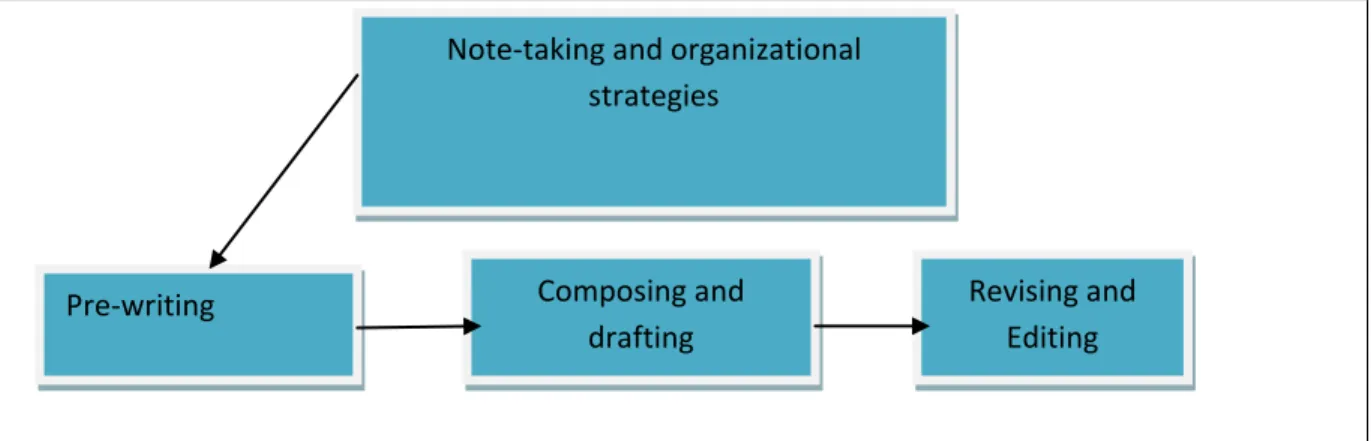
(29) RUNNING HEAD: ORGANIZATIONAL NOTE-TAKING STRATEGIES IN THE PROCESS OF WRITING FORMAL LETTERS. 19. constant processes of revisions, learners will be able to pilot their own writing skills and therefore, their own learning process. The chart below shows the steps proposed to implement this project adapted from Tribble (1996) and Hedge (2005); two learning strategies that will facilitate the writing process for students were added to the writing steps.. Note-taking and organizational strategies. Pre-writing. Composing and drafting. Revising and Editing. Figure 1: Note-taking and Organizational Strategies applied to the steps of Process Writing. Writing stages proposed by Tribble (1996) and Hedge (2005). Adapted by Cárdenas (2011).. Having explored the main constructs related to the topic of this study, research studies done in the field of writing with word processors and metacognitive skills in writing are presented in the next section. 2.4 State of the Art 2.4.1 Writing with word processors In a report by Salomon, Kosminsky, and Asaf (2003), they argue that writing in technological environments affect writing and cognition, particularly writing with word.
(30) RUNNING HEAD: ORGANIZATIONAL NOTE-TAKING STRATEGIES IN THE PROCESS OF WRITING FORMAL LETTERS. 20. processors. These authors mention the long lasting effect versus the direct effect. To start with, the direct effect of word processor has a tendency to create easier production but fewer revisions from learners. On the other hand, when essay planning, learners planned less with the computer than when writing by hand. The authors mention that planning was less relevant to global and conceptual aspects of the essays and pertained more to technical and sequential aspects. The researchers claim that the research could not answer whether planning increased by using word processors. Only ease was a condition mentioned when using word processors at planning stages. Furthermore, they mention that writing with word processors enables and promotes collaborative writing. Ulusoy (2006) carried out a project in which the researcher discusses that computers make the writers’ job easier during different stages of writing. The author states that computers help writers plan more effectively by using concept maps and outlines. Also, the motivational aspect of writing through computers helps learners at pre-writing stages develop their writing. The author mentions the benefits of using word processors in the composing stages, in which learners can compose texts sequentially, follow outlines, and have more freedom than in a paper and pencil based writing. Finally, computers can simplify the revising process. Goldberg, Russell, and Cook (2003) analyzed studies that were focused on the comparison between U.S. school students writing with computers and writing with paper and pencil. They mention something that has been found in other related studies regarding the quantity of writing versus the quality of writing. The researchers mention that for educational leaders who question whether computers should be used for students’ writing development, the results are in favor of computers. The study found more motivation and engagement in writing.
(31) RUNNING HEAD: ORGANIZATIONAL NOTE-TAKING STRATEGIES IN THE PROCESS OF WRITING FORMAL LETTERS. 21. but also students who produced work of a higher quality and greater length. A study by Graham, Harris, and Mason (2005) administered a test of written language to 273 second-grade children in order to determine if these children had problems in their writing. The researchers found that the development of writing implies changes in learners’ behaviors, knowledge, and motivational issues. The instructional model was based on planning and writing stories and a writing strategy to support learners through self-regulation. In their findings they mentioned that through the process writing approach, writing instruction represents significant changes in writing development for students who experience difficulties in writing. Process approaches to writing instruction are beneficial for learners who experience difficulties learning to write. Although the learners made progress in their writing development, the writers mention there is still more research needed to determine the effectiveness in the writing performance of both good and poor writers. In a report by Jaramillo and Medina (2011), the researchers discuss the findings from their project in which they implemented a process writing approach. They report students wrote short descriptive texts about environmental issues in order to develop writing skills. One of their main aims was to sensitize students towards environmental care and conservation. They mention in their findings that students’ motivation was an important factor that was enhanced through the use of English with other subjects such as biology, ecology, etc. Although they mentioned students’ improvement in terms of vocabulary use and how feedback was beneficial for students, there is no other evidence of how students’ writings evolved. In another project, Muñoz (2010) describes the outcomes of a research project with first graders. It presents a detailed account of the development of cognitive and writing skills through.
(32) RUNNING HEAD: ORGANIZATIONAL NOTE-TAKING STRATEGIES IN THE PROCESS OF WRITING FORMAL LETTERS. 22. the use of materials based on the structural cognitive model and how students developed in their role as EFL writers. Some of the project findings had to do with the stages children’s cognitive skills went through during mediation with the teacher and collaboration with their peers and showed whether students were successful at using cognitive skills for the tasks designed for writing development. Also, the author mentions that more tolerance towards errors in the writing process should be fostered during early stages in order to make writing enjoyable for young learners. To sum up, the analysis of the classroom artifacts led the researcher to conclude that learners internalized and overused language structures by means of creating their own L2 grammar through generalization. Children created their own hypothesis about L2 writing systems that helped them convey ideas and develop their acquisition process when writing independently. 2.4.2 Metacognitive skills in writing McMullen (2009) carried out a project that used learning strategies to improve the writing skills for students at Yanbu University College in Saudi Arabia. His aim was to analyze the use of strategies in Saudi students in academic writings. McMullen used Oxfords’ Strategy Inventory for Language Learning (SILL) in order to analyze the frequency in which learners made use of the strategies for writing. According to his findings, from 165 students who participated in the project, 94 females made more frequent use of the strategies. Learners were given explicit strategy instruction prior to the writing tasks and according to the study, females made use of metacognitive strategies more often than their male counterparts. McMullen mentions this study found an improvement of the quality of students’ essays and written products and students benefited from the direct strategy instruction piloted in the project. McMullen.
(33) RUNNING HEAD: ORGANIZATIONAL NOTE-TAKING STRATEGIES IN THE PROCESS OF WRITING FORMAL LETTERS. 23. (2009) found at the end of the project students had become more aware of the benefits the learning strategies had for their written products. The researcher concludes that learners were able to use the margins of test papers to organize their writing (note-taking strategies). They also were able to communicate their ideas more clearly (organizational strategies) by avoiding irrelevant sentences. Students improved in the area of writing mechanics. They also used substitution strategies, using synonyms or descriptive phrases for unknown words to compensate for lack of spelling. In brief, their writings improved in organization, coherence, and mechanics. In another research study conducted at a secondary school with tenth graders in the Netherlands by Kieft and Rijlaarsdam (2006) aimed at studying the use of learning strategies when learning literature. In the hypothesis these authors suggested the more students used planning and organizational strategies, the better the results would be in their writing planning stages. They conducted this project with 113 high school students. They measured through tests the frequency of use of the strategies during the different steps of writing essays in the drafting, revising, and final drafts. They concluded in their findings that adapting the writing tasks to a planning writing strategy while supporting students seemed as if this was more beneficial for literary tasks than for free writing. They said whether learning is present in the discovery stage of the task or in the planning and the writing that students rehearsed in the sessions. In his research project Camelo (2010) shows how classroom projects in writing can be implemented by taking into account students’ interests, their interactions, and the cognitive and metacognitive strategies used to improve writing quality. It was required that students use the strategies while writing different types of texts; the quality of the texts improved due to a.
(34) RUNNING HEAD: ORGANIZATIONAL NOTE-TAKING STRATEGIES IN THE PROCESS OF WRITING FORMAL LETTERS. 24. reflective process and improvements of their drafts. By means of teachers’ guidance and students’ participation, learners were able to identify and use narrative, argumentative, and expository types of texts and their characteristics. The researcher found students were able to use deductive and inductive strategies to monitor their writing process. They also used evaluating and problem solving strategies in order to improve writing tasks. Parra (2010) conducted a study with seventeen students. The researchers’ aim was to explicitly teach socio-affective strategies and measure the impact they had on student’s motivation in learning English. The results from this action research project suggest that teaching socio-affective strategies to learners enhanced learners’ awareness of their own feelings and social relationships in their language learning experience. In their project, Tracy, Reid, and Graham (2009) conducted their research with 127 third grade students and taught these learners planning strategies for writing stories. The students were divided into two groups: in the first group students were given explicit strategies instruction and in the second group students received traditional skills instructions on spelling and grammar. In their outcomes they mentioned that students from the first group wrote longer stories and qualitatively better ones than students from the second group. The researchers also said that learners in the control group maintained the gains achieved during the pre-test and post-test stages. Finally, they mentioned that the writing performance of young writers can be improved by teaching them strategies for planning and writing along with self-regulatory procedures needed to teach the strategies more effectively. Hübner, Nückles Renkl, (2009) focused on cognitive and metacognitive strategies students used while writing learning journals in English. The study mentioned the benefits of the.
(35) RUNNING HEAD: ORGANIZATIONAL NOTE-TAKING STRATEGIES IN THE PROCESS OF WRITING FORMAL LETTERS. 25. learning journals to learners and how through writing these journals, learners were required to use metacognitive skills. The authors mention that this longitudinal study had two groups: the experimental and control group. According to their findings, learners in the experimental group who received cognitive and metacognitive prompts elicited a higher degree of strategies in their journal entries than in the control group. These students were able to outperform the students in the other group; however, a few months later the students in the control group had significantly increased their use of the strategies in journal entries. According to the findings, these results can be explained from the perspective of the cognitive load theory. These prompts might have supported the experimental group’s students in applying cognitive and metacognitive strategies provided that they were unfamiliar with the learning journal method. Thus, the prompts facilitated the task for learners to perform useful strategies such as organization and elaboration strategies. According to the authors’ conclusions, they are not sure how the use of the strategies that prompted cognitive and metacognitive strategies could transfer to other areas. Results of these studies make a meaningful contribution to teachers’ understanding of the writing process, writing strategies, and how writing through word processors has been taught in classroom settings. It is important to understand the different outcomes of these research studies because they provided this researcher with the benefit of knowing how writing instruction can be made more meaningful by taking into account what other researchers have found locally and abroad. Also, it is significant and valuable to highlight that the findings of these research projects contributed to previous research done in the fields of English language learning in both second language learning and foreign language learning..
(36) RUNNING HEAD: ORGANIZATIONAL NOTE-TAKING STRATEGIES IN THE PROCESS OF WRITING FORMAL LETTERS. 26. To summarize, the literature reviewed from these research interventions helped this researcher understand how the theories of writing and teaching instruction have evolved. In addition, this research has brought to light the concept of strategies that learners use during the writing process and the tools in which writers approach writing tasks. The findings of those research projects have provided the researcher with other factors to concentrate on, such as the evaluation of writing, feedback and peer-feedback, and assessment and self-regulation, which frame this research project..
(37) RUNNING HEAD: ORGANIZATIONAL NOTE-TAKING STRATEGIES IN THE PROCESS OF WRITING FORMAL LETTERS. 27. Chapter 3: Research design This chapter presents the type of study conducted, a description of the context, participants, the researcher’s role, and the data collection instruments. It also includes the data collection procedures followed in this project. In addition, this chapter presents the triangulation technique and ethical considerations taken into account during the implementation of the research study. This is a qualitative research study which, according to Denzin and Lincoln (2000), is focused on the interpretation of phenomena in its natural settings in order to understand it from the perspectives of the participants. 3.1. Type of Study Qualitative research has been defined in many ways but this type of research in general is concerned with explaining social phenomena and the understanding of this phenomena. According to Creswell (1994, p.12), qualitative studies are defined as an inquiry process of understanding human problems based on a holistic view that reports on a detailed view of the participants and is conducted in a natural setting. This method of inquiry is often used in different academic disciplines and has become popular in education and language learning. One of the methods of qualitative research is action research. Action research was chosen for this study because it invokes the processes of reflection and analysis in the classroom as a means to change or improve conditions of learning. As Kemmis and McTaggart (1988, p 6) described, the linking of the terms “action” and “research” highlights an essential feature of the method: trying out new ideas in practice as a means of improvement and increasing knowledge. According to.
(38) RUNNING HEAD: ORGANIZATIONAL NOTE-TAKING STRATEGIES IN THE PROCESS OF WRITING FORMAL LETTERS. 28. Burns (1999, p.26), action research is contextual, small-scale, and localized; it identifies and investigates problems within a specific situation. A model provided by Cohen and Manion (1996, p.23) illustrates the steps in action research needed to contemplate the achievement of the goal: •. Identify and formulate the problem.. •. Discuss and negotiate with interested parties.. •. Review literature.. •. Modify or redefine the initial problem as necessary.. •. Select research procedures and methods.. •. Select evaluation procedures.. •. Implement the project over the required time period. Initially, the researcher observed a classroom situation in which he wanted to intervene in. order to bring about changes. The specific issue was students’ performance in writing skills. It was observed that students were not making use of learning strategies in their writing process in the foreign language. Thus, the problem was identified and posed as a research question in terms of students’ abilities, and a proposal was made which intended to find whether students were aware of how they learn by using organizational and note-taking strategies. Therefore, the project aims at improving their language learning experience. This improvement will seek to reinforce their knowledge of the foreign language through the use of their writing skill..
(39) RUNNING HEAD: ORGANIZATIONAL NOTE-TAKING STRATEGIES IN THE PROCESS OF WRITING FORMAL LETTERS. 29. 3.2 Context This research project took place at a catholic school in Bogotá, Colombia. At this institution, students do not follow a textbook. Teachers are required to design worksheets for students. The school claims to follow a communicative approach to TEFL. Learners have eight hours of instruction each week. The syllabus in which the teaching of foreign languages is framed is the competencies curriculum model. The teaching of English is based on the communicative approach applied to three competencies: linguistic, pragmatic, and sociolinguistic. English is taught as an intensive subject; within the curriculum English is seen as an essential subject and the main objective is to develop the competencies in the foreign language for all students who finish the secondary program and whose aim is higher education. According to the educational institutional project (PEI) at that school, the foreign language department has included in the students’ curriculum reading and writing achievements that correspond to the Estándares Básicos de Competencias en Lenguas Extranjeras (National Competency Standards in Foreign Language). Students need to understand elements from the foreign linguistic code to combine ideas coherently, understand different types of written texts and graphics, and organize short paragraphs that fulfill a communicative purpose. 3.3 Participants The participants in this group are thirty students from the seventh grade, eighteen boys and twelve girls between the ages of eleven and twelve. Their language level is elementary A2 according to the Common European Framework of Languages. These learners.
(40) RUNNING HEAD: ORGANIZATIONAL NOTE-TAKING STRATEGIES IN THE PROCESS OF WRITING FORMAL LETTERS. 30. use basic structures fairly well; however, they need to improve their writing skills and the use of more complex structures. These learners share some common difficulties related to writing in their first language that may be transferred to writing in the foreign language. Such difficulties are related to lack of coherence in their writing tasks, their message lacks clarity. These students are required to take standardized international examinations from Cambridge KET; this is an elementary exam that tests the abilities students have in written and spoken language. At this point the test is over the students’ level. Considering their affective and cognitive needs, these learners lack confidence to communicate their feelings and ideas in L2. They sometimes use L1 in the classroom and are often encouraged to use L2. The group represents a diversity of learning styles, but they need to be more self-confident and use the target language in the classroom. Some of the learners are risk-takers, but others need to be encouraged constantly because there is an urgent need for them to become more autonomous in their learning process. Since the group has mixedability individuals, they need challenging activities that stimulate attention and enhance production. Some of them finish writing tasks quickly, but do not check their work. Consequently, the teacher needs to provide an environment that serves as a model for learners. Such an environment will encourage them in their writing process. Beginning in the pre-writing stages, learners can generate their own ideas, organize them, and have opportunities to reflect, react, and interact..
(41) RUNNING HEAD: ORGANIZATIONAL NOTE-TAKING STRATEGIES IN THE PROCESS OF WRITING FORMAL LETTERS. 31. 3.4 Researcher role The researcher’s role was as teacher and observer-participant. As a teacher, the researcher did the planning, modeling strategies, provided feedback, and monitored students. As an observer-participant, the researcher observed and analyzed learners’ responses and behaviors. The participants’ role was focused on guiding the process of the implementation. According to Burns (2010, p.30); classroom observation is a basis of action research. It allows researchers to document and reflect upon students’ interactions and classroom events at the moment they occur. 3.5 Ethical considerations Prior to conducting this project, the three ethical concerns were responsibility, confidentiality, and negotiation. First, the researcher informed the school principal of the project and received a consent letter signed by the principal. As soon as the project was approved, the participants and their parents also received a consent letter requesting their authorization to allow students to participate in the project. To protect participants’ identities and confidentiality, their names were not used. According to Burns (2010, p.33), confidentiality ensures that identities of participants involved in the research are not made public. Therefore, students were told the results of this study would be published but not their names. 3.6 Data collection instruments Taking into account the techniques for data collection, non-observation techniques were used to collect the data. Wallace (1998, p.55) claims these techniques are introspective; individuals self-report on their beliefs and attitudes. Factual data can also be obtained with such techniques. The data collection instruments used for this project were questionnaires, students’.
(42) RUNNING HEAD: ORGANIZATIONAL NOTE-TAKING STRATEGIES IN THE PROCESS OF WRITING FORMAL LETTERS. 32. logs, and focus groups. For the pre-stage of the intervention one instrument was used: the diagnostic test in writing. This test, which is standardized practice, is valid and reliable in terms of format and structure. 3.6.1 Questionnaires A questionnaire was pilot tested and then administered to collect the data regarding learner’s feelings, thoughts, and experiences during and after the intervention. According to Burns (1999, p.129), three types of information can be obtained from questionnaires: factual, behavioral, and attitudinal. During the implementation, a questionnaire was applied to gather information about students’ previous knowledge about writing. Data gathered from these questionnaires included factual information concerned with the use of strategies and the writing process. 3.6.2 Students’ logs The students’ logs gathered information regarding the organizational and note-taking strategies students used when facing the writing task. Also, data concerning writing perceptions and the use of word processors was collected in these logs. Through collecting logs and other types of narrative data, researchers are able to collect a continuous stream of events or behaviors. According to McKernan (1996, p.215), these techniques are unstructured as they allow freedom of responses from participants. These learning logs were useful for the gathering of data that contained students’ reflections and responses to writing the letters. Woolfolk (2001, p.265) claims that learning logs allow students to consolidate their learning and allow instructors to obtain valuable information in regards to student understanding..
(43) RUNNING HEAD: ORGANIZATIONAL NOTE-TAKING STRATEGIES IN THE PROCESS OF WRITING FORMAL LETTERS. 33. 3.6.3 Focus groups According to Krueger and Casey (2009, p.6), in the late 1930s some scientists had doubts about the efficacy of interviews and began investigating alternative ways of conducting interviews. They were concerned about the accuracy of data gathered through close-endedresponse choices. A new form of interviews emerged: focus groups. Focus groups do not have a questioner that may influence the data. Focus groups have specific features. They are composed of five to ten people, though there can be as few as four and as many as twelve. They can provide qualitative data in a focused discussion and allow participants to share their thoughts and interests about a certain topic. This instrument was used at the end of the pedagogical intervention. An advantage of using this instrument was students felt more comfortable talking to the researcher about their experiences in the project. They could view the researcher not as someone in a power position, but rather as someone who encourages different types of comments from participants. 3.7 Triangulation technique In order to overcome problems that arise from relying on a single form of evidence or perspective such as intrinsic biases, diverse sources of information were combined through triangulation. First, the standardized test was used for the needs analysis. Then, the teacher administered questionnaires to learners and collected data during the intervention. This data was compared to the data gathered from students’ logs, and the data that was collected in focus groups was compared to the previous instruments. According to Burns (1999, p.162),.
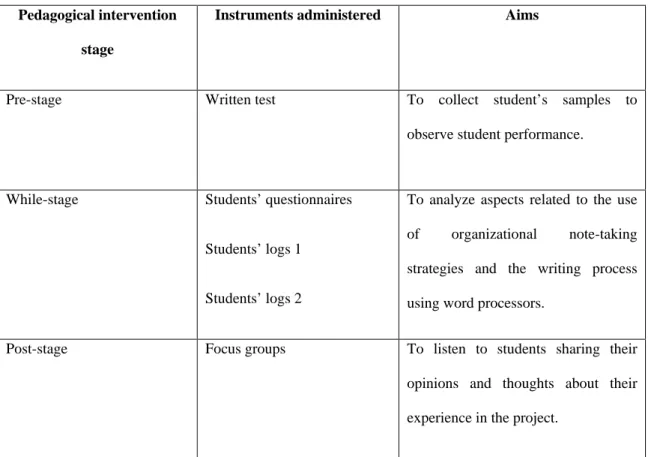
(44) 34. RUNNING HEAD: ORGANIZATIONAL NOTE-TAKING STRATEGIES IN THE PROCESS OF WRITING FORMAL LETTERS. triangulation is one of the most common ways of checking for validity. Triangulation is a way of corroborating that different methods of investigation produced the same results. 3.8. Data collection procedures The instruments used during the implementation of the project are divided into three stages: pre-stage, while-stage, and post-stage. In the pre-stage of the project the written test was administered, and in the while-stage of the pedagogical intervention students answered questionnaires and wrote in their logs. In the post-stage students participated in focus groups. Table 2 shows the stages of the instruments applied and their purposes. Pedagogical intervention. Instruments administered. Aims. stage Pre-stage. Written test. To collect student’s samples. to. observe student performance.. While-stage. Students’ questionnaires. To analyze aspects related to the use of. organizational. note-taking. Students’ logs 1 strategies and the writing process. Post-stage. Students’ logs 2. using word processors.. Focus groups. To listen to students sharing their opinions and thoughts about their experience in the project.. Table 2: Data collection Instruments..
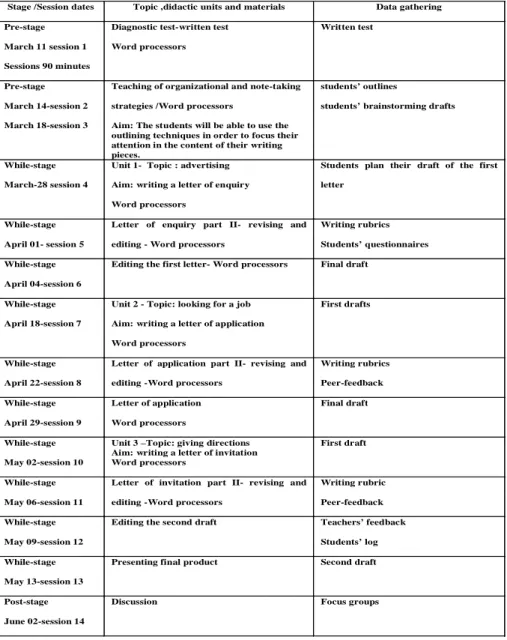
(45) RUNNING HEAD: ORGANIZATIONAL NOTE-TAKING STRATEGIES IN THE PROCESS OF WRITING FORMAL LETTERS. 35. Chapter 4: Pedagogical Intervention This chapter will describe the processes followed during the implementation of the project. The blending of the writing strategies and the process writing approach is explained, as well as that of the design of the didactic units. It will also give an account for the lesson plans, activities used in the implementation, the action plan, and the timeline. For the design of the didactic units a process writing approach was selected, defined by Tribble (1996, p.118) as the teaching of writing that stresses the creativity of the individual writer focused on the process of writing. According to Bereiter & Scardamalia (1987, p.12), process writing involves cognitive processes that aim at problem solving situations and is therefore a nonlinear process that involves creativity from learners who discover and explore their ideas as they approach meaning in communicative activities. Learners are encouraged to get collaboratively involved in planning, organizing, drafting, revising, and editing. Hedge (1988) describes this process as the motivation to write: getting ideas together in order to plan and outlining to make notes. After that a first draft is produced for later revising, editing, and publishing. The steps to follow integrate the process of writing with note-taking and organizational strategies that allow students to plan, reflect, and organize their thoughts before they start the productive stage of writing. The steps were divided into three separate sessions. In the first session students used note-taking and organizational strategies for writing outlines. In the second, learners wrote the first draft of the letter. Finally, in the last session they received feedback and worked on their second drafts. For this pedagogical.
Figure
Documento similar
In the “big picture” perspective of the recent years that we have described in Brazil, Spain, Portugal and Puerto Rico there are some similarities and important differences,
35 In short, the only extant epistolary writing in Austen's early work that is a sustained and lengthy use of the letter form as a mode through which to
In the preparation of this report, the Venice Commission has relied on the comments of its rapporteurs; its recently adopted Report on Respect for Democracy, Human Rights and the Rule
As generalization depends precisely on the degree of conditioning of this common element, this mechanism can elegantly explain perceptual learning within standard
First, a correlational analysis was conducted to examine the extent of the relations between (a) transactional writing beliefs and the quality of the joint written synthesis
In relation to the external validity of the ‘use’ of the different coping strategies, positive correlations were found for mental withdrawal, social support seeking and the use
The study was designed to investigate the usage and its frequency of language learning memory strategies by those students who are learning English as a
For instance, the best overall accuracy of bagging in Breast with 20% noise is achieved using a 10% sampling ratio: The test error goes from 4.1% when no noise is injected to 3.5%
