http://jppres.com/jppres
Original Article | Artículo Original
_____________________________________
Docking studies on novel analogs of quinolones against DNA gyrase
of
Escherichia coli
[Estudios de acoplamiento molecular de nuevos análogos de quinolonas a la ADN girasa de Escherichia coli]
Cristian Davila1, Lorena Llach2, Guillermo Salgado-Moran3, Rodrigo Ramirez-Tagle4*
1Escuela de Química y Farmacia, Universidad Andrés Bello, Republica 237, Santiago, Chile. 2Facultad de Salud, Universidad Bernardo O´Higgins, General Gana 1780, Santiago, Chile.
3Facultad de Ciencias Exactas, Departamento de Química, Universidad Andrés Bello, Autopista Concepción – Talcahuano 7100, Concepción, Chile. 4Facultad de Ingeniería, Ciencia y Tecnología, Universidad Bernardo O´Higgins, General, Av. Viel 1497, Santiago, Chile.
*E-mail: [email protected]
Abstract Resumen
Context: Bacterial resistance to antibiotics is the inevitable consequence of the use of antimicrobial agents. Thus, quinolones are an important class of antibacterials; these agents generally consist of a 1-subtituted-1,4-dihydro-4-oxopyridine-3-carboxylic acid moiety combined with an aromatic or heteroaromatic ring fused at the 5- and 6-position.
Aims: To determine the binding of quinolones to DNA gyrase of
Escherichia coli.
Methods: An analysis was performed using an in silico approach to determine, by docking calculations and energy descriptors, the conformer of 4‐oxo‐1,4‐dihydroquinoline skeleton that forms the most stable complex with DNA gyrase of E. coli.
Results: The complex shows that the pose of the quinolones coincides with the amino acid residues Asp87, Thr88, Arg91 and Met92, which is expected to be critical in the binding of quinolones to DNA gyrase of E. coli. A series of quinolones were computationally designed, and the interactions between the quinolones and the amino acid residues of the DNA gyrase were calculated.
Conclusions: Among the designed compounds, compounds 105 and 115 exhibit higher binding energy values and interact with amino acids Asp87, Thr88, Arg91 and Met92.
Contexto: La resistencia bacteriana a los antibióticos es la consecuencia inevitable del uso de agentes antimicrobianos. Por lo tanto, las quinolonas son una clase importante de antibacterianos; estos agentes generalmente consisten en un resto ácido 1-sustituido-1,4-dihidro-4-oxopiridina-3-carboxílico combinado con un anillo aromático o heteroaromático fusionado en las posiciones 5 y 6.
Objetivos: Determinar la unión de quinolonas a ADN girasa de
Escherichia coli.
Métodos: Se realizó un análisis utilizando un enfoque in silico para determinar, mediante cálculos de unión y descriptores de energía, el confórmero del esqueleto de 4-oxo-1,4-dihidroquinolina que forma el complejo más estable con la ADN girasa de E. coli.
Resultados: El complejo muestra que la postura de las quinolonas coincide con los residuos de aminoácidos Asp87, Thr88, Arg91 y Met92, que se espera que sean críticos en la unión de quinolonas a ADN girasa de E. coli. Se diseñó computacionalmente una serie de quinolonas, y se calcularon las interacciones entre las quinolonas y los residuos de aminoácidos de la ADN girasa.
Conclusiones: Entre los compuestos diseñados, los compuestos 105 y 115 exhiben valores de energía de unión más elevados e interactúan con los aminoácidos Asp87, Thr88, Arg91 y Met92.
Keywords: Arguslab; DNA gyrase; docking; Escherichia coli; quinolones. Palabras Clave: acoplamiento molecular; ADN girasa; Arguslab;
Escherichia coli; quinolonas.
ARTICLE INFO
Received: January 25, 2018.
Received in revised form: July 4, 2018. Accepted: July 5, 2018.
Available Online: July 27, 2018.
http://jppres.com/jppres J Pharm Pharmacogn Res (2018) 5(6): 387 INTRODUCTION
Despite modern antibiotics, transmissible dis-eases are responsible for nearly one third of hu-man deaths worldwide. Bacterial resistance to an-tibiotics is the inevitable consequence of the use of antimicrobial agents. Thus, quinolones are an im-portant class of antibacterial; these agents general-ly consist of a 1-subtituted-1,4-dihydro-4-oxo-pyridine-3-carboxylic acid moiety combined with an aromatic or heteroaromatic ring fused at the 5- and 6-positions (Wube et al., 2012).
Quinolones are highly effective antimicrobial drugs that target bacterial DNA gyrase and type II topoisomerase. Unfortunately, resistance to this class of drugs has become increasingly prevalent and is usually attributable to mutations in the DNA gyrase or a decrease in intracellular drug levels caused by changes in the membrane perme-ability or the overexpression of drug efflux pumps (Chen et al., 2013).
The level of drug resistance varies depending on the mutations and bacterial species. Quinolone inhibition of DNA gyrase occurs through the for-mation of a stable ternary complex between DNA gyrase, DNA and the quinolone molecule that blocks the progression of DNA replications (Lu-pala et al., 2013).
The computational strategies for structure-based drug discovery offer a valuable alternative to the costly and time-consuming process of ran-dom screening (Salgado-Moran et al., 2013). In this sense, docking calculations have been applied in pharmaceutical research for nearly two decades. Virtual screening on protein templates provides an opportunity for the identification of active com-pounds(Perez et al., 2014).
Considering these points, several quinolones with different substitutions were computationally designed. In this study, several quinolones as tar-gets for antibiotics based on the molecular docking between new inhibitors and DNA gyrase using Arguslab were designed (Hafeez et al., 2013; Tangyuenyongwatana and Jongkon, 2016).
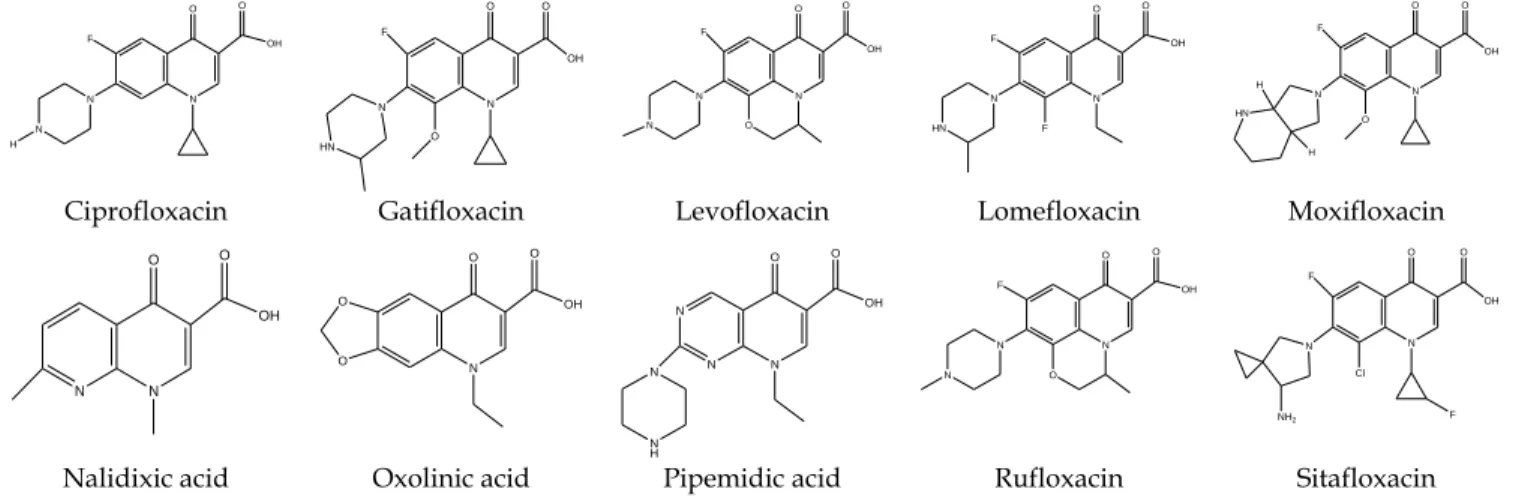
In this study, antibiotic design was conducted with the modifications of hydrophilic and lipo-philic characters of the molecules. The theoretical-ly calculated binding affinities and binding posi-tions of nalidixic acid, oxolinic acid, pipemidic ac-id, ciprofloxacin, gatifloxacin, levofloxacin, lomef-loxacin, moxiflomef-loxacin, ruflomef-loxacin, and sitaflomef-loxacin, which are commonly used antibiotics (Fig. 1) were compared with the new quinolones (supplemen-tary data) (Lupala et al., 2013; Perez et al., 2014).
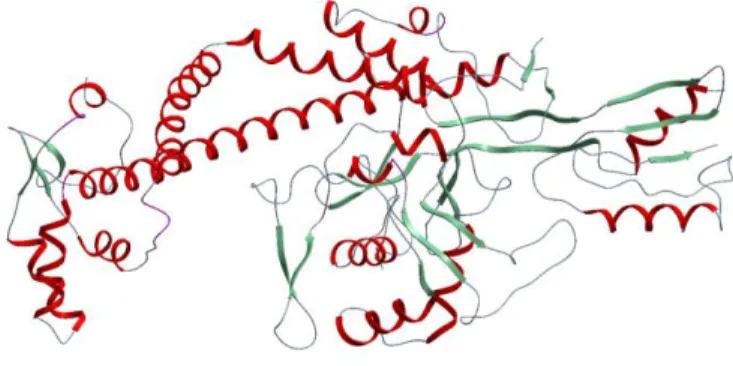
Figure 1. 3D representation of DNA gyrase.
MATERIAL AND METHODS
The docking procedure is conceivable as a complicated optimization or an exhaustive search that involves many degrees of freedom. Hence, the development of efficient docking algorithms would be of vital importance for the design of new drugs (Zarate et al., 2016). The ultimate goal is to find the optimal ligand/protein configurations as well as to consistently predict their binding free energy without relying on formal statistical me-chanics approaches. To computationally accom-plish the key objective within a reasonable time framework, an empirical scoring function (AScore) and a docking engine (ShapeDock) were devel-oped in the ArgusLab program (Oda and Takahashi, 2009).
The AScore is based on the deconvolution of the total protein–ligand binding free energy into different components:
http://jppres.com/jppres J Pharm Pharmacogn Res (2018) 5(6): 388
The dissected terms account for the van der Waals interaction between the ligand and the pro-tein (∆GvdW), the hydrophobic effect (∆G hydrophobic), the hydrogen bonding between the ligand and the
protein (∆G hydrophobic), the hydrogen bonding that
involves the charged donor and/or acceptor
groups (∆G H-bond(chg)), the deformation effect (∆G
deformation), and the effects of the translational and rotational entropy loss in the bidding process (∆G°).
The ShapeDock engine approximates a compli-cated search problem. Flexible ligand docking is available by describing the ligand as torsion tree. In this torsion tree approach, groups of bonded atoms that do not have rotatable bonds are nodes, while torsions are connections between the nodes. The topology of a torsion tree is a determinative factor that influences efficient docking. A balanced tree with a large central node is presumably the favorite case. Two grids overlay the binding site and distinguish grid points with respect to the free volume of the binding site. A fine grid is used to examine whether the atoms at an artificial position are inside or outside the binding site, while a coarse grid is used to establish the search points inside the binding site. A set of energetically fa-vorable rotations is generated by placing the root node of a ligand on a search point in the binding site. The torsion search of the artificial positions is defined by constructing the torsions in a
breadth-first order for each rotation. Of the surviving arti-ficial position candidates, the N-lowest energy poses make the final set of positions to undergo coarse minimization, re-clustering and ranking. The AScore/ShapeDock docking protocol is rapid and reproducible and formally explores all of the energy minima (Tangyuenyongwatana and Jong-kon, 2016).
Candidate optimized conformations of MP3 semiempirical calculations (Hafeez et al., 2013) quinolones bound to their target structures, the DNA gyrase complex(Chen et al., 2013) . Proposed were using Arguslab. Here, docking was conduct-ed with a set of 115 4-oxo-1,4-dihydroquinoline skeleton (see supplementary data). They were de-fined to contain the potential binding pocket be-tween Ala67 and Gln106 (Fig. 2).
RESULTS AND DISCUSSION
The docking results between the DNA gyrase receptor and designed 4‐oxo‐1,4‐dihydroquinoline skeleton are reported in Fig. 3.
The standard antimicrobial agents nalidixic ac-id, oxolinic acac-id, pipemidic acac-id, ciprofloxacin, gat-ifloxacin, levofloxacin, lomefloxacin, moxgat-ifloxacin, rufloxacin, and sitafloxacin, on docking with DNA gyrase produce energy values of 7.9880, 6.9640, 7.7810, 6.4840, 7.5950, 7.2860, 7.7860, 7.2980, -7.1710 and -8.1440 Kcal/mol, respectively.
N
Ciprofloxacin Gatifloxacin Levofloxacin Lomefloxacin Moxifloxacin
N N
Nalidixic acid Oxolinic acid Pipemidic acid Rufloxacin Sitafloxacin
http://jppres.com/jppres J Pharm Pharmacogn Res (2018) 5(6): 389
To recognize the hypothetical binding mode and interaction of quinolones with crucial amino acid residues in the DNA gyrase complex, a mo-lecular docking study was conducted using the crystal structure of DNA gyrase. The percentage frequency of the interaction of quinolones with different amino acids (a maximum distance is 20 Å) is as follows: 20% Ala67, 10% Lys76, 20% Tyr77, 30% His78, 10% Pro79, 30% His80, 20% Gly81, 40% Asp82, 50% Ser83, 50% Ala84, 40% Val85, 30% Tyr86, 100% Asp87, 80% Thr88, 60% Ile89, 70% Val90, 80% Arg91, 70% Met92, 50% Ser97, 50% Leu98, 20% Arg99, 20% Met101, and 60% Leu102.
For the most stable conformer of the quinolones (Fig. 4), its crucial amino acid residues (Asp87, Thr88, Arg91 and Met92) are at the following dis-tances (from the Cα of the amino acid to the C1 of the quinolones): 8.068 Å, 9.7170 Å, 8.5810 Å and 7.4230 Å, respectively, for nalidixic acid; 10.0358 Å, 6.9688 Å, 5.9936 Å and 4.7015 Å, respectively, for oxolinic acid; 10.6030 Å, 7.8760 Å, 6.9830 Å and 6.7880 Å, respectively, for pipemidic acid; 11.3730 Å, 8.2780 Å, 7.990 and 7.1580 Å, respectively, for ciprofloxacin; 8.2100 Å, 6.5070 Å, 10.9330 Å and 11.9860 Å, respectively, for gatifloxacin; 7.1750 Å, 5.3080 Å, 6.8080 Å and 8.4380 Å, respectively, for levofloxacin; and 11.6980 Å, 8.2490 Å, 7.9380 Å and 5.5570 Å, respectively, for rufloxacin.
DNA gyrase is a target of quinolone. However, the molecular details of the quinolone-gyrase in-teraction are not clear. Quinolone resistance muta-tions frequently occur at the residues Ser83 and Asp87 of the GyrA subunit; thus, it is possible that these residues are involved in drug binding. Moreover, Asp87 might be critical in the binding of fluoroquinolones (Wu et al., 2013).
Efforts to develop novel bacterial topoisomer-ase inhibitors that aim to overcome quinolone re-sistance have led to the identification of new bind-ing sites, which suggests that in addition to the cleavage site-specific targeting strategy, alternative drug binding modes for promoting cell death should also be explored (Banoth et al., 2017).
These results allow us to explain the experi-mental results because Asp87 is the amino acid that has the highest frequency of interaction with the quinolones and has been found to be critical in the binding of these drugs (see Fig. 3).
Figure 3. Graphic linking energy, distances from the Cα of the amino acid to the C1 of the quinolones and the
percentage frequency of interaction of the quinolones with different amino acids.
http://jppres.com/jppres J Pharm Pharmacogn Res (2018) 5(6): 390
Nalidixic acid Oxolinic acid Pipemidic acid
Ciprofloxacin Gatifloxacin Levofloxacin
Lomefloxacin Moxifloxacin Rufloxacin
Sitafloxacin JADP-4 JADP-14
http://jppres.com/jppres J Pharm Pharmacogn Res (2018) 5(6): 391 CONCLUSIONS
DNA gyrase, which is an essential target for novel drug design, was docked with the standard antimicrobial agents nalidixic acid, oxolinic acid, pipemidic acid, ciprofloxacin, gatifloxacin, levofloxacin, lomefloxacin, moxifloxacin, rufloxa-cin, and sitafloxacin. When the designed quino-lone analogs were docked against the DNA gyrase, the results indicate that the 105 and 115 com-pounds can be potent antibacterial agents. Analy-sis of the binding models suggests that the amino acid residues Asp87, Thr88, Arg91 and Met92 are critical in the binding of quinolones to the DNA gyrase of E. coli.
CONFLICT OF INTEREST
The authors declare no conflict of interest.
ACKNOWLEDGMENTS
The authors confirm that the project has not funding or grants.
REFERENCES
Banoth S, Boda S, Perugu S, Balabadra S, Manga V (2017) Design, synthesis, biological evaluation and in silico molecular docking studies of novel benzochromeno[2,3-D]thiazolopyrimidine derivatives. Res Chem Intermediat 44: 1833–1846.
Chen SH, Nei-Li C, Tao-Shih H (2013) New mechanistic and functional insights into DNA topoisomerases. Annu Rev Biochem 82: 139–170.
Hafeez A Naz A, Naeem S, Bano K, Akhtar N (2013) Computational study on the geometry optimization and excited - state properties of riboflavin by ArgusLab 4.0.1. Pak J Pharm Sci 26(3): 487–493.
Lupala CS, Gomez-Gutierrez P, Perez JJ (2013) Molecular determinants of the bacterial resistance to fluoro-quinolones: A computational study. Curr Comput Aided Drug Des 9(2): 281–88.
Oda AO, Takahashi O (2009) Validation of ArgusLab efficiencies for binding free energy calculations. Chem-Bio Informat J 9: 52–61.
Perez JJ, Lupala CS, Gomez-Gutierrez P (2014) Designing type II topoisomerase inhibitors: A molecular modelling approach. Curr Top Med Chem 14(1): 40–50.
Salgado-Moran G, Ramirez-Tagle R, Glossman-Mitnik D, Ruiz-Nieto S, Kishore-Deb P, Bunster M, Lobos-Gonzalez F (2013) Docking studies of binding of ethambutol to the C-terminal domain of the arabinosyltransferase from
Mycobacterium tuberculosis. J Chem 2013: 1–5, Article ID 601270.
Tangyuenyongwatana P, Jongkon N (2016) Molecular docking study of tyrosinase inhibitors using ArgusLab 4.0.1: A comparative study. Thai J Pharm Sci 40(1): 21–25.
Wu CC, Li YC, Wang YR (2013) On the structural basis and design guidelines for type II topoisomerase-targeting anticancer drugs. Nucleic Acids Res 41(22): 10630–10640. Wube A, Guzman J-D, Hüfner A, Hochfellner C, Blunder M,
Bauer R, Gibbons S, Bhakta S, Bucar F (2012) Synthesis and antibacterial evaluation of a new series of N -alkyl-2-alkynyl/(E)-alkenyl-4-(1H)-quinolones. Molecules 17: 8217–8240.
Zarate X, Schott E, Escobar CA, Lopez-Castro R, Echeverria C, Alvarado-Soto L, Ramirez-Tagle R (2016) Interaction of chalcones with CT-DNA by spectrophotometric analysis and theoretical simulations. Quim Nova 39(8): 914–918.
_________________________________________________________________________________________________________
AUTHOR CONTRIBUTION:
Contribution Davila C Llach L Salgado-Moran G Ramirez-Tagle R
Concepts or ideas x
Design x
Definition of intellectual content x
Literature search x
Experimental studies x
Data acquisition x
Data analysis x x
Statistical analysis x
Manuscript preparation x x
Manuscript editing x
Manuscript review x x x x