1 2 3 4 5 6 7 8 9 10 11 12 13 14 15 16 17 18 19 20 21 22 23 24 25 26 27 28 29 30 31 32 33 34 35 36 37 38 39 40 41 42 43 44 45 46 47 48
Copyright © Taylor & Francis Group, LLC ISSN: 0003-2719 print/1532-236X online DOI: 10.1080/00032719.2013.853182
Gas Chromatography
DETERMINATION OF VOLATILES IN MOUSE URINE BY
HEADSPACE SOLID PHASE MICROEXTRACTION AND
GAS CHROMATOGRAPHY-MASS SPECTROMETRY
Esther Arnáiz, Daniel Moreno, and Roberto Quesada
Departamento de Química, Facultad de Ciencias, Universidad de Burgos, Burgos, Spain
The extraction and determination of volatile compounds in mice urine were performed using headspace solid-phase microextraction with by gas chromatography-mass spectrometry. In order to optimize the extraction conditions, experimental design was applied. A sample volume of 108l, a temperature of 148.6C, and a time of 94 minutes were found to be the optimal conditions. Samples of male and female mouse urine were analyzed to determine volatile compound profiles. A total of 36 organic compounds including ketones, aldehydes, and terpenes were detected. The results revealed that compounds such as 2-isopropyl-4,5-dihydrothiazole, which is considered a male sexual pheromone, were only detected in male urine samples, whereas others like benzaldehyde were especially abundant in female mouse urine. A comparison of female samples corresponding to different stages of the estrous cycle was also performed.
Keywords: Experimental design; Gas chromatography-mass spectrometry (GC-MS); Headspace-solid-phase micro-extraction (HS-SPME); Mouse urine; Volatile organic compounds
INTRODUCTION
Urine is a complex biological fluid with enormous potential as a source of biochemical information. Therefore, the development of methods for the analysis of urine is an important objective. Urine contains diverse chemicals and plays an important role as a communication tool among animals. Of particular importance are volatile and semi-volatile substances functioning as pheromones. Examples of the extraction of volatile compounds in both rodent and human urine have been reported in literature using different techniques such as purge-and-trap (Prieto et al. 2000) and organic solvents (Achimaran et al. 2010; Zaporozhets, Tsyrulneva, and Ischenko 2012; Hardt and Angerer 2000; Zhang et al. 2008). On the other hand, Q1 solid-phase microextraction (SPME) has gained popularity as a simple, selective,
Received 28 August 2013; accepted 28 September 2013.
Address correspondence to Roberto Quesada, Departamento de Química, Facultad de Ciencias, Universidad de Burgos, 09001, Burgos, Spain. E-mail: [email protected]
Color versions of one or more of the figures in the article can be found online at www. tandfonline.com/lanl.
49 50 51 52 53 54 55 56 57 58 59 60 61 62 63 64 65 66 67 68 69 70 71 72 73 74 75 76 77 78 79 80 81 82 83 84 85 86 87 88 89 90 91 92 93 94 95 96
and environmentally friendly tool for the sampling of a variety of volatile and semi-volatile compounds in different matrices. SPME presents several advantages for the extraction process such as small sample volume and reduced interferences of the matrix leading to cleaner extracts. Thus, SPME serves as a useful analytical tool prior to gas and liquid chromatography analyses (Biniecka and Caroli 2011; Vas and Vékey 2004). Examples of the extraction of organic volatile compounds in diverse matrices such as environmental samples (Krutz, Senseman, and Sciumbato 2003), cosmetics (Alvarez-Rivera et al. 2013), food samples (Lee et al. 2013; Bryant and McClung 2011; Palma-Harris, McFeeters, and Fleming 2001; Kumari et al. 2013; Pozo-Bayón et al. 2001), and biological matrices (Aresta et al. 2008; Mills and Walker, 2001) have been published in literature.
The purpose of this study was to determine small volatile compounds present in mouse urine that may act as rodent pheromones and influence rodent behavior. HS-SPME is well suited to identify these compounds, as it has already been applied to identify pheromones in the glands of Lepidoptera (Frérot, Malosse, and Cain 1997), elephant urine (Kayali-Sayadi et al. 2003), and rodent urine (Dehnhard et al. 2003; Osada et al. 2008; Gutiérrez-García et al. 2007). From the experimental point of view, SPME techniques may be influenced by a relatively large number of factors. To address this issue, experimental design allows rational and systematic optimization of conditions leading to better and more reproducible results (Salafranca et al. 2003). The advantages of using experimental design applied to SPME extraction have been demonstrated for the determination of drugs in biological matrices in humans (Reubsaet et al. 1998) or organic compounds in water (Mousavi et al. 2007; De Lima Gomes et al. 2011). The goal of this study was to optimize the SPME conditions using experimental design to perform the analyses and to establish the best extraction conditions for volatile compounds in mouse urine samples.
EXPERIMENTAL
Urine Samples
Mouse urine samples were provided by Faculty of Medicine, University of Valladolid (Spain). All samples were stored at −20C following collection until analysis.
Solid Phase Micro-Extraction
97 98 99 100 101 102 103 104 105 106 107 108 109 110 111 112 113 114 115 116 117 118 119 120 121 122 123 124 125 126 127 128 129 130 131 132 133 134 135 136 137 138 139 140 141 142 143 144
for one hour in the injection port of the gas chromatograph. Blank extractions and analyses were performed in order to ensure correct identification.
Chromatographic Conditions
Analysis were performed using a 6890N Gas Chromatograph system coupled with a Mass Selective Detector 5975 supplied by Agilent Technologies Network. The injection port was equipped with a 0.75-mm i.d. inlet liner (Supelco, Bellefonte, PA, USA) to optimize fiber desorption and sample delivery on the column (HP-1MS capillary column; 30 m×250m×0.25m). Helium, at a flow rate of 1 ml/min, was used as the carrier gas. The oven temperature program started at 35C. After 2 minutes, the temperature was increased to 80C at 10C min−1, to 250C
at 5C min−1, and finally to 300C at 20C min−1. This temperature was held for
10 minutes. The interface was maintained at 300C, the ion source at 230C, and the quadrupole analyzer at 150C. Electron impact (EI) spectra were obtained with an electron energy of 70 eV. Mass spectral acquisition was performed from 35 to 800 amu. The identity of the compounds was assigned according to the NIST (National Institute of Standards and Technology, Maryland, USA) database.
RESULTS AND DISCUSSION
Experimental Design
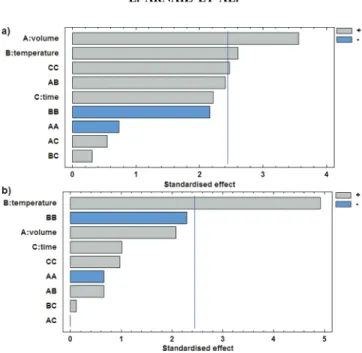
The optimal extraction conditions for the volatile compounds were established using experimental design implemented with the statistical program Statgraphics Centurion XVI.I. An orthogonal central composite design was selected involving three experimental factors (volume of sample, temperature, and time of extraction) and two response variables (the total peak area of the analytes of interest and the number of compounds detected). In order to obtain input data for the calculations, 16 experiments using male mouse urine samples were performed. The resulting Pareto charts are shown in Figure 1.
With respect to the total area response (Figure 1a), there are three effects with p-values less than 0.05 (volume, temperature, and the quadratic effect of time), indicating that they are significantly different from zero at the 95.0% confidence level. In the case of the number of peaks (Figure 1b), there is only one significant effect withp-value less than 0.05, the temperature.
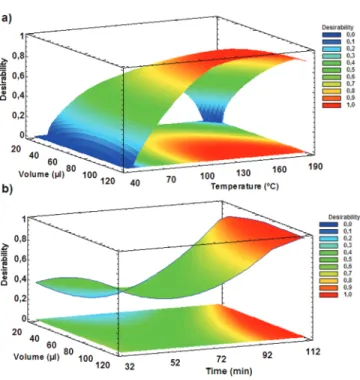
Surface response graphs were generated as a function of total peak area and number of compounds (Figure 2). Improved responses were obtained by increasing both the volume of sample and temperature of extraction.
Response surface modeling (RSM) was used in order to find the optimal conditions for the HS-SPME extractions (Figure 3). The desirability was found to increase with temperature and time whereas volume of sample should be above 60L to optimize the extraction conditions. The optimal conditions were found to be a volume of 108l, 148.6C, and 94 minutes.
Determination of Volatile Compounds in Mouse Urine
145 146 147 148 149 150 151 152 153 154 155 156 157 158 159 160 161 162 163 164 165 166 167 168 169 170 171 172 173 174 175 176 177 178 179 180 181 182 183 184 185 186 187 188 189 190 191 192
Figure 1. Pareto charts for the response variables: (a) total area and (b) number of compounds.
of the estrous cycle were included in the study. Characteristic chromatograms corresponding to male and proestrus female mice urine samples are shown in Figure 4.
The results obtained in neutral extraction conditions, diluting urine samples with NaCl solution in order to increase the ionic force, are summarized in Table 1.
193 194 195 196 197 198 199 200 201 202 203 204 205 206 207 208 209 210 211 212 213 214 215 216 217 218 219 220 221 222 223 224 225 226 227 228 229 230 231 232 233 234 235 236 237 238 239 240
Figure 3. Response surface applied for the optimization of HS-SPME extractions.
The composition of the urine samples is expressed as percentages of the different compounds. The relative abundance of each compound was given as the ratio between the area of the target ion and the total area of all compounds.
A total of 36 organic compounds were identified in the urine samples. Twelve terpenes were identified. Seven compounds (-myrcene, linalool, geraniol, citral, -farnesene, -farnesene, and farnesol) were satisfactorily identified, with farnesol most abundant. The profiles of the male and female samples, both male and female, are similar, although some significant differences were observed. The amount of benzaldehyde detected was much higher in female compared to male
241
Table 1. Relative abundances of identified substances in mouse urine
Male Female
Proestrus Diestrus Estrus
N Compound name Diagnostic ions m/z (A) % % % %
1 3-hepten-2-one 55 (100), 97 (86), 43 (70), 112 (33) 210 034 057 148 2 Benzaldehyde 106 (100), 77 (95), 105 (90), 51
(48.9)
981 8434 7310 6634 3 Dimethyl sulphide 126 (100), 45 (60), 79 (50.6), 111
(15)
174 – – –
4 6-methyl-3-heptanone 57 (100), 43 (80), 72.05 (60), 81 (54), 128 (16)
60 (100), 129(40), 114 (15), 59.05 (25)
008 – – –
10 3-octen-2-one 55 (100), 43 (90), 111 (80), 126 (15)
– 046 050 078 11
3-ethyl-2-methyl-1,3-hexadiene
95 (100), 67 (91), 57 (79), 41 (56) 140 – – – 12 1-phenyl-ethanone 105 (100), 77 (68), 120 (32), 95
(20), 51 (19) 16 Terpene 2 (linalool) 71 (100), 93 (90), 80 (34), 115 (32),
121 (29), 136 (10)
220 061 158 207 17 3-nonen-2-one 55 (100), 43 (55), 71.10 (23), 97
(24), 125 (41)
141 044 063 066
18 3-methyl pyridine 93(100), 65 (33), 79 (11), 43 (7), 075 – – – 19 4-pentyl-phenol 107 (100), 108 (88.2), 77 (22.2), 27
(5.1)
– 112 207 267 20 N-phenyl-formamide 43 (65), 93 (100), 87 (39), 121 (83) 032 – – – 21 2,3-dihydro-benzofurane 120 (100), 91 (80), 107 (30) 200 011 135 173 22 Terpene 3 (geraniol) 69 (100), 41 (57), 93 (24), 123 (13),
111 (8) 25 Ester of propanoic acid 71 (100), 113 (83), 43 (64), 56 (53),
98 (24)
008 007 009 207 26 N-ethyl-benzenamine 106 (100), 153 (30), 77 (14), 136
(5)
052 004 009 014 27 2,6-bis(1,1-dimethyl-ethyl)- 191 (100), 149 (36), 206 (24) 255 188 221 152
phenol
289 290 291 292 293 294 295 296 297 298 299 300 301 302 303 304 305 306 307 308 309 310 311 312 313 314 315 316 317 318 319 320 321 322 323 324 325 326 327 328 329 330 331 332 333 334 335 336
Table 1. Continued
28 Terpene 5 (-farnesene) 69 (100), 41 (53), 93 (64), 133 (35), 81 (22)
1.80 0.28 0.68 0.75 29 Unassigned (cyclohexanol
derivative)
57 (100), 123 (41), 109(21), 85(20) 3.07 0.63 1.44 1.63 30 Terpene 6 (-farnesene) 93 (100), 41 (85), 69 (80), 55 (57),
107 (52), 119 (48)
0.22 0.03 0.08 0.09 31 Terpene 7 69 (100), 41 (62), 93 (93), 119 (30),
161 (34), 204 (28)
0.22 0.03 0.07 0.10 32 Terpene 8 69 (100), 93.05 (60), 107 (22), 123
(14), 136 (15),
0.06 – – –
33 Terpene 9 93 (100), 119 (38), 109 (28), 41 (29)
0.11 0.02 0.04 0.06 34 Terpene 10 (farnesol) 69 (100), 41 (57), 93 (76), 107 (46),
136(26), 204(3)
11.00 1.52 3.73 4.02 35 Terpene 11 69 (100), 41 (59), 93 (39), 79 (17),
107 (16) 121 (11))
1.65 0.25 0.74 0.83 36 Terpene 12 69 (100), 84 (48), 123 (12), 41 (44),
57 (29)
0.20 0.03 0.08 0.08
Analytes not detected in the samples or low than 0.01%.
mice. Benzaldehyde was the main compound detected in all the stages of the female estrous cycle (84.34% in proestrus, 73.10% in diestrus, and 66.34% in estrus), whereas in male urine samples, this percentage dropped to approximately 10%. Percentages of phenyl ethanone in male urine samples (close to 34%) were higher than those detected in females (1–3%depending on their estrous cycle). All terpenes were detected in male and female mice, except that terpene 8 was found exclusively in males. The detected amount of terpenes was in general higher in males than in females. For instance, the farnesol percentage in males was found to be 11%, whereas it decreased to 4%–1.5% in females. The same trend was observed for other terpenes such as-farnesene (1.8%in males, 0.28–0.75%in females), geraniol (3.26%in males, 0.72–2.07%in females), and linalool (2.20%in males, 0.61–2.07% in females).
Some compounds were detected exclusively in urine from one gender. Thus, dimethyl sulfide, 6-methyl-3-heptanone, 2-isopropyl-4,5-dihydrothiazole, 3-ethyl-2-methyl-1,3-hexadiene, 3-methylpyridine, and N-phenylformamide were found only in males. On the other hand, compounds like 4-octen-2-one, 3-octen-2-one, octanal, nonanal, and 4-pentylphenol were exclusively observed in females. Compounds considered as sexual pheromones in mice such as 2-isopropyl-4,5-dihydrothiazole and 2-sec-butyl-4,5-dihydrothiazol were also detected.
337 338 339 340 341 342 343 344 345 346 347 348 349 350 351 352 353 354 355 356 357 358 359 360 361 362 363 364 365 366 367 368 369 370 371 372 373 374 375 376 377 378 379 380 381 382 383 384
CONCLUSIONS
Experimental design was implemented using response surface methodology and applied to the analysis of mouse urine in order to determine the best conditions for the extraction of volatile and semi-volatile compounds using HS-SPME with GC-MS. The use of the optimized extraction conditions (108l, 148.6C, and 94 minutes) resulted in robust, reproducible results. 36 organic compounds were detected in those samples. Several differences were observed when comparing male and female mouse urine samples. Benzaldehyde was found to be the main compound detected in the female urine samples. Depending on the gender, specific compounds were detected. Thus, compounds such as 2-isopropyl-4,5-dihydrothiazole were exclusively detected in males whereas ketones like 4-octen-2-one, 3-octen-2-one were detected in females. This method may have future application for the determination of volatile and semi-volatile compounds in urine.
FUNDING
Financial support from the European Commission ([SME-2011-1] Research for SMEs, PiedPiper project, Grant agreement: 286852) is gratefully acknowledged. Q2
REFERENCES
Achiraman, S., G. Archunan, P. Ponmanickam, K. Rameshkumar, S. Kannan, and G. John. 2010. 1–Iodo-2 methylundecane [1I2MU]: An estrogen-dependent urinary sex pheromone
of female mice.Theriogenology74: 345–353. Q3
Alvarez-Rivera, G., T. De Miguel, M. Llompart, C. Garcia-Jares, T. Gonzalez Villa, and M. Lores. 2013. A novel outlook on detecting microbial contamination in cosmetic products: Analysis of biomarker volatile compounds by solid-phase microextraction gas chromatography-mass spectrometry.Anal. Methods5: 384–393.
Aresta, A., C. D. Calvano, F. Palmisano, and C. G. Zambonin. 2008. Determination of clenbuterol in human urine and serum by solid-phase microextraction coupled to liquid chromatography.J. Pharm. Biomed. Anal. 47: 641–645.
Biniecka, M., and S. Caroli. 2011. Analytical methods for the quantification of volatile aromatic compounds.Trends Anal. Chem.30: 1756–1770.
Bryant, R. J., and A. M. McClung. 2011. Volatile profiles of aromatic and non-aromatic rice cultivars using SPME/GC–MS.Food Chem.124: 501–513.
De Lima Gomes, P. C., J. Y. Barletta, C. E. D. Nazario, Á. J. Santos-Neto, M. A. Von Wolff, C. M. R. Coneglian, G. A. Umbuzeiro, and F. M. Lancas. 2011. Optimization of in situ derivatization SPME by experimental design for GC-MS multiresidue analysis of pharmaceutical drugs in wastewater.J. Sep. Sci. 34: 436–445.
Dehnhard, M., J.-M. Hatt, K. Eulenberger, A. Ochs, and G. Strauss. 2003. Headspace solid-phase microextraction (SPME) and gas chromatography–mass spectrometry (GC–MS) for the determination of 5-androst-2-en-17-one and -17-ol in the female Asian elephant: application for reproductive monitoring and prediction of parturition.J. Steroid Biochem. Mol. Biol. 84: 383–391.
385 386 387 388 389 390 391 392 393 394 395 396 397 398 399 400 401 402 403 404 405 406 407 408 409 410 411 412 413 414 415 416 417 418 419 420 421 422 423 424 425 426 427 428 429 430 431 432
Hardt, J., and J. Angerer. 2000. Determination of dialkyl phosphates in human urine using gas chromatography-mass spectrometry.J. Anal. Toxicol. 24: 678–684.
Kayali-Sayadi, M. N., J. M. Bautista, L. M. Polo-Díez, and I. Salazar. 2003. Identification of pheromones in mouse urine by head-space solid phase microextraction followed by gas chromatography–mass spectrometry.J. Chromatogr. B796: 55–62.
Krutz, L. J., S. A. Senseman, and A. S. Sciumbato. 2003. Solid-phase microextraction for herbicide determination in environmental samples. J. Chromatogr. A999: 103–121. Kumari, R., D. Kumar Patel, P. Chaturvedi, N. Ghazi Ansari, and R. Chandra Murthy.
2013. Solid phase micro extraction combined with gas chromatography-mass spectrometry for the trace analysis of polycyclic aromatic hydrocarbons in chocolate.Anal. Methods5: 1946–1954.
Lee, J. Y., S. M. Yu, H.-J. Sim, S. K. Ko, and J. Hong. 2013. Comparative profiling of volatile composition from different Acorus species by solid-phase microextraction-gas chromatography/mass spectrometry.Anal. Methods5: 3675–3687.
Mills, G. A., and V. Walker. 2001. Headspace solid-phase microextraction profiling of volatile compounds in urine: application to metabolic investigations.J. Chromatogr. B753: 259–268.
Mousavi, M., E. Noroozian, M. Jalali-Heravi, and A. Mollahosseini. 2007. Optimization of solid-phase microextraction of volatile phenols in water by a polyaniline-coated Pt-fiber using experimental design.Anal. Chim. Acta581: 71–77.
Osada,K., T. Tashiro, K. Mori, and H. Izumi. 2008. The identification of attractive volatiles in aged male mouse urine.Chem. Senses33: 815–823.
Palma-Harris, C., R. F. McFeeters, and H. P. Fleming. 2001. Solid-Phase Microextraction (SPME) Technique for Measurement of Generation of Fresh Cucumber Flavor Compounds.J. Agric. Food Chem.49: 4203–4207.
Pozo-Bayón, M. A., E. Pueyo, P. J. Martín-Álvarez, and M. C. Polo. 2001. Polydimethylsiloxane solid-phase microextraction–gas chromatography method for the analysis of volatile compounds in wines. Its application to the characterization of varietal wines.J. Chromatogr. A 922: 267–275.
Prieto, M. J., V. Berenguer, D. Marhuend, and A. Cardona. 2000. Purge-and-trap gas chromatographic determination of styrene in urine and blood. Application to exposed workers. J. Chromatogr., B741: 301–306.
Reubsaet, K. J., H. R. Norli, P. Hemmersbach, and K. E. Rasmussen. 1998. Determination of benzodiazepines in human urine and plasma with solvent modified solid phase micro extraction and gas chromatography; rationalization of method development using experimental design strategies.J. Pharm. Biomed. Anal. 18: 667–680.
Salafranca, J., C. Domeño, C. Fernández, and C. Nerín. 2003. Experimental design applied to the determination of several contaminants in Duero River by solid-phase microextraction.
Anal. Chim. Acta477: 257–267.
Schwende, F. J., D. Wiesler, and M. Novotny. 1984. Volatile Compounds associated with estrus in mouse urine: potential pheromone.Experientia40: 213–215.
Vas, G., and K. Vékey. 2004. Solid-phase microextraction: a powerful sample preparation tool prior to mass spectrometric analysis.J. Mass Spectrom. 39: 233–254.
Zaporozhets, O., I. Tsyrulneva, and M. Ischenko. 2012. Determination of 8 diuretics and probenecid in human urine by gas chromatography-mass spectrometry: Confirmation procedure.Am. J. Anal. Chem. 3: 320–327.
Zhang, J.-X., L. Sun, J.-H. Zhang, and Z.-Y. Feng. 2008. Sex- and gonad-affecting scent compounds and 3 male pheromones in the rat.Chem. Senses33: 611–621.