Article
Synthesis and evaluation of functionalized chitosan nanoparticles as antimicrobial
agents
Porras-GómezM1., Vega-Baudrit J. R.
Laboratorio Nacional de Nanotecnología (LANOTEC), Centro Nacional de Nanotecnología (CeNAT). San José. Costa Rica.
Abstract
The aim of this study is to evaluate the bacteriostatic effect of functionalized chitosan nanoparticles with antioxidants from tropical fruit extracts. In their synthesis and characterization, variables are treated in order to obtain concentrations and other parameters, which show bacteriostatic effect on some species of pathogenic gram-negative ATCC bacterias E.coli, and P. aeruginosa, and gram-positives S. Aureus, and E. faecalis. The hypothesis of this study is that functionalized nanoparticles synthesized according to the ion gelation method using tripolyphosphate as cross-linking agent with modifying agents from tropical fruit extracts, rambutan (Nephelium lappaceum) and blackberry (Rubus glaucus), containing antioxidants; gallic acid, giving chitosan nanoparticles the ability to inhibit bacterial growth.This research evaluated the polyphenol content and antimicrobial activity in conjunction with the nanoparticles against the pathogens mentioned above. Laboratory assays show concentrations between 90 and 200 mg of gallic acid/100g and antimicrobial activity in the gram-positive S. aureus and E. faecalis, and in the gram-negative P. aeroginosa and E. coli; determined by the disc diffusion method showing an inhibition diameter between 9 mm and 18 mm. These results show the potential of these nanoproducts as potential antimicrobial agents for use in the pharmaceutical industry.
Keywords: Nanoparticle, chitosan, bacteriostatic, natural polyphenols, antimicrobial agents.
Introduction
research is required in order to estimate with sufficient precision the real magnitude of the alleged benefits and elucidate possible action mechanisms 1.
Tropical fruits are rich in not-yet-known phytochemical sources with potential applications to pharmacology, medicine and functional foods. According a study of Madrigal et al2, a
collection of Costa Rican traditional fruits (17 different samples) was selected in order to identify their polyphenolic composition (Folin-Ciocalteu test), antioxidant activity (DPPH test) and in vitro antibacterial properties (microbiological assays). Results showed that at least eight of the samples under analysis where natural sources of polyphenols with significant antioxidant activity and three of them exhibited a significant antibacterial effect against both gram-positive and gram-negative bacteria with respect to the experiment control (ampicillin 2 mg/ml). Experimental data suggest that polyphenolic extracts isolated from Costa Rican traditional fruits might be interesting sources of phytochemicals that allow control or prevention of bacterial infections in human patients.
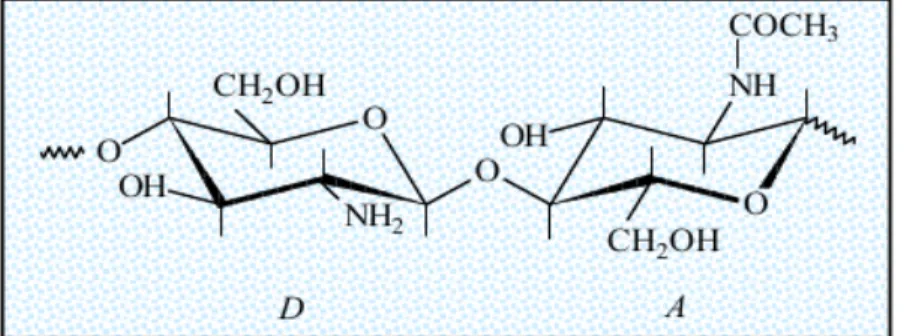
Natural polymers are currently being used as biomaterials, where chitosan is one of the most important ones. It is a cationic linear polysaccharide composed by units of (1-4)-2-deoxy-2-amino-D-glucopyranose (D-glucosamine, GlcN) and (1-4)-2- deoxy-2-acetamide-D-glucopyranose (N-acetyl-D-glucosamine, GlcNAc) derived from deacetylation of chitin (poly[-(1-4)-2 acetamide-2-deoxi-D-glucopyranose]). The latter is the second most abundant polymeric substance in nature after cellulose. It is obtained by chemical methods from the exoskeleton of mollusks and crustaceans.3
Figure 1. Repeating chitosan units
D= D-Glucosamine A= N-acetyl-D-glucosamine
Chitosan is a form of fiber, chemically processed from the shells and bones of crustaceans like crabs, lobsters, and shrimp. It is a form of fiber that is not well-digested by the human body. Studies have noted that as Chitosan passes through the digestive tract, it tends to bond with the ingested fat and pushed out in the stool. It is for this reason that chitosan has been tried as an agent for lowering cholesterol and reducing weight. However, almost all of the conducted medical studies on chitosan have revealed results that have been more negative than positive.
commercially by deacetylation of chitin, which according to chitosan chemistry resources is the structural element in the exoskeleton of crustaceans. The degree of deacetylation (%DA) can then be identified by NMR spectroscopy, and the %DA in commercial chitosan is in the range of 60 to 100 percent.
Chitosan contains an amino group which has a pKa value of ~6,5. This means that chitosan is positively charged and soluble in acidic to neutral solution, with a charge density dependent on pH as well as %DA-value. With this information, it is concluded that chitosan is bio-adhesive and readily binds to negatively charged surfaces like the mucus membranes. Furthermore, chitosan has the ability to enhance the transport of polar drugs across the epithelial surfaces. With that, chitosan is found biocompatible and biodegradable.
Nitrogen acts in its structure as a primary aliphatic amine and produces reactions that are typical of this functional group. Chitosan has pharmaceutical applications as a drug delivery matrix and biomedical applications such as bioadhesive material, fungistatic agent, hemostatic agent and patches for the healing of wounds. During the treatment of burns, humid bandages are applied; these must behave as skin with an 85% of humidity and good permeability in order to provide sufficient conditions to repair it without defects. According to Pastor de Abram4 Chitosan has shown good results in facilitating cicatrization and improving the cell inflammatory functions.
Chitosan has some chemical properties which include: Linear polyamine (poly-D-glucosamine)
Reactive amino groups
Chelates many transitional metal ions Basteriostatic and fungistatic effect Separations of protein
Chitosan has many great benefits. The field of health care, agriculture, cosmetics, waste and water treatment, food and beverage are given a bright future with the discovery of chitosan. Chitosan popularity has expanded greatly in recent years, thus presents potentials for exploitation in several markets.
Due to aforementioned beneficial characteristics, chitosan has been used in early years as drug delivery material to encapsulate bioactives substances.5 At the beginning of 90’s Hassan et al.6
and Ohya et al7 developed chitosan microcapsules (<10um) to release anticarcinogenic agents.
The antimicrobian activity could be due to the presence of saponins, alkaloids, tannins and polyphenols, as highly antimicrobial compounds. Chitosan inhibits the bacteria growth effectively, but the inhibitory effects differ with respect to molecular weight of chitosan and type of bacteria. Chitosan generally presents strong antibacterial effects against high-positive microorganisms. The antibacterial activity of chitosan could be affected by pH and its better activity is in low pH values (pH 4.5-5.8 range tested8).
Method
Synthesis of chitosan nanoparticles: Ion gelation method
A 0.10% v/v chitosan solution in 0.50% v/v acetic acid was prepared based on a 0.50% chitosan stock solution. Sodium trypolyphosphate at three m/v concentrations (1.00%, 0.50% and 0.25%) was employed as cross-linking agent.9,10 Table 1 shows the nomenclature of the synthesized nanoparticles.
Table 1. Nomenclature for nanoparticles
Name TPP concentration NCs 1 Tripolyphoshate 0.10% NCs 2 Tripolyphoshate 0.50% NCs 3 Tripolyphoshate 0.25%
Nanoparticle formation occurs when the chitosan solution is slowly mixed with the trypolyphosphate solution in a vortex shaker.
Functionalization of the chitosan nanoparticles
Two species of tropical fruits were selected for the extraction of antioxidant agents employed as modifiers of the chitosan nanoparticle: Rambutan (Nephelium lappaceum) and blackberry (rubus glaucus). Extraction was performed with a 70% acetone solution with methanol-ethanol mixtures. Products were lyophilized for dehydration during three days. A 1:1:1 mixture of each extract was used during the functionalization of the nanoparticles. In order to identify their polyphenolic composition, the Folin-Ciocalteu test was performed in order to obtain the concentration of galic acid, shown in Table 2 for each modifying agent.
Table 2. Nomenclature for functionalized nanoparticles
Name Meaning
NCs M 1 NCs 1 + modifying agent (blackberry and rambutan)
NCs M 2 NCs 2 + modifying agent (blackberry and rambutan
Characterization of chitosan nanoparticles
The technique used for the products characterization was Scanning probe microscopy specifically atomic force microscopy (AFM). It is a branch of microscopy that forms images of surfaces using a physical probe that scans the specimen.
Microbiological tests
The disk-diffusion method is a means of measuring the effect of an antimicrobial agent against bacteria grown in culture. The bacteria in question are swabbed uniformly across a culture plate. A filter-paper disk, impregnated with the compound to be tested, is then placed on the surface of the agar. The compound diffuses from the filter paper into the agar. The concentration of the compound will be highest next to the disk, and will decrease as distance from the disk increases. If the compound is effective against bacteria at a certain concentration, no colonies will grow where the concentration in the agar is greater than or equal to the effective concentration. This is the zone of inhibition. Thus, the size of the zone of inhibition is a measure of the compound's effectiveness: the larger the clear area around the filter disk, the more effective the compound.
Positive control: Cloramphenicol 30 ug
Negative control: Acetic acid 0.5% v/v
1. RESULTS AND DISCUSSION
As stated in Table 3 Gallic acid concentrations ranging from 92 to 200 mg per 100 g. The fruit that presents more Gallic acid concentration is the Rambutan.
Table 3. Gallic acid concentration in modifying agents
Fruit EAG mg/100 g
Blackberry 92.0 – 97.0
Rambutan 192 - 200
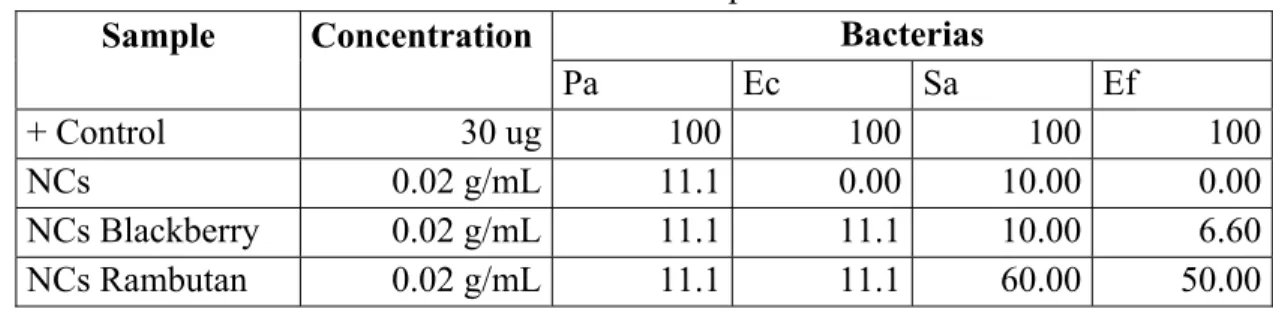
Also in Table 4, it is noted that in effect, rambutan has a greater antimicrobial effect in Gram-positive bacteria S. aureus and E. faecalis, with 60% and 50% inhibition respectively. This is also distinguished in Figure 2.
Table 4. Inhibition percent.
Sample Concentration Bacterias
Pa Ec Sa Ef
+ Control 30 ug 100 100 100 100
NCs 0.02 g/mL 11.1 0.00 10.00 0.00
NCs Blackberry 0.02 g/mL 11.1 11.1 10.00 6.60
- Control 0.00 0.00 0.00 0.00 0.00
Figures 3 and 4 correspond to atomic force microscopy images, which are different types of nanoparticles of chitosan. Figure 3 shows an image of chitosan fibers. It is very different compared with chitosan particles (Figure 4). In the second one, chitosan particles are shown as spherical particles as product of chemical treatment with sodium tripolyphosphate. This reaction is called ionic gelation. It produces a crosslinking effect between a charged polymer and an opposite charged ion (counterion)9, 10.
Figure 3. AFM images of chitosan fibers. Area 5 um2
Figure 4. AFM images of chitosan particles. Area 5 um2
Conclusion
We conclude the chitosan nanoparticles were successful functionalized with rambutan and blackberry The particle functionalized with rambutan fruit extracts possess greater antimicrobial effect.
Reference
1. Gutiérrez, A. Chocolate, polifenoles y protección a la salud, Acta Farm. Bonaerense. 2002, 21, pp 149.
2. Madrigal, S., Rodríguez, G., Krueger, C., Reed, J., Evaluation of Costa Rican Traditional Fruits as potencial sources of natural polyphenolic antioxidants and antimicrobials, Inv Jour. 2010, 1.
3. ASTM F 2103-01. Standard guide for characterization and testing of chitosan salts as starting materials intended for use in biomedical and tissue-engineered medical product applications (American Society for Testing and Materials, Philadelphia) 2001.
5. Peniche, C.W., Peniche, H., Acosta, N., Chitosan: An Attractive Biocompatible Polymer for Microencapsulation, Macromolecular Bioscience. 2003, 3, 10, 511.
6. Hassan, E., Parish, R.C., Gallo, J.M., Optimized formulation of magnetic chitosan microspheres containing the anticancer agent, oxantrazole. Pharmaceutical Research. 1992, 9, pp 390.
7. Ohya, Y., Takei, T., Kobayashi, H., Ouchi, T., Release behavior of 5-fluorouracil from chitosan-gel microspheres immobilizing 5- fluorouracil derivative coated with polysaccharides and their cell specific recognition. Jour of Microencap. 1993, 10, pp 1.
8. Begin, A., Calsteren, M., Antimicrobial films produced from chitosan. Int. J. Biol. Macromol. 1999, 26, 63.
9. Ajun, W., Yan, S., Li, G., Huili, L., Preparation of aspirin and probucol in combination loaded chitosan nanoparticles and in vitro release study.Carbohyd Polym. 2009, 75, 566.