WNT RECEPTORS, BONE MASS AND FRACTURES: GENE-WIDE
ASSOCIATION ANALYSIS OF LRP5 AND LRP6 POLYMORPHISMS WITH
REPLICATION
José A. Riancho1, José M. Olmos1, Begoña Pineda2, Carmen García-Ibarbia1, María I. Pérez-Núñez3, Daniel N. Nan1, Javier Velasco1, Antonio Cano4, Miguel A. García-Pérez2, María T.
Zarrabeitia5 and Jesús González-Macías1
1 Department of Internal Medicine. Hospital U.M. Valdecilla-IFIMAV, University of Cantabria. RETICEF. Santander, Spain
2Research Foundation, Hospital Clínico Universitario, Valencia, Spain.
3 Service of Orthopedic Surgery and Traumatology. Hospital U.M. Valdecilla-IFIMAV, University of Cantabria. Santander, Spain.
4Department of Pediatrics, Obstetrics and Gynecology, University of Valencia, and University Hospital Doctor Peset, Valencia, Spain.
5 Unit of Legal Medicine. University of Cantabria. Santander, Spain
Running title: Polymorphisms of LRP5 and LRP6 and bone
Correspondence: José A. Riancho Dep. Internal Medicine Hospital U.M. Valdecilla Avda Valdecilla s/n 39008 Santander, Spain Fax 34942201695 Tel 34942201990
ABSTRACT
Objectives. Genes explaining the susceptibility to osteoporosis have not been fully elucidated. Our objective was to explore the association of polymorphisms capturing common variations of the lipoprotein receptor related protein (LRP) 5 and 6 genes, encoding two Wnt receptors, with femoral neck bone mineral density (BMD) and osteoporotic fractures of the spine and the hip.
Design. Cross-sectional, case-control and replication genetic association study.
Methods. Thirty nine tagging and functional single nucleotide polymorphisms (SNP) were analyzed in a group of 1043 postmenopausal women and 394 women with hip fractures. The results were replicated in a different group of 342 women.
Results. Three SNPs of the LRP6 gene were associated with BMD (nominal uncorrected p-values<0.05) in the discovery cohort. One showed a significant association after multiple test correction; two of them were also associated in the replication cohort, with a combined standardized mean difference of 0.51 (p=0.009) and 0.65 (p<0.0001) across rs11054704 and rs2302685 genotypes. In the discovery cohort, several LRP5 SNPs were associated with vertebral fractures (odds ratio 0.67; p=0.01), with hip fractures (unadjusted odds ratios between 0.59 and 1.21, p=0.005-0.033, but not significant after multiple test- or age-adjustment), and with height and the projected femoral neck area, but not with BMD. Transcripts of LRP5 and
LRP6 were similarly abundant in bone samples.
Conclusions. In this study we found common polymorphisms of LRP5 associated with osteoporotic fractures, and polymorphisms of the LRP6 gene associated with BMD, thus suggesting them as likely candidates to contribute explaining the hereditary influence on osteoporosis.
INTRODUCTION
The Wnt family includes more than fifteen proteins which have been shown to play an important role in organ development and the homeostasis of several adult tissues, including bone. Wnt ligands stimulate the differentiation of pluripotential precursors towards the osteoblastic lineage, and have an anabolic effect on bone. Intracellular signals transducing Wnt effects are complex and include several pathways, the best known of which is the so called canonical pathway. It starts with the union of Wnt ligands to a membrane receptor complex constituted by a lipoprotein receptor related peptide (LRP) and a frizzled protein. There are at least 10 members of the frizzled family. There are also several LRP’s, with positive or negative effects on Wnt signaling (1). The best known members of the LRP family are LRP5 and LRP6. The role of LRP5 was emphasized by the discovery of some patients with either high or low bone mass phenotypes, caused by activating and loss-of-function mutations, respectively, of LRP5. Furthermore, several candidate gene studies and some multicenter large-scale and genome-wide studies (GWAS) suggested that common LRP5 polymorphisms may influence bone mineral density (BMD) in the general population. Nevertheless, recent animal studies have raised some doubts about the direct role of LRP5 in bone (2). The role of LRP6 has not been studied extensively, but both LRP5 and LRP6 appear to be necessary for skeletal homeostasis (3; 4). Moreover, some investigators suggested that LRP6 polymorphisms influence BMD (5; 6), but the results were not confirmed in other studies (7; 8). Therefore, this is a controversial issue. Population differences and the particular polymorphisms included in those analyses may explain the discordant results. On the other hand, little is known about the relationship between LRP5/6 polymorphisms and hip fractures, which are the most devastating osteoporotic fractures. Therefore, the aim of this study was to use a gene-wide approach to
explore the association of common polymorphisms of LRP5 and LRP6 genes with femoral neck BMD and osteoporotic fractures of the spine and the hip.
MATERIALS AND METHODS
Subjects.- To study the association of genetic polymorphisms with BMD and vertebral fractures we performed a cross-sectional study including 1043 postmenopausal women over 50 years of age (age 51-90) living in Cantabria, a region in Northern Spain with a population of 550.000. They included volunteers recruited by advertisements and women sent to our clinic because of osteoporosis concerns (“Santander group”) and women taking part in a population-based cohort study on the epidemiology of osteoporosis (“Camargo cohort”) (9). Both groups belong to the same geographical region. Femoral neck BMD was measured by DXA using a Hologic QDR 4500 densitometer. The projected neck area in the DXA output was also analyzed. Since the densitometer uses a fixed length for femoral neck assessment, the projected area is a function of the neck diameter. The presence of vertebral fractures was defined as a loss of vertebral body height higher than 20% in lateral X-rays (available in 637 women) assessed by an experienced reader, prior to genotyping.
To study the association with hip fractures, we recruited a convenience sample of unselected patients admitted to hospital because a hip fracture, 60 to 90 years of age (n=394). Those with fractures due to high-impact trauma (such as traffic accidents and falls from a height) were excluded. Control subjects (n=529) included women from the Santander and Camargo groups within the same age range but without osteoporotic fractures.
Women with present or past diseases (cancer, rheumatoid arthritis, malabsorption, severe systemic diseases, etc) or treatments (corticosteroids, anticonvulsants, hormone replacement therapy, etc.) known to affect bone metabolism, or with non-Spanish ancestors were excluded.
The study protocol was approved by the Institutional Committee of Ethics in Clinical Research, and informed consent was obtained from study subjects or their representatives. The results about genetic polymorphisms and BMD were replicated in a cohort of women attending a menopause clinic in Valencia, a region in Eastern Spain. After applying similar exclusion criteria, the cohort included 342 Caucasian postmenopausal women aged 41-69 years. BMD was measured by DXA using either a Lunar or a Norland densitometer. The results from different densitometers were standardized as proposed by Lu et al. (10).
Genotyping.- The Hapmap database was explored to identify SNPs of the LRP5 and LRP6 genes in the Caucasian population. Then, tag-SNPs were selected using the algorithms available in Haploview with the “aggressive tagging” option (11). Minor allele frequency (MAF) of 0.1 and r2 0.8 were used as criteria. In addition, we included some SNPs with potential regulatory function as assessed by the bioinformatics suite Pupa (12; 13). Therefore, 31 SNPs of the LRP5 gene and 11 of the LRP6 gene were finally selected. DNA was isolated from peripheral blood or buccal swabs by using column-based commercial methods and quantified with the Qubit procedure (Invitrogen, Carlsbad, CA, USA). Then alleles at each locus were analyzed by a mass-array Sequenom platform at the Centro Nacional de Genotipado (Santiago de Compostela, Spain). In a sub-sample of study participants, the rs3736228 polymorphism of the LRP5 gene was analyzed by using a Taqman assay (Applied Biosystems). Polymorphisms associated with BMD in the discovery cohort were analyzed in the replication cohort by using the same procedure (mass-array) for genotyping at Unidad Central de Investigación (Facultad de Medicina, Valencia, Spain). Replicate samples were included to confirm the consistency of results.
Gene expression.- Trabecular bone samples were obtained from the femoral heads of patients subjected to hip replacement because of severe osteoarthritis. RNA was isolated with Trizol (Invitrogen), and further purified by using a column adsorption procedure (Qiagen, Hilden,
Germany). Aliquots of RNA (250 ng) were reverse-transcribed with the Superscript III kit (Invitrogen) and quantified by real-time PCR in an ABI7300 apparatus (Applied Biosystems, Foster City, CA), using specific primers and FAM-labelled probes for LRP5 and LRP6 (Taqman gene expression assays, Applied Biosystems). The results were then normalized to the expression of the housekeeping gene TATA box protein (TBP) and an universal reference RNA (Stratagene), by the 2-ΔCt method (14).
Statistical analysis.- Haplotypic blocks were estimated by the Gabriel method, implemented in Haploview (11). The departure from Hardy-Weinberg equilibrium was tested with Plink software (15). The association of alleles with BMD was studied at the single-locus level, assuming additive and recessive models, with Plink. The presence of population stratification was explored with STRUCTURE software, running a dataset with five markers located in different chromosomes (16). BMD results in different cohorts were combined by computing the Hedges’ standardized weighted mean difference with MIX software (17; 18). The significance threshold after multiple test correction for each gene was estimated by considering the effective number of independent marker loci, as proposed by Li and Ji, using the single nucleotide spectral decomposition software (SNPSpD), developed by Nyholt (19).Uncorrected nominal p-values are shown, unless otherwise indicated. p-values <0.05 were considered as statistically significant. The study power (estimated with QUANTO software, available at http://hydra.usc.edu/gxe/) was higher than 89% to find genetic effects explaining at least 1% of BMD variance. Power to detect a fracture odds ratio of 1.4 or higher was 80% and 54%, for hip fractures and vertebral fractures, respectively, assuming an additive model and a minor allele frequency of 0.2.
RESULTS
Bone mineral density
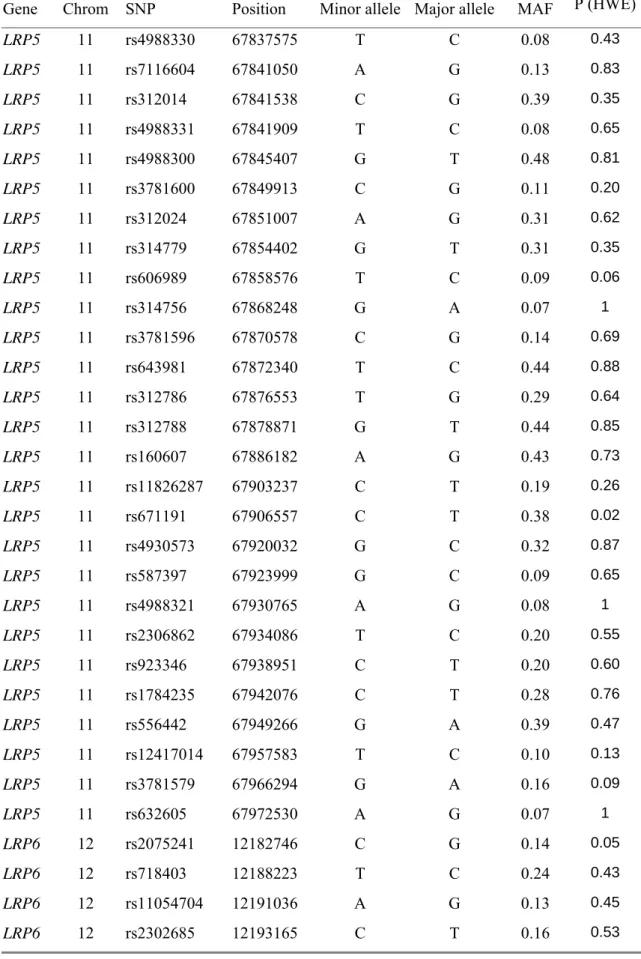
Four SNPs of the LRP5 gene were excluded due to inaccurate separation or low calling rate. The genotyping rate in the remaining set (table 1) was 97.4%. The allelic frequencies were similar to those reported in other Caucasian populations and there was no evidence for departure from the Hardy-Weinberg equilibrium. Only one SNP was associated with a nominal p-value less than 0.05 (0.02, well above the significance 0.003 threshold after multiple test correction) (table 1). No significant hidden population stratification was detected running the STRUCTURE software. The characteristics of women included in the study are shown in table 2.
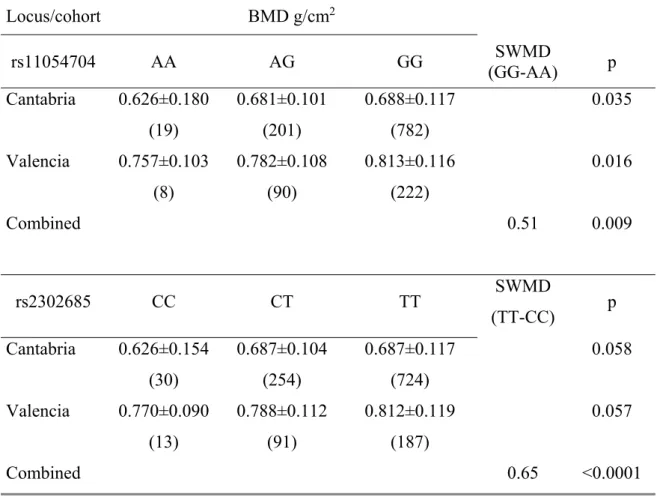
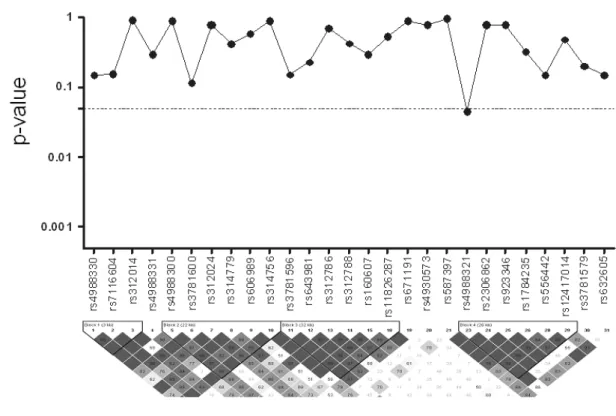
The rs4988321 polymorphism of the LRP5 gene showed a marginal association with age-adjusted BMD (p=0.0488) (figure 1), that did not reach the multiple test-age-adjusted threshold of significance (estimated as p=0.003). Three SNPs of the LRP6 gene were also associated with BMD: rs11054704 (additive p=0.035; recessive p= 0.016), rs2302685 (additive p=0.058; recessive p=0.0039), and rs10845493 (additive p=0.54; recessive p=0.036) (figure 2). Only the p-value for the rs2302685 polymorphism was below the multiple test-adjusted threshold for significance (estimated as 0.006 for the LRP6 SNP set).
We selected those three SNPs for replication in a different cohort (Valencia). In this cohort, rs10845493 was not associated with BMD, but the association was replicated for rs11054704 (p= 0.016, additive model) and almost reached statistical significance for rs2302685 (p=0.057, additive model). The combined standardized weighted mean differences between women with opposite genotypes were 0.51 standard deviations (95% confidence interval 0.13-0.89) and 0.65 standard deviations (95% confidence interval 0.35-0.96) for rs11054704 and rs2302685 loci, respectively (table 3).
Fractures
The association of genetic polymorphisms with fractures was analyzed in 637 women with spine X-rays available (140 with osteoporotic vertebral fractures and 497 controls without fractures). Several polymorphisms of the LRP5 gene tended to be associated with fractures, with nominal p-values <0.05, but they did not reach the multiple test threshold for significance (0.003). Loci rs312788 and rs160607 showed the most significant association The age-adjusted odds ratio was 0.67 in both cases (p=0.009 and 0.01, respectively; figure 3). The rs3736228 polymorphism could not be included in the multiplex reaction along other polymorphisms and was genotyped later in a single assay. It also tended to be associated with fractures in our population (OR 1.5; 95% confidence interval 1.1-2.2; p=0.025).
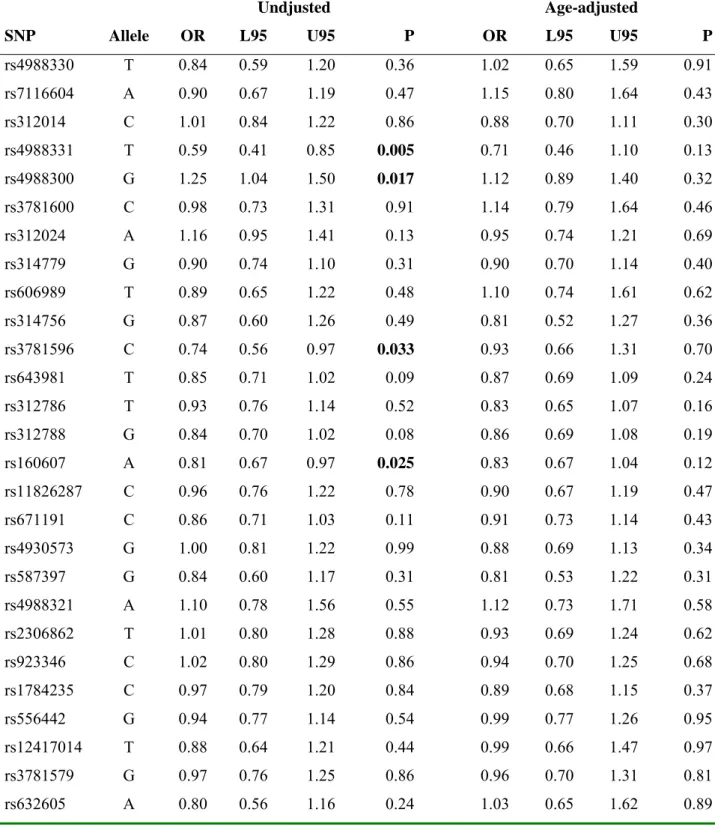
Since LRP5 polymorphisms showed a trend for association with vertebral fractures, but not with BMD, we explored their relationship with body size. After excluding women with vertebral fractures (which can cause a loss of height by themselves), several LRP5 polymorphisms were associated with height (uncorrected p-values 0.002-0.04; figure 3). Likewise, they were associated with the projected femoral neck area, as measured from the densitometer output, even after controlling for height (p-values=0.0014-0.048, figure 3). Several LRP5 polymorphisms also tended to be associated with hip fractures (uncorrected p-values <0.05), including some found associated with vertebral fractures (rs4988300 and rs160607). However, the hip fracture group was somewhat older than the control group. After adjusting the results introducing age as a covariate, similar odds ratios were observed, but with larger confidence intervals and no longer statistically significant (table 4).
SNPs of the LRP6 gene were not significantly associated with either vertebral or hip fractures. The incomplete assessment of fractures in the Valencia cohort did not allow replicating fracture association data.
Gene expression
Gene transcripts were measured in 17 femoral bone samples of patients with osteoarthritis undergoing hip replacement surgery. Transcripts of LRP5 and LRP6 were similarly abundant: 1.5 (range 0.1-4.9) and 1.2 (range 0.1-5.7) arbitrary units, respectively (not significantly different).
DISCUSSION
Rare cases of loss-of-function or gain-of-function mutations of LRP5 are associated with marked decreases or increases, respectively, of bone mass (20-23). Although the skeletal impact of common allelic variants is less clear, several polymorphisms of the LRP5 gene have been associated with bone mass and fractures, in candidate gene studies (6; 24; 25) and in some, but not all genome-wide studies (26; 27). The nonsynonymous rs3736228 polymorphism has been the most widely studied SNP in candidate gene studies (25; 28) and was identified as a quantitative trait locus in the Rotterdam cohort GWAS. It showed a stronger association with spine BMD than with femoral neck BMD (26). In a meta-analysis including 10 eligible studies with 16705 individuals, Tran et al. estimated that the difference in femoral neck BMD across rs3736288 genotypes was 0.011 g/cm2, roughly equivalent to 0.1 standard deviations (25). Our study was not powered to detect such a small difference. The LRP5 polymorphism was also associated with fractures in the GWAS and in a large multicenter study (29). In the present study we confirmed the trend for association with vertebral fractures, but we were not able to confirm the association with BMD. Several factors may explain the differences between studies, including age and menopausal status of subjects. In fact, the association with fractures but not with BMD might suggest an effect of LRP5 alleles on other factors influencing bone strength, such as bone tissue quality or bone geometry. In the present study some LRP5 polymorphisms were associated with body height and femoral neck size. This is in line with
previously published results (30), and suggests that LRP5 may influence skeletal development and growth, and consequently the peak bone mass attained in early adulthood, as also suggested by studies showing an association of LRP5 polymorphisms with BMD in children and young adults (30-33). However, LRP5 SNPs associated with fractures did not coincide with those associated with height or femoral neck projected area. Therefore, further studies are needed to clarify the mechanism explaining the association of LRP5 variants with fractures. LRP5 and LRP6 are known to bind Wnt ligands, but their relative importance in bone tissue is unclear. Whereas several mutations of the LRP5 gene have been associated with abnormal human bone phenotypes (20; 21; 23; 34; 35), only a pedigree with a LRP6 mutation causing metabolic syndrome, coronary heart disease and osteoporosis has been reported (36). Studies with knock-out mice suggest that both LRP5 and LRP6 are needed for the normal skeletal homeostasis (3; 4). In the present study, we showed that LRP5 and LRP6 are expressed in similar amounts in human bone. However, unlike LRP5 polymorphisms, the association of genetic variants of LRP6 with bone mass has been rarely studied, and controversial results have been reported. Van Meurs et al first published that the nonsynonymous rs2302685 polymorphism (Ile1062Val) of the LRP6 gene was associated with fragility fractures in men of the Rotterdam cohort (6). However, the results were not confirmed in a multicenter study (29) and no evidence for association with SNPS in the LRP6 region was found in a meta-analysis of data directly obtained or imputed from GWAS results (37). However, Sims et al reported an association of genetic variants of LRP6, and specifically rs11054704, with BMD in postmenopausal women (5). Trying to clarify the possible influence of LRP6 variants on bone mass, we performed a gene-wide analysis including tagging LRP6 SNPs in a defined population of postmenopausal women. There is no doubt that exploring the association of several SNPs with a phenotype inflate type I error (ie, the possibility of false positive associations). However, there is no general consensus about the best way to control it without
compromising study power, particularly in hypothesis-driven candidate gene studies with several SNPs in linkage disequilibrium. Here we used the method proposed by Nyholt, which takes into consideration the linkage between the genotyped loci (19). The replication in independent cohorts may be the best way to confirm that the results are not just a chance finding. In the present study we found an association of LRP6 SNPs with BMD, with some p-values below the multiple test-adjusted threshold for significance. Furthermore, in the replication cohort we found a consistent association of two LRP6 polymorphisms with BMD. Thus, our results support the hypothesis that allelic variants of LRP6 are associated with BMD in postmenopausal women.
The non-synonymous polymorphism rs2302865 is located on exon 14 of the LRP6 gene and causes an isoleucine/valine change. The rs11054704 polymorphism is located in intron 15, just 2.1 kb downstream of rs2302865, and both belong to the same haplotypic block. The molecular mechanisms involved in the association of these SNPs with BMD remain to be elucidated. Nevertheless, according to the Fast SNP bioinformatic tool (http://fastsnp.ibms.sinica.edu.tw), the region including rs11054704 may act as an intronic enhancer and there may be allelic differences in the binding affinity for some transcription factors (CEBP/ß, CdxA). On the other hand, different rs2302685 alleles not only induce an aminoacid change which may impair the activity of LRP6, but they may also have splicing regulatory consequences. Therefore, considered together, these results strongly suggest that these polymorphisms, or other linked variants located in the same region of the LRP6 gene, are indeed associated with individual differences in BMD. Our data suggest that in women with the least frequent homozygous genotype BMD is 0.5 standard deviations lower than in those with the most frequent genotype. Such a difference is likely to have an important influence at the individual level, but it may be less important at the population level, because the risk genotype is present in only 2-3% of
women. The explanation for the negative results in other studies is unclear (7; 29), but it might be related to differences in the populations studied or to cohort heterogeneity.
This study has several limitations. We estimated that the number of subjects included in Cantabria cohort resulted in 89% power to detect a genetic effect explaining 1% of the BMD variance. However, the sample size limited the statistical power to detect smaller effects, particularly in the replication cohort, which was relatively small and without enough numbers of fractures for replication (only clinical vertebral fractures were recorded because X-rays were not routinely obtained). We were not able to demonstrate a parallel association of LRP6 polymorphisms with fractures, which may be related to the small number of homozygotes for the risk allele and the moderate size of our fracture subgroup, which limited the power of the study when the minor allele frequencies were small. We do not have anthropometric data of patients with hip fractures. Therefore we could not include some potentially important factors, such as body weight, as covariates.
In summary, our data are in line with previously published studies showing an association of
LRP5 polymorphisms with osteoporotic fractures and strongly suggest that some genetic
variants of LRP6 are associated with bone mineral density in postmenopausal women, pointing towards both Wnt co-receptors as osteoporosis candidate genes.
Table 1. Polymorphisms genotyped.
Gene Chrom SNP Position Minor allele Major allele MAF P (HWE)
LRP5 11 rs4988330 67837575 T C 0.08 0.43 LRP5 11 rs7116604 67841050 A G 0.13 0.83 LRP5 11 rs312014 67841538 C G 0.39 0.35 LRP5 11 rs4988331 67841909 T C 0.08 0.65 LRP5 11 rs4988300 67845407 G T 0.48 0.81 LRP5 11 rs3781600 67849913 C G 0.11 0.20 LRP5 11 rs312024 67851007 A G 0.31 0.62 LRP5 11 rs314779 67854402 G T 0.31 0.35 LRP5 11 rs606989 67858576 T C 0.09 0.06 LRP5 11 rs314756 67868248 G A 0.07 1 LRP5 11 rs3781596 67870578 C G 0.14 0.69 LRP5 11 rs643981 67872340 T C 0.44 0.88 LRP5 11 rs312786 67876553 T G 0.29 0.64 LRP5 11 rs312788 67878871 G T 0.44 0.85 LRP5 11 rs160607 67886182 A G 0.43 0.73 LRP5 11 rs11826287 67903237 C T 0.19 0.26 LRP5 11 rs671191 67906557 C T 0.38 0.02 LRP5 11 rs4930573 67920032 G C 0.32 0.87 LRP5 11 rs587397 67923999 G C 0.09 0.65 LRP5 11 rs4988321 67930765 A G 0.08 1 LRP5 11 rs2306862 67934086 T C 0.20 0.55 LRP5 11 rs923346 67938951 C T 0.20 0.60 LRP5 11 rs1784235 67942076 C T 0.28 0.76 LRP5 11 rs556442 67949266 G A 0.39 0.47 LRP5 11 rs12417014 67957583 T C 0.10 0.13 LRP5 11 rs3781579 67966294 G A 0.16 0.09 LRP5 11 rs632605 67972530 A G 0.07 1 LRP6 12 rs2075241 12182746 C G 0.14 0.05 LRP6 12 rs718403 12188223 T C 0.24 0.43 LRP6 12 rs11054704 12191036 A G 0.13 0.45 LRP6 12 rs2302685 12193165 C T 0.16 0.53
LRP6 12 rs12833575 12216108 G A 0.06 0.68 LRP6 12 rs2417085 12222642 C T 0.47 0.42 LRP6 12 rs10845493 12223463 T C 0.15 0.52 LRP6 12 rs10082834 12225273 C G 0.11 0.48 LRP6 12 rs17374170 12255678 C T 0.08 1 LRP6 12 rs17302049 12256592 G A 0.17 0.81 LRP6 12 rs1181334 12258855 T G 0.18 1
Table 2. Characteristics of study subjects (mean and SD or percentages). Cohort/Phenotype Santander/BMD-vertebral fractures (n=608) Camargo/BMD-vertebral fractures (n=435) Hip fractures (n=394) Valencia/BMD (n= 342) Age, yr 69±7 64±9 80±7 52±5 Weight, Kg 66±10 70±12 - 66±10 Height, cm 155±6 155±6 - 158±6 BMI, kg/m2 27.6±4.1 28.9±4.8 - 26.5±4.3 Age at menopause, yr 50±5 49±5 - 48±4 Vertebral Fractures*, % 36 8 - - Arm/forearm fractures, % 11 8.4 16 9 BMD**, g/cm2 0.671±0.112 0.720±0.117 - 0.804±0.115 Smoking, % 4 12 3 26
Calcium intake***, mg/day 659±397 680±358 620±376 - *: data from 637 women with x-rays
**: Hologic DXA in Cantabria and standardized (Lunar or Norland) in Valencia *** From dairy products
Table 3. Association of LRP6 genotypes with BMD in the discovery and replication cohorts and combined estimate of effect. P-values for age-adjusted additive models in each cohort and standardized weighted mean difference (SWMD) between opposite homozygotes (in standard deviation units). Locus/cohort BMD g/cm2 rs11054704 AA AG GG SWMD (GG-AA) p Cantabria 0.626±0.180 (19) 0.681±0.101 (201) 0.688±0.117 (782) 0.035 Valencia 0.757±0.103 (8) 0.782±0.108 (90) 0.813±0.116 (222) 0.016 Combined 0.51 0.009 rs2302685 CC CT TT SWMD (TT-CC) p Cantabria 0.626±0.154 (30) 0.687±0.104 (254) 0.687±0.117 (724) 0.058 Valencia 0.770±0.090 (13) 0.788±0.112 (91) 0.812±0.119 (187) 0.057 Combined 0.65 <0.0001
Table 4. Association of LRP5 polymorphisms with hip fractures. Odds ratio (OR), limits of the 95% confidence interval (L95,U95) and p-values for additive models in the unadjusted and age-adjusted analysis.
Undjusted Age-adjusted
SNP Allele OR L95 U95 P OR L95 U95 P
rs4988330 T 0.84 0.59 1.20 0.36 1.02 0.65 1.59 0.91 rs7116604 A 0.90 0.67 1.19 0.47 1.15 0.80 1.64 0.43 rs312014 C 1.01 0.84 1.22 0.86 0.88 0.70 1.11 0.30 rs4988331 T 0.59 0.41 0.85 0.005 0.71 0.46 1.10 0.13 rs4988300 G 1.25 1.04 1.50 0.017 1.12 0.89 1.40 0.32 rs3781600 C 0.98 0.73 1.31 0.91 1.14 0.79 1.64 0.46 rs312024 A 1.16 0.95 1.41 0.13 0.95 0.74 1.21 0.69 rs314779 G 0.90 0.74 1.10 0.31 0.90 0.70 1.14 0.40 rs606989 T 0.89 0.65 1.22 0.48 1.10 0.74 1.61 0.62 rs314756 G 0.87 0.60 1.26 0.49 0.81 0.52 1.27 0.36 rs3781596 C 0.74 0.56 0.97 0.033 0.93 0.66 1.31 0.70 rs643981 T 0.85 0.71 1.02 0.09 0.87 0.69 1.09 0.24 rs312786 T 0.93 0.76 1.14 0.52 0.83 0.65 1.07 0.16 rs312788 G 0.84 0.70 1.02 0.08 0.86 0.69 1.08 0.19 rs160607 A 0.81 0.67 0.97 0.025 0.83 0.67 1.04 0.12 rs11826287 C 0.96 0.76 1.22 0.78 0.90 0.67 1.19 0.47 rs671191 C 0.86 0.71 1.03 0.11 0.91 0.73 1.14 0.43 rs4930573 G 1.00 0.81 1.22 0.99 0.88 0.69 1.13 0.34 rs587397 G 0.84 0.60 1.17 0.31 0.81 0.53 1.22 0.31 rs4988321 A 1.10 0.78 1.56 0.55 1.12 0.73 1.71 0.58 rs2306862 T 1.01 0.80 1.28 0.88 0.93 0.69 1.24 0.62 rs923346 C 1.02 0.80 1.29 0.86 0.94 0.70 1.25 0.68 rs1784235 C 0.97 0.79 1.20 0.84 0.89 0.68 1.15 0.37 rs556442 G 0.94 0.77 1.14 0.54 0.99 0.77 1.26 0.95 rs12417014 T 0.88 0.64 1.21 0.44 0.99 0.66 1.47 0.97 rs3781579 G 0.97 0.76 1.25 0.86 0.96 0.70 1.31 0.81 rs632605 A 0.80 0.56 1.16 0.24 1.03 0.65 1.62 0.89
FIGURE LEGENDS
Figure 1.-Association of LRP5 polymorphisms with femoral neck BMD. Nominal p-values under an age-adjusted recessive model.
Figure 2.- Association of LRP6 polymorphisms with femoral neck BMD. Nominal p-values under an age-adjusted recessive model.
Figure 3.- Association of LRP5 polymorphisms with osteoporotic vertebral fractures (A), femoral neck projected area (B) and height (C). Nominal p-values under an additive age-adjusted model.
Conflicts of interest
Authors do not have conflicts of interest relevant to this paper Acknowledgements
This study was supported by grants from Instituto de Salud Carlos III- Fondo de Investigaciones Sanitarias (PI 06/0034, 08/0183, PS09/00184 and PS09/01687).
REFERENCES
1. Jeong YH, Sekiya M, HIrata M, Ye M, Yamagishi A, Lee SM, Kang MJ, Hosoda A, Fukumura T, Kim DH & Saeki S The low-density lipoprotein receptor-related protein 10 is a negative regulator of the canonical Wnt/beta-catenin signaling pathway.
Biochemical and Biophysical Research Communications 2010 392 495-499.
2. Yadav VK, Ryu JH, Suda N, Tanaka KF, Gingrich JA, Schutz G, Glorieux FH, Chiang CY, Zajac JD, Insogna KL, Mann JJ, Hen R, Ducy P & Karsenty G Lrp5 controls bone formation by inhibiting serotonin synthesis in the duodenum. Cell 2008 135 825-837. 3. Holmen SL, Giambernardi TA, Zylstra CR, Buckner-Berghuis BD, Resau JH, Hess JF,
Glatt V, Bouxsein ML, Ai M, Warman ML & Williams BO Decreased BMD and limb deformities in mice carrying mutations in both Lrp5 and Lrp6. Journal of Bone and
Mineral Research 2004 19 2033-2040.
4. Zylstra CR, Wan C, VanKoevering KK, Sanders AK, Lindvall C, Clemens TL & Williams BO Gene targeting approaches in mice: assessing the roles of LRP5 and LRP6 in osteoblasts. Journal of Musculoskeletal and Neuronal Interactions 2008 8 291-293.
5. Sims AM, Shephard N, Carter K, Doan T, Dowling A, Duncan EL, Eisman J, Jones G, Nicholson G, Prince R, Seeman E, Thomas G, Wass JA & Brown MA Genetic
analyses in a sample of individuals with high or low bone density demonstrates
association with multiple Wnt pathway genes. Journal of Bone and Mineral Research 2008 23 499-506.
6. van Meurs JB, Rivadeneira F, Jhamai M, Hugens W, Hofman A, van Leeuwen JP, Pols HA & Uitterlinden AG Common genetic variation of the low-density lipoprotein receptor-related protein 5 and 6 genes determines fracture risk in elderly white men.
Journal of Bone and Mineral Research 2006 21 141-150.
7. Mencej-Bedrac S, Prezelj J, Kocjan T, Komadina R & Marc J Analysis of association of LRP5, LRP6, SOST, DKK1, and CTNNB1 genes with bone mineral density in a Slovenian population. Calcified Tissue International 2009 85 501-506.
8. Yerges LM, Klei L, Cauley JA, Roeder K, Kammerer CM, Ensrud KE, Nestlerode CS, Lewis C, Lang TF, Barrett-Connor E, Moffett SP, Hoffman AR, Ferrell RE, Orwoll ES & Zmuda JM Candidate Gene Analysis of Femoral Neck Trabecular and Cortical Volumetric Bone Mineral Density in Older Men. Journal of Bone and Mineral
Research 2010 25 330-338.
9. Olmos JM, Hernandez JL, Martinez J, Pariente E, Llorca J & Gonzalez-Macias J Bone turnover markers in Spanish adult men The Camargo Cohort Study. Clin Chim.Acta 2010.
10. Lu Y, Fuerst T, Hui S & Genant HK Standardization of bone mineral density at femoral neck, trochanter and Ward's triangle. Osteoporosis International 2001 12 438-444.
11. Barrett JC, Fry B, Maller J & Daly MJ Haploview: analysis and visualization of LD and haplotype maps. Bioinformatics 2005 21 263-265.
12. Conde L, Vaquerizas JM, Dopazo H, Arbiza L, Reumers J, Rousseau F, Schymkowitz J & Dopazo J PupaSuite: finding functional single nucleotide polymorphisms for large-scale genotyping purposes. Nucleic Acids Research 2006 34 W621-W625.
13. Reumers J, Conde L, Medina I, Maurer-Stroh S, Van Durme J, Dopazo J, Rousseau F & Schymkowitz J Joint annotation of coding and non-coding single nucleotide
polymorphisms and mutations in the SNPeffect and PupaSuite databases. Nucleic Acids
Res 2008 36 D825-D829.
14. Livak KJ & Schmittgen TD Analysis of relative gene expression data using real-time quantitative PCR and the 2(-Delta Delta C(T)) Method. Methods 2001 25 402-408. 15. Purcell S, Neale B, Todd-Brown K, Thomas L, Ferreira MA, Bender D, Maller J, Sklar
P, de Bakker PI, Daly MJ & Sham PC PLINK: a tool set for whole-genome association and population-based linkage analyses. American Journal of Human Genetics 2007 81 559-575.
16. Pritchard JK, Stephens M & Donnelly P Inference of population structure using multilocus genotype data. Genetics 2000 155 945-959.
17. Petitti DB 2000 Meta-analysis, decision analysis and cost-effectiveness analysis.
Methods for quantitative synthesis in Medicine. New York: Oxford University Press.
18. Bax L, Yu LM, Ikeda N, Tsuruta H & Moons KG Development and validation of MIX: comprehensive free software for meta-analysis of causal research data. BMC
Medical Research Methodology 2006 6 50.
19. Nyholt DR A simple correction for multiple testing for single-nucleotide
polymorphisms in linkage disequilibrium with each other. Am.J Hum.Genet. 2004 74 765-769.
20. Little RD, Carulli JP, Del Mastro RG, Dupuis J, Osborne M, Folz C, Manning SP, Swain PM, Zhao SC, Eustace B, Lappe MM, Spitzer L, Zweier S, Braunschweiger K, Benchekroun Y, Hu X, Adair R, Chee L, FitzGerald MG, Tulig C, Caruso A, Tzellas N, Bawa A, Franklin B, McGuire S, Nogues X, Gong G, Allen KM, Anisowicz A,
Morales AJ, Lomedico PT, Recker SM, Van Eerdewegh P, Recker RR & Johnson ML A mutation in the LDL receptor-related protein 5 gene results in the autosomal
dominant high-bone-mass trait. American Journal of Human Genetics 2002 70 11-19. 21. Balemans W & Van Hul W The genetics of low-density lipoprotein receptor-related
protein 5 in bone: a story of extremes. Endocrinology 2007 148 2622-2629. 22. Gong Y, Slee RB, Fukai N, Rawadi G, Roman-Roman S, Reginato AM, Wang H,
Cundy T, Glorieux FH, Lev D, Zacharin M, Oexle K, Marcelino J, Suwairi W, Heeger S, Sabatakos G, Apte S, Adkins WN, Allgrove J, Arslan-Kirchner M, Batch JA, Beighton P, Black GC, Boles RG, Boon LM, Borrone C, Brunner HG, Carle GF, Dallapiccola B, de Paepe A, Floege B, Halfhide ML, Hall B, Hennekam RC, Hirose T, Jans A, Juppner H, Kim CA, Keppler-Noreuil K, Kohlschuetter A, Lacombe D,
H, Steichen-Gersdorf E, Steinmann B, Sullivan B, Superti-Furga A, Swoboda W, van den Boogaard MJ, Van Hul W, Vikkula M, Votruba M, Zabel B, Garcia T, Baron R, Olsen BR & Warman ML LDL receptor-related protein 5 (LRP5) affects bone accrual and eye development. Cell 2001 107 513-523.
23. Narumi S, Numakura C, Shiihara T, Seiwa C, Nozaki Y, Yamagata T, Momoi MY, Watanabe Y, Yoshino M, Matsuishi T, Nishi E, Kawame H, Akahane T, Nishimura G, Emi M & Hasegawa T Various types of LRP5 mutations in four patients with
osteoporosis-pseudoglioma syndrome: identification of a 7.2-kb microdeletion using oligonucleotide tiling microarray. American Journal of Medical Genetics 2010 152A 133-140.
24. Agueda L, Bustamante M, Jurado S, Garcia-Giralt N, Ciria M, Salo G, Carreras R, Nogues X, Mellibovsky L, Diez-Perez A, Grinberg D & Balcells S A haplotype-based analysis of the LRP5 gene in relation to osteoporosis phenotypes in Spanish
postmenopausal women. Journal of Bone and Mineral Research 2008 23 1954-1963. 25. Tran BN, Nguyen ND, Eisman JA & Nguyen TV Association between LRP5
polymorphism and bone mineral density: a Bayesian meta-analysis. BMC Medical
Genetics 2008 9 55.
26. Richards JB, Rivadeneira F, Inouye M, Pastinen TM, Soranzo N, Wilson SG, Andrew T, Falchi M, Gwilliam R, Ahmadi KR, Valdes AM, Arp P, Whittaker P, Verlaan DJ, Jhamai M, Kumanduri V, Moorhouse M, van Meurs JB, Hofman A, Pols HA, Hart D, Zhai G, Kato BS, Mullin BH, Zhang F, Deloukas P, Uitterlinden AG & Spector TD Bone mineral density, osteoporosis, and osteoporotic fractures: a genome-wide association study. Lancet 2008 371 1505-1512.
27. Styrkarsdottir U, Halldorsson BV, Gretarsdottir S, Gudbjartsson DF, Walters GB, Ingvarsson T, Jonsdottir T, Saemundsdottir J, Center JR, Nguyen TV, Bagger Y, Gulcher JR, Eisman JA, Christiansen C, Sigurdsson G, Kong A, Thorsteinsdottir U & Stefansson K Multiple Genetic Loci for Bone Mineral Density and Fractures. New
England Journal of Medicine 2008 358 2355-2365.
28. Lee YH, Woo JH, Choi SJ, Ji JD & Song GG Association between the A1330V polymorphism of the low-density lipoprotein receptor-related protein 5 gene and bone mineral density: a meta-analysis. Rheumatology International 2009 29 539-544. 29. van Meurs JB, Trikalinos TA, Ralston SH, Balcells S, Brandi ML, Brixen K, Kiel DP,
Langdahl BL, Lips P, Ljunggren O, Lorenc R, Obermayer-Pietsch B, Ohlsson C, Pettersson U, Reid DM, Rousseau F, Scollen S, Van Hul W, Agueda L, Akesson K, Benevolenskaya LI, Ferrari SL, Hallmans G, Hofman A, Husted LB, Kruk M, Kaptoge S, Karasik D, Karlsson MK, Lorentzon M, Masi L, McGuigan FE, Mellstrom D, Mosekilde L, Nogues X, Pols HA, Reeve J, Renner W, Rivadeneira F, van Schoor NM, Weber K, Ioannidis JP & Uitterlinden AG Large-scale analysis of association between LRP5 and LRP6 variants and osteoporosis. Journal of American Medical Association 2008 299 1277-1290.
30. Ferrari SL, Deutsch S, Choudhury U, Chevalley T, Bonjour JP, Dermitzakis ET, Rizzoli R & Antonarakis SE Polymorphisms in the low-density lipoprotein receptor-related protein 5 (LRP5) gene are associated with variation in vertebral bone mass,
vertebral bone size, and stature in whites. American Journal of Human Genetics 2004 74 866-875.
31. Giroux S, Elfassihi L, Cardinal G, Laflamme N & Rousseau F LRP5 coding
polymorphisms influence the variation of peak bone mass in a normal population of French-Canadian women. Bone 2007 40 1299-1307.
32. Brixen K, Beckers S, Peeters A, Piters E, Balemans W, Nielsen TL, Wraae K, Bathum L, Brasen C, Hagen C, Andersen M, Van Hul W & Abrahamsen B Polymorphisms in the low-density lipoprotein receptor-related protein 5 (LRP5) gene are associated with peak bone mass in non-sedentary men: results from the Odense androgen study.
Calcified Tissue International 2007 81 421-429.
33. Koay MA, Tobias JH, Leary SD, Steer CD, Vilarino-Guell C & Brown MA The effect of LRP5 polymorphisms on bone mineral density is apparent in childhood. Calcified
Tissue International 2007 81 1-9.
34. Chung BD, Kayserili H, Ai M, Freudenberg J, Uzumcu A, Uyguner O, Bartels CF, Honing S, Ramirez A, Hanisch FG, Nurnberg G, Nurnberg P, Warman ML, Wollnik B, Kubisch C & Netzer C A mutation in the signal sequence of LRP5 in a family with an osteoporosis-pseudoglioma syndrome (OPPG)-like phenotype indicates a novel disease mechanism for trinucleotide repeats. Human Mutation 2009 30 641-648.
35. Streeten EA, McBride D, Puffenberger E, Hoffman ME, Pollin TI, Donnelly P, Sack P & Morton H Osteoporosis-pseudoglioma syndrome: description of 9 new cases and beneficial response to bisphosphonates. Bone 2008 43 584-590.
36. Mani A, Radhakrishnan J, Wang H, Mani A, Mani MA, Nelson-Williams C, Carew KS, Mane S, Najmabadi H, Wu D & Lifton RP LRP6 mutation in a family with early coronary disease and metabolic risk factors. Science 2007 315 1278-1282.
37. Richards JB, Kavvoura FK, Rivadeneira F, Styrkarsdottir U, Estrada K, Halldorsson BV, Hsu YH, Zillikens MC, Wilson SG, Mullin BH, Amin N, Aulchenko YS, Cupples LA, Deloukas P, Demissie S, Hofman A, Kong A, Karasik D, van Meurs JB, Oostra BA, Pols HA, Sigurdsson G, Thorsteinsdottir U, Soranzo N, Williams FM, Zhou Y, Ralston SH, Thorleifsson G, Van Duijn CM, Kiel DP, Stefansson K, Uitterlinden AG, Ioannidis JP & Spector TD Collaborative meta-analysis: associations of 150 candidate genes with osteoporosis and osteoporotic fracture. Annals of Internal Medicine 2009 151 528-537.