Intense controversy exists regarding the best-suited method for assessing the Personality Disorders (PDs) contained in the DSM taxonomy. DSM-based self-report are among the most widely used instruments in the assessment of PDs, but they have weaknesses as well as strengths (McDermutt & Zimmerman, 2005; Segal & Coolidge, 2003; Widiger & Samuel, 2005). Their strengths include satisfactory internal reliability, replicability, convergence, and the availability of normative data (Widiger & Samuel, 2005). What is more, their use in clinical settings is relatively cheap (Aboraya, 2009). Among their weaknesses, it has been claimed that self-reports grossly overdiagnose and are useful only as screenings (Hyler, Skodol, Kellman, Oldham, & Rosnick, 1990). However, this statement makes no sense in the absence of an external criterion for validating diagnosis. For example, the benchmark position of interviews is undermined by the finding that 60% of personality problems seen in clinical practice are under-threshold according to DSM-based interviews (Westen & Arkowitz-Westen, 1998) and by the suggestion that they underdiagnose compared with expert consensus (Pilkonis et al., 1995). Furthermore, the convergence between self-reports and DSM-based interview scores is poor (Duijsens, Bruinsma, Jansen, Eurelings-Bontekoe, & Diekstra,
1996; Guy, Poythress, Douglas, Skeem, & Edens, 2008; Perry, 1992; Zimmerman, 1994). Finally, there is continuing debate on whether the DSM taxonomy for Personality Disorders (PD) should be substituted by a dimensional alternative, and what this alternative might be (Widiger, Livesley, & Clark, 2009; Widiger & Trull, 2007). Nevertheless, Cloninger and colleagues have argued that the two classification systems (categorical and dimensional) are related; their studies revealed that all PDs are associated with lower scores on the Self-Directedness and Cooperativeness character domains, and that PD clusters present notably high scores on temperament dimensions (Cloninger, Svrakic, & Przybeck, 1993; Svrakic, Whitehead, Przybeck, & Cloninger, 1993).
A review of the literature suggests that the Personality Diagnostic Questionnaire-4+ (4th revision; PDQ-4+; Hyler, 1994), a self-report developed by Hyler to assess DSM-IV PDs is, by virtue of its design, better equipped than other instruments to clarify some of these questions. First, it closely fits the DSM personality disorder descriptors, as each item literally reflects a single DSM-IV diagnostic criterion. Second, the PDQ-4+ is not merely a screening tool, but an independent and well-validated instrument in its own right. As a result, it has been strongly recommended for brief screenings (Widiger & Samuel, 2005). Originally developed from the PDQ-R (Hyler, Skodol, Kellman, Oldham, & Rosnick, 1992), it is 99-item self-report measure on which items are answered using a yes/no format. PDQ-4+ measures ten official DSM-IV PDs (Paranoid, Schizoid, Schizotypal, Antisocial, Borderline, Histrionic, Narcissistic, Avoidant, Dependent and Obsessive-Compulsive) and the two PDs proposed in DSM-IV Appendix B: Fecha recepción: 21-4-11 • Fecha aceptación: 23-9-11
Correspondencia: Natalia Calvo Piñero Psychiatry Department
Hospital Universitari Vall d’Hebron 08035 Barcelona (Spain) e-mail: [email protected]
Psychometric properties of the Spanish version of the self-report
Personality Diagnostic Questionnaire-4+ (PDQ-4+) in psychiatric outpatients
Natalia Calvo
1,2, Fernando Gutiérrez
3,4, Óscar Andión
1,2, Xavier Caseras
2,5, Rafael Torrubia
2and Miguel Casas
1,21 Hospital Universitari Vall d’Hebron, 2 Universitat Autònoma de Barcelona, 3 Hospital Clínic Barcelona, 4 IDIBAPS, 5 Cardiff University
We examined the psychometric properties of the Spanish version of the self-report Personality Diagnostic Questionnaire-4+ (PDQ-4+) in a sample of 437 psychiatric outpatients. Psychometric properties were assessed through internal consistency analysis, exploratory factor analysis (EFA) and concurrent validity. Results indicate that the Spanish version of the PDQ-4+ has moderate internal consistency, which was acceptable for 7 of the 12 self-report scales. The factor structure roughly replicated the DSM-IV clusters. The presence of Personality Disorders was associated with the character dimensions of the Temperament and Character Inventory (TCI).
Propiedades psicométricas de la versión española del autoinforme Personality Diagnostic Questionnaire
–4+ (PDQ-4+) en pacientes psiquiátricos ambulatorios. Este estudio examina las propiedades
Negativistic (Passive-Aggressive) and Depressive PDs. Its total score is used as an index of overall personality disturbance, with scores under 20 ruling out PD, those between 20 and 30 requiring further assessment, and those above 30 signaling probable PD diagnosis (Hyler, 1994). In common with its previous versions (PDQ and PDQ-R), the psychometric properties of the PDQ-4+ have been shown to be satisfactory, both in its original version (Hyler, 1994) and in its adaptation to other languages and cultures (Fossati et al., 1998; Kim, Choi, & Cho, 2000; Wilberg, Dammen, & Friis, 2000; Yang et al., 2000). However, few studies to date have examined the correlation between PDQ-4+ scores and Cloninger’s model of Temperament and Character Inventory (TCI; Cloninger, Przybeck, Svrakic, & Wetzel, 1994) (Hyun Ha, Jo Kim, Abbey, & Kim, 2007; Miller, Campbell, Pilkonis, & Morse, 2008).
The main objective of this study was to analyze the psychometric properties and the internal consistency (α) and factorial structure (Exploratory Factor Analysis) of the Spanish version of the PDQ-4+ questionnaire. A second objective was to compare two assessment systems and to evaluate the concurrent validity of the PDQ-4+ and the scales of the Temperament and Character Inventory (TCI).
Method Participants
The sample consisted of 437 psychiatric outpatients consecutively attended at the Psychiatry Service of a General teaching hospital in Barcelona, Spain. Exclusion criteria were psychosis, cognitive disorders, mental retardation, substance dependence disorder, or severe concomitant medical illness. Patients were assessed with the PDQ-4+ self-report. of the total sample, 366 subjects also completed the TCI questionnaire. Subjects with incomplete or missing questionnaires were excluded. The study was approved by the hospital’s ethics committee. All patients agreed to participate voluntarily and provided written informed consent after receiving a complete explanation of the study.
The mean age of participants was 32.3 years (SD 10.9; range 17-82 years), and 225 (51.5%) subjects were men. In all, 75.9% (n= 332) patients received at least one DSM-IV axis I diagnosis; the most frequently diagnosed DSM-IV axis I disorders were anxiety disorders (n= 215; 64.8%) and mood disorders (n= 184; 55.4%).
Materials
The Personality Diagnostic Questionnaire-4+ (PDQ-4+) has been partly described above. The self-report was translated into Spanish by two of the authors (NC and RT), and then back-translated by a bilingual psychologist. The team agreed on a final version which was then approved by the original author. Preliminary findings on the psychometric properties of the Spanish version have been published elsewhere (calvo, caseras, Gutiérrez, & Torrubia, 2002). The version’s internal consistency (Cronbach’s alpha) for all personality disorders ranged from .34 to .73 (PDQ-4+ total score .93) (Calvo et al., 2002; Calvo, 2007).
The Temperament and Character Inventory (TCI; Cloninger et al., 1994) is a 240-item questionnaire that measures Cloninger’s seven-factor personality model: four temperament (Harm Avoidance, Novelty Seeking, Reward Dependence, and Persistence), and three character dimensions (Self-Directedness,
Cooperativeness, and Self-Transcendence). The Spanish version has shown adequate psychometric properties: Cronbach’s alpha coefficients for dimensions ≥ .65 (exception Persistence with .49), and the factor structure (Promax) replicated the original version (Gutiérrez et al., 2001).
Data analysis
SPSS version 15.0 was used for analysis. The psychometric properties of Self-reported PDQ-4+ scales were analyzed with prevalences and dimensionally (mean and standard deviation), using the DSM-IV thresholds. The internal consistency of the PDQ-4+ self-report scales was examined through Cronbach’s alpha coefficients (α) for individual disorders, clusters, and
total score. In order to explore the underlying structure of the scale, an Exploratory Factor Analysis (EFA) was conducted based on principal components extraction and Promax rotation. Successive extractions of two to five factors were examined, and the best solution chosen based on parallel test, simple structure, and interpretability. Concurrent validity was tested by means of Pearson’s r coefficients between the PDQ-4+ scales and the tcI dimensions.
Results Descriptive analysis
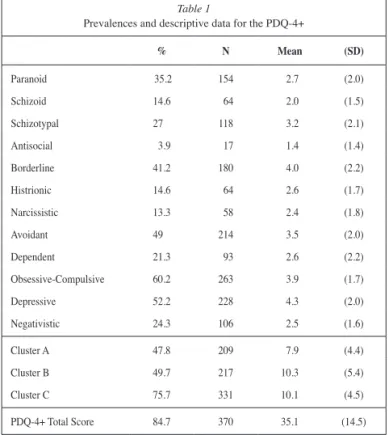
Table 1 presents the prevalences and means of the PDQ-4+ scales, clusters and PDQ-4+ total score. Obsessive-compulsive, Depressive, Avoidant and Borderline PDs were the most prevalent (>40%), and the mean number of criteria met was over 3.5. the total prevalence of PDQ-4+ was over 80% and the mean total PDQ-4+ score was 35.1 (SD 14.5).
Table 1
Prevalences and descriptive data for the PDQ-4+
% N Mean (SD)
Paranoid 35.2 154 02.7 (2.0)
Schizoid 14.6 064 02.0 (1.5)
Schizotypal 27.0 118 03.2 (2.1)
Antisocial 03.9 017 01.4 (1.4)
Borderline 41.2 180 04.0 (2.2)
Histrionic 14.6 064 02.6 (1.7)
Narcissistic 13.3 058 02.4 (1.8)
Avoidant 49.0 214 03.5 (2.0)
Dependent 21.3 093 02.6 (2.2)
Obsessive-Compulsive 60.2 263 03.9 (1.7)
Depressive 52.2 228 04.3 (2.0)
Negativistic 24.3 106 02.5 (1.6)
Cluster A 47.8 209 07.9 (4.4)
Cluster B 49.7 217 10.3 (5.4)
Cluster C 75.7 331 10.1 (4.5)
Internal consistency and Factor analysis
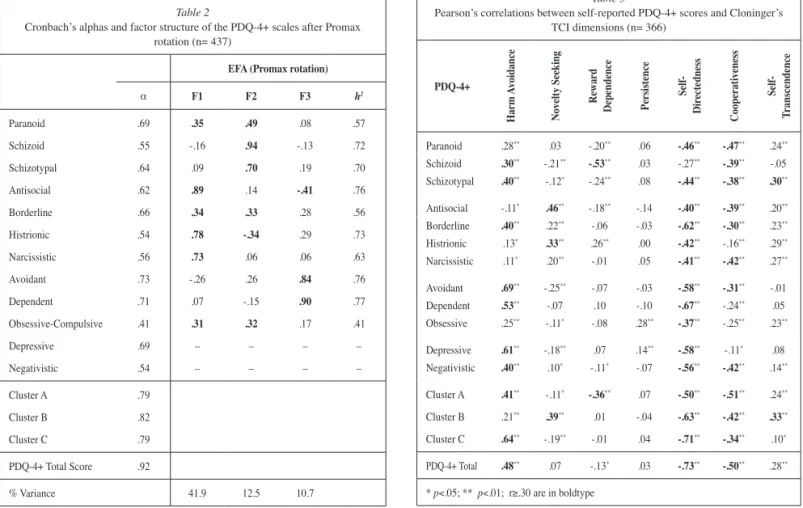
Regarding internal consistency, seven scales reached α
coefficients of .60 or above. Mean α was .61, ranging from .41
(Obsessive-compulsive) to .73 (Avoidant) (Table 2, left).
Results for the factor analysis of the PDQ-4+ disorders (excepting Depressive and Negativistic, which do not belong to any cluster) (EFA) are presented in Table 2 (right). A three-factor solution accounted for 65.2% of the overall variance and was theoretically interpretable. Factor 1, accounting for 41.9% of the explained variance, was defined by Antisocial, histrionic, and narcissistic PDs. Factor 2 explained 12.5% of variance and was chiefly loaded by Schizoid, Schizotypal, and Paranoid PDs. Factor 3 accounted for 10.7% of variance and was defined by Dependent and Avoidant PDs, with Antisocial loading negatively. Paranoid, Borderline and Obsessive-compulsive PDs did not belong unequivocally to a sole factor. congruence coefficients with the theoretical three-cluster DSM-IV structure (assuming «1» for loading and «0» for non-loading disorders) (Guadagnoli & Velicer, 1991) were .86, .89, and .79 for clusters A, B and C respectively.
Concurrent validity PDQ-4+ - TCI
Table 3 reports the Pearson’s correlations of the PDQ-4+ individual PDs, clusters, and total score with the TCI dimensions. the three clusters showed specific association patterns with temperament: Cluster A with Harm Avoidance (.41) and negatively with reward Dependence (-.36); cluster b with novelty seeking (.39); and cluster c with harm Avoidance (.64). Individual disorders followed the same pattern as their corresponding cluster.
In addition, Schizoid and Avoidant PDs were negatively associated with Novelty Seeking, and Obsessive-compulsive PD was the only disorder positively related to Persistence. Self-directedness (between -.27 and -.71) and Cooperativeness (between -.11 and -.51) character scales were related negatively, and Self-transcendence positively, both to the three clusters and to nearly all individual disorders. The PDQ-4+ total score showed a notably high correlation (-.73) with Self-directedness.
Discussion
The current study analyzed the psychometric properties of the Spanish version of the PDQ-4+ self-reports. The PDQ-4+ appeared to have moderate screening properties for the diagnosis of Personality Disorders in this population. our findings suggest that the prevalences obtained with the PDQ-4+ are within the expected range in clinical samples. For example, 83.4% of patients had at least one PD, which is consistent with the results of previous studies ranging from 83% to 91% (Fossati et al., 1998; Wilberg et al., 2000). The mean of 3.29 diagnoses for subject is also within the expected range, in view of previous Italian and Norwegian studies reporting 4.27 and 4.00 respectively (Fossati et al., 1998; Wilberg et al., 2000). The most prevalent diagnoses were Obsessive-compulsive, Avoidant and Borderline PDs, in agreement with Hyun Ha et al., (2007). In accordance with previous authors (Fossati et al., 1998; Wilberg et al., 2000) we found that the PDQ-4+ reported multiple diagnoses and higher prevalence rates of PDs. Compared with structured interviews, this reflects a high false positive rate and a poor ability to establish differential diagnosis (Davison et
Table 2
Cronbach’s alphas and factor structure of the PDQ-4+ scales after Promax rotation (n= 437)
EFA (Promax rotation)
α F1 F2 F3 h2
Paranoid .69 .35 .49 .08 .57
Schizoid .55 -.16 .94 -.13 .72
Schizotypal .64 .09 .70 .19 .70
Antisocial .62 .89 .14 -.41 .76
Borderline .66 .34 .33 .28 .56
Histrionic .54 .78 -.34 .29 .73
Narcissistic .56 .73 .06 .06 .63
Avoidant .73 -.26 .26 .84 .76
Dependent .71 .07 -.15 .90 .77
Obsessive-Compulsive .41 .31 .32 .17 .41
Depressive .69 – – – –
Negativistic .54 – – – –
Cluster A .79
Cluster B .82
Cluster C .79
PDQ-4+ Total Score .92
% Variance 41.9 12.5 10.7
Table 3
Pearson’s correlations between self-reported PDQ-4+ scores and Cloninger’s tcI dimensions (n= 366)
PDQ-4+
Harm
Avoidance
Novelty Seeking
Reward
Dependence Persistence Self- Directedness
Cooperativeness
Self-Transcendence
Paranoid .28** .03 -.20** .06 -.46** -.47** .24**
Schizoid .30** -.21** -.53** .03 -.27** -.39** -.05
Schizotypal .40** -.12* -.24** .08 -.44** -.38** .30**
Antisocial -.11* .46** -.18** -.14 -.40** -.39** .20**
Borderline .40** .22** -.06 -.03 -.62** -.30** .23**
Histrionic .13* .33** .26** .00 -.42** -.16** .29**
Narcissistic .11* .20** -.01 .05 -.41** -.42** .27**
Avoidant .69** -.25** -.07 -.03 -.58** -.31** -.01
Dependent .53** -.07 .10 -.10 -.67** -.24** .05
Obsessive .25** -.11* -.08 .28** -.37** -.25** .23**
Depressive .61** -.18** .07 .14** -.58** -.11* .08
Negativistic .40** .10* -.11* -.07 -.56** -.42** .14**
Cluster A .41** -.11* -.36** .07 -.50** -.51** .24**
Cluster B .21** .39** .01 -.04 -.63** -.42** .33**
Cluster C .64** -.19** -.01 .04 -.71** -.34** .10*
PDQ-4+ Total .48** .07 -.13* .03 -.73** -.50** .28**
al., 2001; Fossati et al., 1998). our findings and those of previous authors suggest that the PDQ-4+ may be a useful screening tool to detect the presence of PDs, but cannot distinguish precisely between them.
Overall, we found moderate evidence of internal reliability. Our findings were consistent with those reported for its predecessor, the PDQ-R (Hyler & Rieder, 1987), and for the Italian (Fossati et al., 1998), Chinese (Yang et al., 2000), Korean (Kim, Choi, & Cho, 2000) and Norwegian versions of the PDQ-4+ (Wilberg et al., 2000). However, it is worth noting that no studies report excellent α coefficients: the means average .60 to .65 (chabrol, rousseau, Callahan, & Hyler, 2007; Fossati et al., 1998; Wilberg et al., 2000; Yang et al., 2000).
For its part, EFA yielded a three-factor structure for individual disorders. This solution is in disagreement with the one found for the PDQ-4+ in a non-clinical sample (Chabrol et al., 2007), but is not directly comparable to other studies which included a different number of PDs (Yang et al., 2000), factorized individual criteria (Mihura, Meyer, bel-bahar, & Gunderson, 2003), or used earlier versions of the instrument (e.g. Hyler, Skodol, Kellman, Oldham, & Rosnick, 1990). In contrast, our solution shows acceptable congruence both with the theoretical A, B and C clusters of the DSM (.86, .89, and .79 respectively) and with the structure that emerges from meta-analyzing a wide range of instruments (.93, .92, and .87; O’Connor, 2005). Other studies have also reported that Paranoid, Borderline, and Obsessive-compulsive disorders do not fit this three-factor structure well: whereas the borderline and Paranoid PDs do not usually load unequivocally in a sole factor, Obsessive PDs form a separate fourth factor that our data are not able to reproduce (Austin & Deary, 2000; O’Connor, 2005).
Finally, our findings of concurrent validity between the PDQ-4+ PDs questionnaire and TCI dimension scales were consistent with previous studies in clinical and nonclinical samples (Cloninger, 2000; Cloninger, Svrakic, & Przybeck, 1993; Hyun Ha, Jo Kim, Abbey, & Kim, 2007; Svrakic, Whitehead, Przybeck, & Cloninger, 1993; Svrakic et al., 2002). Those authors suggest that all PDs are associated with lower scores on the Self-directedness and Cooperativeness character domains. To a lesser degree, high Self-transcendence appears as a core feature of all PDs (see Gutiérrez et
al., 2008 for a review). Among other results, high scorers on cluster A are temperamentally non-affiliative and aloof (low reward Dependence), cluster B subjects are impulsive, need change and stimulation, and have difficulty tolerating boredom (high novelty Seeking), and cluster C subjects are cautious and fearful (high Harm Avoidance). As expected (Cloninger, 2000), Harm Avoidance featured to a certain extent in all PDs. our results confirm that PDs are a combination of character and temperament scores. The Self-directedness and Cooperativeness character dimensions were found to be powerful predictors of the presence and severity of all PDs. The combinations of temperament dimensions can be used as screening tool for each individual PD.
In summary, our study of the Spanish version of the PDQ-4+ self-report shows moderate reliability (internal consistency) and acceptable validity. Drawbacks such as moderate reliability or suboptimal factor structure are widespread across all DSM-based tools (questionnaires or interviews), suggesting a flawed underlying model rather than defects in the instrument itself (Livesley & Jang, 2000; Perry, 1992; Widiger & Trull, 2007). This highlights the fact that instruments cannot be better than the model they operationalize; therefore, improving our instruments further necessarily entails reexamining our taxonomy (Clark, Livesley, & Morey, 1997).
This study presents some limitations. The sample was recruited from a psychiatric outpatients setting, and so the results cannot be generalized to Spanish clinical samples. Future research should investigate the reliability (i.e. test-retest reliability) and convergent and discriminate validity with other categorical and dimensional methods.
Acknowledgements
This work was partially supported by public funds from the Pla Director de Salut Mental i Addiccions (Generalitat de Catalunya Health Department) and grants from the Obra Social - Fundació «La Caixa».
This work was partially supported by a grant from Spain’s Ministerio de Educación y ciencia (FIS 03/0464) awarded to F. Gutiérrez.
References
Aboraya, A. (2009). Use of structured interviews by psychiatrists in real clinical settings: Results of an open-question survey. Psychiatry
(Edgemont),6, 24-28.
Austin, E.J., & Deary, I.J. (2000). The «four As»: A common framework for normal and abnormal personality? Personality and Individual
Differences, 28, 977-995.
begg, c.b., & Greenes, r.A. (1983). Assessment of diagnostic tests when disease verification is subject to selection bias. Biometrics, 39, 207-215. Blackburn, R., Donnelly, J.P., Logan, C., & Renwick, S.J.D. (2004).
Convergent and discriminative validity of interview and questionnaire measures of Personality Disorder in mentally disordered offenders: A multitrait-multimethod analysis using confirmatory factor analysis.
Journal of Personality Disorders, 18(2), 129-150.
Byrne, B.M. (2001). Structural equation modeling with AMOS: Basic
concepts, applications, and programming. Mahwah, NJ: Lawrence
Erlbaum Associates.
Calvo, N. (2007). Tesis doctoral: Adaptació al castellà del Personality
Diagnostic Questionnaire-4+: Propietats psicomètriques en població
clínica i en estudiants. Departament de Psiquiatria i Medicina Legal. Facultat de Medicina. Universitat Autònoma de Barcelona (UAB). calvo, n., caseras, x., Gutiérrez, F., & torrubia, r. (2002). Adaptación
Española del Personality Diagnostic Questionnaire-4+ (PDQ-4+).
Actas Españolas de Psiquiatría, 30, 7-13.
Chabrol, H., Rousseau, A., Callahan, S., & Hyler, S.E. (2007). Frequency and structure of DSM-IV personality disorder traits in college students.
Personality and Individual Differences, 43, 1767-1776.
Clark, L.A., & Harrison, J.A. (2001). Assessment Instruments. In W.J. Livesley (Ed.), Handbook of Personality Disorders. Theory, Research,
and Treatment (pp. 277-306). new york: the Guilford Press.
Clark, L.A., Livesley, W.J., & Morey, L. (1997). Personality disorder assessment: The challenge of construct validity. Journal of Personality
Disorders, 11, 205-231.
Cloninger, C.R., (2000). A practical way to diagnosis personality disorder: A proposal. Journal of Personality Disorders, 14, 99-108.
development and use. St. Louis: Washington University, Center for Psychobiology of Personality.
Cloninger, C.R., Svrakic D.M., & Przybeck, T.R. (1993). A psychobiological model of Temperament and Character. Archives General of Psychiatry, 50, 975-990.
costa, P.t., Samuels, J., bagby, r.M., Daffin, l., & norton, h. (2005). Obsessive-Compulsive personality disorder: A review. In M. Maj, H.S. Akiskal, J.E. Mezzich & A. Okasha (Eds.), Personality Disorders (pp. 405-439). Chichester: Wiley.
Davison, S., Leese, M., & Taylor, P.J. (2001). Examination of the screening properties of the Personality Diagnostic Questionnaire 4+ (PDQ-4+) in a prison population. Journal of Personality Disorders, 15, 180-194. Duijsens, I.J., Bruinsma, M., Jansen, S.J.T., Eurelings-Bontekoe, E.H.M.,
& Diekstra, r.F.W. (1996). Agreement between self-report and semi-structured interviewing in the assessment of Personality Disorders.
Personality and Individual Differences, 21, 261-270.
Fossati, A., Maffei, C., Bagnato, M., Donati, D., Donini, M., Fiorilli, M. et al. (1998). Brief communication: Criterion validity of the Personality Diagnostic Questionnaire-4+ (PDQ-4+) in a mixed psychiatric sample.
Journal of Personality Disorders, 12, 172-178.
Gárriz, M., & Gutiérrez, F. (2009). Personality disorder screenings: A meta-analysis. Actas Españolas de Psiquiatría, 37(3), 148-153. Guadagnoli, E., & Velicer, W. (1991). A comparison of pattern matching
indices. Multivariate Behavioral Research, 26, 323-343.
Gutiérrez, F., torrens, M., boget, t., Martín-Santos, r., Sangorrin, J., Pérez, G., & Salamero, M. (2001). Psychometric properties of the Temperament and Character Inventory (TCI) questionnaire in a Spanish psychiatric population. Acta Psychiatrica Scandinavica, 103, 143-147. Gutiérrez, F., navinés, r., navarro, P., García-Esteve, l., Subirá, S.,
Torrens, M., & Martín-Santos, R. (2008). What do all personality disorders have in common? Ineffectiveness and uncooperativeness.
Comprehensive Psychiatry, 49(6), 570-578.
Guy, l.S., Poythress, n.G., Douglas, K.S., Skeem, J.l., & Edens, J.F. (2008). Correspondence between self-report and interview-based assessment of antisocial PD. Psychological Assessment, 20, 47-54. hopwood, c.J., Morey, l.c., Edelen, M.o., Shea, M.t., Grilo, c.M.,
Sanislow, C.A. et al. (2008). A comparison of interview and self-report methods for the assessment of Borderline Personality Disorder criteria.
Psychological Assessment, 20, 81-85.
hu, l., & bentler, P.M. (1999). cutoff criteria for fit indexes in covariance structure analysis: Conventional criteria versus alternatives. Structural
Equation Modeling, 6, 1-55.
Hyler, S.E. (1994). PDQ-4+ Personality Diagnostic Questionnaire-4+. New York: New York State Psychiatric Institute.
Hyler, S.E., & Rieder, R.O. (1987). PDQ-R: Personality Diagnostic
Questionnaire-Revised. New York: New York State Psychiatric Institute.
Hyler, S.E., Skodol, A.E., Kellman, H.D., Oldham, J.M., & Rosnick, L. (1990). Validity of the Personality Diagnostic Questionnaire-Revised: Comparison with two structured interviews. American Journal of
Psychiatry, 147, 1043-1048.
Hyler, S.E., Skodol, A.E., Oldham, J.M., Kellman, H.D., & Doidge, N. (1992). Validity of the Personality Diagnostic Questionnaire-Revised: A replication in an outpatient sample. Comprehensive Psychiatry, 33, 73-77.
Hyun Ha, J., Jo Kim, E., Abbey, S.E., & Kim, T. (2007). Relationship between personality disorder symptoms and temperament in the young male general population of South Korea. Psychiatry and Clinical
Neurosciences, 61, 59-66.
Kim, D.I., Choi, MR., & Cho, E.C. (2000). The preliminary study of reliability and validity on the Korean version of personality disorder questionnaire-4+ (PDQ-4+). Journal of Korean Neuropsychiatric
Association, 39, 525-538.
Livesley, W.J. (2001). Conceptual and taxonomic issues. In W.J. Livesley (Ed.), Handbook of personality disorders. Theory, research and practice (pp. 3-38). new york: the Guilford Press.
Livesley, W.J., & Jang, K.L. (2000). Toward an empirically based classification of personality disorder. Journal of Personality Disorders, 14, 137-151.
McDermutt, W., & Zimmerman, M. (2005). Assessment instruments and standardized evaluation. In J.M. Oldham, A.E. Skodol & D.S. Bender (Eds.), Textbook of personality disorders (pp. 89-101). Washington DC, American Psychiatric Association Press.
Mealey, L. (1995). The sociobiology of sociopathy: An integrated evolutionary model. Behavioral and Brain Sciences, 18(3), 523-599. Mihura, J.l., Meyer, G.J., bel-bahar, t., & Gunderson, J. (2003).
Correspondence among observer ratings of Rorschach, Big Five Model, and DSM-IV Personality Disorder Constructs. Journal of Personality
Assessment, 81(1), 20-39.
Miller, J.D., Bagby, R.M., & Pilkonis, P.A. (2005). A Comparison of the Validity of the Five-Factor Model (FFM) Personality Disorder Prototypes Using FFM Self-Report and Interview Measures. Psychological
Assessment, 17, 497-500.
Miller, J.D., Campbell, W.K., Pilkonis, P.A., & Morse, J.Q. (2008). Assessment procedures for Narcissistic Personality Disorder. Assessment, 15, 483-492. O’Connor, B.P. (2005). A search for consensus on the dimensional structure
of personality disorders. Journal of Clinical Psychology, 61,323-345. Parker, G., & barret, E. (2000). Personality and personality disorder: current
issues and directions [Editorial]. Psychological Medicine, 30, 1-9. Perry, J.C. (1992). Problems and considerations in the valid assessment of
personality disorders. American Journal of Psychiatry, 149, 1645-1653. Pilkonis, P.A., Heape, C.L., Proletti, J.M., Clark, S.W., McDavis, J.K.,
& Pitts, T.E. (1995). The reliability and validity of two structured diagnostic interviews for personality disorders. Archives of General
Psychiatry, 52, 1025-1033.
Segal, D.L., & Coolidge, F.L. (2003). Structured interviewing and DSM classification. In M. hersen & S.M. turner (Eds.), Adult psychopathology
and diagnosis (4th ed., pp. 72-103). New York: Wiley.
Shea, M.T., & Yen, S. (2003). Stability as a distinction between Axis I and Axis II disorders. Journal of Personality Disorders, 17, 373-386. Skodol, A.E., Oldham, J.M., Rosnick, L., Kellman, H.D., & Hyler, S.E.
(1991). Diagnosis of DSM-III-R personality disorders: A comparison of two structured interviews. International Journal of Methods in
Psychiatric Research, 1, 3-26.
Svrakic, D.M., Whitehead, C., Przybeck, T.R., & Cloninger, C.R. (1993). Differential diagnosis of personality disorders by the Seven-Factor Model of Temperament and Character. Archives General of Psychiatry, 50, 991-999. Svrakic, D.M., Draganic, S., Hill, K., Bayon, C., Przybeck, T.R., &
Cloninger, C.R. (2002). Temperament, character, and personality disorders: Etiologic, diagnostic, treatment issues. Acta Psychiatrica
Scandinavica, 106, 189-195.
Wakefield, J.c. (2008). the perils of dimensionalization: challenges in distinguishing negative traits from Personality Disorders. Psychiatric
Clinics of North America, 31, 379-393.
Westen, D., & Arkowitz-Westen, L. (1998) Limitations in Axis II in diagnosing personality pathology in clinical practice. American Journal
of Psychiatry, 155, 1767-1771.
Widiger, T.A., Livesley, W.J., & Clark, L.A. (2009). An integrative dimensional classification of personality disorder. Psychological
Assessment, 21, 243-255.
Widiger, T.A., & Samuel, D.B. (2005). Evidence-based assessment of personality disorder. Journal of Personality Assessment, 17, 278-287. Widiger, t.A., & trull, t.J. (2007). Plate tectonics in the classification
of personality disorders. Shifting to a dimensional model. American
Psychologist , 62, 71-83.
Wilberg, T., Dammen, T., & Friis, S. (2000). Comparing Personality Diagnostic Questionnaire-4+ with Longitudinal, Expert, All Data (LEAD) Standard Diagnoses in a sample with a high prevalence of Axis I and Axis II disorders. Comprehensive Psychiatry, 41, 295-302. yang, J., bagby, r.M., costa, P.t., ryder, A.G., & herbst, J.h. (2002). Assessing
the DSM-IV structure of personality disorder with a sample of Chinese psychiatric patients. Journal of Personality Disorders, 16, 317-331. yang, J., Mccrae, r.r., costa, P.t., yao, S., Dai, x., cai, t., & Gao, b. (2000).
The cross-cultural generalizability of Axis II constructs: An evaluation of two personality disorder assessment instruments in the people’s Republic of China. Journal of Personality Disorders, 14, 249-263.
Zanarini, M.C., Frankenburg, F.R., Hennen, J., Reich, B., & Silk, K.R. (2005). The McLean Study of Adult Development (MSAD): Overview and implications of the first six years of prospective follow-up. Journal
of Personality Disorders, 19, 505-523.
Zimmerman, M. (1994). Diagnosing personality disorders. A review of issues and research methods. Archives General of Psychiatry, 51, 225-245. Zimmerman, M., Rothschild, L., & Chelminski, I. (2005). The Prevalence
of DSM-IV Personality Disorders in Psychiatric Outpatients. American