
TítuloEnvironmental Sustainability in Information Technologies Governance
25
0
0
Texto completo
(2) Sustainability 2018, 10, 4792. 2 of 25. structures and processes that ensure that the organization’s IT sustains and extends the organization’s strategies and objectives and that it is the responsibility of the board of directors and executive management” [6]. Thus, ITG is a tool that allows organizations to: (i) improve their effectiveness and efficiency, (ii) have a competitive advantage, and (iii) maximize profitability [7]. There are many approaches today concerning ES, among which we can mention the following:. •. •. •. •. •. •. •. ISO14001: A standard developed by the ISO (International Organization for Standardization) whose objective is to reduce the amount of environmental impacts. It was first published in 1996 and had several versions, the last being the revision in September 2015 [8–10]. GRI G4: The fourth version of the GRI (Global Reporting Initiative) guide, which offers the appropriate tools for the preparation of sustainability reports and provides the principles and indicators to measure and demonstrate the performance of an organization with respect to economic, ecological and social issues [11,12]. EMAS: The European EMAS (Eco-Management and Audit Scheme) Regulation represents a voluntary approach that aims to increase corporate environmental performance [13,14]. Originally designed for the industrial sector, EMAS can be applied in all organizations following its revision of 2001 (Regulation (EC) No. 761/2001) in order to increase environmental performance [15–17] and even innovation [18]. SGE21: An auditable and certifiable standard by FORÉTICA used to establish an ethical management system. It focuses mainly on compliance with legislation and regulations, ethical management, and social responsibility policy, and provides a code of conduct and means of review by management to achieve continuous improvement [19,20]. ISO26000: An international standard of the ISO family, which provides guidance to organizations on the methods to implement the principles of social responsibility in the daily activities of an organization [20,21]. ESF: The Environmental and Social Framework (ESF) enables the World Bank and borrowers to better manage environmental and social risks of projects and to improve development outcomes. The ESF offers broad and systematic coverage of environmental and social risks [22]. SR10: Establishes the requirements of a social responsibility management system for organizations committed to the principles and recommendations on social responsibility and, in particular, those contained in the International Standard ISO26000 [23].. Similarly, there are many approaches today concerning ITG, among which we can mention the following:. •. • • •. •. •. COBIT5 (Control OBjectives for Information and related Technology): A reference framework for governance and IT management whose objective is to help organizations create value from IT, maintaining a balance between obtaining benefits, optimizing the level of risk and their resources [24–26]. ISO38500: Constitutes a guide or tool for ITG by establishing ITG activities, such as evaluation, management and monitoring of the use of information and communication technologies [27,28]. CALDER-MOIR: An ITG framework that provides a structural guide to implement ITG. In fact, it is a simple tool to help implement the ISO38500 standard [29]. WEILL & ROSS: Peter Weill and Jean Ross propose an ITG framework where senior management will position the company in the desired profile through the articulation of desirable strategies and behaviors [30]. FORRESTER: The publication of Forrester Research establishes that the implementation of good IT governance requires a framework based on three main elements: structure, process and communication [31]. GTI4U: This model has been proposed by a group of Spanish researchers. It is based on the ISO38500 standard and has been developed to be implemented in a university environment, being also used to evaluate the overall level of maturity of the Spanish university system [32]..
(3) Sustainability 2018, 10, 4792. •. 3 of 25. SMEsITGF: An ITG framework oriented on small and medium-sized enterprises and focused on the analysis of human resource management issues [33].. Both trends (ES and ITG) have followed independent paths until now. However, several studies have recently emerged with the intent to integrate them. Thus, because of the synergy between both, the concept of sustainable IT governance (hereafter, sIT Governance) arises. That is to say, the two trends merge with the intention of contributing to the evaluation, management and monitoring of IT practices in organizational processes and activities from a ES viewpoint [34]. The aim is to reduce or minimize the environmental impact by seeking optimization of resources, strategic alignment, generation of value and risk management [35,36]. SIT Governance is a recent concept that is still in progress. It is true that the number of investigations in this field is increasing (to a lower degree in the topic itself and to a greater degree in related topics), however, there are still no specific models/standards to help organizations to implement sIT Governance. In this sense, the work of Bengtsson and Ågerfalk [37] is a well-known study showing relevant papers relating IT and the environment. Most deal with more energy efficient computers [38,39], server virtualization [39] and other technical aspects that focus on the components (e.g., [40–42]); without taking into account the ES from an integral and strategic point of view. The two more relevant attempts today in merging ES and ITG into an integral and strategic sIT Governance synergy are the following:. •. •. The study carried out by Machado et al. [43] that includes a mapping between activities from COBIT (versions 5 and 4.1), as a representative of ITG, and activities from GRI G4, as a representative of ES. However, this work: (i) puts aside relevant ITG approximations (such as ISO38500, CALDER-MOIR, WEILL & ROSS and FORRESTER) as well as relevant ES approaches (such as ISO14001, EMAS, SGE21 and ISO26000) and (ii) performs a “grosso modo” mapping. The study carried out by Merhout and O’Toole [44], where they review COBIT5, one of the most relevant ITG frameworks, to determine the degree to which it supports the ES dimension (especially in relation to the acquisition, use and disposition of IT assets). They concluded that COBIT5 clearly presents a sustainability deficit, although they do not quantify it. From these studies, we conclude two main deficiencies:. 1.. 2.. The identification of the relevant ES factors using a single approximation to such a domain without complementing it with the other points of view of the main approaches (ISO14001, GRI G4, EMAS, SGE21 and ISO26000). This situation does not allow considering all the information that could be relevant. The high-level of detail (granularity) used in the studies of ES/ITG activities. This situation does not allow specifying, for example, the detailed assignment of factors from ES to (sub) activities of ITG.. These two deficiencies are addressed in this work. The purpose is to contribute to: (i) first, identifying the specific (i.e., not general) factors of ES contained in the main ES approaches (ISO14001, GRI G4, EMAS, SGE21 and ISO26000); and (ii) second, determining to what extent these factors are already present in the main ITG approaches (COBIT, ISO38500 and WEILL & ROSS), concluding with quantitative measurements regarding the ES deficit in current ITG frameworks as a consequence. The first objective is essential since it allows considering all the information that could be relevant coming from the main current ES approaches (not only one) and with an adequate and practical level of detail (instead of a high-level of detail/granularity). The second objective, derived from the first, is equally important in order to evaluate to what extent the current ITG frameworks have an ES deficit. In fact, the study presented here will be the starting point to address the ES deficiencies detected in the ITG frameworks and/or to propose a new comprehensive sIT Governance model. The rest of the article is organized as follows. Section 2 presents the methodology we applied to fulfill the two above-mentioned objectives, whereas Section 3 presents the results obtained for.
(4) Sustainability 2018, 10, 4792. 4 of 25. such objectives. Finally, Section 4 includes the discussion and the main conclusions according to the Sustainability 2018, 10, x FOR PEER REVIEW 4 of 25 results obtained. Sustainability 2018, 10, x FOR PEER REVIEW. 4 of 25. 2. Materials Materials and and Methods Methods 2. 2. Materials and Methods Figure 1 summarizes main activities thatthat we considered in order to achieve the aboveFigure summarizesthe thetwo two main activities we considered in order to achieve the Figureobjectives. 1 summarizes main activities that weof considered in order to achieve the above-in mentioned Thethe firsttwo activity consistsconsists of comparing the main ESmain approaches in order to above-mentioned objectives. The first activity comparing the ES approaches mentioned objectives. The first activity consists of comparing the main ES approaches in order to identify the set of relevant ES factors (first objective). This is because current ES approaches do not order to identify the set of relevant ES factors (first objective). This is because current ES approaches identify thesame setthe ofaspects. relevant ES factors (first This isconsidered because current ES approaches not address the Thus, there ESobjective). factors that arethat by some butdonot by do not address same aspects. Thus,are there are ES factors are considered byapproach some approach but address the same aspects. Thus, there are ES factors that are considered by some approach but not by all of them and, on the other hand, the same ES factor may have different names in different not by all of them and, on the other hand, the same ES factor may have different names different all of them Only and, when on the other hand, the same ES factor from may have different names in activity different approaches. Only when this information has been obtained from Activity 1, can the second activity approaches. this information has been obtained Activity 1, can the second be approaches. Only when this information has been obtained from Activity 1, can the second activity be undertaken: to compare main approaches against of identified relevant factors undertaken: to compare thethe main ITGITG approaches against thethe set set of identified relevant ES ES factors in be undertaken: to compare the main ITG approaches against the set of identified relevant ES factors in order to determine their degree of compliance (second objective). order to determine their degree of compliance (second objective). in order to determine their degree of compliance (second objective).. Figure Figure 1. General description of the main activities and their results. ES: Environmental Sustainability; 1. General description of the main activities and their results. ES: Environmental Figure 1. General description of the main activities and their results. ES: Environmental ITG: Information Technologies Governance Sustainability; ITG: Information Technologies Governance Sustainability; ITG: Information Technologies Governance. We We used used an an analytical analytical strategy strategy of of aa comparative comparative study study between between models models and and standards standards [45] [45] to to We used an analytical strategy of a comparative study between models and standards [45] to address the activities shown in Figure 1. This decision was based on the absence of specialized address the activities shown in Figure 1. This decision was based on the absence of specialized address the activities shown in Figure 1. This decision was based on the absence of specialized publications regarding comparative studies publications studies of of mapping mapping activities activities among amongthe themodels/standards models/standards publications regarding regarding comparative comparative studies of mapping activities among the models/standards related to ES and and ITG. ITG.Specifically, Specifically,we wechose chosethe the Method of Study of Similarity between Models related to ES Method of Study of Similarity between Models and related to ES and ITG. Specifically, we chose the Method of Study of Similarity between Models and and Standards (MSSMS) [46] as the working method for both activities. It proposes seven phases Standards the working working method method for for both both activities. activities. ItItproposes proposesseven sevenphases phasestoto to Standards (MSSMS) (MSSMS) [46] [46] as as the formalize and organize aa study to find the similarities and differences between several approaches formalize and organize study to find the similarities and differences between several approaches formalize and organize a study to find the similarities and differences between several approaches (e.g., frames, models or standards). This method has been applied in different and diverse (i.e., standards). This method method has been applied applied different anddomains: diverse (i.e., e.g., e.g., frames, frames, models models or or standards). This has been inindifferent and diverse comparative analysis of maturity models in business intelligence [47], study on software outsourcing domains: comparative analysis of maturity models in business intelligence [47], study on software domains: comparative analysis of maturity models in business intelligence [47], study on software based on CMMI-ACQ [48], comparison of comparison models and of standards for service capacity outsourcing [48], modelsand andimplementing standardsfor forIT implementing outsourcing based based on on CMMI-ACQ CMMI-ACQ [48], comparison of models standards implementing ITIT management [49] and similarity study of risk management process in software outsourcing projects [50]. service [49] and and similarity similarity study study of of risk risk management managementprocess processininsoftware software service capacity capacity management management [49] Figure 2 presents the seven phases of the MSSMS method. outsourcing projects [50]. Figure 2 presents the seven phases of the MSSMS method. outsourcing projects [50]. Figure 2 presents the seven phases of the MSSMS method. Phase Phase11 Select Selectthe thepossible possible standards standardsand andmodels models totobe beanalyzed analyzed. Phase Phase 22 Define Define the the reference reference model model. Phase 33 Phase Select the the process(es) process(es) Select to be be analyzed analyzed to. Phase44 Phase Setthe thelevel level Set ofdetail detail of. Phase5 5 Phase Createa a Create correspondence correspondence template template. Phase Phase 66 Identify the Identify the similarities among similarities among the models the models. Phase Phase 7 7 Present Present thethe results results. Figure 2. of Method the Method Study of Similarity Similarity between Models andStandards Standards (MSSMS) Figure 2. Phases Phases of Study of between Models and (MSSMS) Figure 2. Phases of the of Study of Similarity between Models and Standards (MSSMS) method. method. method.. The deployment of these phases requires the identification of the elements that make up requires identification ofthe theelements elements thatmake make upand each The deployment deployment of these phases of up each each The approach/model/standard. We requires applied the the identification deductive analytical methodthat [51] for this a approach/model/standard. applied the deductive deductive analytical method documents. [51] for for this this andisaaa approach/model/standard. applied the analytical method [51] and documentary analysis as dataWe collection technique to investigate the published Below documentary analysis as data collection technique to to investigate investigatethe thepublished publisheddocuments. documents.Below Belowisis documentary analysis general description of the sevencollection MSSMS technique phases: general description description of the seven MSSMS aageneral MSSMS phases: phases: Phase 1: 1: Select Select the the possible standards and Phase and models models to tobe beanalyzed analyzed The purpose purpose of this phase is to choose The choose the the set set of of models modelsand andstandards standardstotobe beincluded includedininthe the study, setting setting up up the criteria that support study, support the the selection selection (e.g., (e.g.,the thecontribution contributiontotothe thescope scopeofofstudy study.
(5) Sustainability 2018, 10, 4792. 5 of 25. Phase 1: Select the possible standards and models to be analyzed The purpose of this phase is to choose the set of models and standards to be included in the study, setting up the criteria that support the selection (e.g., the contribution to the scope of study and the number of user organizations). Once the criteria are defined, the documentary analysis will let us identify the bibliographic references that validate our approach selection. Phase 2: Define the reference model The reference model represents the selected approach providing the broadest coverage in the field of study. Considering that the comparative analysis proposed in this work is based on the structure (elements) that make up each approach, the reference model should be the one that contributes most to the field of study through its structure. It will act as the pivot for the comparative analysis, and the correspondences with the other approaches are established around it in an iterative and individual way. This phase synthesizes the approaches selected in Phase 1 through the deductive and documentary analysis, and one is selected as the reference model for the comparative analysis. Phase 3: Select the process(es) to be analyzed The purpose of this phase is to determine the scope of the comparison to be carried out. Thus, the comparison of the approaches selected in Phase 1 may cover all or some of their constituent processes. Phase 4: Set the level of detail Once the standards/models to be considered, the reference model, and the process(es) to be analyzed have been selected, what remains to be defined is what element of the structure for each approach will be used to compare; that is to say, what is going to be mapped and to what level of the structure the mapping will reach. To select the level of detail, we applied the criteria of homogeneity and granularity. The first criterion tries to avoid mapping specific elements of an approach with general elements of another, because that would produce invalid results. The second criterion defines the level of specificity of the mapping taking into account that the highest granularity in a hierarchy would be at the top of it, and the minimum granularity would be at the bottom. The level of detail should be selected considering that granularity and homogeneity are consequently related; that is, homogeneity must be met to apply the minimum granularity. Phase 5: Create a correspondence template This phase defines the template to be used in the next phase. This template will be based on the process(es) to be analyzed (Phase 3) and on the level of detail established in Phase 4. Phase 6: Identify the similarities among the models The purpose of this phase is to identify the similarities among the selected models through the elements that they have in common. Thus, this phase performs the actual comparison among the selected approaches by mapping the considered element. We used an iterative strategy for the mapping: each model/standard is mapped individually regarding the considered element of the selected reference model. Once mapped, the result is reviewed in its entirety and the following is approached in the same way. Phase 7: Present the results The purpose of this phase is to present the results obtained in a structured manner. 3. Results We present in this section the deployment of the seven MSSMS phases (Figure 2) to address the two activities proposed in Figure 1..
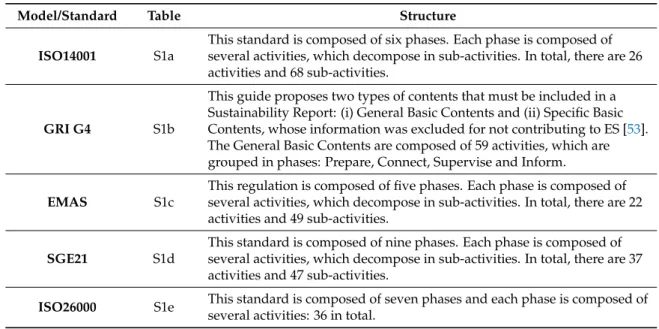
(6) Sustainability 2018, 10, 4792. 6 of 25. 3.1. Activity 1: Identify the Relevant Factors of ES 3.1.1. Phase 1: Select the Possible Standards and Models to be Analyzed The criteria for the selection of the standards and models to be incorporated into the comparative study were the following: (a) those related to ES, (b) those with a relevant proponent institution, (c) those most used by organizations, and (d) those with updated information and whose documentation is available. The following ES approaches were selected using the above-mentioned criteria: ISO14001:2015, GRI G4:2013, EMAS:2009, SGE21:2016 and ISO26000:2012. Table 1 shows the bibliographic references that support the compliance with the criteria for each approach. It is worth mentioning that we have not selected other models because they do not meet any of the aforementioned criteria. For example, ESF [22] and SR10 [23] have not been selected because they do not meet the criterion defined in (c) (i.e., they are not used by organizations despite their relative degree of dissemination). Table 1. Bibliographic references supporting compliance with the criteria for the selection of ES standards and models. Criteria: (a) related to ES, (b) relevant proponent institution, (c) most used by organizations, and (d) updated information and whose documentation is available. Criterion. ISO 14001. GRI G4. EMAS. SGE21. ISO26000. (a) (b) (c) (d). [8] [8] [54] [8]. [11] [53] [55] [11]. [52] [52] [54] [52]. [19] [19] [56] [19]. [21] [21] [57] [21]. 3.1.2. Phase 2: Define the Reference Model Once the ES approaches have been selected, one has to be defined as the reference model in this phase. The deductive and documentary analysis of the five selected approaches lets us gather the sufficient knowledge to select the reference approach. Table 2 shows a descriptive synthesis of the five ES approaches studied, whereas a detailed description for each approach is provided in the supplementary material by means of five tables (Table S1a–e). Each table shows the name of the phase, the name of the activity and its coding. Table 2. Descriptive synthesis of the selected ES approaches. Model/Standard. Table. Structure. ISO14001. S1a. This standard is composed of six phases. Each phase is composed of several activities, which decompose in sub-activities. In total, there are 26 activities and 68 sub-activities.. GRI G4. S1b. This guide proposes two types of contents that must be included in a Sustainability Report: (i) General Basic Contents and (ii) Specific Basic Contents, whose information was excluded for not contributing to ES [53]. The General Basic Contents are composed of 59 activities, which are grouped in phases: Prepare, Connect, Supervise and Inform.. EMAS. S1c. This regulation is composed of five phases. Each phase is composed of several activities, which decompose in sub-activities. In total, there are 22 activities and 49 sub-activities.. SGE21. S1d. This standard is composed of nine phases. Each phase is composed of several activities, which decompose in sub-activities. In total, there are 37 activities and 47 sub-activities.. ISO26000. S1e. This standard is composed of seven phases and each phase is composed of several activities: 36 in total..
(7) Sustainability 2018, 10, 4792. 7 of 25. ISO14001 was selected as the reference model after the analysis carried out because it provides the greatest coverage in ES issues. This decision is supported by [58], which states that this standard is the main reference for environmental management in all types of organizations in the world. 3.1.3. Phase 3: Select the Process(es) to be Analyzed In this case, the processes to be considered are all those relating the dimension of ES. Therefore, all the processes included in the reference model will be analyzed. 3.1.4. Phase 4: Set the Level of Detail We established the minimum level of granularity (as long as homogeneity was maintained) to ensure that the relevant ES factors were identified with a sufficient level of detail. This was to avoid the “grosso modo” issue stated in the Introduction. It should be noted that all the ES approaches studied in this work have the same level of detail, although they use different nomenclatures. For example, where ISO 14001 talks about sub-activities, GRI G4 talks about activities. Table 3 summarizes the relevant information until now: it shows, for each approach, the original and the unified structure based on the reference model (ISO14001). The nomenclature has been unified taking into account the level of detail provided for each approach, irrespective of the name used by each one. Thus, it can be concluded from Table 3 the minimum level of granularity that can be selected for all the approaches: sub-activity. Table 3. Structure and level of detail of each ES approach. ES Approach. Original Structure. Unified Structure. ISO14001 GRI G4 EMAS SGE21 ISO26000. Phase/activity/sub-activity Phase/content/activity Phase/activity/sub-activity Phase/activity/sub-activity Phase/activity. Phase/activity/sub-activity Phase/activity/sub-activity Phase/activity/sub-activity Phase/activity/sub-activity Activity/sub-activity. 3.1.5. Phase 5: Create a Correspondence Template We considered the correspondence template:. • • •. following. aspects. presented. before. in. order. to. define. the. Selected ES approaches: ISO14001:2015, GRI G4:2013, EMAS:2009, SGE21:2016 and ISO26000:2012. Reference model: ISO14001:2015. Level of detail that will be used for the comparisons: sub-activity (in the unified structure).. The elements that make up the template are: the names of the phases and the activities and sub-activities codes, for the reference model, and the sub-activities that are connected with the sub-activity of the reference model (using the unified structure), for each ES approach. 3.1.6. Phase 6: Identify Similarities among the Models Table 4 shows the correspondence template filled with the results of the mapping process, in which three different scenarios can be found:. •. •. First scenario: There is correspondence, without assessing its accuracy. It is enough that the sub-activity makes some reference, although slight. This scenario means that the correspondence template shown in Table 4 defines what sub-activity is the one that refers to the sub-activity of the reference model (ISO14001). This is evidenced by showing the code of the corresponding sub-activity by using the unified structure. Second scenario: The sub-activity does not contribute to ES. The reason for this scenario is that GRI G4, SGE21 and ISO26000 also cover economic and social sustainability domains. In addition,.
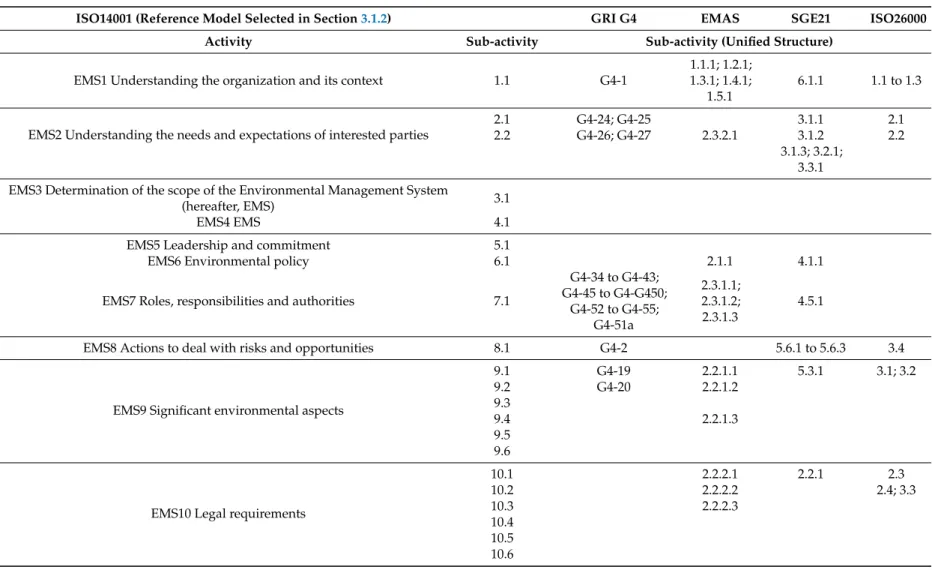
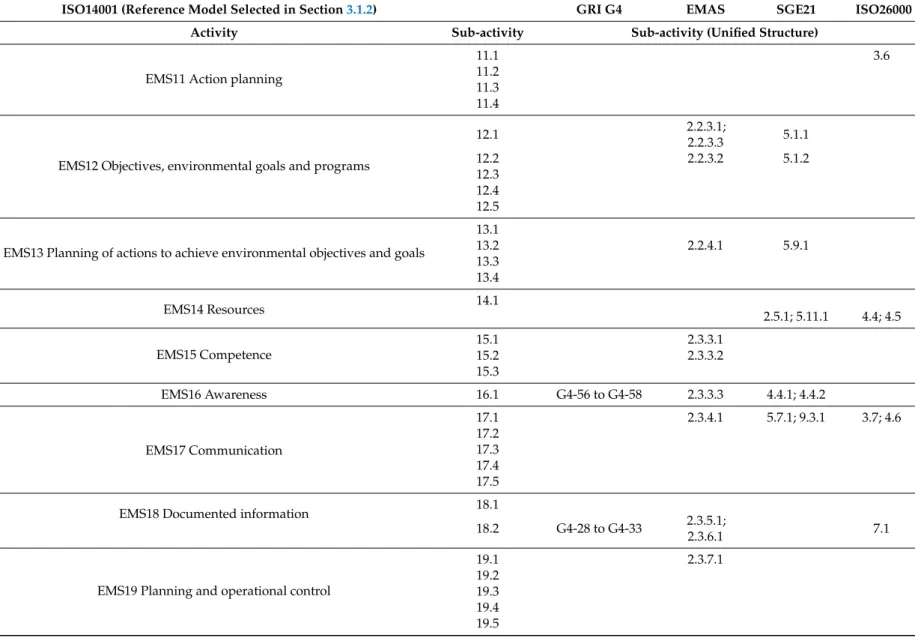
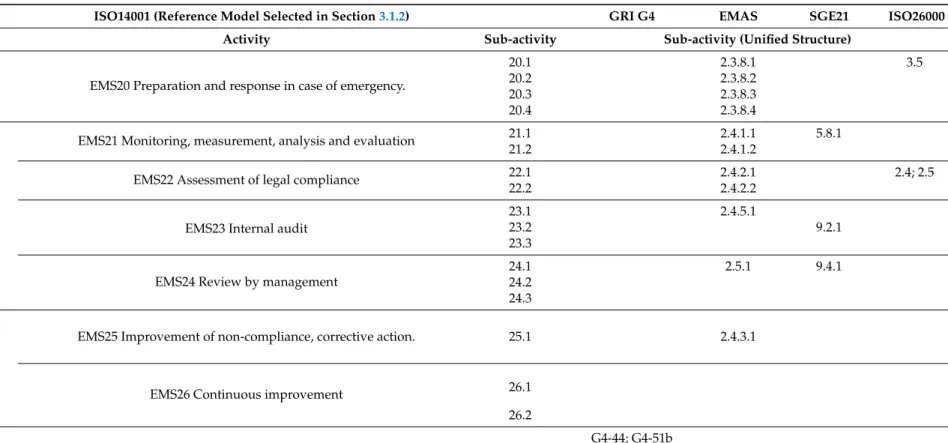
(8) Sustainability 2018, 10, 4792. •. 8 of 25. there are sub-activities typical of the context of each approach. Thus, for example, GRI G4, as a guide to help organizations in preparing sustainability reports, includes sub-activities referring to this specific information. In the same way, EMAS has sub-activities related to the certification process. Such kinds of sub-activities were not considered because they are not a relevant contribution to ES. Third scenario: The sub-activity contributes to ES but does not exist in the reference model (ISO14001). In this case, this sub-activity becomes a reference for the other approaches, providing a new ES factor to be considered. These sub-activities, which have no correspondence in the reference model, are included in Table 4 using the unified terminology as follows: 3.1.3, 3.2.1, 3.3.1, 2.5.1 and 5.11.1 for SGE21; G4-44 and G4-51b for GRI G4, and 4.4 and 4.5 for ISO26000.. Since the purpose of this work is to establish correspondences between ES approaches, we only considered scenarios 1 and 3. An empty cell in Table 4 denotes that there was no correspondence with the sub-activity of the reference model. It is important to note that the relevant ES factors were identified from Table 4 by applying the deductive method. As a representative example, the sub-activity 1.1, from the activity “EMS1 Understanding the organization and its context” of the reference model (first row in Table 4), has correspondence with the sub-activity G4-1 (GRI G4), with the sub-activities 1.1.1, 1.2.1, 1.3.1, 1.4.1 and 1.5.1 (EMAS), with the sub-activity 6.1.1 (SGE21), and with the sub-activities 1.1 up to 1.3 (ISO26000). Since there is correspondence (scenario 1), although it is not exact, it means that each of these sub-activities can contribute to EMS1 activity. Therefore, the set of contributions (sub-activities) for the EMS1 reference activity is:. • • • •. Determine the internal and external problems of the organization, legal aspects and economic environment (from ISO14001). Strategic focus of the organization (mission, vision, strategies, purposes, scope) from GRI G4 and ISO26000. Description of the organization (from EMAS). Define a strategic plan for sustainability (from SGE21).. A similar strategy was used to identify the rest of relevant ES factors. The full description of the relevant ES factors can be found later in Section 3.2.6 (first three columns in Table 8)..
(9) Sustainability 2018, 10, 4792. 9 of 25. Table 4. Template filled with the results of the mapping process between the reference model and the other ES approaches. ISO14001 (Reference Model Selected in Section 3.1.2). PLANNING. LEADERSHIP. CONTEXT OF THE ORGANIZATION. Phase. GRI G4. EMAS. Activity. Sub-activity. EMS1 Understanding the organization and its context. 1.1. G4-1. EMS2 Understanding the needs and expectations of interested parties. 2.1 2.2. G4-24; G4-25 G4-26; G4-27. EMS3 Determination of the scope of the Environmental Management System (hereafter, EMS) EMS4 EMS. 4.1. EMS5 Leadership and commitment EMS6 Environmental policy. 5.1 6.1. SGE21. ISO26000. Sub-activity (Unified Structure) 1.1.1; 1.2.1; 1.3.1; 1.4.1; 1.5.1 2.3.2.1. 6.1.1. 1.1 to 1.3. 3.1.1 3.1.2 3.1.3; 3.2.1; 3.3.1. 2.1 2.2. 3.1. EMS7 Roles, responsibilities and authorities. 7.1. G4-34 to G4-43; G4-45 to G4-G450; G4-52 to G4-55; G4-51a. EMS8 Actions to deal with risks and opportunities. 8.1. G4-2 G4-19 G4-20. EMS9 Significant environmental aspects. 9.1 9.2 9.3 9.4 9.5 9.6. EMS10 Legal requirements. 10.1 10.2 10.3 10.4 10.5 10.6. 2.1.1. 4.1.1. 2.3.1.1; 2.3.1.2; 2.3.1.3. 4.5.1. 2.2.1.1 2.2.1.2. 5.6.1 to 5.6.3. 3.4. 5.3.1. 3.1; 3.2. 2.2.1. 2.3 2.4; 3.3. 2.2.1.3. 2.2.2.1 2.2.2.2 2.2.2.3.
(10) Sustainability 2018, 10, 4792. 10 of 25. Table 4. Cont. ISO14001 (Reference Model Selected in Section 3.1.2) Phase. GRI G4. Activity. Sub-activity. EMS11 Action planning. 11.1 11.2 11.3 11.4. EMAS. EMS13 Planning of actions to achieve environmental objectives and goals. IMPLEMENTATION AND OPERATION. EMS14 Resources. 3.6. 12.2 12.3 12.4 12.5 13.1 13.2 13.3 13.4. 5.1.2. 2.2.4.1. 5.9.1. 5.1.1. 2.5.1; 5.11.1 15.1 15.2 15.3. EMS16 Awareness. 16.1. EMS17 Communication. 17.1 17.2 17.3 17.4 17.5. 4.4; 4.5. 2.3.3.1 2.3.3.2 G4-56 to G4-58. 2.3.3.3. 4.4.1; 4.4.2. 2.3.4.1. 5.7.1; 9.3.1. 3.7; 4.6. 18.1 18.2. EMS19 Planning and operational control. 2.2.3.1; 2.2.3.3 2.2.3.2. 14.1. EMS15 Competence. EMS18 Documented information. ISO26000. Sub-activity (Unified Structure). 12.1 EMS12 Objectives, environmental goals and programs. SGE21. 19.1 19.2 19.3 19.4 19.5. G4-28 to G4-33. 2.3.5.1; 2.3.6.1 2.3.7.1. 7.1.
(11) Sustainability 2018, 10, 4792. 11 of 25. Table 4. Cont. ISO14001 (Reference Model Selected in Section 3.1.2). CONTINUOUS IMPROVEMENT. VERIFICATION. Phase. GRI G4. EMAS. Activity. Sub-activity. EMS20 Preparation and response in case of emergency.. 20.1 20.2 20.3 20.4. 2.3.8.1 2.3.8.2 2.3.8.3 2.3.8.4. EMS21 Monitoring, measurement, analysis and evaluation. 21.1 21.2. 2.4.1.1 2.4.1.2. EMS22 Assessment of legal compliance. 22.1 22.2. 2.4.2.1 2.4.2.2. 23.1 23.2 23.3. 2.4.5.1. EMS23 Internal audit. 24.1 24.2 24.3. 2.5.1. EMS24 Review by management. EMS25 Improvement of non-compliance, corrective action.. 25.1. 2.4.3.1. EMS26 Continuous improvement. SGE21. ISO26000. Sub-activity (Unified Structure) 3.5. 5.8.1 2.4; 2.5. 9.2.1. 26.1 26.2 G4-44; G4-51b. 9.4.1.
(12) Sustainability 2018, 10, 4792. 12 of 25. 3.1.7. Phase 7: Present the Results In order to graphically organize the overlapping and most common sub-activities, the similarities between ES approaches (Table 4) are synthesized by means of a Venn diagram [59] in Figure 3. The five ES approaches are labeled in this figure as A (ISO14001), B (GRI G4), C (EMAS), D (SGE21), and E (ISO26000). With the exception of the cases mentioned in Phase 5 of Activity 1 (3.1.3, 3.2.1, 3.3.1, 2.5.1 and 5.11.1 for SGE21, and G4-44 and G4-51b for GRI G4), the sub-activities of the reference model overlap with the sub-activities of the other approaches (see Table 4). Therefore, the overlapped Sustainability 2018, 10,coded x FOR PEER 25 sub-activities are withREVIEW the nomenclature of the reference model (i.e., A or ISO14001) 11 in ofthe Venn diagram.. Figure Figure 3. 3. Venn Venn diagram diagram with withthe thesimilarities similaritiesbetween betweenthe theES ESapproaches. approaches.. We Wecan candetermine determinefrom fromFigure Figure33the the similarities similaritiesacross acrossthe the ES ES approaches approaches through through their their common common sub-activities: sub-activities:. •• •• •• ••. ••. The 2.2 are are common commonto tothe thefive fiveapproaches approaches(section (sectionA∩B∩C∩D∩E A∩B∩C∩D∩ in The sub-activities sub-activities 1.1, 9.1 and 2.2 inEthe the Venn Diagram). Venn Diagram). Sub-activities ∩B∩D∩E); 7.1, 16.1 Sub-activitiesproposed proposedininfour fourES ESapproaches: approaches:2.1 2.1and and8.1 8.1(section (sectionAA∩B∩D∩E); 16.1 and and 18.2 18.2 (section ∩B∩C∩D);10.1 10.1and and17.1 17.1(section (sectionA∩C∩D∩E). A∩C∩D∩E). (sectionA A∩B∩C∩D); Sub-activitiesproposed proposed three ES approaches: 6.1, 12.2, 12.1,13.2, 12.2, 13.2, 24.1A∩ (section Sub-activities in in three ES approaches: 6.1, 12.1, 21.1 and21.1 24.1 and (section C∩D); A∩C∩D); 10.2, 20.1 and 22.1 (section A∩C∩E); 9.2 (section A∩B∩C). 10.2, 20.1 and 22.1 (section A∩C∩E); 9.2 (section A∩B∩C). Sub-activities proposed proposed in in two two ES ES approaches: approaches: 9.4, 9.4, 10.3, 10.3, 15.1, 15.1, 15.2, 15.2, 19.1, 19.1, 20.2 20.2 to to 20.4, 20.4, 21.2, 21.2, 22.2, 22.2, Sub-activities 23.1 and 25.1 (section A∩C); 11.1 (section A∩E); 23.2 (section A∩D); 2.5.1, 5.11.1, 4.4 and 4.5 23.1 and 25.1 (section A∩C); 11.1 (section A∩E); 23.2 (section A∩D); 2.5.1, 5.11.1, 4.4 and 4.5 (sectionD D∩E). (section ∩E). Less common sub-activities (proposed (proposed by by aa single single ES ES approach): approach): 3.1, 3.1, 4.1, 4.1, 5.1, 5.1, 9.3, 9.3, 9.5, 9.5, 9.6, 9.6, 10.4 10.4 to to Less common sub-activities 10.6, 11.2 to 11.4, 12.3 to 12.5, 13.1, 13.3, 13.4, 14.1, 15.3, 17.2 to 17.5, 18.1, 19.2 to 19.5, 24.2, 24.3, 10.6, 11.2 to 11.4, 12.3 to 12.5, 13.1, 13.3, 13.4, 14.1, 15.3, 17.2 to 17.5, 18.1, 19.2 to 19.5, 24.2, 24.3, 26.1, 26.2 and 23.3 (section only A); 3.1.3, 3.2.1 and 3.3.1 (section only D); G4-44 and G4-51b (section only B).. 3.2. Activity 2: Determine the Deficiencies of the ITG Approaches in ES Feature 3.2.1. Phase 1: Select the Possible Standards and Models to be Analyzed.
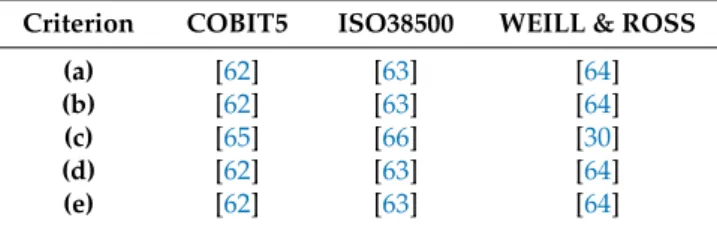
(13) Sustainability 2018, 10, 4792. 13 of 25. 26.1, 26.2 and 23.3 (section only A); 3.1.3, 3.2.1 and 3.3.1 (section only D); G4-44 and G4-51b (section only B). 3.2. Activity 2: Determine the Deficiencies of the ITG Approaches in ES Feature 3.2.1. Phase 1: Select the Possible Standards and Models to be Analyzed We used the following criteria to select the ITG standards and models for the comparative study: (a) those related to ITG, (b) those with a relevant proponent institution, (c) those most used by organizations, and (d) those with updated information and whose documentation is available. However, in this case and as opposed to Activity 1, it was necessary to incorporate an additional criterion: (e) those with a level of detail equivalent to a sub-activity level, regardless of what it is called. This was necessary to take advantage of the level of detail (sub-activity) achieved in the identification of the relevant ES factors, which acts as the reference model for Activity 2 (see Figure 1). Otherwise, it would not be guaranteed that the comparison and the subsequent quantification would be completely objective. Using these criteria, the following approaches were selected: COBIT5:2012, ISO38500:2015, and WEILL & ROSS:2005. Table 5 shows the bibliographic references that support compliance with the criteria for each approach. It is worth mentioning that we have not selected other models for not meeting any of the aforementioned criteria. For example, the ITG Framework for SMEs (SMEsITGF) [33] and the ITG Model for Universities (MITGU) [32] have not been selected because they do not meet criteria b) and c), and the CALDER-MOIR [29,60] and FORRESTER [31,61] approaches have been excluded because they do not meet criterion e), since they are limited to the level of activity. Table 5. Bibliographic references supporting the compliance with the criteria for the selection of ITG standards and models. Criteria: (a) related to ITG, (b) relevant proponent institution, (c) most used by organizations, (d) updated information and whose documentation is available, and (e) level of detail equivalent to a sub-activity level. Criterion. COBIT5. ISO38500. WEILL & ROSS. (a) (b) (c) (d) (e). [62] [62] [65] [62] [62]. [63] [63] [66] [63] [63]. [64] [64] [30] [64] [64]. The relevance of the criterion (e) can be illustrated by trying to compare COBIT5 using the activity instead of the sub-activity level (in the unified structure) with the relevant ES factors. Thus, going back to the example shown in Section 3.1.6, the activity “EMS1 Understanding the organization and its context” of the relevant ES factors is composed of four sub-activities. In this case, the activity “Evaluate” of the process “EDM01 Ensure Governance Framework Setting and Maintenance” from COBIT5 (Table S2a in the supplementary material) could be covered by the above-mentioned EMS1 activity. However, this would be a subjective comparison since it would be not guaranteed to have a connection with all its sub-activities. In fact, if we descend to the sub-activity level, we will see that only two of the four sub-activities of EMS1 are covered by COBIT5, as it will be explained later in Section 3.2.6. 3.2.2. Phase 2: Define the Reference Model In this case, the reference model is the set of the relevant ES factors identified in Activity 1, which are composed of activities and sub-activities. This reference model will be compared with the three approaches selected in the previous phase. Table 6 shows a descriptive synthesis for these.
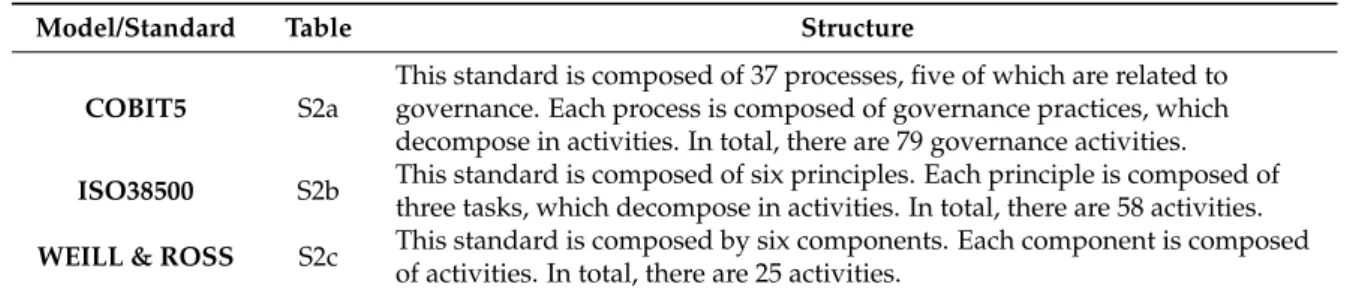
(14) Sustainability 2018, 10, 4792. 14 of 25. approaches, whereas a detailed description for each approach is provided in the supplementary material (Table S2a–c). Each table shows the name of the phase, the name of the activity and its coding. Table 6. Descriptive synthesis of the ITG approaches. Model/Standard. Table. COBIT5. S2a. ISO38500. S2b. WEILL & ROSS. S2c. Structure This standard is composed of 37 processes, five of which are related to governance. Each process is composed of governance practices, which decompose in activities. In total, there are 79 governance activities. This standard is composed of six principles. Each principle is composed of three tasks, which decompose in activities. In total, there are 58 activities. This standard is composed by six components. Each component is composed of activities. In total, there are 25 activities.. 3.2.3. Phase 3: Select the Process(es) to be Analyzed In this case, the processes to be considered are all those relating the dimension of ES and ITG. Therefore, all the processes included in each ITG approach will be analyzed to see if they consider or not the ES factors identified in Activity 1. 3.2.4. Phase 4: Set the Level of Detail The minimum granularity is the sub-activity level. This is because the ITG approaches will be mapped with the relevant ES factors, which are composed by activities and sub-activities. This was to avoid the “grosso modo” issue stated in the Introduction. Logically, homogeneity should be maintained between both levels of detail. When addressing the homogeneity criterion, we are faced with the same inconvenient detail in Phase 4 for Activity 1 (Section 3.1.4). In this regard, it should be noted that all the ITG approaches studied in this work have the same level of detail, although they use different nomenclatures. For example, where COBIT5 talks about activities, the relevant ES factors talk about sub-activities. Table 7 summarizes the relevant information until now: it shows, for each approach, the original and the unified structure based on the relevant ES factors. The nomenclature has been unified taking into account the level of detail provided for each approach, irrespective of the name used by each one. Table 7. Structure and level of detail of each ITG approach. ITG Approach. Original Structure. Unified Structure. COBIT5 ISO38500 WEILL & ROSS. Process/government practice/activity Principle/task/activity Component/activity. Phase/activity/sub-activity Phase/activity/sub-activity Activity/sub-activity. 3.2.5. Phase 5: Create a Correspondence Template We considered the correspondence template:. • • •. following. aspects. presented. before. in. order. to. define. the. Selected ITG approaches: COBIT5, ISO38500 and WEILL & ROSS. Reference model: relevant ES factors derived from Activity 1 (cf. Figure 1). Level of detail that will be used for the comparisons: sub-activity (in the unified structure).. The elements that make up the template are: the relevant ES factors (using the structure Activity, Sub-activity and the Approach which contributes) and the sub-activities that are connected to an ES factor (and how this connection is) for each ITG approach. Thus, during the mapping process, there were different situations determined by two dimensions: location and content. The “location” dimension refers to whether or not the ES sub-activity is located on the ITG approach. On the other.
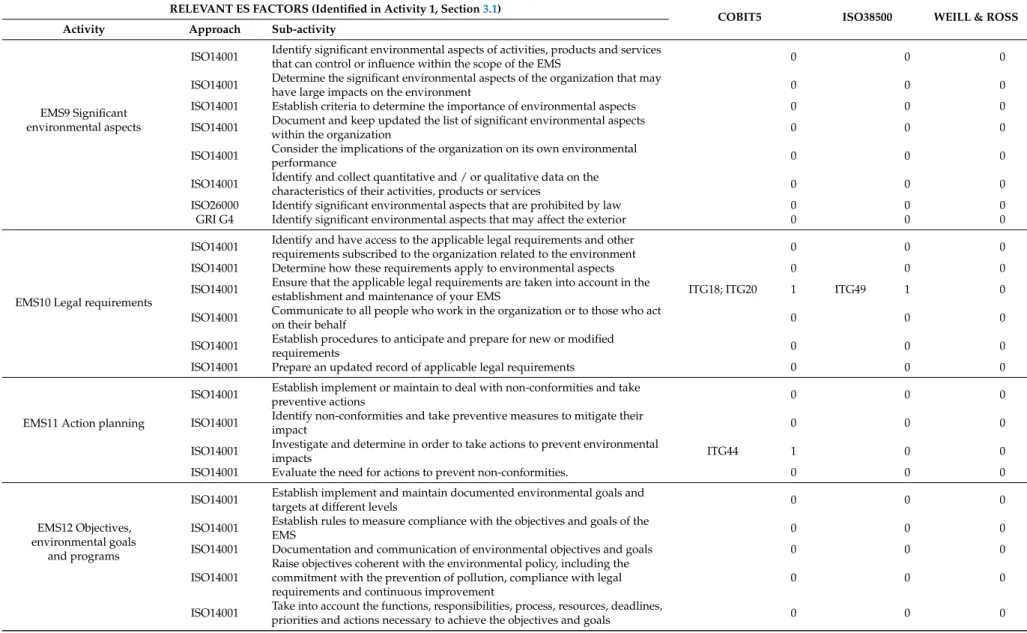
(15) Sustainability 2018, 10, 4792. 15 of 25. hand, the “content” dimension refers to the matching of the points of view (ES and ITG) for the considered ES factor. There are the following four possible situations based on these two dimensions:. • •. • •. Situation 0: The relevant ES factor (sub-activity) does not exist in ITG (i.e., neither of these dimensions are fulfilled). Situation 1: The relevant ES factor (sub-activity) partially corresponds to ITG, but it deals with ES in one model and deals with ITG in the other (i.e., location is partially fulfilled and content is not fulfilled). Situation 2: The relevant ES factor (sub-activity) is present in ITG, but it deals with ES in one model and deals with ITG in the other (i.e., location is fulfilled and content is not fulfilled). Situation 3: The relevant ES factor (sub-activity) is present and with the same meaning in ITG (i.e., both location and content are fulfilled).. 3.2.6. Phase 6: Identify the Similarities among the Models Table 8 shows the correspondence template filled with the results of the mapping process. It is worth mentioning that the situation labeled as “3” in the previous phase never happened. As a representative example of ES deficiencies in ITG, we found the other three possible situations considering the activity “EMS2 Understanding the needs and expectations of interested parties” and COBIT5 (see Table 8). The situation “0” appeared when the sub-activity “Identify the interested parties that are affected”, provided by ISO14001, was considered: it does not exist in COBIT5 (i.e., empty cell). The situation “1” appeared when the sub-activity “Identify the interests of the stakeholders that are affected”, provided by ISO26000, was considered: it is partially considered in COBIT5 by its sub-activity ITG44 (in the unified structure, see Table S2a in the supplementary material). However, while it refers to ES in ISO26000, it refers to IT in COBIT5. The situation “2” appeared, for example, when the sub-activity “Identify the needs and expectations of interested parties”, provided by ISO14001, was considered: it is located in COBIT5 through its sub-activity ITG21 (in the unified structure, see Table S2a in the supplementary material). However, as in the previous example, it refers to two different aspects (ES and ITG). 3.2.7. Phase 7: Present the Results We can determine the similarities across the ITG approaches and the relevant ES factors from Table 8 by identifying their common sub-activities:. •. •. Sub-activities with correspondence in the three ITG approaches considered: “Define the environmental policy of the organization within the defined scope”, and “Define representatives to establish, implement and maintain, in addition to establish the functions and responsibilities”. Sub-activities with correspondence in two of the three ITG approaches considered: “Define a strategic plan for Sustainability”, “Establish procedures to deal with risks and opportunities”, “Detail the most important effects, risks and opportunities”, “Ensure that the applicable legal requirements are taken into account in the establishment and maintenance of your EMS”, “Management must ensure the availability of human, specialized, infrastructure, financial and technological resources to establish, implement, maintain and improve the EMS”, “Establish a research, development and innovation environment”, “Describe values, principles, standards and norms of the organization”, ”Define generalities of how external and internal communication will take” and, finally, “Establish, implement and maintain procedures to periodically evaluate compliance with applicable legal requirements”..
(16) Sustainability 2018, 10, 4792. 16 of 25. Table 8. Correspondence template: ITG approaches vs. ES factors. RELEVANT ES FACTORS (Identified in Activity 1, Section 3.1) Activity. Approach. GRI G4 ISO26000 EMAS SGE21. Determine the internal and external problems of the organization, legal aspects and economic environment Strategic focus of the organization (mission, vision, strategies, purposes and scope) Description of the organization Define a strategic plan for Sustainability. ISO14001 ISO14001 GRI G4. Identify the interested parties that are affected Identify the needs and expectations of interested parties Establish and evaluate the participation of interested parties. ISO14001 EMS1 Understanding the organization and its context. EMS2 Understanding the needs and expectations of interested parties. EMS3 Determination of the scope of the EMS EMS4 Environmental management system EMS5 Leadership and commitment. EMS6 Environmental policy. SGE21. Establish forms of communication with interested parties. ISO26000. Identify the interests of the stakeholders that are affected. ISO14001. Define and document the scope of your EMS. ISO14001 ISO14001. ISO14001. SGE21. EMS7 Roles, responsibilities and authorities in the organization. EMS8 Overview of actions to address risks and opportunities. COBIT5. ISO38500. WEILL & ROSS. Sub-activity ITG1. ITG1. ITG21 ITG15; ITG4 ITG72; ITG73; ITG78; ITG79 ITG44. Establish, document, implement, maintain and continually improve an EMS and determine how to meet the requirements of the EMS Assume the obligation to be accountable for the efficiency of the EMS and report the performance of EMS for review and recommendation of improvements Define the environmental policy of the organization within the defined scope. This environmental policy must include: a commitment to continuous improvement and prevention of pollution, document, implement and maintain this environmental policy and communicate to all people who work for the organization Include in environmental policy: the requirements of the legislation signed by the principal of the organization. 2. 0. 0 0. 0. ITG1; ITG8. 2. 2 0. ITG1; ITG8. 0 2. 3.3. 0 1. 0 2 2. 0 0 0. 0 0 0. 2. 0. 0. 1. 0. 0. 0. 0. 0. 0. 0. 0. 0. 0. 0. ITG9. 1. ITG9. 1. ITG11; ITG7; ITG9; ITG10. 2. ITG16. 1. ISO14001 EMAS. Define representatives to establish, implement and maintain, in addition to establish the functions and responsibilities. ISO14001. Define, document and communicate the authorities. ISO14001 ISO14001. Establish a framework to evaluate risks, threats and opportunities Establish procedures to deal with risks and opportunities. ITG41 to ITG56 ITG41 to ITG56. 1 1. GRI G4. Detail the most important effects, risks and opportunities. ITG41 to ITG56. 1. SGE21. Evaluate, prevent and manage a plan for the environmental risks associated with its activity. ITG41 to ITG56. 1. ITG8. 1. 3.1. 0 ITG1; ITG2; ITG4 to ITG7; ITG43. ITG53 ITG27; ITG18; ITG38. 1. 1. 0. 4.1. 1. 0. 0. 0 1. 0 0. 1. 0. 0. 0.
(17) Sustainability 2018, 10, 4792. 17 of 25. Table 8. Cont. RELEVANT ES FACTORS (Identified in Activity 1, Section 3.1) Activity. Approach ISO14001 ISO14001. EMS9 Significant environmental aspects. ISO14001 ISO14001 ISO14001 ISO14001 ISO26000 GRI G4 ISO14001 ISO14001 ISO14001. EMS10 Legal requirements ISO14001 ISO14001 ISO14001 ISO14001 EMS11 Action planning. ISO14001 ISO14001 ISO14001 ISO14001. EMS12 Objectives, environmental goals and programs. ISO14001 ISO14001 ISO14001 ISO14001. COBIT5. ISO38500. WEILL & ROSS. Sub-activity Identify significant environmental aspects of activities, products and services that can control or influence within the scope of the EMS Determine the significant environmental aspects of the organization that may have large impacts on the environment Establish criteria to determine the importance of environmental aspects Document and keep updated the list of significant environmental aspects within the organization Consider the implications of the organization on its own environmental performance Identify and collect quantitative and / or qualitative data on the characteristics of their activities, products or services Identify significant environmental aspects that are prohibited by law Identify significant environmental aspects that may affect the exterior Identify and have access to the applicable legal requirements and other requirements subscribed to the organization related to the environment Determine how these requirements apply to environmental aspects Ensure that the applicable legal requirements are taken into account in the establishment and maintenance of your EMS Communicate to all people who work in the organization or to those who act on their behalf Establish procedures to anticipate and prepare for new or modified requirements Prepare an updated record of applicable legal requirements Establish implement or maintain to deal with non-conformities and take preventive actions Identify non-conformities and take preventive measures to mitigate their impact Investigate and determine in order to take actions to prevent environmental impacts Evaluate the need for actions to prevent non-conformities. Establish implement and maintain documented environmental goals and targets at different levels Establish rules to measure compliance with the objectives and goals of the EMS Documentation and communication of environmental objectives and goals Raise objectives coherent with the environmental policy, including the commitment with the prevention of pollution, compliance with legal requirements and continuous improvement Take into account the functions, responsibilities, process, resources, deadlines, priorities and actions necessary to achieve the objectives and goals. 0. 0. 0. 0. 0. 0. 0. 0. 0. 0. 0. 0. 0. 0. 0. 0. 0. 0. 0 0. 0 0. 0 0. 0. 0. 0. 0. 0. 1. 0. 0. 0. 0. 0. 0. 0. 0. 0. 0. 0. 0. 0. 0. 0. 0. 1. 0. 0. 0. 0. 0. 0. 0. 0. 0. 0. 0. 0. 0. 0. 0. 0. 0. 0. 0. 0. 0 ITG18; ITG20. ITG44. 1. ITG49.
(18) Sustainability 2018, 10, 4792. 18 of 25. Table 8. Cont. RELEVANT ES FACTORS (Identified in Activity 1, Section 3.1) Activity EMS13 Planning of actions to achieve environmental objectives and goals. Approach. Sub-activity. ISO14001. Design plans to monitor the progress of objectives and goals Establish, implement and maintain one or several programs to achieve objectives and goals Assignment of responsibilities to achieve the objectives and goals in the relevant functions and levels of the organization Establish means and deadlines to achieve the objectives set in the program. ISO14001 ISO14001 ISO14001 ISO14001. EMS14 Resources. ISO14001 SGE21 SGE21 ISO14001. EMS15 Competence. ISO14001 ISO14001 ISO14001. EMS16 awareness. ISO14001 ISO14001 ISO14001 ISO14001 GRI G4 ISO14001 ISO14001. EMS17 Communication. ISO14001 ISO14001 ISO14001 ISO26000. Management must ensure the availability of human, specialized, infrastructure, financial and technological resources to establish, implement, maintain and improve the EMS The assignation of resources must be reviewed by the management to guarantee its availability Define responsible purchasing criteria Establish a research, development and innovation environment. COBIT5. Define generalities of how external and internal communication will take Establish procedures for internal communication between the levels and functions of the organization Document communication decision with its external stakeholders Set one or several methods to perform external communication Establish procedures to receive, document and respond to relevant communications from interested parties Establish the type of information subject to communication with interested parties. WEILL & ROSS. 0. 0. 2.4. 1. 0. 0. 0. 0. 0. 0. 0. 0. 0. 1. 0. ITG25; ITG28; ITG27; ITG34. 1. ITG58; ITG67. 2. 0. 0. 0. 0. 0. ITG23; ITG31;ITG35. Ensure that personnel working in or on behalf of the organization are competent based on their training, education and appropriate experience Identify the training needs of the staff working within or on behalf of the organization Provide training or undertake other training actions for staff and keep track People who work in the organization or on behalf of it must comply with the environmental policy The significant environmental aspects and impacts relating them to their jobs The environmental benefits provided by your personal best performance The functions and responsibilities that it has in the EMS The potential consequences of deviating from environmental procedures Describe values, principles, standards and norms of the organization. Establish internal and external mechanisms to report unethical or illicit behavior and matters related to the integrity of the organization.. ISO38500. ITG29. 2. ITG25. 1. 0. 0. ITG6; ITG7. 1. 0. 0. 0. 0. 0. 0. 0. 0. ITG43. 2. 0. 0 0 0 0. ITG44. 1 0 0 0. 0 0 0 0. 1. 0. ITG44; ITG45. ITG13; ITG14. 1. ITG72; ITG73. 1. 0. ITG72; ITG73. 1. 0. 0. ITG72; ITG73 ITG72; ITG73. 1 1. 0 0. 0 0. 0. 0. 0. 1. 0. 0. ITG78; ITG79. 4.3. 1.
(19) Sustainability 2018, 10, 4792. 19 of 25. Table 8. Cont. RELEVANT ES FACTORS (Identified in Activity 1, Section 3.1) Activity. Approach ISO14001. EMS18 Documented information. ISO14001 ISO14001 ISO14001 ISO14001 ISO14001 ISO14001 ISO14001 ISO14001 ISO14001. GRI G4, ISO26000. ISO14001 EMS19 Operational planning and control. ISO14001 ISO14001 ISO14001 ISO14001 ISO14001. EMS20 Preparation and response in case of emergency. ISO14001 ISO14001 ISO14001. COBIT5. ISO38500. WEILL & ROSS. Sub-activity The documentation of the EMS must be made taking into account: policy, objectives, goals, scope The documentation must include the required records of this international standard Creation and update: Approve the documents regarding their adaptation before their issuance Review and update documents when necessary and approve them again Control of documented information Ensure the identification of changes and the current revision status of documents Ensure that versions of applicable documents are available at points of use Ensure readability and easy identification of documents Ensure the identification of external documents necessary for the EMS Prevent unintentional use of obsolete documents or apply proper identification in case of keeping them for some reason Obtain verification by the interested parties of the information given. Use a rigorous and responsible verification process, in which the data and information come from a reliable source that allows the verification of their accuracy Identify and plan operations associated with significant environmental aspects Establish, implement and maintain documented procedures to control situations that deviate from the environmental policy, objectives and goals Establish operational criteria in work procedures Establish documented procedures for goods and services used by the organization Communicate procedures and requirements to suppliers and contractors Establish, implement and maintain one or several procedures to identify potential situations of potential accidents and emergencies, as well as document how to respond to them Establish procedures to respond to emergency situations and prevent or mitigate environmental impacts Periodically review and modify, when necessary, their emergency preparedness and response procedures, particularly after accidents occur Periodic testing of established procedures, when feasible. ITG70; ITG75; ITG76; ITG77. ITG79. 1. 0. 0. 0. 0. 0. 1. 0. 0. 0. 0. 0. 0. 0. 0. 0. 0. 0. 0. 0. 0. 0. 0. 0. 0. 0. 0. 0. 0. 0. 0. 0. 0. 0. 0. 0.
(20) Sustainability 2018, 10, 4792. 20 of 25. Table 8. Cont. RELEVANT ES FACTORS (Identified in Activity 1, Section 3.1) Activity. Approach. EMS21 Monitoring, measurement, analysis and evaluation. ISO14001. EMS22 Legal fulfillment evaluation. ISO14001. EMS23 Internal Audit. ISO14001. ISO14001 ISO14001 ISO14001 ISO14001 ISO14001. EMS24 Review by the main principals. ISO14001 ISO14001 ISO14001 ISO14001 ISO14001. EMS25 Improvement of non-conformity, corrective action.. ISO14001 ISO14001 ISO14001 ISO14001 ISO14001 ISO14001 ISO14001 ISO14001 ISO14001. EMS26 Continuous improvement. ISO14001 ISO14001. EMS27 Supervise the governance. GRI G4. COBIT5. ISO38500. WEILL & ROSS. Sub-activity Establish, implement, document and maintain one or several procedures to track and regularly measure the fundamental characteristics of its operations that can achieve significant impacts on the environment Ensure that monitoring and measuring equipment are used and maintained calibrated or verified and records kept Establish, implement and maintain procedures to periodically evaluate compliance with applicable legal requirements Keep records of the results of periodic evaluations. ITG18. 0. 0. 0. 0. 0. 0. 1. 0. 2. ITG49. 0. 0. 0 0. ITG46 ITG46. 1 1. 0 0. 0. ITG46. 1. 0. 0. 0. 0. 0. 0. 0. 1. 0. 0. 0. 0. 0. 0. 0. 0. 0. 0. 0 0 0 0 0 0 0 0. 0 0 0 0 0 0 0 0. 0 0 0 0 0 0 0 0. 0. 0. 0. Evaluate the environmental management system The organization must continuously improve the EMS. 0 0. 0 0. 0 0. Supervise the governance. 0. 0. 0. Establish policies to ensure that audits are conducted at planned intervals Establish, implement and maintain audit programs Establish procedures that deal with the determination of audit criteria, frequency and methods Establish procedures for senior management to review the EMS at planned intervals Establish policies to keep records of revisions by management Establish that the results of the reviews include the decisions and actions taken related to possible changes in the environmental policy Establish, implement and maintain procedures to deal with real and potential conformities and take corrective actions Take appropriate actions in relation to the magnitude of the problems and environmental impacts found Ensure that any necessary changes are incorporate into the documentation of the environmental management system Evaluate the need to take action to eliminate the causes of non-compliance Implement any necessary corrective action Review the effectiveness of the corrective measures adopted Identify and correct the non-conformities Investigate the non-conformities (determining causes and taking actions) Evaluation of the need for actions to prevent non-conformities Record of the results of the preventive and corrective actions taken Review of the effectiveness of the preventive and corrective actions taken Ensure that any necessary changes are incorporate into the EMS documentation. 0. 0. ITG41.
(21) Sustainability 2018, 10, 4792. 21 of 25. Taking into account the previous points, we can determine to what extent the relevant ES factors are present in the ITG approaches in order to obtain quantitative measurements about their sustainability deficit. This quantitative study was categorized according to the types of situations already discussed in Section 3.2.5, since each represents a different type of deficiency. Table 9 summarizes the quantitative results. Thus, the first two columns show the number of activities and sub-activities of the relevant ES factors. The last six columns show, for each situation described in Section 3.2.5, the number of sub-activities (ES factors) that are connected to the ITG approach and the corresponding percentage. Table 9. Synthesis of the quantitative study derived from Table 8. Relevant ES Factors Activities. SubActivities. 27. 103. Situations ITG Approach. COBIT5 ISO38500 WEILL & ROSS. “0”. “1”. “2”. Number Of Sub-Activities. %. Number of Sub-Activities. %. Number of Sub-Activities. %. 75 85 98. 72.82 82.52 95.15. 19 15 5. 18.45 14.56 4.85. 9 3 0. 8.74 2.91 0.00. 4. Discussion This work addressed two main objectives regarding sIT Governance: identifying the relevant ES factors derived from the main ES approaches, and determining to what extent these factors are already present in the main ITG approaches. Regarding the first objective, we extracted the relevant ES factors, which are composed of 27 activities and 103 sub-activities (Table 4), from ISO14001, GRI G4, EMAS, SGE21, and ISO26000 (Figure 1, Activity 1). It should be noted that most of these belong to ISO14001, which was the reference model selected in Section 3.1.2. To achieve the second objective (Figure 1, Activity 2), we developed a correspondence template considering the relevant ES factors and COBIT5, ISO38500 and WEILL & ROSS as representative of IT Governance approaches (Table 8). This template let us determine, in a quantitative manner, to what extent current ITG approaches refer to the relevant ES factors (Table 9). Analyzing this last table, we can conclude that the situation labeled as “0” (i.e., the relevant ES factor does not exist in ITG) has, by far, the highest percentages. This situation demonstrates that there is a clear ES deficit in the ITG approaches studied: 72.82% in COBIT5, 82.52% in ISO38500 and 95.15% in WEILL & ROSS. This conclusion quantitatively corroborates the studies performed by Machado et al. [43], and by Merhout and O’Toole [44], although they restricted their analysis only to COBIT. In addition, the quantitative study carried out in our work also reveals that COBIT5 is the proposal that best covers ES issues, as confirmed by the results for situations “1” and “2” in Table 9. It should be noted that the work presented here addressed the two main deficiencies presented in the Introduction section, since: 1.. 2.. The five main ES approaches (ISO14001, GRI G4, EMAS, SGE21 and ISO26000) have been considered in order to extract the relevant ES factors. It is worth mentioning at this point that, although ISO14001 is the approach providing more ES factors, none of the current studies has considered it. The issue about “grosso modo” was considered by applying the criteria of homogeneity and granularity to select the level of detail.. Future work should focus on two immediate research lines. The first would address the specific deficiencies of each ITG approach to make it “more sustainable”. The second line, where we are currently working, would develop a new framework for sIT Governance, including ES in the ITG processes. Thus, we are identifying the relevant (i.e., not general) ITG factors from the main ITG.
(22) Sustainability 2018, 10, 4792. 22 of 25. approaches using the same criteria that were employed here to identify the relevant ES factors. The idea is to develop a correspondence template between the relevant ES and the relevant ITG factors with the purpose to identify the type of ES deficits of the relevant ITG factors. Once these deficiencies have been identified, we can propose a sIT Governance framework. In order to improve this proposal, it will also be important to perform case studies in different organizations. Finally, it is important to note that by using ISO14001 as the reference model we can take advantage of the synergies derived from its wide dissemination. ISO14001 certified organizations would find the new framework familiar. Supplementary Materials: The following are available online at http://www.mdpi.com/2071-1050/10/12/4792/ s1, Table S1a: Description of ISO14001, Table S1b: Description of GRI G4, Table S1c: Description of EMAS, Table S1d: Description of SGE21, Table S1e: Description of ISO26000, Table S2a: Description of COBIT5, Table S2b: Description of ISO38500, Table S2c: Description of the framework by Peter Weill and Jeanne W. Ross. Author Contributions: This paper presents collaborative research results written by W.R.-A. and J.C.-P. (Universidad Técnica de Machala, Ecuador), and by J.A.-G., R.G.-V., V.M.-A., S.R.-Y. and S.S.-G. (Universidade da Coruña, Spain). W.R.-A., J.A.-G. and S.R.-Y. conceived and designed the research, and, with J.C.-P., R.G.-V., V.M.-A. and S.S.-G., performed the research. W.R.-A., J.A.-G., V.M.-A. and S.R.-Y. wrote the main part of the article with substantial input and reviews from the other authors, including the analysis and the interpretation of the results. All authors read and approved the final manuscript. Funding: This research received no external funding. Acknowledgments: We kindly thank the anonymous reviewers for their valuable comments. This work is the result of a PhD collaboration agreement between the Universidade da Coruña (Spain) and the Universidad Técnica de Machala (Ecuador). Conflicts of Interest: The authors declare no conflicts of interest.. References 1. 2.. 3. 4.. 5. 6. 7.. 8.. 9.. 10.. Fokina, O.V.; Fufacheva, L.A.; Sozinova, A.A.; Sysolyatin, A.V.; Bulychev, L.L. Information and communication technologies as a new vector of development of modern global economy. Espacios 2018, 39, 8. ISACA. Sustainability; ISACA: Rolling Meadows, IL, USA, 2012; Available online: http://www.isaca.org/ Knowledge-Center/Research/Documents/Sustainability_whp_Eng_0411.pdf?regnum=460686 (accessed on 11 December 2018). Van der Leeuw, S. Closing remarks: Novel approaches to complex societal change and sustainability. Sustain. Sci. 2018. [CrossRef] United Nations, UN. Report of the World Commission on Environment and Development: Our Common Future, UN Documents: Gathering a Body of Global Agreements, compiled by the NGO Committee on Education of the Conference of NGOs from United Nations Web Sites, transmitted to the General Assembly as an Annex to Document A/42/427 Development and International Co-Operation: Environment. 1987. Available online: www.un-documents.net/wced-ocf.htm (accessed on 23 November 2018). Fernández-Guadaño, J.; Sarria-Pedroza, J. Impact of Corporate Social Responsibility on Value Creation from a Stakeholder Perspective. Sustainability 2018, 10, 2062. [CrossRef] ITGI (IT Governance Institute). Board Briefing on IT Governance, 2nd ed.; ITGI: Schaumburg, IL, USA, 2003; p. 10, ISBN 1-893209-64-4. Quezada-Sarmiento, P.A.; Chango-Canaveral, P.M.; Benavides-Cordova, V.M.; Jumbo-Flores, L.A.; Barba-Guaman, L.; Calderon-Cordova, C.A. Referent framework to government of IT using standards: COBIT 5 and ISO 38500. In Proceedings of the 2017 12th Iberian Conference on Information Systems and Technologies (CISTI), Lisbon, Portugal, 21–24 June 2017; pp. 1–6. International Organization for Standardization. ISO 14001:2015 Environmental Management Systems—Requirements with Guidance for Use; International Organization for Standardization: Geneva, Switzerland, 2015; Available online: http://imsiran.ir/?wpfb_dl=25 (accessed on 11 December 2018). Pesce, M.; Shi, C.; Critto, A.; Wang, X.; Marcomini, A. SWOT Analysis of the Application of International Standard ISO 14001 in the Chinese Context. A Case Study of Guangdong Province. Sustainability 2018, 10, 3196. [CrossRef] Fonseca, L.; Domingues, J. Exploratory Research of ISO 14001:2015 Transition among Portuguese Organizations. Sustainability 2018, 10, 781. [CrossRef].
(23) Sustainability 2018, 10, 4792. 11.. 12. 13. 14. 15. 16. 17. 18. 19. 20. 21.. 22.. 23. 24.. 25.. 26.. 27.. 28.. 29. 30. 31. 32. 33.. 23 of 25. Global Reporting Initiative. G4 Sustainability Reporting Guidelines. 2015. Available online: https://www. globalreporting.org/resourcelibrary/GRIG4-Part1-Reporting-Principles-and-Standard-Disclosures.pdf (accessed on 11 December 2018). Wu, S.; Shao, C.; Chen, J. Approaches on the Screening Methods for Materiality in Sustainability Reporting. Sustainability 2018, 10, 3233. [CrossRef] Seifert, C. The Barriers for Voluntary Environmental Management Systems—The Case of EMAS in Hospitals. Sustainability 2018, 10, 1420. [CrossRef] Merli, R.; Preziosi, M.; Ippolito, C. Promoting Sustainability through EMS Application: A Survey Examining the Critical Factors about EMAS Registration in Italian Organizations. Sustainability 2016, 8, 197. [CrossRef] Daddi, T.; Iraldo, F. The effectiveness of cluster approach to improve environmental corporate performance in an industrial district of SMEs: A case study. Int. J. Sustain. Dev. World Ecol. 2016, 23, 163–173. [CrossRef] Testa, F.; Rizzi, F.; Daddi, T.; Gusmerotti, N.M.; Frey, M.; Iraldo, F. EMAS and ISO 14001: The differences in effectively improving environmental performance. J. Clean. Prod. 2014, 68, 165–173. [CrossRef] Merli, R.; Preziosi, M.; Massa, I. EMAS Regulation in Italian Clusters: Investigating the Involvement of Local Stakeholders. Sustainability 2014, 6, 4537–4557. [CrossRef] Montobbio, F.; Solito, I. Does the Eco-Management and Audit Scheme Foster Innovation in European Firms? Does EMAS Foster Innovation in European Firms? Bus. Strategy Environ. 2018, 27, 82–99. [CrossRef] Forética. SGE 21 Ethical and Socially Responsible Management System. 2017. Available online: http: //www.foretica.org/sge_21_ingles.pdf (accessed on 11 December 2018). Duque Orozco, Y.V.; Cardona Acevedo, M.d.l.M.; Rendón Acevedo, J.A. Responsabilidad Social Empresarial: Teorías, índices, estándares y certificaciones. Cuadernos de Administración 2014, 29, 196. [CrossRef] AENOR. Guidance on Social Responsibility; International Organization for Standardization: Geneva, Switzerland, 2010; Available online: http://www.uobaghdad.edu.iq/uploads/pics13/qaa/iso26000.pdf (accessed on 11 December 2018). The World Bank. Environmental and Social Framework; The World Bank: Washington, DC, USA, 2018; Available online: https://www.worldbank.org/en/projects-operations/environmental-and-socialframework (accessed on 11 December 2018). Arimany-Serrat, N.; Sabata-Aliberch, A. Social responsibility as a management system. Intang. Cap. 2018, 14, 116. [CrossRef] Palalloi, I.A.; Anwar, A. Information technology Governance standards on mobile applications for fishing zone based onCobIT 5 Framework in Majene. In IOP Conference Series: Earth and Environmental Science; IOP Publishing: Bristol, UK, 2018; Volume 156, p. 012008. [CrossRef] Trianto, W. Evaluation of Patient Information System in Public Health Service Using the COBIT 5 Framework. In IOP Conference Series: Materials Science and Engineering; IOP Publishing: Bristol, UK, 2018; Volume 407, p. 012166. [CrossRef] Gunawan, W.; Kalensun, E.P.; Fajar, A.N. Sfenrianto Applying COBIT 5 in Higher Education. In IOP Conference Series: Materials Science and Engineering; IOP Publishing: Bristol, UK, 2018; Volume 420, p. 012108. [CrossRef] Espinoza-Aguirre, C.; Pillo-Guanoluisa, D. IT governance model for public institutions with a focus on higher education. In Proceedings of the 2018 13th Iberian Conference on Information Systems and Technologies (CISTI), Caceres, Spain, 13–16 June 2018; pp. 1–14. Putri, R.E.; Surendro, K. A process capability assessment model of IT governance based on ISO 38500. In Proceedings of the 2015 International Conference on Information Technology Systems and Innovation (ICITSI), Bandung, Indonesia, 16–19 November 2015; pp. 1–6. Velez Lapão, L. Organizational Challenges and Barriers to Implementing IT Governance in a Hospital. Electron. J. Inf. Syst. Eval. 2011, 14, 37–45. Weill, P.; Ross, J.W. IT Governance on One Page. SSRN Electron. J. 2004. [CrossRef] Aguilar Alonso, I.; Carrillo Verdún, J.; Tovar Caro, E. Description of the structure of the IT demand management process framework. Int. J. Inf. Manag. 2017, 37, 1461–1473. [CrossRef] Hontoria Hernández, E.; Fernández, A.; De La Fuente, M.V. Method for it governance based on enterprise modeling. Direccion y Organ. 2011, 45, 5–10. Garbarino-Alberti, H. IT Governance and Human Resources Management: A Framework for SMEs. Int. J. Hum. Cap. Inf. Technol. Prof. 2013, 4, 40–57. [CrossRef].
Figure

+7


Documento similar
The greater availability of data and social interest provide the required scenario to advance in the study and avoid the confusion that can come about from the use of unrealistic
You will participate in fundamental and exploration challenges from the area of Engineering - Computer Studies and Information Technologies, interacting with peers from
bins and its dimensionality. Impact of feature dimensionality. Verification results following the frontal protocol and the mmW TNO database. Verification results following
Linked data, enterprise data, data models, big data streams, neural networks, data infrastructures, deep learning, data mining, web of data, signal processing, smart cities,
The results of this study provide information that allows better understanding of how music students conceive the content (what) and the process (how) of
Advances in Intelligent Data Analysis V: 5th International Symposium on Intelligent Data Analysis, IDA 2003, Berlin, Germany, August 28-30, 2003. Lecture Notes in Computer
We provided them with general guidelines to ease team formation, such as try to make teams whose members share similar personal values, vision (regarding the program
Driven by a notable commercial interest, wireless networks like GSM or IEEE 802.11 are now the focus of industrial attention, because they provide numerous benefits, such as
