Thomas Daniel Stroka · Institute for Sacred Architecture (EEUU)
https://doi.org/10.17979/aarc.2013.3.0.5109
Vivat, Crescat, Floreat: un nuevo carmelo
Vivat, Crescat, Floreat
: A New Carmel
RESUMEN
La orden del Carmen posee una específica espiritualidad contemplativa que demanda un lenguaje arquitectónico autónoma-mente figurativo. La monjas carmelitas de clausura viven en un desierto simbólico, el recinto de su monasterio, a semejanza de los tempranos discípulos de Elías, desperdigados por el Monte Carmelo, en Tierra Santa. Dentro de su vocación de sencillez, se permite a las carmelitas decorar creativamente las capillas de sus monasterios. La presente comunicación ofrece una intro-ducción a la espiritualidad carmelita, las implicaciones arquitectónicas de sus Constituciones y los principios para un nuevo Carmelo.
ABSTRACT
The Carmelite Order has a distinctive spirit of contemplation which calls for an autonomous figurative language of architecture. Cloistered Carmelite Nuns live in a symbolic desert, the enclosure of their monastery, just as early followers of Elijah lived in her-mitages scattered across Mount Carmel in the Holy Land. Despite their call to simplicity, Carmelites are permitted to creatively ornament their monastery chapels. This paper provides an introduction to the Carmelite spirit, architectural implications of their constitutions, examples of Carmelite foundations, and principles for a new Carmel.
PALABRAS CLAVE
Carmelitas; constituciones; Elías; ornamento; arquitectura religiosa.
KEYWORDS
Actas del Congreso Internacional de Arquitectura Religiosa Contemporánea 3 (2013) 249
«The Discalced Carmelite Nuns, by special voca-tion and without depreciating those who, inspired by the Holy Spirit, work for the building up of the earthly city, are led to the solitude of the cloister so as to remain entirely consecrated to contemplation»1. Sacred archi-tecture has an important place in Catholic tradition because of its setting for the worship of God; funda-mental nobility is demanded for the Holy Sacrifice of the Mass and the domus Dei. One commonly overloo-ked tradition is the distinct character of religious hous-es, in particular, the autonomous figurative language of the Carmelite Order, and their patronage of architects and artists. Despite their call for simplicity, their monastery chapels have been creatively ornamented for centuries and have served as powerful places of con-templation for their communities and for lay visitors. This paper will provide an introduction to the Carmelite spirit, architectural implications of their constitutions, examples of Carmelite foundations, and principles for a new Carmel.
The Prophet Elijah, who lived almost three millen-nia ago, is considered the founder of the Carmelite Order and founder of monastic life itself. There is in fact a statue of Elijah at the Vatican among all the figu-res of religious founders (Fig. 01). The spirit of poverty he engendered was so extreme, his followers were happy to live in homes they built with their own hands2.
Fig. 01. The prophet Elijah, founder of the Carmelite Order, gesturing toward the Holy Spirit window at the
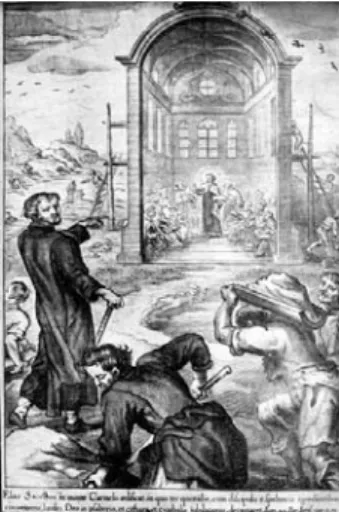
Basilica of Saint Peter, Rome. Fig. 02. The tradition speaks of thebuilding of a Temple to the True God by Elijah and his followers.
It is at Carmel near modern Haifa, Israel, where Elijah competed with the priests of Baal in the ninth century before Christ3. The grotto of the prophetis a small cave at the northern promontory of Mount Carmel which ori-ginally served as an asylum and oratory for Elijah and his followers4(Fig. 02). The idea of contemplation in solitude permeates the daily life of cloistered nuns in the Carmelite Order, and is exhibited in the organiza-tion and order of their monasteries.
Actas del Congreso Internacional de Arquitectura Religiosa Contemporánea 3 (2013) 251 Fig. 08. San Pietro in Oliveto, Brescia (Italy); cloister by Sansovino.
Fig. 03. Countryside surrounding Ávila, Spain, with the Monastery of the Incarnation in the center.
Fig. 05. Reredosat Monastery of the Incarnation, Ávila. Fig. 04. Organization of a monastery at Köln, Germany.
Fig. 06. Duncan G. Stroik, Carmelite Monastery of the Infant Jesus of Prague, Traverse City (Michigan, United States), 2013; the new choir grille.
Fig. 07. Front view etching of the Église de Notre Dame des Champs, Paris, with cloister garth on the left, given over to the Discalced Carmelite Nuns in 1604. Destroyed during the French Revolution.
Crusades, two prominent buildings stood upon Mount Carmel: S. Margaretha castellum, a fortification defended by the Templars, and a Greek abbey dedica-ted to St. Margaret or St. Marina8. The Carmelites endured Muslim raids until they were eliminated from Mount Carmel by the Saracens in the year 1291. The spirit of the order developed as it expanded in a dias-pora beyond the Holy Land. The brothers of Our Lady of Mount Carmel were considered by the Church a mendicant order, the third formally established, after the Franciscans and Dominicans9.
The Primitive Rule, given by St. Albert, Patriarch of Jerusalem, was recognized by Pope Honorius III in 1226 and formally confirmed by Pope Innocent IV as the first rule of the Carmelites (Fig. 03). With only fif-teen points, it includes references for monastery buil-dings. «2. On the choice of foundation sites: You may have foundations in Deserts, or wherever they shall be
THOMAS D. STROKA
Monastery of the Incarnation at Ávila, where St. Teresa would join the Order at the age of eighteen (Fig. 05). In 1562, during the reign of Philip II, just as the last monastery observing the Primitive Rule at Cyprus was taken by the Turks, St. Teresa founded the Monastery of St. Joseph at Ávila, re-instituting the Primitive Rule once again15. The Holy Mother Teresa of Jesus gave to her nuns, at the chapter of Alcalá in 1581, specific constitutions which also point out architectural requirements. The reform initiated by St. Teresa soon expanded to Italy, France and the Low Countries. Guided by Teresa, Father Antonio de Heredia and Father John de Yepey (St. John of the Cross) assisted in the reform of the Carmelite Fathers. The enclosure of the nuns makes them distinct from the men of the Order. «1. The Religious may not be seen without veil except by their parents, brothers and sisters, or in some other cases where there may be an equally just reason...»16. The law of enclosure applies to all parts of the monastery, including the garden, which should be encircled by a high wall17. The public church and the exterior sacristy are the only two areas accessible by others. The most familiar point of con-nection between the enclosure and the public is the turn, where packages can be delivered to the nuns. Inside the church, the laity hear the nuns in song and prayer, but do not see them beyond the grille (Fig. 06). «The material separation between the choir reserved to the nuns and the Church will be made by means of an iron grate placed over a fixed and immovable sup-port and another formed by wooden bars in a vertical position»18. This grille is also closed off by a curtain from the inside of the choir during all times except the liturgical celebration. To impart the spirituality of the desert hermitage, the monastery has both regular cells in the Cloister, as well as hermitages in the woods, where the Religious may find more solitude and absti-nence19. A spirit of simplicity permeates the monastery in its order and daily life. The manual labor of the nuns is not permitted to be so elaborate as to hinder
de Medici, the Queen of France, assisted in financing the beautification of the first monastery in Paris in 1604 (Fig. 07). The Discalced Carmelites were given the Benedictine priory of Notre Dame des Champs, rena-med Carmélites Déschausées. Philippe de Champagne painted stories from Scripture on the vaulted ceiling, while paintings by Guy de Bolonese, Le Brun, and La Hire were located under each window of the church. A wall can be seen which provides for the enclosure around the perimeter of the monastery, as stipulated in the Constitutions. «The walls should be as strong as possible; those of the enclosure high, within which there shall be ample ground so that the Religious may build some hermitages, to which they may retire for prayer after the example of our Holy Fathers»20. The chapel and monastery buildings were sold and demol-ished at the Revolution21
. The Infant Isabella and Archduke Albert VII in the Netherlands asked for the Carmelites to establish a foundation in their land, and had a new monastery built in Brussels. The first English-speaking Carmelites were founded at Antwerp, since all Religious were banished from England and their monasteries destroyed. In Italy, the Carmelites were given the convent of San Pietro in Oliveto, in Brescia. The cloister arcade is attributed to architect Jacopo Sansovino22 (Fig. 08). The formality of Carmelite cloisters is inherited from other monastic orders; the four sides of the court can represent the four rivers of Paradise and the four cardinal virtues, a moral world in which the cloistered are immersed23
.
While the living quarters of the nuns are to be very simple, the church is set apart with great nobility, an example of the ornamentation permitted by the Constitutions. «3. The house, with the exception of the Church, should have nothing ornamental in it; the woodwork should be rough, the house should be small, and the ceilings low, so that what is necessary and not what is superfluous is provided»24. One of the great examples of Carmelite architecture is Santa Maria di Nazareth, in Venice (Fig. 09). The church,
built from 1656/73, was designed by Baldassare Longhena and embellished with a new high altar by Carmelite architect Giuseppe Pozzo in 168525
. Magnificent examples by the Carmelites can be found in the New World, such as at the Templo de Nuestra Señora del Carmen de Celaya, begun in 1802 with the design by don Francisco Eduardo Tresguerras. The Carmelite Monastery of the Infant Jesus, in Santa Clara, California, was designed by Maginnis & Walsh Architects in 1919 (Fig. 10). Certain elements are lif-ted directly from the Carmelite tradition, such as the unique belfry design from the monastery at Ávila26. Though the cells are small and severe, the chapel inte-rior is adorned with a great gilded reredos with a Nativity group flanked by Isaiah and John the Baptist. Also in the United States, the Carmelite Order
dona-Fig. 12. Josep Lluis Sert, Carmel de la Paix, Mazille (France), 1973; the exterior view.
THOMAS D. STROKA
ted the funds for the Our Lady of Mount Carmel Chapel at the National Shrine of the Immaculate Conception in Washington DC27
.
In 1817, John Baptist Frascatti, architect, was com-missioned by the General of the Order to examine the condition of the Monastery of Mount Carmel in the Holy Land28(Fig. 11). The cornerstone of the new Stella Maris Monastery was laid in 1827, and it was conse-crated in 1836. Granite columns dating from the con-vent of Cherbon IV in 1263 were uncovered and set up in the refectory of the monastery. The corridors and cloisters were paved in white marble. The chapel was consecrated a basilica in 1920 by the Patriarch of Jerusalem29.
a new Carmel (Fig. 12). In the last fifty years since the Second Vatican Council, there has been a profusion of iconoclast churches, which diverge from the tradition of sacred architecture and do not adequately serve for con-templation or Divine Worship. There are a few proposi-tions for new Carmelite foundaproposi-tions: First, the enclosu-re must be continuous around the property, and provide a true spiritual desert for the nuns. The monastery may include shared cloisters and gardens but also should provide private hermitages for the nuns to pray in soli-tude (Fig. 14). Second, there must be separation from the lay faithful and the cloistered. In the chapel, the choir grille provides a secure barrier. An altar rail can define the space of the sanctuary while also preventing distracting sightlines for the nuns toward the nave. Thirdly, Teresa of Ávila permits ornament in the chapel
Fig. 13. Duncan G. Stroik, Carmelite Monastery of the Infant Jesus of Prague, Traverse City (Michigan, United States), 2013; the interior renovation.
of the monastery. An iconographic program can be incorporated, inspired by the multitude of Carmelite saints and daily liturgical prayers. Vertical proportions and natural light can provide a transcendent setting for the Holy Sacrifice of the Mass. The domus Deishould contrast with the simplicity of the nuns’ cells and pro-vide scenes for contemplation of the one true God. Fourth, the location of the chapel can be at the heart of the monastery so that the cells of the nuns are gathered around the presence of the Lord (Fig. 15). Inspired by the Carmelite tradition in the Holy Land and the European diaspora, a new Carmel for the twenty-first century may be a wellspring for communion with God for both nuns and laity.
«Vivat, crescat, floreat, vita contemplative!»30. May the contemplative life live, increase and flourish!
PROCEDENCE OF ILUSTRATIONS Fig. 01. Photo by Agnieszka Napiorkowska.
Fig. 02-04. Drawing from Speculum Carm. Martini, Pater Clemens, Der Deutsche Carmel(Bamberg: Dr. J. Kirsch, 1922).
Fig. 03. Photo by Jim Forest.
Fig. 05, 14. Photo by Father Lawrence Lew, OP. Fig. 06, 13. Photo by Dietrich Floeter.
Fig. 07, 09, 15. Trustees of the British Museum ©. Fig. 08. Photo by Roby BS89.
Fig. 10. Photo by Chris Esler. Fig. 11. Photo by Ilia Krivoruk. Fig. 12. Photo by Philippe Gozal.
NOTES
(1) Rule and Constitutions of the Discalced Nuns of the Order of the Most Blessed Virgin Mary of Mount Carmel(1990), paragraph 213, 175.
THOMAS D. STROKA
(2) 2 Kings, 6: «Behold the place where we dwell with thee is too straight for us, let us go as far as the Jordan and take out of the wood, every man a piece of timber, that we may build us there a place to dwell in».
(3) Cf. Jaime Antonio Abundis Canales, La Huella Carmelita en San Angel I(Córdoba: Instituto Nacional de Antropología e Historia, 2007), 15.
(4) Cf. «Introduction», Rule and Constitutions, 22-23. «In the prophet Elijah, whom Sacred Scripture presents on the sum-mit of Mount Carmel in profound prayer, burning with zeal for the glory of God and living continually in His presence, the Order recognizes the inspiration of the Carmelite life, dedicated to contemplation in solitude. Elijah accomplishes his work and disappears ‘leaving behind him a spiritual following’».
(5) Cf. Barbié du Bocage and Alexandre François,
Dictionnaire Géographique de la Bible(Paris: De Crapelet, 1834). (6) Cf. The Discalced Carmelites of Boston and Santa
Fig. 14. The sanctuary of the Carmelite church of Sant’ Egidio alla Scala
(8) Cf. Friedman, Carmel in the Holy Land, 28. (9) Cf. Abundis Canales, La Huella Carmelita, 78-81. (10) Rule and Constitutions, paragraph 2, 80. See also Regla y Constituciones de las Monjas Descalzas de la Orden del Beatísima Virgen María del Monte Carmelo(Burgos: El Monte Carmelo, 1927). «2. De la elección de los lugares: Podréis tener sitios en los desiertos, o donde os fueren concedidos, adaptados y acomodados para la observancia de vuestro Instituto, según que al Prior y a los religiosos pareciere conveniente».
(11) Cf. Abundis Canales, La Huella Carmelita, 11. (12) Cf. Jan K. Birksted, An Architecture of Ineloquence: José Lluis Sert’s Carmel de la Paix. A Study in Modern Architecture and Religion(London: Ashgate Publishing, 2013), 62.
(13) Regla y Constituciones, paragraph 3, 81: «3. De las cel-das de los religiosos: Además de ésto, en el sitio que propusié-reis habitar, tenga cada uno de vosotros su celdilla separada, según que por disposición del prior y con el consentimiento de los demás religiosos, o de la parte más sana, fuere señalada a cada uno».
(14) Regla y Constituciones, paragraph 8, 83: «8. Del orato-rio y del culto divino: El oratoorato-rio, en cuanto sea posible, constrú-yase en medio de las celdas, en el cual os juntéis cada día por la mañana a oir misa, donde esto se pueda hacer cómodamente».
(15) Cf. The Discalced Carmelites, 47.
(16) Rule and Constitutions, paragraph 19, 97. Different paragraph number in the Burgos 1927 edition (Regla y Constituciones): «24. No puedan ser vistas las monjas, sin velo, de ninguna persona, si no es de sus padres y hermanos, o en algún caso donde parezca tan justo como en estos».
(17) Cf. Rule and Constitutions, paragraph 215-216, 176.
Actas del Congreso Internacional de Arquitectura Religiosa Contemporánea 3 (2013) 257
para hacer ermitas, para que las monjas se puedan apartar a tener oración, a ejemplo de los Santos Padres».
(21) Cf. History of Paris, from the Earliest Period to the Present Day. Vol. 1(Paris: Galignani, 1832), 319-320.
(22) Cf. Francesco De Leonardis, ed. Brescia: The Cloisters
(Brescia: Fotostudio Rapuzzi, 2005), 22.
(23) Cf. Véronique Rouchon Mouilleron, Cloisters of Europe: Gardens of Prayer(New York: Viking Studio, 2001), 28. See also Hugo de Folieto, De Claustro Animae, and Honorius Augustodunensis, Gemma Animae.
(24) Rule and Constitutions, paragraph 65, 120. Paragraph 98 in the Burgos 1927 edition: «98. No se labre curiosamente la casa, excepto la iglesia; la madera de ella sea muy tosca y la misma casa pequeña y las piezas bajas, de manera que se cumpla la necesidad y no la superfluidad».
(25) Cf. Saverio Sturm, «Liturgia e architettura nel Carmelo riformato. Archetipi, miti, modelli», Revue d’Histoire
Ecclésiastique106 (2011): 61-96 (77).
(26) Cf. Maginnis & Walsh, Architects, «The Carmelite Convent, Santa Clara, California», The Architectural Forum30 (1919).
(27) Cf. Thomas A. Tweed, America’s Church: The National Shrine and Catholic Presence in the Nation’s Capital(New York: Oxford University Press, 2011).
(28) Cf. The Discalced Carmelites, 168. (29) Cf. Idem, 172.