i
PENINSULA OF SANTA ELENA
STATE UNIVERSITY
FACULTY OF EDUCATION AND LANGUAGES
ENGLISH TEACHING CAREER
“DIGITAL GAMES TO DEVELOP ENGLISH BASIC
VOCABULARY FOR SIXTH GRADERS STUDENTS OF
UNIDAD
EDUCATIVA
JOSÉ
PEDRO
VARELA,
LA
LIBERTAD, SANTA ELENA PROVINCE, 2018 - 2019”
RESEARCH PAPER
As a prerequisite to obtain a:
BACHELOR´S DEGREE IN ENGLISH
AUTHOR:
JOSSELYN KATHERINE MINAYA SOLÓRZANO
ADVISOR:
LIC. KLEBER WALTER LOOR ZAMBRANO MSc.
LA LIBERTAD – ECUADOR
ii
UNIVERSIDAD ESTATAL PENINSULA DE
SANTA ELENA
FACULTAD DE CIENCIAS DE LA EDUCACIÓN E
IDIOMAS
CARRERA LICENCIATURA EN INGLÉS
“DIGITAL GAMES TO DEVELOP ENGLISH BASIC
VOCABULARY FOR SIXTH GRADERS STUDENTS OF
UNIDAD
EDUCATIVA
JOSÉ
PEDRO
VARELA,
LA
LIBERTAD, SANTA ELENA PROVINCE, 2018 - 2019”
RESEARCH PAPER
As a prerequisite to obtain a:
BACHELOR´S DEGREE IN ENGLISH
AUTHOR:
JOSSELYN KATHERINE MINAYA SOLÓRZANO
ADVISOR:
LIC. KLEBER WALTER LOOR ZAMBRANO MSc.
LA LIBERTAD – ECUADOR
vi
DEDICATION
In the long way that I had to walk before achieving this important goal, it is necessary to express some special words that reflect the eternal gratitude for those who always encouraged me to follow and go until the end of this journey:
To my aunt Rocío Rodríguez Sánchez who even though she is not with me anymore, I still feel her presence guiding me and giving me energy to carry out all the activities of a mom.
To my mom, Elena Solórzano Arreaga; moms always motivate their kids to be better people. I have been able to feel her infinite love and that was what I needed to go on.
To my lovely daughter Victoria Isabella. She definitely changed my view to life; now, I have someone to become a professional and give her a better future.
To my dear friend, José Carvajal, who has been a strong support and a great guide for me at the moment of developing this work. Thanks for the constant advices of not giving up when I felt that everything was falling in pieces.
Finally, it is preponderant to thank my boyfriend Leonel Cuello Zambrano who has been my life partner. Thank you because of the confidence you have transmitted me in the difficult moments.
vii
ACKNOWLEDGMENT
I wish to express my eternal gratitude to many special people who have been part of the development of this work. First and foremost, I have to thank God for letting me be alive, guiding my steps and making my dreams turn in real experiences. I also have to express my gratitude to my dear mother because she has modeled the person with ethical and moral values that I am right now, without their support and encouragement I could have never achieved this academic goal.
I would like to sincerely thank my thesis advisor, Lcdo. Kleber Loor Zambrano MSc, for his support and motivation throughout the development of this project work and especially for her guidance and confidence.
Additionally, I have to thank Península of Santa Elena State University, to the Director of the English Language Teaching Career, MSc. Sarita Gonzalez, and to the professors from the Languages School; they are definitely responsible for forming the new English language teaching professionals.
Finally, I wish to thank the principal at Escuela de Educación Básica “José Pedro Varela” for their unconditional support in the application of this proposal.
x
TABLE OF CONTENT
DEDICATION ... VI
ACKNOWLEDGMENT ... VII
... VIII
TABLE OF CONTENT ... X
CHARTS ... XIII
1.2 STATEMENT OF THE PROBLEM ... 3
1.3 CONTEXT OF THE PROBLEM ... 4
1.4 RESEARCH QUESTIONS ... 6
1.5 RATIONALE ... 6
1.6 RESEARCH OBJECTIVE ... 7
1.7 IDEA TO DEFEND ... 7
1.8 SCIENTIFIC TASKS ... 8
CHAPTER II ... 9
THEORETICAL BASIS ... 9
2.1 DEFINITION OF KEY TERMS ... 9
2.1.1ENGLISHASASECOND/FOREIGNLANGUAGE ... 9
2.1.2VOCABULARY ... 9
2.1.3TYPESOFVOCABULARY ... 10
2.1.4INFORMATIONANDCOMMUNICATIVETECHNOLOGIES(ICTS) ... 11
2.1.5DIGITALGAMES ... 12
2.1.6INTERACTIVEMULTIMEDIAINEDUCATION ... 12
2.2 PREVIOUS RESEARCH ... 13
2.2.1TEACHINGVOCABULARY ... 13
xi
2.2.3HOWTOTEACHVOCABULARY ... 16
2.2.4STRATEGIESFORTEACHINGVOCABULARY... 17
2.2.5ICTFORTEACHING ... 20
2.2.6DIGITALGAMESINTHETEACHING-LEARNINGPROCESS ... 21
2.2.7SIGNIFICANCEOFIMPLEMENTINGDIGITALGAMES ... 22
2.3 PHILOSOPHICAL BASIS ... 23
2.4 EDUCATIONAL BASIS ... 24
2.5 LEGAL BASIS ... 25
CHAPTER III ... 27
RESEARCH METHODS ... 27
3.1 RESEARCH DESIGN ... 27
3.1.1QUALITATIVEMETHOD... 27
3.1.2QUANTITATIVEMETHOD ... 28
3.1.3DEDUCTIVEMETHOD ... 28
3.2 POPULATION AND SAMPLE ... 28
3.2.1POPULATION ... 28
3.2.2SAMPLE ... 29
3.4 TECHNIQUES AND INSTRUMENTS FOR DATA COLLECTION ... 30
3.4.1TECHNIQUES ... 30
3.4.1.1 Interview... 30
3.4.1.2 Survey ... 30
3.4.2RESEARCHTOOLS ... 30
3.4.2.1 Questionnaires ... 30
3.4.2.1 Camera ... 31
3.5 DATA COLLECTION PLAN ... 31
3.6 DATA PROCESSING PLAN ... 32
3.7 DATA ANALYSIS ... 33
3.7.1INTERVIEWTOUNIDADEDUCATIVA“JOSÉPEDROVARELA”PRINCIPAL ... 33
3.7.2INTERVIEWTOTEACHEROFSIXTHGRADE ... 36
3.7.3INTERVIEWTOENGLISHLANGUAGEEXPERTS ... 39
3.7.4SURVEYIMPLEMENTEDTOSIXTHGRADESTUDENTS ... 45
3.7.5STUDENTS’SURVEY-RESULTCHART ... 55
3.7.6ANALYSISOFRESULTSFROMSTUDENTS‘SURVEY ... 57
3.8 RESULTS AND DISCUSSION ... 57
xii
PROPOSAL ... 59
4.1 NAME OF THE PROPOSAL ... 59
4.2 DESCRIPTION OF THE PROPOSAL ... 59
4.2.1INFORMATIONANDLOCATION ... 59
4.3 PROPOSAL BACKGROUND ... 61
4.4 SIGNIFICANCE ... 62
4.5 OBJECTIVES ... 63
4.5.1GENERALOBJECTIVE: ... 63
4.5.2SPECIFICOBJECTIVE:... 63
4.6 DESIGN AND DEVELOPMENT OF THE PROPOSAL ... 64
4.7 MULTIMEDIA EDUCATIONAL ACTIVITIES WITH EDILIM ... 64
4.7.1WHATISEDILIM?... 64
4.7.2HOWTOINSTALLEDILIM? ... 65
4.7.3HOWTOCREATEANACTIVITYINEDILIM? ... 68
4.7.5 VOCABULARY CONTENT ... 72
4.7.6ACTIVITIES ... 73
4.8 STRATEGIES OF IMPROVEMENT ... 88
4.8 EVALUATION ... 88
4.8.1 RESULTS OF IMPLEMENTATION ... 89
4.8.2 ANALYSIS OF DIAGNOSTIC AND TEST RESULTS OF STUDENTS ... 91
4.9 CONCLUSIONS AND RECOMMENDATIONS ... 92
4.9.1 CONCLUSIONS ... 92
4.9.2 RECOMMENDATIONS ... 92
5 TIMETABLE ... 94
5.1 RESOURCES ... 97
5.2 REFERENCES ... 98
VIRTUAL UPSE LIBRARY REFERENCES ... 102
JOURNALS ... 103
WEB REFERENCES... 103
VIRTUAL UPSE REFERENCES ... 103
xiii
CHARTS
Chart 1: Population of the investigation... 29
Chart 2: Data Collection Plan ... 31
Chart 3: Data Processing Plan ... 32
Chart 4: Personal information of the Principal ... 33
Chart 5: Personal information of the teacher ... 36
Chart 6: Personal information of specialist 1 ... 39
Chart 7: Personal information of specialist 2 ... 42
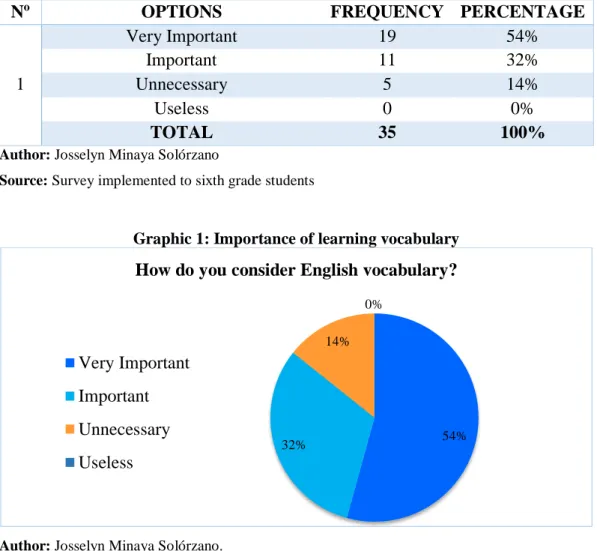
Chart 8: Importance of learning vocabulary ... 45
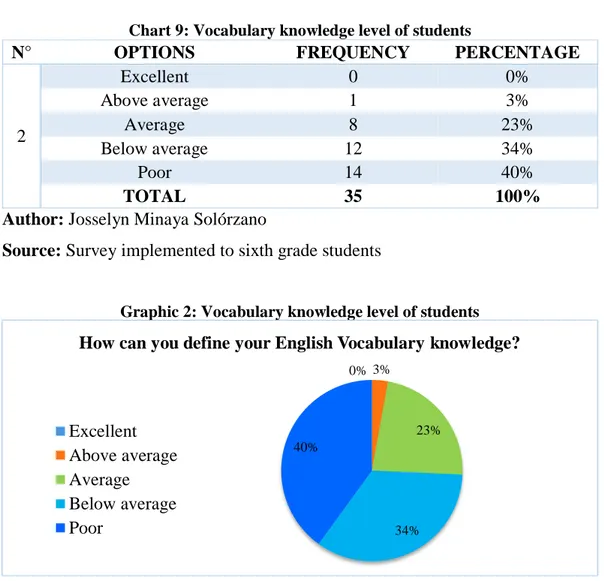
Chart 9: Vocabulary knowledge level of students ... 46
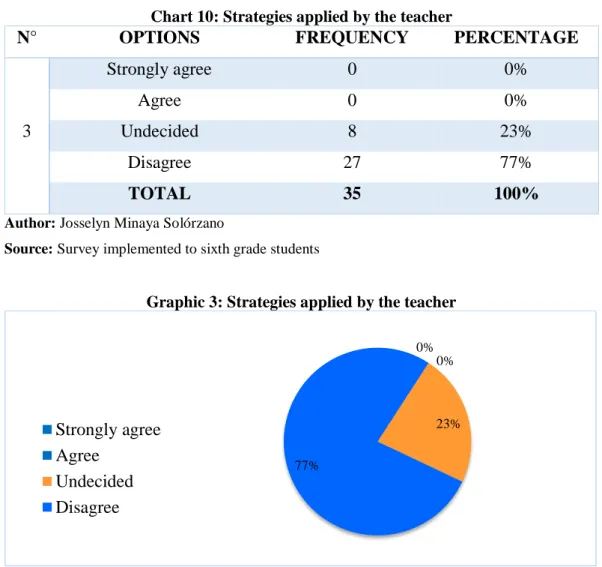
Chart 10: Strategies applied by the teacher ... 47
Chart 11: The use of technology for developing vocabulary ... 48
Chart 12: Frequency of technology use ... 49
Chart 13: Frequency of ICT for practicing vocabulary ... 50
Chart 14: Digital games to develop vocabulary ... 51
Chart 15: Use of digital games for learning ... 52
Chart 16: Support of digital games for learning vocabulary ... 53
Chart 17: Characteristics of digital games ... 54
Chart 18: General Results of Students' Survey ... 55
Chart 19: Beneficiaries ... 60
Chart 20: Vocabulary Content from the Book “Starship English A1.1” ... 72
Chart 21: Strategies of Improvement ... 88
Chart 22: Results of Students’ Diagnostic Test and Final Test ... 89
Chart 23: Timetable... 94
Chart 24: Human Resources... 97
Chart 25: Institutional resources ... 97
xiv
GRAPHS
Graphic 1: Importance of learning vocabulary ... 45
Graphic 2: Vocabulary knowledge level of students ... 46
Graphic 3: Strategies applied by the teacher ... 47
Graphic 4: The use of technology for developing vocabulary ... 48
Graphic 5: Frequency of technology use ... 49
Graphic 6: Frequency of ICT for practicing vocabulary ... 50
Graphic 7: Digital games to develop vocabulary ... 51
Graphic 8: Use of digital games for learning ... 52
Graphic 9: Support of digital games for learning vocabulary ... 53
Graphic 10: Characteristics of digital games ... 54
xv
ATTACHMENTS PAGE
Attachment 1: Questionnaire for the Principal’s interview... 106
Attachment 2: Questionnaire for the Specialist’ interview ... 108
Attachment 3: Questionnaire for teacher’s interview ... 110
Attachment 4: Questionnaire for Students’ survey ... 112
Attachment 5: Diagnostic test implemented to Sixth Grade Students ... 116
Attachment 6: Final Test Implemented to Students of Sixth Grade ... 119
xvi
PENINSULA OF SANTA ELENA
STATE UNIVERSITY
FACULTY OF EDUCATION AND LANGUAGE
ENGLISH TEACHING CAREER
“DIGITAL GAMES TO DEVELOP ENGLISH BASIC VOCABULARY FOR SIXTH GRADERS STUDENTS OF UNIDAD EDUCATIVA JOSÉ PEDRO VARELA, LA LIBERTAD, SANTA ELENA PROVINCE, 2018- 2019”
Author: Josselyn Katherine Minaya Solórzano Advisor: MSc. Kléber Loor Zambrano
ABSTRACT
Nowadays, teaching English as a foreign or second language demands the implementation of strategies that allow students to learn in a more didactic and dynamic way. The use of technology and games during the teaching process represents an alternative in which students are able to acquire new knowledge in a relaxing environment. Thus, the digital games have assumed a very relevant role in the educational lives of children and teenagers. Games may be used for teaching, practicing, or even evaluating the diverse students’ English skills; listening, speaking, reading, writing; vocabulary and grammar as well. For this work, digital games were implemented for developing and improving the low knowledge level of English vocabulary of students of sixth grade from Unidad Educativa “José Pedro Varela” located in La Libertad during the 2018 – 2019 academic period which represents the basis for the acquisition of English and its four main skills and be able to communicate with English speakers from the community and abroad. The quantitative research method was applied in this investigation, a survey was also implement in order to collect information about the teaching and learning process on students.
Keywords: Vocabulary, digital games, technology, English language teaching,
1
INTRODUCTION
In the present era, teaching has been incredibly changing certain aspects that concern with the way in which students learn; strategies or techniques. Therefore, teachers must be more a “guide on the side” than a “sage on stage”. Teachers have become mere instructional managers or facilitators who contribute to the achievements of academic student goals.
It is relevant to mention that learning vocabulary is the clue for the development of oral and written communication. Communication is a mutual relationship between the speaker and the hearer; thus, it increases the necessity to acquire as much vocabulary as possible in order to enhance speaking skills of students. Likewise, for understanding printed texts or listening, students also need to know a vast number of words. Therefore, it has been proved that vocabulary plays a significant part in the acquisition process of English (and the other ones as well) in order for them to transmit information, ideas or opinions to English speakers in an efficient manner. Hence, professionals of education have to find or coordinate the best means for students to acquire new information and use it in a real context (classroom and out of it).
Games are not a new strategy for teaching or learning. It is an effective option for students to practice the contents of English classes in a more dynamic form; children, teenagers, even adults love playing and, few years ago, games were digitalized as a demand of the era in which almost all people have access to a computer, a cell phone or any other technological device.
This research paper is organized by four chapters and each one covers diverse aspects related to this work; these chapters are mentioned and described briefly below:
2 Chapter II-Theoretical Framework: This chapter contains previous researches, philosophical basis, fundamental categories, legal basis, hypothesis and variables of the study.
Chapter III-Methodology: It explains the research approach, level or type of the research, population and sample, techniques and instruments, analysis and interpretation of the results and finally conclusions and recommendations.
3 VARELA, LA LIBERTAD, SANTA ELENA PROVINCE, 2018 – 2019”
1.2 STATEMENT OF THE PROBLEM
Nowadays, learning English is considered as a relevant requisite for acquiring a better life, academic, and professional status. It is known that English as a second or foreign language represents an advantage for those who want to establish relationships with English speakers. Additionally, English has become the global language, which demands the absolute domain of its main skills, being speaking the most necessary for direct communication.
4 school section there is no a specialized teacher in the English area; teachers of each course must cover the contents of this subject without dominating the language and using a text that does not contain activities that promote the vocabulary practice and enhancement. Hence, it increased the necessity to contribute in the academic training of students from this institution referring to the English language teaching.
1.3 CONTEXT OF THE PROBLEM
5 Illustration 1: Problem Tree Analysis
Author: Josselyn Minaya Solórzano
The previous problem tree illustrates the main reasons for the low vocabulary knowledge of students. It is evident that the traditional strategies implemented for the English lessons affects negatively to the development of students’ skills. In this case, the classes are teacher’s centered and students have become a passive part of the teaching – learning process with a very few participation during the lessons. Certainly, students need to be participative, ask questions, provide answers, work in teams, etc. However, this is not possible because of the application of monotonous activities which has a serious consequence; low motivation. The use of the English text, as a permanent didactic resource, does not guarantee that students assimilate the contents of class correctly. Texts are useful since they
LOW VOCABULARY PROFICIENCY OF SIXTH GRADERS STUDENTS OF UNIDAD EDUCATIVA “JOSÉ PEDRO VARELA” FROM LA
LIBERTAD, PROVINCE OF SANTA ELENA
Traditional English
Lack of vocabulary / grammar knowledge principal part of the
class Passive students
Receptive
students
Books are the only resource for practicing the
6 provide a guide of study for teachers and students, but their excessive use could provoke that students develop short term-memory and not retain important words for producing the language, written or orally. Learners need to practice using a variety of didactic activities in order to understand what they are reading or listening.
Finally, sixth grade students of Unidad Educativa “José Pedro Varela” have not received English instruction before and their ‘permanent’ teacher has got the challenge of teaching the English topics included in the English textbook provided by the National Government. However, it is not the same as to receive instruction from a professional in the area, thus, students show a low knowledge of vocabulary having as a consequence misunderstanding in the English classes.
1.4 RESEARCH QUESTIONS
What is the significance of learning vocabulary for dominating a second or foreign language?
Why is it important to innovate English vocabulary lessons?
What are the most efficient alternatives of improving the vocabulary teaching?
Why is the use of technology relevant for practicing and increasing vocabulary knowledge?
1.5 RATIONALE
In a world where most of its population has access to internet and has any technological devices, cell phones mainly, it has become essential to change the way in which certain procedures were used to do, such as, the way of buying food, making reservations in hotels, learning new languages, and others. Nowadays, people can do all the things that were mentioned previously, and more, by using applications in laptops, cell phones, or tablets.
7 beginning and experienced teachers may benefit from technology since it provides wealth teaching resources that allow students to acquire new information in an easier and more practical way.
The use of digital games on students of sixth grade at Unidad Educativa “José Pedro Varela” from La Libertad, Santa Elena province will have a great educational significance to the acquisition of vocabulary which will influence on the development of the four main English skills; listening, speaking, reading and writing. Students from this educational institution will be the main beneficiaries since they will have the opportunity to practice and enhance their vocabulary by doing what they like the most; playing and using technology at the same time. Some of these digital games are based on the English textbooks content and they will be used to upgrade and increase students’ confidence at the moment of producing the language.
Furthermore, digital games will contribute to develop cognitive skills that allow people to accomplish and satisfy their needs. It is also truthful that for learning speaking, pupils need to be motivated and through the use of digital games they will get engaged to the English classes because they will have the interest of working with technology finding all the necessary tools to achieve the objective of developing the speaking skill.
1.6 RESEARCH OBJECTIVE
To analyze the use of digital games through the review of theories, methods and techniques for the development of vocabulary in sixth graders at Unidad Educativa “José Pedro Varela” from La Libertad, Santa Elena province.
1.7 IDEA TO DEFEND
8
1.8 SCIENTIFIC TASKS
To consult the different bibliographical resources in online books, publications or journals for the description of the theoretical framework
To collect and analyze the information after the implementation of surveys to students and present it using statistical graphs, charts and methodological process.
9
CHAPTER II
THEORETICAL BASIS
2.1 DEFINITION OF KEY TERMS
2.1.1 ENGLISH AS A SECOND/FOREIGN LANGUAGE
Acquiring English as a second or foreign language involves different areas, such as: motivation, necessities of students, learning environment, learning strategies and learning awareness. Likewise, the process of teaching and learning requires the practice of the target language skills: listening, speaking, reading and writing. These are the four main English language skills. However, for the correct development of these skills, it is required the acquisition of a very vast number of words. Thus, the instruction of vocabulary has become a crucial part in the acquisition of English or any other foreign language.
Unfortunately, recent studies suggest that the amount of instructional time dedicated to instruction and development of vocabulary is simply insufficient to support the growth level that is needed to close the vocabulary gap between English language learners and their English-proficient peers. Thus, it is important to emphasize that vocabulary is considered as the building block of the language.
2.1.2 VOCABULARY
10
2.1.3 TYPES OF VOCABULARY
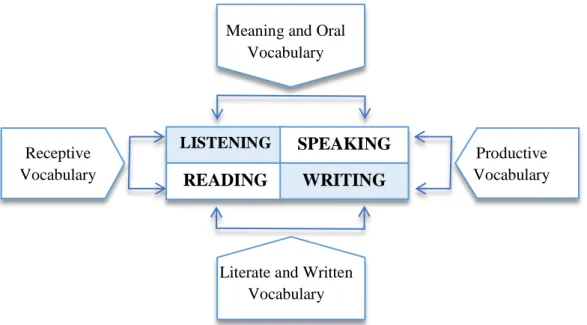
Vocabulary is an essential part for the acquisition of a new language. A consideration in defining the vocabulary building is that students may have different types of vocabulary which may be used for diverse reasons. These types of vocabulary are classified in the following way:
Illustration 2: Types of Vocabulary
Source: Adapted from Pikulski and Templeton (2004)
Author: Josselyn Minaya Solórzano
Productive vocabulary is the group of words a student may apply in the spoken or written language production. This group of words is well-known since they are used frequently by students. Montgomery (2007) determines that our speaking vocabulary is relatively limited: Most adults use a mere 5,000 to 10,000 words for all their conversations and instructions. This number is much less than our listening vocabulary most likely due to ease of use.
Likewise, Montgomery (2007) establishes that students generally find easier to explain themselves orally, using facial expression and intonation in order to help get their ideas across, then to find just the right words to communicate the same
11 ideas in writing. The writing vocabulary of learners is strongly influenced by the words they can spell.
On the other hand, receptive vocabulary is the set of words students understand when others use them. This group of vocabulary is also related to the receptive skills; listening and reading. Montgomery (2007) claims that starting in the womb; fetuses can detect sounds as early as 16 weeks. Moreover, babies are listening during all their waking hours – and we continue to learn new words this way all of our lives. By the time people reach adulthood, most of them will recognize and understand close to 50,000 words. In the case of reading, students may read and understand many words that they do not use in their speaking vocabulary.
2.1.4 INFORMATION AND COMMUNICATIVE TECHNOLOGIES (ICTS)
Information and Communication Technologies provide not only anywhere and anytime access to knowledge, but also equal opportunities for networking and communications that allow knowledge sharing, participation, and lifelong learning. On the other hand, alongside the development of ICT in the educational area, the role and capacity of teachers have become more crucial than ever. As it was established previously, it has been one of the most challenging aspects to enable teachers use and integrate appropriate technology into the teaching and learning process.
12
2.1.5 DIGITAL GAMES
Graham (2012) mentions that using computer or digital games to practice language may provide great educational benefits, in particular when it comes to the development or enhancement of language skills. Many types of games have information gaps built into them that can be easily exploited for vocabulary, listening activities, grammar practice and intensive reading. Additionally, digital games may also be used to promote extensive reading, and make great subjects for writing practice. The principal key for using digital games effectively for the practice of a language is in the choice of game and design of a task and how teachers arrange the room and the learners will depend on the activity in hand; managing the learners in the computer room is worth considering.
2.1.6 INTERACTIVE MULTIMEDIA IN EDUCATION
In a digitalized society, Interactive Multimedia theories, technologies, applications and systems stage the principal role, as they furnish users with the necessary communication tools. Therefore, multimedia-enabled devices, computers and tablets support fully featured interactive multimedia applications and cover wide-ranging interaction requirements from communication to games and interactive art. Deliyannis (2012), a member of the Audio and Visual Arts Department of the Ionian University from Greece, describes that mobile and networked interactive multimedia applications are employed to promptly capture or create user-centered content that after being processed and enrich with the adequate context is relayed back to the community in order to satisfy the necessities of improving learning processes or acquisition of information.
13 programs. Likewise, it is significant to take into consideration the development of the technology in different aspects and a successful implementation of multimedia-enabled teaching and learning includes organizational change, changes in attitudes, and, in some cases, issues related to cost, acquisition of appropriate technologies and human resources but the final product is worthwhile.
2.2 PREVIOUS RESEARCH
2.2.1 TEACHING VOCABULARY
Graves, August, and Mancilla-Martinez (2012) state that “it is estimated that native English speakers acquire around 3,000 new words every school year” (p. 1). This increase in the vocabulary knowledge of students accounts for a relevant portion of their language, and their oral/written proficiency, and reading/listening comprehension development. Likewise, it is stipulated that as more words are acquired, students are able to draw finer distinctions in meaning among words, develop stronger comprehension of how words work together, and increment students’ sensitivity to context and communication intent.
14 an average of 2,000 to 3,000 family words in order to become proficient learners in the target language.
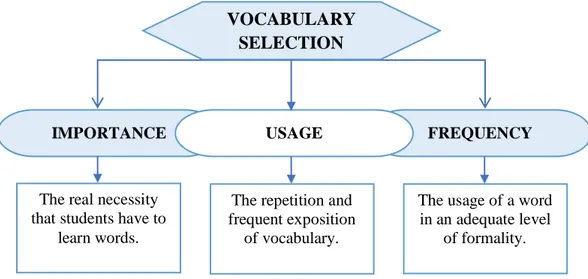
Allen (2006) stipulates that vocabulary knowledge is related to and affects the comprehension and production of the target language. Thus, for teaching vocabulary to learners of English language, teachers need to take into account the criteria for the selection of words that their pupils need to acquire. The way of choosing the vocabulary to teach was described by Allen (2006) and Harmer (2012) and it was illustrated in the following way:
Illustration 3: Selection of Vocabulary
Source: Adapted from Allen (2006) and Harmer (2012)
Author: Josselyn Minaya Solórzano
The importance, according to Harmer (2012), is also related to the necessities that students have at the moment of learning. Schmitt (2011) emphasizes on how necessary the word is for a learner’s present needs, and whether the word is met incidentally while pursuing some other purpose or studied with the explicit goal of learning it. Hence, the use of the book as a guide of what to teach is important, however, students, in most cases need to acquire more vocabulary according to their level.
On the other hand, the objective of teaching vocabulary is to develop students’ abilities to comprehend and produce the English language. The fact that vocabulary
IMPORTANCE USAGE FREQUENCY
The real necessity that students have to
learn words.
The usage of a word in an adequate level
15 is learned incrementally inevitably leads to the implication that words must be met and used multiple times to be truly learned. The number of exposures/usages necessary will depend on the activities applied during the lessons. Learners may be able to use a word to a large extent with just such knowledge.
Finally, the frequency of vocabulary is mainly about the times that learners are exposed to those words. One of the great mistakes many teachers make is to focus on a new word only once, leading to a high probability of that word being forgotten and the time spent on teaching it wasted. This means that students need have more opportunities to use new words as much as they can; students need to practice what they have learnt through the implementation of various activities or exercises in order to assimilate the new words.
2.2.2 THE IMPORTANCE OF LEARNING VOCABULARY
The number of English language learners and limited English proficient students has grown exponentially in the United States and other countries over the past decades. Hang Khong and Saito (2014) claim that given the huge cultural and linguistic diversity among countries, educating this population of students remains a challenge for teachers. The English language, with its worldwide use, probably has a stock of words lager than any other language. Thus, it is not surprising that among English speakers, a large vocabulary is one of the most important parts of verbal proficiency. Moreover, according to Stahl and Nagy (2005), vocabulary is closely associated not only with intelligence, but also with knowledge. A person who knows more words can speak, and even think, more precisely about the word. In addition to the vital importance of vocabulary for success in life, a large vocabulary is more specifically predictive and reflective of high levels of reading achievement. Hiebert and Kamil (2005) make the point that words represent complex and, often, multiple meanings, moreover, multiple word meanings need to be comprehended in the context other words appear in paragraphs or texts.
16 words in a precise and fluent way comprehending the context of the reading. The study carried out by the National Reading Panel (2000) also concludes that vocabulary should be taught directly or in isolation and indirectly which involves the use of passages and the comprehension by analyzing the context.
2.2.3 HOW TO TEACH VOCABULARY
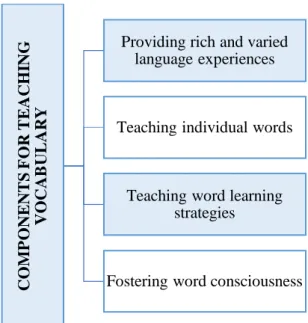
There are different ways to teach vocabulary to students. Graves, August, and Mancilla-Martinez (2012) present a comprehensive plan for vocabulary instruction for students who are just beginning to build up their vocabulary knowledge and encourage teachers or instructors of English language to apply it in their courses. The program has been established in the following four components:
Illustration 4: Components for teaching vocabulary
Source: Adapted from Graves, August, and Mancilla-Martinez (2012)
Author: Josselyn Minaya Solórzano
The graphic above describes the four ways in which students need to be trained in order to acquire new vocabulary more efficiently. The first aspect for an effective vocabulary teaching is to immerse them into a rich array of language experiences or activities allowing students to have the opportunity to learn words through
Providing rich and varied language experiences
Teaching individual words
Teaching word learning strategies
17 frequently in activities, such as, discussions or conversations in which they are given the chance to produce the target language using vocabulary.
According to Graves (2009), helping students master a broad range of individual words is a vital part of effective vocabulary teaching. Therefore, vocabulary instruction is most effective when learners actively process the new word meanings, and when they experience multiple encounters with new words. However, since there are so many words to teach, not all of them may or should receive rich, deep, and extended instruction.
A third way to contribute to the increase of students’ vocabulary is to teach word-learning strategies. The use of word parts to unlock the meaning of unknown words is a good strategy; hence, Nation (2008) manifests that students need to know prefixes, suffixes and roots in order to recognize and understand the various members of family words, for example, indicate, indicates, indicated, and
indicator. Likewise, Graves, August, and Mancilla-Martinez (2012) state that “most vocabulary is learnt from context” (p. 5). Using context is an excellent and recommended strategy to infer word meanings. Furthermore, using dictionaries and similar reference tools is a different strategy to learn new words.
The final component for the vocabulary teaching program proposed by Graves, August, and Mancilla-Martinez (2012) is to foster word consciousness. This term (word consciousness) refers to an awareness of and interest in words and their meanings. Thus, students who are word conscious are aware of the words around them; those they read and hear and those they write or speak. This awareness mainly involves the appreciation of the power that words have at the moment of producing the language and how these words can be replaced by others in order to formulate different utterances.
2.2.4 STRATEGIES FOR TEACHING VOCABULARY
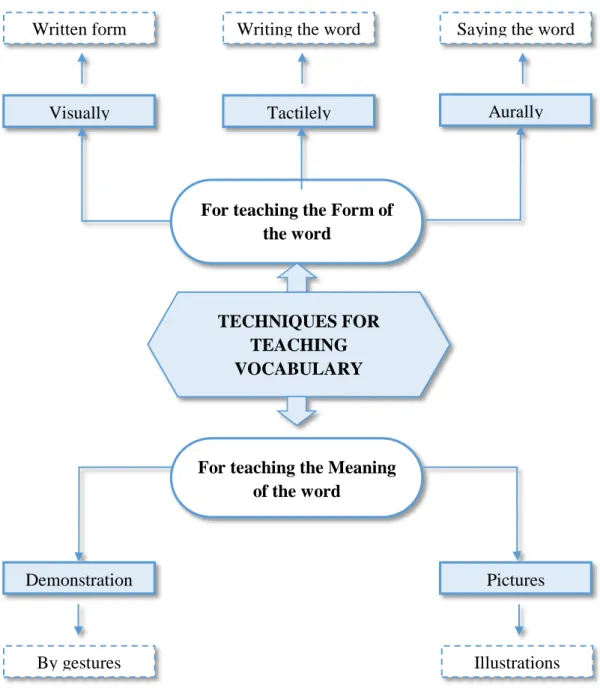
18 to teach the meaning of the word and, finally, they must teach the form and the meaning of the word go together. Nation (2008) makes an example; “if we teach a
fork; we must teach the learner to recognize or produce the word fork; we need to teach him what a fork is; and we must teach him that the sound or shape of a fork
and the meaning of the shape go together” (p. 18). Nation (2010) classifies different techniques for teaching new vocabulary in the following way:
Illustration 5: Techniques for Teaching Vocabulary
Source: Adapted from Nation (2010)
Author: Josselyn Minaya Solórzano
For teaching the Form of the word
Visually Tactilely Aurally
Saying the word Writing the word
Written form
TECHNIQUES FOR TEACHING VOCABULARY
Pictures Demonstration
By gestures Illustrations
19 Nation (2010) determines that a good way to help learners perceive the word by means is through the application of visual techniques. These techniques require that teachers show students the written form of the word, by showing the mouth movements involved in saying the word. Teachers may also use hand movements in order to draw the letters of the word in the air. In the case of tactile techniques, teachers may encourage students to write the word letter by letter on the board or on their notebooks. Furthermore, teachers may use a system of writing like Braille, especially for blind learners. The final strategy for teaching the form or vocabulary words is aurally; this involves the correct repetition of word pronunciation.
On the other extent, it is also significant to teach the meaning of words. As it was illustrated in the graphic above, using actions and pictures are an excellent form. Demonstrative techniques require the application of objects or a cutout figure: the use of realia is also included in this type of technique; mime, gestures, actions or facial expressions are ways for facilitating the comprehension of word meanings. Likewise, visual or illustrative techniques involve the use of pictures, graphs, flashcards, cards, and others. Nation (2008) mentions that an effective way of understanding word meaning is to make use of vocabulary cards. These are small cards (about 4cm x 3cm) with the second language word on one side and the first language translation on the other. Particularly, at the beginning level, a different and very useful strategy is to have a phrase containing the new word along with the word and a picture which may be taken from a newspaper or magazine or even written by hand.
20
2.2.5 ICT FOR TEACHING
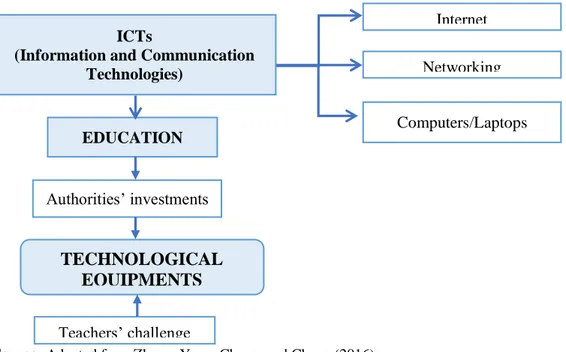
At a global level, it is recognized that within all educational contexts, from school based through to lifelong learning opportunities, addressing the educational needs of learners is a quality imperative. According to Zhang, Yang, Chang, and Chang (2016), it is believed that ICT have a fundamental influence on the teaching and learning process, and many excellent practices have emerged from different nations. However, there is a challenge on how to scale up these cases to reap the benefits of ICT implementation in education in a large scale.
One of the challenges is to encourage teachers to use these technologies; some teachers still refuse to use them because they do not simply dominate them. The updating of teaching methodologies is required in this case and, unfortunately, instructors still apply old-fashioning strategies. Furthermore, ICT is bad used for students since they use them for surfing on their social networks, watching online videos or playing online video games without an educational purpose. Hence, it is necessary to provide suggestions in order to promote the scale up of innovative cases for utilizing ICT in the teaching and learning process.
Illustration 6: ICT in Education
Source: Adapted from Zhang, Yang, Chang, and Chang (2016)
Author: Josselyn Minaya Solórzano
21 Taking into account the benefits of ICT in the educational field, many countries in the developing world, including the least developed nations, are making relevant changes and investments on developing or implementing their respective ICT in their educational plans and on bringing diverse ICT equipment and resources in to their educational institutions. Even with extremely constrained financial resources, some countries are purchasing computers/laptops or adapting adequate spaces for the practice of students using technology.
2.2.6 DIGITAL GAMES IN THE TEACHING-LEARNING PROCESS
Loewenstein, Ocasio, and Jones (2012) claim that English Language Learners (ELL) considered that acquiring new vocabulary is a boring activity since they have to memorize lists of words in order to complete lots of exercises. Therefore, making learning fun is key to any teaching situation and especially for teaching new vocabulary. One good way to generate enthusiasm and excitement about words is to create many opportunities to interact with words in risk-free, safe, and non-evaluative settings. Recent years have seen a growing interest in the pedagogical potential of digital games. Reinders (2012) states that “the educational value of games has long been recognized, but digital games in particular are now acknowledged as having great potential to engage learners and to encourage interaction in the target language”.
22 Littlewood (2003) establishes that the communicative approach is changing the face of foreign language teaching. It provides an introduction to communicative language teaching for practicing classroom teachers.
2.2.7 SIGNIFICANCE OF IMPLEMENTING DIGITAL GAMES
Felicia (2009) mentions that digital games include several implicit educational benefits. They can develop cognitive, spatial and motor skills helping to improve ICT skills. They can be used to teach facts (e.g. knowledge, recall, rote learning or memorization), principles (e.g. cause and effect relationship) and complex problem solving, to increase creativity or to provide practical examples of concepts and rules that would be difficult to illustrate in the real world. They can be particularly useful to perform experiments that could be dangerous in real life such as the use of hazardous chemicals.
Wastiau, Kearney, and Berghe (2009) argue that digital games are important because they are a very popular and widespread leisure-time activity for the age groups whom these systems seek to educate. Digital games are possible vehicles for learning processes of a different nature. Thus, providing schools with information and communication technologies (ICT) in the form of computers, software, internet access and digital content, and providing teacher training programs for these technologies, are aspects that educational authorities need to take into account.
23
2.3 PHILOSOPHICAL BASIS
Vygotsky (2012) mentions that children were perceived as possessing natural cognitive functions of perception, memory and problem solving that could be used as machinery for the transmission of knowledge from generation to generation, from parents and teachers to students. According to Vygotsky (2012), culture appears as informational content of life experiences of children and the development of a child depends on preintellectual speech as well as nonverbal thought, this means that the establishment of interfunctional systemic unity does thought become verbal and the speech intellectual..
Jean Piaget (1896-1980) was one of the most influential theorists in the field of cognitive development. Piaget (as cited in Oakley, 2014) establishes that adults did not simply know more than children; however, their knowledge was structured differently. For a long time, it was believed that learning is an individual accumulation of every day experience or as a transmission of knowledge from the head of the teacher to the head of students. However, Piaget’s theory was based on three main principles; assimilation (the process of putting a new experience into an already existing mental structure), accommodation (the process of revising an existing schema due to a new experience), and equilibration (the process of seeking to achieve stability through the two already mentioned principles).
Graves, August, and Mancilla-Martinez (2012) claims that the term English Language Learners or ELL are used to refer to learners who come from places where a language other than English is spoken and who are still learning or acquiring proficiency in this language. It is important to point out that ELL may indeed experience accelerated growth in vocabulary; however, this requires systematic and permanent vocabulary instruction.
24 not stop to reflect on their value and power” (p. 3). Hence, words that people use both express and shape who they are. Vocabulary, even more significant than accent, gives away social and educational background.
Watkins (2014) points out that Information and Communication Technologies (ICT) should be used in all sectors of education and training as technology skills are essential for the global citizenship. ICT may be a valuable tool for learners since they may improve their quality of life by increasing participation and motivation during the lessons. Thus, access to ICT that support participation in learning opportunities has become an international imperative policy. Likewise, UNESCO (2015) affirms that the remarkable advances in ICT and the rapid expansion of internet connectivity have made today’s world increasingly interconnected, and rendered knowledge and familiarity with ICT essential for every girl and boy, woman and man.
Apperley and Beavis (2011) claim that digital games are, to a greater or lesser extent, dynamic: they are enacted through play. For digital game players, appreciating how their actions in the game will influence future actions by the computer, themselves and other players (both opponents and collaborators) constitutes a key area of knowledge and expertise. Apperley and Beavis (2011) reveal how digital games take on meanings and roles in students’ lifeworlds outside of the immediate “immersive” activity of playing the games themselves.
2.4 EDUCATIONAL BASIS
25 perceived competence, and low willingness to communicate. Finally, results showed a marked and significant improvement, with participants feeling more confident, less anxious, more competent, and more willing to communicate. Felicia (2009) implemented a project which began in January 2008 and ended in June 2009. The aim of the Felicia’s project was to analyze the current situation in eight countries (Austria, Denmark, France, Italy, Lithuania, the Netherlands, Spain and UK) with regard to games based learning. Dr. Patrick Felicia developed a handbook in order to increase teachers’ interest in using digital games in their lessons. This handbook provides the necessary information to understand the educational benefits of digital games and to learn how to use them as educational and motivational resources. Teachers and students were the main beneficiaries since digital games implementation allowed students practice the class content in an engaging and enjoyable way.
Wastiau, Kearney, and Berghe (2009) carried out a project during 2006 and 2008. This project was about learning through games and mobile technology in both school and informal settings. These three investigators proved that digital games could contribute to improve the teaching and learning processes in schools. They showed that teachers presently using digital games in their teaching seem to value them for different purposes. The precise role to be assigned to the teacher when using games in the classroom, the way digital games can support different learning styles and the respective contributions of different types of games to various learning processes, are just a few examples for more in-depth investigations to be launched in the near future. As a result, students’ motivation is significantly greater when computer games are integrated into the educational process and they increased retention of information and knowledge by pupils once digital games were implemented.
2.5 LEGAL BASIS
26 to be instructed academically and the National Government must guarantee that the process of education reaches a high rate in quality being inclusive in the social, cultural, and economical aspects. Likewise, in article 27, it is described that education is a primordial part for people’s lives; education is the only way to be successful and being part of the country progress. Moreover, article 343 establishes that the Educational System leaded by well- trained people must work for the improvement of the teaching and learning process since it is the way to develop individual and collective abilities which are useful in different parts of people’s lives.
27
CHAPTER III
RESEARCH METHODS
3.1 RESEARCH DESIGN
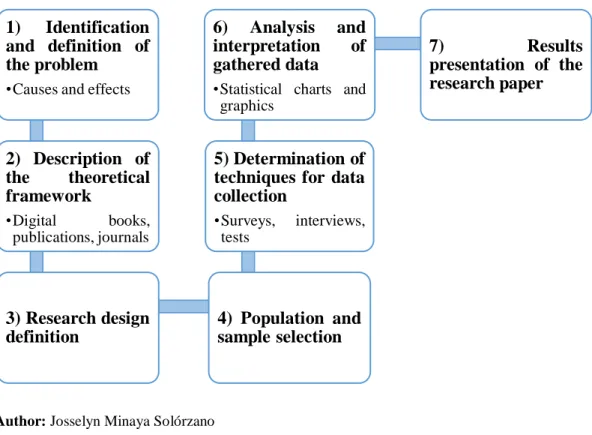
The present action research was implemented at Unidad Educativa “José Pedro Varela”, located in La Libertad from Santa Elena province, specifically to students of sixth grade who evidenced a low knowledge of English vocabulary. Thus, for the achievement of the objectives defined in this research paper, it was important to design a plan that leads in an organized way to work and fulfill the planned activities.
Illustration 7: Plan of the Research Design
Author: Josselyn Minaya Solórzano
3.1.1 QUALITATIVE METHOD
This method was implemented by the investigator in order to gather and analyze the important data taken from the interview to the main authorities from Unidad
28 Educativa “José Pedro Varela”, a teacher of sixth grade and to one experienced English teacher about the relevance of digital games in the teaching – learning process to develop the vocabulary skill of students. Moreover, the investigator will interpret the notes taken from the observation sessions to the classes of students of sixth grade.
3.1.2 QUANTITATIVE METHOD
Additionally, this investigation was based on the quantitative method because the researcher collected information related to the effects of using digital game based- learning to develop the vocabulary skill. This data was collected by the application of surveys to the students of six grade from Unidad Educativa “José Pedro Varela” and, then, presented it in statistical charts and graphics.
3.1.3 DEDUCTIVE METHOD
The implementation of deductive method allowed the investigator to gather all the general and useful information about the importance of learning vocabulary for the acquisition of a second or foreign language. This information was collected from different sources like online books, journals, magazines, etc. and then all that data was simplified in this investigative work.
3.2 POPULATION AND SAMPLE
3.2.1 POPULATION
29 Chart 1: Population of the investigation
N° POPULATION DESCRIPTION QUANTITY PERCENTAGE
1 Principal of Unidad Educativa
“José Pedro Varela” 1 3%
2 Sixth grade teacher 1 3%
3 English teacher (specialist) 2 6%
4 Sixth grade students 35 88%
TOTAL 39 100%
Author: Josselyn Minaya Solórzano
3.2.2 SAMPLE
30
3.4 TECHNIQUES AND INSTRUMENTS FOR DATA COLLECTION
With the purpose of collecting relevant and useful information, different techniques and tools were necessary to implement.
3.4.1 TECHNIQUES
3.4.1.1 Interview
The interview was directly applied to MSc. Angela Reyes Quimis, Principal of Unidad Educativa “José Pedro Varela”, Lic. Patricia del Pillar Suárez Peña, teacher of sixth grade students and one well-trained English teacher, Lic. Gabriel Parrales Picazo who has worked as a teacher in the Escuela Superior Naval (ESUNA) from Salinas since 2017. These people proportionate relevant information about the teaching process since they have a vast experience in the educational field.
3.4.1.2 Survey
Surveys were implemented to students of sixth grade from Unidad Educativa “José Pedro Varela” as an efficient technique to obtain significant information about their English language instruction and the necessity of applying strategies for the correct acquisition of new vocabulary.
3.4.2 RESEARCH TOOLS
3.4.2.1 Questionnaires
31 information about the English teaching, relevance of vocabulary and the role of digital games in the English vocabulary training.
3.4.2.1 Camera
The use of the camera was necessary for having evidence of the different activities planned for the investigation development. This tool was used at the moment of recording the interviews and taking some pictures as evidence of the activities application.
3.5 DATA COLLECTION PLAN
Chart 2: Data Collection Plan
BASIC QUESTIONS EXPLANATION
What for? To develop vocabulary From which people or objects? Students of Sixth grade
About what aspects? Digital Games
Who? Authorities, teachers and students. To Whom? Students and teachers at Unidad Educativa
“José Pedro Varela”
When? - 2020
Where? At Unidad Educativa “José Pedro Varela”
How long? Three months
How? Individually and in groups What data collection
techniques?
Interviews and surveys. With what? Questionnaires and Camera.
32
3.6 DATA PROCESSING PLAN
Chart 3: Data Processing Plan
DETERMINATION
OF A SITUATION DATA SEARCH
DATA COLLECTION
The lack of English vocabulary knowledge was determined through the implementation of a survey directed to sixth
graders students. In addition, the strategies applied by the English
teacher are not the appropriate to develop
the basic vocabulary.
Once the problem was discovered, the investigator started looking for information
related to the topic at books, web sites, magazines, research papers, among others.
Additionally, an interview applied directed to the English
teacher and the Principal of Unidad Educativa "José Pedro Varela" and a specialist
in the English Language Education.
After the problem was confirmed in the sixth grader students at Unidad
Educativa "José Pedro Varela", interviews to principal, teachers, specialist and surveys directed to students were
made, then analyzed in order to develop a proposal
to sort out the started problem.
Using all the information collected that proved the lack of basic English vocabulary knowledge of
sixth graders students at Unidad Educativa "José Pedro Varela", it was important to involve the
principal, English teachers and the group of
students.
The lack of English vocabulary knowledge was determined through the implementation of
a survey directed to sixth graders students.
33
3.7 DATA ANALYSIS
Once the techniques with their tools for collecting information were implemented, it is important to analyze and present it in this research paper using different graphics or charts.
3.7.1 INTERVIEW TO UNIDAD EDUCATIVA “JOSÉ PEDRO VARELA”
PRINCIPAL
Chart 4: Personal information of the Principal
PRINCIPAL’S PERSONAL INFORMATION
FULL NAME: Msc. Angela Reyes Quimis
AGE: 54
DEGREE: Licenciada en Ciencias de la Educación
Author: Josselyn Minaya Solórzano
Source: Msc. Angela Reyes Quimis
QUESTION N° 1: What is your criteria about today’s English education in
Ecuador?
INTERPRETATION
The principal said that learning a new language may provide opportunities of succeeding to people. Therefore, she considered that English teaching must be improved by giving English teachers more training courses in order to upgrade their methodologies and teach according to students’ necessities.
QUESTION N° 2: What is your personal opinion about the English Teaching and
Learning process?
INTERPRETATION
34 courses developed in this province which may difficult because teachers do not receive seminars by the Government.
QUESTION N° 3: What do you think the main problems in the English Teaching-
Learning Process are?
INTERPRETATION
The principal established that the main problem could be the teaching methodology; teachers must have the English knowledge but they did not receive the methodological instruction enough for sharing their knowledge to students. On the other hand, the lack of resources facilities; well-equipped labs may contribute a lot to the teaching process.
QUESTION N° 4: According to your professional experience; Do you consider
that teaching vocabulary is important in English Teaching- Learning Process?
INTERPRETATION
The principal emphasized on the importance of vocabulary for learning any language. She mentioned that vocabulary is the basis for talking and writing and children need to have a vast number of vocabulary words in order to produce and understand any language. That is the process, a child needs to listen and watch objects in his/her environment (house, kindergarten, etc.) for acquiring new vocabulary.
QUESTION N° 5: What is your criterion about the use of digital games to improve
teaching vocabulary?
INTERPRETATION
The interviewee stated that technology is necessary in the present era. Children love playing and if we can combine games with technology, it would be a very teaching powerful strategy.
QUESTION N° 6: According to your criterion, are teachers able to use digital
35
INTERPRETATION
As the principal stipulated before, they have a laboratory for high school students and in the classrooms there is no projector. She said that if teachers want to teach using digital resources they must find the equipment by themselves.
QUESTION N° 7: What is your appreciation about the advantages of the use of
Digital Games during the Teaching-Learning Process?
INTERPRETATION
The principal considered that the use of digital games stimulates students to acquire new information or learn a new language. Likewise, students may learn in a relaxing environment without the pressure or stress of answering oral questions; through the use of digital games they learn deliberately by playing.
QUESTION N° 8: What suggestions would you give teachers that want to
implement Digital Games in the classroom?
INTERPRETATION
The interviewee answered that teachers must be passionate by their job and that means that they have to look for the most appropriated manners to transmit knowledge to students. Digital games seems to be a good option and they have to be creative and original al the moment of developing these resources.
QUESTION N° 9: Do you agree with the implementation of Digital Games in Sixth
graders students? Why?
INTERPRETATION
36
3.7.2 INTERVIEW TO TEACHER OF SIXTH GRADE
Chart 5: Personal information of the teacher
SPECIALIST’S PERSONAL INFORMATION
FULL NAME: Patricia Del Pilar Suárez Peña
AGE: 54
Author: Josselyn Minaya Solórzano
Source: Lic. Patricia Suárez Peña
QUESTION N° 1: What is your criteria about English Education in Ecuador?
INTERPRETATION
Miss Suárez expressed that English is considered the main language for communicating around the world and Ecuador, as a touristic spot, needs that its population speak this language. Therefore, English is included in the educational curriculum; however, not all institutions have a professional in this area and permanent teachers have to take the challenge of teaching this subject.
QUESTION N° 2: How do you describe the use of didactic resources applied to
the Teaching Learning Process?
INTERPRETATION
The teacher mentioned that resources are necessary for the easier comprehension and assimilation of information. She also said that it is required to implement different didactic resources for introducing, practicing or evaluating the contents from classes. The textbook is a permanent didactic material but students learn by doing, acting, watching, etc.
37
INTERPRETATION
The teacher said that according to her criteria and experience, students love learning by watching, through the use of videos, posters, charts, pictures, and others. However, she also stated that the implementation of strategies must be varied since students are not the same, some of them are visual, others are kinesthetic, others are auditory; my role as the teacher is to combine the strategies for a better knowledge assimilation.
QUESTION N° 4: What are the benefits of using didactic resources during the
vocabulary instruction?
INTERPRETATION
The interviewed teacher stated that didactic resources are mainly used to facilitate the students’ understanding. Using didactic materials contributes to visualize the content of the class, words, phrases, etc. students have the opportunity to assimilate the meaning of a word by watching a picture (printed or digital).
QUESTION N° 5: What is your opinion about the implementation of digital games
to develop the English basic vocabulary in sixth graders students?
INTERPRETATION
The interviewee mentioned that in the educational institution she works, teachers are encouraged to create innovative teaching material in order to catch students’ attention and increase their motivation for learning. Digital games may be a useful strategy for teaching but we need to take into account that they do not have the technological facilities enough to implement them in the classes. The laboratory use is exclusively for students from the secondary level and in the classrooms there is no projectors.
QUESTION N° 6: Could you mention the benefits of the use of Digital Games
38
INTERPRETATION
The interviewee answered that digital games are a good resource because students like video games and love using cell phones or computers; they are pretty good at manipulating technological devices, so digital games promote the learning in didactic and technological manner. Furthermore, the teacher said that students may learn new words and practice or reinforce the ones they have learnt in previous lessons.
QUESTION N° 7: Would you recommend the use of digital games to develop the
acquisition of vocabulary in sixth graders students?
INTERPRETATION
Miss Suárez considered that any innovative strategy, or resource is beneficial for students and digital games may be very useful for teaching and learning vocabulary.
QUESTION N° 8: What suggestions would you give to teachers that want to
implement Digital games in English classes?
INTERPRETATION
39
3.7.3 INTERVIEW TO ENGLISH LANGUAGE EXPERTS
Chart 6: Personal information of specialist 1
SPECIALIST’S PERSONAL INFORMATION
FULL NAME: Luis Gabriel Parrales Picazo
AGE: 34
DEGREE: Licenciado en Idioma Inglés
PROFESSIONAL
EXPERIENCE:
English teacher at Unidad Educativa EDUCA (Salinas)
Professor at Higher Technological Institute (Salinas) English Area Coordinator
English digital trainer of teachers
Author: Josselyn Minaya Solórzano
Source: Lic. Luis Parrales Picazo
QUESTION N° 1: Why do you consider that English is important in today’s
education?
INTERPRETATION
Mister Parrales mentioned that English may not be the most spoken language in the world, but it is the official language of 53 countries and spoken by around 400 million people across the globe. This is an important tool to be able to communicate with native English speakers and it is the most common second language in the world. In the other hand, the specialist expressed that English, in the education area, will help in making the students competent in this era of globalization. It will certainly help to bridge the communication gap between people of various other countries.
QUESTION N° 2: According to your criteria, do you consider that teachers use
appropriate didactic resources in their English classes?
40 The specialist said that most of English teachers use appropriate didactic resources in their classes because some of them still have the traditional methods to teach. He, additionally, stipulated that we, as teachers, need to learn and implement the newest strategies and methodologies to our classes.
QUESTION N° 3: According to your criteria, does vocabulary play an important
role in the English language process? Why?
INTERPRETATION
The interviewee answered that vocabulary part is essential in the learning process because students can create a data base (in their minds) with words or phrases to use in dialogues or to communicate with native English people.
QUESTION N° 4: According to your criteria, what techniques, methods or didactic
resources can be used to develop the Basic English vocabulary on students?
INTERPRETATION
The interviewed specialist mentioned that, in his experience, he prefers creating some dialogues with the vocabulary learned in classes. This activity has two stages; the first one, students have to memorize the words in groups of four people and play with them in class; the second one, they have to create a dialogue by themselves using some words or phrases from the last dialogue.
QUESTION N° 5: What is your appreciation about digital games as a helpful
resource for teachers and students in the teaching learning process?
INTERPRETATION
Mister Parrales agreed with this statement and established that digital games are involved in our technological era where students focus on interactive games or activities to learn something.
QUESTION N° 6: Have you ever used digital games to strengthen students’
vocabulary in your English classes?
41 The specialist totally agreed with the use of digital games to strengthen the vocabulary learning of students. He also mentioned that his students are adults and he has to create interactive resources to catch their attention with English games created by him.
QUESTION N° 7: In your opinion, could the use of digital games develop the
teaching of vocabulary? In what aspects?
INTERPRETATION
The interviewed teacher stipulated that the most important part of the use of digital games is to teach something that students have to use later. Moreover, in his opinion, the objective to create digital games is to have a “Recycle Vocabulary”, it is useful because this kind of vocabulary will be in students’ brains and will be used in automatic answers.
QUESTION N° 8: According to your criterion teachers are able to use digital
games in the classroom to enhance English basic vocabulary?
INTERPRETATION
The specialist said that we can consider two aspects to answer this question. The first one is the technological resources that the classroom has: If this institution does not have the appropriate resources, teachers will not give a great class. The second aspect will be the acquisitions of each teacher, we need to be trained with the recent methodologies and strategies to teach to young digital students.
QUESTION N° 9: According to your professional experience, would you
recommend the use of digital games in English classes to improve vocabulary acquisition? Why or why not?
INTERPRETATION
42 process, so for this reason, new ways for teaching vocabulary are of critical importance nowadays.
Chart 7: Personal information of specialist 2
SPECIALIST’S PERSONAL INFORMATION
FULL NAME: Ítalo Rigoberto Carabajo Romero
AGE: 39
DEGREE: Magister in English Education
PROFESSIONAL
EXPERIENCE:
Professor at Universidad Estatal de Milagro Professor at Universidad Agraria del Ecuador.
Professor at Universidad Estatal Península de Santa Elena – English Language Center (La Libertad)
Author: Josselyn Minaya Solórzano
Source: MSc. Ítalo Carabajo Romero
QUESTION N° 1: Why do you consider that English is important in today’s
education?
INTERPRETATION
Mister Carabajo mentioned that learning English is important because students who speak English can communicate with people around the world.
QUESTION N° 2: According to your criteria, do you consider that teachers use
appropriate didactic resources in their English classes?
INTERPRETATION
The specialist thinks that teachers must use appropriate didactic resources for teaching, but certainly, it is complicated to asseverate if this is accomplished by all of them.
QUESTION N° 3: According to your criteria, does vocabulary play an important