The effect of foreign-born residents on migratory patterns of
natives in Spain
María Hierro University of Cantabria
Abstract
This paper examines the effect of internal migration of foreign-born residents on migratory patterns of natives in Spain during 2003-2005. The results obtained through a synthetic index of inter-regional mobility and the comparison of relative redundancies for their migration flows show that the foreign-born population’s influence is negligible.
Citation: Hierro, María, (2007) "The effect of foreign-born residents on migratory patterns of natives in Spain." Economics
Bulletin, Vol. 10, No. 3 pp. 1-6
Submitted: February 22, 2007. Accepted: April 12, 2007.
1. Introduction
Internal migration of a foreign-born population is an issue of increasing concern in internal migration analysis in Spain. Since the mid 1990s high levels of immigration to Spain have caused the percentage of the foreign-born population to increase dramatically from 1.60% in 1998 to 8.46% in 2005 and the propensity to migrate within Spain among the foreign-born population is greater than among natives. The purpose of this paper is to find out whether internal migration of foreign-born residents is indeed affecting current patterns of internal migration of natives to the point of causing different levels of inter-regional mobility across Spanish regions and lesser dispersed migration flows.
The paper is organized as follows. Following on from this introduction, in Section 2 we describe the migratory data used. In Section 3 empirical results are shown. Finally, in Section 4 we present some concluding remarks.
2. Description of data
The data used in this paper come from the Statistics of Residential Variations published by the Spanish National Institute of Statistics (INE). These migration data are based on changes of municipality registered each year. From the year 2000, the quality of these data has substantially improved due to the greater incentive for registration of foreign-born residents as a result of the Law 8/2000 (this Law offered those immigrants living illegally in Spain but registered for over 2 years the right to health care and regularisation) and the measures imposed by the Law 13/2003, which oblige non European Union immigrants without residence permits to renew their registration in local town halls every two years, thus avoiding duplications in the records. However, only since 2003 has information about migratory flows across Spanish regions both for groups of natives and foreign-born population been available and, also, disaggregated migratory flows by socio-demographic characteristics of migrants are not still offered.
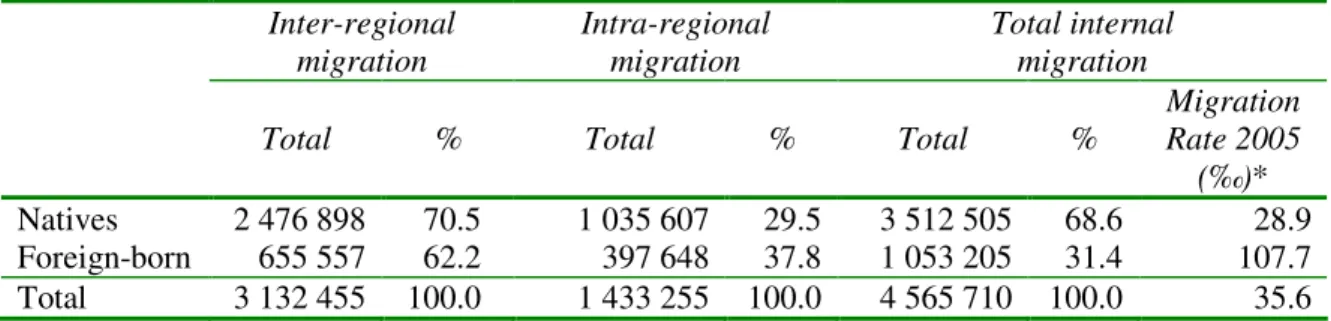
Table 1 reports internal migratory data during 2003-2005 for natives and foreign-born residents by type of migration.
Table 1
Types of Internal Migration within Spain for Natives and Foreign-Born, 2003-2005
Inter-regional migration Intra-regional migration Total internal migration
Total % Total % Total %
Migration Rate 2005 (‰)* Natives 2 476 898 70.5 1 035 607 29.5 3 512 505 68.6 28.9 Foreign-born 655 557 62.2 397 648 37.8 1 053 205 31.4 107.7 Total 3 132 455 100.0 1 433 255 100.0 4 565 710 100.0 35.6
(*) The migration rate is obtained dividing flows of migration by population. Source: Own elaboration from INE data.
We see that migrations within regions (intra-regional migration) are predominant for both groups. Otherwise, according to the migration rate in 2005, foreign-born residents would be nearly 4 times more likely to undertake migration than people born in Spain. An explanation for this fact might be that economic and social attachments to the region of residence would be low for foreign-born residents.
Figure 1 plots the net migration of natives and foreign-born residents for the 17 regions of Spain throughout the period 2003-2005. We see that net migrations of natives and foreign-born differ in terms of sign in 9 regions. Such is the case of Andalucia, where net migration is positive for natives (largely due to returns of earlier emigrants and mildness of climate for retired people) and negative for these foreign-born, due to occupation in the farming sector usually being a first alternative for immigrants previously settled in Andalucia before seeking a new job in another economic sector of another Spanish region.
Figure 1
Net Migration of Natives and Foreign-Born, 2003-2005
Natives -25000 -20000 -15000 -10000 -5000 0 5000 10000 15000 20000 A n d al u si a A ra g ó n A st u ri as B al ea ri c Is la n d s T h e C an ar y I sl an d s C an ta b ri a C as ti le -L eó n C as ti le -L a M an ch a C at al o n ia V al en ci an C . E x tr em ad u ra G al ic ia M ad ri d M u rc ia N av ar re B as q u e C o u n tr y L a R io ja Foreign-born residents -10000 -8000 -6000 -4000 -2000 0 2000 4000 6000 8000 10000 A n d al u si a A ra g ó n A st u ri as B al ea ri c Is la n d s T h e C an ar y I sl an d s C an ta b ri a C as ti le -L e ó n C as ti le -L a M an ch a C at al o n ia V al en ci an C . E x tr em ad u ra G al ic ia M ad ri d M u rc ia N av ar re B as q u e C o u n tr y L a R io ja
Source: Own elaboration from INE data (2003, 2004 and 2005).
Madrid represents a particular case of interest. The sign of both net migrations is the same, but the reasons differ. Madrid is simultaneously the third largest receptor of immigrants in Spain and also the main redistributor of these inflows to other Spanish regions (García-Coll 2005). Relocation of population born in Madrid to neighbouring regions such as Castile-León and Castile-La Mancha explains the negative sign for natives.
However, for an exhaustive examination of migration patterns, analysis of migration flows is essential. In order to find out whether location choices of foreign-born and natives are similar, distribution of migration of natives and foreign-born are compared for each region of origin through a Spearman’s coefficient. Results are reported in Table 2.
Table 2
Spatial Association between Patterns of Emigration of Natives and Foreign-Born within Spain, 2003-2005
Spanish region of origin Spearman’s
coefficient Spanish region of origin
Spearman’s coefficient
Basque Country 0.66 Catalonia 0.84 Castile-León 0.73 Extremadura 0.85 Balearic Islands 0.76 Murcia 0.85
Cantabria 0.78 Asturias 0.87
Castile-La Mancha 0.78 Andalusia 0.92
Madrid 0.80 Valencian C. 0.93
The Canary Islands 0.81 Aragón 0.94
Navarre 0.81 Galicia 0.95
La Rioja 0.82
We see that migration patterns of native and foreign-born residents show a positive spatial association of destinations in all regions. This association is also high (a Spearman’s coefficient higher than 0.8) for 12 regions. This result would reflect the importance of considering migration flows in order to analyse migratory patterns.
3. Methodology and empirical results
In this section we obtain evidence about the effect of internal migration of foreign-born residents on internal migratory patterns of natives in Spain. For this aim, a synthetic index of mobility based on transition probabilities is applied, which allows us to include migration flows in the analysis and, therefore, to capture intradistribution movements (Quah 1996). This index gives an increasing weight to migrations across more distanced locations and a null value to intra-regional migration.
Let us consider
k
population groups differing in some demographic or socioeconomic characteristic such as sex, age, occupation or nationality. Next, from Bartholomew’s (1996) general group of mobility measures, an index of inter-regional mobility is defined for each groupg
,g
=
1 K
,
,
k
:∑ ∑
⋅
⋅
⋅
=
i j ij g ij g i i g gp
d
k
d
(
P
)
1
π
, , , (1)where
p
ij,g is the probability of groupg
to migrate from locationi
to locationj
,d
ij is the number of regional borders which must be crossed to move from region i to region j (the sea is considered another separating region when compared to insular regions),k
i represents the maximum number of regional borders that could be crossed from regioni
and, finally,π
i,gis the generic element for the stationary distribution (see Durrett 1999 and Parzen 1962),
g i,
π
being the proportion of migrations obtained by region i in equilibrium. Transitionprobabilities are usually estimated by maximum likelihood estimation.
This index includes in its formulation three concepts that are essential in the analysis of mobility: transition probabilities establish the movement propensities of migrants, the measure of distance proposed defines special measures of inter-regional migrant distance, and stationary distribution points to equilibrium and distributional tendencies of migrants.
It is easy to prove that the value of this index lies between 0 and 1. If all movements take place within regions, the value of these indexes is 0, since if all movements from each region of origin go to the corresponding furthest region of destination, the value is 1.
g
α
being the proportion of migrations made by groupg
, a synthetic index ofinter-regional mobility,
d
S(P
)
, is defined as:)
(
1
1
)
(
g g g g Sd
d
P
P
∑
⋅
=
α
. (2)An index
d
S(P
)
close to 0 indicates the absence of inter-regional mobility, that is, the sole presence of intra-regional mobility, while an indexd
S(P
)
close to 1 shows that migrations go to the furthest away locations and, therefore, we have the maximum level of inter-regional migration.In order to determine the influence of the characteristic considered on the degree of inter-regional mobility, the following index is defined:
)
(
)
(
)
(
)
(
P
P
P
P
d
d
d
V
=
−
S , (3)where
d
(P
)
is the mobility index for the whole population. An indexV
(P
)
close to 1 would point to a strong influence of such characteristic on the degree of inter-regional mobility. However, an index close to 0 would indicate a characteristic of barely any influence.Since information about migration flows in Spain is only available according to nationality of migrants, Table 3 reports indexes for both groups: natives and foreign-born. These results show that inter-regional mobility is extremely low in Spain. This finding is consistent with almost 70% of internal migration in Spain being intra-regional and the importance of inter-regional migration between neighbouring regions.
Table 3
Inter-regional Mobility for Natives and Foreign-Born in Spain, 2003-2005
2003 2004 2005 1 α 0.799 0.766 0.743 2 α 0.201 0.234 0.257 ) ( 1 1 d P * 0.139 0.146 0.144 ) ( 2 2 P d ** 0.172 0.177 0.168 ) (P S d 0.145 0.152 0.149 ) (P d 0.146 0.154 0.151 ) (P V 0.007 0.013 0.013
(*) d1(P1) is the index of inter-regional mobility for natives.
(**) d2(P2) is the index of inter-regional mobility for foreign-born residents. Source: Author’s elaboration from INE data (2003, 2004 and 2005).
On the other hand, we find that the weight of migration flows of foreign-born population α2 is low (between 20% and 25% of the total migration registered in Spain), so that
d
S(P
)
is strongly influenced by the mobility index for natives. Thus, the small differences observed between inter-regional mobility indexes for natives and foreign-born,)
(
11
d P
andd
2(
P
2)
, gives an indexV
(P
)
very close to 0, which indicates that influence of foreign-born in inter-regional mobility is negligible.Finally, we examine whether internal migration flows of foreign-born become more or less dispersed than flows corresponding to natives. For that, an appropriate measure is the
total entropy (Theil 1967)1 as a measure of the degree of order or disorder in a spatial distribution of migration flows:
∑ ∑
⋅
=
i j ij ijs
s
ET
log
1
(4)where sij represents the weight of the migration flow from i to j on the total migration flows. Concentration of migration flows will be the result of either a large proportion of migration flows going to a small number of locations or coming from a small number of locations. On the contrary, dispersed migratory flows will result from migration flows being quite spread out.
As a normalized measure, we use Total Relative Redundancies (TRR):
2 2
log
log
n
ET
n
TRR
=
−
(5)where
n
is the total number of locations considered. A relative redundancy close to 0 will indicate high dispersion in migration flow distribution, while a relative redundancy close to 1 will point to maximum concentration in migration flow distribution.In Table 4, relative redundancies for migration flows of natives and foreign-born in Spain from 2003 to 2005 are reported.
Table 4
Relative Redundancies for Migration Flows of Natives and Foreign-Born in Spain, 2003-2005
2003 2004 2005
Natives 0.351 0.349 0.353 Foreign-born 0.328 0.326 0.334 Total population 0.340 0.338 0.343
Source: Author’s elaboration from INE data (2003, 2004 and 2005).
The main conclusion is that migration flows of foreign-born tend to be as dispersed as are the migration flows of natives. These low relative redundancies seem to be largely due to the role of suburbanization and the rise in residential migrations in the location choices of migrants, which largely explains the increasing share of intra-regional migration over the last two decades. The residential boom in most Spanish cities, the increasing flexibility of firms and services in spatial location, environmental diseconomies and urban congestion, investment in communications and infrastructures in suburban areas and local initiatives in rural spaces seem to play a larger role in the rise in residential migration and suburbanization. On the contrary, there is some evidence as to foreign-born residents’ preference for moving to cities. García-Sanz and Izcara (2003) find that job opportunities for illegal immigrants are
1
The Gini Index (Plane and Mulligan 1997) and the Index of Dissimilitude (Rogers and Sweeney 1998) are alternative approaches for measuring migration dispersion. On the other hand, measures based on entropy have had a long tradition in spatial interaction models since Wilson’s (1970) pioneer research.
higher in agriculture than in other economic activities. However, once immigrants get a residence permit, they tend to abandon rural areas and settle in urban spaces.
4. Conclusions
The foreign-born population is nearly four times more likely to undertake inter-regional migration than natives in Spain. The influence of this migration is gradually higher due to the foreign-born population constituting an increasing share of the Spanish population. In view of the differences observed in net migration rates for natives and foreign-born, some studies have suggested the presence of differences between the internal migration patterns of both groups, which might represent a possible factor of distortion on the migratory patterns of natives existing since the mid 1970s. However, when the analysis is focused on migration flows, we find that migration patterns of natives and foreign-born show a positive spatial association of destinations in all regions. The analysis of the effect of internal migration of foreign-born on inter-regional mobility and the comparison of the degree of dispersion in their internal migration flows provide the support for our conclusions.
References
Bartholomew, D.J. (1996) The Statistical Approach to Social Measurement, Academic Press: London
Durrett, R. (1999) Essentials of Stochastic Processes, Springer Verlag.
García-Coll, A. (2005) “Migraciones Interiores y Transformaciones Territoriales” Papeles de Economía Española 104, 76-91.
García-Sanz, B. and P. Izcara (2003) “Los Trabajadores Inmigrantes en la Agricultura” Papeles de Economía Española 98, 109-120.
Parzen, E. (1962) Stochastic Processes, Holden-Day: San Francisco.
Plane, D.A and G.F. Mulligan (1997) “Measuring Spatial Focusing in a Migration System” Demography 34, 251-262.
Quah, D. (1996) “Empirics for Economic Growth and Convergence” European Economic Review 40, 1353-1375.
Theil, H. (1967) Economics and Information Theory, Amsterdam: Holland. Wilson, A.G. (1970) Entropy in Urban and Regional Modelling, Pion: London.