During fault-related folding, stratigraphic (Corbett et al., 1987), environmental (Chester et al., 1991) and structural (Srivastava and Engelder, 1990) factors interact to determine the type, fre-quency, and attitude of folding-related fractures. Accordingly, analysis of folding-related fracture patterns can provide information about fault-fold kinematic evolutions. Moreover, field studies of folding-related fracturing are very useful to pro-vide analogues for fracture distribution predictions at depth. This is particularly relevant because of the influence that fractures exert on the migration and accumulation of fluids in the subsurface. Fracture network in thrust-related anticlines is commonly characterised by different subsets dis-playing well-known geometrical relationships with the host-fold. Fractures strike parallel, perpendicu-lar and oblique to the fold axis (Stearns, 1968; Hancock, 1985; Cooper, 1992) and are mostly at high angle to bedding (Tavani et al., 2006). The last feature frequently led to pre-folding
interpre-tations of fracture networks (Thorbjornsen and Dunne, 1997). On the other hand, statistical analysis of large high-angle fracture datasets fre-quently indicates the existence of a relationship between fracture attributes and structural position within folds (Srivastava and Engelder, 1990; Cooper, 1992).
This works reports on fracture data collected in the Fiastrone anticline (Northern Appenines, Italy), where we performed statistical analysis of fracture dis-tributions with the purpose of investigating fracture attitude and relative chronology with respect to the anticline growth.
The Miocene-Pliocene Fiastrone anticline is locat-ed in the central part of the Sibillini thrust sheet, one of the major thrusts of the Northern Apennines (Fig. 1). The folded multilayer consists of alternating limestones, marls and clays (Umbro-Marchean stratigraphic succession). The anticline is characterised by an eastward transport direction,
Longitudinal fracture generation in the Fiastrone
anticline, Sibillini thrust sheet, Northern Apennines (Italy)
J. B
AUSÀ1*, S. T
AVANI1, F. S
TORTI2ANDJ. A. M
UÑOZ11Geomodels, Departament de Geodinàmica i Geofísica, Universitat de Barcelona, 08028 Barcelona, Spain.
2Univeristà degli Studi “Roma Tre”, Dipartimento di Scienze Geologiche, Largo S.L. Murialdo 1, 00146 Rome, Italy.
*e-mail: [email protected]
Abstract: The statistical analysis of folding-related fracture distributions is a well known tool to obtain structural constraints on fault-fold kinematic evolution. In this work we illustrate the fracture pattern exposed in the Fiastrone anticline (northern Appenines) to determine the relationships between longi-tudinal fracture patterns and fold growth. Results indicate a mostly syn-folding origin, with a fracture network dominated by hinge perpendicular extension in the crest and hinge perpendicular compres-sion in the fold limbs.
being 340ºN the average fold axial trend (Fig. 1). The anticline geometry includes a gently west-ward-dipping back limb, a wide flat crestal panel and a steep eastward dipping to overturned fore-limb. Data were collected in 325 georeferenced field analysis sites in the Maiolica (marly lime-stones) and Scaglia (limelime-stones) Formations, where deformation structures were characterised by their orientation, overprinting relationships, spacing, termination or non-termination at bed-ding, and geometric relationships to bedding. The thickness of the boundary layers was also measured for stratabound elements.
In the Fiastrone anticline, pressure solution cleav-age is at high angle to bedding and strikes parallel to fold axis (Fig. 2). Joints are characterized by two sets at high angle to bedding: the first one corre-sponds to elements striking about parallel to fold axis; the second one corresponds to elements strik-ing perpendicular to fold axis. Fault data are scat-tered, with two relative maxima corresponding to conjugated longitudinal normal fault sets.
Pressure solution cleavage mostly locates in the fold limbs, whereas joints and normal faults mostly locate in the crestal sector. This is well imaged (Fig. 3A), where the normalized frequency of pressure solution cleavage and joints vs. bedding dip is plotted. The progressive reduction of the pressure solu-tion cleavage frequency, from the fold limbs towards the crestal sector is also well imaged in the structural transect across the fold (Salvini et al., 1999) of the pressure solution cleavage H/S ratio (equivalent to C/B fissility of Durney and Kisch, 1994) (Fig. 3B). The H/S ratio is high in the fold limbs and reduces towards the crest, indicating a progressive transition from hinge perpendicular compression to hinge perpendicu-lar extension.
Conclusion
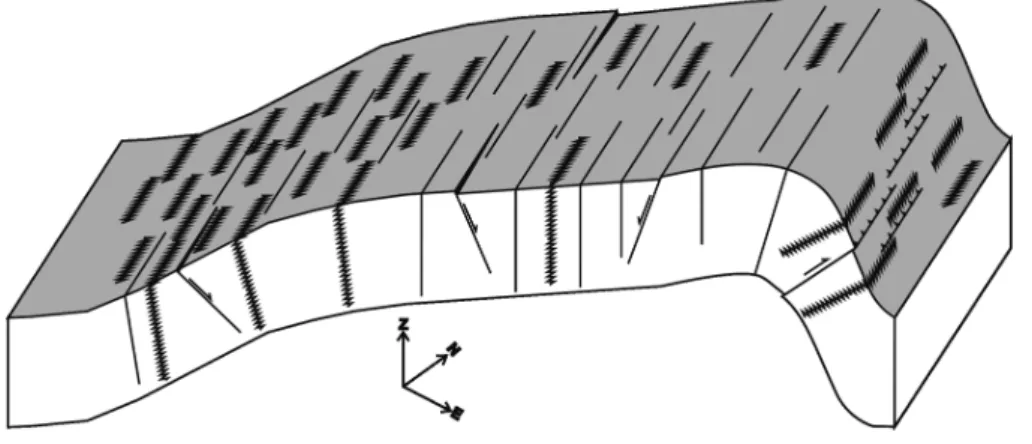
The longitudinal fracture distribution in the Fiastrone Anticline is schematically illustrated (Fig. 4) and can be summarized as follows:
LONGITUDINAL FRACTURES IN THE FIASTRONE ANTICLINE, APENNINES
Figure 2.Cumulative contouring of the present-day orientation and after bedding dip removal (rotation of data for each station in order to make bedding horizontal) of poles to pressure solution cleavages, joints and normal faults.
1. Pressure solution cleavage is at high angle to bed-ding and strikes parallel to fold axis.
2. Joints at high angle to bedding strike parallel to fold axis. In a greater detail the longitudinal pattern includes also other subsets, possibly related to the 3D evolution of the fold.
3. Normal faults and joints locate mostly in the crest, where-as pressure solution cleavage locates mostly in the fold limbs.
These observations, coupled with the progressive cleavage and joint frequency variations suggest a mainly syn-folding origin for the longitudinal fracture pattern in the Fiastrone anticline.
Acknowledgements
This research has been supported by StatoilHydro, the MODES-4D project (CGL2007-66431-C02-01/BTE) and the Geomodels Institute Consortium.
LONGITUDINAL FRACTURES IN THE FIASTRONE ANTICLINE, APENNINES
Figure 4.Schematic distribution of longitudinal fractures in the Fiastrone anticline.
References
CHESTER, J. S., LOGAN, J. M. and SPANG, J. H. (1991): Influence of layering and boundary conditions on bend and fault-propagation folding. Geol. Soc. Am. Bull., 103, 8: 1059-1072.
COOPER, M. (1992): The analysis of fracture systems in subsurface
thrust structures from the foothills of the Canadian Rockies. In: K. R. MCCLAY (ed): Thrust Tectonics, Chapman and Hall, London: 391-405.
CORBETT, K. P., FRIEDMEAN, M. and SPANG, J. (1987): Fracture development and mechanical stratigraphy of Austin Chalk, Texas. AAPG Bull., 71, 1: 17-28.
DURNEY, D. W. and KISCH, H. J. (1994): A field classification and intensity scale for first-generation cleavages. J. Aust. Geol. Geophys., 15, 3: 257-295.
HANCOCK, P. L. (1985): Brittle microtectonics: principles and
practice. J. Struct. Geol., 7: 437-457.
SALVINI, F., BILLI, A. and WISE, D. U. (1999): Strike-slip fault-propagation Cleavage in carbonate rocks: the Mattinata Fault Zone, Southern Apennines, Italy. J. Struct. Geol., 21: 1731-1749.
SRIVASTAVA, D. C. and ENGELDER, T. (1990): Crack-propagation sequence and porefluid conditions during fault-bend folding in the Appalachian Valley and Ridge, central Pennsylvania. Geol. Soc. Am. Bull., 102: 116-128.
STEARNS, D. W. (1968): Certain aspect of fracture in naturally
deformed rocks. In: R.E. RIEKER (ed): National Science Foundation Advanced Science Seminar in Rock Mechanics. Special Report. Air Force Cambridge Research Laboratories, Bedford, Massachusetts: 97-118. AD66993751.
TAVANI, S., STORTI, F., FERNÁNDEZ, O., MUÑOZ, J. A. and
SALVINI, F. (2006): 3-D deformation pattern analysis and evolu-tion of the Añisclo anticline, southern Pyrenees. J. Struct. Geol., 28: 695-712
THORBJORNSEN, K. L. and DUNNE, W. M. (1997): Origin of a
thrust-related fold: geometrics vs. kinematic test. J. Struct. Geol., 19: 303-319.