
Journal Name
Celeste Pérez-Briso,† Ana M. Gallego, Jose M. Martín-Alvarez, Jesús M. Martínez-Ilarduya* and
Pablo Espinet*
A polymer [Pd(CH2SO2C6H4Me)2]n is obtained by thermolysis of cis-[Pd(CH2SO2C6H4Me)2(NCMe)2] to release the MeCN ligands. The corresponding coordination sites are then occupied by weak Pd–O bonds, easier to break than the previous Pd–N bonds. This allows to produce from the polymer cis complexes containing ligands weaker than NCMe, such as acetone or water. The complexes (cis-[Pd(CH2SO2C6H4Me)2{OC(CD3)2}2], cis-[Pd(CH2SO2C6H4Me)2(OH2)2], cis -[Pd(CH2SO2C6H4Me)2(OH2){OC(CD3)2}], and cyclic dimers [Pd(CH2SO2C6H4Me)2(OH2)]2 with bridging methylsulphone groups are formed. The Pd:PPh3:OH2 1:1:1 reaction of the polymer produces cis-[Pd(CH2SO2C6H4Me)2(PPh3)(OH2)], which isomerizes to trans-[Pd(CH2SO2C6H4Me)2(PPh3)(OH2)], with water O-coordinated to Pd and making hydrogen bonds to the two SO2 groups as seen in its X-ray structure. A similar role is played by RNH2 groups in the structures of trans-[Pd(CH2SO2C6H4Me)2(PPh3)(NH3)] and the dimer μ-(N2H4)(trans-[Pd(CH2SO2C6H4Me)2(PPh3)])2. In addition to these interesting intramolecular hydrogen bonding properties provided by the SO2 groups, the structural and 1H NMR data available suggest that the CH2SO2C6H4Me group is an interesting kind of alkyl strongly σ donor, with high trans influence, and forming very stable Pd complexes extraordinarily reluctant to reductive elimination and to hydrolysis by water at room temperature.
Introduction
Palladium-mediated or catalysed cross-coupling reactions, used to form C–C and C–heteroatom bonds, are today among the most powerful transformations of organic synthesis. Over the last decades, our group has made some relevant mechanistic contributions in this field using Pd–C(sp2) systems based in fluoroaryl palladium complexes,1 which are relatively stable and offer easy monitoring of the reactions by 19F NMR. We are now interested in highly stable Pd–C(sp3) systems. In this respect, Pd–CF3 compounds are an important area of
study in the last years. Pd catalysed Ar–CF3 bond formation is
interesting for fluorination of organic molecules, but reductive elimination from Pd complexes containing Pd–CF3 bonds is
extremely difficult.2 Other interesting Pd–C(sp3) systems are methyl derivatives, fairly stable compared to many other alkyls that are prone to undergo β-H elimination. The thermal stability of these methyl derivatives depends on the ancillary ligands, but is not very high.3 Some time ago we reported the preparation of the (arylsulfonyl)alkylpalladium complexes (NBu4)2[Pd2(µ-Br)2R4] and cis-[PdR2(NCMe)2] (R =
[K(18-crown-6)R].7 As expected for a late transition metal, the (arylsulfonyl)alkyl groups in all these complexes prefer to coordinate to palladium through the carbon atom in a σ-alkyl fashion while the oxygen atoms of the sulfonyl group do not coordinate. The opposite preference is generally found for alkali metals, which bind to the highly electronegative oxygen atoms.8
In this paper we are recovering the topic because the few Pd arylsulfonylalkyl complexes reported so far have shown a considerable inertness of the Pd–C(sp3) bond. Compared to CF3
derivatives, the arylsulfonylalkyl complexes are prepared much more easily and we see them as a convenient study model to look for methods to induce difficult couplings, complementary to the inert CF3 or to the more reactive Me group.
9
Its inertness could be also useful in the field of materials, where reactivity is a property to be avoided.10 The Pd–CH2SO2C6H4Me
bond is, for instance, more inert than the Pd–C6F5 bond (which
has a reputation of inertness) towards olefin insertion: [PdX(CH2SO2C6H4Me)(COD)] is reluctant to insertion,5 while
Page 2 of 22
Dalton Transactions
ARTICLE
Journal Name
fast,3 in conditions where the similar arylsulfonylalkyl complexes reported by us are perfectly stable.4 This inertness of the Pd–C bond is further encountered here in its resistance to hydrolisis by water or other weakly acidic molecules. Moreover, the oxygen atoms of sulfones are very weak donors for Pd, and the coordination chemistry reported for them is
general precursor to any of the complexes reported previously by other methods.4 The controlled reactivity of this polymer uncovers an unexpected and highly interesting intramolecular structural interplay of first order (O or N coordination) and second order (H···O=S=O hydrogen bonding) interactions when OH2 or RNH2 molecules are used as ligands.
Results and discussion
1. Synthesis and characterization of [Pd(CH2SO2C6H4Me)2]n
Complex cis-[Pd(CH2SO2C6H4Me)2(NCMe)2] (1) has shown to be
excellent precursor to other Pd complexes with stronger ligands, by displacing the weak acetonitrile ligands.4 In general, complexes [PdR2L2] (R = conventional aryl or alkyl) require
strongly coordinating ligands (e.g. phosphines) for their stabilization, and they undergo easy reductive elimination if the ligands are weak. In view of the unusual thermal stability of complex 1 with a weak ligand MeCN, we decided to submit it to a thermal study. The thermogravimetric analysis of 1 (at 5 °C/min) revealed that two MeCN molecules per Pd atom were quickly eliminated at 134 °C. Alternatively, heating in an oven the white complex 1 at 80 °C up to constant weight (about 1 day) produced the complete elimination of MeCN. In both cases, contrary to complexes with conventional alkyls or aryls, the loss of ligand does not lead to reductive elimination and formation of black Pd, but to formation of a red solid (2) of composition [Pd(CH2SO2C6H4Me)2]n.
Fig. 1 Thermogravimetry diagram of cis-[Pd(CH2SO2C6H4Me)2(NCMe)2] (1).
Only few complexes with stoichiometry [PdR2]n have been
reported previously: the dicyclopalladated cis-[Pd{2 -(C,O)-C6H4NO2-o}2];14 the tetranuclear [Pd(CH2SPh)2]4;15 and
[Pd(CH2CN)2]n, proposed to have a chain structure.16 In all these complexes the apparent coordination deficiency of the Pd atom is compensated by participation of the heteroatoms
discussed later). This insolubility suggests a polymeric structure with the apparent coordinative deficiency of Pd atoms being compensated by involvement of the oxygen atoms of SO2 in bonding to Pd. This is supported by the changes observed in the ν(S=O) stretching absorptions comparing 1 and 2. For 1, where the O atoms are not involved in bonding, two bands are observed at 1135 and 1274 cm–1. In
2 these bands are shifted to lower wavelengths (1116 and 1257 cm–1), reflecting a decrease of S=O bond order when some electron density of the double bond is polarized towards the oxygen atom upon lone pair donation to Pd. Similar wavenumber shifts have been reported comparing MeSO2Ph
(1148 and 1285 cm–1) with LiCH2SO2Ph (1113 and 1211 cm –1
), in this case attributed to the formation of Li–O bonds.17
Chart 1 Polymerization reaction (R = CH2SO2C6H4Me), and the two possible
regular structures of 2. Tacticity around the S atoms is not considered in this figure.
In the absence of crystals suitable for X-ray diffraction studies, the exact structure of the polymer could not be ascertained, but there are good reasons to propose that the mutual arrangement of the two R groups is cis. First of all, there is a very high thermodynamic tendency in PdII for the ligands with high trans influence (the two R groups) to avoid mutually trans arrangement.18 This preference was systematically observed for R = CH2SO2C6H4Me in all the [Pd(CH2SO2C6H4Me)2L2] compounds reported previously,4 and is proposed also for the polymer, where the O-donor SO2 groups have very low trans
influence: the arrangement thermodynamically expected is a trans disposition of the R and O ligands. The reactivity discussed later is also consistent with this proposal in most cases. And the exceptions can be explained.
Journal Name
ARTICLE
This journal is © The Royal Society of Chemistry 20xx J. Name., 2013, 00, 1-3 | 3
Please do not adjust margins
Please do not adjust margins
The S=O···Pd links giving rise to the polymer can producehead/head or head/tail arrangements, both compatible with the cis arrangement of the two Pd–C bonds, and can also have different tacticity around the S atoms (Chart 1). The polymer isolated looks very homogeneous but, beyond that, we do not have any data to favour one structure over another.
The polymer [Pd(CH2SO2C6H4Me)2]n can also be prepared from
(NBu4)2[Pd2(μ-Br)2(CH2SO2C6H4Me)4],4 by reaction with AgNO3
in Me2CO/MeCN (8/1 mixture), filtration of AgBr, and
evaporation of the solution to dryness. Slow addition of water leaves a residue, which is repeatedly washed with water to remove any remaining NBu4NO3. This residue is a mixture of
Pd complexes stabilized only by MeCN or water, which are lost upon prolonged heating at 100 °C (about 3 days) affording 2 in high yield.
2. Special reactivity of [Pd(CH2SO2C6H4Me)2]n
Polymer 2 is a general precursor to all the cis complexes that in our previous paper were synthesized from cis -[Pd(CH2SO2C6H4Me)2(NCMe)2] (1),4 but 2 is an even better
precursor because the Pd···O=S bonds are weaker than the Pd-NCMe bonds. As a matter of fact, complex 1 can be obtained replace acetonitrile. Whereas cationic aquocomplexes of Pd are not infrequent, neutral aquocomplexes [PdR2(OH2)L] are particularly scarce due to the soft-acid character of Pd and the hard-base character of water.19.20
2.a Water complexes
The red polymer 2 is soluble in (CD3)2CO producing a pale
yellow solution. At 293 K this solution displays 1H NMR signals of C6H4 (two pseudodoublets, AA’XX’ spin system), CH2 (broad
signal), and CH3 (sharp singlet), as well as a broad signal due to
water contained in the (CD3)2CO solvent (Fig. 2a).
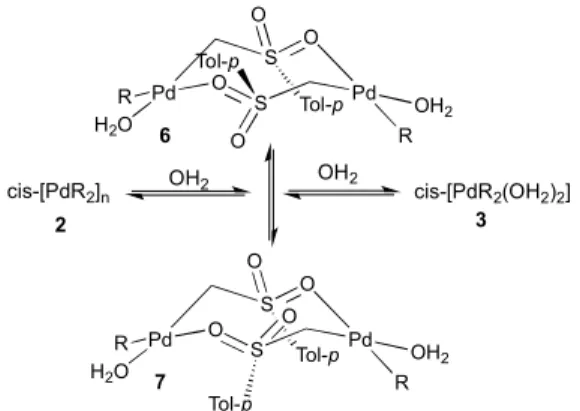
The low temperature 1H NMR spectrum of 2 at 188 K (Fig. 2b) shows the presence of several compounds, which are participating in fast exchange processes producing the broad signals observed at room temperature: cis
-coordinated water correspond to their higher acidity compared to free water.
The polymer can also be dissolved in moist CDCl3 or moist
CD2Cl2, producing yellow solutions. At variance with the
(CD3)2CO case, since these solvents are non coordinating, water is the only ligand available to split the polymer. The low temperature 1H NMR spectra of these solutions suggest the complexes could not be obtained but the proposed structures are supported by the fact that the diastereotopism observed for the H atoms of the methylene groups requires SO2 groups
where one oxygen atom is coordinated to Pd and the other is not. Dimer 6 accounts for the observation in the 1H NMR spectra and COSY experiments of eight equal intensity H atoms (4 non equivalent CH2 groups with diastereotopic H atoms). On
the other hand dimer 7, which possesses a C2 symmetry axis,
conditions. This spontaneous oligomerization with water extrusion is a further support for the structures proposed for 6
and 7. Complexes 3, 6, and 7 quickly lose water out of the solution and eventually regenerate the polymer.
ARTICLE
Journal Name
addition of only one water ligand per Pd atom gave rise to well defined structures suggested us to try this 1:1 ratio in reactions with a more conventional ligand (PPh3). This was afortunate decision that eventually led to very interesting results. Addition of PPh3 (1:1 molar ratio) to a solution of 2 in
A low temperature variable study of this addition of PPh3 to a
yellow solution of 2 in wet CDCl3 at –60 °C (1:1 molar ratio)
reveals the sequence shown in Scheme 2. At low temperature complex 10 is formed, producing partial discoloration of the initial yellow solution, while half of the palladium remains unreacted (in the form of hydrated forms of the polymer). Letting the solution to warm up, these are the only products observed for a long temperature range, but at 0 °C a rearrangement reaction starts, accompanied of almost complete discoloration, forming 8, which more slowly isomerizes to 9. Eventually the 8/9 ratio reaches 2/98, which is the thermodynamic equilibrium (Scheme 2).
Scheme 2 Stepwise formation of the aquo complex 9.
The formation of a complex with geometrical trans preference,
9, by rearrangement of two precursors with clear cis preference, 2 and 10, catches the eye and is somewhat surprising and unexpected, considering that the reluctance for the two CH2SO2C6H4Me groups to be trans to each other had
been so far the dominant feature. The reason for this was understood when the crystal structure of 9 was determined by X-ray crystallography. The structure shows a fairly regular square planar coordination for the Pd atom, with the two bond distances and angles are given in Fig. 3. The most salient features of the structure are: i) the two CH2SO2C6H4Me groups
are trans; and ii) the water molecule, trans to PPh3, makes
intramolecular hydrogen bonds to the sulfoxide groups, connecting each water hydrogen atom to one oxygen atom of each SO2 unit. These two very uncommon features are probably working together in a synergism that stabilizes this structure.
Fig. 3 Molecular structure of 9 from X-ray crystallography. The thermal ellipsoids are set at a 50% probability level. Selected bond lengths [Å] and bond angles [°]: Pd1-P1 2.2084(7), Pd1-O5 2.1430(18), Pd1-C1 2.093(3), Pd1-C2 2.121(3), C1-Pd1-P1 94.70(8), C1-Pd1-O5 85.19(9), C2-Pd1-C1-Pd1-P1 89.79(8), C2-Pd1-O5 90.28(9). None of the hydrogen atoms involved in hydrogen bonding was located in the Fourier map but their positions were calculated with a riding model. After imposing a O–H distance of 0.938 Å (a value that has been observed by neutron diffraction),22 the calculated hydrogen bond distances and angles are H5A···O2 = 2.163 Å; O5-H5A···O2 = 124.36°; and H5B···O4 = 1.825 Å; O5-H5B···O4 = 142.63°. The two S atoms of the sulfone group lie, respectively, above and below the coordination plane. Although the H–O–H angle is not symmetrically arranged relative to the coordination plane, one oxygen atom of each SO2 group is roughly oriented towards the water molecule, allowing for the formation of the two hydrogen bonds. These values of the H···O lengths correspond to hydrogen bonds of moderate strength.23 However, the intramolecular cooperation of two hydrogen bond of the same OH2 molecule must reinforce the bonding effect, which is able
to compensate the electronically unfavourable contribution of the trans arrangement of the two CH2SO2C6H4Me groups in
this complex. As a matter of fact, in contrast with the easy loss of water from cis-[Pd(CH2SO2C6H4Me)2(OH2)2], which occurs
Journal Name
ARTICLE
For a better qualitative estimation of steric requirements and trans influence of the CH2SO2C6H4Me group and its influence in
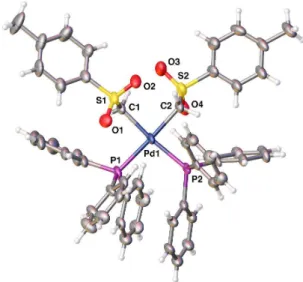
below the coordination plane. In that disposition these groups minimize steric hindrance with the other ligands and with each other. The C1-Pd1-C2 is only 87.1(3)°, compared to 95.69(7)° defined by the P1-Pd1-P2 bulkier PPh3 ligands.
Fig. 4 Molecular structure of 10 from X-ray crystallography. The thermal ellipsoids are set at a 50% probability level. Selected bond lengths [Å] and bond angles [°]: Pd1-P1 = 2.3355(19), Pd1-P2 = 2.351(2), Pd1-C1 = 2.097(8), Pd1-C2 = 2.117(7), Pd1-C2 = 87.1(3), P1-Pd1-P2 = 95.69(7), C2-Pd1-P2 = 87.3(2), C1-Pd1-P1 = 90.2(2).
The comparison of bond lengths in the two structures as a possible indication of trans influence and electron donating ability is somewhat puzzling. In general trans influence of
this be interpreted as a sign of identical trans influence on the Pd–CH2SO2C6H4Me bond length of PPh3 and CH2SO2C6H4Me? large Pd–P bond length difference reflects the fact that OH2 is among the ligands with lowest trans influence. It also suggests that the relationship between bond length to the influenced ligand and trans influence of the influencing is not simple.
Ligands with the highest trans influences are typically strong σ donors that polarize the electron density of the trans bond towards that donor atom, elongating and weakening that bond. Based in this model, the consequence is that the conflict between trans effects of two ligands will have a marked bond length consequence on the weaker σ donor ligand, but the effect on the stronger σ donor can be very minor. With this model the bond length data observed are compatible with a trans influence sequence CH2SO2C6H4Me > PPh3. This
interpretation seems to be supported by the observation of a chemical shift difference of the CH2 groups in the trans
complex 9 compared to any other cis complex. In the 1H NMR spectrum of cis-[Pd(CH2SO2C6H4Me)2(OH2)(PPh3)] (8) the two
inequivalent CH2 groups give rise to two doublets (at 2.78 and
3.04 ppm) with very close 3J(31P–1H) coupling constants (8.5 when the ligand in front is a weaker σ donor.24
2.b Ammonia and other N–H hydrogen donor complexes
The decisive role of water in the constitution of complex 9
suggests immediately other molecules that could play and perhaps reinforce the role of water as O-ligand towards Pd and "chelate" H-donor towards the oxygen atoms of two SO2 groups cis to the water ligand. In effect, the NH3 complex
trans-[Pd(CH2SO2C6H4Me)2(NH3)(PPh3)] (11), equivalent to 9,
can be obtained by treatment of 9 with NH3, or by a variation
of the procedure to the one shown in Scheme 2 for the water complex. The later consists of the rearrangement of cis-[Pd(CH2SO2C6H4Me)2(PPh3)2] (10) and
cis-[Pd(CH2SO2C6H4Me)2(NH3)2] (12). Complex 12 was obtained
from polymer 2 and NH3, and was isolated and fully
characterized. The only practical difference with the preparation of the water complex was that the fast formation of cis-[Pd(CH2SO2C6H4Me)2(NH3)(PPh3)] (13) was observed first, which then isomerized slowly (several days) to trans -[Pd(CH2SO2C6H4Me)2(NH3)(PPh3)] (Scheme 3).
Single crystals of 11 could be obtained and its X-ray diffraction structure was solved and is shown in Figure 5, along with
each to one oxygen atom of each SO2 unit, and the remaining
hydrogen atom makes an intermolecular hydrogen bond with the SO2 unit of a neighbouring molecule. There is a reciprocal interaction from the neighbouring molecule, and these intermolecular interactions define dimers in the solid state structure. The two SO2 groups are located at opposite sides of
the coordination plane.
ARTICLE
Journal Name
6 | J. Name., 2012, 00, 1-3 This journal is © The Royal Society of Chemistry 20xx
Please do not adjust margins
Please do not adjust margins
Scheme 3 Stepwise formation of the ammonia complexes 13 and 11.
As for the water complex, the NH3 hydrogen atom positions
were calculated with a riding model. After imposing a N–H distance of 1.030 Å (a value that has been observed by neutron diffraction),22 the calculated hydrogen bond distances and angles are H1B···O4 = 2.030 Å; N1-H1B···O4 = 127.30°; H1C···O2 = 1.963 Å; N1-H1C···O2 = 146.95°; and H1A···O1# = 2.158 Å; N1-H1A···O1# = 160.99°. All these values of the H···N lengths, intra- and intermolecular, correspond to hydrogen bonds of moderate strength.23
Fig. 5 Molecular structure of 11 from X-ray crystallography. The thermal ellipsoids are set at a 50% probability level. Selected bond lengths [Å] and bond angles [°]:Pd1-P1 2.2465(8), Pd1-N1 2.103(2), Pd1-C1 2.119(3), Pd1-C2 2.112(3), N1-Pd1-C1 89.74(11), N1-Pd1-C2 86.86(12), C1-Pd1-P1 94.08(8), C2-Pd1-P1 89.68(8).
A closely related complex was obtained using hydrazine in Pd:N2H4 2:1 ratio.25 The X-ray diffraction structure of the
corresponding complex, and relevant distances and angles are given in Figure 6. The structure reveals two Pd atoms equivalent by an S2 axis, connected by a bridging hydrazine ligand. The two coordination planes are arranged almost parallel, at the distance imposed by the Pd-N-N-Pd kink.
Fig. 6 Molecular structure of 14 from X-ray crystallography. The thermal ellipsoids are set at a 50% probability level. Selected bond lengths [Å] and bond angles [°]:Pd1-P1 2.2405(6), Pd1-N1 2.131(2), Pd1-C1 2.092(2), Pd1-C2 2.120(2) C1-Pd1-P1 94.33(7), C1-Pd1-N1 88.07(9), C2-Pd1-P1 87.48(7), C2-Pd1-N1 90.97(9).
In this interesting dimeric structure the hydrogen bonding interactions show interesting differences with the previous structures. They are intramolecular as the majority of the interactions already discussed, but the two H atoms on one N atom interact with the O atoms of the CH2SO2C6H4Me groups of the other Pd atom, and not to the CH2SO2C6H4Me groups on the Pd atom coordinated with that N atom. This produces two effects: i) the hydrazine creates a double bridging connection of the two Pd centres, one through the Pd-N-N-Pd bond interactions, and another through the Pd-N-H···O-S-CH2-Pd
hydrogen bond interactions; and ii) in order to make that system of hydrogen bonding interactions possible, the two SO2
groups at each Pd are both oriented above the same face of the coordination plane, that one closer to the other coordination plane of the dimer. Note that in the mononuclear molecules discussed before the two SO2 groups were oriented
one above and the other below the coordination plane. The N2H4 hydrogen atom positions were calculated with a riding model, and a N–H distance of 1.030 Å was imposed (a value that has been observed by neutron diffraction).22 The resulting calculated hydrogen bond distances and angles are H1B···O4# = 1.959 Å; N1-H1B···O4# = 155.65°; and H1A···O2# = 1.926 Å; N1-H1A···O2# = 153.26°. These values of the H···N lengths correspond to hydrogen bonds of moderate strength.23 A related reinforced coordination of water, NH3 as ligand for
Pd
2.c Structural comparison with other molecular systems
Journal Name
ARTICLE
This journal is © The Royal Society of Chemistry 20xx J. Name., 2013, 00, 1-3 | 7
Please do not adjust margins
Please do not adjust margins
from their precursors as in an industrial assembly line,changing the PPh3 ligand by others or using other NH2R ligands might allow for the successful syntheses of many related complexes.
In this respect, Kickham and Loeb reported the synthesis of palladium metalloreceptors for water, ammonia, amines, hydrazine, and the hydrazinium ion.26,27 For this purpose they designed [Pd(L)(CH3CN)]+ cationic complexes (L =
5,8,11-trioxa-2,14-dithia [15]-m-cyclophane) or 5,8,11,14,17-pentaoxa-2,20-dithia[21]-m-cyclophane) as metalloreceptors to coordinate the substrate molecule by O or N σ donation to the Pd center (displacing MeCN) while simultaneously interacting with the peripheral crown ether oxygen atoms via hydrogen bonding. The authors described the structure of their complex with NH3
saying that the metal-bound NH3 substrate is "nested" into the partial crown created by the polyether chain of the macrocycle. In this case the main driving force attracting the molecule to the preformed nest is the strong bond formed by the hard heteroatom (O or N) base with the acidic Pd cation. Using that nesting image we could say in the case of the complexes 9, 11, and 14 reported here the "bird" is attracted to a nest much less comfortable initially, because the acidic site it offers is softer (neutral complex) and the Pd–O or Pd–N bonds will be weaker. However, it is the bird who will heavily rearrange the nest to its own convenience, to make cooperative hydrogen bonding with two SO2 groups instead of
one, by producing cis-trans isomerization against the electronic preferences (trans influence of the ligands) in Pd. Obviously the tight cooperative hydrogen bonding interactions in 9, 11, and 14 are more structurally decisive than in the metalloreceptors above.
3. Stability of CH2SO2C6H4Me Pd complexes
Finally, it is worth commenting briefly on the notable stability in different circumstances of all the CH2SO2C6H4Me Pd
complexes. Concerning hydrolysis, alkyl complexes undergo fast hydrolysis with water to release alkane, whereas common weak monodentate ligands couple fast or very fast to the corresponding alkyl–alkyl, whereas the cis CH2SO2C6H4Me
complexes reported here are very reluctant to couple. In fact they do not couple when heated to 134 °C to produce the polymer. These properties make the Pd-CH2SO2C6H4Me
systems potentially interesting in many fields, from catalysis to materials.
Conclusions
In this work the inertness of the Pd–CH2SO2C6H4Me bond has
let us synthesize by thermolysis a homoleptic Pd polymer that is a very general precursor to almost any Pd complex with this group, as well as some uncommon water and acetone
complexes, including unusual water, ammonia, and hydrazine complexes where the coordinated OH2 or NH2R (R = H, NH2) ligand brings about cis to trans isomerization to establish double hydrogen bridging to two SO2 groups.
As for the inertness of the Pd–C bond observed in this family of compounds, CH2SO2C6H4Me is a highly donor alkyl type group
that produces Pd complexes with unusual resistance to reductive elimination and hydrolysis. In this respect it reminds the stability of fluorinated aryls, and that of mesityl or fluoromesityl derivatives,28 and seems superior to perfluorinated aryls. Consequently it should be a good model for studies of reactions on challenging inert groups. The group is also interesting for application in the field of metal-containing materials demanding thermal stability of the complexes used in the device (e.g. thermotropic liquid crystals).
Acknowledgements
We gratefully acknowledge financial support of the Spanish MINECO (DGI, grants CTQ2014-52796-P and CTQ2016-80913-P), and the Junta de Castilla y León (grant VA256U13; UIC 176).
Notes and references
Ananikov, D. G. Musaev and K. Morokuma, Organometallics, 2005, 24, 715.4 P. Espinet, J. M. Martínez-Ilarduya and C. Pérez-Briso, J. Organomet. Chem., 1993, 447, 145.
5 (a) M. Julia and L. Saussine, Tetrahedron Lett., 1974, 15, 3443; (b) L. Benchekroun, P. Herpin, M. Julia and L. Saussine,
J. Organomet. Chem., 1977, 128, 275.
6 K. W. Chiu, J. Fawcett, W. Henderson, R. D. W. Kemmitt and D. R. Rusell, J. Chem. Soc., Dalton Trans., 1987, 733.
7 P. G. Cozzi, C. Floriani, A. Chiesi-Villa and C. Rizzoli,
Organometallics, 1995, 14, 1756.
8 (a) G. Boche, Angew. Chem. Int. Ed. Engl., 1989, 28, 277; (b) H. J. Gais, G. Hellmann and H. J. Lindner, Angew. Chem. Int. Ed. Engl., 1990, 29, 100.
9 In this respect we have experience in the experimental study of alkyl coupling using the Negishi reaction (a-e) or bimetallic Pd/Au alkyl transmetalations (f, g): (a) E. Gioria, J. M.
ARTICLE
Journal Name
Organometallics, 2014, 33, 4394; (c) J. A. Casares, P. Espinet, B. Fuentes and G. Salas, J. Am. Chem. Soc., 2007, 129, 3508; (d) B. Fuentes, M. García-Melchor, A. Lledós, F. Maseras, J. A. Casares, G. Ujaque and P. Espinet, Chem. Eur. J., 2010, 16, 8596; (e) M. García-Melchor, B. Fuentes, A. Lledós, J. A. Casares, G. Ujaque and P. Espinet J. Am. Chem. Soc.,2011,
133, 13519; (f) M. H. Pérez-Temprano, J. A. Casares, A. R. de Lera, R. Álvarez, and P. Espinet, Angew. Chem. Int. Ed., 2012,
51, 4917; (g) J. delPozo, D. Carrasco, M. H. Pérez-Temprano, M. García-Melchor, R. Álvarez, J. A. Casares and P. Espinet,
Angew. Chem. Int. Ed., 2013, 52, 2189.
10 For instance, in the field of thermotropic liquid crystals conventional alkylcomplexes are excluded due to their thermal lability.
Charmant and A. G. Orpen, Organometallics, 2002, 21, 3536; (b) J. Vicente and A. Arcas, Coord. Chem. Rev., 2005 249, 1135.
20 Some neutral aquo carbene palladium(II) complexes: (a) L.-C. Campeau, P. Thansandote and K. Fagnou, Org. Lett., 2005, 7, axis the ligand with higher trans influence (the C atom in our case) develops some positive partial charge, making a stronger bond to Pd, and the L atom recovers electron density, weakening the interaction with Pd and eventually facilitating the dissociation of L. Blas, P. Espinet, J. M. Martín-Álvarez and F. Villafañe, Angew. Chem. Int. Ed., 2001, 40, 2521; (c) C. Bartolomé, P. Espinet, J. Organomet. Chem., 2006, 691, 3862.
S1
Supporting Information
Polymer [Pd(CH
2
SO
2
C
6
H
4
Me)
2
]
n
, Precursor to
Remarkably Stable Pd Organometallics.
Celeste Pérez-Briso, Ana M. Gallego, Jose M. Martín-Alvarez,
Jesús M. Martínez-Ilarduya* and Pablo Espinet*
IU CINQUIMA/Química Inorgánica, Facultad de Ciencias,
Universidad de Valladolid, E-47071 Valladolid, Spain
E-mail: [email protected]
Contents
1. General methods ... S2
2. Synthesis and characterization of the products ... S2
3. NMR figures ... S6
4. X-ray structure determinations ... S12
1. General methods
S2
All reactions were performed in air unless otherwise stated. If necessary,
solvents were dried using a solvent purification system SPS PS-MD-5 or distilled from
appropriate drying agents under nitrogen, prior to use. Reagents and solvents used were
of commercially available reagent quality.
1
H,
31P{
1H} and
13C{
1H} NMR spectra were recorded with Bruker AV-400
and/or Varian Inova 500-MR instruments. Chemical shifts (in
δ
units, parts per million)
were referenced to the residual solvent signal (
1H and
13C{
1H}), and to 85% H
3PO
4(
31P{
1H}). Elemental analysis for carbon, hydrogen and nitrogen was performed on a
Perkin Elmer 2400 CHN elemental analyser. Infrared spectra were recorded with a
Perkin-Elmer FTIR 1720 X spectrophotometer with samples prepared as Nujol mulls.
Thermogravimetric analyses were made with Perkin-Elmer TGA-7 analyser under
nitrogen at a heating rate of 5 ºC/min.
2. Synthesis and characterization of the products
2.1. [Pd(CH
2SO
2C
6H
4Me)
2]
n(
2
)
Complex
1
(500 mg, 0.95 mmol) was heated in an oven at 80 ºC up to constant
weight (about 1 day) to give the stoichiometric amount of polymer
2
.
To a suspension of AgNO
3(474 mg, 2.79 mmol) in a mixture (40 mL) of
acetone and acetonitrile (8:1) was added (NBu
4)
2[Pd
2(µ-Br)
2(CH
2SO
2C
6H
4Me)
4] (2.14
g, 1.39 mmol). The mixture was stirred in the dark for 30 min. The insoluble AgBr was
filtered off and the resulting solution was evaporated to dryness. Water (20 mL) was
added carefully to the oily residue to give a white solid, which was filtered, washed with
water (3
×
20 mL) and dried under vacuum. The resulting solid was heated in an oven at
100 ºC up to constant weight (about 3 days) to give polymer
2
. Yield: 88%. Analysis
calculated for C
16H
18O
4PdS
2: C, 43.20; H, 4.08. Found: C, 42.93; H, 4.05.
1H NMR
(400.14 MHz, wet CDCl
3, 204 K)
6
δ
= 2.17 (d,
J
HH= 10.7 Hz, 1H, CH
2), 2.33–2.47
(12H, CH
3), 2.64 (d,
J
HH= 12.0 Hz, 1H, CH
2), 2.82 (d,
J
HH= 10.2 Hz, 1H, CH
2), 2.96
(d,
J
HH= 12.0 Hz, 1H, CH
2), 3.12 (d,
J
HH= 10.7 Hz, 1H, CH
2), 3.22 (d,
J
HH= 10.2 Hz,
1H, CH
2), 3.45 (m, 2H, CH
2), 4.99 (s, 2H, H
2O), 5.69 (s, 2H, H
2O), 7.20–7.40 (m, 8H,
H
Aof C
6H
4), 7.60–7.90 (m, 8H, H
Xof C
6H
4).
7
δ
= 2.33–2.47 (12H, CH
3), 2.76 (d,
J
HHS3
= 10.2 Hz, 2H, CH
2), 2.98 (d,
J
HH= 10.2 Hz, 2H, CH
2), 3.20–3.36 (m, 4H, CH
2), 5.31
(br, 4H, H
2O), 7.20–7.40 (m, 8H, H
Aof C
6H
4), 7.60–7.90 (m, 8H, H
Xof C
6H
4).
2.2. cis-[Pd(CH
2SO
2C
6H
4Me)
2(OH
2)
2] (
3
)
To a red suspension of
2
(150 mg, 0.34 mmol) in diethyl ether (20 mL) was
added water (123
µ
L, 6.83 mmol). The mixture was stirred for 30 min, and the resulting
white precipitate was filtered off, washed with diethyl ether (3 mL) and dried under
vacuum. Yield: 90%. Analysis calculated for C
16H
22O
6PdS
2: C, 39.96; H, 4.61. Found:
C, 39.93; H, 4.51.
2.3. trans-[Pd(CH
2SO
2C
6H
4Me)
2(OH
2)(PPh
3)] (
9
)
To a solution of
10
(114 mg, 0.12 mmol) in wet chloroform (20 mL) was added
polymer
2
(52 mg, 0.12 mmol). After 30 min stirring the solution was vacuum
evaporated. The residue was treated with diethyl ether (10 mL) to give a white solid,
which was collected, washed with diethyl ether and dried under vacuum. Yield: 86% (
8
+
9
). Analysis calculated for C
34H
35O
5PPdS
2: C, 56.31; H, 4.86. Found: C, 55.91; H,
4.94. Pure
9
was isolated by crystallization of the white solid in chloroform-hexane.
1H
NMR (400.14 MHz, CDCl
3, 293 K)
δ
= 1.96 (d,
J
HP= 3.0 Hz, 4H, CH
2), 2.35 (s, 6H,
CH
3), 7.17 (m, 4H, H
Aof C
6H
4), 7.36–7.50 (m, 9H, Ph), 7.52 (m, 4H, H
Xof C
6H
4), 7.64
(m, 6H, Ph).
1H NMR (400.14 MHz, CDCl
3, 204 K)
δ
= 1.88 (br, 4H, CH
2), 2.34 (s, 6H,
CH
3), 6.95 (br, 2H, H
2O), 7.19 (m, 4H, H
Aof C
6H
4), 7.37–7.55 (m, 13H, Ph + H
Xof
C
6H
4), 7.64 (m, 6H, Ph).
31P{
1H} NMR (161.98 MHz, CDCl
3, 204 K)
δ
= 42.00 (s, 1P).
13
C{
1H} NMR (100.62 MHz, CDCl
3, 293 K)
δ
= 21.4, 44.4 (d,
J
CP= 7.8 Hz), 126.3,
128.5 (d,
J
CP= 11.3 Hz), 129.2, 129.8 (d,
J
CP= 56.3 Hz), 131.0 (d,
J
CP= 2.6 Hz), 134.5
(d,
J
CP= 11.3 Hz), 142.2, 142.8.
2.4. trans-[Pd(CH
2SO
2C
6H
4Me)
2(NH
3)(PPh
3)] (
11
)
To a suspension of
9
(145 mg, 0.20 mmol) in diethyl ether (20 mL) was bubbled
ammonia for 20 s. The mixture was stirred for 5 min, and the resulting white precipitate
was filtered off, washed with diethyl ether (3 mL) and dried under vacuum. Yield: 90%.
Analysis calculated for C
34H
36NO
4PPdS
2: C, 56.39; H, 5.01; N, 1.93. Found: C, 56.12;
S4
H, 4.90; N, 1.88.
1H NMR (400.14 MHz, CDCl
3, 293 K)
δ
= 2.02 (d,
J
HP= 4.4 Hz, 4H,
CH
2), 2.31 (s, 6H, CH
3), 3.68 (s, 3H, NH
3), 7.09 (m, 4H, H
Aof C
6H
4), 7.33 (m, 4H, H
Xof C
6H
4), 7.38–7.50 (m, 9H, Ph), 7.74 (m, 6H, Ph).
31P{
1H} NMR (161.98 MHz,
CDCl
3, 293 K)
δ
= 38.96 (s, 1P).
13C{
1H} NMR (100.62 MHz, CDCl
3, 293 K)
δ
= 21.3,
43.1 (d,
J
CP= 8.1 Hz), 125.8, 128.4 (d,
J
CP= 10.7 Hz), 129.1, 130.5 (d,
J
CP= 51.0 Hz),
130.6 (d,
J
CP= 2.4 Hz), 134.9 (d,
J
CP= 11.4 Hz), 141.6, 143.8.
2.5. cis-[Pd(CH
2SO
2C
6H
4Me)
2(NH
3)
2] (
12
)
To a red suspension of
2
(150 mg, 0.34 mmol) in diethyl ether (20 mL) was
bubbled ammonia for 2 min. The mixture was stirred for 10 min, and the resulting white
precipitate was filtered off, washed with diethyl ether (3 mL) and dried under vacuum.
Yield: 90%. Analysis calculated for C
16H
24N
2O
4PdS
2: C, 40.13; H, 5.05; N, 5.85.
Found: C, 40.25; H, 4.85; N, 5.87.
1H NMR (400.14 MHz, CDCl
3, 293 K)
δ
= 2.38 (s,
6H, CH
3), 2.60 (s, 4H, CH
2), 2.73 (s, 6H, NH
3), 7.23 (m, 4H, H
Aof C
6H
4), 7.73 (m, 4H,
H
Xof C
6H
4).
13C{
1H} NMR (100.62 MHz, CDCl
3, 293 K)
δ
= 21.4, 34.7, 126.2, 129.4,
142.2, 142.3.
2.6. cis-[Pd(CH
2SO
2C
6H
4Me)
2(NH
3)(PPh
3)] (
13
)
A mixture of
10
(116.3 mg, 0.12 mmol) and
12
(57.5 mg, 0.12 mmol) was
dissolved in chloroform (20 mL). After 10 min stirring the solution was vacuum
evaporated. The residue was treated with diethyl ether (10 mL) to give a white
solid,which was collected, washed with diethyl ether and dried under vacuum. Yield:
87%. Analysis calculated for C
34H
36NO
4PPdS
2: C, 56.39; H, 5.01; N, 1.93. Found: C,
56.05; H, 4.89; N, 1.92.
1H NMR (400.14 MHz, CDCl
3, 293 K)
δ
= 2.14 (s, 3H, NH
3),
2.31 (s, 3H, CH
3), 2.40 (s, 3H, CH
3), 2.77 (d,
J
HP= 8.7 Hz, 2H, CH
2), 3.15 (d,
J
HP= 7.9
Hz, 2H, CH
2), 7.04 (m, 2H, H
Aof C
6H
4), 7.16 (m, 2H, H
Xof C
6H
4), 7.26 (m, 2H, H
Aof
C
6H
4), 7.42–7.54 (m, 9H, Ph), 7.76 (m, 6H, Ph), 7.82 (m, 2H, H
Xof C
6H
4).
31P{
1H}
NMR (161.98 MHz, CDCl
3, 293 K)
δ
= 25.32 (s, 1P).
13C{
1H} NMR (100.62 MHz,
CDCl
3, 293 K)
δ
= 21.3, 21.4, 36.9 (d,
J
CP= 6.6 Hz), 42.46 (d,
J
CP= 103.4 Hz), 126.2,
126.3, 128.8, 129.0 (d,
J
CP= 9.8 Hz), 129.3, 130.5 (d,
J
CP= 37.2 Hz), 130.7 (d,
J
CP=
1.6 Hz), 134.7 (d,
J
CP= 12.4 Hz), 141.5, 141.8, 142.4, 143.6 (d,
J
CP= 5.2 Hz).
S5
2.7. (µ-N
2H
4)(trans-[Pd(CH
2SO
2C
6H
4Me)
2(PPh
3)]
2) (
14
)
To a suspension of
9
(148 mg, 0.20 mmol) in diethyl ether (20 mL) was added
hydrazine monohydrate (5.0
µ
L, 0.10 mmol). The mixture was stirred for 20 min, and
the resulting white precipitate was filtered off, washed with diethyl ether (3 mL) and
dried under vacuum. Yield: 81%. Analysis calculated for C
68H
70N
2O
8P
2Pd
2S
4: C, 56.47;
H, 4.88; N, 1.94. Found: C, 56.07; H, 4.78; N, 1.90.
1H NMR (400.14 MHz, CDCl
3, 293
K)
δ
= 2.31 (s, 12H, CH
3), 2.36 (d,
J
HP= 3.5 Hz, 8H, CH
2), 7.04 (m, 8H, H
Aof C
6H
4),
7.33–7.50 (m, 26H, Ph + H
Xof C
6H
4), 7.65 (m, 12H, Ph), 7.81 (s, 4H, N
2H
4).
31P{
1H}
NMR (161.98 MHz, CDCl
3, 293 K)
δ
= 38.97 (s, 1P).
13C{
1H} NMR (125.67 MHz,
CDCl
3, 293 K)
δ
= 21.4, 42.5 (d,
J
CP= 8.0 Hz), 126.4, 128.4 (d,
J
CP= 10.8 Hz), 129.1,
130.0 (d,
J
CP= 51.4 Hz), 130.6, 134.9 (d,
J
CP= 11.6 Hz), 141.5, 143.2.
S6
3. NMR figures
Fig. S1
:
1H NMR and COSY (400.14 MHz, 204 K) of [Pd(CH
2SO
2C
6H
4Me)
2]
n(
2
) in
wet CDCl
3S7
Fig. S2:
1H NMR (400.14 MHz, 204 K),
31P{
1H} NMR (161.98 MHz, 204 K) and
13
C{
1H} NMR (100.62 MHz, 293 K) of
trans
-[Pd(CH
2SO
2C
6H
4Me)
2(OH
2)(PPh
3)] (
9
)
in CDCl
3S8
Fig. S3:
1H NMR (400.14 MHz, 293 K),
31P{
1H} NMR (161.98 MHz, 293 K) and
13
C{
1H} NMR (100.62 MHz, 293 K) of
trans
-[Pd(CH
2SO
2C
6H
4Me)
2(NH
3)(PPh
3)] (
11
)
in CDCl
3S9
Fig. S4:
1H NMR (400.14 MHz, 293 K) and
13C{
1H} NMR (100.62 MHz, 293 K) of
cis
-[Pd(CH
2SO
2C
6H
4Me)
2(NH
3)
2] (
12
) in CDCl
3S10
Fig. S5:
1H NMR (400.14 MHz, 293 K),
31P{
1H} NMR (161.98 MHz, 293 K) and
13
C{
1H} NMR (100.62 MHz, 293 K) of
cis
-[Pd(CH
2SO
2C
6H
4Me)
2(NH
3)(PPh
3)] (
13
) in
CDCl
3S11
Fig. S6:
1H NMR (400.14 MHz, 293 K),
31P{
1H} NMR (161.98 MHz, 293 K) and
13
C{
1H} NMR (125.67 MHz, 293 K) of (
µ
-N
2H
4)(
trans
-[Pd(CH
2SO
2C
6H
4Me)
2(PPh
3)]
2)
(
14
) in CDCl
3S12
4. X-ray structure determinations
Single crystals of
9
(slow diffusion of hexane into a chloroform solution),
10
⋅
2CHCl
3(evaporation of a chloroform-cyclohexane solution),
11
(slow diffusion of
hexane into a chloroform solution) and
14
⋅
3CH
2Cl
2(evaporation of a
dichloromethane-hexane solution) suitable for X-ray diffraction studies were obtained as indicated.
Diffraction data were collected by using an Oxford Diffraction Supernova
diffractometer, equipped with an Atlas CCD area detector and a four-circle kappa
goniometer. For the data collection Mo microfocus source with multilayer optics were
used at 298.15 and 150.00 K respectively. Using OLEX2,
1the structure was solved with
the SHELXT
2structure solution program using direct methods and refined with the
SHELXL
3refinement package using least squares minimization. The non-hydrogen
atoms were refined anisotropically, and hydrogen atoms were placed at idealized
positions and refined by using the riding model. Crystal data and particular details are
given in Table S1.
CCDC-1529832 (for
9
), CCDC-1529833 (for
10
⋅
2CHCl
3), CCDC-1533563 (for
11
) and CCDC-1533564 (
14
⋅
3CH
2Cl
2) contain the supplementary crystallographic data
for the structures reported in this paper. These data can be obtained free of charge from
The Cambridge Crystallographic Data Center via www.ccdc.cam.ac.uk/data_request/cif.
S13
Crystal system triclinic monoclinic triclinic monoclinic
Space group P-1 P21/n P-1 P21/n
Independent reflections 7775 [Rint = 0.0260,
Rsigma = 0.0554]
Data/restraints/parameters 7775/0/392 12605/0/624 7775/0/391 8839/3/444
![Fig. 1 Thermogravimetry diagram of cis-[Pd(CH 2 SO 2 C 6 H 4 Me) 2 (NCMe) 2 ] (1).](https://thumb-us.123doks.com/thumbv2/123dok_es/3916421.665306/2.918.483.804.565.761/fig-thermogravimetry-diagram-cis-pd-ch-c-ncme.webp)


![Fig. S1: 1 H NMR and COSY (400.14 MHz, 204 K) of [Pd(CH 2 SO 2 C 6 H 4 Me) 2 ] n (2) in wet CDCl 3](https://thumb-us.123doks.com/thumbv2/123dok_es/3916421.665306/14.918.155.763.276.1054/fig-nmr-cosy-mhz-pd-ch-wet-cdcl.webp)


![Fig. S4: 1 H NMR (400.14 MHz, 293 K) and 13 C{ 1 H} NMR (100.62 MHz, 293 K) of cis-[Pd(CH 2 SO 2 C 6 H 4 Me) 2 (NH 3 ) 2 ] (12) in CDCl 3](https://thumb-us.123doks.com/thumbv2/123dok_es/3916421.665306/17.918.160.759.163.785/fig-nmr-mhz-nmr-mhz-cis-pd-cdcl.webp)

