1
Approaches to the Synthesis of 2,3-Dihaloanilines.
Useful Precursors of 4-Functionalized-1H-indoles
Verónica Guilarte, M. Pilar Castroviejo, Patricia García-García, Manuel A. Fernández-Rodríguez, and
Roberto Sanz*
Departamento de Química, Área de Química Orgánica, Facultad de Ciencias, Universidad de Burgos, Pza. Misael Bañuelos s/n, 09001-Burgos, Spain
RECEIVED DATE (to be automatically inserted after your manuscript is accepted if required according to the journal that you are submitting your paper to)
OH
2 Introduction
3 SCHEME 1. Retrosynthetic Analysis of 4-Haloindoles and 2,3-Dihaloanilines
N
Taking into account the foreseeable potential of 2,3-dihaloanilines as precursors of 4-haloindoles, we decided to develop an efficient synthesis of these 1,2,3-functionalized benzene derivatives. We envisaged three different pathways to access these substrates. As shown in Scheme 1, route (a) would involve an ortho-metalation reaction of a 3-haloaniline derivative. To the best of our knowledge, the only reported example of this approach is due to Soll and co-workers, who reported the o-lithiation of N -trifluoroacetyl-3-fluoroaniline 1a and were able to prepare 2-bromo-3-fluoroaniline.13 Alternatively, the desired anilines could be prepared by reduction of the corresponding 2,3-dihalonitrobenzenes (Scheme 1, route (b)).14 However, the only efficient and direct route to these latter compounds is limited to the synthesis of 2-bromo-3-fluoronitrobenzene by a base-mediated halogenation reaction.15 Finally, taking advantage of the efficient synthesis of 2,3-dihalophenols that we have previously developed,16 we also reasoned that the corresponding 2,3-dihaloanilines could be obtained from their phenol counterparts through a “Smiles rearrangement” strategy (Scheme 1, route (c)).17 Herein, we report our results on the synthesis of 2,3-dihaloanilines and their application to the preparation of 4-halo-1H-indoles and different regioselectively functionalized indoles.18
Results and Discussion
4 reaction has not been further used in synthesis in spite of the potential interest in the resulting 2,3-difunctionalized aniline derivatives for the preparation of fluorine-containing indoles. So, first we tried to apply the reported reaction conditions to get 3-fluoro-2-iodotrifluoroacetanilide (3aa) from 1a employing iodine as an electrophile. Thus, using a slight excess of t-BuLi/TMEDA in THF at 78 ºC, we were able to generate the dilithiated species 2a and trap it with iodine, allowing the isolation of 3aa in 63% yield (Scheme 2). We also observed that working at temperatures over ca. 60 ºC a competitive lithium fluoride elimination takes place affording benzyne19 intermediate 5 that intramolecularly evolve to afford, after electrophilic quenching, the iodinated benzoxazole 4 in moderate yield (Scheme 2). This observation has been previously described by Clark and Caroon in the directed metalation of 3-fluoroaniline bearing pivaloyl, N-Boc, or benzoyl as directing groups.20 In an analogous way, the addition of bromine or hexachloroethane as electrophilic reagents to 2a afforded the corresponding 3-fluoro-2-halo-trifluoroacetanilides 3ab and 3ac in 45 and 30% yield. Moreover, the basic hydrolysis of some of these trifluoroacetanilides 3 furnished 3-fluoro-2-haloanilines 6aa and 6ab in high yields (Scheme 2).
SCHEME 2. Synthesis of 3-Fluoro-2-halotrifluoroacetanilides 3 and 3-Fluoro-2-haloanilines 6
6 SCHEME 3. Unsuccessful Synthesis of 3-Chloro-2-iodoaniline from 3-Chloroaniline Derivatives 1b and 8
7 (Scheme 4). Nevertheless, when we applied this strategy to 3-nitrochlorobenzene (13b), only a 13% yield of the corresponding 2-bromo-3-nitrochlorobenzene (14bb)28 was obtained, showing that the deprotonation of 13b was not efficient (Scheme 4). In addition, we tried to metalate this arene derivative by using (tmp)2Zn·2MgCl2·2LiCl as the base, which has been described by Knochel and co-workers for the chemoselective zincation of sensitive arenes and heteroarenes, such as 2-nitrobenzo[b]furan.29 However, 13b was not zincated with this base even at 0 ºC (Scheme 4).
SCHEME 4. Synthesis of 2-Halo-nitrofluorobenzenes 14 and Alternative Preparation of 3-Fluoro-2-haloanilines 6ab and 6ac
8 halides are also useful partners for these metal-catalyzed CN bond forming reactions,34 so the use of this strategy is precluded for our halophenol derivatives. Besides the Pd- and Cu-catalyzed processes, Smiles rearrangement, which works especially well with an activated phenoxy component bearing at least one halogen subsituent, could be considered a complementary and valuable alternative for the preparation of N-arylamines from phenols (Scheme 5).35 This methodology requires the initial conversion of the corresponding phenol into a substituted aryloxyacetamide derivative in which oxygen and nitrogen atoms are connected by a COC(R)2 group. The phenol is usually alkylated with 2-bromo-2-methylpropionamide affording a 2-aryloxy-2-methylpropanamide that undergoes rearrangement to give an N-aryl-2-hydroxypropionamide under basic conditions.36 The formation of the final product must involve a nucleophilic attack of the amide anion leading to a spiro intermediate followed by its breakdown and protonoation (Scheme 5). For this two-step sequence, some one-pot procedures have been reported in literature avoiding the isolation of the intermediate 2-aryloxy-2-methylpropanamide.37 In addition, subsequent hydrolysis of the generated anilide could afford the corresponding aniline.
SCHEME 5. Smiles Rearrangement
As we had reported, a new and efficient synthesis of 2,3-dihalophenols from 3-halophenols using the
10 TABLE 1. Preparation of Propanamides 17 and Dihaloanilides 18 from O-2,3-Dihalophenyl carbamates 15
entry material starting X1 X2 17 yield
a
(%) 18 yield
a
(%)
1 15aa F I 17aa 86 18aa 83
2 15ab F Br 17ab 83 18ab 77
3 15ac F Cl 17ac 82 18ac 76
4 15ba Cl I 17ba 86 18ba 82 5 15bb Cl Br 17bb 80 18bb 78
6 b Cl Cl 17bc 87 18bc 84
7 15ca Br I 17ca 85 18ca 81
8 15cb Br Br 17cb 86 18cb 83 9 15cc Br Cl 17cc 82 18cc 77
10 15da I I 17da 83 18da 79
11 15db I Br 17db 80 18db 77
12 15dc I Cl 17dc 79 18dc 75
a Isolated yield referred to starting material 15. b
Commercially available 2,3-dichlorophenol was used as starting material.
11
Once we have developed a reliable procedure for accessing 2,3-dihaloanilides 18 and due to the lack of methods for the preparation of 2,3-dihaloanilines, we tried to synthesize 2,3-dihaloanilines 6 by hydrolysis of the corresponding anilides 18. We found that, in general, their reaction with ethanolic 6 M HCl at 90 ºC for 6 h afforded 6 in high yields (Table 2). However, iodine-containing rearranged amides 18 did not cleanly furnish the expected haloiodoanilines as partial loss of the iodine atom occurred under the reaction conditions. For instance, 2,3-diiodoanilide 18da led to 2,diiodoaniline (6da) and 3-iodoaniline in a ca. 1:2 ratio (78% combined yield), whereas 3-chloro-2-iodoanilide 18ba afforded a 2:3 mixture of 3-chloro-2-iodoaniline (6ba) and 3-chloroaniline in 80% overall yield.41
12
Lower yield probably due to volatility of this aniline.
Considering our retrosynthetic analysis for the synthesis of 4-haloindoles (Scheme 1), and having developed convenient routes for accessing 2,3-dihaloanilides 3 and 18, then we tackle the preparation of a wide range of different 4-haloindoles. First, an efficient preparation of 4-fluoro-2-substituted-1H -indoles 20 was achieved by reaction of 3-fluoro-2-iodotrifluoroacetanilide (3aa) with terminal aromatic and aliphatic alkynes through a domino Pd/Cu-catalyzed coupling-cyclization process (Scheme 8).42
SCHEME 8. Synthesis of 4-Fluoro-2-substituted-1H-indoles 20
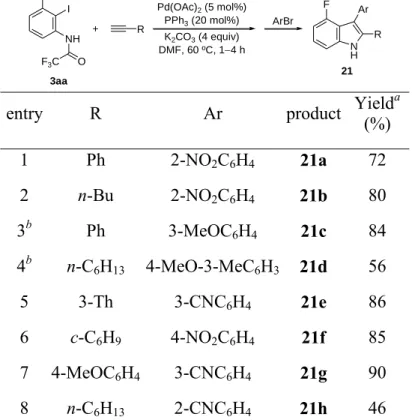
13 terminal alkynes and aryl bromides, which could be added after the starting iodoanilide 3aa was consumed (Table 3, entries 1, 2, 58) or from the beginning of the reaction (Table 3, entries 3 and 4).
TABLE 3. Synthesis of 3-Aryl-4-fluoro-2-substituted-1H-indoles 21a-h
14 SCHEME 9. Synthesis of 3-Aryl-4-fluoro-2-substituted-1H-indole 21i
3aa
N H F +
21i (75%) PdCl2(PPh3)2 (3 mol%)
CuI (2 mol%) Et3N (4 equiv)
MW, 60 ºC, 25 min
MW, 90 ºC, MeCN 30 min
S S
3-MeOC6H4I
MeO
In order to prepare 4-chloro- and 4-bromo-1H-indoles we decided to check the suitability of the 3-halo-2-iodoanilides 18ba and 18ca for a selective Sonogashira coupling with terminal alkynes. Gratifyingly, we found that under standard conditions (Pd-Cu catalysis), and without the use of special phosphine ligands, these 2,3-dihaloanilides underwent selective coupling at the iodine atom despite this
15 TABLE 4. Selective Sonogashira Couplings from 3-Halo-2-iodoanilides 18 and Synthesis of 4-Halo-1H-indoles 23 and 24 from 2-Alkynyl-3-haloanilides 22
based on the corresponding starting material 22. c 1-Cyclohexenyl. d Conducted at 40 ºC for 6 h. e 4-Chloro-1H-indole (R = H). f 4-Bromo-1H-indole (R = H).
We had also shown that 2-substituted-1H-indoles could be prepared in a one-pot manner starting from
16 whereas 3-bromo-2-iodoanilide 18ca formed the corresponding 4-bromoindoles 24 in lower yields (Table 5, entries 911). As in this one-pot protocol, Pd salts are not removed after the Sonogashira coupling and prior to the subsequent cyclization step; the isolation of these indole derivatives 24 in lower yields could be due to competitive Pd-catalyzed processes involving the CBr bond, which could lead to different side-products. So, for accessing 4-bromoindoles the two-step sequence involving isolation of intermediates 22 proved more appropriate.
TABLE 5. One-pot Synthesis of 4-Halo-1H-indoles 20, 23, and 24 from 2,3-Dihalonanilides 18
18 SCHEME 10. Synthesis of 4-Alkynyl-2-substituted-1H-indoles 26 from 2,3-Dichloroanilides 1c,18bc and 4-Bromoindole 24a
19 precursors of other 4-functionalized-1H-indoles using Pd-catalyzed coupling reactions. For instance, 4-heteroarylindoles 28 were formed in high yields by Stille coupling of 4-chloroindoles 23 with 2-(tributylstannyl)furan (Scheme 12, eq 1).50 In addition, 4-phenyl-2-substituted-1H-indoles 29 have been also prepared in high yields by Suzuki coupling of 4-bromoindoles 24 with phenylboronic acid (Scheme 12, eq 2).51
SCHEME 12. 4-Aryl-2-substituted-1H-indoles 28 and 29 from 4-Haloindoles 23 and 24
20 Conclusions
In summary, we have studied different approaches to the synthesis of 2,3-dihaloanilines and we have found that the most efficient route involves a Smiles rearrangement from 2,3-dihalophenols. By using this strategy, 2,3-dihaloanilides were obtained in high yields from O-2,3-dihalophenyl N,N -diethylcarbamates or 3-halo-2-iodoanisoles without any chromatographic purification. 3-Halo-2-iodoanilides have been shown as useful precursors for the synthesis of 4-halo-1H-indoles through their coupling with terminal alkynes, followed by cyclization under treatment with NaOH. In this way, a wide variety of challenging and interesting 4-haloindoles have been prepared, usually in high yields. In addition, the usefulness of these 4-haloindoles as intermediates for further transformations has been briefly outlined, including reactions that afford 2,4- and 2,3,4-functionalized indoles.
Experimental Section
All reactions involving air-sensitive compounds were carried out under a N2 atmosphere in oven-dried glassware with magnetic stirring. Temperatures are reported as bath temperatures. Solvents used in extraction and purification were distilled prior to use. TLC was performed on alumina-backed plates coated with silica gel 60 with F254 indicator; the chromatograms were visualized by UV light (254 nm) and/or by staining with a Ce/Mo reagent, anisaldehyde or phosphomolybdic acid solution and subsequent heating. Rf values refer to silica gel. Flash column chromatography was carried out on silica gel 60, 230-400 mesh. Melting points were obtained with open capillary tubes and are uncorrected. 1H NMR spectra were recorded at 400 or 300 MHz. Chemical shifts are reported in ppm with the residual solvent resonance as the internal standard (CHCl3: 7.26, Acetone-d6: 2.05, DMSO-d6: 2.50). Data are reported as follows: chemical shift, multiplicity (s: singlet, br s: broad singlet, d: doublet, dd: doublet of doublets, dt: doublet of triplets, ddd doublet of doublet of doublets, t: triplet, appt: apparent triplet, td:
21 decoupling. Chemical shifts are reported in ppm with the solvent resonance as internal standard (CDCl3:
77.16, Acetone-d6: 29.84,DMSO-d6: 39.51). Low-resolution electron impact mass spectra
(EI-LRMS) were obtained at 70 eV on a mass spectrometer and only the molecular ions and/or base peaks as well as significant peaks in MS are given. High-resolution mass spectrometry (HRMS) was carried out on a mass spectrometer. Infrared spectra were recorded with a FT-IR spectrophotometer. The microwave heating was performed in a Microwave, CEM Discover S-Class single-mode microwave cavity producing continuous irradiation (Temperature measurements were conducted using an IR sensor located below the microwave cavity floor, and reaction times refer to the total hold time at the indicated temperature. The maximum wattage supplied was 300 W). All commercially available reagents were used without purification unless otherwise indicated and were purchased from standard chemical suppliers.
Synthesis of trifluoroacetamides 1: These compounds were prepared following a reported procedure.13
2,2,2-Trifluoro-N-(3-fluorophenyl)acetamide (1a): purification by recrystallization in hexane
afforded 1a (6.37 g, 77%) as a white solid: 6769 ºC (lit.13 mp 6870 ºC); 1H NMR (300 MHz, CDCl3)
δ 8.38 (br s, 1H), 7.48 (dt, J = 10.2, 2.1 Hz, 1H), 7.34 (td, J = 8.2, 2.1 Hz, 1H), 7.26 (ddd, J = 8.2, 2.1,
1.1 Hz, 1H), 6.95 (tdd, J = 8.2, 2.5, 1.1 Hz, 1H); 13C NMR (75.4 MHz, CDCl3) δ 162.9 (d, J = 246.6 Hz,
C), 155.3 (q, J = 37.8 Hz, C), 136.5 (d, J = 10.6 Hz, C), 130.7 (d, J = 9.2 Hz, CH), 116.2 (d, J = 3.2 Hz,
CH), 115.7 (q, J = 288.4 Hz, C), 113.5 (d, J = 21.2 Hz, CH), 108.5 (d, J = 26.6 Hz, CH);EI-LRMS m/z
207 (M+, 100), 138 (45), 110 (36), 95 (32), 83 (18).
N-(3-Chlorophenyl)-2,2,2-trifluoroacetamide (1b): purification by recrystallization in hexane
afforded 1b (7.15 g, 80%) as a white solid: mp 6870 ºC (lit.52 mp 6668 ºC; 1H NMR (300 MHz,
CDCl3) δ 8.24 (br s, 1H), 7.66 (t, J = 2.0 Hz, 1H), 7.42 (ddd, J = 8.0, 2.0, 1.1 Hz, 1H), 7.31 (t, J = 8.0
22
136.2 (C), 135.2 (C), 130.5 (CH), 126.7 (CH), 121.0 (CH), 118.8 (CH), 115.7 (q, J = 288.5 Hz, C);
EI-LRMS m/z 225 (M++2, 33), 223 (M+, 100), 154 (51), 126 (19).
General Procedure for the Synthesis of N-(3-fluoro-2-halophenyl)-2,2,2-trifluoroacetamides 3: t-BuLi (2.5 equiv of a 1.5 M solution in hexane) was added slowly To a solution of N,N,N´,N´ -tetramethylethylenediamine (TMEDA) (2.5 equiv) in anhydrous THF (3.5 mL/mmol) at 80 ºC. After 5 min a solution of 1a (1 equiv) in THF (1 mL/mmol) was added dropwise avoiding temperature exceed
70 ºC. After 40 min at 80 ºC, a solution of iodine, bromine or hexachloroethane (1.4 equiv) in THF (1
mL/mmol) was added dropwise. The resulting solution was stirred for 40 min at 80 ºC. Then, the reaction mixture was allowed to reach rt and was quenched with H2O (a solution of aqueous Na2S2O3 in the case of using iodine as electrophile). The aqueous phase was extracted with Et2O, and the combined organic layers were washed with 1 M HCl, dried over anhydrous Na2SO4, and the solvents evaporated under reduced pressure. The crude was purified by column chromatography (hexane/EtOAc, 8/1) on silica gel to afford the title compounds 3:
2,2,2-Trifluoro-N-(3-fluoro-2-iodophenyl)acetamide (3aa): The reaction of 1a (2.48 g, 12 mmol)
with iodine (4.26 g, 16.8 mmol) afforded 3aa (2.51 g, 63%) as a white-pale reddish solid: mp 104106
ºC; 1H NMR (300 MHz, CDCl3) δ 8.39 (br s, 1H), 8.05 (d, J = 8.3 Hz, 1H), 7.40 (td, J = 8.3, 2.1 Hz,
1H), 7.016.94 (m, 1H); 13
C NMR (75.4 MHz, CDCl3) δ 161.9 (d, J = 245.6 Hz, C), 155.0 (q, J = 37.7
Hz, C), 137.4 (d, J = 3.6 Hz, C), 130.9 (d, J = 8.9 Hz, CH), 117.5 (d, J = 3.1 Hz, CH), 115.7 (q, J =
288.5 Hz, C), 113.3 (d, J = 23.8 Hz, CH), 79.0 (d, J = 28.8 Hz, C);EI-LRMS m/z 333 (M+, 53), 206
(100), 186 (26), 137 (13), 109 (22); IR (KBr) 3218, 3061, 1717, 1580, 1548, 1463, 1207, 1165, 788, 733
cm1; HRMS calcd for C8H4F4INO, 332.9274; found, 332.9283.
N-(2-Bromo-3-fluorophenyl)-2,2,2-trifluoroacetamide (3ab): The reaction of 1a (414 mg, 2 mmol)
23 8.4, 6.0 Hz, 1H), 7.04 (td, J = 8.4, 1.3 Hz, 1H); 13C NMR (75.4, CDCl3) δ 159.3 (d, J = 247.9 Hz, C), 154.9 (q, J = 37.9 Hz, C), 134.8 (C), 129.6 (d, J = 8.7 Hz, CH), 117.3 (d, J = 3.3 Hz, CH), 115.6 (q, J = 288.9 Hz, C), 113.8 (d, J = 22.0 Hz, CH), 102.0 (d, J = 24.1 Hz, C); EI-LRMS m/z 287 (M++2, 21), 285 (M+, 21), 206 (100), 186 (20), 109 (22); HRMS calcd for C8H4BrF4NO, 284.9412; found, 284.9414.
N-(2-Chloro-3-fluorophenyl)-2,2,2-trifluoroacetamide (3ac): The reaction of 1a (1.03 g, 5 mmol) with hexachloroethane (1.66 g, 7 mmol) afforded 3ac (362 mg, 30%) as a pale brown solid: mp 3840 ºC; 1H NMR (300 MHz, CDCl3) δ 8.07 (d, J = 8.4 Hz, 1H), 7.97 (br s, 1H), 7.07 (td, J = 8.4, 5.9 Hz, 1H), 7.04 (td, J = 8.4, 1.3 Hz, 1H); 13C NMR (75.4, CDCl3) δ 158.3 (d, J = 249.4 Hz, C), 154.9 (q, J = 37.9 Hz, C), 133.7 (C), 128.5 (d, J = 8.6 Hz, CH), 117.5 (C), 117.4 (d, J = 3.5 Hz, CH), 113.8 (d, J = 20.7 Hz, CH), 112.0 (d, J = 20.6 Hz, C); EI-LRMS m/z 243 (M++2, 11), 241 (M+, 35), 206 (100), 144 (27), 117 (18), 69 (13); HRMS calcd for C8H4ClF4NO, 240.9918; found, 240.9924.
Synthesis of 2-(trifluoromethyl)-7-iodobenzo[d]oxazole 4: t-BuLi (16.2 mL of a 1.5 M solution in hexane, 27.5 mmol) was added slowly to a solution of TMEDA (4.2 mL, 27.8 mmol) in anhydrous THF (40 mL) at 78 ºC. After 5 min a solution of 1a (2.27 g, 11 mmol) in THF (10 mL) was added at 78 ºC. After 40 min at 60 ºC, a solution of iodine (3.91 g, 15.4 mmol) in THF (10 mL) was added dropwise. The resulting solution was stirred for 40 min at 0 ºC. Then, the reaction mixture was allowed to reach rt and was quenched with a solution of aqueous Na2S2O3. The aqueous phase was extracted with Et2O (3 × 30 mL), and the combined organic layers were washed with 1 M HCl, dried over anhydrous Na2SO4, and the solvents evaporated under reduced pressure. The crude was purified by column chromatography
(hexane/EtOAc, 12/1) on silica gel affording 4 (1.13 g, 33%) as a red solid: mp 6466 ºC; 1H NMR (300
24 General Procedure for the Synthesis of 3-Fluoro-2-haloanilines 6aa and 6ab: To a solution of the corresponding N-(3-fluoro-2-halophenyl)-2,2,2-trifluoroacetamide 3aa or 3ab (1 equiv) in EtOH (10 mL/mmol) was added a large excess of NaOH (10 equiv) and the mixture was refluxed for 2 h (completion of the hydrolysis was monitored by GC-MS). After the mixture was cooled to rt, most of the EtOH was removed under reduced pressure and the residue was diluted with EtOAc and water. The aqueous solution was extracted with EtOAc (3 × 20 mL), and the combined organic layers were washed with brine, dried over anhydrous Na2SO4, and the solvents evaporated under reduced pressure. The crude was purified by column chromatography on silica gel to afford the title compounds:
3-Fluoro-2-iodoaniline (6aa): Treatment of 3aa (666 mg, 2 mmol) with NaOH (800 mg, 20 mmol), and purification by column chromatography (hexane/EtOAc, 6/1) gave 6aa (407 mg, 86%) as a white
solid: mp 5254 ºC; 1
H NMR (300 MHz, CDCl3) δ 7.07 (td, J = 8.1, 1.6 Hz, 1H), 6.536.48 (m, 1H),
6.45 (td, J = 8.1, 1.3 Hz, 1H), 4.29 (br s, 2H); 13C NMR (75.4 MHz, CDCl3) δ = 162.2 (d, J = 242.2 Hz,
C), 148.8 (d, J = 4.6 Hz, C), 130.0 (d, J = 10.0 Hz, CH), 109.9 (d, J = 2.4 Hz, CH), 104.6 (d, J = 24.4
Hz, CH), 71.8 (d, J = 28.2 Hz, C);EI-LRMS m/z 237 (M+, 100), 110 (12), 83 (12); IR (KBr) 3399, 3299,
3184, 1616, 1553, 1456, 1242, 1020, 771 cm1; HRMS calcd for C6H5FIN, 236.9451; found, 236.9455.
2-Bromo-3-fluoroaniline (6ab): Treatment of 3ab (285 mg, 1 mmol) with NaOH (400 mg, 10 mmol), and purification by column chromatography (hexane/EtOAc, 6/1) gave 6ab (160 mg, 85%) as a white solid: mp 3234 ºC; 1H NMR (300 MHz, CDCl3) δ 7.04 (tdd, J = 8.1, 6.1, 0.7 Hz, 1H), 6.556.47 (m, 2H), 4.23 (br s, 2H);13C NMR (75.4 MHz, CDCl3) δ 159.9 (d, J = 244.2 Hz, C), 146.1 (d, J = 3.1 Hz, C), 128.6 (d, J = 9.8 Hz, CH), 110.8 (d, J = 2.7 Hz, CH), 105.3 (d, J = 22.6 Hz, CH), 96.4 (d, J = 23.6 Hz, C);EI-LRMS m/z 191 (M++2, 88), 189 (M+, 100), 110 (22), 90 (14), 83 (28); IR (KBr) 3443, 3317, 1625, 1464, 763, 582 cm1; HRMS calcd for C6H5BrFN, 188.9589; found, 188.9592.
Synthesis of N-(3-Chlorophenyl)pivalamide (7): t-BuLi (1.6 mL of a 1.6 M solution in pentane, 2.5 mmol) was slowly added to a solution of TMEDA (0.38 mL, 2.52 mmol) in anhydrous THF (3 mL) at
25 temperature. The reaction mixture was allowed to reach 45 ºC and, after 1 h at this temperature, iodine (355 mg, 1.4 mmol) was added. The resulting solution was stirred for 40 min at ºC. Then, the reaction mixture was allowed to reach rt and was quenched with a solution of aqueous Na2S2O3. The aqueous phase was extracted with Et2O (3 × 30 mL), and the combined organic layers were washed with 1 M HCl, dried over anhydrous Na2SO4, and the solvents evaporated under reduced pressure. As analyzed by 1H NMR and GC-MS, the crude resulted to be a ca. 1:1 mixture of 7 and 1b. After purification by column chromatography (hexane/EtOAc, 10/1) on silica gel, 7 was isolated as a white solid: mp 124126 ºC (lit.53 124−126 ºC); 1H NMR (300 MHz, CDCl3) δ 7.67 (t, J = 2.0 Hz, 1H), 7.43 (br s, 1H), 7.377.32 (m, 1H), 7.21 (t, J = 8.0 Hz, 1H), 7.087.03 (m, 1H), 1.30 (s, 9H); 13C NMR (75.4 MHz, CDCl3) δ 176.9 (C), 139.2 (C), 134.6 (C), 130.0 (CH), 124.3 (CH), 120.3 (CH), 118.1 (CH), 39.8 (C), 27.6 (3 × CH3);EI-LRMS m/z 213 (M++2, 11), 211 (M+, 34), 168 (5), 127 (49), 57 (100); HRMS calcd for C11H14ClNO, 211.0764; found 211.0764.
Synthesis of N-(t-Butoxycarbonyl)-3-chloroaniline (8): Prepared according to a published
procedure.24a The residue was recrystallized from hexane to give 8 as a white solid: mp 6769 ºC (lit.54 mp 6970 ºC); 1H NMR (300 MHz, CDCl3) δ 7.51 (br s, 1H), 7.197.12 (m, 2H), 6.98 (dt, J = 7.2, 1.7 Hz, 1H), 6.58 (br s, 1H), 1.50 (s, 9H); 13C NMR (75.4 MHz, CDCl3) δ 152.6 (C), 139.7 (C), 134.8 (C), 130.0 (CH), 123.1 (CH), 118.6 (CH), 116.5 (CH), 81.1 (C), 28.4 (3 × CH3);EI-LRMS m/z 227 (M+, 3), 171 (16), 153 (26), 129 (33), 127 (100).
Synthesis of N-(t-Butoxycarbonyl)aniline (9): n-BuLi (0.7 mL of a 1.6 M solution in hexane, 1.1
26 anhydrous Na2SO4, and the solvents evaporated under reduced pressure. The crude was purified by column chromatography (hexane/EtOAc, 12/1) on silica gel affording 9 (72 mg, 75%) as a white solid: mp 135137 ºC (lit.24a mp 136137 ºC); 1
H NMR (300 MHz, CDCl3) δ 7.36 (d, J = 8.0 Hz, 2H),
7.317.25 (m, 2H), 7.066.99 (m, 1H), 6.56 (br s, 1H), 1.52 (s, 9H); 13
C NMR (75.4 MHz, CDCl3) δ
152.9 (C), 138.4 (C), 129.1 (2 × CH), 123.1 (2 × CH), 118.6 (CH), 80.6 (C), 28.5 (3 × CH3);EI-LRMS
m/z 193 (M+, 5), 137 (26), 119 (20), 93 (100).
Synthesis of 2-t-Butyl-7-iodobenzo[d]oxazole (10) and 2-t-Butoxy-2-t-butyl-7-iodobenzo[d]oxazole (11): t-BuLi (1.6 mL of a 1.6 M solution in pentane, 2.5 mmol) was added to a solution of 8 (227 mg, 1 mmol) in THF (5mL) at 78 ºC. The reaction mixture was allowed to reach 20
ºC for 1 h. Iodine (355 mg, 1.4 mmol) was added at 78 ºC and the reaction was stirred at 20 ºC for 1 h. After this time, the reaction mixture was allowed to warm to rt and was quenched with aqueous Na2S2O3. The aqueous phase was extracted with EtOAc (3 × 30 mL), and the combined organic layers were dried over anhydrous Na2SO4, and the solvents evaporated under reduced pressure. The crude was purified by column chromatography (hexane/EtOAc, 12/1) on silica gel affording a ca. 1:2 mixture of 10 (67 mg, 18%) and 11 (114 mg, 38%):
2-t-Butoxy-t-butyl-7-iodobenzo[d]oxazole (10): white solid: mp 134136 ºC; 1H NMR (300 MHz, CDCl3) δ 7.94 (d, J = 7.8 Hz, 1H), 7.21 (d, J = 7.8 Hz, 1H), 6.71 (t, J = 7.8 Hz, 1H), 6.28 (br s, 1H), 1.64 (s, 9H), 1.47 (s, 9H); 13C NMR (75.4 MHz, CDCl3) δ 154.1 (C), 145.2 (C), 143.4 (CH), 136.2 (C), 131.0 (CH), 127.6 (CH), 95.9 (C) , 80.4 (C), 38.2 (C), 32.4 (3 × CH3), 28.5 (3 × CH3);EI-LRMS m/z
375 (M+, 6), 319 (99), 275 (77), 260 (99), 232 (25), 127 (67), 57 (100); HRMS calcd for C15H22INO2, 375.0695; found, 375.0693.
2-t-Butyl-7-iodobenzo[d]oxazole (11): colorless oil: Rf 0.48 (hexane/EtOAc, 7/1); 1H NMR (300
27 119.7 (CH), 72.3 (C), 34.4 (C), 28.5 (3 × CH3);EI-LRMS m/z 301 (M+, 90), 286 (100), 259 (35), 245 (39), 127 (17); HRMS calcd for C11H12INO, 300.9964; found, 300.9969.
Synthesis of 2-Halo-3-nitrofluorobenzenes 14 from 3-Nitrofluorobenzene 13a: t-BuOLi (2.5 equiv) was added to a flask charged under N2 with 3-nitrofluorobenzene (1 equiv), the halogenating reagent (1.52.0 equiv) and dry DMF (1 mL/mmol). The resulting mixture was heated at 60 ºC for the indicated time and then was allowed to cool to rt. The crude was subjected to flash chromatography on silica gel (hexane/EtOAc, 10/1) to afford the title compounds:
2-Bromo-1-fluoro-3-nitrobenzene (14ab): Reaction of 13a (350 mg, 2.5 mmol) with CBr4 (1.25 g,
3.75 mmol) and t-BuOLi (500 mg, 6.25 mmol) for 4 h afforded 14ab (279 mg, 51 %) as a yellow solid:
mp 4345 ºC (lit.15 mp 4244 ºC); 1
H NMR (300 MHz, CDCl3) δ 7.63 (dt, J = 8.1 1.4 Hz, 1H), 7.47 (td,
J = 8.1, 5.2 Hz, 1H), 7.36 (td, J = 8.1, 1.4 Hz, 1H); 13C NMR (75.4 MHz, CDCl3) δ 159.8 (d, J = 251.1
Hz, C), 151.0 (C), 129.2 (d, J = 8.4 Hz, CH), 121.0 (d, J = 3.5 Hz, CH), 120.1 (d, J =23.4 Hz, CH),
103.6 (d, J = 25.5 Hz, C); EI-LRMS m/z 219 (M+, 81), 189 (26), 175 (68), 163 (31), 94 (100).
2-Chloro-1-fluoro-3-nitrobenzene (14ac):55 Reaction of 13a (350 mg, 2.5 mmol) with C2Cl6 (1.18
g, 5 mmol) and t-BuOLi (500 mg, 6.25 mmol) for 6 h afforded 14ac (323 mg, 74%) as a colorless oil: Rf
0.43 (hexane/EtOAc, 10/1); 1H NMR (300 MHz, CDCl3) δ 7.757.65 (m, 1H), 7.50.39 (m, 2H); 13C
NMR (75.4 MHz, CDCl3) δ 158.8 (d, J = 252.9 Hz, C), 148.9 (C), 128.1 (d, J = 8.3 Hz, CH), 121.0 (d, J
= 3.7 Hz, CH), 120.5 (d, J = 21.9 Hz, CH), 116.0 (d, J = 21.8 Hz, C); EI-LRMS m/z 177 (M++2, 23),
175 (M+, 72), 145 (21), 131 (35), 129 (77), 117 (36), 84 (80), 49 (100); HRMS calcd for C6H3ClFNO2,
174.9836; found, 174.9837.
2-Bromo-1-chloro-3-nitrobenzene (14bb): Reaction of 13b (788 mg, 5 mmol) with CBr4 (2.49 g, 5
mmol) and t-BuOLi (1000 mg, 12.5 mmol) for 17 h afforded 14bb (154 mg, 13%) as a white solid: mp
8385 ºC (lit.11a mp 8384 ºC); 1
H NMR (300 MHz, CDCl3) δ 7.67 (dd, J = 8.1, 1.5 Hz, 1H), 7.61 (dd, J
28
128.7 (CH), 123.1 (CH), 115.4 (C); EI-LRMS m/z 239 (M++4, 26), 237 (M++2, 100), 235 (M+, 76), 191
(89), 179 (63), 110 (71), 75 (74); HRMS calcd for C6H3ClBrNO2, 234.9036; found, 234.9025.
Synthesis of 3-Fluoro-2-haloanilines 6ab and 6ac from Nitroaromatics 14: Powder Fe (3 equiv) was added to a solution of the corresponding 2-halo-3-nitrofluorobenzene 14 (1 equiv) in HCl:EtOH (1:7) and the mixture was refluxed for 2 h (completion of the reduction was monitored by GC-MS). After the mixture was cooled to rt, most of the EtOH was removed under reduced pressure and the residue was diluted with EtOAc and water. The aqueous solution was carefully neutralized with a 1 M NaOH solution. The aqueous solution was extracted with EtOAc (3 × 15 mL), and the combined organic layers were dried over anhydrous Na2SO4, and solvents evaporated under reduced pressure. The crude was purified by column chromatography on silica gel to afford the title compounds (data for 6ab have been reported above):
2-Chloro-3-fluoroaniline (6ac):55 Treatment of 14ac (175 mg, 1 mmol) with Fe (168 mg, 3 mmol), and purification by column chromatography (hexane/EtOAc, 6/1) gave 6ac (123 mg, 85%) as a colorless oil: Rf 0.35 (hexane/EtOAc, 5/1); 1H NMR (300 MHz, CDCl3) δ 7.00 (td, J = 8.2, 6.0 Hz, 1H), 6.576.49 (m, 2H), 4.18 (br s, 2H);13C NMR (75.4 MHz, CDCl3) δ 159.0 (d, J = 245.6 Hz, C), 144.9 (d,
J = 2.4 Hz, C), 127.6 (d, J = 9.7 Hz, CH), 110.8 (d, J = 2.8 Hz, CH), 106.5 (d, J = 20.3 Hz, C), 105.4 (d,
J = 21.3 Hz, CH); EI-LRMS m/z 147 (M++2, 31), 145 (M+, 100), 118 (7), 110 (9), 83 (18); IR (KBr) 3390, 1622, 1470, 987, 767 cm1; HRMS calcd for C6H5ClFN, 145.0095; found, 145.0103.
General Procedure for the Synthesis of 2-(2,3-Dihalophenoxy)-2-methylpropanamides 17 from
29 with a 1 M HCl solution. The aqueous solution was extracted with Et2O (3 × 10 mL), and the combined organic layers were washed with brine, dried over anhydrous Na2SO4, and solvents evaporated under reduced pressure. Without further purification, the crude product was dissolved in dry DMF (1.5 mL/mmol) under N2 and NaOH (3 equiv) was added. After 1 h at rt, 2-bromo-2-methylpropanamide (3 equiv) was added and the reaction was stirred for additional 2 h (completion of the reaction was monitored by GC-MS). The reaction was quenched with H2O and propanamides 17 were filtrated and
recovered as solids that were not further purified:
2-(3-Fluoro-2-iodophenoxy)-2-methylpropanamide (17aa): Reaction of O
-3-fluoro-2-iodophenyl-N,N-diethylcarbamate (15aa, 168 mg, 0.5 mmol) afforded 17aa (138 mg, 86%) as a white solid: mp
100102 ºC; 1
H NMR (300 MHz, CDCl3) δ 7.23 (td, J = 8.2, 6.6 Hz, 1H), 6.85 (br s, 1H), 6.846.76 (m,
2H), 5.84 (br s, 1H), 1.65 (s, 6H);13C NMR (75.4 MHz, CDCl3) δ 177.0 (C), 163.0 (d, J = 245.8 Hz, C),
156.1 (d, J = 4.9 Hz, C), 129.9 (d, J = 9.6 Hz, CH), 114.8 (d, J = 3.0 Hz, CH), 110.4 (d, J = 24.1 Hz,
CH), 83.8 (C), 80.3 (d, J = 25.7 Hz, C), 25.0 (2 × CH3); EI-LRMS m/z 323 (M+, 1), 279 (41), 238 (81),
196 (60), 152 (19), 112 (19), 86 (100); IR (KBr) 3451, 3416, 1673, 1458, 1237, 1152, 600 cm1; Anal.
Calcd for C10H11FINO2: C, 37.17; H, 3.43; N, 4.34. Found: C, 37.44; H, 3.55; N, 4.43.
2-(2-Bromo-3-fluorophenoxy)-2-methylpropanamide (17ab): Reaction of O -2-bromo-3-fluorophenyl-N,N-diethylcarbamate (15ab, 870 mg, 3 mmol) afforded 17ab (684 mg, 83%) as a white solid: mp 9193 ºC; 1H NMR (300 MHz, CDCl3) δ 7.19 (td, J = 8.3, 6.5 Hz, 1H), 6.98 (br s, 1H), 6.916.82 (m, 2H), 6.48 (br s, 1H), 1.60 (s, 6H);13C NMR (75.4 MHz, CDCl3) δ 177.4 (C), 160.2 (d, J
= 247.7 Hz, C), 153.4 (d, J = 3.0 Hz, C), 128.2 (d, J = 9.5 Hz, CH), 116.4 (d, J = 3.2 Hz, CH), 111.2 (d,
J = 22.4 Hz, CH), 104.9 (d, J = 21.2 Hz, C), 83.9 (C), 24.8 (2 × CH3); EI-LRMS m/z 277 (M++2, 1), 275 (M+, 1), 233 (27), 231 (28), 196 (52), 192 (39), 190 (39), 86 (100); IR (KBr) 3428, 3212, 1683, 1463, 1018, 794, 596 cm1; HRMS calcd for C10H11BrFNO2, 274.9957; found, 274.9953.
30 solid: mp 9294 ºC; 1H NMR (300 MHz, CDCl3) δ 7.13 (td, J = 8.3, 6.3 Hz, 1H), 6.98 (br s, 1H), 6.926.84 (m, 2H), 6.73 (br s, 1H), 1.56 (s, 6H);13C NMR (75.4 MHz, CDCl3) δ 177.5 (C), 159.2 (d, J
= 249.2 Hz, C), 152.2 (d, J = 2.2 Hz, C), 127.1 (d, J = 9.4 Hz, CH), 117.0 (d, J = 3.2 Hz, CH), 115.3 (d,
J = 18.1 Hz, C), 111.4 (d, J = 21.2 Hz, CH), 83.9 (C), 24.7 (2 × CH3); EI-LRMS m/z 231 (M+, 1), 196 (20), 187 (49), 146 (53), 86 (100), 58 (29); IR (KBr) 3425, 3214, 1684, 1465, 1452, 1140, 1020, 795, 605 cm1; HRMS calcd for C10H11ClFNO2, 231.0462; found, 231.0469.
2-(3-Chloro-2-iodophenoxy)-2-methylpropanamide (17ba): Reaction of O
-3-chloro-2-iodophenyl-N,N-diethylcarbamate (15ba, 176 mg, 0.5 mmol) afforded 17ba (145 mg, 86%) as a white solid: mp 101103 ºC; 1H NMR (300 MHz, CDCl3) δ 7.267.16 (m, 2H), 6.896.82 (m, 2H), 5.71 (br s, 1H), 1.65 (s, 6H);13C NMR (75.4 MHz, CDCl3) δ 177.1 (C), 156.2 (C), 140.1 (C), 129.5 (CH), 124.1 (CH), 116.8 (CH), 97.3 (C), 83.9 (C), 25.1 (2 × CH3); EI-LRMS m/z 339 (M+, 1), 295 (12), 254 (42), 212 (44), 128 (17), 86 (100), 58 (24); IR (KBr) 3453, 3418, 1673, 1563, 1439, 1151, 1134, 980, 958, 771, 576 cm1; HRMS calcd for C10H11ClINO2, 338.9523; found, 338.9524.
2-(2-Bromo-3-chlorophenoxy)-2-methylpropanamide (17bb): Reaction of O -2-bromo-3-chlorophenyl-N,N-diethylcarbamate (15bb, 153 mg, 0.5 mmol) afforded 17bb (116 mg, 80%) as a white solid: mp 8486 ºC; 1H NMR (300 MHz, CDCl3) δ 7.267.13 (m, 2H), 7.016.94 (m, 2H), 6.11 (br s, 1H), 1.61 (s, 6H);13C NMR (75.4 MHz, CDCl3) δ 177.2 (C), 153.4 (C), 136.1 (C), 128.1 (CH), 125.1 (CH), 118.9 (CH), 118.1 (C), 84.0 (C), 24.9 (2 × CH3); EI-LRMS m/z 291 (M+, 1), 249 (12), 214 (10), 212 (33), 168 (11), 86 (100), 58 (26); IR (KBr) 3467, 3156, 1698, 1570, 1445, 1260, 1149, 963, 544 cm1; HRMS calcd for C10H11BrClNO2, 290.9662; found, 290.9650.
2-(2,3-Dichlorophenoxy)-2-methylpropanamide (17bc): 2,3-Dichlorophenol (81 mg, 0.5 mmol)
(commercially available) was dissolved in dry DMF (0.75 mL) under N2 and NaOH (60 mg, 1.5 mmol)
was added. After 1 h at rt, 2-bromo-2-methylpropanamide (250 mg, 1.5 mmol) was added and the
reaction was stirred for 2 h at rt (completion of the reaction was monitored by GC-MS). The reaction
31
100102 ºC; 1
H NMR (300 MHz, CDCl3) δ 7.267.09 (m, 2H), 7.056.89 (m, 2H), 6.21 (br s, 1H), 1.58
(s, 6H);13C NMR (75.4 MHz, CDCl3) δ 177.3 (C), 152.1 (C), 134.1 (C), 127.2 (CH), 126.7 (C), 125.3
(CH), 119.8 (CH), 84.1 (C), 24.8 (2 × CH3); EI-LRMS m/z 249 (M++2, 1), 247 (M+, 1), 212 (23), 203
(30), 162 (50), 126 (14), 86 (100), 58 (25); IR (KBr) 3474, 3155, 1699, 1450, 1264, 1145, 783, 550
cm1.
2-(3-Bromo-2-iodophenoxy)-2-methylpropanamide (17ca): Reaction of O
-3-bromo-2-iodophenyl-N,N-diethylcarbamate (15ca, 199 mg, 0.5 mmol) afforded 17ca (162 mg, 85%) as a white solid: mp 114116 ºC; 1H NMR (300 MHz, CDCl3) δ 7.35 (dd, J = 8.1, 1.1 Hz, 1H), 7.14 (t, J = 8.1 Hz, 1H), 6.89 (dd, J = 8.1, 1.1 Hz, 1H ), 6.83 (br s, 1H), 5.82 (br s, 1H), 1.64 (s, 6H);13C NMR (75.4 MHz, CDCl3) δ
177.3 (C), 156.2 (C), 131.2 (C), 129.8 (CH), 127.4 (CH), 117.2 (CH), 100.3 (C), 83.9 (C), 25.0 (2 × CH3); EI-LRMS m/z 341 (M+CONH2+2, 6), 339 (M+CONH2, 6), 300 (25), 298 (25), 258 (25), 256 (26), 207 (14), 86 (100), 58 (27); IR (KBr) 3461, 3146, 1674, 1434, 1146, 966, 911, 575 cm1; HRMS calcd for C10H11BrINO2, 382.9018; found, 382.9005.
2-(2,3-Dibromophenoxy)-2-methylpropanamide (17cb): Reaction of O-2,3-dibromophenyl-N,N -diethylcarbamate (15cb, 174 mg, 0.5 mmol) afforded 17cb (144 mg, 86%) as a white solid: mp 111113 ºC; 1H NMR (300 MHz, CDCl3) δ 7.35 (d, J = 7.8 Hz, 1H), 7.146.94 (m, 3H), 6.42 (br s, 1H), 1.60 (s, 6H); 13C NMR (75.4 MHz, CDCl3) δ 177.3 (C), 153.2 (C), 128.6 (CH), 128.4 (CH), 126.3 (C), 120.3 (C), 119.5 (CH), 84.0 (C), 24.9 (2 × CH3); EI-LRMS m/z 295 (M+CONH2+4, 5), 293 (M+CONH2+2, 11), 291 (M+CONH2, 5), 252 (26), 86 (100), 58 (22); IR (KBr) 3467, 3147, 1698, 1440, 1260, 1147, 953, 779, 548 cm1; HRMS calcd for C10H11Br2NO2, 334.9157; found, 334.9150.
32 (CH), 127.7 (CH), 124.0 (CH), 120.4 (CH), 84.1 (C), 24.8 (2 × CH3); EI-LRMS m/z 293 (M++2, 1), 291 (M+, 1), 258 (11), 249 (19), 247 (14), 208 (33), 206 (24), 86 (100), 58 (23); IR (KBr) 3471, 3153, 1699, 1446, 1263, 1149, 953, 912, 548 cm1; HRMS calcd for C10H11ClBrNO2, 290.9662; found, 290.9667.
2-(2,3-Diiodophenoxy)-2-methylpropanamide (17da): Reaction of O-2,3-diiodophenyl N,N -diethylcarbamate (15da, 222 mg, 0.5 mmol) afforded 17da (179 mg, 83%) as a white solid: mp 131133 ºC; 1H NMR (300 MHz, CDCl3) δ 7.59 (dd, J = 7.7, 1.4 Hz, 1H), 7.01 (appt, J = 8.0 Hz, 1H), 6.91 (dd, J = 8.2, 1.4 Hz, 1H), 6.84 (br s, 1H), 6.29 (br s, 1H), 1.63 (s, 6H); 13C NMR (75.4 MHz, CDCl3) δ 177.2 (C), 155.5 (C), 134.1 (CH), 130.3 (CH), 117.7 (CH), 109.5 (C), 106.4 (C), 83.9 (C), 25.1 (2 × CH3); EI-LRMS m/z 431 (M+, 1), 387 (16), 346 (88), 304 (100), 260 (10), 218 (11), 86 (59), 58 (18); IR (KBr) 3465, 3263, 1682, 1429, 1141, 953, 564 cm1; HRMS calcd for C10H11I2NO2, 430.8879; found, 430.8891.
2-(2-Bromo-3-iodophenoxy)-2-methylpropanamide (17db): Reaction of O-2-bromo-3-iodophenyl
N,N-diethylcarbamate (15db, 199 mg, 0.5 mmol) afforded 17db (153 mg, 80%) as a white solid: mp 134136 ºC; 1H NMR (400 MHz, CDCl3) δ 7.58 (d, J = 7.6 Hz, 1H), 7.02 (d, J = 7.9 Hz, 1H), 6.986.92 (m, 2H), 6.27 (br s, 1H), 1.59 (s, 6H);13C NMR (100.6 MHz, CDCl3) δ 177.4 (C), 152.4 (C), 134.9 (CH), 129.2 (CH), 124.8 (C), 120.3 (CH), 102.8 (C), 84.2 (C), 24.9 (2 × CH3); EI-LRMS m/z 385 (M++2, 1), 383 (M+, 1), 341 (17), 339 (18), 304 (100), 300 (50), 298 (53), 86 (96); IR (KBr) 3444, 3184, 1680, 1566, 1437, 1154, 966, 764, 584 cm1; HRMS calcd for C10H11BrINO2, 382.9018; found, 382.9001.
2-(2-Chloro-3-iodophenoxy)-2-methylpropanamide (17dc): Reaction of O-2-chloro-3-iodophenyl
33 3175, 1680, 1568, 1442, 1155, 968, 765, 586 cm1; HRMS calcd for C10H11ClINO2, 338.9523; found, 338.9524.
General Procedure for the Synthesis of N-(2,3-Dihalophenyl)-2-hidroxy-2-methylpropanamides 18 from O-2,3-Dihalophenyl N,N´-Diethylcarbamates 15: To a solution of the corresponding carbamate 1516a (1 equiv) in EtOH (10 mL/mmol) was added a large excess of NaOH (10 equiv) and the mixture was refluxed for 58 h (completion of the hydrolysis was monitored by GC-MS). After the mixture was cooled to rt, most of the EtOH was removed under reduced pressure and the residue was diluted with Et2O and water. The organic phase was rejected and then, the aqueous solution was carefully neutralized with a 1 M HCl solution. The aqueous solution was extracted with Et2O (3 × 30 mL), and the combined organic layers were washed with brine, dried over anhydrous Na2SO4, and the solvents evaporated under reduced pressure. Without further purification, the corresponding crude phenol 16 was dissolved in dry DMF (1.5 mL/mmol) under N2 and NaOH (3 equiv) was added to the mixture. After 1 h at rt, 2-bromo-2-methylpropanamide (3 equiv) was added and the reaction was stirred for 2 h at rt. After complete formation of the corresponding propanamide 17 (monitored by GC-MS), an excess of NaOH (9 equiv) was added and the mixture was heated at 60 ºC for 2 h. The reaction was quenched with H2O and the corresponding propanamide 18 was recovered as a solid after filtration, which was not further purified.
34 N-(2-Bromo-3-fluorophenyl)-2-hydroxy-2-methylpropanamide (18ab): Reaction of O -2-bromo-3-fluorophenyl-N,N-diethylcarbamate (15ab, 580 mg, 2 mmol) afforded 18ab (425 mg, 77%) as a white solid: mp 102104 ºC; 1H NMR (300 MHz, CDCl3) δ 9.47 (br s, 1H), 8.20 (dt, J = 8.3, 1.4 Hz, 1H), 7.25 (td, J = 8.3, 6.2 Hz, 1H), 6.87 (td, J = 8.3, 1.4 Hz, 1H), 3.01 (s, 1H), 1.56 (s, 6H);13C NMR (75.4 MHz, CDCl3) δ 175.1 (C), 159.2 (d, J = 245.9 Hz, C), 137.2 (d, J = 2.2 Hz, C), 129.0 (d, J = 8.8 Hz, CH), 116.3 (d, J = 3.2 Hz, CH), 111.6 (d, J = 22.0 Hz, CH), 101.3 (d, J = 23.2 Hz, C), 74.7 (C), 28.0 (2 × CH3); EI-LRMS m/z 277 (M++2, 12), 275 (M+, 13), 219 (15), 217 (15), 191 (61), 189 (73), 59 (100); IR (KBr) 3326, 3310, 1665, 1601, 1469, 1422, 1252, 777 cm1; HRMS calcd for C10H11BrFNO2, 274.9957; found, 274.9958.
N-(2-Chloro-3-fluorophenyl)-2-hydroxy-2-methylpropanamide (18ac): Reaction of O -2-chloro-3-fluorophenyl-N,N-diethylcarbamate (15ac, 490 mg, 2 mmol) afforded 18ac (351 mg, 76%) as a white solid: mp 106108 ºC; 1H NMR (300 MHz, CDCl3) δ 9.44 (br s, 1H), 8.23 (d, J = 8.4 Hz, 1H), 7.277.16 (m, 1H), 6.90 (t, J = 8.4 Hz, 1H), 2.84 (s, 1H), 1.56 (s, 6H);13C NMR (75.4 MHz, CDCl3) δ
174.9 (C), 158.2 (d, J = 247.4 Hz, C), 136.0 (d, J = 1.2 Hz, C), 128.0 (d, J = 8.7 Hz, CH), 116.0 (d, J = 3.4 Hz, CH), 111.5 (d, J = 20.7 Hz, CH), 111.0 (d, J = 20.0 Hz, C), 74.7 (C), 28.0 (2 × CH3); EI-LRMS
m/z 233 (M++2, 7), 231 (M+, 21), 173 (25), 147 (28), 145 (97), 59 (100); IR (KBr) 3418, 3340, 1677, 1522, 1472, 1253, 1132, 782 cm1; HRMS calcd for C10H11ClFNO2, 231.0462; found, 231.0462.
35 N-(2-Bromo-3-chlorophenyl)-2-hydroxy-2-methylpropanamide (18bb): Reaction of O -2-bromo-3-chlorophenyl-N,N-diethylcarbamate (15bb, 612 mg, 2 mmol) afforded 18bb (454 mg, 78%) as a white solid: mp 107109 ºC; 1H NMR (300 MHz, CDCl3) δ 9.48 (br s, 1H), 8.34 (dd, J = 7.5, 2.3 Hz, 1H), 7.287.19 (m, 2H), 2.56 (s, 1H), 1.57 (s, 6H); 13C NMR (75.4 MHz, CDCl3) δ 174.7 (C), 137.5 (C), 134.9 (C), 128.7 (CH), 125.5 (CH), 119.1 (CH), 114.4 (C), 74.8 (C), 28.1 (2xCH3); EI-LRMS m/z 293 (M++2, 5) 291 (M+, 4), 235 (5), 233 (5), 207 (35), 205 (27), 154 (14), 59 (100); IR (KBr) 3390, 3315, 1663, 1582, 1543, 1450, 1404, 777 cm1; HRMS calcd for C10H11BrClNO2, 290.9662; found, 290.9661.
N-(2,3-Dichlorophenyl)-2-hydroxy-2-methylpropanamide (18bc): 2,3-Dichlorophenol (1.63 g, 10
mmol) (commercially available) was dissolved in dry DMF (15mL) under N2 and NaOH (1.20 g, 30 mmol) was added. After 1 h at rt, 2-bromo-2-methylpropanamide (4.98 g, 30 mmol) was added and the reaction was stirred for 2 h at rt. After completion of the alkylation reaction (monitored by GC-MS), an excess of NaOH (3.60 g, 90 mmol) was added and the mixture was heated at 60 ºC for 2 h. The reaction was quenched with H2O and 18bc (2.08 g, 84%) was isolated after filtration as a white solid: mp 109111 ºC; 1H NMR (300 MHz, CDCl3) δ 9.50 (br s, 1H), 8.378.29 (m, 1H), 7.227.15 (m, 2H), 3.11 (s, 1H), 1.55 (s, 6H);13C NMR (75.4 MHz, CDCl3) δ 175.1 (C), 136.0 (C), 132.8 (C), 127.8 (CH), 125.4 (CH), 122.0 (C), 118.9 (CH), 74.6 (C), 27.9 (2 × CH3); EI-LRMS m/z 251 (M++4, 2), 249 (M++2, 12), 247 (M+, 21), 189 (20), 163 (56), 161 (89), 59 (100); IR (KBr) 3422, 3337, 1671, 1509, 1407, 1124, 778, 701 cm1; Anal. Calcd for C10H11Cl2NO2: C, 48.41; H, 4.47; N, 5.65. Found: C, 48.49; H, 4.47; N, 5.76.
36 200 (15), 198 (15), 59 (100); IR (KBr) 3387, 3285, 1652, 1651, 1525, 1392, 776, 693 cm1; HRMS calcd for C10H11BrINO2, 382.9018; found, 382.9012.
N-(2,3-Dibromophenyl)-2-hydroxy-2-methylpropanamide (18cb): Reaction of O -2,3-dibromophenyl N,N-diethylcarbamate (15cb, 698 mg, 2 mmol) afforded 18cb (556 mg, 83%) as a white solid: mp 119121 ºC; 1H NMR (300 MHz, CDCl3) δ 9.51 (br s, 1H), 8.34 (dd, J = 8.1, 1.4 Hz, 1H), 7.36 (dd, J= 8.1, 1.4 Hz, 1H), 7.15 (t, J = 8.1 Hz, 1H), 3.01 (br s, 1H), 1.55 (s, 6H);13C NMR (75.4 MHz, CDCl3) δ 175.1 (C), 137.4 (C), 129.0 (CH), 128.9 (CH), 125.2 (C), 119.7 (CH), 116.6 (C), 74.6 (C), 28.0 (2 × CH3); EI-LRMS m/z 339 (M++4, 2), 337 (M++2, 5), 335 (M+, 2), 279 (6), 253 (19), 251 (38), 249 (19), 58 (100); IR (KBr) 3444, 3224, 1668, 1575, 1567, 1515, 780 cm1; HRMS calcd for C10H11Br2NO2, 334.9157; found, 334.9165.
N-(3-Bromo-2-chlorophenyl)-2-hydroxy-2-methylpropanamide (18cc): Reaction of O -3-bromo-2-chlorophenyl-N,N-diethylcarbamate (15cc, 612 mg, 2 mmol) afforded 18cc (448 mg, 77%) as a white solid: mp 114116 ºC; 1H NMR (300 MHz, CDCl3) δ 9.51 (br s, 1H), 8.36 (dd, J = 8.2, 1.1 Hz, 1H), 7.34 (dd, J = 8.2, 1.1 Hz, 1H), 7.10 (t, J = 8.2, 1H), 3.22 (s, 1H), 1.55 (s, 6H); 13C NMR (75.4 MHz, CDCl3) δ 175.2 (C), 135.9 (C), 128.7 (CH), 128.2 (CH), 123.8 (C), 122.7 (C), 119.6 (CH), 74.5 (C), 27.9 (2 × CH3); EI-LRMS m/z 295 (M++4, 2), 293 (M++2, 10) 291 (M+, 9), 258 (5), 256 (5), 235 (11), 233 (11), 209 (14), 207 (60), 205 (46), 200 (12), 198 (12), 125(9), 90 (12), 59 (100); IR (KBr) 3343, 3323, 1664, 1526, 1406, 1132, 777, 569 cm1; HRMS calcd for C10H11ClBrNO2, 290.9662; found, 290.9672.
N-(2,3-Diiodophenyl)-2-hydroxy-2-methylpropanamide (18da): Reaction of O
37 (100); IR (KBr) 3318, 1651, 1568, 1523, 1386, 773 cm1; HRMS calcd for C10H11I2NO2, 430.8879; found, 430.8873.
N-(2-Bromo-3-iodophenyl)-2-hydroxy-2-methylpropanamide (18db): Reaction of O -2-bromo-3-iodophenyl-N,N-diethylcarbamate (15db, 796 mg, 2 mmol) afforded 18db (591 mg, 77%) as a white solid: mp 110112 ºC; 1H NMR (400 MHz, CDCl3) δ 9.47 (br s, 1H), 8.36 (dd, J = 8.1, 1.1 Hz, 1H), 7.60 (dd, J = 8.1, 1.1 Hz, 1H), 7.01 (t, J = 8.1 Hz, 1H), 3.01 (br s, 1H), 1.54 (s, 6H);13C NMR (100.6 MHz, CDCl3) δ 175.1 (C), 136.7 (C), 135.5 (CH), 129.5 (CH), 121.1 (C), 120.6 (CH), 101.5 (C), 74.5 (C), 27.9 (2 × CH3); EI-LRMS m/z 385 (M++2, 11), 383 (M+, 11), 327 (12), 325 (12), 304 (40), 299 (55), 297 (46), 286 (18), 246 (34), 207 (77), 59 (100); IR (KBr) 3334, 1661, 1578, 1529, 1392, 774 cm1; HRMS calcd for C10H11BrINO2, 382.9018; found, 382.9001.
N-(2-Chloro-3-iodophenyl)-2-hydroxy-2-methylpropanamide (18dc): Reaction of O -2-chloro-3-iodophenyl-N,N-diethylcarbamate (15dc, 706 mg, 2 mmol) afforded 18dc (508 mg, 75%) as a white solid: mp 101103 ºC; 1H NMR (400 MHz, CDCl3) δ 9.40 (br s, 1H), 8.33 (dd, J = 8.1, 1.2 Hz, 1H), 7.52 (dd, J = 8.1, 1.2 Hz, 1H), 6.89 (t, J = 8.1 Hz, 1H), 2.94 (s, 1H), 1.48 (s, 6H); 13C NMR (100.6 MHz, CDCl3) δ 175.1 (C), 135.2 (CH), 135.1 (C), 128.8 (CH), 127.5 (C), 120.6 (CH), 98.2 (C), 74.6 (C), 27.9 (2 × CH3); EI-LRMS m/z 341 (M++2, 10), 339 (M+, 30), 304 (41), 281 (31), 255 (31), 253 (99), 246 (36), 59 (100); IR (KBr) 3343, 3325, 1662, 1568, 1528, 1397, 776 cm1; HRMS calcd for C10H11ClINO2, 338.9523; found, 338.9522.
38 of the solvent was removed under reduced pressure and the residue was diluted with water and CH2Cl2. The separated aqueous phase was extracted with CH2Cl2 (2 × 30 mL). The combined organic layers were dried over anhydrous Na2SO4 and concentrated under reduced pressure. Without further purification, the corresponding crude dihalophenol 16 was dissolved in anhydrous DMF (6 mL) under N2 and NaOH (480mg, 12 mmol) was added to the mixture. After 1 h at rt, 2-bromo-2-methylpropanamide (1.99 g, 12 mmol) was added and the reaction was stirred for 2 h at rt. After complete alkylation of 16 (monitored by GC-MS), NaOH (9 equiv) was added and the mixture was heated at 60 ºC for 2 h. The reaction was quenched with H2O and the corresponding propanamide 18ba or 18ca was recovered as a solid after filtration. Their spectroscopic data have been reported above.
General Procedure for the Synthesis of 2,3-Dihaloanilines 6 from Anilides 18: A solution of the corresponding N-(2,3-dihalophenyl)-2-hydroxy-2-methylpropanamide 18 (1 mmol) in 6 M HCl:EtOH (1:1) (20 mL) was refluxed for 56 h (completion of the hydrolysis was monitored by GC-MS). After the mixture was cooled to rt, most of the EtOH was removed under reduced pressure and the residue was diluted with EtOAc and water. The aqueous solution was carefully neutralized with a 1 M NaOH solution. The aqueous solution was extracted with EtOAc (3 × 15 mL), and the combined organic layers were dried over anhydrous Na2SO4, and the solvents evaporated under reduced pressure. The crude was purified by column chromatography on silica gel (hexane/EtOAc, 6/1) to afford the title compounds 6:
2-Bromo-3-fluoroaniline (6ab): Reaction of 18ab (275 mg, 1 mmol) gave 6ab (169 mg, 89%). Spectroscopic and characterization data are reported above.
2-Chloro-3-fluoroaniline (6ac): Reaction of 18ac (231 mg, 1 mmol) gave 6ac (96 mg, 66%). Spectroscopic and characterization data are reported above.
39 100), 205 (M+, 77), 126 (16), 90 (30), 63 (12); IR (KBr) 3473, 3381, 1610, 1462, 1018, 769 cm1; HRMS calcd for C6H5ClBrN, 204.9294; found, 204.9293.
2,3-Dichloroaniline (6bc): Reaction of 18bc (248 mg, 1 mmol) gave 6bc (144 mg, 90%) as a white solid: mp 2628 ºC; 1H NMR (300 MHz, CDCl3) δ 6.97 (t, J = 8.0 Hz, 1H), 6.84 (dd, J = 8.0, 1.5 Hz, 1H), 6.63 (dd, J = 8.0, 1.5 Hz, 1H), 4.20 (br s, 2H); 13C NMR (75.4 MHz, CDCl3) δ 144.6 (C), 132.9 (C), 127.6 (CH), 119.4 (CH), 117.3 (C), 113.7 (CH); EI-LRMS m/z 165 (M++4, 9), 163 (M++2, 61), 161 (M+,100), 126 (9), 90 (17), 63 (9); IR (KBr) 3479, 3390, 1615, 1464, 905, 768 cm1; HRMS calcd for C6H5Cl2N, 160.9799; found, 160.9792.
2,3-Dibromoaniline (6cb): Reaction of 18cb (335 mg, 1 mmol) gave 6cb (223 mg, 89%) as a white solid: mp 4143 ºC (lit.57 mp 456 ºC ; 1H NMR (300 MHz, CDCl3) δ 7.01 (dd, J = 7.8, 1.8 Hz, 1H), 6.95 (t, J = 7.8 Hz, 1H), 6.68 (dd, J = 7.8, 1.8 Hz, 1H), 4.28 (br s, 2H);13C NMR (75.4 MHz, CDCl3) δ
146.1 (C), 128.9 (CH), 125.7 (C), 122.9 (CH), 114.1 (CH), 111.5 (C); EI-LRMS m/z 253 (M++4, 48), 251 (M++2, 100), 249 (M+, 53), 172 (12), 170 (12), 90 (43); IR (KBr) 3382, 1611, 1455, 1287, 1014, 768, 695 cm1; HRMS calcd for C6H5Br2N, 248.8789; found, 248.8777.
3-Bromo-2-chloroaniline (6cc): Reaction of 18cc (291 mg, 1 mmol) gave 6cc (195 mg, 95%) as a white solid: mp 3133 ºC; 1H NMR (400 MHz, CDCl3) δ 6.99 (dd, J = 8.0, 1.5 Hz, 1H), 6.90 (t, J = 8.0 Hz, 1H), 6.67 (dd, J = 8.0, 1.5 Hz, 1H), 4.16 (br s, 2H); 13C NMR (100.6 MHz, CDCl3) δ 144.6 (C), 128.1 (CH), 123.2 (C), 122.8 (CH), 119.2 (C), 114.4 (CH); EI-LRMS m/z 209 (M++4, 22), 207 (M++2, 100), 205 (M+, 71), 126 (13), 90 (29), 63 (12); IR (KBr) 3480, 3388, 1615, 1462, 1435, 767 cm1; HRMS calcd for C6H5ClBrN, 204.9294; found, 204.9286.
40 the cooled reaction mixture. The separated aqueous phase was extracted with CH2Cl2 (2 × 20 mL). The combined organic layers were washed with water (2 × 60 mL). The organic layer was dried over anhydrous Na2SO4 and concentrated at reduced pressure. The remaining residue was purified by column chromatography (hexane/EtOAc, 10/1) on silica gel affording the corresponding 4-fluoro-1H-indoles 20:
4-Fluoro-2-phenyl-1H-indole (20a): Treatment of 3aa (167 mg, 0.5 mmol) with phenylacetylene (77 mg, 0.75 mmol), PdCl2(PPh3)2 (10 mg, 3 mol%), CuI (5 mg, 5 mol%) and Et2NH (54 mg, 0.75 mmol) afforded 20a (92 mg, 87%) as a brown solid: mp 62−64 ºC (lit.58 mp 65−67 ºC); 1H NMR (300
MHz, CDCl3) δ 8.45 (br s, 1H), 7.707.63 (m, 2H), 7.517.43 (m, 2H), 7.417.33 (m, 1H), 7.217.09
(m, 2H), 6.93 (dd, J = 2.2, 0.7 Hz, 1H), 6.84 (ddd, J = 10.3, 7.4 1.2 Hz, 1H); 13C NMR (75.4 MHz,
CDCl3) δ 156.5 (d, J = 246.8 Hz, C), 139.3 (d, J = 11.2 Hz, C), 138.0 (C), 131.9 (C), 129.2 (2 × CH),
128.1 (CH), 125.3 (2 × CH), 122.8 (d, J = 7.6 Hz, CH), 118.6 (d, J = 22.4 Hz, C), 107.1 (d, J = 3.6 Hz,
CH), 105.1 (d, J = 18.9 Hz, CH), 95.8 (CH);HRMS calcd for C14H10FN, 211.0797; found, 211.0787.
4-Fluoro-2-hexyl-1H-indole (20b): Treatment of 3aa (200 mg, 0.6 mmol) with 1-octyne (99 mg, 0.9 mmol), PdCl2(PPh3)2 (13 mg, 3 mol%), CuI (6 mg, 5 mol%) and Et2NH (66 mg, 0.9 mmol) afforded 20b (102 mg, 78%) as a brown oil: Rf 0.45 (hexane/EtOAc, 5/1); 1H NMR (300 MHz, CDCl3) δ 7.93 (br s, 1H), 7.156.93 (m, 2H), 6.79 (ddd, J = 10.4, 6.9, 1.7 Hz, 1H), 6.35 (dd, J = 2.2, 0.8 Hz, 1H), 2.74 (t, J
= 7.5 Hz, 2H), 1.801.62 (m, 2H), 1.471.21 (m, 6H), 0.94 (t, J = 6.9 Hz, 3H); 13C NMR (75.4, CDCl3)
δ 155.8 (d, J = 245.1 Hz, C), 140.2 (C), 138.5 (d, J = 11.9 Hz, C), 121.3 (d, J = 7.7 Hz, CH), 117.8 (d, J
= 22.4 Hz, C), 106.5 (d, J = 3.4 Hz, CH), 104.5 (d, J = 19.1 Hz, CH), 95.4 (CH), 31.7 (CH2), 29.14 (CH2), 29.08 (CH2), 28.2 (CH2), 22.7 (CH2), 14.2 (CH3); EI-LRMS m/z 219 (M+, 27), 162 (32), 148 (100), 101 (9); HRMS calcd for C14H18FN, 219.1423; found, 219.1418.
41 corresponding aryl bromide (0.6 mmol) was added and the reaction was stirred overnight at 70 ºC. For the synthesis of 21c and 21d, the corresponding aryl bromide was added from the beginning of the reaction and the mixture was stirred under N2 at 70 ºC until the complete formation of the corresponding 2,3-disubstituted-4-fluoroindole was observed (monitored by GC-MS). In both cases, the resulting mixture was quenched with water, and the aqueous solution was extracted with EtOAc (3 × 15 mL). The combined organic layers were washed with water (2 × 30 mL) and dried over anhydrous Na2SO4. The solvent was removed under reduced pressure and the residue was purified by silica gel column chromatography (hexane/EtOAc) on silica gel to afford the title compounds 21:
4-Fluoro-3-(2-nitrophenyl)-2-phenyl-1H-indole (21a): Treatment of 3aa with phenylacetylene (61
mg, 0.6 mmol) for 1.5 h, further reaction with 1-bromo-2-nitrobenzene (121 mg, 0.6 mmol), and
purification by column chromatography (hexane/EtOAc, 5/1) gave 21a (119 mg, 72%) as a
yellow-orange solid: mp 177179 ºC; 1
H NMR (300 MHz, CDCl3) δ 8.47 (br s, 1H), 8.108.05 (m, 1H),
7.527.42 (m, 2H), 7.387.34 (m, 1H), 7.29 (s, 4H), 7.16 (t, J = 8.2 Hz, 2H), 7.137.06 (m, 1H), 6.74 (dd, J = 11.7, 7.70 Hz, 1H); 13
C NMR (75.4 MHz, CDCl3) δ 156.7 (d, J = 247.1 Hz, C), 150.0 (C),
138.2 (d, J = 10.4 Hz, C), 135.2 (d, J = 0.9 Hz, C), 134.6 (CH), 132.6 (CH), 131.4 (C), 130.7 (d, J = 0.6
Hz, C), 129.0 (2 × CH), 128.4 (CH), 128.1 (2 × CH), 128.1 (CH), 124.8 (CH), 123.3 (d, J = 8.0 Hz,
CH), 116.9 (d, J = 18.6 Hz, C), 108.4 (d, J = 1.7 Hz, C), 107.5 (d, J = 3.7 Hz, CH), 105.9 (d, J = 19.2
Hz, CH); EI-LRMS m/z 332 (M+, 44), 285 (15), 105 (100), 77 (16); HRMS calcd for C20H13FN2O2,
332.0961; found, 332.0949.
2-Butyl-4-fluoro-3-(2-nitrophenyl)-1H-indole (21b): Treatment of 3aa with 1-hexyne (49 mg, 0.6
mmol) for 2.5 h, further reaction with 1-bromo-2-nitrobenzene (121 mg, 0.6 mmol), and purification by
column chromatography (hexane/EtOAc, 5/1) gave 21b (124 mg, 80%) as an orange solid: mp 8587
ºC; 1H NMR (300 MHz, CDCl3) δ 8.19 (br s, 1H), 8.088.03 (m, 1H), 7.657.58 (m, 1H), 7.527.45
(m, 2H), 7.127.08 (m, 1H), 7.087.00 (m, 1H), 6.70 (ddd, J = 11.1, 7.5, 1.2 Hz, 1H), 2.712.54 (m,
42
156.2 (d, J = 245.7 Hz, C), 150.0 (C), 137.8 (d, J = 11.0 Hz, C), 137.2 (C), 134.2 (CH), 132.3 (CH),
130.5 (C), 127.8 (CH), 124.5 (CH), 122.1 (d, J = 7.8 Hz, CH), 116.2 (d, J = 18.8 Hz, C), 107.6 (d, J =
1.6 Hz, C), 107.0 (d, J = 3.5 Hz, CH), 105.3 (d, J = 19.3 Hz, CH), 31.5 (CH2), 25.8 (CH2), 22.3 (CH2),
13.8 (CH3); EI-LRMS m/z 312 (M+, 100), 253 (86), 228 (71), 199 (25); IR (KBr) 3411, 2953, 2927,
1519, 1351, 1046, 779, 753, 740 cm1; HRMS calcd for C18H17FN2O2, 312.1274; found, 312.1276.
4-Fluoro-3-(3-methoxyphenyl)-2-phenyl-1H-indole (21c): Treatment of 3aa with phenylacetylene
(61 mg, 0.6 mmol) and 3-bromoanisole (112 mg, 0.6 mmol) for 5 h, and purification by column
chromatography (hexane/EtOAc, 10/1) gave 21c (133 mg, 84%) as a brown solid: 120122 ºC; 1H NMR
(300 MHz, CDCl3) δ 8.39 (s, 1H), 7.417.24 (m, 5H), 7.247.10 (m, 3H), 7.03 (s, 2H), 6.926.77 (m, 2H), 3.76 (s, 3H); 13C NMR (75.4 MHz, CDCl3) δ 159.2 (C), 157.1 (d, J = 249.0 Hz, C), 138.3 (d, J = 10.8 Hz, C), 136.3 (C), 134.7 (C), 132.2 (C), 128.9 (CH), 128.7 (2 × CH), 128.4 (2 × CH), 128.0 (CH), 123.6 (d, J = 1.9 Hz, CH), 122.9 (d, J = 8.0 Hz, CH), 117.2 (d, J = 18.0 Hz, C), 116.3 (d, J = 2.6 Hz, CH), 113.1 (d, J = 3.0 Hz, C), 112.6 (CH), 107.1 (d, J = 3.7 Hz, CH), 105.9 (d, J = 20.1 Hz, CH), 55.2 (CH3); EI-LRMS m/z 317 (M+, 100), 285 (10), 272 (20), 259 (4); HRMS calcd for C21H16FNO, 317.1216; found, 317.1216.
4-Fluoro-2-hexyl-3-(4-methoxy-3-methylphenyl)-1H-indole (21d): Treatment of 3aa with
1-octyne (66 mg, 0.6 mmol) and 4-bromo-2-methylanisole (120 mg, 0.6 mmol)) for 6 h, and purification
by column chromatography (hexane/EtOAc, 10/1) gave 21d (95 mg, 56%) as a brown solid: mp
211213 ºC; 1H NMR (300 MHz, CDCl3) δ 8.06 (br s, 1H), 7.27 (s, 2H), 7.157.02 (m, 2H), 6.92 (d, J
= 8.6 Hz, 1H), 6.77 (dd, J = 10.0, 7.3 Hz, 1H), 3.91 (s, 3H), 2.76 (t, J = 7.7 Hz 2H), 2.32 (s, 3H), 1.711.61 (m, 2H), 1.401.20 (m, 6H), 0.90 (t, J = 6.6 Hz, 3H); 13C NMR (75.4 MHz, CDCl3) δ 156.6 (d, J = 247.4 Hz, C), 156.4 (C), 137.9 (d, J = 11.4 Hz, C), 136.3 (C), 132.9 (d, J = 1.9 Hz, CH), 130.5 (d, J = 2.1 Hz, C), 128.8 (d, J = 1.9 Hz, CH), 127.9 (C), 127.1 (C), 125.8 (CH), 121.6 (d, J = 8.0 Hz, CH), 116.6 (d, J = 18.1 Hz, C), 112.4 (d, J =2.6 Hz, C), 109.5 (CH), 106.5 (d, J = 3.5 Hz, CH), 105.2 (d,
43 14.2 (CH3); EI-LRMS m/z 339 (M+, 100), 295 (21), 268 (43), 253 (12), 237 (23), 224 (36); HRMS calcd for C22H26FNO, 339.1998; found, 339.1996.
3-(4-Fluoro-2-(thiophen-3-yl)-1H-indol-3-yl)benzonitrile (21e): Treatment of 3aa with
3-ethynylthiophene (64 mg, 0.6 mmol) for 2.5 h, further reaction with 3-bromobenzonitrile (108 mg, 0.6
mmol), and purification by column chromatography (hexane/EtOAc, 10/1) gave 21e (136 mg, 86%) as a
brown solid; 1H NMR (300 MHz, DMSO-d6) δ 11.95 (br s, 1H), 7.827.73 (m, 2H), 7.69 (ddd, J = 7.8, 3.1, 1.6 Hz, 1H), 7.627.49 (m, 3H), 7.27 (d, J = 8.0 Hz, 1H), 7.11 (td, J = 8.0, 5.1 Hz, 1H), 6.92 (dd, J
= 3.9, 2.6 Hz, 1H), 6.77 (dd, J = 11.8, 7.3 Hz, 1H); 13C NMR (75.4 MHz, DMSO-d6) δ 155.9 (d, J = 245.2 Hz, C), 138.3 (d, J = 10.8 Hz, C), 136.7 (C), 135.7 (C), 134.0 (d, J = 1.9 Hz, C), 132.0 (CH), 131.3 (C), 130.4 (CH), 129.3 (CH), 127.0 (CH), 126.8 (CH), 123.8 (CH), 122.5 (d, J = 7.9 Hz, C), 118.9 (CH), 116.0 (d, J = 17.7 Hz, C), 111.2 (CH), 108.9 (d, J = 2.7 Hz, C), 108.0 (d, J = 3.4 Hz, CH), 104.9 (d, J = 19.4 Hz, CH); EI-LRMS m/z 318 (M+, 100), 285 (11), 273 (9); HRMS calcd for C19H11FN2S, 318.0627; found, 318.0621.
2-Cyclohexenyl-4-fluoro-3-(4-nitrophenyl)-1H-indole (21f): Treatment of 3aa with
1-ethynylcyclohexene (63 mg, 0.6 mmol) for 2.5 h, further reaction with 4-bromonitrobenzene (120 mg,
0.6 mmol), and purification by column chromatography (hexane/EtOAc, 5/1) gave 21f (142 mg, 85%) as
an orange solid: mp 239241 ºC; 1H NMR (300 MHz, DMSO-d6) δ 11.7 (s, 1H), 8.19 (d, J = 8.1 Hz, 2H), 7.62 (d, J = 7.5 Hz, 2H), 7.21 (d, J = 8.1 Hz, 1H), 7.07 (dd, J = 12.7, 7.7 Hz, 1H), 6.76 (dd, J = 11.9, 7.7 Hz, 1H), 5.88 (s, 1H), 2.191.96 (m, 4H), 1.651.46 (m, 4H); 13C NMR (75.4, DMSO-d6) δ
44 3-(4-Fluoro-2-(4-methoxyphenyl)-1H-indol-3-yl)benzonitrile (21g): Treatment of 3aa with p
-tolylacetylene (79 mg, 0.6 mmol) for 4 h, further reaction with 3-bromobenzonitrile (108 mg, 0.6
mmol), and purification by column chromatography (hexane/EtOAc, 10/1) gave 21g (153 mg, 90%) as a
pale brown solid: mp 186188 ºC; 1H NMR (300 MHz, CDCl3) δ 8.43 (br s, 1H), 7.69 (d, J = 1.7 Hz, 1H), 7.677.62 (m, 1H), 7.567.52 (m, 1H), 7.43 (t, J = 7.8 Hz, 1H), 7.257.19 (m, 3H), 7.187.10 (m, 1H), 6.87 (d, J = 8.9 Hz, 2H), 6.836.78 (m, 1H), 3.82 (s, 3H); 13C NMR (75.4, CDCl3) δ 159.9 (C), 156.7 (d, J = 248.0 Hz, C), 138.2 (d, J = 10.7 Hz, C), 136.7 (C), 135.6 (d, J = 2.4 Hz, CH), 134.4 (d, J = 2.6 Hz, CH), 130.0 (CH), 129.8 (2 × CH), 128.8 (CH), 123.7 (C), 123.1 (d, J = 8.0 Hz, CH), 119.3 (C), 116.8 (d, J = 18.1 Hz, C), 114.6 (2 × CH), 112.1 (C), 110.1 (C), 107.2 (d, J = 3.7 Hz, CH), 106.2 (d, J = 20.0 Hz, CH), 55.4 (CH3); EI-LRMS m/z 342 (M+, 100), 297 (17), 272 (4); HRMS calcd for C22H15FN2O, 342.1168; found, 342.1172.
2-(4-Fluoro-2-hexyl-1H-indol-3-yl)benzonitrile (21h): Treatment of 3aa with 1-octyne (66 mg, 0.6
mmol) for 2.5 h, further reaction with 2-bromobenzonitrile (108 mg, 0.6 mmol), and purification by
column chromatography (hexane/EtOAc, 10/1) gave 21h (73 mg, 46%) as a pale brown solid: mp
100102 ºC; 1H NMR (300 MHz, CDCl3) δ 8.39 (br s, 1H), 7.76 (d, J = 7.5, 1.4 Hz, 1H), 7.62 (td, J = 7.5, 1.4 Hz, 1H), 7.567.49 (m, 1H), 7.43 (td, J = 7.5, 1.4 Hz, 1H), 7.147.00 (m, 2H), 6.76 (ddd, J = 11.2, 7.5, 1.1 Hz, 1H), 2.802.57 (m, 2H), 1.731.46 (m, 2H), 1.341.08 (m, 6H), 0.82 (t, J = 6.9 Hz, 3H); 13C NMR (75.4, CDCl3) δ 156.2 (d, J = 246.6 Hz, C), 139.7 (C), 138.1 (C), 137.8 (d, J = 10.9 Hz, C), 132.7 (CH), 132.4 (d, J = 1.7 Hz, CH), 132.1 (CH), 127.1 (CH), 122.3 (d, J = 7.9 Hz, CH), 119.1 (C), 116.4 (d, J = 18.5 Hz, C), 114.2 (C), 108.8 (d, J = 2.0 Hz, C), 107.0 (d, J = 3.6 Hz, CH), 105.6 (d, J
= 19.5 Hz, CH), 31.5 (CH2), 29.3 (CH2), 28.9 (CH2), 26.4 (CH2), 22.6 (CH2), 14.1 (CH3); EI-LRMS m/z
320 (M+, 74), 263 (22), 249 (100), 229 (22), 84 (18); HRMS calcd for C21H21FN2, 320.1689; found, 320.1691.
3-45 ethynylthiophene (39 mg, 0.36 mmol) in Et3N (1.5 mL) was charged in a 10 mL sealed tube under N2 and irradiated in the microwave cavity at 60 ºC for 25 min. Then, 3-iodoanisole (84 mg, 0.36 mmol) and MeCN (1.5 mL) were added and the mixture was irradiated for 30 min at 90 ºC. The reaction was cooled to rt and then, EtOAc (10 mL) and water (10 mL) were added. The separated aqueous phase was extracted with EtOAc (2 × 10 mL), and the combined organic layers were dried over anhydrous Na2SO4 and concentrated under reduced pressure. The crude product was purified by column chromatography on silica gel (hexane/EtOAc, 10/1) to afford 21i (72 mg, 75%) as a brown oil: Rf 0.50 (hexane/EtOAc, 5/1); 1H NMR (400 MHz, CDCl3) δ 8.45 (br s, 1H), 7.31 (d, J = 8.0 Hz, 1H), 7.267.22 (m, 2H), 7.187.05
(m, 4H), 6.98 (ddd, J = 4.2, 2.2, 0.5 Hz, 1H), 6.956.90 (m, 1H), 6.846.77 (m, 1H), 3.79 (s, 3H); 13C NMR (100.8 MHz, CDCl3) δ 159.3 (C), 157.0 (d, J = 248.9 Hz, C), 138.1 (d, J = 10.7 Hz, C), 136.4 (C), 132.9 (C), 130.5 (C), 129.0 (CH), 127.0 (CH), 126.1 (C), 126.0 (CH), 123.6 (d, J = 1.7 Hz, CH), 123.0 (d, J = 7.9 Hz, CH), 122.4 (CH), 117.4 (d, J = 18.0 Hz, C), 116.3 (d, J = 2.1 Hz, CH), 112.9 (CH), 107.0 (d, J = 3.7 Hz, CH), 105.8 (d, J = 19.9 Hz, CH), 55.3 (CH3); EI-LRMS m/z 323 (M+, 100), 291 (14), 280 (17), 246 (9), 235 (8); HRMS calcd for C19H14FNOS, 323.0780; found, 323.0789.
46
N-(3-Chloro-2-(2-phenylethynyl)phenyl)-2-hydroxy-2-methylpropanamide (22ba): Reaction of
18ba (339 mg, 1 mmol) with 1-phenylacetylene (153 mg, 1.5 mmol) for 2 h at 80 ºC afforded 22ba (269
mg, 86%) as a white solid: mp 139141 ºC; 1
H NMR (300 MHz, CDCl3) δ 9.83 (br s, 1H), 8.42 (dd, J =
8.2, 1.1 Hz, 1H), 7.657.57 (m, 2H), 7.407.34 (m, 3H), 7.24 (t, J = 8.2 Hz, 1H), 7.15 (dd, J = 8.2, 1.1
Hz, 1H), 2.35 (br s, 1H), 1.58 (s, 6H); 13C NMR (75.4 MHz, CDCl3) δ 174.7 (C), 140.2 (C), 135.7 (C),
131.8 (2 × CH), 129.9 (CH), 129.2 (CH), 128.7 (2 × CH), 124.2 (CH), 122.4 (C), 116.8 (CH), 112.9 (C),
101.7 (C), 81.6 (C), 74.8 (C), 28.1 (2 × CH3); EI-LRMS m/z 315 (M++2, 17), 313 (M+, 51), 254 (54),
229 (33), 227 (100), 190 (27), 59 (41); IR (KBr) 3365, 3321, 1665, 1571, 1534, 1452, 759, 692 cm1;
HRMS calcd for C18H16ClNO2, 313.0870; found, 313.0857.
N-(3-Chloro-2-(hex-1-ynyl)phenyl)-2-hydroxy-2-methylpropanamide (22bb): Reaction of 18ba
(339 mg, 1 mmol) with 1-hexyne (123 mg, 1.5 mmol) for 2.5 h at 80 ºC afforded 22bb (263 mg, 90%)
as a pale brown solid: mp 6668 ºC; 1H NMR (300 MHz, CDCl3) δ 9.65 (br s, 1H), 8.37 (d, J = 8.1 Hz, 1H), 7.247.07 (m, 2H), 2.55 (t, J = 6.9 Hz, 2H), 2.45 (br s, 1H), 1.701.46 (m, 4H), 1.56 (s, 6H), 0.95 (t, J = 7.1 Hz, 3H);13C NMR (75.4 MHz, CDCl3) δ 174.8 (C), 140.2 (C), 135.6 (C), 129.0 (CH), 124.1 (CH), 116.7 (CH), 113.5 (C), 103.7 (C), 74.5 (C), 73.1 (C), 30.7 (CH2), 28.1 (2 × CH3), 22.1 (CH2), 19.6 (CH2), 13.7 (CH3); EI-LRMS m/z 295 (M++2, 17), 293 (M+, 51), 207 (48), 193 (41), 178 (64), 164 (88), 59 (100); IR (KBr) 3419, 3322, 1670, 1572, 1516, 1450, 981 cm1; HRMS calcd for C16H20ClNO2, 293.1183; found, 293.1184.
N-(3-Chloro-2-(hept-1-ynyl)phenyl)-2-hydroxy-2-methylpropanamide (22bc): Reaction of 18ba (339 mg, 1 mmol) with 1-hetptyne (144 mg, 1.5 mmol) for 2.5 h at 80 ºC afforded 22bc (248 mg, 81%)
as a pale brown solid: mp 7678 ºC; 1
H NMR (300 MHz, CDCl3) δ 9.77 (br s, 1H), 8.32 (dd, J = 7.6,
1.8 Hz, 1H), 7.157.05 (m, 2H), 3.49 (s, 1H), 2.49 (t, J = 7.1 Hz, 2H), 1.681.56 (m, 2H), 1.53 (s, 6H),
1.471.21 (m, 4H), 0.88 (t, J = 7.1 Hz, 3H); 13C NMR (75.4 MHz, CDCl3) δ 175.3 (C), 140.0 (C), 135.6
(C), 128.8 (CH), 124.0 (CH), 116.6 (CH), 113.6 (C), 103.8 (C), 74.2 (C), 73.0 (C), 31.1 (CH2), 28.2