
The use of water chemistry and benthic diatom communities for qualification of a polluted tropical river in Costa Rica
22
0
0
Texto completo
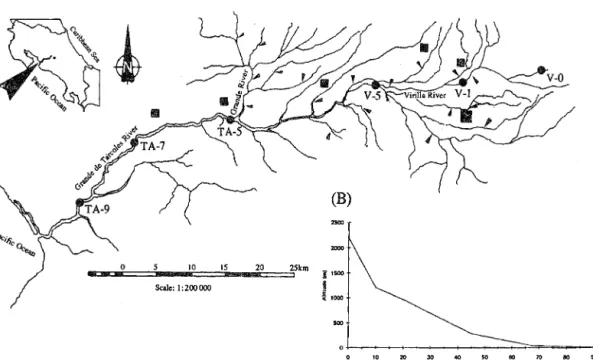
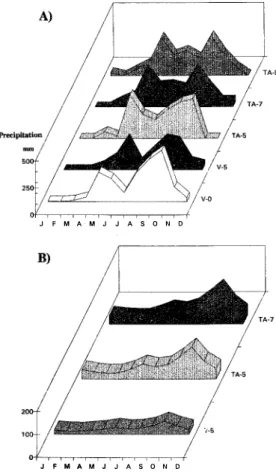
(2) 396. REVISTA DE BIOLOGIA TROPICAL. ( 1 978, 1 979) and Kramme r and Lange-Bertalot ( 1 986) and its modification for nutrient rich, but o x ygen s aturated, ru n ni n g waters by S teinberg and Schiefele ( 1 98 8 ). The former was developed in large, slow-flowing rivers, in which nutrient-rich conditions are mostly cor r e l a t e d w i th r e d u c e d o x y g e n s aturati o n . However in fast-flowing mountain streams and rivers, nutrient-enriched waters are often oxy gen s aturated. This also applies to R. Virilla and R. Tarco l e s . S te i n berg and S chie fe l e ( 1 988) showed that for the latter situation dif ferential species groups must be subdivided into groups of species that benefit from higher nutrient concentrations (eutraphent species) a n d thos e that tol erate organic pollution. Results obtained using these methods are com pared with numerical grouping of the species and the samples respectively. This approach to classification of running waters has already been applied to temperate rivers by several authors , using macrophytes and macroalgae (Holmes 1 983), macrozoobenthos (Braukmann 1 987, Wright et at. 1 984), and macroalgae and microalgae respectively (Pipp and Rott 1993).. THE STUDY SITES. Hidrology and climate: The Rio Grande de Tarcoles drains a catchment area as large as 2 1 69 km2 in the Central Valley of Costa Rica (Fig. l A ) . The b a s i n i s l o cated between two geographical areas: Valle Central and Pacifico Central. It is sun'ounded by the Central American Mountain Range with a westward slope to the Pacific coast. Both areas have a seasonal tropical climate, with a rainy and a dry season, average temperatures higher than 1 8°C, and an annual precipitati o n of 1 500-2000 mm (Instituto Meteorol6gico Nacional 1 99 1 ). Most rainfall occurs between May and November, dry season occurs from December to April. The decrease of the rain during June-July is due to a peculiar decline in precipitation, the so-called "veranillo" (Fig.2A). The annual pattern of discharge reflects the change between the rainy and dry season (Fig. 2 B ) . The annual mean di s c h arge n e ar the mouth of R. Tarcoles ranges from 22 to 6 0 m 3 .s - 1 during the dry season a n d 1 00-200 m3.s- 1 in the rainy season. The discharge peak occurs in October.. (B). .... 'coo 20 Scal.: 1:200 000. 25km .. 11500. f. � ",.. "" • v.o. w V�1. w Y..f. �. �. fA';. �. �. TA·7. •. 00 TA-i'. � Ok_lkm). Fig. 1. A) RIO Grande de Tarcoles basin with sampling sites (V-O to TA-9), as well as the main cities (squares) and the most important sewage effluents (arrows), B) Longitudinal profile of the sampling sites..
(3) SILVA-BENAVIDES: A polluted tropical river. J. J. F. F. M A- M. M A M. J. J. J. J. A S. A S. O. O. N. N. D. 0. Fig. 2. Seasonal variations A) of the precipitation at 5 sam pling sites in the R. T4rcoles basin during 1991 (data from Instituto Meteoro16gico Nacional), B) discharge in R. Tarcoles in 1991 for 3 sampling sites based on daily profile measurements (data from Instituto Costarricense de Electricidad).. Topography and geology: The R. Tat-coles is formed by the confluence of the Rio Virilla, one of the main tributaries flowing down from the East through important cities, meeting the Rio Grande in the western Central Valley to form the R. Tat-coles the remaining 40 km, its total length is 98 km. The gradient (Fig. I B ) is high in the upper part of the basement draining areas between 2200 and 1 200 m a.s.l. (2. 1 % ), moderate in the middle part (0.7 %) and low over the last 30 km section (0. 1 %). The highest elevation of the catchment (2200 m a.s.1 .. ) is located in the foothills of the Central Mountain Range (Cordillera Central) , amid dense forest c o ver. Thi s forest gradually gives w ay t o cleared, agricultural land mixed with increasing portions of urban and industrial areas of the Central Valley ( 1 1 70-25 m a.s.l.). The popula-. 397. tion of this region constitutes 57% of the total of inhabitants of the country, where 63% is urban and 37%.js rural (Deutsche Gesellschaft fUr Technische Zusammenarbeit 1 99 1 ). Along mOst of its length, the R. Tarcoles is turbulent and swift, with a resultant stone- cov ered river bed. Its waters are muddy and usually transports suspended sediments year-round. In the upper R. virina, natural riparian vegetation prails, whereas in the middle and lower portions the banks are rocky and bereft of riparian vegeta..; tion. In the lower sampling points, most of the river substrate is exposed to the sun all day long. The R. Tat-coles watershed is underlain by complexes of volcanic-sedimentary material and intrusive rocks produced by different geo logical pro c e s s e s that to place durin g the Superior Cretacic period (Siu 1 983). Polis and Barva volcanoes have discharged a type of lava c all e d "intercanyon l av a " and tuffs c alled "glowing avalanche deposits", both filled the canyons and were deposited along the river bed, together with post- avalanche lavas, ash, and pyroclastics as well.. Human impacts: The river system is influ enced by two main types of water pollution: point sources from untreated municipal and industrial waste water, and non-point sources from agricultural and local domestic sewage input. R. Tat-coles basin is severely polluted by untreated debris from coffee processing and domestic sewage, especially during the dry sea son (Ramirez 1 986, Deutsche Gesellschaft rur Tec h n i sche Zusammenarbeit 1 99 1 ). Other important effluents include the raw sewage of leather tanneries (Chac6n et. al. 1982 ) , paper mill s , a d i s till e r y , a n d tex tile fac t o ri e s (De u t s c h e G e s el l s c h aft fur Tec h n i sche Zusammenarbeit 1 99 1 ). While an earlier study of metal pollution focussing on dissolved metal concentrations (Ramirez et al. 1 98 5 ) found very low values for Zn, Cu, Pb and Cr « 1 0 Ilg.l- 1 ) in several rivers o f the Tat-coles basin, Fuller et al. ( 1 990) reported levels of Cr, Pb and Zn in fine-grain bed sediments downstream of leather tanneries reaching 50 to 80 times the background concentrations measured in uncon taminated tributaries to R. Virilla upstream the larger cities. In addition, the high deforestation brought on by agriculture, cattle farming and urbanization, enhances soil erosion, which i s severe throughout the whole catchment..
(4) REVISTA DE BIOLOGIA TROPICAL. 398. The sampling points: Six sampling points were selected and named according to a 6-year. twice. Four liter water samples were collected twice from surface water as close to the centre. study conducted by the Servicio Nacionai de. of the river as possible following the river from. Acueductos y Alcantarillados de Costa Rica between 1980 and 1986. The abbreviations V. the highest to the lowest site within the same. O. V-I, V-5 indicate sampling points situated in. ples were returned on ice to the laboratory and. R. Virilla. and TA-5, TA-7, TA-9 correspond. stored at 4°C for 12 hours before analyses were. to sites in R. Tarcoles. Criteria for site selec. made.. tion: (1) distribution along an altitudinal gradi. Information on precipitation was obtained from daily readings taken by the Instituto MeteoroI6gico Nacional (1991) at altitudes comparable to the sites VO, V-I, V5, TA-5, and. ent between the Virilla headwaters and the mouth of R. Tarcoles,. and (2) comparison of river sections upstream and downstream of the sewage effluents from main tributaries (Fig. lA). While conducting some samplings, other selected tributaries near the site V-5 (R. Torres. diurnal time sequence each month. Water sam. TA-7. The temperature was measured with a centigrade thermometer. Daily recordings of river discharge were provided by the Instituto. ated as BER) and the site TA-5, respectively. Costarricense de Electricidad (1990-1991) near the sampling sites V-5, TA-5 and TA-7. The. (Cacho stream), were sampled as well. The. discharge v alues mentioned for V - I , R.. and R. Bermudez, in Tables and Figs. abbrevi. main physical, hydrolqgical and morphological. Bermudez and R. Torres were taken from. features of each sampling site are detailed in. Ramirez (1986).. Table 2.. For suspended sediments, one aliquot of 10 or 20 ml was taken from each sample and fil ter e d through preweighed 1 cm GFIA 2. MATERIAL AND METHODS. Whatman filters. Filters were dried at 120°C for 2 hours, cooled in a desiccator and weighed. Samples were collected monthly between. . in an analytical balance. The turbidity was. January and December 1991 from the 6 main. measured with a HACH-Turbidimeter Model. sites, Rio Torres was sampled once, and the. Nr.2100A and given as V.N.T. units. The con. Rio Bermudez and Cacho stream were sampled. ductivity of the samples was measured with a. TABLE I Criteria for river classification Water quality class I I-II II II-III III Ill-IV IV. Oxygen deficit(%). < 15 < 30 < SO < 75 < 90 > 90. BOD� (mg.!" ). TP (�gP.rl ). NH4-N (�gN.l-I ). 0.0- 0.5 0.5- 2.0 2.0- 4.0 4.0- 7.0 7.0-13.0 13.0-22.0 >22.0. <35 36- 81 82-196 197-261 262-327 >327. <80 81-190 191-470 471-620 621-780 >780. Saprobic level ultraoligosaprobic oligosaprobic 13-mesosaprobic 13- 0.-mesosaprobic a-mesosaprobic o.-meso-polysaprobic polysaprobic. (B) Relative portions of differential species groups: Water quality class II or better 1J-II1 III III-IV IV. Sensitive taxa >50% 10-50% <10% <10% <10%. Moderately tolerant 10-50% >50% >50% 10-50% <10%. Highly tolerant <10% <10% 10-50% >50% >90%. (A) Physico-chemical criteria following Hamm (1969) and Dworski (1982), (B) Classification according to relative portions of differential species groups (Lange-Bertalot 1978, 1979, Krammer and Lange-Bertalot 1986).
(5) SILVA-BENAVIDES: A polluted tropical river. 399. TABLE 2. Physical, hydrological and morphological features for the river sections sampled in the R. Tdrcoles basin in 1991 Site 1). Altitude (m a.s.!). Air temp. (OC). Water temp (0C). Channel width (m). Discharrre (m3 .s- ). Ann. precip. (mm) Main river sections: 2200 v-a n V-I 1200 n V-5 960 n TA-5 280 n 40 TA-7 n 25 TA-9 n. 15-18 (10) 19-26 (10) 21-34 (10) 27-35 (10) 22-30 (10) 25-37 (10). 14-16 (10) 19-24 (10) 22-25 (10) 22-25 (10) 22-25 (10) 24-26 (10). Tribntaries to V -5: 960 Torres n BER 960 n. 22-23 (2) 2l-31 (3). Tributary to TA-5: 280 Cacho n. 27-33 (2). 1-2 20-25. n.d.. 1952. 0.3-1.2. 1402. 30-40. 13-58. 1379. 10-30. 29-142. 2166. 40-60. 31-158. 2582. 25-50. n.d.. 1852. 22-24. 10-20. 0.02-0.04. 1379. 17-24. 3-5. 0.1-0.3. 1379. 23-26. 0.5-1. n.d.. 2166. Susp. sed. Turbidity (U.N.T.). Conduct. ( J.1 S . c m -. (mg. t1) 2-20 (9) 17-424 (9) 60-230 (9) 42-640 (9) 35-1150 (18) 10-282 (9). 2-8 (9) 20-410 (9) 23-82 (9) 60-190 (9) 17-200 (18) 19-180 (9). 86-142 (9) 56-165 (7) 130-305 (9) 120-185 (9) 110-190 (9) 120-160 (9). 112-525 (2) 74-190 (2). 320 (1) 55-70 (2). 320-386 (2) 185-470 (3). 9 (2). n.d.. 240-265 (2). Numbers indicate absolute values or ranges, numbers in brackets indicate numbers of measurements; n. d. =not determined; site abbreviations see text.. Y S I c o n d u c ti v i ty bridge Mo d e l 3 1 , a n d expressed as /-lS.cm - 1 a t 25°C. The pH w a s measured in situ using a digital B arnand Co. LCD pH meter. and a Cole-Parmer type-elec trode. Upon return to the laboratory the sam ples were filtered through Whatman GFC filter p aper. Only s ample s tested for ammonium, alkalinity and chloride were processed without prior filtering. The chemical analyses used are d e t a i l e d in S ta n d ar d Me tho d s for the Examination of Waste Water (American Public Health Association 1 9 75). Total phosphorus was determined by the method used by Ebina et at. ( 1 983). Dissolved oxygen was measured according to the Winkler method. Values for percentage saturation were c alculated using calibration tables with correction made for dif ferences in temperature and altitude. For mea surement of Biochemical Oxygen Demand, the samples were incubated for 5 days and thermo statically controlled at 20°e. The values for oxygen saturation, B OD, and total phosphorus and ammonium found in the present study have been used to determin e the chemi c al water. quality of the R. Tarcoles basin using various indices commonly applied to rivers from the temperate region. Identification and quantification of. Diatom samples were scraped from five stones using a knife and a toothbrush. The samples were taken approximately one to two meters from the bank; due to the swift current, it was impossible to sample stones from the mid dle portion of the river bed. From each stone, two samples were removed and preserved with some drops of formalin (20%). Diatom frus tules were cleaned in boiling 2N HCl, potassi um permanganate and peroxide. The acid and permanganate solution was removed by repeat ed centrifugation and washing with distilled water. Cleaned subsamples (four subsample s from each sample) were dispersed on cover g l a s s e s , dried o n evaporation p lates , a n d embedded in the diatom resin Naphrax. The diatom frustules were identified and quantified under 1 000x oil immersion. A total of 400 diatom valves were identified in each sample. Individuals lying on the girdle side were als o. diatoms:.
(6) 400. REVISTA DE BIOLOGIA TROPICAL. TABLE 3 Chemical variables for the river sections in the R. Grande de Tdrcoles basin in 1991. Site. pH. Alkalinity (meq.rl ). 1. Cl Oxyg sat. BOD N0 3 -N (mg rl) (mg 1- ) (mg I -I ) (%). N02-N (mg rl). NH4-N (mg I -I ). SRP l (Ilg r ). TP (Ilg I -I ). Main river sections: V-O 504-7.6 mean±SD 604±O.5 n (10). 0.2-0.9 0.3±0.2 (1S). 2.5-12.0 7.6±2.3 (18). 103-111 0.3-1.5 106±3 0.S±O.2 (IS) (1S). 004-11 0.S±O.2 (16). 0.0-0.0 O.O±O.O (16). 0.0-1.4 Oo4±O.2 (I S). 0-400 200±100 (IS). 194-339 261±60 (4). V-I meant±SD n. 7.0-7.5 7.0±1.0 (10). 0.5-1.3 l . l ±Oo4 (20). 0.7-S.2 S.0±5.0 (20). 97-112 I OS±6 (20). 4.0-24.5 1O.7±6.0 (20). 0.7-3.1 1.9±O.S (IS). 0.0-0.2 O.O±O.I (20). 0.1-2.3 Oo4±O.S (20). 200-700 400±200 (18). 1471-2284 185S±332 (6). V-5 mean±SD n. 6.S-7.7 7.2±0.3 (10). 0.7-2.7 3.8±0.7 (20). 1.9-24.0 I 3.2±6.1 (20). 74-114 lOO±4 (20). 3.5-37.0 11.9±9.7 (20). 2.1-7.6 4.7±1.7 (18). 0.1-2.1 0.S±0.8 (20). 0.3-3.7 1.5±1.0 (20). 300-3800 I 300±1200 (20). TA-5 mean±SD n. 6.9-7.8 7.2±0.2 (10). 0.9-1.7 1 .2±0.5 (20). 3.6-13.0 11.0±3.3 (20). 91-106 98±9 (20). 6.1-26.0 10.3±604 (20). 2.0-6.0 4.5±1.6 (IS). 0.0-1.2 0.6±Oo4 (20). 0.1-1.5 0.08±0.4 (20). 100-800 500±200 (20). 735-1607 1171±435 (6). TA-7 mean±SD n. 7.2-7.S 7.5±O.2 (10). 1.3-1.7 1.2±Oo4 (20). S.6-13.0 11.5±1.7 (20). 73-107 94±9 (20). 3.1-18.0 6.6±4.2 (20). 2.6-9.3 5.5±2.2 (18). 0.0-2.2 0.6±0.6 (20). 0.0-2.0 1.0±O.7 (20). 455-1100 693±200 (20). 1432-1626 I 529±97 (S). TA-9 mean±SD n. 7.0-7.7 7.3±O.2 (10). 1 .6-2.1 1.4±0.5 (20). 9.6-15.0 1O.7±204 (20). 7S-I 07 87±9 (20). 2.0.904 4.7±2.1 (20). 3.6-9.9 6.2±2.0 ( 1 S). 0.0-1.2 0.5±0.3 (20). 0.0-2.7 0.6±O.8 (20). 313- 1 224 653±300 (20). 738-1355 909±291 (6). 2.1-2.5. 14.0-17.0 5.8-6.5 15.5±1.5 6.0±1.1 (4) (4). 0.2-0.9 (2). 1.5-2.1 2.0±O.8 (4). 1020-2900 1800±969 (4). 542-1219 819±289 (6). Tributaries to V-5: Torres 7.4±7.6 mean±SD n (2). (2). 14.9-21.0 91-106 94±S (2) (4). BER mean±SD n. 7.2-804 7.4±O.2 (3). 1.2-1.7 2.1±O.9 (4). 15.1-22.0 39-S6 IS.4±9.5 5 8±20 (4) (6). 9.6-31.0 23.5±9.9 (6). 0.6-3.6 1.I±1.3 (6). 0.1-0.2 0.2±O.0 (4). 3.3-4.2 3.7±Oo4 (4). 1700-2000 2950-2980 1SOO± 140 2968±13 (4) (4). Tributary to TA-5: Cacho Str.9 7.9-S.2 mean±SD n (2). 1.2-2.9 2.1±0.S (4). 6.1-6.7 604±0.3 (4). 1.6. 0.4-1.3. (2). (2). 0.0 0.0 (4). 0.0-0.2 O.l±O.1 (4). 200-300 0.1±57 (4). 93-100 95±7 (4). n.d.. n.d.. (Numbers are ranges, arithmetical means and standard deviations; numbers in brackets show number of chemical measurements, n.d. = not determined; site abbreviations see text).. counted. Taxonomy is based mainly on Patrick and Reimer ( 1966, 1 975) Krammer and LangeB ertalot ( 1 9 8 6 , 1 9 8 8 , 1 9 9 1 a , 1 9 9 1 b ) and Lange-Bertalot and Krammer ( 1989). Biological water quality classification:. Benthic diatom species composition was used for classification of biological water quality, following the method of differential species groups by Lange-Bertalot (Lange-Bertalot 1 978, 1 979, Krammer and Lange-Bertalot 1 986). This classific ation s y stem rec o gnizes three groups o f species according to their tolerance to organic. pollution: ( 1 ) highly tolerant species which can survive in highly polluted (alpha-mesosaprobic to polysaprobic} environments, (2) moderately tolerant species, which resist less polluted conditions (beta to alpha-mesosaprobic), but disappear in severely· polluted waters and (3) pollution sensitive species, which only occur in oligotrophic and kal;harobic situations. The species belonging to these groups found so far in temperate regions are listed in Krammer and LangeBertalot ( 1 979, 1986) and they are assumed to be cosmopolitan species..
(7) SILVA-BENAVIDES: A polluted tropical river. Calculation of water quality class was based on the relative frequency of species belonging to each of the differential species groups in a s ample (Table l B ). In most cases classification a c co r d i n g to Table 1B w a s made w i th ou t doubts. Samples containing equal portions of each of the 3 differential species groups were assigned intermediate water quality class II-Ill I III. S amples dominated by highly tolerant species, yet with more sensitive species than moderately tolerant ones were c lassified as w ater q u ality III I III-IV, a s s i g n i n g more weight to the portion of highly tolerant species, for which classification is more reliable.. 401. Classification of the species of this study into the seven groups according to S teinberg and Schiefele ( 1 988) is shown in Tables 4 and 5 and used in the discussion, but because the categorization into pollution tolerant and eutraphent species is only available for species from a few alpine rivers and streams, calculation of water quality classes in Table 6 is based on LangeBertalot' s system only (Lange-Bertalot 1 9 79, Krammer and Lange-Bertalot 1 986). Statistical analysis: Diatom c ommunities were defined according to the relative abundance of species in all 47 samples using numerical vegetation analysis. Species with relative. TABLE 4 List of diatoms found in R. Virilla and R. Tarcoles basin in 1991. Abrev.. Species. Achnanthes exigua Grunow. L. B.. S & S. V. V. 0. V 5. T A 5. T A 7. ht. T. A 9 2. Achnanthes helvetica (Hustedt) Lange-Bertalot Aehnanthes infiata (Kiitzing) Grunow achn lanc Achnanthes laneeolata (Brebisson) Grunow achn macu Aehnanthes maeulata Hustedt achn minu Aehnanthes minutissima Kiitzing Aehnanthes sp. afL rieula Hohn & Hellermann Aehnanthes rupestoides Hohn Aehnanthes subhudsonis Hustedt Amphora sp. aff. holsatica Hustedt Amphora montana. Krasske Amphora pediculus (Kiitzing) Grunow cocc plac Cocconeis placentula Ehrenberg Cyclotella meneghiniana Kiitzing Cyclotella sp. I cymb sile CymbeUa silesiaea Bleisch cymb sinu Cymbella sinuata Gregory cymb tumi Cymbella tumida (Brebisson) Van Heurck Diatoma mesodon (Ehrenberg) Kiitzing dipl subo Diploneis subovalisCleve Epithemia sorex Kiitzing Epithemia sp. Eunotia sp. aff. incisa Gregory Fragilaria brevistriatit Griinow Fragilaria capucinavar. eapueina Desmazieres Fragilaria capueina var. gracilis (Ostrup) Hustedt Fragiiaria eapucina var. rumpens (Kiitzing) Lange-Bertalot frag capv Fragilaria capueina var. vaucheriae (Kiitzing) Lange-Bertalot Fragilaria fascieulata (Agardh) Lange-Bertalot Fragilaria goulardji (Brebissom) Lange-Bertalot Fragilaria pinnatll Ehrenberg Fragilaria ulna (Nitzsch) Lange-Bertalot frag ulna Frustulia weinholdii Hustedt Gomphonema sp. aff. grovei M. Schmidt Gomphonema mex.ieamum Grunow Gomphonema olivaeeum (Hornemann) Brebisson gomp parv Gomphonema parvulum Kiitzing gomp parl Gomphonema parvulum var. lagenula (Kutzing) Frenguelli. eu. 5. 2. 2. hs. 5 5 2 2. 5 2. 5 2. 4 2. 4 2. 2. 3. 2. 2. 2. 4. 2. 2. 2. 3. 5. 5. 2. 3 4. 2. 5 4 2 2. 2 4. 4. 3. 2 5. 2 3. 2. 2. 2. s eu. eu hs. 2. 2 2. 2. 2 eu. 2 2. s ht. eu 2. 2 3. 2. 2. 3. 2 ht. eu mt. 2. 3. 5. 5. 4. 4.
(8) 402. REVISTA DE BIOLOGIA TROPICAL. Gomphonema rhombicum Fricke Gomphonema sarcophagus Gregory gomp puml Gomphonema sp. aff. pumilum I (Grunow) Reichardt & Lange-Bertalot Gomphonema sp. aff. pumilum 2 (Grunow) Reichardt & Lange-BertaIot Gomphonema subcIavatum Grunow Gomphonema truncatum Ehrenberg gyro seal Cyrosihma scalproides (Rabenhorst) Cleve Melosira sp. navi arve Navicula arvensis var. mayor Lange-Bertalot navi atom Navicula atomus (Kiitzing) Grunow navi capi Navicula capitatoradiata Germain Navicula chilena Lange-Bertalot Navicula cohnii (HiIse) Lange-Bertalot Navicula contenta Grunow Navicula cryptotenella Lange-Bertalot Navicula elginensis var. elginensis (Gregory) Ralfs navi erif Navicula erifuga Lange-Bertalot Navicula exilis Kiitzing navi goep Navicula goeppertiana (Bleisch) L. Smith Navicula gregaria Cholnoky Navicula laevissima Kiitzing Navicula minima Grunow Navicula sp. aff. modica Hustedt Navicula molestiformis Hiistedt Navicula mutica var. ventricosa (Kiitzing) Cleve & Grunow navi pupu Navicula pupula Kiitzing Navicula schroeterii var. escambia Patrick navi semi Navicula seminulum Grunow Navicula subfasciata var. subfasciata Patrick navi subm Navicula subminuscula Manguin Navicula sp. aff. submuralis Hustedt navi viri Navicula viridula (Kiitzing) Ehrenberg Navicula sp. I Navicula sp. 3 nitz amph Nitzschia amphibia Grunow Nitzschia brevissima Grunow nitz clau Nitzschia claussi Hantzsch nitz diss Nitzschia dissipata (Kiitzing) Grunow nitz font Nitzschia fonticola Grunow Nitzschia fossilis Grunow Nitzschia frustulum (Kiitzing) Grunow nitz inco Nitzschia inconspicua Grunow Nitzschia levidensis var. salinarum (W. Smith) Grunow Nitzschia linearis (Agardh) W. Smith nitz pale Nitzschia palea (Kiitzing) W. Smith Nitzschia palea var. debilis (Kiitzing) Grunow Nitzschia linearis paleacea Grunow Nitzschia sp. aff. pura Hustedt Nitzschia subacicularis Hustedt Nitzschia sublinearis Hustedt Nitzschia subrobusta Lange-BertaIot Nitzschia tropica Hustedt Pinnularia appendiculata (Agardh) Cleve Pinnularia braunii (Grunow) Cleve Rhoicosphenia abbreviata (Agardh) Lange-Bertalot rhoi abbr Stauroneis prominula (Grunow) Hustedt Surirella angusta Kutzing Surirella sp. aff. roba Leclercq suri roba. 3. 3. ht. 2. 2. 5. 4. 4. 4. 3. 2. 2. 2. 4 2 5 2. 3. 3. 2. 3. 2 2 2. 2. 2 2 3. 2 3. 2 3. 2. 3. 4. 3. 4. 5. 5. 3. 2 2. 2 2. 2. 3 t ht. mt s. s hs. 4 2 3. 2 2 4. 4. 2 3. 4 2. ht. ht. 4. 5. ht. ht. 2. 2. t ht ht. eu. 2. 2. ht. ht. 3 3 2 2. 2. ht. 2 5 3 2 2. 3 4. 4 2. 2 5 3. 4 2. 2. 3. 3. 5. 4 2. 5 3. 2 3. 5. 2. 3. 5. 4. 5. 3. 5. 3. 2. 3 5 2. 4 2. eu 4. s ht. eu mt ht. 3 3. 2. 4 2. 4 5. 2 5. 3 3. 5 5. 3 5. 5. 2 5. 2. 2. 2. 2 2. 3. 2. 2 en. 2. 5. 5. 2. 3. 2. 2. 2. 3. Abbreviations of species names used in Table 5. Maximum abundance of species (abundance classes: <1% is not given. 2= 15%. 3=5-10%. 4=10-20%) and classification of species aec. to Lange-Bertalot (=L.B.; ht = highly tolerant. s = sensitive) and ace. to Steinberg and Sehiefele resp. (= S&S; mt = most tolerant. ht = highly tolerant. 1 = moderately tolerant. s = sensitive. hs = highly sensitive. eu = eutraphent)..
(9) TABLE 5. Vegetation table of diatoms of R. Tarcoles due to minimun variance clustering of samples Sample groupNo.. 11 1 1 11 1. 222222. 3 3 3 3 3. Sampling site. T BV T T T T. 4 4 4 44. T TTT TT. TT TT V. AE- A AA A. AAAAAA. AAAA -. Sampling date. NNNMAO N. J 0 S JMJ. AJ M J N. (Month). o o o a p e o. u e e e au. p u au. n c p p y1. r. 5R1 755 7. v. v. v r. r c. v. 997599. Frag. LB. Cymb Nitz. cap v. tumi. t. dis s. Gyro. seal. Dipl. subc. Navi. pupu. Nitz. font. t. Achn 1anc Achn. minu. Cymb. sinu. Cymb. site. Suri. roba. Navi. goep. Achn. macu. Navi. capi. Navi. viri. Rhoi. abbr. ht. s. Cocc. plac. s. Comp. puml. ht. Navi. semi. ht. Nl!vi Comp. arve pari. Nitz. clau. Navi. erif atom. ht. Frag ,. ulna. ht. Navi. n r. 1. Gomp. par vt. ht. Nitz. pale: '. ht. Nitz. amph. ht. Nitz. inco. Navi. subm. 0. v. 666 666. 777 BVV. 8 8 8 8 VVVV. V VVV V. TT TV. TV T T TV. -. AAA -. A - A AA -. 5 5757 0. R 51. 5111. J OOO. MAMMJ S. S S S. MMJ J. -. -. -. -. 1 0 005 ON 0J 0. 777 0. E -. -. 1 1 eu 2 2 2 eu 2 eu 3 eu 3 hs 4 hs 4 eu 4 4 4 ht 4 5 5 eu 5 eu 5 5 hI 6 6 6 6 6 mt 6 eu 6 mt 7 mt 7 8 8 s 8 ht. a p a au e. e e e. a au u. p p 0 u. n c t t. r. p. P P. r r In. r. I. r y y Ip h. I. h. I. II. 2 1 2 3 32. 1111 2. 2 111 11 I. 11 11 I. I. 11 11 I 1 3 11 I 12 I I I I 2. 1. I. I II I. I1 I 2. 21. I I I I1 I. 1 3 2 I 1 I1 I I 12 I. II. 11 1 1 12 1 3 4 446 3 3 213 1 I 1 I1. I II. 12. II I II I I II. I I I II. 11 I 111 2 I11 I 22 11 I 1 I11 12 I I1 222 I 2 1 1222 44 44 2 3 II 2 I3. 3. 11 1. I. I I1. IIII. 2 1 I2. II I 2. I I I II. 3. II. 1. I. 1. 1. I. I. I I. II. I. 1. II II. 1. I. I. I I1. 11 I 3 II I. I. I I 2 11 11 I 1 I II 2 I 11. II I. I. 11 1 I 22 I 2 11 444 43 3 43 2 f I I4 I 1. 1. II I. 11 11 I 1 21 13 1I. I. 1 I 12 1 13 1 111 1. 111 111 111 1 1 12 1. 11 1. 11. I. I. 11. 21. I. 313 22 I. 43 3 32 I 11 I 2 1 I1. 42 2 I 43 I 11 4 4 443 11 3 211. 3 41211 5 4443 2 2 I 3 22 I 1 I1 I 2 I1 I2 1. >60%).. 1. I. I I. I. I. 1 I I11 111 II. 111 2 3 1 12 1 1 I I1. 000 J AM u p a. 1 r 1. r. 12 I 1 1 I I. ,IZ!.. I I. 11 11 11 1 11 11 11 1 13 12. 2 13 1 1 463 1 1 2 I. II II. 43 3 3 I 2 I3 11 I 3 1 2 2 1 1 I II 1 I 1 32 3 3 2 I I1 3 I 1 I. I. 1. 1. I. II. �. �. ... >. '0. t "". g. I I I. � �. 2 11 2 I1 I 2 2 II 1. "9.. el. ::I.. �. I I1. I1 I. 11. I. groups) resp. Only the 31 most discrimina ting species ace. toJancay's ranking ( see methods) are displayed, togeth-. di versity =species di versity of samples: h =very high, I=very low) and species (8 -10%, er with their classification by Lange-berta1ot (LB ) and Steinberg and Schiefele ( SS) resp. (Abbre viations seeT able 4). Abundance class: I =1-5 %,2 =6. (10groups,. VVV. 1 1 11. I. 1 2 2 3 11. 21 13 11. I. 111 000. II. 1 11 1. 1 1 13 22 3 3 62 11 1 5. v. h. I·. 1. r. h. IIII. 1 1 11 1. 71 95. AANJ. u e c c. 1111. 11 111 11 2 111 2 1 11 1 1111. -. e u e. I. 11 1 2 11 2 3 1 1111 2 1 1 11 11 1 5544 446. A - A. c n c. v. 11 11. TVTV. e 0. SS eu. 9 9 99. c. h. h. Di versi ty Species. 9595 5. 5555. 3. 1-2 0 =1. %, 4=21-40%, 5 =4 1.60%, 6 =. � w.
(10) 404. REVISTA DE BIOLOGIA TROPICAL. TABLE 6. Water quality of the sampling points from the R. Tdrcoles basin in 1991 according to physico-chemical variables and diatoms Site. Altitude (m.a.s.l.). Main river sections: V-O 2200 V-I. 1200. V-5. 960. TA-5. 280. TA-7. 40. TA-9. 25. Tributaries to V - 5 : Torres 960 BER. 960. Tributary to TA-5 : Cacho 280. Season. Oxygen deficit. BODS. Rainy Dry Rainy Rry Rainy Dry. I I I I I-I-II I-II-II I I-II-II I I-II I-I-II I-II-II. I-II I-II II-III III-IV-IV III III-IV II-III III-IV-IV II-II-III II-III I-II-II II-III. (II-II) IV IV IV IV IV IV IV IV IV IV IV IV. Il-II-III If-Ill-III I-II-IV I-II-II-III (II-III) IV (II-III) IV II-III-Ill-IV III-IV II-III-IV III-IV III-IV-IV II-II-III. Rainy Dry Rainy Dry. II II-II-III III. III-IV IV III-IV IV. IV IV IV IV. IV IV IV IV. III. I-II. Rainy Dry Rainy Dry Rainy. Dry. TP. Dry. abundance l ower than 1 % were excluded. P e r c e n t a g e data were not tran s formed. Similarity of pairs of samples/species was cal culated using van der Maarel' s similarity index (van der Maarel et at. 1 978). The sample and species groups shown in Table 5 were obtained by m i n i m u m v ar i a n c e c l u s te ri n g w i t h MULVA4, a program package written in FOR TRAN for multivariate analys i s (Wildi and Orloci 1 990). The discriminating species, i.e. species significantly more abundant in one or several sample clusters, were found by Jancey' s ranking, a modification o f Fisher' s analysis of variance, also with MULV A4. A secondary cluster analysis based solely on the discriminat i n g spe c i e s y ielded the s ample groups and species groups displayed in Table 5.. RESULTS Air and water temperature: The variabil ity of water temperature was lower than the variability of air temperature. A higher down stream water temperature is reveled in Fig. 3 and Table 2, with significantly lower values in the headw aters ( l 4- 1 6°C) than near the mouth. Diatoms NH4 -N II-II-III III III III-IV II-III III-IV III-IV III-IV-IV II-III III-lV-IV III-Ill-IV III-IV. III-III-IV. of the river (24-26°C). Neither, the water nor the air temperature were markedly different between the dry and rainy season, however the highest temperature was registered in the former. Flow regime, suspended load and turbidi. The lowest run-off occurred from January to April. An initial increase in discharge is recorded at the beginning of the rainy season (April-May), causing a minor peak in June, followed by a con stant rise from August to the highest level in October (Fig. 2B). Discharge also increases in the river valley downstream (Table 2). In most cases the seasonal changes in sus pended sediments c oincide with changes in precipitation and discharge. V -0 showed the lowest concentrations in c ontrast to down stream sampling points, where concentrations were highly variable (Table 2). Water turbidity at V- I and in the lower sites (TA-5 to TA-9) showed a much wider range ( 1 0- 1 1 50 U.N.T.) than in the headwaters (2-20 U.N.T.). High values were recorded particularly at the first rise of water level in June and during the max imum d i s c h ar g e in October or N ovember (Table 2). ty:.
(11) SILVA-BENAVIDES: A polluted tropical river. Physical and chemical features: At many sampling stations the water was slightly basic, although at V-O lower values in the acid range were recorded (Table 3). At V-O pH values showed seasonal variability with the minimum v alues (5.4) at the end of the dry season, an increase during May and June, and a second minimum in the "veranillo" (6.2). At the other sampling sites there was no clear change of pH values from dry to rainy season (Fig. 3 ). Alkalinity also varied over time and space. Similar to the pattern of pH-values, V-O present ed the lowest alkalinity (average 0.3 meq.t 1 ) while V-5 indicated a slightly basic character and the highest variability (average 1.8 meq.l- l ). At this point the tributari e s R. Torres and R. B ermudez contribute to the high levels. The annual alkalinity minima parallel the maximum discharge and maximum precipitation in October and November (compare Figs. 2 and 3). The con ductivity ranged from 56 to 470 flS. cm- 1 . The highest values in the R. Bermudez, R. Torres and. 4. ... :5. >-. I i\... 3 2. ). .:.=. < o 9. I I I I I I. I I I I I I. �.. rv--. 8. Co. 7 6 5. in V-5, may indicate the accumulation of solute rich ions from waste waters (Table 2). Concentrations of chlorides were high, with annual averages increasing from 7.6 mg.r 1 at v-o to 1 3.2 mgX l at V-5 (maximum 24 mg.t 1 ), and maximum values in R. B ermudez (average 1 8.4 mg.r l , Table 3). Nutrient concentrations: Among all the sites, V-0 and Cacho stream showed the lowest nutrient values (Table 3), but with conspicuous concentrations in phosphorus (approx. 200 flg.r 1 ). Downstream from the headwaters the concentrations rise considerably with maxima at V-5 (due to addition of nutrients by highly polluted tributaries) or TA-7 (Table 3). In gen eral, the results indicate high concentrations of nutrients, especially for SRP, total phosphorus, and nitrate. Seasonal patterns are different for the differ ent variables and are inconsistent from s am pling site to sampling site, but generally one. I. i6. :::t:. 405. -. r I- r} J jv I. I I j I I j. (. I. I. I I I I. i. //. r. ! r' r ! r .v- fA.. '. I. 12. 9<;-"1"1':"�. ». 9"7"1"1':"�. >��� I». 9<;-"1"1':"'1. >;!:!i! ». 9<;-"1"1':"'1. >;!;!j! ». 9<;-"1"1':"'1. >;!�;! ». 9<;-"1"1":'1. >i!�;! ». 9<;-"1"1":'1. >;:!�� ». 19<;-"1'1''':�. >��� l». 9<;-"1"1':"'1. >��;! ». >��;!. 9<;-"1"1":'1. ». >��;!. Fig. 3. Longitudinal and temporal variations of alkalinity, pH and water temperature for all different sampling sites in R. Virilla and R. Tarcoles..
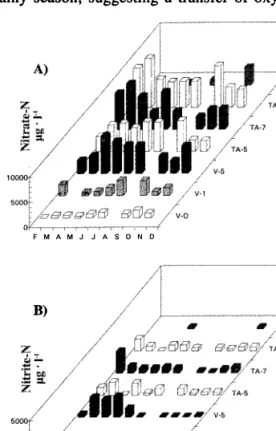
(12) 406. REVISTA DE BIOLOGIA TROPICAL. p e ak at the end of the dry season and/or a s maller peak at maximum discharge c an be observed (Figs. 4 and 5). Minimum concentra tions at maximum discharges , which could be interpreted as a consequence of dilution, were not observed. S oluble reactive phosphorus was lowest at V -0, and showed a relatively constant pattern throughout the entire s ampling period (Fig. 4A) , with the exception o f the peak values found at site V-5 in March and April (3.8 mg.r 1 ). The highest levels of all data were found in tributaries, e.g. in Rio Virilla, Rio Torres and R. B ermudez near sampling point V-5 (Table 3). Large quantities of flo ating foam were observed throughout the s ampling period on those sites, suggesting contamination by deter gents in factory and domestic wastewater. Annual averages of total phosphorus were 1 .5 to 2.5 times higher than values for SRP, with peak values at V-5 and R. Bermudez. As. sampling occasion, observations on seasonality are not available. Ammonium nitrogen (Fig. 4B) was highest at V - 5 a n d in the tri b u tari e s e nt er i n g R. Tarcoles near this site. Annual variability i s very high, with maxima in April o r June and in October. With the exc;eption of V-0 and Cacho stream , where nitrate levels were low year r o u n d , n i trate c o ncentrat i o n s s h o w e d an increase either during the dry season with max ima in March or April or at the beginning of the rainy season and a decline as comp ared with the end of the rainy season in October or November (Fig. 5A). Nitrite as a metastable form of nitrogen is the lowest fraction of inor ganic nitrogen measured, with maximum val ues during dry season (Fig. 5B). Dissolved oxygen and BOD: In most cases the average oxygen concentration is near or above saturation (Table 3). In all cases, oxygen concentrations were slightly higher during the. total phosphorus was not measured at everY. rainy season, suggesting a transfer of oxygen. BER. F M A M J. J. F M A M J. A S O N D. J A S O N D. B). •. BER. •. BER. 500 LJ£7QL::7L::7 F M A M J F M A M J. J. A. DDDa. v-a. J A S O N 0. S O N 0. Fig. 4. Seasonal variations of macronutrients at the differ ent sampling stations in R. Virilla and R. Tarcoles and a tributary to station V -5 (R. Bermudez), A) Soluble reactive phosphorus, B) Ammonium-Nitrogen.. Fig. 5. Seasonal variations of nitrogen compounds at the different sampling stations in R. Virilla and R. Tarcoles and a tributary to station V -5 (R. Bermudez). A) Nitrate, B) Nitrite..
(13) 407. SILVA-BENAVIDES: A polluted tropical river. A). Most tolerant group M. A. M. J. J. A. S. O. N. D. M. A. M. J. J. A. S. O. N. D. C). TA-5. v-,. Sensitive group M. A. M. J. J. A. S. D. N. D. Fig. 6. Seasonal variations of the relative portions of the 3 differential diatom species groups ferent sampling stations in R. Virilla and R. Tarcoles in 1991.. ace. to. Lange-Bertalot at the dif.
(14) 408. REVISTA DE BIOLOGIA TROPICAL. Figs. 7-49. Light micrographs of representatives of the differential species groups (black bar == 10 11m). A) highly tolerant against organic pollution - Figs. 7-14. 16-25; B) moderately tolerant group - Figs. 15. 26-29. 32-38; C) eutraphent species group - Figs. 39-40, 44-45; D) sensitive species group - Figs. 41-42, 45-49 and E) not classified but common on the polluted sites - Figs. 29-30. Figs. 7-8 Navicula goeppertiana, Figs. 8-9 Nitzschia amphibia, Figs. 10-11 Nitzschia paZea, Figs. 13- 1 4 Gomphonema sp. aff. pumilum, Fig. 1 5 Navicula arvensis, Figs. 16-17 Navicula seminulum, Figs.l8-19 Navicula atomus, Figs. 20-21 Navicula schroeterii, Figs. 22-23 Gomphonema parvulum, Figs . 24-25 Navicula minima, Fig.26 Nitzschia clausii, Fig. 27 Navicula capitatoradiata, Figs. 28-29 Navicula sp. aff. cryptocephaZa, Figs. 30-31 Navicula sp., Fig. 32 Navicula sub minuscula, Fig. 3 3 Fragilaria capucina var. vaucheriae, Figs. 34-35 Nitzschia inconspicua, Fig. 36 Navicula cryptotenella, Figs. 37-38 Achnanthes lanceolala, Fig. 39 Cocconeis placenlula, Fig. 40 Rhoicosphenia abbreviata, Figs. 41-42 Cymbella sinuata, Figs. 43-44 Cymbella silesiaca, Figs. 45-46 Achnanthes minutissima, Figs. 47-48 Surirella sp. aff. roba, Fig. 49 Nitzschia linearis..
(15) SILVA-BENAVIDES: A polluted tropical river. 409. Figs. 50-51. SEM photographs of the most characteristic highly tolerant species. Fig. 5 0 Nitzschia palea, Fig. 5 1 Gomphonema sp. aff. pumilum, Fig. 5 2 Gomphonema parvulum, Fig. 5 3 Navicula goeppertiana..
(16) 410. REVISTA DE BIOLOGIA TROPICAL. from the atmosphere favoured by high turbu lence in mid-stream. The biochemical oxygen demand is low upstream (V-0), and increases downstream at V- I , V-5, and TA-5 (Table 3 ) . Increasing self purification processes as well as dilution from clean tributaries may lead to a reduction in the B OD at the lowest sampling sites. The seasonal variability of B OD suggests a slight increase in V- I , V-5, and TA-5 during the dry season due to the accumulation of sewage and to low dilu tion rates (see also Table 6). Diatom species composition, communities. A total of 95 diatom taxa were observed in the samples (Table 4). The genera containing the most species is Navicula (25 species), Nitzschia ( 1 7), Gomphonema ( 1 0) and A chnanthes (9) . Distribution data in Table 4 l argely c orre s p o n d to the m athematical grouping of species shown in Table 5 . Some characteristic diatom species for the places studied are shown in Figs. 7-5 3 . In spite o f high turbidity and pollution, con siderable quantities of benthic diatoms have been found in 47 out of the 5 1 samples . The four samples containing less than 20 frustules each c ame from V-O (May ) , V-5 (June and October) and TA-5 (October). All the species fou n d to be abundant in R. Virilla and R. Tarcoles are cosmopolitan species , and well known in temperate regions. Only some of the rare species, such as Fragilaria goulardii and Gomphonema mexicanum are reported to be more frequent in the tropics (Krammer and Lange-Bertalot 1 986). Many of the species dominating at any one of the sites also occurred at all sampling sites (Table 4). Thus the sites differ more according to the relative proportions of species than to their presence or absence. S easonal distribution patterns were only observed for some species (Table 5 ) ; further patterns may be detected with absolute quantification. S amples are moderately species-rich, mostly containing 25 to 35 species and a maximum of 45 species. S amples are characterized by 3 to 5 species of 1 0 to 20 (30) % relative abundance. Maximum diversity was observed mostly dur ing the rainy season in V-O, V-5 (twice), TA-7 and TA-9, and once in dry season (V- I , April). Lowest diversity was shown by samples from V -0 i n April , T A-7 in O c tober and V -5 in December. and classification:. Cluster analysis also fails to show altitudinal and/or seasonal differences in species composi tion (Table 5 ) , but multivariate methods do reveal similarities between samples and dates. First, groups No. I, 2, 3 , 5 and 6 are distinct from one cluster of samples V- I and V-5 (group No. 8 ) and two sample clusters mainly repre sented V -0 (groups No. 4 and 1 0) . Second, four clusters mainly contain samples taken at one season : Groups No. I , 5 and 7 rainy season, group No. 10 dry season and "veranilIo". The s ample groups described above are characterized by one or several species groups, especially by the respective discriminating speci e s . Thus clusters o f s ample s fro m R. Tarcoles are characterized by the dominance of Navicula goeppertiana, Nitzschia inconspicua and Nitzschia amphibia, while sample clusters representing mainly samples from RVirilla are d o m i n at e d by A chnanthes m i n u ti s s ima, Cymbella sinuata and Surirella sp. aff. roba. Biological classification: Because these species are largely cosmopolitan, 25 species could be assigned to Lange-Bertalot's groups of highly tolerant ( 1 2 species out of 19 listed in Krammer and Lange-Bertalot 1 986) and moder ately tolerant ( 1 3 species out of 38) species (Table 4 ) . All the following highly tolerant species are frequent in R Tarcoles: Navicula g o epp e rtiana, Gomp h o n ema p a rv u l u m , Navicula seminulum, Navicula subminuscula and Nitzschia palea, with highest abundance in the lower sections of the river. Among the mod erately tolerant species, only Nitzschia amphib ia (mostly in the lower sections) and Nitzschia clausii (all along the river) reach higher fre quencies . The following species, which Lange B ertalot regarded as pollution -sensitive, are frequent in our study : Achnanthes minutissima, A mp h o ra m o n tana, Cocconeis placentu la, Cymbella silesiaca, Cymbella sinuata, Nitzschia jrustulum, and Rhoicosphenia abbreviata. The latter-most species mentioned above and several others are also regarded as pollution sensitive by S teinberg and S chiefele ( 1 988) (Achnanthes minutissima, Cocconeis pediculus, Cymbella sinuata and Navicula cryptotenella), or as moderately sensible but eutraphent (e.g. Cocconeis p lacentu la, Cymbella silesiaca, Nitzschia dissipata, Rhoicosphenia abbreviata; for classification of other species see Table 4). Species groups yielded by cluster analysis also reflect pollution tolerances of species, as.
(17) SILVA-BENAVIDES: A polluted tropical river. illustrated in Table 5. While groups No. 6, 7 and 8 comprise highly tolerant and some moderately tolerant species, groups No.1 to 5 consist of pol lution-sensitive and eutraphent species. The relative portions of the three differential species groups displayed in Fig. 6 clearly show differences in water quality of sampling sites: only V -0 contained considerable amounts of sensitive species throughout the year. At aIr the other sampling sites the largest frequency was reached by highly tolerant species, followed by moderately tolerant species.Aside from V -0, the moderately tolerant group was most impor tant in June/July, in some cases also in March, w h i l e s e n s i ti v e s p e c i e s were c o m m o n i n October (TA-7) and December (V-5). Water quality of R.Tarcoles in 1 99 1 , as obtained from Fig. 6 and Table l B , ranged from water quality class II (V-O, November) to IV (TA-7, November). Most frequently, quality classes II-III, III and III-IV were given. The ranges of water quality classes for each sam pling site given in Table 6 show a clear differ ence between s ampling sites, with V-O being the relatively unpolluted site (quality class II rn during the rainy season and III during the dry season) and TA-5 being the most polluted site (Ill / Ill-IV during the rainy season and Ill IV / IV during the dry season) and TA-7 show ing the widest range of water quality classifica tions (II-Ill / III to Ill-IV / IV). In most cases water quality was slightly better during the rainy season than during the dry season.. DISCUSSION The river section s tudied comprises one representative headwater stream and several s e c ti o n s of the l argest river in the C entral Valley i n C o s ta Rica. This research yields information o n the biotope quality of some main sections of a large catchment area and should be supplemented by a careful regional sampling network in order to render informa tion on the water quality of the Rio Grande de Tarcoles basin. When these rivers begin to rise in the rainy season, erosion increases suspended sediment load and turbidity. An enhancement of nutrient concentrations and B OD in each sampling site take s place s i m u l taneou s l y , reflecting the increased discharge of untreated waste water.. 411. The whole R. Tarcoles basin is affected by the raw sewage from coffee plantations and facto ries, untreated domestic and industrial waste water, as reflected in the high amounts of nutri ents and BOD. Later on the rainy season, water quality improves as the initial surge subsides. V-0 and the small Cacho tributary are �he only slightly polluted reference sites. Nutrient concentrations are generally high. The irregular spatio-temporal distribution of nutrient concentrations (Figs. 4 and 5) suggests effects of both punctual sampling and variable hydrologic conditions. The positive relation ship between flow and nitrate level observed in the first rainy months, may be related to nitrifi cation processes due to the oxidation of ammo nium c aused by high turbulence durin g this period of the year (Ramirez 1 9 86, Stachowicz 1 990). On the other hand, because it is very soluble, nitrate may also originate from agricul tural fertilizer (Mason 1 99 1 ). Nitrate concen trations may also be enhanced by high defor estation and consecutive erosion and leaching pro c e s s e s of soil materi al alo n g all the R. Tarcoles catchment basin. The decline of this nutrient at the end of the rainy season may be the result of dilution process. The high quantity of ambient phosphorus (soluble reactive phosphorus and total phospho rus) at all the sampling points suggests a high background of this nutrient. Pringle et al. ( 1 990) and Pringle and Triska ( 1 99 1 ) reported the pres ence of high phosphorus concentrations in sever al unpolluted streams that drain the volcano area in the Caribbean lowlands of Costa Rica. Similar results have been obtained from studies in lakes and rivers in other tropical countries (Talling 1 95 7 , T aIling and TaIling 1 96 5 , Golterman 1 973, Payne 1 9 86). These authors suggest that erosion of rock phosphate is the main natural phosphate source i n w aters fro m volc anic regions. The Tarcoles river basin, just as tecto volcanic basins, is comprised of volcanic-sedi mentary material. This geological formation may provide a high concentration of phosphate to streams and groundwater reserves flowing down from the Irazu, POM and Barva volcanoes draining i nt o R. Viri l l a and R. Tarc o l e s (Echandi-Echeverrfa 1983). This postulated nat ural source of phosphate may obscure the effects of anthropogenic phosphates. High oxygen contents (Table 3) were caused by the high gradient and turbulence, and can.
(18) 4 12. REVISTA D E BIOLOGIA TROPICAL. lead to erroneous interpretations of the results. If we consider the values of oxygen given in the limn o s aprobic ran g e s , all the s ampling points except R. Bermudez should be classified as water quality class II or better (Table 6). This interpretation does not reflect the true pol lution levels. Therefore, oxygen content is an inappropriate indicator of water quality classifi c ation. Oxygen does, however, influence the diatom community despite high concentrations of nitrate, ammonium, and BOD. Among the chemical parameters used by several authors for the water quality classifica tion of l arge, slow flowing European rivers (Table l A), only methods based on B OD and ammonium could be successfully applied to R. Tarcoles (Table 6). According to total phospho rus , all sampling points except Cacho stream (III) and V -0 have to be classified as water quality class N. This Phosphorus-based assess ment is therefore in stark contrast to oxygen based classification.BOD is also considered as an appropriate criterion for classification of the sampling sites, with Cacho stream and V-0 as the least saprobic sites (I-II) and V- I , TA-5 and B ermudez showing the highest saprobic level (ill- N / N). Saprobic levels of samples from the dry season were slightly higher at each sampling site. Another reasonable criterion is ammonium which generally yielded slightly worse classifications than B OD. Sampling sites V-5, R. B ermudez and R. Torres showed the highest degree of pollution (water quality class N). The seasonal pattern of ammonia is not as consistent at each sampling site as that of B OD. The method proposed by Lange-Bertalot ( 1 978 , 1 979) provides a me as of assessing water quality from the relative proportions of three diatom species groups based on their tol erance towards organic pollution. B ecause this m e t h o d w a s d e v e l o p e d for s l o w - m o v i n g European rivers, w e must verify their applica bility to tropical s y s tems , which have high b ac kground nutrient levels and clearly lotic conditions. This study reveals that diatoms are found at all investigated sites and, despite high fine sed iment deposition, suitable samples for analysis could be obtained at 80% of the sites. We can thus conclude that this method can be used for biological monitoring of tropical environments. To a large extent, the species spectrum com prises cosmopolitan species, so that qualifica-. tions from temperate systems can be applied t( tropical environments . However the actuai classification of species into different grades oj tolerance is different from the studies of Lange Bertalot because nutrient levels are generally high and the oxygen content is elevated due to the highly uneven terrain and the swift current of the river. Therefore the c l a s s i fi c at i o n s y s te m o f Steinberg and S chiefele ( 1 988), defining a n extra group o f speci e s preferring n utrient enriched , but oxygen s aturated c o nditions (termed eutraphent species), can be applied even more successfully to the description of the water q u ality of R. Tarc o le s . This s y s tem requires data on the nutrient requirements of a larger portion of the dominating species . As illustrated in Tables 4 and 5 , most of the toler ant or definitively sensitive species, according to L a n g e - B ertal o t , are termed eutrap h e n t specie s by S teinberg a n d S chiefele ( 1 988). High abundance of eutraphent species help to distinguish eutrophic s ampling sites and/or occasions (sample clusters 8 and 9) from sapro bic situations, where they form only a small portion of the community. Achnanthes minutis sima and Cymbella sinuata are the only species classified as sensitive by both Lange-Bertalot and S teinberg and S c hiefele; these species characterize those samples which were given water quality class II-ill or better based on both BOD and NH4 · Remarkably , none of the o l i gotraphent species according to Steinberg and S chiefele ( 1 9 8 8 ) h a v e b e e n fou n d i n t h i s s tu d y . Achnanthes minutissima and Cymbella sinuata, the only sensitive species reaching high per centages all along R. Tarcoles, find optimal conditions in nutrient poor, highly aerated, and slightly alkaline water (Krammer and Lange B ertalot 1 988), but they are found relatively often in polluted sites as well (Van Dam 1 979, Maier and Rott 1 990). For Achnanthes minutis sima it is necessary to consider a taxonomic problem as well: Achnanthes minutissima var. saprophila reaches its maximum in highly pol luted w aters (Kobayasi and Mayama 1 982), while A chnanthes minutissima var. jackei is known to be sensitive to pollution (Krammer and Lange Bertalot 1 986). In the present study, this species could not be identified to the vari ety level, which may hinder correct classifica tion of this species..
(19) SILVA-BENAVIDES: A polluted tropical river. This study confirms the classifications by both Lange-Bertalot and Steinberg and Schiefele. Navicula capitatoradiata is more appropriately considered a tolerant species, due to its maxi mum abundance in VA-5 , while for Navicula c ryptotenella seems to be only sensitive (not highly sensitive as in Steinberg and Schiefele). From the species which were found frequently in this study and which have not been assigned till now, we suggest that Surirella sp. aff. roba and Achnanthes sp. aff. ricula are pollution sen sitive and prefer oligotrophic conditions, while Gyrosigma scalproides and Navicula erifuga as sensitive but eutraphent. It is evident from both chemical and biologi cal water quality classifications that the river downstream from V -0 is heavily loaded with nutrients and organic pollution from domestic sewage, treatment plants, factories and agricul ture. These pollutants are reflected in the high p e r c e n t a g e of t o l e r a n t s p ec i e s (Fi g . 6 ) . Classification according to diatoms i n most cases corresponds to classification according to ammonium, and yields lower water quality classification than B OD, because of the high level of eutraphent species found. Margalef ( 1 958), Johansson ( 1 982), demon strated that in water quality conditions better than alpha-mesosaprobic, environmental fac tors other than nutrient load and biochemical oxygen demand determine the species compo sition of any component of the biota. Diatom communities of unpolluted Austrian streams and rivers were most closely related to stream order and altitude (i. e. mainly temperature, dis charge regime, and geology (Pipp and Rott 1 993), but ambient light, chemical compounds other than carbonates, and competition and pre dation are important as well (e. g. Chessman 1 986, Ward 1 986). Information on the requirements of diatoms u n der tropical c onditions i s s c arc e . Venkateswarlu' s ( 1 969) results from Moosi River near Hyderabad (India) correspond to results from R.Tarcoles concerning the occurrence of Achnanthes minutissima and Fragilaria ulna in well oxygenated, nutrient enriched situations and of Nitzschia palea and Cyclotella meneghiniana in saprobic situations. Podzorski' s study on the reaction of diatoms to environmental change in Broad River, Jamaica ( 1984) deals with seasonal changes of epiphytic (not epilithic) community structure at one sampling station with similar pH,. 413. high conductivity, similar and considerably lower orthophosphate concentrations as com pared to R. Tarcoles. An investigation of lit toral p h y t o b e n th o s of a N i c ar a g u a n l ake (Guerrero and Rodriguez 1 99 1 ) also revealed h i g h p e r c e n t a g e s of Nitzs c h i a amp h i b ia, Nitzschia palea and Navicula goeppertiana at the m o s t p o l l uted s i te s , and A ch n a n th e s minutissima at the less polluted sites. Therefore a study of the benthic algae com munities of tropical reference sites from the same catchment, or a catchment comparable to R. Tarcoles, would be the next step to be taken to adapt classification methods presented here to runoff from volcanic regions in the tropics, char acterized by high water temperatures, high tur bidity and high background concentrations of nutrients. In spite of methodological refinements of classification systems, the present study clear ly demonstrates the need to take the following practical measures to improve the water quality of R. Tarcoles: establishment or improvement of waste water treatment plants, reduction of raw waste water discharge into the river, reduction of fertilizer use and of coffee processing refuse near the river, and establishment of a corridor of riparian vegetation on both river banks to reduce or prevent soil erosion.. ACKNOWLEDGEMENTS I thank the I n s ti t u t o C o s tarri c e n s e de Acueductos y Alcantarillados (Laboratorio de Calidad de Aguas) for assistance in the trans port and chemical analyses, and the Centro de I n v e s ti g a c i 6 n e n C i e n c i a s d e l M ar y Limnologfa (CIMAR-Universidad de Costa Rica) for providing a laboratory for diatom preparation, A. Silva for his valuable assistance during all the samplings. For her ceaseless help with the data anal y s e s and for her general encouragement in this work, I am grateful to E. Pipp. E. Rott and two anonymous reviewers provided constructive comments on the manu script. The efforts of J. Masser in the prepara tion of the figures is greatly appreciated.. RESUMEN La calidad del agua de varias secciones de un rio tropi cal contaminado se estudi6 considerando factores qufmicos y biol6gicos. Los resultados confirman el alto grado de.
(20) 414. REVISTA DE BIOLOGIA TROPICAL. d e terioro de la cuenca del Rfo Grande de Tarcoles , situaci6n reflejada en el alto porcentaje de especies de diatomeas tolerantes a fuerte descarga de nutrientes y mate ria organica. Especies resistentes a fuertes condiciones de contaminaci6n, especies moderadamente resistentes y especies sensitivas a un sistema acuiitico deteriorado han servido de base para cJasificar diferentes niveles sapr6bicos en los sitios estudiados. Para ello se utiliz6 el concepto de grupos de diatomeas desarollado por Lange-Bertalot (1978, 1979, 1986) Y Steinberg and Schiefele (1988). Las especies mas abundantes fueron las siguientes: Navicula goepper tiana, Gomphonema parvulum. Gomphonema s p . a f f . pumilum. Nitzschia palea. Nitzschia amphibia. N. clausii. N. inconspicua, Navicula seminulum, Navicula s p . aff. c ryptocephala . Navic ula schroeterii var. esca mbia . CymbeUa sinuata y Surirella sp. aff . roba.. REFERENCES American Public Health Association . 1 9 7 5 . Standard Methods for the Examination of Water and Waste W a t e r . American Public Health A s s o c i atio n , Washington. 1980 p . Braukrnann, U . 1987. Zooz6nologische und saprobiologis c h e Beit rage zu e i n e r allg e m e i n e n regionalen Bachtypologie. Ergebn . Limnol. 26: 3 5 5 p .. Echandi-Echeverria, E . 198 3 . Sinopsis Hidrogeol6gica, p. 66-70 . In EI Sistema Fluvial de Tarcoles Costa Rica. E s t udios Prelimin ares sobre G eomorfometrfa y Geofactores Basicos . Instituto Geografico Nacional, Consejo Nacional de Investigaciones Cientfficas y Tecnol6gicas. San Jose, Costa Rica. Fuller, C. C . , J. A. Davis, P. J. Lamothe, T. L. Fries, G . Fernandez, J . A . V argas & M . M . Murillo 1 9 9 0 . Distribution and transport of sediment-bound metal contaminants in the Rio Grande de Tarcoles, Costa Rica (Central America). Water Res. 24: 805-812. Gibbs, R . 1967. Amazon River: Environmental factors that control its dissolved and suspended load. Science 156: 1734-1737. Golterman, H. L. 1973. Natural phosphate source in rela tion to phosphate budgets: A contribution to the under standing of eutrophication. Water Res. 7: 3-17. Guerrero, M. & L., Rodriguez. 1991. Species composition of phytobenthos in the littoral of Lake Xolotlan (Managua). HydrobioJ. Bull. 25 : 117-120. Hamm, A. 1969. Die Errnittlung der Gewassergiiteklassen bei F1iBgewassern nach dem Gewassergiitesystem und Gewassergiitenomogramm. Miinchen. Beite. Abwass. Fisch. u . F1uBbiol. 1 5 : 46-49.. Chac6n, B., A. Rodriguez & M . Sanchez. 1982. Calidad de los desechos Ifquidos en la industria de la curtici6n en Costa Rica: una estimaci6n cuantitativa. Tecnologia en Marcha 5: 25-28.. Holmes, N . T. H . 1983. Typing British rivers according to their flora, p. 7 5-174. In L . R. Pittwell (ed.). Methods for the use of aquatic macrophytes for assessing water quality. DOE booklet, Her Majesty's Stationery Office. London.. Chessman, B . 1986. Diatom flora of an Australian river system. Spatial patterns and environmental relation ships. Freshwat. BioI. 16: 805-819.. Imevbore, A. M. 1970. The chemistry of the River Niger in the Kainji Reservoir Area. Arch. Hydrobiol. 67: 412-431.. Cox, E. J . 1991. What is the basis for using diatoms as monitors of river quality?, p . 3 3-41. In B . A . Whitton, E. Rott, G. Friedrich (eds . ) . Use of algae for monitoring rivers. Univ. Innsbruck. Austria.. Instituto Costarricense de Electricidad. 1992. Registro de caudales medios diarios (m3 /s). Ano hidrol6gico: 19901991, 1991-1992. Direcci6n de Planificaci6n Electrica. D e p artamento de E s t u dios Basicos - O f i c i n a d e Hidrologfa, S a n Jose, Costa Rica.. Deutsche Gesellschaft fUr Technische Zusarnmenarbeit (G. T . Z.). 1991. Plan Nacional de Manejo de Desechos de Costa Rica. Informe final. San Jose, Costa Rica. 200 p . Direcci6n General de Estadfstica y Censos , Secci6n de Cartograffa Censal. 1981. Atlas Estadfstico de Costa Rica. Direcci6n General de Estadfstica y Censos, Secci6n de Cartograffa Censal. Oficina de Planificaci6n Nacional y Polftica Econ6mica, San Jose, Costa Rica. 1 84 p . Dworski, E . 1982. In Bundesministerium fUr L a n d und Forstwirtschaft: Detaildarstellung der Gewassergiite fiir die FlieBgewasser Tirols. Wasserwittschaftskataster, Grundlagen der Wasserwirtschaft, Wien. Ebina, J., T . Tsutsui & T . Shirai. 1983. Simultaneous deter mination of total nitrogen and total phosphorus in water using peroxodisulfate oxidation. Water Res. 17 : 17211726.. I n s tituto Meteorol6gico Nacional, Costa Rica. 1 99 1 . Departamento de Climatologia, Secci6n de C6mputo. Resumen de temperaturas ("C). Valores diarios de pre cipitaci6n (mm). Johansson, C. 1982. Attached algal vegetation in running waters of Jiimtland, Sweden. Acta phytogeogr. suecica 71: 84. King, R . & I . B., Ekeh. 1990. Status and seasonality in the physico-chemical hydrology of a Nigerian headwater stream. Acta Hydrobiol. 32: 313-328. Kobayasi, H . & S . , Mayama. 1982. Most pollution-tolerant diatoms of severely polluted rivers in the vicinity of Tokyo. Jap. J. Phycol. 30: 1 8 8-196. Krammer, K. & H. Lange-Bertalot. 1986. Bacillariophy ceae. Naviculaceae. SiiBwasserfiora von Mitteleuropa, Bd. 211. Fischer, Stuttgart. 876 p..
(21) SIL VA-BENAVIDES: A polluted tropical river. Krammer, K. & H . Lange-Bertalot. 1 9 8 8 . Bacillariophy ceae, Epithemiaceae, Surirellaceae. SliBwasserflora von Mitteleuropa, Bd. 2/2. Fischer, Stuttgart. 596 p. Krammer, K. & H. Lange-Bertalot. 1 9 9 1 a. Bacillariophy ceae. Centrales, Fragilariaceae, Eunotiaceae. SliBwasser flora von Mitteleuropa, Bd. 213. Fischer, Stuttgart. 576 p. Krammer, K. & H. Lange-Bertalot. 1 99 1 b. Bacillariophy ceae. Achnanthaceae, Kritische Erganzungen zu Navi cula (Lineolatae) und Gomphonema. SliBwasserflora von Mitteleuropa, B d . 2/4. Fischer, Stuttgart. 437 p. Lange - B ert alot, H. ! 9 7 8 . Diatomeendifferentialarten anstelle von Leitformen: Ein geeigneteres Kriterium def Gewasserbelastung. Arch. Hydrobiol ./Suppl. 5 6 : 1 84-2 1 9 . Lange-Bertalot, H. 1 979. Pollution tolerance o f diatoms as a criterion for water quality e s timatio n . Nova Hedwigia, Beiheft 64: 284-304. Lange-Bertalot. H . & K. Bonik. 1 976. Massenentwicklung b i s h e r s e ltener u n d unbekannter Diatomeen als lndikator starker Abwasserbelastung in Flussen. Arch. Hydrobiol./Suppl. 49, Algological Studies 1 6 : 303-332. Lange-Bertalot, H . & K. Kranuner. 1 989. Achnanthes, eine Monographie der Gattung. Biblioteca Diatomologica 1 8 : 393 p. van der Maarel, E., J. G. M. Janssen & J. M. W. Louppen. 1 97 8 . TABORD, a program for structuring phytosocio logical tables. Vegetatio 3 8 : 143- 1 56. Maier, M . & E . Rotl. 1 990. The effect of local waste-water inflows on the structure of diatom assemblages in fa�t flowing s t reams , p. 5 5 3 -5 6 1 . In H . Simola (ed . ) . P r o c e e d i n g s o f t h e 1 0 t h I n t e rnational Diatom Symposium, Joensuu, August 2 8-September 2, 1 9 8 8 . KoeHz .Koenigstein. Germany. Margalef, R. 1 9 5 8 . "Trophic" typology versus biotic typol ogy, as exemplified in t he regional limnology of Northern Spain. Verh . internal. Verein. Limnol. 1 3 : 3 39-349 . Mason, C . F . 1 99 1 . B iology of Freshwater Pollutio n . Wiley, New York. 339 p. Patrick, R. 1 96 4 . A discussion of the results of the Catherwood Expedition to the Peruvian headwaters of the Amazon. Verh. Internal. Verein. Limnol. 1 5 : 1 084- 1 090. Patrick, R . 1 97 3 . Use of algae, especially diatoms, in the assessment of water quality. p. 76-95. In J. Cairns, K. L. Dickson (eds . ) . Biological methods for the assess ment of water quality. ASTM. Philadelphia.. 415. Payne, A . I . 1 9 8 6 . The Ecology of Tropical Lakes and . Rivers. Wiley, Chichester, 290 p . Pipp, E. & E. Rott. 1 9 9 3 . Bestimmung der 6kologischen Wertigkeit 6sterreichischer F1ieBgewasser nach dem Algenaufwuchs. Blaue Reihe des Bundesministeriums fur Umwelt, Jugend und Familie Wien 2: 1 47 p . Podzorski, A. C. 1 984. The reaction o f epiphytic diatoms (Bacillariophyta) to environmental change in B road River. Western Jamaica. Nova Hedwigia 40: 487-509. Pringle, C . M . , E J . Triska & G . Browder. 1 990. Spatial variation in basic chemistry of streams draining a vol canic landscape on Costa Rica ' s Caribbean slope . Hydrobiol. 206: 73-85. Pringle. M., F . J . Triska . 1 99 1 . Effects of geothermal groundwater on nutrient dynamics of a lowland Costa Rican stream. Ecology 72: 95 1 -96 5 . Ramirez, J . M. 1 986. Estudio sinoptico para mejorar el pro grama de evaluacion de la carga contaminante en la C u e n c a del Rio G r an d e de T a r co l e s . T e s i s de Licenciatura, Univ . de Costa Rica, San Jose, Costa Rica. Ramirez. J. M .• M. A. Sequeira & B . S. Solano. 1 98 5 . Estudio sobre el contenido d e metales pesados e n los nos del Area Metropolitana. Tecnologfa en Mareha 7 : 2 1 -26. Saunders. J. & W . Lewis. 1 9 8 8 . Transport of phosphorus, nitrogen, and carbon by the Apure River, Venezuela. Biogeochem. 5: 323-342. Schoeman, F. R. & E. Y., Haworth. 1 986. Diatoms as indi cators of pollution, p. 757-78 1 . In M. Ricard (ed . ) . Proceedings o f t h e 8 t h I n t e r n a t i o n a l Diatom Symposium, Paris, August 27 Sept . ! , 1 9 84. Koeltz, Koenigstein. Siu, D. 1 98 3 . Resumen Geologico, p. 5 1 -5 3 . In Instituto Geografico Nacional (ed . ) . EI Sistema Fluvial de Tarcoles Costa Rica. Estudios Preliminares sobre Geomorfometrfa y Geofactores B asicos . Instituto Geografico Nacional, Consejo Nacional de Investigaciones Cientfficas y Tecnologicas, San Jose, Costa Rica. Stachowicz, K. 1 990. The effect of flooding on the chemi cal composition of waters in the catchment basin of the River Skawinka (southern Poland). Acta Hydrobiol. 3 2 : 263-277. Steinberg, C . & S . Schiefele. 1 9 8 8 . Biological indication of trophy and pollution of running water s . Z. Wasser Abwasser. Forsch. 2 1 : 227-234.. Patrick, R. & C. Reimer. 1 966. The diatoms of the United S t ates I. Monographs of the Acad . N at . S ciences Philadelphia 1 : 688 p .. Tailing, J. F . 1 957. The longitudinal succession of water characteristics in the White Nile. Hydrobiol. 2: 73-89.. Patrick, R. & c. Reimer. 1 97 5 . The diatoms o f the United S t ates n . - Monographs of the Acad . N at . Sciences Philadelphia 2 : 2 1 3 p.. Tailing, J . F . & I . B. Tailing 1 96 5 . The chemical composi tion of African lake waters. Int. Revue ges . Hydrobiol. 50: 42 1 -463 ..
(22) 416. REVISTA D E BIOLOGIA TROPICAL. Van Dam, H. 1974. The suitability of diatorns for biologi cal water assessment. HydrobioL Bull. 8 : 274-284. Van Dam, H . 1 979. Diatoms and water quality in lowland streams in the province of northern B rabant (The Netherlands). HydrobioL B ulL 1 3 : 1 3-2 1 . Venkateswarlu, V . 1 968. An ecological study of the algae of the River Moosi, Hyderabad (India) with special ref erence to water pollution. II-Factors influencing the distribution of algae. Hydrobiol. 3 3 : 352-363. Venkateswarlu, V. 1 969. An ecological study of the algae of the River Moosi, Hyderabad (India) with special ref erence to water pollution. IV. Periodicity of some com mon species of algae. HydrobioL 34: 45-64.. Vilela, J. & M.C., Souza. 1 99 1 . Notas preliminares sobre 0 desenvolvimento de metodos bioindicadores de quali dade de agua en ambientes 16ticos tropicales. Arq. BioI. Tecnol. 34: 1 09- 1 24. W a r d , J. V. 1 9 8 6 . Altitudinal zonation in a Rocky Mountain stream. Arch. Hydrobiol./Suppl. 74: 1 33- 1 99 . Wildi, O. & L. Orloci. 1 990. Numerical exploration o f com munity patterns. SPB Acad. Den Haag. Holanda 1 24 p. Wright, J. F., D. Moss, P.D., Armitage & M. T. Furse ( 1 984). A preliminary classification of running-water sites in Great B ritain based on macroinvertebrate species and the prediction of community type using environmental data Fresh. BioI. 14: 22 1 -256..
(23)
Figure

+2

Documento similar
No obstante, como esta enfermedad afecta a cada persona de manera diferente, no todas las opciones de cuidado y tratamiento pueden ser apropiadas para cada individuo.. La forma
The expansionary monetary policy measures have had a negative impact on net interest margins both via the reduction in interest rates and –less powerfully- the flattening of the
Jointly estimate this entry game with several outcome equations (fees/rates, credit limits) for bank accounts, credit cards and lines of credit. Use simulation methods to
If the concept of the first digital divide was particularly linked to access to Internet, and the second digital divide to the operational capacity of the ICT‟s, the
In the “big picture” perspective of the recent years that we have described in Brazil, Spain, Portugal and Puerto Rico there are some similarities and important differences,
1. S., III, 52, 1-3: Examinadas estas cosas por nosotros, sería apropiado a los lugares antes citados tratar lo contado en la historia sobre las Amazonas que había antiguamente
In the previous sections we have shown how astronomical alignments and solar hierophanies – with a common interest in the solstices − were substantiated in the
While Russian nostalgia for the late-socialism of the Brezhnev era began only after the clear-cut rupture of 1991, nostalgia for the 1970s seems to have emerged in Algeria
