
TítuloFeasibility of Using Recycled Concrete Aggregates for Half Warm mix Asphalt
32
0
0
Texto completo
(2) FEASIBILITY OF USING RECYCLED CONCRETE AGGREGATES FOR HALF-WARM MIX ASPHALT A.R. Pasandína,*, I. Péreza, L. Caamañoa, N. Pérez-Bargea, B. Gómez-Meijideb a. Universidade da Coruña, E. T. S. I. Caminos, Canales y Puertos, Campus de Elviña s/n, 15071 A Coruña, Spain * Corresponding author. Tel.: +34-881011438. Fax: +34-98116717 b. Nottingham Transportation Engineering Centre (NTEC), Department of Civil Engineering, University of Nottingham, Nottingham, UK, NG7 2RD. Tel.: +44 (0)115 748 4098 Extn. 13900 E-mail addresses: [email protected] (A.R. Pasandín), [email protected] (I. Pérez), [email protected] (L. Caamaño), [email protected] (N. Pérez-Barge), [email protected] (B. Gómez-Meijide). 1.
(3) Abstract The present study describes a laboratory investigation on the feasibility of reusing construction and demolition waste as recycled concrete aggregate (RCA) to manufacture half-warm mix asphalt (HWMA) instead of natural aggregates. In this investigation, semi-dense HWMA for the binder course, type AC 22 bin S, was analysed. Percentages of 0% (control mixture), 55%, and 100% RCA were used instead of natural aggregates (hornfels). Cationic bitumen emulsion, type C60B4, was used to manufacture the aforementioned mixtures. First, the aggregates and bitumen emulsion mixing temperatures and mixing times were determined. Subsequently, volumetric properties, water resistance, resilient modulus, and resistance to permanent deformation were determined. All the samples were manufactured using Marshall compaction. The results indicate that it was possible to dose HWMA made with 55% RCA. The mixture exhibited increased bitumen consumption when compared to that of the control mixture (0% RCA) as well as increased air void content, increased stripping potential, less stiffness, and increased rutting potential. Nevertheless, the results satisfy the required conditions for low-traffic volume roads.. Keywords: half-warm mix asphalt; recycled concrete aggregate; stripping potential; stiffness; permanent deformation. 2.
(4) 1. Introduction Since the early 1990s, there is a growing interest in introducing the concepts of sustainability and green technologies in the construction industry [1]. Hence, the road pavement industry followed two main approaches to contribute to sustainable development. The first involves the emergence of new technologies for mixing and laying asphalt at lower temperatures with a performance similar to that of conventional hot-mix asphalt (HMA) [2]. Previous studies indicated that a reduction from 150 ºC to 140 ºC in mixing and laying operations led to a 32.3% reduction in CO2 emissions [3]. Thus, warm-mix asphalt (WMA) and half-warmmix asphalt (HWMA) are currently used for flexible road pavements. Rubio et al. [4] revealed that WMA exhibited mixing and laying temperatures ranging from 100 ºC to 140 ºC while HWMA exhibited mixing and laying temperatures ranging from 60 ºC to 100 ºC. The second involves the use of residues and industrial by-products as recycled aggregate or as a bitumen modifier or extender. The use of the aforementioned materials that include recycled concrete aggregates (RCA) from construction and demolition waste (C&DW) significantly increased during the last decade [5-6]. The high aggregate demand of bituminous mixtures makes it suitable to use RCA instead of natural aggregates. Furthermore, the aforementioned type of recycled aggregate is potentially suitable for use in bituminous mixtures. Specifically, the RCA are coated with bitumen in the aforementioned mixtures, and this avoids leachates [6-7]. Hence, several investigations focus on the use of RCA in HMA [8]. Most studies agree that it is possible to use RCA to manufacture HMA. However, HMA made with RCA displays increased optimum bitumen content than mixtures made with. 3.
(5) only with natural aggregates [7, 9-15]. The high porosity of the attached mortar [7, 15] appears as mainly responsible for this increased bitumen consumption. The rough texture of RCA makes the coating process more difficult, and therefore, there is a demand for increased bitumen. Additionally, the increased bitumen absorption of the attached mortar onto the RCA surface also leads to increased bitumen consumption. Generally, the water resistance of HMA made with RCA is worse than that obtained in mixtures made only with natural aggregates [7, 9-11, 16-20]. In order to improve the water resistance, a few studies use treatments that help in decreasing water sensitivity [7, 8, 11, 20-21]. Other mechanical properties, such as resistance to permanent deformation of HMA made with RCA appear similar [7, 11, 20] or even better [21] than those obtained for mixtures made only with natural aggregates. In a few investigations, RCA was successfully used to manufacture cold in-place recycled (CIR) mixtures with asphalt emulsion [22] and cold-mix asphalt (CMA) [23-25]. Nevertheless, there is a paucity of studies on the use of RCA in WMA or HWMA. In the aforementioned cases, the most widely used recycled aggregate is the one that is derived from pavement milling, namely, reclaimed asphalt pavement (RAP). Hence, most studies focused on the use of RAP in WMA and concluded that WMA made with RAP can be used successfully in road pavement design [2631]. Furthermore, slag aggregates are used in the manufacture of WMA. Based on Kanitpong et al. [30], WMA with slag aggregates display higher resistance to permanent deformation than HMA made with slag aggregates although their moisture damage resistance is worse.. 4.
(6) 2. Objectives, aim, and scope Two important actions that can decrease CO2 emissions in the road pavement industry include reducing the mixing and laying temperature and reducing the virgin aggregates consumption. As previously mentioned, there is a paucity of published studies on the use of RCA in WMA or HWMA. Thus, the aim of the present study is to analyse the feasibility of using various RCA percentages to manufacture HWMA, and thereby contributing to sustainable construction. The present study includes three main objectives:. -. The first involves standardising the mixing process (mixing temperature, mixing time, and moment when the filler is added to the mixture). This involves designing a homogeneous mixing process that is suitable for all RCA percentages.. -. The second involves obtaining the optimum bitumen content of HWMA made with RCA. The optimum binder content must lead to adequate volumetric properties and an adequate stripping potential. It is expected that the aforementioned requirement is difficult to achieve for all the RCA percentages. It is widely-known that in the case of HMA, the stripping potential of mixtures made with RCA is a main disadvantage.. -. The third is to check whether the use of RCA in HWMA can improve the performance of the bituminous mixtures. Hence, the stiffness and the rutting potential were analysed. The aforementioned results were compared with those obtained for a control mixture, which corresponded to HWMA with 0% RCA.. 5.
(7) 3. Materials and methods 3.1. Basic materials 3.1.1. Aggregates Both RCA and natural aggregates were used in the study. The natural aggregate was crushed hornfels while the RCA was supplied by a C&DW recycling plant in Madrid (Spain). The RCA consisted partly of concrete and petrous materials (89.3% of the mass of the RCA). The remainder of the constituents were bituminous materials (6.5%), ceramics (3.6%), and impurities (0.6%) such as rubber, wood, and gypsum.. As shown in Table 1, given the attached mortar on the RCA surface, the recycled aggregate presented lower bulk specific gravity (a) and increased water absorption (W24) than those of natural aggregates and specifically in the finer fractions. The increased mortar content in the aforementioned fractions [31] is mainly responsible for this performance. The sand equivalent (SE) and the flakiness index (FI) of both aggregates complied with the Spanish specifications (known as PG-3) [34] for all traffic categories. The Los Angeles (LA) abrasion coefficient of RCA only complied for T31, T32, and T2 heavy traffic categories while it complied for all the heavy traffic categories for the hornfels. Table 1 Properties of natural and recycled aggregates. Property. a (g/cm3) WA24 (%) SE (%) FI (%). 0/4 mm 4/8 mm 8/16 mm 16/22.4 mm 0/4 mm 4/8 mm 8/16 mm 16/22.4 mm. Standard. RCA. Hornfels. EN 1097-6 [35]. 2.420 2.450 2.460 2.450 6.770 5.260 4.380 4.090 67. 2.760 2.750 2.750 2.750 0.300 0.670 0.470 0.510 61. 8. 16. EN 933-8 [36] EN 933-3 [37]. PG-3 Specifications (*) T1 T31, T32, T41, T2 T42 -. -. -. -. -. -. ≥ 55 ≤ 20. ≥ 55 T2, T31 ≤ 20. ≥ 55 ≤ 30. 6.
(8) LA abrasion (%). EN 1097-2 [38]. 32. 14.2. ≤ 25. T32 ≤ 30 ≤ 35. -. (*) Traffic category T1 refers to 4,000 > AADHT (Annual Average Daily Heavy Traffic) ≥ 2,000 Traffic category T2 refers to 800 > AADHT ≥ 200 Traffic category T31 refers to 200 > AADHT ≥ 100 Traffic category T32 refers to 100 > AADHT ≥ 50 Traffic category T4 refers to AADHT < 50. 3.1.2. Binder A cationic medium setting bitumen emulsion C60B4 was selected to prepare HWMA specimens. The main properties are listed in Table 2. Table 2 Properties of the bitumen emulsion. Properties. Standard. Value. Breaking value Bitumen content (by water content) Recovered oil distillate from bitumen emulsions by distillation Efflux time by the efflux viscometer (2 mm, 40 ºC) Storage stability by sieving (0.5 mm sieve size) Settling tendency (7 d). EN 13075-1 [39] EN 1428 [40] EN 1431 [41]. 135 g 63%. EN 12846-1 [42] EN 1429 [43] EN 12847 [44]. 1.5% 90 s 0.06% 8%. 3.2. Testing programme 3.2.1. Specimen preparation Specifically, HWMA type AC 22 bin S was selected to perform the study. This mixture is a semi dense half-warm asphalt concrete mixture for the binder course of road pavements. The grain size distribution of the mixture was selected based on the gradation limits given by the Technical Association of Bituminous Emulsions (ATEB) [45]. As shown in Table 3, the selected HWMA exhibited a maximum size of the aggregate corresponding to 22 mm and 5% filler content. Table 3 AC 22 bin S grain size distribution. Sieve size (mm). Percent passing (%) Lower limit. Percent passing (%) Upper limit. 32 22 16 8. 100 90 70 50. 100 100 88 66. Percent passing (%) Selected grain size distribution 100 100 79 58. 7.
(9) 4 2 0.5 0.25 0.063. 24 11 7 3. 38 21 15 7. 45 31 16 11 5. The HWMA samples were manufactured by using 0% (control mixture), 55% RCA (coarse fraction), and 100% RCA instead of natural aggregates. Based on the Spanish standard NLT-159/86 [46], cylindrical Marshall specimens with a diameter of 101.6 mm and a height of 63.5 mm were manufactured. It should be noted that based on the ATEB recommendations [45], all the samples were cured in an oven for 3 d at 50 ºC prior to determining their volumetric properties, water sensitivity, and mechanical properties. 3.2.2. Mixing temperature selection It is recommended that HWMA samples should be manufactured at temperatures lower than 100 ºC [45]. Thus, the aggregates must be heated at a temperature ranging from 100 ºC to 110 ºC, and the bitumen emulsion must be heated at a temperature ranging from 60 ºC to 80 ºC [45]. In order to determine the most suitable heating temperature for both the aggregates and the bitumen emulsion, loose mixtures follow the Spanish standard NLT-145/72 [47]. Hence, aggregates were heated at 100 ºC, 105 ºC, and 110 ºC. For each aggregate temperature, the bitumen emulsion was heated at 60 ºC, 65 ºC, 70 ºC, 75 ºC, and 80 ºC. The procedure was conducted for HWMA made with 0%, 55%, and 100% RCA. All samples were manufactured at the minimum residual bitumen content suggested by the ATEB [45] and by considering the density of the aggregates as follows: 3.82% for mixtures made with 0% RCA, 3.94% for mixtures made with 55% RCA, and 4.00% for mixtures made with 100% RCA. 8.
(10) The NLT-145/72 [47] indicates that the mixing time must correspond to 3 min for the test. This is because the mixing process is a manual process, and thus a decrease in the mixing times can lead to improperly mixed mixtures. Additionally, two possibilities were analysed, namely mixtures in which the filler was introduced at the start of the mixing process and mixtures in which the filler was introduced when only 1 min remains for the mixing time to end. The temperature of the aggregates and the bitumen emulsion was visually determined. Additionally, the moment in the mixing process in which it was appropriate to introduce the filler was also determined. 3.2.3. Mixing time selection In order to determine the volumetric and mechanical properties of the HWMA, a laboratory mixer was used to manufacture the bituminous samples. The ATEB [44] recommends mixing times ranging between 60 and 120 s. In order to select the most suitable mixing time during the mixing process, the bituminous mixtures were visually analysed at different mixing times (60 and 120 s) with the purpose of determining when the mixture was properly coated. 3.2.4. Volumetric properties Bulk specific density (b) as calculated by the saturated surface dry (SSD) water displacement method was determined based on the standard EN 12.697-6 [48]. Cylindrical Marshall samples compacted with 75 blows per face were used. Maximum specific density (m) based on the EN 12.697-5 [49] was also determined. The aforementioned values were used to calculate the air void content (Va) of the asphalt specimens based on EN 12.697-8 [50] as follows:. 9.
(11) Va . m b 100 m. (1). In order to satisfy the ATEB [45] and PG-3 [34], the air void content for HWMA binder courses must be between 5% to 7% for traffic categories T1 and T2 and between 4% to 7% for traffic categories T31, T32, T41, and T42. The air void content was determined for mixtures made with 0%, 55%, and 100% RCA that were manufactured with different residual bitumen contents beginning from the minimum residual binder. 3.2.5. Stripping potential The EN 12697-12 [51] was followed to evaluate moisture damage resistance of HWMA made with 0%, 55%, and 100% RCA. The mixtures were manufactured with different residual bitumen content beginning with the minimum residual bitumen content that complied with the air void content. In this test, for each RCA and residual bitumen content, a set of ten cylindrical Marshall samples compacted with 50 blows per face was manufactured. After the manufacturing, each set was subdivided into two subsets, namely the ‘dry’ and ‘wet’ subsets. Five samples of the ‘dry’ subset was maintained at room temperature while five samples of the ‘wet’ subset were saturated and then held in a water bath for 3 d at 40 °C. Following this, the ‘dry’ and ‘wet’ subsets were left for 2 h at 15 °C. Subsequently, the tensile strength ratio of each set was determined as follows: TSR . ITS w 100 ITS D. (1). where TSR denotes the tensile strength ratio (%), ITSW denotes the average tensile strength of the ‘wet’ specimens (MPa), and ITSD denotes the average. 10.
(12) tensile strength of the ‘dry’ specimens (MPa). Additionally, TSR ≥ 80% is required by the Spanish specifications [34] for HWMA for use in binder courses. From the aforementioned tests, the optimum residual bitumen content was obtained as the minimum that complied with the air void content and stripping potential. 3.2.6. Stiffness Stiffness is directly related to a material's ability to distribute traffic loads [52]. Thus, in order to design a HWMA and analyse its performance, it is essential to know its stiffness. In the study, the stiffnesses of HWMA made with 0% and 55% RCA at the optimum bitumen content were determined by means of the resilient modulus. The indirect tensile mode test was conducted by following EN 12697-26 Annex C [53] and by using the Cooper NU-14 testing machine. The resilient modulus is a non-destructive test. Compressive repeated haversine wave loads are applied to a vertical diametral plane of Marshall specimens compacted by 75 blows per face of the Marshall hammer. The repetition period of the impulse was 3 ± 0.1 s, and the rise time was 124 ± 4 ms. The maximum load was selected to achieve a maximum horizontal strain of 0.005% of the specimen diameter. Tests were conducted at 20 ºC. The resilient modulus was determined after 10 conditioning pulse cycles and five load pulse cycles as follows: MR . F ( 0, 27 ) zh. (2). where MR denotes the resilient modulus (MPa), F denotes the maximum applied load (N), z denotes the horizontal deformation (mm), h denotes the sample. 11.
(13) thickness (mm), and denotes Poisson´s ratio (we assume a Poisson’s ratio of 0.35 [53]). Spanish specifications do not include any requirements for the acceptance of HWMA AC 22 bin S in terms of resilient modulus. Therefore, stiffness results were used for comparison purposes. 3.2.7. Resistance to permanent deformation In order to evaluate the resistance to permanent deformation (i.e. the ability of a mixture to avoid rutting), the RLAT was used without confinement by following BS DD 226:1996 [54]. A Cooper NU-14 testing machine was used to perform the test. The same Marshall specimens as those used in the resilient modulus test were used in the test. The specimens were left at a test temperature of 30 ºC for 12 h and then placed between two load platens. A pre-load of 10 kPa was applied for 600 ± 6 s. Subsequently, the samples were subjected to 5400 load applications. The test was performed under the following conditions: axial stress of 100 ± 2 kPa, load application period of 1 s, and a rest period of 1 s. The axial permanent strain is calculated as follows: p (n,T ) . h x100 h0. (3). where p(n, T) denotes the axial permanent strain after n load applications at a temperature T in ºC, h0 denotes the initial distance between the two load platens (mm), and h denotes the axial permanent deformation (mm). In a manner similar to the stiffness results, the Spanish specifications do not include any requirements for the acceptance of the mixture in terms of RLAT permanent deformation. Therefore, the aforementioned results were used for comparison purposes. 12.
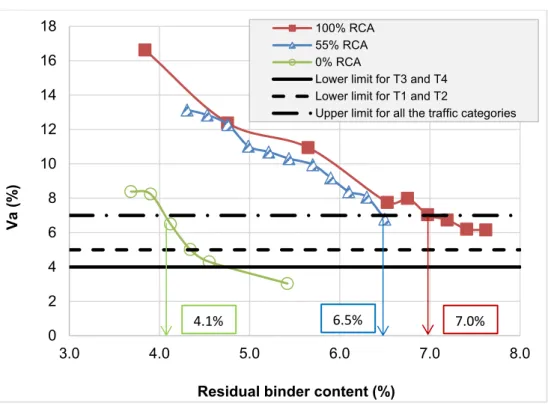
(14) 4. Test results and discussion 4.1. Mixing temperature As previously mentioned, all the temperatures indicated in Section 3.2.2. were tested by following NLT 145/72 [47]. Generally, for each RCA percentage, a combination of lower aggregate-bitumen emulsion temperatures that led to a proper coating was selected, thereby reducing both the environmental impact and the energy consumption. Finally, the selected temperatures used are those shown in Table 4. As shown in the table, the temperature generally increases when the RCA percentage increases. Table 4 Selected mixing temperatures. RCA 0% 55% 100%. Aggregate temperature (ºC) 105 100 110. Bitumen emulsion (ºC) 60 65 65. Figure 1 shows the appearance of the HWMA manufactured with the selected temperatures. As shown in the figure, a proper coating was achieved with the aforementioned temperatures. However, as expected, when the RCA percentage increases, it is significantly more difficult to perform the coating process due to the roughness of the RCA surface. Furthermore, the appearance of the bituminous mixtures when the RCA percentage increases is less shiny due to the increased bitumen absorption of the RCA.. Fig. 1 Appearance of the HWMA manufactured with the temperatures selected based on NLT-145/72: a) HWMA with 0% RCA, b) HWMA with 55% RCA, and c) HWMA with 100% RCA. With respect to the HWMA manufactured at the minimum residual binder content and 0% RCA, it was observed that the coating was similar irrespective of when 13.
(15) the filler was added, namely at the beginning of the mixing process or with only one minute to the end of the mixing process. This holds for all the tested temperatures (see Section 3.2.2). However, for mixtures manufactured at the minimum residual binder content and 55% RCA or 100% RCA, the time at which the filler is added is increasingly important. As shown in the example included in Figure 2, the mixtures in which the filler is added at the beginning of the mixing process (Figure 2a) exhibit a worse coating than those in which the filler is added when only 1 min remains for the mixing process to end (Figure 2b). Thus, in order to optimise and to standardise the manufacturing process, an option was selected in which the filler is added after an initial mixing period. Thus, the filler is added when only 1 min remains for the mixing process to end for all the RCA percentages (0%, 55%, and 100%).. Fig. 2 Appearance of HWMA with 100% RCA manufactured at the temperature of 105 ºC for the aggregates and 75 ºC for the bitumen emulsion: a) Filler incorporated at the beginning of the mixing process and b) filler incorporated when only 1 min remains for the mixing process to end. 4.2. Mixing time In order to select the optimal mixing time, several tests were conducted in the laboratory involving manufacturing mixtures with different mixing times. Thus, it was concluded that a mixing time of 60 s in the laboratory mixer was not sufficient to obtain a proper coating of the aggregates. Specifically, for mixtures made with 55% and 100% RCA, 60 s of mixing time led to improper coating due to the rough nature of the RCA. Therefore, in order to homogenise the mixing process, the maximum mixing time recommended by the ATEB [45] (i.e. 120 s) was used.. 14.
(16) 4.3. Volumetric properties Volumetric properties find wide application in the design of asphalt mixtures. As previously mentioned, the bulk specific density (d), maximum specific density (m), and air void content (Va) were determined for HWMA made with 0%, 55%, and 100% RCA manufactured with different residual bitumen contents. Figures 3, 4, and 5 show the evolution of the aforementioned properties when the residual binder content increases. Fig. 3 Bulk specific density versus the residual bitumen content for HWMA manufactured with 0% RCA, 55% RCA, and 100% RCA. Figure 3 clearly indicates that the bulk specific density increases when the residual binder content increases. This was potentially due to the increased compaction achieved for mixtures with increases in the bitumen emulsion content and the increased mass of bitumen introduced in the mixture. Furthermore, the figure also shows that the bulk specific density of the mixtures decreases when the RCA percentage increases in the composition of HWMA since the RCA density is lower than the natural aggregate density.. Fig. 4 Maximum specific density versus the residual bitumen content for HWMA manufactured with 0% RCA, 55% RCA, and 100% RCA. Figure 4 shows that the maximum specific density decreases when the residual binder content increases. This is due to the lower density of the binder. Additionally, in a manner similar to Figure 3, the figure shows that the maximum specific density of the mixtures decreases when the RCA percentage increases in the composition of HWMA, and this again is because the RCA density is lower than the natural aggregate density.. 15.
(17) Fig. 5 Air void content versus the residual bitumen content for HWMA manufactured with 0% RCA, 55% RCA, and 100% RCA. As expected, Figure 5 shows that, the air void content decreases when the residual binder content increases. Additionally, Figure 5 shows that the air void content increases when the RCA percentage increases in the composition of HWMA. This is potentially because it is more difficult to compact mixtures made with RCA due to the roughness of the RCA surface and because the RCA exhibits increased absorption than that of natural aggregates. In order to comply with the Spanish specifications [34, 45], the lower and upper limits in terms of air void content are also shown in Figure 5. As shown, the first residual content that achieves compliance with the specifications increases when the RCA percentage increases. Thus, the absorptive nature of RCA and its rough surface make mixtures made with RCA demand an increased residual bitumen content as follows: 4.1% for mixtures made with 0% RCA, 6.5% for mixtures made with 55% RCA, and 7.0% for mixtures made with 100% RCA. 4.4. Stripping potential The moisture damage resistance of HWMA was analysed beginning with the minimum residual bitumen content determined in the previous section. Table 5 summarises the water sensitivity results. Table 5 Water sensitivity results for HWMA made with 0%, 55%, and 100% RCA.. RCA 0% 55% 100%. Residual bitumen content (%) 4.1 6.5 7.0 7.2 7.4 7.6. ITSD (MPa). ITSW (MPa). TSR (%). 0.840 0.639 0.793 0.760 0.732 0.862. 0.713 0.525 0.484 0.539 0.502 0.674. 83.1 82.2 61.0 70.9 68.6 78.1. 16.
(18) 7.8. 0.867. 0.676. 77.9. Table 5 clearly shows that the TSR decreases when the RCA percentage increases. Thus, with respect to the HWMA, the incorporation of RCA was detrimental in terms of moisture damage resistance. Table 5 also shows that HWMA made with 0% and 55% RCA exhibits a TSR exceeding 80% as required in the Spanish specifications for the minimum residual binder content determined in the previous section. Nevertheless, in order to comply with the specifications and display adequate water sensitivity, HWMA made with 55% RCA required 39% higher residual bitumen content than mixtures made with 0% RCA (control mixture). Given the aforementioned results, the optimum residual bitumen content for HWMA made with 0% RCA was 4.1% and that for HWMA made with 55% RCA was 6.5%. Additionally, Table 5 also shows that it was not possible to manufacture HWMA with 100% RCA due to its low moisture damage resistance. With respect to minimum residual binder content determined in the previous section, the TSR was only 61.0%, and this was lower than the required 80% TSR. The TSR also increased if the residual bitumen content increased. As shown for 7.8% of the residual binder content, the TSR was 77.9% and was still lower than the required limit of 80%. Hence, it was not considered appropriate to continue increasing the residual binder content since it was excessive, and this contrasts with the principles of sustainability that motivated the study. 4.5. Stiffness Stiffness analysis is conducted on samples made with 0% RCA (control mixture) and 55% RCA at their optimum bitumen contents (4.1% and 6.5% of residual binder content, respectively) by using an indirect tensile strength device. The 17.
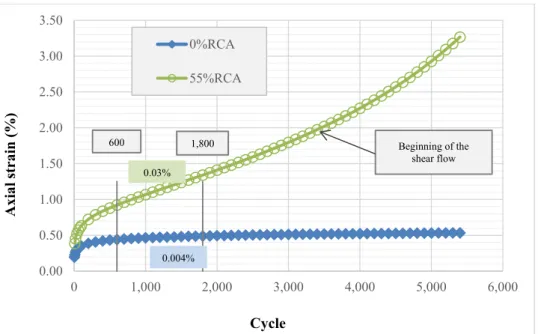
(19) HWMA made with 100% was not analysed due to its poor water resistance performance. The control mixture displayed a resilient modulus of 6,325.5 MPa. In contrast, HWMA made with 55% of RCA exhibited a resilient modulus value of 3,915.0 MPa. Thus, both values were in the range typically exhibited by asphalt concrete mixtures (i.e. from 3450–13,760 MPa) [55]. Nevertheless, HWMA made with 0% RCA was in the middle of the range and HWMA made with 55% RCA was close to the lower limit of this range. Thus, HWMA made with 55% RCA displayed an adequate resilient modulus although it was 40% lower than the control mixture. The low stiffness implied that the mixture could be specifically useful for flexible pavements of low-traffic volume roads. 4.6. Resistance to permanent deformation As shown in Figure 6, the RLAT results are typically shown by the cumulative permanent axial strain evolution versus the number of applied cycles. Figure 6 shows the averaged results of two samples for HWMA made with 0% RCA and six samples for mixtures made with 55% RCA. The increase in the number of samples for mixtures made with 55% RCA was due to the dispersion that indicated the aforementioned mixtures. In a first analysis of the figure, in order to quantify the resistance to permanent deformation, the average creep of the curve slope between 600 and 1800 cycles was used because a linear relationship exists between the cumulative permanent axial strain and the number of load applications in the aforementioned cycles [56]. Thus, a higher slope corresponds to an increased deformation rate and increased rutting potential, i.e. lower resistance to permanent deformation.. 18.
(20) As previously mentioned, given the absence of specifications, the analysis compared the resistance to permanent deformation between mixtures made with 0% RCA (control mixture) and mixtures made with 55% RCA in which both included the optimum bitumen content (4.1% and 6.5% of residual binder content, respectively).. Fig. 6 Cumulative permanent axial strain evolution versus the number of applied cycles for HWMA manufactured with 0% RCA and 55% RCA (averaged results). As shown in Figure 6, HWMA made with 55% RCA displays a higher slope (0.03%) than mixtures made with 0% RCA (0.004%). Specifically, mixtures made with 55% RCA exhibited a slope that was 750% that of mixtures made with 0% RCA. Thus, mixtures made with 55% RCA displayed higher rutting potential than HWMA made with 0% RCA. Nevertheless, all the HWMA tested exhibited permanent deformation levels that were lower or similar to those exhibited by conventional HMA for the RLAT test at the 1800th cycle. For comparison purposes, Santagata et al. [57] obtained values between 0.4% and 1.1 at the 1800th load cycle for the HMA. Aschury et al. [58] obtained values of approximately 1.3% for the HMA. As shown in Figure 6, the HWMA made with 0% RCA exhibits final axial permanent strain values of 0.6% while HWMA made with 55% RCA indicates final axial permanent strain values of 1.3% at the 1800th cycle. Nevertheless, the aforementioned results clearly indicate that mixtures made with 55% RCA displayed higher rutting potential than HWMA made with 0% RCA. The shear flow is considered in a second analysis of figure 6. It is widely-known that permanent deformation is the result of a combination of densification and. 19.
(21) shear flow [59]. Densification is due to the reduction in air voids [59]. When the shear flow acts, the air voids remain constant although the asphalt flows from the tire bed to the tire sides [59]. Additionally, as shown in figure 6, the shear flow acts when mixtures are made with 55% RCA although it does not when mixtures are made with 0% RCA. Furthermore, the aforementioned results indicate that mixtures made with 55% RCA display lower resistance to the permanent deformation than HWMA made with 0% RCA.. 5. Conclusions In the study, A HWMA type AC 22 bin S made with 0%, 55%, and 100% of RCA and bitumen emulsion C60B4 was manufactured by using the Marshall method. After compaction, the mixtures were cured at 50 ºC for 3 d in an oven. Volumetric properties, stiffness, and resistance to permanent deformation were evaluated in a laboratory. The following conclusions were obtained from the study: . As expected, when the RCA percentage increases, the coating process becomes more difficult due to the rough texture of the RCA surface. Hence, there were differences in the optimum mixing temperatures for mixtures made with 0%, 55%, and 100% RCA. A proper aggregate coating was achieved by using mixing temperatures ranging from 100 ºC to 110 ºC for the aggregates and from 60 ºC to 65 ºC for the bitumen emulsion.. . Generally, the results indicated that the introduction of RCA in HWMA led to increased mixing temperatures.. . The introduction of RCA in HWMA caused the mixing process to exhibit a higher influence than when RCA is not used. Specifically, the moment in 20.
(22) which the filler was added to the mixture did not affect the aggregate coating results in the control mixture (0% RCA). Nevertheless, it played a crucial role when 55% and 100% RCA were used. . Hence, in order to design a mixing process that was suitable for all RCA percentages, it was necessary to incorporate the mineral filler when 1 min remained for the mixing process to end and not at the beginning of the mixing process.. . Similarly, a mixing time of 120 s was used. The rough nature of RCA required the mixing time to achieve a proper aggregate coating. Thus, the use of RCA in HWMA led to increased mixing time.. . Given the increased absorption and roughness of the RCA, the effective binder reduced in the mix, and increased energy was necessary to compact the particles. Consequently, the air voids content in HWMA increased with the percentage of RCA.. . The absorptive nature of RCA and its rough surface indicated that HWMA made with RCA demand increased residual bitumen content. Hence, mixtures made with 0% RCA and 55% RCA exhibited optimum residual binder contents of 4.1% and 6.5%, respectively.. . HWMA made with 0% and 55% of RCA, displayed adequate stripping potential (TSR80%) at their optimum bitumen content.. . Nevertheless, as expected, the incorporation of RCA instead of natural. aggregates for manufacturing of HWMA is detrimental in terms of moisture damage resistance. Specifically, it was not possible to manufacture a mixture with 100% RCA due to its high stripping potential. . HWMA made with 0% and 55% RCA displayed resilient modulus in the range of values typically exhibited by asphalt concrete mixtures. 21.
(23) . However, it should be noted that HWMA made with 55% RCA displayed a resilient modulus that was 40% lower than that of the control mixture (0% RCA). Thus, the incorporation of RCA to HWMA reduced the stiffness of the mixture.. . With respect to aforementioned reasons, HWMA made with 55% RCA can be specifically useful for flexible pavements of low-traffic volume roads.. . HWMA made with 55% RCA displayed increased rutting potential when compared to HWMA made with 0% RCA. Nevertheless, both mixtures exhibited an adequate resistance to permanent deformation.. This study is a preliminary investigation that focused on moisture damage resistance, stiffness, and rutting potential of HWMA made with RCA instead of natural aggregates. Further investigations are required to strengthen the understanding of the aforementioned types of mixtures.. Acknowledgments The authors wish to acknowledge the Spanish Ministry of Education and Science for sponsoring this research through Project BIA2013-47987-C3-2-R. The authors would like to thank Ecoasfalt S.A. for supplying the bitumen emulsion required for this study, Tec-Rec for supplying the recycled concrete aggregates, and Probigasa for supplying the natural aggregates. The authors declare that they have no conflict of interest.. 22.
(24) References [1] Aydin, E. (2016). Novel coal bottom ash waste composites for sustainable construction. Constr Build Mater, 124, 582-588. http://dx.doi.org/10.1016/j.conbuildmat.2016.07.142 [2] EAPA. European Asphalt Pavement Association (2005). Low temperature asphalt. [3] Mallick, R.B and Bergendahl, J. (2009). A laboratory study on CO2 emission from asphalt binder and its reduction with the use of warm mix asphalt. Int J Sustain Eng, 2(4), 275-283. https://doi.org/10.1080/19397030903137287. [4] Rubio, M.C., Martínez, G., Baena, L. and Moreno, F. (2012). Warm mix asphalt: an overview. J Clean Prod, 24, 76-84.http://dx.doi.org/10.1016/j.jclepro.2011.11.053 [5] Ossa, A., García, J.L. and Botero, E. (2016). Use of recycled construction and demolition waste (CDW) aggregates: A sustainable alternative for the pavement construction industry. J Clean Prod, 135, 379-386. http://dx.doi.org/10.1016/j.jclepro.2016.06.088. [6] Pasetto, M. and Baldo, N. (2004). The use of construction and demolition aggregate in bituminous concrete for road base layers. In Proceedings of the 2004 global symposium on recycling, waste treatment and clean technology, REWAS (pp. 193-202). [7] Diew, W.Y., Delai, S.D. and Dickson, L. (2007). Value-added utilisation of recycled concrete in hot-mix asphalt. Waste Manage, 27(2), 294-299. http://dx.doi.org/10.1016/j.wasman.2006.02.001. [8] Pasandin, A.R. and Perez, I. (2015). Overview of bituminous mixtures made with recycled concrete Aggregates. Constr Build Mater, 74, 151-161. http://dx.doi.org/10.1016/j.conbuildmat.2014.10.035 [9] Pérez I., Pasandín A.R, Medina L. (2012). Hot mix asphalt using C&D waste as coarse aggregates. Mater Design, 36, 840-846. http://dx.doi.org/10.1016/j.matdes.2010.12.058. [10] Pérez I., Pasandín A.R and Gallego J. (2012). Stripping in hot mix asphalt produced by aggregates from construction and demolition waste. Waste Manage Res, 30 (1), 3 - 11. [11] Lee C.H., Du J.C., Shen D.H. (2012). Evaluation of pre-coated recycled concrete aggregate for hot mix asphalt. Constr Build Mater, 28, 66-71. http://dx.doi.org/10.1016/j.conbuildmat.2011.08.025. [12] Shen D., Du J. (2004). Evaluation of building materials recycling on HMA permanent deformation. Constr Build Mater, 18, 391-397. http://dx.doi.org/10.1016/j.conbuildmat.2004.03.007. [13] Bushal S., Li X., Wen H. (2011). Evaluation of Effects of Recycled Concrete Aggregate on Volumetrics of Hot-Mix Asphalt. Transport Res Rec, 2205 (3), 36-39. http://dx.doi.org/10.3141/2205-05. [14] Pasandín A.R., Pérez I. (2013). Laboratory evaluation of hot-mix asphalt containing construction and demolition waste. Constr Build Mater, 43, 497-505. http://dx.doi.org/10.1016/j.conbuildmat.2013.02.052. [15] Muniz de Farias M., Quiñones Sinisterra F., Gómez Jiménez A.M., Ribeiro e Souza, M.V., Farias Falcão P.R. (2012). Influence of Asphalt Rubber on the Crushing of Recycled Aggregates Used in Dense HMA. Proceedings of Asphalt Rubber. Munich. [16] Paranavithana S., Mohajerani A. (2006). Effects of recycled concrete aggregates on properties of asphalt concrete. Resour Conserv Recy, 48, 1 - 12. http://dx.doi.org/10.1016/j.resconrec.2005.12.009. [17] Wen H., Bhusal S. (2011). Evaluate Recycled Concrete as Hot Mix Asphalt Aggregate. Transportation Northwest (TRANSNOW). University of Washington. [18] Mills-Beale J., You Z. (2010). The mechanical properties of asphalt mixtures with recycled concrete aggregates. Constr Build Mater, 24, 340-345. http://dx.doi.org/10.1016/j.conbuildmat.2009.08.046. [19] Wu, S., Zhong, J., Zhu, J. and Wang, D. (2013). Influence of demolition waste used as recycled aggregate on performance of asphalt mixture. Road Mater Pavement, 14(3), 679-688. http://dx.doi.org/10.1080/14680629.2013.779304 [20] Zhu J.; Wu S.; Zhong J., Wang D. (2012). Investigation of asphalt mixture containing demolition waste obtained from earthquake-damaged buildings. Constr Build Mater, 29, 466-475. http://dx.doi.org/10.1016/j.conbuildmat.2011.09.023. [21] Pasandín A.R., Pérez I. (2014). Mechanical properties of hot-mix asphalt made with recycled concrete aggregates coated with bitumen emulsion. Constr Build Mater, 55, 350-358. http://dx.doi.org/10.1016/j.conbuildmat.2014.01.053. [22] Behnood, A., Gharehveran, M.M., Asl, F.G. and Ameri, M. (2015). Effects of copper slag and recycled concrete aggregate on the properties of CIR mixes with bitumen emulsion, rice husk ash, Portland cement and fly ash. Constr Build Mater, 96, 172-180. http://dx.doi.org/10.1016/j.conbuildmat.2015.08.021.. 23.
(25) [23] Gómez-Meijide B, Pérez I. Non-linear elastic behavior of bitumen emulsion stabilized materials with C&D waste aggregates. Constr Build Mater, 98 (2015) 853-863. https://doi.org/10.1016/j.conbuildmat.2015.07.004 [24] Gómez-Meijide, B., & Pérez, I. (2014). Effects of the use of construction and demolition waste aggregates in cold asphalt mixtures. Constr Build Mater, 51, 267-277. http://dx.doi.org/10.1016/j.conbuildmat.2013.10.096. [25] Gómez-Meijide, B., Pérez, I. and Pasandín, A.R. (2016). Recycled construction and demolition waste in cold asphalt mixtures: evolutionary properties. J Clean Prod, 112, 588-598. http://dx.doi.org/10.1016/j.jclepro.2015.08.038 [26] Hill, B., 2011. Performance evaluation of warm mix asphalt mixtures incorporating reclaimed asphalt pavement. PhD Thesis, University of Illinois at Urbana-Champaign, Urbana, USA [27] Shu, X., Huang, B., Shrum, E. D. and Jia, X. (2012). Laboratory evaluation of moisture susceptibility of foamed warm mix asphalt containing high percentages of RAP. Constr Build Mater, 35, 125-130. https://doi.org/10.1016/j.conbuildmat.2012.02.095 [28] Mogawer, W., Austerman, A., Mohammad, L., & Kutay, M. E. (2013). Evaluation of high RAP-WMA asphalt rubber mixtures. Road Mater Pavement, 14(sup2), 129-147. http://dx.doi.org/10.1080/14680629.2013.812846 [29] Dinis-Almeida, M., Castro-Gomes, J., Sangiorgi, C., Zoorob, S. E. and Afonso, M. L. (2016). Performance of Warm Mix Recycled Asphalt containing up to 100% RAP. Constr Build Mater, 112, 1-6. https://doi.org/10.1016/j.conbuildmat.2016.02.108 [30] Tebaldi, G., Dave, E., Hugener, M., Falchetto, A.C., Perraton, D., Grilli, A., ... and Apeagyei, A. (2018). Cold recycling of reclaimed asphalt pavements. In Testing and Characterization of Sustainable Innovative Bituminous Materials and Systems (pp. 239-296). Springer, Cham. [31] Pasetto, M., Baliello, A., Giacomello, G. and Pasquini, E. (2017). Sustainable solutions for road pavements: A multi-scale characterization of warm mix asphalts containing steel slags. Journal of Cleaner Production, 166, 835-843. [32] Kanitpong, K., Charoentham, N. and Likitlersuang, S. (2012). Investigation on the effects of gradation and aggregate type to moisture damage of warm mix asphalt modified with Sasobit. Int J Pavement Eng, 13(5), 451-458. http://dx.doi.org/10.1080/10298436.2011.565058. [33] De Juan, M.S. and Gutiérrez, P.A. (2009). Study on the influence of attached mortar content on the properties of recycled concrete aggregate. Constr Build Mater, 23 (2), 872-877. http://dx.doi.org/10.1016/j.conbuildmat.2008.04.012. [34] MFOM (2015). Ministry of Public Works. Article 542 (Asphalt Concrete) of the General Technical Specifications for Road and Bridge Works (PG3) from the Spanish Ministry of Public Works. Madrid, Spain (in Spanish). [35] AENOR (2014). Asociación Española de Normalización y Certificación. UNE-EN 1097-6 “Tests for mechanical and physical properties of aggregates. Determination of particle density and water absorption”. Madrid, Spain (in Spanish). [36] AENOR (2012). Asociación Española de Normalización y Certificación. UNE-EN 933-8 “Tests for geometrical properties of aggregates. Assessment of fines. Sand equivalent test”. Madrid, Spain (in Spanish). [37] AENOR (2012). Asociación Española de Normalización y Certificación. UNE-EN 933-3 “Tests for geometrical properties of aggregates. Determination of particle shape. Flakiness index”. Madrid, Spain (in Spanish). [38] AENOR (2010). Asociación Española de Normalización y Certificación. UNE-EN 1097-2 “Tests for mechanical and physical properties of aggregates. Methods for the determination of resistance to fragmentation”. Madrid, Spain (in Spanish). [39] AENOR (2017). Asociación Española de Normalización y Certificación. UNE-EN 13075-1 “Bitumen and bituminous binders. Determination of breaking behaviour. Determination of breaking value of cationic bituminous emulsions, mineral filler method”. Madrid, Spain (in Spanish). [40] AENOR (2012). Asociación Española de Normalización y Certificación. UNE-EN 1428 “Bitumen and bituminous binders. Determination of water content in bituminous emulsions. Azeotropic distillation method”. Madrid, Spain (in Spanish). [41] AENOR (2009). Asociación Española de Normalización y Certificación. UNE-EN 1431 “Methods of test for petroleum and its products. Bitumen and bituminous binders. Determination of recovered binder and oil distillate from bitumen emulsions by distillation”. Madrid, Spain (in Spanish). [42] AENOR (2011). Asociación Española de Normalización y Certificación. UNE-EN 12846-1 “Bitumen and bituminous binders. Determination of efflux time by the efflux viscometer. Bituminous emulsions”. Madrid, Spain (in Spanish).. 24.
(26) [43] AENOR (2013). Asociación Española de Normalización y Certificación. UNE-EN 1429 “Bitumen and bituminous binders. Determination of residue on sieving of bituminous emulsions, and determination of storage stability by sieving”. Madrid, Spain (in Spanish). [44] AENOR (2009). Asociación Española de Normalización y Certificación. UNE-EN 12847 “Bitumen and bituminous binders. Determination of settling tendency of bituminous emulsions”. Madrid, Spain (in Spanish). [45] ATEB (n.d.). Asociación Técnica de Emulsiones Bituminosas. Half-Warm Mix Asphalt with bitumen emulsion. Madrid, Spain (in Spanish). [46] MOPT (2002). Public Works and Transportation Ministry. NLT-159/86. “Resistance to the permanent deformation of bituminous mixtures using Marshall Apparatus”. NLT Standards. Road Test. General Directorate of Highways, second edition, Madrid, Spain (in Spanish). [47] MOPT (2002). Public Works and Transportation Ministry. NLT-145/72. “Coating of the aggregate with bitumen emulsion”. NLT Standards. Road Test. General Directorate of Highways, second edition, Madrid, Spain (in Spanish). [48] AENOR (2012). Asociación Española de Normalización y Certificación. UNE-EN 12697-6 “Bituminous mixtures. Test methods for hot mix asphalt. Determination of bulk density of bituminous specimens”. Madrid, Spain (in Spanish). [49] AENOR (2012). Asociación Española de Normalización y Certificación. UNE-EN 12697-5 “Bituminous mixtures. Test methods for hot mix asphalt. Determination of the maximum density”. Madrid, Spain (in Spanish). [50] AENOR (2003). Asociación Española de Normalización y Certificación. UNE-EN 12697-8 “Bituminous mixtures. Test methods for hot mix asphalt. Determination of void characteristics of bituminous specimens”. Madrid, Spain (in Spanish). [51] AENOR (2009). Asociación Española de Normalización y Certificación. UNE-EN 12697-12 “Bituminous mixtures. Test methods for hot mix asphalt. Determination of the water sensitivity of bituminous specimens”. Madrid, Spain (in Spanish). [52] Pasetto M., Baldo N (2010). “Experimental evaluation of high performance base course and road base asphalt concrete with electric arc furnace steel slags”. Journal of Hazardous Materials, 181, 938-948. https://doi.org/10.1016/j.jhazmat.2010.05.104 [53] AENOR (2006). Asociación Española de Normalización y Certificación. UNE-EN 12697-26 “Bituminous mixtures. Test methods for hot mix asphalt. Stiffness”. Madrid, Spain (in Spanish). [54] BSi (1996). British Standards Institution. Draft for Development BS DD 226:1996. “Method for determining resistance to permanent deformation of bituminous mixtures subject to unconfined dynamic loading”. [55] FHWA (n.d). Federal Highway Administration. “Resilient Modulus Testing and Startup Procedures”. [56] He Gui-ping, Wong Wing-gun (2007). Laboratory study on permanent deformation of foamed asphalt mix incorporating reclaimed asphalt pavement materials. Constr Build Mater; 21; 18091819. https://doi.org/10.1016/j.conbuildmat.2006.05.024 [57] Santagata F.A, Canestrari F., Pasquini E. Mechanical characterization of asphalt rubber-wet process. Proceedings of 4th International SIV Congress. Palermo. Italy; 2007. [58] Aschuri Imam, Woodward David, Woodside Alan. Permanent deformation characteristics of asphalt concrete containing reclaimed materials. In: Sixth International Conference on Maintenance and Rehabilitation of Pavements and Technological Control, Politechnico di Torino, Italy; 2009; 1: 232-242. [59] Babadopulos, L.F.A.L., Ferreira, J.L.S. and Soares, J.B. (2016). An approach to couple aging to stiffness and permanent deformation modeling of asphalt mixtures. Mater Struct, 49: 4929. https://doi.org/10.1617/s11527-016-0834-4.. 25.
(27) a) HWMA with 0% RCA. b) HWMA with 55% RCA. c) HWMA with 100% RCA. Figure 1. 26.
(28) a) Filler incorporated at the beginning of the mixing process. b) Filler incorporated when there was only one minute to the end of mixing process. Figure 2. 27.
(29) 2,450 100% RCA. 2,400. 55% RCA. 2,350. 0% RCA. 2,300 d (kg/m3). 2,250 2,200 2,150 2,100 2,050 2,000 3.0. 4.0. 5.0. 6.0. 7.0. 8.0. Residual binder content (%) Figure 3. 28.
(30) 2,600 100% RCA. 2,550. 55% RCA. 2,500. 0% RCA. m (kg/m3). 2,450 2,400 2,350 2,300 2,250 2,200 3.0. 4.0. 5.0. 6.0. 7.0. 8.0. Residual binder content (%) Figure 4. 29.
(31) 18. 100% RCA 55% RCA 0% RCA Lower limit for T3 and T4 Lower limit for T1 and T2 Upper limit for all the traffic categories. 16 14 12. Va (%). 10 8 6 4 2 6.5%. 4.1%. 0 3.0. 4.0. 5.0. 6.0. 7.0% 7.0. 8.0. Residual binder content (%) Figure 5. 30.
(32) 3.50 0%RCA. 3.00. 55%RCA. Axial strain (%). 2.50 2.00 600. 1.50. 1,800. Beginning of the shear flow. 0.03%. 1.00 0.50 0.004%. 0.00 0. 1,000. 2,000. 3,000. 4,000. 5,000. 6,000. Cycle. Figure 6. 31.
(33)
Figure
Documento similar
