BENEMERITA UNIVERSIDAD AUTONOMA DE
PUEBLA
FACULTAD DE LENGUAS MODERNAS
Identifying Learning Styles in Lengua Meta III Course
at the Facultad de Lenguas BUAP
A thesis submitted to the School of Languages
For the degree of
LICENCIATURA EN LENGUAS MODERNAS
By:
Juan José Gómez Guerrero
Thesis Director:
Mtro. Jesús L. Moreno Carvajal
2
CONTENT
ACKNOWLEDGMENTS... 5
CHAPTER I: INTRODUCTION ... 6
1.1 Introduction to the problem ... 6
1.2 Purpose of the study ... 7
1.3 Research questions ... 7
1.4 Significance of the study ... 8
1.5 Definitions of terms... 8
CHAPTER II: LITERATURE REVIEW... 10
2.1 Introduction ... 10
2.1.1 Towards new approaches in ELT ... 11
2.2 Approaches ... 12
2.2.1 Behaviorism ... 12
2.2.2 Constructivism ... 13
2.2.3 Connectivism ... 13
2.3 Methods in ELT ... 14
2.3.1 Grammar Translation Method ... 15
2.3.2 Direct Method ... 15
3
2.3.4 Silent Way ... 16
2.3.5 Suggestopedia ... 17
2.3.6 Community Language Learning... 17
2.3.7 Total Physical Response ... 18
2.3.8 Communicative Approach (Natural Approach)... 18
2.3.9 High/Scope ... 19
2.4 Learning Styles ... 19
2.4.1 Categorizing Learning Styles ... 20
2.4.1.1 Visual Learner ... 20
2.4.1.2 Auditory Learners ... 21
2.4.1.3 Kinesthetic / Tactile Learner ... 21
2.4.1.4 Concrete Learners ... 22
2.4.1.5 Abstract Learners... 22
2.4.1.6 Sequential Learners ... 23
2.4.1.7 Random Learners... 23
2.4.2 Multiple Intelligences Theory ... 24
2.4.3 The main intelligences in teaching and learning ... 25
2.5 Summary ... 26
CHAPTER III: METHODOLOGY ... 28
3.1 Subjects ... 28
4
3.3 Procedure ... 30
CHAPTER IV: FINDINGS ... 32
4.1 Observations ... 32
4.1.1 Students’ Observations ... 32
4.2 Discovering the students’ learning style. ... 33
4.2.1 Discovering the students’ learning style second test... 35
CHAPTER V: CONCLUSION ... 37
5.1 Conclusions ... 37
5.2 Summary & Discussion ... 37
5.3 Implications ... 38
5.4 Limitations of the study ... 39
5.5 Directions for further research ... 39
5.6 Suggestions ... 40
REFERENCES ... 44
APPENDIXES ... 46
Appendix 1 ... 46
Appendix 2 ... 48
5
ACKNOWLEDGMENTS
Primero debo agradecer a mi madre, Imelda Guerrero Turrubiartes, por su amor, apoyo y comprensión. Especialmente durante el tiempo que le tomó a esta tesis ser terminada. Después es mi deber agradecer a mis hermanos Alejandra y Nohemi, pero en especial y con mucho cariño a mi hermano Renato; el cual partió de este mundo sin haber visto este proyecto finalizado. Que sin su apoyo y amor me hubiera sido difícil llegar a donde he llegado. También quiero agradecer a Irene la persona, que después de mi madre y hermanos, más me ha apoyado en la realización de este proyecto.
6
CHAPTER I: INTRODUCTION
The research field is very similar to the construction field. In both, a curious mind is more than required; moreover, the imagination and a concerned mentality about others are also necessary. In every architectural project the creator finds a social problem that might be solved through his or her building. Thus, every thesis faces a social problem and its aim is to cope with such problem.
1.1Introduction to the problem
Teaching languages academically has been important since always, because of the eagerness of society to travel abroad for business or pleasure (Howatt 1984). The primary attempt to teach languages was on the early nineteenth century, back in those days, the teaching-learning experience was restricted to translating phrases from mother tongue to the target language (Howatt 1984). Larsen-Freeman (1990) states that several methods appeared throughout the ages, such as the already mention Grammar Translation Method, Direct Method, Audio-lingual Method, Silent Way, Suggestopedia, Community Language Learning, Total Physical Response, The Natural Approach; thus, a whole range of possibilities emerged to fit different approaches. However, those methods rarely took into account the learning styles of the students. Not until the twentieth century the learning styles were unknown; consequently, instructors had to change the teaching-learning experience.
7
a task. Regarding the paragraph above, learning styles, will be explained further in this work. When new information is presented to students, they tend to hold on to certain techniques or procedures that help them to internalize the new knowledge they are facing; moreover, the habitual use of the same techniques or procedures, aware or not of the regular use of those, is called learning style (Diaz H. 1995).
As declared above this work is based on identifying the learning styles of the students. Using as a research subject: intermediate students of Lengua Meta III in the Facultad de Lenguas Modernas (LEI) at the Benemerita Universidad Autonoma de Puebla (BUAP).
1.2 Purpose of the study
Every single research has to have an objective or a purpose designed by the investigator to help society or at least a specific part of it. This work aims to help the LEI community; by giving them a tool to identify the learning styles of its students. Consequently the general purpose of this study is identifying the different learning styles. As in any research paper this general purpose will be carried out through a set of specific objectives that are:
To research, based on an instrument, the different learning styles of the students in a classroom of Lengua Meta III at LEI. To assort the founded styles into categories, in order to recognize if there is a predominant style.
1.3 Research questions
This work endeavors to answer the next questions
8
2. How many learning styles can be identified in the group, of Lengua Meta III of LEI at BUAP?
3. Which is the dominant learning style in the group, of Lengua Meta III of LEI at BUAP?
1.4 Significance of the study
It is being said that teaching methods have been used without taking into account the learning styles of students; therefore, some students fail the course or some students do not like the English subject. It is important for new teachers and old teachers as well, to take into consideration the learning styles of their students, in order to enhance their teaching experience. This believe dwells in the fact that teachers work with a group, in other words, they are working with unique human beings put together for one specific purpose, which is to learn English. Hence, if the majority of this group has a certain learning style, and the teacher does not notice it, or does not care about it; the learning experience will not be effective and meaningful. The importance of this study dwells in helping teachers to identify learning styles
1.5 Definitions of terms
Approach: defined by Richards and Rogers (2001) quoting Eduard Antony (1963) is the theories about the nature of language and language learning that serves as a source of practices and principles in language teaching.
9
Method: defined by Richards and Rogers (1997) as the summary of three elements those are: approach, design and procedure.
Procedure: defined as the way of doing something, especially the correct or usual way (Longman Dictionary, 2003).
Meaningful learning: defined by Fink (2003) as any learning that consists of one or more of the following kinds of learning: Foundational knowledge, Application learning, Integration, the Human dimension of learning, Caring, or Learning how to learn
Technique: according to Brown (2000) is the any of a wide variety of exercises, activities or tasks used in the language classroom for realizing lesson objectives.
To learn: according to the Longman Dictionary (2003) is to gain knowledge of a subject or skill, by experience, by studying it, or by being taught.
To teach: the Longman Dictionary (2003) defines teaching as to give lessons in a school, college, or university, or to help someone learn about something by giving them information.
Teaching style: defined by Freeman (1992) as the way how teachers arrange the information to be taught based on their likes, beliefs and previous teaching experiences, this also includes how teacher arrange the classroom furniture, decorations, and how they move and address students.
10
CHAPTER II: LITERATURE REVIEW
Following with the construction illustration proposed in chapter I, the next step for architects and researchers alike, is to find the appropriate material to begin the work. In order to construct a building the architect has to find hard grounds where foundations remain solid; otherwise, the entire structure will collapse and fall down. Hence every research project has to be founded on solid knowledge, or else the research will not be valid and reliable, and share the same structure’s finale.
2.1 Introduction
History has taught us that language has been always an important issue. Since the first men gathered in small groups the language has been presented as a means of communication. Later on the ladder of evolution those small groups had the necessity of communicating with others. The first settlements of men changed into villages, so in order to become bigger communities they had to trade their goods among other villages. They realized that the languages as them evolved, so they had to learn a foreign language with the aim of trading. Throughout the ages, trading was not only the main purpose of learning a second language, but also living abroad was one major factor. The first advance of learning languages was acquiring the second language in the place of origin of that language.
11
teaching methods began since the sixteenth century as Howatt wrote, and every single change in the grammar field affected the teaching area. It is noticeable that every single change in the teaching field affects the learners, throughout history several methods appeared, which were aimed to prepare learners in specific areas of language i.e. some methods trained students in reading comprehension rather than speaking. According to Richards and Rogers (2001) and Larsen-Freeman (1990) the current issues in teaching are not new; they come back from past centuries and most of the methods have been quoted where language and teaching are mentioned; consequently this work will not be different.
2.1.1 Towards new approaches in ELT
It is well known that in ELT “the method”, as the system selected by the teacher to teach the language, is not relevant for the effectiveness of teaching. Some ELT teachers have excellent techniques, and methods; however, students do not get involved in learning the language. This lack of interest dwells in the mismatching between the technique and what is being taught (Haycraft 1995).
12 2.2 Approaches
The approach is the way a teacher prefers to give the class; nonetheless, sometimes the approach is specified by the school in which the teacher works. The approaches were developed by psychologists and scholars of human behavior as schools of thought; however, those schools of thought were adopted by pedagogy in order to create methods to teach. In this ―tree‖ of schools of thought there are a lot of branches; nevertheless, just two branches fit in the teaching area better than the others, these are behaviorism and constructivism (Maya & Díaz 2002). However, according to Siemens (2004) a new branch has sprouted and it is called connectivism and it is closely related to nowadays students. Despite of the behaviorism and connectivism approaches the approach that provides the basis for High-Scope is constructivism, for this reason it is considered the most important for this paper.
2.2.1 Behaviorism
Maya & Díaz (2002) state that behaviorism was formulated by Clark L. Hull in the forties by working with previous theories like Darwin’s theory, Pavlov’s theory, and Watson’s theory, such theories stated that this approach works with an experimental methodology; therefore, it is a quantitative theory that just recognizes measurable facts.
13 2.2.2 Constructivism
Maya & Díaz (2002) stated that this approach, which was formulated by J. Piaget, S. Vigotsky, J. Bruner, and others, had growth nowadays due to the countless methods based on constructivism. The axis of this approach is that the knowledge must be constructed by the learner itself. The focus of this approach dwells in the concept that knowledge is neither passive, nor simple; moreover, constructivism observes knowledge as the result of an action. Therefore knowledge seen from this point of view is complex. The aim of teachers in this approach is to provide the necessary tools to learners, so they will be able to construct knowledge as they need it.
Basically constructivism is scaffolding the knowledge through internal processes; consequently, the formal instruction gets derelict to simply guide lines this according to Piaget cited on (Maya & Díaz 2002). Before doing any improvement on teaching methods or techniques, it is necessary to take into account Piaget’s notes. In other words, any improvement in the teaching-learning fields requires a modification on established patterns, the learner and the teacher must learn again how to do some things, in order to cope with the improvement previously made.
2.2.3 Connectivism
14
Siemens’ theory could be summarized in four categories: 1. - The ability to find connections among fields, ideas, and concepts. 2. - Nurturing and preserving connections are fundamental to facilitate learning. 3. - Choosing what to learn and constant update is needed. 4. - Learning may dwell in non-human applications. In other words, the teachers should not expect passive students; also teachers ought to be open-minded and let students look for other learning sources. Moreover, the teachers have to nurture the students’ eagerness for e-learning sources (Siemens 2004).
It is important to mention this approach since university students are immersed in this digital age, so the teacher must adapt the classroom activities to be updated. It will be a good idea to use technology to appeal new age students.
2.3 Methods in ELT
15
The list below was taken from the authors, yet the most relevant teaching methods used nowadays are mentioned. Such list is not structured according to the approach of the method, so the items are scrambled and works just as a review of methods.
2.3.1 Grammar Translation Method
The Grammar Translation Method also called Classical Method is not new because it was used to teach classical languages, such as Latin and Greek (Larsen-Freeman 1990). She also mentions that this method was used for helping students read and appreciate foreign language literature; besides, the rules were rather than simple just memorizing grammar rules and use the morphology and syntax of the second language.
The abilities that this method developed were the reading and the writing skills; consequently, the accuracy was highlighted (Richards and Rogers 2001). It is noticeable that the students learning styles were not taken into account in this method: however, this method seems to be more than suitable for visual students who like or enjoy reading.
2.3.2 Direct Method
16
highlighted. Therefore, we can deduce that the whole lesson was given in the target language all the time, so the mother tongue was not allowed or constrained to the minimum. Consequently, this method appears to be more appropriate for auditory students who are outgoing and very good in mimicking sounds.
2.3.3 Audio-lingual Method
The Audio-Lingual Method, like the Direct Method differs from Grammar Translation Method. The Audio-lingual Method was developed in the United States during the World War II (WWII); the language was taught through drills and repetitions (Larsen-Freeman, 1990). The basis of this method was the teaching of the target language in small chunks firstly presented orally, and secondly written; consequently, meanings could be better learnt in a cultural context rather than in isolation (Richards and Rogers, 2001). Analogies provided better foundation than analysis; which means that both mother tongue and target language were used by the teacher and students to comprehend better the second language. Due to the order of this method, it seems that the auditory students are firstly beneficiated, and secondly the visual; however the rest of the styles are not fully beneficiated.
2.3.4 Silent Way
17
2001). This is the first attempt to let the student learn by themselves; however, the most enhanced students could be first the kinesthetic because of the puzzle solving. The visual students could be the second ones to be enhanced.
2.3.5 Suggestopedia
The creator of the Suggestopedia method, Georgi Lozanov, believes that language learning can occur faster if the student brings down the psychological barriers that students by themselves build (Larsen-Freeman, 1990). Music plays a special role in the Suggestopedia lessons the teacher plays some quiet music to activate the imagination. The class was most likely a therapy session where comfortable chairs were provided to emphasized relaxation. Nevertheless, the teaching-learning experiences were reduced to memorizing vocabulary and translating phrases. First because of the music the auditory students get appealed by the method; nonetheless, the kinesthetic students are also appealed.
2.3.6 Community Language Learning
18 2.3.7 Total Physical Response
Almost all the methods listed above have students speaking the target language from the first day; however, this method begins with the listening skill. This method is an example of a new general approach to ELT; also named ―the Comprehensive Approach‖ because of the importance of listening comprehension (Larsen-Freeman, 1990). Total Physical Response is based on memory research which says that the more intensive a memory connection is traced; the stronger the memory association will be, and more likely it will be recalled (Richards and Rogers, 2001). The creator of this method states that children learn by internalizing the language, not comprehending grammar rules, so if a child can learn this way, an adolescents or an adults will do it too (Richards and Rogers, 2001). Mainly based in the stimulus-response, this method reduces the stress of learning a second language. Due to the stimulus-response base the kinesthetic students are suited for this method.
2.3.8 Communicative Approach (Natural Approach)
19
important role. Consequently the teacher has to communicate all the time that is to talk, and then the auditory students feel that they are beneficiated.
2.3.9 High/Scope
According to Epstein (2008), High/Scope, which started as a summer camp program for gifted adolescents in Ypsilanti Michigan, where David Weikart along with other camp founders decided to name this program High Scope for its rank and what they wanted for the project. Nowadays the High/Scope's educational method has been adapted to fit all social classes, and ethnical backgrounds. High/Scope emphasizes active participatory learning that means students must have direct, practical experiences with people, objects, events, and ideas. Learners’ interests and choices are the spirit of High/Scope programs. They construct their own knowledge through contacts with the world and the people around them. Pupils take the first step in the learning process by making choices and following their plans and decisions. The role of teachers and parents is to offer physical, emotional, and intellectual support. In active learning settings, the teacher and parents expand the learner’s thoughts with diverse materials and promoting interactions.
2.4 Learning Styles
20
In addition to the learning style theory Lowes & Target (1998) said that students adjust the learning process to time and needs. It is important not to confuse this process with a conscious process. It is more likely the way students learnt the best in the amount of time given. Moreover, Lowes & Target (1998) said that learners might have more than one learning style.
2.4.1 Categorizing Learning Styles
In addition to likes and dislikes on learning or adjusting the time to this purpose, Díaz (1995) states that the learning process is influenced by the environment in which the students grows up, the people students interact, the nature of the knowledge to be acquire and even the amount of knowledge to be acquired. According to this Diaz (1995) those learning preferences are divided in three categories, and each category refers to a preferred, but not unique way students use to learn. Diaz (1995) categorizes learners as: visual learners, auditory learners and kinesthetic or tactile learners. However, Lowes and Target (1998) add to this category, concrete learners, abstract learners, sequential learners, and random learners. Let’s define each learning style and characteristics:
2.4.1.1 Visual Learner
21
flashcards. And finally these students like using books; they find more attractive book’s activities than integrative activities such as debates.
2.4.1.2 Auditory Learners
Diaz (1995) defines auditory learner as the student that is always talking, whispering and chattering on class. This type of students like narratives, jokes, and stories, they can repeat them very accurately after only a few repetitions. Also they perform better in class than their test results indicate. In addition to that Reid (1995) said that auditory learners enjoy listening to tapes or the teacher’s explanations. Also this students need to hear explanations, and instructions given by peers or teachers.
2.4.1.3 Kinesthetic / Tactile Learner
Diaz (1995) defines kinesthetic learners as a person that needs to follow an ―observe-reflect-do‖ sequence to acquire language, in other words the student has to put
hands on something to learn. This type of student constantly moves and cannot stay still for long periods of time. Finally this student is a great ―splitter‖ takes information apart,
analyzes it, and puts it back together again. Moreover, Lowes and Target (1998) said that this learners needs to be actively involved in any activity they perform. And they mostly enjoy role-playing as a tool to learn.
Taking into consideration Diaz (1995), Reid (1995), and Lowes and Target (1998) points of view about learning styles, it is being said that:
22
ii. Auditory learners. Find easier to achieve learning when they hear to explanations; they are responsive to audios, and oral explanations by the teacher.
iii. Kinesthetic learners. Need to be actively involved in doing things in order to learn easily; thus, they like to move around and to be sited is boring for them. They enjoy role-plays or crafting objects they can relate to knowledge.
In addition to those three students’ learning styles, Lowes and Target (1998), talking about learning styles add other four categories: concrete learners, abstract learners, sequential learners, and random learners. Some students can be placed in the previous or in this following category; however, some students share more than one category and style, when studying.
2.4.1.4 Concrete Learners
Lowes and Target (1998) define concrete learners as students who like hands-on projects, related to learning. This students will learn something if it has a purpose, at least a purpose useful for them. And finally they enjoy games, simulations and role plays, related to real situations. This concrete learner could be confused with a kinesthetic learner, but they differ on the nature of the thing to be learnt, if it is useful for them or not.
2.4.1.5 Abstract Learners
23 2.4.1.6 Sequential Learners
Lowes and Target (1998) define these learners as students who are good at classifying and arranging knowledge. They may be very analytical, industrious and reliable. These learners share the same quality of ―splitter” as a kinesthetic learner, but these learners take this ability to the next level.
2.4.1.7 Random Learners
According to Lowes and Target (1998) abstract learners tend to be more imaginative and intuitive towards learning. They are not afraid of mistakes; they may come up with original ideas or ways to look and things. These type of learners seem not to share qualities with other styles.
Taking Lowes and Target (1998) perspective towards learning styles, it is being said that:
iv. Concrete learners. These learners like hands-on, practical activities; they enjoy games and role-plays directed to a specific purpose in class, and they are experimental by nature.
v. Abstract learners. Such learners enjoy theoretical classes, and seem to be good at rational and logical thinking; books, notes, and thinking ideas are nice learning tools for them. So they are good at reading, and writing own ideas and they are less attracted to practical exercises.
vi. Sequential learners. These types of learner are good at categorizing and classifying knowledge; consequently, they are analytical and reliable.
24
Thinking about making activities for each class to fit each learning style is overwhelming; nonetheless, the teachers can leave the learning experience in hands of their students by using strategies that appeal the leading learning style in the classroom.
2.4.2 Multiple Intelligences Theory
Gardener (1999) states in his book frames of mind seven human intelligences, the first two have been characteristically appreciated in the educational field; these are:
25
2.4.3 The main intelligences in teaching and learning
As it was seen above, Gardner stated the theory of multiple intelligences; however, in the academic field just three intelligences are enhanced in classrooms around the world according to Díaz (1995). This author states that just the spatial intelligence, musical intelligence and bodily-kinesthetic intelligence are being developed with a certain teaching method. However, Díaz renames the intelligences as styles that are: visual style, auditory style and kinesthetic style. Each style is the mixture of the ―likes‖, procedures and
techniques that a person has to internalize knowledge. The author states that every single person has a style which he or she feels comfortable to learn or acquire knowledge. Furthermore, this style is not only applicable to learning situations, but also applicable to teaching situations.
In addition, Tileston (2000) said that in nowadays classrooms the three learning styles co-exist. The percentages cited on her book vary from a twenty percent auditory and an eighty percent divided between visual and kinesthetic. So the teacher should look for a variety of activities that appeal the three learning styles. Moreover, Lowes and Target (1998) state that additionally to visual, auditory and kinesthetic learners there are other categories that complement in many ways those main three learning styles.
26
work is based on the three main learning styles: visual learning style, auditory learning style and kinesthetic learning style.
2.5 Summary
In short, Howatt (1984) said that the development of teaching methods began since the sixteenth century, and every single change in areas such as grammar, technology, humanistic, etc. affected the teaching. Richards and Rogers (2001) claim that throughout history several methods appeared which were aimed to prepare learners in specific areas of language, such as listening, speaking, writing, or reading. However, as is stated above, in ELT ―the method‖, as the system selected by the teacher to teach the language, is not
relevant, some ELT teachers have excellent techniques, yet students did not get involved in the activity. This lack of interest dwells in the mismatching between the technique and what is being taught (Haycraft, 1995). Epstein (2008) said that there are approaches that diminish that conflict, although did not blend both teaching and learning styles.
To understand how the methods were developed, it is important to know about the approaches. Maya & Díaz (2002) state that the approaches were developed by psychologists and scholars of human behavior as schools of thought; however, those schools of thought were adopted by pedagogy in order to create methods to teach. Some of the most recognized approaches are the behaviorism, the constructivism, and as Siemens (2004) claims, more recently the connectivism.
27
28
CHAPTER III: METHODOLOGY
The next step for an architect is to develop the blueprints, taking into account all the previous steps. For a researcher the next step is very similar to designing blueprints, he or she has to find and follow a series of steps, entitled methodology. This methodology along with an instrument forms the thesis frame.
The first thing to be clarified is that this type of research is both qualitative and quantitative, so it is based on the results of two instruments, about discovering the learning styles in a, LEI Lengua Meta III at BUAP. Moreover, the learn style instrument was used on the teacher, but also an interview was applied to the teacher. According to Nunan (1996), this research is also a case study; therefore, just a specific group of a community is examined. Moreover, using the methodology triangulation proposed by Patton (1992) a non-participant classroom observation followed by a semi-structured interview and two different instruments were used.
3.1 Subjects
29
The teaching setting was more than suitable; because both the teacher and the students had the proper furniture which consisted of individual tables and comfortable individual chairs. In addition, they had electronic equipment such as computer and a projector to be used in presentations or classes, TV and a DVD/VHS combo player for presenting documentaries or movies related to the class.
The aim in applying the test to the group of students and the group of teachers was to identify the learning style of them; it is worth mentioning that the head teacher of the students was also tested to know his learning style, by using the same instrument that the students answered.
3.2 Instruments
30 3.3 Procedure
The research was made by parts using two researchers. First four classroom observations were done by two different researchers were necessary to study the subjects. In those observations following the criteria of Nunan D. (1994) field notes were taken. The importance of the classroom observations dwells in need to know how the students seem to learn. In other words, the researchers were eager to discover how the students like the information be presented to them, that is if they like to be taught with images, with audios or maybe by games. This could be established by the students’ participation in certain classroom activities.
In order to find if the styles an instrument had to be used; the first test used was the proposed by Metts Ralph (1999) without any modification (See Appendix 1). The procedure for the first instrument was to take a sample of the target group. This sample had to be half of the group plus one, as Nunan (1996) and Patton (1992) propose; however the sample size was twenty out of thirty students. The test of learning styles was photocopied and given to the students. They had to answer the test, and gave it back to the researchers. Due to the results, a second test had to be applied, it was the same test proposed by Metts Ralph (1999); however it was modified changing the criteria already mentioned (See Appendix 2). The same group sample was followed; moreover almost the same participants that answered the first test were used.
31
32
CHAPTER IV: FINDINGS
In these two final chapters the illustration about architecture ends because there is no possible similitude between architecture and research talking about findings and conclusion. This chapter presents the results about the most relevant procedures stated in chapter III. The way the information is presented in this chapter consisted of the procedure performed and the graphic that shows the results obtained.
4.1Observations
As it was acknowledged at the end of chapter three, the observations were important for this work. During the four classroom observations some students’ behaviors were monitored such as the level of attention and participation towards the possible variety of classroom activities, the reaction of the students to the teacher’s instructions, the students use of notebooks and resources like books, handouts, worksheets, audios, videos, games, etc.
4.1.1 Students’ Observations
The students’ level of attention and participation vary from activity to activity, although there were not a wide variety of activities. However, an interesting phenomenon took place, the level of attention and participation moved in ―chunks‖ throughout the group. That is one activity seemed not to please the whole group, just a part of it. And if the activity changed, the part of the group that had being interested was no longer paying attention; thus another part of the group took the lead and participated.
33
The first possible resolution could be because of the proficiency in English, however when the instructions were written on the board or they were on the book, the group of the students that reacted positively to the oral instructions were now doubtful, and another part of the group started performing the activity. It is the same phenomenon as in the level of attention and participation.
Finally the way the students managed the resources vary individually; however, some patterns were noticed. Some students barely used the notebook, and just answered the text book when necessary. Some students depended on their notebooks and books a lot. With this group of students, when the teacher used the board to write some examples or vocabulary they copied the information written on the board to their notebooks. It was not possible for the researchers to notice how they manage some handouts or worksheets because those were not used in the observation period.
4.2 Discovering the students’ learning style.
34 Fig. 1
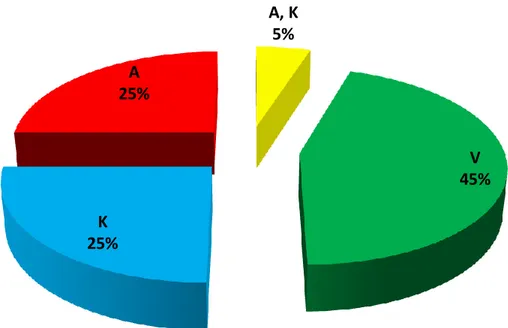
Fig. 1 First unmodified test result
This graph shows the results of the test applied to the students. Each letter represents a style, that is V stands for visual, K for kinesthetic, and A for auditory; the mixture of styles is represented by joining the style letters. It is noticeable the partiality of the results, due to the rating scale of the test. A majority of students having the same style was not present; even though, there are forty-five percent of the students that were visual, this does not represent a major style shared by the students. Twenty-five percent of the students were auditory and other twenty-five percent were kinesthetic. The smallest percentage in this figure represents five percent of the sample that joined two styles, the auditory and the kinesthetic. This phenomenon is interesting because it shows again the partiality of results
A, K 5%
V 45%
K 25%
35
in the first test. Another interesting thing occurred during the test application. It was anxiety by some of the students because the test asked for their names (See Appendix 1). It is well known that when students are asked to answer a test they experience a little bit of anxiety. This test asked for their names; consequently, the anxiety level increased at the point that some of the students asked for permission to leave the name in blank. Unfortunately those students were strongly advised to answer the test completely because it was the way that first test was created.
4.2.1 Discovering the students’ learning style second test.
36 Fig. 2
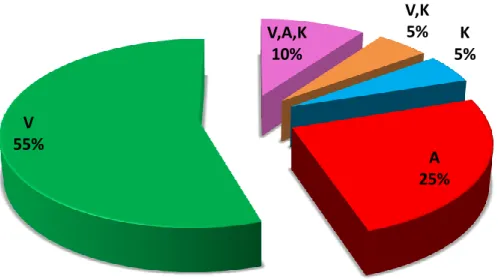
Fig. 2 Results of the second modified test
Similar to fig.1 each style is represented by a letter, and the mixture of styles is represented for its letters. This second test showed a majority of students sharing a style. Fifty-five percent of the sample was visual; although, the first test showed a forty-five percent of students having the same style the result was not as clear as in the second test. Moreover, ten percent had the three styles combined, and five percent were visual-kinesthetic that means that those percentages could work with the visual majority without any problem. In figurative speech the seventy percent of the sample was visual. Twenty-five percent were auditory, and five percent kinesthetic. Those percentages represent the minority; however, that twenty-five percent of auditory students play an important role in the next part.
V,A,K 10%
V,K
5% K
5%
A 25% V
37
CHAPTER V: CONCLUSION
5.1 Conclusions
The conclusion that can be drawn from this research is, this particular group was fifty-five percent visual; moreover, there was a ten percent of the class that had the three learning styles, and a five percent that were visual-kinesthetic. Thus the seventy percent of the group could work visually. It is difficult for a group teacher to notice that they had more than one learning style in the group, it is always necessary to be pointed out by an instrument.
5.2 Summary & Discussion
The results derived from the research to find out, the learning style in Lengua Meta III at the Facultad de Lenguas BUAP, are going to be used to answer the research questions of chapter I.
1. What is the teacher’s level of awareness towards his students learning styles?
The teacher was personally asked about his level of awareness towards his students and said that he did not know about them, also he said that for a teacher is very difficult to know every style from every student. Therefore, the necessity to apply an instrument to discover the learning styles of the group to appeal students towards learning.
2. How many learning styles can be identified in the group of Lengua Meta III of
LEI at BUAP?
38
the common learning styles in this group were visual and auditory; due to the percentages of each style. Since auditory learners were the 25% of the sample and the visual learners were the 55%. The results probe that the seventy percent could work visually, rather than with other learning style. The second strong learning style present was auditory with the thirty percent of the group.
3. Which is the dominant learning style in the group, of Lengua Meta III of LEI
at BUAP?
The results probe that 55% were visual learners; nonetheless, looking at the graphics 70% of the students could work visually. Since students share the visual learning style along with other learning style.
5.3 Implications
This work was done to help the LEI community, to help teachers to improve their classes and the quality of those classes. Moreover, by helping the teachers this thesis also helps students in so many ways, like having truly interested students in class, having teachers less worried about adapting and mixing methods for each class, and hundreds more. However this research also helps teachers and students from other universities and other areas.
39
easier and faster by knowing the styles and adapting the teaching method. And optionally any teacher may apply both instruments at the beginning of the course in order to know the students’ learning style.
5.4 Limitations of the study
The first limitation to be drawn is that some students may have lie on answering both instruments. Although the instruments were designed to obtain fluid and honest answers, some students may have not comprehended the nature of the question. Another limitation is the misinterpretation of learning styles. Since the instruments were based on identifying learning styles; some students may have understood the nature of the instrument as asking the way they would like to be taught. The last limitation dwells in the inexperience of the researcher. This paper is just an ―instrument” to identify learning styles in LEI, Lengua Meta III; however, due to the researcher’s inexperience this work could not be put into practice in other groups, and probably to select a method or activities for the students. This research needs an experienced teacher to carry on an experimental methodology with this proposal.
5.5 Directions for further research
40 5.6 Suggestions
Along with this work the researcher found a teaching method that seems to blend all learning styles. Such method leaves the learning experience on students’ hands. Epstein 2008 said that the basis of this method was to work in small groups deciding what type of material is suitable for their classroom activity. Thus the teacher’s role was at this moment, just a guide he or she had to be there when the learner needs help or asks a question about the activity; however, the teacher’s work was harder than with other methods because they had to plan every activity and make clear instructions for it.
Epstein (2008) said that High/Scope differentiate from other methods because of two important things, firstly the daily plan-do-review sequence, which is positively linked to the students’ developmental progress. That is if every single school’s day the teacher develops a series of engaging activities for the students to do, and at the end of the day he or she reviews what had been done, the students will progress based on the teacher’s feedback about their strengths and weaknesses. The second point that differentiates High/Scope from other methods is the building blocks. As it is well known the work of every teacher is to teach, but if the knowledge is managed in linked chunks, it will be easier for students to deal with that new knowledge. Later with those pieces of new information the teacher will add more knowledge without overwhelming the students.
High/Scope classroom & classroom arrangement:
41
areas is that the students have to reach knowledge using his or her learning style. Therefore, if one student is visual, auditory or kinesthetic he or she will look for material and resources in the areas to accomplish the given task. Even though High/scope does not recommend certain brand of material or equipment, it must follow certain features: 1) attractive to the students, 2) enough for all students, 3) flexible to be moved from one area to other.
For this teaching method, the classroom arrangement is very important. Since the basis is the active participatory learning, the students must work in small groups. Small size groups are recommended because the students have to work in three work stations. Each student has to work in every work station at least once. This work stations must have clear written instructions, and some of the material the students will use.
High/Scope classroom work:
As Epstein (2008) mentioned the core of High/Scope is active participatory learning. High/Scope classroom work follows a sequence, as mentioned above the plan-do-review
42
explicit because the teacher is just a guide in case of trouble. To accomplish the task, the student may use the materials provided by the teacher, or use other resources available in the classroom. 3) ten to fifteen minute large group time for reviewing and recalling along with the teacher what they have learnt. Between stages two and three, students can move through the classroom in order to store material or select more.
As a conclusion, adapting High/Scope to every day classes the teacher has not to be worried in selecting activities for each specific group with certain learning style. Since the students have to complete the task and they have to decide which material to use, this selection will depend on the learning style of each student.
Another suggestion if the teacher or reader do not want to change the teaching method is to check the following chart about learning styles and some possible activities appealing to each learning style.
LEARNER LEARNING MODE SUGGESTED ACTIVITIES
VISUAL Cautious
Needs clarity
Bulletin boards Posters
Realia Flash cards Picture stories Cloze reading Graphic organizers Mind maps
43
Readings
AUDITORY Word dependent
Oral instructions
Listening to audios Storytelling
Songs
Chain games or drills Peer talk
Dictation Reading aloud Discussions
KINESTHETIC Hands-on learning
Hands-on projects
Role play Board games
Races and competition Miming
Group work
Read aloud and acting Show and tell
Experiments
Adapted from Diaz (1995), Reid (1995), and Tileston (2000)
44
REFERENCES
Cohen, A. D. (1998) Strategies in learning and using a second language. New York: Addison Wesley Longman Inc.
Criollo, R. (2003). The Ultimate Guide to Writing a Thesis in TESOL/AL. Mexico: ACD.
Díaz, G. (1995). Managing learning styles in the classroom. Virginia: Teachers of English of other Languages Inc.
Gardner, H. (1999). Intelligence reframed: multiple intelligences for the 21st century. New York: Basic Books.
Haycraft, J. (1995). An introduction to English language teaching. England: Longman.
Howatt, A. (1984). A history of English language teaching. New York: Oxford University Press.
Larsen-Freeman, D. (1990). Techniques and Principals in Language Teaching. USA: Oxford University Press.
Lockhart, C and Richards, J. C. (1994) Reflective teaching in SL classrooms. New York: Cambridge University Press.
Lowes R. & Target F. (1998) Helping students to learn. London: Richmond
Maya, A. & Díaz, N. (2002). Mapas conceptuales elaboración y aplicación. Colombia: Cooperativa editorial Magisterio. Translation: Juan José Gómez Guerrero
45
Patton, M. (1990) Qualitative evaluation and research methods. Newbury Park, California: Sage Publications.
Reid, J. M. (1997) Learning styles in the ESL/EFL classrooms. Boston: Heinle and Heinle Publishers.
Richards, J. & Rodgers, T. (2001) Approaches and methods in language teaching. USA: Cambridge University Press.
Tileston, D. W. (2000). Ten best teaching practices. California: Corwin Press Inc. Willing, K. (1993). Learning styles in adult migrant education. Sydney: Macquire University Press.
WEB PAGES
Epstein, A. (2008). All About High/Scope — FAQs. Retrieve October 09, 2008, from http://www.highscope.org/Content.asp?ContentId=291
Siemens, G. (2004). Connectivism: a new learning theory? Retrieve May 25, 2010, from http://elearning.surf.nl/e-learning/english/3793
46
APPENDIXES
Appendix 1
CONOCE TU ESTILO DE APRENDIZAJE
Nombre: ______________________________ Fecha: ____________________
Este inventario es para ayudarte a descubrir tu manera preferida de aprender. Cada persona tiene su manera preferida de aprender. Reconocer las preferencias personales te ayudará a comprender tus fuerzas en cualquier situación de aprendizaje.
Por favor, responde verdaderamente a cada pregunta. Responde según lo que haces actualmente, no según lo que piensas que sea la respuesta correcta.
Usa la siguiente escala para responder a cada pregunta, marcando con una cruz () la respuesta.
Nunca 1
1. Me ayuda trazar o escribir a mano las palabras que tengo que aprender de memoria
2. Recuerdo mejor un tema al escuchar una conferencia en vez de leer un libro de texto
3. Prefiero las clases que requieren una prueba sobre lo que se lee en el libro de texto
4. Me gusta comer bocados y mascar chicle cuando estudio 5. Al prestar atención a una conferencia, puedo recordar las
ideas principales sin anotarlas
6. Prefiero las instrucciones escritas sobre las orales 7. Yo resuelvo bien los rompecabezas y los laberintos 8. Prefiero las clases que requieren una prueba sobre lo que
se presenta durante una conferencia 9. Me ayuda ver diapositivas y videos para comprender un
47
Fuente: Metts Ralph (1999) ―Teorías y Ejercicios‖, Santiago de Chile, pp. 32. Derechos de propiedad literaria: 1987 Ralph Metts S. J.
10. Recuerdo más cuando leo un libro que cuando escucho una conferencia
11. Por lo general, tengo que escribir los números de teléfono para recordarlos bien
12. Prefiero recibir las noticias escuchando la radio en vez de leerlas en un periódico escritas en un examen o en la pizarra
16. Prefiero que un libro de texto tenga diagramas gráficos y cuadros porque me ayudan mejor a entender el material 17. Me gusta escuchar música al estudiar una obra, novela,
etc.
18. Tengo que apuntar listas de cosas que quiero hacer para recordarlas
19. Puedo corregir mi tarea examinándola y encontrando la mayoría de los errores
20. Prefiero escuchar las noticias en vez de leer el diario 21. Puedo recordar los números de teléfono cuando los oigo 22. Gozo el trabajo que me exige usar la mano o
herramientas
23. Cuando escribo algo, necesito leerlo en voz alta para oír cómo suena
48 Appendix 2
CONOCE TU ESTILO DE APRENDIZAJE
Matricula: ____________________________ Sexo: (M_____) (F_____)
Edad:(18 – 20) (21 – 23) (24 ó más) Fecha: ____________________
Este inventario es para ayudarte a descubrir tu manera preferida de aprender. Cada persona tiene su manera preferida de aprender. Reconocer las preferencias personales te ayudará a comprender tus fuerzas en cualquier situación de aprendizaje.
Por favor, responde verdaderamente a cada pregunta. Responde según lo que haces actualmente, no según lo que piensas que sea la respuesta correcta.
Usa la siguiente escala para responder a cada pregunta, marcando con una cruz () la respuesta.
No me identifico 0
Me identifico parcialmente 1
Me identifico totalmente 2
Pregunta 0 1 2
1. Me ayuda trazar o escribir a mano las palabras que tengo que aprender de memoria
2. Recuerdo mejor un tema al escuchar una conferencia en vez de leer un libro de texto
3. Prefiero las clases que requieren una prueba sobre lo que se lee en el libro de texto
4. Me gusta comer bocados y mascar chicle cuando estudio 5. Al prestar atención a una conferencia, puedo recordar las
ideas principales sin anotarlas
6. Prefiero las instrucciones escritas sobre las orales 7. Yo resuelvo bien los rompecabezas y los laberintos 8. Prefiero las clases que requieren una prueba sobre lo que
se presenta durante una conferencia
9. Me ayuda ver diapositivas y videos para comprender un tema
10. Recuerdo más cuando leo un libro que cuando escucho una conferencia
11. Por lo general, tengo que escribir los números de teléfono para recordarlos bien
49
Fuente: Metts Ralph (1999) ―Teorías y Ejercicios‖, Santiago de Chile, pp. 32. Derechos de propiedad literaria: 1987 Ralph Metts S. J.
Adaptación: Albino Hernández Irene & Gómez Guerrero Juan José 2008
la primera estrofa escritas en un examen o en la pizarra
16. Prefiero que un libro de texto tenga diagramas gráficos y cuadros porque me ayudan mejor a entender el material 17. Me gusta escuchar música al estudiar una obra, novela,
etc.
18. Tengo que apuntar listas de cosas que quiero hacer para recordarlas
19. Puedo corregir mi tarea examinándola y encontrando la mayoría de los errores
20. Prefiero escuchar las noticias en vez de leer el diario 21. Puedo recordar los números de teléfono cuando los oigo 22. Gozo el trabajo que me exige usar la mano o
herramientas
23. Cuando escribo algo, necesito leerlo en voz alta para oír cómo suena
50 Appendix 4
Actualmente nos encontramos realizando una investigación sobre métodos de
enseñanza. La presente entrevista tiene como objetivo saber cuál es la opinión
de los profesores de lenguas de esta facultad sobre los sistemas
representacionales de sus alumnos, y cómo estos encajan en la metodología
comúnmente usada por ellos.
1. ¿Tiene usted conocimiento sobre los sistemas representacionales? (estilos de enseñanza y/o aprendizaje)
a. En caso de tener identificado su sistema representacional ¿Cuál es? b. No ¿le gustaría saberlo?
2. ¿Cuál método de enseñanza es el que utiliza constantemente al impartir su cátedra? 3. ¿Cómo considera los resultados obtenidos atreves de esta metodología?
4. En qué proporción su metodología se adecúa al sistema representacional de sus alumnos.
5. En qué proporción su planeación de clase toma en cuenta el sistema representacional de sus alumnos.
a. ¿De que manera lo hace? (actividades, material, etc.)
b. ¿Le gustaría incluir el sistema representacional de sus alumnos en sus actividades?
6. ¿Le gustaría explorar un método que se adecúe los sistemas representacionales de sus alumnos que permee en ellos un aprendizaje significativo?
7. ¿Conoce el método ―High/Scope‖?
a. No ¿le gustaría conocer esta metodología?