
Comprimidos mucoadherentes bicapa para la administración bucal de carvedilol: Estudios in vitro e in vivo
16
0
0
Texto completo
(2) YEDURKAR PD, DHIMAN MK Y SAWANT KK. 260. INTRODUCCIÓN. INTRODUCTION. Se han realizado grandes esfuerzos centrados en el desarrollo de sistemas mucoadherentes para la administración de fármaco que permitan controlar de forma eficiente la administración sistémica1. De las diversas vías mucóticas disponibles, la vía bucal ha cobrado una importancia significativa como alternativa a la vía oral y a otras vías mucóticas, debido al atractivo de sus ventajas y a sus fructíferos resultados. La superficie de la mucosa bucal para la aplicación del fármaco es mayor y más fácilmente accesible, en comparación con otras mucosas como la nasal, la rectal y la vaginal2. Además, la mucosa bucal es más tolerante a posibles alérgenos debido a la rapidez de la renovación de sus células3. La absorción de los agentes terapéuticos en la cavidad oral permite su entrada directa en la circulación sistémica, evitando de esta forma el metabolismo hepático inicial4. De los sistemas mucoadherentes de administración bucal en forma de pomada5, crema6, solución 7 , micropartículas 8 , comprimidos 9 y parches10, los comprimidos parecen ser la formulación preferida. La desventaja de la mayoría de los sistemas mencionados es la facilidad con la que se eliminan por la secreción salivar continua. Los comprimidos microadherentes resultan atractivos porque se adhieren directamente a la cavidad bucal, se retienen durante períodos de tiempo más largos y se pueden retirar en cualquier momento11. Una forma de dosificación bucal ideal debería poder 1) permanecer en el lugar de adherencia durante un período determinado, 2) liberar el fármaco de forma unidireccional 2) presentar un perfil de liberación sostenido cuando sea necesario12. Teniendo en cuenta los requisitos anteriores, en los presentes estudios se investigaron los comprimidos bicapa, ya que podrían cumplir muchos de ellos. El carvedilol es un agente bloqueante no selectivo β-adrenérgico con actividad α1-bloqueante que también tiene propiedades vasodilatadoras13. Se utiliza en el tratamiento de la hipertensión media o moderada y la angina de pecho14. En administración oral, el carvedilol se absorbe rápida y completamente, pero su biodisponibilidad absoluta es del 25 %, debido a su elevado grado de metabolización hepática inicial13.. Extensive efforts have been focused at developing mucoadhesive drug delivery systems for an efficient control of systemic delivery1. Out of various available mucosal routes, the buccal route has gained significant importance as an alternative to oral route and other mucosal routes because of its attractive advantages and fruitful outcomes. The buccal mucosa has a larger surface area for drug application and has good accessibility as compared to other mucosae such as nasal, rectal and vaginal mucosa2. In addition, the buccal mucosa is more tolerant to potential allergant because of its rapid cell turn over3. Absorption of therapeutic agents from the oral cavity provides a direct entry of such agents into the systemic circulation, thereby avoiding the first-pass hepatic metabolism4. Out of developed mucoadhesive buccal delivery systems such as ointments5, creams6, solutions7, microparticles8, tablets9 and patches10, tablets appear to be the most preferred formulation. The disadvantage of most of these mentioned delivery systems is that they get easily washed away by the continuous salivary secretion. Mucoadhesive tablets appear attractive because they can readily adhere to buccal cavity, are retained for longer period of time and can be removed at any time11. An ideal buccal dosage form should be able to 1) remain at the adhesive site for specified period, 2) provide unidirectional release of drug 2) exhibit sustained release profile when needed12. Considering and working on the above requirements, bilayer tablet was addressed in current investigations, which may fulfill above expectations. Carvedilol is a nonselective β-adrenergic blocking agent with α1-blocking activity and it also has vasodilating properties13. Carvedilol is used in the treatment of mild to moderate hypertension, angina pectoris14. On oral administration, carvedilol is rapidly and extensively absorbed but has absolute bioavailability of 25% due to a significant degree of hepatic first-pass metabolism 13. In current investigation an attempt has been made to design bilayer buccal tablets of carvedilol with the use of mucoadhesive polymers to avoid its first pass metabolism and improve bioavailability. Additionally, the formulation was. Ars Pharm 2007; 48 (3): 259-274..
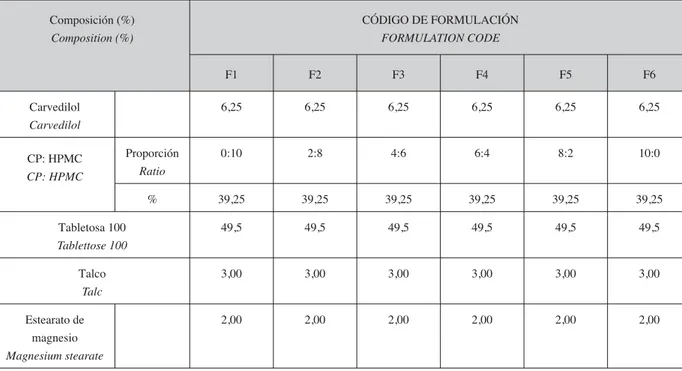
(3) COMPRIMIDOS MUCOADHERENTES BICAPA PARA LA ADMINISTRACIÓN BUCAL DE CARVEDILOL... MUCOADHESIVE BILAYER TABLETS FOR BUCCAL DELIVERY OF CARVEDILOL: IN VITRO AND IN VIVO INVESTIGATIONS. En la presente investigación, se ha intentado diseñar un comprimido bucal bicapa de carvedilol mediante el uso de polímeros microadherentes para evitar el metabolismo inicial y aumentar la biodisponibilidad. Además, la formulación también se ha diseñado para disponer de la ventaja de la liberación sostenida de carvedilol. En la formulación desarrollada se evaluaron características microadherentes como el pH superficial, el porcentaje de % expansión y la fuerza microadherente y el perfil de liberación in vitro. El potencial de la formulación optimizada para aumentar la biodisponibilidad se evaluó in vivo en conejos.. MATERIAL El carvedilol fue amablemente suministrado por Cipla Ltd, Mumbai, India. El carbopol 934P, (Noveon, USP) se adquirió a BF Goodrich (Cleveland OH, EE. UU.). El HPMC K4M fue suministrado por Colorcon, Mumbai, India, como muestra gratuita. La hidroxipropilcelulosa y la etilcelulosa se adquirieron a Hercules, Aqualon, EE. UU. La tabletosa 100 fue suministrada gratuitamente por Meggle, Alemania. El resto de las sustancias químicas utilizadas fueron de grado analítico.. MÉTODOS Formulación de comprimidos bucales bicapa Para la formulación se utilizó la técnica de doble compresión directa15. En esta técnica, se formó la primera capa intermedia y se colocó la mezcla de la segunda capa sobre ella, comprimiéndose posteriormente para obtener el comprimido bicapa. La composición del fármaco que contenía la capa mucoadherente se muestra en la Tabla I. Para la capa de protección se utilizó una combinación fija de polímeros y excipientes [etilcelulosa (EC) - 27 mg, hidroxipropilcelulosa (HPC) - 17 mg, tabletosa 100 - 24 mg, estearato de magnesio - 2 mg]. La mezcla física de fármaco, polímeros y excipientes adecuadamente mezclados se tamizó por una malla de calibre 20 y, a continuación, se comprimió ligeramente en una máquina monocomprimidora (Jaguar, Mumbai, India) con troqueles planos de 8 mm hasta obtener un comprimido. 261. also designed for giving advantage of sustained release of carvedilol. The developed formulation was evaluated for ideal mucoadhesive formulation characteristics such as surface pH, % swelling, in vitro mucoadhesive force, in vitro release profile. Potential of optimized formulation to improve bioavailability was evaluated in vivo in rabbits.. MATERIAL Carvedilol was kindly supplied by Cipla Ltd, Mumbai, India. Carbopol 934P, (Noveon, USP) was obtained from BF Goodrich (Cleveland OH). HPMC K4M was supplied by Colorcon, Mumbai as a gift sample. Hydroxypropyl cellulose and Ethyl cellulose were obtained from Hercules, Aqualon, USA. Tablettose 100 was gifted by Meggle, Germany. Other chemicals used were of analytical grade.. METHODS Formulation of bilayer buccal tablets Direct double compression technique was employed for the formulation15. In this technique, first intermediate layer was formed and second layer blend was placed on first intermediate layer and compressed to get bilayer tablet. Compositions for the drug containing mucoadhesive layer are shown in Table I. For protective layer, a fixed combination of polymers and excipients [Ethyl cellulose (EC) -27 mg, Hydroxy Propyl Cellulose (HPC) - 17 mg, Tablettose 100 -24 mg, Magnesium stearate-2 mg] were used. The physical blend of drug, polymers and excipients was properly mixed and passed through 20 mesh screen, then it was slightly compressed on single station tablet compression machine (Jaguar, Mumbai) using 8 mm flat faced punches to obtain intermediate tablet or loose compact. Similarly, blend of protective layer containing above listed excipients was mixed, sieved and compressed on the previously compressed intermediate tablet or loose compact to get bilayer tablet.. Ars Pharm 2007; 48 (3): 259-274..
(4) YEDURKAR PD, DHIMAN MK Y SAWANT KK. 262. intermedio o un compactado suelto. De forma similar, se mezclaron los ingredientes de la capa de protección con los excipientes indicados anteriormente, se tamizaron y se comprimieron sobre el comprimido intermedio anterior para obtener el comprimido bicapa.. EVALUACIÓN DE LOS COMPRIMIDOS BUCALES. EVALUATION OF BUCCAL TABLETS Technological parameters The diameter and thickness of the formulated tablets were measured using Vernier Caliper. Total weight of the tablets was noted.. Assay. El diámetro y el grosor de los comprimidos formulados se midieron con un calibre Vernier. Se registró el peso total de los comprimidos.. The formulated bilayered tablet was dissolved in 100 mL isotonic phosphate buffer (pH 6.8 ± 0.2): methanol (9:1). The resultant solution was analyzed spectrophotometrically at 242 nm by UV spectrophotometer (Shimadzu 1601) n = 5.. Ensayo. Surface pH. El comprimido bicapa formulado se disolvió en 100 mL de tampón fosfato isotónico (pH 6.8 ± 0.2): metanol (9:1). La solución resultante se analizó espectrofotométricamente a 242 nm con espectrofotómetro UV (Shimadzu 1601) n = 5.. The micro environmental pH of the formulation was measured so as to determine its effect on buccal mucosa. The formulation was first allowed to get wet by adding 0.5 ml distilled water to its formulation surface. The surface pH was then recorded by bringing a combined glass electrode near the surface of the formulation and allowed it to equilibrate for 1 min 16.. Parámetros tecnológicos. pH superficial Se efectuó una medición del pH microambiental para determinar sus efectos en la mucosa bucal. En primer lugar, se humedeció la formulación añadiendo 0,5 ml de agua destilada a su superficie. Seguidamente, se registró el pH acercando un electrodo de vidrio combinado a la superficie de la formulación, dejando que se equilibrara durante 1 minuto16.. Expansión Las muestras se pesaron antes y después de humedecerlas con saliva artificial17. Se colocó el comprimido en un vaso de precipitados de 10 ml, se añadió saliva artificial con una micropipeta y se incubó en un desecante a temperatura ambiente. Después de 10 horas, se retiró la formulación humedecida, se secó suavemente con papel secante y se volvió a pesar. El índice de expansión de la formulación humedecida se determinó de la forma siguiente18 (figura 2):. Ars Pharm 2007; 48 (3): 259-274.. Swelling Samples were weighed, before and after wetting with artificial saliva17. The tablet was placed in 10 ml beaker; artificial saliva was added onto its surface using micropipette and then incubated in dessicator at room temperature. The wetted formulation was removed after 10 hr; the surface was gently dried using blotting paper and reweighed. The swelling index of wet formulation was determined as follows, 18 Swelling index (%) = (Wh-Wd)/Wd x 100 Where, Wh = Weight of hydrated formulation Wd = Weight of formulation (dried).. In vitro Mucoadhesion Tensile strength tester (Instron 1121, UK) was used for measuring the in vitro mucoadhesive strength of the formulations. A tablet was.
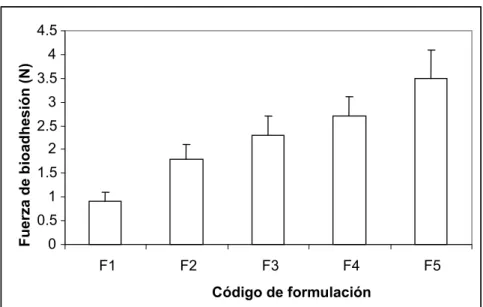
(5) COMPRIMIDOS MUCOADHERENTES BICAPA PARA LA ADMINISTRACIÓN BUCAL DE CARVEDILOL... MUCOADHESIVE BILAYER TABLETS FOR BUCCAL DELIVERY OF CARVEDILOL: IN VITRO AND IN VIVO INVESTIGATIONS. 263. FIGURA 2. Estudios de mucoadherencia de los comprimidos bucales bicapa. FIGURE 2. Mucoadhesion studies of bilayered buccal tablets. 4.5 Fuerza de bioadhesión (N). 4 3.5 3 2.5 2 1.5 1 0.5 0 F1. F2. F3. F4. F5. Código de formulación. Índice de expansión (%) = (Wh-Wd)/Wd x 100 Donde Wh = peso de la formulación hidratada Wd = Peso de la formulación seca.. Mucoadherencia in vitro Para medir la fuerza mucoadherente de las formulaciones se utilizó un medidor de fuerza tensil (Instron 1121, Reino Unido). Se colocó un comprimido en la pinza superior y se fijó una sección de la mucosa bucal (2x2 cm) a la pinza inferior utilizando un adhesivo. Se aplicó tampón fosfato pH 6,8 ± 0,2 a la superficie del comprimido para facilitar la adhesión y se pusieron en contacto ambas superficies con una fuerza de 44g. Transcurridos 10 minutos, se colocó el sistema comprimido-mucosa en el aparato de medición tensil y se estiró a velocidad constante (1 mm/min.). Se registró la fuerza de desprendimiento máxima. Se tomó la media de tres mediciones18.. Estudio de liberación in vitro El estudio de liberación in vitro de los comprimidos bicapa se llevó a cabo en un equipo de disolución automatizada USP XXIV – tipo I (Electrolab, India). El medio de disolución fue. attached to the upper clamp and porcine buccal mucosal section (2x2 cm) was attached to the lower clamp using glue. For ease of adhesion, phosphate buffer pH 6.8 ± 0.2 was applied on the tablet surface and the two surfaces were brought in contact with each other with a force of 44g. After 10 min, the tablet-mucosa system was attached to the tensile strength apparatus and stretched at a constant speed (1mm/min). The maximum detachment force was recorded. The mean of three observations were taken18.. In vitro release study The in vitro release study of the bilayer tablets was carried out in a USP XXIV dissolution automated apparatus – type I (Electrolab, India). The dissolution medium was 200 mL phosphate buffer, pH 6.8 ± 0.2 containing 2% sodium lauryl sulphate, maintained at 37 ± 0.5 0C. The tablet was fixed to the bottom of the vessel by a double sided tape and dissolution was carried out at 50 rpm. Filtered samples (2 mL) were automatically collected at intervals of 1, 2, 3, 4, 5, 6, 7 and 8 h. The samples were compensated with an equal volume of dissolution medium maintained at the same temperature. The concentration of drug released in the medium was assayed spectrophotometrically at 242 nm. The experiment was carried out in triplicate.. Ars Pharm 2007; 48 (3): 259-274..
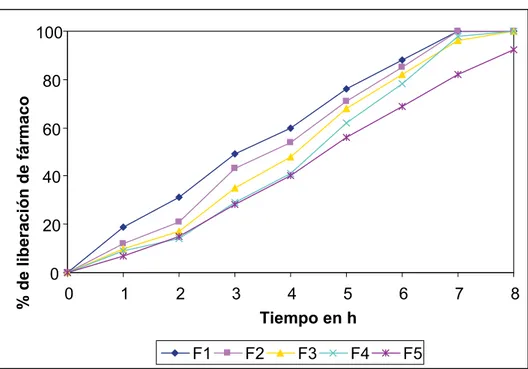
(6) YEDURKAR PD, DHIMAN MK Y SAWANT KK. 264. 200 mL de tampón fosfato, pH 6,8 ± 0,2, con un 2% de lauril sulfato sódico, mantenida a 37 ± 0,5 0C. El comprimido se fijó a la parte inferior del vaso con cinta flexible de doble cara, y la disolución se realizó a 50 rpm. Se recolectaron automáticamente muestras filtradas (2 mL) a intervalos de 1, 2, 3, 4, 5, 6, 7 y 8 h. Las muestras se compensaron con un volumen igual de medio de disolución mantenido a la misma temperatura. La concentración de fármaco liberado en el medio se estimó mediante espectrofotometría a 242 nm. El experimento se realizó por triplicado. Los parámetros y el mecanismo de liberación de carvedilol de los comprimidos bucales se investigaron ajustando los datos a modelos de orden cero, primer orden, Higuchi, Hixson-Crowell y Korsmeyer-Peppas mediante las ecuaciones siguientes19. Orden cero: Qt = Q0 + K0t Primer orden: InQt = InQ0 + K1t Higuchi: Qt =KH √t Hixson-Crowell: Q01/3 - Qt1/3 = Ks t Korsmeyer Peppas: Qt/Q = Kk tn Donde Qt es la cantidad de fármaco disuelta en el tiempo t, QO es la cantidad inicial de fármaco en la solución (en la mayoría de los casos, QO = 0 ), t es el tiempo, n es el exponente de liberación, y K0, K1, KH, Ks y Kk son las constantes de orden cero, primer orden, Higuchi, Hixson-Crowell y Korsmeyer-Peppas, respectivamente (figura 3).. The release parameters and mechanism of release of carvedilol from the buccal tablets were investigated by fitting the data to Zero order, First order, Higuchi, Hixson-Crowell and Korsmeyer-Peppas models using the following equations 19. Zero order - Qt = Q0 + K0t First order - In Qt = InQ0 + K1t Higuchi - Qt =KH √t Hixson-Crowell - Q01/3 - Qt1/3 = Ks t Korsmeyer Peppas - Qt/Q = Kk tn Where, Qt is the amount of drug dissolved in time t, QO is the initial amount of drug in the solution (most times, QO = 0 ), t is the time, n is release exponent and K0, K1, KH, Ks and Kk are the Zero order, First order, Higuchi, Hixson-Crowell and Korsmeyer-Peppas constants respectively (figure 3).. FIGURA 3. Perfil de liberación in vitro de F1 a F5. FIGURE 3. In vitro release profile of F1 to F5.. 100. % de liberación de fármaco. 80 60 40 20 0 0. 1. 2. 3. F1 Ars Pharm 2007; 48 (3): 259-274.. 4 5 Tiempo en h F2. F3. F4. 6. F5. 7. 8.
(7) COMPRIMIDOS MUCOADHERENTES BICAPA PARA LA ADMINISTRACIÓN BUCAL DE CARVEDILOL... MUCOADHESIVE BILAYER TABLETS FOR BUCCAL DELIVERY OF CARVEDILOL: IN VITRO AND IN VIVO INVESTIGATIONS. 265. Estudio farmacocinético. Pharmacokinetic study. Para el estudio se utilizaron conejos blancos macho con un peso de entre 2,0 y 2,5 kg, tras un período de aclimatación de una semana (6 conejos / grupo). Durante los estudios se observaron las indicaciones del comité ético para la investigación con animales (Animal Ethical Committee Guidelines). Para anestesiar los conejos se utilizó diazepam (5 mg/kg; i. m.) y ketamina (40 mg/kg; i. p.). El comprimido bicapa se aplicó directamente en la cavidad bucal de los conejos a los 15 minutos de administrar la anestesia. A uno de los grupos se le administraron comprimidos convencionales (6,25 mg), para comparar los parámetros farmacocinéticos orales y bucales. Como control para el experimento se utilizaron conejos sanos. A intervalos de 1 h, hasta 8 h, se extrajeron entre 0,5 y 1,0 ml de sangre de la vena marginal de la oreja mediante una aguja del calibre 26. La sangre se centrifugó a 8000 rpm, durante 10 min., a una temperatura de 15 0 C (centrifugador Sigma 3K30, Alemania) y se recolectó el plasma. La separación de las proteínas del plasma se hizo añadiendo la cantidad equivalente de metanol y se centrifugó a 10000 rpm durante 10 min. a una temperatura de 15 0 C. A continuación, se recolectó el plasma sin proteínas y se analizó mediante cromatografía de líquidos de alto rendimiento (HPLC, Dionex).. Male white rabbits weighing (2.0-2.5 kg) were used for the studies after an acclimatization period of one week (6 rabbits / group). Animal Ethical Committee Guidelines were observed during the studies. Rabbits were anesthetized by diazepam (5 mg/kg; i. m.) and ketamine (40mg/kg; i. p.). The bilayer tablet was applied directly to the buccal pouch of the rabbits after 15 min following anesthesia. Conventional tablets (6.25 mg) were administered orally to one group to compare oral and buccal pharmacokinetic parameters. Naive rabbits were used as a control for the experiment. At an interval of 1 h, up to 8 h, 0.5-1.0 ml of blood was withdrawn via marginal ear vein using a 26 gauge needle. The blood was centrifuged at 8000 rpm, 10 min, T150C (Sigma centrifuge- 3K30, Germany) and plasma was collected. Protein separation from the plasma was done by adding equivalent amount of methanol and centrifuged at 10000 rpm for 10 min at T - 150C. Then protein free plasma was collected and analyzed by High Performance Liquid Chromatography (HPLC, Dionex).. Análisis de las muestras de sangre Se mezclaron 0,2 ml de plasma con 50 µl de etil p-hidroxibenzoato como estándar interno y se inyectó (20 µl) mediante un filtro de jeringa en un HPLC isocrático con detector de UV visibles (UVD 170U). La columna empleada fue la C18 (4,6 x 100 mm, 3,5 µm) Waters, Irlanda. El cromatógrafo estaba formado por un sistema cromatográfico de alto rendimiento con software Chromeleon. La fase móvil estaba compuesta de metanol–50 mM KH2PO4, pH 2,5 (60:40, v/v) y la velocidad de flujo se ajustó a 1,0 ml/min. Se efectuaron mediciones con una longitud de onda de excitación de 242 nm y una longitud de onda de emisión de 344 nm21. El área bajo las curvas (AUC) de la concentración de fármaco en plasma se determinó mediante el método de la regla trapezoidal, y se registraron los valores de Cmax y Tmax. Los datos. Analysis of blood sample 0.2 ml plasma was mixed with 50 µl ethyl p-hydroxybenzoate acting as internal standard and injected (20 µl) through syringe filter into a isocratic HPLC with a UV-visible detector (UVD 170U). The column employed was C18 (4.6 x 100 mm, 3.5 µm) Waters, Ireland. The chromatograph consisted of a high performance chromatographic system with chromeleon software. The mobile phase consisted of methanol–50 mM KH2PO4, pH 2.5 (60:40, v/v) and the flow-rate was adjusted to 1.0 ml/min. Measurements were made at an excitation wavelength of 242 nm and emission wavelength of 344 nm21. Area under curves (AUC) of the plasma drug concentration was determined with the trapezoidal rule method and Cmax, Tmax were recorded. The pharmacokinetic data was compared with that obtained from the conventional oral tablets20. Statistical analyses were completed using ANOVA wherein p values <0.05 were considered statistically significant.. Ars Pharm 2007; 48 (3): 259-274..
(8) YEDURKAR PD, DHIMAN MK Y SAWANT KK. 266. farmacocinéticos se compararon con los obtenidos de los comprimidos orales tradicionales20. El análisis estadístico se realizó mediante ANOVA, considerándose estadísticamente significativos los valores de p <0,05.. RESULTADOS Y DISCUSIÓN Las composiciones de las formulaciones se indican en las tablas 1 y 2. En total, se prepararon seis formulaciones, utilizando distintas proporciones de CP 934P y HPMC K4M. La técnica de doble compresión directa resultó satisfactoria para la formulación de comprimidos bicapa de carvedilol. Los parámetros físico-químicos de los comprimidos bucales bicapa se representan en la Tabla 3. El diámetro de los comprimidos variaba entre 8,10 ± 0,10 y 8,22 ± 0,18 mm. El grosor de los comprimidos estaba entre 2,55 ±0,10 y 2,60 ±0,12 mm. El peso total de los comprimidos formulados estaba entre 170,80 ± 4,42 y 176,23 ± 4,63 mg. Los valores anteriores fueron satisfactorios y se encontraron dentro de los límites de variación de la farmacopea.. RESULTS AND DISCUSSION Formulation compositions are shown in Table 1 and Table 2. Total six formulations were prepared employing different ratios of CP 934P and HPMC K4M. Double direct compression technique was found satisfactory for formulation of bilayered carvedilol tablets. Physicochemical parameters of the bilayered buccal tablets are depicted in Table 3. Diameter of the tablets ranged from 8.10 ± 0.10 to 8.22 ± 0.18 mm. Thickness of the tablets were found to be from 2.55 ±0.10 to 2.60 ±0.12 mm. Total weight of formulated tablets were between 170.80 ± 4.42 to 176.23 ± 4.63 mg. The above values were found satisfactory and within pharmacopoeial limits of variation.. TABLA 1. Composiciones de la capa mucoadherente. TABLE 1. Compositions of the mucoadhesive layer. Composición (%) Composition (%). CÓDIGO DE FORMULACIÓN FORMULATION CODE F1. F2. F3. F4. F5. F6. 6,25. 6,25. 6,25. 6,25. 6,25. 6,25. Proporción Ratio. 0:10. 2:8. 4:6. 6:4. 8:2. 10:0. %. 39,25. 39,25. 39,25. 39,25. 39,25. 39,25. Tabletosa 100 Tablettose 100. 49,5. 49,5. 49,5. 49,5. 49,5. 49,5. Talco Talc. 3,00. 3,00. 3,00. 3,00. 3,00. 3,00. Estearato de magnesio Magnesium stearate. 2,00. 2,00. 2,00. 2,00. 2,00. 2,00. Carvedilol Carvedilol CP: HPMC CP: HPMC. Peso de la capa mucoadherente: 100 mg. Weight of mucoadhesive layer-100 mg.. Ars Pharm 2007; 48 (3): 259-274..
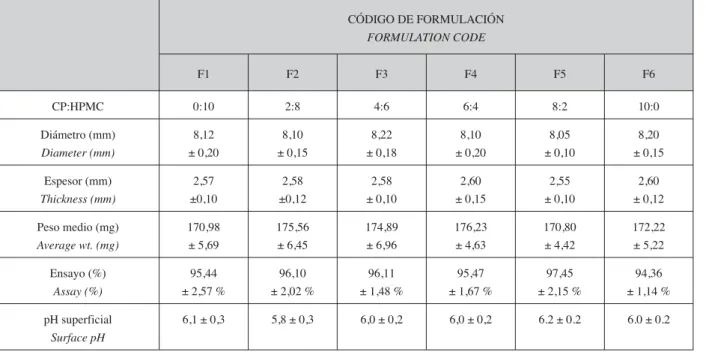
(9) COMPRIMIDOS MUCOADHERENTES BICAPA PARA LA ADMINISTRACIÓN BUCAL DE CARVEDILOL... MUCOADHESIVE BILAYER TABLETS FOR BUCCAL DELIVERY OF CARVEDILOL: IN VITRO AND IN VIVO INVESTIGATIONS. 267. TABLA 2. Composiciones de la capa de protección. TABLE 2. Compositions of the protective layer. Excipientes(%) Excipients(%). Cantidad (%) Qty (%). Etilcelulosa Ethyl cellulose. 38,57. Hidroxipropilcelulosa Hydroxy Propyl Cellulose. 24,28. Tabletosa Tablettose. 34,29. Estearato de Mg Mg. stearate. 2,86. Peso de la capa de protección: 70 mg. Peso total del comprimido: 170 mg. Weight of protective layer-70 mg Total weight of tablet – 170 mg.. TABLA 3. Parámetros físico-químicos del comprimido bucal bicapa. TABLE 3. Physicochemical parameters of the bilayered buccal tablet. CÓDIGO DE FORMULACIÓN FORMULATION CODE F1. F2. F3. F4. F5. F6. CP:HPMC. 0:10. 2:8. 4:6. 6:4. 8:2. 10:0. Diámetro (mm) Diameter (mm). 8,12 ± 0,20. 8,10 ± 0,15. 8,22 ± 0,18. 8,10 ± 0,20. 8,05 ± 0,10. 8,20 ± 0,15. Espesor (mm) Thickness (mm). 2,57 ±0,10. 2,58 ±0,12. 2,58 ± 0,10. 2,60 ± 0,15. 2,55 ± 0,10. 2,60 ± 0,12. Peso medio (mg) Average wt. (mg). 170,98 ± 5,69. 175,56 ± 6,45. 174,89 ± 6,96. 176,23 ± 4,63. 170,80 ± 4,42. 172,22 ± 5,22. Ensayo (%) Assay (%). 95,44 ± 2,57 %. 96,10 ± 2,02 %. 96,11 ± 1,48 %. 95,47 ± 1,67 %. 97,45 ± 2,15 %. 94,36 ± 1,14 %. pH superficial Surface pH. 6,1 ± 0,3. 5,8 ± 0,3. 6,0 ± 0,2. 6,0 ± 0,2. 6.2 ± 0.2. 6.0 ± 0.2. (n=6)± R.S.D.. Ars Pharm 2007; 48 (3): 259-274..
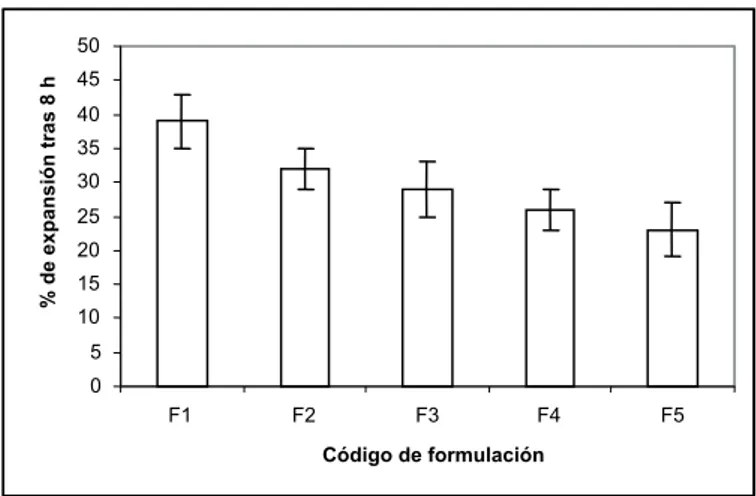
(10) YEDURKAR PD, DHIMAN MK Y SAWANT KK. 268. Los valores del ensayo se encontraron entre 94,36 ± 1,14 y 97,45 ± 2,15 %. El pH superficial de todas las formulaciones se encontraba entre 5,8 ± 0,3 y 6,2 ± 0,2. Los valores obtenidos se aproximan a 6,4, es decir, el pH de la mucosa bucal22 y por tanto no se esperó ninguna irritación de la mucosa ni respuesta alérgica debidas al pH de la formulación.. Assay values ranged from 94.36 ± 1.14 to 97.45 ± 2.15 %. The surface pH of all the formulations was within 5.8 ± 0.3 to 6.2 ± 0.2. The obtained values are close to 6.4 i.e. buccal mucosal pH22 and hence no mucosal irritation and allergic response was expected due to formulation pH.. Swelling Expansión La expansión de la formulación bioadherente en un requisito previo importante y un parámetro crucial para el fenómeno de la bioadhesión23. La expansión del polímero permite la formación del entramado mecánico, al abrir los sitios bioadherentes y permitir el enlace de hidrógeno entre el polímero y la mucosa23. El índice de expansión de la formulación desarrollada se muestra en la figura 1. Todas las formulaciones desarrolladas presentaron un índice de expansión satisfactorio, requerido para la mucoadherencia. El índice de expansión aumentó al aumentar la proporción de HPMC K4M en la formulación. La expansión máxima (39 ± 4 %) se observó en F1, que contenía sólo HPMC K4M. Los resultados concuerdan con los obtenidos por Mahaguna et al25. No fue posible realizar el estudio en F6, que contenía sólo CP 934P, porque la formulación no mantuvo su integridad y se colapsó a la 3ª hora del estudio. La posible razón del colapso de la formulación que contenía sólo CP 934P es que la resistencia del CP 934P es muy baja y forma un gel muy transparente al entrar en contacto con agua o saliva. La diferencia en la expansión de los polímeros se puede atribuir a la diferencia en la resistencia de la estructura de red de la matriz al enlace de agua26.. Ars Pharm 2007; 48 (3): 259-274.. The swelling of the bioadhesive formulation is an important prerequisite and crucial parameter for the phenomenon of bioadhesion23. Polymer swelling permits a mechanical entanglement by opening the bioadhesive sites for hydrogen bonding between the polymer and the mucosa23. Swelling index of developed formulation is shown in Fig 1. All the developed formulations exhibited satisfactory swelling index required for mucoadhesion. The swelling index increased with increase in proportion of HPMC K4M in the formulation. Maximum swelling (39 ± 4 %) was observed in F1, which contained only HPMC K4M. The results are in agreement with those of Mahaguna et al25. Study could not be conducted in F6, which contained only CP 934P because the formulation did not maintain its integrity and collapsed during the 3rd hr of study. The possible reason for collapsing of formulation which contained only CP 934P is that CP 934P has very low strength and forms very lucid gel when comes it in contact with water or saliva. The difference in swelling of the polymers could be attributed to the difference in resistance of the matrix network structure to the water bonding 26..
(11) COMPRIMIDOS MUCOADHERENTES BICAPA PARA LA ADMINISTRACIÓN BUCAL DE CARVEDILOL... MUCOADHESIVE BILAYER TABLETS FOR BUCCAL DELIVERY OF CARVEDILOL: IN VITRO AND IN VIVO INVESTIGATIONS. 269. FIGURA 1. % de expansión de los comprimidos después de 8 horas. FIGURE 1. % Swelling of bilayered buccal tablets after 8th hr.. % de expansión tras 8 h. 50 45 40 35 30 25 20 15 10 5 0 F1. F2. F3. F4. F5. Código de formulación. Mucoadherencia in vitro. In vitro mucoadhesion. La importancia de la capacidad del polímero para absorber agua de la mucosa ha demostrado ser un determinante principal de la mucoadherencia24, 27. La adherencia tiene lugar poco después de la absorción de agua, pero aumenta hasta el punto en el que la sobrehidratación tiene como resultado un descenso en la fuerza mucoadherente debido a la ruptura del entramado en la interfaz polímero/tejido28. Las fuerzas mucoadherentes de las formulaciones desarrolladas se encontraron entre 0,9 ± 0,2 y 3,5 ± 0,6 N. Los resultados muestran que al aumentar la proporción de CP 934P aumentó gradualmente la fuerza. La formulación que mostró la máxima fuerza (3,5 ± 0,6 N) fue F5, que contenía CP 934P: HPMC K4M en una proporción de 8:2. Sin embargo, la formulación que contenía sólo CP 934P se colapsó durante el estudio, por lo que no se puedo llevar a cabo el estudio de mucoadherencia en ella. La combinación de CP 934P y HPMC K4M ha presentado una mayor fuerza de adhesión que los polímeros individuales, lo que implica que ambos polímeros pueden haber tenido un efecto sinérgico.. The importance of the ability of the polymer to take up water from the mucus has been shown to be a primary determinant of mucoadhesion24, 27 . Adhesion occurs shortly after water uptake but adhesion will increase until the point where over hydration results in a drop in mucoadhesive strength due to disentanglement at the polymer/tissue interface28. Mucoadhesive forces of developed formulations were between 0.9 ± 0.2 to 3.5 ± 0.6 N. The results show that gradual increase in force was obtained as proportion of CP 934P increased. Maximum force was shown by F5 (3.5 ± 0.6 N) which contained CP 934P: HPMC K4M in ratio of 8:2. However, the formulation containing CP 934P alone was collapsed during the study therefore mucoadhesion study was not carried out. The combination of CP 934P and HPMC K4M has shown maximum adhesive force than by individual polymers, which implies that both the polymers may have acted synergistically.. Estudio de liberación in vitro El perfil de liberación in vitro de las formulaciones diseñadas se muestra en las figuras 3 y 4. La máxima liberación de fármaco se observó en F1; liberó el 100 % del fármaco en 7 h. La mayor velocidad de liberación de fármaco que. In vitro release study In vitro release profile of the designed formulations is shown in Fig 3. Maximum drug release was observed in F1; it released 100 % of the drug in 7 h. The fastest rate of drug release exhibited by formulations containing HPMC K4M alone (F1), could be attributed to its highest swelling indices, as greater swelling of the matrices leads to faster diffusion of the drug and results in faster release of drug30. Ars Pharm 2007; 48 (3): 259-274..
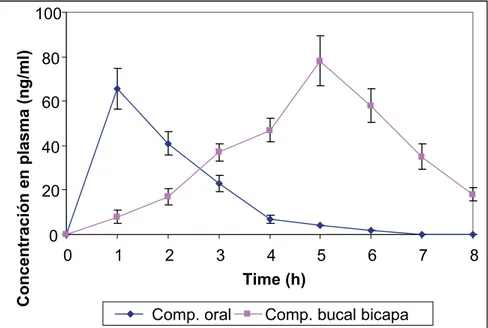
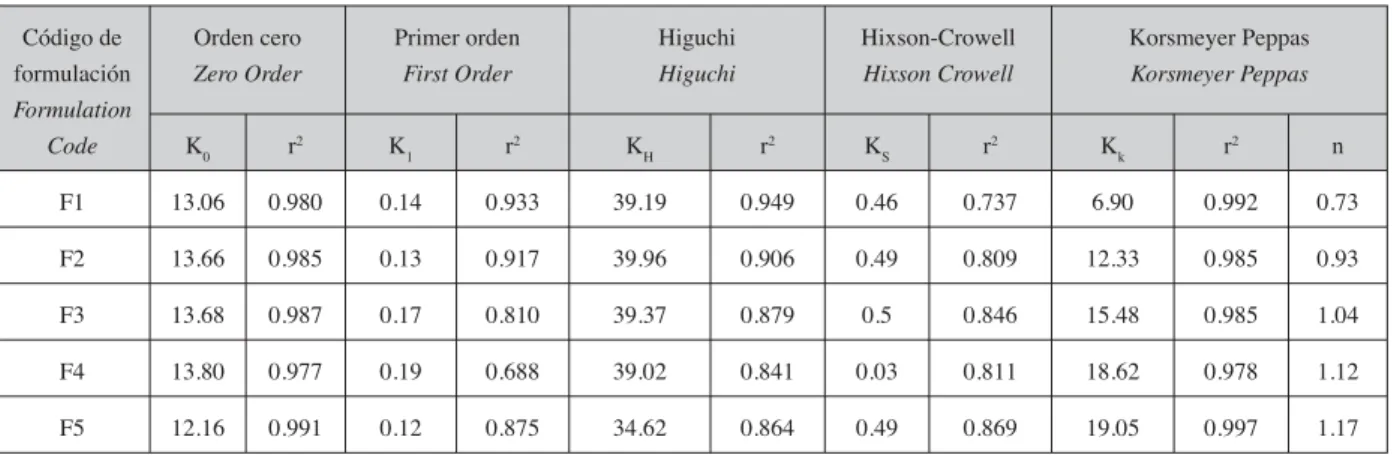
(12) YEDURKAR PD, DHIMAN MK Y SAWANT KK. 270. presentaron las formulaciones que contenían sólo HPMC K4M (F1) se podría atribuir a que sus índices de expansión son más elevados, ya que una mayor expansión de la matriz tiene como resultado una difusión más rápida del fármaco y, por tanto, una liberación más rápida del mismo30. FIGURA 4. Concentración en plasma en relación al perfil de los comprimidos orales y bucales bicapa de carvedilol. FIGURE 4. Plasma concentration Vs time profile of oral and bilayered buccal tablets of carvedilol.. Concentración en plasma (ng/ml). 100 80 60 40 20 0 0. 1. 2. 3. Comp. oral. El estudio no se pudo llevar a cabo en la formulación que contenía sólo CP 934P (F6), debido a la formación de gel y el colapso de la formulación en la 3ª hora del estudio. La posible razón de ello es que puede que se produzca una ionización de CP 934P, ya que el pH 6.8 del experimento es superior a su constante de ionización (pKa) 6,0. Este proceso de ionización lleva al desarrollo de cargas negativas en la superficie del polímero y, debido a ello, la estructura del polímero se amplía y permite que las moléculas de agua penetren en ella, lo que provoca una mayor expansión y no permite controlar la liberación del fármaco29. Para investigar la cinética de la liberación de carvedilol en los comprimidos bucales bicapa, se aplicaron los datos de liberación a los modelos de orden cero, primer orden, Higuchi, HixsonCrowell y Korsmeyer Peppas, y se determinó el mejor ajuste. Los valores de r2, K y n se indican Ars Pharm 2007; 48 (3): 259-274.. 4 5 Time (h). 6. 7. 8. Comp. bucal bicapa. The study could not be conducted in formulation containing CP 934P alone (F6) because of formation of gel and collapsing of formulation at 3rd hr of study. The possible reason behind it is that there might be ionization of CP 934P at experimental pH 6.8 which is higher than its ionization constant (pKa) 6.0. This ionization process will lead to development of negative charges at the polymer surface and due to this; polymer state will change into an extended structure allowing water molecules to penetrate into it, leading to higher swelling, and unable to control drug release29. To investigate the kinetics of carvedilol release from bilayered buccal tablets the release data was applied to, zero order, first order, Higuchi, Hixson-crowell and Korsmeyer Peppas models and best fit was determined. The values of r2, K and n are listed in table 4. It is known that, if the values of n are in between 0 – 0.5 then it.
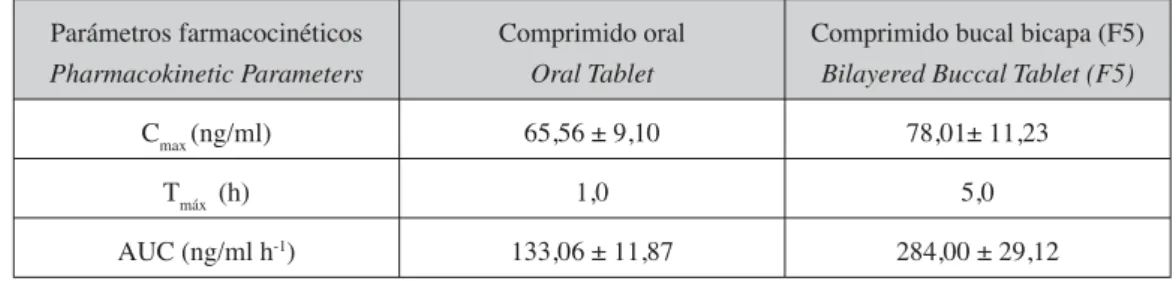
(13) COMPRIMIDOS MUCOADHERENTES BICAPA PARA LA ADMINISTRACIÓN BUCAL DE CARVEDILOL... MUCOADHESIVE BILAYER TABLETS FOR BUCCAL DELIVERY OF CARVEDILOL: IN VITRO AND IN VIVO INVESTIGATIONS. en la tabla 4. Se sabe que si los valores de n se encuentran entre 0 y 0,5 se produce una difusión Fickian, y si se encuentran entre 0,5 y 1,0 el patrón de difusión es no Fickian18, 19.. 271. follows fickian diffusion and if n values lies in between 0.5 -1.0 it supports non-fickian diffusion pattern 18, 19.. TABLA 4. Ajuste al modelo de la liberación de carvedilol de los comprimidos bucales bicapa TABLE 4. Model fitting of carvedilol release from bilayered buccal tablets Código de formulación Formulation Code. Orden cero Zero Order. Primer orden First Order. Higuchi Higuchi. K0. r2. K1. r2. KH. r2. KS. r2. Kk. r2. n. F1. 13.06. 0.980. 0.14. 0.933. 39.19. 0.949. 0.46. 0.737. 6.90. 0.992. 0.73. F2. 13.66. 0.985. 0.13. 0.917. 39.96. 0.906. 0.49. 0.809. 12.33. 0.985. 0.93. F3. 13.68. 0.987. 0.17. 0.810. 39.37. 0.879. 0.5. 0.846. 15.48. 0.985. 1.04. F4. 13.80. 0.977. 0.19. 0.688. 39.02. 0.841. 0.03. 0.811. 18.62. 0.978. 1.12. F5. 12.16. 0.991. 0.12. 0.875. 34.62. 0.864. 0.49. 0.869. 19.05. 0.997. 1.17. Los resultados indican que el mecanismo de liberación cambia con el tipo y la cantidad de polímero incorporado a la formulación, lo que se ve reflejado en los valores observados del exponente de liberación. En la formulación F1, que contenía sólo HPMC K4M, el valor de n fue de 0,73, lo que indica una liberación no Fickian, es decir, que la liberación del fármaco se produce por una combinación de erosión y difusión. Al aumentar gradualmente el contenido de CP 934P en la formulación, se observó que los valores de n aumentaron de 0,73 a 1,17. Esto indica que el patrón de liberación seguía un modelo de orden cero que concuerda con una liberación no Fickian con transporte de caso II, lo que implica que la difusión es el método de liberación dominante. Con valores de n superiores a 1,0 (F3, F4 y F5), se produce la liberación no Fickian con transporte super caso II31, 32.. Hixson-Crowell Hixson Crowell. Korsmeyer Peppas Korsmeyer Peppas. The results indicate that the release mechanism changed with the type and amount of polymer incorporated in the formulation and this can be reflected by the observed values of release exponent. The formulation F1, which contained only HPMC K4M, n value was 0.73; indicating non-fickian release i.e drug release is the combination of erosion and diffusion. When concentration of CP 934P was gradually increased in the formulation, n values were found to increase from 0.73 to 1.17. This shows that release pattern followed zero order model confirming to nonfickian release with case II transport, implying diffusion is dominant in the release mechanism. For n values greater than 1.0 (F3, F4 and F5), non-fickian release with super case II transport is followed 31, 32.. Pharmacokinetic Study Estudio farmacocinético La representación gráfica de la curva de concentración en plasma muestra evidencia de un patrón de liberación sostenida en los comprimidos bucales, en comparación con los comprimidos convencionales administrados por vía oral (fig. 5). Los parámetros farmacocinéticos, como Cmax,. Graphical representation of the plasma concentration curve showed evidence of sustained release pattern from buccal tablet as compared to oral administered conventional tablets (Fig 4). Pharmacokinetic parameters such as Cmax, Tmax and area under the curve (AUC) are reported in Table 5. The average Cmax for the bilayered buccal tablet and conventional oral tablet are 78.01 ± Ars Pharm 2007; 48 (3): 259-274..
(14) YEDURKAR PD, DHIMAN MK Y SAWANT KK. 272. 11.23 ng/ml and 65.56 ± 9.10 ng/ml respectively. Following oral administration, absorption of carvedilol was rapid with a peak plasma concentration achieved in 1 hr (tmax) while that of bilayered buccal tablet was observed at 5th h. Also, drug levels declined to less than 7 ng/ml by the 4th hr in case of oral tablet whereas appreciable levels (47ng/ml) could be detected in case of the buccal tablets, indicating its sustained effect.. Tmax y el área bajo la curva (AUC) se indican en la tabla 5. La media de Cmax de los comprimidos bucales y los orales convencionales es de 78,01 ± 11,23 ng/ml y 65,56 ± 9,10 ng/ml respectivamente. Tras la administración oral, la absorción de carvedilol fue rápida, consiguiéndose una concentración máxima de plasma en 1 hora (tmax), mientras que en el comprimido bucal se observó al cabo de 5 horas. Además, los niveles de fármaco se disminuyeron por debajo de 7 ng/ml al cabo de 4 horas en el caso de los comprimidos orales, mientras que en los comprimidos bucales se detectaron niveles apreciables (47 ng/ml), lo que indica su efecto sostenido.. TABLA 5. Parámetros farmacocinéticos del carvedilol de los comprimidos orales y bucales bicapa TABLE 5. Pharmacokinetic parameters of carvedilol from oral and bilayered buccal tablet Parámetros farmacocinéticos Pharmacokinetic Parameters. Comprimido oral Oral Tablet. Comprimido bucal bicapa (F5) Bilayered Buccal Tablet (F5). Cmax (ng/ml). 65,56 ± 9,10. 78,01± 11,23. Tmáx (h). 1,0. 5,0. AUC (ng/ml h-1). 133,06 ± 11,87. 284,00 ± 29,12. n=6 ± R.S.D. n=6 ± R.S.D.. Los valores del área bajo la curva (AUC) de los comprimidos orales y bucales fueron 133,06 ± 11,87 y 284,00 ± 29,12 ng-h/ml respectivamente. Estos datos revelan un aumento de la biodisponibilidad de aproximadamente el doble en el caso de los comprimidos bucales en comparación con los orales. El análisis ANOVA reveló una diferencia significativa (P < 0,05) entre AUC en las formulaciones orales y bucales, lo que indica que la formulación bucal desarrollada ha mejorado significativamente la biodisponibilidad, en comparación con la formulación oral convencional. Por tanto, estos estudios preliminares in vivo demuestran claramente que el sistema bucal diseñado podrá cumplir los criterios de rendimiento en cuanto a mejora de la biodisponibilidad junto con una liberación sostenida de carvedilol.. Area under the curve values (AUC) for oral and buccal tablets were found to be 133.06 ± 11.87 and 284.00 ± 29.12 ng-hr/ml respectively. This data revealed that there is approximately two fold increase in bioavailability from the buccal tablet when compared with the oral tablet. ANOVA revealed a significant difference (P < 0.05) between the AUC of oral and buccal formulations indicating that the developed buccal formulation has significantly improved bioavailability as compared to the conventional oral formulation. Thus, these preliminary in vivo studies clearly demonstrates that the designed bilayer buccal system will be able to fulfill the performance criteria of improving bioavailability along with sustained release of carvedilol.. CONCLUSION CONCLUSIÓN En resumen, se formuló un comprimido mucoadherente bicapa de carvedilol para adArs Pharm 2007; 48 (3): 259-274.. In summary, mucoadhesive bilayered tablet of carvedilol was formulated for buccal application with the objective of improving bioavailability and providing sustained release. The batch containing.
(15) COMPRIMIDOS MUCOADHERENTES BICAPA PARA LA ADMINISTRACIÓN BUCAL DE CARVEDILOL... MUCOADHESIVE BILAYER TABLETS FOR BUCCAL DELIVERY OF CARVEDILOL: IN VITRO AND IN VIVO INVESTIGATIONS. ministración bucal, con el objetivo de mejorar la biodisponibilidad y conseguir una liberación sostenida. El lote que contenía CP 934P: HPMC K4M en una proporción 8:2 (F5) presentó una expansión satisfactoria y propiedades bioadherentes, lo que es un requisito previo importante para un sistema de administración bucal ideal. El trabajo demuestra colectivamente que el lote F5 ha demostrado tener unas buenas características in vitro y un patrón de liberación sostenido. El ajuste al modelo de la cinética de liberación in vitro sugiere que sigue una cinética de liberación de orden cero. Un proceso de expansión-erosión moduló la liberación de carvedilol de los comprimidos bicapa, y se observó una cinética de transporte no Fickian, anómala y de caso II. Los datos farmacocinéticos revelaron un aumento de la biodisponibilidad de aproximadamente el doble en el comprimido bucal en comparación con el comprimido oral, y también presentó un comportamiento de liberación sostenida. Por tanto, esta investigación demuestra de forma concluyente el potencial del comprimido bicapa de carvedilol desarrollado para la administración bucal y se puede considerar una alternativa a los tratamientos convencionales existentes.. 273. CP 934P: HPMC K4M in 8:2 ratio (F5), exhibited satisfactory swelling and bioadhesive properties which is an important prerequisite for an ideal buccal delivery system. The work collectively demonstrates that batch F5 has revealed good in vitro characteristics and exhibited sustained release pattern. Model fitting of the in vitro release kinetics suggested that it followed zero order release kinetics. A swelling-erosion-diffusion process modulated carvedilol release from bilayer tablets and a non-Fickian, anomalous and case II transport kinetics was observed. Pharmacokinetic data revealed approximately two fold increase in bioavailability by the buccal tablet when compared with the oral tablet and also exhibited sustained release behavior. Thus, this investigation conclusively demonstrates the potential role of the developed carvedilol bilayer tablet in the buccal delivery and may be considered as an alternative to existing conventional therapy.. BIBLIOGRAFÍA/BIBLIOGRAPHY 1. Parvez N, Ahuja A, Khar RK. Development and evaluation of muco-adhesive buccal tablets of lignocaine hydrochloride. Ind J Pharm Sci 2002; 64: 563-567. 2. Rathbone M, Drummond B, Tucker B. The oral cavity as a site for systemic drug delivery. Adv Drug Deli Rev 1994; 13: 1-22. 3. Squier CA, Wertz PW. Structure and function of the oral mucosa and implications for drug delivery. in Rathbone MJ: (eds). Oral Mucosal Drug Delivery. Marcel Dekker. INC. New York. pp 1-26.1996. 4. Nagai T, Konishi R. Buccal/gingival drug delivery systems, J Control Rel. 1987; 6: 353-360. 5. Ishida M, Nambu N, Nagai T. Ointment type oral mucosal dosage forms of carbopol containing prednisolone for treatment of aphtha. Chem Pharm Bull 1983; 31: 1010-1014. 6. Gurny R, Meyer JM, Peppas NA. Bioadhesive intra oral release system: design, testing and analysis. Biomaterials 1984; 5: 336-340. 7. Ponchel G, Touchard F, Duchene D, Peppas NA. Bioadhesive analysis of controlled-release systems: I Fracture and interpretation analysis in poly (acrylic acid) containing systems. J Control Rel 1987; 5:129-141. 8. Berthold A, Cremer K, Kreuter J. Preparation and characterization of chitosan microspheres as drug carrier for prednisolone sodium phosphate as model for anti-inflammatory drugs. J Control Rel 1996; 39:17-25. 9. Voorspoels J, Remon JP, Eechaute W, DeSy W. Buccal absorption of testosterone and its esters using a bioadhesive tablet in dogs. Pharm Res 1996; 13: 1228–1232. 10. Senel S, Ikinci G, Kas S, Yousefi-Rad A, Sargon MF, Hıncal AA. Chitosan films and hydrogels of chlorhexidine gluconate for oral mucosal delivery. Int J Pharm 2000; 193: 197–203. 11. Mumtaz AM, Ch’ng HS. Evaluation of bioadhesive buccal tablets containing triamcinolone acetonide in healthy volunteers. Int J Pharm 1995; 121: 249-254. 12. Llabot JM, Manzo RH, Allemandi DA. Double-layered mucoadhesive tablets containing nystatin. AAPS PharmSciTech, 2002; 3: article 22. 13. Tripathi KD. Antiadrenergic drugs (adrenergic receptor antagonists), in: (eds). Essentials of Medical Pharmacology. 4th ed., Jaypee Publishers, New Delhi, pp 131.1999. 14. Ruffolo RR, Gellai M, Heible JP, Willette RN, Niicholas AJ. The pharmacology of carvedilol. Eur J Clin Phrmacol 1990; 38: S 82. Ars Pharm 2007; 48 (3): 259-274..
(16) 274. YEDURKAR PD, DHIMAN MK Y SAWANT KK. 15. Nafee NA, Ismail FA, Boraie NA, Mortada LM. Mucoadhesive delivery systems II - Formulation and in-vitro/invivo evaluation of buccal mucoadhesive tablets containing water-soluble drugs. Drug Dev Ind Pharm 2004; 30: 995–1004. 16. Shojaei H, Paulson J, Honary S. Evaluation of poly (acrylic acid-co-ethylhexyl acrylate) films for mocoadhesive transbuccal drug delivery: factors affecting the force of mucoadhesion. J Control Rel 2000: 67: 223-232. 17. Oliviera AG de, Giacomelli FC, Giacomelli C, Spinelli A. Microstructure and surface composition effects on the transpassivation of NiTi wires for implant purposes. J Braz Chem Soc 2005; 16: 131-138. 18. Dortunc B, Ozer L, Uyanik N. Development and in vitro evaluation of a buccoadhesive pindolol formulation. Drug Dev Ind Pharm 1998; 24: 281-188. 19. Costa P, Lobo JSM. Modeling and comparison of dissolution profile. Eur J Pharm Sci 2001; 13: 123-133. 20. Miyazaki S, Nakayama A, Oda M, Takada M, Attwood M Drug release from mucosal adhesive tablets of chitosan and sodium alginate, Int J Pharm 1995; 118: 257-263. 21. Hokama N, Hobara N, Kameya H, Ohshiro S, Sakanashi M. Rapid and simple micro-determination of carvedilol in rat plasma by high-performance liquid chromatography. J Chrom B, 1999; 732: 233–238. 22. Repka MA, Prodduturi S, Munjal M, Mididoddi P. Matrix and reservoir based transmucosal delivery systems: tailoring delivery solutions. Am J Drug Deli, 2004; 2: 173-192. 23. Huntsberger JR. Surface energy, wetting and erosion. J. Adhesion 1971; 6: 11-14. 24. Salamat-Miller N, Chittchang M, Johnston TP. The use of mucoadhesive polymers in buccal drug delivery. Adv Drug Deli Rev 2005; 57: 1666– 1691. 25. Mahaguna V, Talbert RL, Peters JI. Influence of hydroxypropyl methylcellulose polymer on in vitro and in vivo performance of controlled release tablets containing alprazolam. Eur J Pharm Biopharm 2003;56:461-468. 26. Panomsuk SP, Hatanaka T, Aiba T, Katayama K, Koizumi T. A study of the hydrophilic cellulose matrix: effect of drugs on the swelling properties. Chem Pharm Bull 1996;44: 1039– 1042. 27. Grabovac V, Guggi D, Bernkop-Schnurch A. Comparison of the mucoadhesive properties of various polymers. Adv Drug Deli Rev 2005; 57: 1713– 1723. 28. Peh KK, Wong CF. Polymeric films as vehicle for buccal delivery: swelling, mechanical and bioadhesive properties. J Pharm Pharm Sci 1999; 2: 53-61. 29. Desai KGH, Pramodkumar TM. Preparation and evaluation of a novel buccal adhesive system. AAPS PharmSciTech 2004; 5: Article 35. 30. Agarwal V, Mishra B. Design, development, and biopharmaceutical properties of buccoadhesive compacts of pentazocine. Drug Dev Ind Pharm 1999; 25: 701-709. 31. Ritger PL, Peppas A. A simple equation for description of solute release. II. fickian and anomalous release from swellable devices. J Control Rel 1987; 5: 37-42. 32. Jug M, Becirevic-Lacan M. Influence of hydroxypropyl-•-cyclodextrin complexation on piroxicam release from buccoadhesive tablets. Eur J Pharm Sci 2004; 21: 251-260.. Ars Pharm 2007; 48 (3): 259-274..
(17)
Figure
+5
Documento similar
glucemia.. e) El uso del fluoruro sódico parece ser bastante eficaz, así como el oxalato potasico a la misma proporción, no encontrando adecuado para nuestros
Los estudios in vivo e in vitro han demostrado que la clara de huevo deshidratada es una fuente alergénica recomendable para el diagnóstico de la alergia al huevo en la
Development and viability of bovine embryos derived from oocytes matured and fertilized in vitro and co-cultured with bovine oviducal epithelial cells. Mechanisms of fertilization
2.- En la actualidad, se sabe que HNF1D promueve la acetilación de histonas en sus genes diana, aunque se desconoce si regula otras modificaciones de cromatina importantes para
Cell viability after shipment was > 80% in all cases, enabling evaluation of (1) adhesion to plastic flasks and hydroxyapatite tricalcium phosphate osteoconductive
Para reducir futuros problemas causados por dichos aspectos, los objetivos del trabajo se centraron en mejorar el proceso de transformación y cultivo in vitro de plantas
In vitro susceptibility to pentavalent antimony in Leishmania infantum strains is not modified during in vitro or in vivo passages but is modified after host tretament with
"Obtaining healthy globe artichoke plants by shoot apex culture and clonal micropropagation in vitro".. "The effect of light intensity and temperature on plant growth
