
VLRC (Virtual Language Resource Center) combined with Collaborative Learning, an approach to increase motivation in A1 tenth grade English students inside two state schools in Santander, Colombia
129
0
0
Texto completo
(2) Increasing motivation at A1 English students by VLRC (Virtual Language Resource Center) combined with CL (Collaborative Learning) 2. Acknowledgements. Firstly, we would like to thank God. We additionally express our gratitude to the university who guided the performance of this project. Besides, we are thankful to our families who support us. In addition, we also thank our children as the main reason to go forward into this process..
(3) Increasing motivation at A1 English students by VLRC (Virtual Language Resource Center) combined with CL (Collaborative Learning) 3. Abstract The aim of this research is to indicate how meaningful tasks, by using Virtual Language Resource Center (VLRC) combined with Collaborative Learning (CL), can increase English motivation inside the classroom. Therefore, the research was focused on the implementation of VLRC activities to support A1 tenth grade students to start motivating English through language learning activities. This research was elaborated by two state English school teachers who have worked for ten years in Santander interested in adequate English teaching methods, focusing on different aspects related to motivation and the actions to empower students with the correct approaches required in order to become better language apprentices. According to John Dewey, the incorporation of VLCR everyday into our student sessions combined with collaborative learning will result in a more engaging learning environment. In Collaborative Learning, students are not considered an isolated part of the language learning process. There must be, according to Dewey, other aspects in where students interrelate with the context, which means the social environment, and also their parents. Twenty students chosen in this research were taken from two - tenth grade - high school classes in Piedecuesta, IPS (Instituto de Promoción Social), and Girón, COLGALAN (Colegio Luis Carlos Galán Sarmiento), Santander. Over the last five years working in these state schools, we have realized how lack of motivation is seen as a reason why students do not accomplish successful results in English. As motivation is not an easy aspect to quantify and neither approach.
(4) Increasing motivation at A1 English students by VLRC (Virtual Language Resource Center) combined with CL (Collaborative Learning) 4 is superior to the other (Shiang-Kwei, 2007) the availability of Internet and multimedia technologies expose learners to numerous sources of information among which they must make choices. For that reason, working on Virtual Learning Centers give the students new tools for developing their goals and also change their point of view about the previous concepts they used to have about education. VLC is focused on the learner; he/she is the center in where the learning process is distributed along the learning experience. Thanks to VLCR, we could increase our students motivation due to they practiced not only in class but also at home using other virtual learning spaces. After collecting data the results showed that they improved in skills such as reading comprehension, grammar and writing activities. Also the interviews demonstrated that using VLCR combined with CL, the students were less reluctant to learn English.. Key words: Motivation, Virtual Language Resource Center (VLRC) Collaborative learning, teacher, language, state schools, teenagers..
(5) Increasing motivation at A1 English students by VLRC (Virtual Language Resource Center) combined with CL (Collaborative Learning) 5. Resumen El objetivo de esta investigación es indicar cómo las actividades significativas, mediante el uso de Virtual Language Resource Center (VLCR) combinadas con Collaborative Learning (CL), pueden aumentar la motivación Inglés en el aula. Por esa razón, la investigación se centró en la realización de actividades VLRC para apoyar a los estudiantes de décimo grado, nivel A1 a motivarse en el aprendizaje del inglés a través de actividades de aprendizaje. Esta investigación fue elaborada por dos profesores de inglés de escuelas públicas que han trabajado durante diez años en Santander interesados en métodos de enseñanza adecuados en inglés, centrándose en los aspectos relacionados con la motivación y las acciones para mejorar los estudiantes con los métodos correctos necesarios para llegar a ser mejores aprendices del idioma. Según John Dewey, la incorporación de VLCR todos los días en nuestras sesiones de estudiantes combinadas con aprendizaje colaborativo resultará en un entorno de aprendizaje más atractivo. De acuerdo con John Dewey, uniéndose VLRC en las sesiones de nuestros estudiantes junto al aprendizaje colaborativo, dará como resultados estudiantes cada vez más interesados en aprender lo más que puedan. En el aprendizaje colaborativo, los estudiantes no se consideran una parte aislada del proceso de aprendizaje de un idioma. Debe existir, según Dewey, otros aspectos en donde los estudiantes se interrelacionan con el contexto, lo que significa tanto el entorno social como sus padres. Veinte estudiantes elegidos en esta investigación se tomaron de dos clases de secundaria, décimo grado, en Piedecuesta, IPS (Instituto de Promoción Social), y Girón, COLGALAN (Colegio Luis Carlos Galán Sarmiento), Santander. En los últimos cinco años de trabajo en estas instituciones.
(6) Increasing motivation at A1 English students by VLRC (Virtual Language Resource Center) combined with CL (Collaborative Learning) 6 públicas, nos hemos dado cuenta de la falta de motivación como la razón por la cual los estudiantes no logran resultados exitosos en inglés. Como la motivación no es un aspecto fácil de cuantificar y ningún enfoque es superior al otro (Shiang-Kwei, 2007), la disponibilidad de las tecnologías utilizadas a través de internet y recursos multimedia expone a los estudiantes a numerosas fuentes de información, entre las que ellos deben tomar decisiones. Por esa razón, trabajando en los Centros de Aprendizaje Virtual se ofrece a los estudiantes herramientas nuevas para el desarrollo de sus objetivos y también cambiar su punto de vista acerca de los conceptos anteriores que solían tener sobre la educación. VLC se centra en el alumno; él / ella es el centro en donde el proceso de aprendizaje se distribuye a lo largo de la experiencia de aprendizaje. Gracias a VLCR, pudimos aumentar la motivación de nuestros estudiantes debido a que practicaron no solo en clase sino también en casa utilizando otros espacios virtuales de aprendizaje. Después de recopilar datos, los resultados mostraron que mejoraron en habilidades como comprensión de lectura, gramática y actividades de escritura. También las entrevistas demostraron que al usar VLCR combinado con CL, los estudiantes eran menos reacios a aprender inglés.. Palabras clave: Motivación, Centro de Recursos Virtual Language (VLRC), aprendizaje colaborativo, profesor, lengua, escuelas públicas, adolescentes..
(7) Increasing motivation at A1 English students by VLRC (Virtual Language Resource Center) combined with CL (Collaborative Learning) 7. Table of Contents Chapter 1: Introduction………………………………………………………………………… 10 1.1 Introduction to the study………………………………………………………………... 10 1.2 Statement of the problem ………………………………………………………………. 12 1.3 Rationale ……………………………………………………………….......................... 13 1.4 Research question………………………………………………………………………. 13 1.5 Objectives………………………………………………………………………………. 13 Chapter 2: Theoretical Framework ……………………………………………………………. 14 2.1 Virtual Language Resource Center ………………………………………………………... 14 2.2 What is motivation? ……………………………………………………………………….. 16 2.3 Perspectives on Motivation ………………………………………………………………... 16 2.4 Collaborative Learning …………………………………………………………………….. 20 2.5 Applications of Social Constructivism to Collaborative Learning in the L2 Classroom …. 20 2.6 Learning Styles Potentially Influencing L2 Classroom Interaction ………………………... 21 Chapter three: Research design ……………………………………………………………….. 21 3.1 Type of study ………………………………………………………………………………. 22.
(8) Increasing motivation at A1 English students by VLRC (Virtual Language Resource Center) combined with CL (Collaborative Learning) 8 3.2 Context ……………………………………………………………………………………... 23 3.3 Participants …………………………………………………………………………………. 24. 3.3.1 Subjects and program description ……………………………………………………….. 24 3.3.2 Researchers’ role ………………………………………………………………………… 28 Chapter 4: Data collection instruments and procedures ……………………………………….. 29 4.1 Thematising ………………………………………………………………………………... 29 4.1.1 Designing Wesche’s framework for writing exercise……………………………………… 29. 4.2 Population ………………………………………………………………………………….. 30 4.3 Questionnaires ……………………………………………………………………………… 30 4.4 Interview …………………………………………………………………………………….32 4.5 Semi-structured interviews …………………………………………………………………. 33 4.6 Interviewing …………………………………………………………………………………34 4.7 Verifying …………………………………………………………………………………….34 4.8 Reporting …………………………………………………………………………………… 34 Chapter five: Pedagogical Intervention and Implementation ………………………………….. 35 Chapter six: Results and data analysis ………………………………………………………….. 37.
(9) Increasing motivation at A1 English students by VLRC (Virtual Language Resource Center) combined with CL (Collaborative Learning) 9 Chapter seven: Conclusions and Pedagogical Implications ……………………………………. 43 7.1 Limitations …………………………………………………………………………………. 44 7.2 Further research …………………………………………………………………………….. 45 References…………………………………………………………………………………......... 46 Appendices ……………………………………………………………………………………... 49.
(10) Increasing motivation at A1 English students by VLRC (Virtual Language Resource Center) combined with CL (Collaborative Learning) 10 Chapter one: Introduction. 1.1 Introduction to the study “They aren’t successful with every student, but with a positive approach to motivation, they can influence many.”(Kauchak & Eggen, 2004). The primary objective with this study consisted of analyzing and suggesting tools to motivate language learning through the use of a Virtual Language Resource Center combined with Collaborative Learning. VLRC When students feel they can make decisions regarding the topics they are going to learn and know, they become engaged with the learning process. (Johnson & Johnson, 1989, 1999). The idea came into mind after observing students’ attitudes through the time we developed English activities at both state schools in Santander (IPS – COLGALAN). We could perceive a kind of “conformity” among tenth grade students in relation to the activities done in class, the final grades and the comprehension level they obtained at the end of the lessons. Students were inclined to participate as little as possible in lessons in order to acquire the minimum required score.. Our belief, as English teachers, comes to the fact that student behavior has always been greatly affected by the motivation they are provided at every level of their education. (Brunstein, 2005) we both believe that language is a critical aspect in order to develop communication across cultures. Knowledge of a specific or different language gives us the opportunity to perceive new. possibilities, to think globally, and to increase our understanding of the world around us..
(11) Increasing motivation at A1 English students by VLRC (Virtual Language Resource Center) combined with CL (Collaborative Learning) 11. At this point, it was necessary to start recognizing the target population in IPS and COLGALAN state high schools. Students from both high schools mentioned love technology. They live around electronic devices and we, as a teachers could take advantage of it. On the other hand, a VLRC let the students check the contents at any place, at any time, twenty-four seven without feeling embarrassed if they need to study or repeat the lessons more than once.. Taking into account this point of view, it clearly demonstrates the importance of setting up and optimizing a VLRC in our context, since it helps teachers and students to transform the theory into practice, developing higher cognitive and social abilities. Furthermore, portraying the above definition as the core for building a VLCR, it can be said that Collaborative learning (CL) represents a significant change in the typical classroom where the teacher is the center of the process. That is to say, in this particular approach, language teaching lays on a learner centered perspective. In this way, both teachers and learners, interact and combine their efforts to attempt to understand, explore and resolve issues, generate ideas and design a collective product together. Students will be involved in tasks that have been designed to explore extra resources to enhance a particular skill. CL activities in the VLCR make students more active and responsible participants in the learning process. After analyzing theories regarding VLRC together with CL, we focused on motivation and the concepts given by different authors. In addition, interventions and data analysis were addressed to compare students’ development through the activities. During research activities, a relevant.
(12) Increasing motivation at A1 English students by VLRC (Virtual Language Resource Center) combined with CL (Collaborative Learning) 12 aspect called teachers’ attention about students’ preferences which preferred working on computers with internet connection. The researchers developed VLRC activities during real classroom time sessions; however, students could continue their learning process at home using the material presented by the teachers in class. Since each student was free to choose the time and the place to practice, we could observe their improvements and how their attitudes changed towards the research, giving them more confidence and increasing their motivation significantly.. 1.2 Statement of the problem. The Colombian education system over the past decades has given both teachers and students incentives to empower and to motivate the correct use of English in classroom. Despite of the established strategies students do not achieve B1 level according to the SABER test. In addition, students inside the classroom must tolerate certain factors such as overcrowded classrooms, lack of multimedia resources, few English lessons per week, among others.. The circumstances described above affected our target population who are students located in Piedecuesta and Girón, Santander. We, as educators, observed their lack of motivation during the assignments developed in class. Interest in improving language skills decreased as same as the will to enhance their abilities. These and other reasons gave us the idea that understanding could not be the main reason for failure. We must apply new strategies that let our students to be exposed to the language and allow them to practice at home the topics studied in.
(13) Increasing motivation at A1 English students by VLRC (Virtual Language Resource Center) combined with CL (Collaborative Learning) 13 the classroom. In this way, the percentage of the students who fail English at school will decrease.. 1.3 Rationale. Keeping in mind the considerations previously stated, the rationale of this study is to suggest a proper A1 state school strategy which is the use of virtual language resource center activities combined with collaborative learning. The VLRC activities were created by the teachers using a familiar website tool. Having students from different performance levels working in groups help them to increase not only their motivation but also their English language proficiency.. 1.4 Research question Do VLRC (Virtual Language Resource Center) combined with Collaborative Learning, increase motivation at A1 tenth grade English students inside two state schools in Santander, Colombia?. 1.5 Objectives . To provide students with a learning environment that fosters the natural learning and practice of the language.. . To provide students with learning opportunities that address their learning styles.. . To demonstrate understanding of collaborative learning principles.. . To assess application of collaboration understanding to current teaching context..
(14) Increasing motivation at A1 English students by VLRC (Virtual Language Resource Center) combined with CL (Collaborative Learning) 14. Chapter two: Theoretical framework 2.1 Virtual Language Resource Center. Considering that “the reason for the existence of any VLRC is to respond to the needs of a specific group or groups of users” (VLRC project partners, 2003: 12), we selected the VLRC as a pedagogical strategy that encourages our students to enhance their process of acquiring the target language through the effective use of authentic materials based on their real context and online activities available to them in a web 2.0.. At the beginning learners might find it challenging to make use of the VLRC if they are not used to this type of resources. In order to guide learners in the process, one class will be devoted to guide learners in their exploration of the Center. The teacher will encourage students to discover the interaction tools available for them and how they can ask for support when they are working on their own.. In 2002, Paquette characterized a VLRC as a learning scenario which “tests on the networking of actors and resources, aims to provide access to learners, synchronously or asynchronously, to different resources: instructors and tutors, subject – matter experts, training managers and professors acting as designers”1.. 1. Paquette, Gilbert, Visual Knowledge and Competency Modeling – From Informal Learning Models to Semantic Web Ontologies. IGI Global. 463 pages, 2010. Paquette, Gilbert, Instructional Engineering for Network-Based Learning..
(15) Increasing motivation at A1 English students by VLRC (Virtual Language Resource Center) combined with CL (Collaborative Learning) 15. According to Paquette, the availability of the internet and multimedia technologies exposes the learner to numerous sources of information among which he must make choices. For that reason, we considered to create a website with planned activities for our target population where they could continue developing their skills at home at the time and the place that they decide to do them. The VLRC allow students a better understanding due to the fact that they are exposed to the content and the activities in both, at school and at home using technology, a tool they enjoy the most. They also have the option to discover the information by themselves.. Taylor (2002) reminds educators that the longer processing time in the online environment is a benefit for students who need longer think time. Therefore, a great variability of resources should be implemented in the VLRC such as readings, videos, audios, website links, extra activities granted students get more engaged on their own learning experience.. Motivation plays an important role in students’ education and it has become a serious issue that must be take into account when we plan our activities. Consequently, when we designed our VLRC, we keep in mind our students’ needs, interests, background, proficiency level, sociocultural context in order to create an interesting technological website. When a students is motivated, they become eventually into an independent language learner..
(16) Increasing motivation at A1 English students by VLRC (Virtual Language Resource Center) combined with CL (Collaborative Learning) 16 2.2 What is motivation? Motivation can be explained as the factors that stimulate or inhibit the desire to engage in behavior (Elliot, 1997). According to Cook (2000), three main factors explain the speed of learners’ learning in second language acquisition: age, personality and motivation. He also stated that motivation is the most important among these three elements. In addition, Dornyei (2001) noted that 99% of language learners who show strong motivation were able to achieve a reasonable working knowledge regardless of their language aptitude. It demonstrates that if we can motivate our students to the VLRC combined with the Collaborative Learning, they will feel more confident and become active and independent learners.. 2.3 Perspectives on Motivation. As educators we need to analyze the strategies we apply inside the class with the students. Lesson plans are essential in that process. Lesson plans are the product of teachers’ thoughts about their classes; what they hope to achieve and how they hope to achieve it. According to the Common European Framework and also the students’ needs in our school, we establish the topics to be covered through the scholar year. In addition to that and as a general statement, we set the lesson plans up in detail as a “time strategy” to not to lose time working with them. However, there are occasions in where time is not enough and we have to add it to finish an idea explained the class before. According to Robertson and Acklam (2000) it does not matter the level of experience though, it is very important that all teachers take the time to think through their lessons before they enter the classroom. Besides, there are some elements to be taken into account for a lesson plan such as variety and flexibility, which allow us to encourage them during the classes. It is time to think back to analyze strengths and aspects to improve. As it was.
(17) Increasing motivation at A1 English students by VLRC (Virtual Language Resource Center) combined with CL (Collaborative Learning) 17 previously described, there are plenty of ideas which need to be checked by ourselves inside the classroom. A well designed lesson plan thinking in the real context and needs of our target population bringing them the appropriate material to provide relevance, it is certainly the main point to increase their motivation.. Abraham Maslow, an American psychologist explained four general perspectives of motivation which are sociocultural, cognitive, humanistic and behavioral. Sociocultural motivation is defined and applied by Lev Vygotsky (1896-1934) and his collaborators (Leontiev, A., Luria, A., Rubinstein, S., and Bakhtin, M.) in Russia in the 1920s and 1930s (McInerney, 2011, p. 3). They explained how history and society influenced the way that humans develop and learn. In ancient times, education took the shape of learning how to manage information around them. Generations passed down to the other ones lessons of constructions, hunting and gathering foods. Eventually, populations settled and grew in size. This change made inevitable the adjustment from hunting to farming and animal domestication. For a period of time, education remained with survival techniques. As the accumulation of even larger more stable populations emerged, specialization of skills appeared for the first time. In this sense, education became more diverse and concentrated.. As cultures progress through the time, different forms of education emerge. An example could be written language and arts. Written texts allow people to start becoming analytical and that process is still affecting today’s people decisions. While the concept has become more abstract, it also helped to cultivate us socially. Now that survival is not a difficult aspect to us, the educational systems have become increasingly more intricate and our minds are free to deliberate about mathematics, music, language and science. Even now at the entrance of the twenty first.
(18) Increasing motivation at A1 English students by VLRC (Virtual Language Resource Center) combined with CL (Collaborative Learning) 18 century, we continue to see more innovations in technology which enable us to change our education. The Internet and new technology in education have given us a new way to exchange our thoughts all over the world. Nowadays, information is so wide and endless; what we really need to understand this everyday information is to speak the language from here this information comes from and we know English is one of these tools to comprehend the world which surround us.. Cognitive motivation, according to Edward L. Deci in his 1975 book, "Intrinsic Motivation" is considered as a theory that explains why people act the way they do. "Cognitive" refers to thought processes and "motivation" analyses the behavior derived from those processes. The theory holds that cognitive motivation depends on information available combined with previous experiences. It assumes that people performed the way they do for some type of incentive or to avoid unpleasant occurrences. Rewards are common in the context where we work. Students tend to do their activities just thinking about in a prize that can be classified in grades, extra points. If not, they do not pay attention and prefer to do an extra activity different from the ones we share in class.. Humanistic motivation is focused on the learner as a whole person and examines the relationships among physical, emotional, intellectual, and artistic needs. According to Deci (1985) positive classroom climate and caring student–teacher relationship are essential to the development of student motivation. Maslow’s hierarchy, beginning with survival and safety.
(19) Increasing motivation at A1 English students by VLRC (Virtual Language Resource Center) combined with CL (Collaborative Learning) 19 needs, progressing through belonging and esteem needs, and ending with intellectual and aesthetic needs, reflects the “whole person” that is central to humanistic views of motivation.. Behavioral motivation following Skinner's lead, devised techniques of behavior modification on the supposition that students are motivated to complete a task by being promised a reward of some kind. Generally the reward takes the form of praise or a grade. At other times the reward may be the privilege of engaging in a self-selected activity. Now, considering the different four general perspectives of motivation, we can conclude that we ourselves as well as our colleagues find ourselves basing the outcome of classroom activities on behavioral motivation. This conclusion is based on the everyday situations we face as teachers, when we have to give our students rewards (incentives) to keep them focus on the class activities. If not, they do not show interest for the activities and they focus their attention to other activities, which can be another task from a subject matter, or they show interest in their own personal activities such as social networks or using their mobiles. If we continue applying this kind of “motivation” in our students, we will continue receiving them with low grades and also a significant lack of motivation.. Operant conditioning interpretations of learning help to reveal why some students react favorably to particular subjects and dislike others. For instance, some students may enter a required math class with a feeling of joy, while others may feel that they have been punished. Skinner suggests that such differences can be traced to past experiences. He would argue that the.
(20) Increasing motivation at A1 English students by VLRC (Virtual Language Resource Center) combined with CL (Collaborative Learning) 20 student who loves math has been shaped to respond that way by a series of positive experiences with math. The math hater, in contrast, may have suffered a series of negative experiences.. 2.4 Collaborative Learning In Dewey’s point of view, learners do not learn in isolation; the individual acquires knowledge by being part of the surrounding community and the world as a whole. Dewey suggested a triangular relationship among the individual, the community, and the world. Dewey believed that ideas are meaningful only if they are: (a) Part of an acceptable theory, (b) Constructed by participants in society (c) Related to the guideposts or reference points provided by society. In Dewey point of view, disciplined, reflective inquiry promoted by a community of learners (i.e., the knowledge community) helps to create meaning among seemingly unstable events. 2.5 Applications of Social Constructivism to Collaborative Learning in the L2 Classroom The L2 learning process is located in a particular social context. It contains becoming part of the culture of the learning community. For the L2 learner, the immediate, close-at-hand learning community is the classroom. For example, if the atmosphere is nurturing and the proper assistance is available the L2 learning community should also extend beyond the classroom. L2 learning can be a global challenge that involves learning about, understanding, and identifying with another culture in which people use a different language..
(21) Increasing motivation at A1 English students by VLRC (Virtual Language Resource Center) combined with CL (Collaborative Learning) 21. 2.6 Learning Styles Potentially Influencing L2 Classroom Interaction Understanding the individual language learners and of any L2 class in general helps the teacher to design lessons that provide a range of activities suitable for all the people in the class, neither slighting nor favoring a particular set of individuals (Oxford, Hollaway, & HortonMurillo, 1992; Oxford, 1996b). An aspect of classroom interaction is group dynamics. The group, which is richer in resources than any single individual, affects members' attitudes, such as confidence and satisfaction, and these attitudes influence interaction. Groups provide guidelines for behavior within the group offer standards for self-evaluation, and help learners maintain energy. In the L2 classroom, the group can be considered the whole class of students and the teacher, but it can also be smaller groups or sub-groups of students working on specific tasks. Senior (1997) argues that L2 classes need to be transformed into united groups. For a class to become united, the typical stages in group life often occur. Frank and Brownell (1989) identify four stages of group life. The first stage is group formation; however the last three which are conflict, cohesion, and problemsolving are known as group development.. Chapter three: Research design This section is focused on the features that the research was developed; in addition, context is considered an important aspect; for that reason, it was studied to give readers some insight where the research was done. Besides, mentioning the participants are considered relevant.
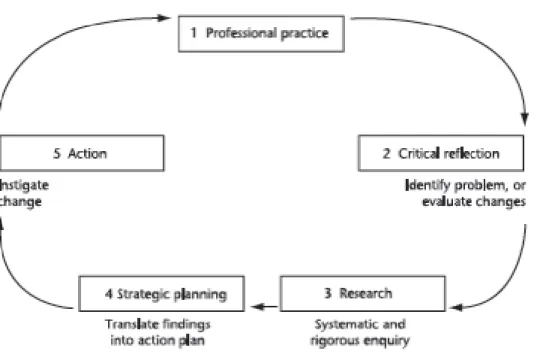
(22) Increasing motivation at A1 English students by VLRC (Virtual Language Resource Center) combined with CL (Collaborative Learning) 22 in our study: students and teacher-researchers, as the researcher’s role and the explanation about data collection instruments and procedures.. 3.1 Type of study. We recognize that our own research practices were shaped by our discipline, by our perspectives as teachers, and by our desire to elaborate results that would help us to make appropriate classroom settings for our students and the collaborative procedures through which we arrived at our findings (Latour and Woolgar 1979, 273 – 286).. The research done was elaborated by using the action research approach which is a strategy focused on the concerns and needs that arose as a routine part of the activity “in the real world”.2 Besides, action research was also seen as research specifically lead to changing matters, and also has persisted a core feature of the notion of action research. Linking research with practice, action research approach discards the concept of a two-stage process in which research is carried out first by researchers and then in an isolated second stage the knowledge made from the research is applied by experts or practitioners. Instead, the two processes of research and action are integrated (Somekh 1995:34). Collaborative learning is a method of teaching and learning in an environment where education institutions are being challenged to improve their rates of retention and quality of student learning, schools and universities are turning to collaborative learning strategies as an answer to those problems. Students which gain in thinking. 2. Denscombe, Martyn. The Good Research Guide For Small-Scale Social Research Projects. Fourth Edition. Mc Graw Hill Open University Press. pp 125-126. 2010.
(23) Increasing motivation at A1 English students by VLRC (Virtual Language Resource Center) combined with CL (Collaborative Learning) 23 skills, communication skills, and mastery of content; and they become more attached to the institution and as a result are more likely to continue. Besides, taking into consideration survey results we selected qualitative studies, where the research is considered an instrument of data collection (Denzin & Lincoln, 2013). This means that data are mediated through this human instrument rather than questionnaires. Also the qualitative researcher needs to describe relevant aspects of self, including assumptions, experiences or expectations to qualify his or her ability to conduct the research (Greenback, 2003).. TABLE 1: The cyclical process in action research. 3.2 Context The target population in where the research project was developed is focused on students from tenth grade courses from public high schools located in Piedecuesta and Girón, Santander..
(24) Increasing motivation at A1 English students by VLRC (Virtual Language Resource Center) combined with CL (Collaborative Learning) 24 Promoción Social high school is a public institution located in Refugio, Km 3 Vía Guatiguará, Piedecuesta, Santander. There are two groups with approximately forty-six students in each one and we have three hours of English lessons per week. Sometimes this schedule cannot be done due to the fact that the school has prepared extra-curricular activities and the activities are prepared through the entire school day. Students’ age are about fourteen and seventeen years old and there are twenty – one women and twenty – five men. Moreover, the institution does not have its own location. The main reason is the lack of establishment because Piedecuesta administration is working on a new structure to get students together in a new one. Now on, they are located in three different schools according to their level.. Luis Carlos Galan Sarmiento, a public high school located in Rio Prado, Girón; fifteen minutes away from the city center is a public institution where the community can find six different centers to offer education to children and young people. There, the students focused on this research are forty-two students who live nearby the school and they receive three hours of English classes per week. Also here, the extra – curricular activities are prepared through school days. At that grade we find twenty women and twenty men who are fifteen and seventeen years old. The school does not have enough spaces to practice sports. That is the reason why students have to practice sport activities outside school in a park or a soccer field away from the school..
(25) Increasing motivation at A1 English students by VLRC (Virtual Language Resource Center) combined with CL (Collaborative Learning) 25. 3.3 Participants. 3.3.1 Subjects and program description The researchers, who are the teachers too, elaborated the study in two – tenth grade courses, one at Instituto de Promoción Social and the other one at Luis Carlos Galan Sarmiento high school. The course was offered to twenty students chosen in this research during six weeks. Tenth grade students were selected based on the topics we worked on at school, and also the process we have established through the last four years in where test methods have varied in relation with their needs. According to Wesche (1983), all tests are samples of behavior, intended to reflect whether the examinee possesses certain knowledge, or to predict whether he or she can perform certain acts. In addition to that, we can realize in our students the strengths and drawbacks which must be improved.. The total number of students, taking into account both state schools, are sixty. However, the authentic number of participants who contributed in the present study was twenty. One of the reasons and the main one was the absence of students at school. The participants’ ages were from fourteen to seventeen. Most of the students belonged to a low socio-economic background. They considered learning English a good opportunity to increase their job probabilities in a near future. In addition, they have seen graduated relatives from state schools in a university where a foreign language is considered as a main requirement to obtain a diploma. Besides, some of the students who participated in the survey realized the importance of recognizing someone’s thoughts about a specific topic. However, they have not been participants of an activity based on.
(26) Increasing motivation at A1 English students by VLRC (Virtual Language Resource Center) combined with CL (Collaborative Learning) 26 the topics the project was about, related to virtual language resource center (VLRC) and collaborative learning (CL) inside a classroom. All the reasons previously described, give students an improper concept about learning a language, so they feel demotivated in order to learn a foreign language. As an evidence to prove students’ English level, they have presented a proficiency test based on the four language communicative strands (listening, reading, writing, spoken production and interaction) at the beginning of the research. The test was based on the aspects they should manage according to the Ministerio de Educación Nacional. TABLE 2: National Bilingual program MEN – Common European Framework NIVELES SEGUN EL. NOMBRE COMUN DEL. NIVEL EDUCATIVO EN EL. METAS PARA EL SECTOR. MARCO COMUN EUROPEO. NIVEL EN COLOMBIA. QUE SE ESPERA. EDUCATIVO A 2019. DESARROLLAR CADA NIVEL DE LENGUA. A1. Principiante. Grados 1 a 3. A2. Básico. Grados 4 a 7. B1. Pre intermedio. Grados 8 a 11. . Nivel mínimo para el 100% de los egresados de Educación Media.. B2. Intermedio. Educación Superior. . Nivel mínimo para docentes de inglés.. . Nivel mínimo para profesionales de otras carreras.. . Nivel mínimo para los nuevos egresados de licenciatura en idiomas.. C1. Pre avanzado. C2. Avanzado. Educación Superior. According to table 2, students evaluated in the proficient test should manage level B1 – pre-intermediate (tenth grade). However, results gave researchers an approach about they have.
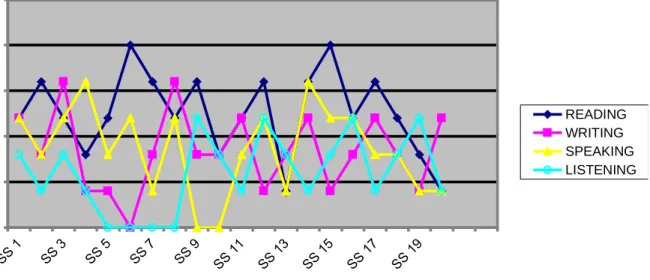
(27) Increasing motivation at A1 English students by VLRC (Virtual Language Resource Center) combined with CL (Collaborative Learning) 27 observed through the time they have worked with them. The proficiency test was elaborated and corrected by the researchers and administered to both tenth grade courses. (SEE APPENDIX 1) The test was divided into the four communicative competences. Each one of the communicative strands has got five activities to be done. Its maximum score could be five (5.0) and the minimum score could be zero (0.0). Each one of the participants took the proficient test individually at classroom in forty – five minutes. According to the scores, researchers could identify students’ level in A1, lower than the level they must obtain in a test according to the educative level researchers expected to appreciate in each language level. Results are classified in the following table. TABLE 3: Students scores per language communicative strand. 6 5 4 3 1 0. READING WRITING SPEAKING LISTENING.
(28) Increasing motivation at A1 English students by VLRC (Virtual Language Resource Center) combined with CL (Collaborative Learning) 28. Table 4. Colegio Luis Carlos Galán Sarmiento: Students who attend the Proficient test.. 15 years old 16 years old 17 years old 18 years old. Table 5. Instituto de Promoción Social: Students who attend the Proficient test.. 15 years old 16 years old 17 years old 18 years old. 3.3.2 Researchers’ role According to Dr. Simon, in quantitative studies, the teachers’ role is non-existent. Participants perform independently of the researcher as if he or she were not there. Quantitative studies ideally should be repeatable by other and under the same conditions, should obtain similar.
(29) Increasing motivation at A1 English students by VLRC (Virtual Language Resource Center) combined with CL (Collaborative Learning) 29 results. In other kinds of research such as correlational, the data are collect without regard to the participants of the person collecting the data.. In qualitative studies, the role of the researcher is different. The research is considered an instrument of data collection (Denzin and Lincoln, 203). This means that data are mediated through this human instrument rather than questionnaires. The qualitative researcher needs to describe relevant aspects of self, including assumptions, experiences or expectations to qualify his or her ability to conduct the research (Greenback, 2003) Information was collected by using constant researchers’ reflection on the students’ activities and the results they obtained working on the events focused on the collaborative learning experiences they had inside the classrooms. In addition, in order to achieve our objective, we collected the data, designed pedagogical interventions as a tool to observe students’ level of participation; (see appendix 4) also, classroom observation through the use of virtual language resource centers in accordance by collaborative learning gave the researchers more opportunities to interact with students in aspects such as amount of effort, motivation and teamwork, relevant in the language learning approach.. Chapter 4: Data collection instruments and procedures 4.1 Thematising Thematising is focused on answer questions of what, why and how this is going to be studied. The answers to these questions will be the background for carrying on with fieldwork,.
(30) Increasing motivation at A1 English students by VLRC (Virtual Language Resource Center) combined with CL (Collaborative Learning) 30 analysis and reporting. The research developed was established according to the previous proficient test and the answers given by the students. 4.1.1 Designing Wesche’s framework for writing exercise. The test is divided into three categories (reading comprehension, grammar and writing) in where students will be able to develop their skills working on different activities. These activities will be part of my project which is focused on motivation inside the classroom.. According to Wesche's framework, students will find in the exam the following concepts: -. Stimulus material: Images about the paragraph.. -. Task posed to the learner: Five questions about the story giving them the passage.. -. Learner response: Students will choose the correct answer to the questions about the paragraph.. The design stage establishes the step where the methodological procedure is planned and prepared. The individuals, or the students, are chosen according to criteria taken from the research objective. Criteria are based on demographic variables, such as life style characteristics or presence in a specific context. It is believed that a researcher will need only a limited number of respondents. In fact, a very large number of respondents can be expected to hinder the researcher's ability to get "in-depth" and miss the opportunity of getting an understanding of each respondent. The exact number of respondents will depend on the subject evaluated. (Kvale 1996). 4.2 Population The schools in where the project is going to be developed are called Luis Carlos Galan Sarmiento (S1) and Instituto de Promoción Social (S2). They are located in Girón and Piedecuesta Santander. The target population studies there from Monday to Friday in the morning. There are three tenth grade courses, for the purpose of this research; we choose to work with tenth-one in both schools. The course is composed mainly by women than men and they know each other for.
(31) Increasing motivation at A1 English students by VLRC (Virtual Language Resource Center) combined with CL (Collaborative Learning) 31 about five or six years. Students in this course are form the ages of fifteen and seventeen and they live around the school. Through the scholar year there have been forty-four students, although some of them decided to drop out for different reasons and nowadays we count with forty students to work. 4.3 Questionnaires At the beginning of the research project, students answered a questionnaire in order to check their likes and also dislikes. The answer data has motivated me to continue the research. In order to understand what a questionnaire is Dr. Martyn Descombe suggests a very concise definition about it.. There are many types of questionnaires. They can vary enormously in terms of their purpose, their size and their appearance. To qualify as a research questionnaire, however, they should do the following:. Be designed to collect information which can be used subsequently as data for analysis. As a research tool, questionnaires do not set out to change people’s attitudes or provide them with information. Though questionnaires are sometimes used for this purpose – for instance, as a way of marketing a product – it is not strictly in keeping with the spirit of a research questionnaire, whose purpose is to discover things..
(32) Increasing motivation at A1 English students by VLRC (Virtual Language Resource Center) combined with CL (Collaborative Learning) 32 Consist of a written list of questions. The important point here is that each person who answers the particular questionnaire reads an identical set of questions. This allows for consistency and precision in terms of the wording of the questions, and makes the processing of the answers easier. (Occasionally, pictures might be used instead of written questions.). Gather information by asking people directly about the points concerned with the research. Questionnaires work on the premise that if you want to find out something about people and their attitudes you simply go and ask them what it is you want to know, and get the information ‘straight from the horse’s mouth’.. 4.4 Interview After analyzing questionnaires results, there should be a need to reinforce some specific issues inside the research project. According to Descombe, Questionnaires offer little opportunity for the researcher to check the truthfulness of the answers given by the respondents. Because the researcher does not meet the respondent and because the answers are given ‘at a distance’, the researcher cannot rely on a number of clues that an interviewer might have about whether the answers are genuine or not. The interviewer might see some incongruity between answers given by the same interviewee and be able to probe the matter. Or the interviewer might note a disparity between a given answer and some other factor (e.g. stated occupation and apparent level of income). In the case of the questionnaire, however, if a respondent states their occupation to be a.
(33) Increasing motivation at A1 English students by VLRC (Virtual Language Resource Center) combined with CL (Collaborative Learning) 33 ‘dentist’, it would seem at first glance that the researcher has little option but to accept this as true. Likewise, on matters of taste or opinion, if the respondent answers along a particular line, the questionnaire researcher would seem to have no solid grounds for challenging the answer. This is all the more true if the questionnaires are anonymous. For that reason, an interview was necessary in the process.. Interviews according to Descombe are an attractive proposition for project researchers. At first glance, they do not seem to involve much technical paraphernalia and they draw on a skill that researchers already have – the ability to conduct a conversation. The reality, though, is not quite so simple. Although there are a lot of superficial similarities between a conversation and an interview, interviews are actually something more than just a conversation. Interviews involve a set of assumptions and understandings about the situation which are not normally associated with a casual conversation (Denscombe 1983; Silverman 1985). When someone agrees to take part in a research interview: There is consent to take part. From the researcher’s point of view this is particularly important in relation to research ethics. The interview is not done by secret recording of discussions or the use of casual conversations as research data. It is openly a meeting intended to produce material that will be used for research purposes – and the interviewee understands this and agrees to it. • Interviewees’ words can be treated as ‘on the record’ and ‘for the record’. It is, of course, possible for interviewees to stipulate that their words are not to be attributed to them, or not to be made publicly available. The point is, though, that unless interviewees specify to the contrary, the interview talk is ‘on record’ and ‘for the record’..
(34) Increasing motivation at A1 English students by VLRC (Virtual Language Resource Center) combined with CL (Collaborative Learning) 34 • The agenda for the discussion is set by the researcher. Although the degree of control exercised by the researcher will vary according to the style of interviewing, there is a tacit agreement built into the notion of being interviewed that the proceedings and the agenda for the discussion will be controlled by the researcher.. 4.5 Semi-structured interviews. With semi-structured interviews, the interviewer still has a clear list of issues to be addressed and questions to be answered. However, with the semi-structured interview the interviewer is prepared to be flexible in terms of the order in which the topics are considered. 4.6 Interviewing Through the interview researchers or interviewers, will take notes as a relevant complement to recordings. Later, the researcher will take notes by hand and some will later type and keep them as text files, others will use the notes written by hand. (E.g. Kvale, 1996). To use the research interview, the researcher contacts the respondents directly. 4.7 Verifying Verification of the data analysis involves the previous steps. “Generalizability means that findings are generalized; reliability refers to the consistency of findings results, whereas validity refers to the fact that investigates what was proposed”. (Kvale 1996).
(35) Increasing motivation at A1 English students by VLRC (Virtual Language Resource Center) combined with CL (Collaborative Learning) 35 4.8 Reporting Reporting protect the research process where he/she writes a report to present his/her findings. Once again, the researcher's influence is significant (Alvesson & Sköldberg, 2000). The researcher will be the one to judge how an explicit participant should be given voice or how perceptive the context will be according to a respondent's comments.. Chapter five: Pedagogical Intervention and Implementation Taking into consideration students’ reactions to English activities in class and the poor results obtained based on the language proficiency test, we could appreciate while we interacted with students that “knowledge” was not the main reason to not to obtain the results expected. As an option we preferred to take a look from another perspective to realize that motivation has been the major reason to fail in the proficient test. The most relevant places in where students receive daily motivation come from their homes and the school where they study and spend most of their time. Intervention was planned to be developed with the participants among six weeks, from February to April 2013 three days per week, one hour each. (See appendix 3) However, due to different activities proposed to students by both state schools including holy week recess, last pedagogical interventions moved forward three more weeks in order to accomplish them successfully. Each one of the proposed activities based on the pedagogical interventions was analyzed based on the changes which were planned while being implemented in classroom. Information was analyzed and took in consideration for future analysis. These classroom activities were developed according to the following schedule..
(36) Increasing motivation at A1 English students by VLRC (Virtual Language Resource Center) combined with CL (Collaborative Learning) 36. Table 6. Summary of Interventions and participants per school Institution. Colegio Luis Carlos Galán Sarmiento Instituto de Promoción Social. Number of Interventions per school. 6. 6. 10. 10. Number of participants per schools. Activities designed and applied in the interventions were done as follows: After analyzed students’ test proficiency, teachers first decided to give the students possible topics to be selected. Together, teachers and students selected one which had a significant value not only for them but also for the society where they interacted every day. (See appendix 2) Next, Students participated giving their own information and asking their classmates about specific data. They listened to the answers and later they started reproducing similar information. After that, Students received teacher’s support in relation with the proposals they had chosen. The teacher and the students had the required equipment to continue elaborating a suitable campaign in where they selected the best options to be put into practice. So, Students had teacher’s support in relation with different questions related to fluency, vocabulary and grammar coherence. Introductions elaboration was held by the teacher supporting students’ experience by creating remarkable phrases and quotations. At the end of the activity, together teacher and students determined the advantages and possible disadvantages the activities would have through the process. In addition, they received their final grade according to the importance of their collaboration with the activities proposed by.
(37) Increasing motivation at A1 English students by VLRC (Virtual Language Resource Center) combined with CL (Collaborative Learning) 37 them and followed by the teacher. (See appendix 3) The aim of the activity is that students were able to elaborate a campaign against endangered animals in where they gave their teammate information about what to do starting at home in order to prevent their extinction. In addition, they described and also proposed solutions by using specific modal verbs such as should, must, can in a campaign to avoid animals’ extinction. Students observed the animals considered in danger in different areas around the world, focusing especially in Colombia. After receiving the information and have concluded which animals are endangered, they discussed about the ones which were in Colombia. Students looked at the link and identify the species located in our context, paying special attention to the reason they are in danger. Based on an established web 2.0, students created a presentation in where they, based on the causes of the problem, gave possible solutions from avoid endangered animals. Choosing among the best presentation, students selected the best ones to prepare a live campaign at school. (SEE APPENDIX 4) There were more activities focused on becoming familiar with the use of web 2.0 tools as an option to express common ideas. This attempt to explain the methodology we applied in the interventions.. Chapter six: Results and data analysis Through this segment educators elaborated activities starting from qualitative and quantitative data that were assembled through two questionnaires: one at the beginning of the research and another one at the end of the research. In addition, teacher-researchers elaborated students’ learning activities and an interview. At the beginning of the research project, students answered a questionnaire as a tool to check their likes and also drawbacks..
(38) Increasing motivation at A1 English students by VLRC (Virtual Language Resource Center) combined with CL (Collaborative Learning) 38. Questionnaire before the research project activities. Questionnaire conclusions . The 47% stated that they are not motivated towards the English class and 7% feel motivated just a few times the other 47% stated that almost always or always are motivated. . The 37% does not feel comfortable, 10% sometimes feels comfortable and the other 54% almost always or always feels comfortable in the English class.. . The 61% think that it is important to learn English.. . 47% always or sometimes likes when the teachers uses videos..
(39) Increasing motivation at A1 English students by VLRC (Virtual Language Resource Center) combined with CL (Collaborative Learning) 39 . 45% always or sometimes like listening English music.. . 48% likes to convey ideas.. . 60% feel that can learn a new language.. . The majority states having a schedule at home to develop the daily activities including the academic ones.. . 38% does additional activities to those of the English class because feels the necessity of learning.. . 50% always or almost always ask when does not understand something about the class.. . 27% participates in study groups 13% almost always, 30% a few times and 7% never.. As a research tool, questionnaires do not set out to change people’s attitudes or to provide them with information. However questionnaires are sometimes used for this purpose – for instance, as a way of marketing a product – it is not strictly in keeping with the spirit of a research questionnaire, whose purpose is to discover things.. Data analysis methods and procedures section. After analyzing questionnaires results, there should be a need to reinforce some specific issues inside the research project. According to Denscombe, Questionnaires suggest little opportunity for the researcher to check the honesty of the answers given in this case by the students. Because the researcher does not meet the respondent and because the answers are given ‘at a distance’, the researcher cannot depend on a number of clues that an interviewer might have about if the answers are original or not. The interviewer might see some inconsistency between answers given by the same interviewee and be able to investigate the matter. Likewise, if the.
(40) Increasing motivation at A1 English students by VLRC (Virtual Language Resource Center) combined with CL (Collaborative Learning) 40 respondent answers along a particular line, the questionnaire researcher would seem to have no solid grounds for challenging the answer. This is all the more true if the questionnaires are anonymous. For that reason, an interview was necessary in the process.. Interviews according to Denscombe are an attractive proposition for project researchers. At first look, they do not seem to involve much technical equipment and they draw on a skill that researchers already have – the ability to conduct a conversation. Although there are a lot of superficial similarities between a conversation and an interview, interviews are something more than just a conversation. Interviews involve a set of assumptions and understandings about the situation which are not normally associated with a casual conversation (Denscombe 1983; Silverman 1985). There is agreement to take part. From the researcher’s point of view is important in relation to research ethics. The interview is not done by secret recording of discussions or the use of casual conversations as research data. It is openly a meeting intended to produce material that will be used for research purposes – and the interviewee understands this and agrees to it. (Denscombe 1983; Silverman 1985). Although the degree of control exercised by the researcher will vary according to the style of interviewing, there is a tacit agreement built into the notion of being interviewed that the proceedings and the agenda for the discussion will be controlled by the researcher.. The most common form of interview is the one-to-one variety which, according to Denscombe, involves a meeting between one researcher and one informant. The most relevant.
(41) Increasing motivation at A1 English students by VLRC (Virtual Language Resource Center) combined with CL (Collaborative Learning) 41 reason for its popularity is that it is easy to organize and to be elaborated. Also, a pro is that the point of view through the interview comes from the interviewee. In addition, one-to-one interview is relatively easy to control.. Semi-structured interviews. With semi-structured interviews, the interviewer still has a clear list of issues to be addressed and questions to be answered. Nevertheless, with the semi-structured interview the interviewer is prepared to be flexible in terms of the order in which the topics are considered, and to let the interviewee develop ideas and speak widely on the issues raised by the researcher. The answers are open-ended, and there is more emphasis on the interviewee elaborating points of interest. The interview was made taking into account the previous survey they made about their point of view about the English class. There were eight punctual questions to be answered in twenty students each (TABLE 7). The teacher gives the instructions to them and also gives them some recommendations such as being as honest as possible at the moment of answering the questions because of the importance it has for them as an option to know their thoughts about the English classes..
(42) Increasing motivation at A1 English students by VLRC (Virtual Language Resource Center) combined with CL (Collaborative Learning) 42. (TABLE 7) Interview Students’ questions 1. ¿Te sientes motivado en la clase de inglés? ¿Por qué? 2. ¿Cuáles aspectos hacen que te sientas cómodo en la clase de inglés y cuáles no? 3. ¿Qué te gustaría aprender en la clase de inglés y por qué? 4. ¿Tienes un horario establecido para estudiar en casa? ¿Cuánto tiempo dedicas al inglés? ¿Por qué? 5. ¿Existen elementos externos que influyen en tu desempeño en la clase? ¿Cómo y por qué? 6. ¿Sientes que las actividades realizadas en inglés son de tu interés? ¿Por qué? 7. ¿Sientes que tú condición económica interfiere en tu desempeño académico, por qué? 8. ¿En algún momento has sentido que tus compañeros no te aceptan? ¿Por qué?. The questions were made in their native language for the reason that some students are not still able to understand important vocabulary in the target language they are studying..
(43) Increasing motivation at A1 English students by VLRC (Virtual Language Resource Center) combined with CL (Collaborative Learning) 43. Chapter seven: Conclusions and Pedagogical Implications. According to the goals of the study and the research question: To what extent does VLRC (Virtual Language Resource Center) together with Collaborative Learning, increase motivation at A1 tenth grade English students inside two state schools in Santander, Colombia? Researchers could observe the positive impact and extracted the following conclusions:. Having English in our social context is more important in today's educational circumstances. Due to the internationalization of the economy, multiculturalism, scientific and technological development, the student population must acquire the necessary tools to face the challenges of postmodernism and the dynamics of globalization. For that reason, the importance of learning a foreign language, which allows young students to appropriate their environment both in university life and in the workplace.. Modern life requires the student to be in a constant communication process. The accelerated advance of communications, the large amount of written material that frequently comes, creates the need to digest this information quickly; thus the importance of learning English, universal language. It also allows the learner to enrich his thinking by broadening his cultural horizon, to update himself in all fields of knowledge, to have more perspective to project himself into his environment for the benefit of the community.. On the other hand, Finocchiaro and Brumfit (1983) established some characteristics of the communicative approach, namely: 1. Contextualization is the essential premise within learning. 2. Learning a language is learning to communicate. 3. The effectiveness of communication should be required. 4. Any didactic aid is accepted, as long as it benefits the learner. It varies according to age, interests, needs, etc. 5. From the beginning, motivation is the effort to communicate..
(44) Increasing motivation at A1 English students by VLRC (Virtual Language Resource Center) combined with CL (Collaborative Learning) 44 6. The linguistic system can be better learned through the effort to communicate. 7. Communicative competence is the desired goal (the ability to use the linguistic system appropriately and effectively). 8. The linguistic variation should be a central concept in the materials and methodology used. 9. Teachers should work in a way that encourages students to use the language. 10. The student is expected to interact with peers.. 7.1 Limitations. After observing the data results from the interview, there might be some aspects that need to be checked in order to contribute to our research project about motivation. 1. Students are interested in English and they considered the language as a relevant aspect which contributes them positively into their lives. Also they find the classes meaningful and the way the teacher interacts in the classes likes them. 2. There is a requirement about the students in order to improve classes. This is related to technology devices and multimedia activities. Unfortunately, there are not enough technological devices for each individual student and the teacher has to deal with the activities on their own. If the students want to listen to a song or a dialog in a learning activity, the educator must bring the appliances to develop it. 3. Students feel more confident if there is a good environment inside the classes. They do not consider appropriate to be constantly scold by the teachers at school. They think that motivation starts from an aspect like this and communication with them is the key to motivate them. 4. English activities developed in class are considered satisfactory in order to learning a language. However and taking into account the previous conclusions, they insist on the use of multimedia devices in the classroom development as a strategy to improve their language skills..
(45) Increasing motivation at A1 English students by VLRC (Virtual Language Resource Center) combined with CL (Collaborative Learning) 45. 7.2 Further research. These activities could spend several times per week and thus, contents may vary. At that point, educators should combined language acquisition strategies and classroom topics. Results should be taken into account for a next research activity. When the process stop, students will not find activities meaningful and lack of motivation may appear again. As a reminder, it is essential to keep students’ enthusiasm during class room activities. If educators try to manage their lesson focused on that goal, eventually success would come and also, students would become autonomous in language learning..
Figure

Documento similar
The study was designed to investigate the usage and its frequency of language learning memory strategies by those students who are learning English as a
The aim of this paper is to demonstrate that reading authentic literary material in the English as a Foreign Language (EFL) classroom can improve students’ language learning skills as
Results revealed four constructs underlying motivation in learning English among Palestinian school children, two attitudinal factos (Motivation and Enjoyment and Awareness
This study has a two-fold objective: First, to adapt and validate the Emotions and Motivation Self-Regulation Questionnaire (EMSR-Q) with university students in
The analysis revealed significant differences in categories such as word count, clout, emotional tone, or analytical thinking when comparing the texts written by an
Her principal research addresses technology-enhanced project-based language learning, intercultural communication and 21st century competences in teacher education. She has
This paper presents an analysis of spoken and written productions in English by early secondary school Spanish students (11-12 year olds), collected in two state schools which have
Taking into account that the tendency in Spanish schools is to establish a bilingual primary education system (Spanish and English), those students who do not major in English
