
A mobile solution to enhance the troubleshooting techniques and maintenance procedures of the engine bleed air system on the boeing 737 aircraft
85
0
0
Texto completo
(2) INSTITUTO TECNOLÓGICO Y DE ESTUDIOS SUPERIORES DE MONTERREY CAMPUS MONTERREY ESCUELA DE INGENIERÍA Y TECNOLOGÍAS DE LA INFORMACIÓN. Los miembros del Comité de Tesis recomendamos que la presente Tesis del Ing. Horacio Rios Corzo sea aceptada como requisito parcial para obtener el grado académico de Maestro en Ciencias con especialidad en: SISTEMAS DE MANUFACTURA.
(3) Resumen. A lo largo de los años el mantenimiento y reparación en la industria aeronáutica han desarrollado diversos sistemas de entrenamiento y recuperación de información necesaria para asegurar eficacia en sus labores y seguridad para los pasajeros. Por el otro lado, las tecnologías de información han alcanzado un grado de madurez mayor y han surgido nuevas propuestas de mejora para la industria aeronáutica, se ha comprobado que la tecnología de realidad aumentada y realidad virtual impactan fuertemente de manera positiva el desempeño de las labores donde ensambles complejos están involucrados. El presente proyecto de investigación propone el uso de hardware móvil como tabletas o teléfonos inteligentes como herramientas para el aceleramiento de la transferencia de conocimiento para las tareas de aislamiento de fallas y mantenimiento aeronáutico en ensambles complejos donde los procesos de reparación no son necesariamente lineales, se propone como caso de estudio el sistema neumático del avión BOEING 737 perteneciente a la compañía Aeromexico. Se desarrolla una aplicación de realidad mixta por un método iterativo, para fortalecer los manuales actuales de la compañía que permite el acceso rápido a cualquier estado de la reparación en tres toques en la pantalla del dispositivo, así como la comunicación vía correo electrónico y despliegue de múltiples ayudas como texto escrito, videos y modelos 3D. Por último se analizan los resultados obtenidos de la implementación y se discute el impacto de la propuesta en la industria aeronáutica..
(4) Dedication. I would like to dedicate this work to my family who accompanied me in this journey and encouraged me to always give my best in every challenge. To my best friend and the love of my life Dulce who gave me her unconditional support during this time..
(5) Acknowledgments. I wish to thank my committee members who were more than generous with their expertise and precious time who provide me with exceptional guidance, knowledge and friendship. To Dr. Eduardo Mendívil who always encouraged me to think out of the box and believed in me by providing constant support in this journey, to Dr. Ciro Rodriguez who welcomed me in the master program and guided me in some many aspects of my formation and to Dr. Hector Siller who was always there to advise me and showed me that you are not too busy to tackle new challenges. Thanks to Aeromexico especially to Alejandro Villaseñor for his advice and patience during the development of this project. I also would like to acknowledge the SEMARA team for this great experience as coworkers and dear friends in every challenge overcome (from coding/modeling problems to visa issues). Thank you Valencia group for its guidance on the project implementations. Thanks to Ricardo, Sujania, Alberto, Octavio, Alejandra and the crew for their patience, support and for so many discussions during this time. I would like to acknowledge my school division, CONACyT and CIDyT for allowing me to conduct this research, thanks for providing any assistance requested..
(6) Table of Contents Chapter 1 Introduction .......................................................................................................... 10 Introduction and Justification ............................................................................................ 10 Current training model of the Aircraft Maintenance Personnel ........................................... 14 Proposed model for training and enhancing knowledge of Aircraft Maintenance Personnel16 Objectives ........................................................................................................................ 18 Chapter 2 Literature review................................................................................................... 19 Introduction ...................................................................................................................... 19 Augmented Reality development for the industry .............................................................. 20 Troubleshooting software implementations ....................................................................... 23 Summary.......................................................................................................................... 26 Chapter 3 The engine bleed air system of the BOEING 737 .................................................. 34 Description of subsystem in the EBAS .............................................................................. 36 Maintenance .................................................................................................................... 38 Isolation of faults .............................................................................................................. 39 BLEED TRIP OFF Light On for both engines ................................................................ 40 Bleed valve: does not close when the bleed switches are moved to off, the engine is the bleed source ................................................................................................................ 41 Duct pressure indication: high, low or zero, the engine is the bleed source. .................. 41 Isolation valve: does not operate correctly. ................................................................... 41 Duct pressure indication: L and R pointers not the same (split), the engine is the bleed source. ......................................................................................................................... 41 Duct pressure indication: L and R pointers not the same (split), the APU is the bleed source. ......................................................................................................................... 42 Chapter 4 Software development .......................................................................................... 46 3.1 Software architecture .................................................................................................. 47 Fault Isolation software development ................................................................................ 53 Augmented reality System development ........................................................................... 53 6.
(7) Phases of AR development .......................................................................................... 53 Chapter 5 Discussion and results.......................................................................................... 57 Results of the software ..................................................................................................... 58 Discussion........................................................................................................................ 64 Chapter 6 Conclusions and future work................................................................................. 68 Future work ...................................................................................................................... 70 Publications and participation on international forums during the development of the project . 71 Bibliography ......................................................................................................................... 72 Appendix A Report of experiment to measure improvement of the AR technique................... 79 Results of the study for the variable time and quality of the final assembly ........................ 80 Inspection test of the final assembly for both methods: ................................................. 81 Results analysis of time variable ....................................................................................... 81 One way ANOVA: time vs method of assembly ............................................................ 82 Fisher average computation ......................................................................................... 83 Result of quality evaluation of the assembly...................................................................... 84. List of figures. Figure 1 MRO market and USA participation ........................................................................ 10 Figure 2 2008 World civil MRO market ................................................................................. 11 Figure 3 Airframe heavy maintenance cost structure ............................................................. 11 Figure 4 Current process of troubleshooting and maintenance with printed manuals ............. 16 Figure 5. Proposed solution to accelerate transfer of knowledge and troubleshooting. techniques with all information in line system installed on mobile device ............................... 17 Figure 6 Definition of Mixed Reality ...................................................................................... 19 Figure 8 Application of AR in the industry related to the work presented in this thesis ............ 22 Figure 9 Distribution of data in a virtual engine maintenance environment to find abnormal behavior in turbines ............................................................................................................. 24. 7.
(8) Figure 10 Comparison of different Troubleshooting and Mixed Reality implementations with the work presented in this thesis ........................................................................................... 26 Figure 11 Affiliations with more publications of application of the AR technology in the aviation industry ................................................................................................................................ 28 Figure 12 Authors with more publications for AR in the maintenance / assembly domain....... 28 Figure 13 Air is taken from the 5° and 9° stages of the compressor section ......................... 34 Figure 14 Pneumatic system schematic ............................................................................... 35 Figure 15 General TBM process ......................................................................................... 38 Figure 16 General CBM process ......................................................................................... 39 Figure 17 Stages of flight ...................................................................................................... 40 Figure 18 UML Activity diagram of TASK 801 ....................................................................... 42 Figure 19 Zoom 1 UML Activity diagram of TASK 801 ........................................................... 44 Figure 20 Zoom 2 UML Activity diagram of TASK 801 ........................................................... 45 Figure 21 Use case diagram for the software ........................................................................ 48 Figure 22 Sequence diagram for accessing the main menu of Fault Isolation Procedure ....... 49 Figure 23 Sequence diagram showing the calls for AR procedures ....................................... 51 Figure 24 Class diagram of the Fault Isolation Software ........................................................ 52 Figure 25 Results of the modeling stage of the project .......................................................... 55 Figure 26 Real and virtual content before (left) and after (right) texturizing and animation stage ............................................................................................................................................. 56 Figure 27 Industrial tablet holder to increase the ergonomics of the training system .............. 57 Figure 28 Changes in memory when the 3D model starts rendering ...................................... 64 Figure 29 Use case diagram of fault isolation software .......................................................... 69 Figure 30 RV-10 training kit with assembly drilled holes in colors .......................................... 79 Figure 31 Normality test for variable time for written instructions method ............................... 81 Figure 32 Normality test for variable time for RA method ....................................................... 82 Figure 33 Individual plot of time vs. method of assembly.. Written instructions:1 & RA. manual:2 .............................................................................................................................. 83 Figure 34 Residuals plot for time........................................................................................... 84 Figure 35 Normality test for quality with written instruction manual and AR method ............... 84. List of tables Table 1 Maintenance related incidents .................................................................................. 12 Table 2 Unsafe acts in occurrences ..................................................................................... 14 Table 3 Published articles (journals & conferences) from 2000 to 2012 ................................. 27 8.
(9) Table 4 Principal studies of the improvements of AR technology when compared to others in the maintenance & assembly domain.................................................................................... 31 Table 5 Comparative between different game engines with AR capabilities ........................... 47 Table 6 Tools used to build a project with AR in mobile technology ....................................... 47 Table 7 Stage of collecting dimensional information of the engine ......................................... 54 Table 8 Processing photographs with freeware IMAGEJ ....................................................... 55 Table 9 Number of code lines generated for the Fault Isolation Software............................... 58 Table 10 Number of code lines generated for AR maintenance procedures ........................... 59 Table 11 Graphical User Interface of mobile software ........................................................... 60 Table 12 Android OS statistics of the different GUI developed for the software...................... 63 Table 13 Results of study: AR vs Traditional Written Instructions .......................................... 65 Table 14 Studies for time comparison of AR vs. written instructions performed at ITESM ...... 66 Table 15 Usability study for markers and markerless AR techniques in the aeronautical area 66. Nomenclature AR: Augmented Reality EBAS: Engine Bleed Air System HSV: High Stage Valve MRO: Maintenance, Repair and Overhauling AMP: Aircraft maintenance personnel PM: Preventive Maintenance CM: Corrective Maintenance OEM: Original Equipment Manufacturer APP: application normally refer for mobile markets (android app / iOS app) ICAO: Civil Aviation Organization FAA: Federal Aviation Administration EASA: European Aviation Safety Agency USA: United States of America 9.
(10) Chapter 1 Introduction Introduction and Justification. Advancement in technology and the commercial devices permit us to enhance sight through the interaction of virtual animations or content with the real world, they also allow touch sensing capabilities as a way of interaction with software, the Augmented Reality (AR) technology permit the study of many possibilities for innovative applications in an extensive variety of fields, as many as our own imagination permits. For the purpose of this work, AR along with mobile devices are tools considered for maintenance procedures and troubleshooting applications in the aeronautical industry. In this section an introduction is presented of the impact area of this investigation in the aeronautical engineering field. The market for the maintenance, repair and overhauling (MRO) in aviation is very interesting in an economical perspective according to the Aeronautical Repair Station Association [1] the civil aviation MRO market generated $80B in economic activity in 2009, $39B where aported by USA, the opportunity for improvements in this market is latent to lower the actual costs of the MRO, this means that better service to costumer can be offer with excelent quality.. Figure 1 MRO market and USA participation [1]. 10.
(11) In 2008 the world civil aviation fleet was 77,134 aircraft [1] where the 47% belong to North America, all of these airplanes are constantly going to different maintenance procedures that imply several cost for the users. The world aviation fleet takes maintenance procedures for the four different MRO market: airframe heavy maintenance, engine overhaul, component MRO and line maintenance.. Figure 2 2008 World civil MRO market [1]. One of the major investments in labor is in the airframe heavy maintenance as shown in Figure 3, where a detail inspection is performed, the proper training of personnel will be translated in reducing time manhours for maintenance and cost of retaining the aircraft in the hangar.. Figure 3 Airframe heavy maintenance cost structure. 11.
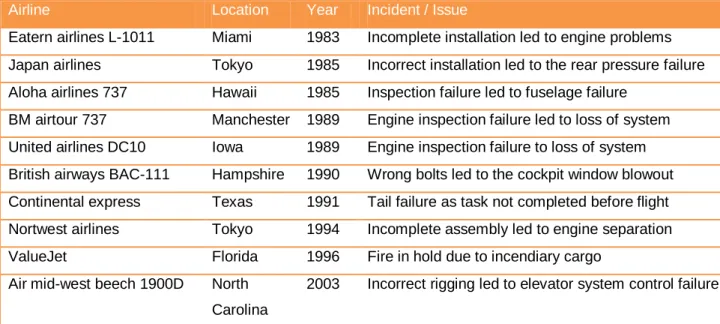
(12) When the airline needs to provide line maintenance, the operators become a main asset in the organization, because 88% of the work is performed by them and only 12% is done by outsourcing [1], the previous knowledge of the systems and subsystems of the aircraft will impact in the efficiency of the service that is offered by the airline. In this kind of maintenance procedures, the transit, daily/weekly and “A” checks are done to ensure the security of the passengers. Every airline has developed a system to transfer the knowledge from the experienced operators to the new hired ones that must performed the checks with few contact with the physical systems of the aircraft. The advancements of technology has permitted that the accidents due to the components of the aircraft is reducing every day buy the failures, that are caused due to human error, are increasing with the complexity of systems in the aircraft, at the beginning of aviation 80% of the faults and accidents were caused by the machine and nowadays the 80% of the accidents are due to human causes leaving only 20% to the machine failure [2]. Airline. Location. Year. Incident / Issue. Eatern airlines L-1011. Miami. 1983. Incomplete installation led to engine problems. Japan airlines. Tokyo. 1985. Incorrect installation led to the rear pressure failure. Aloha airlines 737. Hawaii. 1985. Inspection failure led to fuselage failure. BM airtour 737. Manchester. 1989. Engine inspection failure led to loss of system. United airlines DC10. Iowa. 1989. Engine inspection failure to loss of system. British airways BAC-111. Hampshire. 1990. Wrong bolts led to the cockpit window blowout. Continental express. Texas. 1991. Tail failure as task not completed before flight. Nortwest airlines. Tokyo. 1994. Incomplete assembly led to engine separation. ValueJet. Florida. 1996. Fire in hold due to incendiary cargo. Air mid-west beech 1900D. North. 2003. Incorrect rigging led to elevator system control failure. Carolina Table 1 Maintenance related incidents. History has shown (Table 1 [3]) that there is a lot work to do in the methods for training and transfer knowledge to new and experienced operators, according to the a survey of the Australian Transport Bureau [4] about the occurrence of accidents during maintenance procedures, the most common outcomes were systems operated unsafely during maintenance, towing event and incomplete installation.. 12.
(13) Another study by Boeing and the U.S Air Transport Association member found was one of the factor that contributed to accident where five or more people were killed, 39 of the 264 (15%) from 1982 through 1991. From these 39 accidents they can be divided by its cause [3]: . 23% involved an incorrect removal/installation of the components. . 28% involved a manufacturer or vendor maintenance/inspection error. . 49% involved an error due to an airline´s maintenance/inspection policy. . 49% involved poor design which contributed to the maintenance error. This situation can be reduce by the use of an innovative method that new technologies are offering to us in this days, the hardware required to move digital information is getting smaller and more efficient also the new visual technologies can be used for the purpose of training in the aviation industry. Augmented Reality (AR) is a variation of Virtual Environments (VE), or Virtual Reality as it is more commonly called. VE technologies completely immerse a user inside a synthetic environment. While immersed, the user cannot see the real world around him. In contrast, AR allows the user to see the real world, with virtual objects superimposed upon or composited with the real world. Therefore, AR supplements reality, rather than completely replacing it [5].. Furthermore AR technology is particularly suited for maintenance industry, as it can be easily implemented in several processes. AR can enhance the user’s view of the surrounding scene with different content that include visual animations, sounds, written instructions or static images. Using AR can potentially reduce the numbers of errors during maintenance tasks; in fact AR provides information that is generally not easily available or whose retrieval is relatively demanding. In general many processes in manufacturing, aviation and automobile industry deal with assembly tasks. During maintenance operations, mechanics have to deal with a large amount of different parts that represents a large proportion of search time: standard manuals or handbooks can lead inexperienced operators to frustration and poor performance. As shown in Table 2 the major unsafe acts that lead to accidents are related to memory lapse (21%), procedures shortcuts (16%) and knowledge-based error (11%) this can be avoided by having the right information at right time, if the operator does not remember something he can consult his mobile device to access the manual, also the procedures shortcuts and knowledge-base error can be minimized or eliminated by educating the operators in the proper procedures of repairing the aircraft.. 13.
(14) Airline. Non-airline. Memory lapse. 21%. 20%. Procedure shortcut. 16%. 21%. Knowledge-based error. 11%. 18%. Trip of fumble. 9%. 11%. Failure to check. 6%. 2%. Unintended action. 3%. 6%. Failure to see. 5%. 6%. Table 2 Unsafe acts in occurrences [4]. Current training model of the Aircraft Maintenance Personnel. The aeronautical industry personnel can have varying degrees of educational background, from selftaught individuals to holders of university degree, but independently of their background every person must take a very comprehensive technical training that provides the necessary knowledge, skills and attitudes for assuming responsibility over the health of the components and system of the aircraft. The International Civil Aviation Organization describe that a license is the means by which a state authorizes a license holder to perform specific activities which unless performed properly, could jeopardize the safety of aviation [3]. Theoretical and practical training must be given in order to have an operator with valid license; this training is according to the content and required standards by international association such as Civil Aviation Organization (ICAO), Federal Aviation Administration (FAA) and European Aviation Safety Agency (EASA). The different stages of the basic training course are the knowledge training, knowledge examination, practical training and practical assessment, at the end the student must be competent at using tools and equipment and working in accordance with maintenance manuals. In the first stage the individuals take classes and receive only theoretical information, later they must connect this knowledge in the practical assessment and at the same time develop the necessary skills to succeed in the examination a later ensure the health of the aircraft and the security of the passengers. The profession of aircraft maintenance requires continual education. In fact, regardless of the task, aircraft technicians must always refer to the maintenance manual for the specific aircraft to obtain proper procedures and specifications. A great amount of time is spent searching. 14.
(15) for instructions, which increases maintenance time, worker stress, and decreases overall job performance [6]. If the task implies several procedures for example troubleshooting the engines this task will call different procedures of removal and installation of components. Neumann and Majoros identified that 45% of a AMTs shift is spent finding and reading instructional procedures for job tasks [7]. In order to become a certified aircraft maintenance personnel one operator must complete the basic training, on the job training, and type/task training, but as reviewed in this document currently the principal causes of failure in many accidents in the aviation industry are lack of technical training and skills. This research is focusing in the basic training and on the job training where the operator have to familiarized with the technical data of the manuals and the physical components of the systems, taking into account all the details (torque of certain parts, warnings, checks, etc.) and regulations that must be followed to release the airplane, also the operator have to develop a mind map of the correct functioning of the system and he must be able to troubleshoot if necessary. In the next section the proposed model of training for this stage will be revised and compared to the current training model.. 15.
(16) Proposed model for training and enhancing knowledge of Aircraft Maintenance Personnel The aeronautical organizations had made great efforts in standardizing and training for maintenance area to ensure quality in the different aspects of the services that they provide, but there is still a lot work to do for minimizing the accidents and take the proper care of the aircraft. The need for new tools that can make the process of training more efficient is arising and not only for training also for the use in the different maintenance task in practice. Carrying on big quantities of printed manuals is not the best way to learn and have a clear concept of the functioning of the machine, as show in Figure 4, when a fault of a system has arisen the manuals try to lead the operator through all the steps and checks to isolate the faulty component and give the proper maintenance, this steps implies going back and forth through different stages of the checks and different manuals, for example to check the bleed system, the operator must follow first the safety procedures to ensure the motor has no pneumatic power, this is the first package of paper, then he will start all the steps in the health check and corresponding 2D figures in different pages, this going back and forth through the manuals has become an issue, it is difficult to create the general map of isolation of faults and new operators tend to mechanize their labor instead of leaning and mastering the process.. Figure 4 Current process of troubleshooting and maintenance with printed manuals. 16.
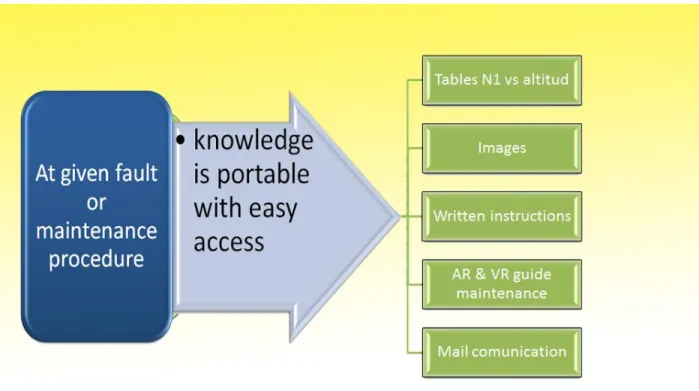
(17) The purpose of this work is to propose an innovative tool than can potentially improve the cognitive process of training and troubleshooting techniques of the aircraft, but also can be used to the everyday task by capturing the know-how and helpful tips of more experienced operators, as shown in Figure 5 this tool will present the knowledge as a portable asset, giving all the information needed by only one touch apart from each other, the operator will be able to form a clear concept of the task and he will access the information at right time like tables of normal functioning of the systems, written instructions of different manuals, images and virtual content to guide the task. This tool is not intended to suppress the process of certification of operators by the different entities in the aviation industry on the contrary is a proposal for enhance the current process training and practical procedures at the hangar and this way reduce the accidents and efficiently take care of the aircraft troubleshooting and maintenance procedures.. Figure 5 Proposed solution to accelerate transfer of knowledge and troubleshooting techniques with all information in line system installed on mobile device. 17.
(18) Objectives. The motivation of this research is to improve the method of training of an aeronautical maintenance process with more information that is not available in regular work environments, in this way accelerate the cognitive process that new users have during training and the stage of familiarizing with complex machines. The scope of this project is to create a prototype system by means of mixed reality (augmented reality / virtual reality) [8] and gestural interface to enhance the cognitive process and ability of a user that holds a job in complex assembly processes that are commonly found in the aeronautical area. This tool is going to be developed for mobile devices with touch screen that have iOS or Android operating system. Is worth to mention that the augmented reality system is scale and pose invariant, this enables the user to move and locate the tablet in the best position for accessing the graphical information. During the investigation is expected to accelerate the transfer of knowledge from the current manuals of maintenance and troubleshooting procedures of a company by using the augmented reality technology along with the several advantages that mobile device have, like portability, low cost, friendly interaction and savings in printed manuals. The case of study on this project is the troubleshooting techniques and maintenance procedures of the engine air bleed system of the BOEING 737 aircraft that has two CFM56-7B engines, where according to the company, the system is one of the most prone to failure or frequently recurring in repairs, thus requiring the most attention and thorough maintenance scheduled tasks. During the development of this project the questions that we are looking to respond are: Is this new tool going to improve the quality of training and troubleshooting the engine? The hardware is reliable enough to maintain the information with easy access at any moment? And from the perspective of the users, are they going to be willing to use the system?. 18.
(19) Chapter 2 Literature review Introduction. There have been several efforts to implement the augmented reality technology into the industrial world, but it is barely reaching the technology matureness to offer commercial applications that have enough stability and ease of use, for example the case of black and white markers, yet there is new products that are been developed to strengthen the offer of new tools like markerless (texturized sheets), infrared tracking, geo-tracking , magnetic tracking or 3D object tracking that can be used with the rendering of virtual models. In the other hand new hardware is been fabricated every year with more capacities that can support complex algorithms and parallelization of tasks with low weight to enhance ergonomic capacities. According to Milgram the reality - virtuality continuum is defined in Figure 6, where the cases of augmented reality (AR), virtual reality (VR) and mixed reality (MR) can be clearly identify with their respective end point at the real environment or the pure virtual environment, this project will be centered in the continuum because it is constrained for two environments: training and in situ troubleshooting (developed of the project showed with the blue point Figure 6). For controlled environment in the classroom is very likely that the user can print the marker to track the models or use the prototype turbine made to scale, where the augmented reality system can be advantageous, but there is situation in situ where the operator most repair the engine, he will be able to take the tablet and follow the instructions in a virtual mode en case he cannot reach a the marker independently of the virtual o augmented reality mode of the system, the operator will be able to interact with the application with touch/gestural screen provided by the device.. Figure 6 Definition of Mixed Reality [8]. 19.
(20) Augmented Reality development for the industry The research community and the industry have made several associations to push further the development and implementation of the augmented reality technology along with hardware that is custom fabricated or acquired from the market, the goals vary from group to group depending of their interest, in the next section an investigation of the relevant projects and research related to this investigation is presented (see Figure 7). One of the representative examples of the creation of a consortium between various industries is the ARVIKA project that tested augmented reality in the development, production and service in the field or the service of the machines and systems that are required for production for the automotive and aircraft industries this is an effort to unified the development of European AR projects [9] (see http://www.arvika.de/www/e/topic2/presse.php to review projects from ARVIKA). In automotive industry there is a wide range of implementations for example, Platonov et-al developed a prototypical AR system for maintenance of BMW 7 Series engine which utilized a monocular camera setup as well as a light weight mobile hardware platform for visualization, the main problems in this was the error accumulation during the tracking and lighting changes [10]. Henderson and Feiner created a prototype for conducting routine maintenance task inside a armored vehicle turret, they used a tracked head worn display (by infrared sensors) to augment a mechanic´s natural view with text, labels, arrows and animated 3D models, reduced time in the performed task and less overall head movement was reported (up to 47% against LCD screen and 56% against Head up display), the qualitative test for the mechanics showed that the augmented reality technology was intuitive and satisfying [11]. Chen et-al built a design evaluation environment that combines a full-scale car display and a visual evaluation system, the image of a car was transmitted via wireless communication onto a personal digital assistant. Then when the image of the car was updated it was constructed on the fly on a PC server and send back to the head mounted display and the personal digital assistant (PDA); multiple users could visualize the car simultaneously and discuss to enable the evaluation of the design [12]. The aeronautical industry can be helped with AR and mobile technology, the need for tools that can increase quality to ensure safety of passenger and longer life to the components of the aircraft is vital for the market, Henderson and Feiner also worked with what they called opportunistic controls that are a class of user interaction techniques for take advantages of unused affordances already present in the domain environment, this allowed the use to have a gesturing interface with the real work besides the augmented reality with black and white markers, for example they could touch a bolt in the rolls Royce Dart 510 turboprop engine, this action would activate a trigger for the action programmed like deploying more information, sound or finished the task [13]. Macchiarella and Vicenzi worked with the inspection of a power-driven rotary oil pump from a model T53-L-13B turbine aircraft engine, the main purpose of the investigation was to recall the names of the major components and several selected functionalities for the. 20.
(21) components to measure the immediate and long term memory recall with different technologies like AR, Interactive AR and print text, the equipment used for this experiment in the AR part was a desktop CPU and Toshiba screen. The principal finding was that AR did not enable learners to recall more information during testing, but it did apparently enable them to recall a greater percentage of what they had learned. Further investigation was necessary to conclude [14]. De Crescenzio et-al investigated daily inspections of the Cessna C.172P and airplane that flight schools often use, they focused in the maintenance check performed before the first flight of the day by using markerless camera pose estimation that tracked the natural features in the physical objects. In this study the participants seemed to understand how to use it, their level of satisfaction was 8/10 and they were willing to use it in everyday assignments [15].. In the side of manufacturing and industrial engineering, Reinhart and Patron developed a modular AR system for guiding manual assembly and for use in assembly planning, they integrated a database to quickly expand to different processes where the 3D model where inserted to the database [16]. Zhang etal integrated the AR technology with a 3 axis CNC machining environment. Render of cutting simulation between a real cutter and a virtual environment was done. Their experiment showed that in situ simulation system can enhance the operator´s understanding and inspection of the machining process as the simulation are performed on real machines for purposes of training and dry runs in the machine [17]. Lee et-al proposed a method of constructing a mixed reality based digital manufacturing environment where real objects, such as real images, are combined with the virtual space of virtual objects. This project was created for the virtual layout planning with the use of image-based tracking method which found and arbitrary feature from actual images, such a safety sign, such images replace the artificial squares markers [18]. The medical industry must be considered because there is procedures that can be enhanced with the use of this technology also there is a big market for the improvement in this field, for example Nicolau et-al presented an augmented reality guidance system for liver thermal ablation an interventional radiology the system could take into account changes in position due to respiration. Besides performing lab testing they also experimented with eight patients with tumors. The system accuracy was reported to be 4.5 mm, what fits medical requirements later they were to investigate the use of electromagnetic tracker to compensate needle bending [19]. Weiss et-al proposed an AR system for Magnetic Resonance Imaging (MRI) guided needle placement in a spine phantom, they validated needle position with an electromagnetic tracking system to provide tip position and orientation, in this study 57 of 60 needles were positions successfully with good results in the measurements of error [20]. Other big interest for the application of the AR technology is marketing and tourism, these industries are taking advantage of AR since the early stages of development, for example Chubassi presented an 21.
(22) augmented reality tourist guide on mobile devices by using the different capacities of new mobile technology like cameras, location, orientation and motion sensors. The augmented information was obtained by matching a camera image to images in a database that have geotabs [21]. In Figure 7 a summary of the different research projects related to the industry is shown where the application area and principal achievements are described.. Figure 7 Application of AR in the industry related to the work presented in this thesis. 22.
(23) Troubleshooting software implementations. As technology advances and manufacturing capabilities improve there has been an increment on the need for specialized software to troubleshoot the complex systems that are fabricated because basically, all non-trivial troubleshooting domains are NP-hard [22]. The software must manage a lot of information to simplify it for the technicians or final users and it should be designed ergonomically to ensure that the tool will be used and will not interfere with the task. For example in 2009 Castellani et-al conducted an study to examine the properties of different assemblies of people, resources, technologies and spaces to inspire design for the different troubleshooting situations, they covered different dislocations between various aspects of the study in the two cases of troubleshooting self-conducted and expert-supported, the dislocations considered in the prototype were physical between the site of the problem and site of problem solution, conceptual between the users and the expert and the logical dislocations between the support resources and the status of the ailing device itself, this study developed a set of integrated mechanisms and systems aimed at harmonizing the various elements and at capturing, where possible, the haecceities of the device [23]. The dislocations were covered by integrating troubleshooting software in the copy-machine and a call center of experts that could be consulted. There are systems for web technology like what Liang proposed, the author made a troubleshooting task model of automobile chassis by using web-based system that guide the users with virtual animations and written instructions this prototype environment for distance learning. This tool was looking to eliminate the limitation of space and time. The tool was not designed for a specific model of automobile and the system run in a desktop computer with internet access [24]. Johnson et-al created a system for developing virtual environments in which pedagogical capabilities are incorporated into autonomous agents that interact with trainees, the agent could monitor progress and guide the persons through different activities like operating a High Pressure Air Compressor (HPAC) of a naval turbine; the environment was constrained to the virtual reality in the computer and the interaction from the users to the system was through buttons in the screen [25]. Ong et-al presented a practical framework in which a system to monitor and maintain turbines was introduced in the emerging grid computing paradigm that can provide the necessary resources to develop the system called Distributed Aircraft Maintenance Environment (DAME, see Figure 8), abnormal behavior could be isolated by using Case-Based reasoning (CBR) which is a problem-solving paradigm that resolves new problems by adapting the solutions used to solve problems of a similar nature in the past also it was incorporated model-based fault detection and isolation (FDI) to estimate and analyze responses of the turbine [26]. This tool was only oriented to analyst and expert engineers working. 23.
(24) together to gather data to perform maintenance and fault diagnosis of aero-engines there were no training capabilities in the system.. Figure 8 Distribution of data in a virtual engine maintenance environment to find abnormal behavior in turbines [26].. In the side of the supply chain Haider et-al developed a concept demonstration called the Automated Test Equipment Multi-Agent System (ATEMAS) to achieved a mechanism for effective and efficient reliability and maintainability predictions for avionics components that can work together with the Maintenance Management Information Systems to calculate the likely obsolescence of avionics parts to enable operator to deal with obsolescence proactively instead of only react to obsolescence in components [27]. Dugri investigated Decision Analysis and Bayesian Networks for generating an optimal decision sequence for troubleshooting; the model was applied to the Engine Air Bleed System of the Boeing 737 the objective was that operators adopted the model as part of their effective troubleshooting procedures but the investigation conclude that it is impractical to apply in complex real world scenarios due to the complexity of the problem and the generation of the solution [28]. In the following table eight different works are presented, each publication is related with the present investigation by using mixed reality technology for troubleshooting complex mechanical systems, the table also shows how this project differentiates from the work in the literature. There is few applications of mixed reality in the troubleshooting domain, only 9 published works were found in Scopus database [29], the main differences between those and the troubleshooting / mixed reality implementation for the EBAS are marked.. 24.
(25) Contribution Author Year. Application. Modeling & Texturizing. Tablet (Android & iOS). Communication. Gesturing interface. Mixed reality system to enhance troubleshooting and procedural task. Mail communication is allowed. Developed for tablets with Android or iOS operating system. Rios et al. 2012. Aeronautical BOEING 737. x. x. x. x. Mixed Reality (MR) system; It shows how remotely situated people can collaborate around physical objects which are not mutually shared, without introducing new interactional problems, such a representation can create reciprocal viewpoints. Identified physical, conceptual and logical dislocations -O'Neill, J et-al. -Roulland et all. -Castellani et al. 2011. XEROX Copy machines. The mixed reality was for the expert far away from the machine. x. x. Mixed Reality system that can be applied to interactive visualization scenarios in diverse human-assisted operations; By means of Tangible Interfaces gesturing recognition, it is possible to activate menus, browse and choose menu items or pick, move, rotate and scale 3D virtual objects Dias et al. 2003. Analysis of possible applications. x. x. TeleAdvisor is a novel solution designed to support remote assistance tasks in many real-world scenarios. It consists of a video camera and a small projector mounted at the end of a tele-operated robotic arm.. Gurevich et al. 2012. Not specific (TV case) hands free, mounted on wrist. x. x. The “Sandra” project aims at even further refine – and to introduce a state of the art – fault isolation maintenance concept for the Saab JAS39 Gripen aircraft. Based on an easy-to-use PC based graphical tool, Fault Isolation on dedicated aircraft monitoring and safety check result data is specified. Petersson & Fransson 2007. Aeronautical Saab JAS39 aircraft. x. x. Troubleshooting task model of automobile chassis by using web-based system that guide the users with virtual animations and written instructions this prototype environment for distance learning.. 25.
(26) Liang 2008. Automobile chassis. x. Developed a game engine to have a virtual operation system future applications could be the guide of user through routine troubleshooting. In addition to the proven applicability for training personnel. Development initiative between Chevron Corporation and SAIC Stadfford & Hauser 2010. Simulation/modeling in the oil field environment. x. x. Virtual reality and Augmented Reality software. Automatic path planning and collision avoidance. Haist 2008. Set up and manage a remote maintenance operation for a thermonuclear fusion reactor. x. x. Figure 9 Comparison of different Troubleshooting and Mixed Reality implementations with the work presented in this thesis. Summary. In this chapter the state of the art of the AR technologies and different implementations of information technologies have been reviewed. As showed before there are different trends of the industrial applications of the software technologies for industrial processes where mechanical components are involved but there are few projects that are actively using AR in mobile devices for training and in situ assignments with the capability of interaction real-virtual environment, even though the research community is starting to see the opportunity in for AR for small and ergonomic hardware to enhance industrial processes. The following section presents a review of the generalized state of the art of the publication related to this investigation, Scopus database was used to perform the queries [29]. In the last years the number of publications on this subject has significantly increase for example, Table 3 presents the total number of articles in conferences and journal related to the development of the augmented reality technology, where the reader can identify that the development for mobile hardware is still in an early stage of development when compare to the work done in tracking techniques.. 26.
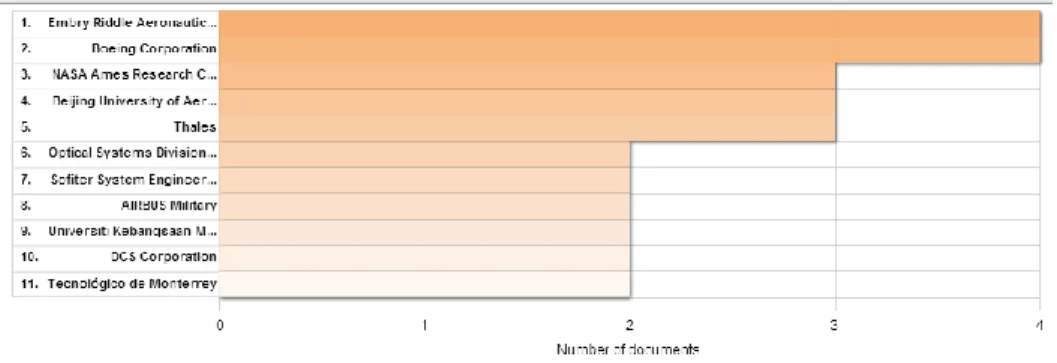
(27) Category. TOTAL. %. Augmented Reality or Mixed Reality. 6655. 100.00%. Interaction. 1903. 28.60%. Tracking. 1326. 19.92%. Mobile. 1300. 19.53%. Mobile devices (Tablet, PDA or handheld). 564. 8.47%. Calibration. 302. 4.54%. Rendering. 402. 6.04%. Authoring. 116. 1.74%. 84. 1.26%. 281. 4.22%. Related to maintenance on mobile devices tablets. 15. 0.23%. Mixed reality system for troubleshooting and maintenance. 8. 0.12%. Related to aviation Related to maintenance / assembly / procedural task. Table 3 Published articles (journals & conferences) from 2000 to 2012. Note: Data gathered from Scopus database: (TITLE-ABS-KEY("augmented reality" OR "mixed reality")) AND (TITLE-ABS-KEY("tracking”) AND PUBYEAR > 1999 “Scopus developers claim to index over 14,000 STM and social science titles from 4000 publishers, stating that it is the "largest single abstract and indexing database ever built". The database claims 4600 health science titles are indexed including 100% MEDLINE coverage, 100% of EMBASE coverage and 100% of Compendex coverage (Compendex is the most comprehensive search database for engineering R&D). It contains 27 million abstracts with citations back to 1966. In addition to American journals, it includes European and Asia Pacific literature in both English and non-English. Indexing includes CAS registry numbers, MeSH terms, EMTREE terms and supplemental key terms added by indexers…” [30]. Table 3 shows that the work done in AR in the aviation industry is barely 84 articles published where main institutions that provided that publications are the Embry Riddle University, Boeing corporation and NASA, more affiliations are showed in Figure 10 [29].. 27.
(28) Figure 10 Affiliations with more publications of application of the AR technology in the aviation industry. The authors Ong and Nee from the National University of Singapore are the principal authors that have presented to the scientific community studies related to procedural knowledge or maintenance procedures using augmented reality [29].. Figure 11 Authors with more publications for AR in the maintenance / assembly domain. Table 4 shows the principal studies and measurements of the efficiency of the AR technology when used in the maintenance and assembly domain since 2000, in general the first published articles were when AR was compared with traditional written instruction and multimedia guides, then more complex comparisons came, between different presentations of AR for example with head mounted displays, with desktop monitors and different interactions methods (virtual button, gesture buttons, sensors).. 28.
(29) TITLE Title Author Country, Year. Description AR system. Comparison system. Conclusions. Augmented reality in the psychomotor phase of a procedural task. Henderson & Feiner USA, 2011. Augmented reality (AR) user interface designed to assist users in the psychomotor phase of procedural tasks. 3D-graphics-based assistance presented on a stationary LCD. Participants overwhelmingly preferred the AR condition, and ranked it as more intuitive than the LCD condition. Exploring the benefits of augmented reality documentation for maintenance and repair. Henderson & Feiner USA, 2011. AR tracked headworn display to augment a mechanic's natural view with text, labels, arrows, and animated sequences designed to facilitate task comprehension, localization, and execution.. Fixed flat panel display representing an improved version of the laptop-based documentation currently employed in practice AND AR providing untracked text and graphics and a fixed flat panel display. The augmented reality condition allowed mechanics to locate tasks more quickly than when using either baseline, and in some instances, resulted in less overall head movement. Opportunistic tangible user interfaces for augmented reality. Henderson & Feiner USA, 2010. Participants performed a simulated maintenance inspection of an aircraft engine using a set of virtual buttons implemented both as Opportunistic Controls with AR. AR with virtual button only using simpler passive haptics. Opportunistic Controls allowed participants to complete their tasks significantly faster and were preferred over the baseline technique.. Assessment of communicative learning via Augmented Reality versus traditional method for aeronautical transportation Warden et al Mexico, 2011. AR method procedural task for maintenance. Traditional method with written instruction. Small sample cases at aeronautical sector. Augmented Reality efficiency in manufacturing industry: A case study. Sääski et al. Finland, 2008. AR instructions that were projected on one lens of a head mounted display. Paper instructions. Usability and method evaluation. 29.
(30) Augmented reality for assembly guidance using a virtual interactive tool. Yuang & Ong & Nee Singapore,2008. Virtual interaction panel (VirIP), is a tool that can be used to interactively control AR systems. Interaction pen during the assembly process It is tracked using a restricted coulomb energy (RCE) network. AR visual assembly tree structure (VATS) is used for information management and assembly instructions retrieval. The results show that the ARbased method can provide an efficient way for assembly guidance.. Augmented assembly using a mobile phone. Hakkarainen et al. Filand, 2008. Mobile phone based augmented reality (AR) assembly sy stem that enable users to view complex models on their mobile phones. N/A. People felt the interface was intuitive and very helpful in supporting the assembly task. Comparative effectiveness of augmented reality in object assembly. Tang et al. USA, 2003. AR instructions in an assembly task. Three instructional media were compared with the AR system: a printed manual, computer assisted instruction (CAI) using a monitor-based display, and CAI utilizing a head-mounted display.. Reduced the error rate for an assembly task by 82% Measurement of mental effort indicated decreased mental effort in the AR condition. Augmented Reality (AR) for Assembly Processes Design and Experimental Evaluation. Wiedenmaier et al. Germany, 2003. Tasks with different degrees of difficulty were selected from an authentic assembly process. AR system. 2 other kinds of assembly support media (a paper manual and a tutorial by an expert). AR support proved to be more suitable for difficult tasks than the paper manual, whereas for easier tasks the use of a paper manual did not differ significantly from AR support. Tasks done under the guidance of an expert were completed most rapidly.. Augmented reality in a learning paradigm for flight and aerospace maintenance training. 30.
(31) Macchiarella et al. USA 2004. AR system. Aerospace maintenance workers and pilots. Determined that AR-based learning effects long term memory by reducing the amount of information forgotten after a seven-day intervening time between an immediate-recall test and longterm-retention-recall test.. N/A. A mobile solution to enhance the troubleshooting techniques and maintenance procedures of the engine bleed air system on the BOEING 737 aircraft. Rios et al. Mexico, 2012. AR system for symmetric assemblies. Written instructions. Quality increase in 24% and time of assembly reduce by 17.22% when using AR system with 2 mirror symmetries in the assembly. AR expert system of knowledge transfer for complex assemblies: application to aeronautical processes Alcazar et al. Mexico, 2010. AR system for assembly of model airplane motors (complex assembly). Written instruction. 25% less time for total assembly of motor with AR. Usability evaluation of different AR technologies for aeronautical maintenance. Lerma et al. Mexico, 2012. AR with mark. AR markerless technology. Study showed that AR with regular black and white marker was better for industrial context but the markerless technology was more satisfactory to the user. Table 4 Principal studies of the improvements of AR technology when compared to others in the maintenance & assembly domain. From Table 4 it can be concluded that the replacement of written instructions by AR procedures will improve the quality of the output in complex assembly, and study to corroborated this results was made for assemblies with two mirror symmetries where similar results were found this study also contributes to the state of the art due to the differences in the assembly from other studies, specific details of this experiment will be given in chapter 5. Title. Area. Ababsa et al France 2012. Geological applications. Contributions Mobile augmented reality system dedicated to outdoor applications. Level of sophistication Camera, GPS and inertial sensor. 31.
(32) Emerenciano et al. Brazil, 2012. Network protocols. Collaborative Augmented Reality. Proposes a protocol for the transmission of visual cues. The protocol focuses on a client-server communication, where the client has the role to remotely supervise the activities, possibly sending interest points or instruction to the server. Lee et al. South Korea, 2012. Maintenanc e engineering. Knowledge Based System. suggests more improved smart maintenance system which can support engineering-knowledge to field engineers immediately as well as 3D CAD design information in working process. Neubert et al USA, Norway & UK, 2012. Maintenanc e engineering. AR application to guide a user through a machine tool setup and a printer maintenance task. Method for rapidly generating crude, appearance-based edge models consisting of a set of planes. Morkos et al USA, 2012. Automotive. Mobile configuration and augmented reality (wearable mobile devices) in a production environment. This paper details BMW's preliminary investigation and applicability study of implementing mobile devices within their manufacturing environment. Chang, J.-R Taiwan, 2011. Road managemen t system. Mobile road management system (RMS) on under the Android platform e. Road engineers are able to download the mobile RMS for free, for anytime and anywhere monitoring and reporting of insitu defects in road systems. A contextual mobile learning system framework. Allows us to learn mastering domestic and professional equipment. AR maintenance system. The work addresses these issues using spatial interaction and visualization techniques for mobile AR applications. Yin et al France, 2009. Schal et al. Austria, 2009. Assist us in our daily lives Field workers of utility companies in outdoor task s. The concept involves video-stream based user interfaces, mobile devices and location-aware information services. Complex model information is located on a PC, and a camera phone is used as a thin client access device to augment still images of the assembly site with animated AR sequences. Karhela, T Finland, 2008. Plant maintenanc es. Augmented Reality, video stream processing and humantechnology interaction.. Billinghurst et al. USA, 2008. Assembly w ork. Mobile phone based augmented reality (AR) assembly system. Mooser et al USA, 2007. Oil platform equipment maintenanc e system. Mobile clients to multiple data sources AR system. Collaborative, application. Savioja et al. Finland, 2007. Industrial plants. Plant Model Services for Mobile Process Maintenance Engineer. For plant personnel or personnel of an industrial service provider. data-driven mobile. 32.
(33) Engineering. Multiple collaborators can use consumer mobile camera phones to furnish a room together in an Augmented Reality environment. Interactive collaborative face Augmented Reality. Henrysson et al. Sweden, 2005. Engineering. Augmented Reality application for 3D scene assembly.. 3D content can be manipulated using both the movement of a camera tracked mobile phone and a traditional button interface. Rios et al Mexico 2012. Aviation. Troubleshooting system with connection to AR maintenance system. System enables user to follow no linear procedures commonly found in fault isolation of aeronautical engines. Andel et al Sweden, 2006. face-to-. Table 5 AR applications on Mobile/tablet hardware in the maintenance domain. In the next chapters the description of the EBAS system and its main functions will be introduced, also data from the Aeromexico company where an explanation of why the EBAS was chosen to be the center of the development then, in the next chapter, an explanation of the software in the mobile device will be described to reach the final part where the results and conclusions are presented.. 33.
(34) Chapter 3 The engine bleed air system of the BOEING 737. The BOEING 737 aircraft is equipped with two CFM56-7B engines that supply trust for the airplane. The engines also supply power for these systems: . Electric. . Hydraulic. . Pneumatic. This work is centered in the study of the pneumatic system and this chapter is designated to give an introduction to the troubleshooting techniques and the maintenance procedures for the mechanical component that belong to the EBAS. The 737 Engine Bleed Air System is designed to provide engine compressed air to air conditioning pack with the purpose of air pressurization in flight, engine air from the compressor is used, from the 5° and the 9° stage in a safe an economical way. The pneumatic system takes air from the Engine 9th Stage Compressor (High Stage) at low throttle settings and the 5th stage compressor (Low Stage) at higher throttle settings.. Figure 12 Air is taken from the 5° and 9° stages of the compressor section [31]. 34.
(35) During the different phases of flight the components must extract and regulate the air to achieve the expected requirements for the aircraft pressurization. The Bleed Air Regulator (BAR) controls the Pressure Regulator and Shutoff Valve (PRSOV) the purpose of the valve is regulate to 42+/- 8 psi, this is the range of pressure where the system will function most efficiently The 737 EBAS also control the temperature of the air this is accomplished by the precooler control valve (PCCV) and the precooler. The precooler is a heat exchanger that uses fan air to cool the hot compressor air, the valve controls the temperature from 390 °F to 450 °F (199 -232 °C). The system also control which compressor air is been used, this could the 5° or the 9°. At lower engine speed N1, the system use 9° stage air because it can accomplish the requirements of the air conditioning packs; the 5° stage is too low at this phase. This regulation is done by the High Stage Regulator (HSR) and the High Stage Valve (HSV) to 32 +/-6 psi. When the engine runs at higher speed and the air pressure gets above 32 +/-6 psi the HSR closes the HSV and the system operates at the 5° stage engine air. When the system pressurization drops below 32+/-6 psi the HSR opens the HSV and the 737 system operates in the 9° stages engine air. The check valve was placed in the design to prevent reverse flow when the air is taken from the 9° stage as shown in Figure 13. When the air pressure of the 9° stage is equal or greater than the 5° stage, the HSR causes the HSV to close in this way reverse flow is not permitted for the 9° stage.. Figure 13 Pneumatic system schematic [28]. 35.
(36) In the other hand if the temperature reaches 490°F there is a overheat switch that closes the PRSOV. The 737 Bleed air system is design to the following: 1. Regulates engine bleed air to 42 +/-8 psi 2. Regulates engine bleed air temperature to 390-450 °F 3. Control 5 and 9 stage air to accomplish systems requirements 4. Prevents reverse flow to the engine compressor 5. Prevents the engine bleed air from getting hotter than 490 F. Description of subsystem in the EBAS. When the system is working in the high stage regulation the components functioning are the HSR and the HSV (32 +/-6), the HSR is controlled only with pneumatic inputs, and this component turns off when reverse flow is detected. There is a supply pressure for the HSR that comes from the 9° stage, when the supply pressure is 10 psi the HSV will be open, when the supply pressure is higher, the HSR provides a constant pressure so the HSV can regulate to 32 +/- 6 psi. When the 9° stage compressor is greater than 110 psi the HSR closes the HSV, also when reverse flow is detected from the PRSOV during engine start, the reverse flow diaphragm closes the HSV. The check valve in the 5° stage prevents the reverse flow to the 5° stage, this component will keep safe the engine and without damage. In other side after the PRSOV the precooler change the temperature of the air, using the fan air, the component is in charge of controlling the amount of fan air that enters is the precooler control valve (PCCV), the air conditioning pack functions more efficiently 390-400 °F, the idea is to control the engine bleed air by using the air from the fan, in the same fashion there is a supply pressure and control pressure in the PCCV, when the control pressure is at 10 psi the air is not flowing. The PCCV is controlled by a 390° sensor when the temperature gets above 390° the control pressure is reduce so the PCCV opens to let air flow. When the air temperature reaches 440° F the 390° is fully open causing the PCCV to be fully open. The supply pressure and the control pressure can be measure by a troubleshooting technique. The BAR and PRSOV control the air pressure of the EBAS, the PRSOV is the last valve that will send the compressed air to the system, the BAR will close the PRSOV if overpressure is detected, there is a supply pressure to the BAR, then it will supply a control pressure to the PRSOV, this way the regulation is 36.
(37) detected, when supply pressure is 10 psi PRSOV opens, if the supply pressure is higher the BAR supplies a control pressure so that the PRSOV can regulate to 42+/-8 psi. If HSV fails and let the air from the 9° flow without control, the BAR has an overpressure switch that will close the PRSOV by reducing the control pressure to 0. The overpressure switch will cause the bleed trip light to illuminate. If the 450° F is activated will reduce the control pressure for the PRSOV in order to regulate the amount of air that is passing through the PRSOV, this should allow the precooler to cool the air that is flowing, if the temperature keeps racing the 450° sensor will continue to close the PRSOV until the EBAS system pressure is really low. A description of how the system works during the different phases of flight will be presented, in engine ground idle the high stage system will be providing the air, the check valve will be close and the air is at low pressure, the PRSOV will be fully open, the air temperature is low enough for the PCCV to remain close. At taxi the high stage system will most likely be providing the bleed air, depending on the throttle setting the pressure will be higher that 32 +/-6 psi, if this is the case the HSV will reduce the pressure also if the air is hotter than 390° the sensor will open the PCCV to cool it. During takeoff and climb throttle settings the high stage air is too high, the HSR will close the HSV and the air will flow through the 5° stage to the PRSOV, the air pressure will be greater than 42 +/-8 psi therefore the PRSOV will regulate the amount of air entering the system also the temperature will be greater than 390° the PCCV will open to regulate the temperature. During cruise the throttles are reduce to maintain speed, also the aircraft becomes lighter the low stage will go below 42 +/-8 psi, the HSV will be close. The PCCV will close because temperature is not above 390°. In some point the low stage air will be too low so the high stage pressure will enter the system until it gets to the maximum allowable pressure at the same time the air temperature may be greater than 390° and the sensor will activate the cooling system. In decent the throttles are back to flight idle the HSV continues open, typically the pressure is less than 32 psi so the HSV will be completely open as the PRSOV, and also the temperature is below 390°. When an operator must troubleshoot the system, he uses simple test equipment that will lead to the component that has failure, this equipment consist in hoses, fittings, regulator, nitrogen pressure source, T-valve and gauge. The procedures have been developed to monitor the pressure depending of the reports of failure by providing nitrogen to HSV, PCCV, HSR and PRSOV.. 37.
(38) Maintenance. Maintenance strategies can be broadly classified in two types: the corrective maintenance (CM) and preventive maintenance (PM). In the industry application of the PM strategy can be generally performed through either experience or original equipment manufacturer (OEM) recommendations, and is based on a scientific approach, where in most cases it is performed at regular time intervals, T [32]. This is the case of the aviation industry, airlines like Aeromexico, it must provide PM to the aircrafts and when the components fail the company will run the corrective maintenance to certified health of the machine and security for the passengers. There are also other concepts involve in the maintenance area that are applied in the aviation industry like the time-based maintenance (TBM) and condition-based maintenance (CBM). As shown in Figure 14 the general TBM process is based in the failure data analysis and it also assumes that the failure of the equipment is predictable. Figure 14 General TBM process [32]. CBM was introduced in order to minimize cost of maintenance because in some cases it is very difficult to obtain an assessment for the TBM that will maintain low the cost and the equipment in good conditions. Figure 15 show the process for CBM, as its name suggest condition monitoring is based on special measurements devices, such as vibrations, pressure gauges and others. The CM process can be carried out into two ways: on-line and off-line. On-line processing is carried out during the running state of the equipment (operating state), while off-line processing is performed when the equipment is not running. [32].. 38.
(39) Figure 15 General CBM process [32]. The principal maintenance tasks that where included during the stage of development of the software are the following: . Chapter 36 Pneumatic Fault Isolation Procedure. . TASK 36-11-03-000-801 BLEED AIR REGULATOR – REMOVAL. . TASK 36-11-03-400-801 BLEED AIR REGULATOR – INSTALLATION. . TASK 36-11-04-000-801 PRESSURE REGULATING AND SHUTOFF VALVE (PRSOV) – REMOVAL. . TASK 36-11-04-400-801 PRESSURE REGULATING AND SHUTOFF VALVE (PRSOV) – INSTALLATION. . TASK 36-11-05-000-801 450 F THERMOSTAT - REMOVAL. . TASK 36-11-05-400-401 450 F THERMOSTAT – INSTALLATION. . TASK 36-11-06-000-801 HIGH STAGE VALVE - REMOVAL. . TASK 36-11-06-400-801 HIGH STAGE VALVE – INSTALLATION. . TASK 36-11-07-000-801 HIGH STAGE REGULATOR - REMOVAL/INSTALLATION. . TASK 36-11-07-400-801 HIGH STAGE REGULATOR – INSTALLATION [33]. Each of the tasks have specifications of the references that the user have to use, the tools, the proper disassembly process, the tags that must be placed to avoid injury and it also specifies the torque of each screw in the component for the installation process.. Isolation of faults. Typically the pilot reports are of two types, one when the bleed trip light was illuminated and the other one is for low duct pressure, the personal in charge of maintenance have to process the available information like the phase of flight, pressure of the ducts, N1 revolutions of the engine, altitude among others. If some of the information is not like available like N1, the maintenance operator has to get the information by running the engine.. 39.
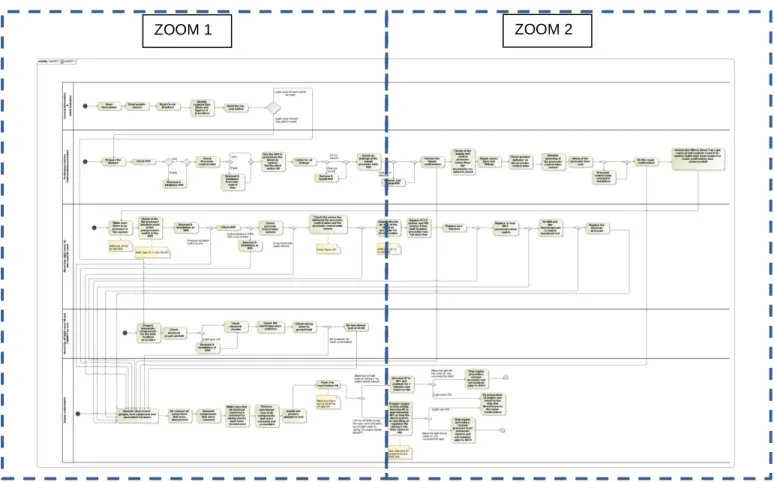
(40) Figure 16 Stages of flight. The main task for the isolation procedures are: . BLEED TRIP OFF Light On for both engines. . Bleed valve: does not close when the bleed switches are moved to off, the engine is the bleed source.. . Duct pressure indication: high, low or zero, the engine is the bleed source.. . Isolation valve: does not operate correctly.. . Duct pressure indication: L and R pointers not the same (split), the engine is the bleed source.. . Duct pressure indication: L and R pointers not the same (split), the APU is the bleed source.. A brief description of the procedures will be given in the following section, the reader should be aware that due to the fact that sensitive information is treated, the procedures will be described general terms. BLEED TRIP OFF Light On for both engines. Occurs when the Precooler outlet temperature is above 485-500 °F (252-260° C) but it also can occur when an overpressure condition is detected (250 psi for the upstream in the PRSOV). Bleed trip due to overpressure do not occur often and they are typically in takeoff thrust. But the over temperature condition is typically due to the PCCV not opening sufficiently. The typical causes for overpressure are the HSV not fully close, the HSR providing too high control pressure to the HSV or faulty BAR overpressure switch actuating too early. If there is an overtemperature could be due to the PCCV, 390° sensor does not open correctly, 450° sensor does not open correctly or the Precooler is not effective. 40.
(41) Bleed valve: does not close when the bleed switches are moved to off, the engine is the bleed source. This condition is presented when the switches are moved to off position but the pressure indication of the dual duct does not decrease to less than 10 psi. A typical failure is presented in the harness when they have an internal shorting that can cause that the electrical array does not close the PRSOV. Duct pressure indication: high, low or zero, the engine is the bleed source.. A high duct pressure condition is a condition in which one or both pointers on the dual duct pressure indicator are higher than 50 psi, with the engines as the bleed source when operating on regulated 5th stage pressure in a stabilized condition. If you have a pilot report or an observed fault and you know the bleed pressure, engine N1 speed, and the altitude at the time the fault was observed, you can determine if the system was operating within limits. A low duct pressure is presented when one or both pointers on the dual duct pressure indicator are lower than 34 psi. It can be difficult to tell which part might be causing the problem when so many parts affect low duct pressure, the idea is to isolate the part by using the proper troubleshooting equipment like nitrogen source, hoses and regulators, and this equipment is used to simulate the effects of the different pressures in the valves. If you know the phase of flight and have the information of the pressure it can be determined if the engine was running within the limits with N1 vs altitude graphs. Isolation valve: does not operate correctly. The isolation valve is controlled by a three-position switch on the P5-10 panel, this is also electrically connected to four switches: engine no 1 bleed switch, engine no 2 bleed switch, left pack switch and right pack switch. The APU bleed air APU bleed air or bleed air from an external ground air source may be used to determine if the operation of the isolation valve is correct. Duct pressure indication: L and R pointers not the same (split), the engine is the bleed source.. Split duct pressure is a condition in which the duct pressure on one side, as shown on the dual duct pressure indicator, is either lower or higher than the duct pressure on the other side with the engines as the bleed source.. 41.
Figure
![Figure 2 2008 World civil MRO market [1]](https://thumb-us.123doks.com/thumbv2/123dok_es/2322322.516794/11.918.123.809.244.515/figure-world-civil-mro-market.webp)

+7
![Figure 8 Distribution of data in a virtual engine maintenance environment to find abnormal behavior in turbines [26]](https://thumb-us.123doks.com/thumbv2/123dok_es/2322322.516794/24.918.287.636.178.411/figure-distribution-virtual-maintenance-environment-abnormal-behavior-turbines.webp)


![Figure 13 Pneumatic system schematic [28]](https://thumb-us.123doks.com/thumbv2/123dok_es/2322322.516794/35.918.194.715.649.1002/figure-pneumatic-system-schematic.webp)
Documento similar
The gain of state space decomposition techniques with respect to the classical exact solution algorithm (solution of the underlying CTMC of the original model) is in both memory
Government policy varies between nations and this guidance sets out the need for balanced decision-making about ways of working, and the ongoing safety considerations
No obstante, como esta enfermedad afecta a cada persona de manera diferente, no todas las opciones de cuidado y tratamiento pueden ser apropiadas para cada individuo.. La forma
In the previous sections we have shown how astronomical alignments and solar hierophanies – with a common interest in the solstices − were substantiated in the
In parallel to the use of aircraft spotters, we have an automatic aircraft detection system developed at UCSD known as TBAD (Transponder-Based Aircraft Detection).. Our airspace is
Nevertheless, the ratio of corporations using patents of introduction is higher than that obtained from the analysis of the entire patent system as a whole (around 8.5% from 1820
In this article, a polarization-sensitive Optical Projection Tomography (OPT) system with image acquisition and processing protocol was developed to enhance the detection of
While Russian nostalgia for the late-socialism of the Brezhnev era began only after the clear-cut rupture of 1991, nostalgia for the 1970s seems to have emerged in Algeria
