www.elsevier.es/magister
MAGISTER
THEORETICAL
REVIEW
A
literature
review
about
Argentinian
educational
management
in
times
of
change
María
Eugenia
Vicente
NationalUniversityofLaPlata(UNLP)andNationalScientificandTechnicalResearchCouncil(CONICET),Calle9No.586,
(1900)LaPlata,Argentina
Received7June2016;accepted28October2016 Availableonline13December2016
KEYWORDS Educational management; Educationreform; Socialinclusion; Secondaryeducation; Argentina
Abstract Theaimofthisarticleistocollectappropriateinformationonthecharacteristicsof educationalmanagementintimesofreformsorchangesinitsinstitutionalstructures.
Thisreviewadoptsadescriptivequalitativemethodologyandappliesdocumentaryanalysis asatechniquetoidentify,describeandrepresentthecontentofthedocumentsinawayother thanthe originals’, inorderto enable itsdiffusion anduse for otherresearch studiesand documentsoneducationalmanagement.
Thefindingsareintendedtoparticipateinadiscussionaboutthesetofroutines,habitsand institutionalpracticesthatformeducationalmanagementintimesofreform.
©2016FacultaddeFormaci´ondelProfesoradoyEducaci´ondelaUniversidaddeOviedo. Pub-lishedbyElsevierEspa˜na,S.L.U.Allrightsreserved.
PALABRASCLAVE Gestióneducativa; Reformaeducativa; Inclusiónsocial; Educación secundaria; Argentina
Unarevisiónbibliográficasobrelagestióneducativaargentinaentiemposdecambio
Resumen Este artículo tiene el objetivo de recopilar la información relevante sobre las característicasquepresentalagestióneducativaenmomentosdereformasocambiosensus estructurasinstitucionales.
Lametodologíarespondeaundise˜nodetipocualitativodescriptivoylatécnicautilizadaes elanálisisdocumental;estádirigidaaidentificar,describiryrepresentarelcontenidodelos documentosdeformadistintaalaoriginal,conelpropósitodeposibilitarsudifusiónyusopara otrasinvestigacionesydocumentossobregestióneducativa.
E-mailaddress:[email protected] http://dx.doi.org/10.1016/j.magis.2016.10.002
Las conclusionesestándestinadasaparticiparenundebatesobreelconjuntoderutinas, hábitosyprácticasinstitucionalesqueconfiguranlagestióneducativaentiemposdereforma. ©2016FacultaddeFormaci´ondelProfesoradoyEducaci´ondelaUniversidaddeOviedo. Pub-licadoporElsevierEspa˜na,S.L.U.Todoslosderechosreservados.
Introduction
In Argentina, the first attempts to achieve social inclu-sionatsecondaryschoolthroughnationaleducationpolicies date back to the 1990s. The educational context of the timewascharacterizedbyincreasedenrollmentrates and the incorporation of middle-class and popular sectors to secondaryschool.Thecriteriafordemocratization, partici-pation,equity andtransformation,asset forthbySection 51 of Federal Education Law No. 24195 enacted in 1993 (MinisteriodeEducacióndelaNación,1993),wouldprovide theinstitutional framework topromoteequal educational opportunitiesandpossibilities.
Thus,theaimoftheeducationpolicywastochangethe traditionaladministrativestructures,characterizedas ver-tical andrepetitiveof certain social orders,to become a modelthatcouldrepresenttheinterestsofbroadsectorsof thepopulationthroughinstitutionaldecentralization. Insti-tutionswouldpresumablybeabletodefinetheirmodesof operationandobjectivesautonomously,accordingtotheir needs.
However,inreality,thegeographicallocation,the socio-economic characteristics ofthepopulation, thequalityof learning and the perceived requirement level formed a secondary educationdefinedinterms of categorizationof schoolswhosediplomasdidnothavethesamevaluein soci-ety(TentiFanfani,2003;Tiramonti,1989).
Inthisregard,some educationalresearchcontributions (Dussel, 2005; Gimeno Sacristán, 2005; Jacinto, 2009; Terigi, 2008) noted that the differential system showed that equality wasonly theoreticaland not real. Contrary to expectations, institutional uniformity proved to be an element of inequality given the wide variety of cultural, geographical, social and economic factors. Furthermore, these studies also showed that educational institutions continued to operate under a traditional mechanism (Tedesco,1986),moresuitedtoorganizeinequalityamong schoolchildren thantomake roomfor thecoexistenceof a plethora of skills, levels, pace of learning, and varied motivationsofyouthsandadolescents.
Later in the2000s, socialinclusion became thecenter ofnationaleducationpoliciesagain,thistimethroughthe implementationofanewinclusionstrategythatmade sec-ondary education compulsory throughout the Argentinian territoryand acknowledgeddifferenttypes ofeducational management(state-run,private,cooperativeandcivil soci-etymanaged schools)andinstitutional formatscapableof organizing the diversity of demands, profiles and trajec-tories of the level. This education reform beganin 2006, throughtheenactmentoftheNationalEducationLaw(LEN)
No. 26206 (Ministerio de Educación de la Nación, 2006), whichgavespecialimportancetotherecoveryofstudents whohavedroppedoutofschool(Feldfeber&Gluz,2011).
As regards the features of secondary school students, Tenti Fanfani (2009), and Briscioli and Toscano (2012) pointed out that compulsory secondary education was accompaniedbyasignificantchangeinthesocial morphol-ogy of students since it entailed not only an increase in schoolingratesbutalsotheincorporationofadifferentset ofstudentstraditionallyexcludedfromthelevelthatbring theirownclassandculturetoschool.
Likewise, changes in social and family structure, and theinstancesof productionand disseminationofmeaning (culture)affectsubjectivityconstructionprocesses.Inthis sense,thecharacteristicsofaccess,permanenceand grad-uationconstituteacomplexprocessthatinterweaveswith other social and personal processes,such as the need to work,thepovertyconditionsof youthsandtheir families, thewilltocontinuestudyingornot,thefreedomtodecide onone’sownfuture,aswellastheexpectationsthat cer-tifiedcompletionof secondary studies generates.In fact, until2011,Argentinakeptalowsecondarygraduationrate inthe poorestsegment ofthe population(40% of quintile 1),whereastherichestsegmentofthepopulationshowed ahighgraduationrate(87%ofquintile5)(IDB,2011).Thus, theenactmentofthelawprovestobeinsufficienttoresolve thecomplexyouthsandadolescents’educationalprocesses. Institutions (DiNIECE, 2009), understood as a set of rules and resources that structure social and educational practices, changed their shape and meaning. As regards organizationalstructuresthatsupportsocialinclusion,there are two different perspectives. On the one hand, it is believedthat socialinclusion is achievedwheneverybody takespartin thesame school(homogeneousstructuresin organizationalandcurricularterms).Someauthors(Arroyo & Nobile, 2015; Montes & Ziegler, 2012; Tenti Fanfani, 2009;Tiramonti, 2012)arguethat socialjustice in educa-tionimpliesthatthosesocialsectorsthatwereexpelledor neveraccessedsecondaryschoolmustremaininand gradu-atefromthoseverysameschools.
needs.Hence, schoolvariety is vitalin ordertocaterfor social andcultural diversity(Duschatzky & Aguirre,2013; Duschatzky, Farrán, & Aguirre, 2010). According to this line ofanalysis, andconsidering Argentina’slow scores in internationaltests(mainlyPISA),evaluationsareseenjust asspecificlearningslicesthatdonotreflectactualvariety of situations within the classrooms. At the same time, social andeconomic regionalcontexts prompt necessarily different forms of knowledge construction (Leal & Pérez Centeno,2014).
Inthisscenario, notonlydoeducationreforms, under-stoodasinnovationsinorganizationalandcurricularforms and dynamics, affect factors directly related to the configurationandrunningof theschool,butalsothe non-pedagogicalbondsbetweenschoolandsociety.Thesebonds, which are foundational and constitutive of institution-specific cultures,define their senseand practices, and it isinthosecultureswhere educationreformsaremeantto beintroduced(Ezpeleta,2004).
Likewise,forAguerrondo(2013)theproblemliesnotin thecontentbutinthemanagementofthepolicies,partly becausepromises arenot(completely) fulfilledandpartly becauseduringtheimplementationprocesses,unexpected elements(beyondcontrol)emergeandfrustratetheresults. Theterm‘‘educationalmanagement’’referstoanaction disciplinethatcloselylinkseducationaltheorytopractice, thussettingitselfupasaprofessionalfield(Vicente,2012, 2014),whosecoreliesinthecoordinationofthepedagogical action.The latter entailsthe creationof favorable condi-tionsandsituationsforthedevelopmentofthepotentialof allactorstoparticipateintheproductionofknowledge,and intheinterpretationandtransformationofculturalcodes, sociallyandhistoricallyproduced(Chaves,2006;Duschatzky &Birgin,2001).
Thus,educationalmanagementstudiesfocusonthe anal-ysisofmultiplestrategiesandwaysofsolvingeveryday con-tingenciesateducationalinstitutionsaccordingtodifferent institutional,grouporpersonalrealities,aswellasspecific problemsandneeds(Garcia,Manzione,&Zelaya,2015).
Inthiscontext,thisarticleaimstoorganizethe contrib-utions about the characteristics assumed by educational management in times of reforms or changes in its insti-tutionaland policymatricesonthesubjectof Argentina’s education reform. Therefore, the next section describes the selected methodological strategy, which applies the literaturereviewasatechniquetofindouttheproduction ofknowledgeonthesubjectforfurtherreflectionsonthe processesof educationalmanagement at schools in times ofchange.
Methodology
Thisstudyfeatures adescriptivequalitative designwhose purpose is to identify the characteristics, properties, dimensions and regularities of institutional performance andschoolmanagementinacontextofeducationreform. Documentaryanalysisisthetechniqueappliedtoidentify, describe and represent the content of the documents in a way other than the originals’, in order to ensure its selectiveandtimelyrecovery,andfacilitateitsexchange, diffusion and use. The databases consulted were the
following: (1) FLACSO’s online catalogs (BIB and REVIS); (2) Memoria Académica: digital repository of magazines, newsletters, theses and audiovisual presentations; (3) e-BIBLIOTECA: access to bibliographic and documentary production in Social Sciences on the Andean region and Latin America in general; (4) EBSCO research databases; mainly: SocINDEX, Professional Development Collection andEducation ResourceInformation Center(ERIC),Portail de revues en sciences humaines et sociales (PERSEE) and Academic Search; (5) JSTOR, SCIelo, Dialnet, Latindex databases;(6)Minutesofconferencesoneducationpolicies andschoolmanagement.
In the aforementioned databases, a search of articles and books containing the keywords: ‘‘institutional struc-ture,’’ ‘‘educational management,’’ ‘‘education policy,’’ and‘‘institutionalchanges’’wasconducted.
Studiesabout education policyor specific programson education policy which did not refer explicitly to the administrativedimensionoreducationalmanagementwere discarded.
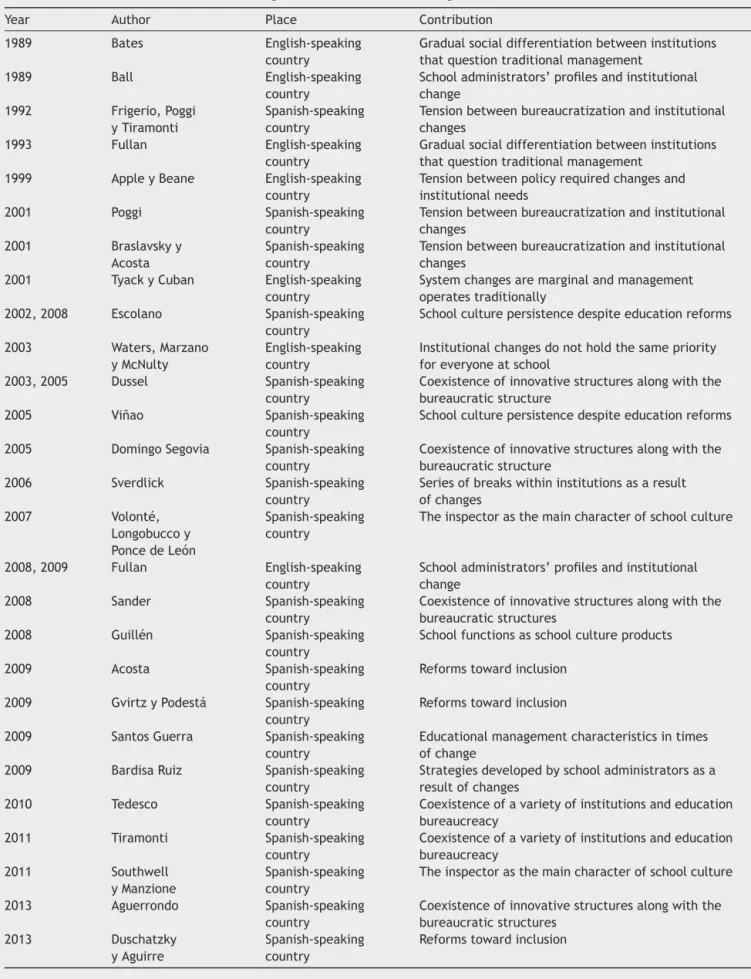
The bodyof the samplecomprises 29 works(17 books and12magazinearticles)oneducationalmanagementand institutional changes (education reforms, curricular and institutionalimprovementsandeducationalinnovations).All ofthemaddressthetopicfromaqualitative methodologi-cal perspective.This groupof works cover differenttime periodsandbelongtoauthorsfromavarietyofcountries. In this sense, the empirical body was organized around keywords and place and timeof contribution for analysis enrichmentpurposes. Thus,thisliteraturereview on edu-cational management is presented considering the place and time in which each work of reference was produced (Table1).
Fordataprocessingpurposes,contentanalysiswas car-ried out through the categorization, fragmentation and encryptionofdataaccordingtothefollowinggeneral varia-bles: (I) institutional functioning; (II) characteristics of schoolmanagement;each ofwhich variesin terms of:(a) time (classic and contemporary contributions), (b) place (AnglophoneandLatinAmericancountries).
Results
Table1 Contributionsoneducationalmanagementandinstitutionalchange.
Year Author Place Contribution
1989 Bates English-speaking
country
Gradualsocialdifferentiationbetweeninstitutions thatquestiontraditionalmanagement
1989 Ball English-speaking
country
Schooladministrators’profilesandinstitutional change
1992 Frigerio,Poggi yTiramonti
Spanish-speaking country
Tensionbetweenbureaucratizationandinstitutional changes
1993 Fullan English-speaking
country
Gradualsocialdifferentiationbetweeninstitutions thatquestiontraditionalmanagement
1999 AppleyBeane English-speaking country
Tensionbetweenpolicyrequiredchangesand institutionalneeds
2001 Poggi Spanish-speaking
country
Tensionbetweenbureaucratizationandinstitutional changes
2001 Braslavskyy Acosta
Spanish-speaking country
Tensionbetweenbureaucratizationandinstitutional changes
2001 TyackyCuban English-speaking country
Systemchangesaremarginalandmanagement operatestraditionally
2002,2008 Escolano Spanish-speaking country
Schoolculturepersistencedespiteeducationreforms
2003 Waters,Marzano yMcNulty
English-speaking country
Institutionalchangesdonotholdthesamepriority foreveryoneatschool
2003,2005 Dussel Spanish-speaking country
Coexistenceofinnovativestructuresalongwiththe bureaucraticstructure
2005 Vi˜nao Spanish-speaking
country
Schoolculturepersistencedespiteeducationreforms
2005 DomingoSegovia Spanish-speaking country
Coexistenceofinnovativestructuresalongwiththe bureaucraticstructure
2006 Sverdlick Spanish-speaking
country
Seriesofbreakswithininstitutionsasaresult ofchanges
2007 Volonté,
Longobuccoy PoncedeLeón
Spanish-speaking country
Theinspectorasthemaincharacterofschoolculture
2008,2009 Fullan English-speaking country
Schooladministrators’profilesandinstitutional change
2008 Sander Spanish-speaking
country
Coexistenceofinnovativestructuresalongwiththe bureaucraticstructures
2008 Guillén Spanish-speaking
country
Schoolfunctionsasschoolcultureproducts
2009 Acosta Spanish-speaking
country
Reformstowardinclusion
2009 GvirtzyPodestá Spanish-speaking country
Reformstowardinclusion
2009 SantosGuerra Spanish-speaking country
Educationalmanagementcharacteristicsintimes ofchange
2009 BardisaRuiz Spanish-speaking country
Strategiesdevelopedbyschooladministratorsasa resultofchanges
2010 Tedesco Spanish-speaking
country
Coexistenceofavarietyofinstitutionsandeducation bureaucreacy
2011 Tiramonti Spanish-speaking
country
Coexistenceofavarietyofinstitutionsandeducation bureaucreacy
2011 Southwell
yManzione
Spanish-speaking country
Theinspectorasthemaincharacterofschoolculture
2013 Aguerrondo Spanish-speaking
country
Coexistenceofinnovativestructuresalongwiththe bureaucraticstructures
2013 Duschatzky
yAguirre
Spanish-speaking country
by the reforms within the institution. Most leadership stylesrequireagreaterorlesserdegreeofmutualsupport between the leader and the staff and, as the process of joint action progresses, mutual adjustments, agreements andnegotiations, allplay a vitalrolein the development ofsocial relationships.Thus,leadershipstyles areneither fixednorimmutable.
Finally,at curricularandteachinglevel,thefindingsof AppleandBeane’s(1999)piecesofresearchpointoutthat the creation of a democratic curriculum entails conflict and debate. There is a constant tension among teachers betweenprovidingamoremeaningfuleducationtoyouths andadolescentsandlivinguptotheexpectationsofcertain educationalgroups,whoseinterestsrespondtoaminority, intermsofknowledgeandskills.
Some of the American authors’ contemporary con-tributions state that education reforms relate to each institutionandwithinthese,toeachgroupofactors. There-fore, in some institutions, some reforms fail or achieve undesirableeffects.
ThecontributionsofTyackandCuban(2001)intermsof institutionalfunctioning,recognizethatsysteminnovations1
were marginal, allowing schools’ traditional structure to persistsothatteacherscouldperformtheirdutiesina pre-dictableway,carryingoutthedailyschooltaskstheschool boards,principalsandparentsexpectedthemtofulfill,i.e. controllingstudentbehavior,instructingheterogeneous stu-dentsandsegregatingpeoplefortheirfuturerolesinschool andlaterinsociety.
Atthesametime,Waters,Marzano,andMcNulty(2003) researchrevealsthatduringthelast20years,thechanges proposedinalmosteveryeducationreformdonotholdthe sameprioritywithintheinstitutions;i.e.whenthechanges proposedareinlinewiththoseoftheinstitution,andthere is agreement on what changes areneeded and how they should be implemented, the changes are prioritized, but wheninnovationscomeintoconflictwithprevailing values andstandards,or theimplementationplanis unclear,the proposedchangesarepushedintothebackground.
At school management level, Fullan (2009) recognizes the emergence of a new paradigm of leadership tocarry outreformswithineachinstitution.Traditionalmanagement practicestriedtoreachagreementthroughalliancesformed withcommoninterestgroupsaimedatbeatingthe opposi-tion.Realityhasshownthatthisstrategyhasonlyshort-term results.Bycontrast,thenewparadigmofeducational man-agementaimsatmeetingcommonpointsbetweenopposing positions,thusreachingsuperioragreementsfortheparties involved. This requires that each institutional actor be included,respectingthedifferences,withouttryingto neu-tralizethem.
Meanwhile, in Latin America, some classic contrib-utions indicate that the practices and characteristics of
1Forexample:thecreation ofschoolsnotorganizedbygrades
(traditionalschoolsareorganizedbyages);optimumuseoftime, space and number of students as flexible resourcesto diversify uniformclassperiods withsame-size classrooms;class size stan-dardization;coursesunificationinspecialized subjectsoraround departmental specializations; team-work promotion among tea-chersvs.independentisolatedworkinseparateclassrooms.
educationalinstitutionsareresistanttochange.This posi-tion is reinforced by a weak coordination between the differentlevelsofeducationalmanagementspecification.
Asregardstheinstitutionalfunctioning,Frigerio,Poggi, andTiramonti(1992),Poggi(2001)andBraslavskyandAcosta (2001) indicate that schools have a dual problem when it comes to facing changes. On the one hand, they are bureaucratized,whichmeans theyhaveroutineproblems, resistance to change and lack of flexibility. On the other hand,educationhasitselfarelativelyslowrhythmofchange sinceitisoneoftheaspectsthatparticipatesinthe preser-vation of culture, and transformations in such field take manyyears.
Besides,educationreformproposalsbelongtoaminority socialsectorandtheycannotbeimprovedneitherbycritical perspectivesfromsectorssuchaslaborunions,employersor publicopinioningeneral,norbyafluidprocessof commu-nication where teachers,principals, parents and students participate.
Finally,therearevariouslevelsofeducational manage-mentspecificationinLatinAmerica:thelevelofeducational institutions,themunicipalordistrictlevel,the departmen-tallevel,thestateorprovinciallevelandthenationallevel. Theselevelstendtobedefineddecreasinglyashierarchical levelsandincreasinglyasinterconnectedsetsofconcentric circles with territorial specificities, which are not recog-nizedassuchorwhicharenotsynergicallycoordinated.This comesontopoftheinabilitytodesigndevicestocounteract theinstitutionalweaknessderivedfromeducationpolicies typicalofthedecadesoftaxadjustmentontheeducation sector.
Regardingeducationalmanagementinschools,the multi-plicityandrangeofobjectivespresenttodayineducational institutions,thevarietyofcontextsinwhichtheyare devel-oped; the increased workload, the greater diversification of its tasks; simultaneity, immediacy and indeterminacy; brevity,varietyanddiscontinuity,arerelevantfeatures of managementpractices(Frigerio,Poggi,&Tiramonti,1992). Furthermore,educationalmanagementis conducted in isolation frommanagementtraining,whichtakes placeat university,whileatthesametimeeducationalmanagement produces information and knowledge in each institution. This fragmentation hinders the possibility of building a techno-scientificsystemthatenablescontinuousinnovation (Braslavsky&Acosta,2001).
On the other hand, contemporary researchon educa-tionalmanagementintheLatin Americanregionindicates the coexistence of innovative structures that attempt to strengthen social inclusion management processes, along with the persistence of the bureaucratic structure that shapes management practices reducing and conditioning reformefforts.
schoolsandbeabletointeractwithinthem;(b)carryoutthe expecteddailyactivities,especiallyintheclassroom,andbe abletomeetthosetasks’demandsandlimitations;and(c) survive consecutive reforms by their reinterpretation and tailoringtothatculture-specificcontextandneeds.
In thisregard,anumberofresearchstudies havebeen conductedwiththeaimofanalysingschoolculturethrough thestudyofschoolsmocks(Dussel,2003),theinspector fig-ure(SouthwellandManzione,2011;Volonté,Longobucco,& PoncedeLeón,2007),schoolfunctions(Guillén,2008)and schoolbooks(Escolano,2002,2008).
On the onehand, schoolsmocks studies(Dussel,2003) pointoutthatanalysingthecultureform‘‘school’’implies studying thewayin which itbecame a nationaland local experience. School smocks served as gateways to deploy thoselocalizationprocessesthatformedthebasisfor expan-sionoftheArgentinianschool.Theuseoftheschoolsmock isunderstoodhereastheproductof‘‘minor’’and‘‘major’’ discursivepractices,ofexpertdiscourses,moraldiscourses, institutionalcodesandregulations,body-relatedpractices andpoliticalandsocialbeliefs.
On the other hand, studies on the inspector figure (Southwell&Manzione,2011;Volonté,Longobucco,&Ponce deLeón,2007)showedthat itactedasacontrol and dis-cipline device with its own abilities and functions, that not only reproduces the rule but also prescribes correct practicesonateachingbasis.Mediationbetween therule (understoodasaguideforteachers’performanceatschool) andthecustomthatcouldbeobservedinrelationtothe sys-temgovernance,turnsintoastrongconfidenceintherule’s quality,asaconfigurationtoolofinspectionpractices.
Asregardsschoolfunctionsstudies,Guillén(2008)states that rituals pervade daily life holding a nodal positionin culture and building themselves as crucial foundationsof theinstitutionallifeofsocietyanditsbodies,amongwhich theschoolisincluded.Traditionalnationalholidaysatschool setthemselvesastherulewhichturnsthemintocommon sense: daily routines andrituals areincorporated intoan everydayschoollifethatprescribesinarigurousand artic-ulate grammar the meaning of Homeland, Patriotism and Citizenship. Thus, a version of history is imposed, a love mandatetoHomeland,nationalsymbolsandwhateverthe countryproduces.
Regarding the school book, research conducted by Escolano (2002, 2008) describe it as a space for memory thatmaterializedtheprogramsthroughwhich eachschool cultureperiod,prevailingimagesandvalueswererealized inthesocietythatproducesandusesthetexts,aswellas thecommunicationandappropriationmethodsofthe edu-cational content. The school book survives as a constant corporeity belonging to the educational sphere and tea-chers’ergologicaltools,althoughitadoptscommunication methodsmergedintocertaintechnologicalformats,atthe sametimethatinfluencessomebehavioralpatternsof peo-plewhomakeuptheirtextsthroughwebbrowsedmaterials. Sander’s contributions (2008) recognize that, in the region,itisnecessarytocontinueinvestinginthe develop-mentofeducationalpracticesthatarepoliticallyeffective forthecommunitiesandtheireducationalinstitutions, cul-turally relevant for the actors playing a role in everyday schoolpractice, sociallysignificant and ethically validfor thegeneralpublic.Inthissense,Aguerrondo(2013)argues
thatoneofthecausesofthedeclineineducationalquality is that the complex bureaucratic organization of educa-tionsystemshasnotallowedteachingcustomizationtothe uniqueneedsofthedifferentsocialgroups.
In addition to these structural issues, a number of demands wasimposed onschools (Dussel, 2005), namely: to teach more and more contents in an interesting and productiveway;toprovidesupportandcare;toassistthe families;toorganizethecommunity;toactasacharitable organizationcollectinganddeliveringfood,healthcareand socialassistance;todetectabuse;toprotecttherightsand expandsocialparticipation.
In this respect, Segovia (2005) notes that within the reform framework, the educational institutions are sub-mitted to new challenges, responsibilities and demands thatratherthanstimulatetheircurricularandinstitutional autonomy,havebecomelikeatoughshieldorveilthat con-ceals and separatesthe law in contrived educationaland curricularprojectsexternallypromoted.Atthesametime, theemerginganxietiesandtensionsoftheteachingstaffact asnewelementsofresistanceorblurthesocialengagement oftheeducationaltask.
Inthiscontext,thestructure,organizationand function-ingofsecondaryeducationwerereformedinmanycountries of the region through the diversification of institutional forms,thecreationofspecialworkshops,theuseofvarious concrete materials, changes in subjects’ passing methods andattendance flexibilization (Acosta,2009; Aguerrondo, 2013;Duschatzky&Aguirre,2013;Gvirtz&Podestá,2009). Particularly in Argentina, and in relation to the insti-tutionalfunctioning,Tiramonti(2011)recognizesthatthe diversityofinstitutionsandcurricularguidelinesisa consti-tutivecharacteristicofsecondaryeducation.Thisdiversity isassociatedwiththeconstructionofdifferentalternatives ortheforcingoftraditionalinstitutionstoincludethesocial groupsnewlyincorporatedintoschools.
AccordingtoTedesco(2010),thediversificationof struc-tureswithinaframeworkofindependentoperationlogicsis takingplacewithouttherelevantstrengtheningofthe cen-tralmanagement’s capacity to set goals, measure results andmakeupfordifferences.Thus,theabilityofpeoplein chargeofeducationalmanagementiseroded.
As regards school management, the contributions of Sverdlick (2006) point out that in times of change, the meanings, representations, and standards --- the values thatorganizeeducationalmanagement---sufferaseriesof breaks.Ontheonehand,strugglestodefendtheirownspace areputup,rigidityandinflexibilitybeingaclearsignof brit-tleness between bonds and agreements. Whereas respect forautonomy and attentiontodifferences arerecognized asneedsinspeech,inpractice,thereisnoroomforerror, doubtorfailure.Furthermore,many schoolsandteachers arestillaskingforprescriptionsandrecipes(typicalofthe ‘90s);thoughtheyalsocomplainaboutit.
Table2 Literaturereviewsummaryoninstitutionalfunctioningandeducationalmanagementduringeducationreforms.
Contributions
Classic Contemporary
Anglophonecountries LatinAmerican countries
Anglophonecountries LatinAmerican countries
Institutional functioning
Institutionalsocial differentiation threatensthe bureaucratic principleof standardization.
Systemchangesare marginalandthe traditional organizational structureofthe schoolpersists.
Concretionlevels interconnectedwith territorial
specificitiesarenot recognizedassuchor arenotsynergically coordinated.
Thediversificationof structuresasaresult ofindependent operationlogics occurswithoutthe relevant
strengtheningofthe central
management’s capacitytosetgoals, measureresults andmakeupfor differences. Schoolmanagement Itischaracterized
byatensionbetween providingamore meaningfuleducation andlivinguptothe expectationsof minorityeducational groups,intermsof knowledgeandskills.
Itischaracterizedby theworkload,the greater
diversificationofits tasks;simultaneity, immediacyand indeterminacy; brevity,varietyand discontinuity.
Traditional management practicesaimedat reachingagreement throughalliances formedwithcommon interestgroupshave onlyshort-term results.
Itischaracterizedby rigidityand
inflexibility;the proposalsdonot contemplatethe realityofteachers andschools,giving prioritytoevaluative andcontrolling criteria.
Source:Compiledbyauthorbasedonliteraturereview.
Finally, some school devices aimed at improving man-agement have lost their pedagogical power, such as the InstitutionalEducationProject(PEI),whichcurrentlyexists asamereformality.Planningpreparation,assessmentsand monitoring practices lost their pedagogical character in favorofevaluativeandcontrollingcriteria.
Meanwhile, Bardisa Ruiz (2009) states that in times of reform, the principal develops a series of strate-gies, such as‘‘displacement,’’ ‘‘control of information,’’ ‘‘controlofmeetings,’’‘‘divisionandformulationofrules,’’ ‘‘allocationofresources,’’‘‘co-optation,’’whichareused astradablegoodsforexchanges,wheresomegroups strug-gletomaintain thestatus quo, andinnovatorstomake a change.
The resultsofthestudies carriedoutbySantosGuerra (2009) also warn that education reforms are faced with somekeyfeaturesofeducationalmanagement:firstly,the high level of routinization, since institutional practices are perpetuated from one year to the next without any structuralanalysisorthoroughreflection;secondly,the tem-poralaspect, giventhatinnovationsrequiremore timeto implement than routine mechanisms based on automatic processes;andfinally,lack ofinterest,skepticism, lackof convictionregardingchangeeffectiveness,badexperiences, lackofclarityintherulesofthegameallbanishindividuals fromparticipatingintheproposedchange.
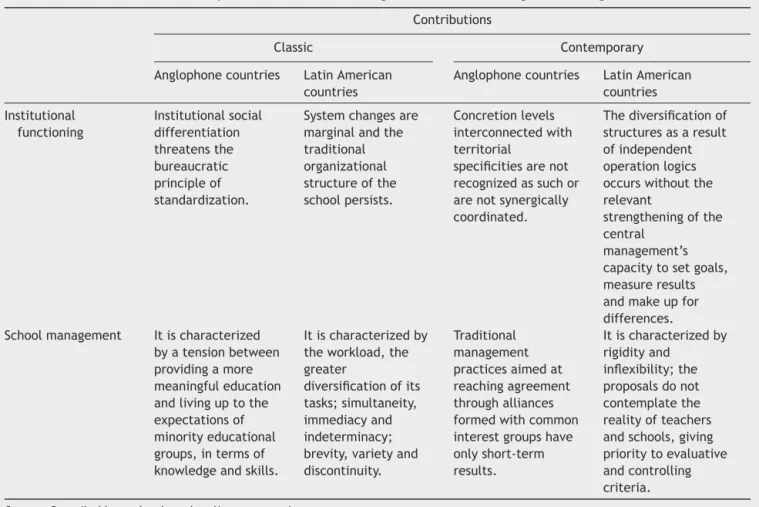
The nexttablesummarizes thecontributionsdescribed above.Thechartcontainssummaryinformationforlinking
and synthesizing knowledge production on the subject (Table2).
Discussion
arein constant rebirth,not inhabitedby the monotonous reiterationofitsobjectives,purposes,tasks,orrules;they areratherseenassomethingthathappensintheoccurrence ofevents.
Second, the literature review specifies two general modelsthatcoexistininstitutionalfunctioningand manage-mentpractices.Ontheonehand,thebureaucraticmodel, whereschoolsritualizetheirrelationswiththebureaucracy in an effort to adapt. Thus, processes are standardized resultingin irrelevant objectives for the institutions, and theexcessive hierarchicallevelscausemultiple and inde-terminateinstitutionalprocessesthathinderthesearchfor solutions that suit each institutional reality (Bates,1989; Oszlak,1977;Weber,1991).On theotherhand,thesocial andculturaldiversityobservedinsubjectivitiesand institu-tionalprofilespoint toresignificationanddemocratization practicesofthetraditionalinstitutionalstructure.This sec-ond model is conceptualized as ‘‘education democracy’’ (Bates,1989)andischaracterizedbytherecognitionofthe keyrolehumanactionplaysintriggeringuniqueandcreative responses toexperience and the variety of local circum-stances.Also,anotherkeyfeatureof thissecondmodelis thatitadvocatesare-politicizationoftheindividualinorder toachieveadomination-freeautonomy.
Third,thisreviewspecifiesdifferentschoolmanagement perspectivesand theirrespective practical consequences. Ontheonehand,theprincipal’straditionalfigureoriented tomonitor,control,superviseandensurethe implementa-tionoftheeducationalserviceis portrayed(Dussel,1995; Müller, Ringler, & Simon, 1992; Southwell & Manzione, 2011).Inthissense,theprincipal’spowersanddutiesentail mainly monitoring activities-hierarchically and coercively understood-andreportingtohigher-rankingauthorities.On theotherhand,amoredemocraticprincipalperspectiveis depicted,orientedtopromotetheautonomyofinstitutions. Inthiscase,managementtaskshaveapoliticalsense,which gives centralitytoprojectswith transformationalcontent drivenbymorecollectiveprocessesthattranslateintothe constitutionofteams inwhichsharedresponsibilities, sol-idarities and collaboration are expressed (DiNIECE, 2013; GvirtzandPodestá,2009).
Fourth,thisliteraturereviewquestionstheroleofrules asthecentraldeviceofany educationalmanagement.On the one hand, in the education bureaucracy model, the rulesareaimedatachievinguniformeducationalgoals, lin-earschooltrajectoriesandinstitutionalformatsdevotedto standardize processes and practices. On the other hand, rulescanbeusedtomakepracticesanddecisionsmore flex-ibleallowingparticular educationalinstitutionstoassume a leading role. In this sense, institutional practices com-bine therecognition of centralgoals and guidelines,with particular interests, needs and moments specific to each institution.
Conclusions
Someconclusions withamethodologicalimpacton educa-tionpoliciesandschoolmanagementcanbedrawnfromthis article.
Regarding its methodological impact, this literature review about school management in times of education
reformallowstorepresent originalresearch contributions comprehensively and synthetically. At the same time, it facilitatestherecoveryoftheprimarydocumentandserves asreferenceforfuturestate-of-the-artresearchonthe sub-ject.
Regarding the contribution of this article to education policies,ontheonehand,itpointsoutthateducation poli-ciesdesignandmanagementaretwocomplexprocessesthat should provide each other feedback. Policy management realizes the guidelines set forth in the regulations while makingthese policies asource of informationtoimprove or change theseregulations. At the same time, acknowl-edgingtheactualpowerofmanagementallowstodiscover thosepractices,strategiesandnegotiationsthattakeplace ineachinstitution,showingthateducationpoliciesaremuch morethanasetofrulesandstandardstobeimplemented. On the other hand, as shown in Table 2, in terms of educationalmanagement(i.e.theorganizationofthe con-ditionsconducivetoeachinstitutionalactors’appropriation orresignificationofsocio-educationalknowledge), control-orientedpractices,suchasruleimplementationsupervision, are still in force coexisting with practices that aim to enhancethe senseof culturaldiversitywithinthe institu-tions.Inreality,thesepracticesresultintensionsbetween themicro-culturalscenariosand themacro-organizational conditions.These tensionssettlebetweenmovingforward towarddecisionsthat respectthe commongoodin a par-ticular context and time and complying with standard regulationsdefinedbythecentralmanagement.Asaresult, attitudesofdistrustandlackofflexibilityarisewithin insti-tutions,wherechangesfailtomakesenseintheirrealities. Finally,thisarticle hasimplicationsfor school manage-ment,understoodasthesetofpracticesanddecisionsthat principalsshouldmakeinordertogenerateandorganizethe conditionsforall institutionalactorstoparticipate mean-ingfully in the construction of knowledge. Depending on thecharacteristicsassumed bytheinstitutionsintimesof change,it isimportantthatprincipals buildtheir agendas prioritizing the solutions for particular institutional prob-lems,maximize theactions that most institutional actors findmeaningful,andcreateprojectsthatsupportthe tra-jectories and histories of youths and adolescents. In this framework,centralmanagementguidelinesandregulations shouldfunctionassupporttools appliedasnecessary,and notbeanendinthemselves.
Conflict
of
interest
Theauthorsdeclarethattheyhavenoconflictsofinterest.
Acknowledgment
National Scientific and Technical Research Council (CON-ICET).
References
Aguerrondo,I.(2013).Elroldelasupervisióneducativaenlagestión delaspolíticaspúblicas.Educar,1,13---27.
Apple,M. & Beane, J. (Comps.) (1999). Escuelas democráticas. 2d.ed.Madrid:Morata.
Arroyo, M., & Nobile, M. (2015). Nuevos formatos escolares e inclusióneducativaenlaescuelasecundaria.Unadiscusiónde laformaescolarapartirdelosaportesdelainvestigación.In D.Pinkasz(Ed.),La investigaciónsobre educaciónsecundaria enlaArgentinaenlaúltimadécada(pp.68---82).BuenosAires: FlacsoArgentina.
Ball,S.(1989).Micropolíticadelaescuela.Haciaunateoríadela organizaciónescolar.Barcelona:Ed.Paidós-MEC.
BardisaRuiz,T.(2009).Análisisyresultadosdelaconstruccióndel sistemadeconvivenciaescolar.Educar,43,95---127.
Bates, R. (1989). Burocracia, educación y democracia: Hacia una política de participación. In R. Bates (Ed.), Práctica críticadelaadministracióneducativa.Valencia:Universitatde Valencia.
Braslavsky,C.&Acosta,F.(Orgs.)(2001).Elestadodelaense˜nanza de la formación en gestión y política educativa en América Latina.BuenosAires:IIPE/UNESCO.
Briscioli,B.&Toscano,A.G.(2012).Laescolarizaciónsecundaria obligatoria.Dosestudiossobrepolíticasdestinadasalreingreso deadolescentesyjóvenesalaescuelaenArgentina.Seminario Internacional:Políticas, Sujetos yMovimientosSociales enel NuevoEscenarioLatinoamericano,SantiagodeChile.
Chaves, P. (2006). La Intervención Cultural como Proceso: PlaneaciónyEvaluacióndeProyectosCulturalesdesdelaAcción Comunicativa.InFigueroaDíaz,M.E.(Coord.),Culturay Desar-rolloHumano:Visioneshumanistasdeladimensiónsimbólicade loindividualysocial.México:CONACULTA.
DiNIECE.(2009).Sentidosentornoalaobligatoriedaddela edu-cación secundaria. Argentina: Ministerio de Educación de la Nación.
DiNIECE(2013). Lasupervisióneducativaennuestropaís:El tra-bajodelsupervisorencincojurisdicciones.SerieLaEducación enDebate,No.12.
Duschatzky,S.,&Birgin,A.(2001).¿Dóndeestálaescuela?Ensayos sobrelagestióninstitucionalentiemposdeturbulencia.Buenos Aires:Manantial.
Duschatzky,S.,&Aguirre,E.(2013).Des-armandoescuelas.Buenos Aires:Paidós.
Duschatzky,S.,Farrán,G.,&Aguirre,E.(2010).Escuelasenescena. Una experiencia de pensamiento colectivo. Buenos Aires: Paidós.
Dussel, I.(1995). Pedagogía y burocracia: Notas sobre la histo-ria de los inspectores. Revista Argentina de Educación, 23, 55---82.
Dussel,I. (2003). La gramática escolar de la escuela argentina: Unanálisis desdela historiade losguardapolvos.Anuariode HistoriadelaEducación,4,11---36.
Dussel,I.(2005).Impactodeloscambiosenelcontextosocialy organizacionaldeloficiodocente.BuenosAires:IIPE/UNESCO. Escolano,A.(2002).Thehistoricalcodificationofthemanualistics
inSpain.PaedagogicaHistorica,38-1,51---72.
Escolano,A.(2008).Laescuelacomoconstruccióncultural.Elgiro etnográficoenlahistoriografíadelaescuela.EspaciosenBlanco,
18,131---146.
Ezpeleta,J.(2004).Loinstitucionaldelaescuelaenlaspolíticas dereformaeducativa.InTentiFanfani,E.(Org.), Gobernabili-daddelossistemaseducativosenAméricaLatina.BuenosAires: IIPE/UNESCO.
Feldfeber, M., & Gluz, N. (2011). Las politicas educativas en Argentina:Herenciasdelos’90,contradiccionesytendencias delnuevosiglo.EducationalSociety,115,339---356.
Frigerio,G.,Poggi, M.,&Tiramonti, G.(1992).Lasinstituciones educativas.Carayceca.Elementosparasucomprensión.Buenos Aires:Troquel-Flacso.
Fullan,M.(1993).Changeforces:probingdedepthsofeducational reform.Schooldevelopmentand themanagementofchange. London:FalmerPress.
Fullan,M.(2009).Large-scalereformcomesofage.Journalof Edu-cationalChange,10,101---113.
García,L.B.,Manzione,M.A.,&Zelaya,M.(2015).Administración ygestióndelaeducación.Laconfiguracióndelcampode estu-dio.Quilmes:EditorialUNQui.
GimenoSacristán,J.(2005).Laeducaciónobligatoria:Susentido educativoysocial.Madrid:Morata.
Guillén,C.I.(2008).Losrituales escolaresenlaescuelapública polimodalArgentina.Avá,12,137---156.
Gvirtz,S.,&Podestá,M.E.(2009).Elroldelsupervisorenlamejora escolar.BuenosAires:Aique.
IDB (2011). GraduateXXI. High school graduation rates in Latin America. Infographicofthe InteramericanDevelopmentBank [Online] Retrieved from: http://www.iadb.org/en/topics/ education/infographic-high-school-graduation-rates-in-latin-america,7110.html[Accessed10.03.2016].
Jacinto,C.(2009).Universalizarelaccesoycompletarlaeducación secundaria.Entrelametasocialylarealidadlatinoamericana. SITEAL,IIPE-UNESCO.
Leal, M.,& PérezCenteno, C.(2014). PISAen el contexto lati-noamericano: Los casos de Argentina, Brasil yChile. Revista LatinoamericanadeEducaciónComparada,5(6),46---62. MinisteriodeEducacióndelaNación(1993).LeyFederalde
Edu-caciónNo.24195,Argentina.
Ministerio de Educación de la Nación (2006). Ley de Educación NacionalNo.26206,Argentina.
Montes, N.& Ziegler, S. (2012).La educación secundariafrente alaobligatoriedad: Unaecuacióncompleja.InSouthwell,M. (Comp.),Entre generaciones. Exploraciones sobre educación, culturaeinstituciones.Rosario:HomoSapiensEditores,Buenos Aires:FLACSO,pp.161---182.
Müller, D., Ringer,F., & Simon, B. (1992). El desarrollodel sis-temaeducativo moderno.Cambio estructuralyreproducción social 1870---1920. Madrid: Ministerio de Trabajo y Seguridad Social.
Oszlak,O.(1977).Notascríticasparaunateoríadelaburocracia estatal.BuenosAires:CEDES/G.ECLACSO,Vol.8.
Poggi,M.(2001).Laformacióndedirectivosdeinstituciones educa-tivas. Algunosaportespara el dise˜no deestrategias. Buenos Aires:IIPE/UNESCO.
Sander, B. (2008). Educac¸ão na América Latina: Identidade e globalizac¸ão.Educac¸ão,2,157---165.
SantosGuerra,(2009).Laescuelaqueaprende.Retos,dificultades yesperanzas.InParedesLabra,J.,HerránGascón,A.&Santos Guerra,M.A.(Coords.),Laprácticadelainnovacióneducativa. Madrid:Síntesis.
Segovia,D.(2005).Nuevasformasdeasesoraryapoyaraloscentros educativos.REICE,1,382---402.
Southwell,M.& Manzione,M.A. (2011).Elevoalasuperioridad: Unestadodelacuestiónsobrelahistoriadelosinspectoresen Argentina.AnuariodeHistoriadelaEducación[online].2011, 12,1.
Sverdlick,I.(2006).ApuntesparaDebatirsobrelaGestiónEscolaren ClavePolítica.UnaMiradaporlaSituaciónenArgentina.REICE, 4e,65---84.
Tedesco, J. C. (1986). Educación y sociedad civil, 1880---1945. BuenosAires:EdicionesSolar.
Tedesco,J.C.(2010).Lostemasdelaagendasobregobiernoy direc-cióndelossistemaseducativosenAméricaLatina.InMarchesi, Á., Tesdesco,J. C. & Coll, C. (Coords.),Calidad, equidad y reformasenlaense˜nanza.BuenosAires:Santillana.
Tenti Fanfani, E. (2009). La ense˜nanza media hoy: Masificación con exclusiónsocial y cultural. InG. Tiramonti& N. Montes (comp.), La escuelamedia en debate. Problemas actuales y perspectivasdesdelainvestigación(pp.53---69).BuenosAires: MANANTIAL/FLACSO.
Terigi,F.(2008).Loscambios enelformatodelaescuela secun-dariaargentina:Porquésonnecesarios,porquésontandifíciles.
RevistaPropuestaEducativa,29,63---71.
Tiramonti, G. (1989). ¿Hacia dónde va la burocracia educativa?
BuenosAires:Mi˜noyDávila---FLACSO.
Tiramonti, G. (Dir.) (2011). Variaciones sobre la forma escolar. Límitesyposibilidadesdelaescuelamedia.Rosario:Homo Sapi-ens,BuenosAires:FLACSO.
Tiramonti, G. (Dir.) (2012). Variaciones sobre la forma escolar. Límitesyposibilidades de laescuela media. Rosario: Flacso-HomoSapiens.
Tyack,D.,&Cuban,L.(2001).Enbuscadelautopía.Unsiglode reformasde lasescuelas públicas. México: Fondode Cultura Económica.
Vicente, M. E. (2012). Educación y Trabajo en Ciencias de la Educación:Aportesdesdeelestudiodelastrayectorias profe-sionalesdesusgraduados.LaPlata:UNLP.
Vicente,M.E.(2014).Aciena˜nosdelafundacióndelasCiencias delaEducaciónenlaUniversidadNacionaldeLaPlata: Estrate-giasyprácticasdelosegresadosenlareconstruccióndelcampo profesional(1914---2014)(Unpublisheddoctoralthesis).Facultad LatinoamericanadeCienciasSociales,BuenosAires,Argentina. Vi˜naoFrago,A.(2005).Éxitoyfracasodelasreformas:Sus
condi-cionantes.CuadernosdePedagogía,348,94---96.
Volonté,F.Longobucco,H.&Poncede León,A. (2007).Los per-filesprofesionalesdelosinspectoresdelaprovinciadeBuenos Aires:Entreloscambiossocioeducativosrecientesylas trayec-torias laboralesyformativas.BuenosAires:DirecciónGeneral deCulturayEducación.
Waters,T.,Marzano,R.,&McNulty,B.(2003).Balancesleadership: What30yearsofresearchtellusabouttheeffectofleadership onstudentachievement.EstadosUnidos:McREL.