C´esar Benavente-Peces, Francisco Cano-Broncano
Universidad Polit´ecnica de Madrid, Ctra. Valencia. km. 7, 28031 Madrid, SpainSebastian Aust, Andreas Ahrens
Hochschule Wismar, University of Technology, Business and Design Philipp-M¨uller-Straße 14, 23966 Wismar, Germany
Keywords: Multiple-Input Multiple-Output System, Singular-Value Decomposition, Bit Allocation, Power Allocation, Wireless Transmission, Multiuser Transmission.
Abstract: Multiuser multiple-input multiple-output (MIMO) downlink (DL) transmission schemes experience both mul-tiuser interference as well as inter-antenna interference. The singular value decomposition provides an appro-priate mean to process channel information and allows us to take the individual user’s channel characteristics into account rather than treating all users channels jointly as in zero-forcing (ZF) multiuser transmission tech-niques. However, uncorrelated MIMO channels has attracted a lot of attention and reached a state of maturity. By contrast, the performance analysis in the presence of antenna fading correlation, which decreases the chan-nel capacity, requires substantial further research. The joint optimization of the number of activated MIMO layers and the number of bits per symbol along with the appropriate allocation of the transmit power shows that not necessarily all user-specific MIMO layers has to be activated in order to minimize the overall BER under the constraint of a given fixed data throughput.
1 INTRODUCTION
Adaptive modulation is a promising technique to in-crease the spectral efficiency of wireless communica-tion systems by adapting the signal parameters, such as modulation constellation or transmit power, dy-namically to changing channel conditions. However, in order to comply with the demand on increasing available data rates in particular in wireless technolo-gies, systems with multiple transmit and receive an-tennas, also called MIMO systems, have become in-dispensable and can be considered as an essential part of increasing both the achievable capacity and integrity of future generations of wireless systems (K¨uhn, 2006). Besides, single-user MIMO transmis-sion schemes for both non-frequency and frequency selective MIMO channels have attracted a lot of at-tention and reached a state of maturity (K¨uhn, 2006; Ahrens and Lange, 2008). By contrast, MIMO-aided multiple-user systems require substantial further re-search where both multiuser as well as multi-antenna interferences have to be taken into account.
Considering the entirety of the antennas of all
to individually changing channel conditions, where the most beneficial choice of the number of activated user-specific MIMO layers together with the number of bits per symbol and the appropriate allocation of the available transmit power offer a certain degree of design freedom, which substantially affects the per-formance of MIMO systems.
Against this background, in this paper a SVD-assisted multiuser MIMO scheme is investigated, where both multiuser interferences as well as multi-antenna interferences are perfectly eliminated. The novel contribution of this paper is that we demonstrate the benefits of amalgamating a suitable choice of ac-tivated MIMO layers and number of bits per sym-bol along with the appropriate allocation of the trans-mit power under the constraint of a given fixed data throughput. Besides the signal processing needed to perfectly separate the users within a multiuser system, multiple antenna systems are affected by signal corre-lation among antennas, which produces a degradation of the link performance, depending on the physical relative position of the antennas and the mobility of the front-ends and has to be taken into consideration. The remaining part of this paper is organized as follows: Section 2 introduces the multiuser system model, while the considered quality criteria are briefly reviewed in section 3. The associated performance results are presented and interpreted in section 4. Fi-nally, section 5 provides some concluding remarks.
2 MULTIUSER SYSTEM MODEL
The system model considered in this work consists of a single base station (BS) supporting K mobile sta-tions (MSs). The BS is equipped with nTtransmit
an-tennas, while the kth (with k=1, . . . ,K) MS has nR k
receive antennas, i. e. the total number of receive an-tennas including all K MSs is given by nR=∑Kk=1nR k.
The (nR k×1) user specific symbol vectorck to be transmitted by the BS is given by
ck= ck,1,ck,2, . . . ,ck,nR k T
. (1)
The vectorckis preprocessed before its transmission by multiplying it with the(nT×nR k)DL
preprocess-ing matrixRkand results in the(nT×1)user-specific transmit vector
sk=Rkck . (2) After DL transmitter preprocessing, the nT
-component signal s transmitted by the BS to the
K MSs results in
s= K
∑
k=1
sk=Rc , (3)
with the(nT×nR)preprocessing matrix
R= (R1,R2, . . . ,RK) . (4) In (3), the overall(nR×1)transmitted DL data vector
c combines all K DL transmit vectorsck (with k= 1,2, . . . ,K)and is given by
c= cT1,cT2. . . ,cTK T
. (5)
At the receiver side, the(nR k×1)vectorukof the kth MS is given by
uk=Hks+nk=HkRc+nk . (6) and can be expressed by
uk=HkRkck+ K
∑
i=1,i6=k
HkRici+nk , (7)
where the MSs received signals experience both multi-user and multi-antenna interferences. In (6), the (nR k×nT)channel matrixHkconnects the nTBS
spe-cific transmit antennas with the nR kreceive antennas
of the kth MS.
It is quite common to assume that the coefficients of the(nR k×nT)channel matrixHkare independent and Rayleigh distributed with equal variance. How-ever, in many cases correlations between the trans-mit antennas as well as between the receive anten-nas can’t be neglected. There are several methods to model and characterize antenna signal correlation into a MIMO channel model for Rayleigh flat-fading channels. In this work it is assumed that the corre-lation among receive antennas is independent of the correlation between transmit antennas. The way to include the antenna signal correlation into the MIMO channel model for Rayleigh flat-fading like channels is given by (Durgin and Rappaport, 1999; Zelst and Hammerschmidt, 2002) and results in
Hk=H1Rx/2·G·H1Tx/2, (8) where G is a (nR k×nT) uncorrelated channel
ma-trix with independent, identically distributed com-plex Gaussian zero-mean unit variance elements and where (·)1/2stands for the square root of a matrix.
The(nR k×nR k)matrixHRxis used to model the
cor-relation between the kth MS receive antennas. More-over, the (nT×nT)transmit correlation matrix HTx
models the correlation between the transmit antennas. The interference, which is introduced by the chan-nel matrixHk, requires appropriate signal processing strategies. A popular technique is based on the SVD of the system matrixHkas described in (Ahrens and Benavente-Peces, 2010). Therein, after pre- and post-processing of the transmitted and received signal vec-tors, the user-specific decision variables result in
c(km,ℓ) y
(m) k,ℓ
w(km,ℓ)
q
ξ(m) k,ℓ
q p(km,ℓ)
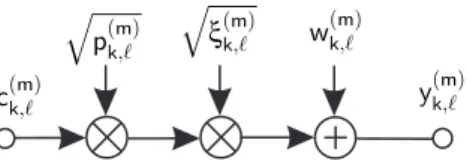
Figure 1: Resulting kth user-specific system model per MIMO layerℓ(withℓ=1,2, . . . ,nR k) and per transmitted symbol block m.
where interferences between the different antenna data streams as well as MUI (multi-user interference) imposed by the other users are avoided as shown in (Ahrens and Benavente-Peces, 2010). In (9), the (nR k×nR k) diagonal matrixVk u contains the non-zero square roots of the eigenvalues ofHHkHk, e. g.,
Vk u= pξ
k,1 0 · · · 0
0 pξ
k,2 . .. ...
..
. . .. . .. ... 0 0 · · · pξ
k,nR k , (10)
and the user-specific(nR k×nR k)diagonal power
al-location matrix is given by
Pk= √
pk,1 0 · · · 0
0 √pk,2 . .. ...
..
. . .. . .. ... 0 0 · · · √pk,nR k
(11)
and simplifies toPk= pβ
InR k×nR kwith the parame-terpβtaking the transmit-power constraint into ac-count as highlighted in (Ahrens and Benavente-Peces, 2010). Finally the additive, white Gaussian noise (AWGN) vector is given bywk. The resulting system model is depicted in Fig. 1
3 PERFORMANCE ANALYSIS
In general, the user-specific quality of data transmis-sion can be informally assessed by using the signal-to-noise ratio (SNR) at the detector’s input defined by the half vertical eye opening and the noise power per quadrature component according to
ρ=(Half vertical eye opening)
2
Noise Power = (UA)2 (UR)2
, (12)
which is often used as a quality parameter (Ahrens and Lange, 2008). The relationship between the signal-to-noise ratio ρ =U2
A/UR2 and the bit-error
probability evaluated for AWGN channels and M-ary
Quadrature Amplitude Modulation (QAM) is given by (Proakis, 2000)
PBER= 2
log2(M)
1−√1
M erfc rρ 2 . (13)
When applying the proposed system structure for the kth user, the applied signal processing leads to dif-ferent eye openings per activated MIMO layerℓ(with ℓ=1,2, . . . ,L and L≤nR kdescribing the number of
activated user-specific MIMO layers) and per trans-mitted symbol block m according to
UA k(ℓ,m)= q
p(k,ℓm)·
q
ξ(m)
k,ℓ ·U
(ℓ)
s k , (14)
where Us k(ℓ) denotes the half-level transmit amplitude
assuming Mℓ-ary QAM, q
ξ(m)
k,ℓ represents the corre-sponding positive square roots of the eigenvalues of
the matrix HHk Hk and q
p(k,ℓm) represents the corre-sponding power allocation weighting parameters. To-gether with the noise power per quadrature compo-nent, introduced by the additive, white Gaussian noise (AWGN) vectorwk in (9), the kth user-specific SNR per MIMO layerℓat the time m becomes
ρ(ℓ,m)
k =
UA k(ℓ,m)2
U2 R
. (15)
Using the parallel transmission over L≤nR kMIMO
layers, the overall mean transmit power becomes
Ps k =∑Lℓ=1P (ℓ)
s k . Considering QAM constellations,
the average transmit power Ps k(ℓ) per MIMO layer ℓ may be expressed as (Proakis, 2000)
Ps k(ℓ)=2 3
Us k(ℓ) 2
(Mkℓ−1) . (16)
Combining (15) and (16) together with (14), the layer-specific SNR at the time m results in
ρ(ℓ,m)
k =p
(m)
k,ℓ ξ
(m)
k,ℓ 3 2(Mkℓ−1)
Ps k(ℓ)
UR2 . (17)
Assuming that the transmit power is uniformly dis-tributed over the number of activated MIMO layers, i. e., Ps k(ℓ)=Ps k/L, the layer-specific signal-to-noise
ratio at the time m, defined in (17), results with the ra-tio of symbol energy to noise power spectral density
Es/N0=Ps k/(2UR2)in
ρ(ℓ,m)
k =p
(m)
k,ℓ ξ
(m)
k,ℓ 3
L(Mkℓ−1)
Es N0
. (18)
Table 1: Investigated user-specific QAM transmission modes.
throughput layer 1 layer 2 layer 3 layer 4
8 bit/s/Hz 256 0 0 0
8 bit/s/Hz 64 4 0 0
8 bit/s/Hz 16 16 0 0
8 bit/s/Hz 16 4 4 0
8 bit/s/Hz 4 4 4 4
has to be used, which depends on the specific trans-mission mode, as detailed in Table 1 for the exemplar-ily investigated two-user multiuser system (nR k=4
(with k=1,2),K=2,nR=nT=8). In order to avoid
any signalling overhead, fixed transmission modes are used in this contribution regardless of the channel quality (Ahrens and Lange, 2008).
However, the user-specific BER of the uncoded MIMO system is dominated by the specific layers having the lowest SNR’s. As a remedy, a MIMO-layer transmit PA scheme is required for minimiz-ing the overall BER under the constraint of a lim-ited total MIMO transmit power. The proposed PA scheme scales the half-level transmit amplitude Us k(ℓ)
of theℓth MIMO layer by the factor q
˜
p(k,ℓm). This re-sults in a MIMO layer-specific transmit amplitude of
Us k(ℓ)
q ˜
p(k,ℓm)for the QAM symbol of the transmit data vector transmitted at the time m over the MIMO layer ℓ. Together with the DL preprocessing design, the layer-specific power allocation parameter at the time
m results in:
q
p(k,ℓm)= q
β(m)qp˜(m)
k,ℓ . (19)
A natural choice is to opt for a PA scheme, which results in an identical signal-to-noise ratio
ρ(ℓ,m) PA k =
UPA k(ℓ,m)2
UR2 =p˜ (m)
k,ℓ
3ξ(k,ℓm)β(m)
L(Mkℓ−1)
Es N0
(20)
for all activated MIMO layers at the time m, i. e., in
ρ(ℓ,m)
PA k =constant ℓ=1,2,· · ·,L . (21)
The power to be allocated to each activated MIMO layer at the time m can be shown to be calculated as follows (Ahrens and Lange, 2008):
˜
p(k,ℓm)=(Mkℓ−1)
ξ(m)
k,ℓ
· L L ∑
ν=1 (Mkν−1)
ξ(m) k,ν
. (22)
12 14 16 18 20 22 24
10−8 10−6 10−4 10−2
10·log10(Es/N0) (in dB)→
b
it
-e
rr
o
r
ra
te
→
(256,0,0,0)QAM (64,4,0,0)QAM (16,16,0,0)QAM (16,4,4,0)QAM (4,4,4,4)QAM
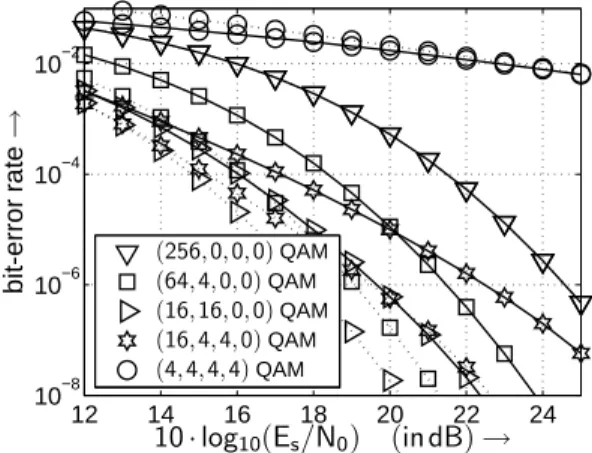
Figure 2: BER with PA (dotted line) and without PA (solid line) when using the transmission modes introduced in Tab. 1 and transmitting 8 bit/s/Hz over uncorrelated fre-quency non-selective channels.
4 RESULTS
In this contribution fixed transmission modes are used regardless of the channel quality. Assum-ing predefined transmission modes, a fixed data rate can be guaranteed. Considering a frequency non-selective SDM (spatial division multiplexing) single-user MIMO link (K=1) composed of nT=4 transmit
and nR=4 receive antennas, the obtained BER curves
are depicted in Fig. 2 for the different QAM con-stellation sizes and MIMO configurations of Tab. 1, when transmitting at a bandwidth efficiency of 8 bit/s/Hz. Assuming a uniform distribution of the transmit power over the number of activated MIMO layers, it turns out that not all MIMO layers have to be activated in order to achieve the best BERs.
PA can be used to balance the bit-error probabili-ties in the different number of activated MIMO layers. As shown in Fig. 2, unequal PA is only effective in conjunction with the optimum number of MIMO lay-ers and at high SNR. Using all MIMO laylay-ers, our PA scheme would assign much of the total transmit power to the specific symbol positions per data block having the smallest singular values and hence the overall per-formance would deteriorate.
0 1 2 3 4 5 0
0.005 0.01 0.015
0.02 p
ξ1
p
ξ2
p
ξ3
p
ξ4
p
d
f
→
singular value→
Figure 3: PDF (probability density function) of the layer-specific amplitudes pξℓ for uncorrelated frequency
non-selective MIMO channels.
0 1 2 3 4 5 6
0 0.01 0.02 0.03
0.04 p
ξ1
p
ξ2
p
ξ3
p
ξ4
p
d
f
→
singular value→
Figure 4: PDF (probability density function) of the layer-specific amplitudes pξℓ for correlated frequency
non-selective MIMO channels.
function) of the largest singular-value to higher val-ues at the cost of the remaining layers. Thus, taking the correlated MIMO channel instead of the uncorre-lated one into consideration, we observe that the in-fluence of the layer with the largest weighting factor increases. Since the performance of a MIMO trans-mission is strongly affected by the smallest singular values of the channel matrix, the statistical distribu-tion of the smallest singular values is of great impor-tance for the characterization of a MIMO transmis-sion scheme. In consequence, as the ratio between the largest and smaller singular-value increases as the correlation between antennas increases, it is expected that the resulting BER increases with respect to the uncorrelated case. Thus, since the pdf dispersion of the singular values changes, the best uncoded solution for the uncorrelated MIMO channel doesn’t necessar-ily lead to the best solution for the correlated one. The obtained BER curves are depicted in Fig. 5 for the dif-ferent QAM constellation sizes and MIMO
configura-12 14 16 18 20 22 24
10−8 10−6 10−4 10−2
10·log10(Es/N0) (in dB)→
b
it
-e
rr
o
r
ra
te
→
(256,0,0,0)QAM (64,4,0,0)QAM (16,16,0,0)QAM (16,4,4,0)QAM (4,4,4,4)QAM
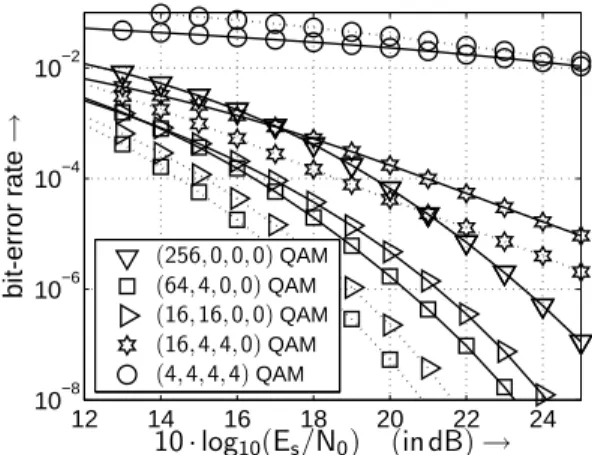
Figure 5: BER with PA (dotted line) and without PA (solid line) when using the transmission modes introduced in Tab. 1 and transmitting 8 bit/s/Hz over correlated frequency non-selective channels.
10 15 20 25 30
10−3 10−2 10−1
10·log10(Es/N0) (in dB)→
b
it
-e
rr
o
r
ra
te
→
(256,0,0,0)QAM (64,4,0,0)QAM (16,16,0,0)QAM (16,4,4,0)QAM (4,4,4,4)QAM
Figure 6: SVD-based user-specific BERs without PA when using the transmission modes introduced in Table 1 and transmitting 8 bit/s/Hz over uncorrelated frequency non-selective channels.
tions of Tab. 1, when transmitting at a bandwidth ef-ficiency of 8 bit/s/Hz. Here, the joint optimization of the number of activated MIMO layers along with the appropriate allocation of the transmit power allows us to minimize the overall BER under the constraint of a given fixed data throughput efficiently.
The parameters of the exemplarily studied two-users MIMO system are chosen as follows: Ps k =
1 V2, nR k =4 (with k =1,2), K =2,nR = nT =
10 15 20 25 30 10−3
10−2 10−1
10·log10(Es/N0) (in dB)→
b
it
-e
rr
o
r
ra
te
→
(64,4,0,0)QAM (16,4,4,0)QAM
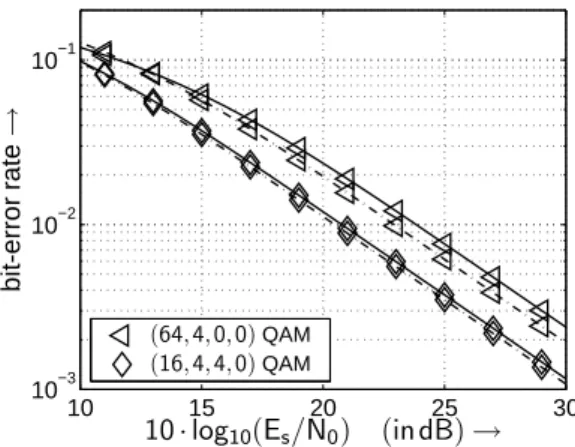
Figure 7: User-specific BERs with PA (dashed line) and without PA (solid line) when using the transmission modes introduced in Table 1 and transmitting 8 bit/s/Hz over un-correlated frequency non-selective channels.
transmit power over the number of activated MIMO layers, it still turns out that not all MIMO layers have to be activated in order to achieve the best BERs. PA can be used to balance the bit-error probabilities in the activated MIMO layers. The obtained BER curves are depicted in Fig. 7 and show, based on the chosen DL preprocessing design, only minor improvements by using adaptive PA within the investigated multiuser MIMO transmission scheme. Here, an equal power distribution seems to be a good choice.
5 CONCLUSIONS
Single- and multiuser MIMO systems in conjunc-tion with SVD-assisted signal processing were inves-tigated in this work. It turned out, that the choice of the number of bits per symbol as well as the num-ber of activated MIMO layers substantially affects the performance of a MIMO system, suggesting that not all MIMO layers have to be activated in order to achieve the best BERs. The main goal was to find that specific combination of the QAM mode and the number of MIMO layers, which gives the best possi-ble BER performance at a given fixed bit/s/Hz band-width efficiency. The Es/N0value required by each
scheme at BER 10−2 was extracted from computer simulations and the best systems are shown in bold in Table 1. Moreover, it has been shown that the antenna correlation strongly affects the system performance. Here, the performed joint optimization of the number of activated MIMO layers along with the appropriate allocation of the transmit power allows us efficiently to minimize the overall BER under the constraint of a given fixed data throughput.
REFERENCES
Ahrens, A. and Benavente-Peces, C. (2010). Modulation-Mode and Power Assignment for SVD-assisted and Iteratively Detected Downlink Multiuser MIMO Sys-tems. In International Conference on Wireless Infor-mation Networks and Systems (WINSYS), pages 107– 114, Athens (Greece).
Ahrens, A. and Lange, C. (2008). Modulation-Mode and Power Assignment in SVD-equalized MIMO Sys-tems. Facta Universitatis (Series Electronics and En-ergetics), 21(2):167–181.
Choi, R. L. and Murch, R. D. (2003). New Transmit Schemes and Simplified Receivers for MIMO Wire-less Communication Systems. IEEE Transactions on Wireless Communications, 2(6):1217–1230.
Choi, R. L. and Murch, R. D. (2004). A Transmit Prepro-cessing Technique for Multiuser MIMO Systems us-ing a Decomposition Approach. IEEE Transactions on Wireless Communications, 3(1):20–24.
Durgin, G. D. and Rappaport, T. S. (1999). Effects of Multi-path Angular Spread on the Spatial Cross-Correlation of Received Voltage Envelopes. In IEEE Vehicu-lar Technology Conference (VTC), pages 996–1000, Houston, Texas, USA.
Joham, M., Utschick, W., and Nossek, J. A. (2005). Lin-ear Transmit Processing in MIMO Communications Systems. IEEE Transactions on Signal Processing, 53(8):2700–2712.
K¨uhn, V. (2006). Wireless Communications over MIMO Channels – Applications to CDMA and Multiple An-tenna Systems. Wiley, Chichester.
Liu, W., Yang, L. L., and Hanzo, L. (2008). SVD Assisted Joint Transmitter and Receiver Design for the Down-link of MIMO Systems. In IEEE 68th Vehicular Tech-nology Conference (VTC), pages 1–5, Calgary.
Meurer, M., Baier, P. W., Weber, T., Lu, Y., and Papathanas-siou, A. (2000). Joint Transmission: An Advanta-geous Downlink Concept for CDMA Mobile Radio Systems using Time Division Duplexing. Electronics Letters, 36(10):900–901.
Proakis, J. G. (2000). Digital Communications. McGraw-Hill, Boston.