AUTOR: Noelia Alcaraz Salarirche
EDITA: Publicaciones y Divulgación Científica. Universidad de Málaga
Esta obra está sujeta a una licencia Creative Commons:
Reconocimiento - No comercial - SinObraDerivada (cc-by-nc-nd): Http://creativecommons.org/licences/by-nc-nd/3.0/es
Cualquier parte de esta obra se puede reproducir sin autorización pero con el reconocimiento y atribución de los autores.
LA EVALUACIÓN EN EL AULA
Explorando el portafolios
en Secundaria
Un estudio de caso
TESIS DOCTORAL
Realizada por: Noelia Alcaraz Salarirche
Dirigida por: Dr. Ángel. I. Pérez Gómez
UNIVERSIDAD DE MÁLAGA
FACULTAD DE CIENCIAS DE LA EDUCACIÓN
DEPARTAMENTO DE DIDÁCTICA Y ORGANIZACIÓN ESCOLAR
Departamento de Didáctica y Organización Escolar
Ángel Ignacio Pérez Gómez, profesor del Departamento de Didáctica y Organización Escolar de la Universidad de Málaga, como director de la tesis doctoral presentada por Dª. Noelia Alcaraz Salarirche, titulada “La evaluación en el aula: Explorando el portafolios en Secundaria. Un estudio de caso”,
CERTIFICA
Que el trabajo realizado por la doctoranda reúne los requisitos necesarios de interés académico, rigor científico, coherencia estructural, documentación pertinente y abundante y exposición clara y ordenada, de manera que puede procederse a su defensa ante la Comisión legalmente nombrada a tal efecto.
Málaga, 16 de marzo de 2015
EL DIRECTOR DE LA TESIS
“Fue el tiempo que pasaste con tu rosa lo que la hizo tan importante” (El principito)
Agradecimientos
A dos profes que ya no están pero estuvieron y hoy, están en mi recuerdo: A Gloria Arenas y su: “Triunfantes perdedoras”. Y a José Manuel Esteve, por enamorarme de la Pedagogía.
A mi director, Ángel Pérez Gómez; al autor y a la persona, por permitirme crecer junto a ambos. Un privilegio que pocos tienen.
A Pilar Sepúlveda por su cariño y por sugerirme al protagonista de mi estudio de caso. A Nieves Blanco, por ese “más”, por hacerme confiar en ella. A Miguel Ángel Santos, por sus magistrales lecciones. A Mª. José, Encarna, Javier Barquín, David, Nacho y a Analía, por estar ahí, por echarme un “cable” cuando lo pedí. A mis compañeras y amigas Monsalud y Laurita, por ser paño de lágrimas y cómplice de risas. A Kiko, de quien aprendí que enseñar es apasionar. También por ponerme en contacto con P. A Juan Carlos, por arrancarme siempre una sonrisa, por su amistad y por su profesionalidad.
A mi amiga Alicia, la genial autora de la imagen de la portada de esta tesis, por regalarme su arte. A Miguel Sola por sus consejos, por su sabiduría, por su siempre respaldo.
A los-as profesionales que me han facilitado el trabajo en este último tramo. Por su rigurosidad y por su puntualidad, a Encumar y a Paul Smith. Al personal de Doctorado de la UMA: Paloma, Isabel y Pepe, por su buen hacer y paciencia.
A mis alumnos y alumnas de la UCA, por enseñarme tanto.
A mis compañeros y compañeras de la UCA, Fernando, Susana, Reme, Adela, Pilar, Pepa y Raquel, por acogerme. A Laura, por su apoyo “emocional” que de eso, sabe mucho. A Mayka, Cotri, Hugo y Berta, por ser refugio fuera de casa.
largas tardes de invierno junto a la estufa.
A dos ‘Antonios’ que creyeron en mí desde muy pequeña, a quienes les habría gustado leer esto. A D. Antonio, mi maestro; y a mi padrino Antonio Osuna, por sus trucos de magia; con quien descubrí que quería dedicarme a la Educación.
A toda mi familia. Incluidas mis estrellas del cielo…
A Carmelo, mi suegro y a Teresa, mi suegra. Por su infinita generosidad.
A mis cuñados y cuñadas, en especial a Jesús, a quien debo entre mucho, parte de mis estudios.
A mis hermanos y hermanas, por significar siempre protección, cobijo. A mis sobrinos y sobrinas, por representar la fuerza, el entusiasmo, la esperanza. Por confiar en mí. Porque sin ellos-as, no soy.
A mi padre, Pepe, un buen hombre de pocas palabras. Por enseñarme que el saber no sólo procede de los estudios, también, de la vida.
Y a mi madre, Mari Cruz, a quien debo ese apellido que orgullosa he de deletrear. A quien debo todo. Una magnífica mujer, a la que quiero parecerme.
Gracias… ¡Muchas gracias!
Índice
PRESENTACIÓN ... 17
ABSTRACT ... 21
PARTE I. EVALUACIÓN ... 41
Capítulo 1 APROXIMACIÓN HISTÓRICA A LA “EVALUACIÓN” ... 43
INTRODUCCIÓN ... 43
1.1 LAS PRIMERAS PRÁCTICAS DE ‘EVALUACIÓN’ CONOCIDAS ... 44
1.1.1 La obsesión por el “método científico”: La ‘evaluación’ como medición ... 45
1.1.2 Nace el término evaluación educativa, de la mano de Tyler ... 46
1.1.3 La era del accountability ... 48
1.1.4 Las voces de Crombach y Srciven: Más allá de Tyler ... 50
1.1.5 La década de los setenta, un periodo de “eclosión de modelos” de evaluación ... 53
1.1.6 El nacimiento de un nuevo paradigma ... 56
Recapitulando: Una síntesis de las generaciones de la evaluación ... 60
Capítulo 2 APRENDIZAJE, CURRÍCULUM Y EVALUACIÓN ... 64
INTRODUCCIÓN ... 64
2.1 APRENDIZAJE: DEL CONDUCTISMO A LA VISIÓN CONSTRUCTIVISTA DEL APRENDIZAJE. ... 66
2.1.1 La caja negra del conductismo ... 66
2.1.2 La preocupación, de las teorías mediacionales, por los procesos que tienen lugar en la mente del sujeto ... 68
2.1.3 El aprendizaje escolar: La metáfora de Mayer ... 69
2.1.4 Aprender de forma relevante ... 70
2.2 APRENDIZAJE Y EVALUACIÓN ... 71
2.2.1 El disparate de la “evaluación” del aprendizaje ... 71
2.3 CURRÍCULUM: DE LA PEDAGOGÍA POR OBJETIVOS AL CURRÍCULUM COMO INVESTIGACIÓN ... 74
2.3.1 La visión técnica del currículum y la “evaluación” ... 74
2.3.2 La visión heurística del Currículum y la “evaluación” ... 78
2.4 LA “EVALUACIÓN” DEL CURRÍCULUM ESCOLAR: OTRO DISPARATE ... 81
Recapitulando: Una síntesis de la relación entre los conceptos de aprendizaje, currículum y evaluación ... 86
Capítulo 3 EVALUACIÓN VERSUS CALIFICACIÓN ... 89
INTRODUCCIÓN ... 89
3.1 LA ESCUELA QUE CALIFICA ... 91
3.1.1 La ilusión de medir el aprendizaje ... 92
3.1.2 Los resultados de “aprendizaje”: ¿Realidad o ficción? ... 95
3.1.3 El deseo por controlar el aprendizaje: Ponerle puertas al mar ... 100
3.1.4 El sin-‐sentido del conocimiento en la escuela: El mensaje que damos al alumnado .... 105
3.1.5 Estudiantes desconfiados-‐as y tramposos-‐as ... 111
3.1.7 Calificación, clasificación y selección: Poderosa damisela doña calificación que nunca
desaparece ... 122
3.1.8 El “refinamiento” de las herramientas de calificación ... 125
3.1.8.1 Hacer “mejores” exámenes ... 126
3.1.8.2 Una nueva moda: las rúbricas ... 132
3.1.9 Implicaciones no educativas de la calificación ... 134
3.2 LA ESCUELA QUE EVALÚA ... 137
3.2.1 La evaluación, siempre al servicio del aprendizaje ... 137
3.2.2 Condiciones para la evaluación en un aula ... 139
3.2.2.1 La evaluación NO puede centrarse principalmente en los productos, sino en los procesos y contextos ... 139
3.2.2.2 La evaluación NO es una cuestión de poder y control sobre el alumnado sino una cuestión de confianza ... 144
3.2.2.3 La evaluación NO se hace para poner nota ... 146
3.2.2.4 La evaluación NO puede penalizar el error ... 148
3.2.2.5 La evaluación NO puede obviar la voz y la participación del alumnado ... 149
3.2.2.6 La evaluación NO debe ser el punto de vista: la vista de un punto ... 150
3.2.2.7 La evaluación NO puede perjudicar a nadie ... 152
3.2.3 Dificultades en torno a la transformación de las prácticas de evaluación ... 155
3.2.4 Implicaciones educativas de la evaluación ... 158
3.3 LAS 1.001 CONFUSIONES SOBRE EVALUACIÓN Y CALIFICACIÓN ... 161
3.3.1 Los apellidos de la evaluación ... 161
3.3.2 Nuevos términos, viejas prácticas ... 164
3.3.3 ¿Por qué lo llaman evaluación cuando quieren decir calificación? ... 167
3.4 ¿PUEDEN CONVIVIR EVALUACIÓN Y CALIFICACIÓN?: EL ‘QUID’ DE LA CUESTIÓN ... 170
3.5 LAS IDEAS ‘AL USO’ DE LO ‘USOS’ Y ‘DESUSOS’ DE LAS HERRAMIENTAS DE EVALUACIÓN O CALIFICACIÓN ... 173
Recapitulando: Una síntesis sobre la evaluación, la calificación y la confusión entre ambas ... 176
PARTE II. PORTAFOLIOS ... 181
Capítulo 4 EL PORTAFOLIOS: ORIGEN, DEFINICIONES, TIPOS Y USOS ... 183
INTRODUCCIÓN ... 183
4.1 ORIGEN: DEL ÁMBITO PROFESIONAL AL ÁMBITO EDUCATIVO ... 183
4.2 DEFINICIÓN DEL PORTAFOLIOS: EL ABANDONO DE SU SENTIDO LITERAL ... 187
4.3 TIPOS DE PORTAFOLIOS ... 189
4.4 LOS POSIBLES USOS DEL PORTAFOLIOS ... 191
4.5 LA MEZCLA DE FUNCIONES, TAMBIÉN, DEL PORTAFOLIOS ... 192
Recapitulando: Una síntesis sobre el origen del portafolios y su aparición en el ámbito educativo ... 197
Capítulo 5 EL PORTAFOLIOS DEBATIÉNDOSE ENTRE LA EVALUACIÓN Y LA CALIFICACIÓN. ... 199
INTRODUCCIÓN ... 199
5.1.2 El portafolios debe fomentar un clima de libertad que propicie la comunicación y el
aprendizaje auténticos ... 205
5.1.3 El portafolios debe apostar por el error como fuente de aprendizaje y desplazar los juicios penalizadores ... 207
5.1.4 El portafolios debe ser un canal que recoja la voz del alumnado y ayude a la comprensión holística de la vida del aula ... 208
5.1.5 El portafolios debe convertirse en un sistema de evaluación ... 209
5.2 El portafolios: De la ‘evaluación auténtica’ a una auténtica evaluación ... 215
Recapitulando: Una síntesis sobre el portafolios, la evaluación y la calificación ... 218
PARTE III. ESTUDIO DE CASO ... 221
Capítulo 6 PRESENTACIÓN DE LA INVESTIGACIÓN ... 223
INTRODUCCIÓN ... 223
6.1 Contexto de la investigación ... 223
6.2 Propósito, metodología y fases de la investigación ... 224
6.3 Recogida de información ... 226
6.4 Algunos apuntes sobre la interpretación de los datos y la redacción del informe ... 227
Capítulo 7 PARA CONTEXTUALIZAR ... 235
INTRODUCCIÓN ... 235
7.1 El maestro y su situación en el centro ... 236
7.2 La idiosincrasia de los grupos ... 239
7.2.1 La tutoría inacabada de Segundo ... 240
7.2.2 La preocupación de Segundo por “el año que viene” ... 243
7.2.3 La premura del tiempo y el aprovechamiento del mismo en Segundo ... 245
7.2.4 La buena sintonía con el grupo de Primero ... 245
7.3 Diseño inicial de la puesta en práctica del portafolios: Algunas cuestiones de partida . 246 7.3.1 Elementos que compusieron los portafolios ... 246
7.3.1.1 Producciones del alumnado ... 250
7.3.1.2 Herramientas de seguimiento y análisis del aprendizaje ... 256
7.3.1.3 Herramientas de seguimiento de la vida del aula ... 264
7.3.2 Replantearse el sentido de la evaluación: Una condición ‘sine qua non’ ... 266
Capítulo 8 ANÁLISIS Y DISCUSIÓN SOBRE LA PUESTA EN PRÁCTICA DEL PORTAFOLIOS…. ... 268
INTRODUCCIÓN ... 268
8.1 La adaptación al cambio ... 269
8.1.1 Una nueva forma de organización: Las carpetas ... 270
8.1.2 Una nueva forma de trabajar: Des-‐escolarizar las mentes ... 272
8.1.3 Un nuevo hábito: Aprovechar el tiempo para trabajar en clase ... 277
8.1.4 Una nueva forma de valorar: La constancia y el trabajo diario frente al “saber acumulado” ... 278
8.1.5 La incorporación de la evaluación al aula: “Convenciéndoles del cuento” ... 280
8.2 Aportaciones del portafolios al sistema de evaluación ... 282
8.2.1 En cuanto a la organización ... 283
8.2.2.3 La reflexión a partir de los borradores y diarios de trabajo ... 299
8.2.3 En cuanto a la comunicación ... 302
8.2.3.1 Comunicación docente > estudiante ... 303
8.2.3.2 Comunicación estudiante > docente ... 307
8.2.3.3 Comunicación docente <> estudiante: El diálogo ... 312
8.2.3.4 Comunicación estudiante <> estudiante ... 315
8.2.3.5 Comunicación docente <> familias ... 316
8.2.3.6 Comunicación estudiante <> investigadora <> docente ... 316
8.3 Algunos cambios desarrollados a partir de la evaluación ... 318
8.3.1 Cambios en el diseño de los instrumentos ... 319
8.3.1.1 En la hoja de registro: ... 319
8.3.1.2 En la hoja de autoevaluación-‐reflexión: ... 320
8.3.1.3 Inclusión de nuevas herramientas ... 323
8.3.1.4 Un cambio a petición del alumnado: Más tiempo para realizar los projects ... 325
8.4 El portafolios como herramienta de calificación ... 326
8.4.1 Separando la calificación de la evaluación ... 326
8.4.2 Cuando la calificación se ausenta en el día a día ... 329
8.4.2.1 “Maestro ¿pero qué nota tengo?” ... 329
8.4.2.2 “¿Y si el año que viene tenemos a un maestro más duro?” ... 331
8.4.2.3 “Te pone un 2 y ya está, tú no sabes el motivo del 2” ... 332
8.4.3 Donde la calificación y la evaluación se encontraron… ... 333
8.4.4 …Y la contradicción se hizo patente ... 336
8.4.4.1 La transparencia se puede empañar ... 337
8.4.4.2 La comunicación se puede desvirtuar ... 339
PARTE IV. SÍNTESIS REFLEXIVA ... 343
Capítulo 9 ALGO ASÍ COMO “METABOLIZANDO IDEAS” ... 345
INTRODUCCIÓN ... 345
9.1 Replantearse el sentido del aprendizaje, del currículum y de la evaluación para trabajar con portafolios ... 346
9.2 El enfrentamiento entre evaluación y calificación ... 349
9.3 Poner el portafolios al servicio de la evaluación ... 351
9.4 Posibilidades educativas que puede ofrecer la introducción en el aula de este sistema de evaluación ... 357
9.5 Dificultades que pueden encontrarse por el camino ... 360
9.6 ¿Portafolios vs. evaluación auténtica? ... 370
9.7 La necesidad de llamar a las cosas por su nombre ... 372
9.8 Evaluación de la evaluación: Volviendo sobre mis pasos y abriendo nuevos horizontes…… ... 376
Elogio a la utopía ... 381
Reflective summary ... 383
Capítulo 10 A FORM OF METABOLISING IDEAS ... 385
10.2 The confrontation between assessment and evaluation ... 388
10.3 Place the portfolio at the service of assessment ... 390
10.4 Educational possibilities offered by introducing this assessment system in the classroom ... 395
10.5 Difficulties which may be found along the way ... 396
10.6 Portfolios vs. authentic assessment? ... 400
10.7 The need to call things by their name ... 401
10.8 Assessing the assessment: Retracing my steps and opening up new horizons ... 402
Praise to utopia ... 407
BIBLIOGRAFÍA ... 409
RELACIÓN DE ILUSTRACIONES ... 429
RELACIÓN DE IMÁGENES ... 431
RELACIÓN DE CUADROS ... 433
GLOSARIO ... 435
ANEXOS ... 439
RELACIÓN DE ANEXOS ... 459
P
RESENTACIÓN
El trabajo que contiene estas páginas es fruto de la investigación realizada
por la autora para la realización de su tesis doctoral. El tema abordado es la
evaluación educativa a nivel de aula, el cual se desarrolla desde lo más general o
la más concreto. Para ello se divide en cuatro partes.
La primera parte, recoge el Marco Teórico de la evaluación. Esta parte se
compone de tres capítulos. El capítulo uno pretende situar al lector o a la lectora a
través de una aproximación histórica del concepto de ‘evaluación’. En él se hace
un recorrido desde el nacimiento del método científico hasta la aparición del
paradigma naturalista, describiendo la evolución que la ‘evaluación’ fue
experimentando, a través de lo que se ha denominado en la literatura “las
generaciones de la evaluación”. El capítulo dos trata de relacionar la ‘evaluación’
con los conceptos de aprendizaje y currículum. En él se muestran dos modelos
opuestos de entender los fenómenos educativos y se exponen las contradicciones
que existen entre los discursos teóricos sobre ‘evaluación’ y las prácticas
educativas. El tercer capítulo ocupa una de las partes más importante de esta
tesis. Se dedica entero a enfrentar la evaluación a la calificación. Para ello se
insiste en la importancia de diferenciar ambos conceptos, no sólo en la teoría sino
en la práctica. La primera parte del capítulo es dedicada a la calificación y las
consecuencias didácticas de la lógica calificadora en la escuela. En cambio, en la
segunda parte se centra la atención sobre la evaluación, las ventajas y
posibilidades educativas de ésta. Se desarrollan lo que hemos denominado los
“NO” de la evaluación. Son las condiciones que establecemos para que una
práctica puede considerarse evaluación y no calificación. El resto del capítulo se
dedica a profundizar en la confusión que a menudo se produce entre ambos
conceptos; al debate teórico sobre los inconvenientes de que ambas prácticas
convivan en la escuela y las diferentes formas de abordarlo; así como al análisis
de los discursos sobre la necesidad de mejorar las herramientas de calificación, a
de esas nuevas ‘herramientas’, el portafolios. Al que dedicamos toda la segunda
parte de la tesis. Ésta se compone de dos capítulos. El capítulo cuatro hace un
recorrido por el origen, la definición, los tipos y los principales usos que se hacen
del portafolios. Y aborda el modo en que el portafolios suele ser usado tanto para
la evaluación como para la calificación. Es el capítulo cinco el que plantea el reto
de poner al portafolios al servicio de la evaluación y establece para ello una serie
de condiciones que una práctica con portafolios debe cumplir para estar sirviendo
al aprendizaje y la evaluación. Se debate también en él si consideramos al
portafolios como una herramienta de ‘evaluación auténtica’ o no.
Todas las cuestiones abordadas en el Marco Teórico de la tesis son las que
sustentan el análisis de la puesta en práctica del portafolios como sistema de
evaluación en dos aulas de secundaria. Nos referimos a la tercera parte del
trabajo, dedicada a la descripción, análisis y discusión de las cuestiones más
relevantes del estudio de caso realizado. Los capítulos seis y siete presentan la
situación de partida del trabajo realizado y describen las características más
relevantes del docente que protagoniza el estudio de caso y su situación en el
centro de Educación Secundaria en el que tiene lugar la investigación. Del mismo
modo se exponen las características de los dos grupos de estudiantes que han
participado; así como las cuestiones de partida en la experimentación del
portafolios como sistema de evaluación en el aula. Se describen y explican
detalladamente cuáles han sido los elementos que compusieron la estructura de
los portafolios, para que estos se fundamentaran sobre la concepción de
evaluación que el maestro tenía. Ambos capítulos son necesarios para poder
situarnos y comprender el análisis y al discusión de los resultados –que en nuestro
caso no se han separado–. Se dedica a ello el capítulo ocho completo, otra de las
partes fundamentales de la tesis, ya que en ella es donde se establecen los
puentes entre la teoría abordada en la primera y segunda parte, y los resultados
procedentes de la investigación realizada a través del estudio de caso.
La última parte de la tesis es dedicada, como no podía ser de otra forma, a
resaltar las principales conclusiones de la tesis. Es una mezcla entre síntesis y
De ahí que se haya denominado “síntesis reflexiva”. En ella además de abordar
las consideraciones más importantes del trabajo realizado, se contempla un último
apartado en donde vuelvo sobre mis pasos. Es el apartado al que se ha
denominado “evaluando la evaluación”, que concluye abriendo nuevas
posibilidades de investigación.
La tesis finaliza con un breve “elogio a la utopía”, consciente de que como
dijo Machado: “Caminante no hay camino, se hace camino al andar”; espero haber
INTRODUCTION
The work set out over these pages is the fruit of the research carried out by
the author for her doctoral thesis. The subject matter is educational assessment at
classroom level. It is a case study within the context of the research carried out by
PAIDI Research Group (Andalusia Plan for Research, Development and
Innovation), HUM-311: "Innovation and Educational Research in Andalusia",
Department of Teaching and School Organisation of the University of Málaga,
directed by Ángel I. Pérez Gómez, “Educational Assessment of Second-Order
Learning, Learning How to Learn, Analysis of International Projects and
Experimentation of Alternative Strategies”, financed by the National R&D Plan of
the General Research Board.
The main aim of the research was to analyse, know, understand and define
the potential and limitations of using of portfolios as a learning and assessment
system in educational processes in two secondary education classrooms, namely a
year one English class and a year two English class, both given by the same
teacher. The analysis and didactic assessment, alongside the teacher and the
pupils, of its implementation, development and putting into practice as a means of
assessment and learning was the driving force behind the entire research process.
The research was carried out in the following stages:
STAGE ONE: THEORETICAL WORK AND NEGOTIATION STAGE TWO: PORTFOLIO EXPERIMENTATION STAGE THREE: DRAFTING AND REVIEW OF THE
REPORT STAGE FOUR: RETURN TO THEORETICAL WORK STAGE FIVE: DRAFTING OF CONCLUSIONS Start of theoretical review and drafting of theoretical framework
Gather information Preparation of the
draft report
Extension of the theoretical framework related to the
emerging categories
Review of the connections between the theoretical framework and
Delimitation and selection of the
sample for study information obtained Analysis of the
Review and negotiation of the draft report with the teacher
involved in the case study
Selection and summary of the main discussion
results
Negotiation with the teacher involved in the
study
Drafting of the final report
Chart I. Main stages of research.
The methodology followed throughout the process comes under the
interpretive or qualitative paradigm of knowledge, through what is known as a
"case study" (Stake, 1995), which studies reality in its natural context, striving to
interpret phenomena in accordance with the meanings they have for the persons
involved, through qualitative methods. According to Simons (2011), understanding
a case requires analysis and interpretation of how people think, feel and act, with
the researcher being "the main instrument in data collection, interpretation and
reporting" (Simons, 2011: 21).
The thesis has been divided into four parts. The first part sets out the
theoretical framework of the assessment. The second part discusses the
theoretical framework corresponding to the portfolio. The third part is dedicated to
the case study report, setting out the description, analysis and discussion of the
most relevant questions. The main conclusions are highlighted in the final part of
the thesis, which is a mix of summary and reflection on the whole work, both the
theoretical part and the report. For this reason it has been called "reflective
summary”. Apart from tackling the most important aspects of the work carried out,
this contains a final section where I retrace my steps, called "Assessing The
Assessment", which also considers new possibilities for research.
The thesis concludes with a brief "Praise to Utopia", aware of what Machado
said: "Traveller, there is no road; you make your path as you walk"; I hope to have
Below is a summary of the most relevant aspects of each of these parts and
their chapters.
PART ONE
Chapter 1 outlines the most recent history of assessment through the
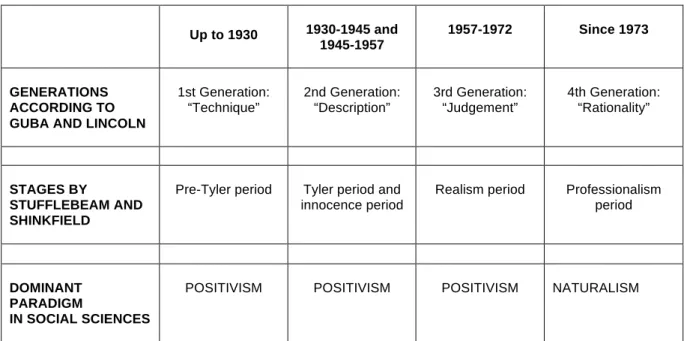
so-called assessment generations. By way of summary and conclusion, the table
below (Table 1) offers an overview of the 20th century, referring to the four
generations of Guba and Lincoln and the five assessment periods, in accordance
with Stufflebeam and Shinkfield, situating them in their respective paradigms
(Table 2).
Up to 1930 1930-1945 and 1945-1957
1957-1972 Since 1973
GENERATIONS ACCORDING TO GUBA AND LINCOLN
1st Generation: “Technique”
2nd Generation: “Description”
3rd Generation: “Judgement”
4th Generation: “Rationality”
STAGES BY
STUFFLEBEAM AND SHINKFIELD
Pre-Tyler period Tyler period and innocence period
Realism period Professionalism period
DOMINANT PARADIGM
IN SOCIAL SCIENCES
POSITIVISM POSITIVISM POSITIVISM NATURALISM
Table 1. Assessment throughout the 19th century (prepared specifically for this purpose, based on Vélez 2007).
Moreover, the first chapter sets out the main characteristics of assessment
in its different stages, referring to the generations defined by Guba and Lincoln
1st Generation of assessment
(Up to 1930)
2nd Generation of assessment
(1930-1957)
3rd Generation of assessment
(1957-1972)
4th Generation of assessment
(Since 1973)
The positivism of natural-physical sciences is assumed.
Tyler coined the term "educational assessment". Assessment is associated with decision-making. Assessment models begin to "hatch".
Interest in the scientific measuring of human conduct.
Move beyond psychological assessment.
Interest in
accountability. Pupils continue to be the direct subject of the assessment, but now along with teachers, resources, content, learning experiences, organisation, etc.
It is here that the qualitative models appear, impregnated by the logic of the naturalistic paradigm. Interest is based on understanding and reconstruction of educational events. Through the application of technical instruments (intelligence and personality tests).
Based on the proposal of B. Bloom, the curriculum is defined in terms of conduct (through highly precise goals). The use of tests continues to predominate. Cronbach includes questionnaires, interviews and observation as assessment techniques.
It is necessary to promote the
exchange of opinions, values and
experiences between the participants of a programme through the use of
Appraisal of results of educational
programmes in pupils through the
application of tests, surveys,
accreditations and experimental comparisons.
Assessment is in charge of verifying the achievement of the proposed goals, in order to appraise the efficiency of the programmes. However, the contribution made by assessment
improving teaching is very small.
Assessment is used for accountability. Moreover, these should have a direct effect on the
programmes, projects or institutions. Decisions should improve teaching.
Assessment is a tool which facilitates empowerment and emancipation of individuals.
Measuring is a synonym of
assessment, with the term measuring being preferred.
The term assessment is preferred to measuring. Both assessment and measuring are spoken of.
The term "judgement" is included The aim of assessment is to appraise the merit or value of the
programmes. An evaluator is a judge, who issues
judgements.
"Measuring" is no longer spoken of, in order to advance in the concept of educational assessment.
Rule-based assessment. Indicates the performance of an individual compared to a group.
Criteria-based assessment. Indicates the performance of an individual against a benchmark.
Criteria-based assessment predominates. Scriven coined the terms formative and summative
assessment, or intrinsic and extrinsic assessment. Alternative assessment models ("Respondent assessment" by Stake, "Democratic assessment" by McDonald, "Illuminative assessment" by Parlett and Hamilton, assessment as "artistic criticism" by Eisner, etc) appear.
Chart II. Main characteristics of assessment during the 19th century (drafted for this purpose).
In short, this chapter aims to show how interest in assessment dates back
historically to ancient times. Some authors place it around 2000 BC. Ever since this
time, the concept of assessment has experienced changes through different
classification made by Guba and Lincoln (1982, 1989) has been followed, referring
to the four "assessment generations", which include four key periods in the way
assessment is conceptualised. Up until 1930 the term measurement was preferred
to assessment, which became more prominent with the arrival of Tyler, who is
recognised as the father of educational assessment. In the Tyler period the order is
reversed and assessment is placed before measuring. However, it was not until
1957 that assessment was first used with the goal of improvement, associating it to
decision-making to improve programmes and teaching, although not directly to
individuals, the subjects of learning. The year 1973 saw the first alternative
proposals to the traditional model based on positivism, representing the start of
understanding of assessment as a tool to empower individuals. This later saw the
inclusion of new principles which would impact the way assessment was
understood in learning in schools, taking on constructivist ideas which altered the
long-standing interpretation of the assessment-evaluation model; the term
measuring gave way to educational assessment.
Chapter 2 shows two ways of understanding educational phenomena, detailing
two opposing models in order to explain the concepts of learning and curriculum.
The block devoted to learning explains how, conceptually, learning theories
have changed and transformed. This sets out how the purest behaviourist
conception, which explains human conduct as being as simple and linear as in the
case of animals, limits analysis to that which can be observed, to that which takes
place outside the black box. This is in contrast to the opposing cognitive current,
put forward by authors such as Bandura, Lorenz, Tinbergen, Rosenthal, Piaget,
Bruner, Ausubel, Vigotsky, Luria, Leontiev, Gagné, Mayer, etc., which concerns
itself with that which takes place inside the human psyche. This is known as
mediational theory. The section on learning is rounded off with Mayer's
classification of the concept of school learning.
Having situated the concept of learning in constructivism, the idea that the
psychological principles of this model on learning by human beings have, or at
is discussed. One of the concepts which must necessarily be affected by such
psychological conquests is assessment. For this reason a section has been set
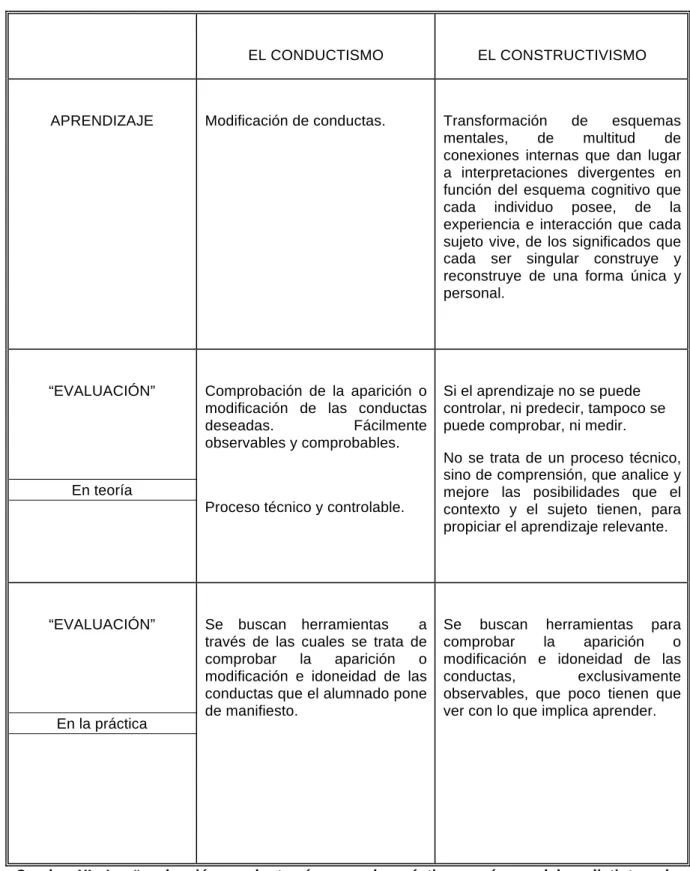
aside to deal with the relationship existing between learning and assessment, with
a chart showing the conceptions of learning and assessment in both models
(behaviourism and constructivism), highlighting how, despite changes in theoretical
discourse on learning and assessment, assessment practice in schools still
responds to the traditional, mechanical and reproductive model.
The block devoted to the curriculum sets out two opposing views on
understanding the curriculum: long-standing target-based pedagogy –typical of the
more technical and mechanical view of education, within a conception of efficiency
of the means-end model–, and the more practical, holistic and critical conception of
the curriculum, led by authors such as Stenhouse, Elliot, Eisner, Shön, Gimeno,
Pérez Gómez, Contreras, etc., which questions this simplistic view and adds
richness, depth and complexity to the processes which take place in the classroom
and which form part of the school curriculum, including the assessment process.
The curriculum and assessment section shows how, as a result of this change of
paradigm, there is a shift in theory from the conceptualisation of assessment as a
measure. A new model appears with the goal of overcoming the limitations
previously found in the assessment sphere. Constructivism recognises that
"standardised achievement tests do not provide all the information needed to
understand what teachers teach and pupils learn" (Pérez Gómez, 1989: 428) and
calls on comprehensive assessment, which is concerned with the quality of the
processes which take place in the classroom. By way of conclusion, another chart
sets out the conceptions of curriculum in the positivist and constructivist
paradigms, with the consequences deriving from both of them in the way
assessment is understood on a theory level. Furthermore, it is again shown how,
despite a theoretical transformation of what classroom assessment means,
day-to-day practice continues to be stale, out-of-date and inconsistent with the new way of
defining the curriculum.
The content of this chapter aims to reflect, in the words of Álvarez Méndez
knowledge which, in turn, is bound to a particular way of understanding education.
In other words, constructivism places us, amongst many other questions, before an
idea of curriculum and learning in the classroom which should inevitably produce
assessment practice, and yet, as indicated, there is very little transformation,
despite being within the framework of two opposing paradigms. In the day-to-day
classroom, even though, as stated by Moreno (2014), this is precisely one of the
greatest paradoxes of assessment in education, since: "whilst over the last three
decades, we have radically changed –in theory at least– our perspective of
teaching, learning and assessment, in practice this assessment continues to be
understood as being synonymous with standardised, external, summative,
product-focused measuring" (2014: 16).
Chapter 3 has been divided into three blocks. The first block, devoted to
evaluation, sets out the most important consequences which affect teachers' and
pupils' ways of thinking and acting under the evaluating logic of the school, to
which end analysis is introduced based on the ecological model of Doyle (1981).
This block discusses questions such as obsession with measuring and controlling
learning; the absolute importance given to the supposed results of school learning;
the meaning pupils give to knowledge at school; the place of mistakes in the
classroom; attitudes of mistrust and mechanisms employed by pupils to
successfully navigate the educational system; the disruption of valuable
communication processes in the classroom; the constant search for new, refined
evaluation tools which end up being confused with assessment; and the selective,
segregating function of evaluation, which, despite having no educational purpose,
remains intact in schools.
We have recalled that a school which evaluates is a school which is
obsessed with measuring the learning of its pupils, something which is impossible
since it involves maintaining a fictitious causal relationship between what is taught
and what is learned. A school which, despite being aware that there is no
correspondence between what the results of the tests show and the learning
actually experienced by the individual, remains bound by the tyranny of results. A
even when this reduces the educational possibilities of the teaching function. A
function which is relegated to merely supervising, devoid of any autonomy. A
school which, through evaluation, silently screams out to pupils that only that which
counts toward the final mark is worth studying or learning. A school which turns
mistakes into the enemy of learning and produces mistrustful, conniving pupils who
will lie, cover up and simulate as much as necessary to ensure they pass. A school
where marks subjugate educational aspects and do not leave any room for
relevant learning, either for pupils or for teachers. A school in which the end
justifies the means. Schools which evaluate place themselves at the service of
selection and classification, turning their back on their social function. In short, a
school which, under the umbrella of evaluation, becomes everything it should not;
a place which, instead of working to combat exam practice, focuses on how to
convert and improve the flagship tool of evaluation.
The second block, dedicated to assessment, is presented in opposition to
evaluation. The first approach, evaluation, is concerned with checking and
controlling learning and obsesses over the academic results of pupils, relegating
processes to an absolutely secondary level; the second approach, assessment,
works for rather than against learning, placing itself at the service of all agents
intervening in the assessment process. This, naturally, implies respect for and
coherence with all the psychological and pedagogical principles of learning. In
consequence, if all agents intervening in the classroom –pupils and teachers– are
to learn both with it and from it, the teacher's vision must go beyond a technocratic
conception of teaching; a conception in which researching, knowing, analysing,
understanding, improving, forming, educating, etc., are conditions of the assessing
practice of a classroom. A school which assesses is a school which places
assessment at the service of learning for both teachers and pupils. Assessment is
therefore always a source of improvement possibilities. Based on this premise, the
block outlines the conditions required for this to always be an opportunity for
learning. However, we believe that, rather than starting with what assessment
it should not do. These are known as the “NOes” to ensure proper assessment.
Seven questions have been developed:
1. Assessment is NOT a question of teacher power and control over pupils, but
rather a question of trust.
2. Assessment CANNOT focus on products, but rather on processes and
contexts.
3. Assessment is NOT to give marks.
4. Assessment CANNOT penalise mistakes.
5. Assessment CANNOT silence pupils and quell participation.
6. Assessment must NOT be: a point of view; the view of a point.
7. Assessment CANNOT harm anybody.
This block concludes with the educational implications of assessment, with
the idea of contrasting them to the perverse effects deriving from the positivist logic
upon which the evaluation practices which prevail in educational systems are
based.
The third and final section of the chapter is dedicated to the most common
confusions regarding the concepts and practices of assessment and evaluation,
since the functions assigned to them even contradict each other. There is a
criticism of the multitude of terms –surnames– used to designate them, often
resulting in the meaning of the terms being lost and bringing about what has
become known as, in accordance with the assessment generations classification
put forward by Guba and Lincoln (1982), the fifth generation of assessment, the
"lost or eclectic generation". Furthermore, it is stated that, whilst concepts become
more sophisticated, practice remains in place, even resulting in traditional practice
becoming concealed behind innovative, imaginative terms for assessment. In
consequence, functions, intentions and even names proliferate and increase in
complexity, to the extent that we are now at a historic moment in which, though
knowledge of assessment is greater than ever before, there is a huge amount of
confusion. Indeed many attempts over previous decades to differentiate between
literature on the nomenclatures which accompany the term assessment is so
extensive that it brings confusion as to the true meaning of the term. The result is
that many forms of practice which claim to be assessment also aim to be practices
for evaluation or measurement. We have therefore called the current period the
fifth generation of assessment: eclectic assessment.
The study by Castillo (2010) in his book "Vocabulary of Educational
Assessment" found a total of 1,097 terms related to the field of assessment, which
he groups together in twelve groups. Many different names have been given to
"assessment": overall assessment, holistic assessment, authentic assessment,
assessment for learning, continuous assessment, illuminative assessment,
responder assessment, criteria assessment, summative assessment, learning
assessment, diagnostic assessment, initial assessment, final assessment,
results-focused assessment, etc. In many cases the meaning of the term can be lost, and
it is not infrequent to find examples of redundancy, such as "overall assessment",
or cases where the term "assessment" is used as a synonym for evaluation, such
as "final assessment".
One of the greatest obstacles to improving assessment, namely the
ambiguity existing in the different practices and discourse on it. Santos Guerra
(2003) refers to it as linguistic reductionism which ends up confusing both terms.
This block also contains a section which draws attention to the indiscriminate
use of the terms assessment and evaluation in the education field. Why call it
assessment when they mean evaluation? is the title chosen to deal with this
somewhat concerning question.
The chapter finishes with two final questions. The first question refers to a
key aspect in this labyrinth: Can assessment and evaluation coexist? The answer,
as set out in this work, is far from straightforward, indeed it is one of the greatest
paradoxes of education. The second question discusses how the way evaluation or
assessment tools are 'used' or 'misused' depends directly on the conceptions of
explores the difficulty and risk involved in trying to convert a tool with a long
evaluation tradition, such as exams, into a possible assessment tool.
PART TWO
Chapter 4 sets out how the portfolio, also known as "folder", "dossier" or
"report folder", has a long history in professional fields related to arts, advertising
and finance. Its purpose was to show off the best productions designed over a
professional career in order to satisfy the demands and interests of different
clients.
In this sense, the portfolio is limited to its literal meaning of "carrying" work,
productions, assignments, etc.; transferred to the educational sphere, it is defined
more or less as a container, in this case of school material. However, the end of
the 1980s saw the start of a current which spread from the USA to Europe,
gradually introducing elements which would become the main characteristics of the
portfolio in school contexts, namely pupils being in charge of, managing and
actively participating in creating their own portfolios. A process guided by the
teacher which comes together in shared reflection. The portfolio therefore began to
abandon the literal sense of the word in order to give way to a new concept
focused more on processes than on products, with this process going
hand-in-hand with a form of crisis in performance tests, which were now coming under
criticism. There was a concern with searching for alternative "assessment" tools
which looked not only at results but also at learning processes. Initially it had
significant presence in the field of reading and writing, either as a mother tongue or
second language, and gradually spread into higher education, including teacher
training. At the turn of this century these experiences began to appear in Spain.
Experiences with portfolios began to proliferate and classifications of their
different types and uses started to appear. We have simplified these types in two
categories: 'the product portfolio' and ‘the process portfolio’. Meanwhile, the uses
have been reduced to: ‘accountability’ and ‘learning’. However, given the common
mix of functions between different types of portfolios, we have decided to add a
evaluation. We can therefore find portfolios which focus on the process ('type'
category), which emphasise the development and learning of pupils ('use'
category), and which aim to be used to achieve a mark, thus fulfilling more of a
summative than a formative function (‘function’ category). The purpose of
presenting these three categories is to remember that, as indicated throughout the
work, assessment and evaluation are often mixed together or confused, it being
common for the characteristics of assessment to be assigned to evaluation in order
to make it more palatable. However, as explained previously, eclecticism is not
without its own problems, and it is not clear, for example, whether a portfolio with
summative function used to obtain a mark is actually used for learning.
Chapter 5 develops what we believe is the main advantage of portfolios
being a relatively recent phenomenon in compulsory education, along with the risk
of transferring portfolio practices from higher education or other fields of knowledge
to lower levels. Two sections have been envisaged for this purpose.
The first section sets out the characteristics required of a portfolio for
assessment and learning, which involves a significant challenge: to place the
portfolio at the service of assessment. In this regard, emphasis has been placed on
making use of the continuous, reflective character given to it, and a series of
conditions have been listed in accordance with the conditions of the assessment.
These are: 1) Focus on analysing learning processes and contexts, emphasising
reflection, organisation, self-assessment and metacognition as key elements. Here
it is the teacher who should feed such processes. 2) Promote a climate of freedom
which encourages communication and true learning, meaning all efforts must focus
on the information provided by pupils being as sincere as possible, and on moving
away from the value of change of school knowledge in order to recover its use
value. 3) Subscribe to learning through mistakes, without any negative judgement.
This third condition implies that the portfolio should be used to help pupils to
construct an informed, organised mind of what is learned and how, with the
informed correction of the teacher taking on particular importance. 4) The fourth
condition says that the portfolio must be a channel which collects the pupil's voice
the reconstruction of all points of view which converge in the educational act, thus
also making it a democratic exercise. 5) Finally, the fifth condition raises the need
to convert the portfolio in an assessment system which includes strategies for
monitoring and analysis of learning, classroom life and pupils' productions, both
finished and incomplete. To this end we propose working with diaries, pupil
self-assessment materials, monitoring and self-monitoring cards, dropboxes, drafts,
etc. Moreover, it is here that a definition of the portfolio itself is offered.
The second section focuses on the risk involved in trying to reproduce in our
field the use given to portfolios in other professional spheres or levels, placing it at
the service of evaluation rather than assessment. There is a brief criticism of
so-called "authentic assessment", where the portfolio approach originates from,
arguing that, once again, the new adjectives used to describe assessment merely
conceal evaluation practices. We believe that authentic assessment is simply
another way of grading pupils, albeit by placing them in more real, contextualised
situations than traditional exams. The work concludes with a call to remember the
importance of not confusing the refining of evaluation tools, which are closer to the
appraisal of more complex, less mechanical learning, with the putting into practice
of true assessment systems, the meanings, uses and purposes of which are
difficult to square with the selective, certifying, accrediting functions of evaluation. It
is for this reason that we have titled this section "Portfolio: from ‘authentic
assessment’ to ‘true assessment’”.
PART THREE
Chapter 6 is dedicated to presenting the research. It describes the context in
which the research took place, and recounts the framework for the study. It also
outlines the purpose, the methodology used –case study– and the research work
stages. The strategies, techniques and sources of information used in the
collection of data are also developed. The final section of this chapter sets out a
series of notes and observations on the interpretation of the data by the
The first section of Chapter 7 is devoted to understanding the starting point of
the work. This describes the most relevant characteristics of the teacher who led
the case study, along with the most significant aspects of his situation in the
secondary education school where he works. Great importance is placed on
explaining the trajectory of the teacher in terms of his particular conceptions of
classroom assessment. Declarations taken from his doctoral thesis and from some
of his conference papers are included to give readers an idea of the teacher's
profile (the teacher is known as “P”). It has also been deemed necessary to outline
P's working conditions, since he has just started at the school. A separate section
is devoted to the idiosyncrasy of the groups of pupils in the two school years taking
part in the research: secondary education years one and two. This indicates the
principal features and particularities considered necessary to understand the
context in which the experience developed, and in order to interpret the analysis
completed. The most idiosyncratic elements of each of the groups are described,
along with the relationship P had with each of them.
Furthermore, there is a detailed description of the elements which made up
the structure of the portfolios, accompanied by illustrations containing examples of
their materials and components. An explanation is provided as to why these were
chosen, setting out one of the most important initial questions in a portfolio
experience: what should it contain? Furthermore, there is discussion of whether the
portfolio is an isolated tool or, to the contrary, it is used with a view to becoming a
complete assessment system. Both decisions have been decisive in the meaning
and purpose of using portfolios in this case study. They are based fundamentally
on P's conception of assessment and, in consequence, of portfolios, to which end
the following is considered a condition sine qua non when implementing a portfolio:
the need to rethink the meaning of assessment. In other words, the value of
examinations in compulsory education needs to be questioned as a misunderstood
assessment tool.
Chapter 8 analyses and discusses the events which took place during the
development of the experience, in accordance with the main theories set out in the
theory and the most relevant experiences which came about during the research,
with the analysis of this work dealing with the theory content outlined more
specifically in chapters 3 and 5, namely the consequences of the evaluation logic
existing in schools, the conditions necessary to start assessment processes and
the conditioning factors involved, the difficulties deriving from the coexistence of
evaluation and assessment, the characteristics required for a portfolio at the
service of assessment, and how this can go beyond being a mere tool to become
an assessment system.
PART FOUR
Chapter 9 of this work deals with the different questions the theoretical study
and the case study have revealed, in order to focus on them, reflect, reach some
conclusions and open up new issues for consideration. This section is dedicated to
the reflective summary of the thesis.
At this point in the work it is time to deal with the different questions the
theoretical study and the case study have revealed, in order to focus on them,
reflect, reach some conclusions and open up new issues for consideration.
For example:
- The importance of considering the meaning of assessment and,
along with it, of the curriculum and learning. Ton insist on the
differentiation made between assessment and evaluation, which has
been the basis for the development of this work, joining together
ideas which, in the thesis, were found many pages apart. To resume
how the conditions defined for assessment and the conditions
established for the portfolio at the service of this assessment
interrelate, and, finally, how these both relate to the portfolio
practice developed in the case study.
- To remember and to reflect on the different possibilities and
difficulties which can be found when developing assessment and
- The confusion which often occurs between improving assessment
strategies and refining evaluation tools. And the indiscriminate use
of the terms assessment and evaluation in the educational sphere.
- By way of conclusion, we shall look back over the experience and
share some of the most personal aspects deriving from it.
PARTE I
. EVALUACIÓN
“La ‘evaluación’ está de moda. Llevamos unos años insistiendo en que hay que evaluar las escuelas, los institutos, las Universidades. Lo cual no es motivo inexcusable de alegría. Cuando un fenómeno pedagógico se pone de moda
hay que estar prevenidos. Nada es inocente”.
(Santos Guerra, 2001: 8).
Capítulo 1 APROXIMACIÓN HISTÓRICA A LA “EVALUACIÓN”
INTRODUCCIÓN
A lo largo de todos los tiempos, las personas, evaluamos y somos
evaluadas, continuamente. Se puede decir que, la evaluación es un proceso
natural permanentemente presente en muchos aspectos de nuestras vidas.
Evaluamos diariamente con distintos fines: Valoramos las características y
posibilidades que nos ofrecen unos productos del mercado con respecto a otros
para comprarlos o no; atribuimos adjetivos a personas, situaciones o cosas, en
función de las impresiones que nos dan; elaboramos juicios que nos ponen de
parte de alguien o en contra de otro alguien en una disputa; buscamos conocer lo
qué le gusta o le molesta a nuestra pareja, con la intención de que la relación vaya
a buen puerto, etc. Evaluamos, valoramos constantemente sin esfuerzo alguno
aparente, y casi sin darnos cuenta de ello. Igual, aunque a diferente nivel, más
sistemático, más consciente, ocurre en los ámbitos profesionales: la medicina, la
justicia, el periodismo, la construcción, la seguridad y vigilancia… y la educación. Y aunque no sería nada desdeñable hablar de los porqués y para qué de la
evaluación en otras esferas profesionales, nos ocupamos en este caso, de la
evaluación en los contextos educativos, concretamente en las aulas. Primero
trataremos de responder algunas cuestiones como ¿en qué época podemos situar
el interés por ‘evaluar’? ¿cuándo aparece la obsesión por la medición? ¿en qué
momento es acuñado el término evaluación educativa?, así como en ¿qué
momento se produce la eclosión de modelos de evaluación en el ámbito
educativo?
1.1 LAS PRIMERAS PRÁCTICAS DE ‘EVALUACIÓN’ CONOCIDAS
El interés por la evaluación se remonta a mucho tiempo atrás. Forrest sitúa
su primera manifestación histórica en el siglo II (a. de C.), tratándose de una
práctica china para seleccionar funcionarios. Se trata de las primeras prácticas
selectivas de evaluación oral (Forrest, 1990: 470, cit. por Gimeno Sacristán, 2002:
338). Lemus (2012) añade que, algo así, como un cuestionario de evaluación
utilizaron Sócrates y otros maestros de la época, en sus prácticas de enseñanza,
alrededor del siglo V (a. de C.). El autor sitúa los sistemas de evaluación educativa
(dogmáticos), entre los siglos V y XV (d. de C.). No tan lejano, Lemus nombra a
dos países precursores de la evaluación, durante el siglo XIX: Estados Unidos, en
1845, comienza a aplicar los test de rendimiento a estudiantes, con objeto de
contribuir a la educación de los estudiantes. Y Gran Bretaña, donde existieron
comisiones para evaluar los servicios públicos. Hernández y Guzmán (1991),
añaden un dato histórico curioso, dicen que en Gran Bretaña fue creada una
comisión para evaluar la educación en Irlanda y que entre sus conclusiones se
encontraba lo siguiente: "El progreso de los niños (en las escuelas estudiadas) era
menor al que debería ser. Para lo cual recomendaban una medida que atajara el
problema: "pagar por resultados", es decir, que parte del salario del profesorado
iría en proporción a las calificaciones obtenidas por el alumnado al final del año
escolar. Ellos lo resaltan por el valor tan actual que podría tener, y yo me hago
eco.
Estos mismos autores sitúan en el año 1845, en Boston, el uso de pruebas
de rendimiento escolar como fuente básica de información para evaluar a las
escuelas y al profesorado. También, añaden, es entre 1887 y 1898, cuando
el pedagogo Joseph Rice, utiliza por primera vez grupos de comparación para
medir la eficacia de los programa; “se estudió los conocimiento de ortografía de
33.000 estudiantes de un amplio sector escolar (…). Este estudio está generalmente reconocido como la primera evaluación formal sobre un programa
educativo realizado en América” (Stufflebeam y Shinkfield, 2005: 33, cit. por Vélez,