
Antecedents of dynamic capabilities: the role of entrepreneurial orientation and intellectual capital
176
0
0
Texto completo
(2) A N T E C E D E N T S OF DYNAMIC C A P A B I L I T I E S : T H E R O L E O F E N T R E P R E N E U R I A L ORIENTATION AND I N T E L L E C T U A L C A P I T A L. APPROVED B Y T H E M E M B E R S O F T H E DISSERTATION C O M M I T T E E. Elisa Cobas Flores, PhD (Chair) Professor EGADE Business School, Monterrey Tecnológico de Monterrey. Bryan Husted, PhD Professor EGADE Business School / Schulich School of Business Tecnológico de Monterrey / York University. Carina Lomberg, PhD Professor IMU - Management University of Bern. Anabella Dávila Martínez, PhD PhD Program Director EGADE Business School Tecnológico de Monterrey.
(3) SUMMARY This dissertation attempts to contribute to our understanding of the antecedents of dynamic capabilities that are entrepreneurial in nature by exploring the interaction of entrepreneurial orientation and intellectual capital. Chapter 1 of this dissertation serves to introduce and synthesize major themes, objectives and contributions. In Chapter 2, I review the literature derived from the resource based view of the firm and dynamic capabilities. The first theoretical perspective is succinctly addressed to argue the importance of resources in the development of dynamic capabilities. The second one is thoroughly examined in order to summarize the purpose and usage of dynamic capabilities. Besides, a detailed categorization of dynamic capabilities’ antecedents considering different levels of analysis is presented. Chapter 3 has two parts. In the first part I focus on the dimensions of the constructs under study. The dimensions of intellectual capital are: human capital, social capital and organizational capital; meanwhile, the dimensions of entrepreneurial orientation are: innovativeness, proactiveness and risk-taking. In addition, integrative capabilities – a particular type of dynamic capabilities – are called so since they integrate the processes of perceiving and capitalizing an opportunity. In the second part, I develop the rationale for each hypothesis included in the conceptual framework. The first hypothesis argues a positive relationship between intellectual capital and integrative capabilities. Also, positive relationships are stated between human capital, social capital, organizational capital and integrative capabilities respectively. The last hypothesis refers to the moderating effect that entrepreneurial orientation has on the intellectual capital-integrative capabilities relationship.. I.
(4) In Chapter 4 I address methodological issues. This dissertation is framed under the quantitative paradigm and data for statistics are collected through surveys carried on in small, medium and large enterprises in Mexico and Ecuador. The final sample has 92 enterprises from Ecuador and 108 enterprises from Mexico. Furthermore, 80% of the total sample has two responses; one belongs to the CEO and the other one to a second level manager. Chapter 5 presents the empirical results using two approaches. The first approach relies on regressions using SPSS while the second approach relies on Structural Equation Modeling (SEM) using AMOS. Results using both statistical techniques are consistent and show robustness. All hypotheses, except the one that argues for a positive effect of human capital on integrative capabilities, are supported as predicted. Finally, this dissertation concludes with Chapter 6 that discusses the main findings, outlines implications for managers and policy makers, details some limitations of the study and provides some new avenues for future research.. II.
(5) To Ecuador, my country, the land that I love and I want to see prosperous…. To all young Ecuadorians, as a testimony that discipline and courage can reach the highest goals…. III.
(6) ACKNOWLEDGEMENTS. I owe my gratitude to my dissertation committee for their intellectual and constant support. I am indebted to Professor Elisa Cobas-Flores not just for guiding and supporting me with patience over these years but for taking a step forward and contributing in my formation as an integral human being. For her vision and leadership that inspires me to look beyond… I also thank Professor Bryan Husted for encouraging and teaching me on how to reach excellence and for his vivid testimony of academic success and inspiring humbleness. My gratitude to Professor Carina Lomberg since your example encourages me to emulate in kindness and openness. I also thank your help during my doctoral exchange in Switzerland and your visit to Mexico for the final defense. I express my unending gratitude to my parents Teodoro and Rocío for their countless ways of supporting me through this long adventure. Above all, your love and constant care despite the distance will always remain in my heart. I could write a book of stories regarding how many times you have helped me. Thank you for just being there during the joyful times and frustrating moments. I owe you a great part of this goal. Thanks Paola (lashita). To my sisters Marcela, Gaby and Marieliza for all the bb and whatsapp messages that kept me going forward. You fueled my days from time to time. I acknowledge the willingness to help and contributions of Professor Jorge Rocha and Professor Laura Zapata that improved this research. IV.
(7) To all my friends of the DCA program. Special thanks to José Antonio for debating ideas, Adán for his patience and willingness to discuss statistical issues, Alfonso and Cecilia for running shoulder by shoulder in our research group… A special thanks to EGADE Business School and the Technology Base Enterprises Chair for their financial support that made possible my studies and this work. Also, my gratitude to CONACyT for the scholarship granted during part of my doctoral studies. A big thank you to Karla Salinas and Mariquita García for helping me with so many things, you are the best secretaries our school has. Also, my gratitude to Karla Cabrera and Coral González for their support in formatting the final document. Finally, and on purpose for being the most important, my gratitude to God. You stand by me always even when I do not deserve such a caring presence and love. Thank you for bestowing so many blessings on my life. Along these years and in my entire existence when I drew closer to you my life had more meaning. Thank you for so many gifts and strengthen me to put them to serve others.. V.
(8) TABLE OF CONTENTS CHAPTER 1 INTRODUCTION AND RESEARCH OBJECTIVES ............................................ 1 1.1 Introduction ........................................................................................................................... 1 1.2 Research Objectives .............................................................................................................. 5 CHAPTER 2 LITERATURE REVIEW ......................................................................................... 7 2.1 The Dynamic Capabilities View and the Resource Based View .......................................... 7 2.2 Antecedents of the Resource Based Theory.......................................................................... 7 2.3 Resources and VRIN/O characteristics ................................................................................. 8 2.4 Dynamic Capabilities View ................................................................................................ 11 2.5 Dynamic Capabilities Antecedents ..................................................................................... 15 2.6 Dynamic Capabilities in General Perspective ..................................................................... 17 CHAPTER 3 THEORETICAL MODEL ...................................................................................... 19 3.1 Entrepreneurial Orientation ................................................................................................. 19 3.1.1 Dimensions of Entrepreneurial Orientation .................................................................. 20 3.2 Intellectual Capital .............................................................................................................. 21 3.2.1 Dimensions of Intellectual Capital ............................................................................... 21 3.3 Integrative Capabilities ....................................................................................................... 22 3.4 Theoretical Model Development ......................................................................................... 23 3.4.1 Hypotheses.................................................................................................................... 37 CHAPTER 4 METHOD ............................................................................................................... 39 4.1 Introduction ......................................................................................................................... 39 4.2 Research Design and Data Collection ................................................................................. 40 4.3 Sample ................................................................................................................................. 46 4.4 Scale Development .............................................................................................................. 47 4.5 Data Analysis ...................................................................................................................... 51 4.6 Ethical considerations ......................................................................................................... 52 CHAPTER 5 EMPIRICAL RESULTS ......................................................................................... 53 5.1 Sample’s General Characteristics........................................................................................ 53 5.1.1 Ecuador’s Sample ......................................................................................................... 53 5.1.2 Mexico’s sample ........................................................................................................... 55 VI.
(9) 5.1.3 Total Sample (Mexico and Ecuador) ............................................................................ 56 5.2 Assumptions for Multiple Regression Analysis .................................................................. 60 5.2.1 Sample Size .................................................................................................................. 60 5.2.2 Multicollinearity ........................................................................................................... 61 5.2.3 Singularity .................................................................................................................... 61 5.2.4 Normality ...................................................................................................................... 62 5.2.5 Linearity........................................................................................................................ 65 5.2.6 Homoscedasticity.......................................................................................................... 66 5.2.7 Independence of errors ................................................................................................. 66 5.3 Reliability of Scales ............................................................................................................ 67 5.3.1 Convergent Validity ..................................................................................................... 67 5.4 Confirmatory Factor Analysis (CFA) – Construct Validity ................................................ 68 5.4.1 Discriminant Validity ................................................................................................... 70 5.5 Common Method Variance (CMV) / Harman Test ............................................................ 71 5.6 Intraclass Correlation .......................................................................................................... 71 5.7 Paper and Web based surveys ............................................................................................. 73 5.8 Early and late respondents................................................................................................... 73 5.10 Descriptive Statistics ......................................................................................................... 74 5.11 Hypotheses Test Results: .................................................................................................. 77 5.11.1 Empirical Findings ..................................................................................................... 79 5.12 Robustness Check ............................................................................................................. 85 CHAPTER 6 CONCLUSIONS..................................................................................................... 88 6.1 Discussion and Conclusions ................................................................................................ 88 6.2 Implications for managers and policy makers..................................................................... 93 6.3 Limitations .......................................................................................................................... 94 6.4 Future Research ................................................................................................................... 95 References ................................................................................................................................. 97 Appendix 1. Entrepreneurial orientation’s instrument ............................................................ 108 Appendix 2. Intellectual Capital’s instrument......................................................................... 109 Appendix 3. Integrative Capabilities’ instrument ................................................................... 110 Appendix 4. Slack Resources’s instrument ............................................................................. 111 VII.
(10) Appendix 5. Reliability of Scales ............................................................................................ 112 Appendix 6. Confirmatory Factor Analysis Scale by Scale ................................................... 118 Appendix 7. Conjoint Confirmatory Factor Analysis (All scales at once) ............................. 129 Appendix 8. Common Method Variance Harman Test........................................................... 131 Appendix 9. Intraclass Correlations ........................................................................................ 133 Appendix 10. Paper vs. Web Based Surveys and Early vs. Late Respondents ....................... 139 Appendix 11. Results using Ordinary Least Squares .............................................................. 141 Appendix 12. Results using Structural Equation Modeling (SEM-AMOS) ........................... 155 Appendix 13. Common Method Variance Test – Common Latent Factor ............................. 160 Appendix 14. Validity and Reliability of scales using Structural Equation Modeling. .......... 162. VIII.
(11) LIST OF TABLES Table 1. Definitions of Dynamic Capabilities .............................................................................. 13 Table 2. What Dynamic Capabilities do and What they are for ................................................... 14 Table 3. Antecedents of Dynamic Capabilities According to main Definitions........................... 15 Table 4. Antecedents of Dynamic Capabilities Considering Levels of Analysis ......................... 17 Table 5. Ecuador’s Enterprises (Respondents and Non-Respondents per Industry) .................... 54 Table 6. Mexico’s Sample of Sent and Received On-line Surveys .............................................. 55 Table 7. Total Sample Characteristics by Industry Type .............................................................. 58 Table 8. Total Sample Categorized by Size .................................................................................. 58 Table 9. Total Sample Categorized by Age .................................................................................. 59 Table 10. Time Response Mexican Sample .................................................................................. 59 Table 11. Time Response Ecuadorian Sample ............................................................................. 60 Table 12. Reliability Analysis of Scales (Cronbach’s Alpha) ...................................................... 67 Table 13. Results of Principal Components with Varimax Rotation ............................................ 68 Table 14. Intraclass Correlations Results (First and Second Respondent) ................................... 72 Table 15. Levene’s Test for Equality of Variances in Paper and Web-based Surveys ................ 73 Table 16. Levene’s Test for Equality of Variances in Early and Late Respondents .................... 73 Table 17. Descriptive Statistics..................................................................................................... 74 Table 18. Correlation Matrix ........................................................................................................ 75. IX.
(12) Table 19. Correlation Matrix (Intellectual Capital Disaggregated) .............................................. 76 Table 20. Regression Models Results ........................................................................................... 77 Table 21. Results - Comparison Multiple Regressions and SEM ................................................. 86. X.
(13) LIST OF FIGURES Figure 1. Disaggregated Resources – Dynamic Capabilities Relationship................................... 25 Figure 2. Theoretical Model: Antecedents for Developing Dynamic Capabilities ...................... 37 Figure 3. Plots for Assessing Normality in Entrepreneurial Orientation, ..................................... 63 Figure 4. Plots to test Normality, Linearity and Homoscedasticity (final model) ........................ 64 Figure 5. Plot to check if regression assumptions are met (final model) ...................................... 65 Figure 6. Statistically significant model paths (SEM-AMOS) ..................................................... 79 Figure 7. Plot of the Interaction Effect of Entrepreneurial Orientation ........................................ 84. XI.
(14) CHAPTER 1 INTRODUCTION AND RESEARCH OBJECTIVES 1.1 Introduction Dynamic capabilities contribute to building new competences, respond to environmental changes and enhance competitive advantage (Teece, Pisano and Shuen, 1997). Furthermore, according to Teece (2007) if an organization pursues strong dynamic capabilities it should be intensely entrepreneurial. Being entrepreneurial refers to the field of entrepreneurship that pursues the understanding of opportunities’ emergence (Venkatarman, 1997).. A recent. bibliographic study reveals that entrepreneurship has been rarely considered in the dynamic capabilities research (Di Stefano, Peteraf and Verona, 2010).. Besides, little empirical. investigation deals with specific antecedents or the microfoundations that develop particular dynamic capabilities (Teece, 2007; Winter, in press). In that sense, research regarding dynamic capabilities that considers entrepreneurship and also indentifies capabilities’ antecedents becomes critical. On one hand, entrepreneurship is relevant since dynamic capabilities affect firm evolution through endogenous entrepreneurship (Newey and Zahra, 2009).. Moreover, strong dynamic capabilities that leverage on the. entrepreneurial view can achieve supernormal returns (Katkalo, Pitelis and Teece, 2010: 1178; Teece 2007). On the other hand, dynamic capabilities’ antecedents need to be examined to undercover their evolutionary fitness (Helfat et al., 2007), and also as an emerging concept becomes important to incorporate its antecedents (Wang and Ahmed, 2007). Furthermore, the relevance of taking into account the antecedents also contributes to aid in theory construction (Corbett, Neck and Laverty, 2011).. 1.
(15) Derived from the entrepreneurship field, this research addresses entrepreneurial orientation since it is a construct which has gained legitimacy and became a key in the entrepreneurship literature (George, 2011), or a central component of entrepreneurship (Slevin and Terjesen, 2011). In regard to specific antecedents, organizational resources have been established as one of the common antecedents in seminal papers’ underlying logic (Helfat and Peteraf, 2009). In consequence, this investigation leverages on intellectual capital as particular intangible resources that might develop dynamic capabilities (Kim and Mahoney, 2010). Thus, this dissertation attempts to shed light on the dynamic capabilities development examining empirically the role of entrepreneurial orientation and leveraging on intellectual capital as a crucial organizational antecedent. Scholars have argued that dynamic capabilities’ outcomes are related to performance (Drnevich and Kriauciunas, 2011; Teece et al., 1997; Zollo and Winter, 2002), economic returns (Chatain, 2011) and economic profits (Makadok, 2001). Additionally, recent research mentions that for deploying value creation strategies the implementation of capabilities is required (Ambrosini, Bowman and Schoenberg, 2011). As a result, the relevance of dynamic capabilities has been acknowledged and triggered the fundamental question of how such capabilities emerge or what are its antecedents. Hence, this issue is important to further understand the processes through which firms create competitive advantage. Accordingly, the literature has dealt with this questions and two debates currently refer to the effect that entrepreneurship has upon dynamic capabilities (Zahra, Sapienza and Davidsson, 2006) and the central role that resources play to develop dynamic capabilities (Eisenhardt and Martin, 2000; Zahra and George, 2002), and consequently should be identified and acquired for this purpose.. 2.
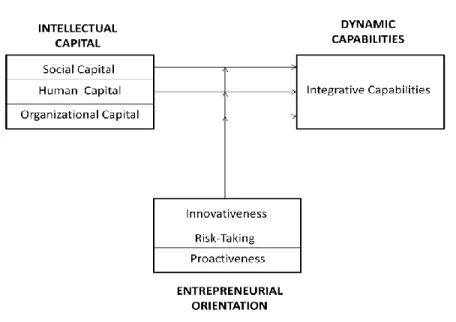
(16) This study propones that intellectual capital is a specific organizational resource that may contribute to the development of a concrete type of dynamic capabilities such as integrative capabilities (Liao, Kickul and Ma, 2009) which emphasizes the opportunity sensing and seizing characteristics of a dynamic capability (Teece, 2007). This argument attempts to answer the concern that little is known about the black box role of explicit resources affecting particular dynamic capabilities (Sirmon, Hitt and Ireland, 2007). In addition, it is argued that the effect of entrepreneurial orientation understood as a “general or lasting direction of thought, inclination, or interest pertaining to entrepreneurship” (Covin and Lumpkin, 2011: 857) has been understudied.. Therefore, this investigation proposes a theoretical model formed by three. constructs: integrative capabilities as the criterion variable and intellectual capital and entrepreneurial orientation as predictor variables. External and internal integrative capabilities are a representation of dynamic capabilities and their aim is to put specific resources and capabilities into a productive use through the combination of opportunity-recognizing and opportunity-capitalizing processes (Liao et al., 2009). In other words, when referring to external integrative capabilities the emphasis is on opportunity recognition; whereas, when referring to internal integrative capabilities the emphasis is on how such opportunity is capitalized in the organization (Liao et al., 2009). Furthermore, these capabilities are called integrative because they integrate the process of perceiving an opportunity and the process of taking a course of action that brings opportunities into use which is also in line with Teece’s (2007) argument that dynamic capabilities should sense and seize opportunities. According to Grant (1996) knowledge is the most important and significant resource of an organization. Moreover, prior knowledge contributes in an important manner to discover 3.
(17) opportunities (Venkatarman, 1997) or entrepreneurial opportunities (Shane, 2000).. Since. integrative capabilities deal with recognizing and capitalizing opportunities, intellectual capital may be a key antecedent of such capabilities since it refers to knowledge from different perspectives (Subramaniam and Yound, 2005; Youndt, Subramaniam and Snell, 2004) and also considers additional core resources due to its composition of social, human and organizational capital. On the other hand, researchers have noted that firms that pursue dynamic capabilities are guided by an entrepreneurial logic (Newey and Zahra, 2009). Furthermore, dynamic capabilities may be developed if firms are intensely entrepreneurial or undertake entrepreneurial activities in first place (Teece, 2007: 1319; Zahra et al., 2006). As a result, since entrepreneurship is an intrinsic characteristic of developed dynamic capabilities, it is argued that an organization’s orientation towards entrepreneurship must exist beforehand.. Thus, what will lead an. organization to develop such capabilities is a mindset that may put the organization in the path to do so. In other words, previous to the achievement of any action, a vision toward the yearned goal, must take place. Following the previous argument, entrepreneurial orientation reflects the organizational mindset of future entrepreneurial firms and helps to previously define what it means to be entrepreneurial (Lumpkin, 2011). Furthermore, entrepreneurial orientation is understood as a firm’s strategic orientation that captures entrepreneurial aspects that guides decision makers to enact a purpose, sustain a vision and lead to change (Lumpkin and Dess, 1996; Rauch, Wiklund, Lumpkin and Frese, 2009; Voss, Voss and Moorman, 2005). Thus, firms that pursue dynamic capabilities should have an entrepreneurial vision and judgment in advance (Rumelt, 1987).. 4.
(18) In sum, this dissertation has several contributions. First, it attempts to empirically add to our understanding about antecedents that develop dynamic capabilities in an emerging context. Second, determine specific resources that have a positive effect on particular dynamic capabilities (intellectual capital and integrative capabilities respectively).. Third, provide. empirical evidence for the theorized intellectual capital – dynamic capabilities relationship. Fourth, offer a theoretical and empirical contribution by linking the entrepreneurial orientation construct to a current theory of strategic management answering Miller’s (2011) call. Furthermore, this dissertation also sheds light expanding the natural relationship between the fields of entrepreneurship and strategic management providing a joint added value (Schendel and Hitt, 2007). Finally, this study provides evidence on the dynamic capabilities area leveraging on information mostly from small and medium enterprises since most research on this topic have been done in large corporations (Zahra et al., 2006). 1.2 Research Objectives This dissertation proposes a general objective, main objectives and enterprise oriented objectives outlines as follows: General Objective Identify antecedents that contribute to the development of dynamic capabilities. Main objectives Determine the influence of entrepreneurial orientation as antecedent of dynamic capabilities and establish whether entrepreneurial orientation increases or decreases the development of dynamic capabilities. Determine the role and impact of intellectual’s capital dimensions for developing dynamic capabilities. 5.
(19) Enterprise oriented objectives Identify the dimensions of intellectual capital that contribute the most in developing dynamic capabilities so that enterprises may create or strengthen them in first place. Understand the role played by an entrepreneurial orientation in the process of developing dynamic capabilities so that enterprises may put emphasis on its elements to build such organizational mindset.. 6.
(20) CHAPTER 2 LITERATURE REVIEW. 2.1 The Dynamic Capabilities View and the Resource Based View This chapter mainly addresses the dynamic capabilities view which is the core theoretical framework that this research builds upon.. Dynamic capabilities sometimes has not been. acknowledged as a theory (Helfat and Peteraf, 2009) but as a view, perspective or concept; whereas, other authors recognize dynamic capabilities as a theory (e.g. Danneels, 2008; 2010). However, there is no doubt that the dynamic capabilities construct was conceived due to a shortcoming of the resource based theory (RBV) that in pertaining to explain performance difference between firms (Barney, 1991; Peteraf, 1993; Peteraf and Barney, 2003) the theory does not address the aspect of rapidly changing environments which constitutes a central aspect in dynamic capabilities (Teece et al., 1997). In that sense, for the sake of a better comprehension of the dynamic capabilities view, since it is closely linked (Barney, 2001) or rooted (Helfat and Peteraf, 2009) in the resource based theory, the following paragraphs address in a succinct manner the antecedents, central aspects and particularities of the resource based theory before explaining thoroughly the dynamic capabilities view. 2.2 Antecedents of the Resource Based Theory Even though Penrose in The Theory of the Growth of the Firm is considered the starting point of what developed into the RBV, some years later, Hoskisson, Hitt, Wan and Yiu (1999) mention other relevant work as antecedents and related to this theory. For example, Philip. 7.
(21) Selznick’s (1957) insight that an organization is a “distinctive competence” is related to the resource theory. Moreover, Alfred Chandler’s (1962) argument that “structure follows strategy” leads to identify distinctive competences. In addition, Igor Ansoff’s (1965) definition of synergy as “one internally generated by a combination of capabilities and competences” is also linked to RBV. To date, the RBV is one of the most influential and cited theories in management aspiring to explain how internal resources enhance sustained competitive advantage. Furthermore, this theory is an efficiency-based explanation of how some firms achieve performance (Barney, 1991) which is also a central aspect of the dynamic capabilities view (Augier and Teece, 2009; Griffith and Harvey, 2001; Wang and Ahmed, 2007). The RBV objective, as already mentioned, is to achieve competitive advantage which is derived from the so-called VRIN(O) type of resources or capabilities that, in turn, dynamic capabilities attempt to reconfigure (Teece et al., 1997; Eisenhardt and Martin, 2000). Therefore, the next paragraphs address these characteristics. 2.3 Resources and VRIN/O characteristics Edith Penrose’s definition of resources refers to “the physical things a firm buys, leases, or produces for its own use, and the people hired on terms that make them effectively part of the firm” (Penrose, 1959: 67). Years later, Barney (1986; 1991) and Wernerfelt (1984) categorized resources in physical (e.g., equipment, location, physical technology, materials), human (e.g., expertise, experience, relationships), and organizational (e.g., sales force, structure, planning, coordinating systems). However, a refined and wider definition for resources was coined by Barney (1991:101) mentioning that they “include all assets, capabilities, organizational processes, firm attributes, information, and knowledge” 8.
(22) Penrose (1959) argued that firms are a collection of productive resources and emphasized that a result of the resources’ heterogeneity gives an organization a unique and particular character.. Regarding the heterogeneity1 aspect, Peteraf (1993) relates this approach to. neoclassical economics in order to propose a model for competitive advantage. This model argues that such advantage is related to the combination of ex-ante and ex-post factors resulting in a difference among organizations based on the resources and capabilities they possess. Furthermore, the concept of imperfect mobility as the notion that such resources and capabilities are not available to all firms in the same circumstances contributes to explaining the aforementioned difference among firms usually expressed in terms of profitability. This theory also assumes that firms are profit-maximizing with boundedly rational managers and accepts that information about resources’ value is asymmetrically distributed (Kraaijenbrink, Spender and Groen, 2010). Valuable Resources: A resource is known as valuable if when it enables the organization to conceive of and implement strategies that improve its efficiency and effectiveness. The main goal, as already mentioned, is firm performance that can be achieved when a strategy exploits opportunities or neutralize threats (Barney, 1991). In other words, a valuable resource creates value for customers or its benefit through better outcomes at the same cost or equal benefit at lower cost (Bensanko, Dranove, Shanley and Schaefer, 2008).. 1. Heterogeneity for Barney (1991, 2001) is a basic assumption in his model for SCA. His definition for heterogeneity is broad and signifies that “strategic resources are distributed unevenly across firms, or that different firms possess different bundles of strategically relevant resources” (Peteraf and Barney, 2003: 317). However, heterogeneity in Peteraf’s (1993) framework has a more central position as one of the four cornerstones of SCA and is also a source of rents. In other words, heterogeneity for Peteraf implies that some firms have resources that generate more value than others and “implies that firms of varying capabilities are able to compete in the market place and, at least, breakeven” (Peteraf, 2003: 180). In sum, competitive advantage is a result of Peteraf’s nuanced conception of heterogeneity and equally to the product of Barney’s notion of more valuable resources among a heterogeneous set (Peteraf and Barney, 2003).. 9.
(23) Rare Resources: Since the possession of only valuable resources does not assure competitive advantage because other organization would be able to imitate them, the second step is to assure that such resources are in less than a number of firms needed to generate perfect competition dynamics (Barney, 1991). In other words, rare resources have to be scarce and only in hands of few firms to control it so the competition may be reduced enabling the earning of Ricardians and Schumpeterian rents (Peteraf and Barney, 2003). Imperfectly Imitable Resources: Barney (1991) indicates that valuable and rare resources give sustainable competitive advantage (SCA) as long as other firms do not have access to such resources. Thus, a further characteristic for resources is that of being imperfectly imitable which means to have three one or a combination of the following reasons. First, unique historical conditions, refers to the ability to acquire and exploit some resources according to their place in time and space. Second, causal ambiguity, when it is not clear that the resources described are the same as those generating a sustained competitive advantage. Third, social complexity, if resources may be very complex social phenomena that takes firms beyond the ability to systematically manage and influence. Substitutability: If there are strategically equivalent firm resources it implies that other organizations with similar bundle of resources may be able to undertake the same strategies in a different way (Barney, 1991). Strategic substitutability or resources is always a matter of degree and in simple terms this final requirement of VRIN is when a resource is difficult to substitute or trade otherwise other firms will acquire them and offer the same value. As any other theory, the RBV has criticisms that have been thoroughly explained (c.f. Kraaijenbrink et al., 2010). However, some relevant aspects are that RBV was never intended to. 10.
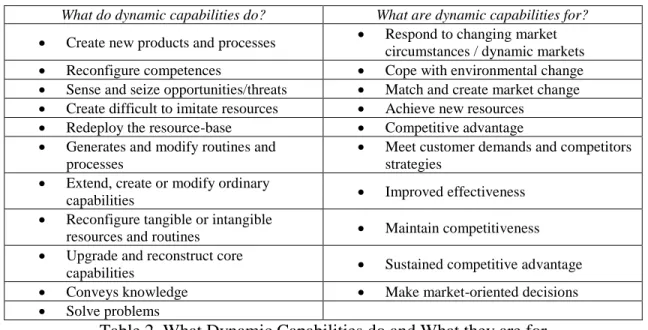
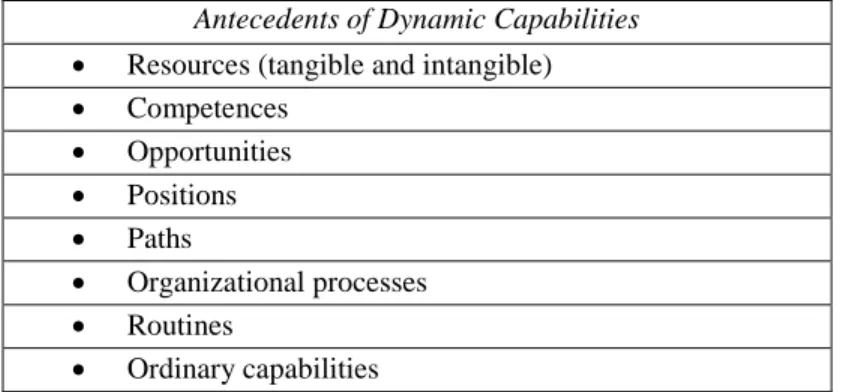
(24) provide managerial implications (Barney, 2005) and that the concern regarding that sustained competitive advantage is not achievable, the insight is that such advantage can be sustained only at the dynamic level which refer to dynamic capabilities. Finally, the RBV has also been the root for analysis addressing core competences (Hamel and Prahalad, 1994), the knowledge-based view of the firm (Grant, 1996), a wide range of phenomena such as information systems and organizational networks (Kraaijenbrink, et al., 2010) and the dynamic capabilities view (Teece et al. 1997) which is of specific concern in this research and is addressed in the next section. 2.4 Dynamic Capabilities View The RBV was conceived as a theory that explains differences in performance among firms without considering major environmental changes that failure to consider them can have a negative impact on performance (Audia, Locke and Smith, 2000). In other words, RBV has not adequately explained how and why some organizations achieved competitive advantage in situations of rapid and unpredictable change (Eisenhardt and Martin, 2000). Thus, the dynamic capabilities view is conceived and considered for some scholars as an extension of the RBV in order to understand strategic change (Teece et al., 1997) by looking at how capabilities are influenced by market dynamism (Eisenhardt and Martin, 2000) or increasingly demanding environments (Teece et al., 1997). In simple words, the dynamic capabilities view attempts to overcome the essentially static nature of that RBV and its derived shortcomings in appropriately explaining organization’s competitive advantage in changing markets (Priem and Butler, 2001). The dynamic capabilities approach since its seminal paper written by Teece and colleagues in 1997 has had an active and increasing interest in researchers. The growing. 11.
(25) literature around this framework has provided a vast number of definitions for dynamic capabilities that it has even produced some confusion that may hinder an effective progress in the field (Barreto, 2010). However, as Williamson states (1999: 1094) “big ideas often take a long time to take on a definition” brings up a challenge for future research. This investigation has acknowledged the importance of developing dynamic capabilities in firms but aims to better understand the factors that bring about such capabilities. That is, one of the central points is to address the antecedents of dynamic capabilities in order to gain a deeper comprehension in regard to the factors that influence the dynamic capabilities’ origins. As a first attempt to tackle this goal, Table 1 summarizes a select group of definitions granted to dynamic capabilities by several researchers in order to further analyze from the definition stand point what antecedents could be derived.. 12.
(26) Author Teece and Pisano, 1994. Definition of Dynamic Capabilities Dynamic capabilities are the subset of the competences/capabilities which allow the firm to create new products and processes, and respond to changing market circumstances. Core argument in relation to path, processes and position.. Teece, Pisano and Shuen, 1997*. The firm’s ability to integrate, build, and reconfigure internal and external competences to address rapidly changing environments.. Eisenhardt and Martin, 2000. The firm’s processes that use resources – specifically the processes to integrate, reconfigure, gain and release resources – to match or even create market change. Dynamic capabilities thus are the organizational and strategic routines by which firms achieve new resources configurations as market emerge, collide, split, evolve and die. The ability to sense and then seize opportunities quickly and proficiently A global dynamic capability is the creation of difficult-to-imitate combinations of resources, including effective coordination of inter- organizational relationships, on a global basis that can provide a firm a competitive advantage.. Teece, 2000 Griffith and Harvey, 2001. Lee, Lee and Rho, 2002. A newer source of competitive advantage in conceptualizing how firms are able to cope with environmental changes.. Rindova and Taylor, 2002. Dynamic capabilities evolve at two levels: a micro-evolution through ‘upgrading the management capabilities of the firm’ and a macro-evolution associated with ‘reconfiguring market competencies’. Dynamic capabilities are essentially change-oriented capabilities that help firms redeploy and reconfigure their resource base to meet evolving customer demands and competitor strategies. A dynamic capability is a learned and stable pattern of collective activity through which the organization systematically generates and modifies its operating routines in pursuit of improved effectiveness.. Zahra and George, 2002. Zollo and Winter, 2002. Winter, 2003. Those that operate to extend, modify or create ordinary (substantive) capabilities.. Zahra, Sapienza and Davidsoon, 2006. The abilities to reconfigure a firm’s resources and routines in the manner envisioned and deemed appropriate by its principal decision-maker(s).. Helfat et al., 2007. A dynamic capability is the capacity of an organization to purposefully create, extend, or modify its resource base. Teece, 2007. The microfoundations of dynamic capabilities are —the distinct skills, processes, procedures, organizational structures, decision rules, and disciplines— Dynamic capabilities can be disaggregated into the capacity (a) to sense and shape opportunities and threats, (b) to seize opportunities, and (c) to maintain competitiveness through enhancing, combining, protecting, and, when necessary, reconfiguring the business enterprise’s intangible and tangible assets.. Wang and Ahmed, 2007. We define dynamic capabilities as a firm’s behavioral orientation constantly to integrate, reconfigure, renew and recreate its resources and capabilities and, most importantly, upgrade and reconstruct its core capabilities in response to the changing environment to attain and sustain competitive advantage.. Augier and Teece 2007; 2009. The ability to sense and then seize new opportunities, and to reconfigure and protect knowledge assets, competencies, and complementary assets with the aim of achieving a sustained competitive advantage. Dynamic capability is a capability that conveys deliberate knowledge, invoked on a repeated basis, on how to question purpose and effectiveness of routines; this deliberate knowledge serves to generate and modify these operating routines and processes to address changing environments and/or create market change A dynamic capability is the firm’s potential to systematically solve problems, formed by its propensity to sense opportunities and threats, to make timely and marketoriented decisions, and to change its resource base.. Mulders, Berends, and Romme, 2010. Barreto, 2010. *Seminal Definition. Table 1. Definitions of Dynamic Capabilities 13.
(27) Leveraging on the core definitions of dynamic capabilities, Table 2 highlights what dynamic capabilities do and what dynamic capabilities are for. The purpose of this table is to further emphasize and also summarize two aspects that give relevance and become fundamental reasons for doing research in this domain. Furthermore, from the practitioners’ perspective this summary attempts to trigger interest in managers in regard to the importance of developing dynamic capabilities in order to achieve sustained competitive advantage. What do dynamic capabilities do? . Create new products and processes. . Reconfigure competences Sense and seize opportunities/threats Create difficult to imitate resources Redeploy the resource-base Generates and modify routines and processes Extend, create or modify ordinary capabilities Reconfigure tangible or intangible resources and routines Upgrade and reconstruct core capabilities Conveys knowledge Solve problems. . . What are dynamic capabilities for? Respond to changing market circumstances / dynamic markets Cope with environmental change Match and create market change Achieve new resources Competitive advantage Meet customer demands and competitors strategies. . Improved effectiveness. . Maintain competitiveness. . Sustained competitive advantage. . Make market-oriented decisions. Table 2. What Dynamic Capabilities do and What they are for. In Table 3, core antecedents that contribute in the development of dynamic capabilities are remarked. The following antecedents are drawn from main definitions of this construct and each one of them may contribute to the development of dynamic capabilities.. 14.
(28) Antecedents of Dynamic Capabilities . Resources (tangible and intangible) Competences Opportunities Positions Paths Organizational processes Routines Ordinary capabilities. Table 3. Antecedents of Dynamic Capabilities According to main Definitions. 2.5 Dynamic Capabilities Antecedents A summary of some cornerstone antecedents inferred from the main conceptualizations of dynamic capabilities are presented in Table 3. However, over the years, more detailed research has mentioned other aspects as potential antecedents that are classified taking into account the environmental, organizational and individual levels due to the multilevel nature of dynamic capabilities formation (Zahra et al., 2006). Relevant antecedents from the three level of analysis are presented as follows in order to better complement the range of antecedents for developing dynamic capabilities. According to Wand and Ahmed (2007) within environmental antecedents the role of market dynamism becomes significant while Sapienza (2006) accounts for internationalization as an origin of dynamic capabilities. Furthermore, Dunning and Lundan (2010) mention that the development of dynamic capabilities is institutionally contingent where new routines may influence the structure of industries and future capabilities. Focusing from the organizational level Zollo and Winter (2002) proposed certain learning mechanisms (such as organizational routines related to experience accumulation, knowledge articulation and knowledge codification) and deliberative investments in organizational structure. 15.
(29) and systems as antecedents of dynamic capabilities. Eisenhardt and Martin (2000) argued that loosely structured organizations benefit as antecedents as well as a decentralized organization (Teece et al., 1997; Teece, 2007). Social capital has also been theorized as a necessary but not sufficient component since it enables dynamic capabilities (Blyler and Coff, 2003). Furthermore, Winter (2003) implicitly states routinization of work as a condition for establishing dynamic capabilities; whereas, Wheeler (2002) leverages on the former argument and additions a communication processes as a main constituent in the development of dynamic capabilities. In addition, organizational design characteristics also influence on the formation of dynamic capabilities (McInerney, 2011) Regarding the individual level, it is important to bring to mind that capabilities leverage on individual skills (Abell, Felin and Foss, 2008; Felin and Foss; 2009) or superior matching of employees skills (Kor and Mahoney, 2005). According to Zollo and Winter (2002) cognitive processes act as antecedents of dynamic capabilities. In that vein, three distinct cognitive scripts are the foundation for dynamic managerial capabilities (Corbett, Neck and Laverty, 2011) while (Zamora-Matute, 2011) also argued that arrangement, willingness and ability scripts are antecedents of dynamic capabilities in conjunction the organization’s social capital. Furthermore, Bingham, Eisenhardt and Furr (2007) showed that organizational heuristics are at the heart of high performing organizational processes which are central to firm capabilities as well as managerial cognition (Danneels, 2010; Tripsas and Gavetti, 2000). On the other hand, Arthurs and Busenitz (2005) point the venture capitalist as a catalyst in bringing about dynamic capabilities beyond the capital they may provide. In sum, as Felin and Hesterly (2007) mentioned, dynamic capabilities requires the analysis of the individual as the fundamental component of every firm. 16.
(30) Table 4 shows more antecedents of dynamic capabilities considering different level of analysis as follows: Environmental Internationalization Institutionally contingent Market dynamism. Organizational Organizational design Communication processes Social capital Decentralized organization Investment (structure and systems) Learning mechanisms. Individual Cognitive processes Cognitive scripts Heuristics Venture capitalists. Table 4. Antecedents of Dynamic Capabilities Considering Levels of Analysis. 2.6 Dynamic Capabilities in General Perspective Dynamic capabilities reflect the organization‘s capacity to achieve new and innovative forms of competitive advantage. These capabilities are the ―firm‘s ability to integrate, build, and reconfigure internal and external competencies to address rapidly changing environments‖ (Teece et al., 1997: 516). Besides the seminal definition, two relevant approaches that define dynamic capabilities consider perspectives that impact aspects both outside and inside the organization. According to Eisenhardt and Martin (2000) dynamic capabilities use the reconfiguration of resources to match and even create market change (outside perspective); meanwhile, Zollo and Winter (2002) argue that dynamic capabilities aim at generating and modifying the organization‘s operating routines (staff and line activities) to seek improved effectiveness (inside perspective). Dynamic capabilities are made of knowledge absorption (Verona & Ravasi, 2003), manifested through the leveraging of external networks (Eisenhardt & Martin, 2000; Teece et al., 1997) and facilitates its ability to adapt to change through innovation (Hill & Rothaermel, 2003). Besides, dynamic capabilities deal with mechanisms for change (Easterby-Smith, Lyles and Peteraf, 2009) which are necessary to innovate as exemplified by Danneels (2002) in the process 17.
(31) of product innovation. Additionally, dynamic capabilities have been analyzed to the point of trying to reveal its micro foundations –disaggregating them into components- in the quest for sustainable performance for the organization (Teece, 2007). In short, dynamic capabilities are those processes that reconfigure the resource base of the venture to attain competitive advantage. These capabilities are developed and built from organizational routines that support experience accumulation, knowledge articulation, and knowledge codification (Macher and Mowery, 2009).. 18.
(32) CHAPTER 3 THEORETICAL MODEL. This chapter will first address the main definition and dimensions (if applicable) of the three main constructs that this thesis deals with. Secondly, the theoretical model development regarding the relationships among constructs in order to derive the hypotheses. 3.1 Entrepreneurial Orientation Entrepreneurial orientation refers to a firm’s strategic orientation, capturing specific entrepreneurial aspects of decision-making styles, methods, and practices (Lumpkin and Dess, 1996).. According to Rauch et al. (2009) entrepreneurial orientation is the entrepreneurial. strategy-making processes that key decision makers use to enact their firm’s organizational purpose, sustain its vision, and create competitive advantage. Furthermore, drawing from the dimensions given to entrepreneurial orientation, this construct consists of processes, structures, and/or behaviors that can be described as aggressive, innovative, proactive, risk taking, or autonomy seeking (Lyon, Lumpkin and Dess, 2000). In this research, three seminal dimensions of entrepreneurial orientation (innovativeness, risk-taking and proactivenness) are addressed. This decision is made based on the meta-analysis results by Rauch et al. (2009) where the most commonly employed measure is the Miller/Covin and Slevin (1989) scale such scale only considers the three aforementioned dimensions. Furthermore, the scale has also gone under careful scrutiny in several empirical investigations (c.f. Covin and Wales, 2011). The argument to exclude two dimensions of entrepreneurial orientation (not considering the five dimensions proposed by Lumpkin and Dess) such as competitive aggressiveness and autonomy is due to the concern that these two particular 19.
(33) dimensions “may be less valid in certain cultural contexts” (Rauch et al., 2009; 779). Further concerns regarding aggressiveness is that this dimensions deals more with start-ups (this research will consider SMEs) and autonomy refers more to the individual or team level of analysis; whereas, the three main dimensions address the firm level (Frishammar and Horte, 2007) which is the level of analysis of this research. Another important issue to take into account is that entrepreneurial orientation has been conceptualized as a reflective second order model or as a formative second order model. This research will draw from the reflective paradigm following the argument that even though the measurement model employed in various studies refers to the scale as a formative measure it is not (Covin and Wales, 2011: 2; George and Marino 2011). A reflective model implies that the structural paths go from entrepreneurial orientation to the dimensions implying that meaning emanates from entrepreneurial orientation to the dimensions and that variations in such dimensions are the result of variation in entrepreneurial orientation (c.f. George, 2011). In the next paragraphs, the dimensions of entrepreneurial orientation are explained. 3.1.1 Dimensions of Entrepreneurial Orientation Innovativeness: Refers to attempts to embrace creativity, experimentation, novelty, technological leadership in both products and processes. It is a tendency to support new ideas and departs from established practices and technologies (Wiklund and Shepherd, 2003).. Proactiveness: Relates to forward-looking and first mover advantage-seeking efforts to shape the environment ahead of the competition.. It is a posture of anticipating and. acting on future wants and needs in the marketplace (Wiklund and Shepherd, 2003). 20.
(34) Risk-taking: Relates to the willingness to commit large amount of resources. In other words, it consists of activities such as borrowing heavily or committing a high percentage of resources to projects with uncertain outcomes, and entering unknown markets (Wiklund and Shepherd, 2003).. 3.2 Intellectual Capital Intellectual capital in a broad sense was defined by Nahapiet and Ghoshal (1998) to the knowledge and knowing capability of a social collectivity, such as an organization, intellectual community or professional practice.. However, Youndt, Subramaniam and Snell (2004). conceptualized this construct as knowledge resources that an organization uses in order to achieve competitive advantage. In that vein, intellectual capital started to be analyzed from different perspectives such as on organization’s ability to utilize its knowledge resources (Subramaniam and Youndt, 2005: 450), or in simple words as the firm’s current knowledge stocks (Kang and Snell, 2009). 3.2.1 Dimensions of Intellectual Capital Intellectual capital is also composed of three sub-dimensions including human, organizational, and social capital (Subramaniam and Youndt, 2005), which are defined as follows. Human capital: Refers to the employee’s knowledge, skills, and abilities residing with and utilized by them (Becker, 1964; Schultz, 1961; Youndt et al., 2004).. 21.
(35) Social Capital: Resides neither at the individual nor the organizational level. Social capital should be understood as an intermediary form of intellectual capital consisting of knowledge in groups and networks of people (Nahapiet and Ghoshal, 1998). Furthermore, Burt (1992) argues that social capital is the knowledge resources embedded in a network of relationships which are not necessarily limited to internal knowledge exchanges. This can be founded among employees mainly but not to discard linkages with external actor as customers, suppliers, among others (Yount et al., 2004).. Organizational capital: Represents institutionalized knowledge and codifies experience stored in databases, routines, patents, manuals and structures (Hall, 1992; Walsh and Ungson, 1991). In essence, organizational capital is said to be the knowledge, skills, and information that stays for the organization when its employees leave temporarily or permanently the firm (Youndt et al., 2004).. 3.3 Integrative Capabilities External and internal integrative capabilities are a representation of dynamic capabilities (Liao et al., 2009). These capabilities are integrative because they focus on scanning the external environment in order to recognize opportunities and also focus on the internal endowment of organizational resources in order to align and match them with the recognized opportunities. According to Liao et al. (2009) when referring to external integrative capabilities the emphasis is on opportunity recognition; whereas, when referring to internal integrative capabilities the emphasis is on how such opportunity is capitalized in the organization. In other words, these capabilities are called integrative because they integrate the process of perceiving an opportunity 22.
(36) and the process of taking a course of action that brings opportunities into use which is also in line with Teece’s (2007) argument that dynamic capabilities should sense and seize opportunities. 3.4 Theoretical Model Development Dynamic capabilities reflect a capacity to orchestrate activities and resources (Katkalo et al. 2010) and also involve the deployment of such resources (Ethiraj, Kale, Krishnan and Singh, 2005). Furthermore, the dynamic capabilities approach considers organizational processes in which the firm brings together resources (Kim and Mahoney, 2010). However, a question that remains under researched relates to what kind of resources is needed for developing particular dynamic capabilities? As already mentioned, a representation of dynamic capabilities is integrative capabilities because the latter integrate the processes of recognizing opportunities and the process of taking a course of action to capitalize those opportunities (Liao et al., 2009).. In the opportunity. recognition phase, elements such as prior knowledge (Shane, 2000), alertness or creativity (Kirzner, 1999), personality traits and social networks (Ardichvili, Cardozo and Ray, 2003) and transaction costs and property rights (Foss and Foss, 2008) have been acknowledged to enhance this process. Hence, out of these and other possibilities, this dissertation will follow the line of logic derived from the knowledge based view (KBV) that highlights the role of knowledge. In other words, the central argument in order to pursue the recognizing and also the capitalizing of opportunities may be carried on best if the processes are founded and rely on knowledge. In addition, this reasoning is followed since the resource based view constitutes a main theoretical perspective in this research where KBV is considered a branch of RBV.. 23.
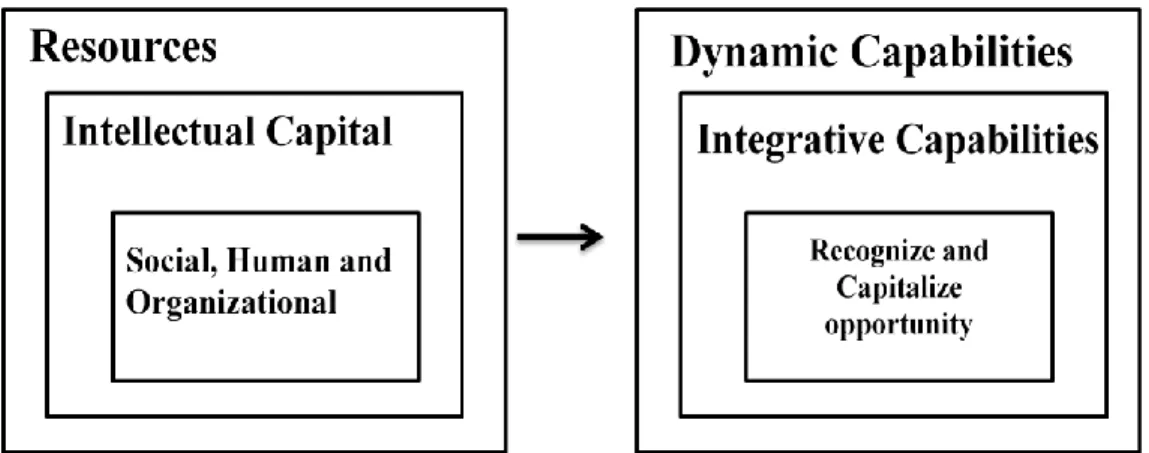
(37) More in detail, this approach contributes to tackle the lately raised question looking at a perspective that emphasizes the relevance of knowledge -and to what is founded in it- as a critical resource. In that sense, Penrose (1959) argued that firms are a repository of knowledge and learning is central for firm growth while Grant (1996) highlights knowledge as the most significant resource in an organization. Additionally, some scholars have recently favored the idea of firms as knowledge-creating entities where a firm endogenously generates its opportunity set (Augier and Teece, 2009). Therefore, leveraging on knowledge and the way it is applied, becomes crucial in recognizing opportunities (Yu, 2001). To develop integrative capabilities knowledge becomes paramount since opportunities are discovered only if these are related to someone’s prior knowledge (Venkatarman, 1997), and firms may produce important results if the capitalization is on knowledge assets as evidenced at a telecommunication industry leader (Massey, Montoya-Weiss and O’Driscoll, 2002). Consequently, an organization that leverages intellectual capital, where knowledge is a central axis of its dimensions (Youndt, Subramaniam and Snell, 2004) a sustained relationship among intellectual capital and integrative capabilities may take place. In a similar vein, Kim and Mahoney (2010) mention that capabilities might be developed when implementing intangible resources such as intellectual capital in an organization. In sum, Figure 1 shows the general concept of how dynamic capabilities are anteceded by resources and how this paper argues for a concrete kind of resources (intellectual capital) in order to develop a particular type of dynamic capabilities (integrative capabilities).. 24.
(38) Figure 1. Disaggregated Resources – Dynamic Capabilities Relationship. Therefore, the hypothesis that is drawn from the aforementioned arguments is presented as follows: Hypothesis 1: Intellectual capital has a positive influence on the development of integrative capabilities.. In the next paragraphs, the arguments of how each intellectual capital’s dimensions (human capital, social capital and organizational capital) influence the development of integrative capabilities are addressed. Human Capital Coff and Kryscynsky (2011) state that there is little doubt that human capital is critical for developing capabilities. If an organization pursues capabilities to make a difference with its competence, it sounds logical that this resource becomes relevant since human capital is the most difficult category of resources to imitate in firms (Fung and Chen, 2010).. 25.
(39) Human capital deals with employee’s knowledge, skills and abilities.. Dimov and. Shepherd (2005) point out the influence of human capital on opportunity recognition which is a characteristic of an integrative capability that is entrepreneurial in nature. Moreover, from the individual perspective, the entrepreneur’s human capital conduces to identify a greater number of opportunities (Ucbasaran, Westhead and Wright, 2008). Also, human capital may allow to screen opportunities and select those that should be pursued and reject those less viable (Ucbasaran et al., 2008). In addition, human capital may contribute to face less uncertainty in regard of the value gained from exploiting an opportunity (Shane and Khurana, 2003). Knowledge is a characteristic of human capital. Thus, in order to develop integrative capabilities whose first stage pursues the recognition of an opportunity, this attribute is argued as fundamental (Helfat, 1997; Denrell, Fang and Winter, 2003). In that sense, McMullen and Shepherd (2006) proposed that opportunity identification requires the consideration of knowledge which is related to the different stocks of information (Shane, 2000). Furthermore, if knowledge is pushed forward and the firm tries to understand, for instance, knowledge in regard of a customer’s problem –and not only employee’s knowledge-, this situation leads to identify even more opportunities with an innovative feature (Shepherd and DeTienne, 2005). On the other hand, the subjectivist theory of entrepreneurship argues that experience and prior knowledge also affect the perceptions of opportunities (Kor, Mahoney and Michael, 2007). For example, a context with more knowledge will generate more entrepreneurial opportunities (Audretsch, Lehmann and Warning, 2005) and vice versa (Audretsch and Keilbach, 2007). It is due to the acquaintance and understanding of a particular subject and its complementary areas of interest that together may trigger several possibilities such as: see new businesses, define. 26.
(40) improvement areas, and address different approaches; which constitute an opportunity in all cases. This derives in another process of integrative capabilities which is the capitalization of opportunities. As a matter of fact, Rosseau (2010) found that joint acquisitions –combination of different sources of knowledge- may allow the parties to complement each other and capitalize on acquisition opportunities that by themselves would not have pursued each party alone. Besides, an important task in an organization is to find a way to help itself to capitalize on their inherent knowledge (Hansen and von Oetinger, 2001). In the process of creating dynamic capabilities Kor and Mahoney (2005) found that a superior matching of someone’s knowledge and skills (characteristics of human capital) to R&D projects and teams are important. Further, knowledge and learning are closely linked and the latter is another important parameter for establishing dynamic capabilities (Wu, Lin and Hsu, 2007; Zollo and Winter, 2002). In that sense, double-loop learning fosters the organization’s sensing of opportunities within its environment (Argyris and Schon, 1996). As a result, abilities also play an important role to enhance deeper learning which in turn contributes in the developing process of integrative capabilities. From another perspective of human capital, the firm’s paths to develop new capabilities are highly dependent on the personnel’s cognitive endowments (Narayanan, Colwell and Douglas, 2009), and exploring the cognitive antecedents of capability development contributes to dynamic managerial capabilities (Corbett et al., 2011) and dynamic capabilities (Zamora-Matute, 2011).. In addition, superior human capital bears greater cognitive ability to be alert to. 27.
(41) opportunities and knowledge to look for opportunities and know how they “look like” (Ucbasaran et al., 2008). In consequence, human capital may play an important role in developing integrative capabilities hypothesized as follows: Hypothesis 1a: Human capital has a positive influence on the development of integrative capabilities.. Social Capital Helfat et al. (2007) explain that dynamic capabilities can be developed internally in an organization; however, they can also be sourced from outside the firm (Ambrosini et al., 2009). Social capital is comprised of internal and external networks that constitute a path to develop new capabilities (Narayanan et al., 2009) since it consists of knowledge in groups and networks of people (Nahapiet and Ghoshal, 1998). Moreover, Blyler and Coff (2003) theorized that social capital, among others, is necessary to develop dynamic capabilities.. Therefore, networks. become relevant to fulfill the opportunity recognition phase of integrative capabilities concerning the sense of opportunities since entrepreneurial networks provide distinct opportunity horizons (Ellis, 2010). Social capital – likewise human capital that leverages on knowledge - allows a broad access to information and permits, for example, “…to learn of more opportunities, see them faster and assess their value more broadly” (Moran, 2005: 1133). Furthermore, social capital facilitates access to information which is a critical part of entrepreneurial opportunities (Shane and Venkataraman, 2000), and contributes to enhance the timing, relevance and quality of such information (Adler and Kwon, 2002). In addition, prior research also suggests that social capital. 28.
(42) may develop dynamic capabilities (Subramaniam and Youndt, 2005). In that sense, this insight may hold true since social capital could facilitate the acquisition, integration and release of resources. Consequently, social capital may be a crucial source of dynamic capabilities since it also enables resource management (Blyler and Coff, 2003). A deeper analysis of social capital includes a closer look into ties (networks), trust and solidarity (Kemper, Engelen and Brettel, 2011). Ties benefit access to both information and resources where the former, as argued, enables to identify opportunities (Bhagavatula, Elfrin, van Tiburg and van de Bunt, 2010; Ellis, 2010; Sheng, Zhou and Li, 2011). A tie that is strong or weak (Granovetter, 1983) is useful to reach other people or organization’s contacts that could provide novel or complementary information drawn from the environment or within that company. These ties work as “bridges” in order to reach other actors. Thus, if a network increases, the number of contacts augments and they may become a better source of facts or data appropriate to “match the dots” and see new business opportunities or define new ways of taking advantage of an opportunity. In other words, diversity of ties among networks stimulates the creation of structural holes for entrepreneurial opportunities (De Carolis and Saparito, 2006). It has been argued that through networks and ties, external knowledge could be enhanced and it may contribute to either sense or seize opportunities. To exemplify this situation, one aspect of analysis could be seen on outside consultants as key actors while implementing new business models, reward systems and organizational structures (Ko, Kirsch and King, 2005). As for the phase of capitalizing an opportunity of an integrative capability, social capital could play a main role as well. For example, a key benefit of trust –an element of social capitalis that it gives an environment “in which people feel secure and psychologically safe to make mistakes and offer and receive criticism” Atuahene-Gima and Murray (2007: 7) which 29.
(43) strengthens exploitation of opportunities. Additionally, trust can motive individuals to seek opportunities and later on to act upon them (DeCarolis and Saparito, 2006). When action is undertaken the process of capitalizing an opportunity takes place. Generally, in regard to strong business networks –an element of social capital- firms may be able to comprehend potential benefits of business partners, discover more opportunities and then enhance entrepreneurial actions (Dess, Pinkham and Yang, 2011). Solidarity, another component of social capital, can be reflected in several cases as collaborative processes. Thus, an opportunity can be exploited –capitalized- once the opportunity is realized through such collaboration processes comprised of investments, assets, systems and actions (Foss and Klein, 2012). In sum, since dynamic capabilities extend and modify the resource base, social capital can facilitate the acquisition of resources by assuring a flow of information from different sources (Blyler and Coff, 2003). Additionally, complementary resources may also be accessed externally –through social capital’s networks- and configured with current resources (Danneels, 2010). As a result, social capital as a dimension of intellectual capital may also have an effect on integrative capabilities development. The hypothesis is argued as follows: Hypothesis 1b: Social capital has a positive influence on the development of integrative capabilities.. Organizational Capital Organizational capital refers to institutionalized knowledge usually stored in databases, routines, manuals and routines.. Organizational capital can also be seen as formalization. 30.
(44) processes that have a positive influence in the dynamic capability formation (MacInerney, 2011; Zollo and Winter, 2002). For example, since organizational capital pursues to codify knowledge, Nayaranan et al. (2009) show evidence of the benefits through an initiative coined as “book of knowledge”. This book captures the organization’s experiences, problems and solutions which contributed to develop capabilities in the implementation of chemical biology pilot platforms. In other words, institutionalized knowledge can help in capability development since best practices and processes when properly documented may be a foundation to replicate similar or innovated dynamic capabilities in the future.. To reproduce a capability such preserved. knowledge and mechanisms can be used recurrently (Subramaniam and Youndt, 2005) and it could result appropriate for large enterprises where capabilities need to be replicated in different business areas or geographical locations. On the other hand, for developing new capabilities the referred foundational and codified knowledge results of great value to leverage upon mechanisms or processes that have yielded important outcomes. This situation may become a platform to trigger new combinations for better results reflected in new dynamic capabilities. A further example could be the approach for creating and utilizing keyword-based patents maps (another hallmark of organizational capital) in order to use them in new technology creations (Lee, Yong and Park, 2009).. The aforementioned creations are similar to express new. innovations into markets which constitute a market disruptiveness dynamic capability (McKelvie and Davidsson, 2009). Thus, the following hypothesis is stated. Hypothesis 1c: Organizational capital has a positive influence on the development of integrative capabilities.. 31.
(45) Entrepreneurial Orientation Moderation Effect Seminal papers in dynamic capabilities have indicated that resources are necessary for developing dynamic capabilities (Eisenhardt and Martin, 2000; Teece et al., 1997, Teece, 2007). Moreover, organizational resources are a common antecedent in the underlying logic for the development of such capabilities (Helfat and Peteraf, 2009). Hence, this study argues that the first step to develop dynamic capabilities is to define and leverage on specific resources. That is the case of knowledge based resources since they are the most important assets in an organization (Grant, 1996). As a matter of fact, Youndt et al. (2004) mentions that intellectual capital has knowledge as a central axis; therefore, this resource becomes the starting point in the process of developing dynamic capabilities. On the other hand, nowadays organizations ought to pursue strong dynamic capabilities whose main characteristic is to be intensely entrepreneurial (Teece, 2007). Furthermore, Zahra et al. (2006) argue the importance for dynamic capabilities to undertake entrepreneurial activities and be guided by a proactive entrepreneurial logic (Newey and Zahra, 2009).. Thus,. entrepreneurship seems to be an intrinsic component for enhancing dynamic capabilities that could become entrepreneurial in nature where frameworks that include entrepreneurship and dynamic capabilities should be pursued (Augier and Teece, 2009).. For instance, the. aforementioned entrepreneurial characteristic becomes paramount for avoiding a fall behind competitors’ capabilities (Wales, Monsen and McKelvie, 2011). In consequence, this study states that a particular type of dynamic capabilities whose characteristic is to be entrepreneurial is represented by integrative capabilities due to its capacity to integrate the processes of sensing and seizing opportunities (Barreto, 2010; Liao et al., 2009;. 32.
Figure


+7




Documento similar
The objective of this paper is therefore to analyze the interaction of firms’ internal capabilities and external or shared capabilities and their effect on both radical and
Explicitly, we posit that understanding coaching as a specific form of lifelong human development in both organizational and educational contexts, is a function of
According to Bueno (1998), ‘intellectual capital’ is knowledge that can be exploited for some money-making or other useful purpose. The term combines the idea of the intellect
This research makes a number of contributions to the strategic management literature by empirically exploring DC and MO and how these affect firm performance in the case of sole
In this way, it appears indispensable to study the internal capabilities of the organisations, in particular their flexibility and the knowledge management that they carry
According to our classification and based on the literature analysis the assets and capabilities that have greater impact on performance would be capabilities of
In the preparation of this report, the Venice Commission has relied on the comments of its rapporteurs; its recently adopted Report on Respect for Democracy, Human Rights and the Rule
This cyclical dynamic reflects one of the specific narrative features of the serial narrative that make it ideal for the exploration of the limits of sympathy:
