
Public participation and the role of social networks in the implementation of the Water Framework Directive in Spain
21
0
0
Texto completo
(2) Hernández Mora, N. Ballester, A.. 1.. INTRODUCTION. requirements throughout the river basin planning process and expands the concept of PP to all. The. Water. (Directive. Framework. 2000/60/CE). Directive. (WFD). introduces. new. stakeholders and the general public, in addition to water users.. requirements in transparency, public information and participation, in an effort to tackle the growing complexity and uncertainty of the challenges we face in the natural resources management arena in general, and in the water resources field in particular. As many authors rightly point out (Espluga and Subirats, 2008, Pahl-Wostl et al. 2007, Lauber et al. 2008), proposed solutions to these problems can no longer be exclusively technical, they require collaboration and participation from interested parties. Pahl-Wostl et al. (2007) argue that “complex issues and integrated management approaches cannot be tackled without taking into account. stakeholders’. information. and. perspectives and without their collaboration.” It is no longer possible to reach technical and scientific consensus on every question, nor is it possible to impose these solutions on a society that is increasingly critical, active and diverse. In this context, “incorporating public participation (…). The WFD was transposed into Spanish law in December 2003, as part of a broader law on fiscal, administrative and social measures (Article 129 of the Law 62/2003), thus making changes to the existing. water. act. but. avoiding. a. more. comprehensive reform of existing legislation. The implementation. process. has. brought. about. significant changes in the content, process and goals of water policy, planning and management. Spain has a long tradition of user participation in water planning and management. However, the public information and participation requirements introduced by the WFD are opening the water decision-making arena to other interested parties beyond users, and are helping to drive a transformation whose turning point can be traced back. to. the. scientific. debates. and. public. demonstrations surrounding the 1998 Basin Management Plans (BMPs) and the 2001 National Hydrologic Plan (NHP). Essentially what is taking place in Spain is a “change in governance. implies delaying the decision making process in. structure and underlying values and paradigms”. order to obtain results that are socially feasible,. (Pahl-Wostl et al. 2007) that, in order to be. responding more adequately to the problems of. properly understood, needs to incorporate an. modern society” (Subirats, 1997).. analysis of the social context in which it is. International treaties, such as the 1998 Aarhus. Convention,. and. EU. and. Spanish. legislation have acknowledged the need for public participation (PP) to legitimize and improve decision making processes in the public policy arena. In the context of the EU it is the WFD that most explicitly incorporates these principles when it states in section 14 of the Preamble that: “success of this Directive relies on (…) information, consultation and involvement of the public,. embedded. This transformation has three driving forces: a) the. WFD. information. and. PP. requirements; b) the growing role of social networks in coordinating the work of individuals and organizations toward a common goal of aquatic. ecosystem. conservation. and. defense of the patrimonial and cultural values of water; and. including users”. Article 14 of the WFD introduces information,. consultation. Ambientalia SPI (2011). and. participation. 2.
(3) Hernández Mora, N. Ballester, A.. between. emerged through the WFD planning process for. different sectors and actors with different. improved public-private collaboration in water. knowledge bases and capabilities.. policy making.. c) the. fruitful. collaboration. This paper focuses primarily on a description and. preliminary. analysis. of. the. first. two. 2.. RESEARCH METHODOLOGY. components. The paper is organized into six. In order to track and evaluate the changes. sections. Following this introduction is a brief. that are taking place in the context of the. description of the research methodology used to. implementation of the WFD, the Foundation for a. gather the information presented in the paper. In. New Water Culture (Fundación Nueva Cultura del. order to understand the institutional context in. Agua. which the WFD-related PP processes have taken. Observatory. place,. the. Implementation of the WFD in Spain. The WFD. administrative organization for water resources. Observatory is made up of experts, scientists and. management in Spain and the role users have. stakeholders. traditionally played. It also offers a brief historical. geographic regions. One of the lines of work of. overview of the public debates that surrounded. the Observatory has focused on the tracking and. the publication of the Draft NHP and the BMPs in. evaluation of the PP processes that have been. the 1990s and the actors and arguments that. carried out in the context of the WFD river basin. emerged then and that have consolidated over. management planning process.. the. third. section. describes. or. FNCA2) for. launched the. from. in. 2006. the. of. the. Evaluation. different. disciplines. and. time. The fourth section includes a description of. This article presents the results of the work of. the PP and consultation processes that are being. the WFD Observatory on PP between 2006 and. undertaken by the River Basin Authorities (RBA) in. 2009 and builds on the experience of the authors. the process of the elaboration of the current. with existing social networks involved in the WFD. BMPs, and of the social networks that have arisen. debates. Five primary sources of data have been. throughout Spain over the past decade in defense. used: •. of the values embodied by the New Water 1. Review. of. RBAs’. websites. to. obtain. Culture . The fifth section includes an effort to. information on the PP processes undertaken. identify strengths and weaknesses of these. in the context of the elaboration of the BMPs.. processes as well as potential best practices and. •. Periodic meetings with members of the WFD. future opportunities. It also suggests possible ways. Observatory between 2007 and 2009 in. in which emerging social networks for water. which progress reports of the situation in the. ecosystem conservation are becoming alternative. different river basins were discussed;. and potentially powerful PP arenas. The final section reflects on some unanswered questions. •. Observation of and participation in PP. regarding the outcome of the PP processes and. processes in some river basins (specifically. the need to capitalize on the possibilities that have. Ebro, Catalan Internal River Basins, Guadiana and Tajo, see Figure 1).. 1. The New Water Culture (Nueva Cultura del Agua) is a concept coined in the 1990s in Spain (Martínez Gil, 1997). It defends an ecosystemic and patrimonial understanding of water resources, and promotes an approach to water management based on integration, transparency and social equity, ecosystem protection and economic rationality. Ambientalia SPI (2011). 2. The FNCA is a not-for-profit organization made up of a network of scientists, experts and stakeholders in Spain and Portugal that work to promote the values of the New Water Culture.. 3.
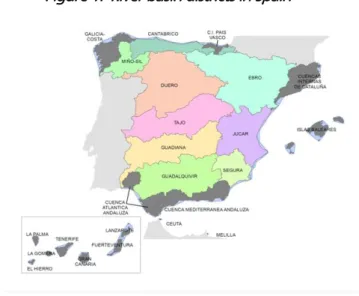
(4) Hernández Mora, N. Ballester, A.. •. Figure 1. River basin districts in Spain. Follow-up of information exchanges and participation in existing social networks for a New Water Culture.. •. Organization of two workshops to evaluate formal and informal PP processes. The first one was held in Madrid in June 2008 with facilitators and participants in formal PP processes organized by RBAs (Ballester, 2008a). The second was held in December 2008 in the context of the FNCA’s VI Iberian Congress. on. Water. Planning. and. Management under the title “The role of citizen networks and social movements in. Source: www.iagua.es (2009). water management”, with participation of over 60 representatives of existing networks. For the management of water resources the. as well as of other organizations and. country is divided into 17 river basin districts (see. interested parties.. Figure 1). The 2001 Water Act (Legislative Decree 1/2001), which consolidated the 1985 Water Act. 3.. PUBLIC. PARTICIPATION. IN. WATER. and its subsequent reforms, establishes that, when river basins cross more than one autonomous. MANAGEMENT PRIOR TO THE WFD. region, water planning and management is the a.. Institutional framework for water resources. responsibility of the central government, through. management in Spain. its RBAs (brightly colored districts in Figure 1).. The origins of Spain’s institutional framework. When river basins fall entirely within one. for water resources management can be traced. autonomous region (grey colored districts), the. back to the 1920s, when the first river basin. regional government has water management. management districts were created. With the. responsibilities. In all cases, however, the central. advent of democracy in the late 1970s, this. Ministry of the Environment and Rural and Marine. framework. and. Affairs3 (Ministerio de Medio Ambiente y Medio. adapted to the decentralized regionally-based. Rural y Marino or MARM) is responsible for. territorial organization that was created. Spain. guiding and supervising the implementation of. today is divided into 17 Autonomous Regions. European Union legislation relating to water. (Comunidades. resources4.. was. gradually. modernized. Autónomas). with. regional. governments that have broad powers over land use. planning,. environmental. and. natural. resources policies, agricultural policy, and other matters. 3. The Ministry of the Environment and Rural and Marine Affairs was created in 2008 as a result of the fusion of the Ministry of the Environment (Ministerio de Medio Ambiente or MMA) and the Ministry of Agriculture, Fisheries and Food (Ministerio de Agricultura, Pesca y Alimentación or MAPA). 4 For more information on Spain’s water institutions see Varela & Hernández-Mora, 2009.. Ambientalia SPI (2011). 4.
(5) Hernández Mora, N. Ballester, A.. b.. User. participation. in. water. resources. management prior to the WFD. infrastructure development in order to meet growing demands. Other values and interests,. Water institutions in Spain have traditionally. such as ecosystem conservation or defense of the. incorporated water user associations for the. interests of society at large that may use water. management of communal irrigation systems.. ecosystems. Since the appearance of the original RBAs in the. enjoyment, have traditionally been excluded from. 1920s,. the decision-making process.. representatives. of. these. irrigator. associations have been an integral part of their. c.. for. recreation. and. aesthetic. River basin planning in Spain prior to the. governing and management bodies. From a. WFD. public participation perspective, the 1985 Water. The. 1985. Water. Act. required. water. Act (which substituted the one in place since. management in Spain to be based on water. 1879) was significant in that it expanded the. planning on both a river basin and on a national. concept of users to representatives of other. scale. In 1993 the Spanish government presented. economic uses beyond irrigators. It also set up the. a first Draft National Hydrologic Plan (DNHP). organizational. through. (Anteproyecto del Plan Hidrológico Nacional),. participatory councils and boards and determined. consisting primarily of a list of 200 new large dams. the proportional representation of permitted users. and 14 inter-basin water transfers connecting. in each of them: the Governing Council, the user-. northern river basins with southern (more arid). participated management boards (User Assembly,. river basins. As Martínez Gil (1997) points out, the. Public. Management. large number of proposed infrastructures was a. Councils, and Dam Release Commission), and in. catalyst for the organization of social movements. the RBA’s planning unit, the Water Council.. opposed to the construction of new dams and in. Works. structure. Councils,. of. RBAs. User. Since 1985 therefore, participation in water. defense of territorial integrity. Additionally, the. management decision making has been largely. lack of adequate technical, socioeconomic and. limited to permit-holding water users: irrigators,. background rationale for the plan prompted the. hydroelectric companies, industrial users, and. involvement. urban water suppliers. Their representation in the. advocated a rigorous technical and public debate. various RBAs’ councils is proportional to the. over water planning principles and goals and. volume of water permitted, hectares irrigated or. defended river ecosystem values. For the first time. megawatts produced (in the case of economic. therefore, other interest groups beyond permitted. uses), or to the number of inhabitants that are. water users were demanding a seat in the. being supplied (in the case of municipalities).. decision-making table.. Since irrigation represents about 75% of overall. Throughout. of. experts. the. and. 1990s. scientists. Spanish. that. RBAs. consumptive water use in Spain, and can use as. undertook an extensive river basin planning. much as 90-95% of available resources in some. process. By 1998, each RBA had approved its own. river basins, agricultural interests have traditionally. basin management plan. The central government. predominated in the public debates over water.. then had to propose a revised DNHP that would. The institutional structure that has solidified. coordinate the different basin plans, resolve. over time relies on a bilateral relationship between. possible conflicts, and establish the conditions for. permitted water users and technical staff in RBAs,. potential inter-basin water transfers (art. 43, Law. all collaborating to augment supply through. 29/1985).. Ambientalia SPI (2011). 5.
(6) Hernández Mora, N. Ballester, A.. Given the challenges and lack of social,. symposium in which over 60 of the invited experts. environmental or financial viability of the first. attended. and. provided. DNHP, the second Draft was preceded by the. publication (Arrojo, 2001).. their. reports. for. publication in 1998 of the “White Book on Water”. Beyond these formal and informal public. (MMA, 2000). The White Book constituted an. debates surrounding the White Book on Water. important first attempt to present a systematic and. and the DNHP, what was perhaps particularly. critical assessment of the situation of water. relevant was the consolidation of the new. resources in Spain and to make this information. arguments,. available to public scrutiny and debate outside of. emerged in opposition to the 1993 DNHP. The. the Water Administration and beyond traditional. 2001 NHP (Law 10/2001) once again proposed. stakeholders. The debates over the White Book in. the construction of a large number of new dams. specialized forums, conferences and other venues. as well as a major inter-basin water transfer. served to further open water policy discussions to. between the Ebro river in the northeast and the. experts and stakeholders from various fields and. southeastern Mediterranean regions (Valencia,. interest groups.. Murcia and Almeria). The social movement that. actors. and. coalitions. that. had. In 2000, the same year that the WFD was. emerged--originally in the Ebro Delta region and. approved, the Spanish Government presented a. the wider Ebro basin and eventually nationwide--. second DNHP. However, neither the White Book. in opposition to what became known as the Ebro. on Water (published when the WFD was being. Transfer, constituted a turning point in the. debated in Brussels) nor the DNHP incorporated. debates over water in Spain (Font and Subirats,. the fundamental shift in water policy and. 2009). For the first time, hundreds of thousands. management that was required by the WFD.. of citizens demonstrated in Tortosa (capital of the. From a public participation perspective the basin. Ebro Delta region), Barcelona, Zaragoza, Madrid. plans and the DNHP were elaborated with very. and Valencia in opposition to the Ebro Transfer. limited public input. Participation was largely. and in defense of a perceived threat to the. restricted to formal debates in the councils of the. territorial identity of the lower Ebro basin and of. 5. RBAs and in the National Water Council . Beyond. broader ecosystem values. In addition, a diverse. the legally prescribed consultation requirements,. coalition of scientists and legal and technical. the Ministry of the Environment invited 100. experts (including the independent members of. scientists and experts from several disciplines to. the National Water Council) coalesced around the. review and assess the proposal. While the. demand for a more rational and sustainable water. resulting reports were not made public by the. policy, consistent with the requirements of the. government, the FNCA organized a public. WFD, and in opposition to the NHP. The collaboration of scientists, technical. 5. The National Water Council is an advisory body ascribed to the Ministry of the Environment and Rural and Marine Affairs. It issues recommendations on projects and plans that impact public water resources and are national in scope. It is made up of appointed representatives of the national and regional governments; the RBAs; and representatives of stakeholder groups (energy, agriculture, commerce, water supply, local governments and environmental interests). Representatives of the national and regional governments hold a majority of seats. As a result, the Council’s reports are usually supportive of official plans and only have minority dissenting opinions issued by its more independent members (environmentalists, scientists and sometimes others).. Ambientalia SPI (2011). experts and social movements toward a common goal responded to the limited opportunities for meaningful public input and debate surrounding water management and policy decision-making. There was a need for a transformation in the way decisions over water were carried out in Spain. Perhaps the most significant record of the. 6.
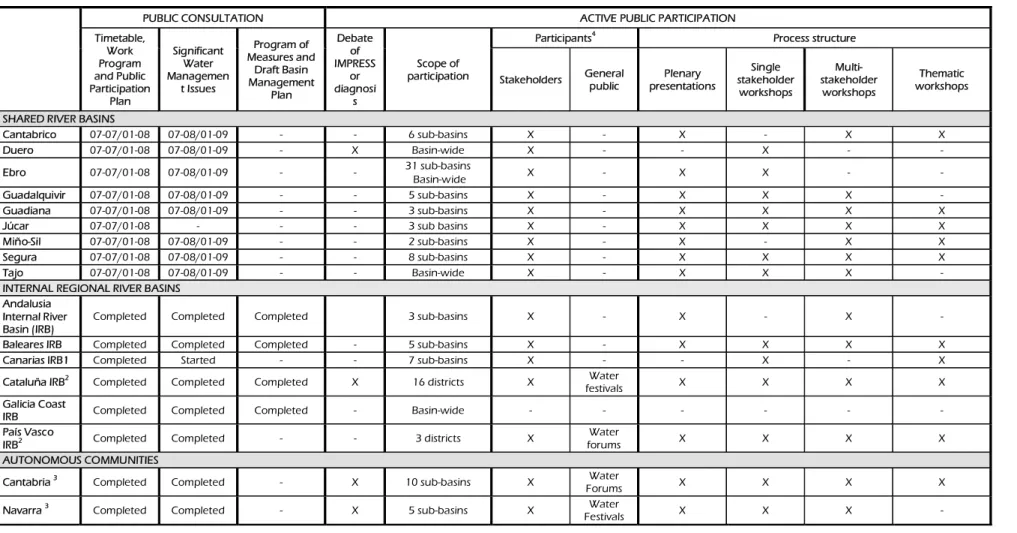
(7) Hernández Mora, N. Ballester, A.. technical and social debates of this period can be. In the first group are the interregional river. found in the proceedings of the Iberian Congress. basins. for Water Planning and Policy (Congresos Ibéricos. Autonomous region, top group in Table 1). de Planificación y Gestión del Agua) organized by. managed by the RBAs. To a large extent, their. the Foundation for the New Water Culture in. public consultation and active participation plans. 1998, 2000, 2002, and 2004.. follow the guidelines established by the General. (those. that. cross. more. than. one. In June 2004, shortly after coming to office, a. Water Directorate of the central MARM. They have. newly elected government modified the NHP by. divided the basins for participation purposes into. cancelling the Ebro Transfer (Royal Decree Law. smaller. 2/2004). It was also at this time that the work. potential stakeholders and grouped them into. required for the implementation of the WFD in. three categories: public administrations (including. Spain started in earnest. To a large extent, as Del. local governments); economic users (including. Moral and Hernández-Mora point out (2007), the. irrigators, industrial users, hydroelectric users); and. conflicts surrounding the 2001 NHP had mired. civil society (including recreational users, scientists,. the water community in a largely fruitless debate. environmentalists, etc.). They organized separate. over proposals and approaches that clearly. workshops in each sub-basin for each stakeholder. needed to be overcome in order to adapt to the. category. philosophy and goals of the WFD.. documents. Multi-stakeholder workshops (where. sub-basins.. to. They. debate. also. the. identified. different. all. planning. all categories were included) have also been organized during the public consultation phase of 4.. PUBLIC PARTICIPATION IN THE 2005-2015. the documents. While the general design of the. RIVER BASIN PLANNING PROCESS. active participation processes may be similar, there are significant differences among them both in. a.. Public participation and the WFD river basin management plans The. PP. timing as well as in content. In the Ebro basin, the RBA defined 27 sub-. processes. the. basins and organized four different workshops in. implementation of the WFD in Spain formally. each one throughout 2007, one with each. started with the publication for consultation of the. stakeholder category, in order to collaboratively. initial. identify. planning. documents. related. to. (timetable,. work. the. primary. water. management. program and PP plan) in early 2007. Table 1. challenges in each region. It also held basin-wide. presents. expert. a. summary. of. the. PP. activities. workshops. undertaken in the different river basin districts.. processes. Beyond the formal consultation processes (shown. recreational users).. for. and. specific. smaller users. participatory (for. instance. in columns 2-4), the active participation activities. In the Guadalquivir, on the other hand, the. undertaken in the different river basin districts. RBA conducted thematic basin-wide workshops in. provide. and. the initial planning phases throughout 2008;. involvement. It is possible to distinguish between. organized plenary presentations to different. three large groups of river basins according to the. stakeholder groups of the Draft Significant Water. way water authorities have organized their PP. Management Issues draft document (Borrador del. activities.. Esquema de Temas Importantes or ETI); and has. new. spaces. for. public. input. conducted multi-stakeholder territorial workshops Ambientalia SPI (2011). 7.
(8) Hernández Mora, N. Ballester, A.. in each of 5 planning regions to discuss the proposed program of measures in late 2009 and early 2010. Another example is the Guadiana RBA, which divided the basin into three planning areas and organized three stakeholder workshops and one multi-stakeholder workshop in each of them in 2008 to present and debate the ETI draft document. It also held thematic basin-wide workshops in 2009 to discuss some particularly challenging issues (agricultural non-point source pollution; environmental flows; or governance). Finally within this first group it is worth noting the design of specific PP or mediation processes in some basins on particularly relevant issues. This is the case, for instance, of the mediation process organized for recreational users (anglers and kayakers) and hydroelectric interests in the Northern river districts (Cantábrico and Miño-Sil). Another noteworthy example is the public participation process in the Júcar river basin district to develop the Júcar River Restoration Plan6. The second group includes those PP processes that are taking place in river basin districts that fall entirely within the territory of an autonomous region and are therefore managed by the water authority of that region (second block in table 1). The situation in those intraregional river basin districts is very diverse, as is apparent in table 1. On one hand are those basins that are still in the initial phases of the planning process, as is the case in some of the Canary Islands, and on the opposite side of the spectrum are the Balearic Islands, Andalusia or Galicia, that have already completed the 6-month public consultation period of its draft BMP or Catalonia, which approved its BMP in November 2010 (December 2010). 6. The Júcar River Restoration Plan public participation process was a result of the agreements reached as part of the debates that led to the modification of the Júcar-Vinalopó water transfer project in 2006.. Ambientalia SPI (2011). 8.
(9) Hernández Mora, N. Ballester, A.. Table 1. Synthesis of public participation processes in Spanish River basin districts PUBLIC CONSULTATION Timetable, Work Program and Public Participation Plan. ACTIVE PUBLIC PARTICIPATION. Significant Water Managemen t Issues. Program of Measures and Draft Basin Management Plan. Debate of IMPRESS or diagnosi s. SHARED RIVER BASINS Cantabrico 07-07/01-08 Duero 07-07/01-08. 07-08/01-09 07-08/01-09. -. X. Ebro. 07-08/01-09. -. -. Guadalquivir 07-07/01-08 07-08/01-09 Guadiana 07-07/01-08 07-08/01-09 Júcar 07-07/01-08 Miño-Sil 07-07/01-08 07-08/01-09 Segura 07-07/01-08 07-08/01-09 Tajo 07-07/01-08 07-08/01-09 INTERNAL REGIONAL RIVER BASINS Andalusia Completed Completed Internal River Basin (IRB) Baleares IRB Completed Completed Canarias IRB1 Completed Started. -. -. 07-07/01-08. 2. Cataluña IRB. Completed. Galicia Coast Completed IRB País Vasco Completed 2 IRB AUTONOMOUS COMMUNITIES Cantabria Navarra. 3. 3. Completed. 4. Scope of participation. Stakeholders. General public. Plenary presentations. Single stakeholder workshops. Multistakeholder workshops. Thematic workshops. 6 sub-basins Basin-wide 31 sub-basins Basin-wide 5 sub-basins 3 sub-basins 3 sub basins 2 sub-basins 8 sub-basins Basin-wide. X X. -. X -. X. X -. X -. X. -. X. X. -. -. X X X X X X. -. X X X X X X. X X X X X. X X X X X X. X X X X -. 3 sub-basins. X. -. X. -. X. -. Water festivals. X -. X X. X -. X X. X. X. X. X. Completed -. -. 5 sub-basins 7 sub-basins. X X. Completed. Completed. X. 16 districts. X. Completed. Completed. -. Basin-wide. -. -. -. -. -. -. Water forums. X. X. X. X. X. X. X. X. X. X. X. -. Completed. -. -. 3 districts. X. Completed. Completed. -. X. 10 sub-basins. X. Completed. Completed. -. X. 5 sub-basins. X. Ambientalia SPI (2011). Process structure. Participants. Water Forums Water Festivals.
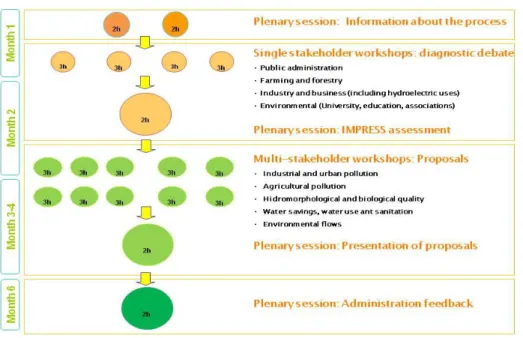
(10) Hernández Mora, N. Ballester, A. NOTA TABLA:. basin. These were followed by multi-stakeholder. Only the Insular Water Councils of the islands of Tenerife and Las Palmas de Gran Canaria have carried out active public participation initiatives. The information in this table therefore refers to these two islands. 2 Catalonia and the Basque Country have undertaken public participation processes both in internal basins as well as in those sub-basins within their territory that are part of the Ebro River Basin District (and Cantabrico River Basin District in the case of the Basque Country). 3 Cantabria and Navarra autonomous regions have undertaken public participation processes in the river sub-basins that are within their respective territories, but that are a part of the Cantábrico, Ebro and Duero (the latter only in the case of Cantabria). Cantabria has internal river basins but has not yet assumed management and planning responsibilities from the Cantábrico River Basin Authority. 4 We consider general public as the natural or legal persons and, in accordance with national legislation or practice, their associations, organizations or groups (article 2.4 Aarhus Convention, 1998, and article 2.1 Law 27/2006). We consider stakeholders the public affected or likely to be affected by, or having an interest in, the decision being made (articles 2.5 y 7 Aarhus Convention 1998, and article 2.2. Law 27/2006). Source: Updated from Ballester & Hernández-Mora (2008).. workshops and thematic working groups for. Within this group, the public participation processes undertaken by the Catalan Water Authority (Agencia Catalana del Agua or ACA) is worth highlighting (see Figure 2). The Agency divided the river basin district into 16 sub-basins for public participation purposes and designed a six-month PP process that it implemented in each of them. Each process started with a shared diagnosis of the situation using the draft IMPRESS document prepared by the ACA for each sub-. Ambientalia SPI (2011). particularly relevant or conflictive issues. The results of the workshops were presented in plenary sessions to all participants. At the end of each process, the ACA held feedback sessions in which it classified the proposed measures into four groups: •. Proposals that were rejected and the reasons that motivated their exclusion;. •. Proposals that were already planned or in the process of implementation;. •. Proposals that were accepted and would be incorporated into the RBMP under the responsibility of the ACA;. •. Proposals that were accepted but exceeded the. ACA’s. responsibility. mandate of. a. and. were. different. the public. administration. In all cases the decisions of the Agency were justified and discussed in the feedback sessions with all participants, thus ensuring participants that their efforts and contributions had been taken into account. Furthermore, the Agency has published an evaluation of the PP process, including indicators such as total number of participants, proposals received, accepted and rejected, and a reflection of future steps for participation in BMP implementation.. 10.
(11) Hernández Mora, N. Ballester, A.. Figure 2. Public participation processes in the Catalan Internal River Basin Districts. Source: Adapted from Ballester (2008b). A. third. participation. group processes. includes. the. undertaken. public in. the. Autonomous Communities of Cantabria and Navarra (last two rows in Table 1) in basins and sub-basins that are a part of the Ebro, Cantábrico or Duero river basin districts. There are two aspects worth highlighting in these processes. The first one is the fact that the governments in each region decided to contribute to the river basin planning process through the promotion of active public participation processes. In the case of Cantabria, the autonomous government created the Office for Hydrologic Public Participation of Cantabria (Oficina de Participación Hidrológica de. Cantabria or OPHIC) in 2006, with the specific purpose of conducting PP processes related to the development of the new BMPs and following up on the implementation of the proposed measures. In. the. case. government. of. Navarra,. the. autonomous. commissioned. the. Center. for. Environmental Resources of Navarra (Centro de. Recursos Ambientales de Navarra or CRANA) in 2005 to undertake the Navarra Water Forum (Foro del Agua de Navarra), a PP process in five. Ambientalia SPI (2011). sub-basins that fall within Navarra territory, and increased their staff to undertake this mission. The second noteworthy aspect is the success of both processes in involving the wider public as a result of their determination to expand the water debates beyond traditional stakeholders. They achieved this through a variety of activities. On one hand their integration with other social networks and PP initiatives such as neighborhood associations, development. Agenda. 21. initiatives,. processes,. rural. networks. of. municipalities, etc. They also conducted extensive fieldwork prior to the start of each sub-basin PP process:. gathering. existing. information. to. determine the situation of the river basins and the primary pressures, impacts and challenges to reaching WFD goals; processing and presenting the information in an easily understood format; and widely disseminating the information among the public. Finally, all processes included large public events (water festivals and forums) with the goal of bringing the issues closer to the wider public.. 11.
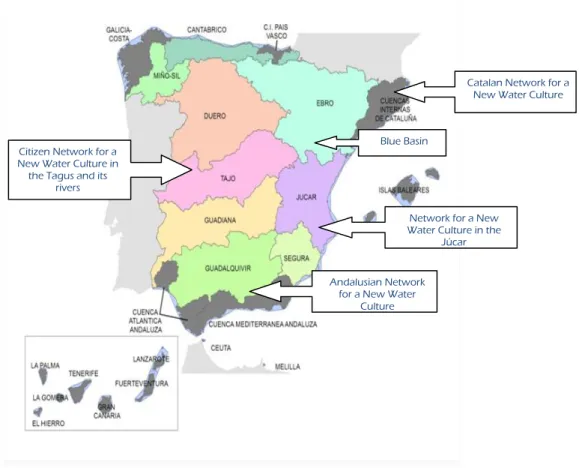
(12) Hernández Mora, N. Ballester, A.. b.. Other forms of public participation: Social. National Hydrologic Plan and the Ebro river. networks for a New Water Culture. transfer.. Public participation in water planning and. •. The Andalusia Network for a New Water. decision-making in Spain has been channeled. Culture (Red Andaluza por una Nueva Cultura. either through formal participation mechanisms in. del Agua), created in 2004 as a regional. the RBAs’ participatory councils and board, or. coordinator of social movements, activists,. through the processes initiated in the context of. technical experts and academics active in. the WFD discussed above. However, other forms. Andalusia.. of PP have emerged over the past several years in response to a perceived need to create alternative. •. in the Tajo/Tejo and its rivers (Red Ciudadana. channels that help interest groups and the larger. por una Nueva Cultura del Agua en el. public to advocate their positions in the water. Tajo/Tejo y sus Ríos), created in April 2007 as. policy debates. These social networks constitute. a. new forms of organization that have a potential to. venues,. protection. public. over. 100. Spanish. associations,. and. institutions,. of. the. Tajo. river. and. its. environmental and cultural values.. information campaigns and the presentation of valid policy alternatives. They have the ability to. of. municipalities and individuals interested in the. pressure, demands for information and more participatory. network. Portuguese. influence water policy decisions through public substantial. The Citizen network for a New Water Culture. •. The Blue basin: Network of organizations in. “use new information in social learning processes. defense of the Ebro River (Cuenca Azul – Red. and derive collective action from new insights. de organizaciones en defensa de la Cuenca. rooted in shared experiences” (Pahl-Wostl et al.. del Ebro), created in 2009 to advocate for an. 2007). They serve the basic functions of social. ambitious implementation of the WFD in the. networks identified by other authors (Lauber et al.. Ebro basin.. 2008) such as: exchanging ideas; disseminating. •. The Network for a New Water Culture in the. knowledge; and exerting influence. They should. Júcar (Red por una Nueva Cultura del Agua. therefore be taken into consideration in the. en el Júcar ) created in March 2010 as a. search for new institutional arrangements that. network of 20 organizations of the Júcar river. can more adequately respond to the challenges. basin in defense of the New Water Culture. and needs of modern society.. values and of a basin management plan in. There are currently five active networks organized with the expressed goal of defending what is known as the values and principles of the New Water Culture and actively involved in the implementation of the WFD in their respective regions (see Figure 3): •. The Catalan Network for a New Water Culture (Xarxa Catalana per una Nova Cultura de. l’Aigua), created in 2001 in the context of the debates surrounding the Ambientalia SPI (2011). accordance with the goals of the WFD These. networks. share. several. common. characteristics. They are all made up of a wide diversity of environmental groups, local and regional citizen organizations, rural development groups, recreational user associations, etc. While member organizations may defend a variety of interests and operate independently from each other, they share the principles of the New Water. 12.
(13) Hernández Mora, N. Ballester, A.. Figure 3. Social networks in defense of a New. Catalan Network for a New Water Culture. Blue Basin. Citizen Network for a New Water Culture in the Tagus and its rivers. Network for a New Water Culture in the Júcar. Andalusian Network for a New Water Culture. Culture (a term that most have used in their. volunteer basis with no staff (with the exception. names) as a uniting and inspiring philosophy, and. of the Xarxa in Catalonia) or headquarters. They. rely on the WFD as the legal backing to their. have close links with the scientific and technical. proposals and actions. Apart from their specific. community who are often active members of the. differences, all networks share similar goals of. networks. Experts contribute information and. protecting water ecosystems and their value as an. technical. integral part of their local and territorial identity.. elaboration of viable alternatives to proposed. They defend an approach to water resources. infrastructures; and provide arguments for the. management based on economic rationality,. development of public comments, allegations and. ecosystem protection and public participation.. public testimony. The networks combine technical. In order to achieve their goals the networks. work. and. with. legal. social. expertise;. activism,. help. in. the. promoting. use some common strategies. For the most part. demonstrations, marches, concerts, forums and. they rely on e-mail lists, blogs and websites to post. seminars, petition drives, river days and other. and share information among members. In some. forms of public mobilization.. cases (Tajo and Andalusia) they hold annual. Social networks have been active in the WFD. meetings hosted by alternating member groups in. PP. different locations of the basin or region to share. clearinghouses and providing guidance to their. information, design strategies, and reinforce. members. In the case of the Xarxa in Catalonia. personal relationships and links. They rarely have. they have played a pivotal role in the monitoring. a solid organizational structure, operating on a. and evaluation of the PP processes organized by. Ambientalia SPI (2011). processes,. serving. as. information. 13.
(14) Hernández Mora, N. Ballester, A.. the Catalan Water Authority, receiving funding. outcomes (the BMPs) are available. We focus our. from the Agency to support its small staff and. analysis on four elements that can be potential. activities.. indicators of the processes’ credibility and success:. If indeed the WFD aims to encourage public. the role played by public authorities, particularly. involvement in the water debates and social. the water administration, in the promotion of the. commitment to the goals of sustainable water. PP processes and their response to the process’. management and use, water authorities should. outcomes; the quality, relevance and adequacy of. support and empower these kinds of grassroots. the information provided to participants in the. initiatives.. process; the PP methodology used; and the. However,. with. the. exception. of. Catalonia, this support has been lacking.. characteristics of the participating public. These elements build on La Calle’s (2008b) proposed. 5. THE. KEYS. TO. EVALUATING. PUBLIC. framework and coincide with some of the design. PARTICIPATION IN RIVER BASIN PLANNING. principles identified by other authors (Von Korff et. PROCESSES IN SPAIN. al., 2010; Mostert et al., 2007; and Acland 2008, as. Von Korff et al. (2010) highlight how the increasing. been. that members of existing social networks have of. accompanied by extensive research focusing on. the PP processes can also contribute valuable. two key issues: (1) what are the benefits of public. information to this initial assessment.. participation. importance. and. (2). of. how. PP. can. has. cited in Irvine and O’Brien 2009). The perception. “good”. or. “effective” participation be carried out and. a.. The role of public authorities. evaluated. In the case of Spain, most PP processes A review of the PP processes currently. are still ongoing and their outcomes, the BMPs, are not available at this time. A detailed evaluation is therefore not yet possible. Basic questions such as whether the PP processes have helped improve public decision-making and resulted in BMPs that help achieve WFD goals cannot be answered at this time.7 Instead, we have chosen to identify and discuss issues that can more directly affect the credibility, legitimacy and results of the PP processes as a first step toward a broader analysis of their impact on improved public decision making which can be undertaken when the. underway highlights the limited compromise that political leaders and water administrators have with both their implementation and results. This lack. of. implication. consequences:. the. has. several. insufficient. negative. human. and. financial resources given to PP in the context of the water planning processes; the lack of integration. of. PP. in. day. to. day. water. management activities and in the basin planning processes; the absence of the PP processes from the political agenda; and the lack of political compromise in supporting the planning goals that should derive from the implementation of the. 7. It is worth noting here that there is a project currently underway, “Deliberative democracy and water policy”, funded by the Spanish Ministry of Science and Innovation for the 20102012 and led by the Institute for Governance and Public Policy of the Autonomous University of Barcelona with participation of several members of the FNCA’s WFD Observatory, including the authors of this paper. The project aims to evaluate the results of the PP processes in the elaboration of the RBMPs and contribute to the academic debate over changes in governance and the introduction of mechanisms for democratic innovation.. Ambientalia SPI (2011). WFD. The relevance and usefulness of PP as an integral part of any public policy decision making process, and of water planning and management in particular, has not been acknowledged by those with water management responsibilities. As a result, PP is too often relegated to marginal. 14.
(15) Hernández Mora, N. Ballester, A.. processes that must be undertaken by legal. policy,. imperative.. sanitation,. industrial. policy,. etc.). that. urban must. supply. and. necessarily. be. The lack of political will or involvement too. integrated in order to be successful. It is for this. often results in the weakness of the PP processes. reason that the WFD requires the creation of the. and the lack of integration of their results in water. Committee of Competent Authorities for each. policy. Consequently the results lose credibility. river basin district to supervise and cooperate in. among participants who become frustrated and. the planning process and in the implementation. lose any incentive to remain involved.. of the BMPs and programs of measures. The. Two. notable. exceptions. are. found. in. committees were not created for river basins in. Catalonia, where the Catalan Water Agency. Spain until late 2008 and have only recently. created a specific PP unit, and in Cantabria, with. started operating, but without any evident. the OPHIC. The creation of these departments,. improvement. with their own personnel and specific mandates,. administrative cooperation.. in. real. and. effective. inter-. results from a political commitment to the idea of. This lack of effective administrative cooperation. improving and facilitating public decision making. is one of the most significant weaknesses common. through PP. As a result, the PP processes. to all PP processes. The lack of coordination in the. undertaken in these two regions stand out for. face of competing and overlapping responsibilities. their intensity, flexibility and coherence.. often results in the avoidance of responsibilities. Another clear example of political support is. and lack of clarity and specificity of programs and. the Navarra Water Forum that was undertaken by. plans and, consequently, in a lack of legitimacy. the CRANA in 2005 as a result of a specific. and mistrust toward PP processes. Many of the. mandate of the autonomous government of. policies and plans that need to be implemented to. Navarra. The Forum resulted in intense PP. achieve WFD goals (for instance agricultural, land. processes in the Ebro and Cantábrico sub-basins. use or industrial initiatives) exceed the powers of. located in the region of Navarra.. the water administration. However, the RBAs hold. A second significant issue regarding public authorities. when. discussing. water. policy. responsibility for promoting PP and approve the BMPs. Consequently, it is the water administration. alternatives is the need for effective inter-. that. administrative. traditional. competent authorities. In this sense, better inter-. approach to public policy and government is. administrative cooperation would allow for a. firmly rooted in the division of responsibilities. more effective and in-depth public debate of. along. policy alternatives, a debate that has so far been. coordination.. administrative. The. boundaries and clearly. defined sectoral responsibilities. However, this approach. cannot. adequately. handle. the. must. promote. cooperation. among. largely limited both in extent and content. It is not only necessary to ensure better. challenge of achieving good ecological status that. coordination. the WFD poses for water ecosystems that often. administrations,. cross political and administrative boundaries. The. departments of the same administration. In the. BMPs’ programs of measures require policies and. case of the RBAs there is a significant lack of. initiatives from different levels of government. integration between the activities of the planning. (municipal, regional, national) and from different. department (responsible for developing the new. sectors (land use and urban policy, agricultural. BMPs and the associated PP programs) and the. Ambientalia SPI (2011). among but. also. different. public. within. different. 15.
(16) Hernández Mora, N. Ballester, A.. other departments within the authorities. To a. the planning documents makes them often. large extent, the latter operate in accordance with. difficult to use and understand by the non-. traditional values and objectives, and have not yet. specialized public, becoming a clear barrier to PP. internalized the new approaches to water policy. in the planning debates. This limitation became. and. the. apparent for instance in the scarce response that. implementation of the WFD, including those. RBAs, received to the initial documents that were. related. published on the webs for public consultation in. management to. more. that open,. come. with. transparent. and. participated decision-making.. 2007 (see table 1) without supporting outreach and information programs.. b.. Information for public participation. Some examples of good practices in this area. Information is a fundamental building block. are the interactive IMPRESS documents that the. for effective public participation. However, in. Catalan Water Agency made available on its. order to be effective, information must be adapted. website during the PP processes, or the user-. to the capabilities and needs of end users,. friendly ETI documents it developed to support. updated regularly, user friendly and reliable.. the different sub-basin PP processes. Another. Information provides content to public debates. example. and influences decisively the construction of. information is the online territorial information. public opinion. Access to information is also a. system or the river reports of the Ebro RBA; or the. right (La Calle, 2008a) that public administrations. summary documents prepared by the OPHIC in. have to recognize and comply with.. Cantabria to inform the PP processes which they. of. an. effort. to. improve. public. In Spain, the WFD implementation process has. were constantly reviewing and improving as they. contributed significantly to the improvement of. gained experiences and inputs in the successive. the quality and quantity of information available. PP processes. Finally, it is worth noting the efforts. to the public on the web pages of RBAs, although. of some RBAs, such as the Guadiana and. there are still substantial differences between. Guadalquivir, to highlight the changes introduced. different sites. It is important to note that quantity. in the different documents as a result of the PP. of. processes to facilitate review.. information. sufficiency. or. does quality,. not. necessarily. since. an. imply. excess. of. information can also lead to opacity. However, the information. available. on. RBA’s. websites. is. constantly improving.. c.. Process design and methodology The. analysis. of. the. different. public. participation processes highlights the importance. In spite of the fact that the WFD, both in the. of the methodology used to design and guide. text as well as the guidance documents (EU,. them. In Spain there is a scarcity of professionals. 2003) established quality criteria for public. specialized in PP and mediation techniques,. information, it is often difficult to find rigorous. particularly with knowledge and experience of. technical information that is presented in a user-. water management and ecosystem issues. Too. friendly and synthetic format; is updated regularly;. often, the techniques and methods used in water. uses language that is adapted to different target. planning PP have not been appropriate to the. audiences; and that makes it possible to identify. needs of specific processes, resulting in frustration. the sources of the information as well as the key. and. elements or arguments. The technical nature of. Additionally, the geographical extension of many. Ambientalia SPI (2011). alienation. of. potential. participants.. 16.
(17) Hernández Mora, N. Ballester, A.. of the sub-basins that were identified for. the draft BMP or, when excluded, the rationale. participation purposes imply the inclusion of. behind that exclusion.. territories with significantly different realities and. A similar example can be found in the. problems, making it difficult to conduct coherent. meetings organized by the Water Authority of the. and. Balearic Islands in the final phase of the planning. integrated. public. debates. on. shared. problems.. process with the goal of presenting the contents. In spite of the fact that uncertainty, complexity. of the draft BMP. These meetings allowed. and change are integral parts of the water. participants to see whether their proposals had. management. PP. been included in the final document and discuss. processes have often lacked the flexibility to adapt. the contents of the draft plan. No other RBA has. to emerging needs and to the realities of different. organized similar meetings so far, indicating that. situations. In this sense, the willingness of some. they may consider the draft BMPs as the feedback. RBAs to create new forums for participation, such. document for participants.. challenges. we. face,. the. as the Miño-Sil or Ebro RBAs that created specific. When the PP process starts with a shared. mediation and PP processes for recreational users,. discussion of existing problems in a river basin and. are noteworthy. Another example is the changes. potential causes--in essence, an open debate of. introduced in the PP plan by the Júcar RBA in. the IMPRESS documents—as was the case in. response to public comments and suggestions.. Cantabria, Navarra and Catalonia, the processes. Another weakness of some of the processes is. themselves are more credible and robust.. the absence of goals and a roadmap for PP. The. A final consideration is that PP is too often. clear identification of goals is key for public. undertaken as a mere formality without sufficient. involvement,. managing. time or integration within the decision-making. expectations, guaranteeing the usefulness of the. process. The WFD encourages PP as a means to. process, planning it correctly and running it. guarantee its success and improve decision-. smoothly. Many processes, particularly the early. making related to water. However, in order to. ones, have failed to adequately communicate the. achieve this goal it is necessary to grant PP. goals of PP, sometimes failing to contextualize it. processes. within. WFD. deliberation and the emergence of potential. implementation. In these cases it has been unclear. conflicts and their resolution. It is also important to. what the future steps of the process would be,. design. how the results would be integrated within the. substantial, going beyond isolated meetings with. BMP, or what criteria would be used to prioritize. stakeholders that are separate from the planning. the proposed measures.. and management processes.. the. for. adequately. framework. of. the. sufficient. processes. time. that. and. are. flexibility. coherent. for. and. The processes that laid the ground rules from the outset, defined clear objectives and clarified their purpose were most robust. The best examples are the feedback sessions organized by the Catalan Water Authority at the end of each sub-basin process. They allowed the Water Authority to clarify their commitment to the results and their intention of including the proposals in Ambientalia SPI (2011). d.. Participants in water debates Ultimately, an analysis of the effectiveness and. credibility of PP has to include a review of who participates and how and when they participate. In this sense, some of the previous indicators discussed here have determined the commitment. 17.
(18) Hernández Mora, N. Ballester, A.. of interested parties to the processes and their. comments and allegations to the draft ETI. active participation throughout their duration. In. document.. this sense, members of social networks for a new. Most PP processes analyzed have not included. water culture are stakeholders that historically. the general public as a target of the information,. have not had a seat at the decision-making table,. consultation or active participation activities.. are committed to an ambitious implementation of. Therefore they have not designed or searched for. the WFD in Spain, and would therefore have a. adequate channels of communication or adapted. significant stake in PP. Their response to, and. the information to different audiences.. involvement in, these processes can help draw. largely been limited to stakeholders, thus limiting. some preliminary conclusions before a more. the quality of the processes and failing to meet. thorough evaluation can be made once the. one of the key WFD requirements: the implication. processes are complete.. of the general public in water planning and. PP has. While there have been internal debates in. management activities. The Water Forums and. some of these networks about the usefulness and. Festivals of Cantabria and Navarra are noteworthy. convenience of getting involved in WFD-related. exceptions. Although they were only organized in. PP,. have. specific moments of the process, they indicate a. participated. In the case of the Ebro’s Cuenca. willingness to go beyond traditional stakeholders. Azul, for instance, the Ebro RBA provided financial. and implicate a wider public in the debates. It is. support for the organization of workshops to. significant that, too often, the processes have. debate proposals and specific issues with expert. ignored existing networks and social movements. support. In Catalonia, the Catalan Water Agency. active and interested in these issues, failing to use. provided continued funding to the Catalan. the potential they offer for involvement and. Network to coordinate environmental non-profits’. participation of a wider public.. overall,. network. representatives. participation in the different sub-basin processes,. A significant barrier to the involvement of. thus reinforcing their work and capabilities and. organized social networks in the PP processes. guaranteeing. traditionally. initiated by the RBAs is the lack of credibility of. underrepresented stakeholder group in the water. RBAs vis-a-vis non-traditional water users and. policy debates. In these cases, PP is contributing to. stakeholders.. reinforce these networks, opening new spaces of. uncertainty with respect to the potential influence. communication between different groups that. of the processes in the final decisions and,. may have common interests and goals.. therefore, the usefulness of PP. These doubts are. input. from. a. In the Tajo, on the other hand, members of the. An. additional. barrier. is. the. only increased with the realization of persisting. Citizen Network participated actively in some of. “back. the initial PP workshops and activities, but went. communication between more traditional water. on to organize a coordinated protest to what they. users (irrigators and hydroelectric users primarily). perceived as a flawed and opaque process where. and the RBAs. This results in a conviction that non-. some of the key issues where not on the table for. traditional stakeholders can more effectively. debate.. influence. The. Tajo. Network. also. served. to. doors”. or. decision-making. exchange technical and legal expertise among. public. members to help guide the elaboration of. established PP processes.. Ambientalia SPI (2011). parallel. activism. and. channels. of. processes. through. campaigns,. outside. 18.
(19) Hernández Mora, N. Ballester, A.. 6. CONCLUDING REMARKS. and development of new hydraulic infrastructures. After reviewing the existing spaces for PP in water. policy. decision-making in Spain and. attempting a first analysis of existing citizen networks and their perception of those spaces, we find some unanswered questions. Perhaps the main ones refer to the effectiveness and ultimate usefulness of public participation processes as well as to their future and continuity. In what pertains to their effectiveness, a pending question refers to the management of the proposals that emerge from PP processes. It is necessary to clarify the criteria used to prioritize these proposals and to include them (or not) in the draft BMP. The organization of feed-back sessions similar to those designed in Catalonia would. help. acknowledge. participants’. contributions and strengthen the processes by demonstrating. the. usefulness. of. everyone’s. efforts. The challenges posed by ineffective interadministrative. coordination. also. affect. the. potential outcome of PP. Since many proposed measures exceed the responsibilities of the water administration, effective mechanisms. it. is. essential. cooperation among. and. to. implement coordination. administrations. with. responsibility in the various sectors (agriculture, land use, industry, etc.) that have an impact on and are impacted by the management of water resources.. The. adequate. balancing. and. integration of conflicting interests and needs of different but interrelated sectors will condition our ability to adequately address fundamental issues for the attainment of WFD goals such as the determination of environmental flows, the revision of water permits, the development of new irrigated agricultural areas, the challenges of nonpoint source pollution, or the construction. to meet various needs. Given that many PP processes take place at the sub-basin level, it will be important to successfully integrate. their. results. into. basin-wide. management approaches. That is, an effort needs to be made to maintain the richness of local contributions without losing the necessary basinwide perspective. In what pertains to the continuity of the PP dynamics once the planning process has been completed, there are no indications of plans to continue these efforts in the implementation phases of the BMPs. The efforts undertaken by stakeholders,. the. public. and. the. water. administration in the development of PP programs can be lost if we can’t guarantee a certain continuity during the implementation phase. Furthermore, the WFD requires the promotion of active participation for the implementation of the Directive, which would logically include the implementation of the BMPs. Along the same lines, it is important to consider how to integrate the active participation processes undertaken under the WFD with the formal participatory structures that are a part of the Spanish water administration. While from a legal perspective they may be different realms of participation, it is important to learn from the experience gained through the more active and extensive PP processes. These should serve to enrich existing formal participation structures which need to be reformed to include new stakeholders and interest groups that are active in public policy debates and can make valuable contributions. A pending challenge remains to involve the general. public. management. in. the. debates,. water. policy. promoting. and public. education and outreach activities, in order to promote an understanding and appreciation of. Ambientalia SPI (2011). 19.
(20) Hernández Mora, N. Ballester, A.. the value of aquatic ecosystems for our health,. Ballester, A. (coord.) (2008b) Intercambio de. livelihoods and emotional wellbeing. Given the. experiencias. constantly changing social context and the. relacionados con la Directiva Marco del Agua.. demands for new forms of governance that can. Fundación Nueva Cultura del Agua y grupo de. better respond to society’s needs, we should. trabajo de participación y DMA del seminario de. reflect on how to best capitalize on the. participación ambiental del Centro Nacional de. opportunities that arise from the appearance of. Educación Ambiental. Unpublished report.. self-organized social networks and movements active in the water debates, and how we can help strengthen them so they can actively contribute to the participation of the wider public in the collective construction of public policies.. de. procesos. the Observatory of the Implementation of the Water Framework Directive in Spain of the. Fundación Nueva Cultura del Agua (Foundation for a New Water Culture) and all those. participación. Ballester, A. and Hernández-Mora, N. (2008).. Participación Pública en el Proceso de Elaboración de los Planes de Cuenca en España. VI Congreso Ibérico de Gestión y Planificación del Agua, Vitoria.. Acknowledgements: We thank our colleagues of. de. Available. at:. http://www.fnca.eu/congresoiberico/documento s/c0417.pdf (checked on 20/03/2010). European Commission (2003). WFD CIS Guidance. document nº 8. Public participation in relation to the Water Framework Directive. September 2008.. professionals and academics involved in water. Del Moral, L. (2008) La participación pública en el. policy and planning in Spain with whom we have. nuevo proceso de planificación hidrológica en. discussed ideas and perspectives and shared. curso. La experiencia de la Demarcación del. information over the past few years.. Guadalquivir y de la Comunidad Autónoma de Andalucía. XIII Jornadas de Derecho de Aguas, Ciudadanos y usuarios en la gestión del agua,. Bibliography Acland, A. (2008) A handbook of public and. stakeholder engagement. Surrey, U.K. Dialogue by design. Arrojo, P. (coord.). (2001) El Plan Hidrológico. Nacional a Debate. Ed. Bakeaz and Fundación Nueva Cultura del Agua.. españolas. Buenas prácticas: Las experiencias de Catalunya y otras Comunidades Autónomas, Jornada taller- Experiencias positivas para la mejora del proceso en la planificación de las demarcaciones hidrográficas de Andalucía. Sevilla, de. septiembre. Del Moral, L. and Hernández-Mora, N. (2007). Síntesis y conclusiones del Panel científico-técnico de seguimiento de la política de aguas en España. Available. at:. http://www.unizar.es/fnca/varios/panel/conclusio nes.pdf (checked on 20/03/2010).. Ballester, A. (2008a) Experiencias de cuencas. 4. Zaragoza, 21-22 February 2008.. 2008.. Available. at:. http://www.unizar.es/fnca/docu/080904taller/bal lester.pdf (checked on 20/03/2010).. Espluga, J. and J. Subirats (2008) Participación. ciudadana en las políticas de agua en España. Panel Científico-Técnico de Seguimiento de la Política de Aguas. Convenio MMA-Universidad de Sevilla. ISBN 13:978-84-691-0027-1. Available at: (http://www.unizar.es/fnca/varios/panel/53.pdf) (checked on 20/03/2010). Font,. N.. and. management Ambientalia SPI (2011). in. J.. Subirats. Spain:. The. (2010). Water. role. policy. of. 20.
(21) Hernández Mora, N. Ballester, A.. entrepeneurs in shaping change. Ecology &. Mostert, D., Pahl-Wostl, C., Rees, W., Searle, B.,. Society,. [Online]. Tabara, D., and J. Tippett (2007) Social learning in. http://www.ecologyandsociety.org/vol15/iss2/art. European river-basin management: barriers and. 25/. fostering mechanisms from 10 river basins.. 15. (2),. Art.. 25.. Irvine, K. and S. O’Brien. (2009) Progress on stakeholder participation in the implementation of the Water Framework Directive in the Republic of. Ecology and society 12(1):19. [Online] URL: http://www.ecologyandsociety.org/vol112/iss1/a rt119/. Ireland. Biology and Environment: Proceedings of. Pahl-Wostl, C., Craps, M., Dewulf, A., Mostert, E.,. the Royal Irish Academy. Vol. 109B, No.3, 365-. Tabara, D., and T. Traillieu. (2007) Social learning. 376.. and water resources management. Ecology and. La Calle, A. (2008a) El nuevo marco jurídico de las. directivas europeas y las nuevas oportunidades de participación. IN: Las aguas subterráneas en. society. 12(2):5.. [Online]. URL:. http://www.ecologyandsociety.org/vol112/iss2/a rt5/. España ante las Directivas Europeas: retos y. Subirats, J. (1997) Democracia: participació i. perspectivas. (Groundwater in Spain in the face of. eficiència. Revista CIFA, 6.. the. European. Directives:. Challenges. and. opportunities). AIH-GE.. Varela,. C.. and. N.. Hernández-Mora.. (2010). Institutions and institutional reform in the Spanish. La Calle, A. (2008b) La importancia de la. water sector: A historical perspective. In: “Water. participación pública: De la obligación a la. Policy in Spain.” Garrido, A. and M.R. Llamas (eds).. convicción. Jornada Taller – Participación en el. Taylor & Francis.. proceso de planificación hidrológica: Experiencias positivas para la mejora del proceso en la planificación de las demarcaciones hidrográficas de Andalucía. Sevilla, 4 septiembre 2008. Available at: http://www.unizar.es/fnca/docu/080904taller/lac alle.pdf. (checked on 20/03/2010).. Von Korff, Y, P. D’Aquino, K.A. Daniell and R. Bijlsma. (2010) Designing participation processes for water management and beyond. Ecology and. society. 15(3):1.. [Online]. URL:. http://www.ecologyandsociety.org/vol115/iss3/a rt1/. Lauber, B., D. Decker and B. Knuth. (2008) Social networks and community-based natural resources. Primary web pages consulted:. management. Environmental management 42:. WFD Observatory of the Fundación Nueva. 677-687.. Cultura del Agua:. Martínez Gil, J. (1997) La nueva cultura del agua. http://www.unizar.es/fnca/index3.php?id=1&pag. en España. (The new water culture in Spain) Ed.. =18. Bakeaz and Fundación Nueva Cultura del Agua.. Iberian Water Congress for Water Management. MMA, 2000. Libro Blanco del Agua en España.. and Planning:. (White book of water in Spain). Secretaría de Estado de Aguas y Costas. Dirección General de. http://www.fnca.eu/congresoiberico/index7.php? lan=1. Obras Hidráulicas y Calidad de las Aguas. Ministerio de Medio Ambiente. Madrid, 637 pp. Ambientalia SPI (2011). 21.
(22)
Figure
Documento similar
