
TítuloMonitoring and characterization of bacterial populations of two biological air filters during the start up phase
11
0
0
Texto completo
(2) 540. M. JOVIC, L. CABROL, F. DUCRAY, R. GAGNEUX AND A. S. LEPEUPLE. robust odour control strategies in order to minimise impact on residential areas has therefore become an important issue for the sector. A wide range of options is available to an operator to control the emissions and thereby reduce the impact on sensitive areas. In broad terms, odour control options can be characterized by two categories: process related control options and end-of-pipe abatement options. The principal behind end-of-pipe abatement techniques is to remove odorous compounds from the air collected from the process using a treatment system. This approach requires the odorous process to first be contained and collected with an extraction system. The emissions can then be treated using different techniques. One of the available technologies is the combination of an acid scrubber aiming at removing ammonia, and a biological filter for the treatment of VOCs. Indeed biofiltration has proved to be economical and environmentally viable (Aizpuru et al. 2001; Malhautier et al. 2005). Biofiltration processes are governed by two main phenomena. The first phenomenon is the mass transfer of contaminants from the gas phase to the liquid phase. Concentration in the biofilm is in equilibrium with the one in the gas phase according to Henry’s law (C*=P/H). The second phenomenon is the bioconversion of pollutants to biomass, metabolic-end-products, carbon dioxide and water. Chemical compounds are biodegraded in the biofilm, which contains organisms growing on the solid medium support. Considering these aspects, abatement efficiency in this process will depend on chemicals, physicals and microbiological parameters of the carrier media used (Malhautier et al., 2005). Nowadays physical and chemical parameters are commonly taken into account for the selection of biofilter carrier media. However, little attention has been paid so far to microbiological parameters. Therefore, the purpose of this study was to evaluate the potentiality of molecular tools to generate biological data useful for biofilter support media characterization. In order to compare the two biofilm carrier media, the monitoring and the characterization of bacterial populations of two biological air filters was realised during the start up phase (four months).. 2 MATERIAL AND METHODS 2.1 COMPOSTING PLANT AND BIOFILTERS’ DESCRIPTION The composting facility studied was receiving compost from sewage sludge and green wastes. The ratio between sewage sludge and green waste varied from 1/4 to 1/3 depending on sewage sludge siccity. The composting building was fully enclosed and the odorous air extracted from this building was conveyed to a deodorization system designed to treat 184,000 m3/h of gaseous effluent. The extracted air was first treated by an acid scrubber and then injected into the biofilter..
(3) MONITORING AND CHARACTERIZATION OF BACTERIAL POPULATIONS. 541. The biofilter was composed of four units of a similar design and configuration. Each unit had a 320 m2 surface area, was 1.5 metre depth and was fed with 46,000 m3/ h of gaseous effluent containing ammonia and VOCs. Three units were filled with mixed peat/branches/wood fragments (biofilter B) and one was filled with mixed peat/ coco fibbers (biofilter A). The two biofilters (units A and B) studied were operated at full-scale (480 m3). 2.2 PHYSICAL AND CHEMICAL MONITORING OF BIOFILTERS 2.2.1 AMMONIA CONCENTRATION MEASUREMENT Ammonia concentration measurements were realised at the inlet and at the outlet of biofilters A and B using colorimetric Dräger tubes (Ammonia NH3-2 – reference D5085845 – MSA) and a Toximeter® II sampling pump (reference D6172755 – MSA). Abatement and elimination capacities were respectively calculated using equations A and B. % abatement = ((C(inlet) – C(outlet))/C(inlet)) . 100. (Equation A). EC = ((C(inlet) – C(outlet))/C(inlet)).Q)/V. (Equation B). EC: Elimination capacities (g/m3filter/h) Q: Flow at the outlet of the biofilter (m3air/h). C: Ammonia concentration (g/m3air) V: Volume of the biofilter (m3filter). 2.2.2 VOCS CONCENTRATION MEASUREMENT VOCs samples were collected in TedlarTM SKC® bags. Quantification of total VOCs was performed within 24 hours using a Flame Ionisation Detector (APHA 360, HORIBA). The results were expressed in mg of ppmv equivalent CH4. 2.3 MICROBIOLOGY 2.3.1 CARRIER MEDIA SAMPLING AND BIOFILM DETACHMENT METHOD As stated by Khammar et al. (2005) and Malhautier et al. (2005), a stratification of bacterial population occurs along the biofilter depth. As a result, it was decided to collect samples at the same point during the time of the study. For each biofilter A and B, 1 L of carrier media samples was collected at 0.30 m depth under the surface. Samples were conserved at 4°C in a sterile bottle and no aqueous phase was added to avoid biofilm desorption during transport. In order to optimize the biofilm detachment technique from both biofilm carrier media, three methods were tested: (i) sonication, (ii) mechanical agitation and (iii) mechanical agitation with glass beads. Influences of parameters such as time (5, 10, 15 and 20 minutes), chemical dispersion agents (physiologic serum, Ringer Solution and PBS (Khammar et al., 2004) and mass ratio glass beads/biofilm carrier media (1/.
(4) 542. M. JOVIC, L. CABROL, F. DUCRAY, R. GAGNEUX AND A. S. LEPEUPLE. 2, 1 and 2) were investigated. For biomass carrier media A, mass media and aqueous phase volume were respectively equal to 100g and 500mL. For biomass carrier media B, these values were equal to 50g and 400mL. 2.3.2 DIRECT CELLS COUNTS Total and viable bacteria were enumerated by epifluorescence microscopy (Olympus) using staining with DAPI (reference D9542 - Sigma) and Total Viable Count (TVC) (AES-Chemunex). AOB and NOB bacteria quantification was carried out using FISH method. In order to evaluate data variability (RDS), three microfilters were examined for each TVC, DAPI and FISH samples. 2.3.2.1 DAPI Bacterial suspensions were incubated in the dark with in a 2.5 μg/mL final concentration DAPI solution during 30 minutes. Stained bacteria were recovered by microfiltration through a 0.2 μm porosity membrane filter (GTBP - Millipore). Microfilters were then mounted on microscope slides in mounting medium (Olympus) and examined using an epifluorescence microscope (Olympus) equipped with a blue excitation filter (330 – 385 nm) and a 420 nm barrier filter. 2.3.2.2 TVC In order to enumerate viable cells in samples, Esterase activity measurements, were undertaken using TVC kit (Doc 200–D0510–07 – AES-Chemunex). After cells staining, microfilters were mounted on microscope slides in a mounting medium (Olympus) and observed using an epifluorescence microscope (Olympus) equipped with a 470 – 495 nm excitation filter and a 519 nm barrier filter. 2.3.2.3 Cell viability Cellular viability rate (R) was evaluated by calculating DAPI/TVC ratio using equation C: R = (Ct / Cv).100 R : Cellular viability rate (%). (Equation C) Ct, Cv: bacteria concentrations (cells/g). 2.3.2.4 AOB and NOB FISH FISH method is based on the capacity of labelled DNA probes to hybridize with a specific sequence of rRNA. Since its first application on biological reactor (Amman et al., 1990a; Amman et al., 1990b), this technique has gained an increasing interest and is now widely applied to study microbial ecology of biological filters (Friedrich et al., 1999; Moter et al., 2000)..
(5) MONITORING AND CHARACTERIZATION OF BACTERIAL POPULATIONS. 543. In this study, FISH method was employed to investigate the colonization of biofilter carrier media by nitrifying bacteria (AOB and NOB). Three DNA probes were selected, two for NOB bacteria (NIT 3 and Ntspa 712) and one for AOB bacteria (Nso 1225) (Gieseke et al., 2001). As described by Gieseke et al. (2001), the control of DNA probes penetration and accessibility in cells was tested using Eubacteria probe EUB 338. This control also insured that rRNA quantity was sufficient for FISH analyses (Amman et al., 1990b). FISH analyses were performed as described by Gieseke et al. (2001) and Amman et al. (1990b). Quantification of nitrifying bacteria on carrier media were realised measuring total surface areas of AOB and NOB clusters (Cell, Olympus, Germany). 2.3.3 ANALYSIS OF TOTAL DNA BY PCR-SSCP SSCP is a separation technique based on single strand DNA secondary structure. As stated by Amman et al. (1995), rDNA is an ideal phylogenic marker. As a consequence, PCR-SSCP on the 16 S rDNA V3 region can be applied for the determination of molecular fingerprints. These fingerprints reflect ecosystem microbial richness and diversity (Khammar et al., 2004). 16 S rDNA PCR-SSCP analyses were realised by the Environmental Technology Institute (ITE, Narbonne, France). The protocol used for DNA extraction was the one designed by Godon et al. (1997). SSCP analyses were conducted as describe by Delbès et al. (2001). Similarity degrees between 16 S rDNA PCR-SSCP profiles (similarity matrix) were calculated using the Pearson coefficient (Dijkshoorn et al., 2001).. 3 RESULTS AND DISCUSSION 3.1 OPTIMIZATION OF BIOFILM DESORPTION METHOD Statistical analyses based on DAPI numerations indicated that parameters such as time, chemical dispersion agents or the presence of glass beads did not have any impact on biofilm’s detachment (ANOVA, p > 0.05). As a result, a comparison of mechanical agitation and sonication was realised using an application time of 5 minutes and physiological serum as a chemical dispersion agent. The coupling of mechanical agitation and sonication was also evaluated. Statistical analyses of DAPI enumerations indicated that mechanical agitation desorbed significantly more biofilm than sonication (Student test, p < 0.05). Nevertheless, as shown in Figure 1, coupling sonication and mechanical agitation did not have a significant effect on biofilm’s desorption efficiency (Student test, p > 0.05). Finally, the desorption method selected for biofilter monitoring was a 5 minutes mechanical agitation in physiologic serum (8% (p/v) NaCl solution) using a Vortex (Scientific Industries) on position 10..
(6) 544. M. JOVIC, L. CABROL, F. DUCRAY, R. GAGNEUX AND A. S. LEPEUPLE. Figure 1. Comparison of three methods for biofilm extraction. The three methods compared were: (i) mechanical agitation (Vortex), (ii) sonication and (iii) coupling sonication/Vortex. Tests were realised on biofilm’s carrier media of biofilter B.. 3.2 MONITORING OF POLLUTANT REMOVAL The monitoring of chemical and physical parameters confirmed that biofilters A and B were fed by VOCs and ammonia. For ammonia inlet concentrations varied from 20 to 40 mg/m3. During the time of the study, determination of the abatement of ammonia did not show significant differences for biofilters A and B. As shown in Figure 2, ammonia was fully eliminated by biofilters A and B after 90 days of functioning. Moreover EC for biofilters A and B was close to 2 g/m3/h.. Figure 2. Graphical representation of NH3 abatement in biofilters A and B during the time of the study. NB: for technical reasons the monitoring of VOCs was not performed. However, inlet concentrations were measured at the beginning of the study. They were close to 5 ppmv CH4 equivalent..
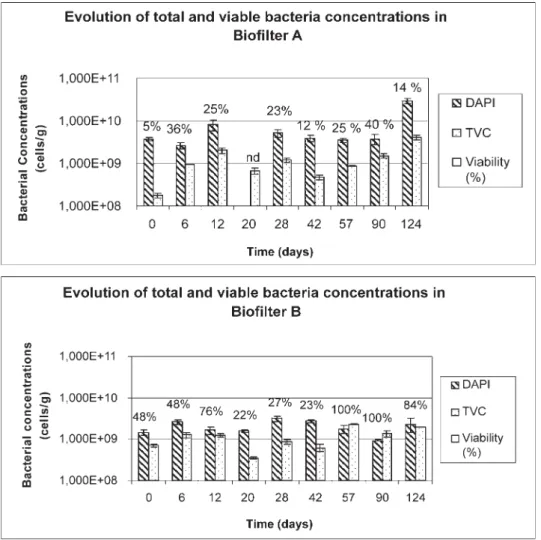
(7) MONITORING AND CHARACTERIZATION OF BACTERIAL POPULATIONS. 545. 3.3 MONITORING OF BIOFILTERS MICROBIOLOGICAL PARAMETERS 3.3.1 TOTAL AND VIABLE BIOMASS MONITORING As described in Figure 3, densities of microorganisms observed on biofilters A and B were in agreement with those reported on other biofilters (Khammar et al., 2004). Statistical analyses of total biomass for biofilters A and B indicated a significant evolution of colonization of biofilm carrier media with time (ANOVA, p < 0.05). Nevertheless, as presented in Figure 3, modifications of the biomass concentrations were not relied with the start up of biofilters A and B. It was conclude that these changes were due to sampling fluctuations or biofilm washing.. Figure 3. Representation of viability rates® and colonization densities (DAPI, TVC) of carrier media of biofilters A and B..
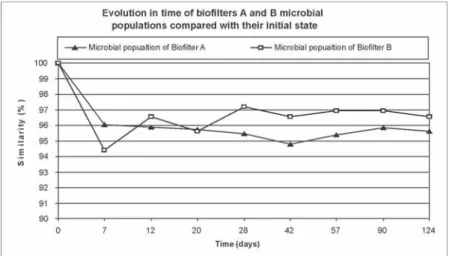
(8) 546. M. JOVIC, L. CABROL, F. DUCRAY, R. GAGNEUX AND A. S. LEPEUPLE. As reported in Figure 3, concentration of viable biomass in both biofilter A and B presented significant modifications during the experiment (Kruskall-Wallis test, p < 0.05 (biofilter A) and ANOVA, p< 0.05 (biofiltrer B)). For biofilter B, modifications of the viable biomass concentration were attributed to sampling fluctuations or biofilm washing. However, for biofilter A, a 1-log increase in TVC enumeration appeared during the first week. This increase was relied to nutriments provision by gaseous effluent. The mean of TVC enumerations was calculated during the entire period of the study. It appeared that concentrations of viable biomass in both biofilters A and B were not significantly different (Student test, p > 0.05). Nevertheless, cellular viability rate was higher in biofilter B than in biofilter A. As indicated in Figure 3, cellular viability rate was ranged between 5 to 40 % for biofilter A and between 22 to 100 % for biofilter B. Also, at t = 0, it appeared that viable biomass concentration in carrier media B was significantly greater than in carrier medium A. It is important to point out that, as the carrier medium could be the only source of nutriments in abnormal working conditions, the biomass would better resist to stops of feeding in a biofilter containing medium B. 3.3.2 AOB AND NOB POPULATION MONITORING During the time of the study, the monitoring of nitrifying bacteria using FISH method did not show any presence of AOB and NOB in biofilters A and B. Positive results obtained with Eubacteria probe (EUB 338) underlined that there was not any problem of FISH probes accessibility in cells. Taking into account these results and ammonia abatement efficiency, the following hypothesis were assumed: (i) AOB and NOB were present in other strates of the biofilters (Khammar et al., 2004) (ii) ammonia was metabolized by others nytrifying bacteria genus, (iii) ammonia was not biodegradated but was absorbed by biofilm carrier media and (iv) ammonia was absorbed by biofilters scrubbing solution. 3.3.3 ANALYSIS OF TOTAL DNA BY 16S RDNA PCR-SSCP Analysis of 16S rDNA SSCP profiles based on similarity matrices allowed the comparison of microbial population of biofilters A and B. As shown in Figure 4, it appeared that microbial populations of biofilters A and B were modified in comparison to their initial state. The results also indicated that the most important variations occurred for biofilter A. As indicated in Figure 5, comparison of SSCP profiles with time for biofilter A and B established that microbial populations of both biofilters A and B converged and became nearly identical after 120 days of functioning. At this time, those microbial populations were closer than at their initial state..
(9) MONITORING AND CHARACTERIZATION OF BACTERIAL POPULATIONS. 547. Figure 4. graphical representation of evolutions of biofilters A and B microbial populations compared with their initial state.. Figure 5. graphical representation of evolution in time of similarities of biofilters A and B microbial populations.. Finally, as presented in Figure 6 comparison of 16S rDNA SSCP profiles between t and t-1, revealed that microbial populations of both biofilters A and B evolved and stabilized. Figure 6 demonstrated that biofilter B stabilized faster than biofilter A. After 60 days of functionning, biofilter B was stabilized whereas this state was reached after 120 days for biofilter A. Those results were attributed to the composition of.
(10) 548. M. JOVIC, L. CABROL, F. DUCRAY, R. GAGNEUX AND A. S. LEPEUPLE. biofilm carrier media. Indeed, biofilter B was packed with a carrier media containing branches coming from the composting facility. Therefore, these results demonstrated that inoculation of biofilm carrier media with an acclimated microbial population significantly reduce biofilter start up phase.. Figure 6. Graphical representation of evolution of biofilters A and B microbial populations compared with their previous state (t-1 to t).. 4 CONCLUSION AND PERSPECTIVES As a conclusion, it appeared that physical and chemical monitoring of biofilters A and B did not provide helpful information to select a biofilm carrier media. Indeed, during the time of the study, abatement efficiencies observed on the two biofilters were not significantly different. Microbiological parameters have provided valuable information. Indeed, it was established, by the quantification of viable biomass, that carrier media B allowed a greater supply in nutriments for the biomass than carrier media A. Dynamic analysis of microbial populations confirmed that important modifications of microbial populations occurred during the start up phases of the biofilters. It was also demonstrated that those modifications were dependant of initial states. Therefore, it appeared that biofilter’s stabilization phase could be reduced using an appropriate inoculum. Finally, the microbial approach proved its interest to better understand phenomena occurring during the start up phase of biofilters. It also demonstrated the interest to use molecular tools to caracterize a biofilm carrier media. Moreover, carrier.
(11) MONITORING AND CHARACTERIZATION OF BACTERIAL POPULATIONS. 549. media B showed benefits compared to carrier media A, as it could significantly reduce the start up phase and provide a greater supply in nutriment. This last point could have a significative impact on biofilter’s stability in the case of feeding stops.. REFERENCES Aizpuru, A., Malhautier, L., Roux, J.C. and Fanlo J.L. (2001) Biofiltration of a mixture of volatile organic emissions. Air & Waste Manage. Assoc. 51: 1662-1670. Amann, R., Krumholz, L.and Stahl, D.A. (1990a) Fluorescent oligonucleotide probing of whole cells for determinative, phylogenetic and environmental studies in microbiology. J. Bacteriol. 172: 762-770. Amann, R., Binder, B.J., Olson, R.J., Chisholm, M.S.W., Devereux, R. and Stahl, D.A. (1990 b) Combination of 16S rRNA-targeted oligonucleotide probes with flow cytometry for analysing mixed microbial populations. Appl. Environ. Microbiol. 56: 1919-1925. Delbes, Leclerc, Zumstein, Godon and Moletta. (2001) A molecular method to study population and activity dynamics in an anaerobic digestor. Water Sci. Technol. 43(1): 51-57. Dijkshoorn, L., Towner, K.J. and Struelens, M. (2001) New approaches for the generation and analysis of microbial typing data. Elsevier. Friedrich, U., Naismith, M., Altendorf, K. and Lipski A. (1999) Community analysis of biofilters using fluorescence in situ hybridization including a new probe for the Xanthomonas branch of the class Proteobacteria. Appl. Environ. Microbiol. 65(8): 3547-3554. Gieseke, A., Purkhold, U., Wagner, M., Amman, R. and Schramm, A. (2001) Community structure and activity dynamics of nitrifying bacteria in a phosphate-removing biofilm. Appl. Environ. Microbiol. 67(3): 1351-1362. Godon, J., Zumstein, E., Dabert, P., Habouzit, F. and Moletta, R. (1997) Microbial 16S rDNA diversity in an anerobic digester. Appl. Environ. Microbiol. 63(7): 2802-2813. Khammar, N., Malhautier, L., Degrange, V., Lensi, R. and Fanlo, J.L. (2004) Evaluation of dispersion methods for enumeration of microorganisms from peat and activated carbon biofilters treating volatile organic compounds. Chemosphere 54: 243-254. Khammar, N., Malhautier, L., Degrange, V., Lensi, R., Godon, J.J. and Fanlo, J.L (2005) Link between spatial structure of microbial communities and degradation of a complex mixture of volatile organic compounds in peat biofilters. J. Appl. Microbiol. 98: 476-490. Khammar, N., Malhautier, L., Bayle, S. and Fanlo, J.L. (2005) Biofiltration of volatile organic compounds. Appl. Environ. Microbiol. 68: 16-22. Moter, A. and Gobel, U. (2000) Fluorescence in situ hybridization (FISH) for direct visualization of microorganisms. J. Microbiol. Met. 41: 85-112..
(12)
Figure


Documento similar
In the “big picture” perspective of the recent years that we have described in Brazil, Spain, Portugal and Puerto Rico there are some similarities and important differences,
No obstante, como esta enfermedad afecta a cada persona de manera diferente, no todas las opciones de cuidado y tratamiento pueden ser apropiadas para cada individuo.. La forma
The aim of this article is to examine Orientalism as a literary characterization mechanism in the contemporary American young adult sports novel Coming Up for Air
1. S., III, 52, 1-3: Examinadas estas cosas por nosotros, sería apropiado a los lugares antes citados tratar lo contado en la historia sobre las Amazonas que había antiguamente
Of special concern for this work are outbreaks formed by the benthic dinoflagellate Ostreopsis (Schmidt), including several species producers of palytoxin (PLTX)-like compounds,
In the previous sections we have shown how astronomical alignments and solar hierophanies – with a common interest in the solstices − were substantiated in the
Díaz Soto has raised the point about banning religious garb in the ―public space.‖ He states, ―for example, in most Spanish public Universities, there is a Catholic chapel
Sigma54 dependent promoters Small molecule binding. Oligomerization
