UNIVERSIDAD DE CUENCA
Facultad de Filosofía, Letras y Ciencias de la Educación Carrera de Lengua y Literatura Inglesa
Poetry-based activities for the promotion of writing skills in fourth level English Language and Literature students at Universidad de Cuenca.
Trabajo de Titulación previo a la obtención del Título de Licenciada en Ciencias de la Educación en la Especialidad de Lengua y Literatura Inglesa.
AUTORA: Erika Valeria Campoverde Llivisaca C.I: 0103478707
TUTOR: Mgt. Juan José Santillán Iñiguez C.I: 0301916144
Resumen
La poesía es uno de los textos literarios menos utilizados cuando se aprende un segundo idioma, privando a los estudiantes de sus beneficios. Esta exclusión se debe a las actitudes de los docentes/estudiantes y metodologías tradicionales en donde se genera una aula
deshumanizada que prioriza la gramática y las actividades formales/estructuradas de escritura, rechazando actividades de escritura creativa. Sin embargo, nuevos enfoques con respecto al uso de la poesía en el aula están surgiendo y estos están respaldados por evidencia empírica que demuestra las ventajas que la poesía tiene en los estudiantes y una clase
deshumanizada. Considerando lo anterior expuesto, este proyecto tiene como objetivo proporcionar a la carrera de Lengua y Literatura Inglesa de la Universidad de Cuenca, un folleto de actividades de escritura basadas en la poesía como una forma de incluir la poesía en la clase mientras se mejora la escritura. Para lo cual, se empleó una metodología
cuantitativa con una encuesta como elemento de recopilación de datos. Los resultados de la encuesta mostraron la actitud positiva de los estudiantes al trabajar con poesía y los temas sobre los cuales se desarrollaron las actividades. La conclusión de este proyecto es que las percepciones negativas sobre la poesía no deben generalizarse, ya que los resultados de la encuesta mostraron las actitudes positivas de los estudiantes hacia ella. Por último, la inclusión de la poesía en el aula es una forma innovadora y significativa de promover la escritura mientras se considera el lado humano de los estudiantes.
Abstract
Poetry is one of the least literary texts to be used in the language learning classrooms,
depraving students from many of its benefits. This exclusion is due to some factors related to teachers and students’ attitudes towards it, and the traditional methodologies previously used.
Inside this traditional approach, there is a dehumanized classroom in which creative writing activities are left behind by giving emphasis to grammar and formal structured writing activities. Nevertheless, new concepts, approaches, and methodologies regarding poetry use in the language classroom are coming forward. These practices are supported by empirical evidence that proofs the great amount of benefits poetry has on language learners and in a dehumanized language classroom. Under this circumstance, this project aims to provide the English Language Literature Major of Universidad de Cuenca with a booklet of poetry-based writing activities for fourth-level students as a way of including poetry in the class while improving writing. To achieve this objective, a quantitative methodology was employed with a survey as its data-gathering element. The percentual results of the survey were promising by showing that students were eager to work with poetry. Additionally, the survey provided the topics on which the poetry-based activities were developed. The conclusion of this project is that negative perceptions about poetry must not be generalized since the survey results showed students’ positive attitudes towards it. Lastly, the inclusion of poetry in the classroom is an innovative and meaningful way to promote writing while considering students’ human
side.
TABLE OF CONTENTS
Abstract ...2
Resumen...3
List of Tables...6
List of Figures...7
List of Appendices...7
Cláusula de Licencia y Autorización para Publicación en el Repositorio Institucional...8
Cláusula de Propiedad Intelectual...9
Acknowledgement...10
Dedication...11
INTRODUCTION...12
CHAPTER 1...14
THE PROBLEM...14
1.1. Topic...14
1.2. Description of the problem ...14
1.3. Background...16
1.4. Justification...18
1.5. Objectives...20
1.5.1. General Objectives...20
1.5.2. Specific Objectives...20
CHAPTER II...21
2.1. THEORETICAL FRAMEWORK...21
2.1.1. Nature of English Poetry...21
2.1.1.1. Definition of Poetry. ...21
2.1.1.3. Formal Verse...22
2.1.1.4. Free Verse...25
2.1.1.5. Poetic Devices...26
2.1.2. Approaches to the use of literary texts in the language classroom...27
2.1.3. Reported Advantages of Poetry Use in EFL/ESL Environments...35
2.1.3.1. Macro-skills...35
2.1.3.1.1. Reading...35
2.1.3.1.2. Speaking and Listening...36
2.1.3.1.3. Writing...37
2.1.3.2. Motivation...39
2.1.3.3. Grammar: ...41
2.1.3.4. Vocabulary...41
2.1.4. Poetry Writing Protocols...42
2.2. LITERATURE REVIEW...47
2.2.1. Empirical Evidence...47
CHAPTER III...52
METHODOLOGY...52
3.1. Method...52
3.2. Human resources: Survey participants’ description...54
3.3. Data gathering techniques...55
3.3.1. Description of the survey ...55
3.3.2. Description of the application of the survey ...56
CHAPTER IV...58
CHAPTER V...75
PROPOSED BOOKLET...75
5.1. Booklet Methodology...75
5.2. Poetry-based Activities...77
CHAPTER VI...152
CONCLUSIONS AND RECOMMENDATIONS...152
6.1. Conclusions...152
6.2. Recommendations ...153
APPENDICES...155
REFERENCES...157
List of Tables Table 4.1. Poetry Interest...58
Table 4.2. Poetry Reading Frequency...59
Table 4.3. Poetry Writing Frequency...60
Table 4.4. Poetry in the class...62
Table 4.5. Activities with poetry...64
Table 4.6. Poetry through Creative Writing...66
Table 4.7. Topics of the Poems...68
Table 4.8. Poetic Devices...70
Table 4.9. Poetry Meter...71
Table 4.10. Poetry Rhyme...72
Table 4.11. Types of Poems...73
List of Figures
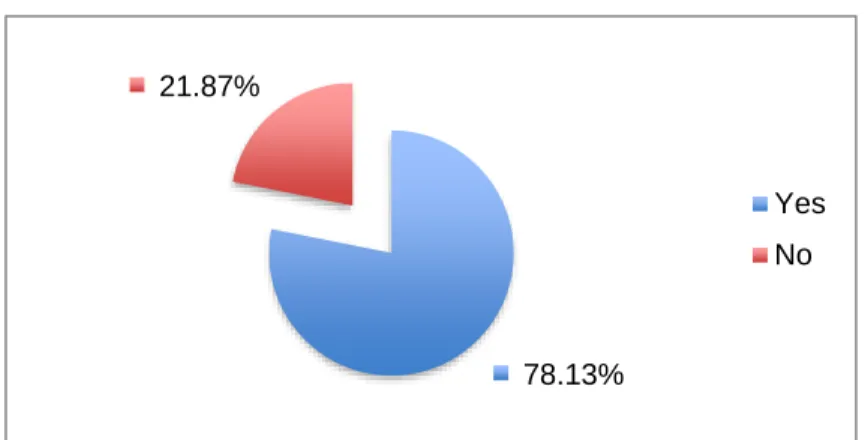
Figure 4.1. Poetry Interest...58
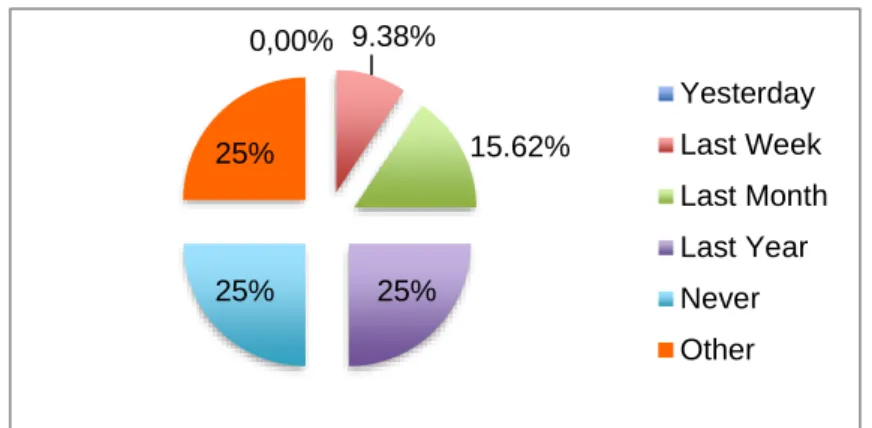
Figure 4.2. Poetry Reading Frequency...59
Figure 4.3. Poetry Writing Frequency...61
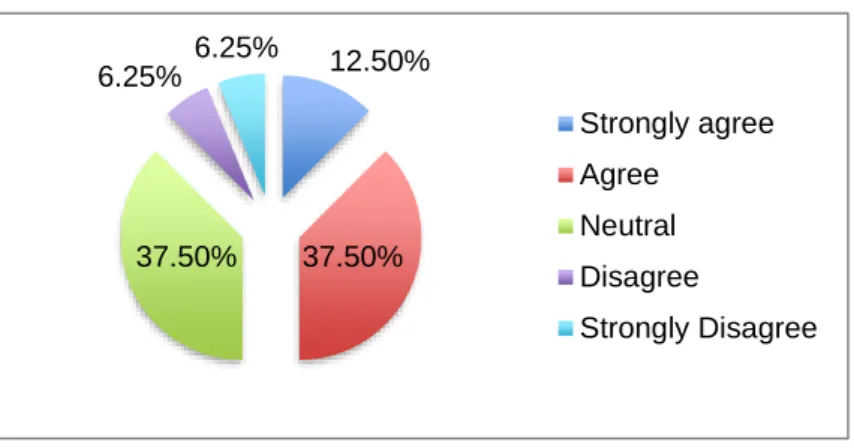
Figure 4.4. Poetry in the class...62
Figure 4.5. Poetry through Creative Writing...67
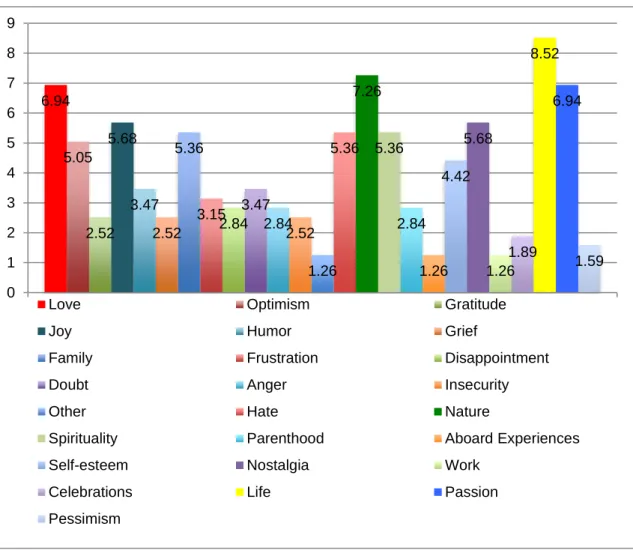
Figure 4.6. Topics of the Poems...69
Figure 4.7. Poetic Devices...70
Figure 4.8. Poetry Meter...71
Figure 4.9. Poetry Rhyme...72
Figure 4.10. Types of Poems...73
Figure 5.1. Two diverged roads...85
Figure 5.2. Word Cloud about life...92
Figure 5.3. A nymph three...107
Figure 5.4. Apollo and Daphne ...107
Figure 5.5. The beauty of Nature...115
Figure 5.6. Bee flying to the flower...115
Figure 5.7. Bird singing...116
Figure 5.8. The power of Nature...116
Figure 5.9. O mistress mine, where are you roaming? ...134
Figure 5.10. Love after death...149
Acknowledgement
Words are not enough to describe how grateful I feel while writing this. However, through these few words I try to express just a small quantity of the immense thankfulness that surrounds me. First, I want to thank God for blessing me with everything I have, and giving me the opportunity to be where I am today. Second, I thank my grandmother, Alba Tapia, for always supporting me and pushing me to be better. I would not be the person that I am today without you. You were by my side in every step of the way and all the gold, money or acknowledgements are not enough to give you back everything you have given me. I can only say thank for everything from the bottom of my heart. Albita, you have made such an impact in my life that will last forever onto many generations.
Next, I acknowledge my parents, Hilda and Alfredo. You may not be close but you have always provided the right words to inspire me or make me feel better. Thank you for encouraging and believing on me. The support system that you have provided me helped me reach this goal of finishing what I once started, and I will always recognize that. Mommy, I thank you for the example you have set as a woman, wife, sister, worker and daughter. Daddy, thank you for your hard work everyday, and for taking care of us. You have taught us that we are not perfect and it is okay to fall as long as we stand up and do things better.
To continue, a very important person during the development of this project was my advisor, Juán José Santillán. Thank you for all your knowledge, patience, and time. Your advice has helped me in such a great manner to complete this work. The guidance/results would have not been the same without you since you love poetry and I consider you to be and expert on poetry.
trusting me and being patient with me throughout this process. A special thanks goes to one of my best friends, Jazmín. My friend, your patience with me is enormous, and I thank you for that. I would have not wanted to have any other friend but you during these four years of college. You are the best!
Last but not least, I want to express my thankfulness to the most loyal doggie, Cotton. During long hours working on the computer, my Cottis has always been by my side waiting for me to finish to play or just sleep. All in all, these people were an important part of the presented project, so for that I give them an immense thank you.
Dedication This work is dedicated to God, my savior
To my grandma, my rock To my parents, my refuge To my brothers, my companion To my sister, my soul
To my nephew, Jose Vicente, my inspiration To my niece, Anali, my sunshine
Poetry is one of the least literary elements used in the second or foreign language classroom. This situation is usually caused by students and teachers’ negative beliefs and past
experiences with poetry. Learners and instructors see poetry as difficult, and their negative past experiences, in which a traditional methodology was used, contributed to this way of thinking. However, the use of poetry in the language classroom offers many advantages that are not being exploited due to the reasons stated above. One of them is that poetry presents to students the opportunity to use the language meaningfully while improving and developing with each one of the activities done with it. As a result, this project is expected to underline the importance that poetry has in language teaching through its implementation in the language classroom by means of a poetry-based activities booklet that promotes students’ writing skill. Consequently, in order to achieve the mentioned statement, the presented work is divided into six chapters. Each one complies a function in the presented project working as a basis for its development.
Chapter I presents the problematic of the topic. Therefore, the description of the problem, its background, and a justification is enunciated. In connection with this the objectives, general and specific, of the work are included. Chapter II is conformed by the theoretical framework, the empirical evidence, and poetry writing protocols. These important points are the basis of the work. In the theoretical framework, definitions and elements related to poetry are found, followed by the approaches to use literary texts in the classroom. The last topic in this chapter is the reported advantages of poetry in EFL/ESL environments; this subchapter is divided and analyzed into macro-skills, motivation, grammar, and
vocabulary.
is the poetry writing protocols that are analyzed throughout Chapter II and employed in Chapter V. Continuing, chapter III is related to the applied methodology in the project. The method, the human resources, the techniques to gather the data, a description of the survey, and its application are specified in this Chapter. After the survey is applied, the results, analysis, and interpretations of it are developed in Chapter IV. Statistical charts and tables are included in this chapter in order to show better the information and results.
Chapter V presents the proposed booklet with activities based on ten chosen poems with final writing products. The poems were selected according to students’ answers in the
CHAPTER I THE PROBLEM 1.1Topic
Poetry-based activities for the promotion of writing skills in fourth level English Language and Literature students at Universidad de Cuenca.
1.2Description of the problem
Literature is one of the resources that are employed to learn, practice, and improve a second or foreign language, and it provides many means to help students achieve that
development. Poetry is one of those means, but according to a Hanauer (2012), Mittal (2016), Khatib (2011), and many others that have studied and contributed to this topic, poetry is the least used instrument when learning a foreign language. As a result, any reasons of the disregard of poetry have been identified. Three of these, which bear a great significance, are explained below.
The first obstacle that has been found addresses the negative beliefs of teachers and students in relation to poetry. According to Khatib (2011), the inappropriate methodology, a traditional one, is one of the main reasons that have contributed to this negative way of thinking of teachers and students. Agreeing to Khatib (2011), Lockward considers that “poetry is the genre most English teachers seem least comfortable with” (as cited in Çetinavc
& Tütüniş, 2012, p. 75-76) because they conceive it as a difficult and an unsuccessful activity that is neither useful nor valuable for the students. In relation with the students, they consider that poetry has a “deep, hidden meaning that they, for the life of them, cannot see” (as cited
metaphorical and highly allusive language.” Another adverse characteristic mentioned by
Zelenkova is the “difficulty in understanding literature due to linguistic and cultural
vagueness”; poetry is full of cultural references which most of students are unaware of, and
that may cause misperceptions (as cited in Çetinavc & Tütüniş, 2012, p. 75).
Furthermore, Iida (2011) remarks how second language (L2) students are only expected to learn and develop overtly measurable writing skills. For instance, academic writing is greatly employed in the educational field, which leaves creative writing out of the picture in the classroom because of the traditional belief that there is not “connection between literary learning and the development of L2 proficiency” (Iida, 2012, p. 1473).
In relation to the idea mentioned above, Hanauer (2012) remarks that the process of learning a language has been dehumanized because it primarily focuses on the structure of the language. Teachers teach and evaluate only mechanical skills, so pupils do not have a context in which they can use the language in a more personal way. In this dehumanized process, the student is just an empty entity and not a subject with emotions, feelings, and experiences that can benefit the process of learning and mastering a language.
Another problem related to the inclusion of poetry in the EFL classroom, according to Iida (2012), is the “lack of empirical evidence.” To complement this idea, Hanuer (2010)
confirms and adds that from all of the reported empirical work related to L2, only a minor part is associated to poetry. Therefore, one can conclude that this situation represents a setback for professionals that want to investigate on that topic or are eager to employ poetry in the classroom since these professionals have scant resources in which they could sustain their thesis or class work.
Education First (EF), Ecuadorians have a significantly low proficiency level in this English, ranking 55 among 80 assessed countries. One can connect this circumstance with what was discussed above regarding the structural emphasis of the current dehumanized language instruction since students lack of communicative abilities that help them to efficiently develop in real-life situations.
In the same line of thought, and in agreement with Iida’s (2011) assertion regarding the lack of empirical evidence, there is not much information related with poetry specifically in Cuenca, but there is research regarding the teaching-learning methodology English
teachers employ in this city. According to Calle, A. et al. (2012), the methodology used in Cuenca is a traditional one, in which the structure of the language is the most important aspect. Teachers that work in public schools in Cuenca only focus on grammar and do not use innovative strategies to help develop communicative skills on the students. Thus, the absence of poetry-based writing task is to be predicted.
1.3 Background
It is a well-known fact that literature has been around since the beginning of time, and humans have created various aesthetic pieces that, even until now, fascinate the world and its readers. All this development in literature caused it to be used in the classroom. Children around the world learned to read and write through famous literary pieces in their first language. Additionally, regarding second language learning, Khatib (2011) remarks that literature and specifically poetry has been used in L2 language teaching for many years until its recent exclusion from the language classroom since it was considered extremely
By way of introduction, some negative positions towards literature in EFL/ESL environments have been expressed. For instance, Topping considers that literature should not be included in L2 curriculums because of its “structural complexity, lack of conformity to standard grammatical rules and remote cultural perspectives” (as cited in Khatib, 2011, p.
164). As poetry is part of literature, it has also been omitted from the EFL/ESL curriculum for many years because there is a common belief that poetry “made no contribution to learning a foreign language for practical purposes” (Khatib, p. 164). Thus, according to
Khatib (2011), poetry is the least used literary material to teach a foreign language.
It is worthwhile to connect the above-stated with notions that explain the reason why poetry is one of the least used elements in the classroom. First, this rejection towards poetry may be found in both, teachers and students. According to Povey, one of the causes of this aversion towards poetry by students is the traditional methodology used in poetry teaching. As well the author claims that an instructor plays a big role on making students believe poetry is challenging since he may transmit his negative beliefs of poetry to his students (as cited in Pushpa & Savaedi, 2014, p.1921).
In addition to what is stated above, Khatib (2011) considers that students fail to comprehend and value poetry for two main reasons: “(a) inappropriate selection of texts and (b) ineffective teaching methodology.” (p. 165) These reasons are related to a traditional
teaching methodology in which teachers only made students memorize irrelevant information about the author, poetic devices, and the political, religious, and philosophical implications of the poem (Khatib, 2011, p. 165), which did not make students involve in the learning process because they were only there to receive and memorize information.
monotony of the classes, have stressed the benefits of using literary texts [including poetry, of course] as the basis for imaginative, interactive activities” (p.165).
Concerning the works available on the topic, Hanauer (2010) reports that “there is
relatively little research on literature and foreign language learners and only a small subset deals with poetry” (p.34). However, the studies that there are on the topic show how
beneficial poetry in the classroom is for EFL/ESL students. Some of these advantages in a brief summary encompass different dimensions of language instruction such as, motivation (Hanuer, 2011- Kirkgoz, 2014), macro-skills development (Hanauer, 2004 - Khansir, 2012), vocabulary (Lazar, 1996 - Iida, 2012), grammar (Kirkgoz 2008 - Khansir, 2012).
1.4 Justification
It is universally acknowledged that graduation projects precise of a justification in order to develop a structured and organized final result. This justification contains specific arguments that state reasons to validate that this work is considered interesting, original, important, beneficial, and practical. These mentioned qualities show the real contribution of the work to the educational field.
To begin with, this project is beneficial and interesting because poetry offers many advantages when used in the second/foreign language learning processes. All of these
benefits can be achieved through engaging activities that transform language-learning classes into a more interesting environment for students. Consequently, some benefits are presented below.
According to Mittal (2016), “poetry promotes literacy, builds community, and fosters emotional resilience. It can cross boundaries that little else can” (p.52) because in poems
Additionally, poetry uses more than one skill to achieve its final product, so the reading, listening, and speaking skills would be vital to genuinely enhance students’ writing because as Mittal (2016) stated, “poetry serves not only as an ideal of language but it is a source of motivation for teaching language and it’s all four skills i.e. reading, writing, speaking and listening.” (p. 55). Thus, writing poetry might be able to enhance different skills and
sub-skills. For instance, learners would increase their vocabulary, which may help improving their writing abilities. As Panavelil expressed, “poems provide students with an opportunity
to enrich their vocabulary in a new way by offering a meaningful context, in which they could be used and hence be remembered more effectively” (p.12) in a writing, speaking, or even listening task.
This project is to be considered important since, according to Hanuer (2012); the process of language learning has been dehumanized, which is a serious consequence of traditional approaches. Nonetheless, the use of poetry in the classroom is a way to attend to this problem. Given that poetry takes into consideration the fundamental human part of learners and situates them as the center of the learning process, a communicative approach is expected.
Practical is another quality that this project possesses because teachers nowadays are always looking for innovative and creative ways to promote pupils’ skills while learning a
second language, so educators may use the activities developed in this booklet. These poetry-based activities are useful and concrete, in which students will use most of the skills while working on the poems or the writing task suggested. To complement the idea above, Mittal (2016) strongly believes that “poems can give language learners a new direction and will
that can inspire students to go beyond the specified information in a traditional textbook by using the language to talk, write, or speak about the cultural references the poem holds.
All in all, this work is original since it aims to incorporate one of the least used literary elements, poetry, into the classroom through a booklet with poetry-based activities to improve students writing. The selection of the poems employed in the manual is based on the students’ preferences. That process would help students to feel directly identified with the
poem and to express themselves through different activities while learning and using the language as a valuable tool for them. Another point that supports the originality of this work is the lack of other similar works according to the author’s research in the electronic sources of the Universidad de Cuenca’s library.
Finally, the explanations provided above justify the development of this work through specific characteristics such as interesting, original, important, beneficial, and practical. A real contribution to the educational field may be seen when fulfilling the above-mentioned characteristics.
1.5 Objectives
1.5.1 General objective: To provide the English Language Literature Major of Universidad de Cuenca with a booklet of poetry-based writing activities for fourth level students.
1.5.2 Specific objectives
1. To identify the topics to be covered in the activities through the administration of a survey to fourth level students of the English Language and Literature Major. 2. To select appropriate poems according to the identified topics.
CHAPTER II
To start with this Chapter, it is important to notice that the same is divided in two essential aspects. The theoretical framework is the first one, in which important poetry properties are detailed since this topic is the central one in this work followed by the approaches to use literary texts in the language classroom and the reported advantages of poetry use. Moreover, the last aspect in this part is the two writing protocols used with poems. Finally, the second aspect in this chapter is the literature review with the empirical works related to poetry.
2.1 THEORETICAL FRAMEWORK 2.1.1 Nature of English Poetry.
2.1.1.1 Definition of Poetry:
There are several concepts of poetry, and each one of them varies in relation to the author that wrote it and his experience with poetry. The definition presented below was written by Hanauer (2004), in which a meaningful experience is connected to the concept of poetry. He considers it to be:
[A] literary text that presents the experiences, thoughts, and feelings of the writer through a self referential use of the language that creates for the reader and writer a new understanding of the experience, thought, or feeling expressed in the text. (p. 10)
As it is noted in the definition the words thoughts, experience, language, feelings and writer are closely related; all of them are the most common themes when talking about
poetry. As concluded by Hanuer (2004) “poetry has the ability to explain the inexplicable and to express the unexpressed” (p. 11) since through poetry the reader/writer can communicate
2.1.1.2 Formal and Free Verse
Another important concept to be noted when talking about poetry is the form. There are two forms in poetry: Formal and Free verse. While formal verse includes all the poems that “that overtly [use] the effects of [meter], rhyme [,] and form” (as cited in Calle &
Santillán, 2013, p. 20), free verse poems are “nonmetrical, nonrhyming lines that closely follow the natural rhythms of speech” (as cited in Calle & Santillán, 2013). Both of them are beneficial when learning and practicing a language, and they can be used in different
moments throughout the learning process. 2.1.1.3 Formal Verse
Formal verse is a characteristic type of poetry for which is important to define its elements. Meter is one of them, and according to Youman (2008), it is “the systematic
arrangement of stressed and unstressed syllables within a line of poetry” (p. 64). It focuses on
the stress in the words in a poem, which is closely related with a poetic foot. According to Fussell (1924) poetic foot “is a measurable patterned, conventional unit of poetic rhythm” (p.19). The author expresses that the poetic foot will usually have “one stressed syllable and one or two unstressed” (p. 19). In English poetry there are four types of feet, according to
Fussell (1924):
1. Iamb (iambic), which is constituted by one unstressed syllable followed by one stressed syllable, as in controlled
2. Trochee (trochaic), which is constituted by one stressed syllable followed by one unstressed syllables, as in poet
3. Anapest (anapestic), which is constituted by unstressed followed by unstressed and
stressed syllables, as in comprehend.
Another significant element related to meter is rhyme. Rhyme is believed by Youman (2008) to be the phonetic sounds at the end of a line in a poem. In the same line of thought, rhyme and meter are closely related with the stanzaic form of a poem. According to Fussell (1924), the stanzaic form refers to the variations in form of the poems separated by a space, and how a poet organizes his poems by lines (p.128). Under this perspective, poems that embody any thematic kind may present variations in their stanzaic structure. Some basic variations are couplet, triplet, quatrain, etc. For instance, a poem that contains “two lines of any length rhyming” (Fussell, 1924, p.129) represents a couplet. Another stanzaic variation is
the triplet, which is defined in Fussell (1924) as “three lines of any length ending with the same rhyme word” (p.131). For example, the poem “On Spies” by Ben Johnson is a triplet.
A Spies, you are lights in state, but of base stuff,
A Who, when you’ve burnt yourselves down to the snuff, A Stink and are thrown away. End fair enough.
Lastly, another common structure is the quatrain, which is known for having four-lines stanzas, and being one of “the most popular and natural strophic forms” (Fussell, 1924, p. 133). “Western Wind” by an anonymous author is an example of this form.
A Western wind, when wilt thou blow, B The small rain down can rain? C Christ! if my love were in my arms B And I in my bed again!
The presented lines may be organized in more complex ways with specific rhyme and meter patterns according to the authors’ desire. These complex organizations create different
(Fussell, 1924, p.123). The major contrast between these two types falls into the dissimilar rhyme scheme. Moreover, another difference is the volta, which is the Italian word for turn, defined by Poetry Foundation (2018) as “the turn of thought or argument” in a poem. The
Petrarchan sonnet presents its turn between the octave and sestet, whereas the Shakespearean sonnet presents it before the last couplet (Poetry Foundation, 2018). The different rhyme scheme, and the turn in each type of sonnet are presented below. The first one is a poem written by George Santayana called “As in the Midst of Battle” (Fussell, 1924, p. 115), and the second poem is “Sonnet XXIX” by Shakespeare (Fussell, 1924, p. 121).
Petrarchan Sonnet. Shakespearean Sonnet
A For thoughts of love, and in foul sin for mirth;
As gossips whisper of a trinket’s worth Spied by the death-bed’s flickering candle-gloom;
As in the crevices of Caesar’s tomb The sweet herbs flourish on a little earth:
So in this great disaster of our birth We can be happy, and forget our doom. TURN
For morning, with a ray of tenderest joy
Gilding the iron heaven, hides the truth, And evening gently woos us to employ Our grief in idle catches. Such is youth; Till from that summer’s trance we wake, to find
Despair before us, vanity behind.
A
When in disgrace with fortune and men’s eyes,
I all alone beweep my outcast state, And trouble deaf heaven with my bootless cries,
And look upon myself and curse my fate, Wishing me like to one more rich in hope, Featured like him, like him with friends possessed,
Desiring this man’s art, and that man’s scope, With what I most enjoy contented least; Yet in these thoughts myself almost despising,
Haply I think on thee—and then my state, Like to the lark at break of day arising From sullen earth sings hymns at heaven’s gate;
TURN
For thy sweet love remembered such wealth brings,
That then I scorn to change my state with kings.
Another variation is the haiku; it is one of the most popular poetic forms from Japan. It’s assembled by a syllabic tercet; each line requires a specific number of syllables. The first
was written by Taniguchi Buson and translated by Harold G. Henderson (as cited in Fussell, 1924, p. 133)
The short night is through: on the hairy caterpillar, little beads of dew.
2.1.1.4 Free Verse
Another poetry feature is free verse; its lines do not rhyme or do not show a specific meter. However, this kind of poetry still finds its way to express its ideas with rhymes that do not follow the usual patterns. It would appear according to Fussell (1984), that free verse “shades into rhythmical prose” (p.76). This rhythmical prose presents an undefined pattern,
but it still develops one. In agreement to that, Fussell (1984) considers that free verse “tends to compensate by employing another kind of pattern, conspicuous repetition of phrases or syntactical forms” (p. 79). Thus, it is reasonable to think that free verse is not completely
free.
To agree with this assertion we have Burroway (2011) who considers that the term free verse is loosely presented and do not express in a whole the real meaning of this kind of poetry. According to Burroway (2011) this term implies that “there is no discipline in the rhythm and sound patterns of poetry that does not follow a predetermined form” (p. 295); she strongly disagrees as free verse has its own form.
breaks used in the enjambment do not have a punctuation pause at the end of each line, and for that reason, according to Fussell (1984), it is hard for the hearer to identify each line break. Lastly, repetition is another feature that embodies free verse poetry. Fussell (1984) explains that as free verse lacks of a specific metrical structure, this kind of poetry
compensates that with the repetition of phrases or syntactical forms. 2.1.1.5 Poetic Devices.
It is a well-know fact the poetry uses certain devices to achieve attractive stanzas that call the attention of its readers. Regardless of its form, most of the diverse types of poetry use these devices. The combination of different poetic devices allows the reader to visualize, imagine, smell, taste, touch, or hear certain written lines in the poem, and this allows students sometimes to connect with the poem. The definition of each one is specified below according to Burroway (2011):
1. Metonymy: The instrument used in poetry in which “one thing is represented by another thing associated with it” (p.21). For example, angels in the school (in
which angels stands for children)
2. Synecdoche: It refers to a “part that stands for the whole” (p.299). For instance, wheels refer to a car.
3. Personification: This device gives human features to inert things. For example, nice rain, angry sun or warm house.
4. Metaphor: It is a device that expresses comparison between two things. For instance, your voice is a sweet melody. Your presence is heaven.
5. Simile: It is a device that expresses comparison between two things by using words such as, like and as…as. For example, your smile is as bright as the sun,
you smell like roses.
For instance, PayPal, Coca-Cola.
7. Assonance: It is the “repetition of a vowel sound between consonants that may or may not match” (p.300). For example, “Hear the mellow wedding bells” by Edgar
Allen Poe.
8. Consonance: It is “the repetition of the consonant that concludes a word or a syllable” (Burroway, 2011, p.300). For instance, “TygerTyger, burning bright” by
William Blakes.
2.1.2 Approaches to the use of literary texts in the language classroom
Once the nature of English poetry has been discussed, an analysis of the approaches when using literary texts in the EFL/ ESL language classroom is needed. This analysis is of great importance in order to examine important characteristics, advantages, and
disadvantages of each approach, and with this information discern the appropriate one that includes poetry and other literary manifestations in class. Van (2009) presents six approaches to literary analysis that are analyzed below. In particular, there is a main focus on the
language-based and the readers-response approaches since they allow the implementation of poetry.
To begin with, the New Criticism approach is a traditional one in which students merely focus on the form of the language. Subjective ideas that the poem or any other literary piece produces on the students are avoided and only objective information is accepted.
value of the literary work” (Van, 2009, p. 4). Furthermore, the role of the student within the
New Criticism approach is heavily dependent on the teacher, as they are not given a chance to show their responses. The teacher’s role is to decode the poem, which does not contribute
with students improving their skills. That being said, New Criticism is not a suited one to accomplish a communicative approach.
The next approach in Van’s (2009) account is Structuralism. According to the author, Structuralism holds important similarities with New Criticism, as the readers’ responses and
reactions are also discarded when analyzing literary texts; only objectivity is allowed. As the name suggests, Structuralism is entirely focused on “processes and structures related to the production of meaning” (p.4) in which the aesthetic value of the work is overlooked (Van, 2009). According to Van (2009), the role of the student is to use their knowledge of themes and structures “to place the work into a meaningful hierarchical system” (p. 4); therefore, this
approach follows a mechanical methodology that does not contribute to EFL/ESL students’ “personal development, cultural awareness or language skills” (Van, 2009, p. 4). That being
said, Structuralism, just as the New Criticism, does not fit into a communicative approach. In contrast with the two approaches described above, the Stylistics one is focused on developing “students’ sensitivity to literature” by analyzing the literary characteristics of the
piece (Van, 2009, p. 4). Thus, according to Van (2009) the role of the teacher is to encourage pupils to develop “aesthetic judgments and interpretations” (p.4) of the literary pieces and compare them to supplementary texts highlighting their aesthetic value. This comparative process benefits students, so they can see how language is employed in each piece and how the register is altered in each one of them (Van, 2009, p. 5). As a result, the student has an active role in this approach since students are in contact with the literary text used, not only to talk about its form but also to give their own interpretations or any other aesthetic
For its part, the Reader-Response approach is wholly focused on the role of the reader and its process for reading literature. Under these circumstances, this approach allows
students to express “their personal experiences, opinions, and feelings in their interpretation of literature” (Van, 2009, p. 5) by transforming the reader into an active participant during
the whole learning process. The pupils’ reaction helps them assimilate and acknowledge the new information of the poem. Consequently, the teacher may start the class by activating the background knowledge or information related to the poem in order to personalize the learning and increase students’ motivation and participation. Undeniably, this process is related to the
CLT approach since language learning is developed through meaningful activities that
activate students’ personal opinions, feelings, and interpretations with the purpose of not only
practicing structures mechanically but communicating something deeper and more complex than just grammar.
The Language-Based approach is a modern way to include literature in the EFL classroom while using and improving the language. According to Lazar (1993), this approach connects literature and language learning through activities to enhance the linguistic
competence. The activities proposed in this approach allow students to respond and
collaboration, peer teaching, and student independence” (Van, 2009, p. 7) learners may
achieve a communicative competence. The roles of students and instructors are strictly defined to achieve the mentioned competence. As a result, according to Van (2009) the instructors’ role is to provide the stimuli, clarify any literary term that may be troubling
students, and manage the class. Nonetheless, their participation is not a major one compared to the students’ role and work. The author expresses many positive points about this approach since it acknowledges students’ ability to communicate in groups or pairs while using and
improving the language. Moreover, this approach allows students to create a relation between the literary piece and their lives while accomplishing “students’ needs in learning about literature and language” (Van, 2009, p. 7). Finally, Van (2009) considers that by using
stimulating literary pieces, students may find literature interesting.
The last approach that Van (2009) accounts is Critical Literacy; this method “has important implications for teaching both language and literature because it reveals the interrelationship between language use and social power” (Van, 2009, p. 8). Students see
language as a medium to analyze and criticize the sociopolitical reasons to use a specific language in a certain time, and how that language affects or affected society. Through this method students acknowledge “issues of identity, culture, political power, gender, ethnicity, class, and religion” (Van, 2009, p. 8) in the chosen literary texts. Nonetheless, the author
recommends being cautious when analyzing texts that are loaded with those themes because students have a variety of experiences and different worldviews, which can cause some complications. All in all, the main objective of this approach is to develop awareness about the “relationship between language and society” (Van, 2009, p. 8); however, it is not
deals with the importance and respect of humanity in the language learning process by considering the learner an individual with vast personal experiences, feelings, and thoughts from which they could build meaningful written pieces using the foreign/second language. According to Hanuer (2012), the language learning process is more than just a cognitive process; it is an “emotional and embodied experience” (p.108). Therefore, teachers should
transform the usual learning process into what is suggested by Hanauer (2012) by setting as their target the development of a more meaningful teaching and learning experience for their students. Teachers in this approach take into consideration the participants’ perspectives, their human side, and their creativity to teach and practice the language in a way in which the strictness of grammar is not as important as the thoughts communicated through the
language. The human individual is the center of this methodology, which the students’ selves and their world are within the language learning process. Under this perspective, Hanuer (2012) develops four principles in which Meaningful Literacy can take place; these are presented below:
1. Autobiographical writing: Students use their creativity, memory, and individual experience in order to write something that will help them discover and appreciate their own persona.
2. Emotional writing: Students emotional responses are the ones requested here through a writing process.
3. Personal insight: Students in this principle have a deep reflective process that allows them to get to know themselves better by appreciating and understating their human condition and personal experiences. All of this is captured into a writing activity.
classroom or to people outside the classroom that are significant for the students (Hanuer, 2012, p. 108).
Hanuer (2012) considers that these principles can be developed through poetry writing in EFL/ESL language learners. Therefore, for all the features mentioned above, Meaningful Literacy shows many common characteristics with the CLT that makes it possible to be developed inside this approach.
In light of what has been discussed above, the Communicate Language Teaching (CLT) is a much wider approach that encompasses some of the approaches discussed above since some of them share similar characteristics. CLT dates from the late 1960s, and it has its origin as a way for language teaching to focus on the mastering of communicative
proficiency rather than the mastering of only the structures (Richards & Rodgers, 2014). The authors state two goals inside this approach:
1. Make communicative competence the goal of language teaching
2. Develop procedures for the teaching of the four language skills that acknowledge the interdependence of language and communication (Richards & Rodgers, 2014, p. 155).
Richards and Rodgers (2014) divided CLT into two approaches, theory of language and theory of learning. The first one is the Theory of Language Teaching: Its main goal is to develop students’ communicative competence, which is conformed by four aspects such as
grammatical competence, sociolinguistic competence, discourse competence, and strategic competence. As a result, it is believed that if a student masters these four aspects, he/she has a communicative competence defined by Widdowson as the “communicative acts underlying the ability to use language for different purposes” (as cited in Richards & Rodgers, 2014, p.
160).
learning rather than just language acquisition” (p.161) through activities that are meaningful and authentic for the students; mechanical exercises to practice structures are excluded from this approach (as cited in Richards & Rodgers, 2014, p. 161). To accomplish this, the theory of learning in CLT has three principles,
1. Communication principle: Activities that involve real communication.
2. Task principle: Activities in which language is used for carrying out meaningful tasks.
3. Meaningfulness principle: Language that is meaningful to the learner supports the learning process (Richards & Rodgers, 2014, p. 161).
This meaningfulness is closely related to the stated above methodology of Meaningful Literacy proposed by Hanauer (2012). As a result, this methodology may be able to develop inside a CLT approach. Both must achieve a communicative competence in students through a meaningful experience taking into account learners’ proficiency and communicative needs.
In relation to the activities that may help the instructor achieve the before mentioned statement, teachers must develop activities that awake students’ communicative processes such as “information sharing, negotiation of meaning and interaction” (Richards & Rodgers,
2014, p. 165).
CLT presents specific roles for learners and instructors in order to achieve students’
communicative competence and avoid the usual roles that traditional approaches present. On the one hand, the teacher within the CLT has various roles that are interchangeable through the learning and teaching process. Breen and Candlin consider these two roles to be the principal ones:
Richards & Rodgers, 2014, p. 167).
From these two roles, one can assert that the instructor acts as a facilitator, and he is not expected to be talking all the time in the class as teachers used to do it in traditional approaches. Teachers will provide the instructions that will ease the communication between groups and the activities by stating specific procedures and organizing the resources available for the activity. Under this perspective, Richards and Rodgers (2014) consider the teacher to also be “ need analyst, counselor, group process manager” (p.167). As it can be seen, the
teacher has a lot of roles that do not include providing all the answers to the students. Teachers’ roles must allow students to participate and construct their own knowledge
On the other hand, students have an active role by participating and developing different learning activities in groups or pairs. Breen and Candlin state learners to be “negotiators between the self, the learning process, and the object of learning” (as cited in
Richards & Rodgers, 2014, p. 166). Therefore, learners work in collaborative groups in which everybody has something to contribute to the learning process. Students must interact with each other and mediate the various opinions and concepts given by group members or just communicate effectively in order to successfully complete the proposed activity. Moreover, the interaction with the teacher is slight, and corrections are usually minimal or non-existent. Students must acknowledge that their success or failure on the learning process depends on the communication process they held with their peers or groups (Richards & Rodgers, 2014, p. 166).
2.1.3 Reported Advantages of Poetry Use in EFL/ESL Environments
Once the analysis of the approaches that may be compatible with the inclusion of poetry in the classroom has been presented, the reported advantages of the use of this literary medium are subsequently developed. Empirical and theoretical works have presented
numerous advantages when using poetry with EFL/ ESL pupils in the language classroom. The most important benefits will be grouped and explored into macro-skills (reading, listening, speaking, writing), motivation, vocabulary, and grammar.
2.1.3.1 Macro-skills: 2.1.3.1.1 Reading:
Hanauer (2004) considers that “reading poetry helps combine the communicative and
focus-on-form approaches, for it naturally links meaning construction and form” (p.67). The reason is that students try to construct the meaning of the poem in general and specific words or forms they are just discovering. When poetry reading is used in the classroom the author considers that is perfectly adequate for foreign language learners to “explore meanings and
use all available resources to create understanding” (Hanauer, 2004, p. 67); therefore, one poem can mean something different for another student because every poem demands us to construct our own personal meaning. Furthermore, Hanauer (2004) considers that students through the reading of poetry “stretch the concept of how English works” (p.68). One way of doing this is that teachers can choose a relatively demanding poem in order to make students reflect on its meaning and extend their concepts and learning with the aid of dictionaries, peer work, and guidance from the instructor. After the reading of the poem discussions of it are encouraged.
language readers, but it should be a significant one in which students internalize the read piece. Liaw (2001) used in his project the Readers’ Response approach, which presented successful results with students. The author complements this information with his findings stating, “students […] felt that they had gained confidence in reading English texts and even enjoyed it” (p. 42). In order to obtain this result, Liaw (2001) underlies the importance of an
appropriate selection of the used literary pieces since that can ensure a high interest and low anxiety in students.
2.1.3.1.2 Speaking and Listening:
Mittal (2016) exposes some advantages that poetry has regarding the speaking skill. The author considers that rhyme is useful as it allows students to memorize the poem easily and repeat it aloud. Mittal (2016) states that the reciting of a poem will help students to practice their pronunciation and improve their speaking skill. Accordingly, Çetinavcı and Tütüniş (2012) indicate that it is important to bear in mind that poetry features topics that are
universal, so this fact facilitates spoken discussions about a poem, its topic, or meaning. This mere action motivates students to practice and develop their speaking ability since everybody possesses different opinions in the classroom about a certain poem. (Çetinavcı & Tütüniş, 2012, p. 76)
Additionally, Cubukcu exposes that poetry employs different rhyming and rhythm features such as “stress, pitch, juncture, and intonation” (p.244) that by an aloud or individual
repetition students become familiar with those sound characteristics (as cited Khansir, 2012, p. 241). This advantage benefits students to “learn how the English linguistic system is used for communication” (Khansir, 2012, p. 244) by fostering the speaking skill. Students,
according to the author, after reading a poem could “see how idiomatic expressions are used,
The speaking and listening skill present a close connection since the listening one allows the speaking to take form. Under this circumstance, since according to Burroway (2011), poetry is “meant to be heard aloud” (p.295), all the points mentioned above not only
benefit the speaking skill but the listening skill also. When a student memorizes a poem and repeats it aloud, the rest of the class is prone to listen to the mistakes he/she makes during the presentation. Additionally, the different sound features mentioned above such as stress, juncture, intonation, and pitch are identified by students’ listening skill which is promoted every time a new poem is presented, read aloud, and discussed about.
2.1.3.1.3 Writing
Hanuer (2004) considers that poetry writing can help learners to expand their comprehension of the language they are learning. The author suggests some strategies that would help language learners to do so. The learner can write poems and express meaningful ideas, feelings, thoughts, and experiences through it; this writing process can be easily achieved through a reflection process (Hanauer, 2004, p.77). This process is directly linked with the Meaningful Literacy proposed by Hanuer (2012). Apart from this, according to Hanuer (2004) poetry writing makes students experiment new “modes of expression” (p.77). Students identify, learn, and clarify specific languages forms or structures through the
experimentation with the language that poetry writing implies. This experimentation with the language allows students to use the language in a creative way and to break certain grammar rules in order to write and represent their ideas in the best way (Hanauer, 2004, p.77). Lastly, the Hanauer (2004) considers that some students may be intimidated by writing tasks for which he suggests to follow a process and provide students “structured poetry writing activities” (p.77); all of this helps students with their fears when writing. Under this
meaningful experiences. Hanauer (2004) considers that scaffolding is crucial during this process since it create situations in which students express themselves and develop the language at the same time. Some scaffolding strategies presented by the teacher are, “specific
poetic form, lists of words or phrases, or an idea that draws on the writer unique knowledge” (Hanauer, 2004, p.77). The author dismisses the idea that poetry writing is complicated for foreign language leaners to express complex or meaningful ideas through poetry according to his own experimentation with EFL/ESL students.
In the same manner, Kirkgoz (2014) gives another insight on poetry writing and creativity. To begin with, the author talks about creativity, which according to Boden “is the ability to come up with new ideas that are surprising yet intelligible, and also valuable in some way” (as cited Kirkgoz, 2014, p. 394). Thus, creativity allows students to seek for more
words to express new thoughts that students may have in their mother tongue. Kirkgoz (2014) considers creative writing to be meaningful for the students and claims that when writing a poem “learners manipulate the language in interesting ways to express uniquely personal meanings; they necessarily engage with the language at a deeper level of processing” (p.395). The assertion stated above can also be linked to Meaningful Literacy since significant
experiences are shaped through poetry writing while using the language.
According to Iida (2012), the use of literature “as a means, not as an end, is
enhance a better understanding of voice and self-expression, gain a greater awareness of writer-reader interaction, and develop L2 literacy skills transferrable to other genre writing” (p.1483), which in the long-run will help the students to develop their foreign language abilities and use them in different situations outside or inside any other classroom.
Hişmanoğlu (2005) states that “[l]iterature can be a powerful and motivating source for writing in ESL / EFL, both as a model and as subject matter” (p. 57). In writing as a
model, students are able to imitate or develop a resembling writing product from model literary texts. For instance, a poem can be given and students can emulate it or write another one with similar characteristics. In addition, writing as a subject matter is a more complex process since the literary texts given function as a springboard for students to interpret it and write their analysis, comments, creative responses, etc. (Hişmanoğlu, 2005). The author considers literary texts such as poems provide various themes and topics that allow students to work with “guided, free, controlled, and other types of writing” (Hişmanoğlu, 2005, p.58) activities.
2.1.3.2 Motivation
Since the macro-skills are settled above, other essential point to be found as a reported advantage of the use of poetry is motivation. Mittal (2016) points out that “poetry serves not only as an ideal of language but it is a source of motivation for teaching students the language and [it is] all four skills i.e. reading, writing, speaking and listening” (p. 55), so through the use of the four skills in the different poetry-based activities students could feel motivated to practice the language and achieve a communicative competence.
Kirkgoz, p.395). Students feel motivated to talk, work, express their feelings, communicate, or any other task when working with an appealing themes for them.
Hanuer (2012) explains that in order to establish and maintain motivation he employs the process of Generating Personal Motivation For Self Exploration in which the facilitator motivates students to talk and explore their lives and experiences, so students go through a process of self-discovery, self-understanding and self-expression. All this process is part of Meaningful Literacy in which the creation of a safe environment, where students are able to express themselves without any kind of fear, is as important as the poem itself.
Additionally, Pushpa and Savaedi (2014) indicate that poems are great motivators because they arouse interest in the students with their great emotional content that with the right approach can create a successful learning environment. Students can communicate successfully about the things that are important for them and teachers motivate them into autonomous classes where they can employ analytical and reflective abilities. In the same line of thought, Panavelil (2011) considers poetry-based activities to be motivating “as they generate strong emotional reactions” (p.41) which was also complemented by Hess’ (2003)
ideas. She considers that through an appropriate guidance or process, poems are the adequate texts that consents students to look at their human side or reality by reading, understanding, and interpreting the poem.
2.1.3.3 Grammar:
Sarac explains “poetry provides readers with a different viewpoint towards language use by going beyond the known usages and rules of grammar, syntax, and vocabulary” (as
cited in Khansir, 2012, p. 241); therefore, students are not presented with the usual rules and grammar points. Students can go beyond those rules and are not so constricted by them, which allow pupils to increase their vocabulary and use figures of speech such as “simile, metaphor, irony, personification, imagery, etc.” (Khansir, 2012, p.241).
Lazar (1993) complements the above-mentioned idea by stating that native-speakers in a normal conversation may make some grammar mistakes due to the spontaneity of the moment, so from there he concludes that language is not always “rigidly governed by rules” (p.100). Under this context, poetry provides students that grammar flexibility from which they can learn something important about the language. Learners experiment with the language by using various structures in order to write their poems, so they may use the language incorrectly during the process. This might be bad for some teachers, but Lazar (1993) considers that “incorrect” use of language as an opportunity for students to recognize
and compare the appropriate way of writing the same structure or idea. Consequently,
instructors may show or elicit from students the correct way that “mistake” should be written.
2.1.3.4 Vocabulary:
improvement since the repetition of words or phrases may be found in poems.
Another point expressed by Panavelil (2011) is that poems promote vocabulary expansion since it provides students with a meaningful setting in which they learn, use, and remember certain words that were involved with the poem and the related activities. As a final point in this section, Scrivener declares that in order for students to acquire or remember a word, they must be startled with it. Since this emotion is provoked, it is easier for the pupil to learn, recall, and even use it later. This principle follows a first language acquisition process since many children attain many words in this way. (Santillán, 2018, p. 40)
2.1.4 Poetry Writing Protocols
It is of great importance to explain protocols for the inclusion of poetry in the
language classroom, which have both an empirical and theoretical support. This information is of special interest for the development of the poetry-based activities to be compiled in the booklet that is presented in Chapter V.
The first protocol to be analyzed is the one proposed by Hanauer (2012), which is based on the principles of Meaningful Literacy. Hanauer (2012) does not consider second language writing as a simple task, but he strongly believes that, in order to attain success in the writing tasks, students need to go through “a process of personal exploration of memory and the expression of personal understanding and insight to other class members” (p.112). Hanauer’s (2012) protocol encompasses the following stages:
2. Thinking, imagining, reliving and talking about a significant life moment: Once a safe environment has been set, students start thinking, imagining, reliving and talking about a significant life moment. In this stage, learners may close their eyes and think about that significant moment; they can relive their experiences again by hearing, smelling, tasting, seeing or touching them again on their minds.
3. Investigation and exploration of the genre of poetry: After that important step, an investigation and exploration of the genre of poetry is necessary since poetry is the medium employed to get students to talk, read, write, and explore their own self. Students may research the different types of poetry and study their different poetic devices in order to use them on their work as well as identify them on the presented poems.
4. Exploring personal experience – listing memories, discussion of unique, personally meaningful experiences; valuing one’s personal history: This stage is closely related to the second one since it demands from the learners to explore personal experience by listing memories and discussing unique, personally meaningful experiences. In this stage, Hanauer (2012) suggests learners to choose the specific moment to be discussed, and list the reasons that make the moment valuable and meaningful. This process aids students to get meaningfully in contact with that specific experience by describing major and minor details that will be later helpful.
5. Poetry writing experimentation – checking your poetry in relation to its ability to ‘show not tell’ and to recreate your experience in another: In other words, the author considers that this is the stage where learners will “try and show that moment in words –
6. Reading of poetry, peer and instructor interaction and the sharing of poetry with individuals the poet writer considers to be of significance beyond the classroom: In this stage a safe interaction in class must be created, in which the reader, listener, and writer share their ideas around each other without concerns. Readers may give feedback to the authors and learn about many unknown situations that developed the writer’s character and
voice. Writers welcome this feedback in order to improve their work. This practice can be also done outside the class by the reading of the student’s work by a close relative.
7. The production and sharing of a complete poetry book: In this stage pupils materialize their experience by the production of their poetry book, and they share it with the teacher or any audience that wishes to see their work. Hanauer (2012) shares his experience on his students’ poetry book by saying how insecure and overwhelmed they felt at the beginning of the process, but there is a change in the learners’ attitude towards the end of the process. Hanauer’s comments acknowledge that students felt accomplished when they saw
their work printed or exposed to somebody else.
This procedure follows a Meaningful Literacy methodology; the objective of the author is to make students reflect on their own significant experiences through poetry. As said by Hanauer (2012) this methodology helped students to change their perception of what English meant for them “from a distant instrumental entity, the English language becomes a personal, emotive and expressive resource” (p.112).
Another protocol to include poems in the class is the one presented by Hess (2003) in which the author considers poems to be the ideal “vehicle for thought and an instrument for shaping language” (p.19). For this reason, one has to bear in mind to take into consideration students’ preferences and level when choosing a poem to be employed in the class.
Initially, Hess (2003) gives basic information about the poem she uses in class and the reasons she chooses it. The author provides an example of the whole process employing the poem ‘Richard Cory’ by Edwin Arlington Robinson to explain in detail each step in her proposed protocol while developing language work in the classroom. After the poem is chosen, Hess (2003) starts the process with the step one called trigger.
1. Trigger: It is the group of activities that consents students to build their schemata. As said by Rumelhart, schemata are the “units of knowledge that helps us to understand the world” (as cited in Hess, 2003, p. 21). The teacher’s role is to add meaningful information to
that schemata by pre-introducing information related to the poem. Hess (2003) states that the teacher creates a “mental landscape” (p.21) appropriate enough for students to easily and
naturally associate it to the poem. Trigger activities connect something meaningful and real from outside the poem and the poem that is going to be read. According to the author, this step involves “pictures, a film strip, a quotation, an anecdote, or any other device that seems suitable” (Hess, 2003, p.21). The trigger used in the example provided by the author is to
show students a set of pictures of faces from which they create an imaginary story or life-event for the chosen picture.
2. Vocabulary preview: Afterwards the trigger, students are exposed to it. Hess (2003) suggests that no more than 7 to 10 words must be presented to students for “the uncovering of the essential meaning of the poem” (p.22). The author points out that students
must be able to identify the meaning of the vocabulary word, pronounce it correctly, use it in a sentence, and spell it. Once learners show they comprehend those words, step number three follows.
4. Listen, react and share continue: The listening process starts once the instructor reads dramatically the poem aloud; this process is repeated three times, in which students may write down some ideas. Following that, learners get together with their peers and share their impressions of the poem. Instructors may skip the vocabulary preview, but only if students’ level is high enough to understand the words after consciously reading the poem.
5. Language: Hess (2003) underlines the importance of the language and the way words are used in the used poem. The author cites Kramsch by exposing her ideas on how poems must not be only used as a catalyst of communicative activities, but also as a medium to identify the “essence of the language that gives meaning to the work” (as cited in Hess,
2003, p.23). Consequently, this is what learners must do in this stage; they go beyond what it is written and try to find meaning linguistics allusions in the work. For instance, in the poem the author chose to use as example in which Richard Cory is the main character and an admired citizen, the word ‘pavement’ “places the townspeople on the ground, while Richard Cory seems to float above the ground”. Every selected word by the author has a purpose and an underlying meaning that the learners may discuss and find during this stage.
6. Picture: Once the poem is fully understood, the visualization process begins with step six- picture. Hess (2003) considers that the teacher and the learners can create a “whole cinematic world” (p.23) from the poem through inquiring students about the characters,
things and places in it. The teacher role is to “lift the image from the page” (p.23) by motivating students to bring the poem to life by picturing, imagining and creating all the details in it.
establish the verbs that contribute the most to the poem, and write their own definitions of some vocabulary words in it. The teacher may also give them phrases in every day language for students to find them in the poem. All this language work will help students to memorize the poem easily.
8. Meaning: Hess (2003) suggests that it is better to provide students with a list of different meanings of the poem, and they can choose one from there and add their own after. However, solely asking students about the meaning of the poem does not bring good results. Once students have the central meaning of the poem defined, they mingle with their peer and discuss about their choices. All of this process leads to a class discussion about the one that describes the poem best and the themes involve in it. For instance, after the class selected the meaning of the “Richard Cory” poem a discussion on what is needed for happiness is held.
9. Spin-off: All the above activities lead to the final one, which is the spin-off. According to Hess (2003) the spin off consists of real world activities that students must do from the poem. Some of the suggested activities are newspaper articles, interviews, press conferences, posters, or any other activity from which students may be able to produce something related to the poem. Some of the spin- off activities done for the example
presented is, Richard Cory’s last will and testament or a page from Richard Cory’s diary. The
average time that Hess (2003) employs for this type of process is two hours, but it varies from class to class since some classes are very engaged on the activities or discussions that the session continues up to two more hours.
2.2 LITERATURE REVIEW 2.2.1 Empirical Evidence