
Authentic materials in the Business English classroom: Annual Reports
18
0
0
Texto completo
(2) find new markets in a competitive world, in an attempt to increase its assets by means of enhancing its operations internationally. Some authors have introduced concepts such as cultural imperialism to define the role that the English language plays nowadays in the business world, becoming a lingua franca that fulfills the historical need to use a common language (Czinkota, Ronkainen & Moffett 2009). Thus, English language lecturers, when facing the challenge of developing the appropriate syllabi for their students, often consider their current (and future) necessities, offering them materials that replicate what is being used in corporations. Some authors (Gayathridevi & Deepa 2015; Kumar & Jain 2010; Nealy 2005) state that communication skills are a key asset in modern organizations, and English plays an important role in that process. One possible way of helping our English language students to be prepared for a prospective professional environment is to study and use authentic and appropriate materials in class (for example, Cook 1981; Peacock 1997; or Tamo 2009). Accordingly, authentic learning, as defined by Herrington, Reeves and Oliver (2014, 401–402), is a pedagogical approach that “situates learning tasks in the context of real-life situations, and in so doing, provides opportunities for learning by allowing students to experience the same problem-solving challenges in the curriculum as they do in their daily endeavors”. By authentic materials we understand those produced to fulfill some social purpose in the language community (Peacock 1997). Thus, the usefulness of the texts and materials used for our teaching purposes should depict, as far as possible, the reality of the international market our students will have to face in a prospective professional setting. Gilmore (2011, 786) states that real materials can be considered as an asset in the language classroom, because of “their ability to highlight a wide variety of discourse features and, through this, develop a range of communicative competencies in learners”. A further reason for using these suitable materials is that they tend to increase the students’ motivation and interest (Breen 1985; Tomlinson 2001). This concept is what Peacock (1997, 144) defines as the “classic argument” for those defending authentic materials as motivating tools for learners (for example, Allwright 1979; Freeman & Holden 1986; Little & Singleton 1991). If students enjoy what they are learning, and find it useful for their daily activities, they will do their best to learn the language appropriately. Additionally, as García Laborda indicates (2011, 104), students should find the materials “challenging, interesting and ‘usable’, to call their attention and motivate them to learn through their interaction”. Finally, the role of authenticity, in our case, the use of authentic materials in foreign language learning, is linked from a research-based perspective, to several fields, 87.
(3) including discourse and conversational analysis, pragmatics, cross-cultural studies, sociolinguistics, ethnology, second language acquisition, cognitive and social psychology, learner autonomy, information and communication technology (ICT), motivation research and materials development. (Gilmore 2007, 97) Many authors have also tried to explain not only the reason for using authentic materials, but also how they can best be exploited in the language classroom (Carter, Hughes & McCarthy 2011; Clarke 1990; Gilmore 2007; Guariento & Morley 2001; Lund 1992; Maley 2011; Widdowson 1990). Some important assets implied by the use of authentic materials are the exposure to real discourse and the eradication of improper language. However, one main drawback is that these materials tend to become outdated easily, so, according to Bhowmik (2015), the effectiveness of authentic materials may depend on the teachers’ knowledge of their students’ abilities, temperament and readiness, and his/her selection of that material. Some authentic materials may work for some specific groups of students, but not necessarily for others. 2 Materials in the English for Business Communication classroom This need to use those materials in the English language classroom is even higher when we have to deal with specific groups, such as those involved in the English language in professional settings, as many firms are looking for those prospective workers who could efficiently locate, manage and communicate business information. Companies express concerns related to the problems that interns often have, focusing on the lack of knowledge of the common activities. There is a need to understand and study the discourse used by different organizations around the world and the types of genres they use; Gunnarsson (2000, 6) reports that in an organization “discourse is of crucial significance, not only for the success of the various communicative activities which occur there, but also for the actual survival of the organization”. Therefore, students need to know what is really been used within firms, what their daily routine is, and work hard to learn the specific genres used in professional settings in an accurate way (Zhang 2013). Although many business degrees pay attention to those basic functions, the business world is constantly changing, companies are adapting to a new working environment, and students have to be prepared to assume those changes. As Orlikowski and Hofman (1996, 12) point out, “organizational change almost inevitably becomes a learning process in which unanticipated obstacles and opportunities emerge”. They should be aware of those possible changes and learn how to behave within new business frameworks. Therefore, the development of real materials can allow students to fully understand real-life situations that may be relevant for their academic and/or professional future 88.
(4) (Donovan, Bransford & Pellegrino 1999; Embong, Abdullah, Yaacob, Noor & Abdullah 2011). In that sense it would be wise to find materials that are simple to use, easy to get, and which can be updated on a regular basis. The annual report (AR) can be a good option to use, as it is updated on an annual basis, tends to use simple language to explain all the facts and figures, and can be downloaded from the net or requested from the companies themselves. Additionally, they are interesting texts to analyze, as their authors have to be frank and offer true facts and figures, a basic aspect of this type of texts for many years (see for instance, Lentz & Tshirgi 1963, on the ethical content of the annual reports, something also observed by Stanton & Stanton 2002). Furthermore, this text also adopts a consumer focus, meeting the information needs of investors and creditors in such a way that could embrace a “broader, integrated range of information” (AICPA 1994, 131). Thus, these are texts that combine an informative and promotional aim (Fortanet 2009), offering an aura of persuasion that could help any reader to become interested in the company (Pullman 2013). 3 Annual Reports in the business English Classroom Annual reports can be very beneficial in the writing techniques classroom for different reasons and purposes (Lord 2002; Palmer-Silveira & Ruiz-Garrido 2007). Although these documents were originally considered as a genre (i.e. Skulstad 2002), we agree with Nickerson and de Groot (2005), who point out that the corporate annual report can be better defined as a genre set, made up of different types of texts that, once combined, offer a specific view on a firm’s operations during one specific year. Some of those documents or sections, such as the Chairman’s Statement, are also considered as genres by themselves (see Palmer-Silveira & Ruiz-Garrido 2014). Annual reports are used in our English for Business Communication classes for three reasons. First, because it is a real text, appreciated by both firms and investors, increasing the image of corporate social responsibility, based on the discursive idea of the concept introduced by Tang, Gallagher and Bie (2015). In fact, the importance given by firms to this type of document has increased gradually in recent years (PalmerSilveira & Ruiz-Garrido 2014). Secondly, annual reports can be used in the classroom due to their availability. They are very simple to find, often downloadable from the net, easily compiled in their traditionally printed format or viewed in new online and digital versions. Finally, this type of document depicts some kind of heterogeneity; there are specific features (mainly, the sections included) in most ARs that convey a particular appearance, which may force the reader to think that all annual reports are similar. This fact allowed us to design a taxonomy of the annual report (Palmer-Silveira 2009), but also allowed us to see that there are enough elements that can be used to give a specific image of a firm, differentiating it from other competitors. 89.
(5) Annual reports, therefore, can be defined as excellent genres to be used in the classroom from a varied standpoint. As Skulstad says (2002), they can be of interest to many people due to their heterogeneity, as we can find different types of discourse (business, environmental, legal, etc.), as well as a good number of sections that can be written by different authors, becoming a practical tool to be used in the business English (BE) classroom. Fortanet (2009, 76) mentions the ten following sections as the ones that most annual reports include: 1. Chairman’s Statement (also called “Letter to shareholders”, among other names) 2. Company or group at a glance 3. Chief executive’s review 4. Corporate responsibility 5. Corporate governance 6. Remuneration report 7. Independent auditors’ report 8. Financial statements 9. Five/ten year financial summary 10. Shareholder information Needless to say, in some cases these sections are introduced with other similar names, different to the general ones used by Fortanet (2009). Just as the business world is changing and there is a need to adapt oneself to the new situations, new discourses and new means of communication, the annual report is also a genre involved in constant changes. An annual report is considered as a multimodal tool (de Groot, Korzilius, Nickerson & Gerritsen 2006), mainly from the perspective described by Kress and Van Leeuwen (2001). That multimodal approach implies the ability to construct meanings from discourse processes integrating different semiotic resources. In language teaching, this approach helps students to learn how to exploit modes beyond verbal language (e.g., visual, gestural, spatial) to both understand and produce different discourse genres more efficiently. Thus, multimodality can be applied to the meaning-making process that occurs through the reading, viewing, understanding, responding to and producing and inter-acting with multimedia and digital texts. It may include oral and gestural modes of talking, listening and dramatising as well as writing, designing and producing such texts. The processing of modes, such as image, words, sound and movement within texts can occur simultaneously and is often cohesive and synchronous. (Walsh 2010, 213) 90.
(6) The usual textual mode and visual illustrations of annual reports are combined with and complemented by the photographic visual mode, not only to ease the reading process but also to enhance the ideational truth the company wants to express through the annual report (de Groot, Korzilius, Nickerson & Gerritsen 2006). Additionally, annual reports are becoming ‘more’ multimodal from another standpoint. Recent ARs are shown online, and some corporate websites show them in combination with other multimodal resources, such as images, sounds, or videos. Therefore, considering multimodality can be studied from three approaches (Jewitt 2014), our concern is closer to the approach of multimodal discourse analysis based on Halliday’s systemic functional linguistics. Its “objective is to analyze semiotic resources in order to understand their meaning potential and how they function, as well as how they can integrate with each other and how they are interpreted in a given context” (Fortanet-Gómez & Crawford Camiciottoli 2015, 1). In this paper we aim at focusing on a number of activities that can be implemented in a number of English for Business communication groups: a) Business undergraduates enrolled in the Business Science degree at Universitat Jaume I. They are in the third year of their degree, and they should have a B1 level (or higher) in the English language before joining our sessions. Business and Economics English is a compulsory subject for them. Groups are formed of 50 students, approximately. b) Language and linguistics undergraduates in the English Studies degree at Universitat Jaume I. They are in the fourth year of their degree and should have a C1 level (or higher) in English before joining the course. English for Business is not a compulsory subject for them. Groups are formed of 25 students, approximately. c) Students of the English Language for International Trade Master’s Program at Universitat Jaume I. It is a one-year program and students should have a C1 level in English before being allowed to join our sessions. All the students following the professional itinerary of this program should take this subject. Groups are formed of 20 students, approximately. All the activities reported are based on the use of different sections of the annual report, and have been successfully used in our classes in recent years. 4 Methodological implementation In order to check how annual reports can increase our students’ linguistic competence in business English settings we have devised a series of activities. Our objective is to observe these students’ progress, evaluating how the knowledge of this specific genre allows them to improve their communicative competence in English, being able to 91.
(7) construct meanings from a specific genre, and understanding and producing different discourse genres efficiently Regarding the specific design of our sessions, our purpose is twofold: on the one hand, we want to explain the ARs features in the classroom, as this type of document can be of great importance for our students, making them aware of a key piece of discourse within business, helping them to read and write it. Additionally, we also want to help them understand all the linguistic and paralinguistic features used by the ARs authors in order to transmit a message to their prospective readers, paying attention to concepts inherent within this type of communication (persuasion, promotion, description, etc.). This type of text can offer great benefits to our students as they are real texts stating actual facts in a promotional/persuasive way. These activities are to be completed by students in the classroom. In most cases they will be requested to work either individually or in small groups (3/4 people per group), discussing the questions. All the activities have been carried out in the past three academic years. Specific data and methods, as well as research findings are explained in detail within each activity. 4.1 Activity 1. The language of crisis Western companies have had to face an economic crisis since 2007. Needless to say, it has been a hard time for many international corporations, and annual reports disclosed this. Those sections devoted to figures often showed that negative balances were jeopardizing the corporate image of many firms. Yet, for our teaching purposes, it was the Chairman’s Statement (CS) the section that could better show that tendency, as words replaced numbers, and raw data had to be explained to the company’s readership, mainly formed by current and prospective stakeholders. Traditionally, chairmen often offered a positive and appealing image of the company in this type of texts, maximizing all the benefits that investing in a firm could offer to any prospective stockholder. Nevertheless, how would these chairmen act in hard times? Would they “spill the beans” and tell the whole truth to anyone interested in investing in their firm? This activity was implemented in the two initial groups of students commented above (Business undergraduates enrolled in the Business Science degree and Language and linguistics undergraduates in the English Studies degree) and it has been a recurrent activity during the past three academic years. A total of 188 Business Science students have taken part in this activity during that time, as well as a total of 72 English Studies students. In both cases sessions lasted for 120 minutes, and the mechanics followed in both types of groups were similar. 92.
(8) Students analyzed if the CS section offers a positive view in those complicated times (somehow disregarding the negative tendency implied by the crisis hitting Western markets) or if, on the contrary, chairmen are frank enough to reveal the economic problems they might be facing. In other words, students have to analyze how language plays an important role in order to define the actual situation of a firm. They have to discuss if it is wise to state the truth, especially when it could jeopardize the company’s interests. To do so we offer each group of students three Chairman’s Statements issued by the same company, two of them previous to the economic crisis (from 2000 to 2006) and a final one (published in 2008 or 2009), where the effect of the economic slowdown might be revealed. We assume there should have been changes in the way these texts are written, due to the negative impact of the crisis. Then, students should focus on and work in trying to observe three different parameters: – Has it changed the way these texts are written? Up to which level? – How do firms cope with the new situation? Which linguistic features are used to show positivity in hard times? How do authors refer to the crisis? – How are they re-creating their own image? Are they offering a new concept of firm? If so, how do they do it linguistically? If we want our students to understand the real impact of the crisis for many firms, it is important to pay attention to the texts created by the companies to share their views on the subject with their prospective readership. In that sense, we understand that the Chairman’s Statement section is probably the best one to be used for this purpose, as it somehow leads the way to the rest of the annual report, establishing its general tone, and we think that, during these years, the impact of the crisis should be commented in order to understand other later sections. Our students, working first individually and then in small groups, read the three texts selected and try to give an answer to the three sets of questions stated above. Students should notice that chairmen are cautious when dealing with the crisis, due to the specific nature of this genre: in fact, students point out that, despite the negative aspects of the economic recession, they can still observe the usual combination of information and promotion that these texts convey, being often used by companies as a tool to help prospective stockholders to decide on investing. Thus, students become aware that authors combine negativity (the current trends imposed by a slumping international market) with positivity (the different possibilities that the company has devised to overcome this current tendency). There are some important changes in the way authors use language in the two initial CSs and the final one, due to the difficulties implied by this positive/negative dichotomy. Chairmen often show that they are dealing with negative times, with tough situations, 93.
(9) but they tend to do so disguising them in a positive coating. Students have observed, from a linguistic perspective, that the use of adjectives and adverbs is a factor affecting the way data appear in these texts, although it is the use of some specific words (or even the avoidance of some other terms) which can be deemed as a specific feature of these texts in recent years. They have seen that the word crisis is rarely used, being substituted for other terms such as “economic difficulties”, “hard times” or other similar expressions. Thus, despite the bad economic situation faced by the global economy during the 2008/2011 period, Chairman’s Statements maintain a positive tone, trying to disregard, as far as possible, any negativity that the overall message could convey. Promotional aspects are increased, trying to minimize the impact of any flaws observed while pointing out the actual information about the firm’s financial liability. As a result, students notice that the promotional features of the AR are often more relevant than its informative contents. 4.2 Activity 2. Introducing data to an audience A second activity that students have to complete, based on the use of annual reports, is to prepare a 10/15-minute presentation, in which they introduce the company to prospective investors. In all the different groups of students commented above presentation is a key asset introduced during our sessions; nevertheless, this specific activity has been devised for our students of the English Language for International Trade Master’s Program, as they have already a C1 level in English before joining our sessions, as well as prior experience in presentations, having acquired it in our previous undergraduate courses. They can use any material, including handouts, product samples, visual presentations (Prezi, Presentation Manager, PowerPoint or similar systems), catalogues, brochures, and so on. These are the general rules that our students have to follow in order to complete this activity. a) Students have one week to browse through the annual report, getting all the information they need for their presentation. All sections can be used. b) Students should collect all the ideas they want to use, bearing in mind only true facts and figures can be used for this activity. Any incorrect data would imply a fail in this activity. c) Presentations will be 10/15 minutes long. The time limit should always be respected. Longer/shorter presentations will not be considered. d) Students can get any material to support their presentation. It is up to the students to choose the type of material that can better help them to enhance the communicative aspect of their presentations. e) Students should follow a logical layout, divided in different sections, with a clear introduction and conclusion. Connections among the different sections of the presentation will be rated. f) Aspects such as body language, voice pitch, rhythm and any other presentation enhancers will be considered. 94.
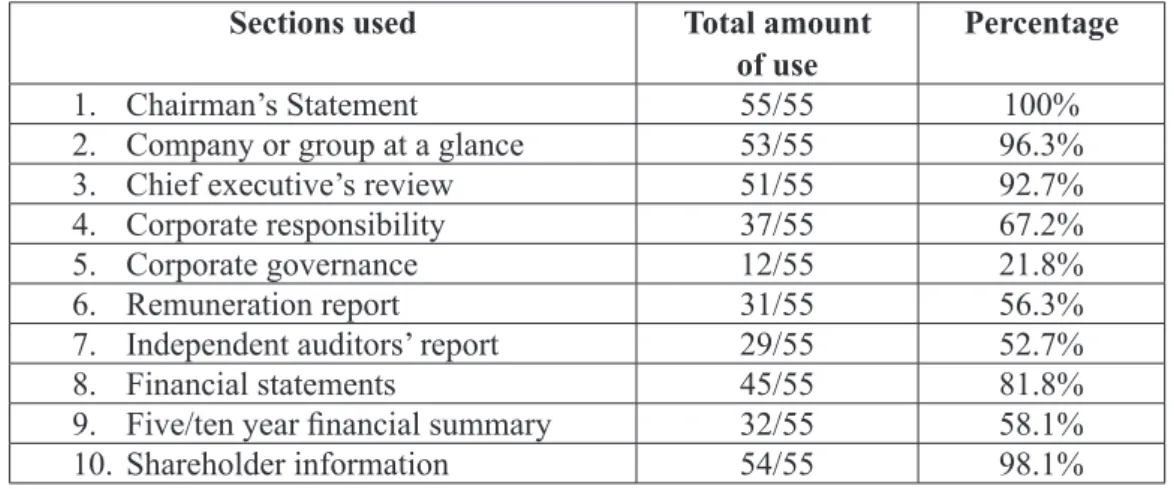
(10) These presentations should be given in front of a group of classmates, who act as prospective international investors, ready to invest their money in any company offering possible benefits; these classmates know the rules of the activity, as they will also have to perform a similar presentation. Each student is handed an AR, which is different to the one that any other colleague in the group has to work with. They have one week to design and rehearse the presentation before the final session. In the final session, those students who do not perform their own presentations take the role of international investors, analyzing the contents of their colleagues’ companies and deciding if they would place their money in the hands of that specific company. They are invited to give feedback to their peers, based on all the aspects commented above (structure, contents, interest of the company, delivery). We have an average of 18/20 students per year, so we use three 120-minute sessions to listen to all the presentations, analyzing them and offering feedback to the students. This activity has been performed every single year since we implemented the master, over a decade ago, implying that around 200 students have already benefited from it. All the sessions are video-recorded, as teachers can then watch the presentations again, evaluating if all the information highlighted in the presentation really does appear in the annual report the students have had to work with. Final marks are also based on the accuracy of the information given to the actual situation of the firm as stated in the annual report. Apart from working on presentation techniques, a key part of many of our business English courses, an important aim of this activity is to observe how students go through a specific set of features, extracting positive aspects and minimizing negative ones. Needless to say, at the end of each presentation other colleagues ask questions that need clarification, and the presenters are only allowed to tell the truth. They have to be quick to analyze how to offer an answer to the questions in a positive way, even when some classmates are trying to find out negative aspects of the firm’s economic results, especially during these past years. This Q&A time can be used in order to complete information that had to be left apart, due to the time allocated for the activity. This final section marks the difference between those students who have simply chosen basic information to prepare their presentations and those who have carefully understood that some additional concepts can also be of interest for some members of the audience, preparing in advance some possible questions that can arise throughout their performance. After completing the activity, we paid attention to the amount of information taken from the ten different sections of the annual report commented above, trying to understand which sections offer more interest for our students. We focused on the three latest editions of the master (2012/13, 2013/14 and 2014/15), observing the use of each one of the sections of the annual report, bearing in mind that all ARs used in the classroom 95.
(11) have got these ten sections. The following table shows the use of data taken from these sections among the 55 recordings analyzed. Sections used 1. 2. 3. 4. 5. 6. 7. 8. 9. 10.. Chairman’s Statement Company or group at a glance Chief executive’s review Corporate responsibility Corporate governance Remuneration report Independent auditors’ report Financial statements Five/ten year financial summary Shareholder information. Total amount of use 55/55 53/55 51/55 37/55 12/55 31/55 29/55 45/55 32/55 54/55. Percentage 100% 96.3% 92.7% 67.2% 21.8% 56.3% 52.7% 81.8% 58.1% 98.1%. Table 1. Use of data taken from the different sections of the annual report Data suggest that the information used in presentations tends to be taken from some specific sections, such as the Chairman’s Statement, company or group at a glance, chief executive’s review, financial statements and shareholder information. On the contrary, not many students look at the corporate governance section, as they probably think that the information appearing there might not be of interest for a prospective stockholder. These data help us to understand what students take as the basis to persuade an interested person into becoming a stakeholder. 4.3 Activity 3. Highlighting the main information The third activity is based on the progression of the students in the previous two activities, and it relates to a relatively new concept of multimodality and the lately-evolving generic features of annual reports and chairman’s statements, mentioned above. Thus, our interest is not so much in the corporate website (which has been widely studied, as Garzone (2009) explains, and could be a further possibility to develop the annual report in the business communication classroom), but in the annual report, and more specifically, in the Chairman’s Statement. Students from the three different BE groups have completed the whole activity or part of it. This has two main functions. First, and in the case of the first two groups, to raise the students’ awareness regarding the evolution of the CS they have seen in the first activity, secondly, and mainly for the members of the third group, to analyze oral communication skills that they had developed in the second activity. Only the most advanced students, namely the group belonging to the master’s 96.
(12) degree, can fully develop this third activity by preparing a final project, also involving the subject on new technologies, as explained below. The first part of the task follows the path established in the previous analysis. This time students do not work with the printed CS, but analyze the online or digital versions of the AR, paying attention to the Chairman’s Statements. For that purpose, we have previously selected five samples of CSs accompanied by certain multimodal resources which may allow them to check the variety of possibilities multinational companies use to promote their annual reports:. webpage Type 1. company’s name: Repsol Features – single page devoted to the AR – heading: “Annual report 2014” – the chairperson’s picture and a quotation from him are included – links to AR and some of its sections are available – the Chairman’s Statement, called “Letter from the Chairman”, is linked webpage address: http://www.informeanual.repsol.com/memoria2014/en/informes.html webpage Type 2. company’s name: Renishaw Features – reports information included in “Reports, videos and presentations” subsection of the “Investors” section – in a further section called “Resources” a video called “Supplement to the Chairman’s Statement (Preliminary results 2013)” can be found – in this video clip, the chairman expands the written statement in the 2013 preliminary results, complementing the written text webpage address: http://resources.renishaw.com/en/details/Video3A20Supplement20to20the20Chairma n’s20statement205BPreliminary20results2020135D(49680) webpage Type 3. Features company’s name: Bankinter – Annual report’s section – video clip of Chairman literally uttering verbatim the “Letter from the Chairman” – video recorded in Spanish, though the Statement is also in English webpage address: https://webcorporativa.bankinter.com/www/webcorp/swf/memoria2013/en/letterfrom-the-chairman-video-ia.html. 97.
(13) webpage Type 4. Features company’s name: Goldman Sachs – section “Shareholder letter” within “2013 Annual Report” site – complete statement and a video clip of the CEO highlighting the main results from the AR webpage address: http://www.goldmansachs.com/s/2013annualreport/shareholder-letter/ webpage Type 5. Features company’s name: Walmart’s – information on ARs found in “Investors” section – within “Annual Reports and proxies”, the “2014 Annual Report PDF” link can be found followed by another label called “2014 Enhanced Digital Annual Report” – this last link leads to a complete multimodal annual report, containing the different sections of this type of documents, including the letter to shareholders accompanied by a message from the CEO, in which he states the main ideas appearing in the letter but also in the annual report, combining his image and some images from the company webpage address: http://www.corporatereport.com/walmart/2014/ar/ Table 2. Types of webpages showing a variety of Chairman’s Statements All in all, those five examples show several ways of promoting the letter from the chairman and all of them can be considered as multimodal, integrating different modes of expressing the message and combining them in different ways. Students analyze those examples and, based on their previous knowledge, they establish a kind of taxonomy on the five ways of presenting the CS and the structure of those that include a video. Then, students try to find out the main ideas chairmen include in their video-recordings by comparing them to the written version of the Chairman’s Statements. Likewise, they also analyze the delivery of the presentations, according to the knowledge acquired in the second activity. All this makes them aware of the relevance of the data enhanced in the video and, by applying their critical analysis, they decide whether the information is the most appropriate option or if the speakers’ performance is the most convincing one. Finally, but only for those in the advanced master’s level, students are required to create or simulate a multimodal setting of a fictitious annual report, focusing mainly on the Chairman’s Statement (written and oral versions). This final project was carried out by 22 students during the 2014/15 course, working in small groups of 4 and 5 students, and was implemented in combination with the subject “New Technologies”. That subject gives them information on websites’ creation and on the inclusion of multimodal resources. Students have two weeks, after having completed the previous activities and 98.
(14) analyses, to prepare a website including a written version of the CS, some multimedia resources about the company, and a video where the CEO speaks about the contents of the previous year annual report. Once the activity is finished, students are delivered a short online questionnaire to answer a few questions about their project work and its usefulness. Among last year’s students, 86.36% were happy about the final results, although most of them (81.82%) think the activity requires more time. In their opinion, they agreed that, by having completed the previous activities, the third task was easier to develop (90.91%). All of them enjoyed the idea of combining their knowledge of more than one subject to do a project and the fact that grades could partly be used in order to evaluate both subjects. Similarly, all agreed that all the activities made them improve their knowledge on presentation skills, the use of the language of promotion, and the idea that the CEO is a key image in order to promote the company to current and prospective shareholders. 5 Conclusions This paper has tried to show the relevance authentic material has in setting where the English language is taught, but especially in the English for business purposes environment. Companies need updated and well-informed employees who know the communication features of the business discourse. An excellent way of teaching this discourse in higher education is by means of using available material which can give an overview of the language students will need in their future career. Annual reports, and more particularly the Chairman’s Statements, seem to be good genres to include in the classroom and use them as example of available business discourse. The use of authentic materials allows the students to understand better what they will find in their prospective professional environments. The multimodal approach that we have undertaken has allowed different groups of students to construct meanings from specific discourse processes. In turn, they have been able to integrate different semiotic resources with the aim of communicating information appropriately. They have been aware of the importance of using visual devices, body language, gestures, and space accurately. The three activities that we have summarized above are just an example of this multimodal, genre-based approach that is followed in our sessions, devised to help our students understand the way that authentic materials are designed by many companies in order to communicate information to customers, stockholders and the media. These activities also allow our students to understand that successful communication in business settings implies sharing information in order to get a result, an objective, and the whole message should be based on the development of the adequate structure to achieve that goal. Multimodal texts allow students to have the 99.
(15) chance of using linguistic, visual and audio modes in order to experience, conceptualize, analyze and apply meaning. Genre-based approaches facilitate our students to understand how those objectives can be fulfilled. Businesses rely on communication and, nowadays, professionals are trained to avoid sending wrong messages to suppliers, employees or customers. If the message is not transmitted accurately, there is little hope of success. Through the previous sections, we have tried to show how students may learn about the language used in a business setting by means of knowing the annual reports and the Chairman’s Statements, dealing with presentations from the information included in those genres, and learning from the way CEOs promote the information of ARs through video-recordings complementing the CS. All in all, authentic material can be more motivating for students to follow the classes better, but also to improve their knowledge on the written and spoken discourse of business communication. Acknowledgements This study has been developed as part of some research projects: Universitat Jaume I Grant No. P1·1A2005-10, Generalitat Valenciana Grant No. GV05/116, and the Ministry of Science and Innovation of Spain Grant No. FFI2011-24269. References AICPA – American Institute of Certified Public Accountants. 1994. Improving business reporting – A customer focus: meeting the information needs of investors and creditors. Comprehensive report of the special committee on financial reporting (The Jenkins Report). New York: American Institute of Certified Public Accountants. Allwright, Richard. 1979. Language learning through communication practice. The communicative approach to language teaching. Christopher J. Brumfit & Keith Johnson, eds. Oxford: Oxford University Press. 167–182. Backcock, Richard D., Bertha Du-Babcock. 2001. Language-based communication zones in international business communication. Journal of Business Communication 38, 372–412. Bhowmik, Subrata K. 2015. World Englishes and English language teaching: A pragmatic and humanistic approach. Colombian Applied Linguistics Journal 17, 142–157. Breen, Michael P. 1985. Authenticity in the language classroom. Applied Linguistics 6, 60–70. Carter, Ronald, Rebecca Hughes, Michael McCarthy. 2011. Telling tails: Grammar, the spoken language and materials development. Materials development in language teaching. Brian Tomlinson, ed. Cambridge: Cambridge University Press. 78–99. 100.
(16) Clarke, David F. 1990. Communicative theory and its influence on materials production. Language Teaching 25, 73–86. Cook, Vivian. 1981. Using authentic materials in the classroom. Modern English Teacher 9, 3–7. Crystal, David. 1997. English as a global language. Cambridge: Cambridge University Press. Czinkota, Michael R., Iikka A. Ronkainen, Michael H. Moffett. 2009. Fundamentals of international business. Bronxville: Wessex Press. de Groot, Elisabeth B., Hubert Korzilius, Catherine Nickerson, Marinel Gerritsen. 2006. A corpus analysis of text themes and photographic themes in managerial forewords of Dutch-English and British annual general reports. IEEE Transactions on Professional Communication 49, 217–235. Donovan, M. Suzanne, John D. Bransford, James W. Pellegrino. 1999. How people learn: Bridging research and practice. Washington: National Academy Press. Embong, Abdul M., Muhammad R. T. L. Abdullah, Raja A. I. R. Yaacob, Azelin M. Noor, Azrai Abdullah. 2011. The sustainability of utilizing the authentic materials in the English classroom: From the perspective of the theory of learning. International Journal of Basic and Applied Sciences 11, 132–134. Fortanet, Inmaculada. 2009. La estructura de la memoria anual en inglés [The structure of the annual report in English]. La Memoria Anual: Información y Promoción en la Nueva Empresa Internacional [The annual report: Information and promotion in the new international venture]. Juan C. Palmer-Silveira, ed. Castellón: Universitat Jaume I. 75–85. Fortanet-Gómez, Inmaculada, Belinda Crawford Camiciottoli. 2015. Introduction. Multimodal analysis in academic settings. From research to teaching. Belinda Crawford Camiciottoli & Inmaculada Fortanet-Gómez, eds. New York and London: Routledge. 1–14. Freeman, David, Susan Holden. 1986. Authentic listening materials. Techniques of teaching. Susan Holden, ed. London: Modern English Publications. 67–69. García Laborda, Jesús. 2011. Revisiting materials for teaching languages for specific purposes. The Southeast Asian Journal of English Language Studies 17, 102–112. Garzone, Giuliana. 2009. Multimodal analysis. The handbook of business discourse. Francesca Bargiela-Chiappini, ed. Edinburg: Edinburg University Press. 155–165. Gayathridevi, K. Sri, R. Deepa. 2015. Effectiveness of a business communication course: Evidence from a business school in India. Business and Professional Communication Quarterly 78, 94–103. Gilmore, Alex. 2007. Authentic materials and authenticity in foreign language learning. Language Teaching 40, 97–118. Gilmore, Alex. 2011. “I prefer not text”: Developing Japanese learners’ communicative competence with authentic materials. Language Learning 61, 786–819. 101.
(17) Guariento, William, John Morley. 2001. Text and task authenticity in the EFL classroom. ELT Journal 55, 347–353. Gunnarsson, Britt L. 2000. Discourse, organizations and national cultures. Discourse Studies 21, 5–33. Herrington, Jan, Thomas C. Reeves, Ron Oliver. 2014. Authentic learning environments. Handbook of research on educational communications and technology. J. Michael Spector, M. David Merrill, Jan Elen & M.J. Bishop, eds. New York: Springer. 401–412. Jewitt, Carey. 2014. Different approaches to multimodality. The Routledge handbook of multimodal analysis. Carey Jewitt, ed., 2nd edition. London: Routledge. 28–39. Kameda, Naoki. 1996. Business communication toward transnationalism: The significance of cross-cultural business English and its role. Tokyo: Kindaibungeishai. Katz, Irvin R., Catherine Haras, Carol Blaszcynski. 2010. Does business writing require information literacy? Business Communication Quarterly 73, 135–149. Kress, Gunther & Van Leeuwen, Theo. 2001 Multimodal discourse: The modes and media of contemporary communication. London: Arnold/Oxford University Press. Kumar, Dileep M., Vishal, Jain. 2010. Survival skills of business management graduates: A study with reference to retail and banking. Far East Journal of Psychology and Business 1, 49–77. Lentz, Arthur, Harvey Tschirgi. 1963. The ethical content of annual reports. The Journal of Business 36, 387–393. Little, David, David Singleton. 1991. Authentic texts, pedagogical grammar and language awareness in foreign language learning. Language awareness in the classroom. Carl James & Peter Garrett, eds. London: Longman. 123–132. Lord, Heather L. 2002. Annual reports: A literature review (1986-2001). Journal of Technical Writing and Communication 32, 367–389. Lund, Steven. 1992. Giving your courses a dose of reality. ELT Forum 3, 10–15. Maley, Alan. 2011. Squaring the circle – Reconciling materials as constraint with materials as empowerment. Materials development in language teaching. Brian Tomlinson, ed. Cambridge: Cambridge University Press. 379–402. Nealy, Chynette. 2005. Integrating soft skills through active learning in the management classroom. Journal of College Teaching and Learning 2, 1–6. Nickerson, Catherine. 2015. The death of the non-native speaker? English as a Lingua Franca in business communication: A research agenda. Language Teaching 48, 390–404. Nickerson, Catherine, Elizabeth de Groot. 2005. Dear shareholder, Dear stockholder, Dear stakeholder: The business letter genre in the annual general report. Genre variation in business letters. Paul Gillaerts & Maurizio Gotti, eds. Bern: Peter Lang. 325–346. Orlikowski, Wanda J., J. Debra Hofman. 1997. An improvisational model of change 102.
(18) management: The case of groupware technologies. Sloan Management Review 38, 11–21. Palmer-Silveira, Juan C. 2009. La creación de documentos informativos/promocionales [The creation of infrmative/promotional documents]. La Memoria Anual: Información y Promoción en la Nueva Empresa Internacional [The annual report: Information and promotion in the new international venture]. Juan C. PalmerSilveira, ed. Castellón: Universitat Jaume I. 63–68. Palmer-Silveira, Juan C., Miguel F. Ruiz-Garrido. 2007. Annual reports in the English for business communication classroom: Methodological perspectives. English for Specific Purposes: Studies for classroom development and implementation. Ana Bocanegra-Valle, María C. Lario de Oñate & Elena López-Torres, eds. Cádiz: Universidad de Cádiz. 149–171. Palmer-Silveira, Juan C., Miguel F. Ruiz-Garrido. 2014. Examining U.S. and Spanish annual reports: Crisis communication. Business and Professional Communication Quarterly 77, 409–425. Peacock, Matthew. 1997. The effect of authentic material on the motivation of EFL learners. English Language Teaching Journal 51, 144–156. Pullman, George. 2013. Persuasion: History, theory, practice. Indianapolis: Hackett. Skulstad, Aud S. 2002. Established and emerging business genres. Kristiansand: HoyskoleForlaget. Stanton, Patricia, John Stanton. 2002. Corporate annual reports: Research perspectives used. Accounting, Auditing and Accountability Journal 15, 478–500. Tamo, Daniela. 2009. The use of authentic materials in classrooms. Linguistic and Communicative Performance Journal 2, 74–78. Tang, Lu, Christine C. Gallagher, Bijie Bie. 2015. Corporate social responsibility communication through corporate websites: A comparison of leading corporations in the United States and China. International Journal of Business Communication 52, 205–227. Tomlinson, Brian. 2001. Materials development. The Cambridge guide to teaching English to speakers of other languages. Ronald Carter & David Nunan, eds. Cambridge: Cambridge University Press. 66–71. Walsh, M. 2010. Multimodal literacy: What does it mean for classroom practice? Australian Journal of Language and Literacy 33, 211–239. Widdowson, Henry. 1990. Aspects of language teaching. Oxford: Oxford University Press. Zhang, Zuocheng. 2013. Business English students learning to write for international business: What do international business practitioners have to say about their texts? English for Specific Purposes 32, 144–156. Įteikta 2015 m. birželio mėn. 103.
(19)
Figure
Documento similar
The aim of this paper is to demonstrate that reading authentic literary material in the English as a Foreign Language (EFL) classroom can improve students’ language learning skills as
Government policy varies between nations and this guidance sets out the need for balanced decision-making about ways of working, and the ongoing safety considerations
No obstante, como esta enfermedad afecta a cada persona de manera diferente, no todas las opciones de cuidado y tratamiento pueden ser apropiadas para cada individuo.. La forma
a) Name of the institution: DIRECCIÓN GENERAL DE ASUNTOS MARÍTIMOS DEL MINISTERIO DE LA DEFENSA NACIONAL. b) Description: La Dirección General de Asuntos Marítimos del Ministerio
In summary, at the end of the three days, we decided -together with these indigenous teachers- to produce effective didactic materials for learning indigenous language and
Unamuno hace mención a esta circunstancia en "La comunión de los solita- rios", breve ensayo en el que declara que las cartas más íntimas o entusiastas que ha recibido
The objective proposed for this work consists of analyzing the degree of importance of the environmental information published by the companies belonging to the electricity sector,
language gains in English according to the type of program they
