OLGA LUCIA CEDIEL GOMEZ SANDRA PATRICIA SANCHEZ MURILLO
In Partial Fulfillment
of the Requirements for the Bachelor in English as foreign language
A Research Project Presented to
THE PROGRAM OF B.A. IN TEACHING ENGLISH AS A FOREIGN LANGUAGE UNIVERSIDAD NACIONAL ABIERTA Y A DISTANCIA
SCHOOL OF EDUCATION FUSAGASUGÁ 2018
ABSTRACT
This descriptive-qualitative research project aimed to analyze the effect of using the mobile devices in the English teaching-learning process, with thirty students of tenth and eleventh
grades from Acción Comunal and Teodoro Aya schools in the Municipal of Fusagasugá. The methodology was developed in four phases, the first one was the application of an entrance test to know the English level, also, it was necessary to characterize the mobile devices that students had to start the project. In the second stage researchers identified the most suitable apps and/or online activities to be developed with the students. In the third stage, selected and/or designed applications or online activities were implemented. Phase four was the evaluation of the process. The data was analyzed through the descriptive statistics and the foundations of Grounded
Theory. The first enabled the teachers describe students’ English level at the beginning and at the end of the project; the last one allowed to identify patters in students’ development. The findings revealed that the mobile devices can work as an innovative strategy for English learning. The products of each one of the classes and the comparison of the tests showed their improvement and progress in their process.
ACKNOWLEDGMENTS
This project is primarily dedicated to god who gave us the opportunity to fulfill a dream, because without it life has no value; is to thank infinitely every moment lived, every moment that allowed us to share and learn from people who, although we did not know them, nor could we see the virtual context in which the collaborative work is carried out in UNAD, helped us in the training process.
Second, grateful to our beloved husbands Fernando and Sergio who were always giving us encouragement and absolute support, for loving us as we are and without a doubt and no less important to our beloved sons, Juan, Andrés, Daniela and Valery who are the guardians and column of our long days of work.
TABLE OF CONTENTS
ABSTRACT ... iii
ACKNOWLEDGMENTS ... iv
LIST OF TABLES ... vi
LIST OF FIGURES ... vii
INTRODUCTION ...8
Statement of the Problem ...12
General Objective ... 14
Specific Objectives ... 14
LITERATURE REVIEW ...15
METHODOLOGY ...22
Procedures of data analysis. ... 28
DISCUSSION ...45
CONCLUSION ...47
REFERENCES ...48
APPENDIX A: INSTRUMENTS ...50
APPENDIX B: NUMBER’S LESSON PLAN ...51
APPENDIX C: PICTURES’ ACTIVITIES ...53
APPENDIX D: FUN ACTIVITIES ...54
APPENDIX E: INTERACTION WITH MOBILE DEVICES ...55
LIST OF TABLES
LIST OF FIGURES
Figure 1 Implementation Of Mobile Devices In English Classes. --- 26
Figure 2 Pedagogical Implementation Stages --- 26
Figure 3 Self-Regulation Stage: Objectives --- 27
Figure 4 English Level--- 30
Figure 5 Core Category --- 33
Figure 6 English Activities Using Moodle “Mil Aulas” --- 36
Figure 7 Students Worked Autonomously --- 38
Figure 8 Motivation In English Classes --- 39
INTRODUCTION
Mobile learning or M-Learning is a tool of mobile technologies and web 2.0, in which the Internet is integrated with mobile devices, represented by cell phones, electronic diaries, tablets and any device that forms a wireless connectivity. According to the above, M-learning is an alternative that allows the use of tools that are useful for the development of pedagogical activities such as multimedia content, chat, mail, forums, and in general all types of files, both content on line and offline. In like manner, M-learning provides many advantages for students of English as a Foreign Language. One of them is the option to download certain applications and programs for teaching this language, which can help students improve their skills, as well as grammar and vocabulary. That is to say, the student, when using these applications, will be able to have a permanent and activated experience with the language, in the moment and place that he wishes; as well as having access to materials such as electronic books in various formats, to develop their language learning process.
However, the use of mobile devices in Acción Comunal and Teodoro Aya Villaveces, two public schools, consider them as mobile phones as a factor of distraction in school activities, since teachers and coordinators think according to the project carried out by (Cuellar y Pachón) which shows that the teachers and coordinators of the two institutions have a negative attitude regarding the use of mobile phones in the classroom, because they do not have adequate training for teaching by means of information and communication technologies, also taking into account the democratization of knowledge that must be taught by the teacher in charge and not by cell phones.
practical way collaborative learning, autonomy and self-regulation of students in language learning, this learning process actually contributes to improving the teaching practice, since it is an opportunity for the teacher to reconsider and reflect on the use of mobile devices so that they can support teaching-learning the foreign language.
The rationale for this strategy might be supported with the idea that “teachers should facilitate the understanding of the new learning and teaching mode” (Acero, 2012). That would help to change teacher’s attitude and to improve students’ motivation towards learning English. That is, setting up a learning environment where learners enjoy English practice using their smartphones and teachers become facilitators who foster interaction among students and their mobile devices.
This paper illustrates the influence of mobiles devices among a group 30 students with an A1 language level according to the common European Framework of Reference for Language (CEFR), one group from a “Teodoro Aya Villaveces” and the other from “Acción Comunal” This study is focused on the implementation of mobile devices as an appealing, motivating and successful strategy and how it influenced at the process and students’ self- management level.
This data was gathered by the qualitative instruments implemented, such as interviews, focus group, student survey, initial and final evaluation.
Significance of the Study
Information and Communication Technology (ICT) its wide relationship with education, especially the rise of mobile devices, give way to the knowledge society, so that as Carnerio, Toscano, & Díaz (2008) have stated "... the combined use of technology, multimedia and internet makes learning possible in practically any scenario (school, university, home, work, leisure spaces, etc.) "(p.104). Technology that allows a complete expansion of educational coverage, which is able to reach different places and populations, without taking into account distance or spatial barriers presented, taking advantage of mobile devices in different contexts and
specifically English.
Learning English in Colombia is at a very low level, according to a report in the Education First English Level Index (EF EPI 2016). To improve these indicators, the Ministry of National Education (2016) through the “Colombia Bilingüe” program seeks that "students reach a level of English that allows them to communicate, interact and share knowledge, so that they can
enhance their human and professional skills". For these reasons and in order to strengthen the English levels of the students of schools and especially to update the contemporary teaching-learning practices of this language, it is essential to link new technologies and especially mobile devices, oriented to promote autonomous learning, centered on formative self-management, through the use of media and mediations, supported by information technologies and
communications with the alternatives they allow, such as the reception and sending of messages that may well be photographic, written, oral texts, academic consultations and other possibilities, both in real time and asynchronous, that supports them in their learning process and practice in learning a language.
these devices can be used as allies according to, Fandos, Jiménez and González (2002) recognize that the potential has been ignored didactic of ICT in education, causing a stagnation in the innovation in areas such as evaluation and content organization, therefore it is essential to understand that educational innovation is important with the use of ICTs since incorporating technologies in the classroom, making a difference in the presentation of content, class exercises, favors the interaction of students and teachers by understanding that there are different practices that allow collaborative construction of what has been learned.
STATEMENT OF THE PROBLEM
Information and Communication Technology (ICT) and especially the rise of mobile devices, give way to the knowledge society, as such way as Carnerio, Toscano, & Díaz have stated "... the combined use of technology, multimedia and internet makes learning possible in practically any scenario (school, university, home, work, leisure spaces, etc.)" (2008, p. 114). This technology allows to expand the coverage education reaching larger population groups, through the removal of spatial barriers and temporary, taking advantage of mobile devices and the time spent in these applications to learning in generally and specifically English in virtually any cultural context.
Nowadays technological globalization allows access and use of mobile devices and language English in different activities of daily life both academic and professional impacting the way in which the company communicates, conducts banking transactions, studies, etc. Therefore, and according to the global trend, each subject carries some type of devices with the communication alternatives that allow: the reception and sending of messages that may be photographic, written texts, oral texts, queries academic and other possibilities, both in real time and asynchronous, that supports them in their process of learning and practice in the English language.
However, most people do not know how to take advantage of all the benefits offered by this type of technology thanks to the applications they offer. With regard to education, it is very common to see students of mobile devices connected to the most common social networks such as Facebook, Instagram and WhatsApp, which interact for non-academic purposes, when
the part of the teachers to implement it and also the students do not have knowledge of how to implement the mobile devices in their academic work.
The cell phone that is seen as a distractor can be a great help and strategy in learning English as a foreign language based on the development of technology and various educational applications to learn languages, these influence and force change the concept of traditional, rotational and repetitive education through new pedagogical strategies that require the most active participation of students, in contexts of communicative technologies, implementing ICT as tools that provide access to knowledge and interaction between peers, empowering subjects as producers and renovators of knowledge and not just as receivers or simple repeaters. From these perspectives and attending to the objectives that the Ministry of Education (2016) seeks in relationship to "students reach an English level that allows them to communicate, interact and share knowledge, so that they can potentiate their human and professional capacities ", is the thinking of new technologies, especially mobile devices, is essential to strengthen contemporary teaching-learning practices, aimed at fostering training, learning autonomous, focused on
formative self-management, through the use of media and mediations, and supported by Information technology and communications.
From these considerations arise the following research questions:
General Objective
To analyze the impact of using mobiles devices in the English teaching-learning process, with thirty students of tenth and eleventh grades of Acción Comunal and Teodoro Aya schools in Fusagasugá.
Specific Objectives
- To characterize the English level of 30 students who were in tenth and eleventh grades at Acción Comunal and Teodoro Aya Villaveces schools in Fusagasugá. - To define the applications or activities that can be carried out within English
classes and outside of them.
- To implement activities through mobile devices for English teaching-learning process with students of Acción Comunal and Teodoro Aya schools in
Fusagasugá.
CHAPTER 1
LITERATURE REVIEW State of the art
Nuez and Sánchez 2014) developed the project called Innovate to educate: use of mobile devices in the teaching and learning of English. The objective was to present a brief study of the problems in the Spanish educational system and motivate the use of mobile devices as agents that allow the use of different materials (ebooks, applications, webs ...) available in the network for its application. The result was that through the extraordinary advancement of mobile
technology it is possible to develop new forms of teaching and learning in formal and informal environments that motivate rethinking the teaching practice.
Pérez M. and Río Carmen (2017), through the project Mobile devices in the teaching / learning process. development and implementation of the «glossary» application, aim to create a methodology for the design and creation of specific materials for mobile devices. The use of mobile phones went beyond checking the glossary, since students also had to take a photograph of each of the selected works, and then upload to a telephone "Highest" of the unique virtual document; in that document they showed all the photos associated to the different items of the test. This collaborative work unit allowed to evaluate the learning, at the same time that
reinforced the acquisition of the concepts and technical terms through the system of peer review. The results obtained by the students in each of these phases were satisfactory. The analysis of the students' performance in the final test of the subject revealed that the learning situation showed be effective for learning bilingual technical terminology.
methodology proposing several activities that could be done from the cell phone with Internet access and follow up the activities from the Virtual Classroom Designed on the basis of the proposed methodology. It was carried out in Nuestra Señora de Fátima Educational School in the city of Riobamba, Ecuador; in an English class, with 40 students of 16 and 17 years old. The activities were developed taking into account the different applications and social networks that had more content in society such as YouTube, WhatsApp, Facebook. A meaningful and fruitful learning was achieved thanks to the existence of infrastructure, cellular technology, the social commitment and the decision to innovate in the way of teaching.
In Colombia, some institutions have been concerned with generating strategies where mobile devices can be implemented as allies of the process of teaching and learning languages and not as a distracting element. This is the case of Sánchez, Castañeda and Londoño (2016) who have their undergraduate thesis entitled Use of mobile applications for learning a foreign
language, which aimed to identify and determine the use of mobile devices for learning a foreign language. The results obtained allowed to determine that nowadays more and more people have access to smart mobile devices and with the same applications developed for this type of devices. Also, there are a large number of applications to learn foreign languages, but not all the four language skills can be developed simultaneously, so it is not possible to reach this type of applications or developments to replace the role of the teacher in the learning process.
classes. One of the difficulties found in the study, has to do with the way of evaluating the issues when using a mobile device, another difficulty found as the little preparation of users to use different programs to teach English.
M- Learning:
According to Brazuelo F. and Gallego D. (2011), Mobile Learning can be defined as the educational modality that facilitates the construction of knowledge, the resolution of learning problems and the development of skills or diverse abilities in an autonomous and ubiquitous way, thanks to the mediation of portable mobile devices. That is, m-learning goes beyond simply teaching in an online environment, this strategy allows students to participate in academic
activities virtually anywhere, which increases access to education and feedback almost in real time both on the part of teachers, as well as on their peers and fosters a collaborative and diversified learning environment for students.
time and even during the development of the classes, in order that the use of this device does not become a distractor.
Mobile devices
The development of m-learning in the classroom requires the use of so-called mobile devices. According to Baz, Ferreira, Alvarez and García (2008) this is "a small-sized device, with some processing capabilities, with permanent connection or intermittent to a network, with limited memory, that has been designed specifically for a function, but that can carry out other more general functions "(p.1) (translation made by the authors). According to this definition, various devices such as PDAs, mobile phones, smartphones, tablets, and others can be related. For this research, it is necessary that both students and teachers have smartphones because they have different functions and capacities that are necessary for the development of m-learning, because they will have to make reproductions, recordings, downloads and uploads, among other activities.
Mobile devices or smartphones allow a greater capacity to store data and perform activities similar to a computer and enable internet connectivity through WiFi and email better than a conventional mobile phone. In addition, they can be music players, photo and video cameras, etc. Also, it must be recognized that all smartphones allow the user to install programs or
applications in addition to those already installed by default, as well as the ability to read
Learning a second language
Formerly in the teaching-learning process of a language the teacher was considered as the sole owner of knowledge; he was the protagonist and who transmitted knowledge. Currently, it fulfills the function of guiding and improving the teaching-learning process of the English language, using countless strategies aimed at developing the communicative part of the student (Guevara, 2000). This, now also plays a more active role, aware and responsible for the level of development of language skills and they are the ones who should give greater initiative in the classroom (Ordorica, 2010).
Throughout the years, there have been several methods that have been developed for language learning which seek to achieve in the student a development of their communicative competence, that is, helping the student to have the ability to use the language they are learning. According to Luzón and Soria (n.d), with reference to the communicative method, they said that "it is not only that students acquire a certain linguistic system, but that they are able to use it to communicate adequately and effectively" (p. 42).
The Task-Based Approach is born from the Communicative method. This is based on the fulfillment of tasks, which according to Estaire (n.d): "Tasks as a linguistic unit in real life are defined as those activities for which we use language in our daily life" (p.1). That is to say, what this approach seeks in learning the English language, is to assign students activities and / or tasks related to everyday situations in their lives or people close to them
Use of devices in the teaching of Languages
the educational context if its effectiveness is positive in the field” (p. 123), with the foregoing it can be argued that the use of devices mobile for educational purposes does not stop, on the contrary, they are increasingly necessary, indispensable and of priority use, they are permanently updated and modified with more advanced technology.
The use of audiovisual material and applications through technology allows expanding the individual and group cognitive environment of learners building knowledge, providing new alternatives and advantages from the didactic in different areas and in the particular case of teaching a second language, since it lets the teacher generate new specific strategies to innovate when it comes to guiding a class. However, the benefit of using any mobile device will be favorable as long as the teacher guides the process towards a didactic and pedagogical purpose for learning English, where smartphones are mediators between the available and relevant content on the web and students. Therefore, if the objective of the teacher in the class is to promote the participation of students and the use of mobile devices, so that they strengthen their competences in learning a second language, the teacher will achieve that these elements become an effective mediator in the student learning process.
In the context of public schools, students usually have a low level of English
proficiency and are afraid to interact in this language; this is where the use of the devices plays an important role and becomes an effective instrument in the classroom, so that students go from being passive recipients of what they learn through books, or photocopies to be active
participants and have a device that is proper and of daily use. The necessary tools to manipulate, download, reuse various audiovisual resources that allow autonomous learning in an
In case of being introduced to the classroom, digital resources are often
considered as a divertimento to break with the traditional dynamics of the class due to the motivation and excitement that they awaken among the students, and not as a real didactic tool. (Duque, 2013)
Therefore, it is essential that the teacher involves mobile devices with a specific and pedagogical purpose, focused on language learning and the use of applications, multimedia and / or digital resources available on the web for this purpose and not only to distract the student or because it is a fashionable strategy; it is really going to be useful for the student to lose the fear of interacting in English, acquiring vocabulary, practicing listening exercises and grammar, they can also send audios recorded by themselves referring to a specific subject given by the teacher in class.
The application and mediation of ICT in the teaching of a foreign language.
The application of any digital medium or mobile device as stated above will be successful as long as the teacher puts a pedagogical purpose; the role of the teacher is essential to ensure that a mobile device is a mediator between knowledge and students. Gonzalo (2014) states that: “Regarding the role of the teacher, his responsibility is to facilitate communication among all those who participate in the activity proposed in the classroom, the student then becomes the protagonist of the class” (p.24). Therefore, if the objective of the class is to enhance the
participation of students, to strengthen their skills in learning a second language, the teacher must be conscious that a mobile device has to become an effective mediator in the students’ learning process.
teacher's duty to make their students know these devices and technology, according to Gómez (2009) "As teachers we must enable opportunities so that all our students, without exception, can access these media. The socialization of technological creations will produce a qualitative
change in our society" (p, 5).
CHAPTER 2
METHODOLOGY Context
This research study was conducted with a group of thirty students from two different public schools. The first group of fifteen students (A) belongs to Acción Comunal, and all of them are currently in tenth grade. Students from this school have had the opportunity to have classes with a native speaker who belong to “Colombia Bilingüe” program. The other group of fifteen students (B) is composed of eleventh grade students from another public school, named Teodoro Aya. All the students that participated, belong to a low social class. They started school at the elementary level; however, they began taking English classes in the sixth grade. The schools only have four hours of English instruction per week.
Regarding the characterization of both groups, it was established that their English
level do not fulfil A1 level according to the Common European Framework, based on a diagnosis test applied.
Method
provides researchers with valuable data to interpret and analyze the impact of the intervention on this group. Moreover, as argued by Nunan and Bailey (2009, p. 229), the value of this action research study, also relies on the fact that it allows the teacher- researchers to identify their teaching context´s problems, reflect critically on their own teaching practice, and bring about change. Also, it is carried out by current practitioners, it is collaboratively conducted, and it is aimed at developing improvement in the target educational conditions. These principles were achieved by following an order in which planning, acting, observing and rigorously reflecting were the main stages in the research process (Kemmis & MacTaggart,1992).
Instruments
Four instruments (questionnaire, semi-structured interview, field notes, diagnostic test, tasks) (See APPENDIX A) were used to gather and interpret the data obtained and collected from the intervention. All of them provided information on learning behaviors so the learners’ evolution could be effectively traced. Instruments brought the necessary support to analyze data regarding the effect of using cellphones in English classes.
Data triangulation procedures were used to increase the validity of the study. Firstly, questionnaire was used to enable the researcher to collect data in field settings. Secondly, semi-structured interviews were conducted to allow the researcher to elicit more information about the project from the students. Thirdly, observation, collected through field notes, allowed the
researcher to collect data from the students’ naturally occurring interactions. Fourthly, a
Data collection procedures
The study was developed according to the following stages: diagnostic test, instrument analysis, literature review of mobile learning and the use of mobile resources in teaching English, planning, lesson plan design, intervention, plan adjustment, implementation, including data collection stages in which data was collected and analyzed. Questionnaire and interview held, and teacher journals’ analysis supported the examination of using cellphones in the classes. Lastly, the data analysis and the reporting stage were developed.
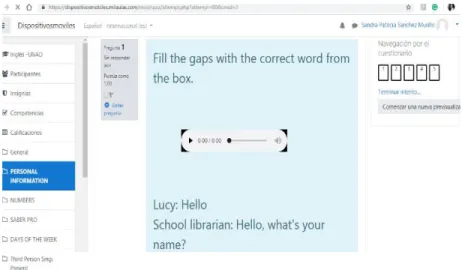
The researchers first identified using cellphones as the main area of the project. They formulated the research question according to the problem and the context of the participants, once the diagnostic test took place. This test was applied virtually through the Moodle platform “Mil Aulas” to know the students’ English level and a characterization of the mobile devices with which they have for the development of the project. Then, an identification of online applications and/or activities was carried out. The researches selected the most suitable
applications and resources to be done in classes according to availability, access and practice so that the student can work in a guided and independent way in the learning of the foreign
language through a rubric of check.
The duration of the intervention was four (4) months and its progress was monitored by sequential and progressive activities. As the intervention developed, the participants’ process was guided by the researchers (teachers) as they were collecting relevant data from their observation (in field notes). At this stage, researchers participated actively, guiding and
Finally, the students were interviewed to obtain information about the advances in their learning and to gain information about the effect of using mobile devices as a learning resource in English classes. The instruments used to gather the information were a survey, a semi– structured interview and their products in each one of the classes.
The semi–structured interview comprised ten questions. It was divided into two main topics, motivation beliefs and the advantages of using the mobile devices in an English class. The purpose of the survey was to obtain information about the effect of the intervention; thus it was read many times to identify salient information, and two teachers also validated the questions.
Pedagogical intervention
This study was supported by the implementation of a pedagogical intervention
which lasted sixteen weeks. They were three days, two hours each week. There was a total of ninety-six hours in which learners were assessed and monitored during the classes. Each session had a lesson plan which was designed according to the purpose of this study and each session (Appendix A). Each class of the course aimed to present one activity to be developed by students independently in approximately ninety minutes responding to the characteristics of M-learning.
Figure 1 Implementation of mobile devices in English classes.
This strategy was followed by the teachers- researchers in the design of each of the lesson plans (Appendix B) in order to outline how the activities would relate to the accomplishment of the objectives and to generate an effective plan to present instruction to the students (Gardner, 1985).
Blending face to face sessions and the mobile devices into the pedagogical implementation provided scaffolds to set a coherent model that evidenced improvement in students English level and allow researchers to analyze students´ statements to the self-management level after being involved in this learning process. The pedagogical implementation was divided in three stages: 1) diagnostic, 2) Self-regulation and 3) Using mobile devices in English class.
Figure 2 Pedagogical implementation stages Brainstorming
or warm up Practice Production Feedback
Pedagogical implementation
stages Self-regulation
The next figure illustrates the stages carried out in the pedagogical implementation. In the diagnostic stage, students answered a diagnostic test with the objective to determine learners´ English level. After implementing the diagnostic, the second stage of the pedagogical implementation was the Self-regulation which aimed to achieve four objectives described in the figure 3.
Figure 3 Self-regulation stage: Objectives
In the Self-regulation stage, students went throughout exploration and analysis opportunities to be aware of the different advantages they can experience if they have a conscious use of phone in the classes. This stage also helped them to know numerous applications and its activities to be done in an autonomous way through their phones.
Furthermore, students were introduced to a brief explanation about the usefulness of the strategy, the purpose, the process to be followed and some samples. The third stage responds to the
implementation of the mobile devices in the classes. At this stage, researchers used the following
Self regulation
stage:
Objectives
Guiding students to
become aware of the
use of mobiles in the
classes for academic
purposes.
Explaining students
the purpose and use
of mobiles in class.
Presenting students
stages: Brainstorming or Warm up, Practice, Production and Feedback. Also at this stage, researchers aimed a) to stimulate recall of prerequisite learning around the theme selected, b) to provide students some vocabulary by using stimulus material, c) to elicit the performance expected by presenting some audios, tests or readings, d) to give students practice, and e) to carry out a language and grammar analysis of some speaking samples with regard to identify functional lexicon and grammatical structures.
CHAPTER 3 Procedures of data analysis.
In this section, the teacher-researchers extracted qualitative evidence that was collected through two questionnaires: one initial and one final; comments, reflections of students taking into account their respective learning processes; a final survey and a focus group.
We used descriptive statistical data analysis techniques such as grounded theory, to make the patterns were identified by categories and then organized by groups. When the axial coding procedure was applied, the researchers read and analyzed the data again to identify the core category with respect to the research question and the objectives.
Data analysis
Descriptive statistic. It helped analyzing the qualitative data to summarize findings by describing general tendencies of the information. Such statistic is indispensable in this study because researchers aimed to measure the advance in the level of English of the students, evidencing through the cell phone in the English teaching-learning process.
The figure 4 represents in a general way the improvement that students had after
implementing the cell phone as a didactic resource. We must remember that the same test was performed at the beginning and end of the process; each skill was designed with a maximum score of 10 points where its respective analysis is the following:
Speaking: In the initial test was shown that students did not have enough communication skills to express ideas or make an oral discussion about a specific topic, so none of the students achieved or attempted to perform this test. At the final test the students improved their abilities for example the oral practices (role plays, conversations, games) in the classroom allowed them to have a great advance in this skill, thus obtaining the score in the final test.
Writing:
Grammar: Taking into account the common European Framework grammatical competence is the ability to understand and expressing meanings expressing and recognizing well-formed phrases and sentences according to these principles and the realization test can show that the students lack a good level, obtaining as a result, 3.63, but with the final test they could improve and demonstrate their progress through the development of classes, explanations, exercises, quizzes, with a final average of 7,1.
Reading: in reference with the common European framework students must have the ability to understand very short and simple texts, reading sentence by sentence, capturing names, words and basic phrases, and rereading when needed where it was evidenced by the first exam where students couldn’t understand texts, which contain frequent and everyday vocabulary. They started the classes with an average of 4,14, but in the course of the classes they were able to interpret short texts and have an understanding of what they had read, obtaining a final score of 7.3.
Listening: Audios were implemented according to the different levels of the Common European Framework, in that we managed to identify that they were not able to answer the questions formulated in the test the score was of 3,71 then they could understand an oral description about a situation, person, place or object, with an average of 5,4.
Grounded Theory. The second method considered in this research was the well-founded theory that allows the researcher to discover relevant patterns and trends in order to examine, analyze, categorize, and implement three coding procedures in grounded theory approach: open, axial and selective coding.
Open Code. Open coding, is the first level of conceptual analysis of data and is the process of breaking down, examining, comparing, conceptualizing and categorizing data. In this phase a list of indicators will be shown (see table 1) were presented considering the constructs that guide the research to conceive them as “conceptual elements of theory” (Glaser & Strauss in Bryant & Charmaz, 2007, p. 18).
Table 1
Indicators from the open coding phase.
Indicators
Collaborative learning
Identification of resources
Motivation Teacher’s roles
Use of cellphone
Self-regulation
Didactic
English Learning strategies
Strengthening skills
Responsibility
Commitment
Axial code. At this step, categories emerged from the first analysis open coding was compared, interconnected and analyzed to find out their relation and connection to understand what was happening in the study; thus, these new categories let teachers-researchers to
triangulate and validate and explore the relevance in the study itself.
Then the researchers started to organize into categories and sub- categories (see table 2). The two main categories that emerged were:
Table 2
Core category, catgories and subcategories.
Selective coding. At this final step the main category was built up after analyzing, connecting and validating the relation among the previous categories emerged from the axial
Research Question Categories Sub- categories
What are the effects of the incorporation of mobile devices in the process of learning English, in students of media education (Teodoro Aya Villaveces and IE Acción Comunal), in the municipality of Fusagasugá?
Self-regulation for building knowledge.
Autonomous-Learning
Motivation in class
Use of the mobile devices in English classes
Teacher’s role
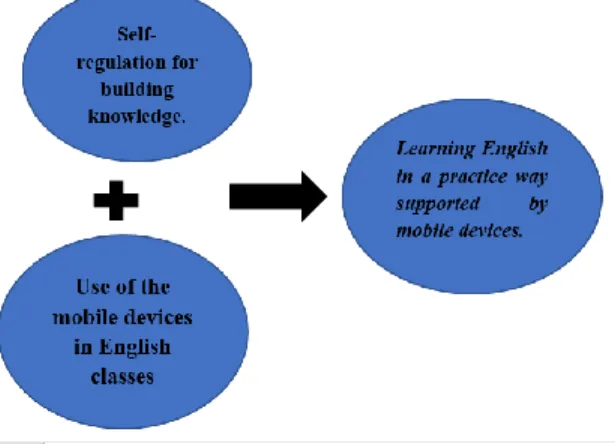
coding. The following figure (Figure 5) shows the core category emerged from the final
categories at the selective coding stage, named Learning English in a practice way supported by mobile devices.
Core category: Learning English in a practice way supported by mobile devices.
The participants in this research study presented difficulties in the development of their English skills and their low self-confidence the teachers to implemented activities and effective strategies of the using the mobile devices and the cooperative work to tackle the aforementioned problems.
Researchers constantly examined whether the strategy and the effects that the use of the m-learning in the English classes, helped learners to improve their skills through implementing practical activities for example; role plays, stop, broken phone, dialogues, (see Appendix C) taking into account the communicative approach.
Through the development of the activities, researchers realized that students had a very beginner level, it means, they had lack of basic vocabulary and some of them barely remembered
elemental grammatical structures. It is well known that there is a gap in the students’
commitment and attitude when learning since they have little motivation and lack of interest, due to the way of teaching implemented by the institutions. The following quote reflects the students’ comments about their schooling process:
“No hay tiempo suficiente para dedicar a cada estudiante” Student 2. “El docente siempre habla y no hay participación de los estudiantes” Student 3.
“Las clases se basan en solo escribir y buscar palabras desconocidas” Student 4.
On the other hand, the development of practical activities through the mobile devices gave students the opportunity to perform listening activities, send audios, work autonomously, as well as to develop skills to work in teams. The researchers observed by means of the experiences collected that student progressed and actively participated in all the activities planned to be developed in an out of the class (see Appendix D). In that way, the intervention strengthened the development of self-regulation aimed at learning the English language supported by mobile devices.
Categories
There are two main categories that emerged from the study “Self-regulation for
building knowledge” and “Use of the mobile devices in English classes” both of them will be explained as follows.
Category one. “Self-regulation for building knowledge”
each of the class sessions. The students had a self-assessment of their progress and could evaluate their effectiveness to continue learning and create a positive environment that allowed them to feel comfortable with each of the classes facilitating their learning.
Self-regulation in the students allowed to know interactive applications in which they developed autonomously activities related to English language learning, students were aware that the strategies taught by the teachers were of great help for their school life, an example of this is the use of the Moodle platform "Mil Aulas" tool that was used to reinforce thematic views, students in this same platform could practice as many times as necessary to obtain better results, one of the activities were the reinforcement tests know , they did not have limits of attempts for the same they had the opportunity to try and improve by themselves.
Students became active participants in each class and each work. Such a shift in focus empowered learners to learn with the methods that the teacher taught and to allowed to see the advance weekly.
Following this, students set their own goals to improve their skills, the activities were designed with the purpose that the student had the opportunity to work again and again or as many times as necessary, so that using the tools and applications that were taught during the project could advance autonomously, the audios had in their cell phones, therefore could work depending on the pace of learning of each.
The reactions of the students confirmed the usefulness of self-regulation in their learning processes, since it helps to recognize their abilities and be able to express them on their own.
“Yo puedo entender algunas cosas” student 15.
“No tengo miedo de pasar al tablero” Students 6.
“Me gustan mis clases de Inglés en la UNAD” Student 10.
“La forma de enseñar es diferente” Student. 17
Finally, an indicator for self-efficacy is related to the degree of engagement shown while learners fulfill a given task. Therefore, positive outcomes of task completion help students maintain a high rate of confidence in them. In this study, students reported that apart from their teachers also the given resources they can help to improve in all areas of knowledge.
Subcategory 1:Autonomous Learning
Autonomous learning attempts to address the educative problems with lack of time and individual approach limitations; however, it enables students to see the learning from a different perspective and to get involved in the learning process more actively.
In the face-to-face classes there was printed material, in which they found speaking and reading activities, to be developed in the class and guided by the teachers, the thematic was explained and in turn there were examples in which the students were involved. Through the WhatsApp group, audios and recordings were sent that complemented the printed activities, so each student had the option of having them in their hands and working at the pace they
considered appropriate, they could repeat again and again until they achieved the objective, being these activities generating autonomous learning.
In the final stage, students were surveyed where they were asked about the use of the cellphone in English classes on their own through an online platform to learn English, where 100% of the students answered in an accurate manner (see image 7). The students finished the process aware of the importance of acquiring the English language and the work that can be done for your own benefit and pleasure.
Subcategory 2: Motivation in class
The figure 8 shows the data extracted from subjects with regard to their perceptions and feelings towards motivation in English classes at the UNAD.
Figure 8 Motivation in English Classes
Comparing the motivation and interest from the first class and the final class of the students who participated, they said that they had started with little pleasure for the English classes, besides the low academic level that they had in the school of origin and that the lack of motivation that they had, brought negative aspects as a product, harming their learning of the English language. However, at the final stage a 100% percent of the participants recognized that the activities and the resources where useful in the learning process. That is why, teachers should be aware of students’ motivation and must design activities according to their interests and learning styles, in order teaching can be effective.
The use of mobile devices was a factor that helped to increase the motivation of the students since in them and in the activities they managed to understand a new way of acquiring knowledge, they saw more easily the development of the activities.
Richard-Amato (2003) quoted in Ebata (n. D) asserts "successful language learners they seem to have higher self-esteem than those who do not succeed. " Data found in students in the focal group that can corroborate these affirmations:
“El trabajo en grupo hace que confiemos en lo que hacemos y nos motiva a trabajar en las
actividades” Student 7. Focus Group.
“Las actividades y los juegos hacían de las clases divertidas y me motivaban a venir cada
“Uno aprende más fácil jugando y con actividades que le den confianza de hablar y
participar” Student 15 Focus Group.
Category two. “Use of the mobile devices in English classes”
The mobile devices as the main boom in our new apprentices, were the main element in the teaching of the second language in the students of the two schools, during the classes that were done in face to face form, the students were not constant with the cell phone, they took it to the meetings or used their parents', so we used this disadvantage as support for collaborative and cooperative work among them. It was shown that it was pleasant for the students to use their cell phones to inquire or help each other in their chores, it was didactic and the traditional class was changed to implement the use of ICT, in this case supporting us from m-learning, so much that the comments of the classes were:
"Las clases son diferentes" Student 2
"Que clases tan divertidas" Student 6
"Nunca pensé aprender Inglés así de fácil" Student 8
No readings were worked through cell phones since it is uncomfortable for students due to the size of the letter and the little didactic. It also showed the lack of commitment of students in terms of improving their learning process, since the tasks that were left were not carried out, finding that there are other priorities, such as school and recreation activities. However, interest was seen in the development of the classes and what was worked had a good product; but students are accustomed to work and to give for a numerical note in their institution, but not because they see the need to learn for life.
In the focus group (See appendix E) the students talked with the research faculty and guest lecturer about the use of mobile devices in school as a learning strategy, where several arguments were taken by the students:
“Es distractor y no se puede utilizar” student 20. Focus Group
“Se puede utilizar, pero con actividades que no den espacio para hacer otras cosas”
student 16. Focus Group
“si se podría implementar, pero el docente no puede estar pendiente de todos” student 27.
Focus Group
“Nos sirve para poder investigar o indagar más acerca de una materia” student 9. Focus
Group
“se puede utilizar de la misma manera en la que trabajamos ya que se aprendio y también
se pasaba el tiempo rápido... No sentíamos que se pasara el tiempo porque estabamos ocupados
y entretenidos”
Figure 9 Activities that allow the Cellphones
helpful and helped them to have a better level of English who entered, facilitating in the same way their academic work in the school.
Subcategory 1: Teacher’s roles
The teachers are guides for the class, that is why they are in charge of propitiating the strategies that allow the student to be motivated, have interest and the most important thing that they have the ability to learn without the need to attract attention.
The teacher sought, planned and investigated in activities that were consistent with the age and level of English of the students, therefore the teacher within the strategies and resources that met:
• The platform "Mil Aulas" through Moodle, where through this work were supported support activities to know, reinforcements to the topics seen in class, with the use of this platform students were motivated when working in the CEAD in person since it categorized the course offering the possibility of interacting in a virtual way as the university does as a negative aspect we find that the students did not carry out activities on their own.
• The use of games and activities were supported by the web, use of the dictionary, always taking into account the playful and didactic to have an innovative and productive class. (Appendix E)
• The WhatsApp, through this application sent class material and activities to be developed outside of it such as; audios such as listening exercises, images, recordings, explanations, and academic information related to the meetings.
The role he plays in the classroom and the aids he handles are really those that encourage a student or ultimately bore and discourage him to not only learn a language but any career.
Subcategory 2: Interaction student- cellphone and students-teachers.
The interaction of the students with the teachers and the cell phones during the
difficulties that were presented; well we know all the students do not possess the same qualities and characteristics to learn, the teachers were aware of that and for that reason the class
dynamics varied.
CHAPTER 5 DISCUSSION
It is evident that the results obtained during the fieldwork process in the Open and Distance University (UNAD) in the teaching and learning of English, through mobile devices, has managed to change the thinking of students, in a positive way and productive since they from the beginning of the class brought with them a level that did not reach a basic knowledge in the English foreign language, so it was consistently noted the acquisition of the language in a prolonged manner.
The present project of the motivation that it offers to the students when carrying out activities of the activities, is a parallel between the first class and the following classes, where it can be evidenced that it arrives with the intention of learning, of asking and going more here, with the motivation in teaching not only English, but can be implemented in the knowledge of tools for the benefit of students a more secure student.
This reason is given as the object of use and disposition of the cell phones, since its use has been adequately disclosed, since it is not only for the use of social networks or telephone calls or perhaps for the operation of a cell phone, hundred applications; if not on the contrary, it is an efficient and effective means for teachers and students, in the teaching of a second language.
CHAPTER 6 CONCLUSION
The general objective of this project was to analyze the impact of the incorporation of the Mobile Devices in the teaching-learning process in English, in the students of the Communal Municipal Education Institution and the Teodoro Aya Fusagasugá Municipal Technical Institution, which took accomplished through synchronous and asynchronous meetings that allowed a broad strengthening of the English language through mobile devices.
The use of mobile devices in the classroom, allowed the student to feel more comfortable in the realization of them, be more motivated and find in the mobile phone educational support with prior teacher planning, which implies an entertaining class, since mobile devices have been positioned to influence the teaching of English and our goal as teachers is to make their influence positive, through appropriate controls that promote teaching-learning strategies, expanding education and making the more active and participative student.
REFERENCES
Acero, C. (2012.). Facilitating collaborative language learning. Fostering self-directed learning.
General successful strategies for language learning. Retrieved from: http://generalsuccessfullearningstrategies.blogspot.com/
Adell & Castañeda (2010). Los Entornos Personales de Aprendizaje (PLEs): una nueva manera de entender el aprendizaje. En R. Roig Vila & M. Fiorucci (Eds.). Claves para la investigación en innovación y calidad educativas. La integración de las Tecnologías de la Información y la
Comunicación y la Interculturalidad en las aulas.
Baz, A. A., Ferreira, A. I., Álvarez R. M., García, R. (2008). Dispositivos móviles. Disponible en http://isa.uniovi.es/docencia/SIGC/pdf/telefonia_movil.pdf
Brazuelo, F. y Gallego, D. J. (2011). Mobile Learning. Los dispositivos móviles como recurso educativo. Sevilla: Editorial MAD, S.L
Duque, F. (2012). El uso de las Nuevas Tecnologías en el aula de inglés, Recovered from:
EF EPI. (2016). Índice del EF English Proficiency. Disponible en https://www.ef.com/__/~/media/centralefcom/epi/downloads/full-reports/v6/ef-epi-2016-spanish-euro.pdf
Fandos, Jiménez, & González. (2002). Estrategias didácticas en el uso de las tecnologías de la información y la comunicación. Acción Pedagógica, 11 (1) 28-39.
Gardner, R. C. (1985). Social psychology and second language learning: The role of attitudes and motivation. London, LN: Edward Arnold.
Gómez, M. (2009). El uso de los dispositivos móviles en la enseñanza y aprendizaje de una segunda lengua. Teaching and learning processes in technology-based higher education, pag. 5. González, O. (2016), Suplemento signos ead: El uso de los dispositivos móvil enseñanza aprendizaje
de una segunda lengua. recovered from:
https://p3.usal.edu.ar/index.php/supsignosead/article/view/3712
Guevara, J. (2000). La enseñanza del inglés en la era digital. Revista de Ciencias Humanas. https://core.ac.uk/download/pdf/150178656.pdf
Kemmis, S., & McTaggart, R. (1992). The action research planner. Geelong, VIC: Deakin
ried.utlp.edu.ec/images/pdfs/vol-2-2/ enfoque_comunitario.pdf. pag, 21
McQuiggan et al. (2015). Review of Mobile Learning Trends 2010-2015: A Meta-Analysis Ken Nee Chee1*, Noraffandy Yahaya1, Nor Hasniza Ibrahim1 and Mohamed Noor Hasan2 http://eprints.utm.my/id/eprint/76105/1/NoraffandyYahaya_ReviewofMobileLearningTrends201 0.pdf
Ministerio de Educación. (2011). Proyecto Raíces de Aprendizaje Móvil llega a Colombia gracias a convenio entre Mineducación y empresa privada.
Mishler, E. (1990). Validation in inquiry-guided research: The role of exemplars in narrative
Nuez, G., & Suárez, J. A. S. (2014). Innovar para educar: Uso de los dispositivos móviles en la enseñanza y aprendizaje
del inglés. Historia y Comunicación Social, 19 (Especial (enero).
Nunan, D. (1999). Second language teaching and learning. Boston, BS: Heinle & Heinle.
Ordorica, D. (2010). Motivación de los estudiantes universitarios para estudiar inglés como lengua extranjera. Lea. Revista Electrónica.
Pérez M. and Río Carmen (2017). Fundación Dialnet, Los dispositivos móviles en el proceso de enseñanza/aprendizaje. Desarrollo e implementación de l a aplicación «Glossary», Recovered from: https://dialnet.unirioja.es/servlet/articulo?codigo=6123759
Rodríguez, N. L., Vallejo, V.G., Proaño, B. F, Romero, R.H, Solís. L., Erazo, P.J., (2017).
Sánchez, Castañeda and Londoño (2016). Uso De Aplicaciones Móviles Para El Aprendizaje De Una Lengua Extranjera; Universidad De La Salle studies. Harvard Educational Review, 60 (4), 415- 442.
Unesco, (2013). United Nations Educational, Scientific and Cultural Organization Recovered from: https://www.un.org/youthenvoy/contact/. University Press.
Richard-Amato (2003) Motivation Factors in Language Learning Makiko Ebata,Digital Hollywood University (Tokyo, Japan)
APPENDIX B: NUMBER’S LESSON PLAN
LESSON PLAN FOR ONLINE SPEAKING LESSONS
Student Teacher’s Name: Sandra Patricia Sanchez Murillo Code:
CEAD/CCAV/CERES/UDR: Fusagasugá
Course: Date:
Topic: NUMBERS AND BASIC OPERATIONS Lesson Nr:
Objective(s):
Do mind operation use plus, minus, times and divide.
Use number for introduce personal information like ID number and Cellphone number.
ACTIVITY DESCRIPTION NG TIMI RESOURCES TEACHING
Previous Knowledge:
In this part the teacher will ask her students if they know about the subject and if they do, ask them to make a brief intervention.
10 minutes
Human resources
Presentation:
The teacher shows a link with the number and its pronunciation. The students should do there exercises that appear there (listening, speaking challenge, recognition).
The teacher will send an audio by WhatsApp with general numbers, they must listen and write the corresponding number. 20 minutes http://www.languagegui de.org/english/numbers/ Audio Practice:
In this space to practice the teacher along with students will play mental operations.
30 minutes
Human resources
Production:
LESSON PLAN FOR ONLINE SPEAKING LESSONS
Student Teacher’s Name: Sandra Patricia Sanchez Murillo Code:
CEAD/CCAV/CERES/UDR: Fusagasugá
Course: Date:
Topic: NUMBERS AND BASIC OPERATIONS Lesson Nr:
Objective(s):
Do mind operation use plus, minus, times and divide.
Use number for introduce personal information like ID number and Cellphone number.
ACTIVITY DESCRIPTION NG TIMI RESOURCES TEACHING
Assignment:
In this stage the teacher will ask their students their telephone numbers and their identification numbers.
The students will send to the teacher an audio by WhatsApp.
The students will listen an audio with telephone numbers and they have to write the numbers that they have listened.
None