1
The Conjugative Relaxase TrwC Promotes Integration of Foreign
1DNA in the Human Genome
23 4
Coral González-Prieto,a Richard Gabriel,b Christoph Dehio,c Manfred Schmidt,b 5
and Matxalen Llosa,a# 6
7
Instituto de Biomedicina y Biotecnología de Cantabria (UC-CSIC-SODERCAN), 8
Santander, Spaina; Department of Translational Oncology, National Center for Tumor 9
Diseases and German Cancer Research Center, Heidelberg, Germanyb, Focal Area 10
Infection Biology, Biozentrum, Universität Basel, Basel, Switzerland 11
12 13
Running head: TrwC promotes DNA integration in the human genome 14
15
# Address correspondence to Matxalen LLosa, [email protected]
16 17
2 ABSTRACT
18 19
Bacterial conjugation is a mechanism of horizontal DNA transfer. The relaxase 20
TrwC of the conjugative plasmid R388 cleaves one strand of the transferred DNA at the 21
oriT, covalently attaches to it and leads the ssDNA into the recipient cell. In addition,
22
TrwC catalyzes site-specific integration of the transferred DNA into its target sequence 23
present in the genome of the recipient bacterium. Here, we report the analysis of the 24
efficiency and specificity of the integrase activity of TrwC in human cells, using the 25
Type IV Secretion System of the human pathogen Bartonella henselae to introduce 26
relaxase-DNA complexes. When compared to Mob relaxase from plasmid pBGR1, we 27
found that TrwC mediated a 10-fold increase in the rate of plasmid DNA transfer to 28
human cells, and a 100-fold increase in the rate of chromosomal integration of the 29
transferred DNA. We used linear amplification-mediated PCR and plasmid rescue to 30
characterize the integration pattern in the human genome. DNA sequence analysis 31
revealed mostly reconstituted oriT sequences, indicating that TrwC is active and 32
recircularizes transferred DNA in human cells. One TrwC-mediated site-specific 33
integration event was detected, proving that TrwC is capable of mediating site-specific 34
integration in the human genome, albeit with very low efficiency compared to the rate 35
of random integration. Our results suggest that TrwC may stabilize the plasmid DNA 36
molecules in the nucleus of the human cell, probably by recircularization of the 37
transferred DNA strand. This stabilization would increase the opportunities for 38
integration of the DNA by the host machinery. 39
40 41
3 IMPORTANCE
42 43
Different biotechnological applications, including gene therapy strategies, 44
require permanent modification of target cells. Long-term expression is achieved 45
either by extrachromosomal persistence or by integration of the introduced DNA. Here 46
we study the utility of conjugative relaxase TrwC, a bacterial protein with site-specific 47
integrase activity in bacteria, as integrase in human cells. Although not efficient as site-48
specific integrase, we found that TrwC is active in human cells and promotes random 49
integration of the transferred DNA in the human genome, probably acting as a DNA 50
chaperone until it is integrated by host mechanisms. TrwC-DNA complexes can be 51
delivered to human cells through a Type IV Secretion System involved in pathogenesis. 52
Thus, TrwC could be used in vivo to transfer the DNA of interest into the appropriate 53
cell and promote its integration. If used in combination with a site-specific nuclease, it 54
could lead to site-specific integration of the incoming DNA by homologous 55
recombination. 56
57 58
4 INTRODUCTION
59 60
Bacterial conjugation is an efficient mechanism of horizontal DNA transfer 61
which confers bacteria an elevated level of genomic plasticity (1). DNA is transferred 62
by conjugation from a donor to a recipient bacterium through a protein complex 63
known as conjugative apparatus (2). In gram-negative bacteria, the conjugative 64
machinery is composed of three functional modules (3): i) the relaxosome, a complex 65
formed by the DNA to be transferred - in particular the site known as origin of transfer 66
(oriT) - and the proteins responsible for DNA processing, which include a relaxase and 67
one or more accessory proteins; ii) the Type IV Secretion System (T4SS), a multiprotein 68
complex organized in a transmembranal conduit that spans both inner and outer 69
membranes; and iii) the coupling protein (T4CP), a DNA-dependent ATPase which 70
brings together the two previous components and is believed to play a crucial role in 71
substrate selection. The translocated substrate is the relaxase covalently linked to the 72
transferred DNA strand. 73
R388 is a conjugative plasmid of broad host range that belongs to the IncW 74
incompatibility group (4). The 15 kb transfer region can be separated into an Mpf (for 75
Mating pair formation) region, which encodes the T4SS apparatus, and a Dtr (for DNA 76
transfer and replication) region encoding the T4CP and the relaxosome (5). The latter is 77
composed of an oriT of 330 bp length, the relaxase TrwC, and two accessory proteins, 78
the plasmid-encoded TrwA and the host-encoded integration host-factor (IHF) (6). 79
During conjugation, TrwC binds to the oriT, cleaves the DNA strand to be transferred at 80
the nic site, and makes a covalent bond with its 5´end (7). Then the relaxase-DNA 81
5 complex is recruited by the T4CP to the T4SS and transported to the recipient cell, 82
where TrwC catalyzes the recircularization of the transferred DNA strand (8, 9). 83
Apart from its role in conjugation, TrwC is able to catalyze site-specific 84
recombination between two oriT copies repeated in tandem (10). The reaction takes 85
place in the absence of conjugation, and thus in the absence of single stranded 86
intermediates, and is favored by the accessory protein TrwA. In contrast, IHF was 87
found to exert a negative regulatory role in TrwC-mediated recombination (11). It was 88
proposed that recombination takes place thanks to the single-stranded endonuclease 89
activity of TrwC coupled to the replication machinery of the host cell (10). 90
Once transferred to the recipient cell during conjugation, TrwC can also 91
catalyze site-specific integration of the transferred DNA strand into an oriT-containing 92
plasmid in the recipient cells (8). In this case, both TrwA and IHF act as enhancers of 93
the reaction. Integration also occurs when the acceptor oriT was located in the 94
chromosomal DNA of the recipient cell (12). A minimal oriT core sequence of 17 bp is 95
enough for TrwC to achieve integration. Two human sequences with one single 96
mismatch to that minimal oriT were tested as acceptors for TrwC-mediated integration 97
and found to be functional with an efficiency only 2-3 times lower than that obtained 98
with the wild-type minimal oriT, indicating that TrwC can act on DNA sequences 99
present in the human genome (12). 100
In addition to the T4SS involved in conjugative DNA transfer, there is another 101
family of T4SS implicated in the secretion of effector proteins during the infection 102
process of several mammalian and plant pathogens (13). Substrate recruitment by 103
T4SS relies on secretion signals present in the protein substrate, and there are several 104
examples of heterologous protein translocation by T4SS upon addition of secretion 105
6 signals. In particular, conjugative relaxases can be translocated into eukaryotic cells 106
through T4SS of bacterial pathogens, either unmodified due to some similarity in their 107
C-termini with the secretion signal of the specific T4SS - as reported for translocation 108
of MobA of plasmid RSF1010 by the VirB T4SS of Agrobacterium tumefaciens (14) -, or 109
upon addition of the corresponding secretion signal, as done with TraA of plasmid 110
pATC58 and the VirB/D4 T4SS of Bartonella henselae (15). Moreover, two different 111
reports have demonstrated that relaxase-DNA complexes from two conjugative 112
systems can be translocated into human cells through the VirB/D4 T4SS of B. henselae. 113
Those studies reported relaxase-mediated transfer of bacterial plasmids containing the 114
oriT and conjugative genes from Bartonella cryptic plasmid pBGR1 (16) or from
115
conjugative plasmid R388 (17). For both relaxases, the addition of a BID domain, the 116
translocation signal for the Bartonella VirB/D4 T4SS (15), increases DNA transfer (16, 117
18). These reports suggest that trans-kingdom DNA transfer may naturally occur during 118
bacterial infection of human cells. 119
T4SS-mediated DNA transfer to human cells may have biotechnological 120
applications as a tool for in vivo DNA delivery into specific human cells (19). A main 121
concern in genetic modification protocols is the fate of the introduced foreign DNA in 122
the cells. Schröder and co-workers found that the relaxase-driven DNA integrated into 123
the human genome at low frequency, and characterized several integration sites 124
demonstrating that pBGR1 Mob relaxase can protect the 5´end of the mobilizable 125
plasmid, but no preference for specific integration sites could be identified, suggesting 126
random integration of the incoming DNA (16). 127
In contrast to Mob, TrwC has site-specific integrase activity in bacteria, 128
conferring added potential as a tool for genomic engineering (20). In this work, we 129
7 analyze TrwC integrase activity into human genomic DNA after the mobilization of 130
TrwC-DNA complexes from B. henselae. We show evidence that TrwC is active in the 131
human cell, although the efficiency of site-specific integration is negligible compared 132
to random integration. Interestingly, we find that TrwC promotes a 100-fold increase in 133
the efficiency of integration of the incoming DNA, suggesting it may be protecting DNA 134
from degradation; this feature could be combined with the action of a site-specific 135
nuclease for genomic engineering purposes. 136
137 138
8 MATERIALS AND METHODS
139 140
Bacterial strains and growth conditions. Escherichia coli strain D1210 (21) was 141
used for DNA manipulations, while strain β2163 (22) was used as donor for conjugative 142
matings to B. henselae. E. coli strains were grown at 37ºC in Luria-Bertani broth, 143
supplemented with agar for growth on plates. B. henselae strain RSE247 (23) was used 144
for the infection of human cells. B. henselae was grown on Columbia blood agar (CBA) 145
plates at 37°C under 5% CO2 atmosphere. For selection, antibiotics were added at the 146
indicated concentrations: ampicillin (Ap), 100 μg/ml; kanamycin monosulphate (Km), 147
50 μg/ml; streptomycin (Sm), 300 μg/ml (E. coli) or 100 μg/ml (B. henselae); 148
gentamicin sulphate (Gm), 10 μg/ml. When needed, media were supplemented with 149
diaminopimelic acid (DAP) at 0.3 mM. 150
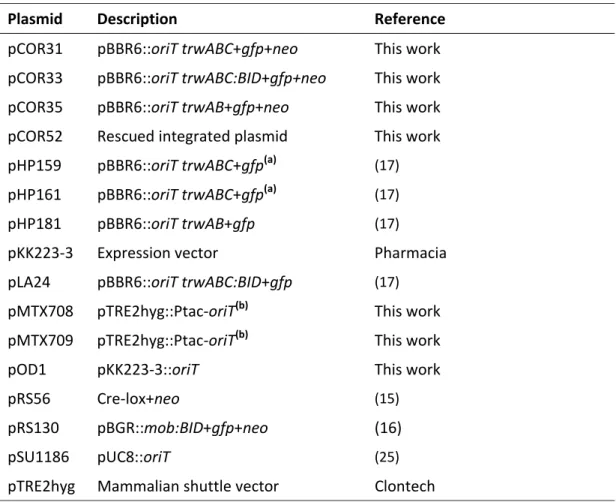
Plasmids. Bacterial plasmids are listed in Table 1. Plasmids were constructed 151
using standard methodological techniques (24). Primers used in plasmid constructions 152
are listed in Table 2. Plasmids pCOR31, 33, and 35 were constructed by cloning a 153
neomycin resistance cassette amplified from pRS56 with primers adding ClaI restriction 154
sites (Table 2) into the same site of pHP159, pLA24, and pHP181, respectively. Plasmids 155
pMTX708 and 709 were constructed by cloning a Ptac-oriT cassette into the NotI site of 156
pTRE2hyg vector, selecting both orientations; Ptac-oriT was amplified from plasmid 157
pOD1, which carries an EcoRI-HindIII fragment from pSU1186 (25) containing R388 oriT 158
into the same sites of expression vector pKK223-3 (Pharmacia). Restriction enzymes, 159
shrimp alkaline phosphatase, and T4 DNA ligase were purchased from Thermo-Fisher 160
Scientific. Kapa HiFi DNA polymerase was purchased from Kapa Biosystems. Plasmid 161
9 DNA was extracted using GenElute Plasmid Miniprep Kit (Sigma Aldrich). DNA
162
sequence of all cloned PCR fragments was determined. 163
Mating assays. Plasmids were routinely introduced in B. henselae by 164
conjugation. E. coli donor strain was grown in LB to stationary phase. 200 μl were 165
collected for each mating and resuspended in 1 ml of PBS. Recipient B. henselae was 166
grown in CBA plates for 3-4 days. After that time, bacteria from half of the plate were 167
collected with a cotton swab and resuspended in 1 ml of PBS. Both donor and recipient 168
aliquots were centrifuged, pellets were resuspended in 20 μl of PBS, mixed, and the 169
mixture was placed on a cellulose acetate filter on a CBA plate supplemented with 170
DAP. The mating plate was incubated at 37ºC in a 5 % CO2 atmosphere during 6 h. 171
Transconjugants were selected by recovering the mating mixture and streaking it on a 172
CBA plate with appropriate antibiotics. The plate was incubated for 6-9 days at 37ºC in 173
a 5 % CO2 atmosphere. 174
Cell lines and growth conditions. Human cell lines used in this work were 175
immortalized hybridoma EA.hy926 (ATCC CRL-2922), a fusion cell line of human 176
umbilical vein endothelial cells (HUVEC) and adenocarcinomic human alveolar basal 177
epithelial cells (A549), and HeLa (ATCC CCL-2), epithelial cells of cervix 178
adenocarcinoma. HeLa cells containing an integrated copy of the R388 oriT were 179
created by transfection of plasmids pMTX708/9 (Table 1) and selection of stable 180
transfectants as explained in the next section. 181
Cell lines were routinely grown in DMEM medium (Lonza) supplemented with 182
FBS 10 % (Lonza) at 37ºC under 5 % CO2. When indicated, antibiotics were added to 183
the medium at the following concentrations: G418 disulfate salt (Sigma Aldrich), 500 184
μg/ml; hygromycin B (Invitrogen), 80 μg/ml; penicillin-streptomycin 1 % (Lonza). 185
10 Transfections. HeLa cells were transfected with the cationic JetPei transfection 186
reagent (Polyplus Transfection). The amounts of DNA and JetPei reagent were adjusted 187
depending on the cell culture format used, following the manufacturer´s instructions. 188
DNA was quantified using a Nano-Drop Spectrophotometer ND-1000 (Thermo 189
Scientific). To generate stably transfected cell lines, HeLa cells were allowed to grow 190
and to express the drug resistance gene under non-selective conditions for 24-48 191
hours after transfection. Then, cells were cultivated in standard medium 192
supplemented with the appropriate drug during 4-5 weeks, until outgrowth of 193
resistant cells. Medium was changed every 2-3 days to avoid loss of selection pressure. 194
To obtain the integration rate of transfected plasmid DNA, transfections were carried 195
out in 6-well plates. To transfect linearized DNA, plasmid DNA was digested with 196
Alw44I (Thermo Scientific) and purified with GeneJet Gel Extraction kit (Thermo 197
Scientific) prior to transfection. 198
Cell infections. B. henselae containing the appropriate plasmids were grown on 199
CBA plates for 3-4 days. Human cells were seeded the day before the infection. For 200
routine infections, cells were seeded in 6-well plates (80,000 cells per well) in 3 ml of 201
medium. When the purpose of the infection was to select human cells that had stably 202
acquired the plasmid transferred from B. henselae, infections were performed in 150 203
mm tissue culture dishes seeded with 1.2x10⁶cells in 20 ml of medium. 204
The day of infection, DMEM was replaced by M199 medium (Gibco) 205
supplemented with FBS 10 % and appropriate antibiotics to select for the B. henselae 206
strains to be added. The bacteria were recovered from the CBA plate and resuspended 207
in 1 ml of PBS. The number of bacteria was calculated considering that an OD600=1 208
corresponds to 109 bacteria/ml (26). Bacteria were added to the human cells to get a 209
11 multiplicity of infection (MOI) of 400. The mixture of human cells and bacteria was 210
incubated for 72 hours at 37ºC under 5 % CO2. 211
Detection of GFP-positive cells. At 72 hours post infection (hpi), infected cells 212
were washed with PBS, trypsinized, and analyzed by flow cytometry using a Cytomics 213
FC500 flow cytometer (Beckman Coulter). Uninfected cells were always used in parallel 214
to set the baseline for detection of GFP-positive cells 215
Selection of stable integration events. At 72 hpi, G418 disulfate salt (Sigma 216
Aldrich) was added to infected cells, and selection was maintained for 4-5 weeks. 217
Resistant colonies were counted on the plates. G418-resistant cell pools were collected 218
for further analysis of GFP expression and PCR analysis. Genomic high molecular 219
weight DNA was extracted using High Pure PCR Template Preparation Kit (Roche). 220
Linear amplification mediated PCR. Amplification of genomic integration sites 221
by linear amplification mediated PCR (LAM-PCR) was performed as described in (27). 222
Briefly, it consists of an initial linear amplification of genome-plasmid junctions with a 223
plasmid-specific primer. After synthesis of dsDNA, the PCR product is cut with a 224
restriction enzyme (BfaI or Tsp509I) and a linker cassette of known sequence is ligated. 225
Exponential PCR amplifications are then performed with plasmid- and linker-specific 226
primers. PCR-obtained bands are then analyzed by gel electrophoresis and high-227
throughput sequencing. Human genomic DNA from human blood (buffy coat; Roche) 228
was analyzed in parallel as negative control. 229
LAM-PCR template was genomic DNA from the G418-resistant pools. PCR 230
reactions were carried out using Taq DNA polymerase (Genaxxon Bioscience). HPLC-231
purified primers (Table 2) were designed using Primer3Plus software and ordered from 232
12 Eurofins Genomics. Details on the primers can be found in supplemental Materials 233
and Methods and Fig. S1. 234
High-throughput sequencing of LAM-PCR products. DNA sequence of purified 235
LAM-PCR products was determined using MiSeq Benchtop next generation sequencing 236
technology (Illumina). The appropriate volumes of different purified samples were 237
mixed together following the manufacturer´s recommendations. Primers used in the 238
second exponential amplification contained the adaptor sequences needed for the 239
sequencing reaction (PE-PCR 1.0 and 2.0, see Table 2). LAM-PCR products were 240
sequenced in both directions. From PE-PCR 1.0 (adaptor present in the primer 241
annealing to the plasmid sequence) 400 nt were sequenced, while only 50 nt were 242
sequenced from PE-PCR 2.0 (adaptor present in the primer annealing to the linker). 243
Information from PE-PCR 1.0 was used for sorting the sequences to the different 244
samples and integration site detection, while information obtained from PE-PCR 2.0 245
was used only for sorting. 246
Bioinformatic analysis to obtain the integration sites was performed by high-247
throughput insertion site analysis pipeline (HISAP) (28). Briefly, sequences were 248
trimmed by identification and removal of plasmid- and linker-specific sequences. 249
Genomic sequences were aligned to the human genome using stand-alone BLAT 250
(UCSC), using assembly GRCh37/hg19 as reference. Sequences with identities lower 251
than 95% were discarded. For each remaining sequence, the chromosome, the 252
integration site, and the nearest RefSeq protein-coding gene were recorded. 253
Detection of oriT-specific integration events by PCR. PCR reactions were 254
carried out using Kapa Taq Polymerase (Kapa Biosystems) following manufacturer´s 255
recommendations. 25 ng of plasmid DNA or 250 ng of genomic samples were used as 256
13 template. To detect the expected cointegrate molecule, primers NotI_Ptac and
257
Int_pCOR (Table 2) were used for initial amplification. A 1:50 dilution of the initial PCR 258
products served as template for the secondary PCR, carried out with primers 259
NotI_Ptac_2 and Int_pCOR_2 (Table 2), annealing approximately 80 bp closer to the 260
expected integration junction. Primers NotI_Ptac and NotI_oriT1 (Table 2) were used 261
to amplify the chromosomal Ptac-oriT cassette. 262
Recovery of Integrated Plasmids. 5 μg of genomic DNA from G418-resistant 263
cell pools were digested with XmaJI (Thermo-Fisher Scientific), which does not cleave 264
within the integrated plasmid. Digested DNA was treated with T4 DNA ligase at a DNA 265
concentration of 10 μg/ml, to favour self-ligation. The reaction was electroporated into 266
ElectroMAX DH10B E. coli cells (Thermo-Fisher Scientific). Plasmid DNA was extracted 267
from gentamicin-resistant E. coli transformants, and analyzed by PCR to narrow down 268
the region of the plasmid where the insert of human origin was located. Primers used 269
for PCR mapping reactions are shown in Table 2. The insert in plasmid pCOR52 was 270
sequenced with primers pCOR33_1641F and pCOR33_12445R (Table 2). 271
Statistical analysis. Unpaired student´s t-test was used to determine 272
statistically significant differences between the mean of at least 3 independent results 273
for each experiment when the data followed a normal distribution. Otherwise, a 274
Wilcoxon-rank-sum analysis was performed for each pair of compared data. 275
276 277
14 RESULTS
278 279
Construction of mobilizable plasmids and target cell lines. TrwC-DNA 280
complexes can be introduced in human cell lines through the T4SS of B. henselae. In 281
order to analyze the integration pattern of the transferred DNA upon Bartonella 282
infection of human cells, new mobilizable plasmids and cell lines were constructed. 283
The mobilizable plasmids previously used to test DNA transfer from B. henselae to 284
human cells (17) contained elements of the R388 Dtr region (oriT+trwABC), but not the 285
genes of the T4SS, and a eukaryotic gfp expression cassette. We added a neomycin 286
phosphotransferase eukaryotic expression cassette in order to be able to select for 287
stable chromosomal integration events. Plasmids were constructed coding for either 288
TrwC or TrwC:BID (TrwC with the secretion signal for Bartonella VirB/D4 T4SS fused to 289
its C terminus), and a negative control lacking trwC. Plasmid pRS130 (16) encoding 290
Mob:BID relaxase and its cognate oriT was always tested in parallel. 291
The cell lines used for Bartonella infections were EA.hy926 and HeLa. The 292
former is derived from fusion of A549 lung carcinoma cells with human vascular 293
endothelial cells, the latter representing the natural target for Bartonella, and is 294
efficiently infected by this bacterium (29). HeLa cells represent a cervix-derived 295
epithelial cells line that can be easily manipulated by cell biological and genetic 296
methods and infection by B. henselae was reported to occur with 50% efficiency (30). 297
We previously showed DNA transfer to EA.hy cells, but HeLa cells were not tested. 298
EA.hy926 and HeLa cells were tested in parallel in infections with B. henselae carrying 299
either pHP161 (oriT+trwABC) or pHP181 (oriT+trwAB). DNA transfer efficiency was 300
15 lower when using HeLa than when using EA.hy926 cells, but it can be detected robustly 301
in both cell lines (Fig. 1). 302
In order to compare frequencies of TrwC-mediated integration into natural 303
sequences of the human genome with integration when the TrwC target is present in 304
the recipient cell genome, a cell line containing a full length wild-type oriT was 305
constructed. We transfected both EA.hy926 and HeLa cells with plasmids pMTX708 306
and pMTX709 (Table 1), carrying a hygromycin-resistance gene and the R388 oriT in 307
both orientations. Both plasmids were used to avoid any bias due to eukaryotic 308
promoters present in the vector, since transcription through the oriT has been shown 309
to affect TrwC-mediated recombination (11), and so it could affect integration. Around 310
100 hygromycin-resistant colonies were obtained in transfections of HeLa cells, while 311
no transfectants appeared for EA.hy926 in spite of several attempts with up to 5 μg of 312
plasmid DNA. Consistent with this finding EA.hy926 cell line has been previously 313
reported to be difficult to transfect (30, 31). 314
The hygromycin-resistant HeLa colonies obtained were pooled together to 315
establish a polyclonal HeLa::oriT cell line, in which the oriT is expected to be located in 316
different chromosomal locations and in the two possible orientations with respect to 317
the vector promoter. In this way, we avoid selecting a single clone in which the oriT 318
copy may lie in a chromosomal region that could affect integration of the mobilizable 319
plasmid. The presence of the oriT was tested by PCR on genomic DNA samples from 320
HeLa and HeLa::oriT cells using primers oriT1 and oriT330 (Table 2).Only one band 321
corresponding to the oriT was present in the sample obtained from HeLa::oriT cells, 322
while no amplification was detected in the sample obtained from unmodified cells (Fig. 323
S2). 324
16 Transient and permanent expression of transferred DNA in human cells. In 325
order to measure transfer and integration rates of DNA molecules led by different 326
relaxases into human cells, gfp and neo-resistance gene expression were measured 327
respectively, as outlined in Fig. 2a. EA.hy926, HeLa and HeLa::oriT cell lines were 328
infected with B. henselae carrying pCOR31 (trwC), pCOR33 (trwC:BID), pCOR35 (ΔtrwC)
329
or pRS130 (mob:BID) mobilizable plasmids. Results are shown in Fig. 2 and Table S2. 330
Three days post infection, gfp expression was measured by flow cytometry (Fig. 2b). 331
DNA transfer occurred to the three different cell lines when a relaxase (TrwC, 332
TrwC:BID, or Mob:BID) was coded in the plasmid, while no DNA transfer was detected 333
when there was no relaxase. The transfer efficiency is higher when using EA.hy926 as 334
host cell, as previously shown (Fig. 1). No significant differences were found in DNA 335
transfer between HeLa and HeLa::oriT cell lines, as expected. In all cell lines, DNA 336
transfer rate was significantly lower when using Mob:BID relaxase compared to TrwC 337
or TrwC:BID. 338
Integration events of the transferred plasmids into the human genome were 339
selected by antibiotic treatment with G418. The drug was added at 72 hpi and 340
selection was maintained for 4-5 weeks. The resistant colonies obtained for each 341
experimental condition were counted and then pooled together. High molecular 342
weight genomic DNA preparations were analyzed by PCR for the presence of trwA and 343
trwC to confirm the presence of the integrated plasmid (Fig. S3). The resistant cell
344
pools were also analyzed by flow cytometry to detect GFP expression as another 345
evidence of integration of the mobilizable plasmids (Fig. S4). 346
Fig. 2c shows the number of resistant colonies obtained after the antibiotic 347
treatment, normalized to the number of cells at the beginning of the experiment. It 348
17 was lower when using EA.hy926 than when using HeLa cells, despite the fact that DNA 349
transfer was up to 10-fold higher with EA.hy926. For all cell lines, no resistant colonies 350
were found when using ΔtrwC plasmid, in concordance with the flow cytometry
351
results, which showed no DNA transfer in the absence of relaxase. When plasmids 352
coded for a relaxase, resistant colonies appeared, but at drastically different rates. 353
Thousands of resistant colonies were obtained in each experiment after mobilization 354
of trwC- and trwC:BID-carrying plasmids, while only up to 100 resistant colonies were 355
found in infections with B. henselae carrying the plasmid coding for Mob:BID (see 356
Table S2). 357
Fig. 2d shows the ratio between NeoR colonies and GFP+ cells, which gives the 358
integration rate, i.e. the proportion of cells receiving the DNA in the nucleus which 359
integrate this DNA into the chromosome. For each cell line, no significant differences 360
were found in the integration rate of TrwC or TrwC:BID plasmids, as expected. No 361
significant differences were found either in the integration rate of each plasmid in 362
HeLa and HeLa::oriT cells. The integration rate was higher than 1 in 20 when the 363
transferred DNA was led by TrwC or TrwC:BID, while it was around 1 in 250 in the case 364
of Mob:BID-driven DNA (Table S2). 365
With the purpose of having a parallel control of random integration, HeLa and 366
HeLa::oriT cells were transfected with plasmid pCOR35 (ΔtrwC). Transient vs. stable
367
expression was determined as outlined before. After transfection of plasmid DNA, we 368
obtained an integration rate of around 1 in 800 when transfecting supercoiled DNA 369
and of close to 1 in 300 when transfecting linearized DNA (Table S2), which is in the 370
range of aour data obtained for Mob-BID. Antibiotic resistant colonies were pooled 371
18 together and analyzed in parallel with those obtained after relaxase-mediated
372
mobilization of plasmid DNA, to compare both plasmid integration patterns. 373
Characterization of genomic integration sites. Relaxases transfer the DNA 374
strand covalently linked to a site known as the nic site. In the case of Mob-led DNA, it 375
has been suggested that the relaxase protects the 5´end of this DNA (16). In addition, 376
we know that TrwC acts as a site-specific integrase of the transferred DNA into the 377
genome of recipient bacteria (12), and we observed enhanced integration rate of 378
TrwC-led DNA. Taking together these evidences, we decided to search for integration 379
events occurring at the nic site of the R388 oriT. For this purpose, we used linear 380
amplification-mediated PCR (LAM-PCR) (32, 33) using a primer annealing close to the 381
nic site, as explained in Fig. S1. This strategy would not detect insertions into the
full-382
length oriT copy of HeLa::oriT, as integration would result in a reconstituted oriT, but it 383
would allow the identification of integration events in other chromosomal locations, 384
and comparison with the integration pattern obtained when the oriT is not present in 385
the genome to be modified. 386
LAM-PCR was performed as explained in Materials and Methods and 387
supplemental Material and Methods sections. Genomic DNA was extracted from pools 388
of several thousands of resistant colonies obtained after mobilization of trwC- or 389
trwC:BID-coding plasmids, and this DNA was used as template for the PCR reactions.
390
Genomic DNA was also extracted from resistant colonies obtained by transfection of 391
plasmids pCOR31 (trwC) and pCOR33 (trwC:BID), which are expected to have a random 392
integration pattern. After LAM-PCR amplification of the integration junctions, two 393
different restriction enzymes were used to avoid any bias due to restriction fragment 394
size. PCR products were checked by electrophoresis in agarose gels (Fig. 3). 395
19 Fig. 3a-c shows the scheme of the expected band sizes observed in these gels. 396
We expected to see as many bands as different integration sites occurring at the nic 397
site (Fig.3a), depending on the location of the nearest restriction site in the genomic 398
junction. If integration did not occur at the nic site, the size of the band would be 399
determined by the nearest recognition site in the integrated plasmid (220 bp when 400
using BfaI and 580 bp when using Tsp509I, since this does not cut in the oriT but in 401
trwA; Fig 3b). In the case of the HeLa::oriT cell line, which has an oriT copy integrated 402
in the genome, we expected to obtain in all cases a major band of 220 bp (BfaI) or 345 403
bp (Tsp509I) corresponding to the sequence of the oriT-carrying integrated plasmid 404
(Fig 3c). 405
As it can be observed in Fig. 3d, a single band was obtained from all samples, 406
obtained either after plasmid transfection or after translocation of TrwC(:BID)-DNA 407
molecules through B. henselae T4SS. The size of the band was in all cases the expected 408
for the full length oriT present in the mobilizable plasmids or in the genomic oriT copy, 409
as explained above and in Fig 3a-c. For the G418-resistant pools obtained either after 410
transfection or infection of HeLa::oriT cells, both 345 bp and 580 bp would be visible 411
when using Tsp509I, as observed in the sample obtained after infection and DNA 412
transfer mediated by TrwC (Fig. 3d bottom gel, line 6). A reason for this not being the 413
case for the other samples could be that the smaller amplicon could be preferentially 414
amplified. 415
These results strongly suggest that the transferred DNA had not become 416
integrated by the nic site at the oriT. Rather, they presumably reflect illegitimate 417
integration events. Since low-frequency site-specific integration events could be 418
masked by this main band, LAM-PCR products were thus analyzed by high-throughput 419
20 sequencing, as explained in Materials and Methods. After identification of linker- and 420
plasmid-specific sequences, the flanked sequences were characterized. As expected 421
from the results in Fig. 3d, most of the 2,000,000 reads obtained were found to be 422
plasmid DNA. This confirms that most of the DNA entering the human cell covalently 423
linked to TrwC is not integrated at the nic site, implying that this DNA is recircularized 424
prior to integration. 425
There were 11,317 reads which could be mapped to the human genome. To 426
discard false positives, identity to the human genome threshold was raised to 98% and 427
integration events obtained less than 15 times were not considered. The resulting 9 428
integration events (IE) are shown in Table 3. IE1 and IE2 were found to occur at the 429
same site of the human genome (the differences in the sequencing reads were 430
assumed to be sequencing errors) so they were considered together as one integration 431
event and named IE2. Most of the integration events showed more than 12 missing 432
base pairs of a total of 41 bp amplified from primer oriTI binding site to the nic site, so 433
they were considered as random integration events. 434
There were only two IE which were not missing any oriT sequence 3’ to the nic 435
site. When aligned with the human DNA sequence, it was found that integration in IE2 436
had occurred at the position nic+1, since this base from the oriT sequence was present 437
at the junction and is not present in the UCSC genomic sequence used as reference. 438
We confirmed the genomic sequence of this position in the genome of the HeLa cells 439
used in the experiment, by amplification of the chromosomal region around the 440
integration site (IS) IS2 with primers IS2_Hu11 and Xba_IS2_Hu11 (Table 2) and 441
sequencing the PCR product with the former primer, and this base pair was not 442
present there either. Considering the high specificity of conjugative relaxases for 443
21 nicking exactly at their nic site, this result suggests that this event was yet another 444
illegitimate integration event. Finally, IE7 occurred exactly at the nic site, and 445
moreover, the eight nucleotides of the human genome 5’ to the integration site are 446
identical to the eight nucleotides 5’ to the nic site in R388 oriT (Fig. 4). This integration 447
event took place 1,352,133 bp downstream of the SLITRK1 gene (NM_052910) in 448
human chromosome 13. 449
As LAM-PCR did not allow the detection of the integration events occurring at 450
the oriT copy present in the chromosome of HeLa::oriT cells, we tried to detect them 451
by PCR amplification of the expected cointegrate molecule; we used a primer 452
annealing in the Ptac promoter located adjacent to the chromosomal oriT copy, and 453
another one annealing in the mobilizable plasmid (Table 2). As a control, the 454
chromosomal Ptac-oriT cassette was amplified in the same samples analyzed; as 455
expected, the cassette was detected in HeLa::oriT and the G418-resistant pools 456
obtained with this cell line, while no amplification was obtained in HeLa and HeLa-457
derived cell pools. The PCR to amplify the oriT-oriT cointegrate was negative (data not 458
shown), even after a second round of PCR amplification. Although we cannot discard 459
oriT-specific integration occurring at such low frequency that it is not detectable by
460
PCR, this results indicates that it is not occurring efficiently. 461
LAM-PCR can only be used to map those integration events that occurred by a 462
known sequence of the transferred DNA (the nic site in our case), but most of the 463
plasmid molecules became integrated in a nic-independent manner. Out of the 8 464
human genomic junctions obtained by LAM-PCR (Table 3), 7 did not occur by the nic 465
site, and so they represent random integration events. However, they provide 466
information on only one of the integration junctions of the plasmid. We attempted to 467
22 characterize other random integration sites by recovery of the integrated plasmids 468
together with the flanking genomic sequences, as outlined in Materials and Methods. 469
With this strategy, we were able to characterize one integration event and its 470
corresponding plasmid-genomic DNA junctions (Fig. 5). We determined that only a 471
fragment of the plasmid was integrated, which does not include the neomycin 472
resistance gene, so most probably there is another integration event somewhere else 473
in that same cell coding for the neoR gene. We also observed that both genomic-474
plasmid DNA junctions did not occur at the same position of the human genome. 475
Moreover, near one of the junctions (IJ-B in Fig. 5b), a genomic rearrangement was 476
found, when compared to the reference genome (see coordinates in Fig. 5b). The 477
reason could be that the genomic region of chromosome 15 where integration 478
occurred corresponds to a copy of L1MC2, a long interspersed element (LINE), often 479
associated with genomic rearrangements and deletions (34). We tried to sequence 480
that region from genomic DNA of the HeLa cell line used in the experiment using 481
primer Chr15_88728 (Table 2), to determine if the rearrangement was already present 482
or it was a consequence of the illegitimate integration event, but mixed sequences 483
were always obtained. 484
The genomic integration sites of all random integration events characterized 485
were aligned with the R388 nic region at the oriT (Table 4). No homology with the oriT 486
was detected, supporting the idea of illegitimate integration. 487
23 DISCUSSION
489 490
The ability to deliver DNA into specific human cell types and to promote its 491
integration in the human genome has high potential as biotechnological tool. In 492
particular, gene therapy strategies ideally should grant in vivo access to specific human 493
tissues and permanent expression of the introduced DNA. In this work, we explore the 494
potential of a bacterial system for genomic modification of the human genome. Our 495
previous work showed that the substrate of a conjugative plasmid, the TrwC-DNA 496
complex, was delivered efficiently to human cells through the T4SS of B. henselae (17); 497
the many advantages of such a DNA delivery system in this context have been already 498
discussed (19). We previously showed in a bacterial system that TrwC could catalyze 499
integration of the transferred DNA into DNA sequences of human origin (12), so we 500
aimed to evaluate its potential role as a site-specific integrase in human cells, which 501
would complement the DNA delivery tool. We have analyzed the fate of the DNA in the 502
human cells after translocation as a TrwC-DNA complex through the VirB/D4 T4SS of B. 503
henselae.
504
We measured the efficiency of DNA delivery and integration by the two 505
relaxases previously described to deliver DNA through the T4SS VirB/D4 of B. henselae, 506
TrwC and Mob:BID. All mobilizable plasmids carried a eukaryotic expression GFP 507
cassette, allowing us to estimate the efficiency of DNA transfer by measuring the 508
percentage of GFP positive cells. This assay probably underestimates the percentage of 509
cells receiving DNA, since this DNA has to get into the nucleus and be converted into 510
double-stranded form so that it can express the GFP gene. Thus, nuclear localization of 511
the relaxase could affect DNA transfer rates. TrwC has been reported to have 512
24 cytoplasmic localization (35) while a passive entry of the Mob-guided DNA has been 513
suggested (16), so none of the relaxases is expected to have an active role in nuclear 514
import. 515
Our results show that DNA transfer is higher when using TrwC compared to 516
Mob:BID. The differences in DNA transfer rates are probably due to differences in T4SS 517
recruitment efficiency for each relaxase. TrwC could be naturally a better substrate for 518
the B. henselae VirB/D4 T4SS than Mob:BID. There is another important factor to take 519
into account: the mobilizable plasmids enconding trwC also code for R388 proteins 520
TrwA and TrwB, which could play a role in substrate recruitment. Deletion of trwB was 521
shown to affect the transfer of TrwC-DNA complexes significantly (17). Thus, it is likely 522
that TrwB enhances recruitment of TrwC by the VirB/D4 T4SS independently of BID, as 523
previously suggested (16, 18). 524
The plasmids mobilized to human cells carried a eukaryotic resistance marker 525
to select for stable integration events by antibiotic treatment. Selection was carried 526
out for four weeks, discarding the possibility of episomal persistence of the transferred 527
plasmid DNA. Each resistant colony was counted as one integration event. Again, this 528
measure is an underestimation of the integration rate. One single colony could harbor 529
more than one integration event; in fact, the only integration event mapped in its 530
extension (the rescued integrated plasmid) did not include the neoR region (Fig. 5a), 531
implying this gene must be integrated somewhere else in the genome. In addition, not 532
all cells integrating the plasmid will thrive to render a colony. This phenomenon was 533
particularly evident with Ea.hy926 cells, which have low viability. Consequently, we 534
obtained less resistant colonies when using EA.hy926 than when using sturdy HeLa 535
cells, despite the fact that DNA transfer was up to 10-fold higher with EA.hy926 (Fig. 536
25 2). Of course, we cannot rule out that the different integration rates observed in both 537
cell lines are due to intrinsic differences affecting host-mediated integration of foreign 538
DNA. 539
The number of integration events obtained for each experiment was 25-158 540
times higher when either TrwC or TrwC:BID were present, compared to Mob:BID 541
(Table S2). When we measured integration rates, as number of resistant colonies 542
normalized to the number of cells expressing the transferred DNA, we observed that 543
the integration rate for TrwC was on average 1 in 20, while for Mob:BID it went down 544
to about 1 in 250, similar to the integration rate obtained for transfected cells (Fig. 2d 545
and Table S2). Thus, we conclude that TrwC facilitates the integration of the 546
mobilizable plasmids, while Mob does not. 547
A plausible explanation for this difference could be the site-specific integration 548
activity of TrwC, which is presumably absent in the Mob relaxase. To test this 549
hypothesis, we analyzed the integration pattern in the human genome, searching for 550
TrwC-mediated site-specific integration events. Their signature would be the precise 551
integration of the R388 nic site into human DNA sequences resembling the natural 552
TrwC target. We analyzed genomic DNA of the resistant cell pools by LAM-PCR, 553
priming from the plasmid DNA into the nic site, and subsequent DNA sequencing. The 554
results showed the presence of intact oriT sequences in the vast majority of the 555
sequencing reads. One possible explanation could be the integration of plasmid 556
concatemers, as it happens in the integration of T-DNA mediated by A. tumefaciens 557
(36), but then oriT-host genome junctions would be detected at the end of the 558
concatemer. The DNA extraction kit isolates high molecular weight DNA (30-50 kb) 559
from mammalian cells, while bacterial cells are not lysed, discarding the possibility that 560
26 plasmid DNA of bacterial origin could be co-isolated. In addition, the absence of
561
transformants when using the same DNA preparations for plasmid rescue (a single 562
transformant was obtained, originated from a rescued integrated plasmid copy) rules 563
out the presence of episomal plasmid molecules. Thus, the most likely possibility is 564
that these reads represent random integration events of the plasmid, which would 565
have been recircularized previously, since it enters the human cell cut at the nic site 566
(where TrwC is covalently bound). Recircularization implies that TrwC is active in the 567
human recipient cell, mimicking its activity in the bacterial recipient cell during 568
conjugation (37). 569
Out of the thousands of different integration events present in the analyzed cell 570
pools, we detected one putative site-specific integration event (IE7). It occurred 571
precisely at the nic site and in a region of the genome showing 8 base pairs identity 572
with the oriT at the 5´ end of the nic site (Fig. 4). Since the probability of integration at 573
any position of the human genome is approximately 1/3x109, and the probability of 574
integration occurring by the nic site is less than 1/1x104 (the size of the integrated 575
plasmids is around 13 kb), the probability that this event occurred randomly is 576
negligible. From our results we infer that TrwC can act as a site-specific integrase in 577
human cells, but host-mediated random integration is at least 3-4 logs more efficient. 578
Thus, after TrwC-mediated recircularization of the DNA (as inferred from the presence 579
of full-length oriTs), most molecules would undergo non-homologous integration 580
events, as observed in the characterized integration sites (Table 4). 581
DNA can also be delivered into human cells by the relaxases Mob and A. 582
tumefaciens VirD2, and it integrates randomly in the genome (16, 38). It was proposed
583
that these relaxases do not play a role in the integration process, which is likely 584
27 mediated by the host machinery, but do protect the 5´end of the transferred DNA, 585
based on preservation of the 5´end region of the transferred DNA molecules (16, 38). 586
In our case, we found by LAM-PCR seven integration events occurring within 20 bp 587
from the nic site (Table 3). By chance, we would expect around 30 integration events 588
lying in a 20 nt region, from about 20,000 total integration events analyzed, so TrwC 589
does not seem to protect the 5’ end of the transferred DNA, but rather to catalyse its 590
conversion to a circular form. Recircularized plasmid DNA will be a more resistant 591
molecular species, showing long-term presence in the nucleus, which could favour its 592
subsequent random integration by the host machinery. 593
From a biotechnological point of view, our results indicate that TrwC is not 594
useful as a site-specific integrase in human cells. However, with the introduction of 595
precision genome editing using RNA-guided endonucleases, such as Cas9 (39), we have 596
entered a new era of genetic engineering and gene therapy which is leaving obsolete 597
the traditional site-specific recombinases and nucleases used for gene targeting in 598
human cells (40). In this new scenario, an improvement in CRISPR-Cas technology 599
would have an immediate impact in the human gene editing field. An RNA-guided 600
nuclease could be translocated simultaneously with TrwC-DNA through the T4SS of 601
bacteria that infect specific human cell types. Delivery of the nuclease protein instead 602
of transfecting the gene could avoid toxicity and off-target activity. The effect of TrwC 603
as DNA chaperone in combination with a site-specific nuclease would promote 604
integration of the incoming DNA molecule by homologous recombination. In support 605
of this approach, it has been reported that concomitant translocation of I-SceI homing 606
site-specific endonuclease together with VirD2 relaxase-T-DNA complexes through A. 607
28
tumefaciens T4SS enhanced T-DNA site-specific integration into the yeast chromosome
608
when the I-SceI target site was present (41). 609
29 AKNOWLEDGMENTS
611
We are grateful to Anabel Alperi for her assessment on HeLa infection by B. 612
henselae. CGP wants to thank members of the Schmidt lab for their help with
LAM-613 PCR. 614 615 FUNDING INFORMATION 616
This work was supported by grant BIO2013-46414-P from the Spanish Ministry 617
of Economy and Competitiveness to ML. CGP was a recipient of a predoctoral 618
fellowship from the University of Cantabria, Spain. The funders had no role in study 619
design, data collection and interpretation, or the decision to submit the work for 620
publication. 621
30 REFERENCES
623 624
1. de la Cruz F, Davies J. 2000. Horizontal gene transfer and the origin of species: 625
lessons from bacteria. Trends Microbiol 8:128-133. 626
2. Zechner EL, de la Cruz F, Eisenbrant R, Grahn AM, Koraimann G, Lanka E, 627
Muth G, Pansegrau W, Thomas CM, Wilkins BM, Zatyka M. 2000. The 628
horizontal gene pool: Bacterial plasmids and gene spread. Harwood Academic 629
Publishers, London. 630
3. Llosa M, de la Cruz F. 2005. Bacterial conjugation: a potential tool for genomic 631
engineering. Res Microbiol 156:1-6. 632
4. Garcillán-Barcia MP, Francia MV, de la Cruz F. 2009. The diversity of 633
conjugative relaxases and its application in plasmid classification. FEMS 634
Microbiol Rev 33:657-687. 635
5. Fernandez-Lopez R, Garcillan-Barcia MP, Revilla C, Lazaro M, Vielva L, de la 636
Cruz F. 2006. Dynamics of the IncW genetic backbone imply general trends in 637
conjugative plasmid evolution. FEMS Microbiol Rev 30:942-966. 638
6. Moncalián G, Valle M, Valpuesta JM, de la Cruz F. 1999b. IHF protein inhibits 639
cleavage but not assembly of plasmid R388 relaxosomes. Mol Microbiol 640
31:1643-1652. 641
7. Llosa M, Grandoso G, de la Cruz F. 1995. Nicking activity of TrwC directed 642
against the origin of transfer of the IncW plasmid R388. J Mol Biol 246:54-62. 643
8. Draper O, Cesar CE, Machon C, de la Cruz F, Llosa M. 2005. Site-specific 644
recombinase and integrase activities of a conjugative relaxase in recipient cells. 645
Proc Natl Acad Sci U S A 102:16385-16390. 646
31 9. Gonzalez-Perez B, Lucas M, Cooke LA, Vyle JS, de la Cruz F, Moncalian G. 2007. 647
Analysis of DNA processing reactions in bacterial conjugation by using suicide 648
oligonucleotides. EMBO J 26:3847-3857. 649
10. César CE, Machón C, de la Cruz F, Llosa M. 2006. A new domain of conjugative 650
relaxase TrwC responsible for efficient oriT-specific recombination on minimal 651
target sequences. Mol Microbiol 62:984-996. 652
11. César CE, Llosa M. 2007. TrwC-mediated site-specific recombination is 653
controlled by host factors altering local DNA topology. J Bacteriol 189:9037-654
9043. 655
12. Agundez L, Gonzalez-Prieto C, Machon C, Llosa M. 2012. Site-specific 656
integration of foreign DNA into minimal bacterial and human target sequences 657
mediated by a conjugative relaxase. PLoS One 7:e31047. 658
13. Llosa M, Roy C, Dehio C. 2009. Bacterial type IV secretion systems in human 659
disease. Mol Microbiol 73:141-151. 660
14. Vergunst AC, van Lier MC, den Dulk-Ras A, Stuve TA, Ouwehand A, Hooykaas 661
PJ. 2005. Positive charge is an important feature of the C-terminal transport 662
signal of the VirB/D4-translocated proteins of Agrobacterium. Proc Natl Acad 663
Sci U S A 102:832-837. 664
15. Schulein R, Guye P, Rhomberg TA, Schmid MC, Schroder G, Vergunst AC, 665
Carena I, Dehio C. 2005. A bipartite signal mediates the transfer of type IV 666
secretion substrates of Bartonella henselae into human cells. Proc Natl Acad Sci 667
U S A 102:856-861. 668
32 16. Schroder G, Schuelein R, Quebatte M, Dehio C. 2011. Conjugative DNA transfer 669
into human cells by the VirB/VirD4 type IV secretion system of the bacterial 670
pathogen Bartonella henselae. Proc Natl Acad Sci U S A 108:14643-14648. 671
17. Fernandez-Gonzalez E, de Paz HD, Alperi A, Agundez L, Faustmann M, Sangari 672
FJ, Dehio C, Llosa M. 2011. Transfer of R388 derivatives by a pathogenesis-673
associated type IV secretion system into both bacteria and human cells. J 674
Bacteriol 193:6257-6265. 675
18. Alperi A, Larrea D, Fernandez-Gonzalez E, Dehio C, Zechner EL, Llosa M. 2013. 676
A translocation motif in relaxase TrwC specifically affects recruitment by its 677
conjugative type IV secretion system. J Bacteriol 195:4999-5006. 678
19. Llosa M, Schroder G, Dehio C. 2012. New perspectives into bacterial DNA 679
transfer to human cells. Trends Microbiol 20:355-359. 680
20. Gonzalez-Prieto C, Agundez L, Linden RM, Llosa M. 2013. HUH site-specific 681
recombinases for targeted modification of the human genome. Trends 682
Biotechnol 31:305-312. 683
21. Sadler JR, Tecklenburg M, Betz JL. 1980. Plasmids containing many tandem 684
copies of a synthetic lactose operator. Gene 8:279-300. 685
22. Demarre G, Guerout AM, Matsumoto-Mashimo C, Rowe-Magnus DA, 686
Marliere P, Mazel D. 2005. A new family of mobilizable suicide plasmids based 687
on broad host range R388 plasmid (IncW) and RP4 plasmid (IncPalpha) 688
conjugative machineries and their cognate Escherichia coli host strains. Res 689
Microbiol 156:245-255. 690
23. Schmid MC, Schulein R, Dehio M, Denecker G, Carena I, Dehio C. 2004. The 691
VirB type IV secretion system of Bartonella henselae mediates invasion, 692
33 proinflammatory activation and antiapoptotic protection of endothelial cells. 693
Mol Microbiol 52:81-92. 694
24. Sambrook J, Russell DW. 2001. Molecular cloning : a laboratory manual, 3rd 695
ed. Cold Spring Harbor Laboratory Press, Cold Spring Harbor, N.Y. 696
25. Llosa M, Bolland S, de la Cruz F. 1991. Structural and functional analysis of the 697
origin of conjugal transfer of the broad-host-range IncW plasmid R388 and 698
comparison with the related IncN plasmid R46. Mol Gen Genet 226:473-483. 699
26. Kirby JE, Nekorchuk DM. 2002. Bartonella-associated endothelial proliferation 700
depends on inhibition of apoptosis. Proc Natl Acad Sci U S A 99:4656-4661. 701
27. Gabriel R, Kutschera I, Bartholomae CC, von Kalle C, Schmidt M. 2014. Linear 702
amplification mediated PCR--localization of genetic elements and 703
characterization of unknown flanking DNA. J Vis Exp 704
doi:10.3791/51543:e51543. 705
28. Arens A, Appelt JU, Bartholomae CC, Gabriel R, Paruzynski A, Gustafson D, 706
Cartier N, Aubourg P, Deichmann A, Glimm H, von Kalle C, Schmidt M. 2012. 707
Bioinformatic clonality analysis of next-generation sequencing-derived viral 708
vector integration sites. Hum Gene Ther Methods 23:111-118. 709
29. Rhomberg TA, Truttmann MC, Guye P, Ellner Y, Dehio C. 2009. A translocated 710
protein of Bartonella henselae interferes with endocytic uptake of individual 711
bacteria and triggers uptake of large bacterial aggregates via the invasome. Cell 712
Microbiol 11:927-945. 713
30. Truttmann MC, Rhomberg TA, Dehio C. 2011. Combined action of the type IV 714
secretion effector proteins BepC and BepF promotes invasome formation of 715
34 Bartonella henselae on endothelial and epithelial cells. Cell Microbiol 13:284-716
299. 717
31. Hunt MA, Currie MJ, Robinson BA, Dachs GU. 2010. Optimizing transfection of 718
primary human umbilical vein endothelial cells using commercially available 719
chemical transfection reagents. J Biomol Tech 21:66-72. 720
32. Gabriel R, Eckenberg R, Paruzynski A, Bartholomae CC, Nowrouzi A, Arens A, 721
Howe SJ, Recchia A, Cattoglio C, Wang W, Faber K, Schwarzwaelder K, Kirsten 722
R, Deichmann A, Ball CR, Balaggan KS, Yanez-Munoz RJ, Ali RR, Gaspar HB, 723
Biasco L, Aiuti A, Cesana D, Montini E, Naldini L, Cohen-Haguenauer O, 724
Mavilio F, Thrasher AJ, Glimm H, von Kalle C, Saurin W, Schmidt M. 2009. 725
Comprehensive genomic access to vector integration in clinical gene therapy. 726
Nat Med 15:1431-1436. 727
33. Schmidt M, Schwarzwaelder K, Bartholomae C, Zaoui K, Ball C, Pilz I, Braun S, 728
Glimm H, von Kalle C. 2007. High-resolution insertion-site analysis by linear 729
amplification-mediated PCR (LAM-PCR). Nat Methods 4:1051-1057. 730
34. Han K, Lee J, Meyer TJ, Remedios P, Goodwin L, Batzer MA. 2008. L1 731
recombination-associated deletions generate human genomic variation. Proc 732
Natl Acad Sci U S A 105:19366-19371. 733
35. Agundez L, Machon C, Cesar CE, Rosa-Garrido M, Delgado MD, Llosa M. 2011. 734
Nuclear targeting of a bacterial integrase that mediates site-specific 735
recombination between bacterial and human target sequences. Appl Environ 736
Microbiol 77:201-210. 737
35 36. Sullivan TD, Rooney PJ, Klein BS. 2002. Agrobacterium tumefaciens integrates 738
transfer DNA into single chromosomal sites of dimorphic fungi and yields 739
homokaryotic progeny from multinucleate yeast. Eukaryot Cell 1:895-905. 740
37. Garcillan-Barcia MP, Jurado P, Gonzalez-Perez B, Moncalian G, Fernandez LA, 741
de la Cruz F. 2007. Conjugative transfer can be inhibited by blocking relaxase 742
activity within recipient cells with intrabodies. Mol Microbiol 63:404-416. 743
38. Kunik T, Tzfira T, Kapulnik Y, Gafni Y, Dingwall C, Citovsky V. 2001. Genetic 744
transformation of HeLa cells by Agrobacterium. Proc Natl Acad Sci U S A 745
98:1871-1876. 746
39. Hsu PD, Lander ES, Zhang F. 2014. Development and applications of CRISPR-747
Cas9 for genome engineering. Cell 157:1262-1278. 748
40. Maggio I, Goncalves MA. 2015. Genome editing at the crossroads of delivery, 749
specificity, and fidelity. Trends Biotechnol 33:280-291. 750
41. Rolloos M, Hooykaas PJ, van der Zaal BJ. 2015. Enhanced targeted integration 751
mediated by translocated I-SceI during the Agrobacterium mediated 752
transformation of yeast. Sci Rep 5:8345. 753
754 755
36 FIGURE LEGENDS
756 757
Fig. 1. DNA transfer to EA.hy926 and HeLa cell lines. The graph shows the 758
percentage of GFP positive cells detected after 3 days of infection. The cell lines 759
indicated in the x axis were infected with B. henselae carrying the mobilizable plasmids 760
pHP181 (containing R388 oriT+trwAB) or pHP161 (coding for R388 oriT+trwABC); this is 761
indicated as AB or ABC, respectively. Data are the mean of at least 5 independent 762
experiments. **, p<0.01. 763
Fig. 2. Transient and permanent expression of the transferred DNA. a) Overview 764
of the experimental design to detect transient expression or stable integration of the 765
transferred DNA. After infection of human cell lines with B. henselae, the DNA 766
transferred through the T4SS will get to the nucleus where genes will be expressed. At 767
3 days post infection, transient expression of gfp can be detected by flow cytometry. 768
Antibiotic treatment was applied for long-term selection of neomycin-resistant 769
colonies, to detect stable integration events. b), c) and d) Graphical representation of 770
the percentage of GFP-positive cells obtained 3 days post infection (b) and the number 771
of G418-resistant colonies normalized for the number of cells at the beginning of the 772
selection (c), as well as the NeoR/GFP+ ratio (d). The different bars represented for 773
each cell line correspond to the different relaxases under study, following the color 774
code indicated in the squares at the top right. Data represent the mean of at least 3 775
independent experiments. *, p<0,05. 776
Fig. 3. Analysis of LAM-PCR products. a-c), Scheme of the expected integration 777
events and the subsequent LAM-PCR products. a) If integration takes place by the 5´ 778
37 end of the nic site, the size of the LAM-PCR would be determined by the distance to 779
the nearest restriction site in the human genome (in pink). Each integration event 780
occurring in a different locus would generate a band of a different size. The nicked oriT 781
is indicated by a slash. b) If the plasmid becomes integrated at any other region than 782
the nic site, the size of the LAM-PCR product would be always the same and would be 783
determined by the distance to the restriction site in the plasmid sequence. c) In 784
HeLa::oriT cell line, in addition to the bands generated from the integration events, the 785
oriT copy present in pMTX708/9 plasmid generates a single band of a size determined
786
by the distance to the restriction site in the plasmid sequence. trw has been omitted 787
from trwA, trwB, and trwC for clarity. Bfa, BfaI. Tsp, Tsp509I. d) Gel electrophoresis of 788
LAM-PCR products obtained when using BfaI (top gel) or Tsp509I (bottom gel) 789
restriction enzymes. The cell line is indicated in the top row (EA, EA.hy926; He, HeLa; 790
He:oriT, HeLa::oriT). Inf, samples obtained after Bartonella infection. Tr, samples 791
obtained by transfection of plasmid DNA. LD, 100 bp ladder. T, trwC-coding plasmid 792
(pCOR31). T:B, trwC:BID-coding plasmid (pCOR33). EA, He, and He::oriT, samples from 793
uninfected cell lines. g, Human genomic DNA (Roche), used as negative control. - 794
(1,2,3), negative controls (no DNA) of linear, first, and second exponential PCRs, 795
respectively. The arrows indicate the bands of the expected size according to Fig. 3b 796
(black arrows) and 3c (blue arrow). 797
Fig. 4. Characterization of integration event IE7. The genome-plasmid 798
integration junction (IJ) is aligned with the DNA sequence around the nic site (oriT, on 799
top) and the chromosomal integration site (IS, on bottom). DNA of plasmid origin is 800
shown in blue, and genomic DNA is shown in black. The nic site and insertion sites are 801
38 indicated by a dash. Regions of homology between the plasmid and the genomic 802
sequences are boxed. 803
Fig. 5. Genomic integration event characterized by recovery of the integrated 804
plasmid. a) Scheme of the mobilizable plasmid coding for trwC:BID, and the structure 805
of the integrant in the genomic DNA of HeLa cells. Plasmid DNA is represented as a 806
blue horizontal line, and HeLa genomic DNA, as a black dashed line. trw is ommited 807
from trwA, trwB and trwC:BID for clarity. The two dashes in the integrant refer to the 808
genomic reorganization shown in b). Both plasmid-genomic DNA integration junctions 809
resulting from the integration event are named IJ-A and -B. The DNA sequence at the 810
junctions is shown below with their respective coordinates, in black (human genome) 811
and blue (plasmid DNA). The junctions are highlighted in a square. Coordinates of 812
human chromosome 15 are indicated as C-number, where the number corresponds to 813
the coordinates of the human genome in UCSC database (assembly GRCh37/hg19). 814
Coordinates of plasmid DNA are indicated as P-number, where the number 815
corresponds to the nucleotide of the open reading frame of gfp (in A) or trwA (in IJ-816
B). b) Genomic rearrangement found near IJ-A. The red dash indicates the genomic 817
junction between non-adjacent human DNA sequences. 818
819 820
39 TABLES
821
Table 1. Plasmids used in this work 822
823
Plasmid Description Reference
pCOR31 pBBR6::oriT trwABC+gfp+neo This work pCOR33 pBBR6::oriT trwABC:BID+gfp+neo This work pCOR35 pBBR6::oriT trwAB+gfp+neo This work pCOR52 Rescued integrated plasmid This work pHP159 pBBR6::oriT trwABC+gfp(a) (17) pHP161 pBBR6::oriT trwABC+gfp(a) (17)
pHP181 pBBR6::oriT trwAB+gfp (17)
pKK223-3 Expression vector Pharmacia
pLA24 pBBR6::oriT trwABC:BID+gfp (17) pMTX708 pTRE2hyg::Ptac-oriT(b) This work pMTX709 pTRE2hyg::Ptac-oriT(b) This work
pOD1 pKK223-3::oriT This work
pRS56 Cre-lox+neo (15)
pRS130 pBGR::mob:BID+gfp+neo (16)
pSU1186 pUC8::oriT (25)
pTRE2hyg Mammalian shuttle vector Clontech (a)
pHP159 and pHP161 differ only in the orientation of the gfp cassette, which is in the same orientation as the Plac promoter in pHP161 and in the opposite in pHP159. (b)
pMTX708/9 differ only in the orientation of the Ptac-oriT cassette. In pMTX708, the
40 Table 2. Oligonucleotides used in this work
824 825
Purpose / name Sequence (5´to 3´) Construction of pCOR31, 33, and 35
mCla_SnaBI_CMV_NeoF CCAAATCGATCTACGTATTAGTCATCGCTATT Cla_EcoRV_NeoR CCAAATCGATGATATCCGGATATAGTTCC Construction of pMTX708/9
NotI_Ptac CCAGCGGCCGCTTATCGACTGCACGG
NotI_oriT1 CCAGCGGCCGCTCATTTTCTGCATCATTGT
Detection of oriT-specific integration events
Int_pCOR TCAGGGCGTCCGTTTC
Int_pCOR_2 CTGCATCACATTTGCATC
NotI_Ptac CCAGCGGCCGCTTATCGACTGCACGG
NotI_Ptac_2 CACTGCATAATTCGTGTC
NotI_oriT1 CCAGCGGCCGCTCATTTTCTGCATCATTGT
PCR mapping of inserts in recovered integrated plasmids
pCOR33_121F TGGACAACCCTGCTGGAC pCOR33_644R TTTCGCCCTATATCTAGTTC pCOR33_1641F CTCGACCTGAATGGAAGCC pCOR33_2158R AGCTGGCGTAATAGCGAAG pCOR33_3157F CGCAACCCCTTGTAAATGC pCOR33_3664R TCTGAACGGCGGTAATCC pCOR33_10431F CCTGGCTGACCGCCCAA pCOR33_10940R GCTTCTAGAGATCTGACGG pCOR33_11927F TCAGGTTCAGGGGGAGGT pCOR33_12445R AATACGCAAACCGCCTCTC
Detection of oriT in HeLa::oriT
oriT1 CTCATTTTCTGCATCATCA
oriT330 CCTCTCCCGTAGTGTTA
Analysis of G418-resistant cell pools
670_TrwC TGTGTGCTAGGTCGAA