Study of the Influence of Fines on a Self-Compacting Concrete
Bustamante, R.1* 2 Rangel, C. 3 Hernández-Olivares, F.
Department of Construction and Technology in Architecture
Superior Technical School of Architecture, Universidad Politécnica de Madrid, Spain
Abstract
The paper presents the results of the tests of a self-compacting concrete made with fines which include Portland cement and three fillers: hornfels, limestone and metakaolin, in a weight proportion between 23% and 45% of the admixtures. The first mix proportions were designed with a high proportion of Portland cement (720-750kg/m3), and are compared to those having a smaller content of cement and more fillers. The results obtained show that the limestone filler percentage should be higher than the hornfels one, and both of them significantly higher than that of the metakaolin so as to facilitate the fluidity and self-compactability. AIso, the higher proportion of fillers causes a rounded porosity in the mixing which has a bearing on better compressive strength results.
Originality
First of all, a previous selection of fillers with different levels of activity was taken as a starting point, to contribute the properties of the hornfels, coming from hornfels rocks, with a semipelitic composition (quartz), rich in Al with high content in Fe and low content in Ca, Mn and alkali. The dark colour is caused by the formation of the rocks during the intrusion of granite in slateous rocks.
Secondly, the properties reached by self-compacting concrete in its fresh state have been measured, with respect to passing ability to flow freely inside the shuttering just by the action of its own weight, both in horizontal and vertical position, covering and filling the spaces between the bars without getting stuck. Therefore the reasons why some mix proportions have achieved or not some self-compacting tests with respect to the contribution of fines have been analysed.
Chief contributions
The variation of the components of the concrete admixtures is analysed, particularly the synergy of the fillers in the contribution of fluidity and workability, reducing the quantity of cement and increasing or reducing separately that of the fillers, and to characterize the application in concretes that don't require high mechanical strengths.
Keywords: self-compacting concrete, hornfel filler, limestone filler, metakaolin.
1
1. Introduction
The main objective of this work is to compare a self-compacting concrete (SCC) with a high content of cement (720-750 kg/m3), with mix proportions with lesser content, with the addition of fillers, one of them more active such as the metakaolin with respect to the other two. The quantity of fines in the mix proportions, cement included, has ranged between 23% and 45%. For this different mix proportions were prepared, Table 1, with the aim of assessing in a fresh state its fluidity and workability, and the compressive strength obtained.
It is a known fact that self-consolidated concretes incorporating metakaolin in the range of 10% in 350 kg/m3 concretes do not need high quantities of cement [Rodríguez Díaz et al: 2008]. Also, hornfel filler is not reactive in the test to determine the alkali-silica reactivity [Witoszek, 2008]. On the other hand, the high amount of cement listed above is to obtain high-strength concrete, and complement the fine fraction added (unhydrated cement).
2. Work methodology
The self-compactability tests were carried out in a fresh state so as to measure the 500 mm slump-flow diameter, T50 ≤ 8 sec, as well as the final diameter ≤ df≤ 850 mm. Also, the segregation strength to
maintain its homogeneity while it flows during the concreting. To this end an L box was made in laminated wood, impermeable material not attackable by cement, based on 200 mm width boards, as well as the V funnel, in laminated wood also, both with natural wood screwed reinforcement pieces.
To determine the slump flow time, 4 sec ≤ Tv ≤ 20 sec, a test with the V funnel has been carried out; prior application of a deshuttering, and once the filling was done the hatch located in the lower part was opened. Also, the L box which had two diameter 16 mm ribbed steel bars separated 60 mm, so as to measure the passing ability of the concrete to reach the end of the box (H2), and to obtain the blocking coefficient: 0.75 ≤ Cbl≤ 1.00.
Later 150 mm x 300 mm cylindrical and 100 mm side cubic samples were prepared. Once turned out, the curing was carried out by immersing them in water at 20 ºC during three weeks. The compressive strength tests were carried out 28 days later. The density and speed of the ultrasounds were measured in each hardened concrete samples, to calculate the ultrasonic Young' s modulus (dynamic) for each type of tested concrete. The ultrasounds` speed was measured with a calibrated Tico equipment, operating at 0.5 kV. The Young's modulus was calculated using the well-known formula Edyn = ρ.v
2
, in laboratory conditions.
3. Materials
3.1. Cement
works were carried out only with the siliceous sand of 4 mm maximum size. During the mixing the superplasticisers (SP) ADVA Flow 340 and 400 were used, carboxylic modified synthetic polymers, ideal to contribute to the self-compacting of the SCC.
3.2. Fillers
Hornfels filler comes from the quarry “Los Plantíos” located between Guijuelo and Guijo de Ávila, 51 km south of Salamanca. The rocky massif part of this quarry is constituted by contact metamorphism rocks hornfels type, formed during the intrusion of granite in slateous rocks. The rocky matrix which forms the quarry is constituted by very hard rocks of siliceous composition essentially. Their composition is semipleitic (quartz) rich in Al with high contents in Fe and low in Ca, Mn and alkalis. Their chemical composition in weight (%) for the main components is: 57.55% in SiO2, 20.52 % in Al2O3 and 7.22% in
Fe2O3. Real density = 2.27 g/cm 3
.
Limestone filler corresponds to fragments of micritic limestone composed by an aggregate of extremely fine calcite crystals, partially re-crystallized to thicker sparitic limestone crystals. According to their mineralogical composition, the chemical analysis presents high contents of Ca and very low contents of Mg and Fe. The grains are varied in morphology although they always present a high degree of roundness. Real density = 2.70 g/cm3.
Metakaolin (MK) is a pozzolanic material obtained from the incineration of very pure c1ays, natural kaolins, at 600°C -800°C temperatures and immediate cooling, which causes an amorphous material which is finely ground. It has a high specific surface and a high content of acid oxides (Al2O3 + SiO2
superior to 90%) and therefore reacts rapidly to portlandite. Real density = 2.44 g/cm3.
4. Mix proportions
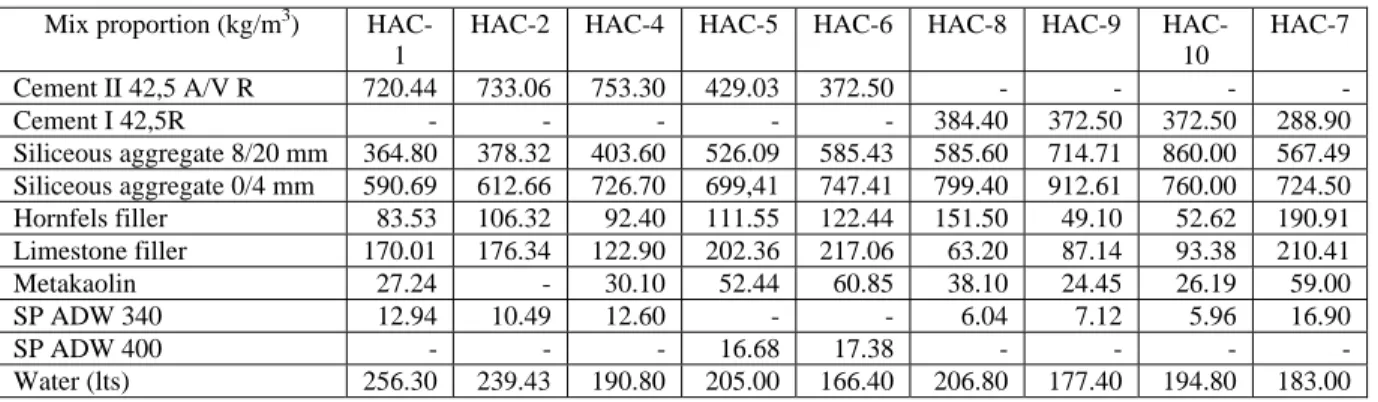
The first mix proportions have a high quantity of cement, approximately twice as much as the last ones. In Table 1, the HAC-3 sample is excluded, similar to the HAC-2 one, which lacks metakaolin.
Table 1: Composition in weight of the mix proportions per cubic meter
Mix proportion (kg/m3) HAC-1
2 4 5 6 8 9 HAC-10
HAC-7
Cement II 42,5 A/V R 720.44 733.06 753.30 429.03 372.50 - - - -
Cement I 42,5R - - - - - 384.40 372.50 372.50 288.90
Siliceous aggregate 8/20 mm 364.80 378.32 403.60 526.09 585.43 585.60 714.71 860.00 567.49 Siliceous aggregate 0/4 mm 590.69 612.66 726.70 699,41 747.41 799.40 912.61 760.00 724.50 Hornfels filler 83.53 106.32 92.40 111.55 122.44 151.50 49.10 52.62 190.91 Limestone filler 170.01 176.34 122.90 202.36 217.06 63.20 87.14 93.38 210.41
Metakaolin 27.24 - 30.10 52.44 60.85 38.10 24.45 26.19 59.00
SP ADW 340 12.94 10.49 12.60 - - 6.04 7.12 5.96 16.90
SP ADW 400 - - - 16.68 17.38 - - - -
Water (lts) 256.30 239.43 190.80 205.00 166.40 206.80 177.40 194.80 183.00
4.1. Water/filler ratio
consistency of samples, the higher w/c ratio lower slump-flow diameter (cm) in the test table (without vibrating): limestone filler mortar 0.7 (25.20 cm), siliceous sand mortar 0.9 (22.20 cm), hornfels filler mortar 0.96 (22.03) and MK mortar 2.22 (19.25 cm). The formation of small round pores is observed particularly in the mixings with hornfels filler, with no use of superplasticiser during the mixing.
4.2. Results obtained
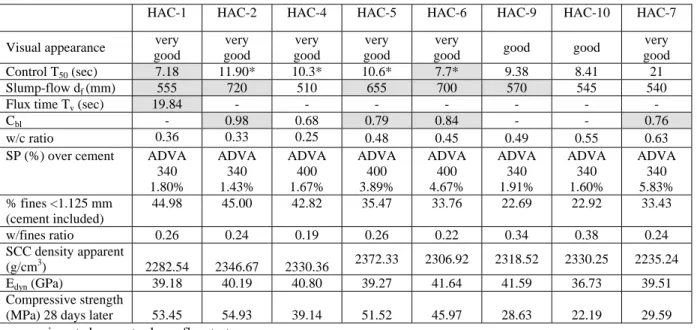
The results obtained in the tests carried out are summarized in Table 2, where the admixtures HAC-3 and HAC-8 are not included, since the planned tests could not be carried out due to lack of fluidity.
Table 2: Results in fresh and hardened state of the concretes
HAC-1 HAC-2 HAC-4 HAC-5 HAC-6 HAC-9 HAC-10 HAC-7
Visual appearance very good very good very good very good very
good good good
very good
Control T50 (sec) 7.18 11.90* 10.3* 10.6* 7.7* 9.38 8.41 21
Slump-flow df (mm) 555 720 510 655 700 570 545 540
Flux time Tv (sec) 19.84 - - -
Cbl - 0.98 0.68 0.79 0.84 - - 0.76
w/c ratio 0.36 0.33 0.25 0.48 0.45 0.49 0.55 0.63
SP (%) over cement ADVA 340 1.80% ADVA 340 1.43% ADVA 400 1.67% ADVA 400 3.89% ADVA 400 4.67% ADVA 340 1.91% ADVA 340 1.60% ADVA 340 5.83% % fines <1.125 mm
(cement included)
44.98 45.00 42.82 35.47 33.76 22.69 22.92 33.43
w/fines ratio 0.26 0.24 0.19 0.26 0.22 0.34 0.38 0.24
SCC density apparent
(g/cm3) 2282.54 2346.67 2330.36 2372.33 2306.92 2318.52 2330.25 2235.24
Edyn (GPa) 39.18 40.19 40.80 39.27 41.64 41.59 36.73 39.51
Compressive strength
(MPa) 28 days later 53.45 54.93 39.14 51.52 45.97 28.63 22.19 29.59
• inverted concrete slump-flow test.
5. Discussion of the results
5.1. Self-compactability of admixtures
It can be concluded that only with the HAC-1 and HAC-6 admixtures, in the test of 50 cm diameter, a time lower than 8 seconds was obtained, including the last one carried out with an inverted concrete slump-flow, in less favorable conditions. These admixtures can be categorized as AC-VI (UNE 83.361). With respect to the diameter df, these three samples plus the HAC-2, HAC-5 and HAC-9 ones have a
range 550 mms ≤df ≤ 8 50 mm (EHE 2008, table A17.3 slump-flow classes); they can also be classified as AC-EI and AC-E2 concretes. The V funnel passing test was only carried out for the HAC-I mixing and the result is lower than 20 seconds. With respect to the L box test, it's only been achieved in admixtures HAC-2, HAC-5, HAC-6 and HAC-7.
5.2. Quantity of Portland cement
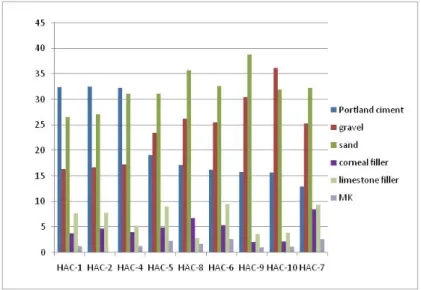
admixtures and the relation water/cement is very low, 0.25; since the metakaolin proportion stays more or less the same (27 kg/m3 in HAC-l and 30 kg/m3 in HAC-4). The compressive strength result decreased considerably too. In the admixture HAC-7, the quantity of cement was reduced to 288.90 kg/ m3, and however a Cbl of 0.76 was reached. For this the quantity of fillers was considerably risen, the hornfels one
up to 8.52% equivalent to 190.90 kg/m3 of the admixture, 9.39% of limestone filler and 2.63% of metakaolin (admixture HAC-l had 1.22% of metakaolin).
Figure 1.Admixtures composition graph
5.3. The gravel and sand aggregates
The gravel distribution can be appreciated in figures 2 and 3. The admixture HAC-5 had more sand than HAC-2, less quantity of cement, more content of limestone filler and a distribution in the vertical more regular, which influences the compression strength obtained (54.93 MPa). The admixtures HAC-9 and HAC-10 which presented small superficial honeycombs of 5 mm diameter, had a high quantity of sand and gravel respectively, but had the lower fines proportion (23%).
Figures 2 and 3. Distribution in the vertical of gravel in HAC-2 and HAC-5 respectively (% in volume)
5.4. The synergy of fillers
of this low activity pozzolana in fixing the lime and absorbing the surplus water, particularly with the hornfels and limestone fillers. In the admixture HAC-5 the difficulty to obtain the slump-flow T50 would
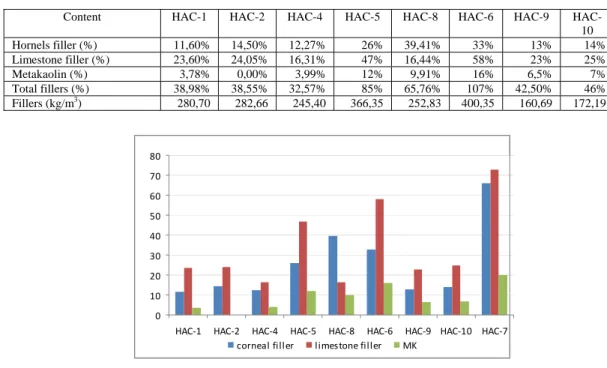
be justified by the increase of metakaolin up to 2.34% of the admixture (52.40 kg/m3), 12% respect to the cement content (Table 3), which has not been compensated with the increase of limestone filler, and with a w/c ratio of 0.48. One of the causes for the mixing HAC-8 concrete not being self-compacting lies in the fact that the hornfels filler content was higher than the limestone filler content, hence not allow a fluid admixture. The hornfels filler content was 6.78% of the admixture (151.50 kg), and the limestone filler was 2.83% (63.20 kg), which in addition had the lowest quantity of this filler with relation to all the admixtures.
Table 3: Filler proportion (%) respect to the cement content
Content HAC-1 HAC-2 HAC-4 5 8 6 9
HAC-10
HAC-7
Hornels filler (%) 11,60% 14,50% 12,27% 26% 39,41% 33% 13% 14% 66%
Limestone filler (%) 23,60% 24,05% 16,31% 47% 16,44% 58% 23% 25% 73%
Metakaolin (%) 3,78% 0,00% 3,99% 12% 9,91% 16% 6,5% 7% 20%
Total fillers (%) 38,98% 38,55% 32,57% 85% 65,76% 107% 42,50% 46% 159% Fillers (kg/m3) 280,70 282,66 245,40 366,35 252,83 400,35 160,69 172,19 460,30
Figure 4. Fillers proportion (%)
On the other hand, in figure 4 the fillers distribution over 100% can be seen. For cement quantities lower than 400 kg/m3, the distribution is that of the admixtures HAC-6, HAC-9, HAC-10 and HAC-7. In the last one, with a cement content of 289 kg/m3, they have not affected negatively in the self-compacting test in the presence of bars, nor have they reduced the compressive strength (with respect to 9 and HAC-10), the contribution of the limestone filler (73%), the hornfels filler (66%), as well as the metakaolin (20%), percentages respect to the cement content (Table 3).
6. The porosity in the compression strength
In the microphotographies impregnated with fluorescent resin a difference in the pores can be appreciated, more or less rounded in the mixing HAC-9, irregular and sharps pores in HAC-10 and rounded pores in HAC-7. It is confirmed that sharp porosity decreases the compression strength since the tensions are greater in the non-rounded forms. That is, the increase of fillers, in particular the hornfels as indicated in section 4.1., has reduced the porosity with angular finishes and therefore a higher compressive strength has been obtained in the mixing HAC-7 of rounded pores (fig. 5-c), than in the mixing HAC-10 (fig. 5-b), as the results comparison shows Table 2.
0 10 20 30 40 50 60 70 80
Figures 5-a HAC-9; 5-b HAC-10; 5-c HAC-7. Sheets impregnated with fluorescent resin.
7. Correlation with the rest of properties
Although the quantity of cement in the test HAC-5 is the 60% of that of HAC-1, compression strength of little more of 50 N/mm2 can be obtained, based on a better mix proportion. Also, the quantity of cement in HAC-6 is almost half as that of HAC-l, with a filler proportion of 107% and 39% respectively, with respect to the cement content, hence the quantity of cement is not a priority to determine the fluidity but to obtain higher mechanical strengths.
The reduction of the cement in the mixings HAC-7, HAC-9 and HAC-10 is related to the reduction of the compression strength in 50% to 60%, and to the form of the porosity as analysed in section 6. This fillers proportion with respect to the quantity of cement between 289 kg/m3 and 372 kg/m3 produces concretes of approximately 25-30 MPa (HAC-7, HAC-9 and HAC-10). But both HAC-5 and HAC-7 had also high percentages of superplasticisers, over the recommended 1.5%.
8. Conclusions
l. Based on the mix proportions carried out with a high quantity of cement (720 kg/m3 approximately), the self-compactability of a concrete and a compression strength around 55 MPa can be reached. But if the quantity of cement is even lower than 300 kg/ m3, it can be compensated with the contribution of hornfels, limestone and metakaolin fillers, for strengths of 25-30 MPa and w/c ratio higher than 0.45.
2. The synergic effects of these fillers demand a joint mix proportion, since the quantity of limestone filler should always be higher than that of hornfels, and that of metakaolin in lower proportion, the action of the first one being decisive to obtain the fluidity of the admixtures.
3. The contribution of fillers helps reducing the damaging angular finishes of irregular pores which concentrate more the tensions, with the formation of rounded pores and therefore the achievement of higher compression strengths.
Acknowledgments
We thank Esgea (Petrographic Studies) for their collaboration, PAS Infraestructura y Servicios S.L. and Grace Construction Products, for the materials supplied.
References
- Barragán et al, Editors, 2008, Proceedings of the 1st. Spanish Congress on Self Compacting Concrete. - EHE 2008. Spanish Instrucción de Hormigón Estructural, Cap. 17 Self-compacting Concrete.