
TítuloClassic molecular compounds and emergent organic inorganic hybrid perovskites with (multi) functional properties and (multi)stimuli responsiveness
152
0
0
Texto completo
(2)
(3) Classic molecular compounds and emergent organic-inorganic hybrid perovskites with (multi)functional properties and (multi)stimuli responsiveness Juan Manuel Bermúdez García Doctoral Thesis UDC 2016. Directores: Dra. María Antonia Señarís Rodríguez Dr. Manuel Sánchez Andújar. Departamento de Química Fundamental, Facultad de Ciencias Centro de Investigacións Científicas Avanzadas (CICA) Universidade da Coruña (UDC). Programa regulado por el RD 99/2011: Química Ambiental y Fundamental.
(4)
(5)
(6)
(7)
(8)
(9) A mi familia y a mis seres queridos,.
(10)
(11) Agradecimientos El trabajo de investigación que aquí se presenta fue financiado por el Ministerio de Economía y Competitividad (MINECO) y por el Fondo Europeo de Desarrollo Regional (FEDER), (proyectos MAT2010-21342-C02-01 y ENE2014-56237-C4-4-R) y la Xunta de Galicia (proyectos 10 PXIB 103 272 PR y GRC2014/042). Asimismo, durante la realización de este trabajo de investigación, he podido disfrutar de contratos asociados a los proyectos (10 PXIB 103 272 PR, MAT2010-21342-C02-01, ENE2014-56237-C4-4-R y GRC2014/042) y de una beca de la Fundación Barrié (Beca de Posgrado 2014) para realizar una estancia de investigación en la Universidad de Oxford. La presente Tesis Doctoral ha sido desarrollada en un entorno de trabajo multidisciplinar, donde se ha contado con el apoyo y colaboración de investigadores pertenecientes a diversas universidades y centros de investigación, tanto nacionales como internacionales. Así pues, me gustaría dedicar las siguientes líneas a agradecerles el haberme permitido trabajar estrechamente junto a ellos. En primer lugar, me gustaría agradecer especialmente a mis directores, la Dra. María Antonia Señarís Rodríguez y el Dr. Manuel Sánchez Andújar, así como a la Dra. Socorro Castro García, investigadores del grupo de “Química Molecular y Materiales (QuiMolMat)” perteneciente a la Universidade da Coruña (UDC) y al Centro de Investigacións Científicas Avanzadas (CICA). Desde el primer momento, me habéis facilitado todas las herramientas a vuestro alcance para formarme como investigador, y vuestra enorme dedicación ha supuesto para mí una fuente de motivación e inspiración continua, por lo que no tengo más que palabras de agradecimiento por haber tenido la fortuna de contar con vuestro apoyo en esta etapa de mi carrera. También me gustaría agradecer a los siguientes investigadores con los que he tenido el placer de trabajar durante la realización de esta Tesis Doctoral: I especially want to thank Prof. Henry J. Snaith FRS, Dr. Amir A. Haghighirad, Dr. Jacob T. W. Wang and all the “Snaithlings”, for the opportunity of doing a research stay in their group of “Photovoltaic and Optoelectronic Devices” of the University of Oxford. Al Prof. Juan Bisquert, director del grupo de investigación de “Dispositivos Fotovoltaicos y Optoelectrónicos” de la Universitat Jaume I de Castellón, y al Dr. Emilio Juárez, investigador del mismo grupo en el momento de mi estancia. Al Dr. Ángel Alegría y a Luis Botana, del grupo “Polymers and Soft Matter” del Centro de Física de Materiales, Universidad del País Vasco - CSIC. Al Dr. Jorge Mira, investigador del grupo de “Magnetismo y Nanotecnología” de la Universidad de Santiago de Compostela. A la Dra. Teresa A. Centeno, investigadora en el Instituto Nacional del Carbon del CSIC, Oviedo..
(12) Agradecimientos. A la Dra. Sofía Calero, al Dr. Said Hamad y a José M. Vicent, investigadores del grupo de “Materiales Nanoestructurados con Aplicaciones Tecnológicas” de la Universidad Pablo de Olavide, Sevilla. Al Dr. Ramón Artiaga, al Dr. Jorge López Beceiro y a la Dra. Sonia Zaragoza, del grupo de investigación de “Propiedades Térmicas y Reológicas de Materiales” de la Universidade da Coruña. Además, quisiera dar las gracias a los doctores con los que he compartido laboratorio en la Universidade da Coruña, Martin Regueiro, Adrian Roca, Aurora Rodríguez, Marta Mato, Israel Carreira, Leticia Naya, Eva López, y especialmente, Susana Yáñez, Breogán Pato y Claudia Gómez, quienes me enseñaron las primeras lecciones en esta etapa predoctoral. No quisiera olvidar dar las gracias a mis compañeros doctorandos y maestrandos, Lorena Alonso, Alberto García, Fernando Rodríguez, Ismael Marcos, Jorge Lado, Patricia Gaudino, Oscar Lenis, Rosa Pujales, Laura Caneda, Iago Neira, Tamara Rama, Olaya Domarco, Diana Martínez, Juan Carlos Fuentes; jóvenes investigadores quienes, a pesar de las dificultades y las trabas encontradas, siguen luchando por mantener vivo el avance de la ciencia española. En el ámbito de lo personal, quisiera permitirme la licencia de dedicarle unas líneas de agradecimiento a mi familia, en especial a mis padres, Juan Bermúdez y Ángeles García, y hermanos, Gabriel Ángel y Nazaret Bermúdez García, quienes me han enseñado los valores y principios, que a su vez aprendieron de mis abuelos, y que me han hecho ser quien soy. Espero haceros sentir orgullosos. También me gustaría agradecer a mis amigos y familiares norteños, Emiliano Caballero, Miguel Cuerva, Santiago Melo, Katia Caamaño, Sabela Baamonde, Adrián Andrade, Nerea Pérez, Ana Quiroga, Carola Heras, Fátima Lucio, Javier Rodríguez, Efrén Díaz, Ana Álvarez, Noelia Lago y la pequeñita Alicia Andrade, sin olvidar a Mar Marañón, Eva Alonso, Diego Alonso y Jesús Alonso. Gracias a todos vosotros he encontrado un hogar en Galicia. Por último, me gustaría agradecerte a ti, Lorena Alonso, el haberme enseñado que una caída inesperada puede ser el principio de un camino aún más inesperado, y por recordarme que la vida misma es Química.. Graciñas bolboreta.
(13)
(14)
(15) Abstract/Resumen/Resumo Abstract: This Ph.D. Thesis focus on the development of new (multi)functional and (multi)stimuli responsive materials, based on organic-inorganic hybrids and molecular compounds, where the application of different stimuli (temperature, external isostatic/uniaxial pressure and/or internal chemical pressure) is able to induce specific functionalities in the materials. Moreover, this work aims to find new hybrid precursors for nanostructured carbon materials. These are important areas of research in Solid State and Materials Science in view of their technological potential and environmental applications. In this context, this Ph.D. Thesis has explored new functional properties on novel organic-inorganic hybrid materials with formula [TPrA][M(dca)3] (M = Mn2+, Fe2+, Co2+ and Ni2+) perovskite-like structure, some of which are synthesized and/or described for the first time. Also two very well-known molecular compounds, namely ferrocene, [Fe(C5H5)2], and ammonia-borane, (H3N·BH3), are investigated in the search for ferroic order. In addition, these studies have revealed pressure-induced caloric effects in the [TPrA][Mn(dca)3], which shows a promising potential for solid state cooling applications. Finally, the [TPrA][M(dca)3] (M = Ni2+ and Co2+) have been found to be very useful precursors in a simple, scalable and economical accessible synthetic method to obtain carbon nanotubes with magnetic nanoparticles embedded, M@CNTs (Ni2+ and Co2+).. Resumen: Esta Tesis Doctoral se centra en el desarrollo de nuevos materiales (multi)funcionales y (multi)sensitivos, basados en híbridos orgánico-inorgánicos y en compuestos moleculares, donde la aplicación de diferentes estímulos externos (temperatura, presión isostática/uniaxial externa y/o presión química interna) es capaz de inducir funcionalidades específicas en estos materiales. Además, este trabajo trata de buscar nuevos precursores híbridos de materiales nanoestructurados de carbono. Estas son importantes áreas de investigación en Ciencia de Materiales, debido al potencial tecnológico y las aplicaciones medioambientales de estos materiales. En este contexto, en esta Tesis Doctoral se han explorado las propiedades funcionales en los nuevos compuestos híbridos orgánico-inorgánicos de fórmula molecular [TPrA][M(dca)3] (M = Mn2+, Fe2+, Co2+ y Ni2+) y estructura tipo perovskita, algunos de los cuales se han sintetizado y/o descrito por primera vez. Además se han estudiado dos materiales moleculares muy conocidos, como son el ferroceno, [Fe(C5H5)2], y el amino-borano (H3N·BH3), en búsqueda de orden ferróico. Asimismo, estos estudios han revelado efectos calóricos inducidos por la presión en el compuesto [TPrA][Mn(dca)3], que muestra un gran potencial para aplicaciones de refrigeración en estado sólido. Finalmente, se ha encontrado que los compuestos [TPrA][M(dca)3] (M = Ni2+ y Co2+) son precursores muy versátiles para obtener nanotubos de carbono con nanopartículas magnéticas embebidas su interior, M@CNTs (Ni2+ y Co2+), mediante un método sencillo, escalable y económicamente accesible.. xi.
(16) Abstract/Resumen/Resumo. Resumo: Esta Tese de Doutoramento céntrase no desenvolvemento de novos materiais (multi)funcionais e (multi)sensibles, baseados en híbridos orgánico-inorgánicos e compostos moleculares, onde a aplicación de diferentes estímulos externos (temperatura, presión isostática/uniaxial externa e/ou presión química interna) é capaz de inducir unha función específica nestes materiais. Ademais, este estudo trata de atopar novos precursores híbridos de materiais nanoestruturados de carbono. Estas son áreas importantes de investigación en Ciencia de Materiais por mor do potencial destes materiais para aplicacións tecnolóxicas e medioambientais, que están relacionadas coas súas propiedades funcionais como, por exemplo, piezoeletricidade, ferroeletricidade, ferromagnetismo, magnetorresistencia, supercondutividade, multiferroicidade, etc. Neste contexto, esta Tese de Doutoramento explora as propiedades funcionais nos novos compostos híbridos orgánico-inorgánicos de fórmula molecular [TPrA][M(dca)3] (M = Mn2+, Fe2+, Co2+ e Ni2+) e estrutura tipo perovskita; ademais de materiais moleculares coñecidos como o ferroceno, [Fe(C5H5)2], e o amino-borano (H3N·BH3). Estes estudos tamén revelaron efectos calóricos inducidos pola presión sobre o composto [TPrA][Mn(dca)3], o que demostra gran potencial para aplicacións en refrixeración de estado sólido. Finalmente, verificouse que os compostos [TPrA][M(dca)3] (M = Ni2+ e Co2+) son precursores versátiles para sintetizar nanotubos de carbono con nanopartículas magnéticas incorporadas, M@CNTs (M = Ni2+ e Co2+), usando un método sinxelo, escalable e accesible.. xii.
(17)
(18)
(19) Preface Global warming, environment pollution, and massive energy and technology consumption are main signatures and drawbacks of our current society, see Figure P-1.. 0.8. 5. 0.6. 0.4. 3. 0.2. 1. 1980. 1985. 1990. 1995. 2000. Year. 2005. 2010. 2015. 550 500 450 400 350 300 250. Global Energy Consumption (QBtu). Global temperature anomaly (ºC). 7. Global mobile-cellular subscriptions (103 millions). In this context, the scientific community faces very complex and urgent challenges, such as: having to develop sustainable energy sources and solutions, reducing their environmental footprint, avoiding the use of expensive and scarce materials (such as rare-earth magnetic alloys, lithium, indium, etc.) as well as of potentially global warming substances such as refrigeration greenhouse gases, etc. And, of course, having to improve the feasibility and efficiency of technological devices, which every time are desirable to become more and more lightweight, smaller and efficient.. Figure P-1. Overlap of three statistical markers of global warming, energy crisis and technology consumption of the last 35 years. The red curve indicates temperature anomalies on global surface temperature compare with 1951-1980 average temperatures.1 The blue curve show the total primary energy consumption in the world,2 while the green curve represent the number of global mobile phone subscriptions. 3. Looking for innovative solutions, and within the fields of Solid State and Materials Science, great efforts have been devoted in the last decades to the development of “(multi)functional materials”,4 and “(multi)stimuli responsive materials”,5 where the application of external single or multiple stimuli is able to induce specific functionalities in the material, for instance a magnetic or an electric response, see Figure P-2.. xv.
(20) Preface. Figure P-2. Examples of (multi)functional and/or (multi)stimuli responsive materials whose structure and functional properties can be modulated by different external stimuli: pressure/strain, electric/magnetic field, light, temperature, etc.. Traditionally, most of these studies were focused on ceramic materials,4 specially oxides and many of them perovskites. This latter compounds, with general formula ABX 3 (A: alkali, alkaline earth, or lanthanide cations, B: transition metal cation, X: O 2-) are crystalline solids whose structure can be defined as a tridimentional network of [BX6] octahedra sharing corners with the A-site cations located inside the resulting cubooctahedral cavities, see Figure P-3. These ABO3 perovskites are known to show a large variety of functional properties, such as piezoelectricity, ferroelectricity, ferromagnetism, magnetoresistance, superconductivity, multiferroicity, etc.6. A: lanthanides, alkali cations, etc. B: transition metals, etc. X: O2-. Figure P-3. Ideal ABX3 perovskite structure.. xvi.
(21) Preface More recently there is a growing interest in developing new (multi)functional and (multi)stimuli responsive materials based on organic-inorganic hybrid compounds, including metal organic frameworks (MOFs) and coordination polymers, which can exhibit a higher versatility, flexibility, structural richness, etc., due to the multiple possible combinations of different organic and inorganic units as building blocks in the structure. In this modern field, significant efforts have been devoted in the very last few years to hybrid organic-inorganic materials with perovskite-like structure, the so-called hybrid perovskites,7 where the Aand/or X-sites become organic building blocks see Figure P-4.. X-site anions. A-site cations. CH3NH3+. CN-. (CH3)2NH3+. C3N2H5+. HCOO-. B-site cations. N 3-. Mn2+, Fe2+ Co2+, Ni2+, Zn2+… Figure P-4. Perovskite-like structure displayed by some organic-inorganic hybrids, where the A-site is normally occupied by midsize organic alkylammonium cations, X by organic or inorganic bidentate-bridging ligands (HCOO-, CN- or N3-) and the B-site by transition metal cations.. Some of these materials have already revealed remarkable functional properties such as the unprecedented photoconductivity in [MA]PbI3 (MA = methylammonium cation, CH3NH3+),8 and the noteworthy cooperative magnetic, electric or elastic order in [AmineH][M(X) 3] (AmineH = midsized protonated amines, M = divalent transition metal cations, X = polyatomic ligands such as HCOO -, N3- or CN).9 Even more, the metal-formates [DMA][M(HCOO)3] (DMA: dimethylammonium cation, (CH3)2NH2+) have been found to be type-I multiferroic materials,10 and very recently, coupled magnetic and electric order has been demonstrated in [MA][Co(HCOO)3]11 opening the large, flexible, multifunctional and designable family of hybrid perovskites to magnetically induced multiferroic behaviour. In addition, organic-inorganic hybrids, where the combination of different organic and inorganic parts allows to control the porosity and chemical composition of the resulting compounds,12 have shown potential in a slightly different scenario: as strategically designed precursors of nanostructured carbon materials with interesting energy and environmentally important applications, such as energy storage, gas adsorption or pollutant removal, among others others.13. xvii.
(22) Preface In view of this background, the main objectives of the present Ph.D. Thesis, which has been elaborated within the Environmental and Fundamental Chemistry Ph.D. Program of the University of A Coruna, have been: (i) the search for novel (multi)functional and (multi)stimuli materials. (ii) the development of organic-inorganic hybrid as precursors of nanostructured carbon materials. As for (i) even if such studies have been mainly carried out among "emergent" organic-inorganic hybrid frameworks, we have also used the alternative approach of revisiting two "old" compounds (namely the "classic" molecular compounds ferrocene and ammonia-borane) in the search for new functional properties Moreover, along these studies we have discovered strong pressure-induced caloric effects in some of these compounds, which could be of interest for cooling applications, aspect that was further investigated in the last months of this Ph.D. work. All these studies have comprised the synthesis of a number of compounds, their structural characterization and the study of their physico-chemical properties: ranging from the more traditional adsorption capacity, to the more recent functional dielectric, (multi)ferroic and refrigeration properties that can be easily modulated under the application of accessible external (multi)stimuli, mainly pressure and temperature. To present the main contributions of this work this memory has been organised as follows: Chapter 1 consist on an introductory section. Chapters 2 to 6 contain self-contained studies presented as research papers which focus on different materials, their properties and applications. In this context, chapter 2 and 3 are devoted to a new family of organic-inorganic hybrids with perovskite-like structure, and formula [TPrA][M(dca) 3] with M = Mn2+ (chapter 2) and M = Fe2+, Co2+ and Ni2+(chapter 3), some of which are presented for the first time. As discussed there, these compounds display remarkable (multi)ferroic properties, multiple phase transitions and (multi)sensitive responsiveness. Even more, and as presented and discussed in chapter 4, these hybrid perovskites are found to display pressure-driven refrigeration properties, concept known as barocaloric effect. Very remarkably, and as far as we know, they would be the first hybrids showing this functionality. In addition, the Ni and Co members of this [TPrA][M(dca)3] family are found to be precursors of carbon nanotubes embedded with magnetic nanoparticles, materials of interest for pollutant removal and recovery under an applied magnetic field, aspect that is presented in chapter 5. On the other hand, in chapter 6, two very well-known “classic” molecular compounds, specifically ferrocene, [Fe(C5H5)2], and ammonia-borane, (H3N.BH3), are revisited from a completely different point of view to the traditional one, revealing new functionalities that had not been described prior to this work. Chapter 7 summarizes the main conclusions obtained out-of the results exposed along the previous chapters. Annexe I contains tables with selected crystallographic data of the [TPrA][M(dca) 3] (M = Mn2+, Fe , Co and Ni2+) compounds. 2+. 2+. Annexe II contains a summary of the Ph.D. Thesis in Spanish language. Annexe III contains the publications in scientific journals and communications in specialized congresses of Juan Manuel Bermúdez García during this Ph.D. work.. xviii.
(23) Preface. References 1 2 3 4 5 6. 7 8 9 10 11 12 13. NASA Goddard institute for space studies, Global Climate Change, 2016, http://climate.nasa.gov/vital-signs/global-temperature/ U.S. Energy Information Administration, International Energy Statistics, 2016, https://www.eia.gov/ International Telecommunication Union, 2016, http://www.itu.int/en/ Kang, Z. C.; Wang, L. Z. Functional and smart materials, Plenum Press, New York, 1998. Coudert, X. Chem. Mater. 2015, 27, 1905. (a) Granger, P.; Parvulescu, V. I.; Kaliaguine, S.; Prellier, W. Perovskites and Related Mixed Oxides: Concepts and Applications, Wiley-VCH, Weinheim, Germany, 2015; (b) F. S. Galasso, Structure, properties, and preparation of perovskite-type compounds, Pergamon Press, New York, 1969; (c) Peña, M. A.; Fierro, J. L. G. Chem. Rev. 2001, 101, 1981. Kieslich, G.; Sun, S.; Cheetham, A. K. Chem. Sci. 2015, 6, 3430. Lee, M. M.; Teuscher, J.; Miyasaka, T.; Murakami, T. N.; Snaith, H. J. Science 2012, 338, 643. Xu, W.-J.; Du, Z.-Y.; Zhang, W.-X.; Chen, X.-M. CrystEngComm 2016, DOI: 10.1039/C6CE01485B. Jain, P.; Ramachandran, V.; Clark, R. J.; Zhou, H. D.; Toby, B. H.; Dalal, N. S.; Kroto, H. W.; Cheetham, A. K. J. Am. Chem. Soc. 2009, 131, 13625. Gómez-Aguirre, L. C.; Pato-Doldán, B.; Mira, J.; Castro-García, S.; Señarís-Rodríguez, M. A.; SánchezAndújar, M.; Singleton, J.; Zapf, V. S. J. Am. Chem. Soc. 2016, 138, 1122. Cheetam, A. K.; Rao, C. N. R. Science 2007, 318, 58. Chaikittisilp, W.; Ariga, K.; Yamauchi, Y. J. Mater. Chem. A 2013, 1, 14.. xix.
(24)
(25) Index Chapter 1: Introduction 1.1. Dielectric materials. 1 3. 1.1.1. Relationship between the dielectric properties and the crystal symmetry. 5. 1.1.2. Ferroelectric and antiferroelectric materials. 6. 1.2. Multiferroic materials. 7. 1.3. Solid state cooling materials. 8. 1.4. Precedents of organic-inorganic hybrid materials with dielectric properties, multiferroicity and temperature and pressure responsiveness. 10. 1.4.1. Dielectric and multiferroic hybrid materials with emphasis in hybrid perovskites. 11. 1.4.2. Temperature and pressure responsive hybrid materials. 13. 1.5. Precedents of organic-inorganic hybrid materials as precursor for functional carbon nanomaterials. 14. 1.6. Main objectives of this work. 15. 1.7. References. 15. Chapter 2: Role of temperature and pressure on the multisensitive multiferroic dicyanamide framework [TPrA][Mn(dca)3] with perovskite-like structure. 19. 2.1. Introduction and objectives. 21. 2.2. Experimental section. 22. 2.2.1. Synthesis. 22. 2.2.2. Single-crystal X-ray diffraction. 22. 2.2.3. Powder X-ray diffraction. 23. 2.2.4. Differential scanning calorimetry (DSC). 23. 2.2.5. Pressure-Volume-Temperature (PVT) analysis. 23.
(26) Index 2.2.6. Dielectric measurements 2.3. Results and discussion 2.3.1. Studies at ambient pressure. 23 23 23. 2.3.1.1. Phase Transition from DSC Data.. 23. 2.3.1.2. Crystal structures.. 24. 2.3.1.3. Structural evolution as a function of temperature. 25. 2.3.1.4. Dielectric properties. 27. 2.3.2. Influence of external pressure on the structural and dielectric transition. 28. 2.4. Conclusions. 29. 2.5. Notes. 30. 2.6. References. 30. Chapter 3: Multiple phase and dielectric transitions on a novel multisensitive [TPrA]-[M(dca)3] (M = Fe2+, Co2+ and Ni2+) hybrid organic-inorganic perovskite family. 33. 3.1. Introduction and objectives. 35. 3.2. Experimental section. 36. 3.2.1. Synthesis. 36. 3.2.2. Single-crystal X-ray diffraction. 36. 3.2.3. Powder X-ray diffraction. 36. 3.2.4. Differential scanning calorimetry (DSC). 37. 3.2.5. Pressure-Volume-Temperature (PVT) Analysis. 37. 3.2.6. Dielectric measurements. 37. 3.3. Results and discussion 3.3.1. Studies at ambient pressure. 37 37. 3.3.1.1. DSC results. 37. 3.3.1.2. Crystal structures and structural transitions as a function of temperature. 38.
(27) Index 3.3.1.3. Dielectric properties 3.3.2. Influence of external and internal pressure on the structural and dielectric transition. 41 42. 3.3.2.1. Influence of external pressure. 42. 3.3.2.2. Influence of internal chemical pressure. 43. 3.4. Conclusions. 45. 3.5. Notes. 45. 3.6. References. 45. Chapter 4: Giant barocaloric effect in the ferroic organic-inorganic hybrid [TPrA][Mn(dca)3] perovskite under easily accessible pressures. 49. 4.1. Introduction and objectives. 51. 4.2. Experimental section. 52. 4.2.1. Synthesis. 52. 4.2.2. Powder X-ray diffraction. 52. 4.2.3. Differential scanning calorimetry (DSC and PDSC). 52. 4.2.4. Elastic heating calculation.. 53. 4.3. Results and discussion. 53. 4.3.1. Differential scanning calorimetry under applied pressure. 53. 4.3.2. Isobaric and isothermal entropy change. 53. 4.2.3. Clausius-Clapeyron method. 54. 4.2.4. Relative cooling power. 54. 4.4. Conclusions. 56. 4.5. Notes. 56. 4.6. References. 56.
(28) Index Chapter 5: A simple method to synthesize carbon nanotubes embedded with magnetic nanoparticles by using the organicinorganic hybrid perovskite [TPrA][M(dca)3] (M = Ni2+ and Co2+) as precursor. 59. 5.1. Introduction and objectives. 61. 5.2. Experimental section. 62. 5.2.1. Synthesis of the [TPrA][M(dca)3] hybrid precursors. 62. 5.2.2. Synthesis of the M@CNTs. 63. 5.2.3. Powder X-ray diffraction. 63. 5.2.4. Elemental analysis. 63. 5.2.5. Thermal characterization. 63. 5.2.6. Infrared and Raman spectroscopies. 63. 5.2.7. Transmission electron microscopy. 63. 5.2.8. Assessment of the porous structure. 63. 5.2.9. Magnetic studies. 63. 5.2.10. Oil adsorption-desorption essays. 63. 5.3. Results and discussion. 63. 5.3.1. Characterization of the [TPrA][M(dca)3] precursors. 63. 5.3.2. Thermal decomposition of the [TPrA][M(dca)3] (M = Ni2+ and Co2+) precursors. 64. 5.3.3. Morphology, crystallinity and composition of the M@CNTs. 66. 5.3.4. Comparison of [TPrA][M(dca)3] with M(dca)2 as precursors of M@CNTs. 69. 5.3.5. Porous structure of M@CNTs. 70. 5.3.6. Magnetic characterization of M@CNTs. 70. 5.3.7. Oil absorption and desorption. 70. 5.4. Conclusions. 71. 5.5. Notes. 72.
(29) Index 5.6. References Chapter 6: New properties in old systems: cooperative electric order in ferrocene and ammonia-borane. 72 75. 6.1. Introduction. 77. 6.2. Experimental section. 79. 6.2.1. Materials. 79. 6.2.2. Dielectric properties. 79. 6.2.3. Quantum calculations. 79. 6.3. Results and discussion. 79. 6.3.1. Ferrocene. 79. 6.3.2. Ammonia-borane. 81. 6.4. Conclusions. 83. 6.5. Notes. 83. 6.6. References. 83. Chapter 7: General conclusions. 87. Annexe I: Crystallographic data. 91. Annexe II: Spanish summary. 101. Annexe II: Publications and communications. 111.
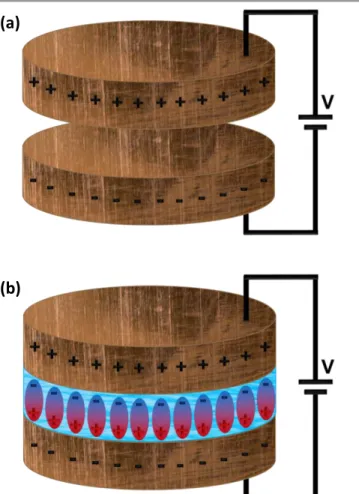
(30)
(31) hapter 1: Introduction. 1.1. 1.2. 1.3. 1.4.. 1.5.. 1.6. 1.7.. Dielectric materials Multiferroic materials Solid state cooling materials Precedents of organic-inorganic hybrid materials with dielectric properties, multiferroicity and temperature and pressure responsiveness Precedents of organic-inorganic hybrid materials as precursor for functional carbon nanomaterials Main objectives of this work References.
(32)
(33) Introduction Generally, the dielectric response of a material is studied in a parallel plate capacitor, which consists of two parallel plates containing the dielectric material in between, see Figure 1-2.. 1.1. Dielectric materials1-3 A dielectric material is an electrical insulator that can exhibit an electric dipole structure; that is, a separation of positive and negative electrically charged entities on an atomic or molecular level. In the presence of an electric field, these dipoles become aligned and oriented with the applied field, process known as polarization, which confer these materials a vast number of technological applications. These materials are ubiquitous in quotidian systems, functioning as electric wire insulator coatings, printed circuit boards, frequency tuners, sensors and transductors of thermal, mechanic or even acoustic signals, etc. Some of the advanced technological applications range from non-volatile Ferroelectric Random Access Memories (FeRAMs) to microsensors or wireless microantennas incorporated in the so-called wearable devices (smartglasses or activity tracker bands), and even bio-acoustic sensors to control the next generation of smartphones projected directly on the skin (the so-called Skinput technology), see Figure 1-1.. When a voltage is applied across the capacitor, the dielectric response can be measured in terms of relative permittivity (also known as dielectric constant), ’r, which represents the increase in charge storing capacity by insertion of the dielectric medium between the plates. This magnitude is equal to the rario ’r = /0, where 0 and are the dielectric permittivity of the vacuum -a universal constant- and of the dielectric material, respectively. The magnitude of ’r, depends on the degree of polarization that can occur in the material. In that context, the polarizability, α, of the dielectric is defined by p = α E, where p is the dipole moment induced by the local electric field, E. This polarizability has four possible components that can add up to each other, namely, electronic, ionic, orientation and space charge polarizability, which are described below:. Figure 1-1. Examples of devices and systems using dielectric materials.. 3.
(34) Chapter 1: Introduction. (a). E≠0. (a). E=0. αe: electronic polarizability p E≠0. (b). (b). αi: ionic polarizability p E≠0. (c) Figure 1-2. Parallel plate capacitor (a) when vacuum is present, and (b) when a dielectric material is present.. (i) The electronic polarizability (αe) results from a slight displacement of the center of the negatively charged electron cloud of an atom relatively to the positively charged nucleus (see Figure 1.3a). This contribution is found in every dielectric material and only arises under the application of an external electric field. (ii) The ionic polarizability (αi) arises from a slight relative displacement or separation of anions and cations in a solid (see Figure 1.3b), and is the principal source of polarization in ionic crystals. (iii) The orientation or dipolar polarizability (αo), which is found only in compounds that possess permanent dipole moments, whose orientation can be modified by an external electric field (see Figure 1.3c). (iv) The space charge polarizability, (αs), which can occur in materials that are not perfect dielectrics but in which some long-range migration may take place. The magnitude of α usually decreases in the order iv> iii> ii> i, although, of course, not all materials show all types of polarization.. αd: orientation polarizability p E≠0. (d). αs: space charge polarizability. p. Figure 1-3. Different polarization mechanism, from top to bottom: electronic, ionic and dipolar polarization.. 4.
(35) Chapter 1: Introduction 1.1.1. Relationship between the dielectric properties and the crystal symmetry4-6 The dielectric properties of crystalline solid state materials, which are one of the scopes of the present research studies, are closely related to their crystal structures, which can directly affect the charge distribution within the solid.. αs + α d + αi + αe αd + αi + αe. Attending to this charge distribution it is possible to classify the dielectric materials into three groups:. αi + αe. (i) Nonpolar dielectrics, which display a centrosymmetric charge distribution where the center of the positive and negative charges coincide.. αe. Figure 1-4. Variation of the dielectric constant with frequency of an AC field, with indication of the possible different contributions.. Experimentally the four contributions to α and ’r may be separated by making measurements over a wide range of AC frequencies. As shown in Figure 1-4, at low frequencies (∼103 Hz), all four (if present) may contribute to α. At higher frequencies ∼106 Hz, space charge effects may not have time to build up and get effectively "relaxed out". At microwave frequencies (∼109 Hz) dipoles do not usually have time to reorient themselves and get effectively relaxed out. The timescale of ionic polarizations is such that they do not occur at frequencies higher than infrarred (∼1012 Hz), so that electronic polarization is the only one observable in the visible and UV region (f > 1014 Hz).. (ii) Neutral (polar) dielectrics, which exhibit a noncentrosymmetric charge distribution where the charges centers (positive and negative) concur at the same point. In these materials it is possible to find polar directions, although they do not exhibit a net preferential polar direction. (iii) Polar dielectrics, which also show a noncentrosymmetric charge distribution, but where the positive and negative charge centers do not concur at the same point. These materials, which show spontaneous polarization in absence of an external electric field, are defined as pyroelectric materials, and they exhibit polarization changes under application of uniform heating, inducing an electric charge on their surface. Moreover, the dielectric materials with a noncentrosymmetric charge distribution, except those included in the 432 Laue class, are defined as piezoelectric materials. These singular compounds are able to generate electricity under mechanical stress, phenomenon known as piezoelectricity.. 32 Laue Classes 11 centrosymmetric. 21 non-centrosymmetric 20 piezoelectrics. -1, 2/m, 4/m, -3, 6/m, m-3, mmm, 4/mmm, -3m, 6/mmm, m-3m. 222, -4, 422, 4-2m, 32, -6, 622, 6-2m, 23, 4-3m. 10 piroelectrics. 1, 2, m, mm2, 4, 4mm, 3, 3m, 6, 6mm. 1 non-piezoelectric 432. Figure 1-5. Relationship between the electric properties and the symmetry of crystalline materials.7. 5.
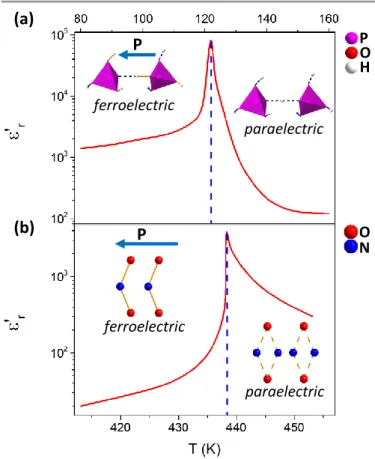
(36) Chapter 1: Introduction More details on the classification of the dielectric materials as a function of their crystalline symmetry can be found in the Figure 1-5. Here the 32 Laue crystalline classes are grouped as a function of the presence (or lack) of symmetry center, which determines the piezoelectric and pyroelectric properties. Within these materials, the highest relative permittivities are found in the group of the so-called ferroelectric materials, which display permanent dipoles aligned parallel along a defined polarization axis. 1.1.2. Ferroelectric and antiferroelectric materials8-10 A ferroelectric material is a pyroelectric where the spontaneous polarization, which is related to the presence of permanent dipoles, can be reversed by the application of an external electric field. Differently from the case of conventional dielectrics, in ferroelectric materials the relationship between the polarization, P, and the applied electric field, E, is not linear, and it displays a hysteresis cycle, see Figure 1-6a. On the other hand, antiferroelectric materials, can be defined as those constituted by two spontaneously polarized sub-networks antiparallel aligned.. (a). temperature the long-range dipole cooperative order is lost and a paraelectric phase, where the electric dipoles are randomly oriented, is obtained. Ferroelectric properties can be essentially originated by two main processes related to structural phase transitions, namely:12 (i) Ionic displacement processes, where the macroscopic polarization is associated with a relative displacement of the positive and negative ions from their equilibrium positions. The most representative materials are those displaying perovskite and related structures, where the most typical example is the barium titanate ceramic, BaTiO3.13 Below Tt = 393 K (120 °C), BaTiO3 shows a polar structure with tetragonal symmetry and P4mm space group, where the Ti4+ cations are in a distorted [TiO6] octahedral environment. This distortion originates a displacement of the positive charges, related to Ti4+ cations, respect to the negative charges, associated with the O2- anions, see Figure 1-7. As a result, below Tt, BaTiO3 exhibits a ferroelectric structure. Meanwhile, above the critical temperature Tt, it shows a nonpolar structure with cubic symmetry space group ̅m, where the Ti4+ cations are located in the center of Pm3 regular [TiO6] octahedra, giving rise to a paralectric phase.. P ferroelectric. (b). paraelectric Ba O Ti. Figure 1-7. Ferroelectric-paraelectric transition associated with ionic displacement processes in BaTiO3 (adapted from Ref. 13). Inset: Unit cell of BaTiO3 below and above the structural transition temperature, Tt = 393 K. Figure 1-6. Hysteresis cycles for (a) ferroelectric and (b) antiferroelectric materials.. These materials, where a metastable ferroelectric phase can be induced by an electric field,11 exhibit a double hysteresis cycle, see Figure 1-6b. Most of the materials with ferroelectric and antiferroelectric properties, can undergo structural transitions at a critical temperature, Tt. Above this. 6. (ii) Order-disorder processes, where ions, molecules, or even hydrogen bonds can experience a transition from an ordered state to a disordered one, above a critical temperature Tt. Sodium nitrite, NaNO2, and potassium hydrogen phosphate, KH2PO4, are very characteristic examples. In the KH2PO4 compound, also known as KDP, the polarization is the result of the dynamic of the protons.
(37) Chapter 1: Introduction within the hydrogen bonds, which induce a structural and dielectric transition,12 see Figure 1-8a. Below Tt = 123 K (-150 °C) this material exhibits a tetragonal phase, space ̅2d; meanwhile, above this temperature it group I4 displays an orthorhombic symmetry with a polar Fdd2 space group. In both structures, the KDP exhibits PO43tetrahedra which alternate with K+ cations along the c-axis, and where the phosphate units are linked by hydrogen bonds in the ab-plane forming a 3D network. Below Tt, the hydrogen atoms are ordered and locally bonded to a specific PO43- oxygen atom, displaying a polar order (ferroelectric phase).. (a) P O H. P. electric dipoles which are parallel aligned along the b-axis of the crystal, see Figure 1-8b. Meanwhile, when increasing the temperature above Tt, the NO2- anions are crystallographically disordered and the polarization disappear. It should be noted that the here presented classification of ferroelectrics as a function of these two main mechanisms is a simplification to facilitate their study; and that in most ferroelectric materials, both mechanisms often appear associated.16 1.2. Multiferroic materials The so-called multiferroics are materials in which two or more ferroic properties coexist (ferroelectricity, ferromagnetism and/or ferroelasticity).. ferroelectric paraelectric. (b). O N. P. ferroelectric. paraelectric. Figure 1-8. Dielectric transition associated to the order-disorder structural transition of (a) KH2PO4 (adapted from Ref. 14) and (b) NaNO2 (adapted from Ref. 15).. Meanwhile above the critical temperature, the hydrogen atoms are randomly disordered between the oxygen atoms, although in average they are located in crystallographic positions at an equidistant distance between these oxygen atoms, giving rise to a paralectric phase. On the other hand NaNO2 displays a different orderdisorder process. This compound undergoes a structural transition from a ferroelectric to a paraelectric phase at Tt = 438 K (165 °C).15 In the ferroelectric phase this material exhibits a polar orthorhombic structure space group Im2m, where the NO2- are ordered and display. Figure 1-9. Scheme of coexistence and interactions of functional properties (polarization, P, magnetization, M, and deformation, ) in multiferroic materials driven by different external stimuli: electric field (E), magnetic field (H) and stress ().. Ferromagnetic. Ferroelectric P. M H. E Multiferroic P,M E,H. Figure 1-10. Properties coexisting in magnetoelectricmultiferroic materials (adapted from Ref. 17).. 7.
(38) Chapter 1: Introduction These compounds can exhibit spontaneous polarization (P), magnetization (M) and/or deformation (), which can be modulated by either an applied external electric field (E) or a magnetic field (H) and/or stress (), see Figure 1-9. The growing trend of miniaturization of electronic devices, boosted by the society’s demand, gives rise to an accelerated research on novel multifunctional materials which can supply the requirements of the technology industry. In this context, the multiferroic materials with magnetoelectric coupling, where magnetic and dielectric properties coexist and are coupled in a single phase material, have attracted great attention in view of the possibility of modifying the magnetization by an electric field or the polarization by the application of an external magnetic field,18 see Figure 1-10. Based on these properties, it would be possible to design a new generation of data storage devices where the information could be either electrically or magnetically written and/or read, giving rise to the socalled multistate memories.19 Advances on these multiferroic materials would broad the Materials Science frontiers and would set new horizons in technological applications, such as spintronics and quantum computing. However, up-to-date, single phase multiferroics are rare as the conventional mechanisms for long-range electric order and cooperative magnetic order are mutually exclusive.20 Most of the ferromagnetic materials display a centrosymmetric space group and require the presence and interactions of transition metal cations with unpaired electrons (mainly electrons at d or f orbitals). Meanwhile, ferroelectric materials usually involve offcentering of transition metal cations with d0 configuration and they display non-centrosymmetric crystal structures. Therefore, the search for new multiferroic compounds constitutes one of the big challenges in modern Solid State and Materials Science. The limited number of single. (b). (a). (c). phase magnetoelectric-multiferroic materials described so far are mainly oxides and can be classified into two subgroups as a function of the mechanisms responsible for their ferroelectricity: (i) Multiferroics type-I, also known as proper multiferroics, where the ferroelectricity and the ferromagnetism show a different origin. Herein the magnetoelectric coupling is weak because the electric and magnetic order as they arise from two different sublattices of cations present within the same phase. A characteristic example is the ceramic BiMO 3 (M = Fe3+, Mn3+, Cr3+, Co3+ and Ni3+) with perovskite structure. In this case, the s2 lone electron pair of the Bi3+ cations generate a structural distortion responsible for the ferroelectricity, while the magnetic order is related to the interaction of the dn unpaired electrons of the M3+ cations through the O2- anions. (ii) Multiferroics type-II, also known as improper multiferroics, in which the ferroelectric order appears as a consequence of another type of order, such as a magnetic order or a charge reorientation. The hexagonal manganites are a clear example of improper multiferroics.21 Above a critical temperature Tt, these compounds display a centrosymmetric crystalline structure, while when cooling below Tt, they undergo a complex magnetic transition that breaks the spatial inversion symmetry and induce a ferroelectric state.. 1.3. Solid state cooling materials Nowadays, refrigeration systems are ubiquitous in either industrial plants, service buildings or living spaces for maintaining the appropriate temperature of technological machines, electronics, foodstuffs, beverages, medicines, and a large list of daily utilities. Refrigeration represent more than 20 % of the total energy consumed in the world, and therefore is one of the main sinks of the global electricity consumption.22,23 Even more, this energy demand is expected to grow dramatically in the coming decades.. (d). Figure 1-11. Stimuli-driven solid state cooling materials where the external stimuli can be a (a) magnetic field, (b) electric field, (c) isostatic pressure or (d) uniaxial strain.. 8.
(39) Chapter 1: Introduction Currently, the conventional cooling devices essentially relies on the vapour compression of hazardous gases, although, this mature and relatively low capital cost technology has a number of important drawbacks,24 specially: (i) The hazardous and pollutant gases involved in the compression processes, that include the use of hazardous chemicals (ammonia (NH3)), ozone depleting chemicals (such as the already prohibited chlorofluorocarbons (CFCs)) , or greenhouse gases (hydrochlorofluorocarbons (HCFCs) and hydrofluorocarbons (HFCs), which in turn are going to be prohibited in Europe in 2020 by the EU Regulation No 517/2014). (ii) Even the newest most efficient units operate well below the maximum theoretical efficiency, and few, if any, further improvements may be possible with the existing vapour-cycle technology. In view of this background, refrigeration based on solid state materials with large caloric effects (that is, with large temperature changes when an external field is applied) is becoming a very attractive alternative to the vapour compression technology as it would offer a number of significant advances as compared with the gas compression technology,22 specially: (i) Considerable operating cost savings by eliminating the most inefficient part of the refrigerator, the compressor, resulting in cooling efficiencies which can be higher than the 45% in the best gas-compression refrigerators. (ii) In addition to their energy savings potential, this technology is an environmental sound alternative to vapourcycle refrigerators and air conditioners, as it does not use ozone-depleting or global-warming volatile fluid refrigerants, but only solid refrigerants and common heat transfer fluid (e.g.: water, alcohol, or air, between others). (iii) It may be built more compactly because the main working material is a solid, and the smaller footprint for operation and the scalable mechanism open up further applications such as cooling of microsystems, very important, for example, for cooling electronic devices (iv) These refrigerators generate much less noise. Solid state materials with stimuli-driven caloric functional properties can be grouped into different categories depending on which external stimulus is needed to provoke the corresponding caloric effect, understood as an adiabatic change of the temperature and/or an isothermal change of the entropy induced by such stimuli.22,25 In this context, and as sketched in Figure 1-11, there are four types of solid state caloric materials, namely: magnetocaloric materials (where the caloric effect is induced by an external magnetic field), electrocaloric materials (the effect is induced by an external electric field), elastocaloric materials (those whose effect is produced by an uniaxial strain) and barocaloric materials (where an isostatic pressure is responsible for the caloric effect) materials. Normally, the entropy of a caloric material decreases when an external stimulus (magnetic, electric or mechanic field) is applied isothermally; meanwhile its temperature increases when this stimulus is applied adiabatically. This. effect can be used in a cooling cycle, as shown in Figure 1-12. When an external field is applied, the material releases heat to a heat sink (e.g.: atmosphere, interchange fluid, etc.) and when the field is removed, the material cools down and absorb heat from the desired cold reservoir, device and/or space (fridge, smartphone, computer, etc.). Figure 1-12 shows the main four stages of a cooling system based on solid state materials, the so-called refrigerating cycle. On the first step the stimulus is applied in adiabatic conditions, increasing the temperature of the material. Secondly, the material cools down under a constant value of the stimulus and transfers the heat to a heat sink. On the third stage, the stimulus is removed in adiabatic conditions and the material cools further. Finally, the already cooled material absorbs heat from the cold reservoir (a fridge in this case) recovering the initial state.. Figure 1-12. Refrigeration cycle for a solid state cooling material where the external stimulus can be either a magnetic or electric field, a uniaxial strain or a isostatic pressure.. Solid state cooling is a rather recent research area, where scientific publications remain scarce and where most of efforts have been focused on magnetocaloric and electrocaloric materials, the ones showing higher caloric effects,22,23,25 see Figure 1-13. Notwithstanding, these materials often require complex synthesis methods, rather expensive materials (many of them containing rare-earths, such as Gd, Gd5Si2Ge2 [Ref. 26] or Fe49Rh51 [Ref. 27]) and high magnetic or electric fields that are technologically limited and/or can produce breakdown of the materials.. 9.
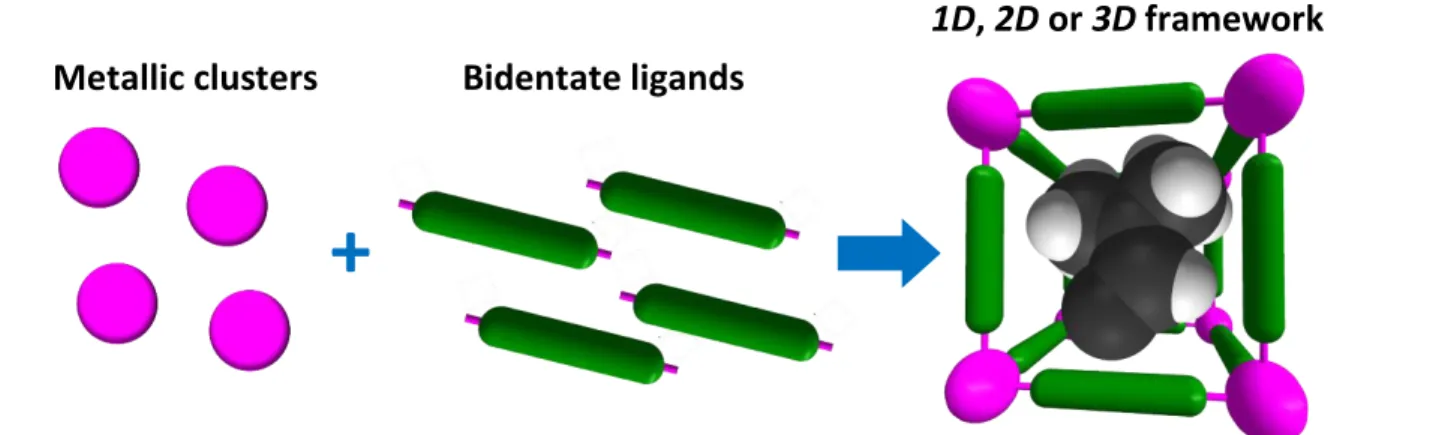
(40) Chapter 1: Introduction Meanwhile, mechanical driven caloric effects (barocaloric and elastocaloric) would be in principle technological and economically more accessible. Nevertheless, less efforts have been devoted to their study, which have focused on expensive metal alloys and some inorganic salts.. Therefore, further exploration in novel compounds are indispensable to design more efficient and economically accessible stimuli-driven caloric materials in order to replace the conventional hazardous and pollutant refrigerant fluids.. 1.4. Precedents of organic-inorganic hybrids with dielectric properties, multiferroicity and temperature and pressure responsiveness. Figure 1-13. Publications on caloric materials along the last decades showing magnetocaloric (MC) publications (blue solid line), electrocaloric (EC) publications either in films (green dotted line) and bluk + films (green solid line), and mechanocaloric (mC) publications including barocaloric (BC) + elastocaloric (eC) materials (red solid line) or only barocaloric materials (red dotted line). Adapted from Ref. 28.. The reason for the limited exploration of mechanocaloric effects in solid state materials is that, up to now, such caloric effects have been observed to be negligible, due to their small entropy change associated with the phase transition and/or to the reduced pressure response.23,28,29 That is the case, for instance, of the inorganic perovskites Pr1-xLaxNiO3 [Ref. 30,31], PbTiO3 [Ref. 32] and BaTiO3 [Ref. 33], (ΔS ≈ 3-4 J K-1 kg-1). Nevertheless, recent studies have reported giant barocaloric effects associated with giant magnetocaloric response,34,35 although they have only been described in a few and relative expensive magnetic materials.. Organic-inorganic hybrids can be defined as compounds which incorporate organic and inorganic units as building blocks in the same crystalline structure. Such building blocks consist of metal cations or metallic clusters linked by bidentate ligands, normally organic, which form frameworks with different dimensionalities (1D, 2D or 3D) that can allocate guest molecules inside their cavities, see Figure 1-14.36,37 The innumerable possibilities of different bidentate ligands, metallic clusters and/or guest molecules result into a great structural richness and functional versatility of these emergent materials, which can find applications in several scientific and technological fields. In addition, these materials can be classified as a function of their porosity into porous or dense hybrid materials.38 Those known as porous hybrids are composed by large and flexible ligands that form large opened cavities or channels which facilitate the diffusion, interchange and release of guest molecules, see Figure 1-15. These materials have received a lot of attention since the 90s due to their potential applications in catalysis, molecular separation, gas storage or pollutant removal, between others.39-41 On the other hand, dense hybrids contain shorter ligands that form smaller cavities where the guest molecules are confined with a much more limited mobility, see Figure 1-16. As a result, dense hybrids, with structures that remind of those of some classic inorganic solids, have been recently found to also present functional and multifunctional properties, such as optic, magnetic or electric properties.42. 1D, 2D or 3D framework Metallic clusters. Bidentate ligands. + Figure 1-14. Coordination scheme of the building blocks that form an organic-inorganic hybrid material.. 10.
(41) Chapter 1: Introduction. Mn O C. Meanwhile above the transition temperature, these cations are rotating inside the cavities breaking the polar order, see Figure 1-17.. (a) C N H M O. Figure 1-15. Crystalline structure of the porous MOF with. (b). molecular formula [Mn3(HCOO)6 ]·[G] (G = H 2 O· CH3OH).. 1.4.1. Dielectric and multiferroic hybrid materials with emphasis in hybrid perovskites During the late 60s, K. Okada and H. Sugie 43 reported for the first time the dielectric response of an organicinorganic hybrid material with molecular formula Cu(HCOO)2·H2O, for which they described an antiferroelectric behaviour below 235 K. Nevertheless, it was not until 2005 when A. Kobayashi et al. observed a ferroelectric-paraelectric transition in porous hybrids of formula [Mn3(HCOO)6]·[G] (G = H2O·CH3OH and CH3CH2OH, respectively),44,45 see Figure 1-15. In the meantime, the first dielectric transitions found in dense hybrids was described by A. K. Cheetham et al. for the [(CH3)2NH2][M(HCOO)3] (M = Zn2+, Mn2+, Co2+, Ni2+ and Fe2+) materials.46,47 These materials display a perovskite-like structure, ABX3 where A = dimethylammonium ((CH3)2NH2+), B = transition metal cations (M2+) and X = formate anion (HCOO-), see Figure 1-16. These authors set the origin of this dielectric transition on an antiferroelectric-paraelectric phase transition driven by ordering of the hydrogen atoms between the dimethylammonium cations, [(CH3)2NH2+], and the M(HCOO)3- framework, in a mechanism similar to that exhibited by KH2PO4. Nevertheless, a later study of our research group resolved the crystal structure of the [(CH3)2NH2][Mn(HCOO)3] compound below the transition temperature, as non-centrosimetric space group Cc, and concluded that the compound shows a ferroelectricparaelectric phase transition.48 This study also reported the mechanism responsible for the dielectric transition associated with the structural one: an order-disorder phase transition, where at low temperature the dimethylammonium cations “freeze” inside the pseudocubooctahedral cavities in a cooperative ferroarrangement.. Figure 1-16. (a) Perovskite-like structure of the [(CH3)2 NH2][M(HCOO)3 ] compounds. (b) Detail of the order of the [(CH3 )2NH2+] cations located inside the cavities. The hydrogen of the [(CH3 )2NH2+] are omitted in both pictures for a better view.. Figure 1-17. Real part of the dielectric permittivity as a function of temperature for the [(CH3)2 NH2 ][Mn(HCOO)3 ] compound. Inset: Order-disorder process associated with the [(CH 3 )2NH2 ] cations inside the perovskite caivities.. 11.
(42) Chapter 1: Introduction Similar dielectric properties are displayed by other members of the series [(CH3)2NH2][M(HCOO)3] (M = Mg2+, Mn2+, Fe2+, Co2+, Ni2+, Zn2+, etc.) and also perovskite-like structure, with the Mg compound showing the highest Tt (∼270 K).49 Very remarkably, in addition to dielectric properties, the [(CH3)2NH2][M(HCOO)3] (M = Mn2+, Fe2+, Co2+ and Ni2+) compounds also exhibit weak ferromagnetism (wfm), in a range of temperatures between 8.535.6 K,50-52 meaning in turn that these materials are also multiferroic materials, see Figure 1-18.. Figure 1-18. Magnetic transitions observed in [(CH3)2 NH2][M(HCOO)3 ] hybrids (adapted from Ref. 53).. the. In view of these interesting functional and multifunctional properties of these hybrid perovskites, further studies were performed. One of the more recurrent strategies used in the recent years have consisted in maintaining the perovskite-like structure making carefully planned modifications, in order to find novel functional properties and establish structureproperties relationships. Beyond the substitution of the M2+ cations on the B-site, great efforts have been devoted to the introduction of different midsize alkylammonium cations in the A-site and even with different bidentate-bridge X-site anions. In this context, the A-site substitutions led to a large family of [AmineH][M(HCOO3)] compounds, where the used alkylammonium cations can range from the linear ethylammonium (CH3CH2NH3+)54 or hydrazinium + 55 (NH2NH3 ) cations to the cyclic guanidinium (C(NH2)3+)56,57 or imidazolium (C3N2H5+)58 cations. These hybrids perovskites also exhibit very interesting properties, for instance the [C3N2H5][Mn(HCOO)3] displays a coexistence of magnetic order below 9 K and electric order below 220 K.58 The multiferroicity found in these [AmineH][M(HCOO)3] (Amine = CH3NH2+ or C3N2H5+) compounds, is described as multiferroicity type-I, where. 12. the magnetic properties arise from the interaction between the magnetic cations of the framework, and the dielectric properties are related to the dynamic of the alkylammonium cations inside cavities. On the other hand, recent discussion have opened up studies of multiferroicity type-II in this formate perovskites, where the electric polarization could be modulated by an external magnetic field and vice versa. This magnetoelectric coupling has been predicted by theoretical calculations in the [C(NH2)3][Cu(HCOO)3], [C(NH2)3][Cr(HCOO)3] and [CH3CH2NH3][Mn(HCOO)3] compounds.54,57,59,60 In addition, experimental data have revealed magnetoelectric coupling at temperatures above the magnetic transition in the case of the [(CH3)2NH2][Mn(HCOO)3]61 and below the magnetic transition for the [(CH3)2NH2][Fe(HCOO)3].62 Very recently, our research group has reported the first example of magnetic ordering-induced multiferroic behaviour in a metal-organic framework magnet: the [CH3NH3][Co(HCOO)3] compound. In this material, the A-site cation strongly distorts the framework, allowing anisotropic magnetic and electric behaviour and coupling between them to occur, giving rise to a type-II multiferroic material.63 On the other hand, although most of the studies have been focused on formate-bridged perovskites, there are some examples of cyanide-bridged perovskite hybrids that also show thermally-induced structural transitions and dielectric responsiveness associated to orderdisorder processes of the A-site cations. These cyanidelinked perovskites combine the alkali metal cation K+ and different M3+ transition metal cations in the B-site, while diverse alkylammonium cations are located in the A-site, resulting in the so far described compounds [Him]2[KM(CN)6] (Him = imidazolium cation, M = Fe3+ and Co3+),64,65 [(CH3)2NH2]2[KCo(CN)6],66 and [(CH3)nNH4-n]2[KFe(CN)6] (n = 1-4).67 Aside from the wide structural and functional diversity found in [AmineH][M(HCOO)3] and [AmineH]2[KM(CN)6] perovskite families, recent studies have also used azide (N3-) as X-site bidentate-bridged anions, finding new properties. For instance, a cation-dependent structural transition was described in the [(CH3)nNH4-n][Mn(N3)3] (n = 1–4) family, which also exhibits a magnetic bistability.68 The analogous [(CH3)2NH2][Cd(N3)3] was found to exhibit ferroelasticity (cooperative deformation order) at room temperature.69 Moreover, our research group has recently reported the coexistence of the three ferroic orders: ferroelectricity, ferromagnetism and ferroelasticity in the [(CH3)2NH2][Mn(N3)3] compound.70 Another very promising, yet very less explored, family of perovskite-like materials is that which integrates the larger X-site bidentate-bridge dicyanamide anions (N(CN)2-)..
(43) Chapter 1: Introduction. A-site cation BTBA+. BTEA+ M N C H. TPrA+. Figure 1-19. Perovskite-like structure of the [A][M(dca)3] compounds.. In that regard, while the HCOO-, N3- and CN- ligands exhibit a similar length (447 pm, 447 pm, 395 pm, respectively),71 (N(CN)2)- is much longer (733 pm). Only very few relative voluminous A-site cations have been able to template a perovskite-like structure, so far benzyltributylammonium (BTBA+), benzyltriethyl+ ammonium (BTEA ) and tetrapropylammonium (TPrA+).72,73 These resulting compounds are formed by [MN6] octahedra linked by μ1-5-dicyanamide ligands (through both nitrile groups), where the A-cations are located in pseudo-cubooctahedral cavities, see Figure 1-19. It should be noted that attempts to use other A-site cations have led to other structures different from the perovskite, such as triple-rutile for A = tetrabutylammonium (TBA+) or LiSbO3-type structure for A = tetrapentylammonium (TPA+).73 1.4.2. Temperature and pressure responsive hybrid materials The high flexible nature of hybrid compounds together with the possibility of combining different functional building blocks, such as magnetic metal cations, polar molecules or chromophore groups, make these compounds a suitable target for (multi)stimuli responsive studies. In principle, these materials can present very diverse responses as a function of external stimuli (magnetic or electric field, temperature, pressure, light, etc) which can be especially strong in the case of applying pressure and temperature due to their rather high flexible structures. In addition, these stimuli can be applied isolated or in combination, leading to multistimuli responsive materials that can give rise to multifunctional properties. In the present memory we are paying special attention to probably two of the more easily and economically accessible external stimuli: temperature and pressure.. Temperature is probably the most studied external stimulus towards which the hybrid materials are quite sensitive. The increase of temperature can produce either amorphization of the material, structural transitions and even anomalous effects, such as negative thermal expansion (NTE), that is, contraction when heated.74 While NTE and thermal amorphization of hybrid materials are rare behaviours, the thermally-induced structural transitions are very common phenomena and attract great attention, especially, in dense hybrids where the phase transitions directly affect the functional properties, such as dielectric, magnetic and multiferroic properties, as it has been explained in the previous sections. On the other hand, despite the fact that hybrids are expected to exhibit high sensitivity to applied external pressure, these kind of studies have remained scarce upto-date. Nevertheless, the relative few data on hybrids exposed to external applied pressure have demonstrated a wide variety of mechanical behaviour towards this pressure,75 namely, amorphization of the material (very common in zeolitic imidazolate frameworks, such as ZIF4), phase transitions, bond rearrangement or proton transfer, see Figure 1-20. Moreover within the elastic regime, it has been experimentally demonstrated (and/or theoretically predicted) that hybrids can display anomalous mechanical responses, such as negative linear compressivity (NLC) that occurs when under compression the material expands itself in a specific direction, although the overall volume gets reduced. 76. 13.
(44) Chapter 1: Introduction ZIF-4. MIL-53. Amorphization. Phase transition. [tmenH2][Er(HCOO)4]2. Bond rearrangement. ZAG-4. Proton transfer. Figure 1-20. Representation of different responses of hybrid compounds to the application of external pressure (adapted from Ref. 75).. Besides the pressure-induced amorphization, which is more common within porous hybrids rather than in dense hybrids, some of these materials undergo phase transitions under high pressure application in the GPa scale. Earlier studies on porous hybrids dealt with phase transitions induced by internal pressure, triggered by the adsorption/desorption of guest molecules, known as “breathing” transitions. Meanwhile during the past few years, there has been an increasing interest in crystallographic studies under external applied pressure on diamond anvil equipped diffractometers, which have revealed that external pressure also drives structural transitions similarly to internal pressure. This is the case, for example, of the MIL-53 compound, which exhibits the same phase transition either by CO2 adsorption or by isostatic external compression.77 An even more uncommon, but highly desirable, behaviour is that of pressure-induced chemical reactions. So far, there are only two described examples of hybrids which have experienced chemical reactions under applied pressure. The first case consist in a reversible pressure-induced bond rearrangement of the [tmenH2][Er(HCOO)4]2 compound (tmenH22+ = N, N, N’, N’-tetramethylethylenediammonium).78 The second example was found for a zinc alkyl gate compound (ZAG-4), where the external pressure provokes a reversible proton transfer between a water guest molecule and a phosphonate group of the framework.79 Although scarce, the pressure-response studies on organic-inorganic hybrids have revealed a high sensitivity towards this external stimulus that can induce even structural transitions with large entropy change associated. Nevertheless, as far as we know, there was not any study about the pressure-induced cooling properties of hybrid organic-inorganic materials.. 14. Therefore, this Ph.D. Thesis aims to be the first experimental study on the cooling properties of these flexible and large pressure-responsive organic-inorganic hybrid materials. As reported in chapter 4, these findings open new opportunities for solid state cooling materials, expanding the horizons of the emergent field of multifunctional and multistimuli organic-inorganic hybrid materials.. 1.5. Precedents of organic-inorganic hybrid materials as precursor for functional carbon nanomaterials Hybrid nanocomposites of carbon nanotubes embedded with magnetic nanoparticles (M@CNTs) are emerging materials with an enormous technological interest related to their multifunctional properties and applications in several fields, such as pollutant removal and magnetic recuperation, spintronic, enhanced optical properties, for very sensitive spectroscopic techniques, magnetic resonance imaging, drug delivery, cancer treatment through hyperthermia, between others. Nevertheless, nowadays most of synthetic procedures to obtain them involve several-step reactions, relatively complex operational conditions, high cost, low reproducibility or difficulties in terms of practical applications. Therefore, it is necessary to develop novel, simple, reproducible, scalable and low-cost methods to obtain well-defined [email protected] In this context, since organic-inorganic hybrid compounds combine organic subunits and metal ions/clusters and their composition and porosity can be easily controlled, these materials are very attractive as precursor for mesoporous and nanoporous carbon materials by simple direct calcination,81 see Figure 1-21..
(45) Chapter 1: Introduction Recent studies have highlighted the potential of hybrid compounds, such as Al-PCPs,82,83 MOF-5 and isoreticular compounds (IRMOF),84,85 ZIF-8,86 ZIF-67,87 and related materials. Nevertheless, results on obtaining carbon nanotubes embedded with magnetic nanoparticles remain very scarce up-to-date.88,89 Trying to elucidate novel and simple, as well as scalable and unexpensive, synthetic routes, the here presented Thesis Dissertation aims to explore the potential of new organic-inorganic hybrid materials as precursor for obtaining well-defined M@CNTs for environmental applications.. (ii) Synthesis of nanostructured carbon materials by using hybrid organic-inorganic materials as precursors. The selected hybrid precursors have been the Ni and Co members of the dicyanamide-bridged [TPrA][M(dca)3] perovskite series. (iii) Revisiting “classic” materials that are known to undergo thermally-induced phase transitions of orderdisorder and displacive nature, and which could display functional properties. The selected candidates have been the very well-known ferrocene, [Fe(C5H5)2], and ammonia-borane, (H3N·BH3). (iv) Compositional, structural and/or morphological characterization of the obtained samples by using elemental analysis, X-ray diffraction, IR and/or Raman spectroscopy, thermal analysis, electron microscopy, etc. (v) Structural characterization of the obtained samples as a function of temperature by using single-crystal X-ray diffraction, powder X-ray diffraction and/or high-resolution synchrotron powder X-ray diffraction. (vi) Calorimetric analysis of the obtained samples as a function of temperature, external hydrostatic/uniaxial pressure and internal chemical pressure.. Figure 1-21. Scheme of carbon nanomaterials synthesis by direct calcination of organic-inorganic hybrids.. (vii) Study of the dielectric properties as a function of different external stimuli: temperature, external hydrostatic/uniaxial pressure and internal chemical pressure.. 1.6. Main objectives of this work. (viii) Study of the adsorption nanostructured carbon materials.. As already mentioned in previous paragraphs, one of the main scopes of this Ph.D. work is to study and develop framework materials as candidates for displaying new (multi)functional properties that could be modulated by multiple external and internal stimuli and even tuning the properties by chemical doping. In addition, these studies also focus on the development of organic-inorganic hybrids as precursors of nanostructured carbon materials. Finally, the alternative approach of revisiting “old” compounds in the search for new functional properties has also been explored. In this context, this dissertation revisits very well-known “classic” molecular materials and delve into the rather young, but very fast growing group of organic-inorganic hybrid compounds, especially those with perovskite-like structure. Therefore, the main objectives of this work can be summarized as follow: (i) Synthesis of “emergent” hybrid compounds with perovskite-like structure that could display structural phase transitions and functional properties, which could be modulated by different external stimuli. The selected “emergent” hybrid materials have been the dicyanamidebridged [TPrA][M(dca)3] (M = Mn2+, Fe2+, Co2+ and Ni2+) perovskites, that have being remained scarcely explored upto-date.. capacity. of. the. (ix) Establishing the relationships between crystal structure, (multi)functional properties and external stimuli, in the materials under study.. 1.7. References 1 Callister, W. D.; Rethwisch, D. G. Materials Science and Engineering: An Introduction; John Wiley & sons, New York 2007. 2 West, A. R. Solid State Chemistry and its Applications; John Wiley & sons, New York, 1984. 3 Abella-Martín, J. M.; Martínez Duart, J. M. Física de dieléctricos; Boixareu: Barcelona, 1984. 4 Park, H. D. Theory of Ferroelectric Pyroelectric Detectors; Minnesota, U. of, Ed.; 1975. 5 Haertling, G. H. J. Am. Ceram. Soc. 1999, 82, 797. 6 Samara, G. Solid State Phys. 2001, 56, 239. 7 Zhang, W.; Xiong, R.-G. Chem. Rev. 2012, 112, 1163. 8 Hippel, V. Dielectrics and Waves; John Wiley & sons, New York, 1954. 9 Schelkens, R. Phys. Status Solidi 1970, 37, 739. 10 Horiuchi, S.; Tokura, Y. Nat. Mater. 2008, 7, 357. 11 Martienssen, W.; Warlimont, H. Ferroelectrics and antiferroelectrics in Handbook of condensed matter and materials data; Mitsui, T., Ed.; Springer: Berlin Heidelberg, New York, 2005.. 15.
Figure


+7

![Figure 1-17. Real part of the dielectric permittivity as a function of temperature for the [(CH 3 ) 2 NH 2 ][Mn(HCOO) 3 ] compound](https://thumb-us.123doks.com/thumbv2/123dok_es/7379739.374271/41.893.482.825.726.1005/figure-real-dielectric-permittivity-function-temperature-hcoo-compound.webp)

![Figure 2-6. Detail of low-angle synchrotron powder X-ray diffraction patterns of the [TPrA][Mn(dca) 3 ] compound obtained at different temperatures between 260 K and 400 K in steps of 10 K](https://thumb-us.123doks.com/thumbv2/123dok_es/7379739.374271/55.893.474.847.762.1017/figure-synchrotron-diffraction-patterns-compound-obtained-different-temperatures.webp)
Outline
Documento similar
上田キャンパス Matsumoto Campus Nagano-Engineering Campus Ina Campus Ueda Campus Faculty of Arts Faculty of Education Faculty of Economics and Law Faculty of Science School
Jointly estimate this entry game with several outcome equations (fees/rates, credit limits) for bank accounts, credit cards and lines of credit. Use simulation methods to
Least Squares Initialisation (LSI) has the aim of improving the initial conditions of partially initialised systems by utilizing the information from observations of limited
The study group comprises 171 patients examined at the Oral Medicine Unit at Department of Dentistry Cli- nic Charles University in Prague, Faculty of Medicine and
2 Modeling and Molecular Simulation Group - CDMF, São Paulo State University, 17033-360, Bauru, SP, Brazil.. 4 Department of Analytical and Physical Chemistry, University Jaume
60 (a) Department of Modern Physics and State Key Laboratory of Particle Detection and Electronics, University of Science and Technology of China, Hefei, China; (b) Institute
60 ( a ) Department of Modern Physics and State Key Laboratory of Particle Detection and Electronics, University of Science and Technology of China, Hefei; ( b ) Institute of
60 ( a ) Department of Modern Physics and State Key Laboratory of Particle Detection and Electronics, University of Science and Technology of China, Hefei; ( b ) Institute of
