
English tourist handbook service to improve the performance of customer service in the Shuar Community in the recinto Limón, city Antonio Elizalde “Bucay” province of Guayas during the year 2015 2016
42
0
0
Texto completo
(2) II.
(3) AUTHORITY. El presente trabajo de investigación, previo a la obtención del Título de: Licenciatura en Ciencias de la Educación, Profesora de Idioma Inglés, es original y basado en el proceso establecido por la Facultad de Ciencias de la Educación, Humanas y Tecnologías. Los criterios en el informe de investigación sobre: “ENGLISH TOURIST HANDBOOK SERVICE TO IMPROVE THE PERFORMANCE OF CUSTOMER SERVICE IN THE SHUAR COMMUNITY IN THE RECINTO LIMÓN, CITY ANTONIO ELIZALDE “BUCAY” PROVINCE OF GUAYAS DURING THE YEAR 2015-2016.”, como también los contenidos, ideas, análisis y conclusiones, son de exclusiva responsabilidad de la autora y del tutor César Narváez Vilema; y el patrimonio intelectual de la misma corresponden a la Universidad Nacional de Chimborazo.. III.
(4) IV.
(5) DEDICATORY. This thesis is dedicated to my grandfather Cacique Juan López Tibiram, for his love, affection and his faith on me, for teaching me to love our culture, for making me believe that nothing is impossible with the blessing of God, for his encouragement when I had no reason to continue with my professional life, for all of that and much more. His selflessness will always be remembered in my heart and my soul, I love you.. Dina Elizabeth Jimbicti López. V.
(6) ACKNOWLEDGEMENTS. It would not have been possible to write this thesis without the help and support of the kind people around me.. First, I would like to thank our God for giving me the strength to finish this study and to my family because of their unequivocal support throughout.. To all my friends, especially to Lcda. Elizabeth Córdova who with her experience has supported the well development of the study.. To the Universidad Nacional de Chimborazo for making to every single student to be excellent professionals.. To the Facultad de Ciencias de la Educación, Humanas y Tecnologías and the Escuela de Idiomas that have been our refuge in this journey of dreams and wishes.. I am most grateful to Mgs. Mónica Cadena, for being my Role Model along the career.. To my principal supervisor, Mgs. Cesar Narváez, for guiding and helping in the development of the research.. To my grandfather the Cacique Juan López Tibiram for his love to our culture and education.. VI.
(7) CONTENT INTRODUCTION .................................................................................................................................1 CHAPTER 1 ..........................................................................................................................................3 1.. PROBLEM STATEMENT .......................................................................... 3. 1.1. GENERAL OBJECTIVE: ........................................................................... 4 1.2. SPECIFICS OBJECTIVES:......................................................................... 4 CHAPTER II .........................................................................................................................................5 3.. THEORETICAL FRAMEWORK ................................................................. 5. 3.1. COMMUNITY BASED TOURISM .............................................................. 5 3.2. TOURIST GUIDE SKILLS ......................................................................... 6 2.. Memory and Storytelling ...........................................................................................................6. 3.. Humor ........................................................................................................................................6. 4.. Passion .......................................................................................................................................7. 5.. Flexibility ...................................................................................................................................7. 6.. Punctuality .................................................................................................................................7. 7.. Sensitivity ..................................................................................................................................8 3.3. THE IMPORTANCE OF ENGLISH LANGUAGE SKILLS IN THE TOURISM SECTOR ........................................................................................................ 8 3.4. THE ROLE OF ENGLISH LANGUAGE PROFICIENCY IN TOURISM .......... 8 3.5. IMPORTANCE OF ENGLISH LANGUAGE IN RURAL AREAS .................... 9 3.7. DEFINITIONS OF BASIC TERMS ........................................................... 12. CHAPTER III ......................................................................................................................................14 4.. METHODOLOGICAL FRAMEWORK ....................................................... 14. 4.1. RESEARCH DESIGN .............................................................................. 14 4.2. TYPE OF RESEARCH ............................................................................. 14 4.3. LEVELS OF RESEARCH ......................................................................... 15 4.4. POPULATION AND SAMPLE.................................................................. 15 4.5. TECHNIQUES AND INSTRUMENTS FOR DATA COLLECTION ............... 15 4.5.1.. Techniques ....................................................................................... 15. 4.5.2.. Instrument ........................................................................................ 16. 4.5.3.. DATA PROCESSING AND ANALYSIS TECHNIQUES ........................ 16. 4.5.4. • Conclusions and recommendations.OPERATIONALIZATION OF SPECIFICS OBJECTIVES .............................................................................. 16 CHAPTER IV ......................................................................................................................................17 5.. ANALYSIS AND INTERPRETATION ...................................................... 17. 5.1. DATA PROCESSING, ANALYSIS AND INTERPRETATION OF RESULTS . 17 CHAPTER V .......................................................................................................................................20. VII.
(8) 6.. CONCLUSIONS AND RECOMMENDATIONS .......................................... 20. 6.1. CONCLUSIONS ...................................................................................... 20 6.2. RECOMMENDATIONS ........................................................................... 21 BIBLIOGRAPHY .......................................................................................... 22 ANEXES ...................................................................................................... 24 OBTAINED RESULTS .................................................................................. 25. VIII.
(9) IX.
(10) INTRODUCTION In Ecuador English is not only considered a global language, but also to be a means of economic, education and tourism development. The tourism industry is fast becoming an important revenue generator for Ecuador, therefore; the importance of speaking this language is becoming indispensable, especially in the case of Ethnic Communities, where the major amount of tourist visitors go. Rio Limon is a Shuar Community located in the Canton General Antonio Elizalde “Bucay”. In this community there are 25 people living in; whose principal means to generate economic income is tourism. Some of the activities “The Shuars” do for visitors are: performing traditional dances, explanations of their culture, language, costumes, clothes, etc. offer traditional food, trips by the jungle, integrate visitors in their spiritual rituals and others. Nowadays, this Community is the most visited Tourist Center in the town, and the majority of visitors are from different countries around the world, for that reason the necessity of improving the quality of touristic services is evident, and one worthy strategy is using English to communicate with them. The local authorities have done something in this respect, for instance, there is a Tourist handbook in English developed by the prefecture of Guayas, but from the perspective of natives it does not solved the problematic. Through dialogues with the inhabitants of the Community, it was possible to know that the contents of the manual are too complicated to understand and use for improving the touristic service, due to the knowledge of the Shuars about this language is minimum. For seeking a possible solution to the fact described before, it was proposed this study which main purpose was to evaluate the English tourist handbook and thus look for the best strategy to help the people involved in the research use this resource in their benefit.. 1.
(11) For the accomplishment of this objective it was used a specialized software to measure the complexity of the vocabulary used in the Tourist handbook “ATOS for Text”. The results from this analysis include: ATOS Level, Word Count, Average Word Length, and Average Sentence Length. To identify the current level of English of the natives it was used a diagnostic test which items were designed based on the language used, involving the two oral skills, listening and speaking. The results reflected that effectively the contents include post intermediate and advance vocabulary and the level of the population is low, some of the possible solutions to be implemented would be the development of workshops in which the Shuars can be trained in the language and in the use of the Handbook, in consequence the customers service might be improved. For a better understanding of the research process, this report has been divided into five chapters which contain valuable information about it; The first chapter shows what are the investigated problem and the objectives which were followed to present a possible solution. In the second chapter is presented the theoretical information regarding to the problem. In the third chapter it is explained the methodology, techniques and instruments used to collect data and how these were used to analyze and interpret it. The fourth chapter is about the analysis, interpretation and discussion of the results, and finally. The fifth chapter shows the conclusions and recommendations the researchers made about the study in the Shuar Community in the Recinto Rio Limón.. 2.
(12) CHAPTER 1 1. PROBLEM STATEMENT The development of Tourism worldwide as for Latin America has come from less to more including Ecuadorian Ethnic Tourism. In Ecuador the Tourism is one of the fundamental pillars of economic development. Tourism is the main reason why visitors come to the country, and today there is an increasing interest on community-based tourism because their recreational spaces are suitable for the implementation of extreme sports, adventure, hiking, rides, mountain biking, among others. Unfortunately, the service here is provided is poor in quality, in terms of, much of the time the tourists do not understand what the natives say. They mostly use their native language “Shuar” or Spanish to communicate. For instance, Rio Limon is a Shuar Community with 25 inhabitants located in the Canton General Antonio Elizalde “Bucay”; it was declared an Ethnic Touristic Center by the Ministry of Tourism of Ecuador in 1977 (Acuerdo Ministerial 1400, MINTUR 1977). Currently, Rio Limón is the most visited Tourist Center in the Bucay, and the majority of visitors are foreigners, that are why the necessity to use English to communicate is countless. The local authorities and the prefecture of Guayas have developed a Tourist handbook in English to overcome this problematic, but it does not changed this fact. Through an observation, it was notice that the Shuars cannot use the handbook, they had many problems to put in practice what the document propose. Considering these facts it was proposed the research study entitled “ENGLISH TOURIST HANDBOOK SERVICE TO IMPROVE THE PERFORMANCE OF CUSTOMER. 3.
(13) SERVICE IN THE SHUAR COMMUNITY IN THE RECINTO LIMÓN, CITY ANTONIO ELIZALDE “BUCAY” PROVINCE OF GUAYAS DURING THE YEAR 2015-2016” with the purpose of evaluating this documents and the existing natives’ English level to suggest some possible strategies to foster the use of the handbook in benefit of the community. 1.1. GENERAL OBJECTIVE: - To evaluate the contents of the English Tourist Handbook-Service of the Shuar Community Recinto Limon in the city of Antonio Elizalde "Bucay" Province of Guayas based on the reality of people who live here to suggest some possible strategies to use this resource efficiently and effectively in benefit of all the community.. 1.2. SPECIFICS OBJECTIVES: . To diagnose the current English level of the people living in Rio Limón community.. . To assess the complexity of the vocabulary used in the English Service-Handbook.. . To contrast the complexity of English used in the handbook with the level of the Shuars.. . To propose some possible solutions to face this problematic.. 4.
(14) CHAPTER II 2. THEORETICAL FUNDATION 2.1. BACKGROUND INFORMATION REGARDING TO THE PROBLEM TO BE INVESTIGATED In the Universidad Nacional de Chimborazo there is no similar research to the present one, but around the world there are some related studies which will be the theoretical base of this study, such as: . The Role of the English Language in the Tourism Industry R, Rao (2007). 3. THEORETICAL FRAMEWORK 3.1. COMMUNITY BASED TOURISM Community Based Tourism (CBT) is a unique type of tourism with characteristics quite different from mass tourism. Those who intend to put CBT into practice need to fully understand the underlying ideas, principles and components behind CBT. CBT is not simply a tourism business that aims at maximizing profits for investors. Rather, it is more concerned with the impact of tourism on the community and environmental resources. CBT emerges from a community development strategy, using tourism as a tool to strengthen the ability of rural community organizations that manage tourism resources with the participation of the local people. However, CBT is far from a perfect, prepackaged solution to community problems. Nor is it a miracle cure or a knight in shining armor that will come to save the community. In fact, if carelessly applied, CBT can cause problems and bring disaster. For this reason, communities that are appropriate for the development of CBT must be chosen carefully and adequately prepared before operating CBT. More importantly, the community should have the strength to modify or suspend CBT, should it grow beyond the management capacity of the community or bring unmanageable negative impacts. (Suansri, P. 2003; p 10). 5.
(15) 3.2. TOURIST GUIDE SKILLS Allen Effeh (2016) in a publication of the “Ibom Tourism virtual magazine” suggests the seven most important skills a tourist guide should have. And in detail explain them as follows:. 1. Communication It all comes down to communication. A tour guide must be articulate and easy to understand, and know how to communicate with large and varying groups of people. A good guide will not only have the physical capability to command attention and project their voice clearly, but also have the interpersonal skills necessary to interact with new people every single day, answer questions, and be approachable.. 2. Memory and Storytelling When you run a tour, you’re selling more than just the sights and sounds; you’re selling knowledge, history, and a story, and your guide must make all of that information compelling. If a tour guide is reading off of cards or getting facts wrong, your guests will not be impressed. The ultimate goal is for your guide to know their script so well that it should seem like it’s their own story, and it should flow naturally from them rather than being obviously memorized. They’re not just giving out information; they’re essentially playing a role.. 3. Humor No one wants a dry, boring, humorless history lesson; they zone out, get bored, and just don’t have a good time. A guide with a good sense of humor will be able to inject some zest into. 6.
(16) their scripts and make the guests feel at ease and happy, increasing their enjoyment of the tour and cutting any tensions that may arise.. 4. Passion Even if your guide isn’t a local, they should be able to fool your guests reasonably well by having true insider knowledge of the best restaurants and neat little secrets that only residents tend to know. They should have true passion for the city or activity, and convey that passion to your guests.. 5. Flexibility Of course, a tour guide isn’t up on a stage delivering lines to a passive audience; your guests will have questions and comments, and your guide should be able to react to them with authority and enthusiasm. This means that the guide will need to know more than just the standard script, and be able to draw from that knowledge in an entertaining and compelling way. They need to be able to be flexible with the tour, adjusting for spontaneous moments and using a unique approach for different types of guests.. 6. Punctuality No one wants to sit around waiting for a guide; it’s incredibly unprofessional. Your best tour guides will be punctual to a fault, ready to accept your guests and able to organize them so that there are as few delays as possible.. 7.
(17) 7. Sensitivity You’re going to have guests coming in from all over the globe and all walks of life, and they will have certain cultural expectations and social norms. The best tour guides are sensitive to these international differences, and are able to tailor their deliveries to respect their guests where possible. They should also be able to deal with guests who have special needs. (Steinberg, M. 2015) 3.3. THE IMPORTANCE OF ENGLISH LANGUAGE SKILLS IN THE TOURISM SECTOR Communication skills are an important element of hospitality industry. Understanding of performance expectations are keys to the achievement of tourist satisfaction. Good oral and written communication skills are the top skills important to hospitality practitioners at different position levels. Good English communication during the study will add value to students' education. According to that fact the hospitality program itself will encourage critical thinking and for example tourism problem solving when it is necessary. In the tourism industry supply and demand side must communicate perfectly in order to ensure quality and needed performance standards. In the business tourism practice oral communication is a bit higher than written communication, but both categories are rated high. (Kay and Russette: 2000). 3.4. THE ROLE OF ENGLISH LANGUAGE PROFICIENCY IN TOURISM The role of English language proficiency in the tourism industry is prominent. It is considered as a factor that could affect choice of hotel and satisfaction of stay. It is more important for those who do not often come into direct face-to-face contact with hotel guests such as the reservation staff 10 and hotel management personnel. For hotel staff who often comes into direct contact with hotel guests, qualities such as pleasant disposition, courtesy, and ‘service. 8.
(18) oriented’ are viewed as more important by hotel guests. Hotel guests expected different level of English language proficiency from the various groups of hotel personnel. In short, the guest’s expectation of English language proficiency is relative in nature. The emphasis on English language proficiency should be based on the nature of job. For the staff members who are in direct contact with guests most of the time, qualities such as ‘courtesy’ and ‘pleasant disposition’ should be given higher priority than language proficiency. An equal stress would only hinder the recruitment process and consequently, affect the quality of service provided by a hotel as it would having difficulty employing sufficient number of staff. (Rao, R: 2007). 3.5. IMPORTANCE OF ENGLISH LANGUAGE IN RURAL AREAS 1. English is a universal language. The importance of English can be understood by the fact that English is used worldwide i.e. throughout the world to communicate. 2. JOB Applicants are required to know English as their primary language. -The recruitment process of the companies today is also on the basis of the knowledge of English. -Preference is given to the applicant who has a better command on English and can communicate easily. 3. Help in the development of the rural areas. -Rural areas can be developed only if there is a flow of technology from urban area to rural area. -This can only be achieved by learning a common language i.e. English. -Communication with the NGO’s and other foreign designators will become efficient. 4. INTERNET is the basic source of knowledge worldwide. -To study through internet, English is very crucial. - All the information on the internet is basically in English, therefore to understand and process the information learning English is very important. Therefore, the importance of English cannot be denied in today’s world. 9.
(19) For the development of rural areas, learning English is very crucial. More and more job opportunities are presented to the applicants who are thorough in English. Hence, learning English can bring about development and technology advancement in the rural areas and also in the development of our country. (Rajasekaran, C. & Anburaj G. 2015; p 100) 3.6. SKILLS OF TEACHING ENGLISH IN RURAL COMMUNITIES In learning a language concentration should be on four main skills namely: Listening, Speaking, Reading and Writing. The above order gains importance because gaining one skill leads to the next and so the order is very important. Listening: Listening is the one basic skill which makes speaking possible. Nobody can speak a language without listening to it. Even an infant starts speaking in a particular language after listening to it for many months. As we adapt a syllabus in which writing and reading of English is given much importance, our students are deprived of speaking abilities because they have not been properly guided in listening skills. This may be the basic reason why they have not been able to speak English in a proper manner. The syllabus should be redesigned to make the students listen a lot. Activities for Listening: The following activities can be implemented to improve the listening skills. 1. Listening to recorded speeches, dialogues, interviews and discussions 2. Listening to news bulletins, chat shows, commentaries, weather reports and 68 Ms. B.S. Gomathi announcements on TV. 10.
(20) 3. Watching English movies on Television 4. Watching talk shows on Television 5. Listening to speeches of great statesmen & politicians 6. Watching headlines The above said activities help students learn pronunciation, improve vocabulary, learn jargons related to various fields, helps in better understanding and right usage of words and phrases. Speaking: Creating and exposing students to English speaking environments should be given foremost importance when speaking exercises are designed. Substitution: Substitution of a word, phrase, or sentence by another is an elementary method which helps students to produce new utterances and to develop speaking skill. A sentence frame is practiced first, and then suitable slots in the frame are identified for substitution. When substitution is made, a number of new sentences are produced with ease by students. Day- to – Day Expression: Expressions of greeting, gratitude, small talk, introductions and making acquaintance, leavetaking, appreciation, expressions of regret and asking to be excused, taking routes, counting, terms related to money transaction etc., are very important communicative acts students need to master. Besides the above activities such as role play, mime, debate on real life situations, eliciting vocabulary from pictures provide a wider scope for the students to enhance their speaking skills.. 11.
(21) 3.7. DEFINITIONS OF BASIC TERMS Community based tourism: Is tourism in which local residents (often rural, poor and economically marginalized) invite tourists to visit their communities with the provision of overnight accommodation, where they earn income as land managers, entrepreneurs, service and produce providers, and employees. At least part of the tourist income is set aside for projects which provide benefits to the community as a whole. (Reference: Thokchom, Asha) Tourism Sector: Is defined as the activities of persons who travel to and stay in places outside their usual environment for more than twenty-four (24) hours and not more than one consecutive year for leisure, business and other purposes not related to the exercise of an activity remunerated from within the place visited. (Reference: Tugberk, Ugurlu) Language Skills: Are skills related with language in this case with English in in order to understand and make the most effective use of your study materials, develop the specialized language and vocabulary relevant to your subject, interpret assignment questions and select relevant and appropriate material for your response, write well-structured and coherently presented assignments, without plagiarism, communicate your needs to your tutors and work productively with other students. (Reference: The Open University) Rural Areas: Is a sparsely populated area outside of the limits of a city or town or a designated commercial, industrial, or residential center. Rural areas are characterized by farms, vegetation, and open spaces. (Reference: ResearchClue) Handbook: Provides a useful and practical guide about tourism sector related with: transportation, accommodation, food and beverage, recreation and entertainment travel services and experienced destination. (Reference: Westcott, Morgan) English level: It is the ability of a person to use communicatively the English Language.. 12.
(22) ATOS: It is used to calculate the readability level for shorter text passages such as magazine and newspaper articles, test items, and other classroom materials. The resulting ATOS level does not include any adjustment for overall length (word count) and is expressed as ATOS Level. (Reference: Renaissance). MCER: It is a European standard, also used in other countries, which serves to measure the level of comprehension and oral and written expression in a given language. (Reference: Instituto Cervantes). 13.
(23) CHAPTER III 4. METHODOLOGICAL FRAMEWORK 4.1. RESEARCH DESIGN This study has the characteristics of a descriptive and action research belonging to the qualitative approach because, through the evaluation of the contents of the tourist handbook and the level of the natives in the community Rio Limón, which was developed in the exactly place where the problem occurred, it was possible to describe and analyze it and at the end propose some possible solutions. It was used the ethnographic method to describe what was happening in this context. Moreover, the techniques and instruments used for gathering the data were specialized software “ATOS” for measuring the complexity of vocabulary used in the handbook and diagnostic tests developed based on tourist information to identify the current level the Shuars have in English. All of these applied to the study population. 4.2. TYPE OF RESEARCH This is an exploratory and descriptive research Exploratory research.- because there is not too much information regarding to the problem and it was not intend to offer final and conclusive solutions to the existing problem. Descriptive research.- the collected information was analyzed and explained based on the theoretical framework to deeply understand the different aspects of the phenomenon. Action research.- because the decisions about the process of the study were taken bearing in mind the facts identified along the data collection process, and because the findings were used in benefit of the population.. 14.
(24) 4.3. LEVELS OF RESEARCH The level of this research is descriptive. It was used to describe the characteristics and/or behavior of the population and the problem and also to define, explain and validate the research findings Qualitative method The qualitative method used was the ethnographic, applied to the population through direct observations in order to describe what was happening in this context. And then, based on the theoretical framework, the gathered data was analyzed, described and interpreted to propose possible solutions to the problem identified. 4.4. POPULATION AND SAMPLE This research was developed in the community Río Limón in the city of Bucay with 25 people who live there in. Because the population is relatively small, it was no necessary to take a sample. 4.5. TECHNIQUES AND INSTRUMENTS FOR DATA COLLECTION 4.5.1. Techniques Diagnosis: It was applied a diagnostic test to the natives to know the current level they have regarding to the English language. Automated assessment: it is an evaluation technique that exploits texts in order to measure the overall quality and assign a score to a text. It was used to measure the complexity of English presented in the Tourist handbook of the Shuar community Rio Limón.. 15.
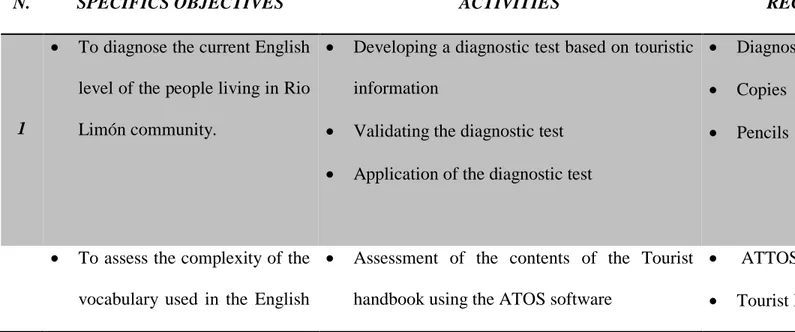
(25) 4.5.2. Instrument Diagnostic test: it was developed based on tourist information to identify the current level the Shuars have in English. ATOS: It is specialized software for measuring the complexity of vocabulary used in the Tourist handbook of the community Rio Limón. 4.5.3. DATA PROCESSING AND ANALYSIS TECHNIQUES •. Critical analysis of the information obtained in the diagnostic phase,. •. Description of the obtained results,. •. Results analysis and interpretation based on the theoretical framework, 4.5.4. • Conclusions and recommendations.OPERATIONALIZATION OF SPECIFICS OBJECTIVES. Table No.1 Operationalization of specifics objectives. N.. SPECIFICS OBJECTIVES . 1. REC. To diagnose the current English . Developing a diagnostic test based on touristic . level of the people living in Rio. information. . Copies. . Validating the diagnostic test. . Pencils. . Application of the diagnostic test. Limón community.. . ACTIVITIES. To assess the complexity of the . Assessment of the contents of the Tourist . vocabulary used in the English. handbook using the ATOS software. . 16. Diagnos. ATTOS. Tourist H.
(26) 2. . Service-Handbook.. Compilation of the result obtained in this . phase . To contrast the complexity. . of English used in the 3. 4. Internet. Compute. Analysis of the obtained results based on. . The. the theoretical framework. . Theo. handbook with the level of. . Interpretation of the gathered data. Tourist H. the Shuars.. . Establishment of conclusions. . Inter. . Com. Establishment of possible solutions to face. . The. the problem. . Tour. . Han. . Com. To propose some possible solutions. to. face. . this. problematic.. By: Dina Jimbicti Source: Specific Objectives CHAPTER IV. 5. ANALYSIS AND INTERPRETATION 5.1. DATA PROCESSING, ANALYSIS AND INTERPRETATION OF RESULTS Community Based Tourism emerges from a community development strategy, using tourism as a tool to strengthen the ability of rural community organizations that manage tourism resources with the participation of the local people. This fact is reflected in the daily activities of people from the community Rio Limón declared an Ethnic Touristic Center by the Ministry of Tourism of Ecuador in in 1977 (Acuerdo Ministerial 1400, MINTUR 1977). Here the tourism is mainly based on the performance of traditional dances, explanations of. 17.
(27) the local culture, language, costumes, clothes, traditional food, spiritual rituals, etc., issues that visitors enormously appreciate. Tourism has changed significantly the reality on inhabitants of Rio Limón in terms of improvement of family income, but this benefit is not reciprocate to visitors, because the quality of tourist services continue being the same as when the Ethnic Touristic Center started working. The local authorities trying to change this reality have created an English Handbook with the principal attractions of the province of Guayas, including the cited community, because, they consider that a good strategy for increasing the quality of the services is offering those, in the language the visitors speak; which in most of the cases is English. Nevertheless, the problem persists, the natives are not able to offer a better service. Through this research study it was identified that the level of English used in the Handbook is remarkably superior to the one the natives have. For getting these results, it was executed some activities directly based on the proposed objectives. Therefore, for the first specific objective which sought to diagnose the current English level of the people living in Rio Limón community, it was developed a diagnostic test based on the International Placement Test “JETSET” in the level A1. The test contained two parts, one for evaluating speaking and the other for listening, both of them considering the most common communication situations. The results reflected that all of the population does not have even an A1 level; they hardly could develop the activities proposed in the test. Because the researched develop the study in the exactly place where the problem was identified, it could be possible to observe that, when foreign visitors arrive to the community, the natives use some isolated English words, like: hello, good morning, good afternoon, good bye, thank you; but, at the moment to establish a communication they were not able even to accurately answer what their names are.. 18.
(28) Regarding to the second specific objective which aimed to assess the complexity of the vocabulary used in the English Service-Handbook it was used specialized software called “ATOS for Text”. The results from this analysis reflected that the kind of English used in this document fits the level 11.9 in the ATOS average which is equivalent to the level B2 according to the Common European Framework of Reference. The following activity planned was to contrast the complexity of English used in the handbook with the level of the Shuars. It is not difficult to notice that the results obtained in the accomplishments described before are extremely opposite. In one side, the Shuars with a so basic level and on the other hand, the tourist handbook with a level stated, in our country, for professionals in the area of English teaching. From the approach of this research, this issue not necessarily constitutes a problem. For the author of this study, the problem appears in the idea that the natives might use the handbook to offer a qualified service to visitors. This conception cannot be conceived for the facts previously explained. The authorities had to do first a study to determine a feasibility of the application of this resource with the communities. In consequence and related to the last specific objective, the solution would be the establishment of English educational programs, to let the natives progressively acquire the language a so improve the tourist services offered in the Rio Limón tourist Center. The characteristics of the program would be based on the methodology to teach people from rural contexts, which considers the reality of these ethnic groups; also, it must be consider strategies to make the learning of English as easier as possible and always focused on the development of the communicative competence of these kind of learners.. 19.
(29) CHAPTER V 6. CONCLUSIONS AND RECOMMENDATIONS 6.1. CONCLUSIONS . The whole populations have a very low basic English level, they are not capable to establish the most basic communicative interaction in English with the foreigners who visit the tourist community center from Rio Limón.. . The tourist handbook is a good issue which helps to present information about famous places from Guayas. Because the kind of information they have, this document has to be handled by professionals with a wide knowledge of English and tourism.. . Even the handbook is a wonderful resource to foster tourism service improvement, it cannot be used effectively by Shuars, because the level of English they have (less that A1) is so far to the level of English presented in this document (B2).. . The solution for this problem would be rethinking the strategies for improving touristic services, for instance developing previous studies before taking any decision regarding to the problem.. 20.
(30) 6.2. RECOMMENDATIONS . Educate to the population in the area of English, but considering it for communication purposes.. . The handbook should have basic instructions which let people who have a weak knowledge of English use it in benefit of them.. . Every single action for improving tourist services must be done based on the real context it will be applied, so the authorities should applied studies to determine the feasibility, benefits and consequences of these decisions.. . It should be established English educational programs, to let the natives progressively acquire the language a so improve the tourist services offered in the Rio Limón tourist Center.. 21.
(31) BIBLIOGRAPHY. . Allen. Effeh. (2016). what. makes. a. good. tour. guide?. from. http://www.telegraph.co.uk/travel/tours/what-makes-a-good-tour-guide/ . ATOS,. Text. complexity and. Lexile. Measures. (2017). Renaissance. from. http://www1.renaissance.com/Products/Accelerated-Reader/ATOS/ATOS-Analyzerfor-Text?_ga=1.143227569.503392602.1492042419 . Gomathi B.S. (2014). Enriching the Skills of Rural Students with Effective Methods of Teaching English Language using LSRW Skills International. Journal of Education and Information Studies. ISSN 2277-3169 Volume 4, Number 2 (2014), pp. 67-69.. . Instituto Cervantes para la traducción en español, Marco Común Europeo de Referencia para las Lenguas: Aprendizaje, Enseñanza, Evaluación (Junio 2002) from http://cvc.cervantes.es/ensenanza/biblioteca_ele/marco/cvc_mer.pdf. . Kay, T.R and Russette, B (2000). Progression analysis (PA): investigating writing strategies at the workplace. Journal of Pragmatics, 35, 907‐921.. . R, Rao. ( 2007; p 10) The Role of the English Language in the Tourism Industry from http://repo.uum.edu.my/3221/1/Ravi1.pdf. . Rajasekaran, C. & Anburaj G, (2015). Ways of Teaching English in Rural Areas IOSR Journal Of Humanities And Social Science (IOSR-JHSS) Volume 20, Issue 2, Ver. II, pp 100-102 e-ISSN: 2279-0837, p-ISSN: 2279-0845.. . ResearchClue (2013) Listener's Assessment on agricultural programs on rural area based radio from http://nairaproject.com/projects/2726.html. . Suansri, P. (2003; p 10) Community Based Tourism Handbook,. Responsible. Ecological Social Tour, ISBN : 974-91433-7-X . Steinberg, Mia (2005), What Makes a Top-Notch Tour Guide? https://www.checkfront.com/what-makes-a-top-notch-tour-guide. from. 22.
(32) . Tourism. Malaysia,. (2006),. retrieved. on. March. 9,. 2007. from. http://www.tourism.gov.my . The. open. University. (2013). The. importance. of. language. skills. from. https://www2.open.ac.uk/students/skillsforstudy/the-importance-of-languageskills.php . Thokchom, Asha (2014) Community participation in tourism development with special reference to Manipur. from http://www.voiceofresearch.org/Doc/Dec2014/Dec-2014_5.pdf. . Tugberk, Ugurlu (2002) Definintion of Tourism (UNWTO Definition of Tourism) / What. Is. Tourism?. Ugurluhttp://www.tugberkugurlu.com/archive/definintion-of-. tourism-unwto-definition-of-tourism-what-is-tourism . Westcott, Morgan (2012) Introduction to Tourism and Hospitality in BC from https://opentextbc.ca/introtourism/. 23.
(33) ANEXES. 24.
(34) OBTAINED RESULTS. 25.
(35) TOURIST HANDBOOK. 26.
(36) 27.
(37) DIAGNOSTIC TEST. UNIVERSIDAD NACIONAL DE CHIMBORAZO FACULTAD DE CIENCIAS DE LA EDUCACIÓN, HUMANAS Y TECNOLOGÍAS CARRERA DE IDIOMAS English Diagnostic Test This diagnostic test was developed based on the International Placement Test “JETSET” in the level A1. The test contains two parts, one for evaluating speaking and the other for listening, both of them considering the most common communication situations. The objective of the test is to identify the current level of the inhabitants of the community Rio Limón, to contrast their level with the one presented in the Tourist-handbook of the same community.. SPEAKING PART ONE - General Questions 1. Hello, how are you? 2. What's your name? 3. Where are you from? 4. Where do you live? 5. How old are you? 6. When's your birthday? PART TWO - Model/Example Questions. 28.
(38) 1. Tell me, what you can see in the jungle? 2. How many people live in your community? 3. Tell me where the central park is. 4. What can you see in a park? 5. Who is the leader of your community?. PART THREE - Here is a picture of a tourist in a local town Tell me what is happening. 29.
(39) LISTENING. PART ONE QUESTIONS Listen to the passage, read the questions and select true (A) or false (B) Mark your answers on your answer sheet.. Barbara, Cuenca. So, what is my favorite animal? Definitely cats. I love cats. I had a cat when I was a child. He was mostly black with white paws and the tip of his tails was white and he was dead cute and he lived to be seventeen years old which is quite old for a cat. I don't know. I just understand cats and I think they understand me. I love them.. 1. Does Barbara love dogs?. A = True. B = False. 2. Did Barbara have a cat when she was a child?. A = True. B = False. 3. Did her pet was brown and black?. A = True. B = False. 4. How old was Barbara’s pet?. A = True. B = False. 5. Does Barbara understand cats?. A = True. B = False. 30.
(40) THANKS FOR YOUR HELP. 31.
(41) 32.
(42) º. 33.
(43)
Figure
Documento similar
16 It is especially noteworthy that there were guilds of journeymen (though not from the maritime cargo-handling guilds). The relevance of this fact is the
The growth of global markets for finance and specialized services, the need for transnational servicing networks due to sharp increases in international investment, the reduced
Government policy varies between nations and this guidance sets out the need for balanced decision-making about ways of working, and the ongoing safety considerations
No obstante, como esta enfermedad afecta a cada persona de manera diferente, no todas las opciones de cuidado y tratamiento pueden ser apropiadas para cada individuo.. La forma
The expansionary monetary policy measures have had a negative impact on net interest margins both via the reduction in interest rates and –less powerfully- the flattening of the
Keywords: Metal mining conflicts, political ecology, politics of scale, environmental justice movement, social multi-criteria evaluation, consultations, Latin
In the previous sections we have shown how astronomical alignments and solar hierophanies – with a common interest in the solstices − were substantiated in the
Even though the 1920s offered new employment opportunities in industries previously closed to women, often the women who took these jobs found themselves exploited.. No matter
