
Search for anomalous production of prompt like sign lepton pairs at root s=7 TeV with the ATLAS detector
42
0
0
Texto completo
(2) Prepared for submission to JHEP. Search for anomalous production of prompt like-sign √ lepton pairs at s = 7 TeV with the ATLAS detector. ATLAS Collaboration Abstract: An inclusive search for anomalous production of two prompt, isolated leptons with the same electric charge is presented. The search is performed in a data sample √ corresponding to 4.7 fb−1 of integrated luminosity collected in 2011 at s = 7 TeV with the ATLAS detector at the LHC. Pairs of leptons (e± e± , e± µ± , and µ± µ± ) with large transverse momentum are selected, and the dilepton invariant mass distribution is examined for any deviation from the Standard Model expectation. No excess is found, and upper limits on the production cross section of like-sign lepton pairs from physics processes beyond the Standard Model are placed as a function of the dilepton invariant mass within a fiducial region close to the experimental selection criteria. The 95% confidence level upper limits on the cross section of anomalous e± e± , e± µ± , or µ± µ± production range between 1.7 fb and 64 fb depending on the dilepton mass and flavour combination..
(3) Contents 1 Introduction. 1. 2 The ATLAS detector. 2. 3 Data sample and Monte Carlo simulation. 3. 4 Event selection. 4. 5 Background determination 5.1 Prompt lepton backgrounds 5.2 Charge misidentification and photon conversions 5.3 Non-prompt lepton backgrounds. 6 6 6 7. 6 Systematic uncertainties. 9. 7 Comparison of data to the background expectation. 10. 8 Upper limits on the cross section for prompt like-sign dilepton produc12 tion 9 Conclusions. 15. 10 Acknowledgements. 16. 1. Introduction. Events containing two prompt leptons with large transverse momentum (pT ) and equal electric charge are rarely produced in the Standard Model (SM) but occur with an enhanced rate in many models of new physics. For instance, left-right symmetric models [1–4], Higgs triplet models [5–7], the little Higgs model [8], fourth-family quarks [9], supersymmetry [10], universal extra dimensions [11], and the neutrino mass model of refs. [12–14] may produce final states with two like-sign leptons. In the analysis described here, pairs of isolated, high-pT leptons are selected, and the invariant mass of the dilepton system (e± e± , e± µ± , µ± µ± ) is examined for the inclusive final state and separately for positively- and negativelycharged pairs. The ATLAS Collaboration has previously reported inclusive searches for new physics in the like-sign dilepton final state in a data sample corresponding to an integrated luminosity of 34 pb−1 [15] and in like-sign muon pairs with 1.6 fb−1 [16]. No significant deviation from SM expectations was observed, and fiducial production cross-section limits as well as limits on several specific models of physics beyond SM were derived. The CDF Collaboration has. 1.
(4) performed similar inclusive searches [17, 18] without observing any evidence for new physics. Furthermore, the ATLAS and CMS Collaborations have performed several searches for likesign leptons produced in association with jets or missing transverse momentum where no evidence of non-SM physics was observed [19–26]. This article is organised as follows. A brief description of the ATLAS detector is given in section 2. The data and simulation samples, the event selection, and the background determination are explained in sections 3, 4, and 5, respectively. The systematic uncertainties on the background estimate (including theoretical uncertainties on the production cross sections) and signal acceptances are summarised in section 6. In section 7 the number of observed lepton pairs in data is compared to the background estimate, and in section 8 these results are used to derive upper limits on the fiducial cross section for like-sign dilepton production in a kinematic region closely related to the experimental event selection.. 2. The ATLAS detector. The ATLAS detector [27] consists of an inner tracking system, calorimeters, and a muon spectrometer. The inner detector (ID), directly surrounding the interaction point, is composed of a silicon pixel detector, a silicon microstrip detector, and a transition radiation tracker, all immersed in a 2 T axial magnetic field. It covers the pseudorapidity1 range |η| < 2.5 and is enclosed by a calorimeter system consisting of electromagnetic and hadronic sections. The electromagnetic part is a lead/liquid-argon sampling calorimeter, divided into a barrel (|η| < 1.475) and two end-cap sections (1.375 < |η| < 3.2). The barrel (|η| < 0.8) and extended barrel (0.8 < |η| < 1.7) hadronic calorimeter sections consist of iron and scintillator tiles, while the end-cap (1.5 < |η| < 3.2) and forward (3.1 < |η| < 4.9) calorimeters are composed of copper or tungsten, and liquid-argon. The calorimeter system is surrounded by a large muon spectrometer (MS) built with air-core toroids. This spectrometer is equipped with precision tracking chambers (composed of monitored drift tubes and cathode strip chambers) to provide precise position measurements in the bending plane in the range |η| < 2.7. In addition, resistive plate chambers and thin gap chambers with a fast response time are used primarily to trigger muons in the rapidity ranges |η| ≤ 1.05 and 1.05 < |η| < 2.4, respectively. The resistive plate chambers and thin gap chambers also provide position measurements in the nonbending plane, which are used for the pattern recognition and the track reconstruction. The ATLAS trigger system has a hardware-based Level-1 trigger followed by a softwarebased high-level trigger [28]. The Level-1 muon trigger searches for hit coincidences between different muon trigger detector layers inside geometrical windows that define the muon transverse momentum and provide a rough estimate of its position. It selects high-pT muons in the pseudorapidity range |η| < 2.4. The Level-1 electron trigger selects local energy 1. ATLAS uses a right-handed coordinate system with its origin at the nominal interaction point (IP) in the centre of the detector and the z-axis along the beam line. The x-axis points from the IP to the centre of the LHC ring, and the y-axis points upward. Cylindrical coordinates (r, φ) are used in the transverse (x, y) plane, φ being the azimuthal angle around the beam line. The pseudorapidity is defined in terms of the polar angle θ as η = − ln tan(θ/2).. 2.
(5) clusters of cells in the electromagnetic section of the calorimeter. For low-energy electron clusters, low activity in the hadronic calorimeter nearby in the η-φ plane is required. The high-level trigger selection is based on similar reconstruction algorithms as those used offline.. 3. Data sample and Monte Carlo simulation. This analysis is carried out using a data sample corresponding to an integrated luminosity of 4.7 ± 0.2 fb−1 of pp collisions, recorded in 2011 at a centre-of-mass energy of 7 TeV. In this dataset, the average number of interactions per beam crossing ranges from about six in the first half of the year to about fifteen at the end of 2011. The data were selected using single-muon and single-electron triggers with pT thresholds of 10 GeV and 16 GeV at Level-1, respectively. In the high-level trigger, a muon with pT > 18 GeV is required, while for electrons, the pT threshold is 20 GeV in the early 2011 data and 22 GeV in the later part of the year. To ensure no efficiency loss for electrons with very high-pT , a trigger with a pT threshold of 45 GeV is also used which has no requirement on the hadronic calorimeter energy deposits near the electron in the η-φ plane at Level-1. Monte Carlo (MC) simulation is used to estimate some of the background contributions and to determine the selection efficiency and acceptance for possible new physics signals. The dominant SM processes that contribute to prompt like-sign dilepton production are W Z and ZZ, with smaller contributions from like-sign W pair production (W ± W ± ) and production of a W or Z boson in association with a top quark pair (tt̄W , and tt̄Z). These are all estimated using MC simulation. For processes with a Z boson, the contribution from γ ∗ → ℓ+ ℓ− due to internal or external bremsstrahlung of final-state quarks or leptons is also simulated for m(ℓ+ ℓ− ) > 0.1 GeV. Sherpa [29] is used to generate W Z and ZZ events, while W ± W ± , tt̄W , and tt̄Z production is modelled using MadGraph [30] for the matrix element and Pythia [31] for the parton shower and fragmentation. The W ± W ± sample includes the W ± W ∓ W ± process. The normalisation of the W Z and ZZ MC samples is based on cross sections determined at next-to-leading order (NLO) with MCFM [32]. The cross sections times branching ratios for W ± Z → ℓ± νℓ± ℓ∓ and ZZ → ℓ± ℓ∓ ℓ± ℓ∓ after requiring two charged leptons (electrons, muons, or taus) with the same electric charge and with pT > 20 GeV and |η| < 2.5, are 372 fb and 91 fb, respectively. For tt̄W and tt̄Z production, the higher-order corrections are calculated in ref. [33] and refs. [34–36], respectively. The full higher-order corrections for W ± W ± production have not been calculated. However, for parts of the process, the NLO QCD corrections have been shown to be small [37, 38]. Based on this, no correction is applied to the LO cross section. Opposite-sign dilepton events due to Z/γ ∗ , tt̄, and W ± W ∓ production constitute a background if the charge of one of the leptons is misidentified. The Z/γ ∗ process is generated with Pythia, and the cross section is calculated at next-to-next-to-leading order (NNLO) using PHOZPR [39]. The ratio of this cross section to the leading-order cross. 3.
(6) section is used to determine a mass dependent QCD K-factor which is applied to the result of the leading-order simulation [40]. Higher-order electroweak corrections (beyond the photon radiation included in the simulation) are calculated using Horace [41, 42], yielding an electroweak K-factor due to virtual heavy gauge-boson loops. The production of tt̄ is modelled using MC@NLO [43], with Herwig [44] used for parton showering and hadronisation. The normalisation is obtained from approximate NNLO QCD calculations using Hathor [45]. The production of W ± W ∓ is generated using Herwig, and the cross section is normalised to the NLO value calculated with MCFM. The production of Zγ → ℓℓγ and W γ → ℓνγ constitutes a background if the photon converts to an e+ e− pair. Alpgen [46] is used to generate W γ production, and the cross section is normalised to be consistent with the ATLAS W γ cross-section measurement for pT (γ) > 15 GeV [47]. The Zγ process is implicitly accounted for in simulation of the Z/γ ∗ process. In addition, a variety of new physics signals are simulated in order to study the efficiency and acceptance of the selection criteria. Pair production of doubly-charged Higgs bosons (pp → H ±± H ∓∓ ) via a virtual Z/γ ∗ exchange is generated using Pythia for H ±± mass values between 50 GeV and 1000 GeV [48]. Production of a right-handed W boson (WR ) decaying to a charged lepton and a right-handed neutrino (NR ) [49, 50] and pair production of heavy down-type fourth generation quarks (d4 ) decaying to tW are generated using Pythia. Like-sign top-quark pair production can occur in models with flavour-changing neutral currents, e.g. via a t-channel exchange of a Z ′ boson with utZ ′ coupling. Since the left-handed coupling is highly constrained by Bd0 − B̄d0 mixing [51], only right-handed top quarks (tR ) are considered. A sample is generated with the Protos [52] generator, based on an effective four-fermion operator uu → tt corresponding to Z ′ masses ≫ 1 TeV [53]. The parton shower and hadronisation are performed with Pythia. Parton distribution functions (PDFs) taken from CTEQ6L1 [54] are used for the MadGraph and Alpgen samples, and the MRST2007 LO∗∗ [55] PDF set is used for the Pythia and Herwig samples. For the tt̄ MC@NLO sample, CTEQ6.6 [56] PDFs are used, while for the generation of diboson samples with Sherpa the CTEQ10 [57] parameterisation is used. Uncertainties on the quoted cross sections are discussed in section 6. The detector response to the generated events is simulated with the ATLAS simulation framework [58] using Geant4 [59], and the events are reconstructed with the same software used to process the data. Simulated minimum bias interactions generated with Pythia are overlaid on the hard scatter events to closely emulate the multiple pp interactions present in the current and in adjacent bunch crossings (pileup) present in the data. The simulated response is corrected for the small differences in efficiencies, momentum scales, and momentum resolutions observed between data and simulation.. 4. Event selection. Events are selected if they contain at least two leptons (ee, eµ, µµ) of the same electric charge with pT > 20 GeV. If the higher-pT lepton is an electron, it is required to have pT > 25 GeV. At least one muon with pT > 20 GeV or one electron with pT > 25 GeV is required to match an object that passed the relevant high-level trigger. These pT thresholds. 4.
(7) are chosen such that they are on the plateau of the trigger efficiency. In addition to the lepton selection, events must have a primary vertex reconstructed with at least three tracks with pT > 0.4 GeV. If more than one interaction vertex is reconstructed in an event, the P 2 one with the highest pT , summed over the tracks associated with the vertex, is chosen as the primary vertex. For Z bosons decaying to electrons or muons, the efficiency of the primary vertex requirements is close to 100%. Electrons are identified as compact showers in the electromagnetic sections of the calorimeters that are matched to a reconstructed track in the ID using the tight criteria described in ref. [60]. These criteria include requirements on the transverse shower shapes, the geometrical match between the track and shower, the number and type of hits in the ID, and they reject electrons associated with reconstructed photon conversion vertices. Electrons must have |η| < 2.47, excluding the transition region between the barrel and endcap calorimeters (1.37 < |η| < 1.52). The electron tracks are refitted with the Gaussian Sum Filter algorithm to account for radiative energy losses (bremsstrahlung) in the detector material [61]. Muon candidates are formed from tracks reconstructed in the ID combined with tracks reconstructed in the MS [62]. To reduce the charge mismeasurement rate the independent charge measurements from these two detectors are required to agree. Muons must have |η| < 2.5. The ID tracks of electron and muon candidates are required to be consistent with originating from the primary interaction vertex. The requirements are |d0 | < 1.0 mm, |z0 sin θ| < 1.0 mm, and |d0 /σ(d0 )| < 3, where d0 (z0 ) is the transverse (longitudinal) distance between the primary vertex and the point of closest approach of the track and σ(d0 ) is the estimated uncertainty on the d0 measurement, typically 15 µm. To ensure precise impact-parameter measurements, a hit in the innermost pixel detector layer is required if the track traverses an active detector component. This requirement also reduces background due to electrons from photon conversions. Both electrons and muons are required to be isolated from other activity in the event. cone∆Riso The isolation energy, ET , is the sum of transverse energies2 in calorimeter cells (inp cluding electromagnetic and hadronic sections) in a cone ∆R = (∆η)2 + (∆φ)2 < ∆Riso around the lepton direction. This quantity is corrected for the energy of the electron object cone∆Riso as well as energy deposits from pileup interactions. The track isolation, pT , is analogously defined as the scalar sum of the transverse momentum of tracks with pT > 1 GeV in a cone of ∆R < ∆Riso around the lepton direction, excluding the lepton track. For muons, pcone0.4 /pT (µ) < 0.06 and pcone0.4 < 4 GeV + 0.02 × pT (µ) are required. For electrons, the T T cone0.3 cone0.2 < 3 GeV + (p (e) − 20 GeV) × 0.037. requirements are pT /pT (e) < 0.1 and ET T These requirements are chosen to maintain good efficiency for prompt leptons over a large pT range while rejecting a large fraction of non-prompt leptons, particularly at low pT . In addition to the isolation criteria, selected leptons are required to be well separated from jets to suppress leptons from hadronic decays. For this purpose, jet candidates 2. Transverse energy is the projection of an energy deposition in the calorimeter in the transverse plane, where the direction is given by the line joining the energy deposition and the nominal interaction point.. 5.
(8) are reconstructed from topological clusters in the calorimeter [63] using the anti-kt algorithm [64] with a radius parameter of 0.4. Their energies are corrected for calorimeter non-compensation, energy loss in upstream material, and other instrumental effects. Furthermore, quality criteria are applied to remove reconstructed jets not arising from hardscattering interactions [65]. Jets are required to have pT > 25 GeV, |η| < 2.8, and 75% of the momentum of the tracks within the jet must originate from the primary vertex. Any jet within a distance ∆R = 0.2 of a candidate electron is removed from the list of jets to avoid counting the electron as a jet. Electrons and muons are then required to be separated by ∆R > 0.4 from any jet with pT > 25 GeV + 0.05 × pT (ℓ). Lepton pairs are selected if they contain two leptons with the same electric charge passing the above selection requirements with invariant mass m(ℓ± ℓ± ) > 15 GeV. Furthermore, for e± e± pairs, the mass range 70–110 GeV is vetoed due to large backgrounds from opposite-sign electron pairs produced by Z decays, where the charge of one lepton is misidentified. Any combination of two leptons is considered, allowing more than one lepton pair per event to be included.. 5. Background determination. Backgrounds to this search arise from three principal sources: SM production of prompt, like-sign lepton pairs (prompt background); production of opposite-sign lepton pairs where the charge of one lepton is misidentified (charge-flip background) or where a photon produced in association with the opposite-sign leptons converts into an e+ e− pair; and hadrons or leptons from hadronic decays (non-prompt background). 5.1. Prompt lepton backgrounds. SM processes resulting in two prompt leptons of the same electric charge are W Z, ZZ, W ± W ± , tt̄W , and tt̄Z production. The background due to these processes is determined from MC simulation using the samples and cross sections described in section 3. Other SM processes are not expected to contribute significantly to the background and are neglected. 5.2. Charge misidentification and photon conversions. Charge misidentification can occur for high-momentum tracks when the tracking detector is unable to determine the curvature of the track. This misidentification can occur for both electrons and muons. In the momentum range of a few hundred GeV relevant for this analysis, the background arising from this source is determined to be negligible based on MC simulation. The rate of misidentification is studied in data with muons from Z → µµ decays where the muons are selected based only on the MS (ID) measurements to study the ID (MS) mismeasurement. The combined probability to mismeasure the charge in both the ID and the MS is found to be consistent with zero and an upper limit ranging from 5 × 10⁻¹⁰ at low pT to 7 × 10⁻² for pT ∼ 400 GeV is placed. This upper limit is used to determine the systematic uncertainty for muons. Another source of charge misidentification occurs for electrons when a high-momentum photon is radiated and converts into an e+ e− pair. Electron candidates are rejected if. 6.
(9) they are associated with conversion vertices [60]. However, for asymmetric conversions, sometimes only one of the tracks is reconstructed and its charge may be different from the charge of the original electron that radiated the photon. The probability for electron charge misidentification to occur, either by this mechanism or by track mismeasurement, is measured as the fraction of like-sign e± e± pairs with 80 GeV< m(ee) < 100 GeV as a function of the electron η following the procedure explained in ref. [66]. The simulation is found to overestimate this probability by about 15%. An η-dependent scaling factor is applied to the simulated rate to account for this overestimate, and the simulation is then used to predict the backgrounds from Z/γ ∗ , tt̄, and W ± W ∓ production. In the central (forward) region the probability increases from about 0.01% (0.6%) at pT ≈ 50 GeV to 0.3% (4%) at pT ≈ 300 GeV. An uncertainty on this misidentification probability of ±(10– 20)% (depending on η) is derived by comparing different methods to determine this factor as described in ref. [66] and by considering the statistical uncertainty on each method. Production of W γ → ℓνγ and Zγ → ℓ+ ℓ− γ can lead to like-sign lepton pairs if the photon converts. This background is determined using the MC samples described in section 3. Since this background is closely related to the charge misidentification for electrons described above, the MC-based estimate is also scaled down by 15% and the same systematic uncertainty of ±(10–20)% is applied. 5.3. Non-prompt lepton backgrounds. The non-prompt background includes lepton pairs where one or both of the leptons result from hadronic decay or misidentification. Processes contributing to this background include W +jet, Z+jet, multi-jet (including bb̄ and cc̄), and tt̄ production. The non-prompt background is determined directly from data. For both electrons and muons, the determination relies on measuring a factor f that is the ratio of the number of selected leptons satisfying the analysis selection criteria (NS ) to the number of leptons failing these selection criteria but passing a less stringent set of requirements, referred to as anti-selected leptons (NA ): f=. NS . NA. The factor f is determined as a function of pT and η in a data sample dominated by nonprompt leptons. Any contamination by prompt leptons in the numerator and denominator is subtracted using MC simulation. The details of the anti-selected definitions and the regions used for measuring f depend on the lepton flavour and are described in more detail below. The primary sources of non-prompt muons are semi-leptonic decays of b- and c-hadrons. For the anti-selection, the isolation criterion described in section 4 is inverted, but a looser requirement of pcone0.4 /pT (µ) < 1.0 is placed. The measurement of f is done in a sample T dominated by non-prompt muons with |d0 |/σ(d0 ) > 5 and |d0 | < 10 mm. These muons are selected from dimuon events with pT (µ) > 10 GeV, m(µµ) > 15 GeV, and where Z-boson candidates have been vetoed. Simulated muons from b- and c-hadron decays are used to determine the expected difference between f for muons with |d0 |/σ(d0 ) > 5. 7.
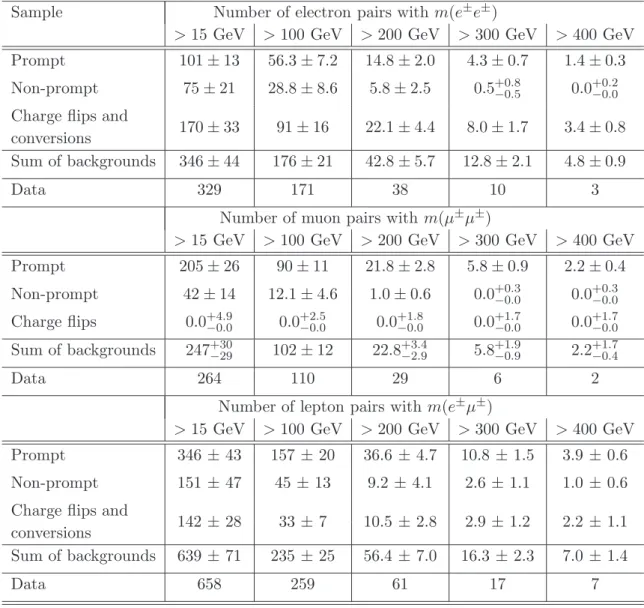
(10) (used in the data-driven determination of f ) and muons with |d0 |/σ(d0 ) < 3 (used in the event selection). In simulation, muons with |d0 |/σ(d0 ) < 3 are more isolated, so a correction factor of 1.34 ± 0.34 is applied to f . The resulting value of f is about 0.10 at pT = 20 GeV and increases to about 0.25 at pT = 100 GeV. One source of uncertainty in this procedure is that the fraction of non-prompt muons from pion and kaon decays may be larger for muons passing the analysis-level impact parameter criteria than for those used in the measurement of f . The uncertainty due to the contribution of light-flavour decays is assessed by exploiting the difference in the track momentum measurement in the ID and the MS, which is expected to be large for kaons or pions decaying in the ID or calorimeters. The difference between f for light-flavour decays and heavy-flavour decays is combined with the fraction of non-prompt muons from light-flavour decays to give an uncertainty of ±15% on f . The total systematic uncertainty on f is the quadratic sum of the statistical error, the uncertainty on the prompt background subtraction, the correction for the isolation-dependence on the impact parameter significance criteria, and the uncertainty in the contribution of pion and kaon decays. It is about ±37% at low pT and ±100% for pT > 100 GeV. For electrons, the main non-prompt backgrounds arise from heavy-flavour decays, charged pions that shower early in the calorimeter, and neutral pions decaying to two photons where one of the photons converts to an e+ e− pair. The anti-selected electrons must have either |d0 |/σ(d0 ) > 3 or fail the medium electron identification criteria while passing the loose electron criteria, as defined in ref. [60]. The inversion of the impact parameter criteria enhances the heavy-flavour background, while the inversion of the medium identification criteria enhances the pion backgrounds. A sample dominated by non-prompt electrons is selected by triggering on a high-pT electron candidate and requiring that the event contains a jet with pT > 20 GeV. Contamination of this sample by prompt electrons is reduced by requiring that there be only one electron candidate and requiring the transmiss ) to be verse mass3 formed by the electron and the missing transverse momentum (ET below 40 GeV. The value of f is found to be about 0.18 at ET = 20 GeV and decreases to about 0.10 at ET = 100 GeV. A systematic uncertainty is determined accounting for the statistical uncertainty, the prompt background subtraction, the pT requirement of the jet in the event, and any trigger bias. The uncertainty is about ±10% at low ET and increases to ±100% for ET > 300 GeV. Alternate anti-selection definitions are used to assess the overlap between the non-prompt and charge misidentification backgrounds, as well as the contributions of light- and heavy-flavour jets to the non-prompt background. For the former, a correction is made to the non-prompt background, amounting to ±(11–25)%, and the full correction is taken as a systematic uncertainty. For the latter, an uncertainty of ±(4–84)% is found, depending on the invariant mass threshold considered. A background prediction is derived from f using dilepton pairs where one or both leptons are anti-selected but pass all other event selection criteria. The non-prompt backp miss miss miss pT (e)(1 − cos ∆φ(e, ET )), where ET is the missing transThe transverse mass is defined as 2ET miss miss verse momentum and ∆φ(e, ET ) is the difference between the azimuthal angles of the electron and ET . 3. 8.
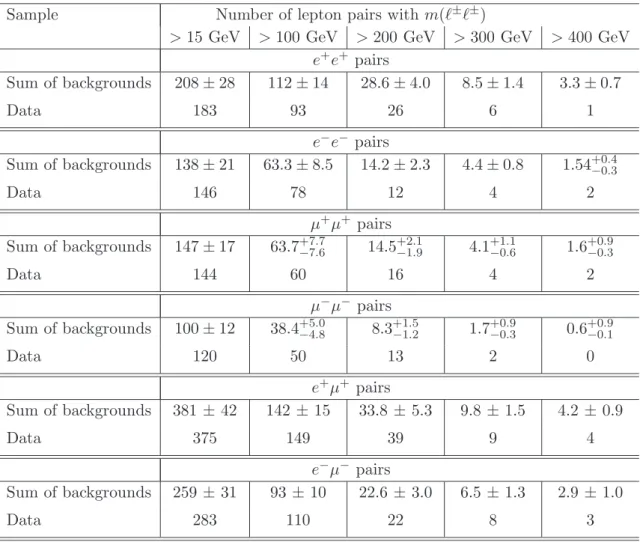
(11) ground prediction is then given by Nnon-prompt =. NA+S. NS+A. X. X. f (pT1 , η1 ) +. i=1. i=1. NA+A. f (pT2 , η2 ) −. X. f (pT1 , η1 )f (pT2 , η2 ),. (5.1). i=1. where the sums are over the number of pairs, NA+S (NS+A ), where the subleading (leading) lepton satisfies the selection criteria and the other lepton satisfies the anti-selection, or over the number of pairs where both leptons are anti-selected (NA+A ). The prompt contributions to NA+S , NS+A , and NA+A are subtracted based on MC predictions. The variables pT1 and η1 (pT2 and η2 ) refer to the kinematic properties of the leading (subleading) lepton. The background estimates are verified in several control regions that are designed to probe specific sources of background. The understanding of prompt leptons is tested in a sample requiring two leptons of opposite charge. This sample is dominated by the Z/γ ∗ process in all three final states, and the data agree with the background prediction to better than 5%. The kinematics of the electron charge misidentification background are verified in pairs of like-sign electrons with 80 GeV < m(e± e± ) < 100 GeV. The non-prompt background is tested by inverting the isolation criteria but requiring a looser isolation cut value. The heavy-flavour background is tested by inverting the |d0 |/σ(d0 ) criterion. Furthermore, for electrons, the light-flavour background is tested by inverting some of the shower shape criteria. The data agree with the background prediction in the various control regions within the systematic uncertainties.. 6. Systematic uncertainties. Several systematic effects can change the signal acceptance and the background estimate. Uncertainties on the event selection efficiencies and on the luminosity affect the predicted yield of signal events as well as those backgrounds that are estimated from MC simulation. Uncertainties on the trigger efficiencies, lepton identification efficiencies, and lepton momentum scales are determined using W , Z, and J/ψ decays [67–69]. The uncertainties on the lepton identification efficiencies result in an uncertainty on the number of like-sign pairs of ±(3–4)%. Effects resulting from uncertainties in the muon momentum scale and resolution are negligible. For electrons the energy scale is known to ±1%, and its impact on the signal acceptance is below 0.1%, while the background estimate is affected by up to ±3.5%. The uncertainties due to the trigger efficiencies are < 1% in all channels. The uncertainty on the integrated luminosity is ±3.9% [70, 71]. The uncertainties on the production cross sections of the SM processes affect the predicted yield of the prompt lepton background. For W Z and ZZ production, an uncertainty of ±10% is estimated due to higher-order QCD corrections by varying the renormalisation and factorisation scales by a factor of two. The uncertainty due to the parton distribution functions (PDFs) is evaluated using the eigenvectors provided by the CTEQ10 set [57] of PDFs, following the prescription given in ref. [72]. The difference between the central crosssection values obtained using this PDF set and that obtained with the MRST2008NLO PDFs [55] is also added in quadrature. This procedure gives a conservative estimate of. 9.
(12) the PDF uncertainty on the cross section. The resulting uncertainty on the cross section is ±7%. For tt̄W , tt̄Z and W ± W ± production a normalisation uncertainty of ±50% is assigned [34, 37]. The production of Z/γ ∗ , tt̄, and W ± W ∓ also constitutes a background in the ee and eµ channels due to charge misidentification. The PDF uncertainties for Z/γ ∗ and tt̄ are computed using the MSTW2008 NNLO PDF sets [73] and the renormalisation and factorisation scales are varied by factors of two to derive the uncertainties due to higherorder QCD corrections. For Z/γ ∗ , an additional systematic uncertainty is attributed to electroweak corrections [40]. The total uncertainties on the Z/γ ∗ and tt̄ cross sections are ±7% and +10/–11%, respectively. The W ± W ∓ cross-section uncertainty is determined using the same scale and PDF variations as for W Z and ZZ, yielding a total uncertainty of ±12%. The systematic uncertainty on the background from non-prompt leptons is discussed in section 5.3. It includes a component due to the systematic uncertainties associated with the measurement of the ratio f and a component due to the statistical uncertainty on the number of anti-selected leptons. For m(ℓ± ℓ± ) > 15 GeV it is ±33% for the µµ, ±31% for the eµ, and ±28% for the ee final states, and it increases to nearly ±100% at higher masses for all final states. The probability of assigning the wrong charge to the lepton and its uncertainty is discussed in section 5.2. For the µµ final state, charge misidentification results in an uncer+1.7 ± ± ± ± tainty of +4.9 −0.0 events for m(ℓ ℓ ) > 15 GeV and −0.0 events for m(ℓ ℓ ) > 400 GeV. For electrons, the uncertainty on the charge-flip background due to uncertainty in the charge mismeasurement probability ranges from ±15% to ±23% for the same mass thresholds. The uncertainty on the W γ and Zγ backgrounds from this source is ±(15–18)% depending on m(ℓ± ℓ± ). Statistical uncertainties due to the limited size of the background MC samples are also considered. Systematic uncertainties on different physics processes due to a given source are assumed to be 100% correlated.. 7. Comparison of data to the background expectation. The predicted numbers of background pairs are compared to the observed numbers of likesign lepton pairs in table 1. For the e± e± (e± µ± ) final state, about 30% (50%) of the background is from prompt leptons in all mass bins. The rest arises from leptons from hadronic decays, charge flips, or photon conversions. For the µ± µ± final state, the prompt background constitutes about 83% of the total background for m(µ± µ± ) > 15 GeV, rising to nearly 100% of the total background for m(µ± µ± ) > 400 GeV. The overall uncertainty on the background is about ±15% at low mass and ±30% at high mass. Table 2 shows the data compared to the background expectation separately for ℓ+ ℓ+ and ℓ− ℓ− events for the ee, µµ, and eµ final states. The background is higher for the ℓ+ ℓ+ final state due to the larger cross section in pp collisions for W + than W − bosons produced in association with γ, Z, or hadrons.. 10.
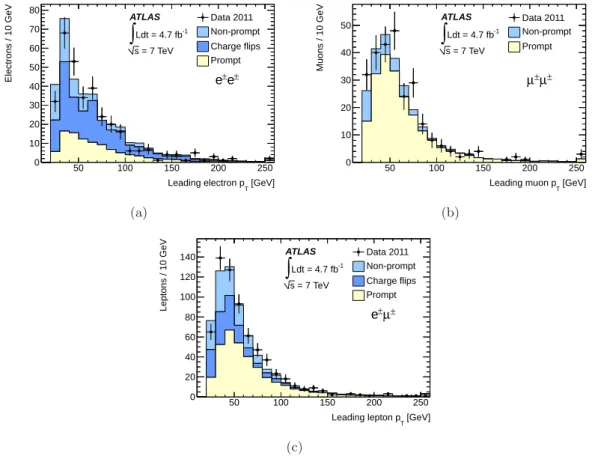
(13) Table 1. Expected and observed numbers of pairs of isolated like-sign leptons for various cuts on the dilepton invariant mass, m(ℓ± ℓ± ). The uncertainties shown are the quadratic sum of the statistical and systematic uncertainties. The prompt background contribution includes the W Z, ZZ, W ± W ± , tt̄W , and tt̄Z processes. When zero events are predicted, the uncertainty corresponds to the 68% confidence level upper limit on the prediction.. Sample Prompt Non-prompt Charge flips and conversions Sum of backgrounds Data. Number of electron pairs with m(e± e± ) > 15 GeV > 100 GeV > 200 GeV > 300 GeV 101 ± 13. 56.3 ± 7.2. 14.8 ± 2.0. 4.3 ± 0.7. 1.4 ± 0.3. 170 ± 33. 91 ± 16. 22.1 ± 4.4. 8.0 ± 1.7. 3.4 ± 0.8. 346 ± 44. 176 ± 21. 42.8 ± 5.7. 12.8 ± 2.1. 4.8 ± 0.9. 329. 171. 38. 10. 3. 75 ± 21. 28.8 ± 8.6. 5.8 ± 2.5. 0.5+0.8 −0.5. Number of muon pairs with m(µ± µ± ) > 15 GeV > 100 GeV > 200 GeV > 300 GeV Prompt Non-prompt Charge flips Sum of backgrounds Data. 205 ± 26. Non-prompt Charge flips and conversions Sum of backgrounds Data. 0.0+0.2 −0.0. > 400 GeV. 90 ± 11. 21.8 ± 2.8. 5.8 ± 0.9. 2.2 ± 0.4. 0.0+2.5 −0.0. 0.0+1.8 −0.0. 0.0+1.7 −0.0. 0.0+1.7 −0.0. 0.0+0.3 −0.0. 12.1 ± 4.6. 247+30 −29. 102 ± 12. 22.8+3.4 −2.9. 5.8+1.9 −0.9. 2.2+1.7 −0.4. 264. 110. 29. 6. 2. 0.0+4.9 −0.0. 1.0 ± 0.6. 0.0+0.3 −0.0. 42 ± 14. Number of lepton pairs with m(e± µ± ) > 15 GeV > 100 GeV > 200 GeV > 300 GeV Prompt. > 400 GeV. > 400 GeV. 346 ± 43. 157 ± 20. 36.6 ± 4.7. 10.8 ± 1.5. 3.9 ± 0.6. 142 ± 28. 33 ± 7. 10.5 ± 2.8. 2.9 ± 1.2. 2.2 ± 1.1. 639 ± 71. 235 ± 25. 56.4 ± 7.0. 16.3 ± 2.3. 7.0 ± 1.4. 658. 259. 61. 17. 7. 151 ± 47. 45 ± 13. 9.2 ± 4.1. 2.6 ± 1.1. 1.0 ± 0.6. The level of agreement between the data and the background expectation is evaluated using 1−CLb [74], defined as the one-sided probability of the background-only hypothesis to fluctuate up to at least the number of observed events. Statistical and systematic uncertainties and their correlations are fully considered for this calculation. The largest upward deviation, observed for m(µ− µ− ) > 100 GeV, occurs about 8% of the time in background-only pseudo-experiments for this mass bin. Figure 1 shows the dilepton invariant mass spectra for the e± e± , µ± µ± , and e± µ± final states, and figure 2 shows the pT of the leading leptons. Good agreement with the. 11.
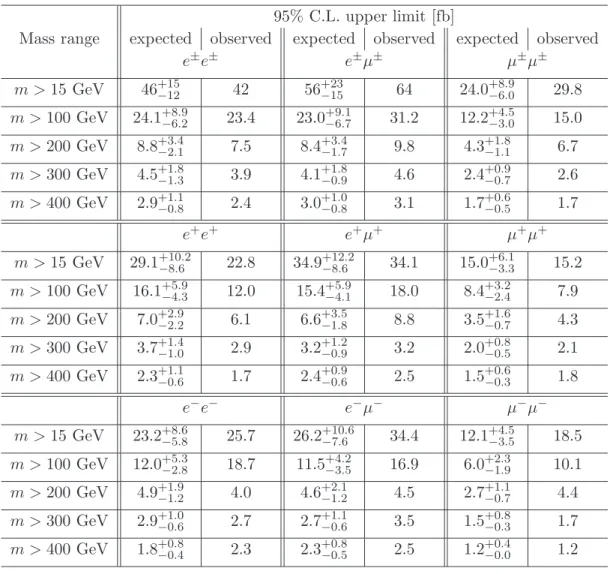
(14) Table 2. Expected and observed numbers of positively- and negatively-charged lepton pairs for different lower limits on the dilepton invariant mass, m(ℓ± ℓ± ). The uncertainties shown are the quadratic sum of the statistical and systematic uncertainties.. Sample. Sum of backgrounds Data Sum of backgrounds Data Sum of backgrounds Data Sum of backgrounds Data Sum of backgrounds Data Sum of backgrounds Data. Number of lepton pairs with m(ℓ± ℓ± ) > 15 GeV > 100 GeV > 200 GeV > 300 GeV e+ e+ pairs 208 ± 28 112 ± 14 28.6 ± 4.0 8.5 ± 1.4 183. 93. 26. 6. > 400 GeV 3.3 ± 0.7 1. e− e− pairs 63.3 ± 8.5 14.2 ± 2.3. 4.4 ± 0.8. 1.54+0.4 −0.3. 4. 2. µ+ µ+ pairs 63.7+7.7 14.5+2.1 −7.6 −1.9. 4.1+1.1 −0.6. 1.6+0.9 −0.3. 4. 2. 1.7+0.9 −0.3. 0.6+0.9 −0.1. 2. 0. 381 ± 42. e+ µ+ pairs 142 ± 15 33.8 ± 5.3. 9.8 ± 1.5. 4.2 ± 0.9. 259 ± 31. e− µ− pairs 93 ± 10 22.6 ± 3.0. 6.5 ± 1.3. 2.9 ± 1.0. 138 ± 21 146. 147 ± 17 144. 100 ± 12 120. 375. 283. 78. 12. 60. 16. µ− µ− pairs 38.4+5.0 8.3+1.5 −4.8 −1.2 50. 13. 149. 110. 39. 22. 9. 8. 4. 3. background expectation is observed for all three channels.. 8. Upper limits on the cross section for prompt like-sign dilepton production. Since the data are consistent with the background expectation, upper limits are placed on contributions due to processes from physics beyond the Standard Model. Limits are derived independently in each final state and mass bin shown in tables 1 and 2. The 95% confidence level (C.L.) upper limit on the number of events, N95 , is determined using the CLs method [74] with a test statistic based on the ratio between the likelihood of the signal plus background hypothesis and the likelihood of the background-only hypothesis. The likelihoods follow a Poisson distribution for the total number of events in each signal region, and are calculated based on the number of expected and observed events. Systematic. 12.
(15) ATLAS. ∫. 100. Data 2011 Non-prompt. Ldt = 4.7 fb-1. Charge flips Prompt. s = 7 TeV. 80. Muon pairs / 20 GeV. Electron pairs / 20 GeV. 120. e±e±. 60. 10 150. 200. 250. 300. 350. s = 7 TeV. Prompt. µ± µ±. 30 20. 100. Data 2011 Non-prompt. 40. 20 50. Ldt = 4.7 fb-1. ∫. 50. 40. 0 0. ATLAS. 60. 0 0. 400. 50. 100. 150. 200. m(e± e± ) [GeV]. 250. 300. 350. 400. m(µ± µ± ) [GeV]. (b) Lepton pairs / 20 GeV. (a) 140. ATLAS. ∫Ldt = 4.7 fb. -1. 120. s = 7 TeV. 100. Data 2011 Non-prompt Charge flips Prompt. e±µ±. 80 60 40 20 0 0. 50. 100. 150. 200. 250. 300. 350. 400. m(e± µ± ) [GeV]. (c). Figure 1. Invariant mass distributions for (a) e± e± , (b) µ± µ± , and (c) e± µ± pairs passing the full event selection. The data are shown as closed circles. The stacked histograms represent the backgrounds composed of pairs of prompt leptons from SM processes, pairs with at least one nonprompt lepton, and for the electron channels, backgrounds arising from charge misidentification and photon conversions. Pairs in the ee channel with invariant masses between 70 GeV and 110 GeV are excluded because of the large background from charge misidentification in Z → e± e∓ decays. The last bin is an overflow bin.. uncertainties are incorporated into the likelihoods as nuisance parameters with Gaussian probability density functions. For the inclusive ℓ± ℓ± final states, the upper limit ranges from 168 pairs for m(eµ) > 15 GeV to 4.8 pairs for m(µµ) > 400 GeV. The limit on the number of lepton pairs can be translated to an upper limit on the cross section measured in a given region of phase space (referred to here as the fiducial fid , via region), σ95 N95 fid R , (8.1) σ95 = εfid × Ldt R where εfid is the efficiency for detecting events within the fiducial region and Ldt is the integrated luminosity of 4.7 fb−1 . The fiducial region definition is based on MC generator information such that it is independent of the ATLAS detector environment. The value of εfid generally depends on the new physics process, e.g. the number of leptons in the final state passing the kinematic. 13.
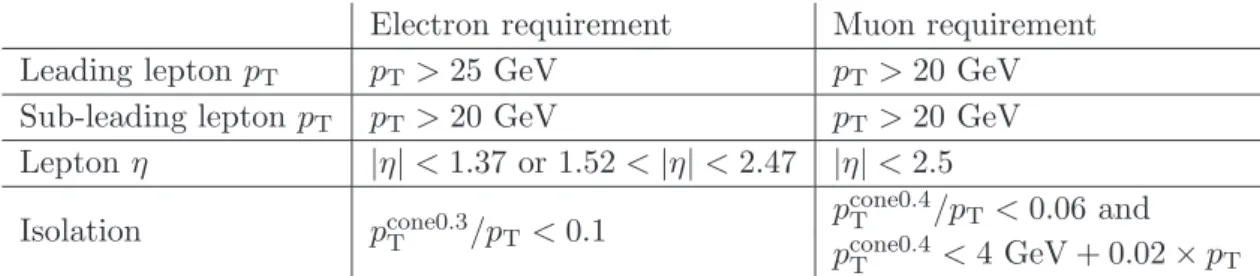
(16) ATLAS. ∫. 70 60. Muons / 10 GeV. Electrons / 10 GeV. 80. Data 2011 Non-prompt. Ldt = 4.7 fb-1. Charge flips Prompt. s = 7 TeV. 50. e±e±. 40. ATLAS Ldt = 4.7 fb-1. Data 2011 Non-prompt. s = 7 TeV. Prompt. ∫. 50 40. µ± µ±. 30. 30. 20. 20 10. 10 0. 50. 100. 150. 200. 0. 250. 50. 100. Leading electron p [GeV]. 150. 200. 250. Leading muon p [GeV]. T. T. (b) Leptons / 10 GeV. (a) ATLAS. 140. ∫Ldt = 4.7 fb. -1. 120. s = 7 TeV. 100. Data 2011 Non-prompt Charge flips Prompt. e±µ±. 80 60 40 20 0. 50. 100. 150. 200. 250. Leading lepton p [GeV] T. (c). Figure 2. Leading lepton pT distributions for (a) e± e± , (b) µ± µ± , and (c) e± µ± pairs passing the full event selection. The data are shown as closed circles. The stacked histograms represent the backgrounds composed of pairs of prompt leptons from SM processes, pairs with at least one non-prompt lepton, and for the electron channels, backgrounds arising from charge misidentification and photon conversions. The last bin is an overflow bin.. selection criteria or the number of jets that may affect the lepton isolation. In order to minimise this dependence, the definition of the fiducial region is closely related to the analysis selection. In the MC generator, electrons or muons are selected as stable particles that originate from a W or Z boson, from a τ lepton, or from an exotic new particle (e.g. a H ±± or a right-handed W ). The generated electrons and muons are required to satisfy the pT , η, and isolation requirements listed in table 3, which mirror the selection requirements cone∆Riso described in section 4. The generator-level track isolation, pT , is defined as the scalar sum of all stable charged particles with pT > 1 GeV in a cone of size ∆Riso around the electron or muon, excluding the lepton itself. The requirement on isolation energy cone∆Riso (ET ) placed in the electron selection is not emulated in the fiducial region definition because the measurement of isolation energy in the calorimeter has a poor resolution. Pairs of like-sign leptons must have m(ℓ± ℓ± ) > 15 GeV and for e± e± , the mass range 70–110 GeV is additionally excluded. The fiducial efficiency, εfid , is defined as the fraction of lepton pairs passing this se-. 14.
(17) Table 3. Summary of requirements on generated leptons in the fiducial region. The definition of iso the isolation variable, pcone∆R , is given in the text. T. Leading lepton pT Sub-leading lepton pT Lepton η. Electron requirement pT > 25 GeV pT > 20 GeV |η| < 1.37 or 1.52 < |η| < 2.47. Isolation. pcone0.3 /pT < 0.1 T. Muon requirement pT > 20 GeV pT > 20 GeV |η| < 2.5 pcone0.4 /pT < 0.06 and T cone0.4 pT < 4 GeV + 0.02 × pT. lection that also satisfy the experimental selection criteria described in section 4. It is determined for a variety of new physics models: H ±± bosons with mass between 50 GeV and 1000 GeV [48], fourth generation quarks decaying to W t with masses of 300–500 GeV, like-sign top-quark production via a contact interaction [53], and right-handed W bosons decaying to ℓ± ℓ± via a right-handed neutrino with m(WR ) = 800–2500 GeV [49, 50]. These models are chosen as they cover a broad range of jet multiplicities and lepton pT spectra. For m(ℓ± ℓ± ) > 15 GeV in the e± e± channel, the fiducial efficiencies range from 43% for models with low-pT leptons to 65% for models with high-pT leptons. The primary reason for this dependence is that the electron identification efficiency varies by about 15% over the relevant pT range [60]. The model dependence introduced by not emulating the calorimeter isolation in the definition of the fiducial region is < 1%. For the e± µ± channel, εfid ranges from 55% to 70%, and for the µ± µ± final state it varies between 59% and 72%. For the higher dilepton mass thresholds the efficiencies are slightly larger than for the lower mass thresholds. The efficiencies are also derived for ℓ+ ℓ+ and ℓ− ℓ− pairs separately and found to be independent of the charge. For the same new physics models, the fraction of events satisfying the experimental selection originating from outside the fiducial region ranges from < 1% to about 9%, depending on the final state and the model considered. To derive the upper limit on the fiducial cross section, the lowest efficiency values are taken for all mass thresholds, i.e. 43% for the e± e± , 55% for the e± µ± , and 59% for the fid , are calculated using µ± µ± analysis. The 95% C.L. upper limits on the cross section, σ95 equation 8.1 and given in table 4. The limits range from 64 fb to 1.7 fb for the inclusive analysis depending on the mass cut and the final state, and are generally within 1σ of the expected limits. Upper limits on the ℓ+ ℓ+ and ℓ− ℓ− cross sections are also derived, using the same efficiencies as for the inclusive limits.. 9. Conclusions. A search for anomalous production of like-sign lepton pairs has been presented using √ 4.7 fb−1 of pp collision data at s = 7 TeV recorded by the ATLAS experiment at the LHC. The data are found to agree with the background expectation in e± e± , e± µ± , and µ± µ± final states both in overall rate and in the kinematic distributions. The data are used to constrain new physics contributions to like-sign lepton pairs within a fiducial region of. 15.
(18) Table 4. Upper limits at 95% C.L. on the fiducial cross section for ℓ± ℓ± pairs from non-SM physics. The expected limits and their 1σ uncertainties are given, as well as the observed limits in data, for the ee, eµ, and µµ final state inclusively and separated by charge.. Mass range. expected observed e± e±. m > 15 GeV. 46+15 −12. m > 100 GeV. 24.1+8.9 −6.2 +3.4 8.8−2.1 4.5+1.8 −1.3 2.9+1.1 −0.8. m > 200 GeV m > 300 GeV m > 400 GeV. 95% C.L. upper limit [fb] expected observed expected observed e± µ± µ± µ±. 42. 56+23 −15. 23.4. 23.0+9.1 −6.7 +3.4 8.4−1.7 4.1+1.8 −0.9 3.0+1.0 −0.8. 7.5 3.9 2.4. e+ e+ m > 15 GeV. 29.1+10.2 −8.6. m > 100 GeV. 16.1+5.9 −4.3 +2.9 7.0−2.2 3.7+1.4 −1.0 2.3+1.1 −0.6. m > 200 GeV m > 300 GeV m > 400 GeV. 64. 24.0+8.9 −6.0. 29.8. 31.2. 12.2+4.5 −3.0 +1.8 4.3−1.1 2.4+0.9 −0.7 1.7+0.6 −0.5. 15.0. 9.8 4.6 3.1. e+ µ+ 22.8. 34.9+12.2 −8.6. 12.0. 15.4+5.9 −4.1 +3.5 6.6−1.8 3.2+1.2 −0.9 2.4+0.9 −0.6. 6.1 2.9 1.7. e− e−. 6.7 2.6 1.7. µ+ µ+ 34.1. 15.0+6.1 −3.3. 15.2. 18.0. 8.4+3.2 −2.4 +1.6 3.5−0.7 2.0+0.8 −0.5 1.5+0.6 −0.3. 7.9. 8.8 3.2 2.5. e− µ−. 4.3 2.1 1.8. µ− µ−. m > 15 GeV. 23.2+8.6 −5.8. 25.7. 26.2+10.6 −7.6. 34.4. 12.1+4.5 −3.5. 18.5. m > 100 GeV. 12.0+5.3 −2.8. 18.7. 11.5+4.2 −3.5. 16.9. 6.0+2.3 −1.9. 10.1. m > 200 GeV. 4.9+1.9 −1.2. 4.0. 4.6+2.1 −1.2. 4.5. 2.7+1.1 −0.7. 4.4. m > 300 GeV. 2.9+1.0 −0.6 1.8+0.8 −0.4. 2.7. 2.7+1.1 −0.6 2.3+0.8 −0.5. 3.5. 1.5+0.8 −0.3 1.2+0.4 −0.0. 1.7. m > 400 GeV. 2.3. 2.5. 1.2. two isolated leptons with large transverse momentum within the pseudorapidity range of the tracking system (|η| < 2.5). The 95% confidence level upper limits on the cross section of new physics processes within this fiducial region range between 1.7 fb and 64 fb for ℓ± ℓ± pairs depending on the dilepton invariant mass and flavour combination.. 10. Acknowledgements. We thank CERN for the very successful operation of the LHC, as well as the support staff from our institutions without whom ATLAS could not be operated efficiently. We acknowledge the support of ANPCyT, Argentina; YerPhI, Armenia; ARC, Australia; BMWF and FWF, Austria; ANAS, Azerbaijan; SSTC, Belarus; CNPq and FAPESP, Brazil; NSERC, NRC and CFI, Canada; CERN; CONICYT, Chile; CAS, MOST and. 16.
(19) NSFC, China; COLCIENCIAS, Colombia; MSMT CR, MPO CR and VSC CR, Czech Republic; DNRF, DNSRC and Lundbeck Foundation, Denmark; EPLANET and ERC, European Union; IN2P3-CNRS, CEA-DSM/IRFU, France; GNSF, Georgia; BMBF, DFG, HGF, MPG and AvH Foundation, Germany; GSRT, Greece; ISF, MINERVA, GIF, DIP and Benoziyo Center, Israel; INFN, Italy; MEXT and JSPS, Japan; CNRST, Morocco; FOM and NWO, Netherlands; BRF and RCN, Norway; MNiSW, Poland; GRICES and FCT, Portugal; MERYS (MECTS), Romania; MES of Russia and ROSATOM, Russian Federation; JINR; MSTD, Serbia; MSSR, Slovakia; ARRS and MVZT, Slovenia; DST/NRF, South Africa; MICINN, Spain; SRC and Wallenberg Foundation, Sweden; SER, SNSF and Cantons of Bern and Geneva, Switzerland; NSC, Taiwan; TAEK, Turkey; STFC, the Royal Society and Leverhulme Trust, United Kingdom; DOE and NSF, United States of America. The crucial computing support from all WLCG partners is acknowledged gratefully, in particular from CERN and the ATLAS Tier-1 facilities at TRIUMF (Canada), NDGF (Denmark, Norway, Sweden), CC-IN2P3 (France), KIT/GridKA (Germany), INFN-CNAF (Italy), NL-T1 (Netherlands), PIC (Spain), ASGC (Taiwan), RAL (UK) and BNL (USA) and in the Tier-2 facilities worldwide.. References [1] J. C. Pati and A. Salam, Phys. Rev. D 10 (1974) 275. [2] R. N. Mohapatra and J. C. Pati, Phys. Rev. D 11 (1975) 566. [3] G. Senjanovic and R. N. Mohapatra, Phys. Rev. D 12 (1975) 1502. [4] T. Rizzo, Phys. Rev. D 25 (1982) 1355; addendum ibid. 27, (1983) 657. [5] J. E. Cieza Montalvo, N. V. Cortez, J. Sa Borges, and M. D. Tonasse, Nucl. Phys. B 756 (2006) 1; erratum ibid. 796 422 (2008). [6] H. Georgi and M. Machacek, Nucl. Phys. B 262 (1985) 463. [7] J. F. Gunion, R. Vega, and J. Wudka, Phys. Rev. D 42 (1990) 1673. [8] N. Arkani-Hamed, A. G. Cohen, E. Katz, A. E. Nelson, T. Gregoire, and J. G. Wacker, JHEP 0208 (2002) 021. [9] P. H. Frampton, P. Q. Hung, and M. Sher, Phys. Rept. 330 (2000) 263. [10] R. M. Barnett, J. F. Gunion, and H. E. Haber, Phys. Lett. B 315 (1993) 349. [11] J. Alwall, P. Schuster, and N. Toro, Phys. Rev. D 79 (2009) 075020. [12] A. Zee, Nucl. Phys. B 264 (1986) 99. [13] K. S. Babu, Phys. Lett. B 203 (1988) 132. [14] M. Nebot, J. F. Oliver, D. Palao, and A. Santamaria, Phys. Rev. D 77 (2008) 093013. [15] ATLAS Collaboration, JHEP 1110 (2011) 107. [16] ATLAS Collaboration, Phys. Rev. D 85 (2012) 032004. [17] CDF Collaboration, A. Abulencia et al., Phys. Rev. Lett. 98 (2007) 221803. [18] CDF Collaboration, T. Aaltonen et al., Phys. Rev. Lett. 107 (2011) 181801.. 17.
(20) [19] CMS Collaboration, JHEP 1208 (2012) 110. [20] CMS Collaboration, JHEP 1205 (2012) 123. [21] CMS Collaboration, JHEP 1106 (2011) 077. [22] CMS Collaboration, JHEP 1108 (2011) 005. [23] ATLAS Collaboration, Phys. Rev. Lett. 108 (2012) 241802. [24] ATLAS Collaboration, Eur. Phys. J. C 72 (2012) 2056. [25] ATLAS Collaboration, JHEP 1204 (2012) 069. [26] ATLAS Collaboration, Phys. Lett. B 709 (2012) 322. [27] ATLAS Collaboration, JINST 3 (2008) S08003. [28] ATLAS Collaboration, Eur. Phys. J. C 72 (2012) 1849. [29] T. Gleisberg, S. Hoeche, F. Krauss, M. Schoenherr, S. Schumann, F. Siegert, and J. Winter, JHEP 0902 (2009) 007. [30] J. Alwall et al., JHEP 1106 (2011) 128. [31] T. Sjöstrand, S. Mrenna, and P. Skands, JHEP 05 (2006) 026. [32] J. M. Campbell, R. K. Ellis, and C. Williams, JHEP 07 (2011) 018. [33] J. M. Campbell and R. K. Ellis, JHEP 1207 (2012) 052. [34] A. Lazopoulos, T. McElmurry, K. Melnikov, and F. Petriello, Phys. Lett. B 666 (2008) 62. [35] M. V. Garzelli, A. Kardos, C. G. Papadopoulos, and Z. Trocsanyi, Phys. Rev. D 85 (2012) 074022. [36] A. Kardos, Z. Trocsanyi, and C. G. Papadopoulos, Phys. Rev. D 85 (2012) 054015. [37] B. Jäger, C. Oleari, and D. Zeppenfeld, Phys. Rev. D 80 (2009) 034022. [38] T. Melia, K. Melnikov, R. Rontsch, and G. Zanderighi, JHEP 1012 (2010) 053. [39] R. Hamberg, W. L. van Neerven, and T. Matsuura, Nucl. Phys. B 359 (1991) 343, erratum ibid. 644 (2002) 403. [40] ATLAS Collaboration, Phys. Lett. B 700 (2011) 163. [41] C. M. Carloni Calame, G. Montagna, O. Nicrosini, and A. Vicini, JHEP 0612 (2006) 016. [42] C. M. Carloni Calame, G. Montagna, O. Nicrosini, and A. Vicini, JHEP 0710 (2007) 109. [43] S. Frixione and B. Webber, JHEP 0206 (2002) 029. [44] G. Corcella et al., HEP 0101 (2001) 010. [45] M. Aliev, H. Lacker, U. Langenfeld, S. Moch, P. Uwer, and M. Wiedermann, Comput. Phys. Commun. 182 (2011) 1034. [46] M. L. Mangano, M. Moretti, F. Piccinini, R. Pittau and A. D. Polosa, JHEP 07 (2003) 001. [47] ATLAS Collaboration, Phys. Lett. B 717 (2012) 49. [48] V. Rentala, W. Shepherd, and S. Su, Phys. Rev. D 84 (2011) 035004. [49] F. del Aguila, S. Bar-Shalom, A. Soni, and J. Wudka, Phys. Lett. B 670 (2009) 399. [50] R. N. Mohapatra and J. C. Pati, Phys. Rev. D 11 (1975) 2558.. 18.
(21) [51] Q.-H. Cao, D. McKeen, J. L. Rosner, G. Shaughnessy, and C. E. M. Wagner, Phys. Rev. D 81 (2010) 114004. [52] J. A. Aguilar-Saavedra, Nucl. Phys. B 843 (2011) 638. [53] J. A. Aguilar-Saavedra and M. Perez-Victoria, Phys. Lett. B 701 (2011) 93. [54] J. Pumplin, D. R. Stump, J. Huston, H. L. Lai, P. Nadolsky, and W. K. Tung, JHEP 0207 (2002) 012. [55] A. Sherstnev and R. S. Thorne, Eur. Phys. J. C 55 (2008) 553. [56] P. M. Nadolsky et al. (CTEQ Collaboration), Phys. Rev. D 78 (2008) 013004. [57] P. M. Nadolsky et al. (CTEQ Collaboration), arXiv:1101.0561, 2011. [58] ATLAS Collaboration, Eur. Phys. J. C 70 (2010) 823. [59] S. Agostinelli et al. (GEANT4 Collaboration), Nucl. Instr. Meth. A 506 (2010) 250. [60] ATLAS Collaboration, Eur. Phys. J. C 72 (2012) 1909. [61] ATLAS Collaboration, ATLAS-CONF-2012-047, https://cdsweb.cern.ch/record/1449796, 2012. [62] R. Nicolaidou, L. Chevalier, S. Hassani, J. F. Laporte, E. Le Menedeu, and A. Ouraou, Journal of Physics: Conference Series 219 (2010) no. 3, 032052. [63] W. Lampl et al., ATLAS-LARG-PUB-2008-002, https://cdsweb.cern.ch/record/1099735, 2008. [64] M. Cacciari, G. P. Salam, and G. Soyez, JHEP 0804 (2008) 063. [65] ATLAS Collaboration, arXiv:1112.6426 (accepted by Eur. Phys. J. C), 2011. [66] ATLAS Collaboration, JHEP 1204 (2012) 069. [67] ATLAS Collaboration, Eur. Phys. J. C 72 (2012) 1909. [68] ATLAS collaboration, ATLAS-CONF-2011-046, https://cdsweb.cern.ch/record/1338575, 2011. [69] ATLAS Collaboration, ATLAS-CONF-2011-063, https://cdsweb.cern.ch/record/1345743, 2011. [70] ATLAS Collaboration, Eur. Phys. J. C 71 (2011) 1630. [71] ATLAS Collaboration, ATLAS-CONF-2011-116, https://cdsweb.cern.ch/record/1376384, 2011. [72] J. Campbell, J. Huston, and W. J. Stirling, Rept. Prog. Phys. 70 (2007) 89. [73] A. Martin, W. Stirling, R. S. Thorne, and G. Watt, Eur. Phys. J. C 63 (2009) 189. [74] A. L. Read, J. Phys. G 28 (2002) 2693.. 19.
(22) The ATLAS Collaboration G. Aad48 , T. Abajyan21 , B. Abbott111 , J. Abdallah12 , S. Abdel Khalek115 , A.A. Abdelalim49 , O. Abdinov11 , R. Aben105 , B. Abi112 , M. Abolins88 , O.S. AbouZeid158 , H. Abramowicz153 , H. Abreu136 , E. Acerbi89a,89b , B.S. Acharya164a,164b , L. Adamczyk38 , D.L. Adams25 , T.N. Addy56 , J. Adelman176 , S. Adomeit98 , P. Adragna75 , T. Adye129 , S. Aefsky23 , J.A. Aguilar-Saavedra124b ,a , M. Agustoni17 , M. Aharrouche81 , S.P. Ahlen22 , F. Ahles48 , A. Ahmad148 , M. Ahsan41 , G. Aielli133a,133b , T. Akdogan19a , T.P.A. Åkesson79 , G. Akimoto155 , A.V. Akimov94 , M.S. Alam2 , M.A. Alam76 , J. Albert169 , S. Albrand55 , M. Aleksa30 , I.N. Aleksandrov64 , F. Alessandria89a , C. Alexa26a , G. Alexander153 , G. Alexandre49 , T. Alexopoulos10 , M. Alhroob164a,164c , M. Aliev16 , G. Alimonti89a , J. Alison120 , B.M.M. Allbrooke18 , P.P. Allport73 , S.E. Allwood-Spiers53 , J. Almond82 , A. Aloisio102a,102b , R. Alon172 , A. Alonso79 , F. Alonso70 , B. Alvarez Gonzalez88 , M.G. Alviggi102a,102b , K. Amako65 , C. Amelung23 , V.V. Ammosov128,∗ , S.P. Amor Dos Santos124a , A. Amorim124a,b , N. Amram153 , C. Anastopoulos30 , L.S. Ancu17 , N. Andari115 , T. Andeen35 , C.F. Anders58b , G. Anders58a , K.J. Anderson31 , A. Andreazza89a,89b , V. Andrei58a , M-L. Andrieux55 , X.S. Anduaga70 , P. Anger44 , A. Angerami35 , F. Anghinolfi30 , A. Anisenkov107 , N. Anjos124a , A. Annovi47 , A. Antonaki9 , M. Antonelli47 , A. Antonov96 , J. Antos144b , F. Anulli132a , M. Aoki101 , S. Aoun83 , L. Aperio Bella5 , R. Apolle118,c , G. Arabidze88 , I. Aracena143 , Y. Arai65 , A.T.H. Arce45 , S. Arfaoui148 , J-F. Arguin15 , E. Arik19a,∗ , M. Arik19a , A.J. Armbruster87 , O. Arnaez81 , V. Arnal80 , C. Arnault115 , A. Artamonov95 , G. Artoni132a,132b , D. Arutinov21 , S. Asai155 , R. Asfandiyarov173 , S. Ask28 , B. Åsman146a,146b , L. Asquith6 , K. Assamagan25 , A. Astbury169 , M. Atkinson165 , B. Aubert5 , E. Auge115 , K. Augsten127 , M. Aurousseau145a , G. Avolio163 , R. Avramidou10 , D. Axen168 , G. Azuelos93,d , Y. Azuma155 , M.A. Baak30 , G. Baccaglioni89a , C. Bacci134a,134b , A.M. Bach15 , H. Bachacou136 , K. Bachas30 , M. Backes49 , M. Backhaus21 , E. Badescu26a , P. Bagnaia132a,132b , S. Bahinipati3 , Y. Bai33a , D.C. Bailey158 , T. Bain158 , J.T. Baines129 , O.K. Baker176 , M.D. Baker25 , S. Baker77 , E. Banas39 , P. Banerjee93 , Sw. Banerjee173 , D. Banfi30 , A. Bangert150 , V. Bansal169 , H.S. Bansil18 , L. Barak172 , S.P. Baranov94 , A. Barbaro Galtieri15 , T. Barber48 , E.L. Barberio86 , D. Barberis50a,50b , M. Barbero21 , D.Y. Bardin64 , T. Barillari99 , M. Barisonzi175 , T. Barklow143 , N. Barlow28 , B.M. Barnett129 , R.M. Barnett15 , A. Baroncelli134a , G. Barone49 , A.J. Barr118 , F. Barreiro80 , J. Barreiro Guimarães da Costa57 , P. Barrillon115 , R. Bartoldus143 , A.E. Barton71 , V. Bartsch149 , A. Basye165 , R.L. Bates53 , L. Batkova144a , J.R. Batley28 , A. Battaglia17 , M. Battistin30 , F. Bauer136 , H.S. Bawa143 ,e , S. Beale98 , T. Beau78 , P.H. Beauchemin161 , R. Beccherle50a , P. Bechtle21 , H.P. Beck17 , A.K. Becker175 , S. Becker98 , M. Beckingham138 , K.H. Becks175 , A.J. Beddall19c , A. Beddall19c , S. Bedikian176 , V.A. Bednyakov64 , C.P. Bee83 , L.J. Beemster105 , M. Begel25 , S. Behar Harpaz152 , P.K. Behera62 , M. Beimforde99 , C. Belanger-Champagne85 , P.J. Bell49 , W.H. Bell49 , G. Bella153 , L. Bellagamba20a , F. Bellina30 , M. Bellomo30 , A. Belloni57 , O. Beloborodova107 ,f , K. Belotskiy96 , O. Beltramello30 , O. Benary153 , D. Benchekroun135a , K. Bendtz146a,146b , N. Benekos165 ,. 20.
(23) Y. Benhammou153 , E. Benhar Noccioli49 , J.A. Benitez Garcia159b , D.P. Benjamin45 , M. Benoit115 , J.R. Bensinger23 , K. Benslama130 , S. Bentvelsen105 , D. Berge30 , E. Bergeaas Kuutmann42 , N. Berger5 , F. Berghaus169 , E. Berglund105 , J. Beringer15 , P. Bernat77 , R. Bernhard48 , C. Bernius25 , T. Berry76 , C. Bertella83 , A. Bertin20a,20b , F. Bertolucci122a,122b , M.I. Besana89a,89b , G.J. Besjes104 , N. Besson136 , S. Bethke99 , W. Bhimji46 , R.M. Bianchi30 , M. Bianco72a,72b , O. Biebel98 , S.P. Bieniek77 , K. Bierwagen54 , J. Biesiada15 , M. Biglietti134a , H. Bilokon47 , M. Bindi20a,20b , S. Binet115 , A. Bingul19c , C. Bini132a,132b , C. Biscarat178 , B. Bittner99 , K.M. Black22 , R.E. Blair6 , J.-B. Blanchard136 , G. Blanchot30 , T. Blazek144a , I. Bloch42 , C. Blocker23 , J. Blocki39 , A. Blondel49 , W. Blum81 , U. Blumenschein54 , G.J. Bobbink105 , V.B. Bobrovnikov107 , S.S. Bocchetta79 , A. Bocci45 , C.R. Boddy118 , M. Boehler48 , J. Boek175 , N. Boelaert36 , J.A. Bogaerts30 , A. Bogdanchikov107 , A. Bogouch90 ,∗ , C. Bohm146a , J. Bohm125 , V. Boisvert76 , T. Bold38 , V. Boldea26a , N.M. Bolnet136 , M. Bomben78 , M. Bona75 , M. Boonekamp136 , C.N. Booth139 , S. Bordoni78 , C. Borer17 , A. Borisov128 , G. Borissov71 , I. Borjanovic13a , M. Borri82 , S. Borroni87 , V. Bortolotto134a,134b , K. Bos105 , D. Boscherini20a , M. Bosman12 , H. Boterenbrood105 , J. Bouchami93 , J. Boudreau123 , E.V. Bouhova-Thacker71 , D. Boumediene34 , C. Bourdarios115 , N. Bousson83 , A. Boveia31 , J. Boyd30 , I.R. Boyko64 , I. Bozovic-Jelisavcic13b , J. Bracinik18 , P. Branchini134a , G.W. Brandenburg57 , A. Brandt8 , G. Brandt118 , O. Brandt54 , U. Bratzler156 , B. Brau84 , J.E. Brau114 , H.M. Braun175,∗ , S.F. Brazzale164a,164c , B. Brelier158 , J. Bremer30 , K. Brendlinger120 , R. Brenner166 , S. Bressler172 , D. Britton53 , F.M. Brochu28 , I. Brock21 , R. Brock88 , F. Broggi89a , C. Bromberg88 , J. Bronner99 , G. Brooijmans35 , T. Brooks76 , W.K. Brooks32b , G. Brown82 , H. Brown8 , P.A. Bruckman de Renstrom39 , D. Bruncko144b , R. Bruneliere48 , S. Brunet60 , A. Bruni20a , G. Bruni20a , M. Bruschi20a , T. Buanes14 , Q. Buat55 , F. Bucci49 , J. Buchanan118 , P. Buchholz141 , R.M. Buckingham118 , A.G. Buckley46 , S.I. Buda26a , I.A. Budagov64 , B. Budick108 , V. Büscher81 , L. Bugge117 , O. Bulekov96 , A.C. Bundock73 , M. Bunse43 , T. Buran117 , H. Burckhart30 , S. Burdin73 , T. Burgess14 , S. Burke129 , E. Busato34 , P. Bussey53 , C.P. Buszello166 , B. Butler143 , J.M. Butler22 , C.M. Buttar53 , J.M. Butterworth77 , W. Buttinger28 , S. Cabrera Urbán167 , D. Caforio20a,20b , O. Cakir4a , P. Calafiura15 , G. Calderini78 , P. Calfayan98 , R. Calkins106 , L.P. Caloba24a , R. Caloi132a,132b , D. Calvet34 , S. Calvet34 , R. Camacho Toro34 , P. Camarri133a,133b , D. Cameron117 , L.M. Caminada15 , R. Caminal Armadans12 , S. Campana30 , M. Campanelli77 , V. Canale102a,102b , F. Canelli31,g , A. Canepa159a , J. Cantero80 , R. Cantrill76 , L. Capasso102a,102b , M.D.M. Capeans Garrido30 , I. Caprini26a , M. Caprini26a , D. Capriotti99 , M. Capua37a,37b , R. Caputo81 , R. Cardarelli133a , T. Carli30 , G. Carlino102a , L. Carminati89a,89b , B. Caron85 , S. Caron104 , E. Carquin32b , G.D. Carrillo-Montoya173 , A.A. Carter75 , J.R. Carter28 , J. Carvalho124a,h , D. Casadei108 , M.P. Casado12 , M. Cascella122a,122b , C. Caso50a,50b,∗ , A.M. Castaneda Hernandez173,i , E. Castaneda-Miranda173 , V. Castillo Gimenez167 , N.F. Castro124a , G. Cataldi72a , P. Catastini57 , A. Catinaccio30 , J.R. Catmore30 , A. Cattai30 , G. Cattani133a,133b , S. Caughron88 , V. Cavaliere165 , P. Cavalleri78 , D. Cavalli89a , M. Cavalli-Sforza12 , V. Cavasinni122a,122b , F. Ceradini134a,134b , A.S. Cerqueira24b , A. Cerri30 , L. Cerrito75 , F. Cerutti47 , S.A. Cetin19b , A. Chafaq135a , D. Chakraborty106 , I. Chalupkova126 ,. 21.
(24) K. Chan3 , P. Chang165 , B. Chapleau85 , J.D. Chapman28 , J.W. Chapman87 , E. Chareyre78 , D.G. Charlton18 , V. Chavda82 , C.A. Chavez Barajas30 , S. Cheatham85 , S. Chekanov6 , S.V. Chekulaev159a , G.A. Chelkov64 , M.A. Chelstowska104 , C. Chen63 , H. Chen25 , S. Chen33c , X. Chen173 , Y. Chen35 , A. Cheplakov64 , R. Cherkaoui El Moursli135e , V. Chernyatin25 , E. Cheu7 , S.L. Cheung158 , L. Chevalier136 , G. Chiefari102a,102b , L. Chikovani51a,∗ , J.T. Childers30 , A. Chilingarov71 , G. Chiodini72a , A.S. Chisholm18 , R.T. Chislett77 , A. Chitan26a , M.V. Chizhov64 , G. Choudalakis31 , S. Chouridou137 , I.A. Christidi77 , A. Christov48 , D. Chromek-Burckhart30 , M.L. Chu151 , J. Chudoba125 , G. Ciapetti132a,132b , A.K. Ciftci4a , R. Ciftci4a , D. Cinca34 , V. Cindro74 , C. Ciocca20a,20b , A. Ciocio15 , M. Cirilli87 , P. Cirkovic13b , Z.H. Citron172 , M. Citterio89a , M. Ciubancan26a , A. Clark49 , P.J. Clark46 , R.N. Clarke15 , W. Cleland123 , J.C. Clemens83 , B. Clement55 , C. Clement146a,146b , Y. Coadou83 , M. Cobal164a,164c , A. Coccaro138 , J. Cochran63 , J.G. Cogan143 , J. Coggeshall165 , E. Cogneras178 , J. Colas5 , S. Cole106 , A.P. Colijn105 , N.J. Collins18 , C. Collins-Tooth53 , J. Collot55 , T. Colombo119a,119b , G. Colon84 , P. Conde Muiño124a , E. Coniavitis118 , M.C. Conidi12 , S.M. Consonni89a,89b , V. Consorti48 , S. Constantinescu26a , C. Conta119a,119b , G. Conti57 , F. Conventi102a ,j , M. Cooke15 , B.D. Cooper77 , A.M. Cooper-Sarkar118 , K. Copic15 , T. Cornelissen175 , M. Corradi20a , F. Corriveau85,k , A. Cortes-Gonzalez165 , G. Cortiana99 , G. Costa89a , M.J. Costa167 , D. Costanzo139 , D. Côté30 , L. Courneyea169 , G. Cowan76 , C. Cowden28 , B.E. Cox82 , K. Cranmer108 , F. Crescioli122a,122b , M. Cristinziani21 , G. Crosetti37a,37b , S. Crépé-Renaudin55 , C.-M. Cuciuc26a , C. Cuenca Almenar176 , T. Cuhadar Donszelmann139 , M. Curatolo47 , C.J. Curtis18 , C. Cuthbert150 , P. Cwetanski60 , H. Czirr141 , P. Czodrowski44 , Z. Czyczula176 , S. D’Auria53 , M. D’Onofrio73 , A. D’Orazio132a,132b , M.J. Da Cunha Sargedas De Sousa124a , C. Da Via82 , W. Dabrowski38 , A. Dafinca118 , T. Dai87 , C. Dallapiccola84 , M. Dam36 , M. Dameri50a,50b , D.S. Damiani137 , H.O. Danielsson30 , V. Dao49 , G. Darbo50a , G.L. Darlea26b , J.A. Dassoulas42 , W. Davey21 , T. Davidek126 , N. Davidson86 , R. Davidson71 , E. Davies118,c , M. Davies93 , O. Davignon78 , A.R. Davison77 , Y. Davygora58a , E. Dawe142 , I. Dawson139 , R.K. Daya-Ishmukhametova23 , K. De8 , R. de Asmundis102a , S. De Castro20a,20b , S. De Cecco78 , J. de Graat98 , N. De Groot104 , P. de Jong105 , C. De La Taille115 , H. De la Torre80 , F. De Lorenzi63 , L. de Mora71 , L. De Nooij105 , D. De Pedis132a , A. De Salvo132a , U. De Sanctis164a,164c , A. De Santo149 , J.B. De Vivie De Regie115 , G. De Zorzi132a,132b , W.J. Dearnaley71 , R. Debbe25 , C. Debenedetti46 , B. Dechenaux55 , D.V. Dedovich64 , J. Degenhardt120 , C. Del Papa164a,164c , J. Del Peso80 , T. Del Prete122a,122b , T. Delemontex55 , M. Deliyergiyev74 , A. Dell’Acqua30 , L. Dell’Asta22 , M. Della Pietra102a,j , D. della Volpe102a,102b , M. Delmastro5 , P.A. Delsart55 , C. Deluca105 , S. Demers176 , M. Demichev64 , B. Demirkoz12 ,l , J. Deng163 , S.P. Denisov128 , D. Derendarz39 , J.E. Derkaoui135d , F. Derue78 , P. Dervan73 , K. Desch21 , E. Devetak148 , P.O. Deviveiros105 , A. Dewhurst129 , B. DeWilde148 , S. Dhaliwal158 , R. Dhullipudi25,m , A. Di Ciaccio133a,133b , L. Di Ciaccio5 , A. Di Girolamo30 , B. Di Girolamo30 , S. Di Luise134a,134b , A. Di Mattia173 , B. Di Micco30 , R. Di Nardo47 , A. Di Simone133a,133b , R. Di Sipio20a,20b , M.A. Diaz32a , E.B. Diehl87 , J. Dietrich42 , T.A. Dietzsch58a , S. Diglio86 ,. 22.
(25) K. Dindar Yagci40 , J. Dingfelder21 , F. Dinut26a , C. Dionisi132a,132b , P. Dita26a , S. Dita26a , F. Dittus30 , F. Djama83 , T. Djobava51b , M.A.B. do Vale24c , A. Do Valle Wemans124a ,n , T.K.O. Doan5 , M. Dobbs85 , R. Dobinson30,∗ , D. Dobos30 , E. Dobson30,o , J. Dodd35 , C. Doglioni49 , T. Doherty53 , Y. Doi65,∗ , J. Dolejsi126 , I. Dolenc74 , Z. Dolezal126 , B.A. Dolgoshein96,∗ , T. Dohmae155 , M. Donadelli24d , J. Donini34 , J. Dopke30 , A. Doria102a , A. Dos Anjos173 , A. Dotti122a,122b , M.T. Dova70 , A.D. Doxiadis105 , A.T. Doyle53 , N. Dressnandt120 , M. Dris10 , J. Dubbert99 , S. Dube15 , E. Duchovni172 , G. Duckeck98 , D. Duda175 , A. Dudarev30 , F. Dudziak63 , M. Dührssen30 , I.P. Duerdoth82 , L. Duflot115 , M-A. Dufour85 , L. Duguid76 , M. Dunford30 , H. Duran Yildiz4a , R. Duxfield139 , M. Dwuznik38 , F. Dydak30 , M. Düren52 , W.L. Ebenstein45 , J. Ebke98 , S. Eckweiler81 , K. Edmonds81 , W. Edson2 , C.A. Edwards76 , N.C. Edwards53 , W. Ehrenfeld42 , T. Eifert143 , G. Eigen14 , K. Einsweiler15 , E. Eisenhandler75 , T. Ekelof166 , M. El Kacimi135c , M. Ellert166 , S. Elles5 , F. Ellinghaus81 , K. Ellis75 , N. Ellis30 , J. Elmsheuser98 , M. Elsing30 , D. Emeliyanov129 , R. Engelmann148 , A. Engl98 , B. Epp61 , J. Erdmann54 , A. Ereditato17 , D. Eriksson146a , J. Ernst2 , M. Ernst25 , J. Ernwein136 , D. Errede165 , S. Errede165 , E. Ertel81 , M. Escalier115 , H. Esch43 , C. Escobar123 , X. Espinal Curull12 , B. Esposito47 , F. Etienne83 , A.I. Etienvre136 , E. Etzion153 , D. Evangelakou54 , H. Evans60 , L. Fabbri20a,20b , C. Fabre30 , R.M. Fakhrutdinov128 , S. Falciano132a , Y. Fang173 , M. Fanti89a,89b , A. Farbin8 , A. Farilla134a , J. Farley148 , T. Farooque158 , S. Farrell163 , S.M. Farrington170 , P. Farthouat30 , F. Fassi167 , P. Fassnacht30 , D. Fassouliotis9 , B. Fatholahzadeh158 , A. Favareto89a,89b , L. Fayard115 , S. Fazio37a,37b , R. Febbraro34 , P. Federic144a , O.L. Fedin121 , W. Fedorko88 , M. Fehling-Kaschek48 , L. Feligioni83 , D. Fellmann6 , C. Feng33d , E.J. Feng6 , A.B. Fenyuk128 , J. Ferencei144b , W. Fernando6 , S. Ferrag53 , J. Ferrando53 , V. Ferrara42 , A. Ferrari166 , P. Ferrari105 , R. Ferrari119a , D.E. Ferreira de Lima53 , A. Ferrer167 , D. Ferrere49 , C. Ferretti87 , A. Ferretto Parodi50a,50b , M. Fiascaris31 , F. Fiedler81 , A. Filipčič74 , F. Filthaut104 , M. Fincke-Keeler169 , M.C.N. Fiolhais124a ,h , L. Fiorini167 , A. Firan40 , G. Fischer42 , M.J. Fisher109 , M. Flechl48 , I. Fleck141 , J. Fleckner81 , P. Fleischmann174 , S. Fleischmann175 , T. Flick175 , A. Floderus79 , L.R. Flores Castillo173 , M.J. Flowerdew99 , T. Fonseca Martin17 , A. Formica136 , A. Forti82 , D. Fortin159a , D. Fournier115 , A.J. Fowler45 , H. Fox71 , P. Francavilla12 , M. Franchini20a,20b , S. Franchino119a,119b , D. Francis30 , T. Frank172 , S. Franz30 , M. Fraternali119a,119b , S. Fratina120 , S.T. French28 , C. Friedrich42 , F. Friedrich44 , R. Froeschl30 , D. Froidevaux30 , J.A. Frost28 , C. Fukunaga156 , E. Fullana Torregrosa30 , B.G. Fulsom143 , J. Fuster167 , C. Gabaldon30 , O. Gabizon172 , T. Gadfort25 , S. Gadomski49 , G. Gagliardi50a,50b , P. Gagnon60 , C. Galea98 , B. Galhardo124a , E.J. Gallas118 , V. Gallo17 , B.J. Gallop129 , P. Gallus125 , K.K. Gan109 , Y.S. Gao143,e , A. Gaponenko15 , F. Garberson176 , M. Garcia-Sciveres15 , C. Garcı́a167 , J.E. Garcı́a Navarro167 , R.W. Gardner31 , N. Garelli30 , H. Garitaonandia105 , V. Garonne30 , C. Gatti47 , G. Gaudio119a , B. Gaur141 , L. Gauthier136 , P. Gauzzi132a,132b , I.L. Gavrilenko94 , C. Gay168 , G. Gaycken21 , E.N. Gazis10 , P. Ge33d , Z. Gecse168 , C.N.P. Gee129 , D.A.A. Geerts105 , Ch. Geich-Gimbel21 , K. Gellerstedt146a,146b , C. Gemme50a , A. Gemmell53 , M.H. Genest55 , S. Gentile132a,132b , M. George54 , S. George76 ,. 23.
(26) P. Gerlach175 , A. Gershon153 , C. Geweniger58a , H. Ghazlane135b , N. Ghodbane34 , B. Giacobbe20a , S. Giagu132a,132b , V. Giakoumopoulou9 , V. Giangiobbe12 , F. Gianotti30 , B. Gibbard25 , A. Gibson158 , S.M. Gibson30 , M. Gilchriese15 , D. Gillberg29 , A.R. Gillman129 , D.M. Gingrich3,d , J. Ginzburg153 , N. Giokaris9 , M.P. Giordani164c , R. Giordano102a,102b , F.M. Giorgi16 , P. Giovannini99 , P.F. Giraud136 , D. Giugni89a , M. Giunta93 , P. Giusti20a , B.K. Gjelsten117 , L.K. Gladilin97 , C. Glasman80 , J. Glatzer48 , A. Glazov42 , K.W. Glitza175 , G.L. Glonti64 , J.R. Goddard75 , J. Godfrey142 , J. Godlewski30 , M. Goebel42 , T. Göpfert44 , C. Goeringer81 , C. Gössling43 , S. Goldfarb87 , T. Golling176 , A. Gomes124a,b , L.S. Gomez Fajardo42 , R. Gonçalo76 , J. Goncalves Pinto Firmino Da Costa42 , L. Gonella21 , S. Gonzalez173 , S. González de la Hoz167 , G. Gonzalez Parra12 , M.L. Gonzalez Silva27 , S. Gonzalez-Sevilla49 , J.J. Goodson148 , L. Goossens30 , P.A. Gorbounov95 , H.A. Gordon25 , I. Gorelov103 , G. Gorfine175 , B. Gorini30 , E. Gorini72a,72b , A. Gorišek74 , E. Gornicki39 , B. Gosdzik42 , A.T. Goshaw6 , M. Gosselink105 , M.I. Gostkin64 , I. Gough Eschrich163 , M. Gouighri135a , D. Goujdami135c , M.P. Goulette49 , A.G. Goussiou138 , C. Goy5 , S. Gozpinar23 , I. Grabowska-Bold38 , P. Grafström20a,20b , K-J. Grahn42 , F. Grancagnolo72a , S. Grancagnolo16 , V. Grassi148 , V. Gratchev121 , N. Grau35 , H.M. Gray30 , J.A. Gray148 , E. Graziani134a , O.G. Grebenyuk121 , T. Greenshaw73 , Z.D. Greenwood25,m , K. Gregersen36 , I.M. Gregor42 , P. Grenier143 , J. Griffiths8 , N. Grigalashvili64 , A.A. Grillo137 , S. Grinstein12 , Ph. Gris34 , Y.V. Grishkevich97 , J.-F. Grivaz115 , E. Gross172 , J. Grosse-Knetter54 , J. Groth-Jensen172 , K. Grybel141 , D. Guest176 , C. Guicheney34 , S. Guindon54 , U. Gul53 , H. Guler85,p , J. Gunther125 , B. Guo158 , J. Guo35 , P. Gutierrez111 , N. Guttman153 , O. Gutzwiller173 , C. Guyot136 , C. Gwenlan118 , C.B. Gwilliam73 , A. Haas143 , S. Haas30 , C. Haber15 , H.K. Hadavand40 , D.R. Hadley18 , P. Haefner21 , F. Hahn30 , S. Haider30 , Z. Hajduk39 , H. Hakobyan177 , D. Hall118 , J. Haller54 , K. Hamacher175 , P. Hamal113 , K. Hamano86 , M. Hamer54 , A. Hamilton145b ,q , S. Hamilton161 , L. Han33b , K. Hanagaki116 , K. Hanawa160 , M. Hance15 , C. Handel81 , P. Hanke58a , J.R. Hansen36 , J.B. Hansen36 , J.D. Hansen36 , P.H. Hansen36 , P. Hansson143 , K. Hara160 , G.A. Hare137 , T. Harenberg175 , S. Harkusha90 , D. Harper87 , R.D. Harrington46 , O.M. Harris138 , J. Hartert48 , F. Hartjes105 , T. Haruyama65 , A. Harvey56 , S. Hasegawa101 , Y. Hasegawa140 , S. Hassani136 , S. Haug17 , M. Hauschild30 , R. Hauser88 , M. Havranek21 , C.M. Hawkes18 , R.J. Hawkings30 , A.D. Hawkins79 , D. Hawkins163 , T. Hayakawa66 , T. Hayashi160 , D. Hayden76 , C.P. Hays118 , H.S. Hayward73 , S.J. Haywood129 , M. He33d , S.J. Head18 , V. Hedberg79 , L. Heelan8 , S. Heim88 , B. Heinemann15 , S. Heisterkamp36 , L. Helary22 , C. Heller98 , M. Heller30 , S. Hellman146a,146b , D. Hellmich21 , C. Helsens12 , R.C.W. Henderson71 , M. Henke58a , A. Henrichs54 , A.M. Henriques Correia30 , S. Henrot-Versille115 , C. Hensel54 , T. Henß175 , C.M. Hernandez8 , Y. Hernández Jiménez167 , R. Herrberg16 , G. Herten48 , R. Hertenberger98 , L. Hervas30 , G.G. Hesketh77 , N.P. Hessey105 , E. Higón-Rodriguez167 , J.C. Hill28 , K.H. Hiller42 , S. Hillert21 , S.J. Hillier18 , I. Hinchliffe15 , E. Hines120 , M. Hirose116 , F. Hirsch43 , D. Hirschbuehl175 , J. Hobbs148 , N. Hod153 , M.C. Hodgkinson139 , P. Hodgson139 , A. Hoecker30 , M.R. Hoeferkamp103 , J. Hoffman40 , D. Hoffmann83 , M. Hohlfeld81 , M. Holder141 , S.O. Holmgren146a , T. Holy127 ,. 24.
Figure

+3
Documento similar
Institute of High Energy Physics, Chinese Academy of Sciences, Beijing; (b) Department of Modern Physics, University of Science and Technology of China, Anhui; (c) Department
Institute of Physics, University of Belgrade, Belgrade, Serbia 12b Vinca Institute of Nuclear Sciences, Belgrade, Serbia 13 Department for Physics and Technology, University of
University at Albany, Albany, NY, United States Department of Physics, University of Alberta, Edmonton, AB, Canada 3 a Department of Physics, Ankara University, Ankara; b Department
Department of Physics, Ankara University, Ankara, Turkey Department of Physics, Dumlupinar University, Kutahya, Turkey 4c Department of Physics, Gazi University, Ankara, Turkey
Department of Physics, University of Alberta, Edmonton, Alberta, Canada 4a Department of Physics, Ankara University, Ankara, Turkey 4b Department of Physics, Gazi University,
Division of Physics, TOBB University of Economics and Technology, Ankara, Turkey 4d Turkish Atomic Energy Authority, Ankara, Turkey 5 LAPP, CNRS/IN2P3 and Université de
Division of Physics, TOBB University of Economics and Technology, Ankara, Turkey 4d Turkish Atomic Energy Authority, Ankara, Turkey 5 LAPP, CNRS/IN2P3 and Université de
Division of Physics, TOBB University of Economics and Technology, Ankara, Turkey 4d Turkish Atomic Energy Authority, Ankara, Turkey 5 LAPP, CNRS/IN2P3 and Université de
