
Comparing English language learners’ beliefs about two faculties at a public university: exploratory practice
96
0
0
Texto completo
(2) COMPARING ENGLISH LANGUAGE LEARNERS’ BELIEFS ABOUT TWO FACULTIES AT A PUBLIC UNIVERSITY: EXPLORATORY PRACTICE. This investigation has been read by the members of the Committee of María Elena Rincón González. And is considered worthy of approval in partial fulfillment of the requirements for the degree of. MAESTRÍA EN LA ENSEÑANZA DEL INGLÉS. __________________________ Dr. Eliphelet Rivera Cuayahuitl Thesis Director. _________________________ Dr. Rebeca Elena Tapia Carlín Committe Member. ___________________________ Dr. Celso Pérez Carranza Committe Member. _______________________________________. Dr. María del Carmen Castillo Salazar Committe Member. Benemérita Universidad Autónoma de Puebla Puebla, Pue. Winter 2016.
(3)
(4) I. Table of Contents. Font Matter TABLE OF CONTENT ............................................................................................................................. I ABSTRACT…………………………………………………………………………………….…………………….…………..……… …….V ACKNOWLEDGEMENTS ..................................................................................................................... VII KEY TERMS………………………………..……………………………………………………………………….……………......… ...VII LIST OF TABLES…………………………………………………….…………………………………………………..….………….… VIII LIST OF FIGURES……………………………………………………………………………………………………………………………IX. Chapter I: Introduction 1.0 Introduction.................................................................................................................................. 1 1.1.. Study rationale .................................................................................................................... 1. 1.2.. Study significance ................................................................................................................ 1. 1.3.. The context of the research ................................................................................................ 2. 1.4.. Background of the researcher ............................................................................................. 3. 1.5.. Research location ................................................................................................................ 4. 1.6.. Aims ..................................................................................................................................... 5. 1.7.. Objectives ............................................................................................................................ 5. 1.8.. Research question(s) ........................................................................................................... 5. 1.9.. Chapter summary and overview of thesis document ......................................................... 6. CHAPTER II Literature Review 2.1.. Introduction ........................................................................................................................ 7. 2.2.. Theory of learning a foreign language ................................................................................ 7. 2.3.. Theory of teaching a foreign language................................................................................ 8. 2.4.Language classroom interaction................................................................................................ 8 2.4.1.. Strategies and methods .............................................................................................. 9. 2.4.2.. Learning and teaching factors ................................................................................... 10.
(5) II 2.5.. Beliefs ............................................................................................................................... 10. 2.5.2.. Learners’ beliefs ........................................................................................................ 11. 2.5.3.. Teacher’s beliefs ........................................................................................................ 11. 2.6.. Exploratory practice .......................................................................................................... 12. 2.6.1.. Classroom puzzles ..................................................................................................... 13. 2.7.. Teaching and learning reflection....................................................................................... 14. 2.8.. Conclusion ........................................................................................................................ 14. CHAPTER III: Research Methodology 3.1.. Introduction ...................................................................................................................... 15. 3.2.. Participants........................................................................................................................ 15. 3.2.1.. Participants from the school of Medicine ................................................................. 16. 3.2.2.. Participants from the school of Psychology .............................................................. 16. 3.3.. Research setting ................................................................................................................ 17. 3.4.. Learning materials ............................................................................................................. 18. 3.5.. Instrument: Survey questionnaire .................................................................................... 18. 3.6.. Administration of the questionnaire ................................................................................. 20. 3.7.. Data collecting procedure ................................................................................................. 21. 3.8.. Data Analysis ……………………………………………………………………………………….………………….…..23. 3.8.. Conclusion ......................................................................................................................... 23. CHAPTER IV: Analysis and Results 4.1.. Introduction ...................................................................................................................... 24. 4.2.. Questionnaire designing ................................................................................................... 25. 4.3.. Results ............................................................................................................................... 27. 4.3.1.. Students from the Faculty of Medicine ..................................................................... 27. 4.3.2.. Students from the Faculty of Psychology .................................................................. 37. 4.3.3.. Teachers’ results........................................................................................................ 47. 4.4.. Similarities and differences between participants............................................................ 56. 4.5.. Level of importance of English………………………………………………………..………………………………61. 4.6.. Suggestions to improve English………………………………………………………………………………………63. 4.5.. Conclusion ......................................................................................................................... 63.
(6) III CHAPTER V: Conclusions 5.1.. Introduction ...................................................................................................................... 67. 5.2.. Aims of the Study .............................................................................................................. 67. 5.3.. Findings Significance ......................................................................................................... 67. 5.3.1. Differences on Participants Opinions ................................................................................ 68 5.3.2. Similarities on Participants Opinions ................................................................................ 69 5.4.. Limitations ......................................................................................................................... 69. 5.5.. Suggestions for Further Research ..................................................................................... 69. 5.6.. Study Contributions........................................................................................................... 70. 5.7.. Final Thoughts/ Conclusions ............................................................................................. 71. Appendices Appendix 1.Academic factor. (Courses) Psychology and medicine teachers……....…………….…….……74 Appendix 2.Academic factor. (Materials) Psychology and medicine teachers…………….…….……..…..75 Appendix 3.Academic about teachers actions……………………………….......…………….…………….….….…..76. Appendix4.Contextual factor. Schedules, classrooms etc. (teachers' opinions)…...…........77 Appendix 5. Contextual factor (Importance of English) teachers' opinions………….....…78 Appendix 6. Students‟ questionnaire…………………………...……………………...…..79 Appendix 7. Teacher‟s questionnaire………..……….………………………………....….82.
(7) V. ABSTRACT This study was inspired after observing the differences between English learners of two different faculties at a public university. These differences seem to have relation to the learners‟ performance towards learning a foreign language. The participants were students from two different faculties at a public university. The participants were native speakers of Spanish taking English classes as part of their curriculum. Drawing on questionnaire data the study explored the opinions of two groups of students and the teachers teaching to those groups. The study aimed to know the participants‟ beliefs associated to their learning process and how these beliefs affected the atmosphere in the classroom. The results showed that there is a relationship between the learning and teaching processes. Also there is a theoretical explanation about teachers‟ and learners‟ beliefs on how learning is affected by everything that is done into the classroom and explores how beliefs can affect such processes. The findings revealed that the students´ profile, this is the fact that the students were from the faculty of Medicine or from the faculty of Psychology, strongly influenced their performance and beliefs about learning English, in the same vein, the teachers´ were also influenced by their students´ beliefs and behavior about learning a foreign language. Overall the study showed that language teachers, need to adapt their teaching to the profile and particular features of the students from the various faculties across the university..
(8) VI. ACKNOWLEDGEMENTS. I would like to extend my deepest appreciation to those who have helped and supported me throughout the development of this study. My mom; Celina González who gave me moral support to complete this study. My dad; Marcelo Rincón (RIP) who was my hero and my mentor without him I would be nothing. My husband Juan Carlos Herrera who gave his inspiration to continue despite life‟s difficulty. I would like to mention all the members of my family, but they know they are in my heart. Dr. Eliphelet Rivera Cuayahuitl, for his guidance and concern without him this study would not be possible. Beside my advisor, I would like to express my sincere gratitude to the committee members: Dr. Rebeca Elena Tapia Carlín, Dr. Celso Pérez Carranza and Dr. María Del Carmen Castillo Salazar for giving their time on reading this study and their valuable comments. Finally; I would like to thank to all professors involved in the “MEI” who supported and motivated me in the best way they can. Finally; to all the participants who were very cooperative in providing information needed to conduct this study..
(9) VII. KEY TERMS BELIEFS. - Dispose or guide people‟s thinking and actions. A proposition which may be conscious or unconsciously held is evaluated in that is accepted as true by the individual…., it serves as a guide to thought and behavior. Borg 2001, page 186. BELIEFS.- belief as an “individual‟s judgment of the truth or falsity of a proposition, a judgment that can only be inferred from a collective understanding of what human beings say, intend, and do” Pajares 1992 page 312. SFP: Students of the Faculty of Psychology SFM: Students of the Faculty of Medicine TFP: Teachers of the Faculty of Psychology TFM: Teachers of the Faculty of Medicine.
(10) VIII. LIST OF TABLES. Page. 1. Table 1 Academic factor “English language courses”(SFM)……........................28 2. Table 4. 2 Academic factor “Materials” (SFM)……....…………………….…....30 3. Table 4.3 Academic factor “Opinions about teachers” (SFM)…....……………..32 4. Table 4.4 Contextual factor “Schedules, classrooms etc.” (SFM)…….……..….34 5. Table 4.5 Contextual factor “Importance of English”(SFM)…………………….36 6. Table 4.6 Academic factor “Courses” (SFP)……….......………………………..38 7. Table 4.7 Academic factor “Materials”(SFP)………………...………………….40 8. Table 4.8 Academic factor “Opinions about teachers”(SFP)……………………42 9. Table 4.9 Contextual factor “Schedules, classrooms etc.”(SFP)………..……….44 10. Table 4.10 Contextual “Importance of English” (SFP)........……………...……..46.
(11) IX. LIST OF FIGURES. Pages. 1. Figure 4.1 Data contrasting teacher‟s opinions about English courses……………48 2. Figure 4.2 Teachers‟ perceptions about their English teaching materials…………49 3. Figure 4.3 Teachers‟ beliefs about themselves “Academic factor”………….……51 4. Figure 4.4 Teachers‟ perceptions about learning conditions……………………....53 5. Figure 4.5 Teachers‟ perceptions on the importance of learning English……...….54 6. Figure 4.6 Academic factors related to the English courses…………………...….56 7. Figure 4.7 Academic factors related to the English materials…….……………….57 8. Figure 4.8 Academic factors related to the English teachers ‟performance……….58 9. Figure 4.9 Contextual factors related to English classes and settings……………..59 10. Figure 4.10 Contextual factors “English in the professional development”………60 11. Figure 4.11 Level of importance for SFM………………………………….……...61 12. Figure 4.12 Level of importance for SFP…………………………………….....…62 13. Figure 4.13 Learner‟s opinions about improving English classes of SFM ...……..63 14. Figure 4.14 Learner‟s opinions about improving English classes of SFP……... …64.
(12) 1. CHAPTER I 1.0 INTRODUCTION 1.1.. Study Rationale This study was inspired after observing the differences between English learners. of two different faculties at a public university in Mexico. These differences in their opinions seem to have relation to the learners‟ performance towards learning a foreign language. Learning a foreign language involves various factors or variables like motivation, aptitudes, age, intelligence, beliefs and attitudes (Gardner cited by Hashwani (2008 “p. 121). In this work students‟ beliefs will be on the focus of the study. The investigation will concentrate on the rationale behind the students‟ perceptions about English language learning. The study also aims to know what extent the teachers‟ work influences the learners‟ beliefs. The method adopted in this study and which can provide enough information about learner‟s beliefs is Exploratory Practice (EP). This method prioritizes the quality of learning and the environment in the classrooms including the relationship between students and teachers. Later in this chapter I will discuss more in detail about this method, adopted in this work.. 1.2.. Study Significance It is important to identify the factors that affect the learning process in the. classroom because they can make possible to understand students learning problems. Allwright and Hanks (2009 pag.88) states “We could expect learners to be more or less successful depending on the nature of their broader societal learning”. The use of EP.
(13) 2. will help to understand the interaction between learners and teachers and the effectiveness of the process of learning a foreign language. The identification of the problems will make possible to reflect on the teaching practice too. Analyzing both the learning and teaching processes can give a whole interpretation of the classroom life.. 1.3.. The Context of the Research Studying the learning process of a foreign language implies to analyze the. different factors that can affect this process. Hosseini & Pourmandnia (2013) describe two of them which are the learner‟s attitude and the perception regarding the target language meanwhile for Gregory (2009) motivation is the most important factor into the process of learning a foreign language. The primary goal of this research is to explore the learners‟ and teachers‟ beliefs to know more about the whole process of learning and teaching a foreign language. a) Beliefs Beliefs on learning a foreign language have their origins on learners‟ background. This can respond to a positive or negative experience during the process of learning a foreign language. Research provides evidence that beliefs can influence on behaviors, attitudes, and motivation (among other things). All these factors work together in order to provide enough information about the learning process and performance of each student into the classroom..
(14) 3. b) Beliefs and learning The interaction between students and teachers can affect in a way their learning process of a foreign language. Exploratory Practice is used to determine the type of beliefs that students and teachers have towards the learning and teaching process of a foreign language. These learner‟s preconceived beliefs affect the way of the strategies and activities are developed during and by the teacher. Also it is important to describe that learners who belong to different department at the same public university have different purposes for learning a foreign language as a part of their personal development. c) English for specific purposes. Learning a foreign language in an institution starts with the institutional requirements (Public University) then with the specific requirements of each faculty; but Medicine and Psychology share the same English syllabus. It means that learners needs are absent into their curriculums. For this reason; the learners‟ and teachers‟ beliefs can affect their perception about the good climate into the classroom to get worthy results.. 1.4.. Background of the researcher Researcher provides evidence that learners beilefs are not the same when they. continue studying at the university. And, according with my experience of teaching, I could notice that students of different faculties at the same public university were showing differences during their learning process. In this moment I realized that I wanted to know more about the factors that influence the learning teaching process into the classroom. The motivation of developing this research study started with the necessity to explain the different variables observed at two faculties during learning English..
(15) 4. 1.5.. Research location This study will be centered in the analysis of the learners‟ attitudes about learning a. foreign language. The university where the participants are studying is a public institution. It is located in the central part of Mexico. This university has established some rules in relation to the teaching of languages due to the demands of the curriculum, which suggests the teaching of English following the same objectives throughout all the faculties regardless the field of study of each faculty. The participants in this research study belong to two different faculties (The faculty of Medicine and the faculty of Psychology). All participants are between nineteen and twenty years old on average. Although, they are studying in two different fields of study, they have to learn English because it is part of the institutional curriculum in both faculties. This study was centered on two specific faculties (medicine and psychology); for this reason the participants are described as following. The faculty of medicine recruits students with specific knowledge. These students must show a previous knowledge about reading comprehension in English, because it promotes the academic interchange with international institutions. During the major, students have to cover four levels of English classes “448 theory- practice classes as a result of 28 credits. (BUAP, 2015a) On the other hand; the faculty of psychology does not require students any English knowledge. But English is a part of the curriculum “four English levels (448 theorypractice classes as a result of 28 credits” (BUAP, 2015b). Although both faculties promote the learning of a foreign language „English‟ into their curriculum; only one promotes the English improvement on the students into it mission of undergraduates..
(16) 5. 1.6.. Aims of the Study This study aims to identifies the students´ (of two programs) and teachers´ opinions. about the factors, contextual and academic, that determine the effectiveness in the teaching and learning of English. The study then aims to identify the differences and similarities between the two groups of participants.. 1.7.. Objective As commented on above, the necessity of determinig and understand the learning. and teaching process through the analysis of learners‟ and teachers‟ beliefs let us to choose exploratory practice (EP). This methodological approach is designed to make a reflection about teaching to promote learning of quality.. 1.8.. Research question(s) The following research questions were designed to identify the English language. learners‟ and teacher‟s beliefs in order to describe their performance during the teaching and learning practice.. Students’ beliefs from the Medicine faculty RQ1 a – What are the contextual and academic factors that determine the effectiveness of the language teaching and learning process on the second course of English of this faculty?.
(17) 6. Students’ beliefs from the Psychology faculty RQ1.b – What are the contextual and academic factors that determine the effectiveness of the language teaching and learning process on the second course of English of this faculty?. Medicine and Psychology language Teachers RQ2 – What are the contextual and academic factors that determine the effectiveness of the language teaching and learning process on the second course of English of the two different faculties at a public university?. Differences and similarities on Participants RQ3 – What are the differences and similarities between the opinions of learners and teachers about the language teaching and learning process?. 1.9.. Chapter summary and overview of thesis document. This chapter aims to give insights into the factors that can affect the learning process of a foreign language. As it was mentioned previously learners‟ and teachers‟ beliefs can affect the perception of the learning and teaching process. The comparison between these perceptions can describe the puzzled generated during the teaching and learning practice. It is important to follow clear steps into a research study in order to have a precise study. The following chapter addresses the review of relevant literature..
(18) 7. Chapter II LITERATURE REVIEW. 2.1. Introduction Learning a foreign language process implies description of the factors that affect the learning development in the interaction between learners and teachers. This interaction generates information to identify possible issues developed during the classroom performance. The objective of this study is to analyze the learners‟ beliefs in order to reflect on the factors that determine differences observed between two faculties at the same public university. This chapter explores relevant literature to the aims of this study. The chapter is organized as follows. It first talks about the process of learning and teaching a foreign language. Then it describes the importance of analyzing the factors that affect the progress of learning and teaching a foreign language into the classroom; after that describes the benefits of using Exploratory Practices as a way to understand problems into the teaching and learning process. Finally to make a reflection of learning and teaching practice in order to conclude the chapter II 2.2 Theory of Learning a Foreign Language The process of learning a foreign language provides insights into the development of the different skills (reading, writing, listening and speaking), but there are affective factors like attitudes, age, motivation, empathy and beliefs that can interfere in the process of acquiring a new language (Hashwani, 2008; Hosseini 2013 &Heinzmann, 2013). And these factors are more related to the language practice into the classroom rather than those associated to the improvement of the language production. Meanwhile Kumaravadivelu.
(19) 8. (2006) suggests that learning a foreign language is a process of growing, it means that it is in a constant change in order to improve this process of learning. The learning process is affected by the way of teaching practice developed by teachers, because teachers apply the methods and techniques that are very common to them. The context of language learning takes place between the learners‟ capacities to understand, analyze and reproduce and the teachers‟ motivation. Here is where learning process plays an important role emphasizing differences between intrinsic and extrinsic motivation. Vermunt and Vermetten (2004) states “Sometimes, students views on learning and good teaching are part of the concept of student learning” And this perception modifies the language teaching process too. 2.3 Theory of Teaching a Foreign Language As it was mentioned before; the learning process of the students are affected by the teaching practice. The teachers‟ planning and the methods used into the classrooms serve as a model of the way of the classes are developed. The roll of teachers as leaders is to provide meaningful activities integrating all the language skills required for their own teaching practices. Kumaravadivelu 2006 has suggested that there is a variety of steps which describe important elements of language teaching as approach, design, methods, practices, principles, procedures, strategies, tactics, and techniques. Moreover; it is important to understand that they have the responsibility of developing the strategies required to make more affective the teaching and as consequence the learning process. 2.4 Language Classroom Interaction In order to figure out the possible factors related to learners beliefs that can affect the learning process in the classroom, it is necessary to determine the activities developed during the practice. Brown (2001) states classroom interaction as the interaction between.
(20) 9. teachers and learnersin the classroom and in this way to develop a good learning output. And also, it is essential to describe the learning experiences of the learners through their perspectives, beliefs and attitudes showed during their practice and the interaction between them and the teacher. Also the effectiveness in the classroom interaction between learners and teachers depends on the context and the professional development. Kumaravadivelu (2006 p.30) describes the “INTAKE” factors (internal learners‟ factors) that play an important role in the learning and teaching process. See fig.1. Input (INTAKE). PROCEDURE. Output. Fig. 1shows the interaction between learners and teachers to get a product (learning product) Acronym INTAKE described by Kumaravadivelu (2006, p.30) Individual factors: Negotiation factors: Tactical factors: Affective factors: Knowledge factors: Environmental factors: It is important to mention that the internal learners‟ factors can contribute to use of diverse strategies or activities during the classroom interaction. 2.4.1 Strategies and Methods Methodology is an important element where teachers have to develop during their teaching practice. The teacher has to expand a specific way of teaching, but it is important.
(21) 10. to adapt the strategies to the syllabus selected to the teaching practice. It is important to consider that teaching is a process where a particular method is selected in order to get a better learning of a foreign language into the classroom. A better success of a language program depends more on the language planning or syllabus, the materials, strategies and finally the best assessment procedures Richards (2012). Next part will be centered on the factors that may affect the teaching and learning practice in the classroom as beliefs.. 2.4.2 Learning and Teaching Factors The term affective factors stands for several variables that characterize learners‟ and teachers‟ dispositions, the most important of which are beliefs. Beliefs on learning and teaching will vary from person to person, place and class practice. Beliefs are personal thoughts based on personal opinions. Li Xu (2012) suggests that learning and teaching practice are direct influenced by the affective factors. Knowledge factors refer to language developed by learners themselves with the intervention of the teachers; and the knowledge factors are affected by the learners‟ and teachers‟ beliefs. Environmental factors are on which the learning and teaching process take place. All the factors mentioned previously are affected by the learners‟ and teachers‟ beliefs.. 2.5 Beliefs Thinking about beliefs, it is very important to mention that they can influence the performance of the participants in the learning and teaching process. Beliefs represent a great insight of the human behavior because they may give a perception of the inner thinking. They represent the heart of the knowledge perception Pajares (1992 p.312). And Borg (1998) suggests that beliefs “guide people‟s thinking and action”. In general, beliefs.
(22) 11. affect the activities developed during and for the class activities. It means that the interaction between the learners and teacher may create a specific atmosphere in the teaching and learning procedure. These beliefs affect the not only the knowledge developed during the classes; they affect teachers and the learners opinions about learning and teaching process. In addition; the next section there is a brief discussion about learners‟ beliefs and how they can affect the learning and teaching practice.. 2.5.1 Learners’ Beliefs Talking about learners‟ beliefs, it can be mentioned that they may vary according to learners‟ opinions, perceptions and conceptualization that determine their learning behavior and can be reflected on their aptitudes, intelligence, attitudes and motivation. As a result of this the learning of the foreign language will be affected depending on the learners‟ beliefs. Furthermore; Martínez (2012) suggests that learners‟ beliefs are closed related by their past classroom learning experiences. And; Altan (2006) cited “Teachers‟ beliefs also strongly influence learners‟ development”. It is important to clarify those learners‟ beliefs on learning English are affected by different factors, but their previous learning experience and the teachers‟ influence are remarkable on their opinions and development in the process of learning and teaching practice.. 2.5.2 Teachers’ Beliefs The teachers‟ practices also are affected by their beliefs. It represents the varieties showed in the teaching performance. It is important to note that beliefs are connected to attitudes in any particular issue developed during the class activities..
(23) 12. All human beings develop values, beliefs and attitudes throughout the progress of their lives. Beliefs and attitudes centered to the human behavior mainly to the values related to a kind of behavior. Meanwhile; for some teachers their students learning have a good progress when the learning is authentic (real life); and there is a good relationship between teacher and students; for others, the appropriate activities and strategies used in the classroom increase a good understanding into the classroom performance. To explain learners‟ and teachers‟ learning and teaching process; it is important to understand that classroom life and the activities developed during the teaching and learning practice.. 2.6 Exploratory Practice Exploratory Practice (EP hereafter) is a method on which is possible to understand the learning process into the classroom. This method provides information about the interaction between learners and students. The variables that can influence in the process of learning like views, perceptions, motivations, aptitudes and attitudes are important to understand a good or bad learning in the classroom activities. This study used Exploratory Practice to understand the classroom activities and the interactions between teachers and students. The main goal of EP is to reach an adequate understanding about an issue affecting classroom life. The issue could be positive or even negative and is described as a puzzle. Allwright (2009) defined exploratory practice as an approach to understand the quality of language classroom life where teachers and students work together. One of the effects of using the principles of EP in classrooms is that teachers might feel stimulated to think about the role of students in acquiring their own knowledge. According to Allwright (p.360, 2009) there are seven principles related to exploratory.
(24) 13. practice which help to understand in a general way the puzzles generated during the process of learning and teaching: . The first one is related to quality of life.. . Understanding classroom life (what to do in order to solve problems related to the teaching and learning practice). . Involve everybody (learners and teachers). . Work to bring people together to reach the same objective.. . Work in a cooperative way for mutual development. . Make it a sustainable enterprise.. . Integrate the work for understanding practice in function of the curriculum to reduce puzzles.. EP concerns itself with „puzzles‟ which may or may not be concerned as much with a better classroom experience. Classroom puzzles where the teacher has to explore in more detail than the other stages.. 2.6.1Classroom Puzzles Puzzle similar as problem is used to explore the classroom conditions. Puzzle is the problem that the teacher and the learner have to face during teaching and learning process involving different factors like motivation, anxiety, and lack of interest, discipline to name a few. To understand the classroom life, it is important to explore those puzzles centered on students, teacher or both of them. For example, the puzzle of motivation, the teacher will make the puzzle with focus on student such as „Why do they lose motivation so quickly? Why don‟t they find studying important? The answer of such questions may offer examples.
(25) 14. of puzzles which will help the teacher to understand the classroom life. Another puzzle could be students‟ participation or teacher‟s feedback in order to find problems or weaknesses during the teaching and learning practice.. 2.7 Teaching and Learning Reflection It was important to incorporate on this study a reflection on teaching practice; where language teachers need to think about what they do, how and why they do it. In a reflective practice, the teachers apply different strategies in classroom practice, observe and reflect on the results, and adapting new ones (Richards and Lockhart, 1996). The strategies provide a unifying rationale for the activities that teachers use in the classroom; classroom observation and reflection enable them to refine the theory and adjust teaching practice. Meanwhile; learning process is affected by the teaching practice, there are factors that can affect the learners‟ performance. Learning and teaching process are liked and the factors that affect one, can affect the other. It means that beliefs of both sides (Teachers and students) will affect the classroom life.. 2.8 Conclusion This chapter describes the relationship between learning and teaching process and argues how beliefs can affect such process. Also there is a theoretical explanation about teachers‟ and learners‟ beliefs and how learning is affected by everything that they do in the classroom, whether these beliefs are implicit or explicit..
(26) 15. CHAPTER III RESEARCH METHODOLOGY. 3.1. Introduction This chapter describes the research methodology of this study. First, the description of the participants is provided and why they were selected. The objective of describing the participants is to state the importance of them into the study. The instrument that was applied in this study will be explained later in detail. After that, the data analysis procedure will be described. Finally a conclusion that answered the research questions reported in chapter 1.. 3.2. Participants This study was developed with the help of the participants of two faculties at a public university (medicine and psychology). They are between 20 and 22 years old. Most of the participants are female. They are Spanish speakers who were taking English classes because it was required to take four levels of the foreign language as a part of their curriculum. Also, the participants have the choice of taking English classes at their faculties or moving to a specific location to take the similar English courses. Although the curriculum of both faculties showed the general objective of the major on which students had to improve their foreign language, they show a difference related to taking the English courses in different periods of their majors. And the participants of both faculties have been taking English classes at noon..
(27) 16. 3.2.1. Participants from the school of Medicine. The admission process at the university identifies the best possible candidates for medical school. Medicine as a competitive school requires individuals with strong background studies of life science. . One of the visions of the medicine faculty is “destacar profesionalmente en México y en el extranjero…” to highlight professionally abroad and in Mexico… (BUAP 2015a), and as a result of this, students have a great engage in learning English as a foreign language. Most of them have got an English certification previously. The participants of medicine school were from two English groups, each group had different teachers of the English language. They were in the second level of English whose ages ranged from twenty to twenty two years old, were studying their fourth semester of their major in their curriculum. Few of them were friends and most of them were unknown classmates in the same classroom because they have the option to choose their foreign language at any moment time of their progress at the faculty.. 3.2.2 Participants from the school of Psychology. Studying Psychology in this particular public university at Puebla City implies that students will develop knowledge related to social science. The vision of this faculty states that students will develop skill related to the social science “que responda a las necesidades sociales en los ámbitos nacional e internacional” (BUAP 2015b)‟ to respond to the social needs in the national and international levels‟, for this reason, they were selected as a part of this study. The test was answered by 21 students of psychology (15 female and 6 male). The participants were from 4 different groups because there were few students in each group.
(28) 17. (8,6, 5 and 2 students) These participants, whose ages ranged from twenty to twenty four years old, were on the third year of their major. They were taking the second level of English. The problem with these students was that some of them almost finish their major and they are stressed with the situation of taking English classes and finish all the levels on time. The main issue was that they did not understand the importance of learning English as a foreign language for their studies.. 3.3 Research setting The research was carried out at a public university in the central part of Mexico. At this particular public university, learning a foreign language is an important requirement to get their degree at the end of their mayors. This assertion is not well established as an important subject of learning in the students‟ curriculum. This University has a specific language department that is able to provide English teachers to the different faculties. The classrooms of the participants (medicine and psychology) are describe in a separate way, because they were in different conditions. In medicine faculty the classrooms where the participants were taking English classes had a computer connected to a projector. And as a result of this, the participants could have interactive classes. The classrooms were big enough to develop different activities like role plays or games where they could move without any problem. Meanwhile, the classrooms in the psychology school were too small and the students were not able to develop any activity of movement. In these classrooms there were not computers and a projector to develop different dynamic activities with these devices..
(29) 18. 3.4 Learning materials The text book used for teaching English in both faculties is divided in modules because the English language department agreed to teach with the same material. The book is divided in modules each module is designed to develop the learners‟ English Skills at the basic level. During the second course the language department decided the learners had to cover the module 5 in the book 1 and finish the course with the modules 1, 2 and 3 of the book number 2. In medicine school there are extra resources to be used during the classes like computer and projector, Meanwhile in Psychology school; teachers only have access to a CD recorder.. 3. 5 Instrument: Survey questionnaire The aim of this questionnaire survey was to know participants opinion about the academic and contextual factors that determine the teaching and learning processes in their English language lessons and the importance of English in participants‟ professional development. The instrument was designed in three main sections. The sections were developed in factors that could have affected the English language learning and teaching process. The factors were categorized in academic, contextual and importance of learning a foreign language in the developments of a specific field of study. The academic factor was divided into three sections. (The language courses, the materials and the teacher‟s practice). The students‟ perceptions about the language courses had three statements. They were designed to know the learners opinions about the classes, the schedules and the number of English courses they need to take in order to have a.
(30) 19. progress on their learning. The second section was about beliefs on the materials used in the classroom. It had four statements. The objective of the second part of the questionnaire was to know the participants‟ opinions related to the book and the further teaching materials used by the teacher. Finally the section related to the students‟ opinions about the teacher‟s performance had five statements. In this section it was relevant to know the participants‟ beliefs on their English teachers and how they influence on the learners‟ English progress. The beliefs of the participants related to the contextual factor had five statements. This section was designed to know the participants perceptions related to the classroom conditions, the schedule and the administrative support on providing the English courses. Finally the last section was related to learners‟ beliefs and the importance of English in their professional development on which had five statements. This last factor tries to show the particular point of view of the English learners in relation to the importance of learning English for their professional development. The test survey had a last part where the participants had to indicate with a circle the level of importance of English in their professional development, where 10 was very important and 1 was for unimportant. And participants had to write a small recommendation to improve their English language lessons in their faculties. It was added because it was necessary to get information to complete the participants‟ needs. It is relevant to mention that the English learners had to answer the survey questionnaire in Spanish because the study needed to indicate the most accurate participants‟ opinions. The main objective of applying this kind of instrument in this study is to know participants‟ beliefs related to learning a foreign language and to know all the puzzles developed during the learning and teaching practice..
(31) 20. Also, this study needed to know the teachers‟ opinions; for this reason, a similar test survey (learners‟ test) was developed. It was written in English because the teachers could understand the meaning of the statement and they could feel confident on choosing the different answer options of satisfaction. A Liker scale was used to rate each item on a 1 to 4 response scale. The Liker scale includes the items 1=strongly agree, 2= agree, 3=disagree and 4=strongly disagree; so the higher score reflects a higher level of disagreement and the lower scale reflects the higher level of agreement of each item.. 3.6 Administration of the questionnaire. It was necessary to apply the instrument to get information about participants‟ beliefs on learning a foreign language. For this reason, it was necessary to pilot the instrument. A set of guiding questions was prepared, read and piloted with a similar population of the participants in order to be closed to the participants for this study. These participants were studying the second level of the foreign language (English) in a faculty of the similar field of study of the participants. Seven women and three men were selected to answer the questionnaire survey. It took 15 minutes to apply the pilot test. After that some students made some suggestions about some statements. For this reason, three of statements were paraphrased and rearranged. The questions that were paraphrased was the number 18 and 20 and 21. (Appendix 6. Students‟ instrument). Participants of this study were more concerned about the usefulness of learning a foreign language in their field of study. The piloting phase also served as rehearsing and helped me to think on which contingencies might arise..
(32) 21. After having all the instruments ready the data gathering took place as following: The participants were explained orally the purpose of the test questionnaire and the importance of it. Also there was a formal oral permission to conduct the research to the teachers too. The questionnaire was applied before the class started. The participants were sitting as they were on their usual classes. The instructions were given in Spanish and they answered the instrument in about from 10 to 15 minutes. The first participants who answered the questionnaire were the students from the Medicine faculty. It was answered by 24 students of the faculty mentioned before (14 women and 10 men). To apply the instrument in the medicine faculty took two different days, because of the different schedules and the English level they were studying in the moment of this study (level 2 of English). On the other hand, applying the instrument in the psychology faculty took several days. It was because the instrument was applied to four different groups in different times. The instrument was applied twice in the same class groups because of the absence of some students in the same class. After that; four teachers were selected to hold a similar survey test in order to know more about the classroom life and the puzzles during the teaching practice process. Although teachers belong to the same language department and they have the possibility to teach in both faculties, they were chosen by their class teaching experience on one specific faculty. The teachers‟ survey was written in English because they as English teachers can understand the statements with any confusion. Although the learners and the teachers‟ surveys were written in different languages, both of them had the same content in order to made the comparison analysis and the contrast between participants opinions..
(33) 22. 3.7 Data collection procedure Registry data started classifying all factors in a chart to be analyzed later. The table was divided by the factors of the questionnaire and their components. There were two different tables, one for medicine faculty and the other one was for the psychology faculty. Then the data was analyzed by a T- test program. This analysis is appropriate whenever you want to compare the means of two groups. The data started in the following way. First, the data obtained in one faculty was listed in a column and then the average of each column (participants‟ opinions) was calculated to determine the significance of mean. Then with the other group of participants (of the other faculty), the same analysis procedure was developed. After that, a comparison between the participants of the two faculties was developed. Once the results of the learners‟ participants were compared the teachers‟ tests surveys were analyzed and compared with learners‟ results to know the different point of views of all participants. There was an extra table that shows the teacher‟s opinions about their students and teaching practice. The information obtained of the two groups of students‟ participants was compared in a specific table. And then the teacher‟s opinion was added in another table to make a triangulation of the information related to the learningteaching practice. To explore the nature of participants‟ beliefs in more detail, there was an extra category of rate were 10 is the highest and 1 the lowest qualities. Both student and teacher groups are featured in a different table. At the end of the instrument a statement was added in order to get the participants‟ testimonial about their improvement of their English classes. The testimonials were classified and analyzed in a chart..
(34) 23. The information obtained was described in different tables to make a proper description of the results. The main objective of this data analysis is to understand the participants‟ beliefs on learning English as a foreign language and the importance of it on their daily and professional life. There are a variety of ways in which people can describe data analysis, and it is very simple to manipulate data during the analysis phase to push certain conclusions; for this reason the ethical issue of the researcher have to be well define.. 3.8 Data analysis The data analysis procedure was made by using a T-test that determined if two sets of data are significantly different or similar from each other in order to understand all puzzles in classroom practice. And also to make a triangulation to teacher‟s opinions were analyzed and compared with the data collection of the learners‟ beliefs. Creswell (1998) mentioned that the learners and teachers‟ beliefs could manipulate the process of their performance into the classroom. These assumptions controlled this study; the procedure and the analysis of the result with the specific purpose of understand the teaching and learning practice into the classroom.. 3.9 Conclusion It is important to pay attention when data analysis is presented, and to think critically about the data and the conclusions which were described. The method chosen for this survey shows a clear understanding of the process by which the data was collected and.
(35) 24. analyzed. But it is important to describe clearly the process of the data analysis discussed on the next chapter..
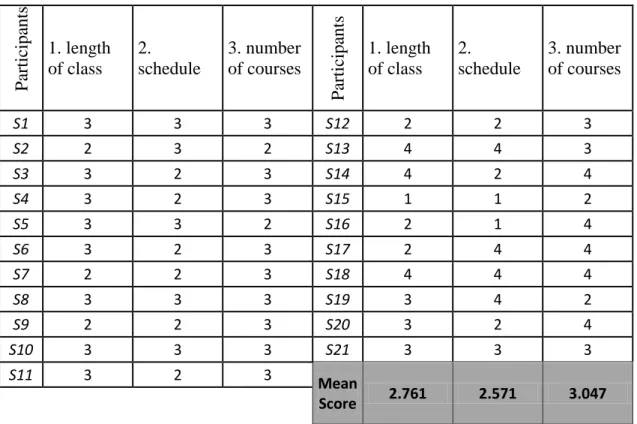
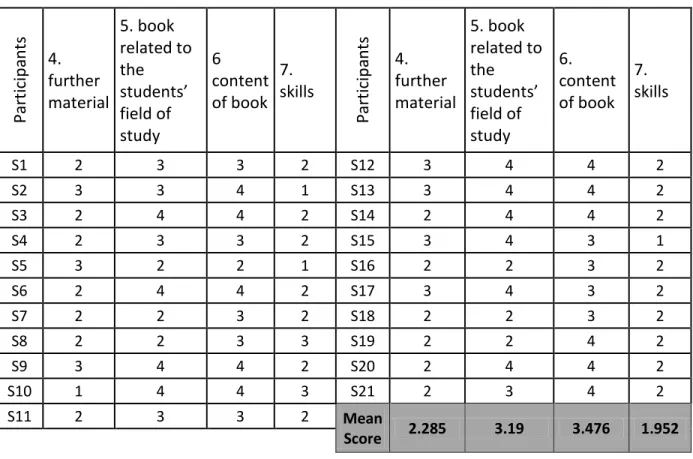
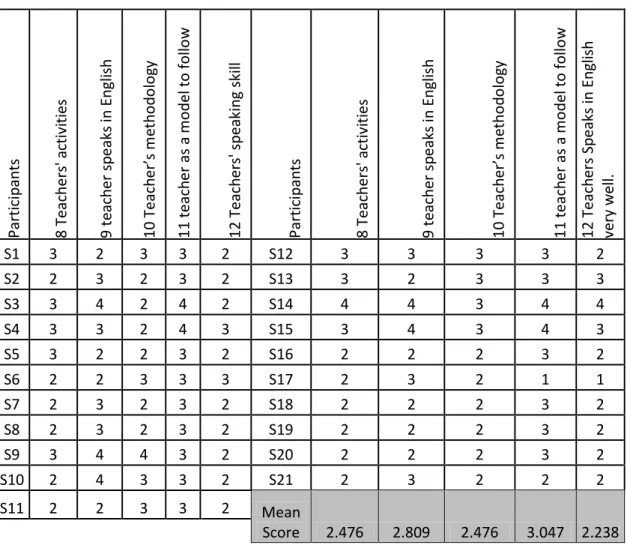
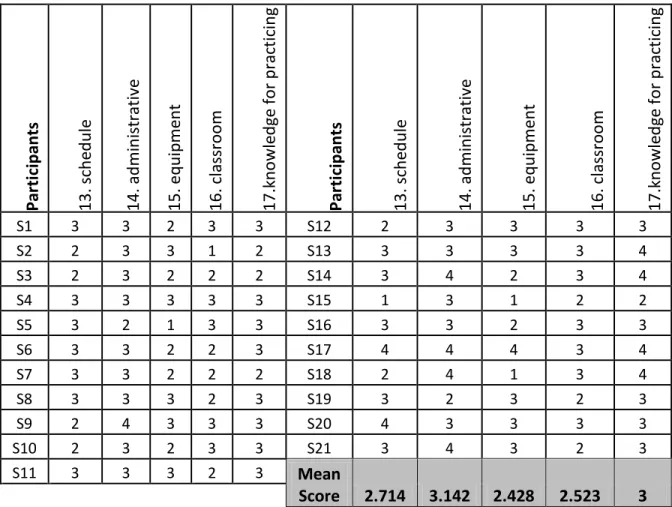
(36) 25. CHAPTER IV ANALYSIS AND RESULTS. 4.1. Introduction This chapter has the purpose of analyzing, discussing and obtaining results from the data collected by mean scores of a questionnaire. The discussion is organized following the sequence from 1 to 22 questions. Each set of data obtained from the two groups of participants (SFM and SFP) area analyzed separately. Findings are presented drawing on tables and figures. The analysis will discuss first the findings from the SFM (Tables from 4.1 to 4.5), and then the findings emerging from the SFP (Tables from 4.6 to 4.10). Findings from the teachers from both faculties of Medicine and Psychology are discussed later in this chapter. (Figures from 4.1 to 4.5). By doing the analysis of the teachers‟ opinions of both faculties, a set of figures are presented (Figures from 4.6 to 4.10). After that, to show participants‟ opinions about the importance of learning English some extra figures are analyzed. (Figure from to 4.5). Finally; the findings presented in the last figures all participants (students and teachers) gave their opinions for their English language learning and teaching. (Figures 4.6 and 4.10). It is worth reminding to the reader that the questionnaire is organized into 5 sections, each of which is composed by a few related questions. Three of these sections explore academic issues and the other two explore contextual issues. The analysis therefore is organized in sections, this means that each table displays the findings of two, three or more questions belonging to the same section. It is worth reminding that the research questions addressed for this study are:.
(37) 26. 1. – What are the contextual and academic factors that determine the effectiveness of the language teaching and learning process on the second course of English in the faculty of medicine and psychology at a public university?. 2. – What are the contextual and academic factors that determine the effectiveness of the language teaching and learning process on the second course of English of the teachers of two different faculties at the public university?. 3. – What are the differences and similarities between the opinions of learners and teachers about the language teaching and learning process?. Finally; the questionnaire has two last important. The first one is developed to know the level of importance of the English language learned during a specific field of study and the second one is a section where the participants are free to give their own suggestion to improve the English classes. The results are represented by figures that show bars about the importance of learning English and a selection of opinions and agreement between participants.. 4.2 Questionnaire designing. The first section of the questionnaire (Appendix 6) investigated the academic context. This section included three questions that asked about: the length of classes, schedules, and number of courses..
(38) 27. The findings from each question are presented in tables and figures. The second sections is about the academic context too; but this section analyses the materials used by the English teachers and the influence of them on their English classes: this section includes 4 questions about the following statements: the use of the textbook, its content and if it suitable to the students‟ needs, and the exams in relation to the evaluation of the language skills. The next five questions are concerned with the teachers‟ performance and influence on the students‟ learning of a foreign language. The other factor analyzed in this study is the contextual factor. The first questions are related to classrooms conditions like equipment, the administrative support on English classes selection and the enough language leaned to be practiced inside and outside the classroom. Finally the last five questions are related to the contextual factor about the importance of learning English on students‟ professional development. The tables are organized into columns, each displaying the outcomes from the issues related to each section. The first figures shows only averages about teachers‟ opinions, then the next figures show figures of bars that show the learners of both faculties average. And finally the last figures of bars show the differences and similarities between all participants including teachers‟ perceptions. The questionnaire used in this study used an agreement- disagreement Liker scale, in which 1=strongly agree, 2=agree, 3=disagree and 4=strongly disagree. The numbers shown in the tables indicate the scale chosen by the participants when completing the questionnaire. The number in the first column just indicates the number of participant. At the end of each column the mean score is given to make the comparison between the participants‟ averages..
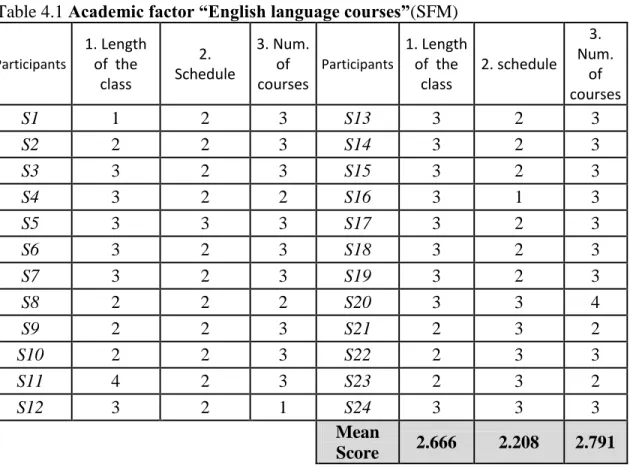
(39) 28. 4.3. Results 4.3.1. Students from the Faculty of Medicine (SFM) Table 4.1 below presents the results, about academic factors related to the English courses on second level which are explored in the first three questions from the questionnaire. The mean score obtained from the 24 participants illustrates their opinions about English language courses. The results about RQ1show that the average opinion of most of the participants, is between “agree” and “disagree”, and the mean score was 2.666 (Table 4.1) in the scale used in this study. This result indicates that the participants are a little bit concerned about the length of their English language classes. The findings from RQ2 relate to the schedule of the English classes and their suitability with their other curricular subject show a mean score of 2.208. This shows that the average opinions of the SFM are on the scale ´agree´. This finding suggests that the students do not have problems with the schedule of the English lessons and that it can be combined with other curricular courses. As for RQ3 that asked whether the language courses were enough for learning English, the findings show that the students´ opinions tended to be in disagreement, so the mean score was 2.791 (Table 4.1). This means that the SFM believe that the number of English courses is not enough to improve their learning of English. From this section we can affirm that the courses schedules are suitable for the students however the number of courses and the length of them do not satisfy the students´ needs..
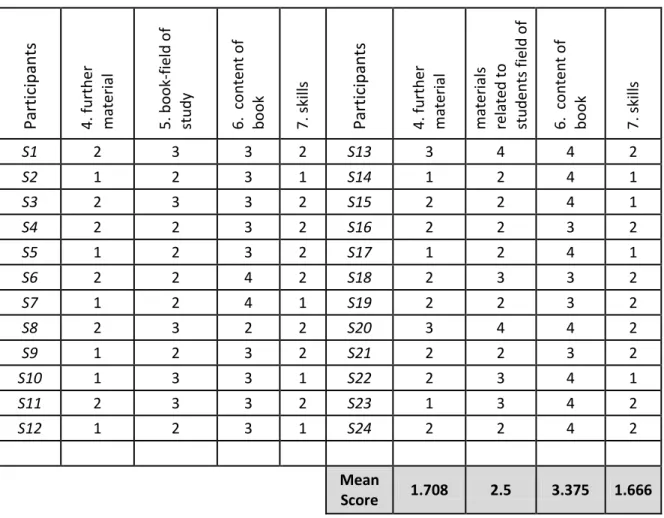
(40) 29. Table 4.1 Academic factor “English language courses”(SFM) Participants. 1. Length of the class. 2. Schedule. S1 S2 S3 S4 S5 S6 S7 S8 S9 S10 S11 S12. 1 2 3 3 3 3 3 2 2 2 4 3. 2 2 2 2 3 2 2 2 2 2 2 2. 3. Num. 1. Length Participants of the of 2. schedule courses class. 3 3 3 2 3 3 3 2 3 3 3 1. S13 S14 S15 S16 S17 S18 S19 S20 S21 S22 S23 S24 Mean Score. 3. Num. of courses. 3 3 3 3 3 3 3 3 2 2 2 3. 2 2 2 1 2 2 2 3 3 3 3 3. 3 3 3 3 3 3 3 4 2 3 2 3. 2.666. 2.208. 2.791. Table 4.2 shows the results related to the course materials of the foreign language learning which are explored in the next four questions from the questionnaire. The mean scores obtained from the participants show their opinions about the materials used by their English teachers in order to get good results at the end of their English courses. RQ4 asks if the English teachers support their English classes with further materials. Findings show that most of the participants strongly agreed with this statement but not all.
(41) 30. of them. Which is reflected in the mean score 1.708.It illustrates that SFM are aware about the fact that their English language teachers complement their English language classes with different materials to make them more attractive. The RQ5 about the use of further English language materials related to the field of study of the SFM, findings show that the students opinions are between “agree and disagree” with a mean score of 2.5. It indicates that some students agree with this statement but there are few of them that disagree. As for RQ6 that asked about the content of the English textbook and the relevance with the learner‟s field of study the findings show that students do not believe their books have a true relation with their field of study because the mean score was 3.375. It means that most of the SFM disagree. For this reason this average is strongly related to a disagreement opinion. The findings from RQ7 show that in the case of their English exams and the integration of the English language skills of learners (Speaking, listening, reading and writing) got a mean score of 1.666. It indicates that the SFM do not have problems with the way they have been evaluated at the end of their English courses and they are satisfied with this procedure of evaluation. According with the results obtained in this part of the instrument (Table 4.1) we can affirm that the SFM belief that their language skills have been evaluated properly and that their teachers have been improving their English classes with further materials; opposite to this; on these students‟ opinions the table suggest a high level of disagreement related to the English text book used in this course level..
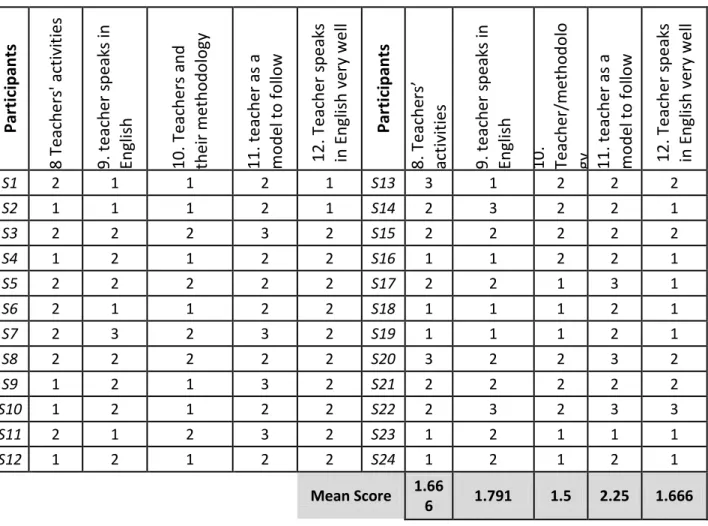
(42) 31. 4. further material. 5. book-field of study. 6. content of book. 7. skills. Participants. S1. 2. 3. 3. 2. S13. 3. 4. 4. 2. S2. 1. 2. 3. 1. S14. 1. 2. 4. 1. S3. 2. 3. 3. 2. S15. 2. 2. 4. 1. S4. 2. 2. 3. 2. S16. 2. 2. 3. 2. S5. 1. 2. 3. 2. S17. 1. 2. 4. 1. S6. 2. 2. 4. 2. S18. 2. 3. 3. 2. S7. 1. 2. 4. 1. S19. 2. 2. 3. 2. S8. 2. 3. 2. 2. S20. 3. 4. 4. 2. S9. 1. 2. 3. 2. S21. 2. 2. 3. 2. S10. 1. 3. 3. 1. S22. 2. 3. 4. 1. S11. 2. 3. 3. 2. S23. 1. 3. 4. 2. S12. 1. 2. 3. 1. S24. 2. 2. 4. 2. Mean Score. 1.708. 2.5. 3.375. 1.666. 7. skills. Participants. 4. further material 5. Further materials related to students field of study 6. content of book. Table 4. 2 Academic factor “Materials”(SFM). The following table 4.3 describes the academic factors related to opinions and beliefs of learners in relation to their English teachers and their performance in their classes. This section contains five questions from the questionnaire. The mean scores obtained from the participants of the SFM illustrate their opinions about their English teachers and how they can affect their English language learning. On learners opinions about teacher‟s activities that motivate their learning RQ8 got mean score of 1.666. It is an average between strongly agree and agree. It suggests that the SFM feel motivated by the English activities developed by their English teachers..
(43) 32. The next aspect related to the use of English language by the teacher in RQ9 got a mean score of 1.791 that displays an agree scale. In this question SFM agree about their English teachers speak in English all the time. Following with the methodology developed by the English teachers in their classes RQ10; the students‟ opinions got a mean score of1.5. This finding represents an average between “strongly agree” and “agree”. It means that learners approve the teaching strategies used by the teacher. The findings from RQ11 related to if the language teacher would be a good leader to follow got a mean score of 2.25. This finding suggests that most of the learners think that their English teachers could be a good guide but few of them disagree this statement. The results about RQ12 show that most of the SFM think that their English teachers speak the foreign language very well with a mean score of 1.666. This mean score is between strongly agree and agree. In learners‟ opinions the language skill of their English teachers is suitable for them to develop a foreign intonation. From this part of the questionnaire we can suggest that the SFM do not have a lot of problems with their English performance in the classroom; but opposite to this; on students‟ opinions, some English teachers do not have enough qualities in order to be followed as a model..
(44) 33. 9. teacher speaks in English. 10. Teachers and their methodology. 11. teacher as a model to follow. 12. Teacher speaks in English very well. Participants. 8. Teachers’ activities. 9. teacher speaks in English. 2. 1. 1. 2. 1. S13. 3. 1. 2. 2. 2. S2. 1. 1. 1. 2. 1. S14. 2. 3. 2. 2. 1. S3. 2. 2. 2. 3. 2. S15. 2. 2. 2. 2. 2. S4. 1. 2. 1. 2. 2. S16. 1. 1. 2. 2. 1. S5. 2. 2. 2. 2. 2. S17. 2. 2. 1. 3. 1. S6. 2. 1. 1. 2. 2. S18. 1. 1. 1. 2. 1. S7. 2. 3. 2. 3. 2. S19. 1. 1. 1. 2. 1. S8. 2. 2. 2. 2. 2. S20. 3. 2. 2. 3. 2. S9. 1. 2. 1. 3. 2. S21. 2. 2. 2. 2. 2. S10. 1. 2. 1. 2. 2. S22. 2. 3. 2. 3. 3. S11. 2. 1. 2. 3. 2. S23. 1. 2. 1. 1. 1. S12. 1. 2. 1. 2. 2. S24. 1. 2. 1. 2. 1. 1.66 6. 1.791. 1.5. 2.25. 1.666. Mean Score. 12. Teacher speaks in English very well. 8 Teachers' activities. S1. 10. Teacher/methodolo gy 11. teacher as a model to follow. Participants. Table 4.3 Academic factor “Opinions about teachers” (SFM). Table 4.4 below presents the results, about contextual factors related to the schedules of the English classes, the administrative department support, the classroom conditions and the practicing of the language that could affect their English language learning success are explored in the following five questions from the questionnaire. The mean score obtained from the 24 participants illustrates their particular opinions. RQ13 asks if the schedule of students English classes could affect their learning got a mean score between “agree” and “disagree”. The mean score was 2.25. It is so close to the agree average. The finding illustrates that English learning is not affected by the.
(45) 34. schedules chosen by most of the SFM. Only a few numbers of students think that their English lessons could be affected by the schedules of their English lessons. (See table 4.4). The findings from RQ14 show that in the case of the support of the administrative department on students‟ needs about taking a foreign class as a part of their curricula got a mean score of 3.083. It indicates that most of the students perceive that their administrative department do not support them. As for the RQ15 that asked about learner‟s perception about the equipment into the classroom that is enough or not for their English classes reached a mean score of 2.583. It is between “agree” and “disagree”. This finding shows that learners are a little bit concerned with the equipment for their English lessons. The findings from the question RQ16 about classroom conditions that may allow a good learning process got a mean score of 2.708with a tendency of disagreement. It shows that most of the SFM notice that the classroom conditions can affect their English language learning. The RQ17related to the practice of English production with students in and out the classroom got an average 2.666, findings show that students‟ opinions are between “agree and disagree”. It indicates that most of the SFM think they are not able to practice their English language learned in and out the classroom. From this section we can affirm that the issues generated by the contextual factors related to the schedules, classroom conditions and administrative support can affect the English language learning of the SFM. According to students‟ opinions, the administrative department of their faculty needs to pay more attention to their needs in relations to their English classes. Opposite to this, English schedules are suitable with their other classes. See table 4.4.
(46) 35. 13. schedule suitable for learning. 14. administrative supportive. 15. Enough equipment. 16. classroom conditions. Participants. 13. schedule suitable for learning. 14. administrative supportive. 15. Enough equipment. 16. classroom conditions. 17. knowledge for practicing. S1. 2. 4. 2. 2. 2. S13. 2. 4. 4. 4. 3. S2. 2. 3. 1. 4. 2. S14. 2. 3. 2. 3. 4. S3. 3. 3. 2. 3. 3. S15. 2. 3. 3. 1. 3. S4. 2. 3. 3. 3. 2. S16. 1. 1. 3. 3. 3. S5. 3. 3. 3. 3. 3. S17. 2. 3. 1. 2. 2. S6. 3. 4. 2. 2. 2. S18. 2. 2. 3. 3. 3. S7. 2. 3. 3. 2. 3. S19. 2. 3. 3. 3. 2. S8. 2. 3. 3. 3. 2. S20. 3. 4. 4. 4. 3. S9 S1 0 S1 1 S1 2. 2. 3. 2. 1. 2. S21. 2. 2. 2. 3. 3. 2. 3. 2. 2. 3. S22. 2. 3. 2. 1. 2. 2. 3. 3. 2. 3. S23. 4. 4. 4. 4. 4. 2. 4. 1. 3. 2. S24. 3. 3. 4. 4. 3. 2.25. 3.083. 2.583. 17. knowledge for practicing. Participants. Table 4.4 Contextual factor “Schedules, classrooms etc.” (SFM). Mean Score. 2.708 2.666. The Table 4.5 below presents the results about the importance of learning English to accomplish their studies. The mean score obtained from the 24 participants illustrates their opinions about the contextual factor related to the importance of English language o students‟ professional development. The findings from RQ18 where students had to give their agree opinion about the certification of English language as a requirement to get their bachelor degree. The mean score was 2.25. This finding suggests that learners are a little bit disagreeing about getting a.
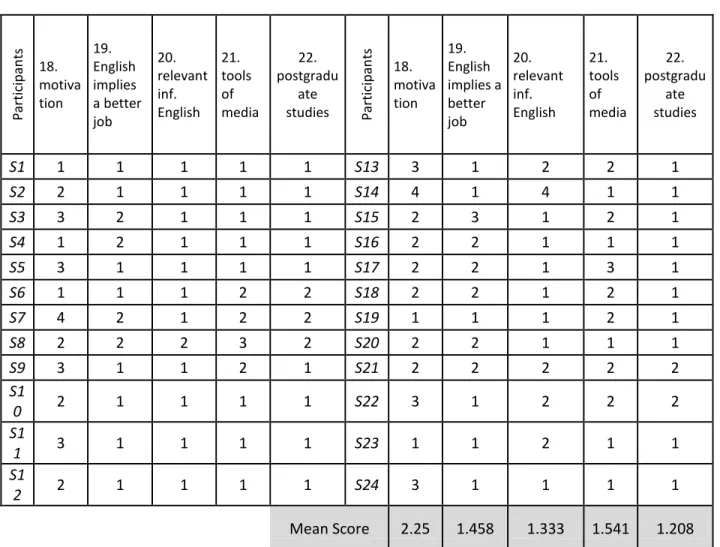
(47) 36. certification of the language to increase their knowledge and motivate their learning of the foreign language. As for RQ19 that asked students their perception about if learning English assures a better job. The mean score was 1.458. It is between “strongly agree” and “agree”. This finding shows that for the SFM leaning English will give a slight possibility to move abroad or getting a better job. On RQ20 the students had to give their opinion about the relevance of English information on students‟ field of study. The mean score obtained was of 1.333. This finding suggests that students are strongly agree about learning English to understand information related to their field of study. And they think that English information found in articles, essays, books and etc. is very relevant for them. The findings from RQ21 students showed a high level of agreement about the value of learning English language for communication thought tools of media. The mean score was 1.541. It suggests that SFM believe that learning English will help them with the use of media tools for communication. Finally, the findings on RQ22 where learning English is relevant for further postgraduate studies gave a mean score of 1.208. This mean score is strongly agree. It means that learners belief that learning English will help on their post graduate studies. From this final section we can validate the statement that learning English is relevant for SFM. Mainly the RQ20 where the students need to read information related on their field of study in a foreign language. And this information is relevant as a complement of their knowledge. Opposite of the idea; studying English as a complement of their curricula or getting their bachelor degree is not an option for their opinions. This idea does not motivate students on learning English as a foreign language..
(48) 37. The SFM prefer to study English language to get more knowledge more than learning for obligation. See table 4.5. 19. 18. English motiva implies tion a better job. 20. relevant inf. English. 21. tools of media. 22. postgradu ate studies. Participants. Participants. Table 4.5 Contextual factor “Importance of English”(SFM). 19. 20. 18. English relevant motiva implies a inf. tion better English job. 21. tools of media. 22. postgradu ate studies. S1. 1. 1. 1. 1. 1. S13. 3. 1. 2. 2. 1. S2. 2. 1. 1. 1. 1. S14. 4. 1. 4. 1. 1. S3. 3. 2. 1. 1. 1. S15. 2. 3. 1. 2. 1. S4. 1. 2. 1. 1. 1. S16. 2. 2. 1. 1. 1. S5. 3. 1. 1. 1. 1. S17. 2. 2. 1. 3. 1. S6. 1. 1. 1. 2. 2. S18. 2. 2. 1. 2. 1. S7. 4. 2. 1. 2. 2. S19. 1. 1. 1. 2. 1. S8. 2. 2. 2. 3. 2. S20. 2. 2. 1. 1. 1. S9 S1 0 S1 1 S1 2. 3. 1. 1. 2. 1. S21. 2. 2. 2. 2. 2. 2. 1. 1. 1. 1. S22. 3. 1. 2. 2. 2. 3. 1. 1. 1. 1. S23. 1. 1. 2. 1. 1. 2. 1. 1. 1. 1. S24. 3. 1. 1. 1. 1. 2.25. 1.458. 1.333. 1.541. 1.208. Mean Score.
Figure
+7


Documento similar
1. S., III, 52, 1-3: Examinadas estas cosas por nosotros, sería apropiado a los lugares antes citados tratar lo contado en la historia sobre las Amazonas que había antiguamente
In the previous sections we have shown how astronomical alignments and solar hierophanies – with a common interest in the solstices − were substantiated in the
of Edward VL Since he had no bodily heir the kingdom passed to his sister Mary, who with the consent of the Lords and in accordance with the proceedures of the kingdom, took
While Russian nostalgia for the late-socialism of the Brezhnev era began only after the clear-cut rupture of 1991, nostalgia for the 1970s seems to have emerged in Algeria
Comparing Spanish and Japanese against the English language we found that both languages have fewer vowel and consonant sounds than in English. In the case of
This study presents the findings of a year-long e-mail exchange between learners of English at Nebrija University in Madrid and learners of Spanish at Trinity College Dublin during
At the same time, however, it would also be misleading and simplistic to assume that such Aikido habituses were attained merely through abstracted thought
From the 20 subjects analysed in this study, 8 subjects use only the correct forro towards the end of the school year6• A study of the 20 subjects in the following year would show
