
Improvement of listening skill in two different eighth grades from a public school in Cali
102
0
0
Texto completo
(2) IMPROVEMENT OF LISTENING SKILL IN TWO DIFFERENT EIGHTH GRADES FROM A PUBLIC SCHOOL IN CALI. DIANA MILENA BOTERO ECHEVERRY LUISA FERNANDA QUINTERO PIMENTEL. Submitted as partial requirement for the degree of Bachelor of Education in Foreign Languages: English-French. Advisor, CARLOS ALBERTO MAYORA. UNIVERSIDAD DEL VALLE FACULTAD DE HUMANIDADES ESCUELA DE CIENCIAS DEL LENGUAJE LICENCIATURA EN LENGUAS EXTRANJERAS INGLÉS Y FRANCÉS SANTIAGO DE CALI 2017.
(3) ACKNOWLEDGEMENTS. We want to thank in first place to our families for their constant support throughout these years of hard work. To our friends because they were our support in bad moments, and they taught us to never give up. We want to thank also to our thesis advisor Carlos Alberto Mayora because his advice always guided us throughout this process and helped us to take good decisions whenever we found obstacles during the practicum and the thesis writing process. We want to thank the school INEM Jorge Isaacs and its principal because they opened their doors for us and they were very gentle when we needed to do our practicum and also carry out our thesis research. We want to thank the English teacher Maria Isabel Moran Moran because she permitted us to use time from her classes for us to do our practicum and our thesis research, and because she was very cooperative throughout our process. Finally, we want to thank the two eighth-grade groups (8-03 and 8-08) because they cooperated with all the activities we proposed in our classes and they were very receptive.. iii.
(4) TABLE OF CONTENTS. Contenido TABLE OF CONTENTS .......................................................................................................... iv INDEX OF TABLES AND FIGURES ...................................................................................... vi ABSTRACT ............................................................................................................................ vii RESUMEN ............................................................................................................................. viii INTRODUCTION .................................................................................................................... 10 1. STATEMENT OF THE PROBLEM ..................................................................................... 12 1.1. Research Questions ......................................................................................................... 12 1.2 Objectives ........................................................................................................................ 13 1.3. Justification .................................................................................................................... 14 2. BACKGROUND .................................................................................................................. 15 3. LITERATURE REVIEW ...................................................................................................... 18 3.1. Listening: ........................................................................................................................ 18 3.2.1. Bottom-up processing: .............................................................................................. 20 3.2.2. Top-down process: ................................................................................................... 21 3.3. Listening strategies ......................................................................................................... 22 3.4. Teaching listening: .......................................................................................................... 23 3.4.1 Listening lessons: ...................................................................................................... 24 3.4.2 Types of listening: ..................................................................................................... 24 3.4.3. Types of listening activities: ..................................................................................... 25 3.4.5. Listening materials: .................................................................................................. 28 3.5. Affect and listening: ........................................................................................................ 32 4. METHODOLOGY ................................................................................................................ 33 4.1. Type of study: ................................................................................................................. 33 4.2. Context: .......................................................................................................................... 33 4.3. Participants: .................................................................................................................... 33 4.4. Data collection procedures and instrumentation. ............................................................. 34 4.4.1. Class observations. ................................................................................................... 35 4.4.2. Survey. ..................................................................................................................... 35 4.4.3. Interview. ................................................................................................................. 36 iv.
(5) 4.4.4. Class diaries. ............................................................................................................ 36 4.4.5. Listening comprehension test.................................................................................... 37 4.5. Treatment. ...................................................................................................................... 42 5. RESULTS ............................................................................................................................. 49 5.1. Results from needs analysis ............................................................................................ 49 5.1.1. Class observation...................................................................................................... 49 5.1.2. Survey. ..................................................................................................................... 50 5.2. Results from the pre and post-tests. ................................................................................. 55 5.3. Results from class diaries or field notes........................................................................... 57 6. DISCUSSION ....................................................................................................................... 62 6.1. Lack of familiarity of the students with listening activities: ............................................. 62 6.3. Equipment and resources: ............................................................................................... 64 6.4. Class size: ....................................................................................................................... 65 6.5. Time constraints: ............................................................................................................ 65 7. CONCLUSIONS ................................................................................................................... 67 8. REFERENCES ..................................................................................................................... 69 Appendix 1 ............................................................................................................................... 74 Appendix 2 ............................................................................................................................... 79 Appendix 3 ............................................................................................................................... 81 Appendix 4 ............................................................................................................................... 82 Appendix 5 ............................................................................................................................... 86 Appendix 6 ............................................................................................................................... 90 Appendix 7 ............................................................................................................................... 95 Appendix 8 ............................................................................................................................... 96. v.
(6) INDEX OF TABLES AND FIGURES. Table 1. Creating pre listening activities by different factors ..................................................... 27 Table 2. Examples of activities for the while-listening stage. ..................................................... 27 Table 3. Examples of post-listening activities. ........................................................................... 28 Table 4. This table shows the structure of the two PET diagnostic tests that were applied respectively at the beginning and at the end of the process. ....................................................... 39 Table 5. This table shows the structure of the audios that were used for the initial and final diagnostic tests. ......................................................................................................................... 40 Table 6. Summary of the six lesson plans used during the treatment. ......................................... 43 Table 7. Shows the structure of the audios used in the treatment. ............................................... 47. Figure 1. Bar graph showing answers to question 3 in the diagnostic survey. ............................. 50 Figure 2. Bar graph showing answers to question 4 in the diagnostic survey. ............................. 51 Figure 3. Bar graph showing answers to question 5 in the diagnostic survey. ............................. 52 Figure 4. Bar graph showing the answers of 21 students (they answered 2 options) to question 7 in the diagnostic survey. ............................................................................................................ 53 Figure 5. Bar graph showing the answers of 42 students (they answered 1 option) to question 7 in the diagnostic survey. ................................................................................................................ 54 Figure 6. Descriptive statistics for both tests. ............................................................................. 55 Figure 7. Bar graph showing the score frequencies from pre and post-test. ................................ 56. vi.
(7) ABSTRACT. The objective of this research was to determine the effect of listening lessons in a population of students from a public school who seldom receive instruction in this skill. The sample of students included those from two different eighth grades (8-03 and 8-08) from a public high school in Cali. The research was a mixed-method approach that combines quantitativequalitative data and procedures. Quantitative data included the needs analysis survey, a pre-test to diagnose students‟ initial level of competence in listening and a post-test to determine the effect after the lessons were implemented. Qualitative data included classroom observations prior to the implementation of the lessons, an interview to the classroom teacher of the classes studied, and our own class diaries while the lessons were implemented. Six lessons that explicitly targeted listening instructions were implemented for a total of 12 hours of instruction between pre and post-test. Results from the initial diagnostic support the need to reinforce listening instruction with these grades. Results from the post test, on the other hand, showed that the treatment was not as effective as we expected in the students. In other words, a treatment of only six classes was not enough for the improvement of the listening skill of this group of eighth graders. From the qualitative analysis, we identified a set of factors that influenced negatively the treatment effects and results including students‟ lack of familiarity with listening activities, negative attitude towards the activities, time constraints, lack of the appropriate resources and equipment for listening instruction, and class size (they were groups of an average of 35 students). Keywords: listening skill, pre-listening, while-listening, post-listening, English as a foreign language.. vii.
(8) RESUMEN. El objetivo de este estudio consistió en determinar el efecto de las clases enfocadas en la habilidad de escucha en una población de estudiantes pertenecientes a una escuela pública, quienes rara vez reciben instrucción enfocada en dicha habilidad. La muestra de estudiantes estuvo constituida por dos grupos de octavo grado (8-03 y 8-08) de una escuela pública de la ciudad de Cali. El estudio se basó en un método de investigación mixto que combina procedimientos tanto cuantitativos como cualitativos. Entre los procedimientos cuantitativos se implementó una encuesta para determinar las necesidades de la muestra, un examen diagnóstico para determinar el nivel inicial de la habilidad de escucha de los estudiantes y un examen diagnóstico final para determinar el efecto de las clases en el nivel de la habilidad de escucha de los estudiantes. Los procedimientos cualitativos consisten en observaciones de clases que se realizaron antes de la intervención, una entrevista a la docente principal del curso y nuestros diarios de clase desarrollados durante la implementación de las clases. La intervención de seis clases enfocadas en la instrucción y enseñanza de la escucha fueron implementadas entre el examen inicial y el final con una duración de 12 horas. Los resultados del diagnóstico inicial arrojaron que efectivamente había una necesidad de reforzar la enseñanza de la escucha. Por otra parte, los resultados posteriores a la intervención demostraron que ésta no fue tan efectiva para los estudiantes como se esperaba. En otras palabras, una intervención de solo seis sesiones no fue suficiente para el mejoramiento de la habilidad de escucha en este grupo de estudiantes de octavo. Sin embargo, según el análisis cualitativo se identificaron unos factores que influenciaron de forma negativa en los efectos y resultados de la implementación, esto incluye la falta de familiaridad de los estudiantes con las actividades de escucha, su actitud negativa hacia las actividades, contratiempos, falta de recursos y equipos necesarios para este tipo de viii.
(9) instrucción, y el tamaño de los grupos (los dos grupos contaban con un promedio de 35 estudiantes).. Palabras clave: Habilidad de escucha, pre-escucha, durante la escucha, después de la escucha, inglés como lengua extranjera.. ix.
(10) INTRODUCTION. English has become an important language all around the world. This is the reason why the government of Colombia has established English as a compulsory subject in all schools from primary to secondary grades. It was constituted according to the article 21 of the general law of education (Ley 115 de 1994) and also in the so-called law of bilingualism (Ley 1651 de 2013). The Ministry of Education has developed some programs such as Programa Nacional de Bilingüismo (PNB) as a strategy to improve the quality of English teaching in Colombia. This program has as its main goal to develop communicative skills in English among citizens of the country with comparable international standards (MEN, 2006). In this way, in 2006, National Standards of Competency in Foreign Language were introduced along the curricular guidelines (MEN, 2006), in order to unify the educational system in the country and to contribute with the objective of the PNB. Despite the different efforts to make improvements in the level of English spoken by Colombian citizens, especially a number of educational programs targeting secondary education, research shows that most high school graduates do not reach the expected levels of communicative competence specified in the National Standards of Competency in Foreign Language and the PNB (Alonso, Díaz, Martínez, Mayora, Moreno, Ochoa, & Roldán, 2017). One of the main reasons why students fail to learn English communicatively is their scarce exposure to the spoken language. Most of the times, the only chance students have to practice English is at the moment of the class (2 to 3 hours per week) and it has also to be considered that some teachers develop their English classes in Spanish thereby reducing chances for students to practice (Cárdenas & Chaves, 2013). Thus, these factors lead to the insufficient development of the four skills, especially the listening skill which sometimes is absent from class activities all 10.
(11) together. Considering this situation, the current study had as its main goal the design and implementation of listening lessons for a class of eighth graders in a public high school in Cali, and to determine if such design had an impact in the level of listening competence of the target students. In order to understand this research problem, the first section describes the statement of the problem, our research questions and the goals and aims of the study, as well as some background studied that support the implementation of a study such as the present one. Next, we go over a review of the literature related to the listening skill itself, the process in psycholinguistic terms, and then move on to listening from a pedagogical perspective, including the strategies this skill involves and the factors teachers must consider at the moment of creating activities and designing lessons involving oral texts. In the following section, the methodology implemented for the study will be explained, including a description of the context, the methods used for data collection and its proper analysis. Finally, we present and discuss the results obtained during the study and the implications the activities implemented had.. 11.
(12) 1. STATEMENT OF THE PROBLEM. The implementation in the Country of the National bilingualism program and the Basic standards of competence in English as foreign language brought to the way of teaching a language the concept of communicative competence, this way of teaching a second language (L2) establishes the importance to integrate the four different language skills which are: reading, listening, writing and speaking. It is supposed that for a successful teaching and effective learning all the skills have to be taught in schools and English courses, but throughout the researchers‟ practicum process in the public school it was found out that listening was not being taught in English classes because of a lack of resources necessary for teaching this skill (i.e. sound-playing equipment, language laboratories or especially equipped classrooms). On the other hand, bearing in mind that listening is one of the most important skills for language learning due to the fact that it provides the input of the target language; we decided to develop a set of classes focused mainly on the improvement and development of this skill.. 1.1. Research Questions. Taking into account that the object of study is focused on the improvement of listening skill in both groups of students, this research arises as the main research question: What is the effect of instruction that explicitly targets listening in the development of this skill in a group of eighth graders from a public school in Cali? In order to answer the main research question, we also propose a number of secondary questions:. 12.
(13) . What is the level of listening comprehension competence of the students from eighth grade in the selected school before the implementation of listening-targeted lessons?. . What is the level of listening comprehension competence of the students from eighth grade in the selected school after the implementation of listening-targeted lessons?. . What is the reaction of the students towards the implementation of these lessons?. 1.2 Objectives. Aim: To determine the effect of instruction that explicitly targets listening in the development of this skill in a group of eighth graders from a public school in Cali. Goals: . Identify the level of listening comprehension competence of the students from eighth grade in the selected school before the implementation of the listening lessons.. . Determine the level of listening proficiency of the students from the eighth grade after the implementation of the listening-targeted lessons.. . Analyze from the information gathered throughout the process whether the listeningtargeted lessons were useful for the improvement of this skill or not.. 13.
(14) 1.3. Justification The present research project has been carried out with the purpose of contributing to the current existent knowledge about instructional design for a specific second language skill. In the case of this study, we decided to focus on the listening skill in a particular context of a public school in Cali. When reviewing previous study, it is noticeable that many have focused on reading and speaking, but only a few have focused on listening. Given the centrality of this skill in the development of second language competence, the scarcity of studies addressing the teaching of listening represents an important lack in our context. In addition, many experts point out a number of problems in the teaching of listening. Some claim that listening is a Cinderella skill (see Nunan, 2002) that is often ignored, and others claim that listening is often tested and rarely taught (Harmer, 2007). Therefore, we decided to carry out a study that could contribute to both the field of listening and the field of language teaching methodology. In this way, we want to provide our experience and findings to enrich the field and to help future researchers to have guidance about the things that have to be borne in mind for a study of this type.. 14.
(15) 2. BACKGROUND. During many years it has been clear the importance of oral comprehension for the development and learning of a new language. Oral comprehension has a great importance as one of the first steps and tools for learning a new language. Children acquire their first language entirely from exposure to oral language. Different theories claim that the more exposure to oral language, or input, the faster and better results in both second and foreign language learning contexts (Krashen, 2003). However, in foreign language contexts, where contact to oral target language is limited, listening is often the weakest skill and the one teachers devote the least time (Nunan, 2009). That‟s why Mosquera (1996) in her work, reviews different methods and approaches that can be used to teach oral skills. The author goes over the different methods, exposing important aspects of each of them and their relevance for the learning and teaching process. At the end, the author suggests that it is not necessary to choose just one method or approach; instead, it can be more useful the incorporation of different methods through the process. This work is important for our study because it helps to have an overview in terms of available methodological options. In Escobar & Gomez‟s (2004) work, it is shown the importance of finding and using different ways to teach a new language. These aspects are important during the teaching and learning process because they will help to arouse the students‟ motivation towards the new language. To reach this goal, the authors suggest the use of pop music not only for the motivation, but also to improve the listening and speaking skills in English as a foreign language. The proposal consists on a didactic Pop Music Workshop in a communicative environment. With this work, the authors show different reasons to use songs in the classes and their effectiveness as a learning tool; they also expect to give other English teachers options of different ways to make classes more 15.
(16) interesting to the students and show others the important tool that using songs can be in the classroom and its effectiveness for the learning process. This work is important for this research because the exposed information about the listening skill is an excellent tool for this theoretical framework and also to understand the important aspects of listening to help students in their learning process. Salazar & Sanabria‟s (2008) work represents an important contribution to our work in terms of bibliography, and the procedure implemented by the authors is similar to our work but in a different context. The purpose of this work was to look into the best way to improve oral comprehension skills of students from fifth grade at a private school. The procedure carried out consisted in an intervention in which different oral comprehension exercises were implemented in each class, and they were analyzed through class observations and records. Students‟ workshops were an important tool for the authors in order to collect information about the students´ process with the skill. By the end of this work, the authors concluded that students showed a higher motivation for doing oral comprehension exercises. They also learned about strategies that could help them to improve this skill and their foreign language learning process. Alemán & Guacaneme (2011) conducted a study whose main purpose was the improvement of the listening skill through the development of learner´s autonomy. The path taken in order to accomplish this purpose was the extra-class work designed by the authors, which was mainly focused to work on both bottom-up and top-down abilities. The research was carried out with students from 502 grade at Institucion Educativa Distrital Antonio José de Sucre. At the end of the research, the results showed that during the application of surveys, activities and class observations, the students presented an important progress in both bottom-up and top-down abilities. Moreover, making a comparison between the extra-class work and the activities done in. 16.
(17) the classroom, the students showed a good progress in both processes, but at the end of the study there was a lower level in the extra-class. This research is important for our work because it can help us to enrich our theoretical framework and complement the information to develop further activities of the teaching process in the listening skill.. 17.
(18) 3. LITERATURE REVIEW 3.1. Listening: Listening is defined as the activity of paying attention, and attending closely for the purpose of hearing sounds. In terms of communicative abilities, listening refers to the process of extracting meaning from oral language (Nunan, 2002; Vandergrift 1999). This process is conditioned by affective, cognitive, and behavioral processes (Halone, Cunconan, Coakley & Wolvin, 1998). According to the cited authors, affective processes include the motivation to attend to others; cognitive processes include attending to, understanding, receiving, and interpreting content and relational messages; and behavioral processes include responding with verbal and nonverbal feedback. Listening in second language learning (L2) is known as a fundamental skill, and throughout years of research it has been shown the importance of this skill for L2 development.. …The term listening is used in language teaching to refer to a complex process that allows us to understand spoken language. Listening is the most widely used language skill, is often used in conjunction with the other skills of speaking, reading and writing. Listening is not only a skill area in language performance, but is also a critical means of acquiring a second language. Listening is the channel in which we process language in real time - employing pacing, units of encoding and pausing that are unique of spoken language. Rost, M. cited in Nunan & Carter (2001, p. 07).. It also has been defined as the “activity of paying attention to and trying to get meaning from something we hear. It is a skill which seems to develop easily for mother-tongue listening, but. 18.
(19) requires considerable effort where listening in a foreign language is concerned.” (Underwood, M.1989, p.01). According to Vandergrift (1999) listening comprehension is a complex process in which listeners play an active role in discriminating between sounds, understanding vocabulary and grammatical structures, interpreting intonation and stress, and finally, making use of all the skills mentioned above, interpreting the utterance within the socio-cultural context. Listening skills are anything but easy to master. This definition about listening skill is the most reliable for this study because it covers all the processes involved in listening for L2 learning. There are two dominant positions regarding the place of listening in foreign language acquisition.. The first one is listening as comprehension and later listening as acquisition.. According to Richards (2008), listening as comprehension is the traditional way of thinking about the nature of listening. This view of listening is based on the assumption that the main function of listening in second language learning is to facilitate understanding of spoken discourse (how we process speech). Listening as acquisition, on the other hand, goes further than the one mentioned before. In this view, the input taken from the listening material cannot only stay as input, but this new information should become intake in the listener‟s memory; in that way, it can be used in the other skills: speaking, reading and writing. In other words, listening comprehension is not only to be good at decoding a message, but also be able to incorporate the new knowledge (both in terms of language and content into the own repertoire).. 19.
(20) 3.2. Top-Down and Bottom-up Processing: As oral language is heard, it is said to be processed into distinctive ways: bottom-up and topdown. Most current models of listening comprehension acknowledge today that these two ways of processing co-occur in parallel while the acoustic signal is both decoded and interpreted (Lynch, 2009). Each way of processing involves a series of activities.. 3.2.1. Bottom-up processing: When this process makes its presence during the comprehension activity, it means that the listener is taking all the input (words, sounds, sentences, texts) offered by the spoken discourse in order to decode the information and have a complete meaning of the message. During this stage, the lexical and grammatical competences are essential. These two competences help students to analyze each component of the message, from its phonological form to the meaning itself. the understanding of grammar takes the listeners to convert what they hear in the message to what they know to have a better comprehension. In this way, almost all the input initially taken from the message can become intake in the listener‟s‟ memory. Bottom-up sub-skills, also called micro-skills, include: 1. Discriminating among the distinctive sounds of English. 2. Retaining chunks of language of different lengths in short-term memory. 3. Recognizing English stress patterns, words in stressed and unstressed positions, rhythmic structure, intonation contours, and their role in signaling information. 4. Recognizing reduced forms of words. 5. Distinguishing word boundaries, recognize a core of words, and interpret word order patterns and their significance. 6. Processing speech at different rates of delivery. 20.
(21) 7. Processing speech containing pauses, errors, corrections, and other performance variables. 8. Recognizing grammatical word classes (nouns, verbs, etc.), systems (e.g., tense, agreement, and pluralization), patterns, rules, and elliptical forms. 9. Detecting sentence constituents and distinguish between major and minor constituents. 10. Recognizing that a particular meaning may be expressed in different grammatical forms. 11. Recognizing cohesive devices in spoken discourse. (Brown, 2000, p.256). 3.2.2. Top-down process: Contrary to the first one, this process requires the listener‟s background knowledge in order to understand the meaning of the message. In this case, the grammar and structure is not so important because the meaning gets more attention than the language. This means that the listener uses his or her background knowledge about experiences in life and topics which will make a reference to the content, and listeners will also use the knowledge about typical situations that could happen in different scenarios. Top-down sub-skills, also called macro-skills, include: 1. Recognize the communicative functions of utterances, according to situations, participants, goals. 2. Infer situations, participants, goals using real-world knowledge. 3. From events and ideas described, predict outcomes, infer links and connections between events, deduce causes and effects, and detect such information, generalization, and exemplification. 4. Distinguish between literal and implied meanings. 5. Use facial, kinesics, body language, and other nonverbal clues to decipher meanings. 21.
(22) 6. Develop and use a battery of listening strategies, such as detecting key words, guessing the meaning of words from context, appealing for help, and signaling comprehension thereof. (Brown, 2004, p 121-122). 3.3. Listening strategies According to Vandergrift (2007, cited by Ghoneim, 2013) strategies are those “that listeners consciously or unconsciously use in order to understand, analyze, and interpret a text. The use of these strategies can make authentic texts more accessible in the early stages of learning a language, so that the process becomes more relevant and interesting to the learners” (p. 101). In other words, listening strategies are tools or techniques helping the listener to have a better understanding of the input. There are different types of strategies known as: cognitive, socioaffective and metacognitive strategies (Peterson, 2001). Cognitive strategies are the ones mainly focused on “comprehending and storing input in working memory or long-term memory for later retrieval” (Buck, 2001 on Richards, 2008 p.11). Some examples of these strategies are: rehearsal, organization, summarization and elaboration. Socio-affective strategies are present when the listening is a two-way activity and the meaning of the message can be negotiated between the listener and the speaker. Some of these strategies are cooperative learning, questioning for clarification and managing one‟s emotions in the learning situation. Metacognitive strategies are the ones which the listener uses to be more conscious of its learning progress and well development. These strategies are useful for the listener in order to plan, monitor and evaluate his/her listening. Goh (1997, 1998) cited by Richards (2008 p. 12) gives a description of each metacognitive strategy mentioned previously:. 22.
(23) . Planning: This will help listeners and students to determine the learning objectives and which means will be helpful to achieve those objectives. It is also important to set real short and long term goals and determine the opportunities to put into practice the listening. Some important tasks for this is previewing the main ideas, rehearsing the language and deciding the aspects of the text in which concentration will take a part.. . Monitoring: This strategy will be helpful to help listeners checking their progress during a listening task or learning activity. Some general listening development during this moment is considering the progress according to determined criteria, determining how close the short and long term goals are going to be achieved, and checking which mistakes are still being made. Specific listening tasks for this strategy are: To check constantly what is and is not being understood during the listening activity, determine if it is appropriate and the accuracy of what is understood, and also identify the source of difficulty.. . Evaluating: This strategy will help to determine the success of learning or listening task. During this strategy is mainly to assess the listening progress, the effectiveness of learning and strategies and appropriateness of the learning goals. Moreover, this strategy will help to check the comprehension of text.. 3.4. Teaching listening: As any other language skill, listening can be taught. That is to say, classroom activities and dynamics can be designed and implemented with the specific aim of having student practice and develop listening processes, sub skills and strategies (Harmer, 2007; Peterson, 2001; Vandergrift & Goh, 2012). However, as noted by Nunan (2002) listening is often a Cinderella skill, a skill. 23.
(24) that does not receive much attention in language classes. Furthermore, Renandya & Farrell (2010) claim that many times listening lesson consists of memory tests than actual preparation of the learner to understand spoken language. The fact is that effective listening lessons have some characteristics that are to be considered. Teachers need to plan and prepare students and not just play an audio or video and ask questions.. 3.4.1 Listening lessons: There are different types of activities done during a listening comprehension activity, but it is really important to determine not just what students listen to but also what students listen for. It is important to bear in mind that the activities presented might be related or answer to the purpose to be achieved, and this will determine the strategies to be used (Richards 2008; Vandergrift 1999; Vandergrift & Goh, 2012).. 3.4.2 Types of listening: According to Brown (2000), the types of listening are related to the type of performance students carry out during the lesson and will also represent a series of techniques for the teaching and improvement of this skill. These types of listening are: . Reactive: this type of listening is mainly focused on listening to a series of utterances in order for students to repeat all of them. Although this does not seem as an effective way of improving listening, it has its advantages because will help students to practice pronunciation.. . Intensive: the only purpose of this type is to focus on the different spoken language components like: phonemes, intonation, discourse markers, stress and even grammatical structure.. 24.
(25) . Responsive: Much of the listening activities consist of a series of structures that will lead to get a response from students. Therefore, the tasks are those related to get a reply from students through asking questions, following instructions, clarification and checking comprehension.. . Selective: When the students are faced to monologues or short narratives, it is not the objective to understand every single word, phrase or event. Instead, students have to get specific details from the oral text, usually the most important ones, and not the general meaning. For this type of listening, the principal activities are those which main focus is to get dates, names, numbers, etc.. . Extensive: The aim of this type of listening, different from the intensive, is to get a general comprehension of the spoken language such as messages or purpose. It will also bring out students‟ interactive skills to create discussions.. . Interactive: In this type of listening, all the types mentioned before can be included because the listening activity should be also related with the speaking performance which involves students in discussions, role plays, conversations, debates, etc.. 3.4.3. Types of listening activities: Listening activities can be classified according to the type of processing they involve. As stated above, language processing can be classified as either bottom-up or top-down. An effective listening lesson will consider an interactive model of comprehension, that is, will combine both types of activities (Richards, 2008). Bottom-up activities: As the name suggests, bottom-up activities evoke this type of processing and therefore are designed to prompt sequential and language-based analysis of the input (Nunan, 2009; Richards, 25.
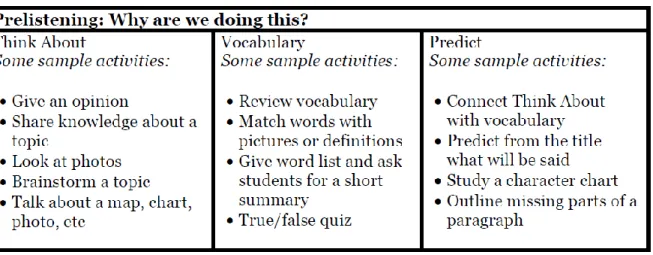
(26) 2008). In other words, these are activities for learners to practice listening micro skills. A fill-inthe-blank activity, a multiple-choice question, minimal pair discrimination are typical examples of these activities. Top-down activities: In the same way, top-down activities are named after the type of processing they evoke and are aimed at prompting parallel and knowledge-based analysis of the input (Nunan, 2009; Richards, 2008). That is to say, these are activities for learners to practice listening macro skills. Tasks that involve inference, predicting or changing the end of a story are typical examples of these kinds of activities.. 3.4.4. Listening task Field (1998) has identified a classical structure for listening lessons. This structure has three stages known as pre-listening, listening and post-listening. The first stage is pre-listening which has two main aims: a) providing context to the students in a way that the listening task resembles real life (most listeners in real life have previous knowledge or are familiarized with the context in which the listening occurs); and b) motivating students to hear (Field, 1998). Consequently, this stage involves activating the students‟ prior knowledge, pre-teaching new vocabulary, setting goals for the listening task. Some activities that can be done in this stage are:. 26.
(27) Table 1. Creating pre listening activities by different factors. Sahr (2011, p.01). The second stage, while listening, according to Field (1998), is the stage in which students will actually interact with the oral text. This stage might involve different types of listening (intensive and extensive, for instance) and different types of listening activities (top-down and bottom-up). Some typical examples of activities at this stage are:. Table 2. Examples of activities for the while-listening stage.. Sahr (2011, p. 02).. 27.
(28) The last stage, post listening or after listening, is important for students to reach a different level of comprehension beyond the understanding of superficial meaning. This stage will not only help students to feel their listening skill has improved, but also, it will be very helpful to make reflect on the language heard by, for example, identifying functions (apologizing, inviting, refusing, etc.) or linguistic structures within the language used in the oral text. Finally, in this stage students can also use information or forms from the input into their own production.. Table 3. Examples of post-listening activities.. (Sahr, 2011).. 3.4.5. Listening materials: The success or failure of listening lessons depends largely on the materials teachers choose. For comprehension to take place, it is important that the input is at the appropriate level of difficulty for the learner (Krashen, 2003). Oral texts that are too difficult for the learner to understand will result frustrating and excessively challenging (Renandya & Farrell, 2010). These are some key elements to be considered when choosing input for listening classes:. 28.
(29) Grammar and vocabulary: Vocabulary size has been determined as a key element for successful listening comprehension. The more known words in the spoken text for the listener, the better the chance for comprehension. Yet, vocabulary size is not determining because listener with a weaker vocabulary base can find different strategies for approaching the listening task and compensate for lexical deficiencies (Nation, 2006; Vandergrift 2006). Different studies have shown that syntactic knowledge does not play an important role because at the moment of listening, listeners are mainly focused on getting the main ideas, and for this grammar knowledge plays a secondary role (Mecartty, 2000; Vandergrift, 2006). Spoken language features: It is well known that spoken language contains a variety of factors and differences which can make its comprehension easy or difficult. For example, accent, speed and phonological processes can influence the way speech is perceived. Regarding accents, studies suggests that no accent is more comprehensible than any other, but, listeners can understand better accents they are familiar with or that they perceive as better or clear because of sociolinguistic attitudes towards the accent (Munro & Derwing, 1995). As for speech rate, it has been found that very fast natural speech can be difficult to understand for beginner or intermediate listeners; however, a slow speech is not necessarily better for comprehension if it contains too much information or unknown vocabulary (Bloomfield, Wayland, Blodgett & Linck, 2011). In English, spoken language is subject to phonological process by which some sounds are reduced, others are completely eliminated and words are combined. A typical example of this is the word “wanna” that results from the fusion of “want to”. Field (2008) found that even familiar words for listeners of a second language are not identified or recognized when affected by these phonological processes. Such processes are common in natural or authentic speech and can be very challenging for basic or intermediate learners. Although there are not. 29.
(30) definite formulas for controlling all these features, they have to be kept in mind at the moment of choosing oral texts as listening material. Teachers should choose texts with features that are appropriate to the level of the students. Organization of information: The way the information is presented in the spoken text can be an aid or a limitation for listener comprehension. Some spoken texts are more formal and the information is presented almost in the same way as in a written text: coherently and structured. In other texts, such as natural conversation, the spoken language is redundant, full of false-starts, hesitations and a more basic vocabulary as compared to that in written texts (Brown & Yule, 1983). Anderson and Lynch (1988) studied the different effects of patterns of presentation of information. They found out that when events are described in chronological sequence, the text is easier to understand than one in which the information is not chronologically organized. They also found that the explicitness of information can help comprehension considering three important aspects: “Whether the text contains not only the necessary information but redundant facts as well, whether the speaker provides all the necessary information but no more, and whether the hearer is required to recognized alternative expressions referring to the same character”. (Anderson and Lynch, 1988, p. 50). Length: Another characteristic of oral texts that has been studied is passage length, meaning the duration of the audio material. Common sense suggests that longer passages would be more difficult for listeners since they impose greater demands on memory (Lynch, 2009). However, in a recent review of the literature, Bloomfield et al. (2011) claim that “several studies have failed to find a significant relationship between length and test item difficulty or other measures of comprehension” (p. 2318). These authors suggest content and density of information has a greater impact on comprehension that the time of the audio passage. In fact, a short audio with a. 30.
(31) lot of information usually implies a faster speech rate. Although many experts recommend the use of short audios or videos, teachers should also consider the density of content and not only time. Authenticity: Authenticity is a controversial issue in language teaching. Some experts claim that authentic texts are better since they expose learners to real language (Nunan, 2009). On the other hand, because of speech rate and phonological processes, authentic language can be too hard to process for beginners learners. Thus, some authors prefer instructional materials that have been selected and modified for teaching purposes especially in early stages of the learning process. Nunan (2009) and Harmer (2007) recommend a balanced combination of both authentic and instructional texts for listening levels and grading them from easier to harder according to students‟ progress. For authentic texts, the cited authors recommend simpler and less difficult tasks. That is, students can hear an authentic weather report and be asked only to identify the name of the cities mentioned. Lynch (2009) suggests the use of general worksheet with very basic information that can be easily be identified to work with authentic texts. Brown (2000) recommends that authentic materials can be used for extensive listening and more instructional and control texts can be used for intensive listening. Visual support: With the rise of multimedia and digital technology, the effects of visual content accompanying the oral message has also been studied (Coniam, 2001; Ginther, 2002). In general terms, there is no concluding evidence to support the idea that video facilitates listening in all cases. The facilitative effect occurs when images are related to the content of the oral text and provide some support to the message; otherwise, video might be distracting. Moreover, students taking video-based texts also find distracting having to move their eyes from the questions on the test booklet to look at the TV or computer screen.. 31.
(32) 3.5. Affect and listening: Since many students in many contexts are rarely exposed to spoken language, a listening lesson can often be threatening and frustrating for them. Thus, it is important that teachers consider affective factors in the planning of their lesson, so that the lesson can be implemented effectively without being affected by anxiety, stress and other negative emotions. Teachers have to bear in mind that the linguistic knowledge is not the only factor that determines success in listening comprehension. Emotions also play an important role and are relevant in how the listener achieves the listening comprehension and how well they respond to it (Vandergrift and Goh, 2012). One of the first affective factors identified by Vandergrift and Goh (2012) is anxiety. Frequently, the listening activity can be seen as a form of evaluation by the listeners or students, which is why so many times the responses do not fill the expectations. This anxiety can lead to a second factor such as low self-efficacy, showing low levels of confidence. Many times, listeners are not conscious enough about how good they are, or are afraid of making mistakes in front others, which leads them to avoid participation or lack of confidence in their answers. The last affective factor is motivation. The more motivated (interested and determined) students are at the moment of the activity, the better results that could be obtained. Motivation can highly determine the performance during the listening comprehension activity. One way in which motivation can be enhanced in listening lesson is the selection of materials. Topics the students are interested in and familiar with will probably benefit motivation. Also, activities should be both challenging (not too easy) and achievable (not too hard) at the same time. Activities that are too easy might bore students, while activities that are too hard can frustrate them and reduce their selfconfidence (Lynch 2009). 32.
(33) 4. METHODOLOGY 4.1. Type of study: This research is based on a mixed method design that uses qualitative and quantitative data collection and analysis procedures. Dörnyei (as cited in Nunan & Bailey, 2009, p. 439) states that a mixed method study is one that “involves the collection or analysis of both qualitative and quantitative data in a single study with some attempts to integrate two approaches at one or more stages of the research process.” This method allows moving from theory to practice, and find practical solutions to issues related to academic contexts.. 4.2. Context: The study was conducted at the INEM Jorge Isaacs public school in Cali, which is located in a middle-low class community at the northern side of the city. It is composed by eight buildings, each one with two floors, surrounded by natural landscapes. The institution has some audiovisual classrooms that count with a video-beam and personal computers for each student. The institution also contributes in the development of competences in different study fields such as: Humanities, arts, sports, social and environmental sciences, and mathematics. It also counts with a project of foreign languages which consists in teaching to students from 10 and 11 grades English, French and German.. 4.3. Participants: The participants selected for this study were eighth-graders, the group of sixty five students were males (31) and females (34) between eleven and fourteen years old. Students were distributed in two different eighth grade classes: 8-08 with thirty students and 8-03 with thirty five students. Participants in this study can be considered a convenience sample, because the 33.
(34) groups were selected according to their schedule and because they had three hours of English class per week. During the development of the study some students could not be included because they missed class and could not provide data when the instruments were administered. The final number of participating students was 60. For the aim of this study we decided to unify the two grades into a sample of 60 students bearing in mind the fact that all the lesson plans and methodology for the classes were the same for both grades. Also, statistical comparisons showed that the two groups of students were not different.. 4.4. Data collection procedures and instrumentation. Data collection was composed of three sub-processes. The first was a diagnostic stage conducted to identify students‟ needs regarding their learning of English. In the diagnostic, we collected data through class observations, self-administered survey (Dörnyei & Taguchi, 2010), and an interview to the classroom teacher. Once the diagnostic process was complete, and the need to include more listening was identified, the second stage, namely the treatment, was designed. It consisted of a pre-test to establish listening comprehension competence of the sample and to implement the treatment, pedagogical sessions that explicitly address listening in the classes. During the treatment, each researcher carried out a class diary where notes were took and observations were recorded on students reactions and involvement (or lack thereof) with the classes and materials of the treatment. Finally, the third stage was the evaluation. This included the post-test to establish if the treatment had produced changes in students‟ listening comprehension competence and to contrast the quantitative results to the field notes from the class diary.. 34.
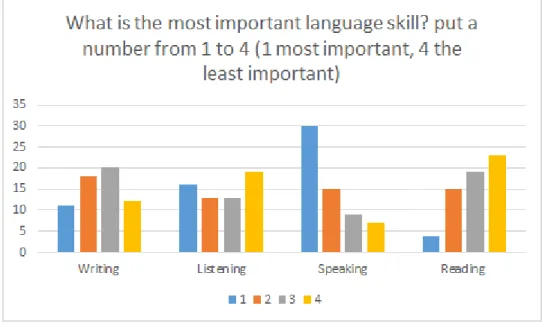
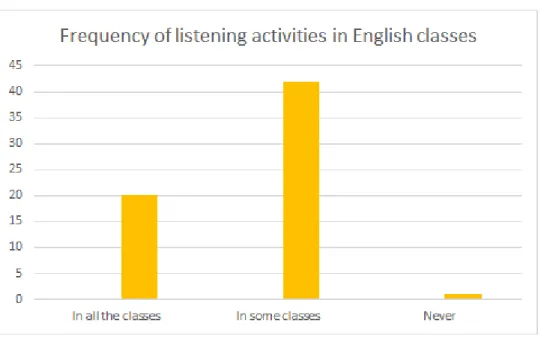
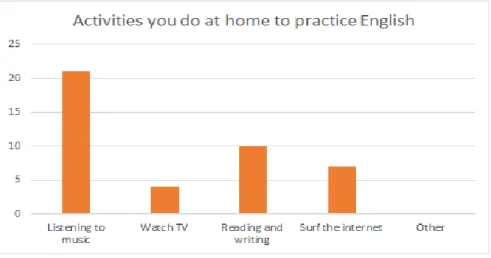
(35) 4.4.1. Class observations. The observations were carried out during six classes with each group in the first semester of the year 2016; each observation lasted at least two hours. During the observations, we took notes about everything that happened in the classroom. The observations focused on different aspects: students‟ attention to the class, motivation, students‟ work, language level and multicultural competence. It was also important for us to identify, and determine the types of activities that were mainly present during the classes. For each observation a special protocol for note-taking was used. See appendix 1, there is a sample of one of the protocols used with 8-03 group.. 4.4.2. Survey. The survey contained nine close-ended questions mostly in multiple choice format. It was administered to a total of sixty five students, but two surveys had to be excluded because student failed to provide clear answers and follow the instructions of the survey. Therefore, only sixty three surveys were taken into account. Question one aimed to identify from which grade students started contact with English. The second question inquired whether students liked English. Question three aimed to identify which activities were the most practiced in their English classes. Question four sought to determine the most important language skill according to students‟ opinion. Question five aimed to identify the frequency with which listening activities were practiced in the class if at all. Question six was about the type of listening activities more practiced in class. Question number seven aimed to inquire if students practiced English at home and, if so, which the activities they used to do, and question eight was about the frequency of these activities. Finally, question nine sought to inquire the type of activities students would prefer in English classes. See appendix 2. 35.
(36) 4.4.3. Interview. In order to gather information from the teacher of the two eighth grades, regarding how the language was taught and which skills were treated in class, we interviewed the teacher. The interview was conducted face-to-face by both of us and was also recorded. It was composed by nine structured questions prepared by the researchers beforehand. The first questions was in order to know what was the vision of language of the teacher, the next questions was about her vision of learning, the third question is the most important for this research because this question aimed to recognize which of the language skills was the most important for the teacher. Questions number four and five were about her experience in the teaching field and years in the school. Question six was made in order to notice if the teacher considered L1 (first language) as an important factor for learning an L2. Question seven was about aspects of the class that improve learning. Finally, questions eight and nine were about her qualities as a teacher and qualities that a good teacher should have. See appendix 3.. 4.4.4. Class diaries. During the six classes of two hours, we recorded all the events that occurred, focusing mainly on students‟ responses to the different listening activities. Therefore, these recordings were useful for us in order to analyze all events of the classes and also to take notes in the diaries about the students‟ strengths and weaknesses. These recordings were also helpful for us because we could identify which were the factors that affected the class and try to find a solution to improve them. The structure of the format that we developed for each class diary took into account the objectives for that specific lesson plan, the phase (pre-listening, while-listening, and postlistening), the type of activity, its duration and a brief description of it, and finally comments 36.
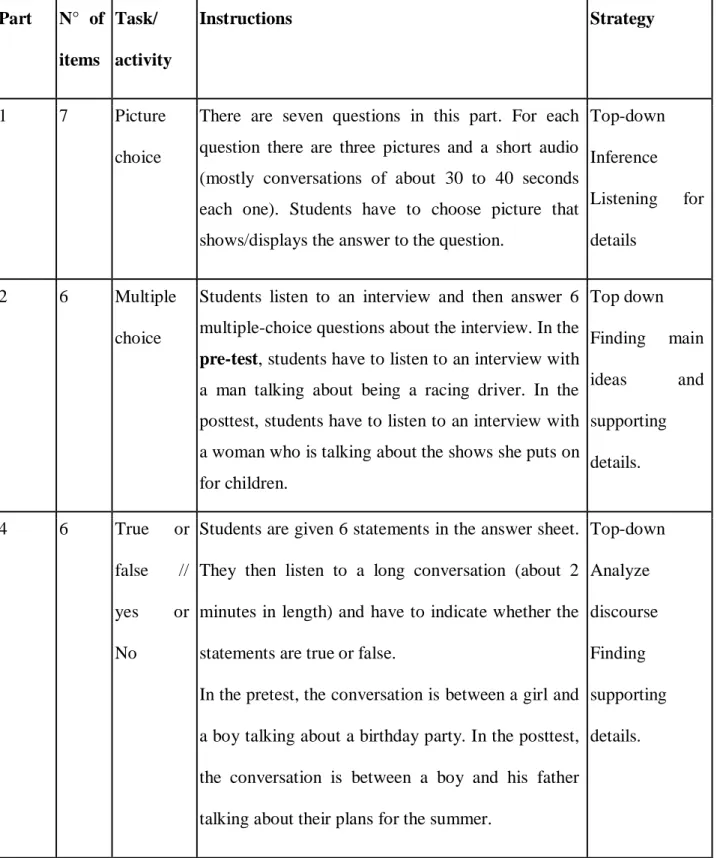
(37) about students‟ responses to the activity, and factors that contributed positively and negatively to the development of the class. In addition, at the end, there was a rubric that helped us to evaluate factors such as: students‟ attention and motivation, risk-taking (i.e. asking for clarification in class), response to feedback, participation, discipline, and whether the lesson goals were achieved by the students or not. See appendix 4.. 4.4.5. Listening comprehension test. We administered two listening comprehension tests, one before the treatment and the other after it was completed. Both tests were taken from practice models of the listening sections of the Primary English Test (PET) that were available online. This test was selected because it is a standardized and validated measure of overall communicative competence in English and is aligned with the levels of the Common European Framework of Reference (CEFR) which have been implemented and used in Colombia since 2006. This test measures communicative skills between the levels A2 and B1. According to the Basic Standards of Competence (MEN, 2006) students in 8th grade should have competencies in all four skills equivalent to the B1.1 level. Besides, the company that produces and administers the test, Cambridge University, indicates that this is an appropriate test for school-aged students. The two listening tests are divided into four parts. The first part has seven questions, each one with a short audio about 30 seconds of duration, each question has three images, and students should choose only one. The second part is composed by six multiple choice questions; students should choose only one answer according to what they heard from an audio of about two minutes of duration. Part three was removed from the test because we consider it was too demanding for the listening level of the students. The fourth part has six true or false questions, student should. 37.
(38) answer if the affirmation about the audio was true or false, and the audio has a length of about two minutes. See appendix 5. The following table shows the structure of both PET tests that were applied respectively at the beginning and at the end of the study.. 38.
(39) Table 4. This table shows the structure of the two PET diagnostic tests that were applied respectively at the beginning and at the end of the process.. Part. N° of Task/. Instructions. Strategy. items activity 1. 7. Picture. There are seven questions in this part. For each Top-down question there are three pictures and a short audio. choice. Inference. (mostly conversations of about 30 to 40 seconds each one). Students have to choose picture that shows/displays the answer to the question. 2. 6. Multiple choice. Listening. for. details. Students listen to an interview and then answer 6 Top down multiple-choice questions about the interview. In the. Finding. main. pre-test, students have to listen to an interview with a man talking about being a racing driver. In the. ideas. posttest, students have to listen to an interview with supporting a woman who is talking about the shows she puts on. details.. for children. 4. 6. True. or Students are given 6 statements in the answer sheet. Top-down. false. // They then listen to a long conversation (about 2 Analyze. yes. or minutes in length) and have to indicate whether the discourse. No. statements are true or false.. Finding. In the pretest, the conversation is between a girl and supporting a boy talking about a birthday party. In the posttest, details. the conversation is between a boy and his father talking about their plans for the summer.. 39. and.
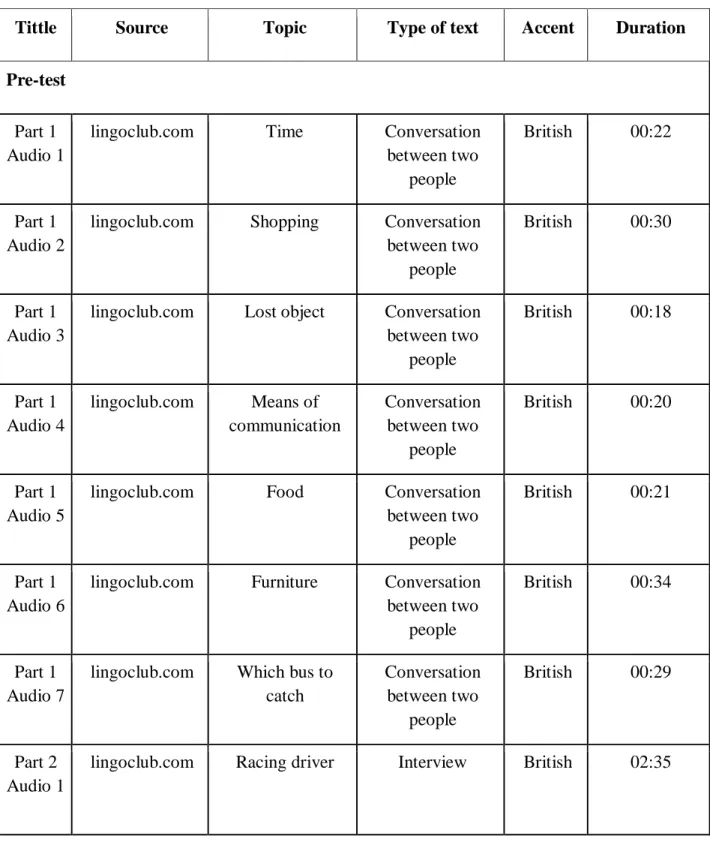
(40) Furthermore, the following table illustrates the structure of the audios used for both of the tests. Table 5. This table shows the structure of the audios that were used for the initial and final diagnostic tests.. Tittle. Source. Topic. Type of text. Accent. Duration. Part 1 Audio 1. lingoclub.com. Time. Conversation between two people. British. 00:22. Part 1 Audio 2. lingoclub.com. Shopping. Conversation between two people. British. 00:30. Part 1 Audio 3. lingoclub.com. Lost object. Conversation between two people. British. 00:18. Part 1 Audio 4. lingoclub.com. Means of communication. Conversation between two people. British. 00:20. Part 1 Audio 5. lingoclub.com. Food. Conversation between two people. British. 00:21. Part 1 Audio 6. lingoclub.com. Furniture. Conversation between two people. British. 00:34. Part 1 Audio 7. lingoclub.com. Which bus to catch. Conversation between two people. British. 00:29. Part 2 Audio 1. lingoclub.com. Racing driver. Interview. British. 02:35. Pre-test. 40.
(41) Tittle. Source. Topic. Type of text. Accent. Duration. Part 4 Audio 1. lingoclub.com. Birthday party. Conversation between two people. British. 02:09. Part 1 Audio 1. book4joy.net. Weather. Monologue. British. 00:18. Part 1 Audio 2. book4joy.net. Food. Conversation between two people. British. 00:30. Part 1 Audio 3. book4joy.net. Clothes. Conversation between two people. British. 00:24. Part 1 Audio 4. book4joy.net. Suitcases and baggage. Conversation between two people. British. 00:37. Part 1 Audio 5. book4joy.net. Exercises. Monologue, Instructions. British. 00:34. Part 1 Audio 6. book4joy.net. Time. Monologue. British. 00:23. Part 1 Audio 7. book4joy.net. Sports. Conversation between two people. British. 00:20. Part 21 Audio 1. book4joy.net. Shows for children. Interview. British. 02:24. Post-test. 1. Appendix 7.. 41.
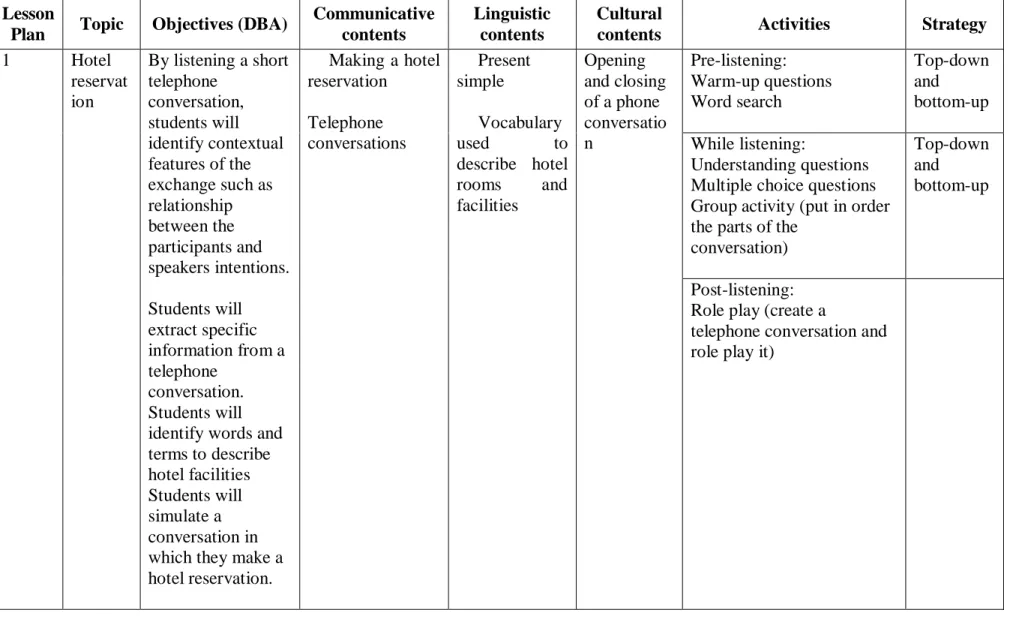
(42) Tittle. Source. Topic. Type of text. Accent. Duration. Part 4 Audio 1. book4joy.net. Summer plans. Conversation between two people. British. 01:41. 4.5. Treatment. The pedagogical intervention counted with six classes that were carried out in 2016 from September to November. For these classes, we designed 6 lesson plans, all of them had a specific topic, each lesson plan had listening objectives for eighth grade taken from the BLR (Basic Learning Rights, MEN, 2016). They also had specific contents according to the different competences: communicative, linguistic, and cultural. The 6 lesson plans were divided into the phases for listening lessons: pre-listening, while-listening, and post-listening. In the pre-listening phase, we worked with activities that helped students to set the context, generate interest, activate prior and current knowledge, predict content, and pre-learn vocabulary (i.e. word search, warm-up questions, unscramble words, matching activities, bingo game, among others.). In the while-listening phase we focused on the listening task itself, and we worked with activities that sought students to listen for gist, for details, and to make inferences (i.e. multiple choice, put in order the words, fill in the gaps, among others.). Lastly, in the post-listening phase we worked with activities that helped us to see students‟ production and acquired knowledge, activities that helped them to go beyond the listening text (i.e. writing production, create a poster, a brochure, and a dialogue, among others.). It is important to remark that for the design of each lesson plan, we took into account all the topics students were covering during their second period of the school (i.e. the weather, vacations, clothes, etc.).. 42.
(43) In the following table, we present a summary of all the lesson plans that were applied during the treatment for both eight grades. Table 6. Summary of the six lesson plans used during the treatment.. Lesson Topic Plan 1 Hotel reservat ion. Objectives (DBA). By listening a short telephone conversation, students will Telephone identify contextual conversations features of the exchange such as relationship between the participants and speakers intentions. Students will extract specific information from a telephone conversation. Students will identify words and terms to describe hotel facilities Students will simulate a conversation in which they make a hotel reservation.. 43. Communicative Linguistic contents contents Making a hotel Present reservation simple. Cultural contents Opening and closing of a phone Vocabulary conversatio used to n describe hotel rooms and facilities. Activities. Strategy. Pre-listening: Warm-up questions Word search. Top-down and bottom-up. While listening: Understanding questions Multiple choice questions Group activity (put in order the parts of the conversation). Top-down and bottom-up. Post-listening: Role play (create a telephone conversation and role play it).
(44) Lesson Topic Plan 2 Visiting a new city. Today‟s forecast. 3. Objectives (DBA). Linguistic contents Future tense. Cultural contents Most. Students will extract specific information from a Vocabulary popular short interaction in Talking about (places around a tour guide. tourist attractions. the city ) places Students will identify words London about the common places in a city. Students will create a brochure to give information about a tour. Students will Describing the Future tense extract specific weather Present information from a tense short weather Talking about forecast precautions Vocabulary according to the (seasons and Students will weather weather) identify vocabulary about the weather. Students will talk about weather preferences.. 44. Communicative contents Describing cities. Activities. Strategy. Pre-listening: Scramble the words. Top-down. While listening: in Organize the words in the correct order Multiple choice questions Matching activities (images with name of the places). The importance of weather forecast, weather changes.. Bottom-up and topdown. Post-listening: Create a brochure Pre-listening: Warm-up question What‟s the weather like (matching images with weather) Write in a season cloud the type of weather of that season. Bottom-up and topdown. While-listening: Listening for specific words and write them in a box Multiple choice questions. Bottom-up and topdown.
(45) Lesson Plan. Topic. Objectives (DBA). Communicative contents. Linguistic contents. Cultural contents. Activities. Strategy. Post-listening: Drawing that represents the weather students‟ prefer 4. What to Students will do on extract specific vacation information from a s? short conversation about summer plans. Students will complete a short conversation about summer plans. Students will identify summer plans vocabulary through a bingo game. Students will write a short paragraph telling a story about a past vacation experience.. 5. What should I wear today?. 45. Describing Future tense summer vacation (will) plans Vocabulary Telling past about activities experiences to do and things to use during summer vacations. Recogniz Pre-listening: Warm-up questions e what Summer Bingo game. Top-down. people plan While-listening: Complete the conversation for summer (fill in the gaps) Open questions vacations. (interpretation). Bottom-up and topdown. Post-listening: Write a short paragraph. Students will Describing Future tense Recogniz Pre-listening: extract specific different types of (going to) Warm-up question information from a clothing Present e what Write the name of the item short conversation tense by watching the image about weather Talking about. Top-down and bottom-up.
(46) Lesson Plan. 6. Topic. Traveltips, getting lost. Communicative Linguistic contents contents clothes. different clothing Vocabulary Students will according to the about clothing identify clothing weather and weather vocabulary through an audio. Planning to buy Students will clothes identify through a card what is the weather like in every season and what they could wear.. Cultural Activities contents people wear While-listening: Put the images of the predepending listening activity in the order they appear in the on the recording Interpretation question weather Post-listening: To fill a card with the information required. Students will Making extract specific suggestions information from a short conversation Giving directions about travel tips. What to do when getting lost. Objectives (DBA). Modal verbs directions. Top-down. Pre-listening: Warm-up questions Directions dictation with a map of a city. Top-down. While-listening: True or false statements Complete the conversation (fill in the gaps). Top-down and bottom-up. Post-listening: Create a poster. 46. Strategy.
(47) Furthermore, there is an example of a lesson plan used for this research in the appendix section. See appendix 8. Instructional audio files were used for each lesson plan used during the treatment. The files were taken from open source websites that offer free listening practice. Most of the audios were taken from Randall‟s ESL cyber listening (1998-2017) which is a website developed as a tool for teachers and students to practice listening skill, in here the audios are divided into levels of proficiency such as: easy, medium, intermediate and advance. They are mostly in American English and treat topics about daily life. Table 7 summarizes the characteristics of the audio files used in the treatment.. Table 7. Shows the structure of the audios used in the treatment.. 47.
(48) 4.6. Data collection and analysis This research was conducted along our practicum as students of the foreign language teaching program. Data collection procedures started on March 2016 and continued with class observations. We observed a total of six classes which allowed us to identify the problems that could be our possible topic for the research. We administered a survey to the students that helped us to reinforce the idea that students had not enough exposure to listening activities. We interviewed the teacher and included a special question about the language skills in order to know what her opinion towards the importance of listening skill. During the next semester, we started our practicum process and our research. We applied the PET test to the students in two different days on September/06/2016 for 8-03 grade and on September/08/2016 for 8-08 grade. On September/13/2016 we started with our treatment lessons until November/15/16. During this time we were recording the classes aimed to observe each class and wrote diaries that helped us to reflect about the events that occurred in the class and to try to find a solution for the problem we evidenced. On November/22/16 we finished the process with the posttest (another version of the PET) that we applied to the students of both grades, it was to analyze if there was an improvement of the listening skill. To compare the results from both tests (pre-test and post-test) we used computer software named IBM SPSS statistics that helped us to determine the T-test. This test is a statistical procedure that compares means of two measures of the same population (in this case, measures and determines the level of significance of the difference if existent. This procedure allows determining whether difference in the means of the measures are due to a factor (in this case the treatment) or are the result of probabilistic randomness.. 48.
(49) 5. RESULTS 5.1. Results from needs analysis 5.1.1. Class observation. During this period of observation, it was noticed that students‟ attention and motivation towards the English classes were mainly positive. In this way, their response to the activities was on time and with a good attitude. It was found out that, in general, they were always attentive and participative. In terms of language level, it was determined that it was not the appropriate level for the course because they showed a lower level of proficiency according to the national English standards by the MEN (Ministerio de Educación Nacional). Finally, the observation that was focused on multicultural competence showed that this aspect is bore in mind in the curriculum, but during the classes it was not present because they were mainly focused on teaching grammar, vocabulary, and translation During the different class observations we made, we could find out that the classes in these grades were focused mainly in the learning of vocabulary and grammar structures, this leads to a lack of the abilities of the language. In order to identify which were the most frequent types of activities in the classroom, we designed a survey for the students. Also, we interviewed the teacher in order to know her opinion about the importance of teaching focused in the development of the four skills of the language but the most important was to know her opinion about the importance of listening.. 49.
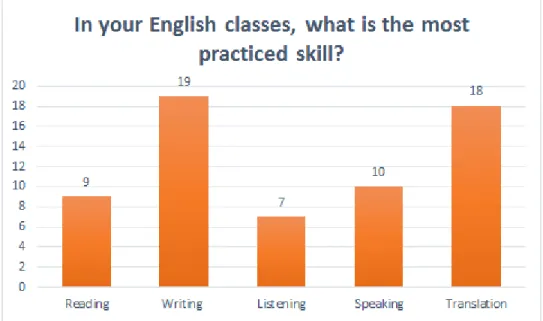
(50) 5.1.2. Survey. In this section of the research we will only focus on the questions we consider as the most relevant for this study. And as we already mentioned we used the whole sample of 60 students of both grades together in order to illustrate better the results.. Figure 1. Bar graph showing answers to question 3 in the diagnostic survey.. Figure 1 shows the answers of the students to the question 3 in the diagnostic survey. As it can be seen, the most frequently practiced skill in their classes is writing, since 19 out of 63 students selected writing as the most practiced skill. According to the students, translation is the second most frequently practiced skill with 18 students choosing this alternative. The graph shows that the other skills are ordered from most to least frequent as speaking (10), reading (9) and listening (7). In other words, according to the answers from students, listening is the least frequently practiced skill in their classes.. 50.
Figure
+7


Documento similar
“ONLINE APPLICATION FOR THE IMPROVEMENT OF THE LISTENING SKILL IN STUDENTS OF EIGHTH GRADE BASIC YEAR AT ESCUELA DE EDUCACION BASICA VEINTICUATRO DE JULIO SANTA
Conclusions On the basis of the participants’ responses, it seems feasible to apply queer theory to English language teaching at primary school level in Spain by prompting
UNIVERSIDAD LAICA VICENTE ROCAFUERTE ENGLISH SCHOOL TOPIC COMMUNICATIVE LANGUAGE TEACHING (CLT) ACTIVITIES FOR ENCOURAGING AN IMPROVEMENT IN THE STUDENTS? ORAL EXPRESSION FROM 1 ST
This questionnaire has been designed in order to get information that will be valuable for the development of the dissertation paper named "Teaching English as a Foreign Language
The purpose of this research was to develop an EFL student case study of English as a Foreign Language in grammar structure, and implement an intervention plan in order to correct
