
EFL students' attitudes and preferences towards written corrective feedback
63
0
0
Texto completo
(2) EFL Students’ Attitudes and Preferences towards Written Corrective Feedback. TABLE OF CONTENTS ABSTRACT INTRODUCTION ................................................................................................................ 1 PART I: THEORETICAL FRAMEWORK ................................................................................ 3 CHAPTER 1: WRITTEN ERROR CORRECTION AND FEEDBACK........................................... 4 1.1. TYPES OF ERROR CORRECTION IN WRITING .......................................................... 9 1.1.1. Direct Feedback ............................................................................................... 9 1.1.2. Indirect Feedback .......................................................................................... 10 1.1.3. Metalinguistic Feedback ............................................................................... 10 1.1.4. Focused and Unfocused Feedback ................................................................ 11 1.1.5. Electronic Feedback ...................................................................................... 11 1.1.6. Reformulation ............................................................................................... 12 1.2. PARTICIPANTS IN THE CORRECTION PROCESS .................................................... 14 1.2.1. Teacher correction ........................................................................................ 14 1.2.2. Peer-correction ............................................................................................. 15 1.2.3. Self-correction ............................................................................................... 15 CHAPTER 2: STUDENTS’ ATTITUDES ON ERROR CORRECTION AND FEEDBACK ............. 17 2.1. Definition ............................................................................................................. 17 2.2. Previous research on attitudes ............................................................................ 18 PART II: EFL STUDENTS’ ATTITUDES AND PREFERENCES TOWARDS WRITTEN CORRECTIVE FEEDBACK .................................................................................................. 24 CHAPTER 3: THE STUDY .................................................................................................. 25 3.1. The educational centre ........................................................................................ 25 3.2. Participants .......................................................................................................... 26 3.3. Research questions .............................................................................................. 28 3.4. Instruments and data collection procedure ........................................................ 28.
(3) EFL Students’ Attitudes and Preferences towards Written Corrective Feedback. 3.5. Results and discussion related to RQ1................................................................. 29 3.6. Results and discussion related to RQ2................................................................. 36 CHAPTER 4: CONCLUSION .............................................................................................. 43 CHAPTER 5: LIMITATIONS AND FURTHER RESEARCH..................................................... 46 REFERENCES.................................................................................................................... 47 APPENDICES .................................................................................................................... 55 Appendix 1 .................................................................................................................. 55 Appendix 2 .................................................................................................................. 57.
(4) EFL Students’ Attitudes and Preferences towards Written Corrective Feedback. List of figures FIGURE 1. PARTICIPANTS’ NATIONALITIES................................................................................. 27 FIGURE 2. SPANISH STUDENTS’ MOTHER TONGUE. ..................................................................... 27 FIGURE 3. SIGNIFICANT DIFFERENCES FOR RQ1 PER GROUP. ........................................................ 35 FIGURE 4. SIGNIFICANT DIFFERENCES FOR RQ1 PER LEVEL OF PROFICIENCY. .................................... 36 FIGURE 5. SIGNIFICANT DIFFERENCES FOR RQ2 PER GROUP.......................................................... 41 FIGURE 6. SIGNIFICANT DIFFERENCES FOR RQ2 PER LEVEL OF PROFICIENCY. .................................... 42. List of tables TABLE 1.TYPOLOGY OF WRITTEN CORRECTIVE FEEDBACK TYPES. (ADAPTED FROM ELLIS, 2009) ........... 13 TABLE 2. PARTICIPANTS’ AGE AND PROFICIENCY IN ENGLISH ......................................................... 28 TABLE 3. RESULTS RELATED TO RQ1 PER GROUP. ....................................................................... 31 TABLE 4. RESULTS RELATED TO RQ1 PER LEVEL OF PROFICIENCY.................................................... 33 TABLE 5. SIGNIFICANT. DIFFERENCES RELATED TO. RQ1. ACCORDING TO SCHOOL YEAR OF THE. PARTICIPANTS………………………………………………………………………………………………………….34. TABLE 6. SIGNIFICANT DIFFERENCES RELATED TO RQ1 ACCORDING TO LEVEL OF PROFICIENCY ............. 35 TABLE 7. RESULTS RELATED TO RQ2 PER GROUP. ....................................................................... 38 TABLE 8. RESULTS RELATED TO RQ2 PER LEVEL OF PROFICIENCY. .................................................. 41 TABLE 9. SIGNIFICANT. DIFFERENCES RELATED TO. RQ2. ACCORDING TO SCHOOL YEAR OF THE. PARTICIPANTS………………………………………………………………………………………………………….41. TABLE 10. SIGNIFICANT DIFFERENCES RELATED TO RQ2 ACCORDING TO LEVEL OF PROFICIENCY ........... 42.
(5) EFL Students’ Attitudes and Preferences towards Written Corrective Feedback. ABSTRACT Knowing students’ attitudes towards a new language can be very useful for language teachers. If the techniques used to correct errors do not meet students’ preferences, subsequent negative attitudes may emerge. This is why teachers should take into consideration students’ preferences for being corrected (Hyland, 2003). Many studies centre on the effect of feedback on students’ writing, but they omit learners’ attitudes and preferences towards corrective feedback (Katayama, 2007). Needless to say, not all students have the same preferences when it comes to written correction. For this reason, a study was carried out (Modalitat 2) to analyse students’ attitudes and preferences towards written correction and to determine age and English proficiency level as possible factors affecting such attitudes and preferences. The main results of the present study point to a greater preference for having all errors corrected in older students. However, younger students feel more motivated when they are corrected, consider making errors more positive and are more willing to accept correction by a classmate. In addition, older students give more importance to content and grammar, whereas younger learners concede similar importance to content, grammar, organization and vocabulary. Results according to level of proficiency show that B2 students feel more motivated to go on learning with correction. The higher the students’ English level, the greater their preference for selfcorrection. Finally, students with a low level of English consider that errors not affecting the understanding of the message should not be corrected. In conclusion, age and proficiency level are variables which affect these attitudes and preferences, but other learners’ variables would have an impact on them as well..
(6) EFL Students’ Attitudes and Preferences towards Written Corrective Feedback. INTRODUCTION Corrective feedback has been an issue of investigation in second language acquisition (SLA, henceforth) for a number of years now. Studies on written and oral feedback started to arise in the 1970s with the communicative approach. EFL and ESL students may have different opinions and preferences towards how to have their errors corrected in the language classroom. Knowing these preferences may help teachers captivate their students. According to Katayama (2007), differences in the learning styles of the students will affect the learning environment by either supporting or inhibiting their intentional cognition and active engagement. Thus, students will feel more motivated by doing things they like and prefer. In the classroom, teachers can use this information as a tool to motivate students and help them improve their learning process. This research study was carried out to analyse students’ attitudes and preferences towards written correction in two different groups at a high school in Almassora (Castelló, Spain). Students filled in two questionnaires and results were analysed in order to determine whether age and level of English may be possible factors affecting their attitudes and preferences for error correction. In this sense, this paper aims to answer the following research questions: RQ 1. How do EFL students feel about error correction in their writings? RQ 2. What are students’ preferences for error correction and feedback?. 1.
(7) EFL Students’ Attitudes and Preferences towards Written Corrective Feedback. The present paper has different parts: firstly, Chapter 1 includes an overview of the literature dealing with error correction. Therefore, the theoretical application of corrective feedback in the classroom, the different types of error correction in writing and the main participants in the correction process will be reviewed in this first chapter. In Chapter 2 we will examine previous research carried out on students’ attitudes. Chapter 3 is the study itself. Thus, we will describe the centre where the study took place and the participants, together with the instruments used to gather students’ opinions and the explanation of the data collection procedure. The results and discussion deriving from the data will also be covered in this chapter. Finally, general conclusions on the topic are proposed, including additional editing strategies and encouraging teachers to give students opportunities to repair their own mistakes.. 2.
(8) EFL Students’ Attitudes and Preferences towards Written Corrective Feedback. PART I: THEORETICAL FRAMEWORK. 3.
(9) EFL Students’ Attitudes and Preferences towards Written Corrective Feedback. CHAPTER 1: WRITTEN ERROR CORRECTION AND FEEDBACK About thirty years ago, Touchie (1986: 75) stated that “language learning, like any kind of human learning, involves committing errors”. Treatment of these errors in the foreign language (FL, henceforth) classroom has been an essential practice for some years. Its importance emerged with the rise of learner-centred approaches to writing instruction in L1 composition classes in the 1970s (Hyland & Hyland, 2006). Ferris (2002: 5) admits that “it is unrealistic to expect that L2 writers’ production will be error free” and she claims that errors in the second language classroom should be treated. Already in the 70s, Hendrickson (1978) set forth that learners were not always able to identify their own mistakes and thus they needed a more expert source to help them find those mistakes. About 30 years later, Zacharias (2007) explained that most students firmly took for granted that teacher feedback was a keystone to improve their writings as they assumed teachers were more competent in terms of linguistic competence and knowledge. On the contrary, Truscott (1996) pointed out students’ unwillingness to change their intuitions and adopt their teacher’s correction. He claimed that they either continue writing as they did before or avoid the conflictive word or structure in following writings, adopting a negative or passive attitude towards teachers’ corrections. Authors like Dulay and Burt (1974) regard error making as inevitable and necessary to language learning. It is even considered a symptom to show that the learner is in the developmental process of learning and internalising the rules of the target language. 4.
(10) EFL Students’ Attitudes and Preferences towards Written Corrective Feedback. (Zhu, 2010). Feedback on such errors is essential to learn a language. As Alavi and Kaivanpanah (2007: 181) put it “providing language learners with clear feedback plays a crucial role in developing learners’ language abilities and helping them direct their learning”. In other words, feedback plays an essential role in writing lessons since it is considered as vital in improving and consolidating learning (Hyland, 2003). What is more, feedback on students’ assignments is contemplated as the greatest influence on students’ achievement (Gibbs & Simpson, 2004). Since it reveals learners the degree or lack of learning, it positively motivates them to further learning, giving them opportunities to discriminate between accepted and unaccepted forms of language (Pica et al., 1996). Similarly, Zacharias (2007) enhances the importance of written feedback by suggesting that providing feedback can be a way to help students improve the quality of their writing and increase their motivation in such practice. Written feedback is not only considered important in the FL classroom, but it is also seen as a teacher’s essential task. Coffin et al. (2003: 102) maintain that “the provision of feedback on students’ writing is a central pedagogic practice”. Nonetheless, overcorrection of errors, mostly at early stages of learning, can be counterproductive and deceitful to the learner (Chaudron, 1988; Fanselow, 1977). Feedback is a keystone in both teaching and learning processes. On the one hand, teachers can improve the methodologies they apply by the feedback they receive from students in order to prove the effectiveness of their teaching. On the other hand, students can improve their writing skills from the feedback they receive from teachers and classmates. This is positive as it encourages both teachers and learners to improve. 5.
(11) EFL Students’ Attitudes and Preferences towards Written Corrective Feedback. and give their best in the language classroom. In addition to teacher’s and learner’s benefit, Selinker (1969) pointed out the importance of errors for language researchers as they provide authentic insights into language acquisition investigation. An early definition of the term ‘error treatment’ was given by Chaudron (1988: 150) as: “... any teacher behaviour following an error that minimally attempts to inform the learner of the fact of error...” There are different ways of giving such information, explicitly or implicitly and oral or written, for instance. Linguists like Fernández (1995) hold that students must be conscious of the error or mistake being corrected at any time and thus being able to analyse the cause of appearance and to reorganise their own learning hypothesis. Error treatment in the SLA classroom has raised much discussion over the years, but researchers agree on focusing such debate on the framing questions posed by Hendrickson (1978), which are: 1. Should learners’ errors be corrected? 2. When should learners’ errors be corrected? 3. Which errors should be corrected? 4. How should errors be corrected? 5. Who should do the correcting? Although concluding answers to these questions have not been formulated yet, researchers have attempted to approach them over the decades. Touchie (1986) considers that teachers should not correct all students’ errors since it could be disruptive in their learning process and discourage them from communicating. He. 6.
(12) EFL Students’ Attitudes and Preferences towards Written Corrective Feedback. agrees on correcting errors which interfere with the understanding of the message and affect communication. Additionally, he maintains that errors occurring frequently and affecting a large number of students must be corrected over less frequent errors and those affecting few students in the classroom. Literature has shown that feedback on content and organization is necessary and greatly increases the quality of students’ writings (Fathman & Whalley, 1990; Huntley, 1992; Kepner, 1991; Sheppard, 1992). Huntley (1992) advocates for the provision of such type of feedback and avoidance of feedback on form. She also recommends introducing peer reviews and student-teacher conferences as alternative methods of giving feedback. Contrary to many researchers on SLA, Truscott (1996) defines corrective feedback as ineffective and harmful for learners. Ferris (2010: 198) refers to him as “...the most passionate critic of written and oral CF...” In Lee’s words (2003: 156) “to date there is no research evidence to show that more error feedback would lead to better or faster development of grammatical accuracy in writing”. Nevertheless, the great majority considers correction should take place in SLA classrooms. Moreover, studies measuring student improvement from a longitudinal approach prove that students receiving feedback on errors over a period of time can improve their language accuracy (Fathman & Whalley, 1990; Ferris, 2002; Ferris & Helt, 2000; Ferris & Roberts, 2001). In an early article, Hendrickson (1980) recognized the dangers of over-correction and tried to encourage L2 writing teachers to take four learner factors into account when correcting written errors. These factors are the students’ aims and communicative. 7.
(13) EFL Students’ Attitudes and Preferences towards Written Corrective Feedback. goals for writing, students’ written proficiency (since advanced learners are more able to locate and self-correct errors), types of errors made and frequency of appearance, and awareness of students’ attitudes to error correction and their degree of confidence. He suggested that teachers give low-esteem learners supportive feedback by focusing on a restricted number of errors and giving more importance to content instead of grammatical errors. Although the terms error and mistake are sometimes used interchangeably, it is important to point out the difference between them. Corder (1983) refers to mistakes as unsystematic errors of performance. And he maintains to reserve “the term error to refer to the systematic error of the learner from which we are able to reconstruct his knowledge of the language to date, i.e., his transitional competence” (Corder, 1983: 168). This means that mistakes can be made due to different reasons, like tiredness, fatigue, pressure or a slip of the tongue, but the learner already knows the correct form and the system’s rules. This is why here he refers to unsystematic errors. However, if the learner makes an error due to unawareness of the system, this error will be systematically made again until the learner is taught that set of rules. In addition, he believes that mistakes are irrelevant to the process of language learning and that errors are important and should be corrected. However, he admits that determining what a mistake and what an error is are difficult tasks which involve a deeper study and analysis than what is usually done. Only someone spending a long period with the groups of students could really recognise what has been taught and what not to students. According to this and to the. 8.
(14) EFL Students’ Attitudes and Preferences towards Written Corrective Feedback. great difficulty in differentiating them which the author refers to, the term error will be overtly used throughout this study.. 1.1. TYPES OF ERROR CORRECTION IN WRITING Ellis (2009) suggests a clear classification of how teachers can correct linguistic errors in students’ assignments. The types of feedback he explains are the following: direct CF, indirect CF, metalinguistic CF, the focus of the feedback, electronic CF and reformulation. We turn to consider each type briefly below. 1.1.1. Direct Feedback Direct feedback involves providing students with the correct form straightaway. This can be done by either crossing the wrong or unnecessary word out, inserting a missing word or writing the right form above or close to the wrong form. The bright side of this type of feedback, according to Ellis (2009), is that it provides the learner with explicit information and guidance about how to correct errors. If learners are unable to self-correct their own errors, this is the best technique to apply. Ferris and Roberts (2001) suggest using direct feedback instead of indirect one with learners of low levels of proficiency, who usually do not know how to correct the erroneous forms. However, Ellis (2009) points out that direct feedback requires minimal treatment by learners themselves and thus this type of feedback may not contribute to long-term learning. Nevertheless, a study by Sheen (2007) corroborates that direct feedback can be efficient in the acquisition of articles.. 9.
(15) EFL Students’ Attitudes and Preferences towards Written Corrective Feedback. 1.1.2. Indirect Feedback Contrary to the previous type, indirect feedback consists of indicating that there is an error but without giving students the right form. Indirect feedback can take two forms: either locating the error or just indicating the error without telling the learner its exact location. According to Lalande (1982), indirect feedback provides learners with the competence of problem solving and guided learning, fostering learners to ponder on their own errors. This is why it is preferable to direct feedback and, moreover, it is more likely to convey to long-term learning (Ferris & Roberts, 2001). Nevertheless, students with low L2 proficiency levels may not have enough linguistic knowledge to correct their errors even when they are pointed out (Ferris & Hedgcock, 2005). 1.1.3. Metalinguistic Feedback This type of feedback is given by proving a hint about the error, like its nature or an explanation of the grammar. The first case –telling the learner the nature of the errormatches the goal of using a correction code, although it is not exactly the same. Error codes are abbreviations used to label the nature of the error, such as grammar, vocabulary or spelling, among others. Then, students have to elaborate their own correction. Similarly, metalinguistic information can be given in the form of explanations on the grammar related to the errors made. This type is less frequent since it requires more time than using correction codes.. 10.
(16) EFL Students’ Attitudes and Preferences towards Written Corrective Feedback. 1.1.4. Focused and Unfocused Feedback ‘The focus of the feedback’ is a category used by Ellis (2009) to refer to the teacher’s correction of all- or most- errors (unfocused feedback) or to only one or two specific types of errors (focused feedback). Authors like Sheen et al. (2009) provide evidence on focused written feedback to enhance linguistic accuracy. Ellis (2009) suggests that treating corrections is more complex in unfocused feedback since the learner needs to attend to many types of errors, being unable to focus much on each of them. Then, focused feedback is more effective in that the learner can review diverse corrections of one single error and get evidence to understand why what was written is wrong and to obtain the right form. However, he explains that an advantage of unfocused feedback is that it tackles a great variety of errors, so although it might not be as powerful in the acquisition of specific features as focused feedback in the short term, it is in the long run. 1.1.5. Electronic Feedback This type of written feedback is a modern one since it includes the use of new technologies in both the teacher’s correction and the student’s expected subsequent response. This category, known as ‘electronic feedback’, consists of selecting the error and providing the learner with useful and appropriate online links with examples of correct usage. Ellis (2009) reports on some advantages of electronic feedback. The first one is that it the teacher is no longer the responsible for judging what is a correct form and what is not. He suggests that an approach based on usage would be more reliable since. 11.
(17) EFL Students’ Attitudes and Preferences towards Written Corrective Feedback. teachers’ intuitions can be erroneous. Another advantage is that it promotes students’ independence as they are in charge to choose the corrections which they consider best apply in the text. 1.1.6. Reformulation This type of feedback involves the rewriting of the learner’s text. Students are responsible for using such resources to correct their errors or not and for how to do it. This technique is described by Cohen (1989: 4) as a way “to preserve as many of the writer’s ideas as possible, while expressing them in his/her own words so as to make the piece sound native-like”. The learner’s text is reformulated and they have to identify the modifications that have been made. Table 1 below summarizes the types of written feedback along with some advantages and drawbacks mentioned above.. 12.
(18) EFL Students’ Attitudes and Preferences towards Written Corrective Feedback. WRITTEN CF CATEGORISATION. DESCRIPTION. ADVANTAGES. DRAWBACKS. Direct CF. Teacher provides the student with the correct form. -Provides learners with explicit guidance about correction -Benefit low proficient students, who usually do not know how to correct. Requires minimal treatment by students do not contribute to long-term learning. Indirect CF. Teacher indicates there is an error but does not give the right form -Locating the error -Indicating there is an error without revealing its exact location.. -Problem solving competence and guided learning -Conveys to long-term learning because students have to ponder on their errors. Low proficient students may not have enough linguistic knowledge to correct their errors. Metalinguistic CF. Teacher gives a hint about the error (explanation). Learners get reasoned and detailed feedback. Explanations may be time-consuming for teachers. Unfocused (U) CF Focused (F) CF. (U) Teacher corrects all errors (F) Teacher correct one or two specific types of error. (U) effective in the long term (F) enhances linguistic accuracy. (U) attend to many types of errors (F) only focuses on some types. Electronic CF. Teacher gives learners online links of correct usage. -Not based on teachers’ intuitions -Promotes students’ independence. (Not mentioned). Reformulation. Learners’ texts are modified and they identify the changes. Final decisions about correction lay on students themselves. (Not mentioned). TABLE 1. Typology of written corrective feedback types (adapted from Ellis, 2009).. 13.
(19) EFL Students’ Attitudes and Preferences towards Written Corrective Feedback. 1.2. PARTICIPANTS IN THE CORRECTION PROCESS 1.2.1. Teacher correction Unlike Truscott (1999), who argued that teachers are responsible for changing student attitudes towards the benefits of error correction by taking a “correction-free approach” in their classrooms, most researchers consider teacher correction a central practice in EFL and ESL contexts and have proved its effectiveness. In his study, Zhang (1985) found out that teacher feedback was more effective for improving grammatical errors than peer or self-correction. Affective factors are also important in the success of feedback and studies suggest that students have a preference for teacher feedback over other types (Saito, 1994; Sengupta, 1998; Zhang, 1995). Hyland and Hyland (2006: xv) describe teachers’ awareness on feedback as follows: Teachers are now very conscious of the potential feedback has for helping to create a supportive teaching environment, for conveying and modelling ideas about good writing, for developing the ways students talk about cultural and social worlds and their growing familiarity with new literacy practices.. Moreover, apart from the errors made, Hyland (1998) found out that teachers also take into account the student who committed them, building their comments and correction on the teacher-student relationship and the student’s background, needs and preferences. Then, teacher feedback can be very useful for L2 writing learners. However, other participants can take an active part in the process as well. Consequently, peer and self-correction should not be left behind, as we are going to discuss in the next section.. 14.
(20) EFL Students’ Attitudes and Preferences towards Written Corrective Feedback. 1.2.2. Peer-correction According to Hansen and Liu (2005), peer review consists of students assuming the role of trained peer reviewers with the goal of providing their classmates with comments on their writings in either written or spoken mode. This approach is considered emotionally, cognitively, and linguistically beneficial to students’ writing development (Berg, 1999; Hu, 2005; Min, 2005; Rollinson, 2005). Witbeck (1976: 325) observed that peer-correction drives to “greater concern for achieving accuracy in written expression in individual students and creates better atmosphere for teaching the correctional aspects of composition”. In the same line, Wanchid (2013) supports Vygotsky’s idea of the proximal development, which consists of the extension of one’s abilities through the leadership and reactions of others. In this way, feedback from more proficient peers will give scaffolding to the rest of classmates and diminish problems linked with peer-correction, as trustworthiness or unwillingness to accept feedback from equals. Nevertheless, the effect of using peer-correction in the EFL writing classroom is still a polemic issue. Wanchid (2013) maintains that this is so because of learners’ English proficiency level and cultural influences, like abstaining from giving accurate judgements in order to keep a friendly relationship or being reluctant to participate in group discussions. 1.2.3. Self-correction Many researchers propose self-correction as the most effective strategy of feedback (Pishghadam et al., 2011; Ibarrola, 2009). Pishghadam et al. (2011) point out that once. 15.
(21) EFL Students’ Attitudes and Preferences towards Written Corrective Feedback. learners are capable of self-correcting, they already know the right form or at least they have it as an option in mind. Self-correction is defined by Wanchid (2013: 158) as “a strategy according to which students read, analyze, correct, and evaluate their own writing by using guided questions or checklists, both form-focused and meaning focused”. Some of the advantages to self-correction, according to Yang (2010), are the increased independence of students from the teacher, the students’ retention of their own mistakes, their awareness of their own learning process (including strengths and weaknesses) and the time-saving factor. Moreover, this approach to feedback helps students concentrate better on their own errors and diminish dependence on the teacher, fostering thus students’ autonomy and self-determination (Ancker, 2000). Apart from this independency from the teacher, Pishghadam et al. (2011: 958) include that learners are “given an opportunity to consider and activate their linguistic competence, so that they can be active participants”.. 16.
(22) EFL Students’ Attitudes and Preferences towards Written Corrective Feedback. CHAPTER 2: STUDENTS’ ATTITUDES ON ERROR CORRECTION AND FEEDBACK In this chapter, a definition of the term ‘attitude’ will be formulated, along with a review of previous research and findings in an attempt to examine earlier studies on students’ attitudes and preferences to corrective feedback.. 2.1. Definition The term attitude is known as “a psychological tendency that is expressed by evaluating a particular entity with some degree of favour or disfavour” (Eagly & Chaiken, 1993: 1). This positive or negative behaviour that attitudes imply should be respected and, as Brown (2007) claims, teachers need to bear in mind that students also have both positive and negative attitudes. Dörnyei (2005: 214) provides a clear distinction between ‘attitudes’ and ‘beliefs’: The main difference, in fact, between the conception of attitudes and beliefs is exactly that the latter have a stronger factual support whereas the former are more deeply embedded in our minds and can be rooted back in our past or in the influence of the modelling example of some significant person around us.. However, the boundaries between them are not clear-cut and they are often used interchangeably. According to Corder (1967), there is a direct relationship between errors and acquisition, since learner’s errors provide researchers with evidence on how language is learned and internalised. Then, their attitudes will depend on how they perceive acquisition of a given language. In a similar way, by knowing students’. 17.
(23) EFL Students’ Attitudes and Preferences towards Written Corrective Feedback. attitudes and preferences for marking-techniques, teachers can adapt their methodologies to convey a feedback approach which matches students’ likes. Thus, students would feel more confident and passionate on the subject, perceiving that they are meaningful and taken into account inside the classroom.. 2.2. Previous research on attitudes Some researchers have already analysed students’ attitudes and preferences for corrective feedback. In this section, a review of some of these studies is included. According to Hyland and Hyland (2006: 3), “ESL students, particularly those from cultures where teachers are highly directive, generally welcome and expect teachers to notice and comment on their errors and may feel resentful if their teacher does not do so”. Attitudes and preferences may be affected by students’ context, which they define as a frame which encloses feedback and offers resources for its proper interpretation. Such attitudes are affected by cultural factors, especially experiences and backgrounds, and will determine students’ preferences for feedback and subsequent responses in following writings. The institution itself, the classroom’s principles, students’ goals in learning to write, their abilities, and the genres studied are frequently important but ignored variables in feedback studies (Ferris, 2003). However, students have individual identities and may disregard cultural models (Hyland & Hyland, 2006). This is why, although we can review on previous literature to compare results, we cannot generalise attitudes and preferences equally to all students.. 18.
(24) EFL Students’ Attitudes and Preferences towards Written Corrective Feedback. Research on EFL students’ attitudes to teacher feedback demonstrate that learners keep in mind and appreciate encouraging comments and expect constructive criticism instead of clichéd remarks (Ferris, 1995a; Hyland, 1998). Some authors maintain that corrections are not as discouraging to ESL and EFL students as for native speakers of the language, since they do not invest so much self-esteem in their writings as native speakers do (Leki, 1991; Schachter, 1991). A number of studies investigating students’ attitudes to teacher feedback (Cohen, 1987, 1991; Cohen & Cavalcanti, 1990; Ferris, 1995b; Hedgcock & Lefkowitz, 1994, 1996; Leki, 1991, Radecki & Swales, 1988) showed that learners consider teacher feedback valuable and helpful in order to improve their writing. If students do not get what they believe they need, they may lose motivation (Ferris, 2003). Results point to a students’ preference for specific comments and suggestions for revising. Furthermore, studies report that learners tend to prefer direct feedback rather than indirect correction (Chandler, 2003; Ferris & Roberts, 2001). Hedgcock and Lefkowitz (1994) conducted a survey study of 110 ESL and 137 EFL (French, German and Spanish) students and found that both groups had a positive attitude toward written corrective feedback. However, they reported that EFL students had a preference for correction on grammar, vocabulary, content and style, while ESL students preferred feedback on content and organization. In response to that, Sheen (2011) pointed out that this EFL students’ preference for feedback on linguistic features matches the students’ priorities and goals in learning. She explains that EFL learners are more interested in developing their L2 knowledge, while ESL learners. 19.
(25) EFL Students’ Attitudes and Preferences towards Written Corrective Feedback. focus on developing their writing skill. Sheen (2011: 44) concludes that “the learning context may determine how learners respond to the corrective feedback they receive”. Besides, individual factors like proficiency level, learning style adopted, personality of the subject, and motivation may have an impact in the way learners respond to corrective feedback (Conrad & Goldstein, 1999). In the study conducted by Storch and Wigglesworth (2010), findings showed that the effectiveness of written corrective feedback depended on the type of errors made and the learners’ level of proficiency. They suggested that particular elements like learners’ attitudes, beliefs and objectives are essential factors, though usually neglected in written corrective feedback research, in determining if learners were able to benefit from feedback. Leki’s (1991) findings showed that ESL students valued grammar as the most important aspect in writing. However, she reported that some of them did not mind correction on grammatical accuracy. Any of the students surveyed wanted to receive indirect correction; most of them wanted indirect correction along with metalinguistic clues to assist them in correcting the error. Lim (1990) investigated the attitudes, opinions and expectations of Singapore secondary school students to error and feedback and found out a positive attitude toward peer correction in the classroom. Students preferred their grammar errors to be corrected first, followed by vocabulary, spelling, organization of ideas, and punctuation errors. Her findings showed that students wanted to take an active part in. 20.
(26) EFL Students’ Attitudes and Preferences towards Written Corrective Feedback. correcting the error, but they stated that the primary responsibility for correcting errors lay on the teacher. In a similar study, Oladejo (1993) analysed whether students’ preferences differ according to their level of proficiency in the target language. His findings revealed that learners did not lean toward peer correction and was not successful for advanced learners, although this correction technique may be successful in intermediate ones. The majority of students in the study showed a preference for organization of ideas to be corrected, followed by grammar errors, vocabulary errors and finally spelling and punctuation errors. Although similar opinions on the topic would be desired, teachers and students often have different attitudes on error correction. As Oladejo (1993: 84) puts it “teachers’ opinion and classroom practice regarding corrective feedback do not always match the perceived needs and expectations of learners; such mismatch could contribute to lack of success in language learning”. Some teachers prefer correcting all errors as they appear, while others believe that constant correction can boost students’ level of anxiety and thus hinder learning (Krashen, 1982). Similarly to teachers, some students prefer being corrected more than others but there is a tendency for all students wishing to be corrected. Leki (1991) found out that 100 per cent of the ESL students who participated in the study preferred all their written errors to be corrected. Apart from this study, many others have shown that L2 learners want teacher correction in the classroom (Ferris, 1995b; Hedgcock & Lefkowitz, 1994, 1996). However, some. 21.
(27) EFL Students’ Attitudes and Preferences towards Written Corrective Feedback. students find constant correction deterring and irritating. They can become frustrated and abstain from participating to prevent committing errors (Zhu, 2010). Due to these different attitudes, Zhu (2010: 128) maintains that “both teachers and students should adopt a reasonable approach to handle the error-correction problem effectively and appropriately in order to adapt to their preferences in learning and teaching”. Therefore, by knowing students’ attitudes towards error correction teachers can adapt to the learner’s needs and preferences. Such beliefs may influence the effectiveness of teachers’ feedback (Schulz, 1996). These beliefs may be gathered for analysis by means of questionnaires or surveys including statements or questions devised to obtain students’ attitudes on correction and feedback (Fantozzi, 1998). According to Sheen (2011), one of the reasons why corrective feedback has shown manifold results in research regarding the efficacy of teachers’ correction is learner variables. Sheen (2011: 129) explains that “individual difference (ID) variables- such as language aptitude, anxiety, and attitudes towards corrective feedback- influence learners’ receptivity to error correction and thus the effectiveness of the feedback”. She adds that learners differ according to both cognitive factors- such as language proficiency, intelligence and learning strategies- and affective factors- like level of anxiety, attitudes and degree of motivation. These variables affect the process of language learning and its subsequent outcomes (Dörnyei, 2005; Gardner & MacIntyre, 1992, 1993). A study conducted by Havranek and Cesnik (2001) showed that corrective feedback benefited learners with a positive attitude towards error correction and with a high. 22.
(28) EFL Students’ Attitudes and Preferences towards Written Corrective Feedback. language level. Schulz’s (1996) findings indicated that all surveyed students (who were ESL learners) had positive attitudes towards error correction. Schulz (2001) conducted a follow-up study with FL students and reported that FL learners also considered grammar instruction and corrective feedback essential in language learning. We can conclude from Schulz’s (2001) study that learners with a preference for grammatical accuracy have a positive attitude towards error correction. Then, we can surmise that learners with positive attitudes towards corrective feedback and grammatical accuracy will benefit more from corrective feedback than those with negative attitudes (Sheen, 2011). She holds that learners’ attitudes towards error correction tend to influence the scope of engagement in learning a language.. 23.
(29) EFL Students’ Attitudes and Preferences towards Written Corrective Feedback. PART II: EFL STUDENTS’ ATTITUDES AND PREFERENCES TOWARDS WRITTEN CORRECTIVE FEEDBACK. 24.
(30) EFL Students’ Attitudes and Preferences towards Written Corrective Feedback. CHAPTER 3: THE STUDY 3.1. The educational centre The data presented in this study to develop this Master’s Thesis were gathered at IES Vila-Roja. It is a state high school located in Almassora in the province of Castelló de la Plana (Spain). Almassora is a town with a population of around 26,200 inhabitants located in the south-east of Castelló. It is a bilingual territory, where both Spanish and Catalan are official languages. Nonetheless, Spanish was not spoken by either the teacher or any student during the lessons observed. English and Valencian were the only languages used in the classroom. The centre’s vehicular language is Valencian and there is no option of choosing a specific teaching language. The high school receives students from different schools, but most of them come from nearby schools such as C.P. Germans Ochando, C.P. Regina Violant and C.P. Cardenal Cisneros due to the current regulation of high school allocation regarding proximity of the centre. However, there are some students who come from C.P. Embajador Beltrán, a school which corresponds to another high school. The centre hosts 685 students and 60 teachers altogether. A vocational training course on ‘Image and Sound’ is also taught there. The standard four grades of ESO (compulsory secondary education) and two years of Bachillerato (optional secondary education) are taught at Vila-Roja High School. The centre was built in 2003 in order to. 25.
(31) EFL Students’ Attitudes and Preferences towards Written Corrective Feedback. meet the elevated demand of students, which IES Álvaro Falomir could not cover alone.. 3.2. Participants Two groups of students were observed and asked to fill in two questionnaires in order to carry out this study. In both groups English is taught as a foreign language and it is a compulsory subject in the syllabus. One of the groups is composed of 29 students in 4th year of ESO, 18 male and 11 female students. There are two immigrants in the group that come from Romania. The students’ ages range from 15 - 16 years old, except for one student who is retaking the course and is 17 years old. A placement test was administered to students in order to determine the average level of proficiency, together with each student’s mark to define groups conforming to level of English. Out of the 29 students, 13 got an A2 level, 12 got a B1 and 4 got a B2 level of English, according to the Common European Framework of Reference for Languages (CEFR). The other group is composed of 24 students in the 2nd year of Bachillerato. There are 17 females and only 7 male students. There are two immigrants, a Romanian and a South American girl. All the students in this class are 17 or 18 years old. As for the level of English, 6 students got an A2 level in the placement test, 12 got a B1 and 6 got a B2. Both groups are studying the Science and Technology modality which the high school offers. Most of the students in the first group were attending an optional subject called. 26.
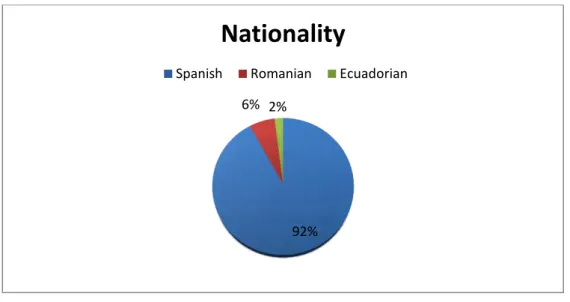
(32) EFL Students’ Attitudes and Preferences towards Written Corrective Feedback. Practical English. Many of the students in both classes attended private tuition or language schools and were highly motivated in learning the foreign language. Figure 1 below indicates the different nationalities of the students taking part in the present study.. Nationality Spanish. Romanian. Ecuadorian. 6% 2%. 92%. FIGURE 1. Participants’ nationalities Participants were asked what their mother tongue was. Figure 2 illustrates the percentage of Spanish students choosing Spanish, Valencian or both as their mother tongue.. Spanish students' mother tongue Valencian. Spanish. Both. 13% 26% 61%. FIGURE 2. Spanish students’ mother tongue. 27.
(33) EFL Students’ Attitudes and Preferences towards Written Corrective Feedback. In turn, Table 2 presents age and level of proficiency in English of the participants in the study. The English level of proficiency was determined thanks to the Quick Placement Test by Oxford University Press which the subjects were asked to complete. Total number of participants Age. English Level. 53. 15 years old. 32%. 16 years old. 20%. 17 years old. 32%. 18 years old. 16%. A2. 35%. B1. 46%. B2. 19%. TABLE 1. Participants’ age and proficiency in English. 3.3. Research questions Taking into account the literature discussed in Chapter 1 and 2 of the present work, we have formulated the following research questions considering the variables of age and level of proficiency: RQ 1. How do EFL students feel about error correction in their writings? RQ 2. What are students’ preferences for error correction and feedback?. 3.4. Instruments and data collection procedure The instruments used to gather data were two questionnaires. Answers to questionnaire Number 1 respond to RQ1, whereas the second questionnaire elicits students’ answers to RQ2.. 28.
(34) EFL Students’ Attitudes and Preferences towards Written Corrective Feedback. Data collection comprised two intact English lessons (55 minutes each) per group. It means a sum of four 55-minute lessons, which makes 220 minutes in total to gather students’ opinions and their level of proficiency. The placement test along with Questionnaire 1 was completed in one lesson. Then, Questionnaire 2 took another lesson to be answered. Both questionnaires are included in the Appendices. Students were asked to openly state their opinions by filling in the questionnaire individually in class. Special attention was taken to ensure that students did not discuss the answers with one another and that they did not take the questionnaire home in order to prevent exchange of ideas.. 3.5. Results and discussion related to RQ1 The data gathered in Questionnaire 1 in order to answer RQ 1 were analysed by two different viewpoints. As stated above, the results were analysed according to the variables of age and level of proficiency. Thus, the results related to RQ1 are presented in two different tables. As far as the variable of age is concerned, students were classified into two groups. Group 1 is composed by 29 students who are 15-16 years old in the 4th year of ESO. In turn, Group 2 is formed by 24 students who are studying the last year in high school and are between 17 and 18 years old. Regarding the variable of English level, students’ answers were divided into three groups: A2, B1 and B2. The first one is made of 19 students, the second one of 24 students and, finally, the B2 level consists of 10 students.. 29.
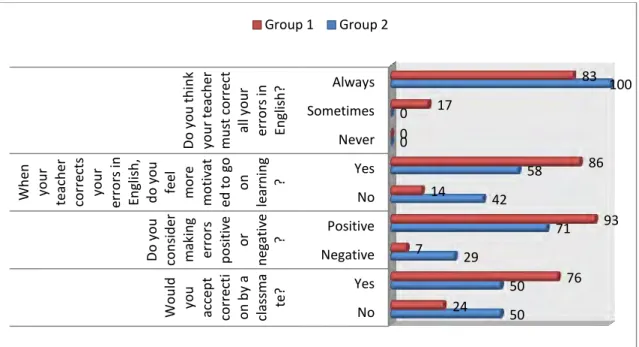
(35) EFL Students’ Attitudes and Preferences towards Written Corrective Feedback. First, the frequency for each questionnaire item was counted and presented in percentages. Then, the data obtained were compared and analysed to try to answer RQ1: How do EFL students feel about error correction in their writings? As can be seen in Table 3 below, the majority of students in both groups believe that teachers must correct all errors and that making errors is necessary to learn. Both groups showed a high level of concern with making errors, but there is a slight difference between the groups, being the older group the most worried about making mistakes in English when they write. Group 1 stated to be more motivated to go on learning when they are corrected than Group 2, which showed balanced results (58% for ‘Yes’ and 42% for ‘No’). In general, they claimed that making errors is positive. Many of them stated that the reason why they consider it positive is that they can use that knowledge to prevent errors reappearing in the future. All students agreed that making errors is normal when learning a language. The results showed that half of the students in each group are worried about the quality of their English when their writings are checked, while the other half feels rather uncomfortable, frustrated or feels nothing. Nevertheless, results do not show any relevant difference between the two groups of different ages for this question. Results revealed that Group 1 is more likely to accept correction by a classmate, while only 50% of Group 2 would accept it. Both groups agreed on not accepting an English. 30.
(36) EFL Students’ Attitudes and Preferences towards Written Corrective Feedback. teacher who did not correct the errors in their writings. Finally, all students regarded correction of written errors as useful.. Do you think your teacher must correct all your errors in English? Do you think that making errors in English is necessary to learn more? Are you worried of making errors when you write in English? When your teacher corrects your errors in English, do you feel more motivated to go on learning? Do you consider making errors is positive or negative? Do you think making errors is a failure or normal when you are learning a language?. When your English teacher corrects your writings, you feel.... Would you accept correction by a classmate? Would you accept an English teacher who did not correct the errors in your writings? Do you consider correction on your written tasks useful?. Always 83% / 100% Yes 100% / 96% Always 62% / 71% Yes 86% / 58%. Group 1 / Group 2 Sometimes Never 17% / 0% 0% / 0% No 0% / 4% Sometimes Never 34% / 29% 4% / 0% No 14% / 42%. Positive 93% / 71% Failure 0% / 0%. Negative 7% / 29% Normal when you are learning a language 100%/100% Uncomfortable Frustrated 10% / 8% 14% / 21%. -. -. -. -. -. Nothing happens to me 21%/17%. Yes 76% / 50% Yes 4% / 8%. No 24% / 50% No 96% / 92%. -. I worry about the quality of my English 55%/54% -. -. -. Yes 100% / 100%. No 0% / 0%. -. -. TABLE 2. Results related to RQ1 per group Table 4 depicts the results classified by level of proficiency. As shown in the table, A2 and B1 students have a greater tendency for believing that teachers must always correct their errors, whereas students in the most advanced group (B2) sometimes have this feeling. The three groups consider making errors necessary to learn more.. 31.
(37) EFL Students’ Attitudes and Preferences towards Written Corrective Feedback. Students in the B2 level present a higher level of anxiety about making errors than students in the A2 and B1 levels. Five percent of students with the lowest proficiency level advocates never feeling worried about making errors when writing in English. Most students from the three levels admitted to feeling more motivated to go on learning when they are corrected, especially the B2 level (100%). Students from all levels tend to feel worried about the quality of their English when they are corrected, but the percentage of B2 students is higher (70%). The group which is more likely to accept correction by a classmate is the B1 level. The other groups present similar acceptance for and against peer correction. In general, the three groups would not accept an English teacher who did not correct the errors in their essays. As shown in the table below, only 4% of the students with a B1 level of English and 20% of the students with a B2 would accept so.. Do you think your teacher must correct all your errors in English? Do you think that making errors in English is necessary to learn more? Are you worried of making errors when you write in English? When your teacher corrects your errors in English, do you feel more motivated to go on learning? Do you consider making errors is positive or. Always 95%/88%/10%. A2 / B1 / B2 Sometimes Never 5%/12%/90% 0%/0%/0%. -. Yes 100%/96%/100%. No 0%/4%/0%. -. -. Always 58%/63%/70%. Sometimes 37%/37%/30%. Never 5%/0%/0%. -. Yes 74%/63%/100%. No 26%/37%/0%. -. -. Positive 90%/74%/90%. Negative 10%/26%/10%. -. -. 32.
(38) EFL Students’ Attitudes and Preferences towards Written Corrective Feedback. negative? Do you think making errors is a failure or normal when you are learning a language? When your English teacher corrects your writings, you feel... Would you accept correction by a classmate? Would you accept an English teacher who did not correct the errors in your writings? Do you consider correction on your written tasks useful?. Failure 0%/0%/0%. Normal when you are learning a language 100%/100%/100%. -. -. Uncomfortable 10%/12%/0%. Frustrated 26%/12%/10%. Yes 63%/71%/50%. No 37%/29%/50%. Nothing happens to me 10%/26%/20 % -. I worry about the quality of my English 54%/50%/70 % -. Yes 0%/4%/20%. No 100%/96%/80%. -. -. Yes 100%/100%/100%. No 0%/0%/0%. -. -. TABLE 3. Results related to RQ1 per level of proficiency In order to determine the contrast among the frequencies obtained in the questions from the questionnaire the Chi-Squared test (χ² test) was employed. This test can be used even with data measured in a nominal scale (as is our case in some questions). In order to carry out this contrast, the data have been included in a frequency. The contrast shows us to what extent the observed or empirical frequency differs from the expected frequency. After having presented the percentages obtained in each question in the previous tables, the answers which presented significant differences in the Chi-Squared test are displayed in the following tables. Once again, the differences have been analysed according to school year and level of proficiency.. 33.
(39) EFL Students’ Attitudes and Preferences towards Written Corrective Feedback. As shown in Table 5 below, four significant differences according to the school year of the participants were found. From the results obtained in the Chi-Squared test, it can be said that students in Group 2 (2nd year of Bachillerato) significantly consider more important that the teacher should correct all their errors in English than students in Group 1 (4th year of Secondary Education). Secondly, students from Group 1 feel more motivated when the teacher corrects them than older students from Group 2. Moreover, Group 1 students significantly consider making errors in English more positive than students in Bachillerato. Finally, students in Group 1 significantly would accept correction by a classmate more than students in Group 2.. Do you consider your teacher must correct all. Value χ2. d.f.. Significance. 4.569. 1. .041. 5.249. 1. .024. 4.620. 1. .037. 3.819. 1. .048. your errors in English? When your teacher corrects your errors in English, do you feel more motivated to go on learning? Do you consider making errors is positive or negative? Would you accept correction by a classmate?. TABLE 4. Significant differences related to RQ1 according to school year of the participants The following figure shows the significant differences between groups about questions answering RQ1 with percentages.. 34.
(40) EFL Students’ Attitudes and Preferences towards Written Corrective Feedback. Would you accept correcti on by a classma te?. Do you consider making errors positive or negative ?. When your teacher corrects your errors in English, do you feel more Do you think motivat your teacher ed to go must correct all your on learning errors in ? English?. Group 1. Group 2 83. Always Sometimes Never. 0 0 0. Yes. 86. 58 14. No. 42. Positive Negative. 100. 17. 71 7. 29. Yes. 76. 50 24. No. 93. 50. FIGURE 3. Significant differences for RQ1 per group As can be seen from Table 6, the test only showed a significant difference among the three levels of proficiency in the questions answering RQ1. B2 students feel significantly more motivated to go on learning when the teacher corrects their errors than students with a lower level of English. However, B1 students are the least motivated. Value χ2. d.f. 2. Significance. 5.107 .049 When your teacher corrects your errors in English, do you feel more motivated to go on learning? TABLE 5. Significant differences related to RQ1 according to level of proficiency. Figure 4 displays the significant differences among the three levels of English:. 35.
(41) EFL Students’ Attitudes and Preferences towards Written Corrective Feedback. When your teacher corrects your errors in English, do you feel more motivated to go on learning?. A2. B1. B2. 74 63. Yes. 100. 26 37. No 0. FIGURE 4. Significant differences for RQ1 per level of proficiency Once we have discussed the results for RQ1, we turn to analyse RQ2.. 3.6. Results and discussion related to RQ2 Data related to RQ2 were gathered and analysed in the same way as data associated with RQ1. Questionnaire 2 (see Appendices) shows the twelve questions asked to students in order to answer RQ2: What are students’ preferences for error correction and feedback? As can be seen in Table 7, the majority of students prefer being corrected by the teacher and in red pen. Almost all students prefer being corrected all the errors in an essay. Just 4% from students in Group 1 would rather only be corrected some of the errors. Although results show a higher preference for getting the right answer instead of being the students themselves who correct the errors, the percentages are quite balanced in both groups. They also prefer the teacher to cross the errors out and to give the. 36.
(42) EFL Students’ Attitudes and Preferences towards Written Corrective Feedback. appropriate word. Still a high percentage of students prefer the teacher to underline the errors and to write comments at the end of the essay. Only a low percentage chose a correction code. Most students from both groups like receiving specific and detailed comments from the teacher when giving an essay back. Students in Group 1 consider the four options given (grammar, content, organization and vocabulary) fairly as important factors in an essay. Students in Group 2 favour grammar and content equally, but none of them chose either organization or vocabulary. Both groups consider the teacher should point out grammar errors over vocabulary and other types of errors. Even when an error does not affect understanding of the message, most students believe it should be corrected. Moreover, most students admit that if there were many errors in their writings, they still would like their teacher to correct all of them. Most students in Group 1 consider they will not repeat a corrected error in the future; however, students in group 2 equally answered affirmatively and negatively to the question. Half of students in both groups consider quite equally that the task of locating and correcting errors lays on the teacher and the other half that it lays on the students themselves.. I prefer my teacher to correct my essays in... Who do you prefer to correct your essays?. Red pen 92% / 88% The teacher 89% / 92%. In my essays, I prefer the teacher to highlight.... All the errors 96% / 100%. Group 1 / Group 2 Green pen Pencil 4% / 12% 4% / 0% The Selfclassmates correction 4% / 0% 7% / 8% Some errors. -. -. 37.
(43) EFL Students’ Attitudes and Preferences towards Written Corrective Feedback. What do you prefer the teacher does to correct your essays?. Cross the errors out and give the appropriate words 65% / 50%. What kind of comments would you like your teacher to make when giving an essay back?. General comments 24% / 17%. The most important in an essay is.... Grammar 31% / 50%. 4% / 0% Marks the errors and I correct them 45% / 37% Underline the errors and write comments at the end of the essay 31% / 42% Specific and detailed comments 68% / 71% Content 24% / 50%. In your essays, the teacher should point out.... Grammar errors 73% / 75% Yes 93% / 96%. Vocabulary errors 10% / 4% No 7% / 4%. Other 17% / 21%. -. -. -. Correct all errors 73% / 67%. Correct only serious errors 7% / 21% No 73% / 50% The main task of students is to locate and correct their own errors 52% / 42%. Correct errors affecting understanding 10% / 8%. Correct all repeated errors 10% / 4%. -. -. -. -. I prefer the teacher.... Tells me the right answer 55% / 63%. If an error does not affect the understanding of the message, should it be corrected? If there were many errors in your essay, what would you like your teacher to do?. Once your errors are corrected, do you think you will repeat them? Which statement are you in favour with?. Yes 27% / 50% The main task of the teacher is to locate and correct students’ errors 48% / 58%. -. -. Use a correction code 4% / 8%. Write questions 0% / 0%. Positive comments 4% / 8%. Negative comments 4% / 4%. Organization 24% / 0%. Vocabulary 21% / 0%. TABLE 6. Results related to RQ2 per group. 38.
(44) EFL Students’ Attitudes and Preferences towards Written Corrective Feedback. As shown in the above table, more advanced students have a more open view towards how to have errors marked. Although the three groups show a clear preference for correction in red pen, some B2 level students have chosen correction in green pen (20%) or pencil (10%). Most students in the three groups prefer being corrected by the teacher and having all errors corrected. Students with the lowest level of proficiency would rather have the teacher tell them the right answer, the intermediate level favours being given the right answer and correcting the errors themselves equally, and the higher level prefers correcting the errors themselves. When giving an essay back, most students in the three groups want the teacher to give specific and detailed comments, especially B2 students (90%). Grammar is considered the most important factor in an essay by most students, especially by B2 students (70%). Similarly, grammar errors are labelled as the most important errors the teacher should point out. All students with a B1 and B2 level of proficiency consider that errors which do not affect understanding of the message should be corrected as well. Only 16% of A2 students consider that this kind of error should not be corrected. The three groups support having all errors corrected in an essay were many errors had been made, especially the B2 level favoured it (90%). Half of the students in A2 and B1 levels consider they will repeat the same errors in the future, only students with a B2 level show a difference and claim they believe they will not make them again (90%). In. 39.
(45) EFL Students’ Attitudes and Preferences towards Written Corrective Feedback. a similar way, half A2 and B1 students consider it is the teacher’s task to locate and correct errors. B2 students consider it a students’ task.. I prefer my teacher to correct my essays in... Who do you prefer to correct your essays?. Red pen 95%/96%/70% The teacher 95%/88%/90%. In my essays, I prefer the teacher to highlight... I prefer the teacher.... All the errors 100%/96%/100% Tells me the right answer 79%/50%/40%. What do you prefer the teacher does to correct your essays?. Cross the errors out and give the appropriate words 68%/58%/40%. What kind of comments would you like your teacher to make when giving an essay back? The most important in an essay is.... General comments 16%/29%/10%. In your essays, the teacher should point out... If an error does not affect the understanding of the message, should it be corrected? If there were many errors in your essay, what would you like your teacher to do? Once your errors are corrected, do you think you will repeat them? Which statement are you in favour with?. Grammar errors 74%/63%/90%. Grammar 36%/29%/70%. A2 / B1/ B2 Green pen Pencil 5%/4%/20% 0%/0%/10% The Self-correction classmates 5%/8%/10% 0%/4%/0% Some errors 0%/4%/0% Marks the errors and I correct them 21%/50%/60% Underline the Use a errors and correction write code comments at 0%/13%/0% the end of the essay 32%/29%/60% Specific and Positive detailed comments comments 0%/13%/0% 79%/54%/90% Content Organization 32%/50%/10% 16%/17%/0%. -. -. Write questions 0%/0%/0%. Negative comments 5%/4%/0% Vocabulary 16%/4%/20 %. Vocabulary errors 16%/4%/0% No 16%/0%/0%. Other 10%/33%/10%. -. -. -. Correct all errors 64%/67%/90%. Correct only serious errors 10%/21%/0%. Yes 48%/42%/10%. No 52%/58%/90%. Correct errors affecting understanding 10%/8%/10% -. Correct all repeated errors 16%/4%/0% -. The main task of the teacher is to. The main task of students is. -. -. Yes 84%/100%/100%. 40.
(46) EFL Students’ Attitudes and Preferences towards Written Corrective Feedback. locate and correct students’ errors 63%/54%/30%. to locate and correct their own errors 37%/46%/70%. TABLE 7. Results related to RQ2 per level of proficiency After presenting the tables with the percentages for each question in Questionnaire 2, the results obtained in the Chi-Squared Test are displayed. Table 9 shows the only significant difference according to the school year of the participants. Related to what the most important in an essay is, there exist significant differences between both groups. Students in Group 2 give more importance to content and grammar, and none to organization and vocabulary. However, students in Group 1 concede similar importance to the four aspects. Value χ2 14.401. d.f. 3. Significance .002. The most important in an essay is... (grammar/content/organization/vocabulary) TABLE 8. Significant differences related to RQ2 according to school year of the participants. The differences explained before can be found in the following graph, including the percentages.. The most important in an essay is…. Group 1. Group 2. 31. Grammar 24. Content Organization. 0. Vocabulary. 0. 50 50. 24 21. FIGURE 1. Significant differences for RQ2 per group. 41.
(47) EFL Students’ Attitudes and Preferences towards Written Corrective Feedback. According to the differences among the English level of the participants, the test showed significant differences in the students’ preferences in correction for either obtaining the right answer straightaway or having the errors located but to correct the errors themselves. A2 students significantly prefer their teacher to give them the correct answer. The higher the English level of the students, the greater their preference for correcting the errors on their own. Secondly, it was found out that A2 students significantly consider that errors not affecting the understanding of the message should not be corrected. Value χ2 5.396. d.f. 2. Significance .048. I prefer the teacher... (tells me the right answer/ marks the errors and I correct them) If an error does not affect the understanding of 5.691 2 .047 the message, should it be corrected? TABLE 9. Significant differences related to RQ2 according to level of proficiency. The following chart represents the different answers to the questions explained before.. If an error does not affect the understandin g of the message, should it be corrected?. I prefer the teacher…. A2. B1. B2. Tells me the right answer. 40 21. Marks the errors and I correct them. 50. 60 84. Yes No. 79. 50. 0 0. 100 100. 16. FIGURE 2. Significant differences for RQ2 per level of proficiency. 42.
(48) EFL Students’ Attitudes and Preferences towards Written Corrective Feedback. CHAPTER 4: CONCLUSION The purpose of this study was to examine EFL students’ attitudes and preferences for error correction and feedback and to analyse them according to the variables of age and level of proficiency. We have attempted to show that EFL learners have different opinions and attitudes towards corrective feedback. The analysis of the participants’ responses revealed several differences among the groups. On the one hand, their attitudes towards written corrective feedback differed according to their age. Older students demanded more feedback from the teacher. Nevertheless, younger learners felt more motivated with correction, regarded making errors more positively, and were more willing to accept correction by a classmate than older ones. In regard to their English level of proficiency, B2 students felt more motivated to go on learning when the teacher corrects their errors than students with lower levels of English. However, B1 students were the least motivated. On the other hand, participants’ preferences for error correction and feedback varied as well. According to their age, older students gave more importance to content and grammar, while younger learners conceded similar importance to content, grammar, organization and vocabulary. Regarding their English level, A2 students preferred their teacher to give them the correct answer. Thus, the higher the English level of the students, the greater their preference for correcting errors on their own. In addition, the results showed that A2 students consider that errors not affecting the understanding of the message should not be corrected.. 43.
(49) EFL Students’ Attitudes and Preferences towards Written Corrective Feedback. Analysis of our data leads us to believe that age and level of proficiency are significant variables in the attitudes and preference for feedback in the EFL classroom. Moreover, evidence from previous research shows that taking these preferences into account can be useful for language teachers as it helps motivate students. After this review on the results of the study, some suggestions can be made in order to improve the provision of feedback in the L2 classroom and to obtain a more fluid interaction and relationship teacher-students and among students themselves. It may be suggested that teachers include short discussions on error correction in everyday lessons so that students clearly understand the aim of feedback and the different types and methodologies available for such practice. Moreover, it is also important and recommendable that teachers become aware of how they apply error correction in the classroom and that they take into account students’ needs and preferences. Teachers should consider additional editing strategies for correcting errors in the L2 classroom. One way is to encourage students to fix their own errors. In order to do so, it would be advisable to spend some time in class devoted to learn new editing strategies. Then, students would be able to learn how to self-correct under the teacher’s supervision, which is indispensable to guide learners in the process. Researchers like Ferris (1995b) and Reid (1998) propose that teachers help students to develop self-editing strategies. As Sheen (2011: 48) puts it, “pushing learners to stretch their interlanguage engages them in noticing the gap and in hypothesis testing”. Selfcorrection reinforces students’ motivation and empathy towards both teaching and learning processes. Consequently, this would reinforce students’ attitude and empathy. 44.
(50) EFL Students’ Attitudes and Preferences towards Written Corrective Feedback. towards the teacher and the subject positively. Additionally, feeling that they can correct their errors themselves is a positive reinforcement for students. Thus, selfcorrection can be highly productive if students are taught how to do it. Although elementary learners may need guidance and explicit or direct correction, both implicit or indirect correction and self-correction may be useful strategies for intermediate and advanced learners. Sheen and Ellis (2011) declare that teachers should take learners’ learning goals and attitudes towards correction into account and comment with them the importance of correction in the acquisition of a language. Additionally, teachers should bear in mind the variety of correction strategies available and adjust them to the needs of individual learners. They also suggest teachers correct learners’ errors implicitly, so that learners have the opportunity to self-correct. In summary, Sheen (2011: 174) concludes that “the success of feedback depends on a myriad of cognitive, sociocultural, discoursal and internal and external learner factors that mediate the effectiveness of any particular feedback type”. Accordingly, if teachers take learners’ factors into account- including their attitudes and preferencescorrection may be more favourable. All the factors mentioned above- the empathetic relationship among the teacher and the students, the positive reinforcement of taking an active part in the correction process, the students’ needs and attitudes and the time investment in self-correction- would bring about students who look at their own work and performance more critically and would make them ponder on the tasks they carry out in the classroom.. 45.
Figure
Documento similar
Students obtain final grades lower than seventy-five in two or more courses (or their equivalent) from the specialization curriculum in which they are enrolled (or in 32 % or more
Students obtain final grades lower than seventy-five in two or more courses (or their equivalent) from the specialization curriculum in which they are enrolled (or in 32 % or more
Other co-receptors that enhance BMP signaling are members of the Repulsive Guidance Molecule family (RGM). RGM molecules modify specific BMP ligands binding affinity for the BMP type
As a consequence, there are many differences among Universities with respect to students: staff ratios, with more students per teacher in Italian institutions – this is due to
The implementation of this activity is intended to make students more involved in the English language. For this, they have also been considered in evaluating the task, making
Cultural values and attitudes to science offer a more effective explanation of this opposition than competition theories: those expressing egalitarian values and privacy concerns
b)Which are the factors that may influence different learning experiences?(e.g, students´ attitudes towards the programs, students´ learning style, appropriateness and level of
The goal of the present study is to determine whether teachers think that some contents are more masculine and more appropriate for boys, and other contents are more feminine and
