Molagavita through the role-playing method
Presented by:
Laura Melissa Grimaldy Quiroga
1.096.952.710 Bacherlor of Arts in ELT
Examiner:
Claudia Munera
UNIVERSIDAD NACIONAL ABIERTA Y A DISTANCIA – UNAD SCHOOL OF EDUCATION – ECEDU
Table of contents
Justification ………5
Definition of the problem ………..8
Research question………..9
General objective ………...10
Specific objectives ………10
Investigation line ………...11
Definition of the line ………...11
Characteristic: Research topic and Research line ……….12
Theoretical framework ………..13
Conceptual framework ………..27
Social affective strategies ……….33
Video ………33
Flash cards ………34
Linguistic reproduction (LR) ………35
Language production (LP) ………36
Appropriate and meaningful short dialogues for the child's age
(AMSDCA) ………...37
Methodological design ……….39
Focus: Type of research ………...39
Information gathering and information analysis tools ………..43
Results ………..44
Initial test ……….44
Field diary one: Diagnostic test 1 ………47
Strategies ………..49
Video ………49
Flash cards ………...50
Games ………..51
Linguistic reproduction (LR) ………...52
Language production (LP) ………...53
Songs and directed games (SDG) …::………..54
Appropriate and meaningful short dialogues for the child's age (AMSDCA) ………...55
Final test ………..57
Discussion ………..66
Conclusions and recommendations ………68
References ………..70
Graphic index Graphic 1. Question number 1 of the diagnostic test ……….44
Graphic 2. Question number 2 of the diagnostic test ……….45
Graphic 3. Question number 3 of the diagnostic test ……….46
Graphic 4. Part 1. Question number 1 of the diagnostic test final ……….57
Graphic 5. Part 1. Question number 2 of the diagnostic test final ……….58
Graphic 6. Part 1. Question number 3 of the diagnostic test final ……….59
Graphic 7. Part 2. Question number 1 of the diagnostic test final ……….60
Justification
This research project aims to improve the communicative skills of primary school students from the Educational Institution Llano de Molagavita, rural school El Laurel in the municipality of Molagavita, Santander.
This project originates from the students’ low level of English language perfomance; also because their rural context does not allow them to access a foreign language as English so easily. On the other hand, most of the public school teachers do not have the competences to teach English, they do not recognize the importance of it, leaving aside the levels that students must reach according to the basic standards of Competence in Colombia.
This project will be applied over a period of two months, with a group of fourth graders, between the ages of 9 and 10.
This is achieved through the role-playing method, as it allows kids to strengthen this ability and to reach the students in a more motivating and simple way, leaving traces in them and leading to the development of the English language.
It is important to start improving the communicative competence in English from early elementary school, since it is the base for them to develop the language when they are teens and adult; nowadays, speaking a foreign language is very important and completely necessary pushed by the fact that globalization is happening at a very fast pace worldwide.
Countryside students do not have many opportunities in terms of their living standards, since they live far away from technology and communications, so it is up to the teacher to bring them closer together and teach them another language so that they can improve their level and easily learn a foreign language.
To all this, it is added the lack of preparation of the teaching staff, since they are mostly prepared for teaching and do not give importance to a foreig language, and those who cannot correct pronunciation mistakes and do not create dialogue settings among students, are limited to teaching vocabulary as to what is written and not more.
Definition of the problem
The primary students from the Institution Educativa Llano de Molagavita, Rural school El Laurel in the municipality of Molagavita Santander, do not have the adequate context to learn a foreign language, since it is a secluded region with little access to technology, in addition to being in a rural area, the kids´ relatives do not have secondary education and therefore, they do not know another language, in addition the students showcase grammatical errors in the way they speak others.
On the other side, the learning opportunities of these students are based on the nearest school, sometimes the English teachers have not been trained as such, so the kids learning is not the best.
Also, due to their being located in such distant places, they do not have the necessary tools to learn a foreign language, therefore, kids do not feel motivated to learn a foreign language or at least reach a proficiency level fit for their grades or ages.
For this reason, we will work with fourth graders, as they are the seed for learning a foreign language, initiating the process of improvement of skills and competences in English.
Research question
General objective
To Improve the English level of the fourth-grade students from the Rural School El Laurel in Molagavita Santander, through the role-playing method
Specific objectives
To prepare a diagnostic test to know the communicative level of children from fourth grade of the Educational Institution Llano de Molagavita Rural School El laurel in Molagavita, Santander
To use didactic strategies based on the role play method to strengthen communicative listening and speaking skills in students
Investigation line
Bilingualism in distance education mediated by technology
Definition of the line
The Ministry of National Education of Colombia (MEN) recognizes the importance of bilingualism in this globalized world for different subject areas, so that the proposed MEN educational policies aimed at the student population, society and the productive sector. Line Bilingualism in Distance Education Mediated Technologies, born from the perspective of responding to such policies, and from the initiative of the UNAD in their participatory projects in offering programs and agreements teaching - learning a second language. The Ministry of National Education (MEN) assumes bilingualism as "the different degrees of mastery with which an individual manages to communicate in more than one language and one culture. These varying degrees depend on the context in which each person develops. Thus, according to the use made of other than the native languages, they acquire the character of second or foreign language. (MEN, primer Form Foreign Languages. P. 5, 2006).
(...) despite not being used in different circumstances to academic, students of a foreign language can achieve high levels of performance to be effective communicators when required. (MEN, Cartilla Form in Foreign Languages, p. 5. 2006).
From the above concepts, it should be noted that the line of Bilingualism in distance education mediated by technology, not only will try to respond to the contributions of English as a foreign language, but all those languages that can be assumed as a second or foreign language in the country, with the main objective of contributing to the scientific, social, economic and academic development of communities, regions and Colombia, in general, as well as the incursion and participation in communication processes worldwide, allowing interaction our educational community to new experiences and different contexts, in pursuit of internationalization and the use of e-learning as an effective educational tool.
Characteristic: Research topic and Research line
The line of research fits my topic because it allows teaching English through roles, the technology also allows students to take positions on their learning and makes it easy to understand what is said, it also allows students to be builders of their knowledge with the support of other tools like technology.
Theoretical framework
This project has some theorists who support what is done in it, which are:
Depending on the specific nature of the teacher’s objective, role-play can be fitted into the timetable in several ways. Van Ments (1983) identifies the following:
O as an introduction to the subject
O as a means of supplementing or following on from a point that is being explored
O as the focal point of a course or a unit of work
O as a break from the routine of the classroom or the workshop O as a way of summarizing or integrating diverse subject matter
O as a way of reviewing or revising a topic O as a means of assessing work
This technique, also known as dramatizations or simulations, is that two or more represent a situation or real life case, acting in the role assigned to them and so it becomes more vivid and authentic.
When you want someone to understand as closely as possible a behavior or situation, you are asked to "put yourself in somebody else´s place" the one who lived that reality in person. If you assume the role it is meant to mentally evoke a situation, dramatically revive it, or to allow a student to take a stand against something that is given, the intimate understanding is far more profound and enlightening.
In this role-playing or performing roles: representing (dramatizer or take positions) A typical situation (one case) in order to take real, visible, lived, so that the action of one who understands best or who must intervene in it in real life.
This objective is achieved not only in those who represent the roles, but throughout the group that acts as a participant observer for its insight into the process. The actors convey the group's sense of living the event as if it were real.
The use of this type of group techniques require certain skills and a high degree of maturity in the group. It is not a technique that we can do in our first training sessions.
1. Encourage communication in the group and increase participation 2. Show problematic situations
3. Criticizing previous decisions of the group itself
Student-centered teaching methods shift the focus of activity from the teacher to the learners. These methods include active learning, in which students solve problems, answer questions, formulate questions of their own, discuss, explain, debate, or brainstorm during class; cooperative learning, in which students work in teams on problems and projects under conditions that assure both positive interdependence and individual accountability; and inductive teaching and learning, in which students are first presented with challenges (questions or problems) and learn the course material in the context of addressing the challenges. Inductive methods include inquiry-based learning, case-based instruction, problem-based learning, project-based learning, discovery learning, and just-in-time teaching. Student-centered methods have repeatedly been shown to be superior to the traditional teacher-centered approach to instruction, a conclusion that applies in case the assessed outcome is short-term mastery, long-term retention, or depth of understanding of course material, acquisition of critical thinking or creative problem-solving skills, formation of positive attitudes toward the subject being taught, or level of confidence in knowledge or skills.
From my point of view, technological progress, increasingly closer relations between the countries of the world in political, economic, educational, cultural and social aspects, are some of the changes we face today which make it necessary to mention and support the need to learn the English language.
So, it is essential to learn this language more than ever before, because each day it is used with more frecuency in all areas of knowledge and human development. Practically, it can be said that this is the language of today's world.
Thus, for global consensus, English has been chosen as the language of international communication. English is the language of diplomacy in a global world in which relations between countries are becoming more important.
Therefore, learning English is no longer a luxury, it is a necessity today that is not called into question, for this reason it is important to gradually immerse in classrooms strategies that catch students´ attention, in this case role-playing, generating innovation in the classroom, and students are motivated to learn while having fun.
A pre-experimental study conducted at the basic level in the Islamic State (2007), the author showed that after applying the role-play as a strategy for learning the language, students´ level of English increased.
Also, in Mexico (2007), it was carried out a study in middle school, in which the role –play was applied and aimed at improving the ability to speak English in students. The results showed that the level of the ability to speak English improved significantly. In addition, this strategy allowed students to express themselves spontaneously and strongly use their imagination.
Regarding national experiences, Montenegro (2011) conducted a study on the role play as a teaching tool for teaching English, stating in its conclusions that the "role play is a unique strategy and has become a solution to develop the speaking skill in English, because this covers speaking and helps reflection of universal values and the development of student self-esteem "
Within his theory, the ideas that support it are the functioning of the intelligence with its processes of assimilation and accommodation; the concept of schema as a given mental structure; the process of balance between accommodation and assimilation in which there is a cognitive conflict and the stages of development with their stages.
Piaget assumes that teaching takes place "from the inside out".
For him education aims to promote the intellectual, affective and social growth of the child, but taking into account that this growth is the result of natural evolutionary processes. Educational action, therefore, must be structured in a way that favors the personal constructive processes, through which growth operates. Discovery activities should therefore be a priority. This does not imply that the child has to learn alone. On the contrary, one of the basic characteristics of the Piagetian pedagogical model is, precisely, the way in which the horizontal social interactions stand out.
The implications of Piagetian thinking in learning have an impact on the constructivist conception of learning. The general principles of Piagetian thinking about learning are:
2. The contents are not conceived as ends, but as instruments at the service of natural evolutionary development.
3. The basic principle of Piagetian methodology is the primacy of the method of discovery. 4. Learning is an internal constructive process.
5. Learning depends on the level of development of the subject. 6. Learning is a process of cognitive reorganization.
7. Cognitive conflicts or cognitive contradictions are important in the development of learning.
8. Social interaction favors learning.
9. Physical experience involves an awareness of reality that facilitates problem solving and promotes learning.
10. Learning experiences should be structured in such a way as to favor cooperation, collaboration and exchange of views in the joint search for knowledge (interactive learning).
Lev Vygotsky has a clear influence of historical materialism, which is based on Engels' conception of activity as the engine of humanization, an activity-based psychology.
Activity is a process of transforming the environment through the use of instruments.
By basing his psychology on the concept of activity, Vigotsky considers that man is not limited to responding to stimuli but acts upon them, transforming them. This is possible thanks to the mediation of instruments that are interposed between the stimulus and the response.
It refers to the mediation of the different instruments, which divides them into tools and signs, giving the major importance to the signs, in the case of spoken language, which will have much influence on this cognitive theory.
It distinguishes two classes of instruments depending on the type of activity they make possible. The simplest type of instrument would be the tool that acts materially on the stimulus, modifying it. Thus, a hammer acts directly on the nail, so that the action to which it gives rise not only responds to the environment but also modifies it materially. This is the kind of instrument Engels referred to when he considered the importance of work in the process of hominization.
other symbolic systems that allow us to act on reality (eg, measurement systems, chronology or arithmetic, the literacy system, etc.) .
They are the signs, as mediators that modify the subject and, through this, to the objects, those that have more interest for the cognitive psychology.
For Vigotsky meanings come from the external social environment, but must be assimilated or internalized by each child or individual. His position coincides with that of Piaget when he considers that signs are produced in interaction with the environment, but in Piaget's case, that environment is composed only of objects, some of which are social objects. composed of objects and persons that mediate in the interaction of the child with objects.
This project is also based on Learning by Discovery. Hence the importance of studying aspects that concern him and presenting Jerome Bruner as one of its exponents.
In other words, learning by discovery is when the instructor presents all the tools necessary for the individual to discover for himself what he wants to learn. It is a very useful learning, because when carried out in an ideal way, it ensures a meaningful knowledge and encourages research habits and rigor in individuals.
Forms of learning by discovery.
Learning by discovery comes in different forms that are appropriate for achieving different types of objectives, and also serves individuals with different levels of cognitive ability. These are:
Inductive Discovery: This type of discovery involves the collection and reordering of data to arrive at a new category, concept or generalization. Identify two types of lessons:
• The open lesson of inductive discovery is the one whose main purpose is to provide experience to children in a particular process of search: the process of categorization or classification. There is no particular category or generalization that the teacher expects the child to discover. It is aimed at "learning how to learn", in the sense of learning how to organize data.
• The structured lesson of inductive discovery: is the one whose main purpose is for children to acquire a particular concept. The main objective is to acquire the content of the subject to be studied within the framework of the discovery approach.
In this type of discovery, the development is gradually in children between the ages of eight and over (concrete or formal stage "Piaget").
The structured lesson of inductive discovery uses concrete or figurative materials. Concepts of the descriptive sciences are developed. What stands out is the importance of the organization of the data.
Deductive discovery: The deductive discovery would imply the combining or relating general ideas, in order to arrive at specific statements, as in the construction of a syllogism.
• The simple lesson of deductive discovery: This technique of instruction involves asking questions that lead the student to form logical syllogisms, which can result in the student correcting the incorrect statements he has made.
• The lesson of semiductive discovery Is where the children think inductively in a deductive system. They come to rules or properties observing specific data, which are controlled by the system in which they work. The system (that is, the elements with which it is worked and the operation being used) limits the possible results.
The educational outcome is that the teaching process is simplified, as it greatly reduces the likelihood of children reaching an unexpected conclusion. It develops gradually in children aged 8 years and over. (concrete or formal stage "Piaget").
• The lesson of hypothetical-deductive discovery. Children use a deductive way of thinking. In general, this will involve making hypotheses about causes and relationships or predicting outcomes. It develops in children between the ages of 11 and 12 years (formal stage "Piaget").
Transductive Discovery: The individual relates or maps two particular elements and warns that they are similar in one or two respects. It can lead to over-generalization or stereotyped thinking; can lead to perceptions divergent or imaginative world considering themselves highly creative.
• The lesson of transductive discovery: The general purpose of it would be to develop skills in the artistic methods of search. The selection and organization of the "data" or specific materials will be largely controlled by the child. It develops in children 8 years and over. (concrete or formal stadium "Piaget").
The roles
In Discovery Learning, there are some roles that are fundamental in the actions of the subjects and the instructor to follow the instructions given by Bruner.
Role of the instructor.
• Acts as a mediator between specific knowledge and the understandings of individuals.
• Facilitates learning, designing and developing strategies. • Performs activities according to the knowledge to be taught.
• It is aware of the problems that arise for trainees in order to guide them.
• Verify the correct monitoring of the guidelines, the identification of errors and the correction of the same.
Apprentice role:
• Re-elaborate their own representations or models of reality.
• Use and transfer learning to other situations.
Conceptual framework
This project raises different strategies and concepts that are important to clarify to understand the purpose of it.
Role-playing allows students to have different positions to which they are accustomed and do more for their learning.
The goal is to figure out how to act and take decisions that each of the students in different situations have to assume Then he tries to act like that character in one case home. This technique will help us put ourselves in the other person is very useful in different cases.
Role-playing allows the students change roles and modify their behavior and their thinking to take a different role for himself, from children this function becomes small when we take the role of our favorite characters either stories or television and by taking that position the children change their way of thinking and acting differently.
Role-playing facilitates the understanding of theoretical concepts. It stimulates and motivates from the experiential that students build from this.
Effectiveness of the methodology of role-playing as a teaching tool in the career of Events Organization Role playing is the English expression to define the "role play" understood as role-playing.
This is to clarify that I mean the role-play whose sole purpose is leisure and recreational fun.
It has the distinction of being a cooperative game where all participants are actors and spectators at some point in the process. Simulation exercises and role-play are one of the oldest educational methods used for training in many disciplines and even in professional fields.
The precursor in this area is the psychiatrist, theorist and educator Jacob Levy Moreno who worked psychodrama as a form of psychotherapy inspired improvisational theater. During the “60 play therapy” so-called, focusing it on a recreational-educational aspect particularly aimed at working with children they took place.
The game is perceived as a personal challenge, where each member is a significant and part constituting the result sought. I propose the "challenge" as a motivator, and students were assigned a place to learn for the sake of being able to request and demand conditions in performing their jobs. And they are the ones who must meet demand. It forces them to recognize their own abilities and weaknesses.
According to the Mexican Ministry of Public Education (2110), describes a series of educational strategies that promote the development of language skills, so that they succeed in learning a foreign language. These are described to be taken into account in the teaching and learning sessions English
Vocabulary: In order to consider the intentional use of vocabulary different cognitive strategies
Strategies:
- Heating (Warm up). This should be part of a daily lesson plan where participation of all students is important as a space in which students practice English in a fun way created to promote initial understanding of target structures.
- Auditive comprehension. Hearing is not the same as listening; which means that to listen the person has to concentrate on what is being said to decipher and interpret. Why, people who listen must discriminate between different sounds, understand the vocabulary and grammatical structures, interpret the emphasis and intention and interpret the socio-cultural context in which the educational segment occurs.
- Skimming. Understand the most important ideas and discard what is irrelevant to get a general picture, choosing the main points, while the details are neglected.
- Scanning. Extract specific information by reading, not interested in understanding a passage in full, but if you get certain detailed facts.
- Understanding. Find and understand the main idea instead of trying to understand each and every one of the words is the main objective in reading.
Grammar: The grammar of a language can be considered as the set of principles governing
assembly of elements in meaningful sentences, classified and ordered. Grammatical competence is the ability to understand and express meaning expressing and recognizing well-formed sentences.
• Writing
Written expression is one of the most difficult skills to learn. However, this is a unique opportunity to test the effectiveness of learning other skills.
• Speaking
The oral expression gives the opportunity for students and demonstrate their ability to communicate orally using the vocabulary and grammatical structures.
• Pronunciation
This knowledge has three areas: sound and intonation. Some exercises to help with this skill are: Repeating chorally or individually, listening and singing songs, phonetic exercises, looking up in the dictionary, reading books with audio cassete, read, recording your voice to hear yourself, do skills spelling, karaoke, etc.
On the other hand, learning strategies are those that students use to perform successfully learning varies from person to person depending on the type of problem or task that has to be solved, Brown (2000) suggests that "strategies are methods that people use to solve problems, "plus" he explains that each individual can make use of a variety of strategies to facilitate the solution of it."
Cognitive learning strategies are those that are directly related to material handling. Wenden and Rubin (1987, p.22) defines them as the next steps in solving a problem that requires direct analysis of the material and makes the following: clarification / verification, inductive inference, deductive reasoning, practice and memorization.
Rubin (1987, p.25) mentions that such strategies are used to promote communication as students use them when they find difficulty communicating because of their inadequate knowledge of the language.
Socio affective strategies
Wenden and Rubin (1987, p.27) define social strategies such as those that require the active participation of students, although it is considered that they do not directly contribute to learning, they represent an option to optimize learning and when making use of them, students put their knowledge into practice. Strategies in this category proposed by Wenden and Rubin (1987, p.27) and Oxford (1990: 163) are: creating opportunities to practice, decreasing levels of anxiety and stress through relaxation, deep breathing and meditation, conversation starters, watching movies and listening.
Video
Flash cards
They are words, images, symbols or numbers, on one or both sides, used to acquire different knowledge through the re-reading of the set of cards. One side of the card writes one question and the other the answer. Flash cards can be vocabulary, historical data, chemistry, math, literature or any subject that can be learned through questions and answers.
Flash cards are widely used as a learning exercise to aid memorization by means of spaced repetition, very effective for elementary, middle and high school students.
They are also known as learning cards, educational cards, study cards, didactic cards, memory cards or mnemonic cards.
Flash cards or learning cards can be made of paper or digital.
Linguistic reproduction (LR): on repetition as one of the ways to encourage the use of language.
The linguistic reproduction or LR refers to the set of activities oriented to the presentation, repetition or imitation, in accordance with the presented model. The strategy is implemented in the classroom by the teacher and is the way children reproduce the vocabulary, sentences or any fragment of the language in accordance with the model of the target language. This strategy involves rote work and can be presented in the form of isolated words or chunks.
The child repeats (reproduces) and thus has the opportunity to practice both new and revised vocabulary. The repetition is not very structured, that is to say, it does not cling to the classical form of what in English is known as "drilling", that is to say, a systematic exercise of repetitions, first group, then in small groups and finally individually.
The reproduction is identified in the three moments of the class. At the opening, notes the naming list, in the songs of the home routine, in the first repetitions of vocabulary of the subjects already seen, for example, numbers or colors.
Language production (LP): a strategy to facilitate the meaningful use of the language.
The linguistic production or LP as a teaching strategy has been defined, for the present study as: all activity focused on facilitating the use of learning that allow the child to express their ideas in the target language, naturally, whether oral or written.
The child takes elements of the language and expresses ideas that are not necessarily simple repetitions of pre-formulated structures. Language production is a widespread strategy in language teaching, especially in relation to meaningful teaching, as it is considered to be the one with the best results.
Songs and directed games (SDG): the key strategies to increase motivation for learning.
As its name says, it consists in the use of songs or thought games with specific pedagogical objectives. The songs can be presented in audio or video format and the directed games, they can be of competences or for entertainment, both have in common that they are included in the class plan, either to facilitate the teaching of new concepts or to review what has previously been seen.
Games promote interactions among children, even when they do not all participate, the dynamic makes the children from their places participate in shouting cheers or trying to solve the challenges on their own, when playing is about. In the case of songs, most of them involve the total work of the group. When they sing the songs, whether with the support of technological resources or without them, they are producing the language in a fun way, because to the simple vocabulary they give rhythm and intonation. When it comes to songs with choreography, playfulness adds a higher level of motivation.
Appropriate and meaningful short dialogues for the child's age (AMSDCA): creation of
real-life scenarios as a means of teaching.
The short and appropriate short dialogues represent, like the previous one, a common strategy for language teaching. In the school they consider that the use of dialogues allows to present situations of the real life in context.
Methodological Design
Focus: Type of research.
For this proposal, the type of Research - Action in the classroom (RA) represents a process by which the investigated subjects are authentic co - investigators, participating very actively in the approach of the problem to be investigated (that will be something that (which determines the whole course of the research), the methods and techniques to be used, the analysis and interpretation of the data, the decision of what to do with the results and what actions will be scheduled for your future.
The researcher acts essentially as an organizer of the discussions, as a facilitator of the process, as a catalyst for problems and conflicts, and, in general, as a technician and resource available to be consulted.
of stages, each of which consisted of a process of planning, action and obtaining information on the outcome of this action.
For the development of the proposal, it is presented from the critical social paradigm, the opportunity to carry out an intervention distributed in three phases: Deconstruction, Reconstruction and Evaluation.
It begins with Deconstruction, seen from "yesterday" when doing an analysis of the pedagogical practice in the English language teaching, denoting the traditional, the management of only some topics, especially the repetition of simple vocabulary, the lack of understanding of strategies for its application and away from actual experience and significant act.
With this examination, we reach the Reconstruction phase, that is, "today" appears, in which the transformation and innovation of the didactic experience is sought, which includes taking advantage of the prescriptions from an active action, the building knowledge, solving problems and evaluating processes; that make teaching-learning, a "know-how" of both teacher and student.
With regard to the Approach, it is necessary to have knowledge of aspects that structure it for its connection with this pedagogical proposal.
Throughout history it has been said that the qualitative approach covers interviews, open questionnaires, discussion groups or techniques of participant observation or visualization, collection of documents, and oral, body and written language class in which the complete discourses of the subjects are collected to proceed to their interpretation and analysis of the meanings produced in a given culture; here the researchers study reality in context.
Based on this information, the proposal in question is taken up by the author, emphasizing a Qualitative Approach because it refers to research that studies the qualities and characteristics of the object of study through participant observation.
Information gathering and information analysis tools.
For the implementation of the proposal, a focal group will be considered, specifically fourth grade in which an initial diagnostic test will be extracted, the strategies planted and the role-playing method will be applied.
The teacher's field diary will be taken into account in order to know the progress, appropriation and analysis of what was proposed in the project.
Results
Initial test
An initial test was applied to the students to know the English level they were in.
The results were the following:
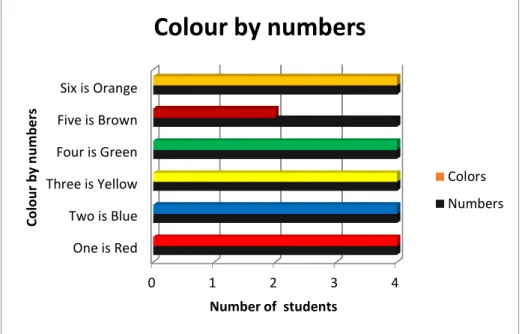
Graphic 1. Question number 1 of the diagnostic test
1. Listen and color.
Conclusions
According for the four students’ answers:
• The 100% that corresponds to four students, know the numbers until six
0 1 2 3 4
One is Red Two is Blue Three is Yellow Four is Green Five is Brown Six is Orange
Number of students
Co lo u r b y n u m b e rs
Colour by numbers
Colors
• The 100% corresponds to four students, know the colors: yellow, blue, red, orange and green.
• The 50% that corresponds to two student students, do not know the color brown.
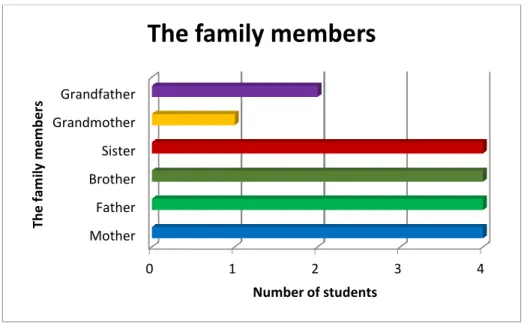
Graphic 2. Question number 2 of the diagnostic test
2. Circle the family members named in the song.
Conclusions
According for the four students’ answers:
• The 100% that corresponds to four students, recognize in the audio the members of the family: father, mother, brother and sister.
• The 50% that corresponds to two students, recognize in the audio the member of the family: Grandfather.
0 1 2 3 4
Mother Father Brother Sister Grandmother Grandfather
Number of students
Th e fam ily m e m b e rs
• The 25% that corresponds to a student, recognizes in the audio the member of the family: Grandmother.
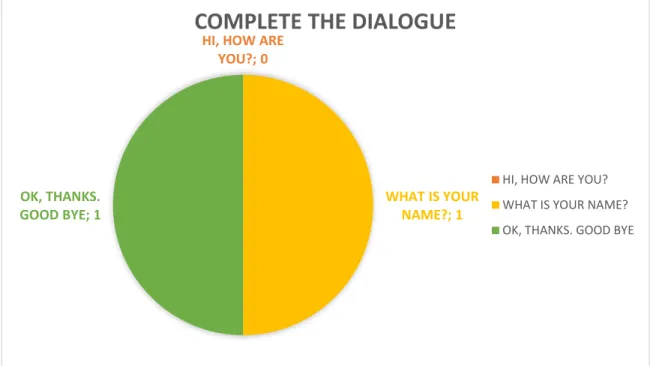
Graphic 3. Question number 3 of the diagnostic test
1. Look, listen and read. Complete the dialogue
Conclusions
According for the four students’ answers:
• 0% of students know how to answer the question How are you?
• 25% of the students answer the question What is your name? On the other part,
25% of the students translate the question into Spanish, then 25% answer the question in Spanish, finally 25% students do not know to answer this question.
HI, HOW ARE YOU?; 0
WHAT IS YOUR NAME?; 1 OK, THANKS.
GOOD BYE; 1
COMPLETE THE DIALOGUE
HI, HOW ARE YOU?
WHAT IS YOUR NAME?
• 75% of students translate Spanish to say goodbye to another, 25% of students answer the question with some grammatical mistakes.
Field diary one
Diagnostic test 1
The test is presented to the students of fourth grade, it is explained what their goal is and what they want to achieve with it. Students are nervous because they say they do not know any English.
During the development of the test, they look insecure and ask the teacher if what they do is okay or not. You are told them that it does not matter if they do not already know that the idea is to measure their knowledge and then teach them what is necessary.
On learning this, they calm down and continued with the test. In the first point of coloring according to the key, you could see that they understood most of the colors and knew the numbers up to 10 in English.
grandfather" so you could see that they knew the basic members of the family as they are: mother, father, sister and brother.
The difficulty of the students to understood the audio is observed so it is necessary to play it twice so that they understood what it says.
In the third and last point where the students had to complete the dialogue, I did not do it in its entirety, first they did not know the correct pronunciation of the words so when reading them they did not understand them and when they read them they did not do it correctly, they did not know to answer greetings in English and did not have the ability to follow a simple conversation, to know their name or how they are.
At the end of the test, the low level was observed they have in the language for the fourth grade that is with the children where the project is developed is observed.
Strategies
Videos
In this strategy, the students began the class observing a video that was about the subject of the day, then it repeated what it said and it was felt the content of the same one.
Guide 1: Greetings
Flash cards
The flash card strategy allowed students to observe the writing of words and practice pronunciation, as they had to do it several times until they did well, then asked in disorder and the students had to respond correctly.
Guide 4: Family
Games
The strategy of the games allowed students to develop communicative skills in addition to others. The idea was to make them speak in English and learn in a motivating way.
Guide 3: Basic conversation
Guide 8: Like and dislikes
Linguistic reproduction (LR)
With this strategy the students repeat the given vocabulary and perform sentences or repeat them to learn their pronunciation and writing.
Guide 4: Family
Language production (LP):
With this strategy, Student express their knowledge in oral and written form, following structures or models.
Guide 5: Describing people
Songs and directed games (SDG):
With this strategy student performed different games for the development of skills and learned simple songs on the topics to be discussed.
Guide 2: Basic conversation
Appropriate and meaningful short dialogues for the child's age (AMSDCA):
Students with this strategy create short dialogues, using questions and answers from their daily lives, understanding more what they say in English.
Final test
At the end of the project, a final test is done to know if the method and the strategies used allowed the learning of the students.
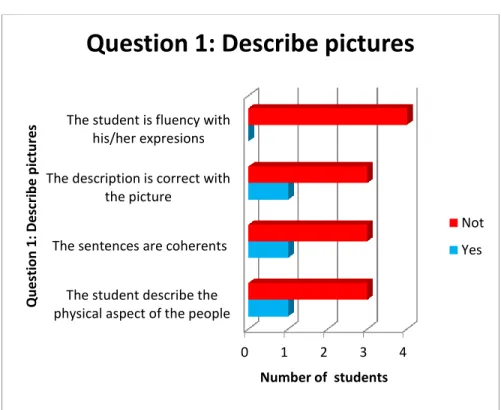
Graphic 4. Part 1. Question number 1 of the diagnostic test final
1. Choose one picture and describe the person
Conclusions
According for the four students’ answers:
• The 25% that corresponds to a student, describes the physical aspect of a person while the 75% that correspond to three students, do not describe the physical aspect of a person.
0 1 2 3 4
The student describe the physical aspect of the people The sentences are coherents The description is correct with
the picture
The student is fluency with his/her expresions
Number of students
Qu e sti o n 1: Desc ri b e p ic tu re s
Question 1: Describe pictures
Not
• The 25% that corresponds to a student, makes coherent sentences while the 75% that corresponds to three students do not make coherent sentences.
• The 25% that corresponds to a student, make a correct description according to the image while the 75% that corresponds to three students, do not make a correct description according to the image.
• The 100% that corresponds to four students, are not fluent with their expressions.
Graphic 5. Part 1. Question number 2 of the diagnostic test final
2. Describe yourself
Conclusions
According for the four students’ answers:
0 1 2 3 4
The description is correct The student describe his physical
aspect
The student is fluency with his/her expressions
Number of students
Qu e sti o n 2: Desc ri b e you rsel f
Question 2: Describe yourself
Not
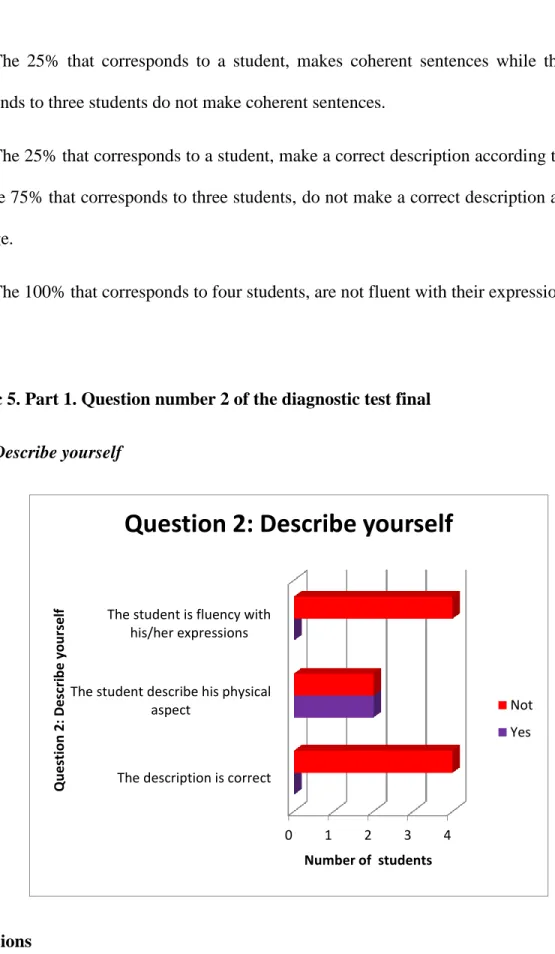
• The 100% that corresponds to four students, is not described yourself in the correct way.
• The 50% that corresponds to two students, describe their physical aspect, by other part, the 50% of the students, not describe their physical aspect.
• The 100% that corresponds to four students, are not fluent with their expressions.
Graphic 6. Part 1. Question number 3 of the diagnostic test final
3. Who is this person?- What is her/his name? - Describe two members of his family
Conclusions
According for the four students’ answers:
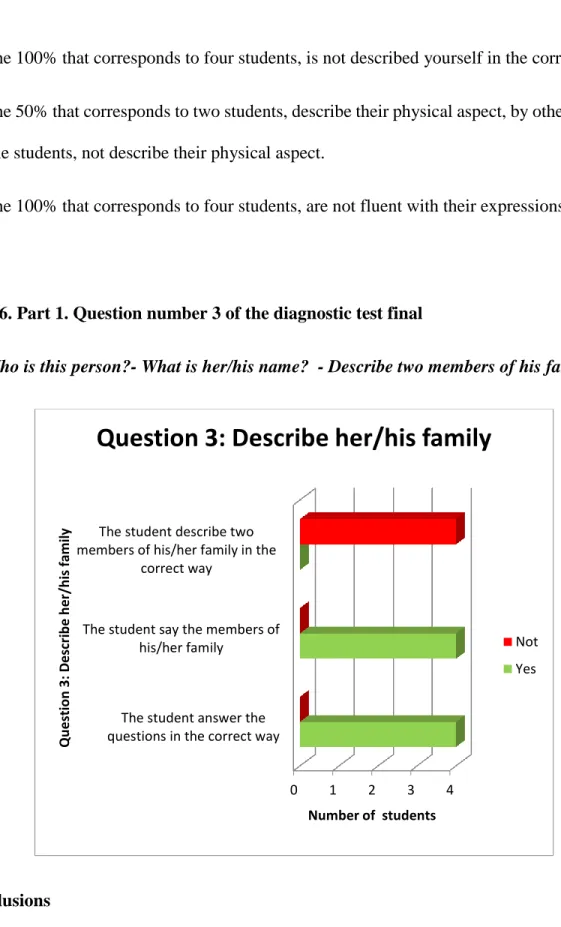
The 100% that corresponds to four students, answer the questions in the correct way.
0 1 2 3 4
The student answer the questions in the correct way The student say the members of
his/her family The student describe two members of his/her family in the
correct way
Number of students
Qu e sti o n 3: Desc ri b e h e r/ h is fam ily
Question 3: Describe her/his family
Not
The 100% that corresponds to four students, say the members of his family.
The 100% that corresponds to four students, do not describe the two members of their family in the correct way.
Graphic 7. Part 2. Question number 1 of the diagnostic test final
1. Choose the place and create the dialogue with other person.
Conclusions
According for the four students’ answers:
0 1 2 3 4
The students greet in the correct way The students ask simple
questions The students are fluency with
their expressions The students talk about the
correct topic The dialogue is coherent
Number of students
Qu e sti o n 3: Di al o gu e
Question 3: Dialogue
Not
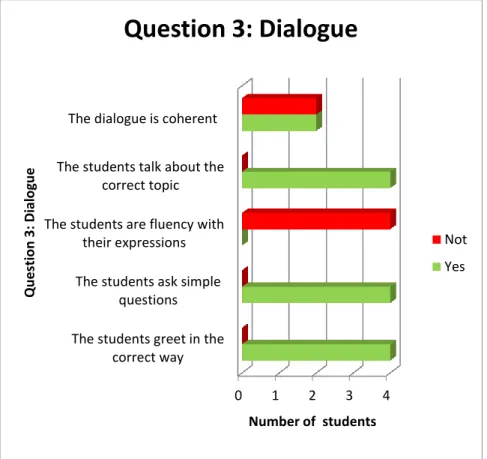
• The 100% that corresponds to four students, greet in the correct way and ask simple questions.
• The 100% that corresponds to four students, are not fluent with their expressions and speak of the topic in the correct way.
• The 50% that corresponds to two students, are coherent with their dialogue, by the other part, the 50% that corresponds to two students, are not coherent with their dialogue.
Graphic 8. Part 3. Question number 1 of the diagnostic test final
1. Color the face (yellow-happy or red-sad)
0 1 2 3 4
Te gusta el inglés Es fácil aprender inglés Es llamativo el inglés Es interesante Entiendes inglés Las actividades fueron claras Te gustaron las actividades
desarrolladas en clase
Number of students
Qu e sti o n 1: C o lo r th e fac e
Question 1: Color the face
Sad
Conclusions
According for the four students’ answers
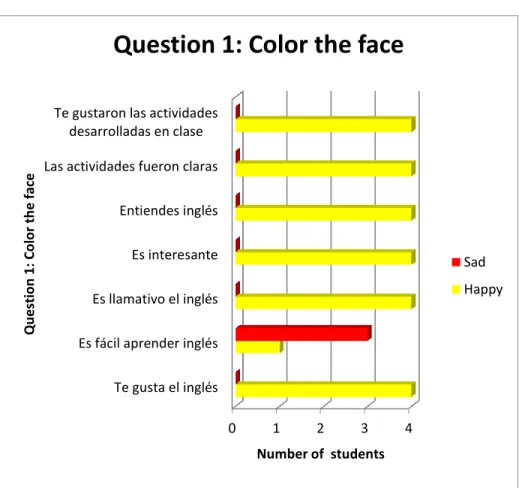
• The 100% that corresponds to four students, say that they like English.
• The 25% that corresponds to a student, says that it is easy to learn English, by other part, the 75% that corresponds to three students, say that it is not easy to learn English.
• The 100% that corresponds to four students, say that the English is appealing, say that English is interesting, say that they understand English, say the activities were clear and say that they liked the activities developed in class.
Part 3. Question number 2 of the diagnostic test final
1. Answer the questions
The students were asked five questions, to know their opinion about what was learned and done in the classes, the importance of continuing to learn, giving information to their families and knowing what they thought motivating classes.
Field diary two
Diagnostic test 2 (final)
Students are talked about the purpose of this test, they understood it and started the development of the activity. I noticed that the students were a bit nervous and more nervous because they were being recorded.
On the first part each one chose an image to describe it according to their comfort, during the development of this activity the students showed to be nervousness and the majority do not describe the images that selected, give sentences without sense and they mention words of the vocabulary that they were taught, only one student describes the image with one or two meaningful sentences.
On the second part, where they had to describe themselves, they made mostly meaningless sentences and the description was not understandable, two students managed to describe themselves not in their totality, but if with one or two sentences that made sense, others, on the other hand, could not talk because they felt nervous.
family, then they had to describe them, in this part they tried of describing them, two of them with difficulty, since they said the sentences, but in Spanish or they said incoherent words also mentioned loose vocabulary. On the other hand, the other two students were more consistent with their expressions and gave one or several descriptions of their relatives.
In part two of the test the students chose a place and according to it they did a dialogue with a partner, group one, the students were fluent and coherent with what they were asked, one of them with a little difficulty, the others more spontaneous, it was understood, the dialogue was short.
The second group, spoke little and was not coherent somewhere since they were asked questions and did not respond, but they were mostly understood. They tried to make several sentences with coherence and to use the vocabulary seen in the classes.
In this last part, the students made it known what they liked and what they did not like about all classes, they said that they liked to learn English but that it seemed difficult because they read one way and write another.
In conclusion, Students, in spite of being nervous, tried to make coherent sentences to express what they wanted to say or describe, even if they did not do it coherently, at least they tried to speak.
I can be observed between the first evaluation, of the classes and this final test, the form of expressing itself in terms of sentences or words that the children said, since they did not respond nor greet, they did not pronounce any word.
In this test, it can observe this, they answered simple questions, and talked about them and others, they made a short conversation, among other skills that were developed as a result of this project.
Discussion
This project is a good tool to teach students a new language, as it allows them to be able to take roles in their learning process and are more aware of learning, in addition to being motivated with the strategies used during their development.
The expectations that I had on this project were reached, since at the beginning students did not feel the ability and also did not have the knowledge to express a word or sentence in English, and at the end of this project in such a short time they learned to greet and try to express themselves in English is very satisfying and proves as evidence that the method is good and helps to teach a foreign language.
The results given in the project, allows teachers to rethink the way of teaching, as it is easier to approach knowledge with strategies and methods striking for students, and is a motivating way for them.
this method allows to be flexible with the learning and to transversalize in the same, being accessible for all the teachers.
Conclusions and recommendations
At the beginning of the project, the students did not feel motivated to learn English, since their classes had been monotonous and boring, besides they did not have much knowledge about the English language, and the little that they had presented pronunciations in the writing of the same.
During the development of the project, students were motivated and saw the ease of learning English, because its context is very difficult to practice outside of class, so learning is limited in what is done in the classroom, so both must be dynamic and motivating for them.
At the end of the project, it can be seen the great change of the students, as they try to speak in English and communicate between them, also learned more vocabulary, which allows them to speak with more confidence and confidence.
The students present shortcomings in the pronunciation of words, this is because of their way of speaking, although this practice helps to improve it, students also have the ability to understand sentences or short texts when reading, so if it is clear that the method works.
they learn are aware of what is necessary as another language and how easy it can be to speak or write.
In this case, students learned to develop communicative skills, focusing on speaking correctly.
This project can be the basis for teaching English from the smallest degrees, so as a recommendation it can be said that it would be very good to apply it from preschool to higher grades, being constant in the themes and supporting the writing part, since in this project only the oral part is worked.
References
Anne-Marie Truscott de Mejía, Claudia Lucia Ordoñez, Laura Fonseca. (2006). Lineamientos para la educación bilingue en Colombia: hacía una politica coherente. Informe de investigación estudio investigativo sobre el estado actual de la educación bilingüe (inglés-español) en Colombia. Centro de Investigación y Formación en Educación Universidad de los Andes Bogotá. Recuperado de http://www.colombiaaprende.edu.co/html/productos/1685/articles-266111_archivo_1.pdf
Brown, D. (2000) Principles of Language Learning and teaching. Fourth New York: Longman en
Palacios, J., Marchesi, A. y C. Coll (1999) Desarrollo Psicológico y Educación. México: Alianza.
Brunner, Jerome S, (1960) El aprendizaje por descubrimiento. [en línea]. Recuperado de www.viu.es/el-aprendizaje-por-descubrimiento-de-bruner
Carlos Guanoquiza, (2013) [en línea] the role play as a teaching - learning strategy for enhancing
Cohn, Marvin. (2013). Helping Your Teen-age Student: What Parents Can Do to Improve
Reading and Study Skills. Dutton. ISBN 978-05-2593-065-5.
Clemente Rodríguez Sabiote, Miguel Ángel Gallardo Vigil, Teresa Pozo Lorente y José Gutiérrez Pérez. Iniciación al análisis de datos cuantitativos en educación. teoría y práctica mediante spss
del análisis descriptivo básico. Recuperado de
Http://www.ugr.es/~erivera/PaginaDocencia/Posgrado/Documentos/ClementeCuadernoDescri ptiva.pdf
Desarrollo Cognoscitivo: Las teorías de Piaget y de Vigotsky. 1973. Recuperado de
http://brayebran.aprenderapensar.net/files/2010/10/MARTINEZ_InvAccionenelAulapag27_3 9.pdf
Donough, M. y Shaw, C. (1993) Listening Skills. In Chrystal, D y K. Johnson (ed) Materials and Methods in ELT. Cambridge USA.
DR. Felder, Role-playing technique, (2009) [en línea] recuperado de:
Escuela de la educación, Research Project, unit 1, unit 2, recuperado de: http://knowledgeportal.pakteacher.org
FRANCO, (2014) tesis de investigación. [Blog internet] Venezuela. Recuperado de
http://tesisdeinvestig.blogspot.com.co/2011/11/tipos-de-investigacion-segun-ander-egg.html
García, A. (2008). Aprender a Aprender. Estrategias para Activar el Pensamiento. Cambridge:
Cambridge University Press.
Harni, A. (2007). Using role play in teaching speaking. A Pre-Experimental Study at Islamic Junior High School Soebono Mantofani Jombang-Ciputat.
Julián Pérez Porto y Ana Gardey. (2009). Definicion.de: Definición de video. Recuperado de https://definicion.de/video/
Ladousse, G. (1995). Role play. Resources Book for the Teacher Series. New York. Oxford University Press.
Lewin, Kurt, (1946) La Investigación-acción participativa Capítulo 1 (pp. 15-26) España: Editorial Popular.
Louis Cohen., Lawrence Manion., Keith Morrison. Research Method in Education, Sixth Edition.
Luis Gerardo Meza Cascante, (2000), El paradigma positivista y la concepción dialéctica del
conocimiento, M.B.A., [en línea] Escuela de Matemática, Instituto Tecnológico de Costa Rica, recuperado de
https://tecdigital.tec.ac.cr/revistamatematica/ContribucionesV4n22003/meza/pag1.html
Mark Chesler and Robert Fox. (1966). Teacher resource booklets on classroom social relations and learning. Role.playing methods in the classroom. Science Research Associates, Inc. Chicago.
Olusegun Agboola Sogunro, (2004) "Efficacy of role‐playing pedagogy in training leaders: some reflections", Journal of Management Development, Vol. 23 Issue: 4, pp.355-371, Recuperado de https://doi.org/10.1108/02621710410529802
Quantitative research book materials and links. Go to Research Methods, Design, and Analysis textbook website (under the Website Gallery section). Recuperado de http://www.pearsonhighered.com/educator/product/Research-
Robert A. Denemark. (2010). The international studies enciclopedia. Designing and using simulations and role-playing exercises. eISBN: 9781444336597
Role-playing technique, A.A. (2010) [en línea], recuperado de
http://es.slideshare.net/sabbyval/tcnica-del-role-playing
Shawna Shapiro and Lisa Leopold. (2012). Perspectives: a critical role for role-playing pedagogy.
Tesl canada journal/revue tesl du canada. Vol. 29, No 2.
Solis Mariana, (2012) Facultad de diseño y comunicación y diseño, Role-playing como