
The effect of ring size variation on the structure and stability of lanthanide(III)
complexes with crown ethers containing picolinate pendants
†Adrián Roca-Sabio, Marta Mato-Iglesias, David Esteban-Gómez, Andrés de Blas, Teresa
Rodríguez-Blas and Carlos Platas-Iglesias
Departamento de Química Fundamental, Universidade da Coruña, Campus da Zapateira-Rúa da Fraga 10, 15008 A, Coruña, Spain
Dalton Transactions Volume 40, Issue 2, pages 384–392, 14 January 2011
Received 29 June 2010, Accepted 06 October 2010, First published 29 November 2010
How to cite:
The effect of ring size variation on the structure and stability of lanthanide(III) complexes with crown ethers containing picolinate pendants.A. Roca-Sabio, M. Mato-Iglesias, D. Esteban-Gómez, A. de Blas, T. Rodríguez-Blas and C. Platas-Iglesias, Dalt. Trans., 2011, 40, 384–392. DOI: 10.1039/C0DT00746C .
Abstract
The coordination properties of the macrocyclic receptor N,N
′-bis[(6-carboxy-2-pyridyl)methylene]-1,10-diaza-15-crown-5 (H2bp15c5) towards the lanthanide ions are reported. Thermodynamic stability constants
were determined by pH-potentiometric titration at 25 °C in 0.1 M KCl. A smooth decrease in complex detailed conformational analysis performed with the aid of DFT calculations (B3LYP model) indicates that the complexes adopt a Λ(λδ)(δδλ) [or Δ(δλ)(λλδ)] conformation in aqueous solution. Our calculations show that the interaction between the LnIII ion and several donor atoms of the crown moiety is weakened as the ionic radius of the metal ion decreases, in line with the decrease of complex stability observed on proceeding to the right across the lanthanide series.
Keywords: picolinate ligands; crystal structures; lanthanide complexes; crown ethers; stability in solution
Introduction
difficult.3 Thus, the design of systems that can selectively recognize a given LnIII ion, or at least a particular group of them, remains a challenging task for coordination chemistry.4 As far as coordination chemistry in aqueous solution is concerned, the LnIII ions are dominated by their oxophilicity,5 as well as by their tendency to adopt high coordination numbers (typically 8 or 9).6 As a result, stable LnIII complexation in aqueous solution is normally achieved by using octa- or nona-dentate ligands containing negatively charged oxygen donors such as carboxylates or phosphonates.7 Besides negatively charged oxygen groups, these ligands often contain N-donor atoms such as amine or pyridine nitrogen atomsthat contribute to form stable complexes in aqueous solutions. For instance, several macrocyclic receptors containing pyridine units either within the macrocyclic framework8 or as pendant arms9 have been shown to provide stable LnIII complexation inwater. Furthermore, polydentate ligands containing picolinate groups also form stable complexes with the LnIII ions inwater.10,11
The stability trends for LnIII complexes in aqueous solution usually fall within one of the following categories: (i) In the most common case, the stability constants increase across the lanthanide series from LaIII to LuIII, as expected on the basis of the simple electrostatic interaction between the metal ion and the donor atoms of the ligand;12 (ii) For a second group of ligandsthe stability of the corresponding LnIII complexes increases across the series, reaches a plateau, and then declines;13,14 (iii) The third class of ligands includes a few macrocycles such as ba18c6 (Scheme 1), for which the stability decreases along the lanthanide series.15 However, independently of the stability trend, most of the ligands provide limited discrimination along the lanthanide series, except for a few cases where an important selectivity was found for the heavier lanthanides.16
Scheme 1. Ligands discussed in the present work.
metal ions; (ii) the use of ring size variation to maximize the thermodynamic stability of the complex by matching the radius of the metal ion and the hole size of the macrocyclic moiety (the hole-size effect); and (iii) the introduction of adequate pendant arms to improve the selectivity for a particular metal ion with respect to the parent macrocycle. The match between these structural properties of the ligand and the coordination properties of the metal ion usually determines the stability of the corresponding complex.
In a recent paper we reported the complexation properties towards the LnIII ions of the macrocyclic receptor containing picolinate pendant arms bp18c6 (Scheme 1).21 This receptor shows an unprecedented selectivity for the large LnIII ions. The LaIIIand CeIII complexes show the highest log KML values among the different
LnIII ions, with a dramatic drop of the stability being observed from CeIII to LuIII as the ionic radius of the LnIII ions decreases (log KCeL − log KLuL = 6.9). This drop in the log KML values is six orders of magnitude
higher than that observed for ba18c6 (1.4). In the [Ln(bp18c6)]+ complexes the metal ion is directly bound to the ten donor atoms of the bp18c6 ligand, but the interaction between the LnIII ion and several donor atoms of the crown moiety is weakened as the ionic radius of the metal ion decreases. Instead, the stability of the LnIII complexes of bp12c4 increases across the lanthanide series, reaches a plateau close to the middle of the series, and then slightly decreases for the smallest lanthanides.22 In the [Ln(bp12c4)]+ complexes the metal ion is directly bound to the eight donor atoms of the ligand. The lower denticity of bp12c4 in comparison to bp18c6 allows the additional coordination of water molecules to the metal ions. Indeed, the hydration numbers obtained from luminescence lifetime measurements in aqueous solution of the EuIII and TbIII complexes suggest an equilibrium between a dihydrated (q = 2), ten-coordinate and a monohydrated (q = 1), nine-coordinate species.23
As a continuation of our previous work, herein we report the complexation properties towards the LnIII ions of the macrocyclic ligand N,N′-Bis[(6-carboxy-2-pyridyl)methylene]-1,10-diaza-15-crown-5 (H2bp15c5,
Scheme 1). The aim of this work is to evaluate the effect that macrocyclic ring size variation has on the stability and structure in solution of the LnIIIcomplexes with the series of ligands bp12c4, bp15c5 and bp18c6. Thermodynamic stability constants of the LnIII complexes of bp15c5 have been determined by pH potentiometry. Aiming to rationalize the stability trend observed across the lanthanide series the structure of the LnIII complexes was studied by using 1H and 13C NMR techniques in D2O solution. Luminescence
lifetime measurements on the EuIII and TbIII complexes have been carried out to determine the hydration number of the complexes in solution. In addition, the complexes were characterized by density functional theory (DFT) calculations carried out at the B3LYP level.
Results and discussion
Ligand protonation constants and stability constants of the metal complexes
The protonation constants of bp15c5 as well as the stability constants of its metal complexes formed with CaII and several LnIIIions were determined by potentiometric titration in 0.1 M KCl; the constants and standard deviations are given in Table 1, which also lists the protonation and stability constants reported for the related systems bp12c4,22bp18c6,21ba15c524 and ba18c615(Scheme 1). The protonation constants reported in Table 1 for bp15c5 (8.34, 6.85 and 3.05, I = 0.1 M KCl) differ significantly from the values measured at I = 0.1 M KNO3 (8.21, 7.19, 3.43 and 2.53),
25
which most likely reflects a different ability of the two anions to bind protonated forms of the ligand.26 The ligand protonation constants are defined as in eqn (1), and the stability constants of the metal complexes are expressed in eqn (2):
𝐾
𝑖=
[H𝑖L]𝐾
ML=
[M][L][ML] (2)In comparison to the bisacetate derivative of the same macrocycle (ba15c5, Scheme 1), bp15c5 has lower protonation constants for the first and second protonation steps, which occur on the amine nitrogen atoms. This is in line with previous investigations, which showed that the replacement of the carboxylate groups of edta by pyridinecarboxylate units leads to a decrease in the basicity of the two amine nitrogen atoms.27,28 The basicity of the amine nitrogen atoms varies in the following order: bp12c4 > bp15c5 > bp18c6. Thus, the basicity of the pivotal nitrogen atoms decreases as the size of the crown moiety increases, in agreement with the trend observed for the bisacetate derivatives ba15c5 and ba18c6. The third protonation process in bp15c5 is attributed to the protonation of the pyridylcarboxylate groups.29,30
Table 1. Ligand protonation constants and thermodynamic stability constants of bp15c5 and its metal complexes as determined by pH-potentiometry [I = 0.1 M KCl]. Data reported previously for related ligands are provided for
comparison.
Potentiometric titrations of H2bp15c5 have been carried out in the presence of equimolar Ln III
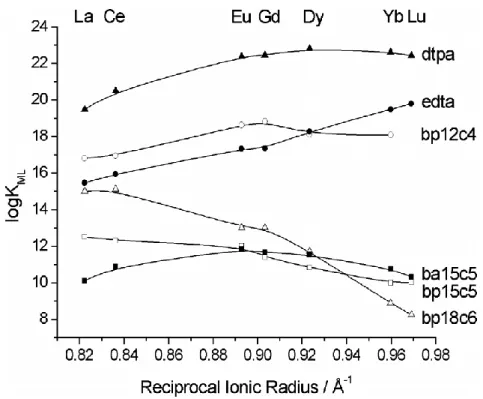
and CaII ions in order to determine the stability constants of the corresponding metal complexes (Table 1). The variation of the stability constants across the lanthanide series for the complexes of bp15c5 is compared to those of bp12c4 and bp18c6 in Fig. 1. The bp15c5 complex of LaIII shows the highest log KML value among the
different LnIII ions, with a smooth drop of the stability being observed from LaIIIto LuIII as the ionic radius of the LnIII ions decreases. The opposite trend is observed for most classical polydentate acyclic and macrocyclic ligands in aqueous solution, whose stability constants with LnIII ions increase from LaIII to LuIII due to the increasing charge density of the metal ions. The trend observed for bp15c5 is also different to that observed for ba15c5, for which the stability constants increase across the series for the large LnIII ions, reach a maximum close to the centre of the series, and then decline (Table 1, Fig. 1). The stability constants observed for bp15c5 complexes follow a trend that is similar to that reported for bp18c6.21 However, the stability drop observed for bp15c5 complexes (Δlog KML = log KLaL − log KLuL = 2.5) is less important than
complexes of bp18c6 are more stable than the bp15c5 counterparts for the large LnIII ions, while for the heaviest lanthanides the complexes of bp15c5 become slightly more stable than those derived from the large crown moiety. However, the ligand containing the smallest crown moiety fragment, bp12c4, forms complexes that are more stable than the bp15c5 and bp18c6 analogues along the whole lanthanide series (Fig. 1). It is rather obvious that among this series of ligands the 12-membered macrocyclic ring of bp12c4 provides the best fit with the LnIII ions. The complexes of bp12c4 are more stable than the edta31 counterparts for the large LnIII ions, while this situation is reversed close to the end of the lanthanide series. This is a consequence of the different stability trends of edta and bp12c4 complexes along the series. Indeed, LnIII -edta complexes represent a classical example for which the stability is increasing along the lanthanide series, while the bp12c4 counterparts show a stability trend similar to that observed for dtpa31 complexes (Fig. 1). A comparison of the stability constants obtained for bp15c5 and bp18c6 complexes with those reported for the corresponding bisacetate derivatives shows that the replacement of the carboxylate groups of ba15c5 and ba18c6 by pyridinecarboxylate units leads to an increased stability of the complexes with the large LnIII ions (see data for bp15c5 and ba15c5 in Fig. 1).
Fig. 1. Variation of the stability constants (log KML values, I = 0.1 M KCl, 25 °C) across the lanthanide series for
bp15c5 complexes and related systems. The solid lines are simply a guide for the eye. Ionic radii were taken from reference 2 assuming coordination number 9.
Photophysical properties
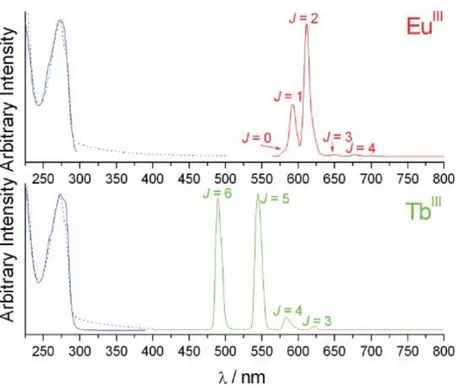
The absorption spectra of the [Ln(bp15c5)]+ complexes (Ln = Eu or Tb) are dominated by a weak absorption band at ca. 273 nm typical of the picolinate chromophore (Fig. 2, see also Table 2).33 The emission spectra of both complexes recorded under excitation through the ligand bands show the typical narrow transitions characteristic of the corresponding metal ion as a consequence of ligand-to-metal energy transfer.34 In the case of the EuIII complex the 5D0 →
7
FJ transitions are observed around 580 (J = 0), 593 (J = 1), 612 (J = 2),
652 (J = 3) and 678 nm (J = 4). For the TbIII analogue the typical 5D4 → 7
FJ are observed around 623 (J = 3),
most intense emission band of the lanthanide cations (5D0 → 7
F2 at 612 nm for Eu III
and 5D4 → 7
F5 at 545 nm
for TbIII) afforded a perfect match with the corresponding absorption spectra, thereby unambiguously confirming the antenna effect.33 The absolute quantum yields of the metal centred luminescence amount to 0.13 (EuIII) and 2.5% (TbIII). These data show that picolinate units of bp15c5 allow relatively efficient sensitization of the TbIII luminescence as a result of an efficient ligand-to-metal energy transfer and effective shielding of the metal ion from radiationless deactivation (see below). The quantum yield observed for the EuIII complex is considerably lower than that determined for the TbIII analogue, as usually observed for LnIIIcomplexes containing picolinate units.11 The quantum yields determined for the EuIII and TbIII complexes of bp15c5 are however considerably lower than those reported for the corresponding tri(dipicolinates), which amount to 24% (EuIII) and 22% (TbIII).35
Table 2. Spectroscopic properties of the EuIII and TbIII complexes of bp15c5.
[Eu(bp15c5)]+ [Tb(bp15c5)]+
λmax/nm (ε/M−1 cm−1)[a] 273 (4200) 273 (5500)
τ (H2O)/ms 0.924(2) 2.50(1)
τ (D2O)/ms 1.474(2) 2.99(1)
Δkobs 0.404 0.07
Φ(H2O) (%)a 0.13 2.5
q 0.2b 0.1c
0.1d
a Absolute quantum yields measured relative toquinine sulfate in diluted acidic solution (absolute quantum yield: 0.546).32b eqn (3). c eqn (4). d eqn (5).
The number of inner sphere water molecules (q) can be determined by using luminescence lifetime measurements on solutions of EuIII or TbIII complexes in H2O and D2O.
36,37
This method is based on the fact that O–H oscillators of coordinated water molecules quench the LnIII excited state more efficiently than O–D oscillators of D2O. Considering that the most common coordination numbers for Ln
III
complex.23Therefore, the presence of one inner-sphere water molecule for the [Ln(bp15c5)]+ complexes should be considered. in 10−5 M D2O and H2O solutions of the complexes, and used to calculate the number of coordinated water
molecules q according to the method proposed by Parker and co. [eqn (3) and (4)]:40
𝑞
Eu= 1.2(Δ𝑘
obs− 0.25)
(3)𝑞
Tb= 5.0(Δ𝑘
obs− 0.06)
(4)In these equations Δkobs = kobs(H2O) − kobs(D2O) and kobs = 1/τobs. These calculations provide q values of 0.2
(EuIII) and 0.1 (TbIII). The use of the expression proposed by Horrocks et al.41 for EuIII complexes [eqn (5)] provides a similar result (Table 2), with an estimated uncertainty for q of ±0.1.
𝑞
Eu= 1.11(Δ𝑘
obs− 0.31)
(5)These results indicate the absence of inner-sphere water molecules in the [Ln(bp15c5)]+ complexes, which probably results in nine-coordinate complexes.
1
H and 13C NMR spectra
The 1H and 13C NMR spectra of the diamagnetic [Ln(bp15c5)]+ complexes (Ln = La or Lu) were recorded in D2O solution at pD = 7.0 (Fig. 3). The spectra of both complexes are very similar, suggesting that they adopt
similar structures in aqueous solution (Fig. S1, ESI†). The spectra of the LaIII
analogue were assigned with the aid of HSQC and HMBC 2D heteronuclear experiments as well as standard 2D homonuclear COSY and NOESY experiments (Table 3). The two picolinate pendant arms are magnetically non-equivalent, which results in a C1 symmetry of the complex in solution. This is confirmed by the
13
coordination of the crown moiety is slow in the NMR time-scale, pointing to a relatively rigid structure of the crown moiety in solution. This is compatible with a nonadentate binding of the macrocyclic ligand to the LnIII ions.
Table 3.1H and 13C NMR Shifts (ppm with respect to TMS) of [La(bp15c5)]+ recorded in D2O solution (pD = 7.0) at
298 K. See Scheme 2 for labellinga.
H3 8.03 H13ax 3.68 C1 173.3 C16 68.9
H4 8.14 H13eq 2.91 C2 150.6 C17 55.1
H5 7.70 H14ax 3.45 C3 123.8 C18 63.4
H7a 3.97 H14eq 2.61 C4 140.8 C19 158.6
H7b 4.52 H15ax 3.70 C5 125.8 C20 124.6
H8ax 2.72 H15eq 3.45 C6 157.7 C21 141.1
H8eq 3.12 H16ax 3.96 C7 64.2 C22 123.5
H9ax 3.74 H16eq 3.13 C8 54.4 C23 149.1
H9eq 3.21 H17ax 2.74 C9 71.2 C24 173.1
H10ax 3.60 H17eq 2.74 C10 69.6
H10eq 3.91 H18a 4.16 C11 69.6
H11ax 3.81 H18b 4.40 C12 68.1
H11eq 4.18 H20 7.73 C13 55.8
H12ax 4.15 H21 8.13 C14 53.0
H12eq 4.15 H22 8.07 C15 68.8
a2J18a–18b = 16.8 Hz; 2J7a–7b = 15.4 Hz.
Fig. 3.1H NMR spectrum (500 MHz) of [La(bp15c5)]+ recorded in D2O solution (pD = 7.0) at 298 K. The asterisk
The specific CH2 proton assignments of the axial and equatorial H7–H18 protons were not possible on the
basis of the 2D NMR spectra. However, it is known from previous 1H NMR studies on LnIII complexes with macrocyclic ligands that the ring axial protons experience strong coupling with the geminal protons and the vicinal axial protons, while the equatorial protons provide strong coupling with the germinal protons only.43 Indeed, the 3JH–H coupling constants characterising the coupling between vicinal pairs of protons (axial–axial,
axial–equatorial and equatorial–equatorial) follow the Karplus equation [3JH–H = 7-cosϕ+5cos2ϕ,
where ϕ represents the H–C–C–H dihedral angle].44 According to our DFT calculations (see below), the ϕ values involving axial–axial vicinal protons are close to 180° (171–178°), while the dihedral angles defined by axial–equatorial and equatorial–equatorial vicinal protons fall within the range 43–77°. Thus, the specific assignment of the axial and equatorial protons could be achieved in some cases by observing the coupling pattern of the proton signals. For instance, the signals due to protons H14 and H13 observed at 2.61 and 2.91 ppm (Fig. 3), could be assigned to equatorial protons, as the spin coupling pattern is dominated by a 2JH–H of 12–13 Hz, the
3
JH–H values being substantially smaller (< 4 Hz). In other cases the assignments of
the equatorial and axial protons could be achieved by observing the cross-peaks in the COSY spectra, as axial protons are expected to give two strong cross-peaks (geminal and axial–axial), whereas equatorial protons should show one strong (geminal) and two weak (equatorial–equatorial and equatorial– axial) cross-peaks.
The 1H NMR spectra of the paramagnetic CeIII, EuIII and YbIII complexes were also obtained in D2O solution.
The protonspectra consist of 30 signals, which again points to a C1 symmetry of the complexes in solution
(Fig. 4). The binding of a ligandto a paramagnetic LnIII ion generally results in large NMR frequency shifts at the ligand nuclei, with magnitudes and signs depending critically on both the nature of the lanthanide ion and the location of the nucleus relative to the metal centre.45 This is indeed the case of the paramagnetic [Ln(bp15c5)]+ complexes (Fig. 4), for which the 1H NMR signals are observed in the range 16 to −8 (CeIII), 19 to −18 (EuIII) and 70 to −45 ppm (YbIII
). The 24 1H NMR signals due to protons 7–18 (Scheme 2) can be grouped into two different sets according to their relative line broadening, 12 resonances being appreciably sharper than the remaining ones (Fig. 4). These two sets of signals correspond to two sets of LnIII-proton distances, the broader resonances being associated to the axial protons, which are closer to the metal ion.46 Unfortunately, an assignment of the spectra was not possible due to the large number of proton signals and the low symmetry of the complex. However, the spectra confirm a nonadentate coordination of the ligand to the metal ions in aqueous solution.
Fig. 4.1H NMR spectra (300 MHz) of [Ln(bp15c5)]+ complexes (Ln = Ce, Eu or Yb) recorded in D2O solution
(pD = 7.0) at 298 K.
DFT calculations
Aiming to obtain information about the structure in solution of the [Ln(bp15c5)]+ complexes we have performed DFT calculations based on the B3LYP model. On the grounds of our previous experience,47,48 in these calculations we have used the effective core potential (ECP) of Dolg et al.49 and the related [5s4p3d]-GTO valence basis set for the lanthanides, while the remaining atoms were described by using the 6-31G(d) basis set. This ECP includes 46+4fn electrons in the core, leaving the outermost 11 electrons to be treated explicitly.
The minimum energy conformation obtained from our calculations for all LnIII ions investigated corresponds to the Λ(λδ)(δδλ) form (Fig. 5). A second diastereoisomeric form, Λ(λδ)(δλλ), is close in energy to the former one, particularly for the large lanthanides; the energy difference between these two forms amounts only to 0.85 kJ mol−1 for LaIII, and it increases to 4.10 kJ mol−1 for LuIII. The remaining conformations investigated show high relative energies with respect to the minimum energy conformation (8.3–37.8 kJ mol−1). The relative energies of most of conformations investigated show a smooth change along the lanthanide series from LaIII to LuIII. However, two conformations [Λ(δδ)(δδδ) and Λ(λδ)(δδδ), Fig. 5] show an abrupt destabilization upon decreasing the ionic radius of the LnIII ion from EuIII to HoIII, and then become more stable for LuIII. This abrupt change in the energetic trend from EuIII to HoIII is due to the decoordination of one of the oxygen atoms of the crown moiety [O(5), Fig. 6], leading to eight-coordinate complexes. This result is in line with a better fit of the crown moiety size of the ligand and the large LnIII ions.
Fig. 5. C-PCM relative free energies of different diasterisomeric forms of [Ln(bp15c5)]+ complexes (Ln = La, Eu, Ho or Lu) in aqueous solution.
In a recent paper we have shown that our computational procedure provides relative free energies of LnIII DOTA-like complexes that deviate from the experimental values by 0.8–4.6 kJ mol−1.48 Furthermore, a single species in solution is observed in the NMR spectra of the [Ln(bp15c5)]+ complexes (Ln = La, Ce, Eu, Yb or Lu). Thus, we may conclude that most likely the [Ln(bp15c5)]+ complexes adopt a Λ(λδ)(δδλ) conformation in aqueous solution.
Table 4 shows the bond distances of the metal coordination environment calculated for the Λ(λδ)(δδλ) conformation of [Ln(bp15c5)]+ complexes, while the optimized geometry of the GdIII complex is shown in Fig. 6. Most of the distances between the LnIII ions and the donor atoms of the ligand decrease along the lanthanide series, as usually observed for LnIII complexes as a consequence of the lanthanide contraction.1 However, the distances between the LnIII ion and two of the oxygen atoms of the crown moiety [O(4) and O(5)] follow a different trend. Indeed, these distances decrease along the series from LaIII to GdIII, and then increase for the smaller HoIII and LuIII ions. Thus, the interaction between the LnIII ion and several of the donor atoms of bp15c5 is weakened as the ionic radius of the metal ion decreases. These results clearly indicate a better match between the binding sites offered by the ligand structure and the binding sites required by large LnIII ions, which results in a drop of the complex stability upon decreasing the ionic radius of the metal ion.
In a previous paper we have reported the X-ray single structure of the [Cd(bp15c5)] complex,25 where the metal ion is seven-coordinate. Interestingly, in [Cd(bp15c5)] the two donor atoms of the ligand that remain uncoordinated correspond to those for which a lengthening of the Ln-donor distances is predicted by our DFT calculations [O(4) and O(5)]. Thus, the lengthening of the distances between the metal ion and these donor atoms appears to be a general strategy adopted by bp15c5 to accommodate small metal ions.
Table 4. Bond distances [Å] of the metal coordination environments obtained for the Λ(λδ)(δδλ) conformation of [Ln(bp15c5)]+complexes at the B3LYP/6-31G(d) levela.
a Geometry optimizations were performed in the gas-phase. See Fig. 6 for labelling.
Conclusions
around the middle of the lanthanide series. The drop of stability in [Ln(bp15c5)]+ complexes upon decreasing the ionic radius of the metal ion is attributed to the better match between the binding sites offered by the ligand structure and the binding sites required by large LnIII ions.
Experimental section
Solvents and starting materials
N,N′-Bis[(6-carboxy-2-pyridyl)methylene]-1,10-diaza-15-crown-5 (H2bp15c5) was prepared as previously
reported by us.25 All other chemicals were purchased from commercial sources and used without two-dimensional NOESY, COSY, HMQC, and HMBCexperiments. Electronic spectra in the UV-Vis range were recorded at 25 °C on a Perkin–Elmer Lambda 900 UV-Visspectrophotometer using 1.0 cm quartz cells. Excitation and emission spectra were recorded on a Perkin–Elmer LS-50Bspectrometer. Luminescence lifetimes were calculated from the monoexponential fitting of the average decay data, and they are averages of at least 3–5 independent determinations. Quantum yields of the metal centred luminescence were measured relative to quinine sulfate in diluted acidic solution (absolute quantum yield: 0.546).32
Potentiometric measurements
The stock solutions of LnCl3 were prepared from LnCl3·xH2O. The concentration of the solutions was
determined by complexometric titration with a standardized Na2H2EDTA solution (H4EDTA =
ethylenediaminetetraacetic acid) usingxylenol orange as indicator. Ligand stock solutions were prepared in double distilled water and the exact ligandconcentration was determined from the potentiometric titration curves with KOH.
Ligand protonation constants and stability constants of LnIII complexes were determined by pH-potentiometric titration at 25 °C in 0.1 M KCl. As observed for bp18c6 and bp12c4,21,22 the stability constants could be determined from direct potentiometric titrations, as complex formation was fast. The samples (3–5 ml) were stirred while a constant N2 flow was bubbled through the solutions. The pH of the
titration mixture was adjusted by addition of a known volume of standard aqueous HCl. The titrations were carried out adding standardized KOH solution with a Methrom 702 SM Titrino automatic burette. A Metrohm 692 pH/ion-meter was used to measure pH. The H+ concentration was obtained from the measured pH values using the correction method proposed by Irving et al.53 The ligand and metal–ligand (1 : 1) solutions (3.5 mM) were titrated over the pH range 2.0 < pH < 12.0. The titration data for LnIII complexation were successfully refined assuming the presence of only 1 : 1 metal–ligand species in solution; in all cases only data corresponding to the lower portions of the titration curves were employed for the calculations in order to avoid complications arising from competing hydrolysis/precipitation at higher pH values. The protonation and stability constants were calculated from parallel titrations with the program PSEQUAD.54 The errors given correspond to one standard deviation.
Computational methods
vacuo at the HF level by using the effective core potential (ECP) of Dolg et al. and the related [5s4p3d]-GTO valence basis set for the lanthanides,49 and the 3-21G basis set for C, H, N and O atoms. The ten most stable conformations obtained from HF calculations were then fully optimized employing hybrid DFT with the B3LYP exchange–correlation functional56,57 and the 6-31G(d) basis set for the ligand atoms. In aqueous solution relative free energies of the different isomers were calculated from solvated single point energy calculations on the geometries optimized in vacuo. Solvent effects were evaluated by using the polarizable continuum model (PCM). In particular, we used the C-PCM variant58 that employs conductor rather than dielectric boundary conditions. The solute cavity is built as an envelope of spheres centered on atoms or atomic groups with appropriate radii. Calculations were performed using an average area of 0.2 Å2 for all the finite elements (tesserae) used to build the solute cavities. For lanthanides the previously parameterized radii were used.59 Final free energies include both electrostatic and nonelectrostatic contributions.
Acknowledgements
The authors thank Ministerio de Educación y Ciencia (MEC) and Fondo Europeo de Desarrollo Regional (FEDER) (CTQ2006-07875 and CTQ2009-10721), and Xunta de Galicia (INCITE09E1R103013ES) for financial support. The authors are indebted to Centro de Supercomputación de Galicia (CESGA) for providing the computer facilities.
Notes and references
1. M. Seitz, A. G. Oliver and K. Raymond, J. Am. Chem. Soc., 2007, 129, 11153–11160.
2. R. D. Shannon, Acta Crystallogr., Sect. A: Cryst. Phys., Diffr., Theor. Gen. Crystallogr., 1976, A32, 751–767.
3. K. L. Nash and M. P. Jensen, In Handbook on the Physics and Chemistry of Rare Earths. J. K. A. Gschneidner and L. Eyring, (ed.), (Elsevier, Amsterdam, 2000, 28, 311–371.
4. N. André, R. Scopelliti, G. Hopfgartner, C. Piguet and J.-C. G. Bünzli, Chem. Commun., 2002, 214– 215; C. Piguet and J.-C. G. Bünzli, Chem. Soc. Rev., 1999, 28, 347–358; S. Floquet, M. Borkovec, G. Bernardinelli, A. Pinto, L.-A. Leuthold, G. Hopfgartner, D. Imbert, J.-C. G. Bünzli and C. Piguet, Chem.–Eur. J., 2004, 10, 1091–1105.
5. G. R. Choppin, J. Alloys Compd., 1997, 249, 1–8.
6. S. A. Cotton, C. R. Chimie, 2008, 8, 129–145.
7. P. Caravan, J. J. Ellison, T. J. McMurry and R. B. Lauffer, Chem. Rev., 1999, 99, 2293–2352.
8. G. Tircso, E. T. Benyo, E. H. Suh, P. Jurek, G. E. Kiefer, A. D. Sherry and Z. Kovacs, Bioconjugate
Chem., 2009, 20, 565–575; G. Tircso, Z. Kovacs and A. D. Sherry, Inorg. Chem., 2006, 45, 9269–
Giovenzana, R. Pagliarin, G. Palmisano, F. R. Sirtori and M. Sisti, J. Med. Chem., 2000, 43, 4017– 1999, 23, 669–670; M. Polasek, M. Sedinova, J. Kotek, L. Vander Elst, R. N. Muller, P. Hermann and I. Lukes, Inorg. Chem., 2009, 48, 455–465; M. Polasek, J. Kotek, P. Hermann, I. Cisarova, K. Binnemans and I. Lukes, Inorg. Chem., 2009, 48, 466–475.
10. N. Weibel, L. Charbonniere and R. Ziessel, Tetrahedron Lett., 2006, 47, 1793–1796; A. Borel, H. Kang, C. Gateau, M. Mazzanti, R. B. Clarkson and R. L. Belford, J. Phys. Chem. A, 2006, 110, 12434–12438; P. H. Fries, C. Gateau and M. Mazzanti, J. Am. Chem. Soc., 2005, 127, 15801–15814; C. Gateau, M. Mazzanti, J. Pecaut, F. A. Dunand and L. Helm, Dalton Trans., 2003, 2428–2433; Y. Bretonniere, M. Mazzanti, J. Pecaut, F. A. Dunand and A. E. Merbach, Chem. Commun., 2001, 621– 622; Y. Bretonniere, M. Mazzanti, J. Pecaut, F. A. Dunand and A. E. Merbach, Inorg. Chem., 2001, 40, 6737–6745; A. Nonat, P. H. Fries, J. Pecaut and M. Mazzanti, Chem.–Eur. J., 2007, 13, 8489–8506; A. Nonat, M. Giraud, C. Gateau, P. H. Fries, L. Helm and M. Mazzanti, Dalton Trans., 2009, 8033–8046; M. Mato-Iglesias, C. Platas-Iglesias, K. Djanashvili, J. A. Peters, E. Tóth, E. Balogh, R. N. Muller, L. Vander Elst, A. de Blas and T. Rodríguez-Blas, Chem. Commun., 2005, 4729–4731; E. Balogh, M. Mato-Iglesias, C. Platas-Iglesias, E. Tóth, K. Djanashvili, J. A. Peters, A. de Blas and T. Rodríguez-Blas, Inorg. Chem., 2006, 45, 8719–8728.
11. C. Platas-Iglesias, M. Mato-Iglesias, K. Djanashvili, R. N. Muller, L. Vander Elst, J. A. Peters, A. de Blas and T. Rodríguez-Blas,Chem.–Eur. J., 2004, 10, 3579–3590; N. Chatterton, Y. Bretonniere, J. Pecaut and M. Mazzanti, Angew. Chem., Int. Ed., 2005, 44, 7595–7598.
12. P. Caravan, T. Hedlund, S. Liu, S. Sjöberg and C. Orvig, J. Am. Chem. Soc., 1995, 117, 11230–11238; D. Chapon, J.-P. Morel, P. Delangle, C. Gateau and J. Pécaut, Dalton Trans., 2003, 2745–2749.
13. L. Sarka, I. Bányai, E. Brücher, R. Király, J. Platzek, B. Radüchel and H. Schmitt-Willich, J. Chem.
Soc., Dalton Trans., 2000, 3699–3703.
14. M. Mato-Iglesias, T. Rodriguez-Blas, C. Platas-Iglesias, M. Starck, P. Kadjane, R. Ziessel and L. Charbonniere, Inorg. Chem., 2009, 48, 1507–1518.
15. C. A. Chang and M. E. Rowland, Inorg. Chem., 1983, 22, 3866–3869.
16. L. Tei, Z. Baranyai, E. Brucher, C. Cassino, F. Demicheli, N. Masciocchi, G. B. Giovenzana and M. Botta, Inorg. Chem., 2010,49, 616–625.
17. R. D. Hancock and A. E. Martell, Chem. Rev., 1989, 89, 1875–1914; R. D. Hancock and A. E. Martell,Supramol. Chem., 1996, 6, 401–407; B. P. Hay and R. D. Hancock, Coord. Chem. Rev., 2001, 212, 61–78.
18. R. D. Hancock, H. Maumela and A. S. de Sousa, Coord. Chem. Rev., 1996, 148, 315–317.
19. Y. Inoue and G. W. Gokel, in Cation Binding by Macrocycles. Complexation of Cationic Species by
Crown Ethers, Marcel Dekker, New York, 1990.
G. W. Gokel, Chem. Soc. Rev., 1992, 21, 39–47; R. M. Izatt, K. Pawlak and J. S. Bradshaw, Chem. Rev., 1995, 95, 2529–2586.
21. A. Roca-Sabio, M. Mato-Iglesias, D. Esteban-Gomez, E. Toth, A. de Blas, C. Platas-Iglesias and T. Rodríguez-Blas, J. Am. Chem. Soc., 2009, 131, 3331–3341.
22. Z. Palinkas, A. Roca-Sabio, M. Mato-Iglesias, D. Esteban-Gomez, C. Platas-Iglesias, A. de Blas, T. Rodriguez-Blas and E. Toth, Inorg. Chem., 2009, 48, 8878–8889.
23. M. Mato-Iglesias, A. Roca-Sabio, Z. Palinkas, D. Esteban-Gomez, C. Platas-Iglesias, E. Toth, A. de Blas and T. Rodriguez-Blas, Inorg. Chem., 2008, 47, 7840–7851.
24. C. A. Chang and V. O. Ochaya, Inorg. Chem., 1986, 25, 355–358.
25. R. Ferreirós-Martínez, C. Platas-Iglesias, A. de Blas, D. Esteban-Gómez and T. Rodríguez-Blas, Eur.
J. Inorg. Chem., 2010, 2495–2503.
26. P. Mateus, N. Bernier and R. Delgado, Coord. Chem. Rev., 2010, 254, 1726–1747.
27. N. Chatterton, C. Gateau, M. Mazzanti, J. Pecaut, A. Borel, L. Helm and A. E. Merbach, Dalton
Trans., 2005, 1129–1135.
28. R. Ferreiros-Martinez, D. Esteban-Gomez, C. Platas-Iglesias, A. de Blas and T. Rodriguez-Blas, Dalton Trans., 2008, 5754–5765.
29. M. Mato-Iglesias, E. Balogh, C. Platas-Iglesias, E. Toth, A. de Blas and T. Rodríguez-Blas, Dalton
Trans., 2006, 5404–5415.
30. R. Ferreiros-Martinez, D. Esteban-Gómez, C. Platas-Iglesias, A. de Blas and T. Rodríguez-Blas, Inorg. Chem., 2009, 48, 10976–10987.
31. A. E. Martell, R. J. Motekaitis, R. M. Smith, NIST Critically selected stability constants of metal
complexes database. Version 8.0 for windows. Gaithersburg, MD: National Institute of Standards and
Technology, Standard Reference Data Program, 2004.
32. S. R. Meech and D. Phillips, J. Photochem., 1983, 23, 193–217.
33. L. J. Charbonniere, N. Weibel, P. Retailleau and R. Ziessel, Chem.–Eur. J., 2007, 13, 346–358.
34. N. Sabbatini, M. Guardigli and J.-M. Lehn, Coord. Chem. Rev., 1993, 123, 201–228; S. I. Weissmann, J. Chem. Phys., 1942, 10, 214–217.
35. A.-S. Chauvin, F. Gumy, D. Imbert and J.-C. G. Bünzli, Spectrosc. Lett., 2004, 37, 517–532; A.-S. Chauvin, F. Gumy, D. Imbert and J.-C. G. Bünzli, Spectrosc. Lett., 2007, 40, 193, erratum.
36. W. D. Horrocks, Jr. and D. R. Sudnick, Acc. Chem. Res., 1981, 14, 384–392.
37. W. D. Horrocks, Jr. and D. R. Sudnick, J. Am. Chem. Soc., 1979, 101, 334–340.
38. L. Valencia, J. Martínez, A. Macías, R. Bastida, R. A. Carvalho and C. F. G. C. Geraldes, Inorg.
Chem., 2002, 41, 5300–5312.
40. A. Beeby, I. M. Clarkson, R. S. Dickins, S. Faulkner, D. Parker, L. Royle, A. S. de Sousa, J. A. G. Williams and M. Woods, J. Chem. Soc., Perkin Trans. 2, 1999, 493–504.
41. R. M. Supkowski and E. D. Horrocks, Jr., Inorg. Chim. Acta, 2002, 340, 44–48.
42. L. Vaiana, M. Regueiro-Figueroa, M. Mato-Iglesias, C. Platas-Iglesias, D. Esteban-Gómez, A. de Blas and T. Rodríguez-Blas,Inorg. Chem., 2007, 46, 8271–8282.
43. S. Aime, M. Botta and G. Ermondi, Inorg. Chem., 1992, 31, 4291–4299.
44. M. Karplus, J. Am. Chem. Soc., 1963, 85, 2870–2871; C. F. G. C. Geraldes, A. D. Sherry and G. E. Kiefer, J. Magn. Reson., 1992, 97, 290–304.
45. J. A. Peters, J. Huskens and D. J. Raber, Prog. Nucl. Magn. Reson. Spectrosc., 1996, 28, 283–350; I. Bertini, M. B. L. Janik, Y.-M. Lee, C. Luchinat and A. Rosato, J. Am. Chem. Soc., 2001, 123, 4181– 4188.
46. S. Aime, L. Barbero, M. Botta and G. Ermondi, J. Chem. Soc., Dalton Trans., 1992, 225–228.
47. M. Regueiro-Figueroa, D. Esteban-Gomez, A. de Blas, T. Rodriguez-Blas and C. Platas-Iglesias, Eur.
J. Inorg. Chem., 2010, 3586–3595; C. Nuñez, M. Mato-Iglesias, R. Bastida, A. Macías, P.
Perez-Lourido, C. Platas-Iglesias and L. Valencia, Eur. J. Inorg. Chem., 2009, 1086–1095.
48. M. Purgel, Z. Baranyai, A. de Blas, T. Rodríguez-Blas, I. Bányai, C. Platas-Iglesias and I. Tóth, Inorg.
Chem., 2010, 49, 4370–4382.
49. M. Dolg, H. Stoll, A. Savin and H. Preuss, Theor. Chim. Acta, 1989, 75, 173–194.
50. M. González-Lorenzo, C. Platas-Iglesias, F. Avecilla, C. F. G. C. Geraldes, D. Imbert, J.-C. G. Bünzli, A. de Blas and T. Rodríguez-Blas, Inorg. Chem., 2003, 42, 6946–6954.
51. E. J. Corey and J. C. Bailar, Jr., J. Am. Chem. Soc., 1959, 81, 2620–2629.
52. J. K. Beattie, Acc. Chem. Res., 1971, 4, 253–259.
53. H. M. Irving, M. G. Miles and L. Pettit, Anal. Chim. Acta, 1967, 38, 475–488.
54. L. Zékány and I. Nagypál, In Computation Methods for Determination of Formation Constants, Ed. D. J. Leggett, Plenum, New York, 1985, p. 291.
55. Gaussian 03, Revision C.01, M. J. Frisch, G. W. Trucks, H. B. Schlegel, G. E. Scuseria, M. A. Robb,
J. R. Cheeseman, J. A. Montgomery, Jr., T. Vreven, K. N. Kudin, J. C. Burant, J. M. Millam, S. S. Iyengar, J. Tomasi, V. Barone, B. Mennucci, M. Cossi, G. Scalmani, N. Rega, G. A. Petersson, H. Nakatsuji, M. Hada, M. Ehara, K. Toyota, R. Fukuda, J. Hasegawa, M. Ishida, T. Nakajima, Y. Honda, O. Kitao, H. Nakai, M. Klene, X. Li, J. E. Knox, H. P. Hratchian, J. B. Cross, V. Bakken, C. Adamo, J. Jaramillo, R. Gomperts, R. E. Stratmann, O. Yazyev, A. J. Austin, R. Cammi, C. Pomelli, J. W. Ochterski, P. Y. Ayala, K. Morokuma, G. A. Voth, P. Salvador, J. J. Dannenberg, V. G. Zakrzewski, S. Dapprich, A. D. Daniels, M. C. Strain, O. Farkas, D. K. Malick, A. D. Rabuck, K. Raghavachari, J. B. Foresman, J. V. Ortiz, Q. Cui, A. G. Baboul, S. Clifford, J. Cioslowski, B. B. Stefanov, G. Liu, A. Liashenko, P. Piskorz, I. Komaromi, R. L. Martin, D. J. Fox, T. Keith, M. A. Al-Laham, C. Y. Peng, A. Nanayakkara, M. Challacombe, P. M. W. Gill, B. Johnson, W. Chen, M. W. Wong, C. Gonzalez and J. A. Pople, Gaussian, Inc., Wallingford CT, 2004.
57. C. Lee, W. Yang and R. G. Parr, Phys. Rev. B:, 1988, 37, 785–789.
58. V. Barone and M. Cossi, J. Phys. Chem. A, 1998, 102, 1995–2001.
59. U. Cosentino, A. Villa, D. Pitea, G. Moro and V. Barone, J. Phys. Chem. B, 2000, 104, 8001–8007.
†
![Table 3. 1 H and 13 C NMR Shifts (ppm with respect to TMS) of [La(bp15c5)] + recorded in D 2 O solution (pD = 7.0) at 298 K](https://thumb-us.123doks.com/thumbv2/123dok_es/3999776.676208/8.892.213.682.679.1087/table-nmr-shifts-ppm-respect-tms-recorded-solution.webp)
![Fig. 4. 1 H NMR spectra (300 MHz) of [Ln(bp15c5)] + complexes (Ln = Ce, Eu or Yb) recorded in D 2 O solution (pD = 7.0) at 298 K](https://thumb-us.123doks.com/thumbv2/123dok_es/3999776.676208/10.892.211.686.92.484/fig-nmr-spectra-mhz-ln-complexes-recorded-solution.webp)
![Fig. 5. C-PCM relative free energies of different diasterisomeric forms of [Ln(bp15c5)] + complexes (Ln = La, Eu, Ho or Lu) in aqueous solution](https://thumb-us.123doks.com/thumbv2/123dok_es/3999776.676208/11.892.247.665.161.1108/relative-energies-different-diasterisomeric-forms-complexes-aqueous-solution.webp)
