
The Use of the Diminutive Suffixes ito/a and illo/a in the Spanish Translation of The Fifth Child by Doris Lessing
68
0
0
Texto completo
(2) Diminutive Suffixes in The Fifth Child. 114. diminutive is severely restricted (González-Espresati, 2008:2). The translated text presents 35 nouns modified by these suffixes (not counting lexicalized diminutives), many of which are repeated, so that the total incidence is 69 in a novel of 224 pages. Given the scarcity of synthetic diminutive forms in the English text, this incidence seems quite high and led us to enquire what alternative formulations or contextual cues may have given rise to the use of the diminutive in the translation. A second objective was to compare the behaviour of the diminutive in this translation with the theoretical descriptions of the diminutive in Spanish from the field of cognitive linguistics. Keywords: diminutives, affect, Idealized Cognitive Model, denotation, connotation INTRODUCTION Background The translation of diminutives from Spanish into English has been described as problematic (Mendoza, 2011, 155; Nañéz Fernández, 1997-98: 176, Ruiz de Mendoza Ibáñez 1995-6, 155). This is mainly owing to the large range of nuances which are triggered by the diminutive and which, given the lack of a synthetic diminutive in English, need to be rendered analytically, often resulting in clumsy paraphrase (Ruiz de Mendoza Ibáñez 1995-6, 155). By contrast, the translation of diminutives from English into languages with a rich diminutive system would seem to be quite straightforward and has received relatively little attention. An exception is Chamonikolasová & Rambousek (2007), who tested the assumption that texts translated from English into Czech would have fewer diminutives than original texts in Czech. Surprisingly, the authors found that a large number of base forms in English were replaced with Czech diminutives and that ‘the analysis does not confirm the expectation that the source language…might result in a lower incidence of diminutives in Czech translations compared to Czech originals’ (ibid: 48). With regard to translation into Spanish, Fernández Guerra (2001) devotes some attention to the use of the diminutive in four Spanish translations of English novels. This author found that the appearance of the synthetic diminutive in the English texts accounted for very few cases, whereas a major source of motivation was the use of the ‘adjective + noun’ construction, in which the adjective almost invariably denoted ‘small size’. However, in about 40% of cases there were no obvious formal clues in the Hikma 18 (1) (2019), 113 – 180.
(3) 115. Julian Borne y Mercedes Díaz Dueñas. source text, and the possible motivations for using the diminutive were not explored (ibid: 119-123). Objectives With these precedents in mind, this article sets out to investigate the motivation for the use of the Spanish diminutive suffixes –ito/a and –illo/a in Ángela Pérez’ translation of The Fifth Child by Doris Lessing (1988). Specifically, we will identify the diminutives in the translated Spanish text and then search the original for any formal, semantic or contextual cues which may have prompted the translator to use a diminutive. Based on Fernández Guerra (2001), our expectation is that the major motivation for the use of the diminutive in the translation will be the ‘adjective + noun’ construction denoting small size. As a second objective, we will consider the extent to which the diverse forms and functions of the Spanish diminutive, as described in the field of cognitive linguistics, are present in the target text. It is hoped that the study will be of interest to practitioners and teachers of translation, by describing the potential of the diminutive for conveying a wide range of meanings in translation from English into Spanish, as well as providing many examples and discussions of actual translation practice. In this respect, we share Toury’s view (1995:111) that the identification, classification and discussion of translators’ solutions can help future practitioners to develop their own strategies ‘in fuller consciousness and under much more control’. Structure The article is structured as follows: in the next section, the formal characteristics of the -ito/a and -illo/a diminutives are described. Subsequently, their range of potential meanings is discussed and an attempt is made to explain the pragmatic mechanisms by which their apparently unsystematic connotations may be recognized in context. Our attention then turns to the formal characteristics of the diminutive in English and to other lexical formulations which have been proposed as performing at least some of the functions of diminutive suffixes in Spanish. In the third section, after a brief description of Doris Lessing’s novel The Fifth Child, we present and illustrate formal and semantic/pragmatic classifications of the source text cues and show how they correspond quantitatively to the use of the ito/a- and illo/a diminutives in the target text. In the ensuing discussion we illustrate how the diminutive is used in the translation to convey specific nuances of meaning, and consider the implications of our findings for English-Spanish translators and students of translation.. Hikma 18 (1) (2019), 113 – 180.
(4) Diminutive Suffixes in The Fifth Child. 116. The final section sets out the principal conclusions from our analysis and suggests future lines of research into the use of the diminutive in translation from English to Spanish. 1. DIMINUTIVES IN SPANISH AND ENGLISH 1.1 The Spanish diminutive suffix 1.1.1.. Morphology. As Lázaro Mora points out (1999, 46-48) Spanish has a broad range of diminutive suffix forms, including -ito, -ita (perrito, casita); -ico, -ica (cestico, mesica); -illo, -illa (trenecillo, jarrilla); -ete, -eta (chiquete, chiqueta); -ín, -ina (mocín, mocina); -ejo, -eja (tomatejo, cebolleja) and -uelo, -uela (chicuelo, chicuela). Many of these are specific to certain countries and regions, but in standard Peninsular Spanish the -ito/a and -illo/a forms are most frequent (Santibáñez Sáenz 1999, 173). These two suffixes may be added to the end of almost any word class in Spanish to create a diminutive through a process of derivation which does not alter the category of the base word (Martín Zorraquino 2012, 127). Frequently, some formal modification of the base is necessary for phonetic reasons; words ending in -e, -n, and -r, for example, require the addition of /c-/ or /-ec-/ immediately before the suffix: so botón [button] becomes botoncito/botoncillo, or sol [sun] becomes solecito/solecillo (ibid, 128). In most cases, the base word may equally admit -ito/a or -illo/a, but there are some exceptions owing to euphonic constraints: it would be difficult to pronounce *sillilla or *cuchillillo, for example (Ruiz de Mendoza Ibáñez 19956, 165). A further constraint is semantic, when a diminutive form has become lexicalized to create a word with a meaning distinct from the base, as in camilla, which denotes stretcher rather than a small bed, or mesilla, which is a bedside table rather than any kind of small table (Santibáñez Sáenz 1999, 176). In these cases, speakers select the -ito/a suffix to create the diminutive, since the -illo/a form denotes a separate concept. 1.2 1.2.1. Semantic and pragmatic values Nouns. When applied to nouns, the denotative value of the diminutive suffix is ‘small in size’; for example, by turning caja [box] into cajita, one may refer to a small box (Martín Zorraquino 2012, 124). However, as this author notes (ibid, 130), one could equally well express a small box analytically (‘una caja pequeña’), the difference being that this formulation lacks the connotation of affect encoded by the diminutive suffix. Very often, affect comes to replace the denotative value altogether, so that entities which logically cannot be Hikma 18 (1) (2019), 113 – 180.
(5) 117. Julian Borne y Mercedes Díaz Dueñas. reduced in size are nevertheless expressed with a diminutive (for example, hora [hour] may be expressed as horilla or sol [sun] as solecito). Accordingly, Merino Ferradá (2002a, 664) has proposed a basic distinction between diminutives in which “the denotative meaning of ‘smallness’ is communicated together with the affective connotations” and those in which “the denotative meaning is not part of the interpretation, although the affective connotations are present.” With regard to what kind of affective connotations may be encoded by the diminutive, these have traditionally been considered unsystematic and often unrelated to the denotative meaning of ‘small in size’ (Monge 1965, 139; Santibáñez Sáenz 1999, 173). Moreover, the same diminutive suffix applied to the same word (añito, for instance) can have positive or negative overtones depending on the context, a fact which may reinforce the view that it is arbitrary or capricious (Alonso 1951, cited in Ruiz de Mendoza Ibánez 1995-6, 156). More recently, however, a case has been made for the regularity of connotative meaning in the diminutive suffix, based on the theory of metaphor and particularly the concept of Idealized Cognitive Models (ICM) from the field of cognitive linguistics (Mendoza, 2011; Ruiz de Mendoza Ibáñez 2008, 135-137; 1995-6, 163-165; Santibáñez Sáenz 1999, 174-176). In this view, notions about small entities that we have derived from experience give rise to the positive and negative affect encoded by the diminutive suffix. Small things tend to be easily controllable and harmless, and this leads to two opposing emotional responses: on the one hand, small things may be easy to manage, charming and likeable and on the other, they may be insignificant, weak or contemptible. According to Ruiz de Mendoza Ibáñez (1995-6), the likeable aspects of ‘small in size’ are usually represented by the -ito/a form while the derogatory aspects are evoked by the -illo/a form (Ruiz de Mendoza Ibáñez 1995-6, 161). Thus -ito may be added to pastel to form ‘a nice’ or ‘delicious little cake’, in contrast to pastelillo which may be rendered as ‘a modest’ or even ‘nasty little cake’ (ibid, 167). However, on occasion the -illo/a form may be combined with a word with negative meaning, in which case it has the paradoxical effect of diminishing the unwelcome attributes of the referent, thus assuming a positive nuance. For instance, the word granuja [a rogue] may be attenuated by -illa to suggest a harmless, rather charming little rogue (ibid, 163). Conversely, if the -ito/a form appears in negative context, such as ‘¡Vaya peliculita más aburrida!’ [‘What a boring little film!’] the incongruous positive affect seems to intensify the overall connotation of contempt, through what Ruiz de Mendoza Ibáñez calls ‘negative affection’ (ibid, 167). Hikma 18 (1) (2019), 113 – 180.
(6) Diminutive Suffixes in The Fifth Child. 2.. 118. OTHER WORD CLASSES. With regard to the functions of the diminutive suffix in other word classes, Mendoza (2011) suggests that the -illo/a form tends to convey approximation or attenuation, particularly in the case of gradable adjectives, such as ‘altillo’ [‘a little bit tall/high’] or ‘gordillo’ [‘fattish’]. Such a nuance is held to derive from associations of the concept of ‘small’ with ‘marginal’, so that the suffix seems to signal only partial membership of a conceptual category such as ‘fat’ (ibid 141-145). By adding the -illo/a suffix to participles and adjectives which imply some kind of intensity, such as urgency, effort, or anger, an incongruous effect is again achieved: ‘corriendillo’ [‘running a little bit’]; ‘tirandillo’ [‘struggling a little bit’] or ‘enfadadillo’ [‘a little bit angry’]. Such combinations may be humorous or playful in tone, an attitude frequently indexed by the diminutive (Alonso, 1937:43, cited in Prieto, 2005: 19); indeed, Dressler and Merlini (1994) propose ‘non-seriousness’ as a general pragmatic feature of communicative situations in which the diminutive is used. In contrast to the -illo/a suffix, the -ito/a form applied to adjectives, adverbs and participles often conveys intensification. This function is held to derive from cases where the diminutive qualifies a base word which already encodes the idea of small, as in ‘chiquito’, which reinforces the smallness inherent in ‘chico’. By analogy, the same effect of intensification may be achieved by applying the diminutive to base words which have nothing to do with size, as in ‘ahorita’ [‘right this moment’] or ‘igualito’ [‘exactly alike’] (Mendoza, 2011: 149). From this brief discussion it is clear that the nuances of the diminutive may only be grasped by considering the whole speech act in which it appears (D’Angelis & Mariottini 2006, 366). Moreover, non-linguistic contextual factors may be crucial in determining which of a possible number of interpretations is most plausible (Santibáñez Sáenz 1999, 184). In addition, while the diminutive often indicates the speaker’s attitude to the referent, it is also frequently used to index his or her attitude to the listener (Martín Zorraquino 2012, 131; Fernández Guerra 2001, 12). By the same token, in the context of a novel, it may help to reflect a character’s relationship with other characters, or the writer’s relationship with the reader. 2.1. The -ito/a and -illo/a diminutives as interpersonal markers From an interpersonal point of view, the use of the diminutive has been shown to communicate good feelings towards the listener and to establish and strengthen the bonds between speakers (Travis, 2004: 269). This may be explained in terms of Brown and Levinson’s politeness theory (1987), in which diminutives are classified as in-group identity markers Hikma 18 (1) (2019), 113 – 180.
(7) 119. Julian Borne y Mercedes Díaz Dueñas. (1987, 103). If the diminutive is used when addressing the listener (Juanito, for example), or when designating phenomena related to him or her, the original meaning of reduced size seems to evoke reduced interpersonal distance and thus satisfies the listener’s need to be accepted, liked and admired – that is, in Brown and Levinson’s terms, attends to his or her positive face (Martín Zorraquino 2012, 133-139). Clearly, the role of intonation may introduce many other shades of meaning, sometimes at odds with positive face, such as surprise or annoyance (Klett, 2015: 182); but we would argue that independently of intonation, the basic feature of reduced distance between speakers persists. Accordingly, recurrent use of the diminutive is typical of informal and intimate settings such as the family, particularly when addressing children (Travis, 2004: 252), and may also represent an attempt between relative strangers to promote a feeling of informality and intimacy (D’Angelis & Mariotinni, 2006: 368). A further function of the diminutive in personal interaction is to compensate a specific threat to either positive or negative face. Thus a criticism concerning the appearance of the listener or the listener’s friend may be attenuated by the diminutive, as in ‘María está gordita’ [‘Maria is a bit fat’] (Santibáñez Sáenz 1999, 183). Here, in addition to limiting the extent to which the speaker regards the person as fat, the positive properties associated with small size evoked by the -ita diminutive counteract the prevailing view of fatness as a negative condition and present it in a more favourable light (ibid). Such a ploy may also be regarded as fulfilling Leech’s (1983) Politeness Principle, which instructs us to minimize the expression of impolite beliefs in interaction with others (1983, 81). The role of the -ito/a and -illo/a diminutives in situations of threat to negative face (i.e. the desire not to be imposed on) may likewise be analysed in terms of Brown and Levinson face-threatening account (1987) or Leech’s Politeness Principle (1983). For instance, the imposition on negative face inherent in a request such as ‘Firme por aquí, por favor’ [‘Sign here please’] may be symbolically reduced by using the notorious formulation ‘Una firmita aquí’ [‘A little signature here’], particularly common in banks, which seems to minimize not only the imposition involved in signing but also the disastrous consequences which may follow as a result. In terms of Leech (1983), the device fulfils the Maxim of Tact by minimizing the cost to the listener (1983, 109). To sum up, following Mendoza Ibáñez (1995-6) and Santibáñez Sáenz (1999), we have suggested that the positive and negative values of the -ito/a and -illo/a diminutives derive from our experience of the Idealized Cognitive Model of size, whereby on the one hand small things are harmless and easy to control, which makes them likeable, but they are also Hikma 18 (1) (2019), 113 – 180.
(8) Diminutive Suffixes in The Fifth Child. 120. unimportant and may be considered negligible or worthy of contempt. Nominal diminutives therefore commonly index the speaker’s positive or negative attitude towards the referent. In other word classes diminutives may attenuate or conversely intensify the state of affairs predicated by the base word, effects which have also been shown to derive from metaphor. As an interpersonal marker, use of the diminutive is associated with informal and intimate settings, particularly with children, broadly indexing affection and familiarity, but potentially expressing a wide range of other attitudes such as humour, playfulness, irony or contempt; it may also work a means of attenuation in face-threatening exchanges. We shall now move on to consider diminutive forms in English and alternative forms which have been identified as conveying some of the connotations of the Spanish diminutive. 2.2.. The diminutive in English. 2.2.1. Synthetic forms In contrast to Spanish, English has a highly reduced set of diminutive suffixes and these may only be added to nouns. Examples are -ling (as in duckling or sapling), -kin (napkin), -ette (serviette, cigarette) and let (piglet, flatlet) (Fernández Guerra 2001: 63-68). Moreover, many of the words with these suffixes have become conventionalized to the extent that the allusion to small size may not be readily apparent and no connotation of affect is conveyed (as in ‘launderette’, for instance). According to Fernández Guerra (ibid, 131), the only productive diminutive suffixes in English are -let, -ie and -y, the last two forms being frequently added to both proper nouns (Janie, Andy, etc.) and common nouns in infantile formulations such as piggy, doggy, daddy etc. (Ruiz de Mendoza Ibáñez 1995-6: 157). Although the -ie and -y forms are commonly regarded as expressing affection and intimacy (Fernández Guerra 2001: 68) they do not derive from the ICM of small size in the same way as the -ito/a and -illo/a suffixes in Spanish, and may communicate a rather different sort of attitude. Wierzbicka (1985: 169) contends that their pervasive use in nouns in Australian English is expressive of good cheer and camaraderie rather than of intimacy. 2.2.2. Analytical forms In addition to the highly restricted set of diminutive suffixes, English has a number of lexical structures which seem to convey similar nuances to the -ito/a and -illo/a suffixes in nouns and adjectives. Chief among these is the adjective little located immediately before the noun and optionally preceded by a further evaluative adjective such as pretty or charming, as in. Hikma 18 (1) (2019), 113 – 180.
(9) 121. Julian Borne y Mercedes Díaz Dueñas. ‘a charming little cottage’ (Ruiz de Mendoza Ibáñez 1995-6: 161; Merino Ferradá, 2001: 668). Various aspects of the adjective little support the contention that its function is quite similar to the -ito/a and -illo/a diminutives. As Ruiz de Mendoza Ibáñez (1995-6: 160) shows, in most contexts ‘little’ only appears in attributive or pre-modifying position and lacks comparative and superlative forms, so that it does not seem to denote a particular quality of the referent in the same way as, for example, ‘expensive’ does. Rather, like the -ito/a and -illo/a diminutives, it indexes some kind of attitude towards the referent on the part of the speaker (ibid), in which the denotative meaning of ‘small in size’ may or may not be present. For instance, according to Merino Ferradá (2002a, 664), an utterance such as ‘I want to go home to my dear little husband’ may be spoken without irony even if the husband is not small. Similarly, since both little and the -ito/a and -illo/a diminutives derive from the ICM of size, with its divergent corollaries of ‘likeable’ and ‘insignificant’, they may express both positive and negative attitudes. Very often context is essential to determine which kind of attitude is meant (Merino Ferradá 2002a, 668). These reflections are echoed in Muehleisen (1997), who finds that little appears with a very limited number of nouns denoting physical objects in a corpus of newspaper articles. When linked with these nouns (as opposed to abstract nouns) there is usually a connotation of affect. The author cites the usage note for little in the Longman Dictionary of Contemporary English: ‘[little] often suggests you are talking about someone or something you like or feel sympathetic towards: “What a sweet little dog”; but ‘Little’ can also suggest that someone or something is unimportant: “What a silly little man”’ (1997, 101). In addition to the adjective little before a noun denoting a physical object, other adjectives have been proposed as fulfilling some of the functions of the -ito/a and -illo/a nominal suffix, such as small, fat, old, thin, tiny and young (Fernández Guerra 2001, 123). Certain terms of address with familiar or affective connotations, such as Grandpa or Granny, may likewise correspond to the Spanish form (abuelito/a; ibid). Beyond this, however, it is difficult to identify functional equivalents to the Spanish diminutive suffix, especially in word classes other than nouns (Ruiz de Mendoza Ibáñez 19956, 170). Given this divergence, it seems relevant to ask if translations from English into Spanish contain instances of the diminutive and if so, to consider what factors in the original text seem to prompt the use of the diminutive in the translation. To do this we chose a novel which focuses on children, a topic which as indicated above may be expected to favour the use of the diminutive when dealt with in Spanish. Hikma 18 (1) (2019), 113 – 180.
(10) Diminutive Suffixes in The Fifth Child. 122. 3. ANALYSIS 3.1. Description of the novel. The Fifth Child (1988) was Doris Lessing’s 35th book. The story is set against the backdrop of England from the 1960's to the 1980's. A young married couple, David and Harriet, buy a large house in a small town near London, which they hope will provide an idyllic setting to raise a big family. In spite of financial difficulties, which force them to depend on David’s father to pay the mortgage, everything develops happily enough while they bring up their first four children. However, things run awry with an unexpected fifth pregnancy, which meets criticism from friends and family, and turns out to be very distressing and painful. When Ben, the fifth child, is born, it is immediately clear that the child is abnormal. His birth signals the end of their happy family life and the onset of a long series of problems and suffering, above all for Harriet. The question of how and why this alien figure appears in the midst of an unconventionally conservative couple and destroys their family life has given rise to various interpretations (Rothstein, 1988) and has been likened to the myth of Frankenstein (Davies, 2013). Written in notably stark, simple sentences with a rather sardonic style (ibid), events are generally recounted in the third-person by an omniscient narrator. However, as Zhao (2012) shows, the focus often shifts to reflect Harriet’s point of view. Generally speaking, the narrator maintains an apparently objective stance while events relayed through the eyes of Harriet are more clearly coloured by her attitudes and feelings, i.e. by affect (ibid. 1501); indeed, most of the fragments which we have described as conveying affect are from passages in which Harriet is the focalizer (see 3.2.3. below). 3.2.. Methodology and results. 3.2.1.. Procedure. In a first step, both researchers read both texts (original and translation) to gain a general impression of style and tone. Next, we scanned the target text for -ito/a and -illo/a diminutives. The original list contained lexicalized diminutives as well as axiological or value-laden ones, and also a few borderline cases which required discussion (e.g. ‘periquito’). After discarding the lexicalized tokens, we were left with a total of 69 for analysis. The next step was to identify the fragments in the source text corresponding to the diminutives in the translation, and to establish what cues (if any) appeared to have motivated their use. It was found that the great majority of cases evoked one or both of the basic meanings of the diminutive, that is to say smallness and/or affect (Martín Zorraquino 2012: 124).. Hikma 18 (1) (2019), 113 – 180.
(11) 123. Julian Borne y Mercedes Díaz Dueñas. In the next section we illustrate the criteria for distributing the cues in the two basic categories. Page numbers for original and translated fragments refer to the editions of the novel cited in the bibliography. 3.2.2.. Classification of ST cues. 3.2.2.1. Small size We included in this category all the cues which convey the notion of smallness, whether explicitly or implicitly. An example of explicit communication is when the noun is qualified by an adjective such as ‘small’, as in: ‘This small town, and the four children, with another coming, put them off…’ (p.48). Often there is no adjective but the noun denotes a young member of a certain set, thus relying upon the reader’s world knowledge to communicate the idea of small size: ‘baby’, ‘child’, ‘girl’ ‘infant’, ‘three-year old’, ‘six-year old’, ‘puppy’, ‘foals’ and ‘calves’. In these instances the ST is not suggesting that the referent is a small example of the subset; rather, the notion of small size derives from comparison of the referent with older members of the set. An example of implicit smallness is ‘bits of biscuit’ (p.105); through our world knowledge we know that fragments are smaller than the whole, while a biscuit is itself quite small as a subset of food. Or again, ‘twiggy growths’ (p.90) evokes the idea of small size through our knowledge that twigs are small offshoots on branches. A few of the cues conveying small size depend on intratextual reference. For instance, attentive readers may remember that the dog referred to in the following fragment was described as ‘a little terrier’ five pages before: ‘“He killed Mr McGregor [a pet cat],” Luke said fiercely. “He killed him.” “And the poor dog,” said Helen. Both children were accusing Harriet.’ (p.80). Or again, in the following cue, readers will have learned that Luke is a baby and therefore his head will be small: ‘When he bent to kiss her goodbye, and stroked Luke’s head, it was with a fierce possessiveness that Harriet liked and understood...’ (p.24). 3.2.2.2. Affect Turning to the communication of affect, again we encounter different degrees of intensity, with the affective force sometimes evident from the immediate cotext of the cue, and on other occasions requiring a broader appraisal of context and of the narrative perspective from which the description is given. As an illustration of strong affect felt by Harriet, we may cite the following: ‘Or they [the children] rushed up to kiss her, or stroke her face, or Hikma 18 (1) (2019), 113 – 180.
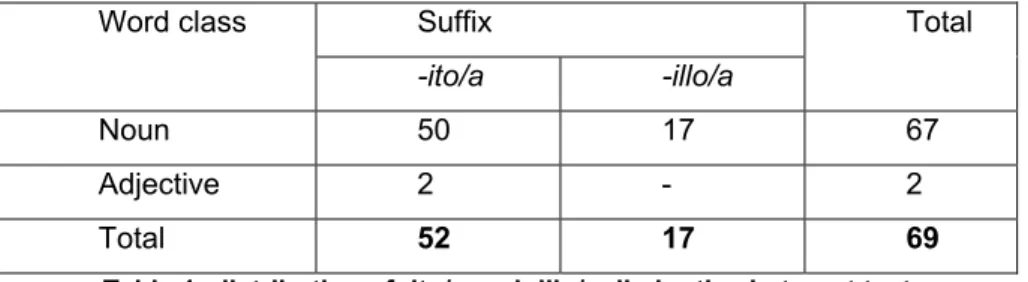
(12) Diminutive Suffixes in The Fifth Child. 124. nuzzle to her like happy calves or foals’ (p.93). Here the cotext alone is sufficient to appreciate positive affect, and this is reinforced by our knowledge of the context – the family is reunited after the departure of Ben, the dysfunctional fifth child. By contrast, the affect in the following cue is mild: ‘The little town they lived in had changed in the five years they had been here.’ (p.29). Here, the fact that Harriet liked the town when she first moved there, while the ensuing list of changes are all unpleasant, leads us to feel that positive affect is conveyed in the cue. These two examples both communicate positive affect, while in the following cue strong negative affect is apparent from the cotext alone: ‘His small cold eyes seemed to her malevolent.’ (p.64). However, there are many cues where it is difficult to judge if negative or positive effect is predominant. This is particularly the case where sympathy seems to be mixed with a certain distaste, as in the following description of Amy, a child with Down Syndrome: ‘But the poor baby was in Sarah’s arms, covered up so as not to upset everyone...’ (pp.32-33). Given this ambiguity, we classified the cues which encode affect without attempting to distinguish between positive and negative affect or taking into account the intensity with which it is conveyed. Once the cues had been classified according to small size and affect, we introduced a further subdivision to distinguish between cues which conveyed (i) small size and affect, (ii) small size only or (iii) affect only. We felt that these categories were adequate to describe the motivation for using the –ito/a and –illo/a form in about 90% of cases. However, a fourth category, ‘neither small size nor affect’, was created to take account of the few cases which did not seem to convey either of these two notions. (See appendices 1-4 for the distribution of all 69 cues in the four categories, together with the Spanish translations.) 3.3.. Results. 3.3.1.. Formal aspects. As noted above, the ito/a and -illo/a diminutive suffixes appear on 69 occasions in El quinto hijo, not counting lexicalized forms. In nearly all cases the suffix is added to a noun, with only two cases of an adjectival diminutive (‘pobrecita Amy’, which occurs twice). Table 1 also shows that the -ito/a form is nearly three times as frequent as the -illo/a form.. Hikma 18 (1) (2019), 113 – 180.
(13) 125. Julian Borne y Mercedes Díaz Dueñas. Word class. Suffix. Total. -ito/a. -illo/a. Noun. 50. 17. 67. Adjective. 2. -. 2. Total. 52. 17. 69. Table 1: distribution of -ito/a and -illo/a diminutive in target text. Turning to the formal properties of the ST cues, Table 2 shows that the two major word classes are adjective + noun (33) and noun only (24), which together constitute nearly 83% of cases, or over 85%, if we include the construction ‘adjective + proper noun’ in the first group. As expected, very few of the diminutives in the target text reflect the use of diminutive suffixes or abbreviations in the ST (‘granny’, ‘puppy’, ‘gran’), and there are only two examples of ‘duplication’ i.e. adjective + adjective + noun (‘poor little things’ and ‘soft little limbs’). The remaining categories involve transposition, whereby other word classes in the ST are rendered by the nominal diminutive in the target text. The classes involved are two adjectives (‘blue-veined’ → ‘venillas’; ‘twiggy’ → ‘ramitas’); one participle (‘giggling’ → ‘risillas’) and one quantifier (‘some’ → ‘un poquito’). Word Class in ST. Suffix in TT -ito/a. Adjective + noun. Total. -illo/a. 28. 5. 33. Little. 21. 2. 23. Small/(er/ish). 4. 1. 5. Poor. 2. 1. 3. Short. 0. 1. 1. Noun only. 16. 8. 24. Nominal diminutives/ abbreviations. 3. 2. 5. Hikma 18 (1) (2019), 113 – 180.
(14) Diminutive Suffixes in The Fifth Child. 126. Adjective + proper noun. 2. -. 2. Adjective adjective + noun. 2. -. 2. Participle. -. 1. 1. Quantifier. 1. -. 1. Total. 52. 17. 69. +. Table 2: Word classes in source text rendered by the ito/a and -illo/a diminutives in the target text. These results show that the noun + adjective construction is the major trigger for the appearance of the ito/a and illo/a diminutives in the Spanish translation. Moreover, in 28 out of 33 instances, the adjective conveys ‘small size’, usually by means of ‘little’ (23 instances). 3.3.2.. Semantic and pragmatic aspects. As described in 3.2.2., we created four categories of ST cue based on combinations of small size and affect. In 32 out of 69 cases, the use of the ito/a- and illo/a diminutives in the target text corresponds to cues which combine both aspects. This is illustrated in the following example, in which aunt and grandmother express their sympathy for the children whose happiness is blighted by the antisocial behaviour of their younger brother, Ben: Category 1: small size and affect Alice said, watching them, ‘Poor little things.’ Dorothy said, ‘It’s a shame.’ (p.71). –Pobrecitos –dijo Alice, mirándoles. –Es una vergüenza –dijo Dorothy. (p.100). The second largest category of cue, accounting for 22 of the ito/a and -illo/a diminutives, are those which communicate the idea of small size but without any suggestion of attitude or feeling on the part of the narrator:. Hikma 18 (1) (2019), 113 – 180.
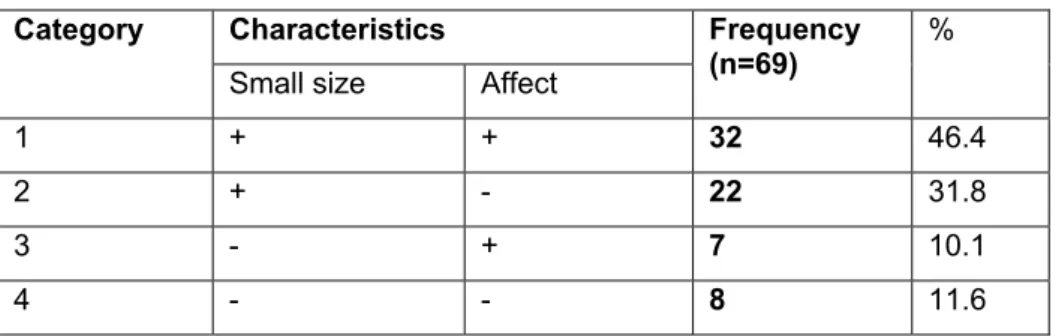
(15) 127. Julian Borne y Mercedes Díaz Dueñas. Category 2: small size only ...the nannies all wanted to go abroad with families who had a baby, or perhaps two: or to be in London. This small town, and the four children, with another coming, put them off. (p. 48). …todas querían irse al extranjero con familias de un hijo, como mucho dos; o quedarse en Londres. Aquel pueblecito, los cuatro niños y otro en camino, las espantaba. (p. 67). Lagging far behind these two categories of cues, with seven and eight examples respectively, are those which communicate affect only and those which communicate neither affect nor small size. The former is illustrated by one of the few instances of a synthetic diminutive in the source text: Category 3: affect only Jane had been awake in the night with her teeth, and had wanted Mummy, not Granny (p.33). Jane había pasado la noche despierta porque le estaban saliendo los dientes y había reclamado a su mamá, no a la abuelita. (p.45). Finally, the fragment below, in which the narrator describes the favourite haunts of Ben and his friends in their teens, serves to illustrate the fourth set of cues: Category 4: neither small size nor affect In the park, in a café, in the cinema, and, when they could borrow (or steal?) motorbikes, off to some seaside town. (p. 147). En el parque, en el café, en el cine y en algún pueblecito de la costa cuando conseguían motocicletas prestadas (¿o robadas?). (p. 208). Table 3 summarizes the frequency of the target text diminutives in relation to the four categories:. Hikma 18 (1) (2019), 113 – 180.
(16) Diminutive Suffixes in The Fifth Child. Category. 128. Characteristics. Frequency (n=69). %. Small size. Affect. 1. +. +. 32. 46.4. 2. +. -. 22. 31.8. 3. -. +. 7. 10.1. 4. -. -. 8. 11.6. Table 3: Distribution of ito/a and -illo/a diminutives according to category of cue. 4. DISCUSSION 4.1.. The diminutive as a translation strategy. We began this article by asking what, given the scarcity of synthetic diminutive forms in English, motivated their use in the Spanish translation of ‘The Fifth Child’? Our analysis reveals a clear answer to this question, namely the suggestion in the source text of small size plus affect (46.4%), small size only (31.8%,) or affect only (10.1%). However, in 11.6% of cases we were unable to identify any specific motivation for using the ito/a and illo/a diminutives in the Spanish text. In the ensuing paragraphs we illustrate these findings and consider their implications for translators and students of translation. First of all, it should be emphasized that in nearly 57% of cases, the source text conveys nuances of meaning roughly corresponding to those evoked by the ito/a and illo/a diminutive as described in 2.2, that is to say affect with or without small size (categories 1 and 3). In these cases, the diminutive may be viewed as a useful translation resource to capture a range of connotations which are either expressed analytically in the source text or are recoverable from the context, most of them reflecting the feelings and attitudes of Harriet. For instance, owing to the positive associations of ‘small’ deriving from the ICM of size (see 2.2.), the -ito/a diminutive is particularly apt for describing children and babies in a context of strong affection, as in the following fragment in which Harriet is cuddling her favourite child, Luke: Example 1 She loved the look of him, the comical soft little face, with soft blue eyes – like bluebells, she thought – and his soft little limbs… it was as if she were sliding her hands along them, and then. Hikma 18 (1) (2019), 113 – 180.
(17) 129. Julian Borne y Mercedes Díaz Dueñas enclosing his feet in her palms. A real baby, a real little child. (p.62). Le gustaba su aspecto, su carita cómica y delicada, los delicados ojos azules (como campanillas, pensaba ella) y aquellas piernas y aquellos bracitos…era como si estuviera acariciándole y le apretara luego los piececitos. Un bebé real, un niñito real. (p.87). In the following example, the use of ‘little’ in the source text does not only indicate the size of the room but by virtue of its association with Luke, also indexes Harriet’s feelings towards him. The diminutive in the translated text performs the same function: Example 2 Luke was an easy baby. He slept most peaceably in the little room off the big bedroom, and was contentedly breast-fed. Happiness! (p.24). Luke era un niño muy bueno. Dormía pacíficamente en el cuartito que daba al dormitorio de matrimonio y se alimentaba satisfactoriamente al pecho materno. ¡Felicidad! (p.32). The playful aspect of the diminutive is uppermost in the following example, conveyed by the incongruity between the small size implied by the diminutive and the statement that the animal concerned is big: Example 3 Again a pet was brought. This time it was a big dog, a cheerful boisterous mongrel, Sarah’s children’s friend, but most particularly Amy’s. (p.85). Trajeron de nuevo un animalito. Esta vez un perro grande, alegre y bullicioso, un cruce de razas, amigo de los hijos de Sarah, y en especial de Amy. (p.121). As described in 2.2., the diminutive may also transmit a range of negative nuances, deriving from the notion of small things being insignificant or negligible. In the following example the -illa diminutive captures the patronizing light in which, in the sixties, Harriet’s progressive friends regarded her for remaining a virgin at the age of twenty-four: Hikma 18 (1) (2019), 113 – 180.
(18) Diminutive Suffixes in The Fifth Child. 130. Example 4 ‘It must be something in her childhood that’s made her like this. Poor thing.’ (p.10). «Pobrecilla, algo tuvo que pasarle en la infancia para que sea así». (p.11). Or again, in example 5, the -illa diminutive reflects the note of dislike and envy in Harriet’s perception of her sister Angela: Example 5 Angela, efficient, brisk (‘a coper’, as Dorothy said, the ‘thank God’ being unspoken), allowed it to be known that she felt the two other sisters took up all of Dorothy and left her nothing. She was like a clever, pretty little fox. (p.32). Angela, eficiente, vivaz (que «se las arregla sola», como decía Dorothy, guardándose el «gracias a Dios»), hacía notar que creía que sus dos hermanas acaparaban completamente a Dorothy y no dejaban donde para ella. Parecía una linda zorrilla inteligente. (p. 43). Finally, the potential of the -illo diminutive to interact with the context in order to convey strong negative affect bordering on horror, is exploited by the translator in the following description of Harriet breast-feeding her fifth child: Example 6 Now he had begun something new: he had taken to interrupting the fierce sucking several times during a feed, and bringing his gums together in the hard grinding movement that made her cry out in pain. His small cold eyes seemed to her malevolent. (p.64). Ben había empezado a hacer algo nuevo: interrumpía la frenética succión varias veces durante una toma y cerraba las encías con aquel firme movimiento triturador que la hacía gritar de dolor. Sus ojillos fríos le parecían malévolos. (p.90). In these and many other examples in categories 1 and 3, the diminutive proves to be a useful mechanism for conveying nuances of meaning suggested by the source text. However, we need also to consider the category ‘Small size only’, which accounts for nearly 32% of the. Hikma 18 (1) (2019), 113 – 180.
(19) 131. Julian Borne y Mercedes Díaz Dueñas. diminutives in the translation. In these cases, it may be claimed that the translation adds nuances to the source text, since the Spanish diminutive always implies affect (Martín Zorraquino 2012, 124), which is absent in the original. About half of the examples in this category involve the description of children. As Gibson (1992, 171) has remarked, the Spanish typically display great affection towards children, an attitude which is certainly not characteristic of the narrator of the Fifth Child. We might therefore argue that the diminutive here reflects how children would naturally be described in Spanish, and the urge to create a natural-sounding Spanish text takes precedence over the risk of imbuing it with a warmth that is absent in the original. Example 7 The four children were brought in to see their new brother in the hospital ward. (p.61) Llevaron a los cuatro niños a ver a su nuevo hermanito al hospital. (p.86). Example 8 The lawn was patchily lush, and toys lay about. Birds sang in the shrubs, ignoring the children. (p.39). La hierba estaba irregularmente crecida y había juguetes esparcidos por todo el prado. Los pájaros cantaban en los arbustos, ignorando a los chiquillos. (p.19). Finally, on eight occasions it is difficult to see any motivation for using the diminutive in the translation, beyond the general aim of lending naturalness to the Spanish text, since neither small size nor affect are apparent in the source: Example 9 Weekends were spent looking around towns within commuting distance of London…(p.13). Dedicaron los fines de semana a visitar los pueblecitos próximos a Londres…(p.16). Hikma 18 (1) (2019), 113 – 180.
(20) Diminutive Suffixes in The Fifth Child. 132. 4.2. Characteristics of the diminutive in translation Although we have suggested that one of the motivations for using the -ito/a and illo/a diminutives is to lend naturalness to the translated text, this does not mean that its use in the translation is wholly characteristic of Spanish literary texts in general. Formally, for instance, the resource is almost entirely restricted to nouns, whereas as noted in 2.1., virtually all word classes are capable of accommodating the diminutive in Spanish. In her study of the translation of diminutives from Spanish novels into English, Fernández Guerra (2011: 100-105) notes that approximately 25% of the diminutives appear in other word classes, specifically adjectives, adverbs, nominal verb forms and proper names which, as discussed below, may be difficult to render with a diminutive when translating from English into Spanish. From a formal point of view, therefore, it seems that the diminutive in the Spanish translation is used rather differently from the ways it is used in independent texts. As a consequence of the absence of adverbial and adjectival forms, some of the semantic values of the diminutive are also absent, notably its role as an intensifier and attenuator (Mendoza, 2011: 142-152). Similarly, although it has been claimed that in spoken Spanish the affective connotations of the diminutive prevail over the denotation (Martín Zorrquino, 2012: 125), in the present text it is the other way around, with only seven cases of affect without any suggestion of small size. A further distinctive feature of the diminutive in El quinto hijo is that it is very rarely used as a marker of interpersonal dynamics. However, this may be due to the fact that the ST does not contain much dialogue, with only seven of the cues occurring in stretches of direct speech. Thus while the cues may signal Harriet’s private attitude towards another character, they do not usually function as an index of her relation with them in interaction, a tendency which is upheld in the translation. However, there are exceptions, such as example 10, in which Dorothy’s mother adopts the point of view of her grandchildren by referring to herself as ‘abuelita’, a typical Spanish affectionate term of address for grandmothers: Example 10 ‘...I’ll come up and say goodnight. And then your gran is off to bed. I’m tired.’ (p. 44). —Yo subiré a daros las buenas noches. Y luego la abuelita se acostaré también. Estoy cansada.’ (p. 61). Hikma 18 (1) (2019), 113 – 180.
(21) 133. Julian Borne y Mercedes Díaz Dueñas. In this regard, it is relevant to note that while in Spanish it is very common to add the ito/a diminutive to proper nouns as an affective term of address (‘Clarita’, ‘Juanito’ etc.), this option is not usually available in contemporary literary translation, which conventionally opts for reproducing the name as it appears in the source text rather than provide target language equivalents (Cartagena 1999, 99; Moya 2000, 180). For instance, if ‘Paul’ were rendered as ‘Pablo’, as would have been normal until about 1965 (Franco Aixelá 2000, 261), one might expect ‘little Paul’ to become ‘Pablito’. However, applying this diminutive to ‘Paul’ would result in the very strange hybrid ‘Paulito’, so the translator is obliged to use an analytical alternative, as in the example below: Example 11 They said, ‘We are longing to see the new baby.’ They said, ‘Is little Paul still as delicious as he was?’ (p. 67). Decían: «Estamos deseando ver el nuevo bebé.» «¿Sigue el pequeño Paul tan encantador?» (p. 95). In this respect, contemporary conventions for translating proper names act as a constraint for using the diminutive as an interpersonal marker in Spanish translation, which may partly account for its low incidence with this function in El quinto hijo. CONCLUDING REMARKS In the course of this analysis, we hope to have shown that the -ito-a and –illo/a dimunitives may be used to capture many shades of meaning which are expressed analytically or are recoverable from the context in the original text. In the present translation, notions of affection, happiness, playfulness, irony, contempt, dislike and horror in the source text are effectively rendered by this suffix, and the scarcity of the synthetic form in English does not limit its use in the translation. On a formal level, we have found that in about half the examples, the diminutive is used to reflect the structure ‘adjective + noun’, in which the adjective conveys small size. In most cases the adjective concerned is ‘little’, which has been claimed to index both smallness and affect in a similar way to the -ito/a and -illo/a diminutives. However, the motivation for the use of the diminutive in this translation is by no means a systematic response to any formal cue in the source text. In this respect, it is worth mentioning that the. Hikma 18 (1) (2019), 113 – 180.
(22) Diminutive Suffixes in The Fifth Child. 134. ‘little + noun’ construction appears over 80 times in the novel, but is rendered by the diminutive in only 23 instances in the translation. We have also noted the use of the -ito/a and -illo/a diminutives to add nuances of affect which are not discernible in the corresponding source text fragments. This was particularly the case in the descriptions of children, leading us to suggest that it is motivated by the Spanish tendency to use diminutives in such a context, even though the result is occasionally at odds with the detached tone of the narrator in the source text. Finally, we have seen that not all the formal and semantic characteristics of the diminutive as described by the authors discussed in 2.1. have been exploited in the translated text, particularly its use in word classes other than nouns. This finding tempts us to suggest that its behaviour in this translation may be more characteristic of texts translated from English into Spanish than of original Spanish texts. Clearly, to substantiate this claim we would need to look at the behaviour of the diminutive in a large number of English texts translated into Spanish, and compare it with similar texts written directly in Spanish, using a corpusbased approach. However, if we accept that a translated text ‘fights against the constraints imposed upon it by the source text’ and therefore ‘carries concomitantly the features of both source and target language’ (Balskó 2008, 59), it would seem reasonable to suppose that the use of the diminutive in Spanish translated texts is likely to differ from its use in original texts. Quantitative research on the incidence of the diminutive in a large corpus of Spanish texts translated from English would indicate the extent to which the patterns described here are representative of translation practice in general. Future research might also broaden the analysis to include other diminutive forms and also augmentatives such as -ón/ona, -azo/aza, and ote/ota. Knowledge of how these morphological resources are used in actual translation practice may enable both professionals and students of translation to apply them in a more conscious and systematic way. REFERENCES Alonso, A. (1937). El artículo y el diminutivo. Santiago de Chile: Universidad de Chile. —. (1951). Estudios lingüísticos: Temas españoles. Madrid, España: Gredos.. Hikma 18 (1) (2019), 113 – 180.
(23) 135. Julian Borne y Mercedes Díaz Dueñas. Balaskó, M. (2008). What does the Figure Show? Patterns of Translationese in a Hungarian Comparable Corpus. Trans-kom 1 (1), 58-70. Cartagena, N. (1999). Acerca de la traducción de los nombres propios en español. In N. Cartagena and C. Schmitt (Eds.), Miscellania Antervpiensia, 93-121. Tübingen, Germany: Max Niemeyer Verlag. Chamonikolasová, J. and Rambousek, J. (2007). “Diminutive Expressions in Translation: A Comparative Study of English and Czech. In W. Vandeweghe, S. Vandepitte and M. Van de Velde (Eds.), The Study of Language and Translation. Amsterdam, Netherlands: John Benjamins. D’Angelis, A. and Mariotinni, L. (2006). La morfopragmática de los diminutivos en español y en italiano. In M. Villayandre Llamazares (Ed.) Actas del XXXV Simposio Internacional de la Sociedad Española de Lingüística, 359-378. León, España: Universidad de León. Davies, S. (2013). When Lessing is More for Bookclubs. The Telegraph. 8th July 2013. Retrieved from https://www.telegraph.co.uk/culture/books/ 10166664/When-Lessing-is-more-for-book-clubs.html. Dressler, W.U. and Merlini, L. (1994). Morphopragmatics. Diminutives and Intensifiers in Italian, German and Other Languages. Berlin and New York, Germany and USA: Mouton de Gruyter. Fernández Guerra, A. (2001). El uso del diminutivo en español y en inglés. Estudio contrastivo. Valencia, España: Reproexpres. Franco Aixelá, J. (2000). La traducción condicionada de los nombres propios (inglés-español). Salamanca, España: Ediciones Almar. Gibson, I. (1992). Fire in the Blood: the New Spain. London, U.K.: Faber and Faber. González-Espresati, C. (2008). Review of El uso del diminutivo en español y en inglés by Ana Fernández Guerra. Hermȇneus. Revista de traducción e interpretación,10: 1-3. Klett, E. (2015). El diminutivo en español y francés: rasgos transculturales y translingüísticos para su enseñanza. El hilo de la fábula. Revista anual del Centro de Estudios Comparados, 15: 173-185. Lázaro Mora, F. Á. 1999. La derivación apreciativa. In Demonte, V. and Bosque, I. (Eds.) Gramática descriptiva de la lengua española, III, 4645-4682. Madrid, España: Espasa-Calpe.. Hikma 18 (1) (2019), 113 – 180.
(24) Diminutive Suffixes in The Fifth Child. 136. Leech, G. (1983). Principles of Pragmatics. London, U.K.: Longman. Lessing, D. (1988). The Fifth Child. London, U.K.: Jonathan Cape. Lessing, D. (2001). El quinto hijo [orig. The Fifth Child]. Translated by Ángela Pérez. Madrid, España: Ediciones B. Longman Dictionary of Contemporary English, 3rd edition. (1995). Harlow, U.K.: Longman Group Ltd. Martín Zorraquino, M. A. (2012). Los diminutivos en español: aspectos morfológicos, semánticos y pragmáticos. Los valores estilísticos de los diminutivos y la teoría de la cortesía verbal. In Luque Toro, L., Medina Montero, J. F. and Luque, R. (Eds.) Léxico Español Actual III, 123-140. Venice, Italy: Università Ca’ Foscari Venezia. Mendoza, M. (2011). Size matters: grammaticalization, metaphor and the Spanish diminutive. Estudios de Lingüistica Aplicada, 54: 135-157. Merino Ferradá, M. C. (2002) Morphopragmatic dimensions of the diminutive in Spanish and English. A relevance theoretic approach. In Iglesias Rábade, L. and Doval Suárez, S. M. (Eds.), Studies in Contrastive Linguistics. Proceedings of the 2nd International Contrastive Linguistics Conference. Santiago de Compostela, España: Universidad de Santiago. Moya, V. (2000). La traducción de los nombres propios. Madrid, España: Cátedra. Muehleisen, V. L. (1997). Antonymy and Semantic Range in English. PhD dissertation, Northwestern University. Retrieved from http://www.f.waseda.jp/vicky/dissertation/ Nañez Fernández, E. (1997-98). Amado Alonso y el diminutivo. Cauce, Revista de Filología y su Didáctica, 20-21: 173-182. Prieto, V. M. (2005). Spanish Evaluative Morphology: Pragmatics, Sociolinguistics and Semantic issues. PhD dissertation. University of Florida. Retrieved from http://etd.fcla.edu/UF/UFE0010940/prieto_v. pdf Rothstein, M. (1988). The Painful Nurturing of Doris Lessing’s Fifth Child. The New York Times. 4th June, 1988. Retrieved from https://archive.nytimes.com/www.nytimes.com/books/99/01/10/speci als/lessing-child.html?module=inline. Hikma 18 (1) (2019), 113 – 180.
(25) 137. Julian Borne y Mercedes Díaz Dueñas. Ruiz de Mendoza Ibañéz, F. J. (1996).“Some notes on the grammatical status of the Spanish -ito/-illo diminutives and their translation into English. Pragmalinguística, 3-4, 1995-6: 155-172. Ruiz de Mendoza Ibañéz, F. J. (2008). Cross-linguistic analysis, second language teaching and cognitive semantics: The case of Spanish diminutives and reflexive constructions. In De Knop, S. and De Rycker T. (Eds.) Cognitive Approaches to Pedagogical Grammar. Volume in Honor of René Dirven, 121-152. Berlin & New York, Germany and USA: Mouton de Gruyter. Santibáñez Sáenz, F. (1999). Conceptual Interaction and Spanish Diminutives. Cuadernos de investigación filológica, 25: 173-190. Travis, C. E. (2004). The ethnopragmatics of the diminutive in conversational Colombian Spanish. Intercultural Pragmatics, 1-2: 249-274. Toury, G. (1995). Descriptive Translation Studies – and beyond. Amsterdam and Philadelphia, Netherlands and USA: Benjamins. Wierzbicka, A. (1985). Different Cultures, Different Languages, Different Speech Acts: Polish versus English. Journal of Pragmatics, 9 (2-3): 145-178. Zhao, K. (2012). A Narrative Analysis of Lessing’s The Fifth Child. Theory and Practice in Language Studies, 2 (7): 1498-1502.. Hikma 18 (1) (2019), 113 – 180.
(26) Diminutive Suffixes in The Fifth Child. 138. Appendix 1 Source text fragments rendered by –ito/a and –illo/a diminutives in the Spanish translation of The Fifth Child by Doris Lessing (1988) p. ‘It must be something in her childhood that’s made her like this. Poor thing.’. p. …así comentaban entre ellas las chicas ilustradas modernas: ‹‹Pobrecilla, algo tuvo que pasarle en la infancia para que sea así.››. .10 .11 p . 13. Anyway, they were not sure London was what they needed – no, it wasn’t, they would prefer a smallish town with an atmosphere of its own.. p .16. De todos modos, no estaban seguros de que Londres fuera lo que necesitan…no, no lo era, era mejor un pueblecito, con su ambiente propio.. p. Weekends were spent looking around towns within commuting distance of London..... p. Dedicaron los fines de semana a visitar los pueblecitos próximos a Londres…. p. ‘How many children are you intending to have?’ asked Molly, with the short laugh that means there is no point in protesting.. p. –¿Cuántos niños pensáis tener? –preguntó Molly, con una risilla que indicaba que no tenía sentido protestar.. p. They all drank champagne, and poured some on little Luke’s head.. p. Todos bebieron champán y le echaron un poquito en la cabeza al pequeño Luke.. p. Luke was an easy baby. He slept most peaceably in the little room off the big bedroom, and was contentedly breast-fed.. .13 .16 .18 .23 .24 .32 .24 p .32 p. Luke era un niño muy bueno. Dormía pacíficamente en el cuartito que daba al dormitorio de matrimonio y se alimentaba satisfactoriamente al pecho materno. ¡Felicidad! When he bent to kiss her goodbye, and stroked Luke’s head, it was with a fierce possessiveness that Harriet liked and understood.... .24. Hikma 18 (1) (2019), 113 – 180.
(27) 139. Julian Borne y Mercedes Díaz Dueñas. p. Al inclinarse para darle el beso de despedida y acariciar la cabecita a Luke, le embargaba una intensa sensación de posesión…. p. But the little girl did look a bit like Genghis Khan, didn’t she?. p. Pero la verdad es que la niñita se parecía bastante a Gengis Kan, ¿o no?. p. A baby Genghis Khan with her squashed little face and her slitty eyes?. p. Un Gengis Kan bebé con la carita aplastada y los ojos rasgados.. p. The little town they lived in had changed in the five years they had been here.. p. En los cincos años que llevaban viviendo allí, el pueblecito había cambiado.. .32 .29 .40 .29 .41 0. .29 .41 p. 1. .32. Angela, efficient, brisk (‘a coper’, as Dorothy said, the ‘thank God’ being unspoken), allowed it to be known that she felt the two other sisters took up all of Dorothy and left her nothing. She was like a clever, pretty little fox.. p. .43 2. Angela, eficiente, vivaz (que ‹‹se las arregla sola››, como decía Dorothy, guardándose ‹‹el gracias a Dios››), hacía notar que creía que sus dos hermanas acaparaban completamente a Dorothy y no dejaban nada para ella. Parecía una linda zorilla intelligente. p But the poor baby was in Sarah’s arms, covered up so as not to upset everyone.... .32/3 p. .45 3. Pero la niñita estaba en los brazos de Sarah, completamente tapada para que no molestara a nadie y William miraba a todas partes menos a su mujer. p Jane had been awake in the night with her teeth, and had wanted Mummy, not Granny. .33 p. Jane había pasado la noche despierta porque le estaban saliendo los dientes y había reclamado a su mamá, no a la abuelita.. p. She sat there at the head of the table, the collar of her blue shirt pushed to one side to show part of a blue-veined white breast…. .45 4. .33 p. .45 5. Estaba sentada a la cabecera de la mesa, con el cuello de la blusa azul hacia un lado mostrando parte de su blanco pecho con venillas azules… p … and Paul’s energetically moving little head.. .33. Hikma 18 (1) (2019), 113 – 180.
(28) Diminutive Suffixes in The Fifth Child. p. 140. …y la cabecita de Paul moviéndose vigorosamente.. .45 6. p. ‘The father of four children speaks,’ said Sarah, passionately cuddling her poor Amy, defying them to say aloud what they must be thinking.. p. –Lo dice el padre de cuatro hijos –dijo Sarah, abrazando con vehemencia a su pobrecita Amy, desafiándoles a decir en voz alta lo que debían estar pensando.. p. ‘Just like her mother,’ said Sarah forlornly: this referred to Dorothy’s decision that Harriet needed her more than Sarah did, her defective child notwithstanding.. p. –Exactamente igual que su madre –dijo Sarah acongojada; lo decía por la decisión de Dorothy de que Harriet la necesitaba más que Sarah, pese a su niñita disminuida.. .34 .46. 7. .34 .47. 8. p. She was fifteen, a plain dark plump girl who they all knew would shortly blossom and become beautiful.. p. –Tenía quince años, era una muchachita feúcha, morena y regordeta y todos sabían que pronto florecería y sería guapísima.. p. The lawn was patchily lush, and toys lay about. Birds sang in the shrubs, ignoring the children.. .37 .51. 9. .39 p. Los adultos se acercaron a mirarlos desde las ventanas. El jardín seguía abandonado; nunca había tiempo para atenderlo. La hierba estaba irregularmente crecida y había juguetes esparcidos por todo el prado. Los pájaros cantaban en los arbustos, ignorando a los chiquillos.. p. She sat at the head of the table – the position near the stove – stirring her tea, with one eye on baby Paul, who was fretful in his little chair and wanted to be cuddled.. p. Estaba a la cabecera de la mesa (su puesto, cercal del fogón) revolviendo su té, con un ojo en el pequeño Paul, que estaba inquieto en su sillita y quería que le hicieran mimos.. .55. 0. .42 .59. 1. p. ‘...I’ll come up and say goodnight. And then your gran is off to bed. I’m tired.’. p. –Yo subiré a daros las buenas noches. Y luego la abuelita se acostaré también. Estoy cansada.. .44 .61. Hikma 18 (1) (2019), 113 – 180.
(29) 141. 2. Julian Borne y Mercedes Díaz Dueñas. p. ...the nannies all wanted to go abroad with families who had a baby, or perhaps two: or to be in London. This small town, and the four children, with another coming, put them off.. p. …todas querían irse al extranjero con familias de un hijo, como mucho dos; o quedarse en Londres. Aquel pueblecito, los cuatro niños y otro en camino, las espantaba.. .48 .67. 3. p. She imagined pathetic botched creatures, horribly real to her, the products of a Great Dean or a borzoi with a little spaniel. p. Imaginaba patéticas criaturas deformes, espantosamente reales para ella, fruto de un dogo alemán o un barzoi y un perrito de aguas;. p. …a lion, and a dog; a great cart horse and a little donkey; a tiger and a goat.. p. ...de un caballo de tiro y un burrito; de un tigre y una cabra.. p. ‘Suddenly the little girl found she was alone. She and her brother had lost each other.’. p. De pronto, la niñita descubrió que estaba sola. Ella y su hermano se habían extraviado…. .52 .73. 4. .52 .73. 5. .55 .77. 6. p. ‘This strange girl was smiling, but it was a nasty smile, not friendly, and the little girl thought this other girl was going to reach up out of the water and pull her down into it...’. p. –…Y aquella niña extraña sonreía, pero era una sonrisa desagradable, no era una sonrisa amistosa, y la niñita pensó entonces que aquella otra niña iba a salir del agua y a tirarla a la charca…. .56 .88. 7. p. The four children were brought in to see their new brother in the hospital ward.. p. Llevaron a los cuatro niños a ver a su nuevo hermanito al hospital.. p. Harriet yearned for this baby, this little child, from whom she had been separated so soon.. .61 .86. 8. .62 p .86. David estaba a los pies de la cama, con el pequeño Paul en brazos. Harriet añoraba a aquel niñito, su bebé, del que se había visto separada tan pronto…. Hikma 18 (1) (2019), 113 – 180.
(30) Diminutive Suffixes in The Fifth Child. 9. 142. p. She loved the look of him, the comical soft little face, with soft blue eyes.... p. …le gustaba su aspecto, su carita cómica y delicada, los delicados ojos azules…. p. ...with soft blue eyes – like bluebells, she thought – and his soft little limbs.... p. …los delicados ojos azules (como campanillas, pensaba ella) y aquellas piernas y aquellos bracitos.... p. ...it was as if she were sliding her hands along them, and then enclosing his feet in her palms.. p. …era como si estuviera acariciándole y le apretara luego los piececitos…. p. ...A real baby, a real little child.. p. …Un bebé real, un niñito real…. .62 .87. 0. .62 .87. 1. .62 .87. 2. .62 .87. 3. p. Now he had begun something new: he had taken to interrupting the fierce sucking several times during a feed, and bringing his gums together in the hard grinding movement that made her cry out in pain. His small cold eyes seemed to her malevolent.. p. Ben había empezado a hacer algo nuevo: interrumpía la frenética succión varias veces durante una toma y cerraba las encías con aquel firme movimiento triturador que la hacía gritar de dolor. Sus ojillos fríos le parecían malévolos.. .64 .90. 4. p. ‘That Ben gives me the creeps. He’s like a goblin or a dwarf or something. I’d rather have poor Amy any day.’. p. –Ben me pone carne de gallina. Parece un trasgo o un pigmeo o algo así. Prefiero a mi pobrecita Amy.. p. He clutched her shirt with both hands, pulled himself up, and stood on her thigh. The hard little feet hurt her.. p. Él le agarró la blusa con ambos manos, estiró y se puso de pie apoyándose en su cadera. Los piececitos duros le hacían daño.. .68 .96. 5. .68 .97. Hikma 18 (1) (2019), 113 – 180.
(31) 143. 6. Julian Borne y Mercedes Díaz Dueñas. p. Soon she gave up, put him back in his pen, or cage.... p. …pronto renunció y volvió a ponerle en su corralito o jaula…. p. She took him down into the big living-room where all the family were, and put him into the playpen there.. p. Le bajaba al salón donde estaba toda la familia y le colocaba allí en el corralito…. p. Alice said, watching them, ‘Poor little things.’. .69 .97. 7. .69 .97/8. 8. .71. Dorothy said, ‘It’s a shame.’ p. –Pobrecitos –dijo Alice, mirándoles. –Es una vergüenza –dijo Dorothy.. p. And Paul, her baby whom Ben had deprived her of, the wonderful three-year-old.... p. Y Paul, el bebé del que Ben la había despojado, el precioso niñito de tres años…. p. ...enchanting, a charmer – was her baby again.. p. …encantador, un tesoro…volvió a ser su bebecito.. p. ‘He killed Mr McGregor,’ Luke said fiercely. ‘He killed him.’. .100 9. .78 .110. 0. .78 .110. 1. .80. ‘And the poor dog,’ said Helen. Both children were accusing Harriet. p. .113 2. –Él fue quien mató a Mister McGregor –dijo Luke furioso–. Él le mató. –Y al perrito –dijo Helén. En realidad, los dos niños acusaban a Harriet.. p. Twice his age, but apparently half his age, this afflicted infant, who was radiant with affection, suddenly became silent.. p. Le doblaba la edad, pero parecía a la inversa; y aquella pobre niñita, radiante de amor, de repente se quedaba en silencio…. .81 .114. Hikma 18 (1) (2019), 113 – 180.
(32) Diminutive Suffixes in The Fifth Child. 3. p. He tore some primroses off their stems, and stood with them in his hands, intently staring at them. Then he crushed them in his strong little fists and let them drop.. p. Y entonces arrancó unas prímulas y se quedó con ellas en la mano, mirándolas con interés. Luego las estrujó entre sus fuertes puñitos y las tiró.. .82 .116 p. 4. p. –Me has inspirado, Harriet. Al fin y al cabo, yo también tengo un hogar. No es tan grande como el vuestro, pero es una hermosa casita.. p. Again a pet was brought. This time it was a big dog, a cheerful boisterous mongrel, Sarah’s children’s friend, but most particularly Amy’s.. p. Trajeron de nuevo un animalito. Esta vez un perro grande, alegre y bullicioso, un cruce de razas, amigo de los hijos de Sarah, y en especial de Amy.. .85 .121. 6. ‘I’ve been inspired by you Harriet! After all, I’ve got a home too. It’s not as big as yours but it’s a nice little house.’. .85 .120. 5. 144. p. He went into the garden, where they could see him, a squat little gnome, poking with a stick at the earth.. p. Se fue al jardín; le vieron golpear la tierra con un palo; parecía un duendecillo achaparrado.. .86 . 122. 7. 8. p. ...the light from this warm room reached across the lawn to a shrub that was starkly black with winter, little twiggy growths that showed a glitter of water, and illuminated the white trunk of a birch.. p .128. Se veían en el jardín las formas oscuras de los arbustos y los árboles, pero la luz de la cálida estancia iluminó el prado hasta un arbusto rigurosamente negro de invierno, iluminó brotes de ramitas que mostraban un destello de agua, e iluminó el tronco blanco de un abedul.. p.91. The parents sat down on a sofa, facing the doors, which burst inwards, and there they were, two slight, elegant little creatures, with flaring red, frost-burned cheeks .... .90. p .128 9. Los padres se sentaron en un sofá, de cara a las puertas, que se abrieron de golpe, y aparecieron ellos, dos criaturitas elegantes, flacas, con las mejillas quemadas por el frío…. p. ‘With Granny?’ asked Helen, anxious.. p. –¿Con la abuelita? –preguntó Helen, anhelante.. .93 .130. Hikma 18 (1) (2019), 113 – 180.
(33) 145. 0. Julian Borne y Mercedes Díaz Dueñas. p. At supper they were overbright, giggling, hysterical.. p. En la cena estuvieron exageradamente animados, soltando risillas, histéricos.. p. She was a stolid, quiet little girl, Dorothy in miniature, never saying anything unnecessary.. p. Era una niñita tranquila, imperturbable, una Dorothy en miniatura, que nunca decía nada innecesario.. p. Or they rushed up to kiss her, or stroke her face, or nuzzle to her like happy calves or foals. p. O corrían a besarla, o le hacían una caricia en la cara o le frotaban la nariz como ternerillos o potrillos dichosos.. p. Or they rushed up to kiss her, or stroke her face, or nuzzle to her like happy calves or foals.. p. O corrían a besarla, o le hacían una caricia en la cara o le frotaban la nariz como ternerillos o potrillos dichosos.. p. Two figures appeared, a long way off under the pinpoints of the ceiling lights, and came towards her.. p. A lo lejos, bajo los puntitos de las luces del techo, aparecieron dos figuras que avanzaron hacia ella.. p. ...a small girl all blurred, her flesh guttering and melting…. p. …una niñita completamente borrosa, con la piel derretida y fundida…. p. She gave him bits of biscuit, keeping her fingers clear of his teeth.. p. Le dio trocitos de galleta, procurando no tocarle los dientes con los dedos.. p. He crouched at the French doors, waiting for John to arrive; then followed him around like a puppy.. p. Se acurrucaba en las puertaventanas esperando que llegara John; luego le seguía a todas partes como un perrillo.. .92 .130. 1. .92/3 .131. 2. .93 .131. 3. .93 .131. 4. .96 .136. 5. .98 .139. 6. .105 .148. 7. .110 .154. Hikma 18 (1) (2019), 113 – 180.
Figure

Documento similar
The purpose of the research project presented below is to analyze the financial management of a small municipality in the province of Teruel. The data under study has
In the “big picture” perspective of the recent years that we have described in Brazil, Spain, Portugal and Puerto Rico there are some similarities and important differences,
The lifetime signed impact parameter probability dis- tribution was determined as a function of the tau lifetime as follows: impact parameter distributions, for di erent lifetimes,
On the other hand at Alalakh Level VII and at Mari, which are the sites in the Semitic world with the closest affinities to Minoan Crete, the language used was Old Babylonian,
The following figures show the evolution along more than half a solar cycle of the AR faculae and network contrast dependence on both µ and the measured magnetic signal, B/µ,
In the previous sections we have shown how astronomical alignments and solar hierophanies – with a common interest in the solstices − were substantiated in the
What is perhaps most striking from a historical point of view is the university’s lengthy history as an exclusively male community.. The question of gender obviously has a major role
The broad “WHO-ICF” perspective on HrWB provided at Figure 1 has a significant implication also for HRQoL. The develop- ment of ICF and its conceptual approach has challenged to
